Monthly Archives: May 2011

Every state has the right to self-defense — except a Palestinian state

After returning to the White House having delivered his much anticipated Middle East speech, I imagine President Obama now eagerly awaits news on how quickly and handsomely he will be rewarded by nervous campaign donors who were still unsure about his loyalty to Israel. The cash will no doubt now start rolling in.

As for security, every state has the right to self-defense, and Israel must be able to defend itself – by itself – against any threat. Provisions must also be robust enough to prevent a resurgence of terrorism; to stop the infiltration of weapons; and to provide effective border security. The full and phased withdrawal of Israeli military forces should be coordinated with the assumption of Palestinian security responsibility in a sovereign, non-militarized state.

Every state has the right to self-defense, unless it’s a Palestinian state. In a Palestinian state the primary responsibility of its security forces will be to protect Israel.

From Israel, Larry Derfner comments:

In his speech on the Middle East, Obama gave the Palestinians nothing and gave Israel a lot, which means he strengthened the status quo, which Israel is perfectly happy with and only the Palestinians want to change. By saying the Israeli-Palestinian border should be based on the ’67 line, he just repeated what Clinton said publicly about a year ago (and what her husband said in the White House a decade ago). What was new, or at least newer, was his endorsement of Netanyahu’s call for a “non-militarized” Palestine – which is a contradiction to a sovereign Palestine, something Obama claimed also to support. And by mentioning the need to stop the smuggling of weapons into Palestine, he might have been giving a nod to Netanyahu’s demand to keep the Israeli army on the Jordan Valley. Also, he repeated his opposition to the Palestinians’ plan to seek recognition from the UN in September. In all, a very, very good day for the occupation. But I think Obama just lost the Palestinians. Abbas cannot go along with this prescription, none of them can. They have to go to the UN, they have to go ahead with the popular resistance, to go out into the street en masse – to the settlements, to the army outposts, to the fence, and hope for the Tahrir effect – to win the world to their side – and for this, they must remain non-violent – and shame Israel in the eyes of the world and force Obama and the other timid Western leaders to force Israel to end the occupation. There’s just no other way. I’d thought that maybe after killing Bin Laden, Obama would have the political capital to pressure Israel. Whether he has it or not, he’s too timid, or too election-minded, to use it. To the cause of peace and justice in Israel and Palestine, he just became a write-off.

Who could have predicted that after two years, Obama’s greatest achievement is that he increasingly makes George Bush look like a man of substance.

To my ear, the best worst paragraph in the speech was this:

That is the choice that must be made – not simply in this [Israeli-Palestinian] conflict, but across the entire region – a choice between hate and hope; between the shackles of the past, and the promise of the future. It’s a choice that must be made by leaders and by people, and it’s a choice that will define the future of a region that served as the cradle of civilization and a crucible of strife.

At least when Dubya delivered a vacuous statement like this, he’d make it a bit more entertaining by mangling a few words or making an inappropriate facial expression.


Facebooktwittermail

Follow the money

The Wall Street Journal reports:

Jewish donors and fund-raisers are warning the Obama re-election campaign that the president is at risk of losing financial support because of concerns about his handling of Israel.

The complaints began early in President Barack Obama’s term, centered on a perception that Mr. Obama has been too tough on Israel.

Some Jewish donors say Mr. Obama has pushed Israeli leaders too hard to halt construction of housing settlements in disputed territory, a longstanding element of U.S. policy. Some also worry that Mr. Obama is putting more pressure on the Israelis than the Palestinians to enter peace negotiations, and say they are disappointed Mr. Obama has not visited Israel yet.

One top Democratic fund-raiser, Miami developer Michael Adler, said he urged Obama campaign manager Jim Messina to be “extremely proactive” in countering the perception in the Jewish community that Mr. Obama is too critical of Israel.

He said his conversations with Mr. Messina were aimed at addressing the problems up front. “This was going around finding out what our weaknesses are so we can run the best campaign,” said Mr. Adler, who hosted a fund-raiser at his home for Mr. Obama earlier this year.

“Good friends tell you how you can improve. They don’t tell you ‘everything’s great’ and then you find out nobody buys the food in your restaurants,” he said.

It is difficult to assess how widespread the complaints are. Many Jews support Mr. Obama’s approach to the Middle East, and his domestic agenda. But Jewish fund-raisers for Mr. Obama say they regularly hear discontent among some supporters.

Facebooktwittermail

Assassination nation: Are there any limits on President Obama’s license to kill?

James Bovard writes:

How much evidence should the US government be obliged to show before it kills an American citizen?

None, according to the Obama administration.

And how much evidence should the government be obliged to possess of an American’s wrongdoing before officially targeting them for killing?

That’s a secret, according to the Obama team.

As part of its war against violent extremism, the Obama administration now claims a right to kill Americans without a trial, without notice, and without any chance for targets to legally object. On May 6, the US government launched a drone attack to try to kill a US citizen in Yemen. The Obama administration alleges that Anwar al-Awlaki, an American born Muslim cleric, helped spark killings at Fort Hood, Texas, and an attempt to blow up a jetliner in 2009. Mr. Awlaki might be a four-star bad guy, but government press releases and background briefings have not previously been sufficient to justify capital punishment. The drone attack failed to terminate Awlaki, though two other people were killed.

The US government has admitted that it has added the names of other Americans to a list for targeted killing. The American Civil Liberties Union sued last year to compel the government “to disclose the legal standard it uses to place US citizens on government kill lists,” but was thwarted when the Obama administration claimed the entire program was a “state secret.” Last December, federal Judge John Bates dismissed the ACLU’s lawsuit because “there are circumstances in which the Executive’s unilateral decision to kill a US citizen overseas” is “judicially unreviewable.”

Assuming that Obama doesn’t lose his appetite for extrajudicial killing, it seems likely that missiles fired from drones will remain his weapon of choice. Old-fashioned death squads leave open the inconvenient possibility that the assassination target might attempt to surrender.

Did Osama bin Laden have his empty hands held high just before he was shot in the head? We can only be sure that any awkward record of such a fact would remain sealed in a vault for many decades.

Facebooktwittermail

Why did US medical personnel remove high-value detainee Abu Zubaydah’s eye?

Jason Leopold reports:

Shortly after he was captured in March 2002 at a safe house in Faisalabad, Pakistan, following an early morning raid jointly conducted by the CIA, FBI, Pakistani police and Inter-Services Intelligence (ISI), Abu Zubaydah woke up at a black site prison in Thailand and discovered that his left eye had been surgically removed.

Zubaydah, who is wearing an eye patch in a photograph included in his Guantanamo threat assessment file released by WikiLeaks last month, apparently never consented to the medical procedure and to this day has no idea why it was done, according to one of Zubaydah’s attorneys.

“I can tell you that Abu Zubaydah has no explanation for the loss of his eye,” said Brent Mickum, who has represented Zubaydah in his since 2007. “He continually wants me to make inquiries to try and determine the circumstances for which he lost his eye, but no one has been forthcoming.”

Facebooktwittermail

Anticipation builds (in Washington) for Obama’s big Mideast speech

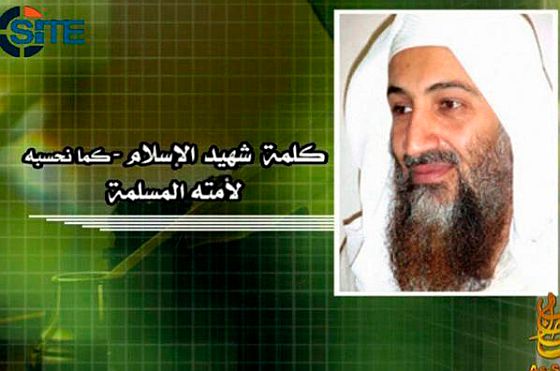
Osama bin Laden might be dead, but al Qaeda still operates a nimble media outfit.

Just as the US media drone anticipating President Obama’s speech later this morning started to grow tiresome, Obama’s words got preempted by Osama’s.

I can’t help wondering what his assassination would have looked like if it had occurred immediately after he expressed support for the Arab Awakening.

In an audio message recorded shortly before his death, Reuters reports:

Bin Laden praised the Egyptian revolution and urged Arab protesters to maintain their momentum, adding: “I believe that the winds of change will envelope the entire Muslim world.”

“This revolution was not for food and clothing. Rather, it was a revolution of glory and pride, a revolution of sacrifice and giving. It has lit the Nile’s cities and its villages from its lower reaches to the top,” he said.

“To those free rebels in all the countries — retain the initiative and be careful of dialogue. No meeting mid-way between the people of truth and those of deviation.”

Bin Laden made no specific reference to Libya, Syria, Bahrain and Yemen, where pro-democracy protesters have had less success than in Egypt and Tunisia, but said Israel, reviled by many ordinary Arabs, was worried by the unrest.

Bin Laden called on young Arabs to consult “those of experience and honesty” and to set up a framework that would allow them to “follow up events and works in parallel… to save the people that are struggling to bring down their tyrants.”

How significant is Osama’s endorsement of the uprisings? It probably won’t have much influence on the average demonstrator in Syria, Bahrain, Libya, Egypt, or Yemen. But it might result in a few would-be jihadists joining the political mainstream.

Meanwhile, how much influence is Obama likely to have two years after his previous and much-hyped Cairo speech turned out to be hollow rhetoric?

McClatchy’s Hannah Allam just took the pulse of the Arab street:

Most common responses when I asked random Egyptians about watching Obama’s #MEspeech: He’s speaking? When? About what?

Facebooktwittermail

The new geopolitics of food

Lester Brown writes:

In the United States, when world wheat prices rise by 75 percent, as they have over the last year, it means the difference between a $2 loaf of bread and a loaf costing maybe $2.10. If, however, you live in New Delhi, those skyrocketing costs really matter: A doubling in the world price of wheat actually means that the wheat you carry home from the market to hand-grind into flour for chapatis costs twice as much. And the same is true with rice. If the world price of rice doubles, so does the price of rice in your neighborhood market in Jakarta. And so does the cost of the bowl of boiled rice on an Indonesian family’s dinner table.

Welcome to the new food economics of 2011: Prices are climbing, but the impact is not at all being felt equally. For Americans, who spend less than one-tenth of their income in the supermarket, the soaring food prices we’ve seen so far this year are an annoyance, not a calamity. But for the planet’s poorest 2 billion people, who spend 50 to 70 percent of their income on food, these soaring prices may mean going from two meals a day to one. Those who are barely hanging on to the lower rungs of the global economic ladder risk losing their grip entirely. This can contribute — and it has — to revolutions and upheaval.

Already in 2011, the U.N. Food Price Index has eclipsed its previous all-time global high; as of March it had climbed for eight consecutive months. With this year’s harvest predicted to fall short, with governments in the Middle East and Africa teetering as a result of the price spikes, and with anxious markets sustaining one shock after another, food has quickly become the hidden driver of world politics. And crises like these are going to become increasingly common. The new geopolitics of food looks a whole lot more volatile — and a whole lot more contentious — than it used to. Scarcity is the new norm.

Until recently, sudden price surges just didn’t matter as much, as they were quickly followed by a return to the relatively low food prices that helped shape the political stability of the late 20th century across much of the globe. But now both the causes and consequences are ominously different.

In many ways, this is a resumption of the 2007-2008 food crisis, which subsided not because the world somehow came together to solve its grain crunch once and for all, but because the Great Recession tempered growth in demand even as favorable weather helped farmers produce the largest grain harvest on record. Historically, price spikes tended to be almost exclusively driven by unusual weather — a monsoon failure in India, a drought in the former Soviet Union, a heat wave in the U.S. Midwest. Such events were always disruptive, but thankfully infrequent. Unfortunately, today’s price hikes are driven by trends that are both elevating demand and making it more difficult to increase production: among them, a rapidly expanding population, crop-withering temperature increases, and irrigation wells running dry. Each night, there are 219,000 additional people to feed at the global dinner table.

More alarming still, the world is losing its ability to soften the effect of shortages. In response to previous price surges, the United States, the world’s largest grain producer, was effectively able to steer the world away from potential catastrophe. From the mid-20th century until 1995, the United States had either grain surpluses or idle cropland that could be planted to rescue countries in trouble. When the Indian monsoon failed in 1965, for example, President Lyndon Johnson’s administration shipped one-fifth of the U.S. wheat crop to India, successfully staving off famine. We can’t do that anymore; the safety cushion is gone.

That’s why the food crisis of 2011 is for real, and why it may bring with it yet more bread riots cum political revolutions. What if the upheavals that greeted dictators Zine el-Abidine Ben Ali in Tunisia, Hosni Mubarak in Egypt, and Muammar al-Qaddafi in Libya (a country that imports 90 percent of its grain) are not the end of the story, but the beginning of it? Get ready, farmers and foreign ministers alike, for a new era in which world food scarcity increasingly shapes global politics.

Facebooktwittermail

The geopolitical battle for the Arab street

Trita Parsi and Reza Marashi write:

The Middle East is undergoing its most dynamic transformation since World War I, when Sir Mark Sykes and Georges Picot first divided the region into colonized spheres of influence. Nearly 100 years later, with the overthrow of Hosni Mubarak in Egypt and Zine El-Abidine Ben Ali in Tunisia, and the ongoing struggle in Yemen, Syria, Libya and Bahrain, all states in the region – or involved in the region – have been forced to reassess their policies and alliances.

These developments have also permanently shattered the frames through which the Middle East was understood – or presented – by various governments. The defining struggle is not between “moderates” and “radicals” – at least not if the definition of “moderate” is an Arab state allied with the U.S. and at virtual peace with Israel. The deposed dictatorships in Cairo and Tunis both fit this false definition of “moderate.” Nor is the struggle between Islamic and secular forces. As R. K. Ramazani points out, the rallying call of protesters across the region has been democracy and dignity, not Islam and Sharia. And to the extent that protests in Bahrain have taken on a sectarian tone, it is arguably due to the efforts of the Al-Khalifa royal family and its Saudi Arabian protector – both considered “moderates” in the old frame.

These recent developments have shocked not only status quo political systems, but also an increasingly intense rivalry for regional influence between Israel, Saudi Arabia and the U.S. on one side, Iran on another, and Turkey as the third vertex in an emerging triangle of competition. Rather than end the rivalry, this shock has changed its context and created both challenges and opportunities for all sides. Regional unrest has demonstrated both the Arab street’s relevance, and its ability to play a decisive role in the region’s future. Thus, if the Arab democracy wave continues unabated, it will not only test status-quo powers investing in an order that suppresses the streets, but also emerging powers that claim to champion them.

Facebooktwittermail

For many Israelis the words “Arabs” and “peace” can’t be combined

Mark Perry writes:

We have before us the example of George Orwell, the eccentric British author of 1984, whose real name was Eric Blair. What’s interesting about Orwell (or, perhaps, simply predictable) is that he adopted his pen name to save his respectable parents the disgrace of having to admit that their son didn’t work for a living, but was (oh, the humiliation) . . . a writer. And the irony: this same Orwell spent years toiling over a story whose theme is that it’s possible to erase the past by a simple act of denial. Thus, Winston Smith (“1984″‘s main character) is told in a torture chamber of the “Ministry of Love” that his belief that his country, “Oceania” was, at one time, not at war with Eastasia is a delusion: “Oceania is at war with Eastasia,” he is told. “Oceania has always been at war with Eastasia.”

Orwell would tell us that those who read “1984” and put it aside in relief (“thank God we don’t live in a world like that”), miss the point. The past is altered continuously, even perniciously–and now (some 63 years after the book’s publication) no more constantly than when it comes to the Middle East. “Mubarak is a moderate,” “we have always supported democracy in Egypt” and “the Arabs aren’t interested in peace” are perhaps not as insidious as “Oceania has always been at war with Eastasia,” but they’re damned close. The beauty of these phrases (as Winston Smith learned) is that if you utter them often enough, they actually become true. Hence, we described former Egyptian President Hosni Mubarak as a moderate so often that we actually came to believe it–and were taken by surprise when we discovered the Egyptian people didn’t agree. So? So now we’re worried that the current revolution will deny the Egyptian people their fundamental rights. Unlike with Mubarak–who was chock full of them.

Human beings are good at this kind of thing, as it turns out, because adopting these phrases (“we have always supported democracy in Egypt”) helps us evade responsibility for the state of the world. Then too, it’s easier to follow the script than to utter the truth–“Mubarak is a tyrant, but what the hell, we supported him anyway,” “we’ve never given a fig for democracy in Egypt” and (finally) “it’s not the Arabs who aren’t interested in peace, but Israel.” It’s this last phrase that seems most pertinent now, when the-take-it-or-leave-it 2002 Arab Peace Initiative is being discussed (again), as a possible resolution of the Arab-Israel (and, hence, the Palestinian-Israeli) conflict.

Facebooktwittermail

Debunking the mythical “Sharia threat” to our judicial system

The ACLU’s Blog of Rights says:

As the ACLU has documented elsewhere, there has been a wave of anti-Muslim sentiment and attacks on Muslim communities in the U.S. in the last few years. Most recently, multiple states have proposed legislation banning the consideration of Islamic or "Sharia" law by state courts. Anti-Muslim groups claim these measures are necessary because the courts are being "overtaken" by Sharia law. Specifically, Sharia-ban proponents have pointed to a number of court cases involving Islamic religious doctrine or Muslim parties that supposedly evince a "Sharia threat" to our judicial system.

A new report by the ACLU, Nothing to Fear: Debunking the Mythical "Sharia Threat" to Our Judicial System, examines, in detail, the cases repeatedly cited by anti-Muslim groups as evidence of the alleged "Sharia threat" to our judicial system. The report concludes that these cases do not stand for the principles that anti-Muslim groups claim. Rather, these court cases deal with routine matters, such as religious freedom claims and contractual disputes. Courts treat these lawsuits in the same way that they deal with similar claims brought by people of other faiths. So instead of the harbingers of doom that anti-Muslim groups make them out to be, these cases illustrate that our judicial system is alive and well, and operating as it should.

As we argue in our case challenging an Oklahoma Sharia law ban, prohibiting courts from considering Islamic law serves only one purpose: to bar Muslims from having the same rights and access to the courts as any other religious individuals. For example, if Sharia law were completely banned from consideration, it would be nearly impossible for Muslims to bring First Amendment claims when their religious rights are violated because the court could be barred from referring to a Muslim plaintiff’s religious beliefs. This result would be patently unfair because it would single out Muslims for disfavorable treatment in our judicial system and render them second-class citizens.

People of all faiths routinely turn to our legal system to protect the right to practice their religion. The Supreme Court has, for example, upheld the right of a Christian to receive unemployment benefits after refusing to work on Sundays in violation of his religious beliefs; and the right of Amish parents to withhold their children from compulsory education on religious grounds. Muslims should not be denied the same opportunities in court, and lawsuits that happen to involve their Islamic faith do not present a "threat" to our legal system any more than claims asserted by Christians, Jews, or other religious individuals.

Facebooktwittermail

The slap that sparked a revolution

The Observer reports:

Manoubia Bouazizi has grown used to the idea that her son Mohamed no longer belongs to her but to the Arab world. In the streets near where she lives on the outskirts of Tunis, she is stopped by people who recognise her, who have heard she is the mother of the market trader who set himself on fire in protest against an authoritarian regime, who kick-started the Jasmine revolution, and so the Arab spring.

His likeness is everywhere. Around the corner from her home, a pizza restaurant proprietor has mounted a full-colour reproduction of Mohamed’s face in his window to advertise a special discounted “Revolutionary Menu”.

Manoubia freely admits she, also, has made money from the global interest surrounding her son’s death. Sometimes she will be paid by the media organisations who want to interview her, and she has a ready-made contract drawn up for them to sign. The family were given 20,000 Tunisian dinars (about £9,000) by former president Zine al-Abidine Ben Ali as compensation for their loss and there are rumours – which Manoubia denies – that she has sold Mohamed’s vegetable cart to a rich businessman in the Emirates.

Still, her new-found prosperity is much in evidence. The Bouazizi family used to live in a modest, concrete house in the central Tunisian town of Sidi Bouzid. Now Manoubia, her husband and her six surviving children have decamped to a large apartment in La Marsa, a pretty seaside suburb of Tunis. Inside, there are caged canaries hanging from the tiled walls and a computer in one of the bedrooms.

When asked to describe what kind of person her son was, Manoubia has difficulty replying. “I can’t think of one single memory,” she says. “He was a man of good faith.” When pressed, her daughter Laila remembers that her brother’s favourite meal was “steak and chips” and that he supported Esperance Sportive, a Tunisian football team. Other than this, the family is disinclined to dwell on personal detail.

For Manoubia, as for those around her, it seems that the man has been subsumed by the myth. “It is strange to think that my little Mohamed should grow up to become this person,” Manoubia says, sitting in the front room of her rented house, her black robes gathered around her and set starkly against a bright orange blanket covering the sofa. She turns away as she speaks, not making eye contact, and it feels sometimes as though she is reciting answers she has learned by rote, having formulated the sentences hundreds of times before. “I am proud and happy that he should have been the first spark of the revolution.”

It is a phrase I will hear again and again, in varying forms across Tunisia. Some will call Mohamed Bouazizi “the drop that tipped over the vase”; others will insist that his death “lit the touchpaper” for the Arab spring revolts. But listen closely and there is also a growing murmur of dissent among those who believe that Mohamed was not a political hero but a media creation, manufactured by a myth-making machine that swung into action in the immediate aftermath of his death.

Facebooktwittermail

U.S. speeds up direct talks with Taliban

The Washington Post reports:

The administration has accelerated direct talks with the Taliban, initiated several months ago, that U.S. officials say they hope will enable President Obama to report progress toward a settlement of the Afghanistan war when he announces troop withdrawals in July.

A senior Afghan official said a U.S. representative attended at least three meetings in Qatar and Germany, one as recently as “eight or nine days ago,” with a Taliban official considered close to Mohammad Omar, the group’s leader.

State Department spokesman Michael A. Hammer on Monday declined to comment on the Afghan official’s assertion, saying the United States had a “broad range of contacts across Afghanistan and the region, at many levels. . . . We’re not going to get into the details of those contacts.”

The talks have proceeded on several tracks, including through nongovernmental intermediaries and Arab and European governments. The Taliban has made clear its preference for direct negotiations with the Americans and has proposed establishing a formal political office, with Qatar under consideration as a venue, according to U.S. officials.

Facebooktwittermail

News roundup — May 18

Hamas deputy foreign minister talks about Israel

ROBERT SIEGEL (NPR host): And I’d like to ask you to begin with what has been a major difference between Fatah and your group, Hamas. Ismail Haniyeh, the prime minister of the Hamas government in Gaza, spoke the other day of the Palestinians’, and I quote, “great hope of bringing to an end the Zionist project in Palestine.”

About a week earlier, Hamas leader Khaled Mashaal said in Cairo that the goal of your movement is a Palestinian state in the West Bank and Gaza with Jerusalem as its capital. Which is it that Hamas seeks, a two-state solution alongside Israel or an end to the state of Israel altogether?

GHAZI HAMAD (Deputy Foreign Minister, Hamas): I think there is all kind of contradictions because maybe people understand that the occupation is a reflection of the Zionist movement, and I think the declaration of Hamas is very clear. We accept the state and ’67 borders. This state should be independent. It was chosen as the capital for Palestine and the right of return for the refugees.

But I think that Israel will not accept this because Israel reject all the demands of the Palestinian people because they believe that they have to have a Jewish state and Jerusalem is the capital of Israel and no right of return. So I think we’ll still have a big struggle and big disputes.

SIEGEL: But just to clarify, if Israel were to accept a two-state solution in which Palestine would be in Gaza and the West Bank and have its capital in Jerusalem, is that an acceptable aim that Hamas is striving for, or is that in and of itself insufficient because there would still be a state of Israel?

Mr. HAMAD: Look, we said frankly we accept this state and ’67 borders, but the question now should be directed to Israel. We need clear answer from Israel because Netanyahu said that we will not go back to the ’67 borders. We will not (unintelligible) settlements. So we still the victims of the occupation. (NPR)

US slaps sanctions on Syria’s Assad for abuses

The United States slapped sanctions on Syrian President Bashar Assad and six senior Syrian officials for human rights abuses over their brutal crackdown on anti-government protests, for the first time personally penalizing the Syrian leader for actions of his security forces.

The White House announced the sanctions Wednesday, a day before President Barack Obama delivers a major speech on the uprisings throughout the Arab world. The speech is expected to include prominent mentions of Syria.

The Obama administration had pinned hopes on Assad, seen until recent months as a pragmatist and potential reformer who could buck Iranian influence and help broker an eventual Arab peace deal with Israel. (AP)

Tanks shell Syrian town as West piles on pressure

Tanks shelled a Syrian border town for the fourth day Wednesday in a military campaign to crush demonstrations against President Bashar al-Assad, under mounting Western pressure to stop his violent repression of protesters.

Troops went into Tel Kelakh Saturday, a day after a demonstration there demanded “the overthrow of the regime,” the slogan of revolutions that toppled Arab leaders in Egypt and Tunisia and challenged others across the Middle East.

Assad had been partly rehabilitated in the West over the last three years but the United States and European Union condemned his use of force to quell unrest and warned they plan further steps after imposing sanctions on top Syrian officials. (Reuters)

The war in Libya’s western mountains

“While much attention has been focused on rebel efforts in eastern Libya and in the city of Misurata, rebels have held control of most of the Nafusah Mountain region since the unrest began in February,” my colleagues Sergio Peçanha and Joe Burgess explain in the introduction to a fascinating, richly informative graphic on the fighting there.

Last month, after the rebels in these remote mountains made an unexpected show of strength, seizing a border post along the Tunisian frontier, my colleague Scott Sayare reported that “the region’s isolated hamlets were among the first to join the uprising,” fueled by simmering resentment from a Berber community which was neglected by Col. Muammar el-Qaddafi’s Arab nationalist regime.

Despite the fact that even rebel fighters in the region estimate their ranks at just a few hundred ill-equipped and untrained young men, they have someone held off attempts by government forces to reimpose Tripoli’s rule. (New York Times)

Libyan rebel government works to boost legitimacy

NATO kept up its bombing campaign against Libyan leader Moammar Gadhafi over the weekend, hitting missile launchers and other targets around Tripoli. The rebels say they welcome military support, but they would like something more: formal diplomatic recognition for their transitional government.

Some special guests flew in recently for the rebels’ weekly pep rally in Benghazi — delegates from areas of western Libya that are still under Gadhafi’s control. The delegates came to take their seats in the 30-seat National Transitional Council — a kind of proto-parliament.

Eastern Libyans like Mansour Makhlouf are glad to see them.

“Gadhafi’s people are spreading rumors that we are divided. But we’re not divided — we are all brothers,” Makhlouf says. (NPR)

War crimes prosecutor seeks Gaddafi warrant

The International Criminal Court’s chief prosecutor has asked a three-judge panel to issue arrest warrants for Libyan leader Muammar Gaddafi, his second-eldest son, Saif al-Islam, and his intelligence chief, Abdullah Senussi.

Luis Moreno-Ocampo described the evidence against the three men as “very strong” in a press conference on Monday and said he believed Libyans eventually would turn them over to the court.

The filing against Gaddafi comes just three months into the uprising against his 41-year rule, which evolved from peaceful protests in major cities to an armed rebellion based out of the east. Gaddafi’s regime has brutally attempted to suppress the opposition movement by shelling rebellious cities, and imprisoning and torturing those who speak out. (Al Jazeera)

Radio free Benghazi – the war of words

For hours and hours, I didn’t know what to make of it: Tribute FM is the first ever English language radio station in Libya. And it sounds just like Magic. Diana Ross . . . the Jackson Five . . . the Temptations . . . some German rap . . . Easy Like Sunday Morning . . . just as you’re nodding along, thinking “this is nice, I wonder if they have a phone-in,” you remember: this is probably the most radical statement of a successful revolution coming out of any radio, anywhere in the world. It is a huge moment for a country in which not just English but most European languages have been invisible for decades.

Before Muhammad, Aman and two others launched Tribute in Benghazi last week, “English wasn’t frowned on, it was completely illegal,” Muhammad tells me by phone. “It was taken out of schools, it got to the point where nothing in English was available in the city. You couldn’t advertise in English, you couldn’t read a newspaper in English.”

It is a measure of how isolating this was for young Libyans that setting up a radio station would be such a priority as the fighting continues, the stream of refugees is unabated and Gaddafi has not, as yet, surrendered. (The Guardian)

Facebooktwittermail

How Jewish supremacists created Israel

During an era in which Israel is used to getting a free ride in the Israel-friendly American press, it’s worth recalling that it wasn’t always like this.

Clifton Daniel went on to become the New York Times‘ managing editor, but back in 1947 he was the paper’s Middle East correspondent and reported from Jerusalem on the Zionists’ rise to power — an ascent that was assured because Western Jews shared the same form of superiority that other Western colonialists exercised in asserting control over the rest of the Middle East, his informants told this reporter.

If Zionists and their allies these days are tireless in declaring that Israel is the historic homeland of the Jewish people, the Jews who actually created Israel were in no doubt that they are engaged in an enterprise of colonization. Jewish settlers, outnumbered by the indigenous population, would only be able to take control of Palestine through a program of Jewish domination. They intended to assert power through persuasion if possible, but by force if necessary.

PALESTINE JEWS MINIMIZE ARABS

Sure of Superiority, Settlers Feel They Can Win Natives by Reason or Force
By Clifton Daniel
Special to THE NEW YORK TIMES

JERUSALEM, March 19 — Palestine’s Zionists are generally confident that relations with their Arab neighbors can be satisfactorily adjusted once the country’s political status has been settled.

If not confident, they rarely allow themselves to be troubled by the problem, being usually preoccupied with issues they consider more urgent. That attitude, which has been manifested in numerous conversations that I have had in the past three weeks with everyday citizens of all degrees, has developed in spite of the fact that the presence of the Arab majority is fundamentally the largest obstacle to the achievement of Zionism’s national aims.

It is an attitude shared by almost everyone, no matter which of the many proposed political solutions he may advocate. A non-party professional man of Rehovoth summarized it when he said: “Give use time, give us peace and give us a policy.”

Surprised at Mention

Talking to Jews in ordinary walks of life — not Zionist leaders — one gets the impression that relations with the Arabs are not among there major concerns. Some were even surprised that in the present circumstances the subject should be discussed.

Their unconcern seems to be the product of several factors. First of all, they feel, although not boastfully, that as a people they are superior to the Arabs in skill and education. “Look at an Arab village and a Jewish settlement side by side,” one of them remarked recently. “There is a difference of 200 or 300 years.”

Another man stated the difference even more bluntly when he described the Western Jew as bearing the same relation to the Oriental Arab as the white man to the native in a colonial system. Some of the chauvinistic youth carry this feeling of superiority so far as to despise the Arab as an inferior.

Whatever the degree of their superiority complex, however, the Jews are certainly confident of their ability to bring the Arabs to terms — by persuasion if possible, by might if necessary. The program of the largest terrorist group, the Irgun Zvai Leumi, is to evacuate the British forces from Palestine and declare a Zionist state west of the Jordan, and “we will take care of the Arabs.”

Some of this confidence may be whistling in the dark. In any case the usual emphasis is not on might but persuasion. There appears to be a sincere belief among Zionists that their settlement in Palestine has conferred large and tangible benefits on the indigenous population. Everyone can cite an example from their own experience.

“I would be deceiving you if I told you that we are consciously thinking about improving the condition of the Arabs all the time,” one man told me. “Naturally we devote our first and best efforts to our own people coming from Europe. We help the Arabs incidentally — largely by example. As a result of our example they are freeing themselves from feudalism.”

Sure Arabs Are Grateful

The Zionists are convinced that the Arabs are grateful for the improvements introduced by Jews and would so express themselves if not incited by the politicians to make a show of hostility.

Wherever Arabs are left to their own inclinations, Zionists frequently tell you, they show themselves friendly. They make a ceremony of welcoming new Jewish settlements, often bringing coffee and food on the first day. They sit side by side with Jews in public markets, work in Jewish enterprises, buy from Jewish stores in spite of the Arabs’ anti-Zionist boycott, and deal with Jewish banks. Their inherent willingness to get along with Jews is the primary article of the Zionists’ faith.

Nevertheless, Arab-Jewish relations are admitted by Zionists to be almost entirely commercial. The relationship is usually one of buyer and seller, employer and employee. The cultural gulf, Zionists say, is such that social relationships are virtually impossible. Simple country Arabs sometimes invite their Jewish neighbors to their traditional festivities but the invitations are admittedly seldom returned.

Look for Common Interests

“Wherever there are common interests relations are good,” one Zionist observed. A young skilled workman who had joined his Arab colleagues in a strike against the Iraq Petroleum Company in Haifa explained his cooperation by saying: “We have common interests.”

There is a belief that areas of common interest would be enlarged if the political irritant could be removed from Arab-Jewish relations.

A leader of the diamond industry in Tel Aviv contended that substantially enlarging the Jewish community in Palestine was the only way of coming to a settlement with the Arabs. His theory was that the Arabs would either ignore or try to crush a numerically inferior community and that immigration was the only means of bettering the Zionists’ bargaining position.

Neither he nor virtually any other Zionist with whom I talked would consider being subject to the Arab majority in Palestine. They wish to feel secure in their culture, religion and economy and to be free to develop a Zionist national home in their own way without restrictions.

Some Jews in Palestine have already attained that feeling of freedom from the restrictive presence of Arabs. In Nevah Ilan the Arab problem did not seem to exist for the young, husky French settlers, mostly veterans of the resistance.

Nevah Ilan, established four months ago, is almost literally up in the clouds, and the Arabs are far below. Eager, enthusiastic and optimistic, the settlers are absorbed in the task of restoring life to a barren but beautiful hill. Almost their only contact with their neighbors has been one visit by an Arab, who showed great interest in their plans and methods.

Tel Aviv Self-Contained

The all-Jewish metropolis of Tel Aviv is self-contained and separated from the rest of the country. The average resident has no daily contact with the majority element of the country — a fact that is probably true of most Jews in Palestine.

Tel Aviv residents do not worry about the Arab problem, a young journalist there said. They do not consider it insurmountable.

“Perhaps we do not have enough contact with the Arabs,” a business man mused somewhat self-reproachingly.

(Thanks to Yousef Munayyer at The Jerusalem Fund for featuring this New York Times article in this post.)

Facebooktwittermail

Here comes your non-violent resistance

M.S., at The Economist‘s Democracy in America blog, writes:

For many years now, we’ve heard American commentators bemoan the violence of the Palestinian national movement. If only Palestinians had learned the lessons of Gandhi and Martin Luther King, we hear, they’d have had their state long ago. Surely no Israeli government would have violently suppressed a non-violent Palestinian movement of national liberation seeking only the universally recognised right of self-determination.

Palestinian commentators and organisers, including Fadi Elsalameen and Moustafa Barghouthi, have spent the last couple of years pointing out that these complaints resolutely ignore the actual and growing Palestinian non-violent resistance movement. For that matter, they elide the fact that the first intifada, which broke out in 1987, was initially as close to non-violent as could be reasonably expected. For the most part, it consisted of general strikes and protest marches. In addition, there was a fair amount of kids throwing rocks, as well as the continuing threat of low-level terrorism, mainly from organisations based abroad; the Israelis conflated the autochthonous protest movement with the terrorism and responded brutally, and the intifada quickly lost its non-violent character. That’s not that different from what has happened over the past couple of months in Libya; it shows that it’s very hard to keep a non-violent movement non-violent when the government you’re demonstrating against subjects you to gunfire for a sustained period of time.

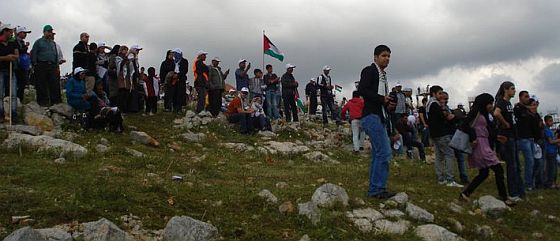
In any case, if you’re among those who have made the argument that Israelis would give Palestinians a state if only the Palestinians would learn to employ Ghandhian tactics of non-violent protest, it appears your moment of truth has arrived. As my colleague writes, what happened on Nakba Day was Israel’s “nightmare scenario: masses of Palestinians marching, unarmed, towards the borders of the Jewish state, demanding the redress of their decades-old national grievance.” Peter Beinart writes that this represents “Israel’s Palestinian Arab Spring”: the tactics of mass non-violent protest that brought down the governments of Tunisia and Egypt, and are threatening to bring down those of Libya, Yemen and Syria, are now being used in the Palestinian cause.

So now we have an opportunity to see how Americans will react. We’ve asked the Palestinians to lay down their arms. We’ve told them their lack of a state is their own fault; if only they would embrace non-violence, a reasonable and unprejudiced world would see the merit of their claims. Over the weekend, tens of thousands of them did just that, and it seems likely to continue. If crowds of tens of thousands of non-violent Palestinian protestors continue to march, and if Israel continues to shoot at them, what will we do? Will we make good on our rhetoric, and press Israel to give them their state? Or will it turn out that our paeans to non-violence were just cynical tactics in an amoral international power contest staged by militaristic Israeli and American right-wing groups whose elective affinities lead them to shape a common narrative of the alien Arab/Muslim threat? Will we even bother to acknowledge that the Palestinians are protesting non-violently? Or will we soldier on with the same empty decades-old rhetoric, now drained of any truth or meaning, because it protects established relationships of power? What will it take to make Americans recognise that the real Martin Luther King-style non-violent Palestinian protestors have arrived, and that Israeli soldiers are shooting them with real bullets?

Facebooktwittermail

Obama’s war against whistle-blowers

Jane Mayer writes:

On June 13th, a fifty-four-year-old former government employee named Thomas Drake is scheduled to appear in a courtroom in Baltimore, where he will face some of the gravest charges that can be brought against an American citizen. A former senior executive at the National Security Agency, the government’s electronic-espionage service, he is accused, in essence, of being an enemy of the state. According to a ten-count indictment delivered against him in April, 2010, Drake violated the Espionage Act—the 1917 statute that was used to convict Aldrich Ames, the C.I.A. officer who, in the eighties and nineties, sold U.S. intelligence to the K.G.B., enabling the Kremlin to assassinate informants. In 2007, the indictment says, Drake willfully retained top-secret defense documents that he had sworn an oath to protect, sneaking them out of the intelligence agency’s headquarters, at Fort Meade, Maryland, and taking them home, for the purpose of “unauthorized disclosure.” The aim of this scheme, the indictment says, was to leak government secrets to an unnamed newspaper reporter, who is identifiable as Siobhan Gorman, of the Baltimore Sun. Gorman wrote a prize-winning series of articles for the Sun about financial waste, bureaucratic dysfunction, and dubious legal practices in N.S.A. counterterrorism programs. Drake is also charged with obstructing justice and lying to federal law-enforcement agents. If he is convicted on all counts, he could receive a prison term of thirty-five years.

The government argues that Drake recklessly endangered the lives of American servicemen. “This is not an issue of benign documents,” William M. Welch II, the senior litigation counsel who is prosecuting the case, argued at a hearing in March, 2010. The N.S.A., he went on, collects “intelligence for the soldier in the field. So when individuals go out and they harm that ability, our intelligence goes dark and our soldier in the field gets harmed.”

Top officials at the Justice Department describe such leak prosecutions as almost obligatory. Lanny Breuer, the Assistant Attorney General who supervises the department’s criminal division, told me, “You don’t get to break the law and disclose classified information just because you want to.” He added, “Politics should play no role in it whatsoever.”

When President Barack Obama took office, in 2009, he championed the cause of government transparency, and spoke admiringly of whistle-blowers, whom he described as “often the best source of information about waste, fraud, and abuse in government.” But the Obama Administration has pursued leak prosecutions with a surprising relentlessness. Including the Drake case, it has been using the Espionage Act to press criminal charges in five alleged instances of national-security leaks—more such prosecutions than have occurred in all previous Administrations combined. The Drake case is one of two that Obama’s Justice Department has carried over from the Bush years.

Gabriel Schoenfeld, a conservative political scientist at the Hudson Institute, who, in his book “Necessary Secrets” (2010), argues for more stringent protection of classified information, says, “Ironically, Obama has presided over the most draconian crackdown on leaks in our history—even more so than Nixon.”

Describing Drake’s concerns that the NSA was showing a flagrant disregard for the constitutional rights of US citizens, Mayer writes:

Drake says that in the Air Force, where he learned to capture electronic signals, the FISA law “was drilled into us.” He recalls, “If you accidentally intercepted U.S. persons, there were special procedures to expunge it.” The procedures had been devised to prevent the recurrence of past abuses, such as Nixon’s use of the N.S.A. to spy on his political enemies.

Drake didn’t know the precise details, but he sensed that domestic spying “was now being done on a vast level.” He was dismayed to hear from N.S.A. colleagues that “arrangements” were being made with telecom and credit-card companies. He added, “The mantra was ‘Get the data!’ ” The transformation of the N.S.A., he says, was so radical that “it wasn’t just that the brakes came off after 9/11—we were in a whole different vehicle.”

Few people have a precise knowledge of the size or scope of the N.S.A.’s domestic-surveillance powers. An agency spokesman declined to comment on how the agency “performs its mission,” but said that its activities are constitutional and subject to “comprehensive and rigorous” oversight. But Susan Landau, a former engineer at Sun Microsystems, and the author of a new book, “Surveillance or Security?,” notes that, in 2003, the government placed equipment capable of copying electronic communications at locations across America. These installations were made, she says, at “switching offices” that not only connect foreign and domestic communications but also handle purely domestic traffic. As a result, she surmises, the U.S. now has the capability to monitor domestic traffic on a huge scale. “Why was it done this way?” she asks. “One can come up with all sorts of nefarious reasons, but one doesn’t want to think that way about our government.”

[Bill] Binney [former head of the NSA’s Signals Intelligence Automation Research Center, or SARC], for his part, believes that the agency now stores copies of all e-mails transmitted in America, in case the government wants to retrieve the details later. In the past few years, the N.S.A. has built enormous electronic-storage facilities in Texas and Utah. Binney says that an N.S.A. e-mail database can be searched with “dictionary selection,” in the manner of Google. After 9/11, he says, “General Hayden reassured everyone that the N.S.A. didn’t put out dragnets, and that was true. It had no need—it was getting every fish in the sea.”

Facebooktwittermail

US officials briefed on bin Laden raid couldn’t be trusted to keep it secret

The latest account of the raid in which Osama bin Laden was assassinated on May 2, says:

The decision to launch on that particular moonless night in May came largely because too many American officials had been briefed on the plan. U.S. officials feared if it leaked to the press, bin Laden would disappear for another decade.

The Associated Press account describes the scene inside the house as SEALs stormed in, “blowing their way in with explosives, through walls and doors, working their way up the three-level house from the bottom.”

Small knots of children were on every level, including the balcony of bin Laden’s room.

As three of the SEALs reached the top of the steps on the third floor, they saw bin Laden standing at the end of the hall. The Americans recognized him instantly, the officials said.

Bin Laden also saw them, dimly outlined in the dark house, and ducked into his room.

The three SEALs assumed he was going for a weapon, and one by one they rushed after him through the door, one official described.

Two women were in front of bin Laden, yelling and trying to protect him, two officials said. The first SEAL grabbed the two women and shoved them away, fearing they might be wearing suicide bomb vests, they said.

The SEAL behind him opened fire at bin Laden, putting one bullet in his chest, and one in his head.

It was over in a matter of seconds.

Back at the White House Situation Room, word was relayed that bin Laden had been found, signaled by the code word “Geronimo.” That was not bin Laden’s code name, but rather a representation of the letter “G.” Each step of the mission was labeled alphabetically, and “Geronimo” meant that the raiders had reached step “G,” the killing or capture of bin Laden, two officials said.

As the SEALs began photographing the body for identification, the raiders found an AK-47 rifle and a Russian-made Makarov pistol on a shelf by the door they’d just run through. Bin Laden hadn’t touched them.

Were the guns even loaded?

Facebooktwittermail

The Obama deception: Why Cornel West went ballistic

Chris Hedges writes:

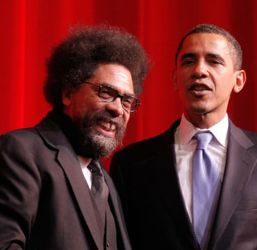
The moral philosopher Cornel West, if Barack Obama’s ascent to power was a morality play, would be the voice of conscience. Rahm Emanuel, a cynical product of the Chicago political machine, would be Satan. Emanuel in the first scene of the play would dangle power, privilege, fame and money before Obama. West would warn Obama that the quality of a life is defined by its moral commitment, that his legacy will be determined by his willingness to defy the cruel assault by the corporate state and the financial elite against the poor and working men and women, and that justice must never be sacrificed on the altar of power.

Perhaps there was never much of a struggle in Obama’s heart. Perhaps West only provided a moral veneer. Perhaps the dark heart of Emanuel was always the dark heart of Obama. Only Obama knows. But we know how the play ends. West is banished like honest Kent in “King Lear.” Emanuel and immoral mediocrities from Lawrence Summers to Timothy Geithner to Robert Gates—think of Goneril and Regan in the Shakespearean tragedy—take power. We lose. And Obama becomes an obedient servant of the corporate elite in exchange for the hollow trappings of authority.
No one grasps this tragic descent better than West, who did 65 campaign events for Obama, believed in the potential for change and was encouraged by the populist rhetoric of the Obama campaign. He now nurses, like many others who placed their faith in Obama, the anguish of the deceived, manipulated and betrayed. He bitterly describes Obama as “a black mascot of Wall Street oligarchs and a black puppet of corporate plutocrats. And now he has become head of the American killing machine and is proud of it.”

“When you look at a society you look at it through the lens of the least of these, the weak and the vulnerable; you are committed to loving them first, not exclusively, but first, and therefore giving them priority,” says West, the Class of 1943 University Professor of African American Studies and Religion at Princeton University. “And even at this moment, when the empire is in deep decline, the culture is in deep decay, the political system is broken, where nearly everyone is up for sale, you say all I have is the subversive memory of those who came before, personal integrity, trying to live a decent life, and a willingness to live and die for the love of folk who are catching hell. This means civil disobedience, going to jail, supporting progressive forums of social unrest if they in fact awaken the conscience, whatever conscience is left, of the nation. And that’s where I find myself now.

“I have to take some responsibility,” he admits of his support for Obama as we sit in his book-lined office. “I could have been reading into it more than was there.

“I was thinking maybe he has at least some progressive populist instincts that could become more manifest after the cautious policies of being a senator and working with [Sen. Joe] Lieberman as his mentor,” he says. “But it became very clear when I looked at the neoliberal economic team. The first announcement of Summers and Geithner I went ballistic. I said, ‘Oh, my God, I have really been misled at a very deep level.’ And the same is true for Dennis Ross and the other neo-imperial elites. I said, ‘I have been thoroughly misled, all this populist language is just a facade. I was under the impression that he might bring in the voices of brother Joseph Stiglitz and brother Paul Krugman. I figured, OK, given the structure of constraints of the capitalist democratic procedure that’s probably the best he could do. But at least he would have some voices concerned about working people, dealing with issues of jobs and downsizing and banks, some semblance of democratic accountability for Wall Street oligarchs and corporate plutocrats who are just running amuck. I was completely wrong.”

Facebooktwittermail

A Palestinian awakening and an Israeli nightmare

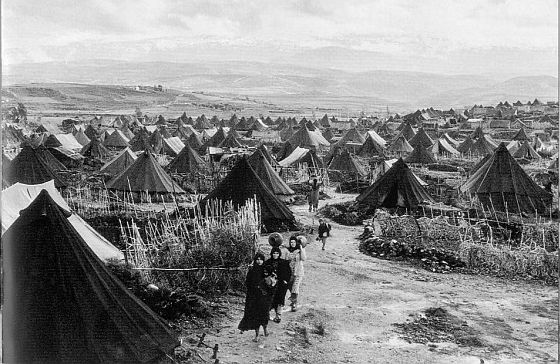
A refugee crisis that has lasted for 63 years following the ethnic cleansing of Palestine in 1948.

Peter Beinart writes:

Why did thousands of Palestinians yesterday converge upon Israel’s borders? Partly because Syria’s war-criminal leader, Bashar al-Assad, and his ally, Hezbollah, wanted them to. But there’s more to it than that. Palestinians also marched from Jordan and Egypt, whose governments did their best to stop the protests. In fact, they marched from every corner of the Palestinian world, in a tech-savvy, coordinated campaign. What hit Israel yesterday was the Palestinian version of the Arab spring.

Something fundamental has changed. I grew up believing that we—Americans and Jews—were the shapers of history in the Middle East. We created reality; others watched, baffled, paralyzed, afraid. In 1989, Americans gloated as the Soviet Union, our former rival for Middle Eastern supremacy, retreated ignominiously from the region. When Saddam Hussein tried to challenge us from within, we thrashed him in the Gulf War. Throughout the 1990s, we sent our economists, law professors and investment bankers to try to teach the Arabs globalization, which back then meant copying us. In a thousand ways, sometimes gently, sometimes brutally, we sent the message: We make the rules; you play by them.

For Jews, this sense of being history’s masters was even more intoxicating. For millennia, we had been acted upon. Mere decades earlier, American Jews had watched, trembling and inarticulate, as European Jews were destroyed. But it was that very impotence that made possible the triumph of Zionism, a movement aimed at snatching history’s reins from gentiles, and perhaps even God. Beginning in the early 20th century, Zionists created facts on the ground. Sometimes the great powers applauded; sometimes they condemned, but acre by acre, Jews seized control of their fate. As David Ben-Gurion liked to say, “Our future does not depend on what gentiles say but on what Jews do.” The Arabs reacted with fury, occasional violence, and in Palestine, a national movement of their own. But they could rarely compete, either politically or militarily. We went from strength to strength; they never missed an opportunity to miss an opportunity.

That world is gone. America and Israel are no longer driving history in the Middle East; for the first time in a long time, Arabs are. In Tahrir Square, Egypt’s young made a revolution. President Obama bowed to reality and helped show Hosni Mubarak the door; Benjamin Netanyahu stood athwart history, impotently yelling stop. Now Egypt’s leaders are doing its people’s will, bringing Hamas and Fatah together in preparation for elections. Hamas and Fatah are complying because they fear their own Tahrir Square. They sense that in Palestine too, a populist uprising stirs; that’s part of what yesterday’s marches were about. For American and Israeli leaders accustomed to Palestinian autocrats and Palestinian terrorists, this is something new. Netanyahu and his American backers are demanding that Obama rewind the clock, but he can’t. The Palestinians no longer listen to functionaries like George Mitchell. They have lost faith in American promises, and they no longer fear American threats. Instead, they are putting aside their internal divisions and creating facts on the ground.

Al Jazeera reports:

At least 353 people were injured, one of them critically, when Egyptian security forces attacked a pro-Palestine demonstration outside the Israeli embassy in Cairo on Sunday night, according to witnesses and the Health Ministry.

Activists told Al Jazeera that army and internal security troops used tear gas, rubber-coated bullets and live ammunition to disperse thousands of protesters who had gathered to mark the 63rd anniversary of the “Nakba” or “catastrophe” – the day in 1948 that Israel declared its independence and thousands of Palestinians fled or were expelled form their homes.

At least two protesters were shot by live ammunition, while others were hospitalised after inhaling tear gas or being hit by rubber-coated steel bullets, some of which penetrated the skin, witnesses said.

Facebooktwittermail