Unlike the bland, state-owned Egyptian station, or its more conservative, Saudi-owned rival Al Arabiya, Al Jazeera has captured the hopes of the crowds gathering on the streets of Cairo.
“The genius of Arab satellite TV,” Abderrahim Foukara, Washington bureau chief for Al Jazeera, once told me, “is that it [has] captured a deep-seated common existential pain called Arab sensibility and turned it into a picture narrative that speaks to something very deep in the Arab psyche.”
Put another way: There is no chance that the world would be watching these extraordinary events play out in Egypt if Egyptians had not watched the Tunisian revolution play out in their living rooms and coffee shops on Al Jazeera.
The media is by no means the only force at play in the continuing upheaval in Egypt, the Tunisian revolution, or the copy-cat demonstrations going on elsewhere in the Arab world. At root is a raw anger fed by decades of political, intellectual, and economic stagnation that has led to a powerful convergence of the region’s three main political trends — pan-Arab nationalism, nation-state nationalism, and Islamism.
However, Arab media have been at the vanguard of articulating this new and explosive development. Arab satellite television, such as Al Jazeera — and the increasingly aggressive ethos of Arab print journalism exemplified by newspapers like Egypt’s Al-Masry Al-Youm and Tunisia’s crusading Kalima Tunisie — have fueled a sense of common cause among Arabs across the region every bit as real as the “imagined communities” that are at the core of the concept of nation.
The army said on Monday it would not use force against Egyptians staging protests demanding President Hosni Mubarak step down, a statement said.
It said “freedom of expression” was guaranteed to all citizens using peaceful means.
It was the first such explicit confirmation by the army that it would not fire at demonstrators who have taken to the streets of Egypt since last week to try to force Mubarak to quit.
“The presence of the army in the streets is for your sake and to ensure your safety and wellbeing. The armed forces will not resort to use of force against our great people,” the army statement said.
“Your armed forces, who are aware of the legitimacy of your demands and are keen to assume their responsibility in protecting the nation and the citizens, affirms that freedom of expression through peaceful means is guaranteed to everybody.”
It urged people not resort to acts of sabotage that violate security and destroy public and private property. It warned that it would not allow outlaws and to loot, attack and “terrorise citizens”.
As long as the masses in Egypt and in the entire Arab world continue seeing the images of tyranny and violence from the occupied territories, Israel will not be able to be accepted, even it is acceptable to a few regimes.
The Egyptian regime became an ally of the Israeli occupation. The joint siege of Gaza is irrefutable proof of that. The Egyptian people didn’t like it. They never liked the peace agreement with Israel, in which Israel committed itself to “respect the legitimate rights of the Palestinian people” but never kept its word. Instead, the people of Egypt got the scenes of Operation Cast Lead.
It is not enough to have a handful of embassies in order to be accepted in the region. There also have to be embassies of goodwill, a just image and a state that is not an occupier. Israel has to make its way into the hearts of the Arab peoples, who will never agree to the continued repression of their brothers, even if their intelligence ministers will continue to cooperate with Israel.
If there’s one thing shared by all factions of the Egyptian opposition, it is their seething hatred of Israel. Now their representatives will rise to power, and Israel will find itself in a difficult situation. Neither will anything remain of the virtual achievement that Netanyahu often paraded – the alliance with the “moderate” Arab regimes against Iran. A real alliance with Egypt and its sister-states can only be based on the end of the occupation, as desired by the Egyptian people, and not on a common enemy, as an interest of its regime.
So what has happened so far? A corrupt president in Tunisia flees, to cheers from around the world. Protests erupt in Egypt, and gloom descends. Protests are held in Iran, and the world cheers. A prime minister is deposed in Lebanon, to fear and dread. An Iraqi president is overthrown in a military offensive, and it’s called democracy. Raucous demonstrations take place in Yemen, and they’re called interesting but not terribly important.
Why the different reactions? This is supposedly the new Middle East the West always wanted, but something still isn’t working out. This isn’t the Middle East they dreamed of in the Bush administration, and not what nourished Prime Minister Benjamin Netanyahu’s wildest dreams. A new, unexpected player has appeared: the public.
Up to now, the world has been divided into two camps: “complicated” countries where the government represents the public and every decision is subject to public oversight, and “easy” countries where business is conducted at the top and the public is just window dressing. The dividing line between the two has always been starkly clear. Everything north of the Mediterranean belonged to the first group and everything to the south and east to the second.
The north had political parties and trade unions, a left wing and a right wing, important intellectuals, celebrities who shaped public opinion, and of course, there was public opinion itself. In the south the division was simple. It was the distinction between moderates and extremists, meaning pro-Westerners and anti-Westerners.
If you’re a Saudi king who buys billions of dollars of American weapons, you’re pro-Western and therefore entitled to continue to rule a country without a parliament, one where thieves’ hands are amputated and women aren’t allowed to drive. If you’re an Egyptian president who supports the peace process, you’re pro-Western and have permission to continue to impose emergency rule in your country, jail journalists and opposition members, and fix elections.
The events of the last few days in Egypt – apparently the most important regional development since the Islamic revolution in Iran and the Egyptian-Israeli peace deal of 1979 – are also an expression of the decision-makers’ nightmare, the planners and intelligence agents in Israel.
While in other countries many are watching with satisfaction at what looks to be possibly the imminent toppling of a regime that denied its citizens their basic rights, the Israeli point of view is completely different.
The collapse of the old regime in Cairo, if it takes place, will have a massive effect, mainly negative, on Israel’s position in the region. In the long run, it could put the peace treaties with Egypt and Jordan in danger, the largest strategic assets after the support of the United States.
The changes could even lead to changes in the IDF and cast a dark cloud over the economy.
Western intelligence in general and Israeli intelligence in particular did not foresee the scope of change in Egypt (the eventual descriptor “revolution” will apparently have to wait a little longer). Likewise, almost all of the media analysis and academic experts got it wrong.
In the possible scenarios that Israeli intelligence envisioned, they admittedly posited 2011 as a year of possible regime change – with a lot question marks – in Egypt and Saudi Arabia, but a popular uprising like this was completely unexpected.
More than this, in his first appearance at a meeting last Wednesday of the Foreign Affairs and Defense Committee the new head of military intelligence Major General Aviv Kochavi said to member of Knesset, “There are currently no doubts about the stability of the regime in Egypt. The Muslim Brotherhood is not organized enough to take over, they haven’t managed to consolidate their efforts in a significant direction.”
If the Mubarak regime is toppled, the quiet coordination of security between Israel and Egypt will quickly be negatively affected. It will affect relations between Cairo’s relationship with the Hamas government in the Gaza Strip, it will harm the international forces stationed in Sinai.
It will mean the refusal of Egypt to continue to allow the movement of Israeli ships carrying missiles through the Suez canal, which was permitted for the last two years, according to reports in the foreign press, in order to combat weapons smuggling from Sudan to Gaza. In the long run, Egypt’s already-cold peace treaty with Israel will get even colder.
From the perspective of the IDF, the events are going to demand a complete reorganization. For the last 20 years, the IDF has not included a serious threat from Egypt in its operational plan.
In the last several decades, peace with Cairo has allowed the gradual thinning out of forces, the lowering of maximum age for reserve duty and the diversion of massive amounts of resources to social and economic projects.
The IDF military exercises focused on conflict with Hezbollah and Hamas, at most in collusion with Syria. No one prepared with any seriousness for a scenario in which an Egyptian division would enter Sinai, for example.
If the Egyptian regime falls in the end, a possibility that seemed unbelievable only two or three days ago, the riots could easily spill over to Jordan and threaten the Hashemite regime. On Israel’s two long peaceful borders there will then prevail a completely different reality.
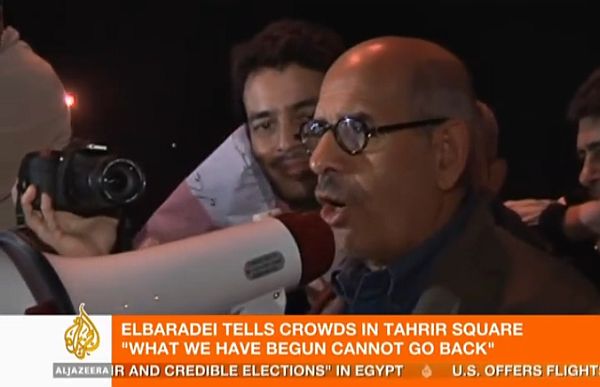
Egyptian activist and Nobel Peace Prize laureate Mohamed ElBaradei addressing “those people who have been safeguarding democracy” in Cairo’s Tahrir Square. “What we have begun cannot go back,” he told the crowd.
“We have a key demand: For the regime to step down and to start a new era.”
The National Coalition for Change, which groups several opposition movements including the Muslim Brotherhood, wants ElBaradei to negotiate with the Mubarak government, Al Jazeera reports.
Mohamed ElBaradei is heading back to Egypt despite direct threats against his life. He said this to Newsweek:
When Egypt had parliamentary elections only two months ago, they were completely rigged. The party of President Hosni Mubarak left the opposition with only 3 percent of the seats. Imagine that. And the American government said that it was “dismayed.” Well, frankly, I was dismayed that all it could say is that it was dismayed. The word was hardly adequate to express the way the Egyptian people felt.
Then, as protests built in the streets of Egypt following the overthrow of Tunisia’s dictator, I heard Secretary of State Hillary Clinton’s assessment that the government in Egypt is “stable” and “looking for ways to respond to the legitimate needs and interests of the Egyptian people”. I was flabbergasted—and I was puzzled. What did she mean by stable, and at what price? Is it the stability of 29 years of “emergency” laws, a president with imperial power for 30 years, a parliament that is almost a mockery, a judiciary that is not independent? Is that what you call stability? I am sure not. And I am positive that it is not the standard you apply to other countries. What we see in Egypt is pseudo-stability, because real stability only comes with a democratically elected government.
If you would like to know why the United States does not have credibility in the Middle East, that is precisely the answer. People were absolutely disappointed in the way you reacted to Egypt’s last election. You reaffirmed their belief that you are applying a double standard for your friends, and siding with an authoritarian regime just because you think it represents your interests. We are staring at social disintegration, economic stagnation, political repression, and we do not hear anything from you, the Americans, or for that matter from the Europeans.
So when you say the Egyptian government is looking for ways to respond to the needs of the Egyptian people, I feel like saying, “Well, it’s too late!” This isn’t even good realpolitik. We have seen what happened in Tunisia, and before that in Iran. That should teach people there is no stability except when you have government freely chosen by its own people.
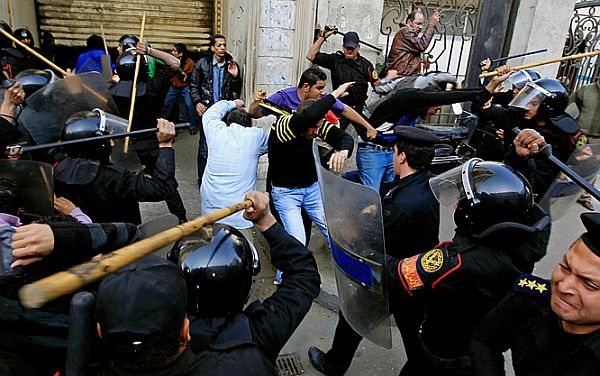
Police in both plain clothes and formal security uniforms were present by the thousands. Riot police were seen sleeping on, and manning, the 6 October and 15 May bridges – the main ones connecting main streets of the city — since last night. Hundreds of people gathered in several streets downtown chanting “People want the government down”, “Copts and Muslims don’t want this system”, and, “Bread, freedom, human integrity.” They were chased and beaten fiercely, many of them also dragged off by force – by thugs and state security agents.
Everywhere, the message was the same: “The people want the fall of the regime,” the protesters chanted as they marched over broken glass. On the Corniche, Cairo’s busy road along the Nile, protesters stopped traffic, setting a dumpster on fire and chanting “Down, Down Mubarak!” Moments later, they scattered after a charge by over a dozen plainclothes thugs, armed with sticks and knives, who chased them in between cars and onto a nearby bridge.
Throughout the evening, TIME’s Cairo reporter continued to hear reports of an impeding rally in the center of the city. And at around 11 p.m., a group of protesters attacked the Foreign Ministry, ransacking an outside office, before being pushed back.
The government released statements on Tuesday and Wednesday that sought to place much of the blame for Tuesday’s protest on Egypt’s largest opposition group, the banned Muslim Brotherhood. Activists who actually participated in the demonstrations say the allegation is bogus. “They’re trying to play the same old cards — by threatening the West and the United States that when this regime leaves power, the Muslim Brotherhood will take over. This is absolutely not true,” says Shadi Taha, a member of the liberal Tomorrow Party, whose leader Ayman Nour — a darling of the Bush administration — was on the street on Tuesday. “What we witnessed yesterday was that more than 90% of those people who took to the streets… it was probably their first time to demonstrate. We used to call them the silent majority — the majority that is not involved in politics, who have never been involved in politics, and who definitely are not involved in the Muslim Brotherhood.”
On October 2, 2009, the UN Human Rights Council was widely expected to pass a resolution supporting the Goldstone Report, the UN’s probe of war crimes committed during Israel’s war in Gaza in December 2008 and January 2009.
The Council instead agreed to delay a vote on the report until March 2010, following major reservations expressed by the Palestinian Authority, the United States and Israel.
A UNHRC endorsement of the report would have brought Israeli officials one step closer to prosecution before a war crimes tribunal, an event many Palestinians were anxious to see.
But, as The Palestine Papers reveal, the Palestinian Authority apparently sacrificed a potential victory for Palestinian victims in exchange for favorable assurances on negotiations from the United States and, they hoped, from Israel.
The latest announcement of diplomatic recognition of Palestine means that governments representing 304 million out of South America’s 386 million people have joined the international movement pressing for the creation of a fully sovereign Palestinian state.
Peru last night announced it recognises Palestine as a state, becoming the seventh South American country to do so in a rapid diplomatic domino effect which has alarmed Israel.
The declaration came on the eve of a Latin American-Arab summit to be hosted in the Peruvian capital, Lima, reflecting growing political and economic ties between the two regions.
“Palestine is recognised as a free and sovereign state,” Peru’s foreign minister, José Antonio García Belaúnde, told RPP radio. “There was no pressure from any side. We have acted with freedom and independence.” He expressed Peru’s continued support for peace talks.
The announcement followed similar decisions by Argentina, Bolivia, Brazil, Chile, Ecuador and Guyana in recent weeks, bolstering Palestinian hopes of momentum towards global recognition.
It came as a chink of good news for Palestinians amid controversy and despair over leaked peace talks documents showing negotiators’ apparent weakness in dealings with Israel and the US.
The most significant thing about today’s protests across Egypt is that their scale was totally unexpected. Yes, there has been a wave of protests since late 2004. But none have been nationwide to this extent, and none have been as big. We still do not have a clear picture of what transpired in much of the country, and media focus tended to be on the main protest in Cairo’s Midan Tahrir. But that is enough to know that these may be the biggest protest movement since at least the 1977 bread riots and perhaps even the biggest since the 1950s.
It was not predictable, just like Tunisia, because it was an unknown unknown — we did not know that the threshold for such an event had been reached, partly because previous protests had fizzled out or were effectively contained by the regime . While we (here I mean the press, analysts, and activists) knew many Egyptians were tired of the current state of affairs, we did not know that an external change (what happened in Tunisia) could have this kind of impact on a country that, after all, has been protesting for years and that is nowhere as repressive and controlled as Tunisia was under Ben Ali. I suspect the staggering effrontery of the regime during December’s parliamentary elections and the moment of national unity after the New Year’s Eve January bombing also played a role. A significant number of Egyptians simply do not find the regime credible anymore, and hold it responsible for much of the deterioration of the country — in terms of the socio-economic situation, sectarian relations, and political accountability. Today, a red line has been irrevocably crossed, a barrier of fear transcended.
The Palestine Papers provide unprecedented access into the internal workings of the U.S.-brokered Israeli-Palestinian negotiating process. But the leaked documents and meetings also touch on other key issues surrounding U.S. intervention in the conflict – including dozens of documents on Palestinian security issues. At the heart of these is the work of the Office of the U.S. Security Coordinator (USSC), what many refer to as “The Dayton Mission,” – a designation derived from the USSC’s chief, Lt. General Keith Dayton, who retired last October. Among other things they confirm – from Dayton’s own mouth – that Palestinian Authority forces supported by the United States engaged in torture.
The establishment of the USSC – its mandate and purpose — is fraught with misunderstandings. The first is that U.S. military officers are training Palestinian security personnel. That’s not true. Palestinian security personnel were initially trained by American contractors (in this case, Dyncorp) – the same kind of contractors who have given the U.S such problems in Iraq. Later, these private contractors were joined by trainers provided by the Jordanian Public Security Directorate. While the facilities for the training (located outside of Amman) are provided by the United States, the Palestinian trainees were (and are) equipped by the Egyptians.
While the now-retired Dayton was a senior three-star military officer (he was preceded by General William Ward and has been succeeded General Michael Moeller), he never reported through a military chain of command. Rather, he reported directly to the Secretary of State – first to Condoleezza Rice, under the Bush administration and, later, to Hillary Clinton, under President Barack Obama. There are a number of reasons for this, not the least of which is that his mission is controversial among senior Pentagon officers, who argue that a U.S. training mission (whose goal is to create a military force that cooperates with Israel), will raise serious objections among Arabs. As a U.S. Army colonel told me in 2009: “This is just a stupid idea – it makes us look like we’re an extension of the Israeli occupation.” This of course is a view that many Palestinians, including Hamas, also take.
British intelligence helped draw up a secret plan for a wide-ranging crackdown on the Islamist movement Hamas which became a security blueprint for the Palestinian Authority, leaked documents reveal. The plan asked for the internment of leaders and activists, the closure of radio stations and the replacement of imams in mosques.
The disclosure of the British plan, drawn up by the intelligence service in conjunction with Whitehall officials in 2004, and passed by a Jerusalem-based MI6 officer to the senior PA security official at the time, Jibril Rajoub, is contained in the cache of confidential documents obtained by al-Jazeera TV and shared with the Guardian. The documents also highlight the intimate level of military and security cooperation between Palestinian and Israeli forces.
The bulk of the British plan has since been carried out by the West Bank-based PA security apparatus which is increasingly criticised for authoritarian rule and human rights abuses, including detention without trial and torture.
The British documents, which have been independently authenticated by the Guardian, included detailed proposals for a security taskforce based on the UK’s “trusted” Palestinian Authority contacts, outside the control of “traditional security chiefs”, with “direct lines” to Israel intelligence.
Many have questioned why the European Union failed to provide an independent view to that of the United States on Middle East policy during the last decade. It is not a simple question to answer. Partly the EU failed to assert its voice because, at the beginning of the decade, it was scrambling to contain the impact of inflating US hubris, fuelled by the defeat of Saddam Hussein. Partly it was also a simple reflection of most European politicians’ dependency on Washington. But the release of The Palestine Papers provides another answer.
They show how Tony Blair in particular had so undercut the political space, that there was effectively no room for it. In a secret policy switch in 2003, he tied the UK and EU security policy into a major American counter-insurgency (COIN) ‘surge’ in Palestine.
It was an initiative that would bear a heavy political cost for the EU in 2006, and for years to come, when Hamas won parliamentary elections by a large majority. The EU’s claims for democracy have rung hollow ever since. Blair’s ‘surge’ also left the EU exposed as hypocrites: On a political level, for example, the EU might talk about its policy of fostering reconciliation between Palestinian factions, but at the security plane, and in other ways, the EU was pursuing the polar opposite objectives.
In 2003, US efforts to marginalize President Arafat by leeching away his presidential powers into the embrace of Prime Minister Mahmoud Abbas, collapsed. Arafat dismissed Abbas as PM. This was a blow to the US policy which – even then – was focused on creating a ‘de-Fatah-ised’ Palestinian Authority. Bush complained to Blair bitterly about Abbas’ dismissal: the Europeans still were ‘dancing around Arafat’ – leaving the US to ‘do the heavy lifting’ with the Israelis. Europeans were not pulling their weight in the ‘war on terror’, Bush concluded.
Blair’s COIN surge was his response to Bush: The Palestine Papers reveal ‘a security drive’ with the objective of “degrading the capabilities of the rejectionists: Hamas, PIJ [Palestinian Islamic Jihad], and the Al Aqsa Brigades – through the disruption of their leaderships’ communications and command and control capabilities; the detention of key middle-ranking officers; and the confiscation of their arsenals and financial resources held within the Occupied Territories. US and – informally – UK monitors would report both to Israel and to the Quartet. We could also explore the temporary internment of leading Hamas and PIJ figures”.
U.S. military officials tell NBC News that investigators have been unable to make any direct connection between a jailed army private suspected with leaking secret documents and Julian Assange, founder of the whistleblowing website WikiLeaks.
The officials say that while investigators have determined that Manning had allegedly unlawfully downloaded tens of thousands of documents onto his own computer and passed them to an unauthorized person, there is apparently no evidence he passed the files directly to Assange, or had any direct contact with the controversial WikiLeaks figure.
Meanwhile, the latest of the Doha Debates revealed overwhelming support for WikiLeaks among young Arabs:
Arab youth have overwhelmingly embraced the WikiLeaks phenomenon and told their governments to stop lying to them.
In the latest Doha Debate an audience of mostly Arab and Muslim students supported the motion: This House believes the world is better off with Wikileaks, by a margin of 74 to 26 percent.
The highly-charged debate was held weeks after the whistle-blowing website published confidential US diplomatic cables, exposing official corruption in several Middle East states and a yawning gap between the private and public positions of Arab rulers on Iran.
A student won instant applause when he said: “I would rather live in a world where I am told the truth than in a world where I am told lies”. Another female student from Qatar asked: “Is it really that wrong to know the truth?”
Two Egyptians have died after a wave of unusually large anti-government demonstrations swept across the country.
The two died in the eastern city of Suez, according to the Reuters news agency. The report did not detail how or when they died.
Thousands of Egyptians have taken to the streets in demonstrations, reportedly the largest in years, that they have explicitly tied to the successful uprising in nearby Tunisia.
On Tuesday night, hours after the countrywide protests began, the interior ministry issued a statement blaming the Muslim Brotherhood, Egypt’s technically banned but largest opposition party, for fomenting the unrest.
Inspired by events in Tunisia, thousands of protesters gathered in Cairo and elsewhere, calling for reforms and demanding an end to the presidency of Hosni Mubarak, which has now lasted for nearly three decades.
The demonstrations prompted US secretary of state Hillary Clinton to assert during a press conference that “Egypt’s government is stable.”
Mikati “is seen as a genuinely neutral figure,” said Amal Saad-Ghorayeb, a research adviser at the Doha Institute in Qatar. He “is balanced and enjoys good relations with Syria and Saudi Arabia,” the two main powerbrokers in Lebanon, she said.
Syria, Hezbollah’s backer, was initially blamed for Hariri’s killing by many Lebanese, and withdrew its troops from the country following a wave of protests. Both Syria and Hezbollah have denied responsibility for the murder.
Hassan Nasrallah, Hezbollah’s leader, said in a televised speech yesterday that his group and its allies will seek to form a national unity government if their candidate wins the nomination.
Hezbollah backed Mikati when he was premier for three months in a caretaker government before the 2005 parliamentary elections. The group’s initial choice for the premiership this time was Omar Karami, 76, a pro-Syrian politician. Karami declined to be nominated citing his age and health, Hamdan said.
Mikati, from the northern city of Tripoli, is worth $2.5 billion according to Forbes magazine. He founded Investcom, which runs phone networks in emerging markets, with his brother, Taha, in 1982. MTN Group Ltd., Africa’s largest mobile-phone operator, bought the company in 2006 for $5.5 billion.
Mikati called for “solidarity to bring the country out of this severe crisis,” and said his candidacy isn’t “a challenge to anyone,” according to a statement on his website.
Foreign protests, boycotts, embargoes and sanctions, along with internal resistance, helped bring about the isolation and eventually the end of apartheid in South Africa in the 1990s.
Now Israelis fear pro-Palestinian, or anti-Israeli, activists are using the same tactics against their country, with increasing effect.
Carlos Santana, Gil Scott Heron, Elvis Costello, Gorillaz Sound System, the Klaxons, the Pixies, Faithless, Leftfield, Tindersticks, Meg Ryan and film director Mike Leigh have all decided not to go to Israel in recent months.
Some older, established acts — Paul McCartney, Elton John and Rod Stewart among them — have ignored boycott pressure.
The activist website boycottisrael.info keeps count.
Israeli analysts say pressure is brought to bear on artists by a global “delegitimisation network.”
White South Africa was ostracized in a campaign lasting years. Today, Facebook and Twitter can flash protest messages globally in seconds, putting pressure on entertainers to stay away from Israel, and drawing the attention of millions of fans.
The intent of the anonymous Internet video was unambiguous: “This person should be killed — and soon,” read a message underneath a photo of Israel’s deputy state prosecutor, Shai Nitzan.
His alleged offense? “Betraying” his Jewish roots by opening a criminal inquiry into racist threats and hate speech expressed on two Israel-based Facebook pages with statements in Hebrew such as “Death to Arabs.”
It was the latest, and most overtly violent, sign of what many here are calling a wave of intolerance toward people of different races, religions, orientations and viewpoints.
From rabbinical prohibitions against renting homes to “non-Jews” to government crackdowns on left-wing activists, Israelis are grappling with their nation’s identity and character.
Across the political spectrum, some see the struggle as a threat to Israel’s democratic ideals. Opposition leader Tzipi Livni, of the centrist Kadima party, warned that “an evil spirit has been sweeping over the country.” Defense Minister Ehud Barak said a “wave of racism is threatening to pull Israeli society into dark and dangerous places.”
The Tunisian army general who refused to back president Zine al-Abdine Ben Ali’s crackdown on protesters warned on Monday that a political vacuum could bring back dictatorship and vowed to protect the revolution.
“Our revolution is your revolution. The revolution of the youth could be lost and could be exploited by those who call for a vacuum,” General Rashid Ammar told crowds outside the prime minister’s office, where protesters have demanded the fall of the interim government. “The army will protect the revolution.”
One of the more astonishing revelations in The Palestine Papers — detailed records and minutes of the Middle East peace process leaked to Al Jazeera — is that the administration of US President Barack Obama effectively repudiated the Road Map, which has formed the basis of the “peace process” since 2003. In doing so it has backed away even from commitments made by the George W. Bush administration and blown an irreparable hole in the already threadbare “two-state solution.”
But even worse, the US position perhaps unwittingly opens the door to dangerous Israeli ambitions to transfer — or ethnically cleanse — non-Jewish Palestinian citizens of Israel in order to create an ethnically pure “Jewish state.”
Al Jazeera’s release of The Palestine Papers helps to make clear why there is no Palestinian state. It illuminates a key flaw in Palestinian and western understanding of Israeli thinking. It is this flaw which helps explain why a state has failed to emerge – despite the many, many opportunities in the last nineteen years in which it could have.
The root premise has been, since the outset of the ‘process’, that Israel was intent on having and maintaining a Jewish ‘majority’ within Israel, and that with time – and a growing Palestinian population – Israel would have to acquiesce to a Palestinian state simply to maintain its Jewish majority: that is, by losing Palestinians into their own state, Israel’s Jewish majority could be conserved – and by these means, and only by such means, finally could such a majority be conserved.
It is a very compelling narrative. It suggested that a Palestinian state was inevitable: Palestinians simply had to ‘prove’ their readiness to assume statehood to Israel – and a state would be given them.
Professor Mushtaq Khan from London’s School of Oriental and African Studies argued in a recent talk that it was precisely this type of analysis that lay behind Fatah’s approach to Oslo. It explains, he argues, why the Palestinian leadership at this time never made real attempts to create serious bargaining power vis-à-vis Israel: the leadership simply did not think it necessary. They saw their task to be ‘confidence building’ with the Israelis.
“The Obama way”:
4.29: At a moment when the success of the Tunisian revolution is sending a message across the region about the effectiveness of people’s power and arousing renewed hope for the restoration of lost dignity, the image of Palestinian negotiators ingratiating themselves before Israeli ministers, strikes a very discordant note.
When Ahmed Qurei, a former Palestinian prime minister, told Israel’s foreign minister Tzipi Livni that, “I would vote for you,” he might have been joking, but such a fawning expression of admiration for a minister who so strongly supported the slaughter of Palestinians in Gaza, exposes the Palestinian leadership in the worst possible light.
3.30: Mark Perry and Ali Abunimah describe how the Obama administration, contrary the image it presented as being willing to put pressure on the Netanyahu government, has in fact never swerved from the role of acting as “Israel’s lawyer”:
A series of six key documents dating from February of 2009 – a core element of the confidential memos, monographs and meeting notes leaked to Al Jazeera as part of The Palestine Papers – show that George Mitchell and his coordinating team, as well as Secretary of State Hillary Clinton, have consistently pressured Palestinian negotiators (and in particular chief negotiator Saeb Erekat) to accept Israeli demands on a host of core negotiating issues.
In addition, the documents show that the United States has been willing to ignore and even abandon key agreements and principles that, in years past, it insisted both parties follow. The evidence for this, in the documents, is compelling – even overwhelming. It explodes the idea that the Obama administration ever even attempted to pull the United States off a doomed course.
The evidence that America remains Israel’s lawyer emerges first in the account of a February 27, 2009 meeting between Mitchell and key members of his team, with Saeb Erekat (and a top assistant) at the U.S. Consulate in Jerusalem.
During several 2008 meetings with Palestinian negotiators, Livni proposed annexing Arab villages to the future Palestinian state, forcing tens of thousands of Israeli Arabs to choose between their citizenship and their land.
“The US position on borders perhaps unwittingly opens the door to dangerous Israeli ambitions to transfer — or ethnically cleanse — non-Jewish Palestinian citizens of Israel in order to create an ethnically pure ‘Jewish state.'”
Her clearest language came on June 21, 2008, when she told senior Palestinian negotiators Ahmed Qurei and Saeb Erekat that their land swaps should include Israeli Arab villages. Udi Dekel, a top adviser to the then-Israeli prime minister Ehud Olmert, rattled off a list of villages that would be annexed to Palestine.
Livni: We have this problem with Raja [Ghajar] in Lebanon. Terje Larsen put the blue line to cut the village in two. [This needs to be addressed.] We decided not to cut the village. It was a mistake. The problem now, those living on Lebanese soil are Israeli citizens.
Dekel: Barka, Barta il Sharqiya, Barta il [Garbiya], Betil, Beit Safafa…
Qurei: This will be difficult. All Arabs in Israel will be against us.
Becker: We will need to address it somehow. Divided. All Palestinian. All Israeli.
Two months earlier, in another meeting with Qurei and Erekat, Livni herself mentioned the same villages, describing them – their status in the state of Israel – as a problem in need of resolution.
Livni: Let us be fair. You referred to 1967 line. We have not talked about Jerusalem yet. There are some Palestinian villages that are located on both sides of the 1967 line about which we need to have an answer, such as Beit Safafa, Barta’a, Baqa al-Sharqiyeh and Baqa al-Gharbiyyeh.
Livni’s choice of words is striking. Beit Safafa, Barta’a and Baqa al-Gharbiyya all sit at least partly on the Israeli side of the Green Line; their inhabitants carry Israeli passports, pay taxes to the Israeli government, and overwhelmingly self-identify as Israelis.
But Livni describes them as Palestinians – and suggests that they do not belong in the state of Israel.
2.19: It has long been understood that a negotiated agreement between Israelis and Palestinians would involve so-called “land swaps” through which some of the occupied territory outside Israel’s 1967 borders on which Jewish settlements have been constructed would become part of Israel, in exchange for areas of land within the ’67 borders that would become part of the new Palestinian state.
The following exchange between Israeli and Palestinian negotiators during a meeting held on March 12, 2008, makes it clear that the Israelis do not even recognize the existence of the 1967 line. Keep in mind that these were negotiators representing the so-called moderate government of Ehud Olmert.
The following Israeli [I] and Palestinian [P] negotiators attended the meeting: Israeli: Udi Dekel [UD] and Dani Tirza [DT]; Palestinian: Dr. Samih Al-Abed [SA], Khaled Elgindy [KE], Nizar Farsakh [NF].
Udi Dekel [I]: Now, about today’s meeting, I don’t know what Abu Alaa and [Tzipi] Livni agreed but, as I understand it, we need to agree on a common language when it comes to territory and borders. From your side, I know there was discussion of percentages, or areas (in sq. km)… In the previous two meetings with Abu Alaa and Livni, we started to explain all the considerations of what we mean when we talk of territory and borders.
SA [P]: You are jumping directly into discussing areas. We need to discuss parameters or guidelines. You spoke of sq. km, but we already have a starting point, which is 1967. We just need to have all the maps. This is what we need for a breakthrough. We must have a common language, agree on common maps and data, and then we can have a discussion about the issues.
UD [I]: As you know, our guiding principles are UNSC Res. 242, the need for boundaries that can provide security for Israel, and we’re talking about the situation on the ground, as per Pres. Bush’s letter.
SA [P]: Do you mean the situation as it was then, or now?
UD [I]: Reality now… But we’re not going to argue. We can’t change reality on the ground. We don’t see the 1967 border as a reference, first because we don’t even know exactly where the line is.
SA [P]: We have all the maps that were signed by you.
UD [I]: But that wasn’t exactly the line on the ground.
SA [P]: If not the 1967 line, then what is your reference?
UD [I]: We said already, the situation on the ground.
SA [P]: The wall?
UD [I]: The security fence is not a border. Unfortunately, it is needed for security. Every week we intercept 3 to 4 suicide bombers. As we’ve said before, the fence is not a border and can be moved like we did with Lebanon.
NF [P]: What is your frame of reference?
UD [I]: We’re talking about blocs of settlements—not far in the West Bank, but close to the area we are talking about—are to be part of Israel. In Oslo we used the West Bank outline map.
DT [I]: It is the West Bank outline map, in which under our law Israeli military law is applied.
SA [P]: This is your law. In our law, the line is 1967.
DT [I]: Based on which maps? There is no…
SA [P]: This is the standard we’ve worked from, from Oslo to Taba… we are not going to discuss any other line. If we’re going to waste time this is something else.
UD [I]: This is your opinion, but not our opinion. It is very difficult to locate the exact line of the situation that existed on 4 June 1967.
1.54: This is one of those days when a lot of American journalists must know what it felt like being a native journalist in the Soviet Union — never allowed to swerve from the official line. At the Los Angeles Times, Edmund Sanders yawns: “The documents so far haven’t revealed anything that someone moderately familiar with the Mideast hasn’t already heard.”
12.19: Amjad Atallah suggests that the release of the Palestine Papers “may have the same emotive impact among Palestinians that the suicide of Mohamed Bouazizi had in Tunisia” — another event in which Al Jazeera‘s groundbreaking news coverage played a key role.
WikiLeaks’ data dump of U.S. diplomatic records; the demonstrations in Tunisia, Algeria, Egypt, Jordan, and Yemen; and Hezbollah’s success in Lebanon have created an atmosphere of empowerment among a normally dispirited Arab public. Change is no longer impossible — and the United States no longer needs to be the agent of change.
This means there may be more exhibitions of “people power” with unpredictable consequences. The Arab authoritarian systems (most with the support of the U.S. government) are ill-equipped to deal positively with this type of demand for change.
Different forces in the region will now begin to see how they can take advantage for good or bad from this new reality. Unfortunately, if the United States stays true to form, we’ll simply struggle to see whether we can maintain the status quo.
In other words, President Obama is likely to yet again act as an obstacle, not an instrument of change in the world.
11.59: Noam Sheizaf assesses the effect of the Palestine Papers on the Israeli side.
Prime Minister Netanyahu will probably not suffer any damage on the home front, at least in the short term. Netanyahu might even use the papers to claim that his government’s construction projects in occupied East Jerusalem pose no threat to the peace process, since the Palestinians have already agreed to give up most of the Jewish neighborhoods in this part of the city.
The Israeli government would also benefit from a renewal of the internal war on the Palestinian side. For years, Israel has tried (and for the most part, succeeded) to break Palestinian society into sub-groups with different political interests and agendas. When those groups fight each other, the Palestinian cause suffers.
Yet from a wider perspective, the release of the Palestinian offers during the 2008 talks serves as proof that Israel in fact had a partner for peace on the Palestinian side. Actually, the question from now on will be whether Israel itself is a partner for an agreement. Furthermore, after the steps Palestinian and Israeli negotiators took towards each other in previous rounds of talks, the current Israeli offers, such as a temporary state on half of the West Bank’s territory, will appear cynical and unrealistic.
For years, Israel has used the peace process as a way to hold back international pressure on the Palestinian issue. It will be harder to do so from now on. This will be Netanyahu’s greatest problem.
11.47: Rashid Khalidi on Democracy Now!: Leaked “Palestine Papers” underscore weakness of Palestinian Authority, rejectionism of Israel and U.S.
“The biggest Yerushalayim in Jewish history”
11.35: In the Financial Times [registration required], Nadia Hijab writes:
When, some 30 years on, the late Palestinian leader Yasser Arafat returned from the failed Camp David summit in 2000, he was excoriated by the US and Europe for rejecting Israel’s “generous offer”. By contrast, many Palestinians heaved a sigh of relief that Mr Arafat had refused to sign an agreement that would have ceded Jerusalem, and trisected the West Bank.
Now these new leaks reveal that it is the PLO/PA that has been making the generous offers, and Israel has been rejecting them. If the documents are to be believed, almost all of East Jerusalem has been on the table. Perhaps this time we should be grateful Israel hasn’t signed.
What next? The Palestinian leadership have two plausible options, but will likely take neither.
The first would to be attempt to retake the high ground. This would mean dissolving the PA, and refocusing its attention on the PLO’s primary task – the liberation of Palestine. This would also involve repairing relations with Hamas, and trying to bring all Palestinian political and civil forces into a rejuvenated organisation.
The second is to continue down the road of hoping that someone, somewhere will exert pressure on Israel to give up the occupied territories and recognise Palestinian rights.
10.56: The Guardian describes anger and disbelief among Palestinians in Gaza reacting to the release of the Palestine Papers:
Tailor Maher Mohammad, 50, said the revelations were incredible. “I couldn’t believe my eyes when I watched it, this is cheating to Palestinian people. Jerusalem is a holy land, nobody can make concessions regarding it because it’s not for Palestinians only but for all Muslims.”
Mahmoud Ismael, 58, a shopkeeper, questioned the motives of the person who leaked the documents. Palestinians, he added, expected little from their leaders whether Fatah or Hamas. “Both of them don’t care about Palestine, they care only about their benefits,” he said.
Salah Bardaweel, a senior Hamas leader, said the organisation was studying the document. “We are asking the president Mahmoud Abbas to go to the public and announce his position on what was leaked by Al Jazeera, and make it clear we don’t accept that and assure the Palestinian principles on the key issues.”
The main problem now, he added, was “not between Hamas and Fatah, it’s now between the Palestinian people and the Palestinian negotiator”.
10.03: Palestinian chief negotiator Saeb Erekat accused of treason:
9.23: Some Palestinians who don’t like the message have attacked the messenger. AJ’s Alan Fisher tweets: “The crowd has managed to get into the office in Ramaallah. #aljazeera’s staff is ok. Some walls have graffiti”. Fisher nows says the crowd has gone and the AJ building is under police protection.
[The British member of parliament] Gerald Kaufman once described Labour’s 1983 manifesto as the longest suicide note in history. If ever a set of documents merits this epithet, it is surely the one we publish today. Written by Palestinian officials, obtained by al-Jazeera and shared with the Guardian, the papers are the confidential record of 10 years of efforts to seek a peace agreement with Israel.
It is hard to tell who appears worst: the Palestinian leaders, who are weak, craven and eager to shower their counterparts with compliments; the Israelis, who are polite in word but contemptuous in deed; or the Americans, whose neutrality consists of bullying the weak and holding the hand of the strong. Together they conspire to build a puppet state in Palestine, at best authoritarian, at worst a surrogate for an occupying force. To obtain even this form of bondage, the Palestinians have to flog the family silver. Saeb Erekat, the PLO chief negotiator, is reduced at one point to pleading for a fig leaf: “What good am I if I’m the joke of my wife, if I’m so weak,” he told Barack Obama’s Middle East envoy George Mitchell.
9.12: AJ’s Clayton Swisher outlines the land swap agreement that Palestinian negotiators were offering — a swap that would be like exchanging real estate in Manhattan for vacant desert lots in Arizona:
9.05: Tariq Ali says that the extent of the capitulation documented in the papers would have shocked even Edward Said, who at its inception described the Oslo peace process as a ‘Palestinian Versailles’:
Even he would have been taken aback by the sheer scale of what the PLO leadership agreed to surrender: virtually everything except their own salaries. Their weaknesses, inadequacies and cravenness are now in the public domain.
Now we know that the capitulation was total, but still the Israeli overlords of the PLO refused to sign a deal and their friends in the press blamed the Palestinians for being too difficult. They wanted Palestine to be crushed before they would agree to underwrite a few moth-eaten protectorates that they would supervise indefinitely. They wanted Hamas destroyed. The PLO agreed. The recent assault on Gaza was carried out with the approval of Abbas and Hosni Mubarak in Egypt, not to mention Washington and its EU. The PLO sold out in a literal sense. They were bought with money and treated like servants. There is TV footage of Ehud Barak and Bill Clinton at Camp David playfully tugging at Arafat’s headgear to stop him leaving. All three are laughing. Many PLO supporters in Palestine must be weeping as they watch al-Jazeera and take in the scale of the betrayal and the utter cynicism of their leaders. Now we know why the Israel/US/EU nexus was so keen to disregard the outcome of the Palestinian elections and try to destroy Hamas militarily.
9.00: Haaretz‘s Akiva Eldar says Palestine Papers trump US State Department cables released by WikiLeaks:
The documents revealed by Al Jazeera are much more important than the documents recently released by WikiLeaks. The former document the talks that took place in 2008 between the head of the Palestinian negotiating team and then Foreign Minister Tzipi Livni, as well as with American officials, which is not just a chapter in history.
The compromises presented by the Palestinians vis-a-vis permanent borders in the West Bank and East Jerusalem are relevant to today. The Palestinian map that was shown to Ehud Olmert and representatives of the Bush administration was presented again two months ago to representatives of President Barack Obama, as well as Obama’s Mideast envoy George Mitchell and later Netanyahu’s representative Isaac Molcho. Molcho refused to accept the document.
The leaked documents completely discredit the claim that there is “no peace partner” made by the leader of the newly formed Atzmaut faction, Ehud Barak, and his boss, Benjamin Netanyahu.
8.53: Al Jazeera interviews Abdel Bari Atwan, Editor Al-Quds Al-Arabi
Over the last several months, Al Jazeera has been given unhindered access to the largest-ever leak of confidential documents related to the Israeli-Palestinian conflict. There are nearly 1,700 files, thousands of pages of diplomatic correspondence detailing the inner workings of the Israeli-Palestinian peace process. These documents – memos, e-mails, maps, minutes from private meetings, accounts of high level exchanges, strategy papers and even power point presentations – date from 1999 to 2010.
The material is voluminous and detailed; it provides an unprecedented look inside the continuing negotiations involving high-level American, Israeli, and Palestinian Authority officials.
Al Jazeera will release the documents between January 23-26th, 2011. They will reveal new details about:
the Palestinian Authority’s willingness to concede illegal Israeli settlements in East Jerusalem, and to be “creative” about the status of the Haram al-Sharif/Temple Mount;
the compromises the Palestinian Authority was prepared to make on refugees and the right of return;
details of the PA’s security cooperation with Israel;
and private exchanges between Palestinian and American negotiators in late 2009, when the Goldstone Report was being discussed at the United Nations.
In The Guardian, Seumas Milne and Ian Black write:
The overall impression that emerges from the documents, which stretch from 1999 to 2010, is of the weakness and growing desperation of PA leaders as failure to reach agreement or even halt all settlement temporarily undermines their credibility in relation to their Hamas rivals; the papers also reveal the unyielding confidence of Israeli negotiators and the often dismissive attitude of US politicians towards Palestinian representatives.
Last night Erekat said the minutes of the meetings were “a bunch of lies and half truths”. Qureia told AP that “many parts of the documents were fabricated, as part of the incitement against the … Palestinian leadership”.
However Palestinian former negotiator, Diana Buttu, called on [chief Palestinian negotiator, Saeb] Erekat to resign following the revelations. “Saeb must step down and if he doesn’t it will only serve to show just how out of touch and unrepresentative the negotiators are,” she said.
In an article on the origin of the documents, The Guardian reported:
The bulk of the documents are records, contemporaneous notes and sections of verbatim transcripts of meetings drawn up by officials of the Palestinian negotiation support unit (NSU), which has been the main technical and legal backup for the Palestinian side in the negotiations.
The unit has been heavily funded by the British government. Other documents originate from inside the PA’s extensive US- and British-sponsored security apparatus.
The Israelis, Americans and others kept their own records, which may differ in their accounts of the same meetings. But the Palestinian documents were made and held confidentially, rather than for overt or public use, and significantly reveal large gaps between the private and stated positions of Palestinian and, in fewer cases, Israeli leaders.
The documents – almost all of which are in English, which was the language used by both sides in negotiations – were leaked over a period of months from several sources to Al Jazeera. The bulk of them have been independently authenticated for The Guardian by former participants in the talks and by diplomatic and intelligence sources.
The NSU – formally part of the Palestine Liberation Organisation (PLO) – is based in the West Bank town of Ramallah under the chief Palestinian negotiator, Saeb Erekat. It has drawn heavily on the expertise of Palestinian-American and other western-trained diaspora Palestinian lawyers for technical support in negotiations.
Al Jazeera has made the complete searchable database of the documents available on its new Transparency Unit site.
It’s over. Given the shocking nature, extent and detail of these ghastly revelations from behind the closed doors of the Middle East peace process, the seemingly endless and ugly game is now, finally, over. Not one of the villains on the Palestinian side can survive it. With any luck the sheer horror of this account of how the US and Britain covertly facilitated and even implemented Israeli military expansion – while creating an oligarchy to manage it – might overcome the entrenched interests and venality that have kept the peace process going. A small group of men who have polluted the Palestinian public sphere with their private activities are now exposed.
For us Palestinians, these detailed accounts of the secretly negotiated surrender of every one of our core rights under international law (of return for millions of Palestinian refugees, on annexing Arab Jerusalem, on settlements) are not a surprise. It is something that we all knew – in spite of official protests to the contrary – because we feel their destructive effects every day. The same is true of the outrageous role of the US and Britain in creating a security bantustan, and the ruin of our civic and political space. We already knew, because we feel its fatal effects.
For the overwhelming majority of Palestinians, official Palestinian policy over these past decades has been the antithesis of a legitimate, or representative, or even coherent strategy to obtain our long-denied freedom. But this sober appreciation of our current state of affairs, accompanied by the mass protests and civil society campaigns by Palestinian citizens, has been insufficient, until now, to rid us of it.
The release into the public domain of these documents is such a landmark because it destroys the final traces of credibility of the peace process. Everything to do with it relied upon a single axiom: that each new initiative or set of negotiations with the Israelis, every policy or programme (even the creation of undemocratic institutions under military occupation), could be presented as carried out in good faith under harsh conditions: necessary for peace, and in the service of our national cause. Officials from all sides played a double game vis-à-vis the Palestinians. It is now on record that they have betrayed, lied and cheated us of basic rights, while simultaneously claiming they deserved the trust of the Palestinian people. [Continue reading…]
This website or its third-party tools use cookies, which are necessary to its functioning. By closing this banner, you agree to the use of cookies.