Author Archives: News Sources

Obama administration apparently complicit in the torture of an American teenager

Glenn Greenwald writes:

Gulet Mohamed is an 18-year-old American citizen whose family is Somalian. His parents moved with him to the U.S. when he was 2 or 3 years old, and he has lived in the U.S. ever since. In March, 2009, he went to study Arabic and Islam in Yemen (in Sana’a, the nation’s capital), and, after several weeks, left (at his mother’s urging) and went to visit his mother’s family in Somalia, staying with his uncle there for several months. Roughly one year ago, he left Somalia and traveled to Kuwait to stay with other family members who live there. Like many teenagers who reach early adulthood, he was motivated in his travels by a desire to see the world, to study, and to get to know his family’s ancestral homeland and his faraway relatives.

At all times, Mohamed traveled on an American passport and had valid visas for all the countries he visited. He has never been arrested nor — until two weeks ago — was he ever involved with law enforcement in any way, including the entire time he lived in the U.S.

Approximately two weeks ago (on December 20), Mohamed went to the airport in Kuwait to have his visa renewed, as he had done every three months without incident for the last year. This time, however, he was told by the visa officer that his name had been marked in the computer, and after waiting five hours, he was taken into a room and interrogated by officials who refused to identify themselves. They then handcuffed and blindfolded him and drove him to some other locale. That was the start of a two-week-long, still ongoing nightmare during which he was imprisoned for a week in an unknown location by unknown captors, relentlessly interrogated, and severely beaten and threatened with even worse forms of torture.

Facebooktwittermail

WikiLeaks: Israelis demanded bribes before allowing goods into Gaza

Reuters reports:

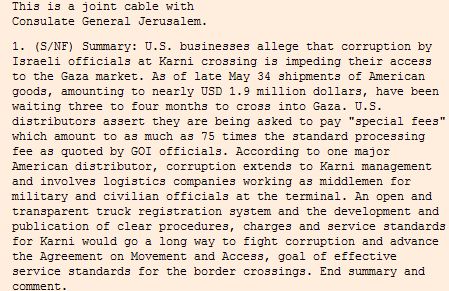
U.S. distributors accused Israel in 2006 of charging exorbitant fees to allow their goods into Gaza and an Israeli general admitted corruption existed at a major border crossing, a U.S. diplomatic cable shows.

The cable, obtained by WikiLeaks and published Thursday by the Norwegian newspaper Aftenposten, said frequent closures of the Karni crossing had “exacerbated the problem of access and appears to have forced up the cost of bribes” paid to Israelis.

The disclosures predate the 2007 armed takeover of the Gaza Strip, home to 1.5 million Palestinians, by Hamas Islamists hostile to the Jewish state. Israel has cited the Hamas threat in justifying a controversial blockade it has kept on Gaza, with Egyptian help.

“As of late May 34 shipments of American goods, amounting to nearly USD 1.9 million dollars, have been waiting three to four months to cross into Gaza,” said the cable, classified “secret” by the U.S. ambassador to Israel at the time, Richard Jones.

“U.S. distributors assert they are being asked to pay ‘special fees’ which amount to as much as 75 times the standard processing fee as quoted by GOI (Israeli government) officials.”

The cable quoted distributors for several U.S. companies complaining that payoffs were required to move their trucks to “a spot near the head of the so-called ‘Israeli line’,” which progressed more quicker to help Israelis supplying Palestinians.

“According to business contacts, allegations of corruption at Karni have a long history,” the cable said.

Facebooktwittermail

What Iranians really think

Abbas Milani writes:

The failure of American and British governments to predict the fall of the shah in 1979 was one of the biggest intelligence failures of the twentieth century. In the aftermath of that monumental mess, the British government ordered a policy review to learn what went wrong. They identified three main errors: inattention to the brutality of the regime’s secret police (SAVAK), insufficient knowledge of the corruption of the ruling elite and a lack of focus on the intellectual life of Iran.

Today, thirty years later, the dominant discourse on American policy toward Tehran often suffers from exactly the same three maladies. As the nuclear impasse with Iran continues, the new Republican majority in the House of Representatives is likely to pressure the Obama administration for harsher measures against the clerical regime, so the debate about the stability of the Iranian elite and the power of the opposition, and about what would be the right U.S. policy, is only likely to increase.

In the weeks before the policy of ending subsidies on food and petroleum was implemented, several leading security officials of the regime threatened the people with harsh punishment should they react to the new economic landscape. Lest anyone missed the message, and lest anyone did not hear about the prison sentences against leaders of the opposition, the regime also organized a major show of force in Terhan—a “security exercise,” they said—intended to remind the people of what might happen if they dared demonstrate against the new harsh reality. In the days after the implementation of the policy, every night President Ahmadinejad is reported to have convened special sessions with his cabinet to address or contain any problem. The regime was clearly worried that any small incident might act as a trigger that would once again lead to mass demonstrations.

Facebooktwittermail

Troubling trends in the Middle East

In an examination of the “five mostly troubling trends from 2010 that will probably define and plague the Middle East for the year ahead,” Rami G Khouri writes:

The transformation of the formerly localized Arab-Israeli conflict into the fulcrum of a much wider regional confrontation with strong religious overtones bodes ill for the region in the years ahead.

The Arab-Israeli conflict now anchors a much more violent and complex stand-off that sees some Arab states (notably Syria), Iran and powerful Arab Islamist resistance movements like Hamas and Hezbollah working together to repel not only Israeli territorial aggression, but what they see as wider American-Israeli hegemonic ambitions in the Arab-Islamic Middle East.

The narrow competing claims of Palestinians and Israelis in a small corner of the region have now transformed into a regional and quasi-global existential battle among powerful actors who seem prepared to fight to the finish.

Large regional and global conflicts will now more easily find local proxies to wage the battle, while local feuds will often escalate quickly into more fierce and intractable conflicts because of the association with foreign actors.

Facebooktwittermail

In Iraq, Turkey demonstrates the effectiveness of soft power

Anthony Shadid reports:

A Turkey as resurgent as at any time since its Ottoman glory is projecting influence through a turbulent Iraq, from the boomtowns of the north to the oil fields near southernmost Basra, in a show of power that illustrates its growing heft across an Arab world long suspicious of it.

Its ascent here, in an arena contested by the United States and Iran, may prove its greatest success so far, as it emerges from the shadow of its alliance with the West to chart an often assertive and independent foreign policy.

Turkey’s influence is greater in northern Iraq and broader, though not deeper, than Iran’s in the rest of the country. While the United States invaded and occupied Iraq, losing more than 4,400 troops there, Turkey now exerts what may prove a more lasting legacy — so-called soft power, the assertion of influence through culture, education and business.

“This is the trick — we are very much welcome here,” said Ali Riza Ozcoskun, who heads Turkey’s consulate in Basra, one of four diplomatic posts it has in Iraq.

Turkey’s newfound influence here has played out along an axis that runs roughly from Zakho in the north to Basra, by way of the capital, Baghdad. For a country that once deemed the Kurdish region in northern Iraq an existential threat, Turkey has embarked on the beginning of what might be called a beautiful friendship.

In the Iraqi capital, where politics are not for the faint-hearted, it promoted a secular coalition that it helped build, drawing the ire of Iraq’s prime minister, Nuri Kamal al-Maliki, along the way. For Iraq’s abundant oil and gas, it has positioned itself as the country’s gateway to Europe, while helping to satisfy its own growing energy needs.

Just as the Justice and Development Party of Prime Minister Recep Tayyip Erdogan has reoriented politics in Turkey, it is doing so in Iraq, with repercussions for the rest of the region.

Facebooktwittermail

Israeli media acting like North Korean media

Didi Remez, whose blog is Coteret, provides a translation of an interview with the Israeli human rights attorney, Micheal Sfard, who appeared on Israel Defense Forces Radio yesterday morning.

Niv Raskin, IDF Radio: Now we turn to the IDF investigation on the death of protester Jawaher Abu Rahma. According to the IDF investigation, senior officers say it’s a kind of fabrication. The Bilin protester didn’t die of [tear] gas inhalation; she was a cancer patient. We want to talk about this issue with the family’s lawyer, Attorney Michael Sfard.

Attorney Michael Sfard: The IDF didn’t publish, its court journalists did.

Raskin: What do you mean?

Sfard: What I mean is that no IDF officer was willing to talk on-record. The IDF Spokesperson didn’t even put out a communiqué. Everything was done through journalists. They weren’t presented with even one document. I have never encountered such crazy fabricated blood libel.

Raskin: With your permission, let’s review the facts, at least as they were published. First, according to the reports, according to the investigation conducted by the IDF, there was no report of a wounded woman on Friday. According to those officers, at least, this casts doubt over whether she was at the protest at all.

Sfard: Niv, I don’t know where to start. There’s almost no word, no letter, of truth in the sentence you just uttered. And the most terrible thing is that I don’t know how Israeli media, which had the extraordinary courage to topple a Prime Minister [Olmert – DR] over corruption, acts like the North Korean media when it’s about something the IDF wants to achieve. There isn’t even one substantiating foundation for any of the components you described. Jawaher was at the protest. Dozens of people saw her there. I spoke to eyewitnesses who were beside her at the protest. Jawaher collapsed at the protest. She wasn’t sick like the IDF Spokesperson said on Friday. She didn’t have cancer as he’s saying today.

Raskin: Those officers ask why there aren’t photos of her at the protest when there dozens of photos from it.

Sfard: Because the IDF shot so much gas, that it was everywhere in the village and people all over were affected by it. The IDF has to this day refused order the opening of an [official] investigation. How is it supposed to obtain the photos? The Judge Advocate General hasn’t, until this very moment, ordered the opening of an investigation. So, on the one hand, they don’t open an investigation. On the other hand, they come up with these fabrications. If the IDF invested a tiny fraction of the energy it’s investing in fabrications, in investigating itself, lives would be saved because the IDF would know where its action were wrong.

Raskin: Let’s, with your permission, try to return to factual issues. The gaps in the timeline. According to the Palestinian medical reports, a blood sample was taken from Abu Rahme 40 minutes before she even arrived at the hospital. How does that work?

Sfard: Look at what we’re discussing. Do you know how many medical files I’ve seen where, under the pressure of a life threatening incident, someone wrote 2 instead of 3? That’s what’s important? According to what the IDF is telling journalists and journalists are telling us, is that she was a cancer patient. Is there one [real] journalist at Yediot this morning? Can the senior reporters — Nahum Barnea, Shimon Shiffer and Sever Plocker — ask the reporters and editors if they have one document substantiating the claim that she had leukemia? This is a farce! If we find an incorrect noting of a time, do we absolve the IDF of responsibility for her death?

Raskin: You’re criticizing the media?

Sfard: Of course.

Raskin: I’m not sure that’s the correct address. Someone gave them this version. Those were senior officers. Another allegation, they say, is that her clothes didn’t smell of tear gas, contradicting the Palestinian claims. They [also] talk about a quiet funeral, not the kind they have for Shahids [martyrs in Arabic — DR] and that the Palestinians usually know how to leverage [these funerals] for a PR advantage and that didn’t happen this time.

Sfard: Hold on, I want to understand, are you serious? The IDF is claiming that because it was a quiet funeral, she died from an illness and not by its hands? Is that a serious argument? So the IDF’s proof that she wasn’t at the protest is that there wasn’t rioting [at the funeral]? Look what’s become of us! I have to prove that there was or wasn’t a smell on Jawaher’s clothes when the IDF won’t investigate the incident? The IDF is talking about some kind of examination conducted by its officers. These aren’t people who know how to investigate.

Raskin: To summarize, bottom line, you’re saying that she wasn’t sick?

Sfard: What the hell? What sickness? She had an ear problem. We..really…her ear problem. Yesterday I got 20 calls from 20 reporters requesting an explanation what kind of problem she had with her ear. Let’s assume she had an ear problem. Does she deserve to die at a protest for it?

Raskin: A couple of days ago we spoke to her uncle who was with her at the protest. He said she was suffering from a kind of asthma and that she had suffered from respiratory problems over the past few years. That means that you can’t say she a clean medical record. Not that means anything. But it’s an important thing to say.

Sfard: Look, Niv. I’m not a Palestinian. I’m an Israeli and you’re an Israeli. I want to tell you..why not put out an orderly communiqué saying: ‘This is a tragic incident and we will investigate it. We use tear gas and other non-lethal weapons precisely so things like this won’t happen. We’ll look into how this happened.’ Then task the military police with a serious investigation, because a protester has died. This is important because, if an Israeli protester dies, it won’t matter what illness he had, the police will investigate seriously.

Raskin: Attorney Michael Sfard, representing the Abu Rahme family, thanks for joining us. I’ll just point out in this context that in contrast to what Attorney Sfard says, the item on the IDF investigation appears in all the [Israeli] media and not just in Yediot Aharonot, which Sfard attacked.

Facebooktwittermail

WikiLeaks: Israel told US it would keep Gaza near collapse

Reuters reports:

Israel told U.S. officials in 2008 it would keep Gaza’s economy “on the brink of collapse” while avoiding a humanitarian crisis, according to U.S. diplomatic cables published by a Norwegian daily on Wednesday.

Three cables cited by the Aftenposten newspaper, which has said it has all 250,000 U.S. cables leaked to WikiLeaks, showed that Israel kept the U.S. Embassy in Tel Aviv briefed on its internationally criticized blockade of the Gaza Strip.

The territory, home to 1.3 million Palestinians, is run by the Islamist Hamas group, which is shunned by the West over its refusal to recognize Israel, renounce violence or accept existing interim Israeli-Palestinian peace deals.

“As part of their overall embargo plan against Gaza, Israeli officials have confirmed to (U.S. embassy economic officers) on multiple occasions that they intend to keep the Gazan economy on the brink of collapse without quite pushing it over the edge,” one of the cables read.

Israel wanted the coastal territory’s economy “functioning at the lowest level possible consistent with avoiding a humanitarian crisis,” according to the November 3, 2008 cable.

Facebooktwittermail

Why think tanks attract sycophantic opportunists

Benjamin H. Friedman lists the reasons think tank analysts lack intellectual independence. Think tanks are shaped by five forces creating political bias:

The first is institutional funding. If you take government or industry money, you will hesitate to undertake research that offends your sponsors. Many people see foundations as somehow cleaner money, but they too have agendas. Even those of us that rely on donations from many individuals of an ideological persuasion get selected to advance that ideology and thus cannot much violate it.

Second, personal profit biases ideas. Many defense and homeland security experts, especially the most prominent ones, work for defense contractors or investment companies in that industry.

Third is ambition. Those concerned with defense analysts’ independence tend to focus on money, but as Hans Morgenthau tells us, power matters more. Analysts tend to reflect the views of one party because they hope to serve it or because their employer does. Those pining for jobs in the Obama or Thune administration are not going to tell you exactly what they think about Afghanistan without considering how their would-be bosses would react.

A fourth bias in defense analysis is what academics call a selection bias. Just as people that go into the international development business are likely to support increased foreign aid, defense analysts are more likely than most to be hawkish people.

Fifth is social convention. When these pressures point in a particular direction, it seems impolite and for many people uncomfortable to swim against the tide. And we unconsciously adjust our political views to fit in with those around us.

Facebooktwittermail

Don’t deny detainees their day in court

Amos N. Guiora and Laurie R. Blank write:

The idea that every person deserves his or her “day in court” is a fundamental principle in the United States and many countries worldwide. Yet more than nine years after 9/11, the United States remains paralyzed not just about how to give the thousands of detainees in U.S. custody around the world their day in court but about whether to give them that day in court.

Multiple judicial forums have been created to try nonstate actors who have perpetrated war crimes from Rwanda to Sierra Leone to Cambodia to the former Yugoslavia — to give them their day in court. That makes the failure to answer this question for post-9/11 detainees particularly perplexing and deeply troubling.

Two successive administrations have been incapable of answering what should be the most basic questions: if, how and where to try terrorists. In the meantime, post-9/11 detainees languish in indefinite detention. The result is a fundamental and overwhelming violation of the rights of individuals who are no more than suspects, in either past or (more problematic) future acts.

The Obama administration now intends to issue an executive order establishing indefinite detention without trial for detainees at Guantanamo Bay. This decision will formalize this violation of basic rights. Denying individual accountability will now be official U.S. policy and law.

Facebooktwittermail

The conventional right-wing wisdom in Israel

Yaniv Reich at Hybrid States notes:

A brilliant, must-see video by the Eretz Nehederet show in Israel.

What is most remarkable about this short satirical piece is how realistic it is. It can be considered satire, but it unfortunately reflects far too common thoughts that have infected Israeli critical thinking capacities. Like conservatives who can’t tell that Stephen Colbert is mocking them, I suspect a number of right-wing Israeli hacks will self-identify with this video. Maybe they’ll even try to redesign early childhood education around these innovative ideas.

Facebooktwittermail

‘The Left has nowhere to go’

Chris Hedges writes:

Ralph Nader in a CNN poll a few days before the 2008 presidential election had an estimated 3 percent of the electorate, or about 4 million people, behind his candidacy. But once the votes were counted, his support dwindled to a little over 700,000. Nader believes that many of his supporters entered the polling booth and could not bring themselves to challenge the Democrats and Barack Obama. I suspect Nader is right. And this retreat is another example of the lack of nerve we must overcome if we are going to battle back against the corporate state. A vote for Nader or Green Party candidate Cynthia McKinney in 2008 was an act of defiance. A vote for Obama and the Democrats was an act of submission. We cannot afford to be submissive anymore.

“The more outrageous the Republicans become, the weaker the left becomes,” Nader said when I reached him at his home in Connecticut on Sunday. “The more outrageous they become, the more the left has to accept the slightly less outrageous corporate Democrats.”

Nader fears a repeat of the left’s cowardice in the next election, a cowardice that has further empowered the lunatic fringe of the Republican Party, maintained the role of the Democratic Party as a lackey for corporations, and accelerated the reconfiguration of the country into a neo-feudalist state. Either we begin to practice a fierce moral autonomy and rise up in multiple acts of physical defiance that have no discernable short-term benefit, or we accept the inevitability of corporate slavery. The choice is that grim. The age of the practical is over. It is the impractical, those who stand fast around core moral imperatives, figures like Nader or groups such as Veterans for Peace, which organized the recent anti-war rally in Lafayette Park in Washington, which give us hope. If you were one of the millions who backed down in the voting booth in 2008, don’t do it again. If you were one of those who thought about joining the Washington protests against the war where 131 of us were arrested and did not, don’t fail us next time. The closure of the mechanisms within the power system that once made democratic reform possible means we stand together as the last thin line of defense between a civil society and its disintegration. If we do not engage in open acts of defiance, we will empower a radical right-wing opposition that will replicate the violence and paranoia of the state. To refuse to defy in every way possible the corporate state is to be complicit in our strangulation.

Facebooktwittermail

Psychologists protest ‘inhumane, harmful’ treatment of Bradley Manning

Raw Story reports:

A psychologists’ group has sent a letter to Defense Secretary Robert Gates asking him to “rectify the inhumane, harmful, and counterproductive treatment” of the Army private accused of being WikiLeaks’ source for the US State Department cables.

In a letter dated Monday, Psychologists for Social Responsibility (PsySR) argued that PFC Bradley Manning, who has been held in solitary confinement at the Marine Corps brig in Quantico for the past five months, may be the victim of political retribution. The group also suggested that the psychological damage Manning may be suffering from spending 23 hours a day alone may ruin his bid for a fair trial.

“History suggests that solitary confinement, rather than being a rational response to a risk, is more often used as a punishment for someone who is considered to be a member of a despised or ‘dangerous’ group,” the letter stated. “In any case, PFC Manning has not been convicted of a crime and, under our system of justice, is at this point presumed to be innocent.”

Facebooktwittermail

The Israeli-Palestinian alliance that worries the Israeli government

In an analysis on the political fallout from the killing of Jawaher Abu Rahmah, a Palestinian women who died after inhaling tear gas fired by Israeli troops in the West Bank on Friday, Tony Karon writes:

[T]he news of Abu Rahmah’s death has highlighted a new alliance emerging between a small number of Israeli leftists and Palestinians engaged in unarmed mass protest action. Scores of Israeli activists had actually joined Friday’s demonstration, and they challenged the IDF claim that tear gas was fired only after stones were thrown by protesters. The news that Abu Rahmah had died brought hundreds of Israeli Jews to a protest in Tel Aviv on Saturday night outside Israel’s Defense Ministry, where a handful were arrested. More were held later by the police after 25 protesters converged on the residence of the U.S. ambassador to Israel and allegedly threw some of the U.S.-made tear-gas canisters collected in Bil’in onto his lawn.

The self-described leftists and anarchists engaged in direct action in concert with unarmed Palestinian protests are a negligible presence on an Israeli political spectrum whose median has moved steadily to the right over the past decade. But their actions may be directed less at the Israeli political mainstream than at international civil society. The Israeli protesters often use English rather than Hebrew in placards and slogans, and explicitly connect Israel’s occupation of Palestinian territories with South Africa’s apartheid system. That’s intended as a signal to international civil society, which helped end the apartheid regime through its support for boycotts and economic sanctions in the 1980s. Joseph Dana, an Israeli activist and the media coordinator for the Palestinian Popular Struggle Coordination Committee, says these Israeli leftists are “seeking to use the privileged access their voice carries in North America and Europe to add power to the voice of the Palestinians they struggle alongside, sidestepping engagement with [an Israeli] society that is unwilling to listen.”

Their numbers may be relatively small, but the activists are certainly making their presence felt. Weekly demonstrations against Israeli settlement activity in the Sheikh Jarrah neighborhood of East Jerusalem regularly draw scores of Israelis, who have also ventured out to demonstrations elsewhere in the West Bank. Just last week, Israeli anarchist Jonathan Pollak was sentenced to three months in an Israeli prison for his role in a bicycle protest against the Gaza blockade three years ago. In court for his sentencing, an unrepentant Pollak wore a T-shirt bearing the face of slain South African antiapartheid activist Steve Biko.

As much as it irks Israel’s liberal supporters in the West, the apartheid comparison with Israel’s occupation is being drawn more and more frequently, even by current Israeli Defense Minister Ehud Barak. Barak, of course, was using it to warn his countrymen of the danger of failing to achieve a two-state solution, which leaves Palestinians effectively ruled by a state that denies them citizenship. But its function for Tel Aviv leftists is to spur the international community to action — hoping that the fact that it comes from Jewish Israelis will counter any hesitation based on sensitivity to charges of anti-Semitism in the West.

The growing assertiveness of Israel’s leftists has the authorities worried.

Facebooktwittermail

Substantial evidence contradicts the Israeli army’s version of the events surrounding the death of Jawaher Abu Rahmah

The Popular Struggle Coordination Committee just released the following statement:

Since yesterday, the army has been promoting in the Israeli media a mendacious version regarding the events that led to the death of Jawaher Abu Rahmah of Bil’in on Friday, 31 December 2010. According to the army’s version, Jawaher was not injured by tear gas and was possibly not even present at the demonstration. The army spokesperson did not see fit to publish an official statement on the matter, instead passing the information to the media in the name of anonymous “army sources.”

The facts of the matter, which are supported by the testimony of eyewitness who were present at the demonstration, as well as by the ambulance driver who evacuated her to the hospital, contradict completely the army’s version:

Soubhiya Abu Rahmah, mother of Jawaher: “I was standing beside Jawaher on the hill that is near the place where the demonstration took place, when we were injured by a cloud of tear gas. Jawaher began to feel unwell from inhaling the gas and started to move back from the place; soon after that she vomited and collapsed. We took her to the nearest road, and from there she was evacuated by ambulance to the hospital, where she remained until her death. She was not sick with cancer, nor did she have any other illness; and she was not asthmatic.”

Ilham Fathi: I was on the roof of my house, which is located a few meters from where Jawaher stood. When the cloud of tear gas moved in our direction, I went downstairs in order to close the windows. While I was closing one of the windows, I saw her lose consciousness from the gas and ran over to her, together with Islam Abu Rahmah, in order to pull her away. We picked her up together and carried her to my garden. We called for help and she began to vomit and foam at the mouth. Phone: 059-5127887

Islam Abu Rahmah: “I was standing with Jawaher, her mother and my grandmother in order to watch the confrontation that was going on just in front of us, in the area of the fence. The wind moved the gas in our direction, making our eyes itch and tear up. After that she (Jawaher) began to cough and foam at the mouth. Soon after that she became weak and lay down on the ground. I succeeded in carrying her as far as the Abu Khamis home, about 40 meters in the direction of her house, but then she became terribly weak, vomited violently and foamed at the mouth. She was having difficult breathing and lost her sense of direction. We got a few women to help her by waving a paper fan over her face in order to provide some oxygen. After that she was taken to the hospital.”

Saher Bisharat, the ambulance who evacuated Jawaher: “We received Jawaher near the entrance that is parallel to the fence, which is where the demonstration was taking place. She was still partially conscious, answered questions, and said that she had choked on gas. I took her straight to the hospital.” (Click here to view the Red Crescent report). Phone: 059-9374348

The army has also claimed that the reports about Abu Rahmeh’s injuries started to arrive only several hours after the incident, in the evening. That claim is contradicted by a tweet sent by the NGO Jewish Voices for Peace (JVP), which reports the injury of Jawaher, including her name, in real time (click here to view). The tweet was sent at 2:36 pm (4:36 am on the West Coast of the United States). Wafa, the Palestinian news service, published a report that includes the injury of Jawaher Abu Rahmah shortly after the event (click here to view).

Also according to “army sources,” which remain anonymous, Jawaher Abu Rahmah suffered from a serious illness, possibly leukemia; the “sources” postulate that she died from a pre-existing condition rather than tear gas inhalation. Several sources reject that claim.

Dr. Uday Abu Nahlah: “Jawaher Abu Rahmah was employed in my home on a regular basis. On Thursday she was at work as usual, healthy, only one day before her death.” Phone: 059-9796827 (English and Arabic).

Jawaher had an inner ear infection, which affected her balance, for which she was recently given a CT scan. The radiologist who performed the CT scan, Dr. Hamis Al Sahfi’i, confirmed that the brain scan was normal (for the CT scan results click here). Jawaher had a minor health issue involving fluids in her inner ear. Her physicians insist that she did not suffer from any illness or from any symptoms that might, if combined with tear gas, lead to her death.

There is not, nor could there be, any indication that Abu Rahmah had cancer; in fact, she was in good health. The director of the hospital refutes the claim that she died from a pre-existing condition:

Mohammed Aida, director of the Ramallah health center where Abu Rahmah received her care: “Jawaher Abu Rahmah died from lung failure that was caused by tear gas inhalation, leading to a heart attack. She arrived at the hospital only partly conscious, and then lost consciousness completely.” Click here for the hospital’s official medical report.

Mohammed Khatib, a member of Bil’in’s Popular Coordinating Committee: “The army is trying to evade its responsibility for Jawaher’s death with lies and invented narratives that have no basis. They are spreading these lies and invented narratives via the media, which is not bothering to do basic fact checking. Our version is supported by named sources and with medical documents. In a properly functioning society, the army’s version, which has been spread by anonymous sources, would not be considered worthy of publication.”

Facebooktwittermail

2010, the year of assassination by drones

The Asian News International news agency reports:

As many as 2,043 people, mostly civilians, were killed in US drone attacks in northwestern parts of Pakistan during the last five years, a research has revealed.

The yearly report of Conflict Monitoring Centre (CMC) has termed the CIA drone strikes as an ”assassination campaign turning out to be revenge campaign”, and showed that 2010 was the deadliest year ever of causalities resulted in drone-hits in Pakistan.

According to the report, 134 drone attacks were reported in Pakistan’s FATA region in 2010 alone, inflicting 929 causalities. December 17 was the deadliest day of 2010 when three drone attacks killed 54 people in Khyber Agency.

Regarding civilian causalities and attacks on women and children, the report said: “People in the tribal belt usually carry guns and ammunition as a tradition. US drone will identify anyone carrying a gun as a militant and subsequently he will be killed.”

“Many times, people involved in rescue activities also come under attack. The assumption that these people are supporters of militants is quite wrong,” The Nation quoted the CMC report, as stating.

The document cited the Brooking Institute”s research, which suggested that with every militant killed, nearly ten civilians also died.

It also mentioned a related research report of Campaign for Innocent Victims in Conflict (CIVIC), which underlined that at least 2,100 civilians were killed and various others injured during 2009, in the ongoing war on terror and drone attacks.

The CMC report, “2010, The Year of Assassination by Drones,” can be read here [PDF].

Facebooktwittermail

From Bilin to Tel Aviv, outrage at killing of Jawaher Abu Rahmah

At Electronic Intifada, Joseph Dana writes:

“I am in shock, we are in shock,” Hamde Abu Rahmah told me as we stood outside the small cemetery in Bilin where 36-year-old Jawaher Abu Rahmah was buried on Saturday. One day earlier, on 31 December, Jawaher was killed after inhaling US-made tear-gas fired by Israeli soldiers at demonstrators in the occupied West Bank village. Jawaher’s brother Bassem was killed by Israeli occupation forces in a similar manner in 2009.

“We simply did not think that this would happen. We deal with tear-gas on a regular basis but the amount that they used and the strength was something we have not yet seen,” continued Hamde, Jawaher’s cousin who has reported on and photographed Bilin’s regular demonstrations against Israel’s wall and occupation since 2008.

Friday’s demonstration, on New Year’s Eve, was enormous. Over 1,000 people — Palestinians, Israelis and internationals — joined villagers in Bilin to call for an end to Israel’s wall. Israel tried to stop the demonstration before it even began by creating a ring of military checkpoints on roads encircling the village to prevent non-villagers from attending. However, their strategy failed as hundreds of activists trekked through the rolling hills to reach the village.

Even prime minister of the Ramallah-based Palestinian Authority, Salam Fayyad, briefly joined the demonstration leading from the village center to the area of the wall. How Fayyad reached the village and why he left so quickly was unclear to everyone, some joked that the soldiers let him through the checkpoints because they consider him a Zionist.

Facebooktwittermail

Wikileaks: Israel plans total war on Lebanon, Gaza

Juan Cole writes:

The Norwegian newspaper Aftenposten has summarized an Israeli military briefing by Israeli Chief of Staff Gen. Gabi Ashkenazi of a US congressional delegation a little over a year ago and concludes that

The memo on the talks between Ashkenazi and [Congressman Ike] Skelton, as well as numerous other documents from the same period of time, to which Aftenposten has gained access, leave a clear message: The Israeli military is forging ahead at full speed with preparations for a new war in the Middle East.

The paper says that US cables quote Ashkenazi telling the US congressmen, “I’m preparing the Israeli army for a major war, since it is easier to scale down to a smaller operation than to do the opposite.”

The general’s plans are driven by fear of growing stockpiles of rockets in Hamas-controlled Gaza and in Hizbullah-controlled Southern Lebanon, the likely theaters of the planned major new war. Ashkenazi does not seem capable of considering that, given a number of Israeli invasions and occupations of those regions, the rockets may be primarily defensive.

Facebooktwittermail

Gazan youth’s manifesto for change

The Guardian reports:

The meeting takes place in a bare room in a block of flats in the centre of Gaza City. No photographs, no real names – those are the conditions.

This is the first time that a group of young Palestinian cyber-activists has agreed to meet a journalist since launching what it calls Gaza Youth’s Manifesto for Change. It is an incendiary document – written with courage and furious energy – that has captivated thousands of people who have come across it online, and the young university students are visibly excited, but also scared. “Not only are our lives in danger; we are also putting our families at risk,” says one of them, who calls himself Abu George.

Gaza Youth’s Manifesto for Change is an extraordinary, impassioned cyber-scream in which young men and women from Gaza – where more than half the 1.5 million population is under 18 – make it clear that they’ve had enough. “Fuck Hamas…” begins the text. “Fuck Israel. Fuck Fatah. Fuck UN. Fuck UNWRA. Fuck USA! We, the youth in Gaza, are so fed up with Israel, Hamas, the occupation, the violations of human rights and the indifference of the international community!”

It goes on to detail the daily humiliations and frustrations that constitute everyday life in the Gaza Strip, the Palestinian slice of land that Israel and Egypt have virtually sealed off from the world since Hamas was elected to power in 2006.

GAZAN YOUTH’S MANIFESTO FOR CHANGE

Fuck Hamas. Fuck Israel. Fuck Fatah. Fuck UN. Fuck UNWRA. Fuck USA! We, the youth in Gaza, are so fed up with Israel, Hamas, the occupation, the violations of human rights and the indifference of the international community! We want to scream and break this wall of silence, injustice and indifference like the Israeli F16’s breaking the wall of sound; scream with all the power in our souls in order to release this immense frustration that consumes us because of this fucking situation we live in; we are like lice between two nails living a nightmare inside a nightmare, no room for hope, no space for freedom. We are sick of being caught in this political struggle; sick of coal dark nights with airplanes circling above our homes; sick of innocent farmers getting shot in the buffer zone because they are taking care of their lands; sick of bearded guys walking around with their guns abusing their power, beating up or incarcerating young people demonstrating for what they believe in; sick of the wall of shame that separates us from the rest of our country and keeps us imprisoned in a stamp-sized piece of land; sick of being portrayed as terrorists, homemade fanatics with explosives in our pockets and evil in our eyes; sick of the indifference we meet from the international community, the so-called experts in expressing concerns and drafting resolutions but cowards in enforcing anything they agree on; we are sick and tired of living a shitty life, being kept in jail by Israel, beaten up by Hamas and completely ignored by the rest of the world.
There is a revolution growing inside of us, an immense dissatisfaction and frustration that will destroy us unless we find a way of canalizing this energy into something that can challenge the status quo and give us some kind of hope. The final drop that made our hearts tremble with frustration and hopelessness happened 30rd November, when Hamas’ officers came to Sharek Youth Forum, a leading youth organization (www.sharek.ps) with their guns, lies and aggressiveness, throwing everybody outside, incarcerating some and prohibiting Sharek from working. A few days later, demonstrators in front of Sharek were beaten and some incarcerated. We are really living a nightmare inside a nightmare. It is difficult to find words for the pressure we are under. We barely survived the Operation Cast Lead, where Israel very effectively bombed the shit out of us, destroying thousands of homes and even more lives and dreams. They did not get rid of Hamas, as they intended, but they sure scared us forever and distributed post traumatic stress syndrome to everybody, as there was nowhere to run.

We are youth with heavy hearts. We carry in ourselves a heaviness so immense that it makes it difficult to us to enjoy the sunset. How to enjoy it when dark clouds paint the horizon and bleak memories run past our eyes every time we close them? We smile in order to hide the pain. We laugh in order to forget the war. We hope in order not to commit suicide here and now. During the war we got the unmistakable feeling that Israel wanted to erase us from the face of the earth. During the last years Hamas has been doing all they can to control our thoughts, behaviour and aspirations. We are a generation of young people used to face missiles, carrying what seems to be a impossible mission of living a normal and healthy life, and only barely tolerated by a massive organization that has spread in our society as a malicious cancer disease, causing mayhem and effectively killing all living cells, thoughts and dreams on its way as well as paralyzing people with its terror regime. Not to mention the prison we live in, a prison sustained by a so-called democratic country.

History is repeating itself in its most cruel way and nobody seems to care. We are scared. Here in Gaza we are scared of being incarcerated, interrogated, hit, tortured, bombed, killed. We are afraid of living, because every single step we take has to be considered and well-thought, there are limitations everywhere, we cannot move as we want, say what we want, do what we want, sometimes we even cant think what we want because the occupation has occupied our brains and hearts so terrible that it hurts and it makes us want to shed endless tears of frustration and rage!

We do not want to hate, we do not want to feel all of this feelings, we do not want to be victims anymore. ENOUGH! Enough pain, enough tears, enough suffering, enough control, limitations, unjust justifications, terror, torture, excuses, bombings, sleepless nights, dead civilians, black memories, bleak future, heart aching present, disturbed politics, fanatic politicians, religious bullshit, enough incarceration! WE SAY STOP! This is not the future we want!

We want three things. We want to be free. We want to be able to live a normal life. We want peace. Is that too much to ask? We are a peace movement consistent of young people in Gaza and supporters elsewhere that will not rest until the truth about Gaza is known by everybody in this whole world and in such a degree that no more silent consent or loud indifference will be accepted.

This is the Gazan youth’s manifesto for change!

We will start by destroying the occupation that surrounds ourselves, we will break free from this mental incarceration and regain our dignity and self respect. We will carry our heads high even though we will face resistance. We will work day and night in order to change these miserable conditions we are living under. We will build dreams where we meet walls.

We only hope that you – yes, you reading this statement right now! – can support us. In order to find out how, please write on our wall or contact us directly: freegazayouth@hotmail.com

We want to be free, we want to live, we want peace.
FREE GAZA YOUTH!
GYBO
December, 2010

Gaza Youth Breaks Out at Facebook.

Facebooktwittermail