JTA reports: France’s highest court of appeals confirmed earlier rulings that found promoters of a boycott against Israel guilty of inciting hate or discrimination.
The rulings passed on Tuesday by the Paris-based Court of Cassation confirmed the Nov. 27 convictions of 12 individuals by the Colmar Court of Appeals in connection with their 2009 and 2010 actions in supermarkets near the eastern city of Mulhouse.
The individuals arrived at the supermarket wearing shirts emblazoned with the words: “Long live Palestine, boycott Israel.” They also handed out fliers that said that “buying Israeli products means legitimizing crimes in Gaza.”
The court in Colmar imposed fines to the collective tune of $14,500 and court expenses on Laila Assakali, Yahya Assakali, Assya Ben Lakbir, Habiba Assakali, Sylviane Mure, Farida Sarr, Aline Parmentier, Mohammad Akbar, Jean-Michel Baldassi, Maxime Roll, Jacques Ballouey and Henry Eichholtzer. [Continue reading…]
Author Archives: News Sources
Indonesia’s fires are driving climate, public health crises
Climate Central reports: Indonesia is in the grips of a double-headed climate and public health crisis as fires rage across the country. On Monday, the fires reached such a fever pitch that Indonesian Prime Minister Joko Widodo cut a trip to the U.S. short to return home and deal with the inferno that’s turning air toxic and putting more carbon dioxide in the atmosphere than the U.S. on a daily basis.
Nearly 116,000 fires have been documented and air quality in Indonesia and its neighboring countries has suffered. The fires are a yearly occurrence, but this year is already the second-most prolific burn year on record and dry conditions driven by this year’s strong El Niño mean it still has a shot at the top spot. [Continue reading…]
Tehran and Moscow: a shaky alliance
Hanin Ghaddar writes: Fundamentally, Iran wants in Syria what is has in Lebanon — weak, ineffective state institutions incapable of making decisions without the approval of their patrons. As in Lebanon, Iran wants to indirectly control Syria’s state institutions and have access to the Golan in the same way it has access to South Lebanon through Hezbollah.
Of course Putin mainly wants to empower himself, but he needs the Syrian institutions to do so. Russia wants to preserve the Syrian state. Putin wants to prop Assad up simply because the state institutions — including the army and the security apparatus — are still linked to his regime. Putin is not investing in Assad per se, but rather in Syria’s institutions. That’s why Russia has only supplied weapons to the Syrian Army and wants all militias united under it.
Unlike Tehran, Moscow is not interested in changing demography or in maintaining the Shiite/Alawite corridor. Moscow does not want to see Assad go and then be implicitly replaced by Soleimani. Assad must go eventually, but only after a stable political solution is secured. That’s why Russia went with Geneva I. [Continue reading…]
Iran invited to participate in international talks on Syria’s future
On Friday, the Wall Street Journal reported: “European Union foreign policy chief Federica Mogherini spoke in favor of including Iran. ‘All relevant actors, regionally and internationally should be involved,’ she said. ‘I hope that Iran can be part of this common effort.’ ”
But US Secretary of State John Kerry said: “For the moment Iran is not at the table. And there will come a time perhaps where we will talk to Iran but we are not at the moment at this point of time.”
That was Friday, now it’s Tuesday.
The Associated Press reports: Iran has been invited to participate for the first time in international talks over Syria’s future, U.S. officials said Tuesday, a shift in strategy for the United States and its allies as they seek to halt the four-year civil war and eventually ease President Bashar Assad out of power.
Iran has yet to reply, the officials said.
The next diplomatic round starts Thursday in Vienna, with Secretary of State John Kerry, Russian Foreign Minister Sergey Lavrov and several top European and Arab diplomats attending.
Washington had held out the possibility of Iran joining the discussions in future, but is only now offering Tehran a seat after days of behind-the-scenes negotiation, particularly with its regional rival Saudi Arabia. Russia extended the invitation. [Continue reading…]
will #Iran go to #Syria talks? 'Not to my knowledge," Iranian official tells me.
— Laura Rozen (@lrozen) October 27, 2015
Istanbul has more Syrian refugees than all of Europe says David Miliband
The Associated Press reports: Nearly 60% of refugees are living in cities today and there are currently more Syrian refugees in Istanbul than in all the rest of Europe, the head of the International Rescue Committee has said.
David Miliband told The Associated Press in an interview Monday that “the iconic image” of a refugee being someone in a camp has changed.
He said so many people are fleeing conflict and chaos that there’s no room for them in camps. Equally important, he said, is that most people don’t want to be in refugee camps and when they’re displaced for a long time, they want to earn a living — even if that means working in the black market.
Miliband gave the example of Istanbul, without citing any figures. The International Rescue Committee said there are currently more Syrian refugees in Istanbul – some 366,000 – than the rest of Europe put together.
Currently, there are 20 million refugees in the world, including 2 million in Turkey, and 40 million people uprooted and displaced in their own countries, which Miliband called “a grisly world record.” [Continue reading…]
The dangerous consequences of routinized venomousness in public life
Pankaj Mishra writes: In the guise of hyper-patriotism, trash talk has gone mainstream in the world’s two biggest democracies. Donald Trump, the leading candidate in Republican primaries, set a new low in public discourse by calling Mexican immigrants “rapists.” The Hindu nationalist chief minister of one of India’s richest states recently underscored the deterioration in India’s political culture by declaring Muslims could only live in the country if they stopped eating beef.
One hopes that a dignified retort of the kind that defused the menace of McCarthyism — “Have you no decency, sir?” — terminates this season of demagogues. But public support for them suggests that a disturbingly broad assault is underway on democratic values — indeed, on civility itself.
People foaming at the mouth with hate and malice have become a common sight on both traditional and social media. Mobs in India and mass shooters in America have thrived in this climate of irrationalism. Many people, it seems, can think only in the categories of friends and foes, group loyalty or treason; their preference for abuse kills all possibilities of reasoned debate. [Continue reading…]
What Russia’s own videos and maps reveal about who they are bombing in Syria
Bellingcat reports: The Russian Federation launched an air campaign on 30 September 2015, allegedly targeting Islamic State (or ISIS) positions in Syria. The Russian Ministry of Defense (MoD) has been releasing selected videos on its YouTube channel ever since. Bellingcat began geolocating and independently verifying videos published by the Russian MoD after initial reports from the ground indicated that Russian airstrikes have instead destroyed positions held by the Free Syrian Army and other groups rather than ISIS.
Bellingcat has geolocated, verified, and visualised each airstrike published by the Russian MoD on its official YouTube channel as of 25 October. The outcome of our work is unequivocal: the overwhelming majority of Russian airstrikes have targeted positions held by non-ISIS rebel groups posing a more immediate threat to the Syrian regime and its head, Bashar al-Assad. In contrast, ISIS strongholds have rarely been attacked. The methodology and results of the investigation are laid out below.
We noticed that, for many videos, the Russian MoD adds a description in Russian before the video of the strike itself begins. A longer, more in-depth description is also appended to each upload, along with the title of the video. For the verification process, each video was uploaded to Bellingcat’s Checkdesk verification project. We Google-translated the description and pasted the original one in Russian alongside to keep track of the information in an independently managed online space. [Continue reading…]
Iran’s generals are dying in Syria
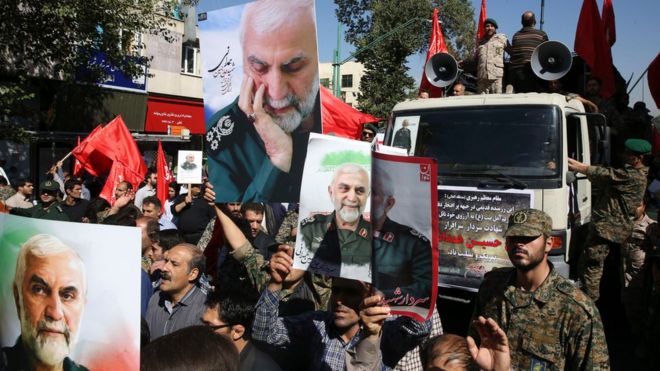
Robin Wright writes: The Islamic Republic described the first men to die as a few young “volunteers” deployed to protect symbols of the faith. The numbers have escalated since then. In June, the Islamic Republic News Agency reported that more than four hundred volunteers from Iran, including Afghan refugees living in the country, had died in Syria so far. Iranian news agencies and social media are now rife with stories about senior officers killed in Syria on the war’s toughest front lines. Last week, Iran’s Fars News Agency reported that the death toll hit eight in just two days. The funerals have become major events, sometimes drawing thousands onto Tehran’s streets to escort the coffins to Zahra’s Paradise.
Iran has increasingly been forced to acknowledge its losses—including at least four generals in the past year—with some reports suggesting that twice that number have been killed since the intervention began. Brigadier General Hossein Hamedani, who was killed on October 8th, was given a state funeral. Iran’s Supreme Leader, Ayatollah Ali Khamenei, personally called on Hamedani’s family to convey his condolences. Khamenei’s official Twitter account, in English, lauded the general for fulfilling his “martyrdom wish.”
Hamedani’s death was a setback for Iran—and possibly for Syria, too. According to Jane’s Defense Weekly, Syria’s regular Army has been halved since the war began, in 2011. Assad has increasingly relied on leaders in Iran to develop strategy, and counted on Hezbollah, Iran’s proxy force in Lebanon, to provide new fighters. Hamedani was the senior Iranian tactician in northern Syria, where the regime is simultaneously fighting Western-backed rebels, the Islamic State, a local Al Qaeda franchise, and smaller militias. Hamedani was a hero of the war with Iraq—the deadliest modern conflict in the Middle East—and his death was the most notable Iranian military loss since that war ended. [Continue reading…]
Who of the great journalists covering Syria has nailed, or will, why so many high-level pro-Assad officers/operatives are dying in Syria?
— Hassan Hassan (@hxhassan) October 26, 2015
Pro-Assad pages confirm the death of Major General Izzadin Ibrahim in Deir Ezzor pic.twitter.com/whLPGYqZxS
— Hassan Hassan (@hxhassan) October 26, 2015
Russian airstrikes in Syria appear to violate laws of war, says Human Rights Watch
Human Rights Watch: At least two air strikes in northern Homs on October 15, 2015, that local residents believed to be Russian, apparently violated the laws of war. The air strikes killed a total of 59 civilians, residents said, including 33 children and a commander of the local armed opposition group. Russia should investigate the attacks.
The deadliest attack hit a house in the village of Ghantou, where the extended Assaf family had taken shelter, killing a reported 46 family members, all civilians, including 32 children and 12 women, first responders and local activists said. The victims were related to a local commander affiliated with the opposition Free Syrian Army (FSA), but witnesses said that he was away from the home at the front lines. The second air strike, on the neighboring town of Ter Maaleh, hit near a bakery, and according to local witnesses, killed at least 13 civilians as well as a local FSA commander who was a Syrian army defector. It is not clear whether he was the intended target, as neither Russia nor Syria have issued statements about the specific air strikes. [Continue reading…]
Yemen hospital hit by Saudi-led air strike: Medecins Sans Frontieres
Reuters reports: A hospital in north Yemen run by medical aid group Medecins Sans Frontieres (MSF) was bombed in a Saudi-led air strike, wrecking the facility and lightly wounding two staff members, the group said on Tuesday.
A Saudi-led Arab coalition intervened in Yemen’s civil war in March to try to restore its government after its toppling by Iran-allied Houthi forces, but a mounting civilian death toll has alarmed human rights groups.
“Our hospital in the Heedan district of Saada governorate was hit several times. Fortunately, the first hit damaged the operations theater while it was empty and the staff were busy with people in the emergency room. They just had time to run off as another missile hit the maternity ward,” MSF country director Hassan Boucenine told Reuters by telephone from Yemen.
“It could be a mistake, but the fact of the matter is it’s a war crime. There’s no reason to target a hospital. We provided (the coalition) with all of our GPS coordinates about two weeks ago,” he said. [Continue reading…]
Poets are the latest target in crackdown by Iranian hardliners
The Associated Press reports: Two Iranian poets jailed for their work and sentenced to 99 lashes apiece for shaking hands with members of the opposite sex are the latest targets in a crackdown that analysts say pits hard-liners against those offering new glimpses of life in the Islamic Republic.
The sentences follow a pattern of arrests and convictions targeting activists, journalists and artists that has served as a grim backdrop to President Hassan Rouhani’s efforts to soften the country’s image and improve relations with the West, including through the landmark nuclear agreement reached last summer.
Hard-liners in the police, judiciary and military view any rapprochement with the West as a threat to the Islamic Republic and a sign of moral decay. Rights groups and analysts say those targeted in the ongoing crackdown on expression in Iran also serve as pawns in the hard-liners’ struggle with moderates ahead of February’s parliamentary elections.
“I think people thought with the nuclear deal, there would be sort of a bit of a thaw as well or a bit of an opening up,” said Karin Deutsch Karlekar, the director of Free Expression Programs at PEN America, an organization promoting literature and freedom of speech. “I think the judiciary is sort of pushing back and trying to make clear that there isn’t going to be that opening people were hoping for.” [Continue reading…]
Drone warfare is self-defeating
Musa al-Gharbi writes: The sweeping language in the post-9/11 Authorization for the Use of Military Force (AUMF) has empowered both presidents George W. Bush and Barack Obama to interpret their counterterrorism mandate broadly, to include targets ranging from the Taliban to the Islamic State in Iraq and the Levant (ISIL), Boko Haram and other Al-Qaeda affiliates around the world.
The U.S. drone program, which aims to eliminate high-value targets from these organizations and disrupt imminent terrorist plots against the United States, has been a key component of their efforts.
However, critics have questioned the program’s effectiveness for some time. For example, U.S. officials didn’t always know whom they were killing or what group the targets belong to — let alone whether or not they committed any grievous crime or posed a meaningful threat to U.S. personnel or interests. Moreover, those killed in the drone strikes were generally not high-value targets, but low-level militants, a term denoting any military-aged male killed in the campaign. [Continue reading…]
Taliban and Russian interests may converge in fight against ISIS
The Daily Beast reports: The Taliban are not as lonely as they once were. The pariahs who protected Osama bin Laden and quickly collapsed when the U.S. counter-attacked after September 11, 2001, have been developing contacts with neighboring states and even with Russia, driven out of Afghanistan in 1989.
There’s nothing simple about this picture, and, interestingly, it appears partly tied to Russian efforts to oppose the spread in Afghanistan of groups pledging allegiance to the so-called Islamic State in Syria and Iraq. That same concern has helped to forge links between the Taliban and their longtime enemies in Iran.
And the Russian connection is emerging, ironically, at the same time that Afghanistan’s Uzbek warlord and vice president, Abdul Rashid Dostum, has openly warmed to his onetime allies in Russia and tried to strengthen ties to the former Soviet states on Afghan frontier.
Dostum visited Moscow and Grozny this month and launched an offensive just last week in provinces near the Turkmenistan border. Dostum lumped the Taliban together with Daesh, a common Arabic acronym for the Islamic state, on his enemies list.
“The countries of the Commonwealth of Independent States from Russia to Tajikistan and Turkmenistan, all these states are willing to stand with us against Daesh [one of the acronyms for the so-called Islamic State], against extremism, against the bloodthirsty Taliban,” Dostum declared.
But The Daily Beast has learned that Russia and some of these neighboring states may be playing a double game, or, at the very least keeping their options open if the Taliban manage to retake power. [Continue reading…]
Exxon has known about climate change for decades while spending millions to promote climate denial
Scientific American reports: Exxon was aware of climate change, as early as 1977, 11 years before it became a public issue, according to a recent investigation from InsideClimate News. This knowledge did not prevent the company (now ExxonMobil and the world’s largest oil and gas company) from spending decades refusing to publicly acknowledge climate change and even promoting climate misinformation — an approach many have likened to the lies spread by the tobacco industry regarding the health risks of smoking. Both industries were conscious that their products wouldn’t stay profitable once the world understood the risks, so much so that they used the same consultants to develop strategies on how to communicate with the public.
Experts, however, aren’t terribly surprised. “It’s never been remotely plausible that they did not understand the science,” says Naomi Oreskes, a history of science professor at Harvard University. But as it turns out, Exxon didn’t just understand the science, the company actively engaged with it. In the 1970s and 1980s it employed top scientists to look into the issue and launched its own ambitious research program that empirically sampled carbon dioxide and built rigorous climate models. Exxon even spent more than $1 million on a tanker project that would tackle how much CO2 is absorbed by the oceans. It was one of the biggest scientific questions of the time, meaning that Exxon was truly conducting unprecedented research.
In their eight-month-long investigation, reporters at InsideClimate News interviewed former Exxon employees, scientists and federal officials and analyzed hundreds of pages of internal documents. They found that the company’s knowledge of climate change dates back to July 1977, when its senior scientist James Black delivered a sobering message on the topic. “In the first place, there is general scientific agreement that the most likely manner in which mankind is influencing the global climate is through carbon dioxide release from the burning of fossil fuels,” Black told Exxon’s management committee. A year later he warned Exxon that doubling CO2 gases in the atmosphere would increase average global temperatures by two or three degrees — a number that is consistent with the scientific consensus today. He continued to warn that “present thinking holds that man has a time window of five to 10 years before the need for hard decisions regarding changes in energy strategies might become critical.” In other words, Exxon needed to act. [Continue reading…]
The African lion: What faster decline of apex predator means for ecosystems
By Matt Hayward, Bangor University
There is nothing as awe-inspiring as watching the brutal power of a lion capturing its prey. At close range, their throaty roars thump through your body, raising a cold sweat triggered by the fear of what these animals are capable of doing now, and what they once did to our ancestors. They are the most majestic animals left on our planet, and yet we are currently faced with the very real possibility that they will be functionally extinct within our lifetime.
In fact, lion populations throughout much of Africa are heading towards extinction more rapidly than previously thought, according to new research by Oxford biologist Hans Bauer and colleagues, published in PNAS. The team looked at 47 sites with credible and repeated lion surveys since 1990, and found they were declining everywhere in Africa aside from four countries: Botswana, Namibia, South Africa and Zimbabwe.
West and Central African lion populations have a 67% chance of halving in size in just two decades, and East African populations a 37% chance. Almost all large lion populations that once exceeded 500 individuals outside of southern Africa are declining. These declines in Africa’s apex predator occur at the same time that the continent’s mega-herbivores are also plummeting.
Everything you need to know about the vast network of undersea cables that makes the Internet global
The Washington Post reports: Russians submarines and spy ships are “aggressively operating” near the undersea cables that are the backbone of the global Internet — worrying some U.S. intelligence and military officials who fear the Russians may sabotage them if a conflict arises, the New York Times reports.
For all the talk about the “cloud,” practically all of the data shooting around the world actually relies on a series of tubes to get around — a massive system of fiber-optic cables lying deep underneath the oceans.
The network connects every continent other than Antarctica, carrying e-mails, photos, videos and emoji around the globe. Here’s what that looks like in the style of a vintage maritime map, courtesy of TeleGeography: [Continue reading…]
Saving Syria’s ‘lost generation’
The Atlantic reports: It wasn’t long after the onset of the Great Recession that academics and headline writers began referring to recent college graduates as a “lost generation.” Faced with unemployment rates for their cohort higher than at any time since World War II, young Americans seemed doomed to a lifetime of lower earnings and savings. But even at the peak of pessimistic predictions, pundits had to acknowledge: Those with college degrees were relatively well-off compared to those without.
What, then, do you call an entire generation that never even finishes college? That’s the threat facing Syria’s young adults. In the years leading up to the current civil war, enrollment figures for Syrian tertiary education had been climbing steadily upward—from 12 percent of the college-age population in 2002, according to the UNESCO Institute for Statistics, to 26 percent in 2010, on the eve of the Syrian uprising. Now, the estimated 100,000 university-qualified refugees currently scattered throughout the Middle East and Europe must place their hopes in schools outside Syria—and that’s to say nothing of those still inside the country, where few educational institutions remain functional. In neighboring Turkey, Lebanon, and Jordan, all of which have been overwhelmed with refugees since the start of the conflict, only a fraction of students have found ways to continue their studies, despite the number of Syrian students in Turkish universities, for example, reportedly quadrupling in recent years. With professors and researchers displaced as well, Syria’s entire university infrastructure is at risk. [Continue reading…]
Russian warplanes shatter tenuous truce forcing thousands of Syrians to flee
The New York Times reports: For almost two years, the village in the Syrian countryside north of the city of Homs had been relatively calm, profiting from a tenuous truce between the government and rebel groups that had made it a refuge for thousands of desperate people displaced by the war.
But the peace was shattered earlier this month, when Russian warplanes started attacking the village, Ter Ma’aleh, killing at least a dozen people and sending most of the residents into hurried exile.
The assault on the village was part of a wider escalation of violence across the country that has displaced tens of thousands of people in just weeks and led relief workers to warn that Syria is facing one of its most serious humanitarian crises of the civil war.
The intensity of the fighting, they say, is fueling increased desperation as a growing number of Syrians are fleeing to neighboring countries and, especially, to Europe. More than 9,000 migrants a day crossed into Greece last week, according to the International Organization for Migration, the most since the beginning of the year. [Continue reading…]