Neil Postman, the author of Amusing Ourselves to Death, died ten years ago




Neil Postman, the author of Amusing Ourselves to Death, died ten years ago
Here’s a story in English:
A sheep that had no wool saw horses, one of them pulling a heavy wagon, one carrying a big load, and one carrying a man quickly. The sheep said to the horses: “My heart pains me, seeing a man driving horses.” The horses said: “Listen, sheep, our hearts pain us when we see this: a man, the master, makes the wool of the sheep into a warm garment for himself. And the sheep has no wool.” Having heard this, the sheep fled into the plain.
And here is “a very educated approximation” of how that story might have sounded if spoken in Proto-Indo-European about 6,500 years ago:
(Read more at Archeology.)
Ethan Watters writes: In the summer of 1995, a young graduate student in anthropology at UCLA named Joe Henrich traveled to Peru to carry out some fieldwork among the Machiguenga, an indigenous people who live north of Machu Picchu in the Amazon basin. The Machiguenga had traditionally been horticulturalists who lived in single-family, thatch-roofed houses in small hamlets composed of clusters of extended families. For sustenance, they relied on local game and produce from small-scale farming. They shared with their kin but rarely traded with outside groups.
While the setting was fairly typical for an anthropologist, Henrich’s research was not. Rather than practice traditional ethnography, he decided to run a behavioral experiment that had been developed by economists. Henrich used a “game”—along the lines of the famous prisoner’s dilemma—to see whether isolated cultures shared with the West the same basic instinct for fairness. In doing so, Henrich expected to confirm one of the foundational assumptions underlying such experiments, and indeed underpinning the entire fields of economics and psychology: that humans all share the same cognitive machinery—the same evolved rational and psychological hardwiring.
The test that Henrich introduced to the Machiguenga was called the ultimatum game. The rules are simple: in each game there are two players who remain anonymous to each other. The first player is given an amount of money, say $100, and told that he has to offer some of the cash, in an amount of his choosing, to the other subject. The second player can accept or refuse the split. But there’s a hitch: players know that if the recipient refuses the offer, both leave empty-handed. North Americans, who are the most common subjects for such experiments, usually offer a 50-50 split when on the giving end. When on the receiving end, they show an eagerness to punish the other player for uneven splits at their own expense. In short, Americans show the tendency to be equitable with strangers—and to punish those who are not.
Among the Machiguenga, word quickly spread of the young, square-jawed visitor from America giving away money. The stakes Henrich used in the game with the Machiguenga were not insubstantial—roughly equivalent to the few days’ wages they sometimes earned from episodic work with logging or oil companies. So Henrich had no problem finding volunteers. What he had great difficulty with, however, was explaining the rules, as the game struck the Machiguenga as deeply odd.
When he began to run the game it became immediately clear that Machiguengan behavior was dramatically different from that of the average North American. To begin with, the offers from the first player were much lower. In addition, when on the receiving end of the game, the Machiguenga rarely refused even the lowest possible amount. “It just seemed ridiculous to the Machiguenga that you would reject an offer of free money,” says Henrich. “They just didn’t understand why anyone would sacrifice money to punish someone who had the good luck of getting to play the other role in the game.”
The potential implications of the unexpected results were quickly apparent to Henrich. He knew that a vast amount of scholarly literature in the social sciences—particularly in economics and psychology—relied on the ultimatum game and similar experiments. At the heart of most of that research was the implicit assumption that the results revealed evolved psychological traits common to all humans, never mind that the test subjects were nearly always from the industrialized West. Henrich realized that if the Machiguenga results stood up, and if similar differences could be measured across other populations, this assumption of universality would have to be challenged.
Henrich had thought he would be adding a small branch to an established tree of knowledge. It turned out he was sawing at the very trunk. He began to wonder: What other certainties about “human nature” in social science research would need to be reconsidered when tested across diverse populations? [Continue reading…]
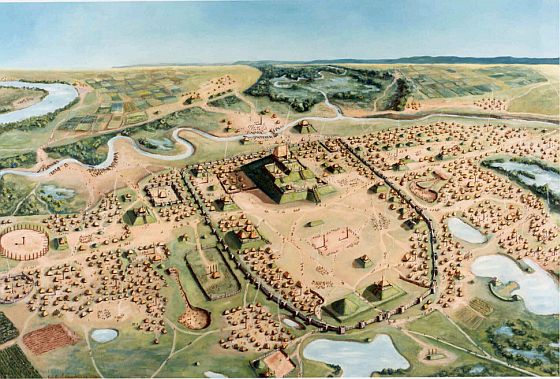
Annalee Newitz writes: One thousand years ago, in the place where St. Louis, Missouri now stands, there was once a great civilization whose city center was ringed with enormous earthen pyramids, vast farmlands, and wealthy suburbs. For hundreds of years it was the biggest city in North America. Then a mysterious fire changed everything.
The city that once existed in St. Louis’ current footprint is known today as Cahokia, and its creators are commonly called the Mound Builders because of the 120 or so enormous mounds they left behind. Shaped much like the stone pyramids of the Maya civilization to the south, these mounds rose up hundreds of feet, and were often built on top of tombs. At their summits were ceremonial buildings made from wood and thatch. Unfortunately, many of these magnificent creations were destroyed in the nineteenth century when St. Louis was built. Below, you can see one of the only remaining pyramids, known as Monk’s Mound.
The first evidence of a settlement in the Cahokia area is from the year 600 CE, at a time when the Maya civilization would have been at its peak. But it wasn’t until after the largest cities of the Maya began to fall in the 1000s that Cahokia came into its own. It’s estimated that the city center held as many as 15,000 people (making it comparable in size to European cities of the same era), and reached the height of its productivity between roughly 1000-1300 CE. [Continue reading…]

There are all kinds of problems in posing the question, is war natural? If we conclude it is unnatural, then we are likely to treat it as an aberration that might be avoided if we were to simply know better — that in some sense all wars happen by mistake.
If we conclude that war-making is an intrinsic feature of human nature, then we assume a kind of fatalism that views war as ugly but unavoidable.
In an essay which probes the question of whether humans have the instinct to make war, the evolutionary biologist, David P Barash, makes an important distinction between violence and war — the former being an adaptation, while the latter a capacity. He explains the distinction between adaptation and capacity in this way:
Language is almost certainly an adaptation, something that all normal human beings can do, although the details vary with circumstance. By contrast, reading and writing are capacities, derivative traits that are unlikely to have been directly selected for, but have developed through cultural processes. Similarly, walking and probably running are adaptations; doing cartwheels or handstands are capacities.
Barash writes:
[Napoleon Chagnon’s] best-selling book The Fierce People (1968) [on the Yanomami people of the Venezuelan/Brazilian Amazon] has been especially influential in enshrining an image of tribal humanity as living in a state of ‘chronic warfare’.
Chagnon has been the subject of intense criticism but, to my mind, there is simply no question about the empirical validity and theoretical value of his research. In a field (call it evolutionary psychology or, as I prefer, human sociobiology) that has often been criticised for a relative absence of hard data, his findings, however politically distasteful, have been welcome indeed. Among these, one of the most convincing has been Chagnon’s demonstration that, among the Yanomami, not only is inter-village ‘warfare’ frequent and lethal, but that Yanomami men who have killed other men experience significantly higher reproductive success — evolutionary fitness — than do non-killers. His data, although disputed by other specialists, appear altogether reliable and robust.
So I admire the man, and his work, but I have a growing sense of discomfort about the way that Chagnon’s Yanomami research has been interpreted and the inferences that have been drawn from it.
I fear that many of my colleagues have failed, as previously have I, to distinguish between the relatively straightforward evolutionary roots of human violence and the more complex, multifaceted and politically fraught question of human war. To be blunt, violence is almost certainly deeply entrenched in human nature; warfare, not so much. A fascination with the remarkably clear correlation between Yanomami violence and male fitness has blinded us to the full range of human non-violence, causing us to ignore and undervalue realms of peacemaking in favour of a focus on exciting and attention-grabbing patterns of war-making.
As an evolutionary scientist, I have been enthusiastic about identifying the adaptive significance — the evolutionary imprint — of apparently universal human traits. For a long time, it seemed that Chagnon’s finding of the reproductive success of Yanomami men who were killers was one of the most robust pieces of evidence for this. Now I am not so sure, and this is my mea culpa.
There has also been a tendency among evolutionary thinkers to fix upon certain human groups as uniquely revelatory, not simply because the research about them is robust, but also because their stories are both riveting and consistent with our pre-existing expectations. They are just plain fun to talk about, especially for men.
Remember, too, the journalists’ edict: ‘If it bleeds, it leads.’ You are unlikely to see a newspaper headline announcing that ‘France and Germany Did Not Go To War’, whereas a single lethal episode, anywhere in the world, is readily pounced upon as news. Language conventions speak volumes, too. It is said that the Bedouin have nearly 100 different words for camels, distinguishing between those that are calm, energetic, aggressive, smooth-gaited, or rough, etc. Although we carefully identify a multitude of wars — the Hundred Years War, the Thirty Years War, the American Civil War, the Vietnam War, and so forth — we don’t have a plural form for peace.
It makes evolutionary sense that human beings pay special attention to episodes of violence, whether interpersonal or international: they are matters of life and death, after all. But when serious scientists do the same and, what is more, when they base ‘normative’ conclusions about the human species on what is simply a consequence of their selective attention, we all have a problem.
The most serious problem with Chagnon’s influence on our understanding of human nature is one familiar to many branches of science: generalising from one data set — however intensive — to a wider universe of phenomena. Academic psychologists, for example, are still reeling from a 2010 study by the University of British Columbia which found that the majority of psychological research derives from college students who are ‘Western, Educated, Industrialised, Rich, and Democratic’ — in short, WEIRD. [See “The Weirdest People in the World“.] Similarly, the Yanomami are only one of a large number of very different, tribal human societies. Given the immense diversity of human cultural traditions, any single group of Homo sapiens must be considered profoundly unrepresentative of the species as a whole.
Just as the Yanomami can legitimately be cited as notably violence-prone — at both the individual and group level — many other comparable tribal peoples do not engage in anything remotely resembling warfare. These include the Batek of Malaysia, the Hadza of Tanzania, the Martu of Australia, a half-dozen or more indigenous South Indian forager societies, and numerous others, each of whom are no less human than those regularly trotted out to ‘prove’ our inherent war-proneness.
In the Dark Ages of biology, taxonomists used to identify a ‘type species’ thought to represent each genus, but the idea no longer has any currency in biology. The great evolutionary biologist Ernst Mayr effectively demonstrated that statistical and population thinking trumps the idea of a Platonic concept of ‘types’, independent of the actual diversity of living things, not least Homo sapiens. Yet anthropologists (and biologists, who should know better) seem to have fallen into the trap of seizing upon a few human societies, and generalising them as representative of Homo sapiens as a whole. Regrettably, this tendency to identify ‘type societies’ has been especially acute when it comes to establishing the supposed prevalence of human warfare.
In his justly admired book The Better Angels of our Nature (2011), the evolutionary psychologist Steven Pinker made a powerful case that human violence — interpersonal as well as warring — has diminished substantially in recent times. But in his eagerness to emphasise the ameliorating effects of historically recent social norms, Pinker exaggerated our pre-existing ‘natural’ level of war-proneness, claiming that ‘chronic raiding and feuding characterised life in a state of nature’. The truth is otherwise. As recent studies by the anthropologist Douglas Fry and others have shown, the overwhelmingly predominant way of life for most of our evolutionary history — in fact, pretty much the only one prior to the Neolithic revolution — was that of nomadic hunter-gatherers. And although such people engage in their share of interpersonal violence, warfare in the sense of group-based lethal violence directed at other groups is almost non-existent, having emerged only with early agricultural surpluses and the elaboration of larger-scale, tribal organisation, complete with a warrior ethos and proto-military leadership. [Continue reading…]

Jon Krakauer writes: Twenty-one years ago this month, on September 6, 1992, the decomposed body of Christopher McCandless was discovered by moose hunters just outside the northern boundary of Denali National Park. He had died inside a rusting bus that served as a makeshift shelter for trappers, dog mushers, and other backcountry visitors. Taped to the door was a note scrawled on a page torn from a novel by Nikolai Gogol:
ATTENTION POSSIBLE VISITORS.
S.O.S.
I NEED YOUR HELP. I AM INJURED, NEAR DEATH, AND TOO WEAK TO HIKE OUT OF HERE. I AM ALL ALONE, THIS IS NO JOKE. IN THE NAME OF GOD, PLEASE REMAIN TO SAVE ME. I AM OUT COLLECTING BERRIES CLOSE BY AND SHALL RETURN THIS EVENING. THANK YOU,
CHRIS McCANDLESS
AUGUST ?From a cryptic diary found among his possessions, it appeared that McCandless had been dead for nineteen days. A driver’s license issued eight months before he perished indicated that he was twenty-four years old and weighed a hundred and forty pounds. After his body was flown out of the wilderness, an autopsy determined that it weighed sixty-seven pounds and lacked discernible subcutaneous fat. The probable cause of death, according to the coroner’s report, was starvation.
In “Into the Wild,” the book I wrote about McCandless’s brief, confounding life, I came to a different conclusion. I speculated that he had inadvertently poisoned himself by eating seeds from a plant commonly called wild potato, known to botanists as Hedysarum alpinum. According to my hypothesis, a toxic alkaloid in the seeds weakened McCandless to such a degree that it became impossible for him to hike out to the highway or hunt effectively, leading to starvation. Because Hedysarum alpinum is described as a nontoxic species in both the scientific literature and in popular books about edible plants, my conjecture was met with no small amount of derision, especially in Alaska.
I’ve received thousands of letters from people who admire McCandless for his rejection of conformity and materialism in order to discover what was authentic and what was not, to test himself, to experience the raw throb of life without a safety net. But I’ve also received plenty of mail from people who think he was an idiot who came to grief because he was arrogant, woefully unprepared, mentally unbalanced, and possibly suicidal. Most of these detractors believe my book glorifies a senseless death. As the columnist Craig Medred wrote in the Anchorage Daily News in 2007,
“Into the Wild” is a misrepresentation, a sham, a fraud. There, I’ve finally said what somebody has needed to say for a long time …. Krakauer took a poor misfortunate prone to paranoia, someone who left a note talking about his desire to kill the “false being within,” someone who managed to starve to death in a deserted bus not far off the George Parks Highway, and made the guy into a celebrity. Why the author did that should be obvious. He wanted to write a story that would sell.
The debate over why McCandless perished, and the related question of whether he is worthy of admiration, has been smoldering, and occasionally flaring, for more than two decades now. But last December, a writer named Ronald Hamilton posted a paper on the Internet that brings fascinating new facts to the discussion. Hamilton, it turns out, has discovered hitherto unknown evidence that appears to close the book on the cause of McCandless’s death. [Continue reading…]
