Author Archives: Paul Woodward

Farewell Helen Thomas

It’s good that Helen Thomas will no longer be in White House press briefings. Not because she sullied the reputation of the Washington press corps with a few undiplomatic remarks, but because those who lack her boldness and bluntness will no longer be able to use her presence to foster the illusion that American journalism still values courage.

When Thomas was asked during a White House Jewish Heritage Celebration on May 27 (before the Mavi Marmara massacre) whether she had any comments on Israel, she said without a pause: “Tell them to get the hell out of Palestine.”

“It’s their land,” Thomas asserted, referring to the Palestinians and baldly challenging the notion that Israel was founded on land that belongs to the Jews. When asked where the Jews should go, she said they should “go home” — to Germany, Poland, America or from wherever else they had emigrated to Israel.

As soon as the video (see below) of Thomas’ remarks was made public, Washington’s mechanisms of tribal discipline swiftly kicked into gear.

Her words were “unconscionably callous and vile,” said Andrew Sullivan. “Thomas deserved what she got,” said Dana Millbank. Both saw her departure as a loss, yet just as President Obama deemed her words “out of line,” no one in Washington was willing to go to the heart of what she said.

In 1948 three-quarters of a million Palestinians were driven out of their homes by Zionists in order to make room for the creation of a Jewish state. For that reason, Helen Thomas, an American of Lebanese descent, apparently believes — as do most people in the Middle East — that the Jewish claim to “own” the land on which Israel was created is a claim based on religious dogma rather than historical fact.

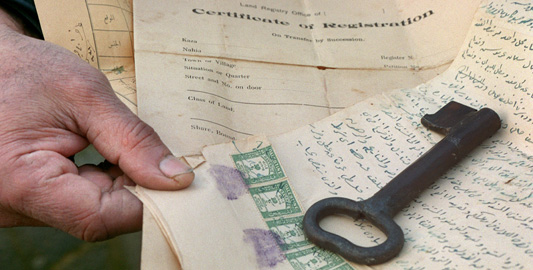
Those families who still possess the keys to homes they lost and the legal titles to land on which they were built, see the issue not as one of “disputed territories” but as one in which colonizers — like America’s settlers — grabbed land and then tried to disguise their acts of dispossession by invoking divine authority.

As Thomas has been dumped by her agent, forced to retire and is now ostracized by colleagues who disingenuously profess their admiration for her journalistic courage, Washington once again displays itself as a unique and rather pathetic satellite of Israel.

As the world condemns Israel’s latest act of unconscionable brutality, America’s media willingly turns its attention to the “unconscionable” words of an 89 year-old woman who had the audacity to say a few blunt words about the Jewish state. Oy veh!

Facebooktwittermail

Palestine: A great moral and political cause of our time that unites people across the world

“Palestine has become a great moral and political cause of our time that unites people across the world,” said Seamus Milne, addressing marchers in London on Saturday.

Drowning in their narcissistic self-obsession, this is a reality that completely escapes the comprehension of most Jewish Israelis, most Jews, and most Americans: the issue of Palestine has become a global cause not as an expression of antipathy towards Israel but out of sympathy towards Palestinians. To the extent that this has been turned into a Jewish issue, it has become so because so many Jews refuse to allow it to be seen otherwise.

Israel’s condition of national hysteria within which the existence of the Jewish state is perceived as being in perpetual danger, has become a psychological trap that rules out the possibility of a negotiated settlement to the conflict.

Israel is literally frozen in fear. And compounding that fear is the fact that it is repeatedly confronted by the fearlessness of those who challenge its claims.

To break out of the trap of fear, it is time that Jewish Israelis (and those in the Diaspora who share the same affliction) to ask themselves this question: How can we live in this world with dignity and nobility if we do not rise above our fear?

Never forget, never forgive — what at one time was a visceral expression of self-preservation — has become a crippling self-limitation. As a non-Jew, I cannot pretend to fully know what the trauma of the Holocaust feels like, yet the need for the Jewish people to become healed and liberated from this trauma is surely a worthy and necessary task to be embraced. Without this, the separation between Israel and the rest of the world will only widen and in that widening gap our common sense of humanity will be lost.

Facebooktwittermail

Israel’s separate reality

One of the lessons of state communism is that there is no better environment in which to control the way people think than one in which they believe they are free.

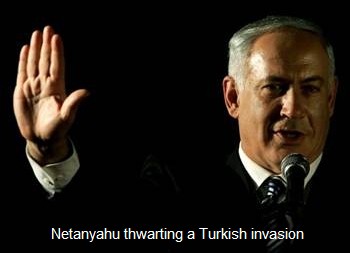
Stalin never had it so easy as Benjamin Netanyahu when it comes to getting a whole population to effortlessly swallow a pack of lies.

“Everything is against Jews. We have the right to defend ourselves. If Turkey sends a ship full of Muslim terrorists, it means that we have to stop them,” a resident of Tel Aviv tells Max Blumenthal during celebrations in support of the Mavi Marmara massacre. “It reminds us of the Holocaust.”

Another says, “It’s the first time we don’t need to kiss anyone’s ass. Not the United States, not the United Nations. We are on our own. We can do it. We did it — I don’t know — sixty years ago. We can do it again…”

Probably the most bewildering aspect of the Gaza flotilla affair has been the righteous indignation expressed by the Israeli government and people, writes Ilan Pappe, in Scotland’s Sunday Herald.

The nature of this response is not being fully reported in the UK press, but it includes official parades celebrating the heroism of the commandos who stormed the ship and demonstrations by schoolchildren giving their unequivocal support for the government against the new wave of anti-Semitism.

As someone who was born in Israel and went enthusiastically through the socialisation and indoctrination process until my mid-20s, this reaction is all too familiar. Understanding the root of this furious defensiveness is key to comprehending the principal obstacle for peace in Israel and Palestine. One can best define this barrier as the official and popular Jewish Israeli perception of the political and cultural reality around them.

A number of factors explain this phenomenon, but three are outstanding and they are interconnected. They form the mental infrastructure on which life in Israel as a Jewish Zionist individual is based, and one from which it is almost impossible to depart – as I know too well from personal experience.

The first and most important assumption is that what used to be historical Palestine is by sacred and irrefutable right the political, cultural and religious possession of the Jewish people represented by the Zionist movement and later the state of Israel.

Most of the Israelis, politicians and citizens alike, understand that this right can’t be fully realised. But although successive governments were pragmatic enough to accept the need to enter peace negotiations and strive for some sort of territorial compromise, the dream has not been forsaken. Far more important is the conception and representation of any pragmatic policy as an act of ultimate and unprecedented international generosity.

Any Palestinian, or for that matter international, dissatisfaction with every deal offered by Israel since 1948, has therefore been seen as insulting ingratitude in the face of an accommodating and enlightened policy of the “only democracy in the Middle East”. Now, imagine that the dissatisfaction is translated into an actual, and sometimes violent, struggle and you begin to understand the righteous fury. As schoolchildren, during military service and later as adult Israeli citizens, the only explanation we received for Arab or Palestinian responses was that our civilised behaviour was being met by barbarism and antagonism of the worst kind.

According to the hegemonic narrative in Israel there are two malicious forces at work. The first is the old familiar anti-Semitic impulse of the world at large, an infectious bug that supposedly affects everyone who comes into contact with Jews. According to this narrative, the modern and civilised Jews were rejected by the Palestinians simply because they were Jews; not for instance because they stole land and water up to 1948, expelled half of Palestine’s population in 1948 and imposed a brutal occupation on the West Bank, and lately an inhuman siege on the Gaza Strip. This also explains why military action seems the only resort: since the Palestinians are seen as bent on destroying Israel through some atavistic impulse, the only conceivable way of confronting them is through military might.

The second force is also an old-new phenomenon: an Islamic civilisation bent on destroying the Jews as a faith and a nation. Mainstream Israeli orientalists, supported by new conservative academics in the United States, helped to articulate this phobia as a scholarly truth. These fears, of course, cannot be sustained unless they are constantly nourished and manipulated.

From this stems the second feature relevant to a better understanding of the Israeli Jewish society. Israel is in a state of denial. Even in 2010, with all the alternative and international means of communication and information, most of the Israeli Jews are still fed daily by media that hides from them the realities of occupation, stagnation or discrimination. This is true about the ethnic cleansing that Israel committed in 1948, which made half of Palestine’s population refugees, destroyed half the Palestinian villages and towns, and left 80% of their homeland in Israeli hands. And it’s painfully clear that even before the apartheid walls and fences were built around the occupied territories, the average Israeli did not know, and could not care, about the 40 years of systematic abuses of civil and human rights of millions of people under the direct and indirect rule of their state.

Nor have they had access to honest reports about the suffering in the Gaza Strip over the past four years. In the same way, the information they received on the flotilla fits the image of a state attacked by the combined forces of the old anti-Semitism and the new Islamic Judacidal fanatics coming to destroy the state of Israel. (After all, why would they have sent the best commando elite in the world to face defenceless human rights activists?)

As a young historian in Israel during the 1980s, it was this denial that first attracted my attention. As an aspiring professional scholar I decided to study the 1948 events and what I found in the archives sent me on a journey away from Zionism. Unconvinced by the government’s official explanation for its assault on Lebanon in 1982 and its conduct in the first Intifada in 1987, I began to realise the magnitude of the fabrication and manipulation. I could no longer subscribe to an ideology which dehumanised the native Palestinians and which propelled policies of dispossession and destruction.

The price for my intellectual dissidence was foretold: condemnation and excommunication. In 2007 I left Israel and my job at Haifa University for a teaching position in the United Kingdom, where views that in Israel would be considered at best insane, and at worst as sheer treason, are shared by almost every decent person in the country, whether or not they have any direct connection to Israel and Palestine.

That chapter in my life – too complicated to describe here – forms the basis of my forthcoming book, Out Of The Frame, to be published this autumn. But in brief, it involved the transformation of someone who had been a regular and unremarkable Israeli Zionist, and it came about because of exposure to alternative information, close relationships with several Palestinians and post-graduate studies abroad in Britain.

My quest for an authentic history of events in the Middle East required a personal de-militarisation of the mind. Even now, in 2010, Israel is in many ways a settler Prussian state: a combination of colonialist policies with a high level of militarisation in all aspects of life. This is the third feature of the Jewish state that has to be understood if one wants to comprehend the Israeli response. It is manifested in the dominance of the army over political, cultural and economic life within Israel. Defence minister Ehud Barak was the commanding officer of Benjamin Netanyahu, the prime minister, in a military unit similar to the one that assaulted the flotilla. That background was profoundly significant in terms of the state’s Zionist response to what they and all the commando officers perceived as the most formidable and dangerous enemy.

You probably have to be born in Israel, as I was, and go through the whole process of socialisation and education – including serving in the army – to grasp the power of this militarist mentality and its dire consequences. And you need such a background to understand why the whole premise on which the international community’s approach to the Middle East is based, is utterly and disastrously wrong.

The international response is based on the assumption that more forthcoming Palestinian concessions and a continued dialogue with the Israeli political elite will produce a new reality on the ground. The official discourse in the West is that a very reasonable and attainable solution – the two states solution – is just around the corner if all sides would make one final effort. Such optimism is hopelessly misguided.

The only version of this solution that is acceptable to Israel is the one that both the tamed Palestine Authority in Ramallah and the more assertive Hamas in Gaza could never accept. It is an offer to imprison the Palestinians in stateless enclaves in return for ending their struggle. And thus even before one discusses either an alternative solution – one democratic state for all, which I myself support – or explores a more plausible two-states settlement, one has to transform fundamentally the Israeli official and public mindset. It is this mentality which is the principal barrier to a peaceful reconciliation within the fractured terrain of Israel and Palestine.

How can one change it? That is the biggest challenge for activists within Palestine and Israel, for Palestinians and their supporters abroad and for anyone in the world who cares about peace in the Middle East. What is needed is, firstly, recognition that the analysis put forward here is valid and acceptable. Only then can one discuss the prognosis.

It is difficult to expect people to revisit a history of more than 60 years in order to comprehend better why the present international agenda on Israel and Palestine is misguided and harmful. But one can surely expect politicians, political strategists and journalists to reappraise what has been euphemistically called the “peace process” ever since 1948. They need also to be reminded that what actually happened.

Since 1948, Palestinians have been struggling against the ethnic cleansing of Palestine. During that year, they lost 80% of their homeland and half of them were expelled. In 1967, they lost the remaining 20%. They were fragmented geographically and traumatised like no other people during the second half of the 20th century. And had it not been for the steadfastness of their national movement, the fragmentation would have enabled Israel to take over historical Palestine as a whole and push the Palestinians into oblivion.

Transforming a mindset is a long process of education and enlightenment. Against all the odds, some alternative groups within Israel have begun this long and winding road to salvation. But in the meantime Israeli policies, such as the blockade on Gaza, have to be stopped. They will not cease in response to feeble condemnations of the kind we heard last week, nor is the movement inside Israel strong enough to produce a change in the foreseeable future. The danger is not only the continued destruction of the Palestinians but a constant Israeli brinkmanship that could lead to a regional war, with dire consequences for the stability of the world as a whole.

In the past, the free world faced dangerous situations like that by taking firm actions such as the sanctions against South Africa and Serbia. Only sustained and serious pressure by Western governments on Israel will drive the message home that the strategy of force and the policy of oppression are not accepted morally or politically by the world to which Israel wants to belong.

The continued diplomacy of negotiations and “peace talks” enables the Israelis to pursue uninterruptedly the same strategies, and the longer this continues, the more difficult it will be to undo them. Now is the time to unite with the Arab and Muslim worlds in offering Israel a ticket to normality and acceptance in return for an unconditional departure from past ideologies and practices.

Removing the army from the lives of the oppressed Palestinians in the West Bank, lifting the blockade in Gaza and stopping the racist and discriminatory legislation against the Palestinians inside Israel, could be welcome steps towards peace.

It is also vital to discuss seriously and without ethnic prejudices the return of the Palestinian refugees in a way that would respect their basic right of repatriation and the chances for reconciliation in Israel and Palestine. Any political outfit that could promise these achievements should be endorsed, welcomed and implemented by the international community and the people who live between the river Jordan and the Mediterranean Sea.

And then the only flotillas making their way to Gaza would be those of tourists and pilgrims.

Facebooktwittermail

“All I saw in Israel was cowards with guns”

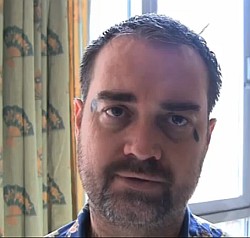
“All I saw in Israel was cowards with guns.” These are the words of Ken O’Keefe, a former US Marine who was just deported from Israel after surviving the Mavi Marmara massacre.

In 2002, O’Keefe initiated what some would regard as a quixotic endeavor: an effort to prevent the war in Iraq by positioning Western volunteers as human shields at strategic sites in Iraq. The Truth Justice Peace action failed, but O’Keefe’s passion to follow the dictates of his own conscience has continued unabated.

This is part of a statement O’Keefe made upon arriving in Istanbul on Friday after his expulsion from Israel:

I remember being asked during the TJP Human Shield Action to Iraq if I was a pacifist, I responded with a quote from Gandhi by saying I am not a passive anything. To the contrary I believe in action, and I also believe in self-defence, 100%, without reservation. I would be incapable of standing by while a tyrant murders my family, and the attack on the Mavi Marmara was like an attack on my Palestinian family. I am proud to have stood shoulder to shoulder with those who refused to let a rogue Israeli military exert their will without a fight. And yes, we fought.
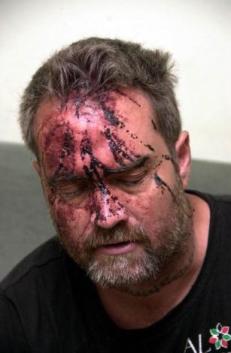
When I was asked, in the event of an Israeli attack on the Mavi Mamara, would I use the camera, or would I defend the ship? I enthusiastically committed to defence of the ship. Although I am also a huge supporter of non-violence, in fact I believe non-violence must always be the first option. Nonetheless I joined the defence of the Mavi Mamara understanding that violence could be used against us and that we may very well be compelled to use violence in self-defence.

I said this straight to Israeli agents, probably of Mossad or Shin Bet, and I say it again now, on the morning of the attack I was directly involved in the disarming of two Israeli Commandos. This was a forcible, non-negotiable, separation of weapons from commandos who had already murdered two brothers that I had seen that day. One brother with a bullet entering dead center in his forehead, in what appeared to be an execution. I knew the commandos were murdering when I removed a 9mm pistol from one of them. I had that gun in my hands and as an ex-US Marine with training in the use of guns it was completely within my power to use that gun on the commando who may have been the murderer of one of my brothers. But that is not what I, nor any other defender of the ship did. I took that weapon away, removed the bullets, proper lead bullets, separated them from the weapon and hid the gun. I did this in the hopes that we would repel the attack and submit this weapon as evidence in a criminal trial against Israeli authorities for mass murder.

I also helped to physically separate one commando from his assault rifle, which another brother apparently threw into the sea. I and hundreds of others know the truth that makes a mockery of the brave and moral Israeli military. We had in our full possession, three completely disarmed and helpless commandos. These boys were at our mercy, they were out of reach of their fellow murderers, inside the ship and surrounded by 100 or more men. I looked into the eyes of all three of these boys and I can tell you they had the fear of God in them. They looked at us as if we were them, and I have no doubt they did not believe there was any way they would survive that day. They looked like frightened children in the face of an abusive father.

But they did not face an enemy as ruthless as they. Instead the woman provided basic first aid, and ultimately they were released, battered and bruised for sure, but alive. Able to live another day. Able to feel the sun over head and the embrace of loved ones. Unlike those they murdered. Despite mourning the loss of our brothers, feeling rage towards these boys, we let them go. The Israeli prostitutes of propaganda can spew all of their disgusting bile all they wish, the commandos are the murders, we are the defenders, and yet we fought. We fought not just for our lives, not just for our cargo, not just for the people of Palestine, we fought in the name of justice and humanity. We were right to do so, in every way.

While in Israeli custody I, along with everyone else was subjected to endless abuse and flagrant acts of disrespect. Women and elderly were physically and mentally assaulted. Access to food and water and toilets was denied. Dogs were used against us, we ourselves were treated like dogs. We were exposed to direct sun in stress positions while hand cuffed to the point of losing circulation of blood in our hands. We were lied to incessantly, in fact I am awed at the routineness and comfort in their ability to lie, it is remarkable really. We were abused in just about every way imaginable and I myself was beaten and choked to the point of blacking out… and I was beaten again while in my cell.
In all this what I saw more than anything else were cowards… and yet I also see my brothers. Because no matter how vile and wrong the Israeli agents and government are, they are still my brothers and sisters and for now I only have pity for them. Because they are relinquishing the most precious thing a human being has, their humanity.

In conclusion; I would like to challenge every endorser of Gandhi, every person who thinks they understand him, who acknowledges him as one of the great souls of our time (which is just about every western leader), I challenge you in the form of a question. Please explain how we, the defenders of the Mavi Marmara, are not the modern example of Gandhi’s essence? But first read the words of Gandhi himself.

“I do believe that, where there is only a choice between cowardice and violence, I would advise violence…. I would rather have India resort to arms in order to defend her honour than that she should, in a cowardly manner, become or remain a helpless witness to her own dishonour.” – Gandhi

And lastly I have one more challenge. I challenge any critic of merit, publicly, to debate me on a large stage over our actions that day. I would especially love to debate with any Israeli leader who accuses us of wrongdoing, it would be my tremendous pleasure to face off with you. All I saw in Israel was cowards with guns, so I am ripe to see you in a new context. I want to debate with you on the largest stage possible. Take that as an open challenge and let us see just how brave Israeli leaders are.

I doubt that there is a single Israeli official who would have the guts to take up O’Keefe’s challenge. Instead, the IDF has issued a laughable claim:

Ken O’Keefe (Born 1969), an American and British citizen, is a radical anti-Israel activist and operative of the Hamas Terror organization. He attempted to enter the Gaza Strip in order to form and train a commando unit for the Palestinian terror organization.

The IDF spelled his name correctly and the year he was born — thereafter, the errors and deceptions follow. O’Keefe renounced his US citizenship in March 2001. He is now an Irish and Palestinian citizen, though describes himself as “in truth a world citizen.”

If the IDF had a shred of evidence that O’Keefe was heading to Gaza to train a commando unit for Hamas, I guarantee he would not now be in Istanbul. He would be in an Israeli jail awaiting trial. (In an interview with Al Jazeera appearing below, he does indeed dismiss Israel’s claims.)

But when O’Keefe says that all he saw in Israel was “cowards with guns” he points to a fundamental truth that reveals the character of the Jewish state.

As a nation that revels in its willingness to crush its opponents, Israel operates with the mindset of every bully: it only feels convinced of its strength when facing a weak opponent.

Lacking the courage to hold its own among equals, Israel operates in a world defined by dominance and oppression.

(Thanks to Ann El Khoury at Pulse for reporting on O’Keefe’s statement.)

Facebooktwittermail

Hamas welcomes EU proposal to monitor crossings

The Ma’an news agency reports:

Hamas officials have supported a proposed EU plan to monitor Gaza crossings and life the Israeli-lead siege on the coastal enclave, statements issued Sunday indicated.

Hamas leader Salah Al-Bardawil called statements by Spanish Minster of Foreign Affairs Miguel Ángel Moratinos, whose country currently holds the head of the rotating EU parliament, said the movement would welcome a European presence at all Gaza border crossings.

“We spoke with the team of the chief (foreign) representative yesterday and we are going to make a proposal over the next few days so that situations like the ones that happened (this week) will not be repeated,” Moratinos told Agence-France Presse on Saturday, referring to the Israeli attack on a Turkish aid ship carrying nationals from around the globe that killed at least nine.

The ship was carrying 10,000 tons of aid, including cement, books, prefabricated houses and medical equipment in an attempt to break Israel’s sea blockade of Gaza, from which it says it unilaterally withdrew in 2005.

The plan reportedly includes the activation of the EU monitoring committee at Rafah, and developing similar initiatives at at least three other crossings as well as assisting in sea patrols so that the Gaza Port could open.

“Hamas welcomes this proposal in all its aspects,” Al-Bardawil said, saying first that the party “does not mind at all” EU or international presence at Rafah, and reaffirmed the party’s refusal to accept Israeli policing in the south.

“Secondly, Israel should not obstruct any convoys or ships coming to the Gaza port,” the official said, reiterating the importance of having a “seaport that links Gaza with the world.”

As for the details, Al-Bardawil said, they need to “be studied by the Palestinian government so a consensus can be reached” on what is acceptable in terms of having international patrols in Gaza waters.

Breaking the siege on Gaza, the official said, would “contribute to the building of a modern seaport in Gaza,” which he described as an essential ingredient to the revitalization of all of Gaza.

Facebooktwittermail

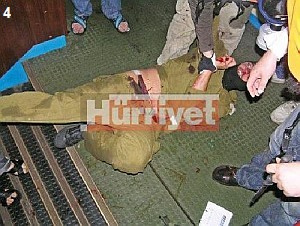
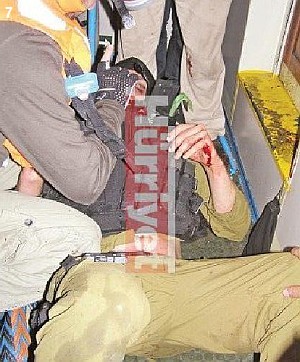
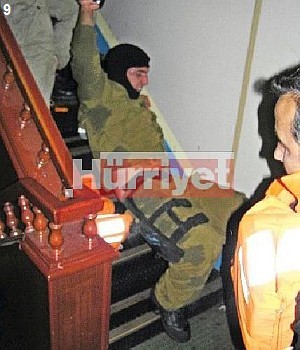
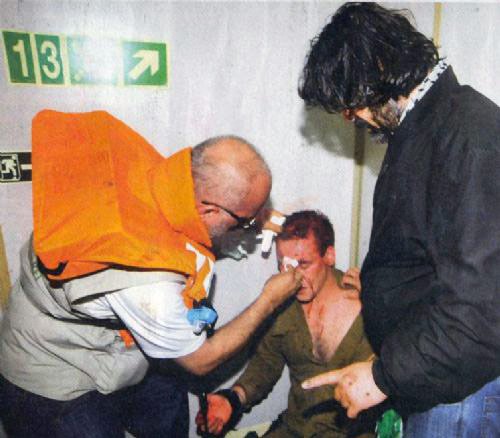
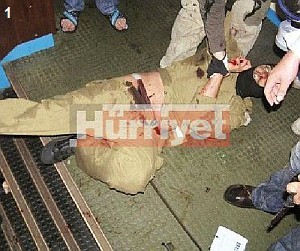
Hurriyet photos of disarmed Israeli commandos receiving medical care


(Photo via Ali Abunimah)

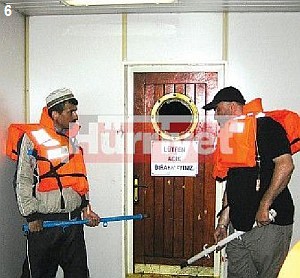
On the Mavi Marmara, the ship that Benjamin Netanyahu has dubbed “the hate boat”, Israeli soldiers who had been hurt were given medical aid. But some of the civilians who had been shot ended up dying because the Israelis refused to have them evacuated.

Accounts provided by activists on board claim that the first Israeli commandos to land on the ship were forcibly disarmed and then taken below deck for their own safety. Photographs now published by Turkey’s leading newspaper, Hürriyet, support this claim.
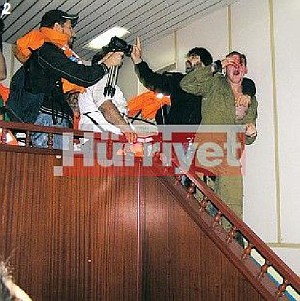
Soldiers from any military force rely on their weaponry to maintain their image of power. The Israeli military is no different from any other in wanting to avoid having the vulnerability of its own elite soldiers highlighted. What these photographs reveal, however, is that once these particular soldiers were no longer able to defend themselves, they were not lynched. On the contrary, they were taken out of harms way.
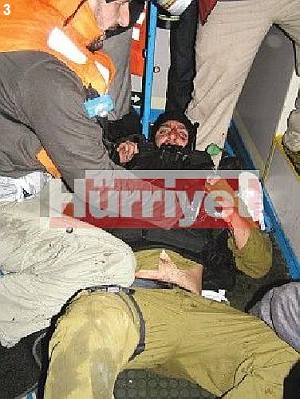
Given the terror that Israelis experience when faced with the risk of having soldiers taken hostage, it appears that one element in the over-reaction of the remaining armed commandos was that they thought it inconceivable that any of their comrades could be held without coming to further harm.

Humiliation and fear.

Was this the context in which enraged soldiers decided that they would then set about teaching their adversaries a lesson?

Did nine men, many of whom were well past an age where it seems at all likely they were engaged in any kind of combat, then become scapegoats?

Were the deaths on the Mavi Marmara the result of a few soldiers demonstrating their military muscle in a desperate effort to restore their tattered pride?


Facebooktwittermail

Gaza flotilla activists were shot in head at close range

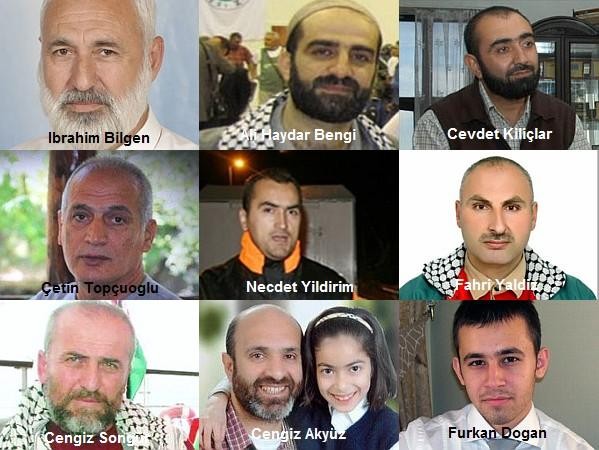
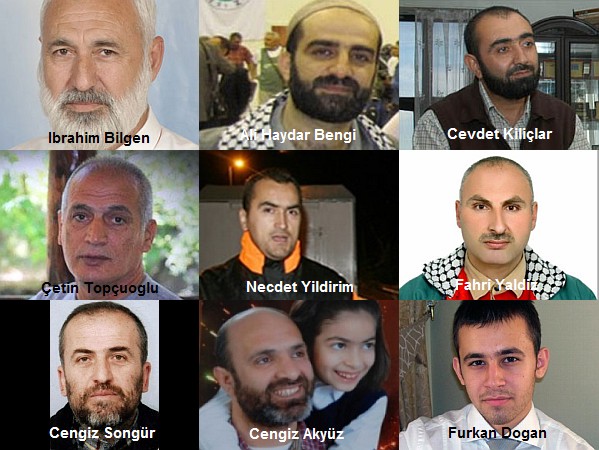
As more of the facts emerge, it is now becoming clear that the massacre on board the Mavi Marmara, was a massacre of middle-aged men. Ibrahim Bilgen, 61, Çetin Topçuoglu, 54, Cengiz Songür, 47, Fahri Yaldiz, 43, Cengiz Akyüz, 41, Ali Haydar Bengi, 39, Cevdet Kiliçlar, 38, Necdet Yildirim, 32. Only one was under thirty — the nineteen-year-old and American-born, Furkan Dogan.

The testimony of survivors suggests that most of the victims were targets of indiscriminate violence. Six of the dead were killed by a single Israeli commando who is now in line for a medal of valor.

Al Jazeera reported:

Sadreddin Furkan was another volunteer up with the captain when soldiers from the helicopter came to take over the bridge. They shot him three times in one leg and again on the other foot. “They were shooting in all directions. I felt a deep pain in my leg. It began bleeding. They shot me from behind.”

The Guardian reports:

Israel was tonight under pressure to allow an independent inquiry into its assault on the Gaza aid flotilla after autopsy results on the bodies of those killed, obtained by the Guardian, revealed they were peppered with 9mm bullets, many fired at close range.

Nine Turkish men on board the Mavi Marmara were shot a total of 30 times and five were killed by gunshot wounds to the head, according to the vice-chairman of the Turkish council of forensic medicine, which carried out the autopsies for the Turkish ministry of justice today.

The results revealed that a 60-year-old man, Ibrahim Bilgen, was shot four times in the temple, chest, hip and back. A 19-year-old, named as Fulkan Dogan, who also has US citizenship, was shot five times from less that 45cm, in the face, in the back of the head, twice in the leg and once in the back. Two other men were shot four times, and five of the victims were shot either in the back of the head or in the back, said Yalcin Buyuk, vice-chairman of the council of forensic medicine.

The findings emerged as more survivors gave their accounts of the raids. Ismail Patel, the chairman of Leicester-based pro-Palestinian group Friends of al-Aqsa, who returned to Britain today, told how he witnessed some of the fatal shootings and claimed that Israel had operated a “shoot to kill policy”.

He calculated that during the bloodiest part of the assault, Israeli commandos shot one person every minute. One man was fatally shot in the back of the head just two feet in front him and another was shot once between the eyes. He added that as well as the fatally wounded, 48 others were suffering from gunshot wounds and six activists remained missing, suggesting the death toll may increase.

The new information about the manner and intensity of the killings undermines Israel’s insistence that its soldiers opened fire only in self defence and in response to attacks by the activists.

“Given the very disturbing evidence which contradicts the line from the Israeli media and suggests that Israelis have been very selective in the way they have addressed this, there is now an overwhelming need for an international inquiry,” said Andrew Slaughter MP, a member of the all party group on Britain and Palestine.

The Times reports:

Six of the nine passengers killed in an Israeli raid on an aid convoy bound for Gaza were shot by a single Israeli commando, who is being considered for a medal of valour for saving his injured comrades as passengers attacked them with clubs, knives and even guns they had taken from downed Navy Seals.
[…]
Identified for security reasons only as Staff Sergeant S, he said that contrary to initial Israeli Army reports, the shooting had started within minutes as he and his comrades were set upon by a “mob of mercenaries”.

As he landed on the ship’s top deck, he said he saw three of his superior officers who had landed ahead of him lying wounded, one with a bullet wound to the stomach, another shot in the knee and the third beaten unconscious.

Taking charge, he formed his men in a perimeter around the wounded, pulled his 9mm Glock pistol and opened fire on passengers he accused of shooting at the boarding party with guns taken off the first soldiers, who had been overwhelmed as they landed one by one.

Hybrid States points out:

Yesterday, however, we were informed by a navy officer that navy commandos don’t carry 9mm guns, and that the empty 9mm casings were proof that the humanitarian activists had brought guns with them. Oops, someone forgot to tell Sergeant S.

Facebooktwittermail

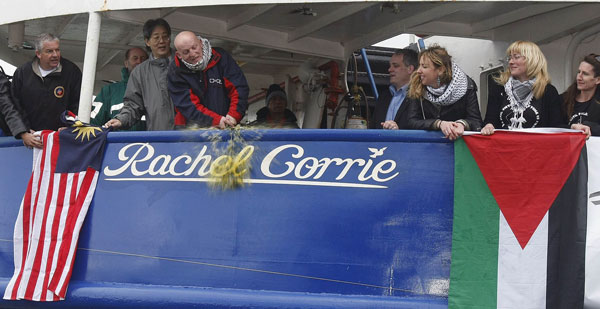
Israeli navy refuses to say the name “Rachel Corrie”

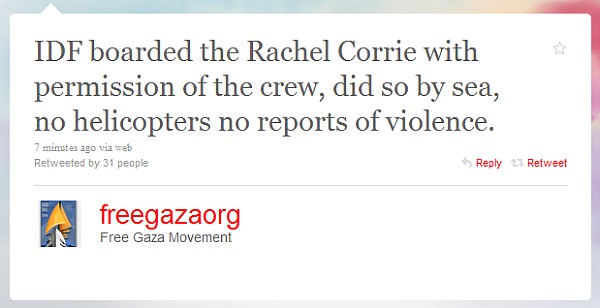
As Israeli naval operators engaged in radio communications with the MV Rachel Corrie this morning, they refused to address the ship by its current name — the name linked to its permanent International Maritime Organization identification number, IMO 6715281. Instead, in both communications released by the IDF, the ship is referred to as “Motor Vessel Linda” — the name used by the ship’s previous owner.

The Israeli military apparently not only refuses to accept responsibility for killing unarmed civilians — it refuses to even utter their names.

Facebooktwittermail

Rachel Corrie seized by Israeli military

Free Gaza Movement press release:

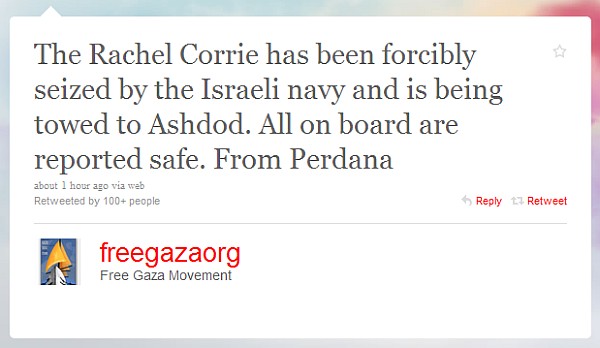
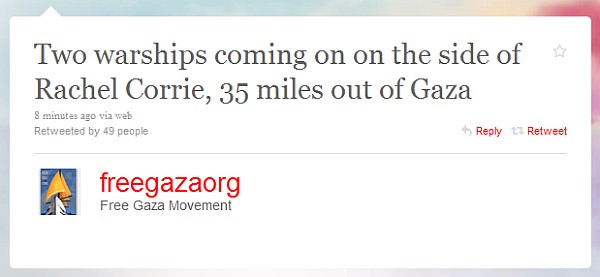
Just before 9am GMT this morning, the Israeli military forcibly siezed the Irish-owned humanitarian relief ship, the MV Rachel Corrie, from delivering over 1000 tons of medical and construction supplies to besieged Gaza. For the second time in less then a week, Israeli naval commandos stormed an unarmed aid ship, brutally taking its passengers hostage and towing the ship toward Ashdod port in Southern Israel. It is not yet known whether any of the Rachel Corrie’s passengers were killed or injured during the attack, but they are believed to be unharmed.

The Corrie carried 11 passengers and 9 crew from 5 different countires, mostly Ireland and Malaysia. The passengers included Nobel Peace Prize laureate Mairead Maguire, Parit Member of the Malaysian Parliament Mohd Nizar Zakaria, and former UN Assistant Secretary General, Denis Halliday. Nine international human rights workers were killed on Monday when Israeli commandos violently stormed the Turkish aid ship, Mavi Marmara and five other unarmed boats taking supplies to Gaza. Prior to being taken hostage by Israeli forces, Derek Graham, an Irish coordinator with the Free Gaza Movement, stated that: “Despite what happened on the Mavi Marmara earlier this week, we are not afraid.

The 1200-ton cargo ship was purchased through a special fund set up by former Malaysian Prime Minister and Perdana Global Peace Organisation (PGPO) chairman Tun Dr. Mahathir Mohamad. The ship was named after an American human rights worker, killed in 2003 when she was crushed by an Israeli military bulldozer in the Gaza Strip. Its cargo included hundreds of tons of medical equipment and cement, as well as paper from the people of Norway, donated to UN-run schools in Gaza.

According to Denis Halliday: “We are the only Gaza-bound aid ship left out here. We’re determined to deliver our cargo.” The Rachel Corrie had been part of the Freedom Flotilla, a 40-nation effort to break through Israel’s illegal blockade, before being forced to drop off late last week due to suspicious mechanical problems.

The attack on the Rachel Corrie may spell trouble for Israel’s relationship with Ireland. The Irish government had formally requested Israel allow the ship to reach Gaza. On 1 June, the Irish parliament also passed an all-party motion condemning Israel’s use of military force against civilian aid ships, and demanding “an end to the illegal Israeli blockade of Gaza.”

Nobel Laureate Mairead Maguire summed up the hopes of this joint Irish-Malaysian effort to overcome Israel’s cruel blockade by saying: “We are inspired by the people of Gaza whose courage, love and joy in welcoming us, even in the midst of such suffering gives us all hope. They represent the very best of humanity, and we are all privileged to be given the opportunity to support them in their nonviolent struggle for human dignity, and freedom. This trip will again highlight Israel’s criminal blockade and illegal occupation. In a demonstration of the power of global citizen action, we hope to awaken the conscience of all.”

Facebooktwittermail

Remembering the dead and the Rachel Corrie‘s mission

Humanitarian aid workers, a firefighter, a politician, a taekwondo champion, a photojournalist, a student who hoped to become a doctornine Turkish men, mostly fathers who leave behind children and wives.

Even while their deaths are at the center of an international crisis that is rocking the state of Israel, these individual lives lost have scarcely gained attention — firstly because the Israeli government resisted revealing any information about who died and in what circumstances, and then, while maintaining a stranglehold on the facts, Israel’s propaganda machine has worked furiously to portray the victims as villains.

The world has largely viewed Israel’s efforts to conceal its brutality with a mixture of skepticism, contempt and outrage. Yet in one regard the hasbara has worked: it has effectively sold the idea that the organizers and participants in the Freedom Flotilla were intent on picking a fight. This was an act of provocation and where opinions differ is on whether the provocation was justified or not.

As MJ Rosenberg wrote:

The first thing you need to know about the Gaza flotilla disaster is that the intention of the activists on board the ships was to break the Israeli blockade. Delivering the embargoed goods was incidental.

In other words, the activists were like the civil rights demonstrators who sat down at segregated lunch counters throughout the South and refused to leave until they were served. Their goal was not really to get breakfast. It was to end segregation.

Yes and no.

The Freedom Flotilla is part of a movement that aims to end the siege of Gaza, but delivering humanitarian aid is not incidental.

Israeli officials and the Israeli public who see themselves as victims of a campaign designed to make Israel look bad, fail to recognize that what cements Muslim solidarity and what has turned Gaza into a global issue, is not a global conspiracy against Israel or against Jews; it is a heartfelt response to human suffering.

The Freedom Flotilla carried thousands of tons of aid, not to poke Israel in the eye, but to help those in need. The many thousands of people who engaged in fundraising, made donations, gathered together supplies and readied the ships — a grass roots effort spread mostly across Europe and the Middle East — believed, naively or not, that the fruits of their efforts would be of real and practical assistance to the population in Gaza.

But, the cynics will ask, how could a few hundred people in a small flotilla of boats hope to successfully defy Israel’s military might? Firstly, simply on the basis that other vessels had completed the same mission. But more importantly, because courageous acts are invariably undertaken in defiance of the odds. The heroic imagination is enticed by what seems impossible.

The Freedom Flotilla as David, is not challenging the Goliath of Israel in order to give the mighty Jewish state some bad headlines. This is about defeating an agent of oppression. It is not about destroying Israel, but about challenging and overcoming the injustices which Israel sustains.

As the MV Rachel Corrie now approaches Gaza, Israel’s Foreign Ministry Director-General Yossi Gal says: “We have no desire for a confrontation. We have no desire to board the ship. If the ship decides to sail the port of Ashdod, then we will ensure its safe arrival and will not board it.”

A conciliatory gesture should receive a similar response, should it not?

Don’t be fooled. Israel and the United States are now working hand in glove to try and “moderate” the oppression of the population in Gaza. While the world calls for the siege to be ended, the Obama administration is calling for it to be “new approach.” Benjamin Netanyahu is reported to be “softening” his position.

This is about moving pressure from the heel to the toe, but it still means the Palestinians remain under an Israeli foot. It’s about taking Gaza out of the spotlight in the hope that global outrage can be replaced by global indifference.

For the Rachel Corrie to sail into the Israeli port of Ashdod under its own steam would be to capitulate to the power that claims it withdrew from Gaza even while it persists in maintaining absolute control over its population, its borders, its airspace and its economy.

The Rachel Corrie must reach Gaza, but if it is thwarted, more ships will come. Israel cannot win.

(Note of thanks to Lawrence of Cyberia for compiling information on those who died in the Flotilla Massacre and creating a page where new information is being added.)

Facebooktwittermail

MV Rachel Corrie due to reach Gaza within hours. “The world is watching” — Mustafa Barghouthi

The MV Rachel Corrie, a cargo ship in the Freedom Flotilla whose passage from Ireland was delayed by mechanical difficulties, is now hours away from its destination.

“I commend this courageous action of brave international civilians who are carrying essential medical, education and construction materials denied by Israeli suffocating and illegal siege on Gaza. It is vital that they have maximum support by the international community!” a Palestinian political leader, Dr Mustafa Barghouthi, told Nobel Peace laureate Mairead Maguire today. She and other activists on board the cargo ship carrying humanitarian aid from the Republic of Ireland to Gaza, said they hope to reach their destination by Saturday morning.

The world is watching,” said Dr Barghouthi, calling upon the international community to ensure the safe passage of the Rachel Corrie; he urged the EU representatives to take immediate and concrete steps in pressuring Israel to refrain from blocking the ship.

An appeal has gone out calling on Irish Americans to support the effort to end the siege of Gaza. Lorna Siggins, reporting from the Rachel Corrie for the Irish Times, writes:

Former UN assistant secretary general Denis Halliday has called on the [Irish] government to highlight the situation of the Gaza-bound Irish aid ship Rachel Corrie with US president Barack Obama’s administration and the EU.

Speaking by satellite phone on board the Rachel Corrie yesterday several hundred miles from Gaza, Mr Halliday said it was imperative that the Obama administration and the EU supported Ireland’s call on the Israeli authorities to ensure safe passage for the ship, which is carrying aid supplies.

“We feel that, like the UN, the EU has failed the Palestinians and we feel that the EU could exert more pressure in terms of trade links, which the Israelis are very dependent on,” he said.

Mr Halliday, a Connemara resident, confirmed that Minister for Foreign Affairs Micheál Martin had been in phone contact with the ship over the past two days .

“We are very grateful to the Minister, who has been completely supportive, but we need more,” Mr Halliday said.

“We also feel there is a role for the Irish diaspora here, in the US and elsewhere to lobby politicians over this continued illegal blockade of Gaza, which is causing such hardship to the Palestinian people.”

As Robert Naiman notes:

The issue of the Gaza blockade has tremendous resonance in Ireland, partly because of Ireland’s high degree of engagement in international humanitarian causes — John Ging, head of the UN Relief and Works Agency in Gaza, who had called on the international community to break the siege by sending ships loaded with aid, is also Irish — but also, of course, because the Irish people have some experience with the consequences for civilians of a colonial blockade.

Between 1845 and 1850, more than a million Irish people starved to death under British rule while, as Sinead O’Connor famously noted, food was shipped out of Ireland under armed guard. A million more fled Ireland to escape starvation, many to America, including Falmouth Kearney, President Obama’s great-great-great grandfather.

Many Irish people — and Irish-Americans — take the responsibilities of this legacy very seriously.

Facebooktwittermail

Israel’s national psychosis

The feeling of helplessness of a poor lonely victim, confronting the rage of a lynch mob and frantically realizing that these are his last moments, accurately reflect the current psychosis of the majority of the Israeli public, writes Anshel Pfeffer.

“We felt like the Ramallah lynch.” I am certain that the unnamed Israeli naval commando who said these words to a reporter a few hours after the bloodbath on the Mavi Marmara regrets them now. It is quite clear why the image came to his mind at the time. None of us has forgotten the pictures of a baying mob literally hacking to pieces the reservists Yossi Avrahami and Vadim Nurzhitz nine and a half years ago and throwing their bodies out of the window of a Palestinian police station.

But the visual resemblance is where the comparison ends. The two unarmed reservists were on their own, after straying into Ramallah, and were cruelly murdered. They were dead before the army was even fully aware that they were missing. True, the naval commandos on the Turkish ferry were surrounded by club-wielding enemies, intent on killing them – one of them was even thrown off the deck – but they were simply at a very temporary tactical disadvantage. Backing them up was all the firepower and might of a modern navy, and indeed the results were not surprising. After a few minutes of scuffling, in which seven commandos were wounded, the full force was unleashed and nine people on the other side were killed. Hardly a lynch situation.

But it was that remark that was picked up by the entire Israeli media and used as the headline encapsulating the whole bloody event. Why? Because the feeling of helplessness of a poor lonely victim, confronting the rage of a lynch mob and frantically realizing that these are his last moments, accurately reflect the current psychosis of the majority of the Israeli public.

Everything that followed the disastrous raid on the Gaza flotilla – the descriptions in the media, the justifications of the Israel Defense Forces spokesman and the reactions of the politicians – prove how detached we have become from the way that Israel is perceived from outside. One sentence that was repeated over and over to justify the final outcome was: “And what if they had succeeded in killing one of our soldiers?” This is a rhetorical argument that is unanswerable in any discussion held in Israel. No matter how many combatants we have lost in all the wars, operations, accidents and other foul-ups, every time the radio announces the death of yet another an IDF soldier, something dies within every one of us.

That is a noble sentiment, a feeling of a society with a shared responsibility and destiny, but we have lost any other perspectives and are incapable of realizing that it is only we Israelis who feel this. We have hunkered down deep inside our collective bunker and have lost sight of any suffering or loss on the other side.

I don’t want to use this column to discuss the shortcomings of Israeli hasbara, as the implications of this event go well beyond public relations in their significance. But one thing that was very clear to me on Monday, as I watched the Israeli media strategy unfold before the television cameras at the Ashdod port, was how all the professional spokespersons swiftly fell back on the same comforting tropes that appeal only to the Israeli public and a shrinking group of die-hard supporters overseas. Even the experienced professionals, who should know better, could do no more than to convince the already convinced.

Let’s just continue their argument for a moment. Say that two IDF commandos had been killed in the confrontation. It would have been another national tragedy for us, but would anyone outside of Israel have been moved? Not a bit: They would simply have been two heavily armed soldiers carrying out an illegal raid who were killed by brave civilians defending a ship bearing humanitarian aid. None of Israel’s arguments – that the members of the Turkish relief organization IHH were actually murderous jihadis, that there is no humanitarian crisis in Gaza, that Israel was prepared to allow the cargo to go through its own port and that the blockade is justified as the only way to keep more missiles from reaching Hamas – would have been any more persuasive. Not because they were badly presented or inaccurate, but simply because moral people around the world see almost everything that happens in the region as a result of a deeply immoral situation that the Israeli leadership and the great majority of the Israeli public is doing nothing whatsoever to change.

That may be a simplistic perspective, devoid of any nuance, but it is not an anti-Semitic or even anti-Israeli position, as some try to persuade us. It is simply a moral viewpoint. And even most perceptive Israelis can’t seem to see that. Our powers of analysis are impressive, up to a certain level. A few hours after the dust settled it was clear what had gone wrong on a tactical level. On Monday evening, in one of those moments of tired, off-the-record frankness, an IDF colonel said to me, “Come on Anshel, we all know what the problem was here. This was a policing operation, not something for a real army.” He was right, but this is far from an isolated example. Criticizing the IDF is too easy. The real blame lies with successive Israeli governments and the broad public that are not brave enough to end the 42-year-old occupation and prefer instead to throw the army at the problem. As good as our army is, the result will only be more and more bloodshed. So how do we deal with it? By convincing ourselves that we are the moral ones and everyone else just wants to kill us.

If only we had some real friends, friends we could trust implicitly, who could point out the error of our ways. This could be the shining moment of the Jewish Diaspora. They love us, but they also see things from another perspective. We need a strong, unified voice from the Jewish leadership in the United States and Europe telling Israelis enough is enough, you are hurtling down the slippery slope of pariahdom and causing untold damage to yourselves and us. Lift your heads above the ramparts and see that the world has moved on.

Instead, we find the establishment of the Jewish world crouching with us in the bunker.

In his breathtaking analysis of the decline of secular Zionism in America, “The Failure of the American Jewish Establishment,” which appeared in the New York Review of Books last month, Peter Beinart describes how the leaders of America’s major Jewish organizations have succeeded in estranging an entire generation of young Jews from Israel “by defending virtually anything any Israeli government does.” In doing so “they make themselves intellectual bodyguards for Israeli leaders who threaten the very liberal values they profess to admire.”

Beinart persuasively explains how this has convinced many young Jews that they have noting in common with a country whose policies contradict so much of what they have been brought up to believe in. But there is another damaging aspect to this cheerleading. Every Israeli cabinet minister who is greeted by cheering audiences during visits abroad fails to see all those who, disgusted, prefer to stay at home.

They return to Israel convinced that at least the Jewish people are still behind us and that our opponents are simply anti-Semitic. Other voices, such as the new lobbies JStreet and JCall, are ostracized by the establishment instead of being treated as what they really are, authentic voices for many concerned Jews.

When the history of the Jewish people in the early 21st century is written, the conclusion will be unavoidable. In its hour of need Israel was let down by the Diaspora.

Facebooktwittermail

Turkish president: Israel will never be forgiven

Al Jazeera‘s Jamal Elshayyal describes the attack on the Mavi Marmara, witnessing activists being shot, how the injured were left to die, and how he was abused under Israeli detention.

Al Jazeera reports:

The Turkish president has said that Israel’s military raid on civilian aid ships bound for the Gaza Strip has caused “irreparable” damage to his country’s relations with Israel, and will “never” be forgiven.

“From now on, Turkish-Israeli ties will never be the same. This incident has left an irreparable and deep scar,” Abdullah Gul said in a televised speech on Thursday, as thousands gathered in the streets of Istanbul to pay their respects to the humanitarian activists killed during the raid.

The raid “is not an issue that can be forgotten… or be covered up… Turkey will never forgive this attack,” he said.

Hassan Ghani, a journalist for PressTV describes his experience on board the Mavi Marmara as it came under Israeli attack.


Parts two and three of the interview with Hassan Ghani.

Today’s Zaman adds:

Activists say some people who were initially on the flotilla are missing. They are also telling stories of horror, carnage and pure barbarism at the hands of Israeli officials. In a shocking account, Humanitarian Aid Foundation (İHH) President Bülent Yıldırım, who returned on Thursday, said a photographer, whose first name was Cevdet, was shot in the forehead by a soldier one meter away from him. “Our Cevdet [Kılıçlar], he is a press member. He has become a martyr. All he was doing was taking pictures. They smashed his skull into pieces. We soon made out that these were real bullets they were firing. Rubber bullets also kill because you shoot at very close range, between one-and-a-half and two meters.”

Kevin Ovenden of Britain, an activist on the ship that arrived in İstanbul on Thursday, also said a man who had pointed a camera at the soldiers was shot directly through the forehead with live ammunition, with the exit wound blowing away back of his skull.

There were also claims that Israeli official reports on the number of people killed are untruthful. Yıldırım said, “Until now they have returned nine dead bodies, but our list is bigger. There are people missing.” Speaking to journalists at Atatürk International Airport shortly after his return, Yıldırım said: “We saw 38 injured who were brought back to us by doctors after the attack. Now they are saying there are 21 people who have been injured.” Yıldırım was on the main passenger ship, the Mavi Marmara, which the Israeli navy attacked at the start of its raid.

Another witness, Yücel Köse, who was on the ship Gazze repeated Yıldırım’s allegations of missing people. “The Mavi Marmara was bombed right in front of our eyes. They threw the wounded into the water,” he said. Köse said the soldiers were upset when some of their men were held by activists aboard the Mavi Marmara.

Facebooktwittermail

Can Americans be murdered by the Israeli government with impunity?

For several days, Israel has been able to contain some of the fallout from the flotilla massacre by withholding information about the dead and injured. The object of this exercise has clearly been to slow the flow of information in the hope that by the time the most damning facts become known, the international media’s attention will have turned elsewhere.

But the dead now have names and faces and one turns out to be a nineteen-year-old American: Furkan Dogan.

Dogan is alleged to have been shot with five bullets, four in the head.

Does the Obama administration intend to investigate the circumstances in which one of its citizens was killed? Protecting the lives of Americans is after all the most fundamental responsibility of our government.

Dogan’s death was presumably instant, but according to Al Jazeera‘s Jamal Elshayyal there were others on board the Mavi Marmara who died because Israeli soldiers refused to treat their injuries.

“After the shooting and the first deaths, people put up white flags and signs in English and Hebrew. An Isreali [on the ship] asked the soldiers to take away the injured, but they did not and the injured died on the ship.”

Crimes have been committed and since the suspects all acted under the direction of the Israeli government and its defense forces and took place on international waters outside Israel’s area of legal jurisdiction, “a prompt, impartial, credible and transparent investigation conforming to international standards” — a demand made by the UN Security Council with the support of the Obama administration — cannot be conducted by the Israeli government or a commission appointed by them. An investigation conforming to international standards must also be an international inquiry.

Facebooktwittermail

Israel is becoming a liability for the United States

Carlo Strenger notes in Haaretz:

During the media frenzy of the last days a crucial headline has received close to no attention: Mossad chief Meir Dagan told the Knesset’s Foreign Relations Committee that Israel is gradually turning from a strategic asset into a liability for the United States of America.

As it’s a bit difficult to brush aside Dagan as a softheaded idealist, our policy makers will find another way not to listen. They will say, “this would never have happened under George W. Bush; this is only because the Obama administration is not friendly towards Israel. We simply need to wait for Obama to end this term; he won’t get reelected.”

Nothing could be further from the truth. I have heard warnings that Israel is becoming a strategic liability for the U.S. from Americans, including high ranking members of the George W. Bush administration, for years. The only difference is that during the Bush years, nobody in the administration would say this on record or for attribution.

As if to echo and underline Dagan’s message, Anthony Cordesman, one of the most respected non-partisan national security experts in Washington writes:

[T]he depth of America’s moral commitment [to Israel] does not justify or excuse actions by an Israeli government that unnecessarily make Israel a strategic liability when it should remain an asset. It does not mean that the United States should extend support to an Israeli government when that government fails to credibly pursue peace with its neighbors. It does not mean that the United States has the slightest interest in supporting Israeli settlements in the West Bank, or that the United States should take a hard-line position on Jerusalem that would effectively make it a Jewish rather than a mixed city. It does not mean that the United States should be passive when Israel makes a series of major strategic blunders–such as persisting in the strategic bombing of Lebanon during the Israeli-Hezbollah conflict, escalating its attack on Gaza long after it had achieved its key objectives, embarrassing the U.S. president by announcing the expansion of Israeli building programs in east Jerusalem at a critical moment in U.S. efforts to put Israeli-Palestinian peace talks back on track, or sending commandos to seize a Turkish ship in a horribly mismanaged effort to halt the “peace flotilla” going to Gaza.

It is time Israel realized that it has obligations to the United States, as well as the United States to Israel, and that it become far more careful about the extent to which it test the limits of U.S. patience and exploits the support of American Jews. This does not mean taking a single action that undercuts Israeli security, but it does mean realizing that Israel should show enough discretion to reflect the fact that it is a tertiary U.S. strategic interest in a complex and demanding world.

And then comes word from the Canadian writer, Margaret Atwood, whose impartial observations as a first-time visitor to the Jewish state cut to the core when she says:

[T]he concept of Israel as a humane and democratic state is in serious trouble. Once a country starts refusing entry to the likes of Noam Chomsky, shutting down the rights of its citizens to use words like “Nakba,” and labelling as “anti-Israel” anyone who tries to tell them what they need to know, a police-state clampdown looms. Will it be a betrayal of age-old humane Jewish traditions and the rule of just law, or a turn towards reconciliation and a truly open society?

Time is running out. Opinion in Israel may be hardening, but in the United States things are moving in the opposite direction. Campus activity is increasing; many young Jewish Americans don’t want Israel speaking for them. America, snarled in two chaotic wars and facing increasing international anger over Palestine, may well be starting to see Israel not as an asset but as a liability.

Israelis never tire of declaring with great solemnity that they survive in a dangerous neighborhood — invariably the observation is used as a justification for some form of brutality. Yet behind the faux boldness of this embattled nation is the comforting awareness that little Israel enjoys the protection of its big American friend. But any friendship can eventually be strained beyond repair.

As Israel becomes more and more isolated, that isolation may reinforce the delusions of those convinced that the rest of the world is dangerous yet for others it will make the rest of the world increasingly appealing. Thus will arise the demographic threat that no racist scheme can resolve: the threat that life in a Jewish state is simply no longer appealing to enough Jews.

Facebooktwittermail