Israel’s secretive nuclear activities may undergo unprecedented scrutiny next month, with a key meeting of the International Atomic Energy Agency tentatively set to focus on the topic for the first time, according to documents shared Friday with The Associated Press.
A copy of the restricted provisional agenda of the IAEA’s June 7 board meeting lists “Israeli nuclear capabilities” as the eighth item — the first time that that the agency’s decision-making body is being asked to deal with the issue in its 52 years of existence.
The agenda can still undergo changes in the month before the start of the meeting and a senior diplomat from a board member nation said the item, included on Arab request, could be struck if the U.S. and other Israeli allies mount strong opposition. He asked for anonymity for discussing a confidential matter.
Even if dropped from the final agenda, however, its inclusion in the May 7 draft made available to The AP is significant, reflecting the success of Islamic nations in giving concerns about Israel’s unacknowledged nuclear arsenal increased prominence.
Author Archives: Paul Woodward
Israel still might not dodge a human rights threat from Britain
“Sighs of relief will have been heard in Israel’s London embassy on Friday morning as it emerged that Britain’s Liberal Democrat party had failed to capitalize on a surge in pre-election opinion polls,” Haaretz reported.
Cleggmania might have proven to be short-lived — or at least not translated well in a parliamentary system that disregards the size of the vote. Still, I’d says those breaths released in relief should probably have been held in. An Israeli nightmare might still come to pass: Foreign Secretary Nick Clegg in a coalition government. As of Friday afternoon, that outcome is still in the cards.
But why should Israel be so afraid of Britain’s newest political star?
“Clegg is bad news for Israel,” one official here said. “His party is running on a human rights platform, and the atmosphere is hostile to Israel. We remind the Liberal Democrats of South Africa during apartheid. Even if Clegg decides not to take the foreign portfolio, the very fact that Liberal Democrats sit in the cabinet is likely to mean trouble for us.”
Israel’s Lieberman-run ministry of foreign affairs might make a mockery of diplomacy, but it should never be faulted for its bluntness: Good for human rights; bad for Israel. There’s a slogan to remember!
Lieberman’s TEA party and dual loyalty
Joe Lieberman’s Terrorist Expatriation Act is designed to strip the constitutional rights from any American who is accused of supporting terrorism, but the political sentiment he’s tapping into is simply, America first. Does Lieberman have no concern about where this might go?
How about this New Yorker who Max Blumenthal interviewed recently? Presumably she’s an American citizen, but it sounds like she puts Israel first:
As for where Lieberman is finding support, it isn’t coming from the White House but other Democrats have spoken favorably:
Several major Democratic officials spoke positively about the proposal, including Secretary of State Hillary Rodham Clinton. Noting that the State Department already had the authority to rescind the citizenship of people who declare allegiance to a foreign state, she said the administration would take “a hard look” at extending those powers to cover terrorism suspects.
“United States citizenship is a privilege,” she said. “It is not a right. People who are serving foreign powers — or in this case, foreign terrorists — are clearly in violation, in my personal opinion, of that oath which they swore when they became citizens.”
Speaker Nancy Pelosi said she supported the “spirit” of the measure, although she urged caution and said that the details of the proposal, like what would trigger a loss of citizenship, still needed to be fleshed out.
Interesting comment from Clinton… Makes me wonder: how does she feel about Rahm Emanuel serving in the Israeli Defense Force? I know that doesn’t count as an infraction of the law because Israel is not a country hostile to the US, but there’s no avoiding the fact that serving in the Israeli military is serving a foreign power.
As for the “spirit” of the measure, I guess Pelosi will have to explain what she means, but Megan McArdle is not alone in finding this spirit hard to discern:
Can someone explain to me–hopefully using graphs, and small words–why Joe Lieberman is willing to share the precious blessing of American citizenship with Charles Manson, Gary Ridgeway, and David Berkowitz, but wants citizenship stripped from a guy who strapped some firecrackers to a bag of non-explosive fertilizer?
Indeed. And if even Glenn Beck and Chuck Schumer both doubt the wisdom of Lieberman’s bill, that might be a hint that this truly is an act of idiocy.
An arrest warrant needs a name on it; a death warrant needs none.
In the narrative that sketches the legality of the war on terrorism, the tribal nature of the “battlefield” is the pretext used to justify killing people instead of attempting to arrest them. Counterterrorism experts scoff at the notion that FBI agents (or Pakistani law enforcement officials for that matter) could possibly waltz into a village in South Waziristan and handcuff a Taliban or al Qaeda suspect. The logistics of such an operation would indeed be daunting.
But here’s the thing: The United States is now killing people when it doesn’t even have a legal basis for even initiating their capture.
In the US — and most other legal jurisdictions — an arrest warrant needs to show probable cause connecting a crime that has been committed to the person named on the warrant.
In Pakistan, the CIA can target someone for assassination without knowing their name, without witnessing them commit a crime — simply on the Orwellian pretext that their “pattern of life” can be deemed a threat to the United States.
The Los Angeles Times reports:
The CIA received secret permission to attack a wider range of targets, including suspected militants whose names are not known, as part of a dramatic expansion of its campaign of drone strikes in Pakistan’s border region, according to current and former counter-terrorism officials.
The expanded authority, approved two years ago by the Bush administration and continued by President Obama, permits the agency to rely on what officials describe as “pattern of life” analysis, using evidence collected by surveillance cameras on the unmanned aircraft and from other sources about individuals and locations.
The information then is used to target suspected militants, even when their full identities are not known, the officials said. Previously, the CIA was restricted in most cases to killing only individuals whose names were on an approved list.
The new rules have transformed the program from a narrow effort aimed at killing top Al Qaeda and Taliban leaders into a large-scale campaign of airstrikes in which few militants are off-limits, as long as they are deemed to pose a threat to the U.S., the officials said.
At a time when Faisal Shahzad — a name that might not evoke much terror — is a name uppermost in many people’s minds, it’s worth remembering Mir Aimal Kasi.
In 1993 he too had conducted a pattern of life analysis, having noted the turn lane that directed traffic into the CIA’s Langley headquarters. In his targeted killing operation, he too had found the high-value targets of his choice — James Woollsey and Robert Gates — were too illusive and so he opted to shoot CIA employees whose names he didn’t know.
Soon before receiving a death sentence in 1998, Kasi told Salon:
“I am not against the USA or the American people. I am against the policies of the U.S. government toward Islamic countries or toward Muslims.”
“A lot of young people in Pakistan,” he said, “think mostly the same.”
Whoever follows in the footsteps of Faisal Shahzad may have less interest in constructing a Rube Goldberg type contraption than in causing mayhem the America way — as did Mir Aimal Kasi, John Allen Muhammad, and Nidal Malik Hasan.
“This is a blow back. This is a reaction. This is retaliation. And you could expect that,” Pakistani Foreign Minister Mahkdoom Qureshi told CBS News after the Times Square bombing attempt. “Let’s not be naive. They’re not going to sort of sit and welcome you eliminate them. They’re going to fight back.”
The Israeli exception
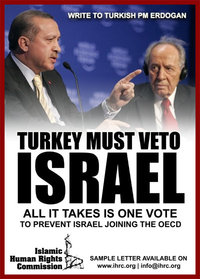
At Foreign Policy in Focus, John Feffer draws attention to the contradiction between Israel’s behavior as a rogue state and the fact that it is about to be granted the privileged status of membership in the Organization for Economic Cooperation and Development — unless, that is, a country such as Turkey steps up and exercises its right to cast a veto.
North Korea and Israel have a lot in common.
Neither is a signatory to the Nuclear Non-Proliferation Treaty (NPT), and both employ their nuclear weapons in elaborate games of peek-a-boo with the international community. Israel and North Korea are equally paranoid about outsiders conspiring to destroy their states, and this paranoia isn’t without some justification. Partly as a result of these suspicions, both countries engage in reckless and destabilizing foreign policies. In recent years, Israel has launched preemptive strikes and invaded other countries, while North Korea has abducted foreign citizens and blown up South Korean targets (including, possibly, a South Korean ship in late March in the Yellow Sea).
And they’re both exceptions in their regions: Israel is a Jewish state in an Arab region; North Korea is an old-style feudal dictatorship in an Asian region marked by relative prosperity and political openness. But the two countries often behave as if they are exceptions to all other rules as well. For instance, they both share an antipathy toward human rights organizations that attempt to hold them to international standards. Witness the recent attacks by Israel (and its hard-right supporters) of Human Rights Watch because of reports critical of Israel’s human rights record. North Korea also routinely rejects human rights inquiries as a challenge to its sovereignty. (For a proposal on a better strategy to engage North Korea on human rights issues, check out my latest piece Starting Where North Korea Is.)
Despite these similarities, these two roguish powers haven’t had a great deal of interaction. Between 1992 and 1994, Israel secretly negotiated a billion dollar buy-out of North Korea’s missile export program to the Middle East, and the United States intervened to nix the deal (only to explore a similar option with North Korea at the end of the Clinton administration). In 2007, Israel bombed a suspected nuclear facility in Syria that may or may not have been built with North Korean assistance. Otherwise, the two countries maintain their innocence and distance.
And yet one country is an official rogue and the other country only plays one on Arab TV. The difference in designation owes much to U.S. policy. One of the perks of world domination is the chance to make like Adam in Genesis and name all the animals. North Korea, according to Washington, is beyond the pale. Israel, however, is “one of us”: firmly ensconced in the Judeo-Christian tradition, accorded honorary European status, and even considered worthy of membership in the Organization for Economic Cooperation and Development (OECD).
Meanwhile, The Guardian reports:
Britain has refused to allow Israel’s Mossad secret service to send a representative back to the country’s London embassy following the row over the killing of a Hamas operative by agents using forged UK passports.
Israel’s Yediot Aharonot newspaper reported yesterday that the Foreign Office is digging in its heels because Israel is refusing to commit itself not to misuse British passports in future clandestine operations.
Afghanistan: is it time to talk to the Taliban?
In The Guardian, Jonathan Steele writes:
Eight years after they were overthrown by US air power, a drumbeat is starting to sound across Afghanistan in favour of talking to the Taliban, the country’s once-hated former rulers. An idea that used to seem absurd, if not defeatist, is coming to be seen as the only credible way to end an ever-widening war. Moreover, the proposed agenda of negotiations is not a Taliban surrender, but an offer to share power in Kabul.
President Hamid Karzai and other senior Afghan politicians support the idea. So too do a growing number of foreign governments, including Britain’s – at least tentatively – now that British troops are being killed at twice the rate they were in early 2009.
Perhaps most surprisingly, even among Afghanistan’s small but determined group of woman professionals, the notion of making a deal with the ultra-conservative men who forced them into burkas and denied them the right to work outside the home is no longer anathema. A desperate desire for peace is trumping concern over human rights.
The myth of Talibanistan
Pepe Escobar’s analysis is interesting as always — though one note of warning: In writing about Baitullah Mehsud I think Escobar is actually referring to Hakimullah Mehsud. Reports that Baitullah was killed last August, have, as far as I’m aware, not been disputed. It was Hakimullah who reemerged this week after he was reported to have been killed in January.
What is never mentioned by US corporate media is the tremendous social problems Pakistan has to deal with because of the mess in the tribal areas. Islamabad believes that between the Federally Administered Tribal Areas (FATA) and NWFP, at least 1 million people are now displaced (not to mention badly in need of food aid). FATA’s population is around 3.5 million – overwhelmingly poor Pashtun peasants. And obviously war in FATA translates into insecurity and paranoia in the fabled capital of NWFP, Peshawar.
The myth of Talibanistan anyway is just a diversion, a cog in the slow-moving regional big wheel – which in itself is part of the new great game in Eurasia.
During a first stage – let’s call it the branding of evil – Washington think-tanks and corporate media hammered non-stop on the “threat of al-Qaeda” to Pakistan and the US. FATA was branded as terrorist central – the most dangerous place in the world where “the terrorists” and an army of suicide bombers were trained and unleashed into Afghanistan to kill the “liberators” of US/NATO.
In the second stage, the new Obama administration accelerated the Predator “hell from above” drone war over Pashtun peasants. Now comes the stage where the soon over 100,000-strong US/NATO troops are depicted as the true liberators of the poor in Af-Pak (and not the “evil” Taliban) – an essential ploy in the new narrative to legitimize Obama’s Af-Pak surge.
For all pieces to fall into place, a new uber-bogeyman is needed. And he is TTP leader Baitullah Mehsud, who, curiously, had never been hit by even a fake US drone until, in early March, he made official his allegiance to historic Taliban leader Mullah Omar, “The Shadow” himself, who is said to live undisturbed somewhere around Quetta, in Pakistani Balochistan.
Now there’s a US$5 million price on Baitullah’s head. The Predators have duly hit the Mehsud family’s South Waziristan bases. But – curioser and curioser – not once but twice, the ISI forwarded a detailed dossier of Baitullah’s location directly to its cousin, the Central Intelligence Agency. But there was no drone hit.
And maybe there won’t be – especially now that a bewildered Zardari government is starting to consider that the previous uber-bogeyman, a certain Osama bin Laden, is no more than a ghost. Drones can incinerate any single Pashtun wedding in sight. But international bogeymen of mystery – Osama, Baitullah, Mullah Omar – star players in the new OCO (overseas contingency operations), formerly GWOT (“global war on terror”), of course deserve star treatment.
Drone strikes like “canon fire”
CNN reports:
Drone-launched missiles are now hitting lower-level al Qaeda and Taliban personnel, camps, training areas, bomb makers, buildings and other targets in the remote region.
“You’ve had an expanded target set for time now, and given the danger these groups pose and their relative inaccessibility, these kinds of strikes — precise and effective — have become almost like the cannon fire of this war. They’re no longer extraordinary or even unusual,” the official said.
The US counterterrorism official who likened Hellfire missile attacks to cannon fire, reached for a comparison which though perhaps ill-conceived is also revealing. If drone warfare is meant to epitomize precision, nothing represents blunt force more than a cannon.
As for the claim that big-name targets have now given way to an expanded range of lower level targets, US officials who still insist that there have been no more than a handful of civilians killed in drone attacks might be posed a basic challenge: How often can they even name the dead?
Drone attacks provoke calls for revenge

In a report on the CIA’s campaign of drone warfare in Pakistan, the Los Angeles Times recounts the stories of some of the civilian victims of the attacks.
Many of the boys that Zaman Khan grew up with in the South Waziristan town of Shakai eventually joined the Taliban. He knew they had become militants, but he never thought it odd to have them over for tea.
Whether it was because of Taliban visits or the proximity of a regular Taliban meeting place 30 yards away, Khan’s house became a target March 15, 2008.
The missile struck while everyone slept, killing Khan’s brother, Wazir Khan, 40; Wazir’s wife, Zara Bibi, 30; and their 4-year-old son, Irshad. The left half of Wazir’s body had been sheared off. Zara’s and Irshad’s bodies were charred from head to toe.
Wazir’s two other children, Noor Rehman, 10 at the time, and Ishaq Khan, 3, survived. Physically, they recovered but suffer from psychological problems, Zaman Khan said.
“Ishaq doesn’t talk at all,” Khan said. “He can’t recognize his family, and he drinks only if someone helps him.”
Three weeks after that strike, a house full of civilians in the same neighborhood was struck, instantly killing cousins Sher Maan, 20, and Azeem Ullah, 30, and Azeem’s wife, Gul Anama, 25.
“It was a huge blast that shook the ground,” said Amin Ullah, 20, a Shakai farmer.
“I believe that most of the victims of these drone attacks are innocent people,” Ullah said. “Pakistan should be carrying out these attacks. Pakistan knows the terrain, knows its people and knows the militants.”
Andrew Exum, a former Army officer in Afghanistan and Iraq, has declared the drone program counterproductive and called for an end to it. In an analysis published last year, Exum and David Kilcullen, a former counterinsurgency advisor to the head of U.S. Central Command, Army Gen. David H. Petraeus, dismissed drones as technology substituting for strategy.
“Every one of these dead noncombatants represents an alienated family, a new desire for revenge, and more recruits for a militant movement,” they wrote.
Drones have proved invaluable in Afghanistan, where they focus on surveillance, intelligence-gathering and watching over coalition troops, Exum said in an interview. But in Pakistan, the U.S. and the government in Islamabad need to make the case that the attacks are part of a joint strategy supporting Pakistani policy, he said.
“I’m not saying drones can’t be part of the solution, but right now I think they’re part of the problem,” Exum said.
Drone attacks have enraged men such as Momin Khan. On a September morning last year, Khan heard the thunderclap of a drone strike in Machis, his village in North Waziristan, and ran to see what had happened.
As he joined other villagers running down a dirt road, the 50-year-old unemployed teacher saw black smoke and flames curling out of a house about 60 yards away. The missile had killed two people there. As he ran closer, a second missile strike shook the ground.
Shrapnel from the blast cut into his shoulder and legs. He woke up in a hospital.
Four people were killed in the second strike, he said. Although Taliban militants have often used Machis as a haven, Khan said he was sure the house initially targeted had only civilians in it.
“These drones fly day and night, and we don’t know where to hide because we don’t know who they will target,” he said. “If I could, I would take revenge on America.”
Philip Alston, the United Nations special representative on extrajudicial, summary or arbitrary killings, said that without full disclosure of the CIA drone program, “the opportunities for abuse are immense.”
“The CIA is running a program that is killing a significant number of people, and there is absolutely no accountability in terms of the relevant international law,” he said.
Scott Horton, while considering some of the legal issues surrounding the program notes:
No weapons system remains indefinitely the province of a single power. Drone technology is particularly striking in this regard, because it is not really all that sophisticated. It seems clear that other powers have this technology–Israel and Iran have each been reported to be working with it, Russia and China could obviously do so easily if they desired, and the same is probably true for Britain, France, and Germany, not to mention Japan and Taiwan, where many of the cutting-edge breakthroughs in robotics actually occur. The way America uses this technology is therefore effectively setting the rules for others. Put another way, if it’s lawful for America to employ a drone to take out an enemy in the desert of Yemen, on the coast of Somalia, in a village in Sudan or Mauretania, then it would be just as lawful for Russia, or China–or, for that matter, for Israel or Iran. What kind of world is this choice then creating? Doesn’t it invariably lead us closer to the situation in which a targeted killing will be carried out in a major metropolis of Europe or East Asia, or even the United States? And doesn’t that move us in the direction of a dark and increasingly lawless world?
This is not idle speculation. The choices the United States has made are being studied very closely in capitals around the world. In Russia, for instance, national-security analysts have noted the American drone strikes with a measure of approbation, because they see such strikes as justifying lethal countermeasures of their own against perceived terrorist enemies. A number of enemies of the Russian government who were critical of policies or actions connected with the Second Chechen War have recently met violent death, often after Russian authorities linked them to Chechen terrorist groups. The Polonium poisoning of Aleksandr Litvinenko in London, for instance, or the assassination of Umar Israilov in Vienna, which Austrian prosecutors linked earlier this week to a Putin-protégé, the president of Chechnya, are two examples that suggest that Europe may have been cleared as a theater for targeted killings by a great power. The 2004 killing of former Chechen President Zelimkhan in Qatar is an example of another Russian targeted killing in the Gulf. The recent likely Israeli assassination of Mahmoud al-Mabhouh in Dubai is another instance. Targeted killings of this sort have always been with us, of course, but with the Bush-era “War on Terror” they are making a strong comeback and are gaining in claims of legitimacy and legality. The drone technology promises to take targeted killings to a whole new level.
My point here is a simple one. The United States cannot assume exclusivity in this technology, and how it uses the technology will guide others. The United States has to decide now whether it wants to legitimize a broader right of sovereign states to assassinate their enemies using drones. The consequence of such a step to the world as a whole will be severe. This also points to the danger of the United States using drones for targeted killings and keeping silent about the process, which invites the view that the practice involves an arbitrary and capricious use of power. If the United States elects to continue on its current path, it also owes the world a clear accounting for its use of drones as a vehicle for targeted killings.

Predator warfare blowback
“Looks like you just lost that bet, Mr. Woodward. I’ll be waiting for your apology,” a reader said after I wrote on Sunday, “if I was to place a bet on who did this, I’d go with someone whose sympathies are probably more Tea Party than Taliban.”
Indeed I was wrong, though I’m not sure what I’m being asked to apologize for. Having engaged in premature speculation or having entertained the suspicion that there could be among the ranks of the Tea Party crowd anyone crazy enough to try and set off a bomb in Times Square?

Even if I and others were mistaken in suggesting that the Times Square incident might be connected to the Tea Party movement, the movement itself needs to engage in a bit of self-examination if it wants to understand its image problem — not pretend it’s simply the victim of unfair criticism.
Moving on, Noah Shachtman reports:
Federal agents have made an arrest in the Times Square bombing attempt. And YouTube may have provided some clues to the investigators.
Faisal Shahzad was attempting to board a plane for Dubai when he was apprehended at New York’s JFK airport. Law enforcement officials believe the Connecticut resident recently bought the 1993 Nissan Pathfinder that was rigged with explosives and fertilizer and left smoldering in Times Square.
One “clue in the investigation is a video posted online early Sunday morning by persons in Connecticut, who may have been involved in the bomb attempt and are being sought by law enforcement,” ABC News reports.
The video (below), features the voice of Qari Hussain Mehsud, the “Pakistani Taliban master trainer of suicide bombers,” according to the Long War Journal. The clip congratulates fellow Muslims for the “jaw-breaking blow to Satan’s USA.” “The attack a revenge” for the slaying of extremist leaders in Iraq and Pakistan, the video continues, and is a response to “the recent rain of drone attacks.”
If Faisal Shahzad was the best recruit the Pakistani Taliban could find, the threat they pose to the United States is probably limited, but DHS Secretary Janet Napolitano’s initial assessment that this was a “one-off” operation is clearly premature. Indeed, if the intense campaign of drone warfare in Pakistan has triggered enough outrage among a few Pakistani Americans to seek revenge in Times Square, then there is one word that this administration should now be thinking about seriously: blowback.
President Obama seems to pride himself in having been less hesitant to take the war to Pakistan than was his predecessor, yet as the reappearance of Hakimullah Mehsud should make clear, the successes of the drone campaign have not been as great as the CIA has often claimed, while the costs have just as frequently been understated.
Killing innocent people “over there,” inevitably elevates the risk that innocent people will again end up dying here.
The bomb-making abilities on display in Times Square may have made some observers respond dismissively — and I am guilty of having done so — but the Taliban’s threat to bring the war to the United States can no longer be regarded as empty rhetoric.
“I call this a Rube Goldberg contraption”
That’s a description of the Times Square incendiary devise provided by James M Cavanaugh. He spoke to the New York Times and is a former bomb expert with the federal Bureau of Alcohol, Tobacco, Firearms and Explosives who investigated car bombs and tracked the Unabomber, Theodore J Kaczynski, and Eric R Rudolph, the bomber of abortion clinics and other sites.
Now that a “person of interest” has been identified who is said to be a naturalized American citizen originally from Pakistan, it seems that those of us who were quick to point a finger of suspicion at the Tea Party crowd were wrong.
But, let’s imagine that this Rube Goldberg contraption had in fact been put together by a rightwing nut — or a group of them. The construction of the bomb would be taken as an indication of the severity of the threat. Which is not to say that the threat would be treated as insignificant, but neither would it be overstated.
Now the picture has turned international we will instead be encouraged to believe: first comes the Rube Goldberg contraption; next a dirty bomb or a nuclear weapon.
Add the jihadist element and suddenly the sky’s the limit.
The sadistic logic behind Israel’s siege of Gaza
The Israeli human rights group, Gisha, has taken the Israeli government to court in an effort to force Israel to reveal information on the import controls through which Gaza is being held under siege.
Rules that allow the importation of cinnamon but not coriander might seem arbitrary and it’s unlikely that further documentation from the Israelis will show otherwise. But there does appear to be a sadistic logic at work here. Nothing more effectively reinforces a sense of powerlessness in a population than for the minutiae of everyday life to be under the constant, arbitrary and callous control of an invisible and inaccessible power. This is the logic and practice of subjugation. It is an exercise in the crushing of human will.
Gisha’s director, Sari Bashi, says she is no security expert, “but preventing children from receiving toys, preventing manufacturers from getting raw materials – I don’t see how that’s responsive to Israeli security needs.”
And she says that some of the prohibitions appear to be absurdly arbitrary: “I certainly don’t understand why cinnamon is permitted, but coriander is forbidden. Is there something more dangerous about coriander? Is coriander more critical to Gaza’s economy than cinnamon? This is a policy that appears to make no sense.”
She argues that if there is a logic behind such decisions, the military should reveal what it is.Now, after several months’ waiting, the state has given its response to the court, in a written submission, seen by the BBC.
It throws a small pool of light on the process behind the blockade.
The overall rationale is set out, in bold type: “The limitation on the transfer of goods is a central pillar in the means at the disposal of the State of Israel in the armed conflict between it and Hamas.”
The Israeli authorities also confirm the existence of four documents related to how the blockade works: how they process requests for imports into Gaza, how they monitor the shortages within Gaza, their approved list of what is allowed in, and a document entitled “Food Consumption in the Gaza Strip – Red Lines” which sets out the minimum calorie intake needed by Gaza’s million and a half inhabitants, according to their age and sex.
This paper was however, the state insists, just a draft power-point presentation, used for “internal planning work”, which “never served as a basis for the policy of the authority”.
But while the first three documents promise a great deal of detail, that detail is not delivered.
In each case, the state argues that disclosure of what is allowed in and why would, in their words, “damage national security and harm foreign relations”.
A view of life in Gaza
In a bloggingheads.tv interview, Robert Wright speaks to Bassam Nasser, who works for the Catholic Relief Services in Gaza. Though Wright’s questions tend to be somewhat uninformed and predictable, Nasser’s responses provide a much richer and more nuanced view of life under siege and Israeli occupation than can be gleaned for standard news reports.
Is J Street, AIPAC’s Trojan horse for disarming the American Jewish left?
After meeting last week with J Street‘s executive director, Jeremy Ben-Ami, the Jerusalem Post‘s Shmuel Rosner mused that J Street may have a complimentary role to the one performed by AIPAC.
Maybe as a separate organization with more credibility on the left J Street can help Israel more by way of helping curb the wacky initiatives of the far left (like divestment in Berkeley).
Richard Silverstein responds to that suggestion by saying:
I’d never quite thought of the fact that J Street either intentionally or unintentionally may serve to co-opt the political energy of the American Jewish peace movement. Progressives funnel their energy into the organization which transmutes it in turn into faintly liberal pro-Israel substance that bears only a slight resemblance to the actual political values of many of those progressives. In this way, J Street contributes to the dumbing down of progressive Jewish politics.
“Dumbing down” might be a charitable way of characterizing what J Street is doing. What J Street itself might claim to be a moderating influence in its efforts to occupy the supposedly all-powerful political center, can also be seen as classic Israeli divide-and-rule politics.
Where does Israel face some of its most serious political challenges coming from? The Goldstone Report, the embryonic but significant BDS movement, and the broad political trend that with increasing vigor and fearlessness is questioning Israel’s legitimacy. On all counts, J Street stands resolutely on Israel’s side. Yet even as it does so, it attempts to appeal to American Jews who already have a critical view of the Jewish state. It says, we hear you, we embrace you, and now you can quiet down.
To call J Street, AIPAC’s Trojan horse does not have to imply some kind of nefarious conspiracy behind the scenes but simply suggests that J Street by design or accident is on the way to becoming an integral part of the Israel lobby.
Tea partying through history
At TomDispatch, Steve Fraser and Joshua B. Freeman, put the Tea Party movement in a historical context.
[T]he Tea Party movement reminds us that the moral self-righteousness, sense of dispossession, anti-elitism, revanchist patriotism, racial purity, and “Don’t Tread on Me” militancy that were always at least a part of the populist admixture are alive and well. For all the fantastical paranoia that often accompanies such emotional stances, they speak to real experiences — for some, of economic anxiety, insecurity, and loss; for others, of deeper fears of personal, cultural, political, or even national decline and moral disorientation.
Though such fears and feelings are, in part, legacies of the corporate liberal order — one of the dark sides of “progress” under capitalism — in this new populist moment, anti-capitalism itself barely lingers on. Though outrage at the bank bailout did help propel the Tea Party explosion, anti-big-business sentiment is now a pale shadow of its former self, a muted sub-theme in the movement when compared to the Wallace moment, not to mention those of Huey Long or the Populists.
This is hardly surprising since, at least economically, capitalism has, according to recent surveys of Tea Party membership, served many of them reasonably well. Like Goldwater supporters of the 1960s, those who identify with the Tea Party movement are generally wealthier than the population as a whole, and more likely to be employed. They are also apparently better educated, so their fondness for Sarah Palin’s intellectual debilities may be more a case of resentment of bicoastal cultural snobbery than eye-popping ignorance.
Alongside an exalted rhetoric about threats to liberty lies a sour, narrow-minded defensiveness against any possible threat of income redistribution that might creep into the body politic… and so into their pockets. “Don’t Tread on Me,” once a rebel war cry, has morphed into: “I’ve got mine. Don’t dare tax it.” The state, not the corporation, is now the enemy of choice.
Tea Party or Taliban?
Any event that can be described as an act of terrorism will no doubt provoke some level of alarm, but the incendiary device that fizzed in Times Square apparently provoked as much curiosity as fear.
Taj Heniser from Seattle, who couldn’t get to see the show, “Next to Normal,” because 45th St had been blocked, told the New York Times that watching New York’s emergency services deal with the thwarted attack was a different kind of show. “It’s almost the equivalent of a $150 show,” she said.
If Taliban leaders in Pakistan were picking up that kind of response, I think they might have thought twice about claiming responsibility for what has universally been described as an amateurish effort.
Maybe the genius at work here had less interest in learning the finer details of bomb-making than he had in creating what he imagined was going to be a devastating political statement. He dreamed perhaps that he could engineer an Obama “My Pet Goat” moment of incompetence at a time of crisis.
Josh Marshall, along with the rest of the liberal media, was whooping it up at the White House Correspondents Dinner when news of the incendiary event first broke.
“I watched the administration folks to get a sense of how seriously I should be taking it,” Marshall wrote at Talking Points Media.
President Obama did not rush back to the Situation Room in the White House to closely monitor events at the first indication that America could be under attack. Likewise the media saw no reason to interrupt their merrymaking.
So, pretty much everything went according to plan — or so the bomber imagines, perhaps.
Now he’s trying to figure out why America is not reeling in shock and anger having witnessed the complacency of its government and the complicity of the media.
All speculation at this point, but if I was to place a bet on who did this, I’d go with someone whose sympathies are probably more Tea Party than Taliban.
The first lead fits the profile: white male in his 40s.
US lifting the veil on Israel’s nuclear status
The Wall Street Journal reports:
The U.S. is negotiating with Egypt a proposal to make the Middle East a region free of nuclear weapons, as the U.S. seeks to prevent Iran from derailing a monthlong U.N. conference on nuclear nonproliferation that begins Monday.
U.S. officials familiar with the move call it an important step in assuring countries that Washington—criticized by some for its silence about Israel’s undeclared nuclear arsenal—will equitably address weapons proliferation across the region, as Iran seeks to shift focus away from its own nuclear program.
But here’s the catch: before Washington applies any pressure on Israel, there must be significant progress in the peace process.
Still, there is one element here that should have been worthy of a headline of its own but doesn’t even get a mention in the article: the Obama administration seems to effectively be ending US complicity in Israel’s policy of nuclear ambiguity.
Another important part of this story that the WSJ article glides over without clarification is the reason the US is negotiating specifically with Egypt.
Washington is pushing for revisions to the Non-Proliferation Treaty to close some of its loopholes but for these to pass in the 189-nation conference, the US needs the support of the 118-non-aligned states led by Egypt. That support will not be forthcoming without some kind of agreement on a nuclear-free Middle East.
The future of Palestine: righteous Jews vs. the new Afrikaners
As anyone who has spent time in the Occupied Territories knows, it is already an incipient apartheid state with separate laws, separate roads, and separate housing for Israelis and Palestinians, who are essentially confined to impoverished enclaves that they can leave and enter only with great difficulty.
Israelis and their American supporters invariably bristle at the comparison to white rule in South Africa, but that is their future if they create a Greater Israel while denying full political rights to an Arab population that will soon outnumber the Jewish population in the entirety of the land. Indeed, two former Israeli prime ministers have made this very point. Ehud Olmert, who was Netanyahu’s predecessor, said in late November 2007 that if “the two-state solution collapses,” Israel will “face a South-African-style struggle.” He went so far as to argue that, “as soon as that happens, the state of Israel is finished.” Former Prime Minister Ehud Barak, who is now Israel’s defense minister, said in early February of this year that, “As long as in this territory west of the Jordan River there is only one political entity called Israel it is going to be either non-Jewish, or non-democratic. If this bloc of millions of Palestinians cannot vote, that will be an apartheid state.”
Other Israelis, as well as Jimmy Carter and Bishop Desmond Tutu, have warned that if Israel does not pull out of the Occupied Territories it will become an apartheid state like white-ruled South Africa. But if I am right, the occupation is not going to end and there will not be a two-state solution. That means Israel will complete its transformation into a full-blown apartheid state over the next decade.
In the long run, however, Israel will not be able to maintain itself as an apartheid state. Like racist South Africa, it will eventually evolve into a democratic bi-national state whose politics will be dominated by the more numerous Palestinians. Of course, this means that Israel faces a bleak future as a Jewish state. Let me explain why.
For starters, the discrimination and repression that is the essence of apartheid will be increasingly visible to people all around the world. Israel and its supporters have been able to do a good job of keeping the mainstream media in the United States from telling the truth about what Israel is doing to the Palestinians in the Occupied Territories. But the Internet is a game changer. It not only makes it easy for the opponents of apartheid to get the real story out to the world, but it also allows Americans to learn the story that the New York Times and the Washington Post have been hiding from them. Over time, this situation may even force these two media institutions to cover the story more accurately themselves.
The growing visibility of this issue is not just a function of the Internet. It is also due to the fact that the plight of the Palestinians matters greatly to people all across the Arab and Islamic world, and they constantly raise the issue with Westerners. It also matters very much to the influential human rights community, which is naturally going to be critical of Israel’s harsh treatment of the Palestinians. It is not surprising that hardline Israelis and their American supporters are now waging a vicious smear campaign against those human rights organizations that criticize Israel.
The main problem that Israel’s defenders face, however, is that it is impossible to defend apartheid, because it is antithetical to core Western values. How does one make a moral case for apartheid, especially in the United States, where democracy is venerated and segregation and racism are routinely condemned? It is hard to imagine the United States having a special relationship with an apartheid state. Indeed, it is hard to imagine the United States having much sympathy for one.