Author Archives: Paul Woodward

Palestinian roads: cementing statehood, or Israeli annexation?

At The Nation, Nadia Hijab and Jesse Rosenfeld write:

Palestinian Authority Prime Minister Salam Fayyad has staked his political credibility on securing a Palestinian state by 2011 in the entire West Bank, Gaza and East Jerusalem, a program enthusiastically embraced by the international community. Ambitious PA plans include roads and other infrastructure across the West Bank, with funds provided by the United States, Europe and other donors.

Fayyad has argued that development will make the reality of a Palestinian state impossible to ignore. However, many of the new roads facilitate Israeli settlement expansion and pave the way for the seizure of main West Bank highways for exclusive Israeli use.

For decades Israel has carried out its own infrastructure projects in the occupied West Bank and East Jerusalem. These include a segregated road network that, together with the separation wall Israel began building in 2002, divides Palestinian areas from each other while bringing the settlements–all of which are illegal under international law–closer to Israel.

Now, armed with information from United Nations sources and their own research, Palestinian nongovernmental organizations are raising the alarm. Their evidence spotlights the extent to which PA road-building is facilitating the Israeli goal of annexing vast areas of the West Bank–making a viable Palestinian state impossible.

Facebooktwittermail

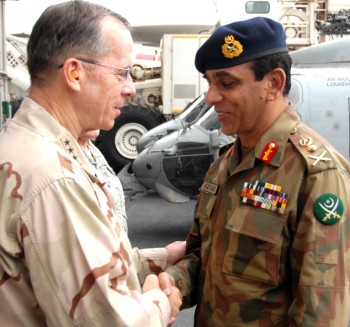
All Kayani’s men

Anatol Lieven, in an article where he notes that Pakistan’s military is among the most democratic of institutions in what otherwise remains a largely feudal society, writes:

American operations in South Asia… are threatening to upset [a] fragile balance between Islam and nationalism in the Pakistani military. The army’s members can hardly avoid sharing the broader population’s bitter hostility to U.S. policy. To judge by retired and serving officers, this includes the genuine conviction that either the Bush administration or Israel was responsible for 9/11. Inevitably therefore, there was deep opposition throughout the army after 2001 to American pressure to crack down on the Afghan Taliban and their Pakistani sympathizers. “We are being ordered to launch a Pakistani civil war for the sake of America,” an officer told me in 2002. “Why on earth should we? Why should we commit suicide for you?”

Between 2004 and 2007, there were a number of instances of mass desertion and refusal to serve in units deployed to fight militants, though mostly in the Pashtun-recruited Frontier Corps rather than in the regular army. These failures were caused above all by the feeling that these forces were compelled to turn against their own. We must realize in these morally and psychologically testing circumstances, anything that helps maintain Pakistani military discipline cannot be altogether bad—given the immense scale of the stakes concerned, and the consequences if that discipline were to fail.

For in 2007–2008, the battle was beginning to cause serious problems of morale. The most dangerous single thing I heard during my visits to Pakistan in those years was that soldiers’ families in villages in the NWFP and the Potwar region of the Punjab were finding it increasingly difficult to find high-status brides for their sons serving in the military because of the growing popular feeling that “the army is the slave of the Americans” and “the soldiers are killing fellow Muslims on America’s orders.”

By late 2009, the sheer number of soldiers killed by the Pakistani Taliban and their allies, and still more importantly, the increasingly murderous and indiscriminate Pakistani Taliban attacks on civilians, seem to have produced a change of mood in the areas of military recruitment. Nonetheless, if the Pakistani Taliban are increasingly unpopular, that does not make the United States any more well liked; and if Washington ever put Pakistani soldiers in a position where they felt that honor and patriotism required them to fight America, many would be willing to do so.

Facebooktwittermail

Pakistani intelligence officials say Taliban chief Hakimullah Mehsud is alive

The Washington Post reports:

Even by the standards of a bullet- and bomb-dodging Taliban commander, Hakimullah Mehsud has displayed notable survival skills.

The Pakistani Taliban chief was thought to have died in a leadership duel last summer, only to stage a news conference a few days later. A U.S. drone strike in January was followed by intense speculation about his fate, then statements by Pakistani intelligence officials that he was “100 percent” dead.

On Thursday, those intelligence officials circulated another message: Mehsud is alive.

Earlier reports that Mehsud was dead — repeated by U.S. officials — were hailed as a potentially fatal blow to the Pakistani Taliban, a loose network of border-based militants that has carried out a cascade of suicide attacks in recent years. News of his survival again underscored the staying power of a group that Pakistan’s military has targeted with unprecedented force in the past year. It also has exposed blind spots within the Pakistani and U.S. intelligence services, which struggle to develop reliable information in Taliban strongholds.

Meanwhile, the Los Angeles Times reports:

A Pentagon report presented a sobering new assessment Wednesday of the Taliban-led insurgency in Afghanistan, saying that its abilities are expanding and its operations are increasing in sophistication, despite recent major offensives by U.S. forces in the militants’ heartland.

The report, requested by Congress, portrays an insurgency with deep roots and broad reach, able to withstand repeated U.S. onslaughts and to reestablish its influence, while discrediting and undermining the country’s Western-backed government.

But the Pentagon said it remained optimistic that its counter-insurgency strategy, formed after an Obama administration review last year, and its effort to peel foot soldiers away from the Taliban will show success in months to come.

Facebooktwittermail

Iraq prime minister lashes out at rival

The Los Angeles Times reports:

Iraq’s prime minister dismissed his rival’s call for international help to resolve the country’s postelection political crisis as the dispute threatens to inflame rifts and undermine American plans for withdrawal.

In a televised speech Friday, Prime Minister Nouri Maliki, whose political bloc finished a close second behind former premier Iyad Allawi’s slate in the March 7 elections, alleged that “regional, international” players were attempting a coup d’etat against his government.

“We have accomplished very much in Iraq,” he said from the southern shrine city of Karbala, the symbolic heartland of Iraq’s Shiite Muslims, who were long oppressed under the Sunni-dominated Baath Party government of Saddam Hussein.

“We will not allow any foreign interference in our internal affairs that will breach our sovereignty,” Maliki said.

Meanwhile, earlier this week, the New York Times reported:

The torture of Iraqi detainees at a secret prison in Baghdad was far more systematic and brutal than initially reported, Human Rights Watch reported on Tuesday.

The existence of the prison, which housed mostly Sunni Arab prisoners, has created a political furor in Iraq, prompted government denials and fanned sectarian tensions.

“Abu Ghraib was a picnic” compared with the secret prison, said Sheik Abdullah Humedi Ajeel al-Yawar, one of the most influential Sunni Arab tribal leaders in the northern province of Nineveh, where the detainees were rounded up by Iraqi soldiers based on suspicions that they had links to the insurgency and brought to Baghdad with little due process. Abu Ghraib is the prison at which American guards tortured Iraqi prisoners, severely damaging Iraqis’ trust in the United States.

Human Rights Watch gained access on Monday to about 300 male detainees transferred from the once secret prison at the Old Muthanna military airfield to the Rusafa prison in Baghdad and documented its findings, which it described as “credible and consistent,” in a draft report provided to The New York Times on Tuesday by the rights group.

The group said it had interviewed 42 detainees who displayed fresh scars and wounds. Many said they were raped, sodomized with broomsticks and pistol barrels, or forced to engage in sexual acts with one another and their jailers.

Facebooktwittermail

Israel official: Accepting Palestinians into Israel better than two states

After a recent poll indicated that in increasing numbers Palestinians are losing faith in the two-state solution, remarks by Reuven Rivlin, a senior member of Likud and the Speaker in Israel’s parliament, suggest that a one-state solution may be more likely than most commentators generally imagine.

Haaretz reports:

Knesset Speaker Reuven Rivlin said Thursday that he would rather accept Palestinians as Israeli citizens than divide Israel and the West Bank in a future two-state peace solution.

Speaking during a meeting with Greece’s ambassador to Israel Kyriakos Loukakis, Rivlin said that he did not see any point of Israel signing a peace agreement with the Palestinian Authority as he did not believe PA President Mahmoud Abbas “could deliver the goods.”

Referring to the possibility that such an agreement could be reached, Rivlin said: “I would rather Palestinians as citizens of this country over dividing the land up.”

Late last year, Rivlin said in a Jerusalem address that Israel’s Arab population was “an inseparable part of this country. It is a group with a highly defined shared national identity, and which will forever be, as a collective, an important and integral part of Israeli society.”

In a speech given in the president’s residence, the Knesset speaker called for a fundamental change in relations between Jews and Arabs in Israel, urging the foundation of a “true partnership” between the two sectors, based on mutual respect, absolute equality and the addressing of “the special needs and unique character of each of the sides.”

Rivlin also said that “the establishment of Israel was accompanied by much pain and suffering and a real trauma for the Palestinians,” adding that “many of Israel’s Arabs, which see themselves as part of the Palestinian population, feel the pain of their brothers across the green line – a pain they feel the state of Israel is responsible for.”

“Many of them,” Rivlin says, “encounter racism and arrogance from Israel’s Jews; the inequality in the allocation of state funds also does not contribute to any extra love.”

Facebooktwittermail

Israel’s fascist mood

Responding to the results of a poll I highlighted yesterday, Gideon Levy writes:

Israel is ready for a monster. Nothing will stop it. Every kind of violent and dangerous leader and every war crime will be welcomed here, welcomed by the stupid and ignorant.

Our immune systems have long weakened. The press will be silent, and the Supreme Court will forgive. Meanwhile, protest slumbers and civil society, a concept on the rise in world politics, doesn’t exist. Go explain to the Israel of 2010 that the media’s role is to expose wrongdoing, the non-governmental organizations’ role is to warn us, and the Supreme Court’s role is to be a gatekeeper. Instead, all of them are to be punished. Go explain that the tyranny of the majority is no less dangerous than control by the minority. Go explain that democracy means unlimited, free criticism.

All this is gone and forgotten. We have no one to instill these values. We have survived Pharaoh, and we will survive Iran, but not this problem. It filters down from within, threatening to bring everything down on the people. The current public atmosphere is the classic breeding ground, as if it were taken from the history books for cultivating savage regimes. There is no need for a military coup in Israel. The defense establishment has excessive control over most aspects of life. There is no need for a dictator, either. The tyranny of the majority is dangerous enough.

Facebooktwittermail

How to: risk World War III, and blow billions doing it

At Wired, Noah Shachtman writes:

The Pentagon’s plan to fire ballistic missiles at terrorists isn’t just a nuclear Armageddon risk. It’s a ludicrously expensive way to accidentally start World War III: each weapon could cost anywhere from a few hundred million to $1 billion.

The Defense Department wants to spend about $240 million next year on the controversial “prompt global strike” project. Eventually, it could lead to weapons that could strike virtually anywhere in the planet within an hour or two. But that quarter-billion would be the tiniest of down payments.

“There are no accurate cost estimates for the program, largely because the technology is unproven,” writes Joe Cirincione at ForeignPolicy.com. His back-of-the-envelope calculation: $10 billion for 10 conventionally-armed Intercontinental Ballistic Missiles, meant to strike at terrorists on the move. “Each missile with its tiny payload could easily go over $1 billion each.”

Visit msnbc.com for breaking news, world news, and news about the economy

Facebooktwittermail

The perils of PowerPoint


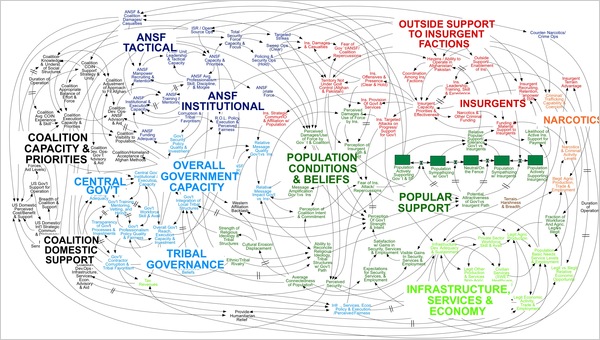
An article by Elisabeth Bumiller in the New York Times includes the diagram above. The illustration is indispensable for the lede — it does little to convey the principle failings of Powerpoint, least of all the cognitive style that Powerpoint engenders.

Gen. Stanley A. McChrystal, the leader of American and NATO forces in Afghanistan, was shown a PowerPoint slide in Kabul last summer that was meant to portray the complexity of American military strategy, but looked more like a bowl of spaghetti.

“When we understand that slide, we’ll have won the war,” General McChrystal dryly remarked, one of his advisers recalled, as the room erupted in laughter.

The slide has since bounced around the Internet as an example of a military tool that has spun out of control. Like an insurgency, PowerPoint has crept into the daily lives of military commanders and reached the level of near obsession. The amount of time expended on PowerPoint, the Microsoft presentation program of computer-generated charts, graphs and bullet points, has made it a running joke in the Pentagon and in Iraq and Afghanistan.

“PowerPoint makes us stupid,” Gen. James N. Mattis of the Marine Corps, the Joint Forces commander, said this month at a military conference in North Carolina. (He spoke without PowerPoint.) Brig. Gen. H. R. McMaster, who banned PowerPoint presentations when he led the successful effort to secure the northern Iraqi city of Tal Afar in 2005, followed up at the same conference by likening PowerPoint to an internal threat.

“It’s dangerous because it can create the illusion of understanding and the illusion of control,” General McMaster said in a telephone interview afterward. “Some problems in the world are not bullet-izable.”

In General McMaster’s view, PowerPoint’s worst offense is not a chart like the spaghetti graphic, which was first uncovered by NBC’s Richard Engel, but rigid lists of bullet points (in, say, a presentation on a conflict’s causes) that take no account of interconnected political, economic and ethnic forces. “If you divorce war from all of that, it becomes a targeting exercise,” General McMaster said.

Commanders say that behind all the PowerPoint jokes are serious concerns that the program stifles discussion, critical thinking and thoughtful decision-making. Not least, it ties up junior officers — referred to as PowerPoint Rangers — in the daily preparation of slides, be it for a Joint Staff meeting in Washington or for a platoon leader’s pre-mission combat briefing in a remote pocket of Afghanistan.

Last year when a military Web site, Company Command, asked an Army platoon leader in Iraq, Lt. Sam Nuxoll, how he spent most of his time, he responded, “Making PowerPoint slides.” When pressed, he said he was serious.

“I have to make a storyboard complete with digital pictures, diagrams and text summaries on just about anything that happens,” Lieutenant Nuxoll told the Web site. “Conduct a key leader engagement? Make a storyboard. Award a microgrant? Make a storyboard.”

Despite such tales, “death by PowerPoint,” the phrase used to described the numbing sensation that accompanies a 30-slide briefing, seems here to stay. The program, which first went on sale in 1987 and was acquired by Microsoft soon afterward, is deeply embedded in a military culture that has come to rely on PowerPoint’s hierarchical ordering of a confused world.

“There’s a lot of PowerPoint backlash, but I don’t see it going away anytime soon,” said Capt. Crispin Burke, an Army operations officer at Fort Drum, N.Y., who under the name Starbuck wrote an essay about PowerPoint on the Web site Small Wars Journal that cited Lieutenant Nuxoll’s comment.

In a daytime telephone conversation, he estimated that he spent an hour each day making PowerPoint slides. In an initial e-mail message responding to the request for an interview, he wrote, “I would be free tonight, but unfortunately, I work kind of late (sadly enough, making PPT slides).”

By Bumiller’s account, the military’s PowerPoint problem derives mostly from the ubiquity of its use, but as Edward Tufte, one of PowerPoint’s most ardent and cogent critics makes clear, the problem runs much deeper.

Imagine a widely used and expensive prescription drug that promised to make us beautiful but didn’t. Instead the drug had frequent, serious side effects: It induced stupidity, turned everyone into bores, wasted time, and degraded the quality and credibility of communication. These side effects would rightly lead to a worldwide product recall.

Yet slideware -computer programs for presentations -is everywhere: in corporate America, in government bureaucracies, even in our schools. Several hundred million copies of Microsoft PowerPoint are churning out trillions of slides each year. Slideware may help speakers outline their talks, but convenience for the speaker can be punishing to both content and audience. The standard PowerPoint presentation elevates format over content, betraying an attitude of commercialism that turns everything into a sales pitch.

Of course, data-driven meetings are nothing new. Years before today’s slideware, presentations at companies such as IBM and in the military used bullet lists shown by overhead projectors. But the format has become ubiquitous under PowerPoint, which was created in 1984 and later acquired by Microsoft. PowerPoint’s pushy style seeks to set up a speaker’s dominance over the audience. The speaker, after all, is making power points with bullets to followers. Could any metaphor be worse?

PowerPoint is packaged thought. The presenter has, supposedly, already done the required thinking and the audience is presented with the package on the understanding that the contents conform to the labeling. The PowerPoint spell is the illusion that a well-labelled package has valuable content when it may in fact turn out to be an empty box.

As Tufte concludes:

Presentations largely stand or fall on the quality, relevance, and integrity of the content. If your numbers are boring, then you’ve got the wrong numbers. If your words or images are not on point, making them dance in color won’t make them relevant. Audience boredom is usually a content failure, not a decoration failure.

At a minimum, a presentation format should do no harm. Yet the PowerPoint style routinely disrupts, dominates, and trivializes content. Thus PowerPoint presentations too often resemble a school play -very loud, very slow, and very simple.

The practical conclusions are clear. PowerPoint is a competent slide manager and projector. But rather than supplementing a presentation, it has become a substitute for it. Such misuse ignores the most important rule of speaking: Respect your audience.

Facebooktwittermail

Who’s afraid of nuclear terrorists?

A couple of weeks ago, President Obama hosted a nuclear security summit in Washington to address an issue so grave, 40 heads of state were in attendance. Had Obama also extended invitations to the mayors of America’s major cities, it’s unclear how many would have been able to squeeze the summit into their busy schedules.

The Washington Times reports:

The U.S. military has canceled a major field exercise that tests its response to a nuclear attack, angering some officials who say that what is now planned for this month will be a waste of time.

U.S. Northern Command in Colorado withdrew from major participation in this month’s National Level Exercise (NLE), a large-scale drill that tests whether the military and the Department of Homeland Security can work with local governments to respond to an attack or natural disaster.

The exercise was canceled recently after the planned site for a post-nuclear-attack response — Las Vegas — pulled out in November, fearing a negative impact on its struggling business environment.

A government official involved in NLE planning said a new site could not be found. The official also said the Northern Command’s exercise plans for “cooping” — continuity of operations, during which commanders go to off-site locations — also had been scratched.

“All I know is it’s been turned into garbage,” said the official, who asked not to be identified because of the sensitivity of the information. “It’s a nonevent.”

Will al Qaeda be emboldened by this turn of events? I kind of doubt it. In fact Las Vegas — which might not generally epitomize a realistic outlook — is probably making a safe bet here as it wagers that its economic health takes precedence over its need to be prepared to handle a nuclear attack.

Facebooktwittermail

How Israel operates as an apartheid state

In a talk delivered to the Fifth Bilin International Conference for Palestinian Popular Resistance, held in the West Bank village of Bilin on April 21, Jonathan Cook described some of the aspects of Israeli apartheid — the systematic discrimination between Jews and non-Jews inside the state of Israel.

A few weeks ago I met Uzi Ornan, an 86-year-old professor from the Technion University in Haifa, who has one of the few ID cards in Israel stating a nationality of “Hebrew.” For most other Israelis, their cards and personal records state their nationality as “Jewish” or “Arab.” For immigrants whose Jewishness is accepted by the state but questioned by the rabbinical authorities, some 130 other classifications of nationality have been approved, mostly relating to a person’s religion or country of origin. The only nationality you will not find on the list is “Israeli.” That is precisely why Professor Ornan and two dozen others are fighting through the courts: they want to be registered as “Israelis.” It is a hugely important fight – and for that reason alone they are certain to lose. Why?

Far more is at stake than an ethnic or national label. Israel excludes a nationality of “Israeli” to ensure that, in fulfillment of its self-definition as a “Jewish state,” it is able to assign superior rights of citizenship to the collective “nation” of Jews around the globe than to the body of actual citizens in its territory, which includes many Palestinians. In practice it does this by creating two main classes of citizenship: a Jewish citizenship for “Jewish nationals” and an Arab citizenship for “Arab nationals.” Both nationalities were effectively invented by Israel and have no meaning outside Israel.

This differentiation in citizenship is recognized in Israeli law: the Law of Return, for Jews, makes immigration all but automatic for any Jew around the world who wishes it; and the Citizenship Law, for non-Jews, determines on any entirely separate basis the rights of the country’s Palestinian minority to citizenship. Even more importantly, the latter law abolishes the rights of the Palestinian citizens’ relatives, who were expelled by force in 1948, to return to their homes and land. There are, in other words, two legal systems of citizenship in Israel, differentiating between the rights of citizens based on whether they are Jews or Palestinians.

That, in itself, meets the definition of apartheid, as set out by the United Nations in 1973: “Any legislative measures or other measures calculated to prevent a racial group or groups from participation in the political, social, economic, and cultural life of the country and the deliberate creation of conditions preventing the full development of such a group or groups.” The clause includes the following rights: “the right to leave and to return to their country, the right to a nationality, the right to freedom of movement and residence, the right to freedom of opinion and expression.”

Such separation of citizenship is absolutely essential to the maintenance of Israel as a Jewish state. Were all citizens to be defined uniformly as Israelis, were there to be only one law regarding citizenship, then very dramatic consequences would follow. The most significant would be that the Law of Return would either cease to apply to Jews or apply equally to Palestinian citizens, allowing them to bring their exiled relatives to Israel – the much-feared Right of Return. In either a longer or shorter period, Israel’s Jewish majority would be eroded and Israel would become a binational state, probably with a Palestinian majority.

Facebooktwittermail

Israelis have an un-American view of democracy

Imagine reading this report in an American newspaper:

More than half of white Americans think human rights organizations that expose immoral behavior by the United States should not be allowed to operate freely, and think there is too much freedom of expression here, a recent survey found.

The pollsters surveyed 500 white Americans who can be considered a representative sample of the adult white population.

They found that 57.6 percent of the respondents agreed that human rights organizations that expose immoral conduct by the United States should not be allowed to operate freely.

Slightly more than half agreed that “there is too much freedom of expression” in the US.

The poll also found that most of the respondents favor punishing journalists who report news that reflects badly on the actions of the US military.

Another 82 percent of respondents said they back stiff penalties for people who leak illegally obtained information exposing immoral conduct by the military.

In reality, the views related in the fictitious article above are not those of white Americans but come from Jewish Israelis and pertain to their own state, military, and press. The results of the poll commissioned by the Tami Steinmetz Center for Peace Research at Tel Aviv University, are reported by Haaretz.

During his recent visit to Israel, Vice President Joe Biden spoke about the “unbreakable bond borne of common values” shared by America and the Jewish state.

What the Israeli poll makes clear is that Jewish Israelis and Americans, far from having an unbreakable bond of common values, actually have significantly different views about how democracy works. As Daniel Bar-Tal, a professor at Tel Aviv university said: “The public recognizes the importance of democratic values, but when they need to be applied, it turns out most people are almost anti-democratic.”

Of course, even my attempt to contrive some kind of ethnic symmetry by juxtaposing the dominant ethnic group in the United States with that in Israel, is itself a tenuous parallel. We now have a non-white president but for as long as Israel remains a Jewish state it will surely never have a non-Jewish prime minister.

Most Americans understand that the separation of Church and State protects both democracy and religious freedom. In this era, we know that if any single ethnic or religious group were to assert a “right” to control this country, the United States would cease to be a democracy. The principle of equal rights does not come in different ethnic flavors.

Facebooktwittermail

When will time run out for a two-state solution?

Yousef Munayyer says it’s time for the Palestinians to give the Israelis an ultimatum: the Palestinian Authority should set a date for the Israeli occupation to end and settlements be dismantled. “If this deadline is not met, the PA should dissolve the authority and convert the disjointed national movement into a broad civil rights movement seeking equal rights in a bi-national state.”

Munayyer writes:

Among those involved in the Middle East peace process industry there is much talk about “time running out” for a two-state solution.

Recently, the same sentiments were echoed by the US state department, reflecting a shift in the way the Obama administration is publicly talking about the conflict.

On more than one occasion, the state department and other Obama administration figures have said that “the status quo is unsustainable”. Notice again the element of time.

Time has been running out for a two-state solution since the beginning of Israel’s colonial enterprise in occupied Palestinian territory in 1967. Yet despite this reality, analyses of the situation continue to repeat this now-meaningless cliche year after year, decade after decade. It seems that, to many, time in the Middle East can be magically be suspended. Gravity, in this war-torn region, ceases to affect the inverted hourglass.

The idea that time is running out presupposes some actual threshold beyond which time will actually have run out – a midnight hour when the Cinderella-style fantasy of a two-state solution wakes up to the embarrassing reality of facts on the ground.

However, we never hear analysts specify where the threshold lies – at what point Israeli actions of settlement construction and expansion are considered to have finally tipped it over the edge. Without this, the two-state solution becomes the consummate zombie, very much alive in the policy discussion despite being long dead in reality.

Meanwhile, AFP reports:

A growing number of Palestinians support the establishment of a single state for Jews and Arabs including Israel and the occupied territories, according to a poll released on Wednesday.

The survey by the Jerusalem Media and Communication Centre (JMCC) found that support for a bi-national state in which Israelis and Palestinians would have equal rights had grown to 33.8 percent from 20.6 percent in June 2009.

During the same period, support for a negotiated two-state solution dropped from 55.2 percent to 43.9 percent, while 32.1 percent of respondents said the “peace process is dead” in response to a separate question.

Most Palestinians, 43.7 percent, support peaceful negotiations, while 29.8 percent support armed struggle and 21.9 percent support peaceful resistance as the best strategy for ending the Israeli occupation, the poll found.

Facebooktwittermail

Obama’s Middle East star gazing

“Despite the inevitable difficulties, so long as I am President, the United States will never waver in our pursuit of a two-state solution that ensures the rights and security of both Israelis and Palestinians.” President Barack Obama, Washington, April 26, 2010.

“There has never been in the White House a president that is so committed on this issue, including Clinton who is a personal friend, and there will never be, at least not in the lifetime of anyone in this room.” US Middle East envoy, George Mitchell, in a meeting during his most recent trip to Israel and the West Bank.

* * *

If the two-state solution is a destination, then any US president who claims he has an unwavering commitment to get their should demonstrate that by stating an estimated time of arrival. A goal is a dream with a deadline.

But if the two-state solution is a reference point — something akin to the North Star when viewed by an ocean navigator — then keeping it in sight has nothing to do with getting there.

Thus it is with President Obama’s carefully chosen words: his stated commitment is not to the resolution of the conflict but to the pursuit of a two-state solution — a star he promises to gaze at for at least three and maybe seven more years.

And if George Mitchell is right in saying that Obama is the best we can hope for in the White House in our lifetimes, should we abandon hope that the conflict will be resolved, or should we abandon the idea that in this foreign arena a US president is an indispensable agent of change?

Among Washington’s peace dreamers, the latest star upon which many are hoping to hitch a ride is “linkage”: the idea that the prospect of more dead American soldiers Afghanistan or Iraq — deaths that can loosely be associated to an adjacent festering conflict — will help galvanize a domestic sense of urgency, required for resolving the Israeli-Palestinian conflict.

But here’s a problem with that idea. If the president won’t set a target date for resolving the conflict, and he sees American troops thereby placed at further risk, are we to infer that he views the duration of the deployment of those troops with equal uncertainty?

To argue that the Middle East conflict endangers the lives of American troops in the Middle East would seem to make their withdrawal as great if not a greater imperative than resolving the conflict. After all, which is an American president more likely to be able to accomplish? Order the withdrawal of the troops under his command, or end a conflict that has lasted for most of the last century?

But if there is an imperative upon which those who seek Middle East peace should really be focused, it is not the national interests of the United States; not the need for solidarity in opposing Iran’s nuclear ambitions; nor the need for stability across a region fractured by conflict; but to address and make amends for the injustices upon which Israel was founded; injustices whose perpetuation have for 62 years fomented anger and resentment which will never be pacified until a just solution can be found.

Facebooktwittermail

Preparations for a military strike on Iran

Ten days ago, the New York Times published a story about a memo on Iran from Defense Secretary Robert Gates to National Security Adviser Gen James Jones.

David E Sanger and Thom Shanker reported on the contents of this memo, yet neither of them possesses a copy of the memo, nor have they read it, nor did they even report directly on its contents. In fact, it was not until after their story appeared that they received official confirmation of the memo’s existence.

In an interview on National Public Radio, when asked what the memo said, Sanger neglected to mention that he had never set eyes on the document. Were he to have made that clear, he could not have presumed to say anything about what the memo said — merely what he had been told about what it said. To position his source as the gatekeeper and shaper of the report would make it rather obvious that Sanger was a willing tool of a senior administration official, but no self-respecting journalist wants to be seen prostituting his services.

Sanger’s NPR interviewer, Warren Olney, also appeared willing to collude in this charade by skirting around the fact that the reporter had not set eyes on the memo, but nevertheless Olney pressed Sanger on the issue of his source’s agenda:

Olney: Can you say anything at all about the motivations of the people that revealed this memo to you?

Sanger: Um, no, the only thing I would say is that I would caution people against — I would do this in many kinds of story — the assumption that somebody just dropped off word of this memo in front of us.

A classified memo in an unmarked manila envelope could be dropped off, but how exactly would word of such a memo be “dropped off”?

Sanger wants to dispel an image of his being a passive recipient of information he is being fed, yet given that he has no means to independently interpret the contents of the memo and contrast that interpretation with the one being provided by his primary source, what he recounts is merely his source’s angle.

As I wrote when the article came out, the identity of Sanger’s source may be more significant than the existence of the memo. If it turns out that it was Dennis Ross, then the New York Times may yet again be serving a role in preparations for military action.

Flynt Leverett and Hillary Mann Leverett write:

We do not know who leaked the Gates memo. But the “senior officials” who did so were clearly seeking to use their selective description to catalyze more robust planning for potential military strikes against Iranian nuclear targets — the very option that Gates has consistently opposed.

This explains Gates’s public claim that his memo had been “mischaracterized” by the leaker. It also explains [Defense Undersecretary Michele] Fluornoy’s later statement that an attack against Iran is “off the table in the near term.” (Though, after White House intervention, Gates’s spokesman walked back Flournoy’s comment.)

The reality is that a cadre of senior National Security Council officials — including Deputy National Security Adviser Tom Donilon and Dennis Ross, senior director for the central region (including Iran) — is resisting the adoption of containment as the administration’s Iran strategy.

For some, containment is problematic because it would be interpreted in Israel and pro-Israeli circles here as giving up on preventing Iran from becoming a nuclear threshold state. Republicans could use this to label Obama as weak on national security.

Others in this camp may actually believe that Washington should be preparing for military action against Iran.

As Ross told us before he returned to government service in the Obama administration, President George W. Bush’s successor would probably need to order military strikes against Iranian nuclear targets.

Pursuing diplomatic initiatives early in Obama’s tenure, Ross said, would be necessary to justify potential military action to domestic and international constituencies.

That is precisely what the administration has done — first, by pursuing halfhearted diplomatic initiatives toward Tehran, then, when Iran did not embrace them, blaming Iran for the impasse.

Adopting containment as the administration’s posture toward Iran might undermine some White House officials’ efforts to prepare the political ground for an eventual presidential decision approving military strikes.

We have also heard former Bush administration officials close to Vice President Dick Cheney take note of the recent rise in U.S. public support for military action against Iran, as measured by some opinion polls.

Against that backdrop, these Republicans say, Obama — “a Chicago pol”— could ultimately see his way clear to ordering military strikes.

Facebooktwittermail

Abbas says Obama needs to impose a Middle East solution

In a speech to the Fatah leadership, Mahmoud Abbas pointed out the contradiction inherent in the posture that President Obama has assumed. On the one hand Washington has been pushing the line that a resolution to the Israeli-Palestinian conflict represents a vital American interest, yet at the same time Obama says, “we can’t want it more than they do.”

Unless Obama believes that in this particular arena he lacks the ability to defend American interests, he needs to advance or withdraw from his position — a position which is unsustainable.

What is Obama actually doing? He is, as far as I can see, employing a range of tactics yet has no strategy. As a result, every move he makes lacks credibility.

The Independent reports:

Palestinian president Mahmoud Abbas made a blunt appeal to the US at the weekend, asking US President Barack Obama to “impose” a solution to the Middle East conflict. The call comes amid deepening frustration at Israel’s refusal to suspend the construction of Jewish homes in Arab-dominated East Jerusalem.

The plea, made several times in private but uttered in public for the first time, came as US envoy George Mitchell wrapped up a three-day visit to Jerusalem without any breakthrough on starting the proximity talks. “Since you, Mr President and you, the members of the American administration, believe in this [Palestinian statehood], it is your duty to call for the steps in order to reach the solution and impose the solution – impose it,” Mr Abbas said in a speech to leaders of his Fatah party.

“But don’t tell me it’s a vital national strategic American interest … and then not do anything,” he added.

Richard Haass, in the Wall Street Journal, argues that an initiative to impose peace at this time is doomed to failure but that even if the conflict could be resolved, the national security rewards for the United States would be limited.

The danger of exaggerating the benefits of solving the Palestinian conflict is that doing so runs the risk of distorting American foreign policy. It accords the issue more prominence than it deserves, produces impatience, and tempts the U.S. government to adopt policies that are overly ambitious.

This is not an argument for ignoring the Palestinian issue. As is so often the case, neglect will likely prove malign. But those urging President Obama to announce a peace plan are doing him and the cause of peace no favor. Announcing a comprehensive plan now—one that is all but certain to fail—risks discrediting good ideas, breeding frustration in the Arab world, and diluting America’s reputation for getting things done.

As Edgar noted in “King Lear,” “Ripeness is all.” And the situation in the Middle East is anything but ripe for ambitious diplomacy. What is missing are not ideas—the outlines of peace are well-known—but the will and ability to compromise.

Haass’ argument, as one would expect, is that of an avowed foreign policy realist and it exposes a weakness inherent in every angle from which every US government has approached the conflict: they have studiously avoided acknowledging that injustice lies at the heart of the conflict. Instead of pursuing justice, they frame the issue as being one of balancing interests.

In the latest effort to skirt around the issue of justice we have been told that the conflict needs to be resolved because it is in America’s national interests and that the perpetuation of the conflict is endangering the lives of American soldiers in the region. In this narrative, the Palestinians — as has happened so many times before — somehow become marginal. Enlisting their support is reduced to an exercise in recruiting a few good sports — obliging fellows like Salam Fayyad, who will be good enough to assist the US and Israel in accomplishing their aims.

Facebooktwittermail

In the name of Zionism

In his latest column, Uri Avery writes:

If one speaks in Israel of “Zionism”, one means “not Arab”. A “Zionist” state means a state in which non-Jewish citizens cannot be full partners. Eighty percent of Israel’s citizens (the Jews) are telling the other twenty percent (the Arabs): the state belongs to us, not to you.

The state constructs settlements in the occupied territories because it is Zionist. It builds in East Jerusalem because it is Zionist. It discriminates against its Arab citizens in almost every field because it is Zionist. It mistreats African refugees who manage to reach its borders because it is Zionist. There is no dastardly act that cannot be wrapped in the Zionist flag. If Dr. Samuel Johnson were living in Israel today, he would say “Zionism is the last refuge of a scoundrel”.

The “Zionist Left” is also waving this flag in order to show how patriotic it is. In the past, it used it mainly to keep its distance from the radical left, which was fighting against the occupation and for the two-state solution. Nowadays, after the “Zionist Left” has itself adopted this program, it continues to wave the Zionist flag in order to differentiate itself from the “Arab” parties (including the Communist Party, 90% of whose voters are Arab).

In the name of Zionism, the “Zionist Left” continues to reject any possibility of including the Arab parties in a future government coalition. This is an act of self-mutilation, since it prevents in advance any possibility of the “Left” returning to power. That’s simple arithmetic. As a result, the “Zionist Left” has practically disappeared.

Facebooktwittermail

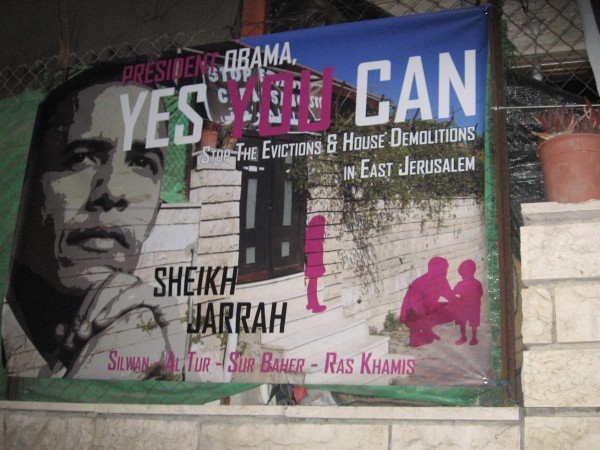
Jerusalem is crumbling under the weight of its own idealization

The Sheikh Jarrah activists who are want a just Jerusalem wrote an open letter in response to a letter that Elie Wiesel published as a full-page ad in the Wall Street Journal last week. Wiesel described Jerusalem as “the world’s Jewish spiritual capital” and “the heart of our heart, the soul of our soul.” The Sheikh Jarrah activists who, unlike Wiesel, actually live in Jerusalem, say: “We cannot recognize our city in the sentimental abstraction you call by its name.” They describe the city they call home as “crumbling under the weight of its own idealization.”

This disconnect between cherished image and lived reality no doubt holds just as true not simply for Jerusalem but for Israel itself among so many Zionists who passionately defend the Jewish state while choosing not to live there.

From Jerusalem, an open letter to Elie Wiesel

Dear Mr. Wiesel,

We write to you from Jerusalem to convey our frustration, even outrage, at your recently published letter on Jerusalem. We are Jewish Jerusalemites –- residents by choice of a battered city, a city used and abused, ransacked time and again first by foreign conquerors and now by its own politicians. We cannot recognize our city in the sentimental abstraction you call by its name.

Our Jerusalem is concrete, its hills covered with limestone houses and pine trees; its streets lined with synagogues, mosques and churches. Your Jerusalem is an ideal, an object of prayers and a bearer of the collective memory of a people whose members actually bear many individual memories. Our Jerusalem is populated with people, young and old, women and men, who wish their city to be a symbol of dignity — not of hubris, inequality and discrimination. You speak of the celestial Jerusalem; we live in the earthly one.

For more than a generation now the earthly city we call home has been crumbling under the weight of its own idealization. Your letter troubles us, not simply because it is replete with factual errors and false representations, but because it upholds an attachment to some other-worldly city which purports to supersede the interests of those who live in the this-worldly one. For every Jew, you say, a visit to Jerusalem is a homecoming, yet it is our commitment that makes your homecoming possible. We prefer the hardship of realizing citizenship in this city to the convenience of merely yearning for it.

Indeed, your claim that Jerusalem is above politics is doubly outrageous. First, because contemporary Jerusalem was created by a political decision and politics alone keeps it formally unified. The tortuous municipal boundaries of today’s Jerusalem were drawn by Israeli generals and politicians shortly after the 1967 war. Feigning to unify an ancient city, they created an unwieldy behemoth, encircling dozens of Palestinian villages which were never part of Jerusalem. Stretching from the outskirts of Ramallah in the north to the edge of Bethlehem in the south, the Jerusalem the Israeli government foolishly concocted is larger than Paris. Its historical core, the nexus of memories and religious significance often called “the Holy Basin”, comprises a mere one percent of its area. Now they call this artificial fabrication ‘Jerusalem’ in order to obviate any approaching chance for peace.

Second, your attempt to keep Jerusalem above politics means divesting us of a future. For being above politics is being devoid of the power to shape the reality of one’s life. As true Jerusalemites, we cannot stand by and watch our beloved city, parts of which are utterly neglected, being used as a springboard for crafty politicians and sentimental populists who claim Jerusalem is above politics and negotiation. All the while, they franticly “Judaize” Eastern Jerusalem in order to transform its geopolitics beyond recognition.

We invite you to our city to view with your own eyes the catastrophic effects of the frenzy of construction. You will witness that, contrary to some media reports, Arabs are not allowed to build their homes anywhere in Jerusalem. You discover see the gross inequality in allocation of municipal resources and services between east and west. We will take you to Sheikh Jarrah, where Palestinian families are being evicted from their homes to make room for a new Jewish neighborhood, and to Silwan, where dozens of houses face demolition because of the Jerusalem Municipality’s refusal to issue building permits to Palestinians.

We, the people of Jerusalem, can no longer be sacrificed for the fantasies of those who love our city from afar. This-worldly Jerusalem must be shared by the people of the two nations residing in it. Only a shared city will live up to the prophet’s vision: “Zion shall be redeemed with justice”. As we chant weekly in our vigils in Sheikh Jarrah: “Nothing can be holy in an occupied city!”

Respectfully,

Just Jerusalem (Sheikh Jarrah) Activists

Facebooktwittermail

Israel’s indispensable enemies

The brutality with which the Iranian authorities have suppressed political dissent since last June’s disputed presidential election has been widely reported. The Washington Post now reveals that the political turmoil has had another effect: it has resulted in a new supply of intelligence as disaffected officials leak information about Iran’s nuclear program.

As a result, a National Intelligence Estimate being prepared for President Obama which was due out last fall is not expected to be completed until August.

The revisions to the NIE underscore the pressure on the U.S. intelligence community to produce an accurate assessment of Iran’s nuclear ambitions as President Obama pursues a policy aimed at preventing the country from acquiring an atomic bomb. The community’s 2007 assessment presented the startling conclusion that Iran had halted its work on developing a nuclear warhead, provoking enduring criticism that the report had underestimated the Iranian threat.

Officials briefed on the new version, which is technically being called a “memo to holders” of the first, say it will take a harder tone. One official who has seen a draft said that the study asserts that Iran is making steady progress toward nuclear weapons capability but that it stops short of concluding that the Islamic republic’s top leaders have decided to build and test a nuclear device.

There is little question that Iran sees strategic value in making its nuclear intentions hard to decipher, but let’s for the sake of argument assume that its goal is to put itself in the same position as Japan: not to assemble a nuclear arsenal but to have the means to do so at short notice. Could such a capability pose an existential threat to Israel (or anyone else)?

Israeli leaders have already made it clear that they draw no distinction between a nuclear armed Iran and an Iran that has nuclear weapons capability, yet this may say less about the nature of an Iranian threat than it does about the nature of Zionism. Deprive Israel of its existential threats, and the necessity for a Jewish state becomes less imperative. Take away the fear of annihilation and Jewish identity will lose one of its most unifying attributes.

Israel might fear its enemies, yet can it survive without them?

Facebooktwittermail