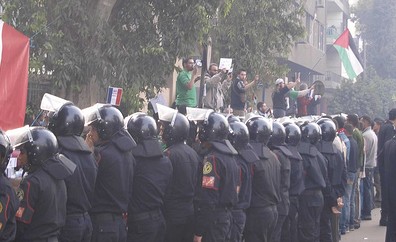
Members of an international group gathered in Cairo to protest against the siege of Gaza have rejected an Egyptian offer to allow 100 of them entry into the Palestinian territory.
Organisers of the Gaza Freedom March (GFM), which is comprised of 1,300 people from 42 different countries, declined the offer on Wednesday, saying “we refuse to whitewash the siege of Gaza”. [continued…]
While Egypt is reported to be receiving technical assistance from the United States in constructing an underground steel barrier along Gaza’s southern border, Egypt’s foreign minister, Ahmed Aboul Gheit, told The National: “The Egyptian state and people paid a very high price and paid with their blood for more than 50 years in support of the Palestinians. No one should compare himself with what Egypt did and is still doing for the Palestinians.”
In Beirut, Hizbollah Secretary General Sayyed Hassan Nasrallah urged Egypt to stop building the barrier which could cut off the tunnels that currently provide a lifeline for the Palestinian territory which remains under an Israeli-imposed siege.
The Daily Star reported: “Nasrallah told a crowd of tens of thousands of Lebanese Shiite Muslims marking the Ashura religious ceremony that Egypt should be condemned if it does not halt the wall building. [continued…]
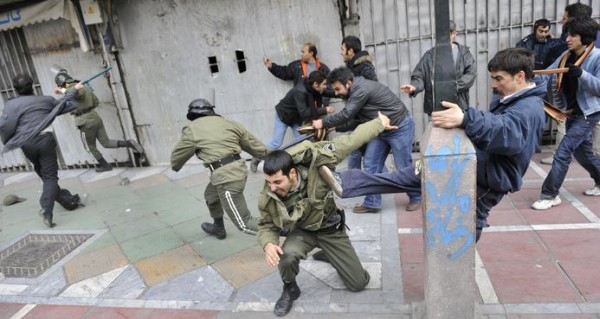
Tens of thousands of hard-line government supporters turned out for state-sponsored rallies Wednesday, some of them calling for the execution of opposition leaders as Iran’s police chief threatened to show “no mercy” in crushing any new protests by the pro-reform movement.
Pro-government rallies were staged in Shiraz, Arak, Qom and Tehran, among other cities. Demonstrators at a rally in Tehran chanted “Death to Mousavi,” a reference to opposition leader Mir Hossein Mousavi. Some shouted “Rioter hypocrites must be executed” and held up a banner that read: “We sacrifice our blood for supreme leader.”
The government gave all civil servants and employees a day off to attend the rallies and organized buses to transport groups of schoolchildren and supporters from outlying rural areas to the protests. [continued…]
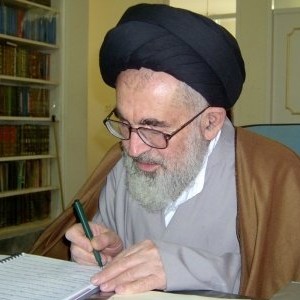
Militia forces that had been surrounding the Qoba Mosque in Shiraz since early Tuesday morning mounted attacks on the mosque where Ayatollah Seyyed Ali Mohammad Dastgheib delivers sermons.
Basijis and plainclothes agents chanted slogans against Ayatollah Dastgheib, Mir Hossein Mousavi, Mehdi Karroubi and Mohammad Khatami and attacked the mosque with bricks and stones.
Ayatollah Dasteghieb’s students positioned themselves inside the mosque and tried to keep the ‘invaders’ from entering the sacred place of worship. A group of the Grand Ayatollah’s supporters rushed to the scene to help safeguard the mosque.
Ayatollah Dastgheib issued a statement of warning on Monday against the illegal behavior of authorities and a crackdown on protestors.
Ayatollah Dastgheib is a Shia Source of Emulation and a member of the Assembly of Experts, the body tasked with appointing a new Leader for the Islamic Republic in the event of the Leader’s death.
Ayatollah Dastgheib studied under Grand Ayatollahs Rouhollah Khomeini, the founder of Iran’s revolution, Seyyed Mohammad-Reza Golpayegani and Hajj Seyyed Ali Akbar Khoei. [continued…]
Many observers expected the movement, a disparate mix of opposition groups that has taken to the streets since the fraudulent presidential elections of June 12, to lose momentum after the initial protests. Repression, intimidation and disorganisation would lead to resignation among the movement’s followers. Some argued that because it was bourgeois (for which read illegitimate and superficial) and apparently confined to urban areas, it did not reflect any genuine popular desire to shake the system. In fact, the protesters were the ones rejecting the democratic return of Mahmoud Ahmadinejad to the presidency.
The opposition’s leaders – under constant surveillance, cut off from their base and with no plan (or intention) to overturn the system put in place by Ayatollah Ruhollah Khomeini – could be punished, perhaps even lured back. The regime could count on Iran’s rural poor, who had benefited from the largesse of Mr Ahmadinejad’s populist policies, and on the republic’s committed security apparatus.
That expectation and these assumptions have proved wrong: the depth of discontent with the nature and workings of the regime clearly cuts across social and regional divides. It may seem to be on a roll in the Middle East, boasting of regional political successes against the US and technological prowess in its nuclear programme, but there is something rotten at the heart of the Islamic Republic. [continued…]
Senate Foreign Relations Committee Chairman John Kerry has filed a formal request to visit Iran, according to the Iranian-based Fars News Agency.
A spokesman for the Iranian Foreign Ministry confirmed the request today. “Since it [the request] is for a parliamentary visit, the issue has been referred to the parliament. The legislative officials are studying the case and they are in charge for providing a response,” Ramin Mehman-Parast said at a weekly press conference.
According to Fars, Iranian Parliament Speaker Ali Larijani also confirmed today that Kerry has made a formal request to visit Tehran. [continued…]
The Obama administration is readying sanctions against discrete elements of the Iranian government, including those involved in the deadly crackdown on Iranian protesters, marking a shift to a more aggressive U.S. posture toward the Islamic republic, U.S. officials said.
Ten months after President Obama set a year-end deadline for Iran to engage with world powers on its nuclear program, the government in Tehran has failed to respond in kind, other than an abortive gesture in the fall.
Now, in what may be a difficult balancing act, officials say the administration wants to carefully target sanctions to avoid alienating the Iranian public — while keeping the door ajar to a resolution of the struggle over Iran’s nuclear program. The aim of any sanctions is to force the Tehran government to the negotiating table, rather than to punish it for either its apparent push to develop a nuclear weapon or its treatment of its people. [continued…]
Then Habiba’s elderly husband was badly beaten in a village brawl there was only one place, she said, that she could turn to for help and justice.
Barefoot and weeping, the farmer’s wife, 50, trekked for four hours through Afghanistan’s Hindu Kush mountains to meet the local Taleban commander.
“My feet were bleeding and I cried the whole way but I didn’t care about my safety,” she said. “We are poor people. We know the Government doesn’t help people like us.”
Corruption and incompetence in President Karzai’s Government — particularly at local level — have forced a growing number of people to seek the services of the Taleban.
The shadow government is not limited to justice. In Helmand, in August, Taleban commanders issued printed travel permits on headed notepaper from the “Islamic Emirate of Afghanistan” to let people through checkpoints on the roads in and out of Lashkar Gah, the provincial capital. [continued…]
Eight years ago, a terrorist bomber’s attempt to blow up a transatlantic airliner was thwarted by a group of passengers, an incident that revealed some gaping holes in airline security just a few months after the attacks of Sept. 11. But it was six days before President George W. Bush, then on vacation, made any public remarks about the so-called “shoe bomber,” Richard Reid, and there were virtually no complaints from the press or any opposition Democrats that his response was sluggish or inadequate.
That stands in sharp contrast to the withering criticism President Barack Obama has received from Republicans and some in the press for his reaction to Friday’s incident on a Northwest Airlines flight heading for Detroit. [continued…]
CBS News has learned that as early as August of 2009 the Central Intelligence Agency was picking up information on a person of interest dubbed “The Nigerian,” suspected of meeting with “terrorist elements” in Yemen.
Sources tell CBS News “The Nigerian” has now turned out to be Umar Farouk Abdulmutallab. But that connection was not made when Abudulmutallab’s father went to the U.S. Embassy in Nigeria three months later, on November 19, 2009. It was then he expressed deep concerns to a CIA officer about his son’s ties to extremists in Yemen, a hotbed of al Qaeda activity.
In fact, CBS News has learned this information was not connected until after the attempted Christmas Day bombing. [continued…]
The Christmas Day airline bomb plot suspect organised a conference under the banner “War on Terror Week” as he immersed himself in radical politics while a student in London, The Times has learnt.
Umar Farouk Abdulmutallab, 23, a former president of the Islamic Society at University College London, advertised speakers including political figures, human rights lawyers and former Guantánamo detainees.
One lecture, Jihad v Terrorism, was billed as “a lecture on the Islamic position with respect to jihad”.
Security sources are concerned that the picture emerging of his undergraduate years suggests that he was recruited by al-Qaeda in London. Security sources said that Islamist radicalisation was rife on university campuses, especially in London, and that college authorities had “a patchy record in facing up to the problem”. Previous anti-terrorist inquiries have uncovered evidence of extremists using political meetings and religious study circles to identify potential recruits. [continued…]
Israel and its courts have always recognized that they are bound by norms of international law that it has formally ratified or that have become binding as customary international law upon all nations. The fact that the United Nations and too many members of the international community have unfairly singled out Israel for condemnation and failed to investigate horrible human rights violations in other countries cannot make Israel immune from the very standards it has accepted as binding upon it.
Israel has a strong history of investigating allegations made against its own officials reaching to the highest levels of government: the inquiries into the Yom Kippur War, Sabra and Shatila, Bus 300 and the Second Lebanon War.
Israel has an internationally renowned and respected judiciary that should be envy of many other countries in the region. It has the means and ability to investigate itself. Has it the will? [continued…]
Editor’s Comment — The Netanyahu government’s stonewalling of the Goldstone inquiry does not appear to have purely been an act of self-protection; it also seems to reflect a national spirit of impunity rooted in the conviction: “We had no choice.”
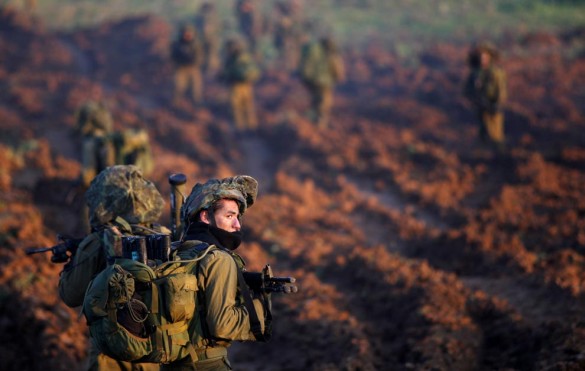
Having turned this declaration into a battle cry, violence was cleansed of doubt as Israel embarked on its own jihad. “We went into Gaza and God went into Gaza with us,” was how one Israeli Special Forces soldier put it.
When the enemy’s homes have been flattened, their bodies incinerated, their land defiled and their water poisoned and all of this is being done under God’s watchful eye and under His protection, the killers return to their homes expecting glorification, not to become the targets of an international inquiry.
As Israel’s Prime Minister, Benjamin Netanyahu, and Palestinian Authority President Mahmoud Abbas, meet at the United Nations today, “both sides have made clear that they’ll essentially be humoring Obama, showing up because the President of the United States expects it of them and not to relaunch long-stalled ‘final status’ peace negotiations, as the administration had hoped,” writes Tony Karon at Time magazine.
The conventional wisdom among most seasoned observers of the conflict is that the status quo is untenable — that at some point both sides will have to arrive at a mutually acceptable way of implementing a two-state solution.
The process that might lead to that point is as murky as ever.
The possibility that receives less consideration is that Israelis, living in a country forged through war — a country that has never really known peace — having become resigned to the apparent necessity of remaining on a perpetual war footing, have now reached a point where war is more than tolerable: it is acceptable.
War is what created Israel, has allowed it to exist and will guarantee its perpetuation. Many Israelis may pay lip-service to the notion that peace is desirable, yet it is their willingness to engage in war that makes them feel safe.
For Ariel Siegelman, an Israeli soldier who fought in Gaza in a special forces unit of the IDF, the key lesson from the 2006 war in Lebanon was this: “We learned that we had been living in an imaginary world and that the most dangerous type of war is the one that you call peace. We learned that we are not in fact in a ‘peace process’ at all. We are at war.”
In the Washington Post just this week, Jackson Diehl pointed out that even as the UN’s damning report on the war on Gaza brought renewed critical attention to the most recent conflict, “Operation Cast Lead, as the three-week operation is known in Israel, is generally regarded by the country’s military and political elite as a success.” (Diehl, with apparent satisfaction, predicted: “As for the Goldstone report [PDF], the heat it briefly produced last week will quickly dissipate”.)
Claiming that the wars in Lebanon and Gaza had for Israel both been qualified successes, Diehl suggested that Israel is far less fearful than are most of its allies about picking a fight with Iran.
… as with Gaza, even a partial and short-term reversal of the Iranian nuclear program may look to Israelis like a reasonable benefit — and the potential blowback overblown.
Americans who do not share Diehl’s neoconservative perspective, don’t need to ask themselves whether they share Israel’s view of itself; they simply need to decide whether the United States has a responsibility (or any legitimate excuse) for sustaining Israel’s war machine.
Without American arms, the Jewish state will not be starved of materiel — there are plenty of non-US arms manufacturers who would happily pick up the new demand.
The only issue is whether we should regard Israel’s wars as ours.
* * *
Israel’s military might and its fighting forces have been celebrated by Israelis and Israel’s supporters through numerous songs and videos. Here are a few:
A United Nations fact-finding mission investigating the three-week war in Gaza issued a lengthy, scathing report [PDF] on Tuesday that concluded that both the Israeli military and Palestinian armed groups “committed actions amounting to war crimes,” and possibly crimes against humanity.
The four-member mission, led by Justice Richard Goldstone, a widely respected South African judge, also concluded that neither Israel nor the Palestinian groups had carried out any “credible investigations” into the alleged violations. If that did not change within six months, the United Nations Security Council should refer the situation to the International Criminal Court in the Hague for possible prosecution, the panel concluded.
“The prolonged situation of impunity has created a justice crisis in the Occupied Palestinian Territory that warrants action,” the members said in their 574-page report on the war, during which some 1,200 Palestinians were killed, including at least several hundred civilians, and 13 Israelis died, 10 soldiers and 3 civilians. [continued…]
Editor’s Comment — Perhaps the report’s most disturbing finding says less about the past than it portends for Gaza and Israel’s future:
Some 30 per cent of children screened at UNRWA schools had mental health problems, while some 10 per cent of children had lost relatives or friends or lost their homes and possessions. WHO estimated that some 30,000 children would need continued psychological support and warned of the potential for many to grow up with aggressive attitudes and hatred.
The despicable attacks on human rights organisations investigating Israel’s Gaza offensive in January confirm Churchill’s observation: “A lie gets halfway around the world before the truth has a chance to get its pants on.” The mission led by the South African judge Richard Goldstone to investigate international human rights and international humanitarian law violations during Israel’s offensive, established by the UN Human Rights Council (UNHRC), is the latest victim. His findings are about to be made public. The knives have been out for the mission for months. Now they are being plunged into him and his colleagues. Until the report is out Goldstone can’t defend it. So the smears and misrepresentation are left free to pollute public discourse.
The New York-based Human Rights Watch (HRW) has assiduously responded to a deluge of scurrilous attacks on its credibility and staff, yet totally unfounded allegations – for example, about accepting Saudi government funding and failing to give a critical report to the Israel Defence Forces before releasing it to the public – are constantly being recycled. HRW messed up by failing to see that the nerdy and, to most people, disturbing hobby of its weapons expert Marc Garlasco (he collects German and American second world war memorabilia) could be used to discredit his role as author of highly critical reports of Israel’s military conduct in Gaza. But when this story broke last week, the equation implied in some allegations – “Nazi” object-collector plus “Israel-basher” equals “antisemite” – was baseless and defamatory. That he also worked on reports critical of Hamas and Hezbollah was ignored. As another excuse to attack HRW, and deflect attention from its reports’ findings, the Garlasco affair was a gift.
The human rights world is not beyond reproach. UNHRC has hardly been impartial on Israel. Goldstone accepted his role only after the council president agreed to the alteration of the mission’s mandate to cover all parties to the conflict, not just Israel. But mistrust alone does not explain the extraordinary scale of the attacks on human rights organisations, including all Israeli ones, for their reports on Israel. [continued…]
As the war in Afghanistan enters its ninth year, in the minds of most Americans the attacks of September 11, 2001 remain the signal event that shaped everything that has followed. Yet had we been paying more attention, we would have known that September 9, 2001, the day that Ahmed Shah Massoud was assassinated, was no less significant.
On that day, Afghanistan lost a leader of global stature — a man who truly was irreplaceable. Now, as much as ever, as the Taliban is resurgent and American and its allies attempt to prop up a deeply corrupt government in Kabul, the memory of Massoud is a symbol of the Afghan people’s so many shattered hopes.
A year after Massoud’s death, John Burns wrote in the New York Times:
As Americans prepare to mark the Sept. 11 anniversary, with many still struggling to come to terms with the cataclysm of that day, Afghans are passing through their own harrowing remembrance, of an attack that was overshadowed for the rest of the world by what happened two days later in the United States. Only four men died on Sept. 9 — the 49-year-old Mr. Massoud, an aide and the assassins — but there has been little healing of the wounds the killers inflicted on the hearts and the hopes of millions of his countrymen.
Ask Afghans who knew Mr. Massoud what it was about him that inspires such grief, and they struggle. Like [Fahim] Dashti [who was with Massoud at the time of his assassination], they talk of his skills as the guerrilla commander who astonished Soviet generals he outfought during the occupation of the 1980’s, or of his years holding out against the Taliban, when almost all other guerrilla leaders had joined the Taliban or fled abroad.
They speak of Mr. Massoud’s directness, his lack of pretense or false piety, his modesty, the look of somber intensity that rarely left his face. But usually, they give up, as people do when they try to define charisma. Mr. Dashti, the editor, resorted, in the end, to the simplest words. “We loved him,” he said. “We loved him more than we loved our own mothers and fathers. He embodied everything we loved about Afghanistan.”
Let me correct a few fallacies that are propagated by Taliban backers and their lobbies around the world. This situation over the short and long-run, even in case of total control by the Taliban, will not be to anyone’s interest. It will not result in stability, peace and prosperity in the region. The people of Afghanistan will not accept such a repressive regime. Regional countries will never feel secure and safe. Resistance will not end in Afghanistan, but will take on a new national dimension, encompassing all Afghan ethnic and social strata.
The goal is clear. Afghans want to regain their right to self-determination through a democratic or traditional mechanism acceptable to our people. No one group, faction or individual has the right to dictate or impose its will by force or proxy on others. But first, the obstacles have to be overcome, the war has to end, just peace established and a transitional administration set up to move us toward a representative government.
We are willing to move toward this noble goal. We consider this as part of our duty to defend humanity against the scourge of intolerance, violence and fanaticism. But the international community and the democracies of the world should not waste any valuable time, and instead play their critical role to assist in any way possible the valiant people of Afghanistan overcome the obstacles that exist on the path to freedom, peace, stability and prosperity.
During the 1990s, and especially during the time of the Taliban rule, which began in 1996, Washington never knew exactly how to deal with Massoud. But after the attacks on the US embassies in Kenya and Tanzania in 1998, Central Intelligence Agency (CIA) agents sought a meeting with Massoud in Dushanbe. The CIA wanted information on how to get to bin Laden. Massoud carefully considered all the angles, but ultimately he could not but criticize American shortsightedness. For the Bill Clinton administration, the ultimate aim was to get bin Laden and destroy al-Qaeda. For Massoud, the main point was to destroy the Taliban. He repeatedly stressed at the time that “without the Taliban, Osama can’t do anything”.
Massoud, indeed, had agents and intelligence in the heart of Taliban country. The best example is how his Panjshiris planted a powerful truck bomb just outside Mullah Omar’s compound in central Kandahar, in 1999. The explosion left a huge crater and killed 10 people, including three of Mullah Omar’s bodyguards. Omar escaped, almost by a miracle, but if the Northern Alliance could get close to the Taliban, they could not penetrate al-Qaeda’s ultra-hardcore security to try to find and menace bin Laden. And as much as the Northern Alliance could penetrate the Taliban, security chief Arif – now head of intelligence of Hamid Karzai’s government – says that “Osama was actively trying to recruit spies inside the Panjshir Valley”. But once again, no one investigated the “Moroccans”.
In his interview with Asia Times Online, the second-to-last in his lifetime, Massoud repeatedly portrayed al-Qaeda, the Taliban and Pakistan as a sort of “triangle of evil”. He criticized the US for basically following a Pakistani plan: try to “reform” the Taliban and concentrate on seducing Taliban “moderates” (a contradiction in terms). There were never any moderates within the Taliban. Mullah Omar was totally under the spell of bin Laden. American diplomats with knowledge of Central Asia were warning about the “Arabization” of Afghanistan. But no one in Washington was listening. The US only got the message after September 11 – and after Massoud’s death.
In the first months of 2001, Massoud calculated that he had to involve himself in a complex gamble: change his image from warrior to statesman. He addressed the European parliament in Strasbourg, France, in April 2001. This was his first official trip to the West. He tried hard to attract Western support for the resistance against the Taliban. But still no one was listening. In Strasbourg, Massoud delivered a stunning message that nobody took seriously at the time: “If President Bush doesn’t help us, then these terrorists will damage the United States and Europe very soon – and it will be too late.”
Afghanistan Revealed a documentary broadcast by National Geographic in October 2001, presents a portrait of Massoud and his struggle to save Afghanistan.
With great sorrow and deep consternation, we hereby declare the death of the latest hope. Perhaps rumors of its death are greatly exaggerated, to paraphrase the famous quote by Mark Twain, but the fears are being validated day after day. Barack Obama’s America is not delivering the goods. Sharing a glass of beer with a racist cop and a pat on the back of Hugo Chavez are not what we hoped for; wholesale negotiations on freezing settlement construction are also not what we expected. Just over six months after the most promising president of all began his term, perhaps hope has a last breath left, but it is on its deathbed.
He came into office amid much hoopla. The Cairo speech ignited half the globe. Making settlements the top priority gave rise to the hope that, finally, a statesman is sitting in the White House who understands that the root of all evil is the occupation, and that the root of the occupation’s evil is the settlements. From Cairo, it seemed possible to take off. The sky was the limit.
Then the administration fell into the trap set by Israel and is showing no signs of recovery.
A settlement freeze, something that should have been understood by a prime minister who speaks with such bluster about two states – a peripheral matter that Israel committed to in the road map – has suddenly turned into a central issue. Special envoy George Mitchell is wasting his time and prestige with petty haggling. A half-year freeze or a full year? What about the 2,500 apartment units already under construction? And what about natural growth? And kindergartens?
Perhaps they will reach a compromise and agree on nine months, not including natural growth though allowing completion of apartments already under construction. A grand accomplishment.
Jerusalem has imposed its will on Washington. Once again we are at the starting point – dealing with trifles from which it is impossible to make the big leap over the great divide.
We expected more from Obama. Menachem Begin promised less, and he made peace within the same amount of time after he took office. When the main issue is dismantling the settlements, the pulsating momentum that came with Obama is petering out. Instead, we are paddling in shallow water. Mitchell Schmitchel. What’s in it for peace? Prime Minister Benjamin Netanyahu will once again meet him in London at the end of the month. A “magic formula” for a settlement freeze may be found there, but the momentum is gone.
Not in Israel, though. Here people quickly sensed that there is nothing to fear from Obama, and the fetters were taken off. Defense Minister Ehud Barak was quick to declare that there is no Palestinian partner, even after the Fatah conference elected the most moderate leadership that has ever been assembled in Palestine. Afterward, in a blatant act of provocation, he brought a Torah scroll into the heart of the Muslim Quarter in the Old City of Jerusalem, in full view of television cameras, just so America can see who’s boss around here.
Deputy Prime Minister Eli Yishai and Knesset Speaker Reuven Rivlin, another two politicians who smell American weakness, were quick to declare during a visit to Ma’aleh Adumim that Israel will not freeze any construction. To hell with Obama. The settlers continue to move into more homes in East Jerusalem, Netanyahu is silent and Israelis sense that the “danger” has passed. Israel is once again permitted to do as it pleases. The landlord has once again gone insane. Except that the landlord has gone insane because the real landlord is showing signs of weakness, signs of folding, signs of losing interest in events in the region that most endangers world peace.
Nothing remains from the speeches in Cairo and Bar-Ilan University. Obama is silent, and Yishai speaks. Even “Israel’s friends” in Washington, friends of the occupation, are once again rearing their heads.
One source familiar with Obama’s inner circle likened him this week to a man who inflates a number of balloons every day in the hope that one of them will rise. He will reach his goal. The source compared him to Shimon Peres, an analogy that should insult Obama. The trial balloons the U.S. president sends our way have yet to take off. One can, of course, wait for the next balloon, the Obama peace plan, but time is running out. And Israel is not sitting idly by.
The minute Jerusalem detected a lack of American determination, it returned to its evil ways and excuses. “There is no partner,” “Abu Mazen is weak,” “Hamas is strong.” And there are demands to recognize a Jewish state and for the right to fly over Saudi Arabia – anything in order to do nothing.
An America that will not pressure Israel is an America that will not bring peace. True, one cannot expect the U.S. president to want to make peace more than the Palestinians and Israelis, but he is the world’s responsible adult, its great hope. Those of us who are here, Mr. President, are sinking in the wretched mud, in “injury time.”
Editor’s Comment — When an 11 year-old gets the privilege of going to The White House to interview the president and the kid respectfully observes, “I notice as president you get bullied a lot,” it’s time to sit up straight.
Obama’s lack of backbone is apparent to a child and his method for handling getting bullied — “if I’m doing a good job, I’m doing my best, and I’m trying to always help people, then that keeps me going” — might make him feel better but it does little to push back those who are emboldened by his weakness.
Is Obama capable of imposing his will? After six months we should know the answer to that question. The fact that we don’t is a problem.
Much has been written about the fact that Iran’s democratic movement today combines the three characteristics of a velvet revolution—nonviolent, nonutopian and populist in nature—with the nimble organizational skills and communication opportunities afforded by the Web. Less discussed has been the significance of the youthfulness and Internet-savvy nature of the Iranian population.
Seventy percent of Iranians are under the age of 30. And in a population of 75 million, 22 million are Internet users. In spite of the nominal leadership of reformists like Medhi Karroubi, Mir Hossein Mousavi and Mohammad Khatami, the real leaders of the movement have been the thousands of groups and individuals who work autonomously, and whose structure replicates the Internet.
Until now, this lack of structure has given the movement its power. But the democratic movement has reached its own hour of reckoning.
As Supreme Leader Ayatollah Ali Khamenei and his cohorts come nearer to a crisis, as rifts within the regime deepen in coming weeks, as the regime ratchets up its ruthlessness against the democrats, and as the world, with anxious eyes on the nuclear issue, carefully watches the domestic situation in Iran, the democratic movement must develop a more coherent plan of action and a more disciplined leadership. And the world, particularly the West, must also let the regime know that it will not stand by idly as the people of Iran are brutalized by the regime.
To many in the outside world, the regime’s brashness—its willingness to murder peaceful demonstrators in broad daylight and its adventurism in the nuclear arena—have been shocking. But to the people of Iran, who have long suffered the consequences of the regime’s political despotism, its ideological sclerosis, and its economic incompetence and corruption, recent events are only egregious manifestations of what they have endured for three decades. It is the slow, sinister grind of this structural violence that has now turned nearly every strata of Iranian society—save those who owe their fortunes to the status quo—into the de facto foe of the regime. [continued…]
Editor’s Comment — Just as much as the power of the state is invested in its security apparatus, it equally resides within the perceptions of a population which believes in the state’s power.
Physical power functions above all to sustain an illusion of power.
When unarmed civilians start chasing the police, the veil has been lifted.
When Khamenei hears the chant “death to the dictator” now ringing out, he knows this is no figure of speech and no empty threat.
Judging from the events of Ashura, however, the protests now seem to carry the potential to turn into a full-scale civil disobedience campaign, not unlike the first intifada the Palestinians initiated against Israel in 1987. Such an uprising will mean continuous periods of strikes and civil disobedience, as well as more confrontations between members of the public and security forces.
The main factor contributing to the new status quo is the unrelenting policies of the Supreme Leader, which have pitted his philosophy of the Islamic Republic against longstanding Islamic institutions.
This is a battle that Khamenei will find extremely difficult to win. In fact, if developments continue in their current form, they can result in significant changes to the structure of his regime, or more drastically, lead to its total demise.
His decision to allow the Basij to mount an attack on mourners at Ayatollah Montazeri’s funeral was one factor leading to the spread of opposition in rural areas, faster and more efficiently than any campaign the reformist camp could have orchestrated. Yes, members of the opposition tried to take advantage of the mayhem, but also many genuine mourners had come to pay homage to a Grand Ayatollah. To Ayatollah Khamenei’s forces, they were all the same. To allow attacks against the residents of a holy city where the seeds of the 1979 revolution were planted was not just dead wrong from a religious perspective, it was politically counterproductive as well. [continued…]
Iranian security forces stormed opposition offices in a series of raids Monday and rounded up at least a dozen prominent dissidents in a new crackdown on the country’s reformist movement, opposition Web sites and activists reported.
The arrests came a day after violent clashes between anti-government demonstrators and security forces coinciding with Ashura, the peak of an intense mourning period in Shiite Islam. At least eight people were killed in the clashes, state television reported. Opposition sources said the death toll was higher.
Among those reported arrested were Ali Reza Beheshti, a top aide to political opposition leader Mir Hossein Mousavi; Emadeddin Baghi, a human rights activist; and Ibrahim Yazdi, a 78-year-old former foreign minister who was in Iran’s first government after the 1979 Islamic revolution. [continued…]
Hossein Ali Montazeri’s death has left the Iranian regime stunned and reeling. The grand ayatollah’s passing at the beginning of the religious mourning month of Moharram galvanised an opposition movement that the regime, despite its repressive muscle, has failed to crush six months after the disputed re-election of the president Mahmoud Ahmadinejad.
For those wondering who could possibly fill Montazeri’s shoes as the regime’s most potent clerical scourge, the authorities betrayed their fears by providing a swift, if unofficial, answer that few would dispute.
After Montazeri’s tumultuous funeral in Qom last Monday, hundreds of plainclothes militiamen ransacked the premises of his close friend, the Grand Ayatollah Yousef Sanei. There was no surer sign that the regime believes he will become the opposition’s new spiritual leader: like Montazeri, the 72-year-old cleric is an outspoken champion of democratic values in an Islamic system. [continued…]
With Iran’s crackdown on protesters intensifying, the Obama administration and allied governments are rethinking their approach to planned sanctions in hopes of focusing the punishments more tightly on the Iranian leadership, U.S. officials say.
U.S. and allied officials have been in discussions for months about how to impose economic penalties on Tehran to discourage it from continuing with a uranium enrichment program that the West believes is aimed at developing a nuclear bomb.
But as the Iranian government’s crackdown has taken a growing toll on the opposition movement, officials are increasingly concerned that broad sanctions harming ordinary citizens would appear harsh to the outside world and would risk alienating parts of the population with which the West seeks to establish common cause. [continued…]
The tragedy in the midst of this farce was that it was all so much easier. And the problem had nothing to do with any of the myriad of shinplaster grotesqueries we have come to expect from the Department of Homeland Security. Obama’s statement “that all appropriate measures be taken to increase security for air travel” is totally beside the point.
It is really simple, the American Embassy in Lagos, Nigeria screwed up bigtime. Even a minor consular officer like a grade 6 Foreign Service Officer can understand that, even if no one in the press or the Obama Administration seems to. Unfortunately it appears no minor consular officer ever got their hands on this in Lagos. This screw up was handled by the big guys at the Embassy.
Once a credible person of the stature of Abdulmutullab’s father, multimillionaire Umaru Mutullab, one of the most important figures in banking in all of Africa, contacted the Embassy and said he feared his son had been “radicalized,” the Embassy should have immediately reviewed the young man’s American multiple entry visa granted to him by the American Embassy in London in 2008 and placed a hold on it pending a hearing. But that’s not what happened. According to the Department of State, Umaru had a face to face meeting at the request of high officials in Nigerian Security with top American embassy officials on November 19th. And the records at State show what did happen. [continued…]
Egyptian security forces have attempted to prevent dozens of US activists from reaching their embassy in Cairo.
Hoping to ask the American ambassador for help in reaching the Gaza Strip on Tuesday, some 41 American citizens instead found themselves surrounded by riot police.
All those rounded up were members of the Gaza Freedom Marchers organisation, a group planning to travel to Gaza to protest an Egyptian and Israeli blockade of the besieged territory.
However, one activist, Ali Abunimah, a co-founder of The Electronic Intifada website, told Al Jazeera that the US embassy did eventually allow US citizens to enter their embassy in groups of ten.
“We met with a political rep. in the embassy, Greg Legrefo, and talked about the dire situation in Gaza and international complicity for more than hour …. but the bottom line is the US supports the siege of Gaza.
“The US Army Corps of Engineers is even providing technical assistance to build an underground wall [to stop the Gaza tunnel networks from operating].” [continued…]
As we approach the one year anniversary of Israel’s attack on Gaza, we are proud to be able to share with you an exclusive peek at Joe Sacco’s new book Footnotes in Gaza. Rather than focus on the current phase of the conflict, the book deals with an often forgotten, or unknown, event – the massacre of 111 Palestinians by Israeli forces in the Gaza towns of Rafah and Khan Younis in 1956. While these southern Gazan towns are currently in the news as the Gaza Freedom March and Viva Palestina convoy try to enter Rafah from Egypt, Sacco’s book takes us back to 1948 and 1956 to show us how we arrived at the point we are today.
We’ll be posting more on the book in coming weeks, including a more formal review and an interview with Sacco, but as we turn our eyes towards Gaza on this solemn anniversary, let us remember everything that came before it. [continued…]
Caspian Makan, Neda Agha-Setan‘s fiancee, was interviewed by BBC Persia, noting that Neda would have turned 27 this year. “Neda’s goal was not Mousavi or Ahmadinejad, it was her country and was important for her to fight for this goal. She had said many times that if she had lost her life or been shot in the heart, which indeed what happened, it was important for her to continue in this path,” he said.
Considering her young age she has taught a lesson to us all.
About the day of the incident, Mr. Makan said: “When the clashes were occurring, Neda was far away from the demonstrations, she was in one of the side alleys near Amir Abad. Thirsty and tired or being cooped up for about an hour in the car in heavy traffic with her music instructor, she finally gets out of the car and, based on the pictures sent in by the people, armed forces in civilian clothes and the Basiji targeted and shot her in the heart.”
“It was over in a matter of minutes, the Shariati Hospital was nearby, the people around her tried to bring her to the emergency room by car, but before that could even happen she died in her instructor’s arms.”
Mr. Makan added: “We got her body back finally yesterday with some diffculties. Of course, her body was not at the Tehran Coroner but at a one outside of Tehran. The medical examiners
wanted parts of her body, including a portion of her femoral bone but the chief medical examiner would not say why and no explanations were ever given.”
“Finally the family consented just so they could get her body back as soon as possible, since just this issue could have resulted in delaying the reception of the body. We buried the body in a small area in the Zahra Cemetery in the late afternoon of 31 Khordad [June 21]. Also, they had brought in other people who had been killed in the protests so it seemed that the whole event was scheduled to be such.”
About payment for releasing the remains, Mr. Makan had this to say: “No specific amount has been paid at this time, although hospitals, clinics, surgeons and medical examiners have been ordered by the Iranian security services, based on various orders, not to list ‘bullet wound’ as the cause of death on the death certificate in order to prevent the families from filing international complaints in the future. I haven’t seen the release notice of Neda’s remains yet, but I will obtain it from her father in the coming days.”
Mr. Makan regarding government ban of memorial service for Neda Agha Setan said: “We were going to hold her memorial Monday 1st of Tir [June 22] at 2:30 PM at a mosque at Sharyati street north of Seyed Khandan. But Basijis and mosque officials refused our request for her memorial service so to avoid further public confrontation and instability. They knew that Neda was an died innocently, and people in Iran and the international community are informed of that fact. So they decided to avoid a situation where a mass rally would take place. In any way, we do not have permission for a memorial service for now.”
However, many eye witnesses told BBC Persia that a large gathering took place with the intention of performing a memorial service at Al Reza Mosque at Nilofar square in Tehran. But the security forces intervened by throwing people out of the mosque and intervening with the service.
Mr. Makan also commented on fake pictures of videos claiming to be Neda at various sites:”I was looking at some sites including ‘iReport’. There was a picture of a young woman with green signs from previous calm demonstrations and had claimed it was Neda before being shot. These pictures have no relation to the event. It seems that Mr. Mousavi’s supporters are trying to portray Neda as one of his supporters. This is not so. Neda was incredibly close to me and she was never supportive of either two groups. Neda wanted freedom and freedom for all.”
BBC Farsi tried to contact Neda Agha-Sultan’s other family members but was told by a close relative of hers that, for reasons of their own, the Agha Sultan family could grant an interview.
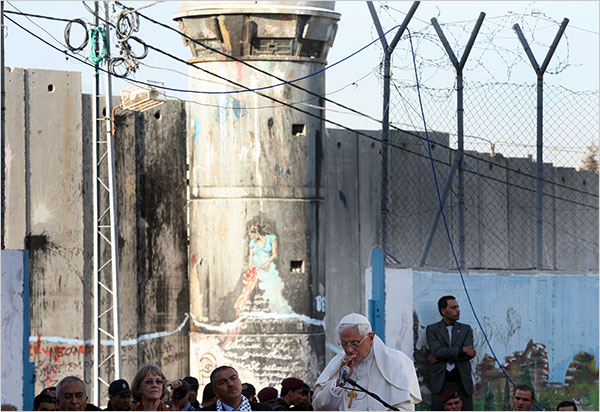
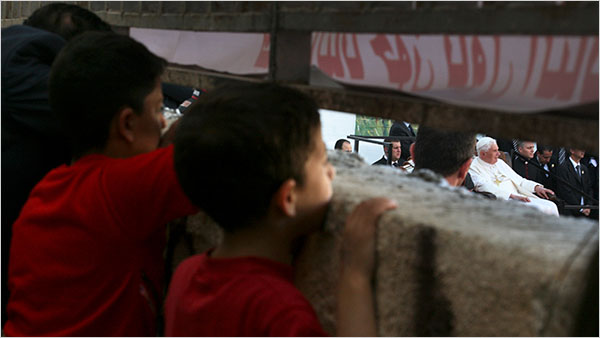
The New York Times ran an article with the headline: “In Bethlehem, Pope laments Israeli wall“. The perfect place to use the image above — the one their own photographer had provided. Right?
Wrong. Instead, they went with a poetic Getty image: little children peaking over a little wall. How enchanting!
The Israel Defense Forces announced on Wednesday that an internal investigation has determined that no civilians were purposefully harmed by IDF troops during Operation Cast Lead in the Gaza Strip.
Following the release of the investigation results, Defense Minister Ehud Barak said that the army’s willingness to probe itself “once again proves that the IDF is one of the most moral armies in the world.
“The IDF is not afraid to investigate itself and in that, proves that its operations are ethical,” said Barak. The defense minister added that he has “complete faith in the IDF, from the chief of staff to the last of the combat soldiers.” [continued…]
Editor’s Comment — Oh my! And to think that cynics like me could have judged the IDF so harshly. What better time could there be to watch again this rousing anthem and wonderful tribute to the most moral army in the world: Don’t mess with the IDF.
When Hillary Clinton met Benjamin Netanyahu in Jerusalem during her recent visit to Israel, her party was dismayed to see Uzi Arad at the next Israeli prime minister’s side. Arad’s involvement in the “AIPAC case” has resulted in him being barred from entry into the US. Joseph Fitsanakis continues the story:
As soon as Secretary Clinton and her advisers realized Arad was standing next to Netanyahu in the meeting room, they tried to discreetly avoid diplomatic complications by requesting that “only three participants from each side stay in the meeting”. It was an indirect way of requesting that Mr Arad leave the room. But the US delegation was stunned when Israel’s Prime Minister-Designate kept the former Mosad agent present, choosing instead to kick out Israel’s Ambassador to the United States, Sallai Meridor. Clinton’s delegation did not say a word about the Netanyahu’s diplomatic slap-in-the-face, hoping the incident would not make headlines. Ambassador Meridor was not so sensitive about the affair. He was so put off that he announced his resignation soon afterwards.
Netanyahu’s office later explained that Arad’s presence was required in the meeting “because of the Iranian issue.”
Arad is an advocate of “maximum deterrence” towards Iran and has said Israel should threaten to strike ‘everything and anything of value.’ He has said Israel should threaten to hit the Iranian leadership and their holiest sites and that they should hit everything together. This comes from the man tipped to become Netanyahu’s national security adviser.
Arad also recently made the following remarks about the Palestinians. During an interview on Israel National News TV (Arutz Sheva is a media network based in the West Bank and is seen as the voice of the Jewish settler movement), Arad was asked whether the time has come to abandon the two-state solution. This is how he responded:
I don’t think that one has to go that far because at the end of the day, I don’t think the majority of Israelis want to see themselves responsible for the Palestinians. We do not want to control the Palestinian population. It’s unnecessary. What we do want is to care for our borders, for the Jewish settlements and for areas which are unpopulated and to have our security interests served well. But also to take under our responsibility these populations which, believe me, are not the most productive on earth, would become a burden. We want to relieve ourselves of the burden of the Palestinian populations – not territories. It is territory we want to preserve, but populations we want to rid ourselves of.
Israel needs “settlements.” They are intrinsic to the image it has long sought to convey to overseas admirers and fund-raisers: a struggling little country securing its rightful place in a hostile environment by the hard moral work of land clearance, irrigation, agrarian self-sufficiency, industrious productivity, legitimate self-defense and the building of Jewish communities. But this neo-collectivist frontier narrative rings false in modern, high-tech Israel. And so the settler myth has been transposed somewhere else — to the Palestinian lands seized in war in 1967 and occupied illegally ever since.
It is thus not by chance that the international press is encouraged to speak and write of Jewish “settlers” and “settlements” in the West Bank. But this image is profoundly misleading. The largest of these controversial communities in geographic terms is Maale Adumim. It has a population in excess of 35,000, demographically comparable to Montclair, N.J., or Winchester, England. What is most striking, however, about Maale Adumim is its territorial extent. This “settlement” comprises more than 30 square miles — making it one and a half times the size of Manhattan and nearly half as big as the borough and city of Manchester, England. Some “settlement.”
There are about 120 official Israeli settlements in the occupied territories of the West Bank. In addition, there are “unofficial” settlements whose number is estimated variously from 80 to 100. Under international law, there is no difference between these two categories; both are contraventions of Article 47 of the Fourth Geneva Convention, which explicitly prohibits the annexation of land consequent to the use of force, a principle re-stated in Article 2(4) of the United Nations Charter. [continued…]
he aid convoy, stranded in Aqaba, Jordan, for five days, on its way to the Gaza Strip, turns back to Syria after Cairo’s refusal to let it cross through its territory.
Members of the convoy, led by British MP George Galloway, were hoping to reach a solution through Turkish mediation and enter Gaza through the Red Sea port of Nuweiba, the most direct route.
“After talks between the Turkish government’s envoy and the Egyptian consulate in Aqaba, we agreed to go to Syria,” Zaher Birawi, spokesman for the convoy, told Agence France-Presse.
“We have told the Egyptians that we were not trying to challenge them and urged them to help us, but they refused,” Birawi said. [continued…]
Editor’s Comment — Today’s Zaman says: “Turkish Prime Minister Recep Tayyip Erdoğan said he supports the convoy and urged Egypt to allow the Turkish deputies to enter.” And the Viva Palestina Twitter feed adds: “Seems Turkish pressure means convoy will move to Syria (maybe on the road tonight) and Turkey will fund a chartered ship from Syria for ALL.”
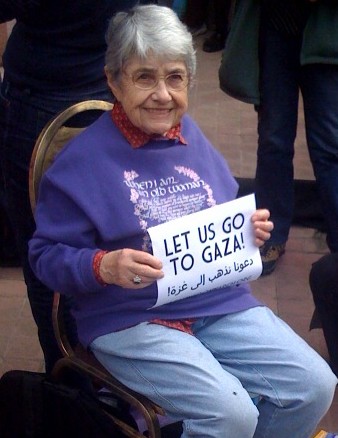
Hedy Epstein, the 85 year old Holocaust survivor and peace activist, announced that she will begin a hunger strike today as a response to the Egyptian government’s refusal to allow the Gaza Freedom March participants into Gaza.
Ms. Epstein was part of a delegation with participants from 43 countries that were to join Palestinians in a non-violent march from Northern Gaza towards the Erez border with Israel calling for the end of the illegal siege. Egypt is preventing the marchers from leaving Cairo, forcing them to search for alternative ways to make their voices heard.
Ms. Epstein will remain outside the UN building at the World Trade Center (Cairo) – 1191 Cornish al-Nil, throughout today, accompanied by other hunger strikers. “It is important to let the besieged Gazan people know they are not alone. I want to tell the people I meet in Gaza that I am a representative of many people in my city and in other places in the US who are outraged at what the US, Israeli and European governments are doing to the Palestinians and that our numbers are growing,” Epstein said. [continued…]
(Photo credit: Ali Abunimah)
Yesterday we joined the people of Gaza, the people of all of Palestine, and allies around the world in remembering the anniversary of the inhuman and illegal Israeli attacks that stole the lives of more than 1,400 mothers, fathers, daughters, and sons last December and January. And, in a manner far too appropriately suited to remembering an unfathomably vicious massacre and the preposterous silence of the American and Egyptian governments, we freedom marched in circles throughout the streets of Cairo.
The Egyptian government has revoked the contracts for the buses that would take us one step closer on our journey to Gaza and has forbidden us from leaving Cairo. Military police have torn down our small hand-written cards tied to the Kasr al Nil Bridge, following the Israelis’ lead in trying to disappear the names and numbers of Gaza’s martyrs. Candles meant to float along the Nile in remembrance are still in their boxes, their hundreds of distributors never permitted to board the feluccas (river boats) waiting just beyond overwhelming security forces. We regroup, circle again, and find another path to remembering and reminding, another way through the many checkpoints and the impossible border ahead. [continued…]
One year after the Zionist entity’s savage assault on the besieged refugee population of the Gaza Strip, a group of 16 international human rights and aid groups released a report documenting the wretched conditions under which the people of Gaza are inexplicably left to suffer.
We hear much of this suffering, but all too often it’s just an afterthought in the heat of political discussion. And for those who have never gone through such conditions, it will be impossible to understand the comprehensive breadth of the restrictions placed upon every facet of daily life in Gaza.
I hardly ever read these reports in full, usually just perusing the conclusions, but reading the detailed facts and figures mentioned in this one (entitled ‘Failing Gaza: No rebuilding, no recovery, no more excuses‘) really drives home the extent of the oppression. [continued…]
Despite the fact that a year has passed since the start of the Gaza military operation, the damage caused by three weeks of war and the near total closure preceding it has yet to be repaired. The reason: Israel’s ongoing policy blocking goods from entering the Gaza Strip, including a near total ban on reconstruction materials. [continued…]
This website or its third-party tools use cookies, which are necessary to its functioning. By closing this banner, you agree to the use of cookies.

 embers of an international group gathered in Cairo to protest against the siege of Gaza have rejected an Egyptian offer to allow 100 of them entry into the Palestinian territory.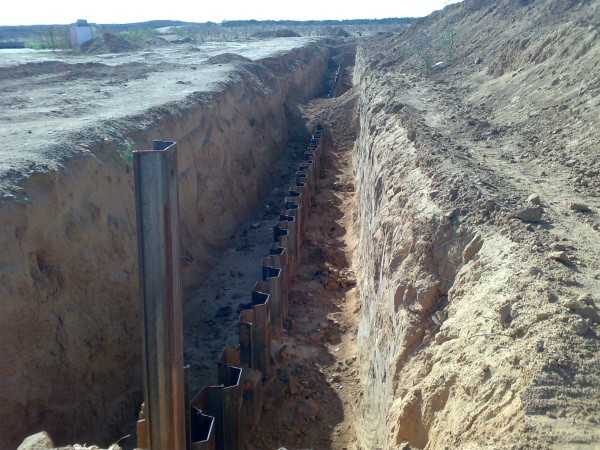



 ilitia forces that had been surrounding the Qoba Mosque in Shiraz since early Tuesday morning mounted attacks on the mosque where Ayatollah Seyyed Ali Mohammad Dastgheib delivers sermons.



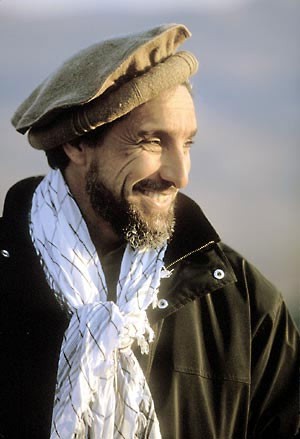 As Americans prepare to mark the Sept. 11 anniversary, with many still struggling to come to terms with the cataclysm of that day, Afghans are passing through their own harrowing remembrance, of an attack that was overshadowed for the rest of the world by what happened two days later in the United States. Only four men died on Sept. 9 — the 49-year-old Mr. Massoud, an aide and the assassins — but there has been little healing of the wounds the killers inflicted on the hearts and the hopes of millions of his countrymen.
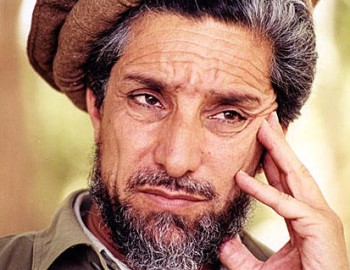 Let me correct a few fallacies that are propagated by Taliban backers and their lobbies around the world. This situation over the short and long-run, even in case of total control by the Taliban, will not be to anyone’s interest. It will not result in stability, peace and prosperity in the region. The people of Afghanistan will not accept such a repressive regime. Regional countries will never feel secure and safe. Resistance will not end in Afghanistan, but will take on a new national dimension, encompassing all Afghan ethnic and social strata.
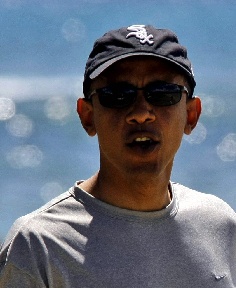 ith great sorrow and deep consternation, we hereby declare the death of the latest hope. Perhaps rumors of its death are greatly exaggerated, to paraphrase the famous quote by Mark Twain, but the fears are being validated day after day. Barack Obama’s America is not delivering the goods. Sharing a glass of beer with a racist cop and a pat on the back of Hugo Chavez are not what we hoped for; wholesale negotiations on freezing settlement construction are also not what we expected. Just over six months after the most promising president of all began his term, perhaps hope has a last breath left, but it is on its deathbed.


 aspian Makan,

 edy Epstein, the 85 year old Holocaust survivor and peace activist, announced that she will begin a hunger strike today as a response to the Egyptian government’s refusal to allow the Gaza Freedom March participants into Gaza.