Author Archives: Paul Woodward

Time to be afraid of everyone and everything

The 1982 Chicago Tylenol murders resulted in seven deaths and spawned an industry: the production of tamper-resistant packaging. Four years earlier mercury-injected Jaffa oranges from Israel caused short-lived panic across Europe. But 32 years later tamper-resistant oranges have yet to make it to the produce shelves.

The same populations that needed at all costs to be protected from the risk of contaminated pharmaceutical products were apparently willing to live with the risk presented by unpackaged food. The difference between the two cases seemed to have had less to do with risk assessment than with the conjunction (or lack of one) between fear and commercial opportunity.

The Government of Fear in Washington is now raising two new alarms — each with security and commercial implications that have yet to become apparent, though right now this looks like good news for McDonalds and bad news for Sizzler.

CBS News has an exclusive report on the latest terrorist plot about which the Department of Homeland Security wants to generate some fear.

The plot uncovered earlier this year is said to involve the use of two poisons – ricin and cyanide – slipped into salad bars and buffets.

Of particular concern: The plotters are believed to be tied to the same terror group that attempted to blow up cargo planes over the east coast in October, al Qaeda in the Arabian Peninsula.

In online propaganda al Qaeda in the Arabian Peninsula has praised the cargo attack, part of what it called “Operation Hemorrhage.”

The propaganda says in part, “…attacking the enemy with smaller but more frequent operations” to “add a heavy economic burden to an already faltering economy.”

Meanwhile, here comes another alarm:

Attorney General Eric Holder says that the growing number of American citizens joining terrorist groups including Al Qaeda is “one of the things that keeps me up at night.”

“You didn’t worry about this even two years ago — about individuals, about Americans, to the extent that we now do,” Holder said in an interview with ABC News airing Tuesday. “And that is of … of great concern.”

Be afraid of what you eat. Be afraid of your fellow Americans.

Happy Holidays from the US Government!

Facebooktwittermail

Cables reveal Israel welcomed Hamas takeover of Gaza

If mainstream media reports and government statements could be relied upon, the Bush administration and the Israeli governments led by Ariel Sharon and then Ehud Olmert were perpetually of one mind — Washington simply mirrored Jerusalem. But newly-released cables indicate that when it came to views about Hamas’ control of Gaza, there was in 2007 a significant divergence of opinion. While a plan hatched by Elliot Abrams for a US-supported Fatah coup to unseat the democratically-elected Hamas government, was rapidly unraveling, the Israelis said they would be pleased to see Hamas assume complete control of Gaza.

A cable describing a June 12, 2007 meeting between US Ambassador Richard Jones and Israeli Military Intelligence Director Amos Yadlin indicated that Israel regarded Gaza as less of a threat than Iran, Syria or Hezbollah. At the height of the eight-day battle between Hamas and Fatah for the control of Gaza, the cable said:

The Ambassador commented that if Fatah decided it has lost Gaza, there would be calls for Abbas to set up a separate regime in the West Bank. While not necessarily reflecting a consensus GOI [Government of Israel] view, Yadlin commented that such a development would please Israel since it would enable the IDF to treat Gaza as a hostile country rather than having to deal with Hamas as a non-state actor. He added that Israel could work with a Fatah regime in the West Bank. The Ambassador asked Yadlin if he worried about a Hamas-controlled Gaza giving Iran a new opening. Yadlin replied that Iran was already present in Gaza, but Israel could handle the situation “as long as Gaza does not have a port (sea or air).” [Emphasis mine.]

Implicit in Yadlin’s remarks was the view that Hamas’ control of Gaza would make it easier for Israel to control the territory from the air with more frequent missile attacks.

As the US ambassador questioned the Israeli intelligence chief, one has to wonder whether either of them had been briefed on the Abrams plan.

In a report published by Vanity Fair in April 2008, David Rose wrote:

Vanity Fair has obtained confidential documents, since corroborated by sources in the U.S. and Palestine, which lay bare a covert initiative, approved by Bush and implemented by Secretary of State Condoleezza Rice and Deputy National Security Adviser Elliott Abrams, to provoke a Palestinian civil war. The plan was for forces led by [Palestinian Authority National Security Advisor Muhammad] Dahlan, and armed with new weapons supplied at America’s behest, to give Fatah the muscle it needed to remove the democratically elected Hamas-led government from power. (The State Department declined to comment.)

But the secret plan backfired, resulting in a further setback for American foreign policy under Bush. Instead of driving its enemies out of power, the U.S.-backed Fatah fighters inadvertently provoked Hamas to seize total control of Gaza.

Some sources call the scheme “Iran-contra 2.0,” recalling that Abrams was convicted (and later pardoned) for withholding information from Congress during the original Iran-contra scandal under President Reagan. There are echoes of other past misadventures as well: the C.I.A.’s 1953 ouster of an elected prime minister in Iran, which set the stage for the 1979 Islamic revolution there; the aborted 1961 Bay of Pigs invasion, which gave Fidel Castro an excuse to solidify his hold on Cuba; and the contemporary tragedy in Iraq.

Within the Bush administration, the Palestinian policy set off a furious debate. One of its critics is David Wurmser, the avowed neoconservative, who resigned as Vice President Dick Cheney’s chief Middle East adviser in July 2007, a month after the Gaza coup.

Wurmser accuses the Bush administration of “engaging in a dirty war in an effort to provide a corrupt dictatorship [led by Abbas] with victory.” He believes that Hamas had no intention of taking Gaza until Fatah forced its hand. “It looks to me that what happened wasn’t so much a coup by Hamas but an attempted coup by Fatah that was pre-empted before it could happen,” Wurmser says.

The botched plan has rendered the dream of Middle East peace more remote than ever, but what really galls neocons such as Wurmser is the hypocrisy it exposed. “There is a stunning disconnect between the president’s call for Middle East democracy and this policy,” he says. “It directly contradicts it.”

While media reports at that time described the fight between Hamas and Fatah as being a “Hamas coup”, the Israeli intelligence chief did not see Hamas’ attacks as “part of a premeditated effort to wipe out Fatah in Gaza.”

What is transparent in both the Abrams plan and also now revealed in several cables, is that when it comes to the partnerships Israel and the US have backed with the Palestinians, whether Palestinian leaders had political legitimacy or popular support was of little concern — the sole requirement was that Israel/US work with Palestinians willing to place Israel’s interests first. In other words, Israel wanted to back a Palestinian leadership which would be incapable of surviving without Israeli support.

In a June 11, 2007 meeting between the US ambassador and Yuval Diskin, the head of Israel’s internal security service, Shin Bet, the Israeli described a “very good working relationship” with a Palestinian intelligence chief, Tawfik Tirawi, who he described as “psychopathic, cruel, dangerous and prone to extreme mood swings.”

In the West Bank, Diskin said that ISA [Shin Bet] has established a very good working relationship with the Preventive Security Organization (PSO) and the General Intelligence Organization (GIO). Diskin said that the PSO shares with ISA almost all the intelligence that it collects. They understand that Israel’s security is central to their survival in the struggle with Hamas in the West Bank. [Emphasis mine.]

Facebooktwittermail

How a secret gets revealed and then becomes secret again

On November 30, The Express Tribune, Pakistan’s first internationally affiliated newspaper (partnered with The International Herald Tribune – the global edition of The New York Times) reported:

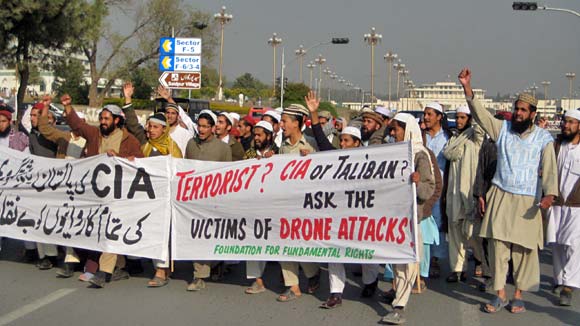
A North Waziristan tribesman, whose brother and teenage son were killed in a drone strike last year, said on Monday that he would sue all those US officials supposedly in control of the predator’s operations in Pakistan.

Karim Khan, a local journalist from Mirali town of the lawless tribal district, had sent a $500 million claim for damages to the US Defence Secretary Robert Gates, CIA chief Leon Panetta and its station head in Islamabad Jonathan Banks.

On December 10, a report appearing in the Miami Herald repeated the same claims:

The lawsuit, which stands little chance of being won, is lodged against the CIA station chief in Islamabad, identified as Jonathan Banks; CIA Director Leon Panetta; and Defense Secretary Robert Gates. There’s speculation that the publicity has compromised the position of the CIA chief in Pakistan. The U.S. Embassy in Islamabad refused to confirm that Banks was the right person.

“What CIA station chief? I can’t talk about employees,” embassy spokesman Alberto Rodriguez said.

But yesterday, the New York Times started reporting like a newspaper that takes directions from the government censors.

Just as in Israel, where secrecy can be imposed through censorship even when the “secret” has been made known everywhere else in the world, the New York Times is now following government directions by refusing to reprint the CIA station chief’s name even though it has been widely reported outside and inside the United States.

The Central Intelligence Agency’s top clandestine officer in Pakistan’s capital, Islamabad, was removed from the country on Thursday amid an escalating war of recriminations between American and Pakistani spies, with some American officials convinced that the officer’s cover was deliberately blown by Pakistan’s military intelligence agency.

The American spy’s hurried departure is the latest evidence of mounting tensions between two uneasy allies, with the Obama administration’s strategy for ending the war in Afghanistan hinging on the cooperation of Pakistan in the hunt for militants in the mountains that border those two countries. The tensions could intensify in the coming months with the prospect of more American pressure on Pakistan.

As the cloak-and-dagger drama was playing out in Islamabad, 100 miles to the west the C.I.A. was expanding its covert war using armed drones against militants. Since Thursday, C.I.A. missile strikes have killed dozens of suspects in Khyber Agency, a part of the tribal areas in Pakistan that the spy agency had largely spared until now because of its proximity to the sprawling market city of Peshawar.

American officials said the C.I.A. station chief had received a number of death threats since being publicly identified in a legal complaint sent to the Pakistani police this week by the family of victims of earlier drone campaigns.

So, before his cover was blown and this cloak-and-dagger drama started playing out, are we to suppose that the CIA station chief was happily cruising round Islamabad in an open-top Cadillac proudly flying the Stars and Stripes on the hood?

Even if the station chief who must now not be named was less exposed before a name which might be his name appeared in print, let’s not pretend he operated in Pakistan with anything less than maximum security.

The Washington Post confirms: “Ordinarily, station chiefs in Islamabad rarely stray beyond the sprawling American diplomatic compound, living and working in a warren of apartments and offices set deep inside the embassy complex’s walls.”

Maybe the issue is not threats to the station chief’s life as much as threats to his liberty. Pakistan’s judicial system, unlike its government, has at times displayed what American officials might regard as an irksome level of independence.

A report in Pakistan’s Daily Mail, published on December 1 (part of which appears below without corrections — the English and editing are rough, but the story is strong), provides interesting background on the legal action being brought by Kareem Khan.
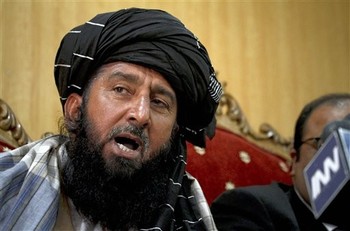
Kareem Khan challenged the precision of drone attacks and specifically questioned the precision of 31st December 2009 attack where in three innocent lives were taken by CIA in a secretive mode. He further challenged that if CIA can establish involvement of any of victims of 31st December attack in terrorism he will pay damages to United States instead.

While talking about the catastrophe he told The Daily Mail how his18 years old son Zaenullah, his young brother Asif Iqbal and a mason who was working on construction of village masque and had came from another village of Khyber Pakhtunkhawa were killed.

Kareem Khan told The Daily Mail that “his family is one of few educated families from the North Waziristan .He himself is M .Phil while his son was employee of Government school in town and his brother was graduate of National University of Modern languages from Islamabad .After compilation of his studies he went back to his town to add his positive contribution in educational uplifting of tribal area. They were innocent Pakistani citizen of Islamic Republic Of Pakistan whose fundamental rights have been guaranteed under the Constitution of Islamic Republic of Pakistan

In the response of one question about the families of victims he told Asif Iqbal left two years old son Muhammad Kafeel and a widow. Mohammad Kafeel has no one to look after as his mother is suffering great emotional and mental trauma. . “I lost my son and brother and now family’s full responsibility is now on me now we are living in uncle’s house waiting for justice or compensation”. He told The Daily Mail

Kareem Khan told the Daily Mail after this tragedy “I went here and there for Justice but all in vain because of undefined and so called system in tribal areas than one of my good friend suggested me to ask for Justice through legal way”. On November 29 2010 I through my lawyer Mirza Shahzad Akbar issued a legal notice to United States Secretary Defence Mr. Robert Gates, Director CIA Leon Panetta CIA Islamabad Station Chief Jonathan Banks for damages of $ 500 Million .he added

He also told that Drone attacks in tribal areas are carried out by CIA in langly, Virginia USA with co-ordination of local intelligence gathered by spies on ground in tribal area. CIA, s Islamabad station Chief, Jonathan Banks coordinates such intelligence through the network of on ground spies, who are paid a hefty amount for pointing out any militant. On these uncorroborated reports, CIA is executing people of tribal areas.

He stated that “CIA Director Leon Panetta has been reported in media saying that ‘Drone attacks are precise and limited in terms of collateral damage’.

“CIA officials are not part of United States armed forces, therefore under international law they are civilians directly participating in hostilities. Furthermore being non-diplomat and non-armed forces members CIA officials, who are operating drone attacks have no immunity and therefore are liable for murder and damages under laws of Pakistan and principles of natural justice throughout the world’ Kareem Khan explained

Kareem Khan also grumbled that media is not playing vibrant role and journalists even don’t bother to find ground realities. Every time we watched in media that numbers of militants are killed in the result of drone attacks. All the time they go for figures they don’t even bother to differentiate the innocent people and militants. Unfortunately they just rely on people who are present there and love to create hype for their own purpose.Kareem Khan gave the example of Hakeem Ullah Mehsood, Jalal Din ,Aimen Alzwari and Sheikh Usamma and told that according to so called reliable sources media published news regarding their, several times deaths . Which is very funny situation because in my limited knowledge a person died once in his or her life .

Shahzad Mirza Akbar ,the legal representative of Kareem khan who was present during the interview told The Daily Mail Drone attacks on house of his client is in clear violation of United Nations declaration of Human Rights ,International Covenant on Civil and Political Rights(ICCRP) and the citizens of Pakistan through the constitution of Islamic Republic of Pakistan .Those who have committed this atrocity are liable to be charged under the Penal Code of Pakistan and no law custom or authority gives CIA the permission to carry out killing in the sovereign territory of another country .So this is illegal act of United States and CIA and cannot be recognized as legal at any judicial or legal forum .The UN special report on extra –judicial ,summery and executions declared in 2004

“Empowering Government to identify and kill “known terrorists” places no verifiable obligation upon them to demonstrate in any way that those against whome lethal force is used are indeed terrorists, or to demonstrate that every other alternative had been exhausted”.

He told Court issued the notice on November 29, 2010 and count down has been started from today .He also talked about next step is to go in American court for justice.

So what’s the story here? Is it about the life of a CIA station chief being placed at risk? Or is it about the struggle among the victims of drone warfare who believe that tribal people should be afforded the same political, legal and human rights and protections as anyone else?

Strangely, the Washington Post and the Wall Street Journal, while acceding to a CIA request not to reprint the station chief’s name, nevertheless provide additional identifying information about him which I have not included here, nor has it appeared in the Pakistani press. That information was, no doubt, provided to them by the CIA!

Facebooktwittermail

The legal assault on WikiLeaks and press freedom

As the Justice Department develops a legal strategy for attacking WikiLeaks it will be looking for political cover to defend itself from the charge that it is attacking the First Amendment rights of a free press and will do so by arguing that what WikiLeaks does is not journalism.

The administration’s lack of interest in defending the Constitution is transparent. The question is, where will the pillars of the American mainstream media establishment take their stand? In defense of a free press? Or will they equivocate because they attach greater value to the privilege of government access than they do to their obligation to serve the public?

Wired reports:

The Justice Department would have no problem distinguishing WikiLeaks from traditional media outlets, if it decides to charge WikiLeaks founder Julian Assange with violating the Espionage Act, a former federal prosecutor told lawmakers Thursday.

“By clearly showing how WikiLeaks is fundamentally different, the government should be able to demonstrate that any prosecution here is the exception and is not the sign of a more aggressive prosecution effort against the press,” said Kenneth Wainstein (pictured at right), former assistant attorney general on national security, during a House Judiciary Committee hearing about WikiLeaks and the Espionage Act on Thursday.

The hearing was the first to publicly address WikiLeaks. It consisted of testimony from legal scholars and attorneys as well as former Green Party presidential candidate and consumer advocate Ralph Nader. Testimony focused primarily on whether the 1917 Espionage Act should be revised to make it easier to prosecute recipients of classified information.

But Wainstein’s remarks, coming from a former prosecutor, hint at arguments the Justice Department is likely to make if it proceeds with prosecuting Assange under the existing Espionage Act.

Facebooktwittermail

In Britain’s effort to crush political dissent, the disabled have become fair game

How dangerous is a man in a wheelchair? British police officers attempting to restore order on the streets of London during recent student protests, decided they couldn’t take any chances when facing the threat posed by 20-year-old Jody McIntyre who suffers from cerebral palsy and is a self-described revolutionary.

In an interview, the BBC’s Ben Brown challenged McIntyre, saying: “There’s a suggestion that you were rolling towards the police in your wheelchair. Is that true?”

McIntyre turns the table on his interviewer by asking: “Do you think that I could have in any way posed a physical threat from the the seat of my wheelchair to an army of police officers armed with weapons?”

On the BBC’s Breakfast News, McIntyre faced similar treatment by interviewers who seemed inclined to believe the police must have been reacting to some form of provocation.

At Open Democracy, Ryan Gallagher notes that the tone of these interviews is:

… typical of how the mainstream media have responded to protests and the policing of them both past and present. Their automatic assumption is that the police are protectors of our best interests, defenders of public order, righteous upholders of the law. Protesters, on the other hand, are automatically perceived as a threat and a potential destructive force – they are folk devils: outsiders, troublemakers and vandals of decency.

The police are therefore at an immediate advantage in the media realm, for they are always given the benefit of the doubt. Officers may have had to crack a few skulls during the fees protests, however only because they were provoked by what [Prime Minister] David Cameron described as “feral thugs”. And it is for this same reason that McIntyre was repeatedly placed on the back foot throughout his BBC interview. Was he a “cyber-radical?” Did he want to build a “revolutionary movement?” The police would never just attack a defenceless disabled man in a wheelchair, would they?

Kira Cochrane spoke to McIntyre about his treatment by the BBC.

Was he surprised by the tone of Brown’s interview? “Not at all,” he says, “because it’s state television. Why do we so heavily criticise state television in other countries and then suggest that our state television would be impartial? I was at a demonstration against the government, and I’m then interviewed on television that works for the government. Why would they question me fairly?”

I ask whether he was scared at any point during the demonstration, and he suggests he has seen much worse recently. At 18, straight after his A-levels, and inspired by Che Guevara, McIntyre decided to travel through South America for three months; after that, he went to Palestine to live in areas including Gaza and Bil’in. “I had Israeli soldiers invading one village every night, shooting at us with live bullets, so a Metropolitan police officer is really not going to pose much of a worry to me. But it was quite humiliating, obviously, to be dragged from my wheelchair.” Was he surprised by the incident? “No, and I don’t know why other people are. To me, it’s as if people must have been asleep all their lives if they don’t realise this is the police’s role at demonstrations – to protect the interests of the government and the state.”

He has been on a lot of protests, on a wide range of issues, and says he has always had a political outlook, which he chronicles on his blog, Life on Wheels (“One man’s journey on the path to revolution”). He isn’t a student himself, but says he cares deeply about the issue both because “acceptance into university should be based on the merit of your grades, not the size of your wallet” and because “education is simply the first target. These cuts, this axe that the government is wielding, is going to affect everyone.”

At the New Statesman, Laurie Penny writes:

The truly fascinating aspect of McIntyre’s story is what it reveals about how the British understand disability: namely, that ‘real’ disabled people are not whole human beings. The attitude is that there are two types of disabled person: there are ‘real’ disabled people, who are quiet and grateful and utterly incapable of any sort of personal agency whatsoever, and ‘fake’ disabled people, people like Jody McIntyre, who are disqualified from being truly disabled by virtue of having personality, ambition, outside interests and, in this case, the cojones to stand up to a corrupt and duplicitous government.

This remarkable Catch-22 clause, whereby the authorities can claim that any disabled person who criticises them on disability issues or any other issues must de facto not actually be disabled, does not only affect how individuals like McIntyre are treated. It directly influences policymaking in the most clinical and ruthless of ways. Bear in mind that, alongside its highly publicised cuts to secondary and higher education funding, this government is also taking away benefits from disabled people: housing benefit, income support, the mobility component of Disability Living Allowance and other vital sources of funding are being decimated or removed entirely.

Facebooktwittermail

The killing spirit in America

“I don’t want to just end the war,” Barack Obama said in January 2008, “but I want to end the mindset that got us into war in the first place.”

That was a line which seduced many a progressive across America during the presidential campaign and it’s one reason so many now feel betrayed. Either Obama later had a change of heart, or he knew at the time that he was cynically making a vacuous statement for the sole purpose of hooking a slice of the electorate — one that might be sufficiently inspired to provide useful foot soldiers in his campaign.

Reflecting some of that sense of betrayal, David Bromwich writes:

It has lately become usual for right-wing columnists, bloggers, and jingo lawmakers to call for the assassination of people abroad whom we don’t like, or people who carry out functions that we don’t want to see performed. There was nothing like this in our popular commentary before 2003; but the callousness has grown more marked in the past year, and especially in the past six months. Why? A major factor was President Obama’s order of the assassination of an American citizen living in Yemen, the terrorist suspect Anwar al-Awlaki. This gave legal permission to a gangster shortcut Americans historically had been taught to shun. The cult of Predator-drone warfare generally has also played a part. But how did such remote-control killings pick up glamor and legitimacy? Here again, the president did some of the work. On May 1, at the White House Correspondents dinner, he made an unexpected joke: “Jonas Brothers are here tonight. Sasha and Malia are huge fans. But boys, don’t get any ideas. Two words: predator drones. You will never see it coming.” The line caught a laugh but it should have caused an intake of breath. A joke (it has been said) is an epigram on the death of a feeling. By turning the killings he orders into an occasion for stand-up comedy, the new president marked the death of a feeling that had seemed to differentiate him from George W. Bush. A change in the mood of a people may occur like a slip of the tongue. A word becomes a phrase, the phrase a sentence, and when enough speakers fall into the barbarous dialect, we forget that we ever talked differently.

I’m not sure about Bromwich’s claim that the turning point was 2003.

Relatively early in America’s expansionist history, the slogan, “Wanted: Dead or Alive,” positioned extra-judicial killing at the center of a conception of justice in which the gun was elevated to the status of a sacred instrument.

It should have come as no surprise a week after the September 11 attacks, that a cowboy in the White House would try shaping the American mindset into one necessary for war, by employing those words.

President Bush said yesterday that he wanted Osama bin Laden, the Saudi exile, “dead or alive” in some of the most bellicose language used by a White House occupant in recent years.

“I want justice,” he said after a meeting at the Pentagon, where 188 people were killed last Tuesday when an airliner crashed into the building. “And there’s an old poster out West that says, ‘Wanted: Dead or Alive.’ ”

He then seemed to temper his remarks by adding: “All I want and America wants is to see them brought to justice. That’s what we want.”

Almost nine years later, Obama’s Attorney General Eric Holder confirmed that the same mindset was still at work — in spite of the Democratic president’s campaign promise — and assured Congress that bin Laden “will never appear in an American courtroom.”

The clichéd phrase, “bring to justice,” even if it might seem to preclude the justice of extrajudicial killing, nevertheless connotes justice as the exercise of power — not the enactment of a legal process that should by definition have an unpredictable outcome.

Which brings us to the American wrath now being directed at Julian Assange. His “crime” — the fact that most Americans wouldn’t be able to say what crime he might have committed hasn’t dampened their desire to see him punished — has I believe less to do with national security or legal statutes than the simple fact that he and WikiLeaks have embarrassed America. How dare a scruffy Australian have the audacity to do that?

Imperial power has no humor and responds to the smallest affront with fierce indignation.

Facebooktwittermail

Too much freedom in America

There’s too much freedom, a few constitutional amendments need tossing out and the government needs greater powers — this would seem to sum up the views of the majority of Americans… if the latest polling is reliable.

The American public is highly critical of the recent release of confidential U.S. diplomatic cables on the WikiLeaks Web site and would support the arrest of WikiLeaks founder Julian Assange by U.S. authorities, a new Washington Post-ABC News poll finds.

Most of those polled – 68 percent – say the WikiLeaks’ exposure of government documents about the State Department and U.S. diplomacy harms the public interest. Nearly as many – 59 percent – say the U.S. government should arrest Assange and charge him with a crime for releasing the diplomatic cables.

Assange was scheduled to appear in a London courtroom Tuesday to formally contest an extradition order on sexual assault charges in Sweden. U.S. federal authorities are reportedly investigating whether Assange could be charged with violating the Espionage Act by releasing the documents, but his potential extradition to Sweden could significantly complicate any U.S. attempt to quickly try him.

A generational gap was evident among those polled, with younger Americans raised in the Internet age expressing distinct views on the matter. Nearly a third of those ages 18 to 29 say the release of the U.S. diplomatic cables serves the public interest, double the proportion of those older than 50 saying so. When it comes to Assange, these younger adults are evenly split: Forty-five percent say he should be arrested by the United States; 46 percent say it is not a criminal matter. By contrast, those age 30 and older say he should be arrested by a whopping 37-point margin.

As always, the polling information is frustrating as much because of what it doesn’t show as by what it reveals. The answers to these follow-up questions might have helped clarify who was dumber — the pollsters or those being polled:
1. If you believe the release of the cables damaged the public interest, can you list the top five most damaging revelations?
2. If you believe the release of the cables damaged the public interest, can you explain whether you see any distinction between the interests of the American people and the interests of the US government?
3. If you would like to see Julian Assange arrested, can you explain what crime you think he committed?
4. If you think he committed a crime, do you believe that the same charges should be brought against the editors of the New York Times and other newspapers that published the cables?
5. The First Amendment protects freedom of speech and freedom of the press. Can you explain your understanding of these freedoms and do you believe that the US Constitution can be set aside whenever the government says that national security is at stake?

Facebooktwittermail

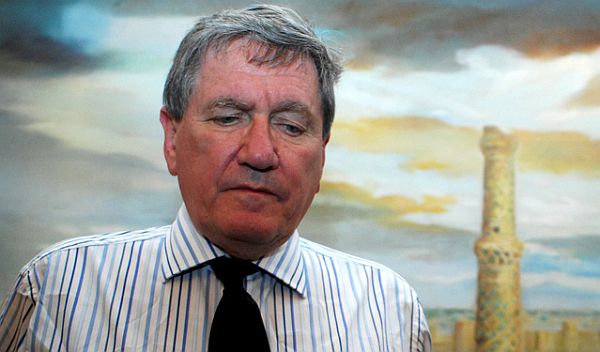
Holbrooke’s death-bed ‘stop the war’ comment just a joke

The real story is not the one reported. The real story we can only imagine — but it’s buried in here somewhere.

The Washington Post reports that Richard Holbrooke’s final words before entering surgery in which he died yesterday evening, were these: “You’ve got to stop the war in Afghanistan.”

Did Obama’s Af-Pak envoy go seriously off-message in the last moments of his life and reveal his abhorrence for what has become President Obama’s war? And more to the point, was the White House disturbed that this might be Holbrooke’s legacy — right at the moment that the administration was ready to wheel out its stay-on-course message about the war’s progress?

The Washington Post — at who’s behest we’ll probably never know — now provides some clarification. Holbrooke was just joking around while engaged in pre-surgery banter.

In the following account, the Post uses a phrase beloved by its reporters and those at the New York Times: emerged.

News pops up like mushrooms from an invisible mycelium. For a reporter to report on how a story emerges — well that would be unseemly and unnecessary, a distraction from the narrative that is supposedly the reader’s sole interest.

What possible concern could we have in understanding the chain of events that led to an anti-war death-bed story getting airbrushed out of the record?

Thank goodness we now know that Holbrooke was not eager to end the war.

As friends and colleagues from four decades of diplomatic life reflected on the intensity of Richard C. Holbrooke’s dedication, many were not surprised to learn that concerns about the Afghanistan war were apparently among his final thoughts.

Following Holbrooke’s death, The Washington Post, citing his family members, reported that the veteran diplomat had told his physician just before surgery on Friday to “stop this war.”

But on Tuesday a fuller account of the tone and contents of his remarks emerged.

As Dr. Jehan El-Bayoumi was attending to Holbrooke in the emergency room at George Washington University Hospital, she told him to relax and asked what she could do to comfort him, according to an aide who was present. Holbrooke, who was in severe pain, said jokingly that it was hard to relax because he had to worry about the difficult situation in Afghanistan and Pakistan.

El-Bayoumi, an Egyptian-American internist who is Secretary of State Hillary Rodham Clinton’s physician, replied that she would worry for him. Holbrooke responded by telling her to end the war, the aide said.

The aide said he could not be sure of Holbrooke’s exact words. He emphasized Tuesday that the comment was made in painful banter, rather than as a serious exhortation about policy. Holbrooke also spoke extensively about his family and friends as he awaited surgery by Farzad Najam, a thoracic surgeon of Pakistani descent.

Hmmm… Holbrooke’s surgeon was of Pakistani descent… No, I promise, I won’t go there.

Facebooktwittermail

The end of hypocrisy

Carne Ross has provided one of the most concise and cogent analyses of the impact of the WikiLeaks cables release and concludes that the challenge this event has thrown up can only be met with one solution: “that governments must close the divide between what they say, and what they do.”

A knee-jerk response to the prospect that diplomacy might not enjoy the confidentiality that it supposedly requires has been the assertion that this confidentiality is the basis of trust. Confidentiality, we are told, fosters candor. Behind closed doors, everyone becomes honest. Right.

On the contrary, what the cables actually reveal is what one might expect: that absent the political accountability that comes from publicly declaring ones objectives, confidentiality provides space for adventurism and for the promotion of policies that might be disowned if ever made public.

The cables reveal leaders across the Middle East — leaders all of whom have been blessed by the United States as “moderates” — whose overriding interest is the protection of their own autocratic power in the name of American-backed “regional stability.”

Even when it comes to candid assessments delivered by diplomats to their own government, such honesty often comes loaded with bias. Consider, for instance, this cable from Ambassador James Jeffrey while he served in Ankara. Referring to the foreign policy objectives outlined by Turkey’s foreign minister Ahmet Davutoglu representing the ruling AKP, Jeffrey writes sourly:

[T]he AKP’s constant harping on its unique understanding of the region, and outreach to populations over the heads of conservative, pro-US governments, have led to accusations of “neo-Ottomanism.” Rather than deny, Davutoglu has embraced this accusation. Himself the grandson of an Ottoman soldier who fought in Gaza, Davutoglu summed up the Davutoglu/AKP philosophy in an extraordinary speech in Sarajevo in late 2009 (REF A). His thesis: the Balkans, Caucasus, and Middle East were all better off when under Ottoman control or influence; peace and progress prevailed. Alas the region has been ravaged by division and war ever since. (He was too clever to explicitly blame all that on the imperialist western powers, but came close). However, now Turkey is back, ready to lead — or even unite. (Davutoglu: “We will re-establish this (Ottoman) Balkan”).

If Hillary Clinton did not rely on her ambassador’s confidential opinion but actually read Davutoglu’s speech, she might have come to a different conclusion.

The Turkish foreign minister said: “We want to have a new Balkan region, based on political dialogue, economic interdependency and cooperation, integration and cultural harmony and tolerance.”

The thrust of his argument was that the Balkans had thrived not by virtue of Ottoman rule per se, but because of the dynamism fostered by “multicultural coexistence.” Likewise, he portrayed contemporary Turkey’s strength as being multicultural: “Turkey is a small Balkan, a small Middle East, a small Caucasus. We have more Bosnians living in Turkey than in Bosnia, more Albanians living in Turkey than in Albania, more Chechens living in Turkey than in Chechnya, more Abkhazians living in Turkey than in Abkhazia, and we have Kurds, Arabs, Turks together.”

Is this the perspective of a man enthralled by a romanticized Ottoman golden age, or is Davutoglu offering a glimpse at the kind of multicultural future on which the region and the world surely depends?

But enough of my preamble — here’s what Ross writes:

It will take a long time, perhaps many years, for the full impact of the WikiLeaks disclosure of thousands of US diplomatic cables to become known. Make no mistake: this is an event of historic importance — for all governments, and not only the US.

As politicians of all sides bellow their condemnation of WikiLeaks, governments are with some desperation trying to pretend that it’s business as usual. But the truth is that something very dramatic in the world of diplomacy has just taken place, and thus indeed in the way that the world runs its business. History may now be dated pre- or post-WikiLeaks.

The mainstream press has as usual missed the story, with their obsession with Iran or Qaddafi’s voluptuous nurse or Karzai’s corruption — which, incidentally, is reported by US diplomats in excruciating detail. But this event carries a much deeper significance than merely the highly-embarrassing and in some cases dangerous revelations in the enormous trove of documents. No one, and neither the US State Department nor WikiLeaks, can say with any confidence whether the effects of this massive disclosure will be good or bad, for in truth no one can know. There will be many and long-lasting consequences. That is all that can be known with any certainty at this point.

The presumption that governments can conduct their business in secret with one another, out of sight of the populations they represent, died this week. Diplomats and officials around the world are slowly realizing that anything they say may now be one day published on the Internet. Governments are now frantically rushing to secure their data and hold it more tightly than ever, but the horse has bolted. If a government as technically sophisticated and well protected as the US can suffer a breach of this magnitude, no government is safe. Politicians can demand the prosecution of Julian Assange or — absurdly — that WikiLeaks be designated as a terrorist organization, but the bellows of anger are tacit admission that government’s monopoly on its own information is now a thing of the past.

Hillary Clinton has described the WikiLeaks disclosures as an attack on the “international community.” But in truth this is something else: an attack on the governments that make up the current international system of diplomacy. The deep-seated assumption, both among the public and political classes, that governments have business that they should conduct in secret with one another has been shattered. Pause, incidentally, to observe the politicians and commentators declaring the need for governments to operate in secrecy, when they don’t even know what government is keeping secret. From this day forward, it will be ever more difficult for governments to claim one thing, and do another. For in making such claims, they are making themselves vulnerable to WikiLeaks of their own.

Why? Because the most damaging thing about the WikiLeaks disclosures is not the fact that they happened (though this is bad enough for the US government) but the revelation, long suspected but now proven, of the yawning discrepancy between US words and actions in that most contested area, the Middle East. Cable after cable details the extraordinarily intimate and co-dependent relations between the US and various despotic and unpleasant Arab regimes. One Arab intelligence chief plots with American officials to target Iranian groups, or confront Hezbollah. Another undemocratic Arab leader invites US bombers to attack targets in his own territory. It is this discrepancy — between word and deed — that will keep the wind in WikiLeaks’ sails, and others like them, for long to come.

Governments around the world are this week telling each other that nothing has really changed and that if they restrict the circulation of those really sensitive telegrams and glue up all the USB slots in their computers, that this won’t happen to them. But it will. There will be more such revelations, not about the US (which so far has been the main target of WikiLeaks’ somewhat arbitrary attentions), but others — British, Chinese? — for the reality is that electronic data is formidably difficult to protect.

The reason is simple. In order to be effective as organizations, governments and foreign offices are required to circulate sensitive data, so that their officials and diplomats actually know what’s going on. One reason why the UN is ineffective as an organization is because nothing is secret there, and as a result no one circulates anything sensitive. Don’t buy the argument that the really important stuff is kept Top Secret and hasn’t been compromised. Even a cursory perusal of the WikiLeaks archive reveals cables that are the very meat and drink of diplomacy — what foreign leaders and governments really think, and what they really want in their relations with the US.

Governments are therefore confronted with an insoluble conundrum. If they restrict and protect the data, and perhaps even stop recording the most delicate information (as no doubt some diplomats are now considering), they will inevitably reduce their operational effectiveness. If they circulate the data widely, as the US did before WikiLeaks, they will risk compromise on this devastating scale.

There is in fact only one enduring solution to the WikiLeaks problem and this is perhaps the goal of WikiLeaks, though this is sometimes hard to discern. That is that governments must close the divide between what they say, and what they do. It is this divide that provokes WikiLeaks; it is this divide that will provide ample embarrassment for future leakers to exploit. The only way for governments to save their credibility is to end that divide and at last to do what they say, and vice versa, with the assumption that nothing they may do will remain secret for long. The implications of this shift are profound, and indeed historic.

Facebooktwittermail

Embedded with the Taliban

For an American cable news organization to embed reporters with the Taliban would be a bold move. CNN isn’t bold. But on Saturday evening it took the moderately risky move of airing a Norwegian journalist’s film of life with Taliban fighters.

“Some people might see this and think that you are trying to humanize this force which is attacking American troops,” Anderson Cooper says to Paul Refsdal. The problem being that if we see a Taliban commander embracing his children we might make a dreadful connection: such a scene must have preceded many a drone attack in which militants and their families have been eliminated. Refsdal simply says: “I show what I saw. I show the everyday life of the Taliban.”

Supporters of the war, however, better shield their eyes from such images — at least if they want to cling to the fiction that American forces are pitted against fanatical inhuman monsters.

As for the attack that is shown in the clip below, the Pentagon claims no such attack occurred. Cooper seems to infer from this that the Taliban has an inflated view of its own capacities. That’s one way of reading it. Another is to recognize that attacks against coalition forces are so frequent that the only ones worth recording are those that do damage — as though the only bullets a soldier need worry about are the ones that hit their target.

However CNN might have attempted to insulate themselves from criticism for airing this documentary, it’s likely impact will be this: that many Americans come away seeing the Taliban for what they are — an indigenous fighting force defending their homeland. In America’s war of independence, the militiamen who drove out the British, no doubt saw themselves in exactly the same way.

Facebooktwittermail

How to spot a terrorist

Eric Holder went to California to provide an update on the FBI’s terrorist training program. What he has yet to acknowledge is this: if the FBI can’t catch “terrorists” without first providing them with fake bombs, maybe the guys they’re catching aren’t really terrorists.

Doesn’t the criminal process attach as much importance to means as it does to motives? Disregard means, and we are heading into the Orwellian world of thoughtcrimes.

The New York Times, reporting on the Attorney General’s speech to Muslim Advocates, said:

In his remarks, Mr. Holder said that stings had been used for decades against many types of crimes. And he defended the investigation last month in Portland, Ore., in which a young Somali-American man, Mohamed Osman Mohamud, 19, was arrested after law enforcement agents said he tried to trigger what he thought was a car bomb at a Christmas tree-lighting ceremony.

“I make no apologies for the how the F.B.I. agents handled their work in executing the operation that led to Mr. Mohamud’s arrest,” Mr. Holder said. “Their efforts helped to identify a person who repeatedly expressed his desire and intention to kill innocent Americans.”

He added: “But you also have my word that the Justice Department will — just as vigorously — continue to pursue anyone who would target Muslims, or their houses of worship.”

Despite the attorney general’s reassurances, some in attendance were deeply concerned by the federal government’s ongoing undercover sting operations.

“I grew up during the civil rights era and I’m aware how the civil rights community was infiltrated by provocateurs and agents who sought to undermine the legitimate struggles of the movement,” said Abu Qadir Al-Amin, 60, an African-American imam from Vallejo, Calif. “So my antennae are up and I try to educate the Muslim community so that they don’t put themselves in a vulnerable position if someone comes along suggesting they do something illegal.”

Facebooktwittermail

The age of political apathy is ending

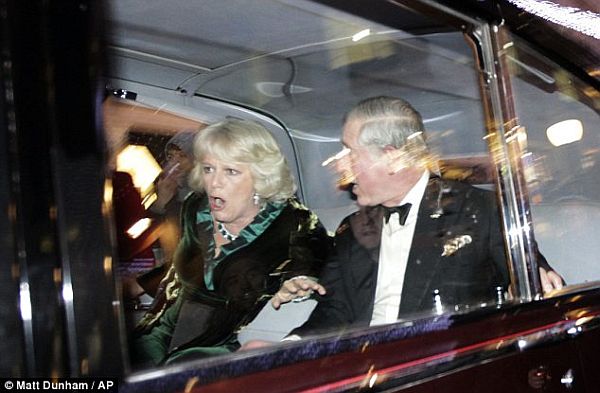
“Off with their heads,” shouted demonstrators crowding round the Rolls Royce carrying Prince Charles and his wife Camilla to a West End theater last night. Even if he didn’t fear for his life, Britain’s heir to the throne was reminded of the fate of his namesake, Charles I, last time Britons violently upturned the established order. And even if to Americans the British monarchy has the appearance of a quaint anachronism, the incident serves as a reminder that there are never any institutional seats of power that can perfectly protect themselves from the wrath of a population that forcefully demands to be heard.

For much of the last two decades, the West’s cynical democratic leaders have comforted themselves with the knowledge that governmental power rarely requires popular support. With election strategies that hinge on securing a 51% majority — a minority from a largely apathetic electorate — the only constituencies that have demanded and been rewarded with loyal service are those who pay handsomely to have their interests represented.

No more. The new British government recently volunteered to test the theory that austerity measures are not only a panacea for the economic travails of these times, but that a docile population will buckle under when forced to swallow bitter medicine. Unless the government is forced to change course, this will make higher education unfordable for most of a generation.

On the streets of London, Britain’s young people are now demonstrating that their character has been misjudged. None has done so more articulately than Barnably, a 15 year-old speaking at the Coalition of Resistance national conference in London on November 27.

Aaron Porter writes:

The last 30 days have shaken the coalition. Together with UCU, the lecturers’ union, we brought 50,000 to the streets of London on 10 November for the biggest student demonstration in a generation. It has sparked a new wave of activism that has involved tens of thousands of students, parents, pupils and teachers in creative, nonviolent protests and direct action.

By piling pressure on MPs with dozens of spontaneous demonstrations, scores of occupations and hundreds of thousands taking action around the country, we have come together to defend education and fight for our future. A generation has found its voice.

In its founding statement, the Coalition of Resistance declared:

It is time to organise a broad movement of active resistance to the Con-Dem government’s budget intentions. They plan the most savage spending cuts since the 1930s, which will wreck the lives of millions by devastating our jobs, pay, pensions, NHS, education, transport, postal and other services.

The government claims the cuts are unavoidable because the welfare state has been too generous. This is nonsense. Ordinary people are being forced to pay for the bankers’ profligacy.

The £11bn welfare cuts, rise in VAT to 20%, and 25% reductions across government departments target the most vulnerable – disabled people, single parents, those on housing benefit, black and other ethnic minority communities, students, migrant workers, LGBT people and pensioners.

Women are expected to bear 75% of the burden. The poorest will be hit six times harder than the richest. Internal Treasury documents estimate 1.3 million job losses in public and private sectors.

We reject this malicious vandalism and resolve to campaign for a radical alternative, with the level of determination shown by trade unionists and social movements in Greece and other European countries.

This government of millionaires says “we’re all in it together” and “there is no alternative”. But, for the wealthy, corporation tax is being cut, the bank levy is a pittance, and top salaries and bonuses have already been restored to pre-crash levels.

An alternative budget would place the banks under democratic control, and raise revenue by increasing tax for the rich, plugging tax loopholes, withdrawing troops from Afghanistan, abolishing the nuclear “deterrent” by cancelling the Trident replacement.

An alternative strategy could use these resources to: support welfare; develop homes, schools, and hospitals; and foster a green approach to public spending – investing in renewable energy and public transport, thereby creating a million jobs.

In another address to the national conference, the rapper, Lowkey, pointed out that the Liberal Democrats have not only reversed themselves on the issue of university tuition fees but also abandoned their proposal of an arms embargo on Israel. He also noted the irony that even during the rule of a Tory government, the Conservative Party headquarters in London has less protection than the Israeli embassy.

Facebooktwittermail

Case against Assange begins to unravel

As much as the mainstream media has willingly promoted the narrative of Julian Assange as a bad-boy rock-star type figure who has innocent groupies throwing themselves at his feet, the fact is, a rebellious enterprise such as WikiLeaks naturally attracts individuals who themselves have a rebellious independent spirit. It would seem likely that this would apply as much the women who accused Assange of sexual impropriety as it would to anyone else involved in WikiLeaks.

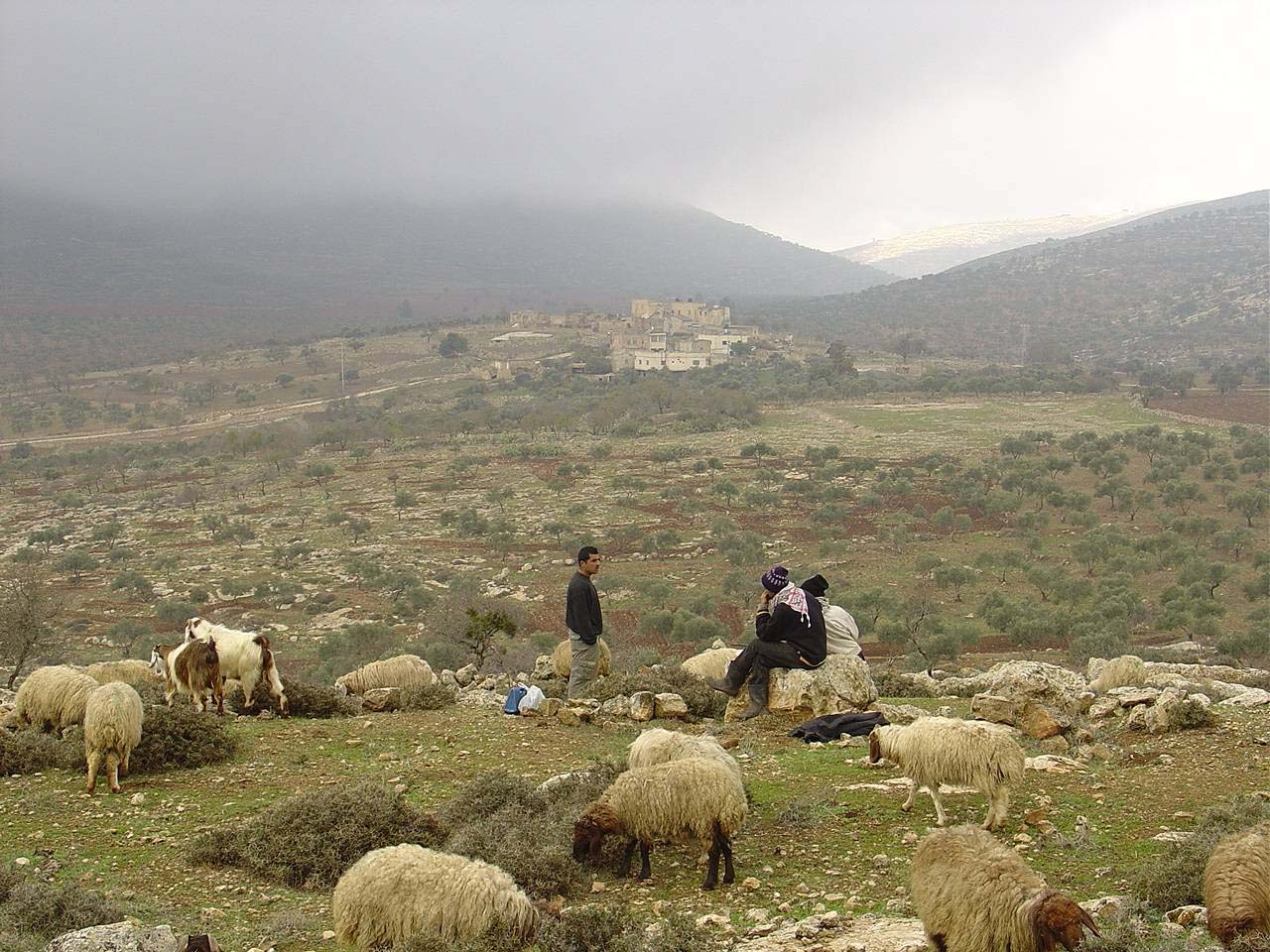
Given the way events have unfolded in recent days, one might doubt that these women — however justifiable might be their personal grievances — would now want to serve the interests of WikiLeaks’ enemies. Perhaps that’s one of the reasons why one of them — Anna Ardin — has taken up residence here, in the tiny village of Yanoun in the West Bank, where only one of the 1990 Palestinian inhabitants speaks English.

Australia’s Crikey.com reports (h/t Raw Story):

Anna Ardin, one of the two complainants in the rape and sexual assault case against WikiLeaks editor-in-chief Julian Assange, has left Sweden, and may have ceased actively co-operating with the Swedish prosecution service and her own lawyer, sources in Sweden told Crikey today.

The move comes amid a growing campaign by leading Western feminists to question the investigation, and renewed confusion as to whether Sweden has actually issued charges against Assange. Naomi Klein, Naomi Wolf, and the European group Women Against Rape, have all made statements questioning the nature and purpose of the prosecution.

Ardin, who also goes by the name Bernardin, has moved to the West Bank in the Palestinian Territories, as part of a Christian outreach group, aimed at bringing reconciliation between Palestinians and Israelis. She has moved to the small town of Yanoun, which sits close to Israel’s security/sequestration wall. Yanoun is constantly besieged by fundamentalist Jewish settlers, and international groups have frequently stationed themselves there.

Ardin recently mocked her detractors and the press by tweeting: “CIA agent, rabid feminist / Muslim lover, a Christian fundamentalist, frigid & fatally in love with a man, can you be all that at the same time …”

Facebooktwittermail

How WikiLeaks turned the First Amendment into a ‘problem’

First Amendment attorney Floyd Abrams says: “WikiLeaks may just be the price we pay for freedom of the press in this country.”

Why not: “WikiLeaks demonstrates the value of the First Amendment”?

After all, what’s the good of having a free press when journalists so willingly serve the interests of the establishment? If the Fourth Estate had not turned itself into a fourth branch of government, WikiLeaks would have little reason to exist — or at least, little reason to be challenging the authority of the US government.

Freedoms not exercised will easily be taken away.

Time reports:

Thanks to nearly a century of cases dealing with the clash between national security and the freedom of the press, the Constitution provides enormous protection for publishers of state secrets. Those who leak the secrets in the first place — government officials, even soldiers, for instance — can and are prosecuted, such as Army private, Bradley Manning, now sitting in a military prison after having been charged with illegally downloading secret files amid suspicions that he gave them to WikiLeaks.

Putting someone like Assange in jail for publishing documents he did not himself steal, on the other hand, is exactly the kind of thing that First Amendment makes difficult. “From everything we’ve seen, [Manning] was merely responding to the notion that Assange might publish the cables,” former CIA inspector general Frederick P. Hitz told TIME. “There’s nothing to show that Assange played an active role in obtaining the information.” He conceded that the leaks had been tremendously damaging, but added “I don’t see any easy effort there” in pursuing charges.

Holder has said the government will explore whether Assange could be charged with a form of theft since the records had been stolen, though such a course is fraught will obstacles, given that the files are digital copies of government records. Holder said too the government will consider whether Assange might be guilty of conspiring somehow with Manning, or went beyond the traditional role of publisher by acting as a kind of broker in dissemenating the files to newspapers around the world. What worries famed First Amendment attorney Floyd Abrams is that if the government stretches to get around the Constitution to charge Assange, it may end up damaging the press freedoms enjoyed by every publisher. Nobody should applaud Assange, Abrams told TIME, but trying to remedy the harm he caused could easily leave the country worse off. “WikiLeaks may just be the price we pay for freedom of the press in this country,” Abrams said.

The New York Times reports on the administration’s ongoing effort to find a legal trap in which they might snare Assange:

Justice Department officials have … examined whether Mr. Assange and WikiLeaks could be charged with trafficking in stolen government property.

But scholars say there might be legal difficulties with that approach, too, because the leaked documents are reproductions of files the government still possesses, not physical objects missing from its file cabinets. That means they are covered by intellectual property law, not ordinary property law.

“This is less about stealing than it is about copying,” said John G. Palfrey, a Harvard Law School professor who specializes in Internet issues and intellectual property.

Intellectual property law criminalizes the unauthorized reproduction of certain kinds of commercial information, like trade secrets or copyrighted music, films and software files. But those categories do not appear to cover government documents, which by law cannot be copyrighted and for which there is no ordinary commercial market.

Mr. Assange has received leaks of private-sector information as well. He has indicated, for example, that his next step might be to publish a copy of the contents of a hard drive belonging to an executive at a bank — apparently, Bank of America.

If he does so, some of the problems associated with trying to find a way to prosecute him for distributing leaked government documents could disappear. The works of a person in the private sector are automatically copyrighted, and bank documents could be deemed trade secrets.

“If you had large-scale dissemination of a private-sector company’s records, there might be some kind of argument there similar to commercial espionage,” said James Boyle, a Duke University law professor who specializes in intellectual property and public-domain issues.

There would still be obstacles. For example, Mr. Assange could claim that his distribution of the files was allowable under the “fair use” exception to copyright law and that it was not for financial gain. Still, “fair use” does not allow wholesale reproduction, and prosecutors could argue that his organization was raising money from its activities.

Even so, Mr. Boyle cautioned, intellectual property law is not well designed to prosecute what WikiLeaks is doing.

“The reason people are upset about this is not about commercial theft or misusing the fabulous original expressions of U.S. diplomats,” Mr. Boyle said. “I think it is the wrong tool. You go after Al Capone for tax evasion rather than bootlegging — fine. But this is a bridge too far.”

Facebooktwittermail

Latest graduate in FBI’s terrorist training program

Since it’s difficult to identify and capture terrorists, the FBI seems to have concluded that an effective counterterrorism program can only work if they first find potential terrorists, coach them and then catch them. It’s a bit like sports hunting for those whose pride in displaying a trophy is undiminished by the fact that the animal was raised to be shot.

Associated Press reports:

A 21-year-old man charged with trying to blow up a military recruiting center briefly hesitated when he heard about a federal sting operation that nabbed an alleged terrorist in Oregon last month but decided to keep going with his plan, authorities said.

Antonio Martinez, a naturalized U.S. citizen who goes by the name Muhammad Hussain after recently converting to Islam, faces charges of attempted murder of federal officers and attempted use of a weapon of mass destruction.

He told an informant working with the FBI he thought about nothing but jihad and wasn’t deterred even after a Somali-born teenager was arrested in Portland, Ore., the day after Thanksgiving in a sting, court documents released Wednesday showed.

The Oregon suspect intended to bomb a crowded downtown Christmas tree-lighting ceremony. But – like Martinez – the people he’d been communicating with about the plot were with the FBI. Martinez wondered if he was headed down a similar path, documents say.

After hearing about the Oregon case, Martinez was uneasy and called the informant demanding to know who he was, according to court documents.

“I’m not falling for no b.s.,” he told the informant. He said he still wanted to go ahead, but the informant told him to think about it overnight and call the next day, which Martinez did.

In the following days, Martinez reiterated his support for the plan several times, documents show, at one point reassuring the informant that he didn’t feel pressured to carry it out: “I came to you about this, brother.”

The bomb he’s accused of trying to detonate was fake and had been provided by an undercover FBI agent. It was loaded into an SUV that Martinez parked in front of the recruiting center, authorities said, and an FBI informant picked him up and drove him to a nearby vantage point where he tried to set it off.

“There was never any actual danger to the public during this operation this morning,” U.S. Attorney Rod J. Rosenstein said Wednesday. “That’s because the FBI was controlling the situation.”

The FBI’s dubious approach to counterterrorism was highlighted earlier this week in a Washington Post report on a convicted forger named Craig Monteilh who became an FBI informant and is now suing the agency.

The Islamic Center of Irvine in Southern California was a target of Monteilh’s operations.

In the Irvine case, Monteilh’s mission as an informant backfired. Muslims were so alarmed by his talk of violent jihad that they obtained a restraining order against him.

He had helped build a terrorism-related case against a mosque member, but that also collapsed. The Justice Department recently took the extraordinary step of dropping charges against the worshiper, who Monteilh had caught on tape agreeing to blow up buildings, law enforcement officials said. Prosecutors had portrayed the man as a dire threat.

Compounding the damage, Monteilh has gone public, revealing secret FBI methods and charging that his “handlers” trained him to entrap Muslims as he infiltrated their mosques, homes and businesses. He is now suing the FBI.

Officials declined to comment on specific details of Monteilh’s tale but confirm that he was a paid FBI informant. Court records and interviews corroborate not only that Monteilh worked for the FBI – he says he made $177,000, tax-free, in 15 months – but that he provided vital information on a number of cases.

Some Muslims in Southern California and nationally say the cascading revelations have seriously damaged their relationship with the FBI, a partnership that both sides agree is critical to preventing attacks and homegrown terrorism.

Facebooktwittermail

Lying for the State Department

Is skill in the art of lying a prerequisite for the job of State Department spokesman, or is it just an ability acquired through on-the-job training?

James Rubin, State spokesman for the Clinton administration, demonstrated that he retains his fluency in an interview he did this afternoon alongside Salon‘s Glenn Greenwald and John Burns from the New York Times who were all guests on KCRW’s On The Point.

Glenn Greenwald:

I’ve written about this before, but what’s most remarkable is how — as always — leading media figures and government officials are completely indistinguishable in what they think, say and do with regard to these controversies; that’s why Burns and Rubin clung together so closely throughout the segment, because there is no real distinction between most of these establishment reporters and the government; the former serve the latter. Below is the clip itself; I’m posting the specific evidence showing that Rubin’s general claim (that these cables contain no deceit or wrongdoing) as well as his specific claims about Yemen were absolutely false:

Regarding Rubin’s claims about Yemen: here is the cable reflecting a meeting between Gen. David Petraeus and the Yemeni President in January, 2010, proving that it was the U.S., not Yemen, which perpetrated the December, 2009 air strike. Moreover, it records this:

President Obama has approved providing U.S. intelligence in support of ROYG [Republic of Yemen government] ground operations against AQAP targets, General Petraeus informed Saleh. . . . Saleh lamented the use of cruise missiles that are “not very accurate” and welcomed the use of aircraft-deployed precision-guided bombs instead. “We’ll continue saying the bombs are ours, not yours,” Saleh said, prompting Deputy Prime Minister Alimi to joke that he had just “lied” by telling Parliament that the bombs in Arhab, Abyan, and Shebwa were American-made but deployed by the ROYG.

As Salon‘s Justin Elliott noted, this cable “confirms that the Obama Administration has secretly launched missile attacks on suspected terrorists in Yemen, strikes that have reportedly killed dozens of civilians.” Despite that, State Department spokesman P.J. Crowley had the following exchange on December, 15, 2009, with reporters:

QUESTION: On the conflict in Yemen, Houthis say that U.S. warplanes have launched airstrikes in northern Yemen. Is the U.S. involved in any military operations in Yemen?

MR. CROWLEY: No.

QUESTION: No?

MR. CROWLEY: But we — those kinds of reports keep cropping up. We do not have a military role in this conflict.

In response to having been caught spouting these falsehoods in the wake of the WikiLeaks release, Crowley claimed that he confined his denial to only one attack in which the U.S. was not involved (the one on the Yemeni Houthis), but the clear words from the Press Conference prove that his denial applied to “any military operations in Yemen” (Q: “Is the U.S. involved in any military operations in Yemen? MR. CROWLEY: No”). The WikiLeaks cable reveal that is false; the airstrike launched by the U.S. occurred a mere two days later, on December 17.

Among Rubin’s many dubious claims, none is more disingenuous than his assertion that the Yemeni government’s choice to lie to its own people is one over which the US has no control, and thus he implies, no interest. On the contrary, the Obama administration has just as deep an investment as does the Yemeni government in concealing from the Yemeni people the depth of America’s military involvement in their country.

Having opted for a policy which runs the risk of turning Yemen into another Somalia, the administration is holding on to the dubious idea that so long as this emerging war can avoid being officially stamped “made in America,” Yemen’s feeble government might be able to retain its grip on power.

Facebooktwittermail

Leiberman suggests New York Times could be investigated

The Guardian reports:

Joe Lieberman, the chair of the Senate homeland security committee, told Fox News: “To me the New York Times has committed at least an act of, at best, bad citizenship, but whether they have committed a crime is a matter of discussion for the justice department.”

Lieberman also said that the department of justice should indict Julian Assange, the founder of WikiLeaks, under the 1917 Espionage Act and try to extradite him from the UK. Asked why this had not happened, Lieberman admitted there was probably an argument going on over how to charge Assange.

“I think this is the most serious violation of the Espionage Act in our history,” Lieberman said, adding: “It sure looks to me that Assange and WikiLeaks have violated the Espionage Act.”

At the daily state department briefing in Washington, DC, Philip Crowley, the department’s press spokesman, said: “What WikiLeaks has done is a crime under US law.”

The Guardian appears to have misquoted Crowley. According to the transcript of yesterday’s briefing, he said:

What we’re investigating is a crime under U.S. law. The provision of 250,000 classified documents from someone inside the government to someone outside the government is a crime. We are investigating it. And as we’ve said, we will hold those responsible fully accountable. That investigation is still ongoing.

From all the information currently available, the only individual who is believed to have committed a crime is Private First Class Bradley Manning. He has been has been arrested and charged with the unauthorized use and disclosure of classified information.

The New York Times reporter David Sanger told NPR:

The Times knew that this material was going to be out there anyway. We didn’t get the initial leak,” he says. “If we had done nothing — if we had ignored it — I think it would have looked strange. I think that also would have been irresponsible. It is the responsibility of American journalism, back to the founding of this country, to get out and try to grapple with the hardest issues of the day and to do it independently of the government.

Which is why the Times‘ sycophantic executive editor, Bill Keller, consulted with the administration for advice on each of the cables it has published. So much for “independence.”

Facebooktwittermail

Paypal and the State Department’s legal charade

“On November 27, the State Department — the US government basically — wrote a letter saying that the WikiLeaks activities were deemed illegal in the United States and as a result our [acceptable use] policy group had to make the decision of suspending the account,” PayPal’s VP of Platform Osama Bedier said on stage at Le Web 2010 conference in Paris today, TechCrunch reported. He later clarified that this letter was not sent to Paypal but was addressed to Julian Assange and his lawyer Jennifer Robinson.

This is what the State Department letter from legal adviser Harold Hongju Koh says on the legality of WikiLeaks activities:

As you know, if any of the materials you intend to publish were provided by any government officials, or any intermediary without proper authorization, they were provided in violation of U.S. law and without regard for the grave consequences of this action. As long as WikiLeaks holds such material, the violation of the law is ongoing.

The letter then goes on to provide an assessment of the damage that publication of “documents of this nature at a minimum would” cause. It also claims that WikiLeaks is not acting in accordance with the organization’s stated principles.

The only illegal action that the State Department identified was one that could be committed by a US government official. If WikiLeaks itself was violating or about to violate any law, it’s hard to imagine that the State Department would be mealy mouthed about stating the fact. Indeed, not only would the legal infraction be spelled out but likewise the legal consequences.

For that reason — the lack of legal recourse — State was forced to fall back on moral persuasion, in the hope that it might pressure WikiLeaks to do what the US government regards as “the right thing.”

The fact that the administration is now clutching at straws in its pursuit of a legal case against WikiLeaks is evident in the suggestion that Assange might be charged with receiving stolen property. If that happens, Bill Keller at the New York Times better get ready to turn himself in — for that matter, virtually every journalist in America should volunteer to be arrested.

One can only assume that Paypal, Visa, Mastercard and other corporations that are now acting as lackeys for the Obama administration in its witch-hunt against WikiLeaks, hope that come the day they themselves run afoul of the law, they can expect leniency in return for today’s favors. Even worse, they seem happy to display a corporate-government solidarity that reflects the all too transparent fact that representative democracy now means government of corporations, for corporations, by corporations.

Facebooktwittermail