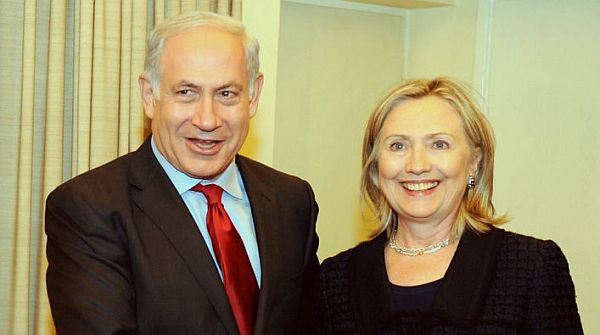
I guess Hillary Clinton already has her hands full overseeing the State Department’s UN credit card number theft operations along with coordinating cyber attacks on WikiLeaks — the Middle East peace process would just have to go on the back burner. There will be a statement tomorrow.
I wonder whether Israel still gets a free squadron of F-35 striker jets, for… well, just for being Israel. On the other hand, the US could consider offering firefighting equipment instead of fighter jets.
The decision to throw in the towel on getting a paltry three-month extension of the settlement slowdown is not “a retreat,” the Washington Institute for Near East Policy’s David Makovsky tells Politico. That’s true. You can only retreat if you first advance.
The United States has decided to abandon an effort to persuade Israel to issue a new temporary West Bank settlement moratorium in order for direct Israeli-Palestinian peace talks to resume, U.S. officials said Tuesday.
“After consulting with the parties, we have determined that a moratorium extension will not at this time provide the best basis for resuming negotiations,” a U.S. official said on the condition of anonymity Tuesday.
“We are still going to continue our engagement with both sides on the core issues and we continue to work towards the goal of a framework agreement,” the official said.
“We hope, obviously, to get the parties to direct talks, but in the meantime, we will continue our engagement with both sides,” the official said, declining to use the word “proximity” in reference to the talks. “We are not changing course. We are still very much committed” to getting a framework agreement.
Secretary of State Hillary Clinton is due to make a statement Wednesday on the Middle East peace process. On Friday, Clinton will speak to the Saban forum, which will also be addressed by Palestinian Nation Prime Minister Salam Fayyad and Israeli Defense Minister Ehud Barak.
There will be “no dramatic change” in policy that Clinton announces, a second U.S. official said Tuesday on condition of anonymity.
State Department spokesman PJ Crowley insists: “The process has not stopped. We obviously recognize that, we face a difficult obstacle, and we will continue to engage the parties on the way forward.”
Meanwhile, Brazil and Argentina are showing another way forward which does not depend on the ineffectual Obama administration: recognizing the state of Palestine.
Saudi Arabia’s Prince Turki al-Faisal demanded on Sunday that WikiLeaks be “vigorously punished” and said that it was incumbent on the US “to not just be extra vigilant but to try to restore the credibility and the legitimacy of their engagement with the rest of us, and ensure that there are no more leaks to be faced in the future,” Reuters reported.
At Saudi Arabia’s urging, Morocco broke ties with Iran and began a domestic campaign against Moroccan Shiites in exchange for economic trade-offs, an Egyptian diplomat told sources at the U.S. Embassy in Rabat, according to a leaked U.S. diplomatic cable published by the Lebanese newspaper Al Akhbar.
“[The diplomat] said goading Iran, a country with which it had limited economic interests, and demonizing the Shi’a, a powerless minority group, was a small price for Morocco to pay for a strategy that could have major payoffs,” the April 2009 cable read.
In exchange for active Moroccan support, Saudi Arabia allegedly promised to ensure the flow of subsidized oil and compensate for the loss in direct foreign investment in Morocco resulting from the global financial crisis.
The diplomat, whose name had been redacted from the cable, also said that the domestic campaign against Shiites was intended to neutralize opposition groups in the municipal elections and reassert King Mohammed VI’s authority as a religious leader.
Morocco broke ties with Iran in March 2009, accusing Tehran of using its embassy in Rabat as a base for spreading Shiite Islam. The formal break in relations was followed by a crackdown on Morocco’s tiny Shiite minority, which resulted in the closure of religious schools and the arrest of hundreds of people.
“WikiLeaks cables portray Saudi Arabia as a cash machine for terrorists,” declares The Guardian, reporting on the US State Department’s concerns about the Kingdom’s role in funding al Qaeda and other militant organizations.
Reporters Eric Lichtblau and Eric Schmitt wait until paragraph nineteen of their report to declare: “Saudi Arabia, a critical military and diplomatic ally, emerges in the cables as the most vexing of problems.” Paragraph nineteen! Why wasn’t that in the first paragraph? Just because President Obama has demonstrated his willingness to bow to King Abdullah, does the Times feel obliged to assume the same posture?
Saudi Arabia is the world’s largest source of funds for Islamist militant groups such as the Afghan Taliban and Lashkar-e-Taiba – but the Saudi government is reluctant to stem the flow of money, according to Hillary Clinton.
“More needs to be done since Saudi Arabia remains a critical financial support base for al-Qaida, the Taliban, LeT and other terrorist groups,” says a secret December 2009 paper signed by the US secretary of state. Her memo urged US diplomats to redouble their efforts to stop Gulf money reaching extremists in Pakistan and Afghanistan.
“Donors in Saudi Arabia constitute the most significant source of funding to Sunni terrorist groups worldwide,” she said.
Three other Arab countries are listed as sources of militant money: Qatar, Kuwait and the United Arab Emirates.
The cables highlight an often ignored factor in the Pakistani and Afghan conflicts: that the violence is partly bankrolled by rich, conservative donors across the Arabian Sea whose governments do little to stop them.
The problem is particularly acute in Saudi Arabia, where militants soliciting funds slip into the country disguised as holy pilgrims, set up front companies to launder funds and receive money from government-sanctioned charities.
The counterpart of asymmetric warfare is asymmetric fear — a form of mass hysteria in which smaller and smaller threats provoke more and more extreme reactions.
The arc that connects Osama bin Laden to Julian Assange describes the pathology of these times: fear has become our only compass.
When the United States Secretary of State describes the release of reams of somewhat embarrassing but generally informative cables as “an attack on the international community,” and while opinion makers call for Assange’s arrest, assassination or execution, we shouldn’t be asking how much harm WikiLeaks can do, but whether the political establishment in America is becoming unhinged.
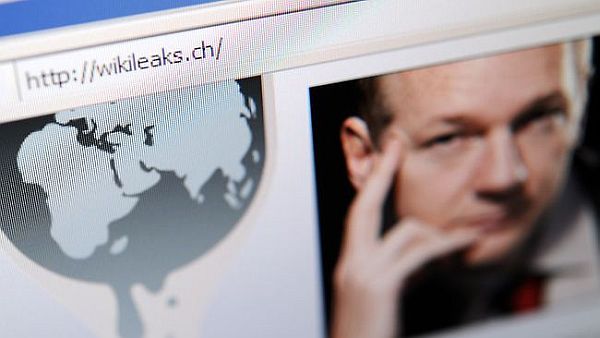
Julian Assange and Pfc Bradley Manning have done a huge public service by making hundreds of thousands of classified U.S. government documents available on Wikileaks — and, predictably, no one is grateful. Manning, a former army intelligence analyst in Iraq, faces up to 52 years in prison. He is currently being held in solitary confinement at a military base in Quantico, Virginia, where he is not allowed to see his parents or other outside visitors.
Assange, the organizing brain of Wikileaks, enjoys a higher degree of freedom living as a hunted man in England under the close surveillance of domestic and foreign intelligence agencies — but probably not for long. Not since President Richard Nixon directed his minions to go after Pentagon Papers leaker Daniel Ellsberg and New York Times reporter Neil Sheehan – “a vicious antiwar type,” an enraged Nixon called him on the Watergate tapes — has a working journalist and his source been subjected to the kind of official intimidation and threats that have been directed at Assange and Manning by high-ranking members of the Obama Administration.
Published reports suggest that a joint Justice Department-Pentagon team of investigators is exploring the possibility of charging Assange under the Espionage Act, which could lead to decades in jail. “This is not saber-rattling,” said Attorney General Eric Holder, commenting on the possibility that Assange will be prosecuted by the government. Secretary of State Hillary Clinton called the Wikileaks disclosures “an attack on the international community” that endangered innocent people. White House Press Secretary Robert Gibbs suggested in somewhat Orwellian fashion that “such disclosures put at risk our diplomats, intelligence professionals, and people around the world who come to the United States for assistance in promoting democracy and open government.”
For the past several months, Assange has widely believed to have been in hiding somewhere in the United Kingdom. The public perception has been one of a man hunt.
But according to his U.K.-based lawyer, Mark Stephens, Scotland Yard has actually had precise knowledge of Assange’s whereabouts since he arrived in this country in October. Indeed, Stephens maintains, they even have a phone number should they wish to reach him.
“I feel like I am sitting in the middle of a surreal Swedish fairytale,” Stephens said. “The trolls keep threatening to come on and keep making noises off stage. But at the moment, no appearance from them.”
Apparently, the delay in Assange’s apprehension stems from the fact that the original warrant listed the maximum penalty only for the most serious charge (in this case, rape), rather than for all of the charges (which include sexual molestation and unlawful coercion). Assuming the new warrant fulfills the letter of the law, Soca will then be legally obliged to authorize the police to arrest Julian Assange.
Baruch Weiss, a former federal prosecutor who served in the Treasury and Homeland Security departments, asks:
What law did Assange violate? It will surprise many that there is no statute making it illegal to reveal classified information. There are statutes that criminalize the disclosure of very specific types of classified information, such as the identity of a covert operative (think Valerie Plame) or “codes, ciphers or cryptographic systems.” But there is no catch-all law that simply says, “Thou shalt not disclose classified information.”
Indeed, when Congress tried to enact such a statute, President Bill Clinton sensibly vetoed it. His reason: The government suffers from such an overclassification problem – some intelligence agencies classify even newspaper articles – that a law of this sort would end up criminalizing the disclosure of innocuous information. And even that vetoed statute would have applied only to government officials, not to private individuals or journalists.
Instead, prosecutors in the Assange case, like the prosecutors in the AIPAC case I handled, would resort to the Espionage Act of 1917, an archaic, World War I-era statute that prohibits “willfully” disclosing “information relating to the national defense.” According to Judge T.S. Ellis in the AIPAC case, this means that the prosecution must prove, among other things, that a defendant knew that the information he was disclosing was potentially damaging to national security and that he was violating the law.
Here, Assange can make the department’s case especially difficult. Well before publishing the cables, he wrote a letter to the U.S. government, delivered to our ambassador in London, inviting suggestions for redactions. The State Department refused. Assange then wrote another letter to State, reiterating that “WikiLeaks has absolutely no desire to put individual persons at significant risk of harm, nor do we wish to harm the national security of the United States.”
In that second letter, Assange stated that the department’s refusal to discuss redactions “leads me to conclude that the supposed risks are entirely fanciful.” He then indicated that WikiLeaks was undertaking redactions on its own.
In an interview with the BBC, Bill Keller, executive editor of the New York Times, said that his paper presented to the Obama administration all the cables they planned on publishing and sought and received advice on making redactions and on national security issues. The fact that the administration was willing to enter into discussions with the Times but not Wikileaks, suggests that the administration has less concern about security risks than it does with sustaining the incestuous relationship it enjoys with its favorite newspaper.
A press release just issued by Wikileaks says the Julian Assange Defense Fund has been frozen.
The Swiss Bank Post Finance today issues a press release stating that it had frozen Julian Assange’s defense fund and personal assets (31K EUR) after reviewing him as a “high profile” individual.
The technicality used to seize the defense fund was that Mr. Assange, as a homeless refugee attempting to gain residency in Switzerland, had used his lawyers address in Geneva for the bank’s correspondence.
Late last week, the internet payment giant PayPal, froze 60Keur of donations to the German charity the Wau Holland Foundation, which were targeted to promote the sharing of knowledge via WikiLeaks.
WikiLeaks and Julian have lost 100Keur in assets this week.
One of the most fascinating aspects of the Cablegate exposure is how it is throwing into relief the power dynamics between supposedly independent states like Switzerland, Sweden and Australia.
WikiLeaks also has public bank accounts in Iceland (preferred) and Germany.
Please help cover our expenditures while we fight to get our assets back.
True believers in secrecy know that its most staunch defenders are secrecy’s worst enemies. They know that the inevitable consequence of the rampant proliferation of a secrecy culture, will be to feed doubt that secrecy itself has any legitimacy. The assumption will take hold that secrecy’s one and only function is the protection of power.
Secrecy is maintained by constructing barriers between those who can know and those who can’t. The powers of a Security State have less to do with protecting secrets than with controlling the barriers of secrecy and determining who can be allowed in and who must be kept out. In other words, secrecy ends up having more to do with maintaining inequities in the distribution of power than in protecting the public interest.
In the multitude of ways that the Obama administration has mishandled the WikiLeaks drama, none is worse than the signal it has just sent out to a generation of young Americans: if you have an inquiring mind, don’t bother applying for a job with the US government. If however you are happy to blindly follow orders and have a slavish admiration for institutional authority — who knows, maybe one day you could become president.
The Office of Management and Budget today directed all federal agencies to bar unauthorized employees from accessing the Wikileaks web site and its leaked diplomatic cables.
In an email to federal agencies obtained by TPM, the OMB’s general counsel directed the agencies to immediately tell their employees to “safeguard classified information” by not accessing Wikileaks over the Internet.
Classified information, the OMB notes, “remains classified … until it is declassified by an appropriate U.S. Government authority.” Employees may not view classified info over a non-classified system (i.e., the Internet), the OMB says, “as doing so risks that material still classified will be placed onto non-classified systems.”
Reading a classified document appearing in the New York Times presents the risk that the designation of its secrecy will lose effect in the minds of those who are required to maintain a reverential respect for rubber stamps.
Meanwhile, the State Department, apparently hoping it might be able to lobotomize a few young minds in preparation for government service, sent out some friendly advice:
Students of Columbia University’s School of International and Public Affairs were warned this week not to spread the Wikileak cables online if they ever wanted a job at the State Department.
The warning came through the office of career services, from an unnamed alumnus who now works at State and wanted to pass along the message.
“The documents released during the past few months through Wikileaks are still considered classified documents. He recommends that you DO NOT post links to these documents nor make comments on social media sites such as Facebook or through Twitter,” reads the email, sent by the office of career services. Engaging in these activities would call into question your ability to deal with confidential information, which is part of most positions with the federal government.”
Oh the irony, that any of us could have been so naive as to imagine that the Bush era might be followed by a more enlightened administration. Instead, a cast of colorful characters who were easy to demonize has been replaced by something worse: technocratic zombies who have normalized and solidified the power grabs initiated by their Machiavellian predecessors.
And this is what it has come to under Obama’s leadership: that the surest way of predicting how this administration will act, is simply to ask: what would be the most cowardly course of action? For that is the direction in which we can be sure it will proceed.
If this failing was merely that of a particular president or political party, America might not be in such bad shape, but the test came on 9/11 and America has been failing ever since.
Danger always poses a challenge. Will fear scream so loudly that nothing else can be heard?
“Courage is the ability to follow your principles even when you’re scared to death,” said Lt Cmdr Charles Swift after successfully challenging the Bush administration before the Supreme Court in Hamdan v. Rumsfeld.
Swift appears in Secrecy — a documentary no less relevant now than when it came out in 2008. (If you’re a Netflix subscriber you can “watch instantly.”)
Last year (before WikiLeaks had acquired such prominence), the film’s directors Peter Galison and Robb Moss joined professors Jack Goldsmith (author of The Terror Presidency and former Assistant Attorney General in the Bush administration) and Martha Minow from Harvard Law School, for a discussion on the documentary, moderated by Jonathan Zittrain from Harvard’s Berkman Center for Internet & Society.
Ever since 9/11, protecting America has been the name of the political game, yet there has been no consensus about what constitutes that which is under threat and in need of protection. Global hegemony? Rampant consumerism?
What has gradually become clear is that it is American democracy itself which faces the greatest challenge and if the issue of secrecy is to be addressed in a way that supports rather than undermines democracy, it will be approached using the same principles that shape the whole operation of government, with checks and balances, for these are the principles which if not applied will fall into disrepair, leaving an America armed to protect everything while no longer standing for anything.
Rep. Ron Paul (R-Texas) is taking a stand as one of Julian Assange’s few defenders in Washington, arguing that the WikiLeaks founder should get the same protections as the media.
Attorney General Eric Holder said this week that the Justice Department is examining whether Assange can be charged with a crime for posting hundreds of thousands of leaked government intelligence documents and diplomatic cables.
Many Republicans have gone even further in their attacks on Assange, especially former Arkansas GOP Gov. Mike Huckabee, who said this week that the source who leaked to the WikiLeaks founder should be tried for treason and executed if found guilty.
But in a Thursday interview with Fox Business, Paul said the idea of prosecuting Assange crosses the line.
“In a free society we’re supposed to know the truth,” Paul said. “In a society where truth becomes treason, then we’re in big trouble. And now, people who are revealing the truth are getting into trouble for it.”
Nigeria will file charges against former U.S. Vice President Dick Cheney and officials from five foreign companies including Halliburton Co. over a $180 million bribery scandal, a prosecutor at the anti-graft agency said.
Indictments will be lodged in a Nigerian court “in the next three days,” Godwin Obla, prosecuting counsel at the Economic and Financial Crimes Commission, said in an interview today at his office in Abuja, the capital. An arrest warrant for Cheney “will be issued and transmitted through Interpol,” the world’s biggest international police organization, he said.
Peter Long, Cheney’s spokesman, said he couldn’t immediately comment when contacted today and said he would respond later to an e-mailed request for comment.
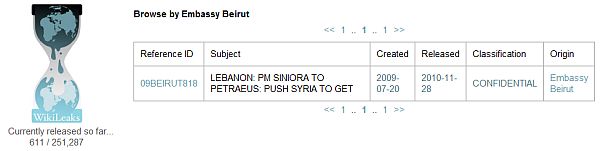
Is WikiLeaks diversifying its cable supply line? As of 8.00PM US Eastern, the WikiLeaks Cablegate site lists just one cable originating from the US Embassy in Beirut.
The Lebanese newspaper Al Akhbar however, has published two other cables from Beirut, here and here. This might imply that WikiLeaks has picked out a handful of cables that it is going to feed to news outlets other than The Guardian, El País, Le Monde, and Der Spiegel.
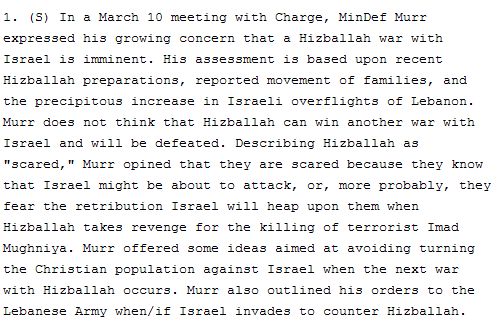
The summary below comes from a March 2008 secret cable and describes a meeting with Elias Murr, then Lebanon’s defense minister and now also deputy prime minister:
Lebanon's Defense Minister Elias Murr told the US the Lebanese army would remain in their bases if Israel launched an assault on Hezbollah
In the cable mentioned, the Lebanese Minister of Defense Elias al-Murr discusses with U.S. Embassy officials his preparations for an impending war with Israel, which involved sequestering the Lebanese Army in its bases until Hizbullah is destroyed…
What makes this leak especially damning is the fact that al-Murr specifically mentions his meeting with General Michel Sleiman (who, in March 2008, was still the commander of the Lebanese Army, and not yet the President of Lebanon) and talks about sharing his plans with him. Today, al-Murr is considered to be one of the President’s key ministers, so it’s quite possible that the toxic nature of this scandal will spread beyond the Ministry of Defense all the way to the Presidential Palace.
There has been a lot of noise over the past few weeks from March 8 circles to the effect that President Sleiman is no longer considered a “consensual” president (because of his support for Hariri’s bid to table the false witness file until after the STL indictment is released). The Wikileaks scandal is going to provide the perfect excuse for Hizbullah and Aoun to go on the offensive again against the STL and the March 14 camp. I would not be surprised if Sleiman demands al-Murr’s resignation, just to save his own position.
As for whether Hezbollah or anyone else in Lebanon would actually find these machinations surprising, one of Qifa Nabki‘s commenters, “Shai,” is probably right on target when saying:
Seems to me Hezbollah is perfectly happy when the Lebanese Army stays out of the game. What better than to be deemed the sole “defender of Lebanon”? Who could ask such a defender to put down their arms, when the so-called “official army” stays indoors to watch the war on TV?
Gary Anderson, a retired US Marine colonel, says that Julian Assange is an enemy combatant and is “as much an enemy to the United States as any Al Qaeda operative.”
Not long ago an Esquire headline writer posed the question: “Should we execute Julian Assange?” “We” being the national American vigilante?
“Lives are at risk” is one of those fire-alarm imperatives that drains blood from the brain. It sets arms and legs and vocal chords in motion, fixes the mind on red-light conclusions and turns quiet deliberation into an unaffordable luxury.
A few years ago in Reader’s Digest, Michael Crowley rang the same alarm bell when he demanded that life-threatening websites like Cryptome (a sibbling of WikiLeaks) be shutdown.
To understand what nuts and zealots can do with this sort of information [available through sites like Cryptome], recall what happened in the early 1990s when three abortion doctors were killed after pro-life extremists created “wanted” posters displaying the physicians’ names and photographs. A few years later, a website showed pictures of other abortion doctors, and listed the murdered ones with their names crossed out. Eventually the site’s Web server shut it down.
Having been an outlet for State Department and CIA propaganda in the 1940s and 50s, Reader’s Digest was already on shaky ground positioning itself as a champion of public interest, but it was the Department of Justice which revealed that on occasions Reader’s Digest itself had been a source of dangerous information.
Stories of crimes contained in popular literature and magazines also constitute a rich source of bombmaking information. For example, the August 1993 edition of Reader’s Digest contains an account of efforts by law enforcement officers to track down the killer of United States Court of Appeals Judge Robert S. Vance and attorney Robert Robinson. That article contained a detailed description of the explosive devices used by the bomber in committing the murders, including such information as the size of the pipe bombs, how the bombs were constructed, and what type of smokeless powder was used in their construction. According to the Arson and Explosives Division of the Bureau of Alcohol, Tobacco and Firearms, in a bombing case originating in Topeka, Kansas, the devices were patterned after the bomb used to kill Judge Vance. Upon questioning, the suspect admitted to investigators that he constructed the bomb based on information contained in the Reader’s Digest article.
As Daniel Ellsberg notes, in its efforts to clamp down on embarrassing leaks, the government’s first recourse is invariably to declare that “lives are at stake”
That’s a script that they roll out — every administration rolls out — every time there’s a leak of any sort. The best justification they can find for secrecy is that lives are at stake. Actually lives are at stake as a result of silence and lies which a lot of these leaks reveal.
In the latest revelations from WikiLeaks, the dangers of secrecy are no more clearly evident than in what we now learn about the vulnerability of Pakistan’s nuclear stockpiles — an issue we have previously been repeatedly assured poses no immediate risk. Secretly, we now learn, America’s leading diplomats in Pakistan did not share the confidence that the administration wanted to instill among Americans whose ignorance it preferred to guard.
Less than a month after President Obama testily assured reporters in 2009 that Pakistan’s nuclear materials “will remain out of militant hands,” his ambassador here sent a secret message to Washington suggesting that she remained deeply worried.
The ambassador’s concern was a stockpile of highly enriched uranium, sitting for years near an aging research nuclear reactor in Pakistan. There was enough to build several “dirty bombs” or, in skilled hands, possibly enough for an actual nuclear bomb.
In the cable, dated May 27, 2009, the ambassador, Anne W. Patterson, reported that the Pakistani government was yet again dragging its feet on an agreement reached two years earlier to have the United States remove the material.
She wrote to senior American officials that the Pakistani government had concluded that “the ‘sensational’ international and local media coverage of Pakistan’s nuclear weapons made it impossible to proceed at this time.” A senior Pakistani official, she said, warned that if word leaked out that Americans were helping remove the fuel, the local press would certainly “portray it as the United States taking Pakistan’s nuclear weapons.”
The fuel is still there.
It may be the most unnerving evidence of the complex relationship — sometimes cooperative, often confrontational, always wary — between America and Pakistan nearly 10 years into the American-led war in Afghanistan. The cables, obtained by WikiLeaks and made available to a number of news organizations, make it clear that underneath public reassurances lie deep clashes over strategic goals on issues like Pakistan’s support for the Afghan Taliban and tolerance of Al Qaeda, and Washington’s warmer relations with India, Pakistan’s archenemy.
The issue here, however, is more complex than transparency vs secrecy. While the dangers posed by nuclear stockpiles in Pakistan — and for that matter anywhere else — should concern everyone, the overbearing relationship between the US and a client state which it has turned into a theater for remote war, has fed popular and well-founded suspicion about the intentions of the US government. Pakistanis widely believe that the United States is intent on stealing the Islamic republic’s nuclear crown jewels. Those suspicions will now be further compounded as Pakistan’s government struggles to placate competing international and domestic fears.
If transparency is the buzzword of this political moment, maybe it should be seen as a signal that a larger issue is in desperate need of remedying — an issue that WikiLeaks cannot address: that the need for transparency is symptomatic of a global deficit in trust.
We have repeatedly been given reason to expect that government leaders, corporations and other powerful institutions cannot be trusted. WikiLeaks now fuels that mistrust and those who feel threatened can either shrink behind the barricades of secrecy or acknowledge that they must address the monumental task of building confidence in the fragile idea of public service.
In The Independent yesterday, Yossi Melman made an intriguing statement. Melman is the intelligence and military affairs correspondent for Haaretz and generally regarded as well informed on the operations of Mossad. He wrote:
Three events – not seemingly related – took place yesterday. The leaking of State Department documents, many of which deal with the world’s concerns about Iran’s nuclear programme; the mysterious assassination in Tehran of a top Iranian nuclear scientist and the wounding of another, and the appointment of Tamir Pardo as the new head of Mossad, Israel’s foreign espionage agency.
But there’s a link between them. They are part of the endless efforts by the Israeli intelligence community, together with its Western counterparts including Britain’s MI6 and America’s CIA, to sabotage, delay and if possible, to stop Iran from reaching its goal of having its first nuclear bomb.
In the rest of his article he focused on the assassins in Tehran and says that it is “obvious” that “Israel was behind it.” He does not amplify on this part of his opening assertion, namely, that the leaking of State Department cables is part of the effort to stop Iran developing nuclear weapons. However you read it, he seems to be suggesting that WikiLeaks is in some way part of the effort.
Interestingly, a request for a debate on WikiLeaks in the Israeli parliament has been rejected.
The Knesset will not hold a debate on WikiLeaks, despite a request by a number of parliamentarians for a session on leaked U.S. cables that has rocked the diplomatic world.
The Knesset Presidium, the body which regulates plenary debates in Israel’s parliament, turned down a request from a number of members for a session on the consequences of the leaks for national security.
Among the WikiLeaks disclosures were an Israeli plan to coordinate its 2008 invasion of Gaza with Palestinian President Mahmoud Abbas and details of Israel’s covert ties with governments in the United Arab Emirates.
This is not a conspiracy theory. To say that terrorism is a fabrication of a national security state is to say that when the label “terrorist” starts being indiscriminately applied to anyone who threatens the government we have taken another step towards totalitarianism.
Rep. Peter King, R-N.Y., the incoming chairman of the House Committee on Homeland Security, is calling for WikiLeaks to be designated a terrorist organization.
As Republicans come into power, they’re going to explore what can be done. They can’t do much. But let’s be honest. The quest to find some way to define Assange’s group as terrorists is not about fighting terrorism. It’s about indulging the fantasy, well put by Cornell law professor William Jacobson, of Assange being hunted down like a Robert Ludlum villain and possibly “killed while resisting arrest.”
And all of this assumes there’s something talismanic about declaring someone a “terrorist.” In reality, American agents could capture any boogeyman they wanted and prosecute him in the United States. The 1992 decision in U.S. v. Alvarez-Machain affirmed that the government was within its rights when a Mexican citizen was abducted and brought to the U.S. to be tried for the murder of a Drug Enforcement Administration agent. “We have kidnapped people to bring them to justice,” explains David Cole, a law professor at Georgetown. “Whether it applies in this case, I don’t know.”
It probably doesn’t. What’s being lost in the James Bond scenarios about taking down WikiLeaks is that its current, highly embarrassing leaks don’t actually threaten American intelligence assets. They create problems for diplomats, and by extension they embarrass the United States. They cause the State Department to lose face. That’s not terrorism as we define it.
So how does King or anyone else turn Julian Assange into a terrorist? They either have to define terrorism in some real way that would eventually open up media organizations to terror charges of their own, or WikiLeaks actually has to do something materially to benefit terrorists. Neither scenario seems likely. What is likely: None of this gets past the shouting stage.
Weigel’s analysis may be sound in the short term but the broader question is not legal. It is whether in American popular discourse the term “terrorist” continues to acquire legitimacy in broader and broader applications or whether those who criticize the term’s flagrant abuse are able to shout louder and get more widely heard. So far the terrorists are winning.
I didn’t come up with the headline — it’s from Israel’s pro-settler Arutz Sheva news network. And as their report makes clear, this favorable review of what has been described as a diplomatic 9/11, reflects the views of the Israeli government.
Just as Benjamin Netanyahu on September 11, 2001, said the attacks were a “good thing” for US-Israeli relations and then again in 2008 told an Israeli audience, “We are benefiting from one thing, and that is the attack on the Twin Towers and Pentagon,” it’s likewise reasonable to assume that he is similarly pleased with the repercussions of “Cablegate.” If for the past few days the diplomatic world has been thrown into disarray, the one country that so far remains unscathed is Israel.
WikiLeaks, on the other hand, having placed itself at the vanguard of a movement demanding transparency in global affairs, has so far failed to live up to the standard it is setting for others. They don’t need to jeopardize the security of their own operations, but they do need to explain the inner workings of the editorial process through which by releasing some cables and withholding others they are now feeding a narrative to the global media.
I’ll leave it others to construct elaborate theories on how WikiLeaks could be seen as a Mossad or CIA operation, but whether or not either or both intelligence organizations have played a role in shaping this story, one of its central features echoes the history of Israel and its use of a strategy of “divide-and-survive” across the Middle East.
In The American Interest earlier this year, Benjamin E Schwartz described this policy:
When American diplomats talk about the road to peace, few Israelis dare articulate one awkward truth. The truth is that Israelis have managed their conflict with the Arabs and the Palestinians for half a century not by working to unite them all, but either by deliberately and effectively dividing them, or by playing off existing divisions. By approaching matters in this way, Israelis have achieved de facto peace during various periods of their country’s history—and even two examples of de jure peace. It is because of divisions among Palestinians that Israelis survived and thrived strategically in 1947–48, and because of divisions among the Arab states that Israel won its 1948–49 war for independence. Divisions among the Arabs and divided competition for influence over the Palestinians allowed Israelis to build a strong state between 1949 and 1967 without having to contend with a serious threat of pan-Arab attack. It was because of divisions and the strength of Egypt amid those divisions that Anwar Sadat decided to make a separate peace in 1979. It was because of another set of divisions that King Hussein was able to do the same in 1994.
The results of Israeli statecraft did not produce an American-style comprehensive peace, and it did not produce peace with the Palestinians. It may not even have produced a lasting peace with Egypt and Jordan—time will tell. But it did produce peace in its most basic and tangible form: an absence of violence and the establishment of relative security. This is what peace means for the vast majority of Israelis, most of whom do not believe that their Arab neighbors will ever accept, let alone respect as legitimate, a Jewish state in geographical Palestine. And the way Israelis have achieved this peace is, in essence, through a policy of divide and survive.
Now, thanks to WikiLeaks, we see the Saudi king insulting the president of Pakistan, Egypt insulting Iran, America’s fear of Turkey — suspicions, fear and hostility pushed from the background into the foreground with no consequence more predictable than that these expressions of candor will be divisive and further erode the political authority of every player, except for one: Israel.
Meanwhile, if Israeli officials are discreet enough not to openly celebrate the divisions exposed by WikiLeaks, they have no hesitation in trumpeting their sense of vindication arising from the public display of hostility towards Iran expressed by so many of the region’s autocratic leaders.
With only 220 out of 251,287 cables released so far, who knows what surprises lie ahead, but it seems striking and noteworthy that Israel has managed to be the subject of so little attention. Considering the tensions between the Obama administration and the Netanyahu government that have been so widely reported, it’s strange that in the first collection of cables we would see little or no evidence of this discord. At the same time there is an abundance of ammunition provided to those who want to push for war against Iran.
At face value, Wikileaks if not serving can at least be said to have been very obliging in advancing Israel’s agenda — and giving the neocons cause for celebration.
Meanwhile, as the media’s attention is riveted by Wikileaks, assassins — presumably operating under the direction of Mossad — have been active on the streets of Tehran, murdering one nuclear scientist and injuring another.
Assassins on motorbikes have killed an Iranian nuclear scientist and wounded another in identical attacks this morning. They drove up to the scientists’ cars as they were leaving for work and attached a bomb to each vehicle which detonated seconds later.
The man who was killed was Majid Shahriari, a member of the engineering faculty at the Shahid Beheshti in Tehran. His wife was wounded. The second attack wounded Fereidoun Abbasi, who is also a professor at Shahid Besheshti University, and his wife.
They are senior figures in Iranian nuclear science. Abbasi was a member of the Islamic Revolutionary Guards, or Pasdaran, and once taught at the Pasdaran-run Imam Hossein University. He was hailed by Mahmoud Ahmadinejad three years ago as Iran’s academic of the year.
“Israel is not the center of international attention,” Prime Minister Benjamin Netanyahu asserted shortly before the Wikileaks released a cache of 250,000 American diplomatic cables.
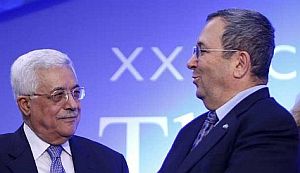
If he was confident that that was the case, why would Bibi draw attention to the fact? Perhaps because he knew that some of the leaks would serve his interests in multiple ways, not the least of which being that they further damage the credibility Mahmoud Abbas as top political representative of the Palestinian people. In other words, they would help reinforce Abbas’ position as a leader possessing enough authority to negotiate but not enough to make a deal.
It has long been claimed that Abbas supported Israel’s effort to topple Hamas through the war on Gaza. Wikileaks now provides hard evidence that the Palestinian Authority was indeed given advance notice of Operation Cast Lead.
At the end of May, 2009, Israel’s defense minister Ehud Barak met a Congressional delegation from the House Committee on Foreign Affairs led by Congressman Ackerman. In that meeting, Barak “explained that the GOI [Government of Israel] had consulted with Egypt and Fatah prior to Operation Cast Lead, asking if they were willing to assume control of Gaza once Israel defeated Hamas.” Naturally both parties declined, but the point is that they were then in a position to intercede and try and prevent the war — or, sit back and wait to see whether Israel would succeed in dislodging their common nemesis.
Having colluded with Israel in this way, the Palestinian Authority then put itself in a position to be blackmailed and subsequent reports suggest that this is indeed what happened when Israel later wanted to see the Goldstone Report blocked in the UN.
The Shaliab news agency quoted informed sources in Washington as saying that a meeting between PA representatives and an Israeli delegation took place in Washington last week to persuade the PA to withdraw its support for the Goldstone Report. This report could not be confirmed by TAAN.
The source told Shahab that the PA officials initially rejected the Israeli request, until Israeli officer Eli Ofarham showed up and displayed on his laptop a videotaped file showing Mahmoud Abbas urging Israel war minister Ehud Barak to continue the war on Gaza.
The sources also revealed that the PA official also listened to a recorded telephone conversation between director of the general staff office Dov Weissglas and Abbas’s aide Tayeb Abdelrahim in which the latter called on Israel to invade the refugee camps of Jabaliya and Al-Shati and said that the fall of those camps would end the rule of Hamas.
Weissglas, according to the record, said that this would lead to thousands of casualties among citizens, but Abdelrahim stressed that they all elected Hamas and chose their own destiny.
The comfort Netanyahu is drawing from the Wikileaks revelations goes much further. The Israeli claim that it belongs to a de facto alliance with so-called moderate Arab states with whom it shares an equal fear of a nuclear-armed Iran, is now clearly substantiated.
King Abdullah of Saudi Arabia has repeatedly urged the United States to attack Iran to destroy its nuclear programme, according to leaked US diplomatic cables that describe how other Arab allies have secretly agitated for military action against Tehran.
The revelations, in secret memos from US embassies across the Middle East, expose behind-the-scenes pressures in the scramble to contain the Islamic Republic, which the US, Arab states and Israel suspect is close to acquiring nuclear weapons. Bombing Iranian nuclear facilities has hitherto been viewed as a desperate last resort that could ignite a far wider war.
The Saudi king was recorded as having “frequently exhorted the US to attack Iran to put an end to its nuclear weapons programme”, one cable stated. “He told you [Americans] to cut off the head of the snake,” the Saudi ambassador to Washington, Adel al-Jubeir said, according to a report on Abdullah’s meeting with the US general David Petraeus in April 2008.
Wikileaks has at this point (Sunday evening) released just 220 out of 251,287 leaked cables. They say the remaining cables will be released over the next few months. “The subject matter of these cables is of such importance, and the geographical spread so broad, that to do otherwise would not do this material justice.”
This will no doubt be an effective media strategy that serves to extend the story, but in the name of transparency, Wikileaks should explain how exactly they’ve arrived at their own cherry-picking process. As every news editor knows, picking and choosing what to highlight and when has as much if not more impact in shaping the news than the reporting itself.
If getting all this information into the public domain really serves the greatest interest, why the delay?
The American geopolitical prism is distorted in multiple ways, but none is more consistently evident than the strange idea that the actions of a nation can be understood simply by deciphering the thoughts and intentions of one man — even if we’re not always sure who The Man really is.
Iran — Ahmadinejad or Khamenei? North Korea — Kim Jong-il. Russia — Putin. Turkey — Erdogan. Syria — Bashar al-Assad. Egypt — Hosni Mubarak. Iraq — Saddam. Brazil — Lula. Venezuala — Chavez. Cuba — Castro. North Vietnam — Ho Chi Minh. South Africa — Mandela. Britain — Churchill. Germany — Hitler. Soviet Union — Stalin. China — Mao, Hu or who?
Reduce a nation to a single man and the task of understanding that nation’s cultural and political complexity will often be reduced to a question about how we deal with The Man.
Can he be trusted? Can he be befriended? Can he be bribed? Should he be kept at a distance? Does he need to be contained? Must he be killed?
For a few months in Afghanistan recently, Mullah Akhtar Muhammad Mansour became The Man — a representative of the Taliban offering the US a ticket home. That man turned out to be an impostor, while the word is that the man with one eye and his fellow commanders have no interest in laying down their weapons:
Sayed Amir Muhammad Agha, a onetime Taliban commander who says he has left the Taliban but who acted as a go-between with the movement in the past, said in an interview that he did not know the tale of the impostor.
But he said the Taliban leadership had given no indications of a willingness to enter talks.
“Someone like me could come forward and say, ‘I am a Talib and a powerful person,’ ” he said. “But I can tell you, nothing is going on.”
“Whenever I talk to the Taliban, they never accept peace and they want to keep on fighting,” he said. “They are not tired.”
Where does this obsession with The Man come from? Faith in personal salvation through Jesus Christ? The institution of the regal American presidency? The religion of individualism?
Whatever its origin, it skews America’s relations with the world — a world in which individuals, even those regarded as the authors of history, both shape and mirror the societies, cultures and historical junctures within which they operate. It is that which they mirror, to which we give far too little account.
American officials and journalists visiting the West Bank, if they are eager to boost the credibility of its unelected political leaders, like to speak about the professionalism of the Palestinian Authority’s security services. For instance, an aide to Hillary Clinton was recently quoted by Roger Cohen, saying:
[A]s we approached Ramallah there were these troops in berets. They were so professional, we thought at first they were Israel Defense Forces. But, no, they were Palestinians, this completely professional outfit, and it was clear this was something new.
What could be more inspiring — to a visitor from Washington — than Palestinians who looked like Israelis?
The Financial Times presents a much grimmer picture in which local human rights groups warn that a brutal regime is emerging with the authoritarianism of a police state. (As a report by David Rose almost two years ago makes clear, the trend is not new — but it is getting worse.)
Naiema Abu Ayyash’s worst fears were confirmed this month when she finally managed to visit her husband in Jericho prison.
Badr Abu Ayyash, 42, a farmer and local politician in the west Bank, was arrested by the Palestinian Authority’s Preventive Security unit on September 14. Aside from two brief and apparently supervised phone calls, his family was denied all contact with him.
“He looked very different,” said Ms Abu Ayyash, a mother of four. “He could hardly walk. He had difficulty breathing and was very thin. When he shook my hand, I noticed that he had no strength at all.”
She has no doubt her husband was tortured. “I started screaming at the officer: ‘What are you doing to him?”’ Her pleas fell on deaf ears. After a few cursory exchanges, her husband was led back to his cell.
According to former inmates and activists familiar with Palestinian prisons, Ms Abu Ayyash has every reason to be worried. They say prisoners affiliated with the Islamist Hamas movement, which runs the Gaza Strip, are beaten regularly and deprived of medicine and basic comforts such as blankets and mattresses.
There is evidence that a significant number of detainees are tortured during interrogation. The most common form of abuse is known as Shabeh, in which detainees are handcuffed and bound in stress positions for long periods.
Claims of torture and abuse by members of the Palestinian security forces are not new. There has, however, been a sharp rise in reported cases, leading Human Rights Watch to remark last month that “reports of torture by Palestinian security forces keep rolling in”. The New York-based organisation also bemoaned the “rampant impunity” of officers allegedly involved in the abuses.
Many analysts and observers fear that life in the west Bank is taking on an increasingly authoritarian hue. “I feel real concern that we are reaching the level of a police state,” says Shawan Jabarin, the director of al-Haq, a Ramallah-based human rights group.
It is a concern shared by Randa Siniora, the director of the Palestinian Independent Commission for Human Rights, the ombudsman responsible for processing complaints against Palestinian officials. Her commission received more complaints about torture in the west Bank in October than in any month since mid- 2009. “We are looking at a very gloomy situation,” she said. “I am afraid that this [problem of torture and abuse] will become systematic.”
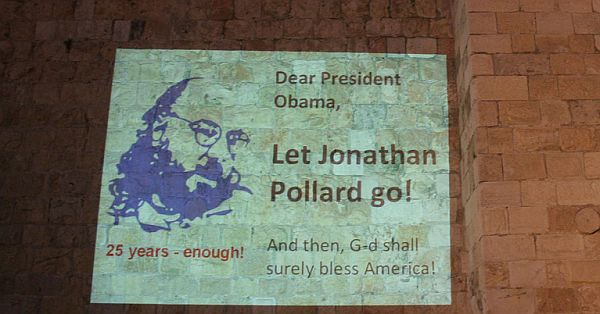
A “relentless” campaign by David Nyer, a Jewish Orthodox activist from Monsey, New York, has succeeded in winning significant support from House Democrats who are now calling on President Obama to release Jonathan Pollard.
Pollard is a former civilian intelligence analyst who was convicted of spying for Israel and through a plea bargain received a life sentence in 1987. He is believed to have caused incalculable damage to US national security.
Nyer’s campaign “struck gold” when he succeeded in winning the support of Rep. Barney Frank. The JTA reported:
Getting Frank was a coup, one congressional insider said, not only because he has a leadership position, but because his pronounced liberalism in other arenas adds credibility to an effort that has been identified in recent years with the Israeli and pro-Israel right.
Frank took up the cause because he long has believed that Pollard’s life sentence was disproportionate to the crime, his spokesman said.
“It is something he feels strongly about,” Harry Gural told JTA.
Launching the initiative at a Capitol Hill news conference Nov. 18, Frank listed two factors that made the matter timely: Pollard’s 25 years in prison as of Sundayand the parlous state of the Israeli-Palestinian peace process.
“The justification of this is the humanitarian one and the notion that the American justice system should be a fair one,” Frank said. “We believe that clemency after 25 years for the offenses of Jonathan Pollard would do that.
“My own hope is that if the president would do this, it would contribute to the political climate within the democracy of Israel and would enhance the peace process.”
Frank alluded to Obama’s low popularity in Israel where, fairly or not, the president has been saddled with a reputation as cool to Israeli interests.
The Jerusalem Post reports that Benjamin Netanyahu has asked the US to add Pollard’s release to the many other generous incentives the Obama administration have offered Israel in the hope of a 90 day, once only, extension to the settlement slowdown.
In “Why Pollard Should Never Be Released (The Traitor),” published in the New Yorker in January 1999, Seymour Hersh wrote:
A full accounting of the materials provided by Pollard to the Israelis has been impossible to obtain: Pollard himself has estimated that the documents would create a stack six feet wide, six feet long, and ten feet high. Rafi Eitan, the Israeli who controlled the operation, and two colleagues of his attached to the Israeli diplomatic delegation — Irit Erb and Joseph Yagur — were named as unindicted co-conspirators by the Justice Department. In the summer of 1984, Eitan brought in Colonel Aviem Sella, an Air Force hero, who led Israel’s dramatic and successful 1981 bombing raid on the Iraqi nuclear reactor at Osirak. (Sella was eventually indicted, in absentia, on three counts of espionage.) Eitan’s decision to order Sella into the case is considered by many Americans to have been a brilliant stroke: the Israeli war hero was met with starry eyes by Pollard, a chronic wannabe.
Yagur, Erb, and Sella were in Washington when Pollard was first seized by the F.B.I., in November, 1985, but they quickly left the country, never to return. During one period, Pollard had been handing over documents to them almost weekly, and they had been forced to rent an apartment in northwest Washington, where they installed a high-speed photocopying machine. “Safe houses and special Xeroxes?” an American career intelligence officer said, despairingly, concerning the Pollard operation. “This was not the first guy they’d recruited.” In the years following Pollard’s arrest and confession, the Israeli government chose not to cooperate fully with the F.B.I. and Justice Department investigation, and only a token number of the Pollard documents have been returned. It was not until last May [1998] that the Israeli government even acknowledged that Pollard had been its operative.
In fact, it is widely believed that Pollard was not the only one in the American government spying for Israel. During his year and a half of spying, his Israeli handlers requested specific documents, which were identified only by top-secret control numbers. After much internal assessment, the government’s intelligence experts concluded that it was “highly unlikely,” in the words of a Justice Department official, that any of the other American spies of the era would have had access to the specific control numbers. “There is only one conclusion,” the expert told me. The Israelis “got the numbers from somebody else in the U.S. government.”
Richard Perle? He was Assistant Secretary of Defense in the Reagan administration at that time and early in his career had been caught by the FBI passing classified information to the Israeli embassy in Washington.
Pollard’s American interrogators eventually concluded that in his year and a half of spying he had provided the Israelis with more than a year’s worth of the daily FOSIF reports from Rota [in Spain, the location of the Navy’s Sixth Fleet Ocean Surveillance Information Facility (FOSIF)]. Pollard himself told the Americans that at one point in 1985 the Israelis had nagged him when he missed several days of work because of illness and had failed to deliver the FOSIF reports for those days. One of his handlers, Joseph Yagur, had complained twice about the missed messages and had asked him to find a way to retrieve them. Pollard told his American interrogators that he had never missed again.
The career intelligence officer who helped to assess the Pollard damage has come to view Pollard as a serial spy, the Ted Bundy of the intelligence world. “Pollard gave them every message for a whole year,” the officer told me recently, referring to the Israelis. “They could analyze it” — the intelligence — “message by message, and correlate it. They could not only piece together our sources and methods but also learn how we think, and how we approach a problem. All of a sudden, there is no mystery. These are the things we can’t change. You got this, and you got us by the balls.” In other words, the Rota reports, when carefully studied, gave the Israelis “a road map on how to circumvent” the various American collection methods and shield an ongoing military operation. The reports provide guidance on “how to keep us asleep, thinking all is working well,” he added. “They tell the Israelis how to raid Tunisia without tipping off American intelligence in advance. That is damage that is persistent and severe.”
As the Transportation Security Administration faces a barrage of criticism, some indignant Americans are calling for the “Israelification” of US airports — as though the security procedures used in a tiny Middle Eastern ethnocracy with one international airport could easily be scaled up for America.
Ironically, Israelification is not what we need — it’s what we already have.
Consider the real outrages of the last decade that, simply because they were done in the name of national security, the majority of Americans found tolerable:
a global war on terrorism that led to massive increases in defense spending, the creation of multiple new intelligence and security agencies, and Washington’s enslavement to fear-based politics — that was OK;
with disregard for international law, the invasion of Iraq on a false pretext — that was OK;
the kidnapping, secret imprisonment and torture of individuals most of whom had nothing to do with 9/11 — that was OK;
the authorization of warrantless wiretaps — that was OK;
the implementation of a remote-controlled assassination program — that was OK;
in short, the normalization of war crimes all of which were deemed justifiable because of 9/11 — that was OK;
but “don’t touch my junk” — there are limits to what Americans will tolerate.
TSA administrators are no doubt frustrated by the fact that had the new pat-down procedures been implemented in late 2001, they would probably have been welcomed by a population that widely supported the idea of doing “whatever it takes” to stop “the terrorists.”
The problem, then and now, is that air transportation security is imagined to be about catching terrorists. On this count, the TSA seems to have a poor record.
In May, the Government Accountability Office released a report noting that SPOT’s [“Screening of Passengers by Observational Techniques”] annual cost is more than $200 million and that as of March 2010 some 3,000 behavior detection officers [BDOs] were deployed at 161 airports but had not apprehended a single terrorist. (Hundreds of illegal aliens and drug smugglers, however, were arrested due to the program between 2004 and 2008.) What’s more, the GAO noted that at least 16 individuals later accused of involvement in terrorist plots flew 23 different times through U.S. airports since 2004, but TSA behavior-detection officers didn’t sniff out any of them.
Does this imply that the TSA’s BDOs have yet to pinpoint the way a terrorist walks, talks, or dresses? The TSA’s “failure” in this instance might simply mean that the individuals who escaped their attention were not at those times actually doing anything suspicious.
The point is, there are justifiable and unjustifiable grounds to turn a person into an object of suspicion. A system that simply on the basis of religion, ethnicity or nationality, regards a person with suspicion, is unjust and will be ineffective. Indeed, a system which even regards its targets as “the terrorists” conjures up the false notion that it is dealing with a class of people rather than a class of behavior.
Which brings me back to my initial claim that the Israelification of America is already deeply entrenched. Israel’s fear of the Arab world has been transplanted into American consciousness to such a degree that we are moving toward the absurd conclusion that if this country operated even more like Israel than it already does, then we would be able to feel as safe as the Israelis do.
Living inside a fortress and defining ones existence in terms of threats posed by eternal enemies, is a good way of justifying spending more and more on increasingly elaborate fortifications. But those who invest deeply in this mindset and who profit from its perpetuation, have the least interest in exploring what we need to understand most: why our enemies think the way they do. Delve into that question, and the notion of eternal enmity quickly evaporates — thus the perpetuation of the myth that we are under threat not because of what we do but because of who we are.
Meanwhile, next time a TSA officer offends your dignity, spare a thought for the Palestinians who while passing through IDF checkpoints suffer vastly worse when attempting no more than to travel from one town to the next.
This website or its third-party tools use cookies, which are necessary to its functioning. By closing this banner, you agree to the use of cookies.







 If he was confident that that was the case, why would Bibi draw attention to the fact? Perhaps because he knew that some of the leaks would serve his interests in multiple ways, not the least of which being that they further damage the credibility Mahmoud Abbas as top political representative of the Palestinian people. In other words, they would help reinforce Abbas’ position as a leader possessing enough authority to negotiate but not enough to make a deal.