Author Archives: Paul Woodward

What are the guardians of Israeli Jewish racial purity so afraid of?

Sayed Kashua makes fun of the Israelis who are afraid of their daughters being seduced by irresistible Arab men.

You know, until now I was certain that the role of preserving the honor of women and shackling them with male bonds was something you had designated for us Arabs. What has happened that you enlightened types no longer trust in your daughters’ ability to distinguish between good and bad? And why are you treating them like feckless, frivolous types whom Arab men can easily entice and lead astray?

There is nothing to be done: that’s how it’s always been. In the eyes of a racist majority, the inferior minority will always have a gilded phallus. He’s primitive, animal-like, closer to nature – and therefore necessarily more sexual. In your eyes, apparently, women can be beautiful, but will continue to be primitive, led by passion alone, and will be seduced by the animal’s caressing voice to taste the forbidden fruit. Never mind the daughters of Israel, who, according to our demonstrators and the bearers of our racial purity, are waiting in line to fall into the robust arms of Arabs.

What worries me is the Arab daughters, the unfortunate daughters of Palestine who according to the theory we are considering can only make do with the leftovers rejected by the daughters of Israel. In the end, there will be no choice, you know. True, it might be tough in the first years, what with the usual patriarchal restrictions and tribal structure, but gradually these barriers will be shattered on both sides. The sons of Israel who have been abandoned and the Arab daughters left to their own devices will have to cooperate for the sake of the continuity of the human race.

I feel sorry for them, those who will have to compromise on all kinds of unwanted commando fighters, rejected fighter pilots, established high-tech men, not to mention marketing vice presidents, development managers and intelligence personnel who will start to court the daughters of Palestine. It will start with spins around the Arab neighborhoods; then they will go to the movies in Tira, Taibeh and Kalansua; gradually they will take out subscriptions to the opera and the Cinematheque and will insist on shopping exclusively in the Arab malls. In short order they will also want to rent apartments and some will want to shop in the heart of Arab villages.

But we will want to preserve the character of the Arab communities. We will not let anyone reduce the density or improve the education system, and we will view every attempt to built industrial parks or hospitals as a blow to the delicate fabric we have woven for years. Many Arab communities will draw up charters setting forth conditions for Jews who want to live in them, and a major demand will be for every Jewish candidate to be an Arab.

Then our side will produce militants who will claim that the Jewish men are threatening the Arab womb and tainting the sacredness of our virginal women. A sheikhs’ letter will be written, we will demonstrate against young Jewish men who are pestering our girls, and some Jewish journalist who knows Arabic will write a cynical critique about it in one of the more liberal Arab newspapers. Many reader comments will be hurled against him. He will be accused of self-righteousness and unfairness because he is not willing to admit simple, true facts, namely that races must not be mixed, nations must not be mixed and divine laws must not be messed with.


Facebooktwittermail

‘Disappeared’ Pakistanis — innocent and guilty alike — have fallen into a legal black hole

Without a single reference to President Obama’s drone war in Pakistan, extrajudicial detention of prisoners at Guantanamo, the torture of suspected terrorists, CIA-run secret prisons, rendition, presidential authorization to assassinate US citizens, or the United States’ long history of supporting governments that use their power to suppress political dissent by making their opponents “disappear,” the New York Times reports:

The Obama administration is expressing alarm over reports that thousands of political separatists and captured Taliban insurgents have disappeared into the hands of Pakistan’s police and security forces, and that some may have been tortured or killed.

The issue came up in a State Department report to Congress last month that urged Pakistan to address this and other human rights abuses. It threatens to become the latest source of friction in the often tense relationship between the wartime allies.

The concern is over a steady stream of accounts from human rights groups that Pakistan’s security services have rounded up thousands of people over the past decade, mainly in Baluchistan, a vast and restive province far from the fight with the Taliban, and are holding them incommunicado without charges. Some American officials think that the Pakistanis have used the pretext of war to imprison members of the Baluch nationalist opposition that has fought for generations to separate from Pakistan. Some of the so-called disappeared are guerrillas; others are civilians.

“Hundreds of cases are pending in the courts and remain unresolved,” said the Congressionally mandated report that the State Department sent to Capitol Hill on Nov. 23. A Congressional official provided a copy of the eight-page, unclassified document to The New York Times.

Separately, the report also described concerns that the Pakistani military had killed unarmed members of the Taliban, rather than put them on trial.

Two months ago, the United States took the unusual step of refusing to train or equip about a half-dozen Pakistani Army units that are believed to have killed unarmed prisoners and civilians during recent offensives against the Taliban. The most recent State Department report contains some of the administration’s most pointed language about accusations of such so-called extrajudicial killings. “The Pakistani government has made limited progress in advancing human rights and continues to face human rights challenges,” the State Department report concluded. “There continue to be gross violations of human rights by Pakistani security forces.”

Facebooktwittermail

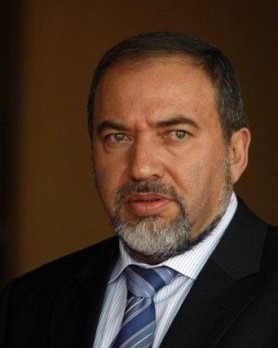
Lieberman represents Israel

In recent months, Israel’s political leaders and Israel’s stateside supporters have been railing against the so-called delegitimization movement. It’s debatable whether such a movement exists but even to the extent that it does, the effect it has had in tarnishing Israel’s image is minuscule in comparison to Israel’s own unintentional delegitimization efforts.
The latest examples came this month in a new campaign to guard Jewish racial purity. A letter signed by the wives and daughters of prominent rabbis, urges Jewish women not to date or even work with Arab men. It was preceded by a letter signed by hundreds of rabbis calling on Jews not to rent apartments to Arabs. The letters are part of a “racist tidal wave” sweeping across Israel, says defense minister, Ehud Barak.

In this context, the American Jewish diaspora is becoming acutely uncomfortable. The more transparent Israeli racism becomes, the harder it is for Americans — Jewish or non-Jewish — to support Israel; the more obvious it is that Israel’s Jewish identity is being defended at the expense of its democratic identity.

Strange then, that the editors of the liberal The Forward, seem to imagine that getting rid of Avigdor Lieberman as foreign minister would significantly help Israel.

In an editorial, the paper says:

Lieberman’s tenure in such a prominent position has been dismissed as an embarrassing annoyance by most Diaspora leaders, a necessary burden to ensure that his Yisrael Beiteinu party remains in Prime Minister Benjamin Netanyahu’s coalition. Besides, the inner workings of Netanyahu’s government are arguably not our right to influence, no more than Israelis should have a say in who is U.S. Attorney General or mayor of New York.

But if Netanyahu persists in keeping Lieberman, both men should know this: The obligation we assume as Diaspora Jews to support Israel and combat delegitimization becomes much harder, more distasteful and less effective every time the foreign minister opens his mouth. It betrays our Judaic and civic values to stand by while such a man advocates for the transfer of Arab citizens of Israel, for a discriminatory loyalty oath, for an endless postponement of peace negotiations that are the only — the only — way to ensure that Israel remains Jewish and democratic.

The Israeli newspaper Haaretz published an editorial December 28 excoriating the foreign minister, arguing that “Lieberman and his pronouncements only provide vindication to Israel’s adversaries.” For that reason, the paper declared, he must go.

And if Lieberman goes, Israel will change?

No doubt its liberal supporters would welcome a more respectable face such as could be provided by a Likud-Kadima coalition (which isn’t in the offing), but Lieberman is no different from Rabbi Meir Kahane who said, in reference to Israel’s Arab-hating population: “I say what they think.”

As more and more Israelis openly declare their unwillingness to live alongside Arabs, what appears to be changing is not that Israel is becoming more racist but that its underlying racism is being expressed more freely.

Kahane said: “I want Democracy for Jews but I don’t want Democracy for Arabs because otherwise there won’t be a Jewish State!” He was dubbed an extremist and an aberration, but the veil is now being lifted.

Who can be so naive as to imagine that an Israel without Lieberman as its foreign minister would become a more tolerant, democratic society? Or are these calls for his departure nothing more than an appeal for cosmetic changes necessary for making the indefensible, defensible?

Kahane had it right: Israel is a “democracy” for Jews, which is to say that it grants rights to Jews that it withholds from others, and as that unpalatable truth becomes increasingly evident to the whole world, the liberal Jewish diaspora will need to abandon the illusion that Israel can be a Jewish and democratic state. It can only be one or the other.

Facebooktwittermail

When Americans stop being killed in Iraq it stops being called a war

Just as the State Department defines “terrorism” in terms of threats to American lives and threats to America’s national security, the war in Iraq is ceasing to be a “war” because fewer and fewer Americans are dying — as though the only blood that supports life is American blood; as though life itself only truly qualifies as such when it carries the American brand.

From a US base near Khanaqin, the New York Times reports:

Somewhere else, miles away from a tiny desert outpost where American troops dozed in combat vehicles and brewed midnight pots of Dunkin’ Donuts coffee, another Iraq was seething. Iraqi bureaucrats and soldiers were killed by bullets and bombs. Iraqi army patrols were rocked by explosions.

But for the Americans camped out at this remote checkpoint, keeping watch over Iraqi soldiers and passing traffic, it was another quiet night of a quieted war.

They ate ribs and watched a slasher movie. They lifted weights and talked about Christmases spent in Hawaii. They took turns watching the headlights of watermelon trucks and oil tankers glide across the horizon of one of Iraq’s most violent and ethnically divided regions, noting routine radio chatter and shift changes in a logbook.

“It’s boring,” said Sgt. Bradley Jackson, sprawled out in a swamp-green Stryker vehicle, as he monitored the road to Khanaqin, a disputed town claimed both by Iraq’s Arab and Kurdish populations. “And that’s the way we like it.”

By no means is the fighting in Iraq over. American forces remain the targets of snipers’ bullets, rocket attacks, mortar launches and roadside bombs. Some soldiers are still shooting and hunting insurgents. Others are still dying, joining the ranks of the roughly 4,400 troops who have been killed since the United States invaded in 2003.

But largely, the newly renamed mission, Operation New Dawn, is a twilight war for the troops still living in dusty camps and sprawling corrugated bases across the country.

Facebooktwittermail

WikiLeaks’ gift to Robert Mugabe

The political and media establishment’s assault on WikiLeaks has had the unfortunate effect of creating two camps — one for which WikiLeaks is a band of cyber-terrorists and the other in which WikiLeaks’ embattled status fosters a sense that all challenges are unwarranted.

At this point, I still believe that WikiLeaks’ actions pose a legitimate challenge to the cancerous growth of secrecy in the West’s nominal democracies. If however I was living under the oppressive rule of the Mugabe regime in Zimbabwe, I don’t think I’d have a favorable view of Julian Assange and his cohorts. Indeed, in this instance, I’d say WikiLeaks fucked up — perhaps catastrophically.

Christopher R. Albon writes:

Last year, early on Christmas Eve morning, representatives from the U.S., United Kingdom, Netherlands, and the European Union arrived for a meeting with Zimbabwean opposition leader Morgan Tsvangirai. Appointed prime minister earlier that year as part of a power-sharing agreement after the fraud- and violence-ridden 2008 presidential election, Tsvangirai and his political party, Movement for Democratic Change (MDC), are considered Zimbabwe’s greatest hopes for unseating the country’s long-time de facto dictator Robert Mugabe and bringing democratic reforms to the country.

The topic of the meeting was the sanctions imposed on Zimbabwe by a collection of western countries, including the U.S. and E.U. Tsvangirai told the western officials that, while there had been some progress in the last year, Mugabe and his supporters were dragging their feet on delivering political reforms. To overcome this, he said that the sanctions on Zimbabwe “must be kept in place” to induce Mugabe into giving up some political power. The prime minister openly admitted the incongruity between his private support for the sanctions and his public statements in opposition. If his political adversaries knew Tsvangirai secretly supported the sanctions, deeply unpopular with Zimbabweans, they would have a powerful weapon to attack and discredit the democratic reformer.

Later that day, the U.S. embassy in Zimbabwe dutifully reported the details of the meeting to Washington in a confidential U.S. State Department diplomatic cable. And slightly less than one year later, WikiLeaks released it to the world.

In Zimbabwe’s The Standard, Nqaba Matshazi writes:

The recent WikiLeaks cable releases could have afforded President Robert Mugabe ammunition to call for elections next year, with his main argument that his coalition partner, Morgan Tsvangirai was in bed with the West.

For years now, Mugabe has claimed that Tsvangirai was a pliant tool for Britain and America and revelations that the Prime Minister called for the West to maintain sanctions against Zimbabwe will only strengthen the veteran leader’s resolve to hold elections.

The removal of sanctions is listed as one of the priority issues in the Global Political Agreement (GPA) and hawks in Mugabe’s Zanu PF party are already screaming treason and are using the cables as an excuse to call for the end of the inclusive government.

Political analysts last week told The Standard that the leaked cables were fitting well into Zanu PF’s agenda and they would use them to confront the government.

Trevor Maisiri said Zanu PF would now use the cables as an excuse to call for the end of the inclusive government charging that they were getting rid of imperialist influences in the government.

“Zanu PF will obviously see these leaks as a bonus to their already rubber-stamped position of early elections,” he said.

“What Zanu PF may then do is craft their message upon the urgency of having election so as to retire the MDC-T out of government and thereby ensure that there is a blockade of the USA influence in Zimbabwean affairs.”

South Africa’s Business Day reports:

Zimbabwean government’s threat to investigate treason charges against Prime Minister Morgan Tsvangirai over his confidential talks with US diplomats disclosed by WikiLeaks was Zanu (PF)’s opening salvo ahead of proposed elections next year, analysts said yesterday.

The South African government yesterday refused to speculate on how new treason charges, if instituted against Mr Tsvangirai, would affect President Jacob Zuma ’s mediation efforts.

Siphamandla Zondi, executive director at the Institute for Global Dialogue, said the WikiLeaks revelations would hurt Mr Tsvangirai’s political stature, and were likely to be exploited by President Robert Mugabe to discredit him and reinforce negative perceptions spread by Zanu (PF) that the Movement for Democratic Change (MDC) was “the political surrogates and puppets” of western powers.

The attorney-general, Johannes Tomana, reportedly said he intended appointing a commission of five lawyers to examine whether recent disclosures amounted to a breach of the constitution.

Facebooktwittermail

New York art shoppers protected from seeing the word ‘Gaza’

Does this say more about the sensitivities of the Gagosian Gallery’s wealthy patrons or its owner, Larry Gagosian, or do they each find the mention of Gaza (and by implication, reference to Israel’s inhumane treatment of Gaza’s residents) offensive?

At the New York Times, Robert Mackey reports:

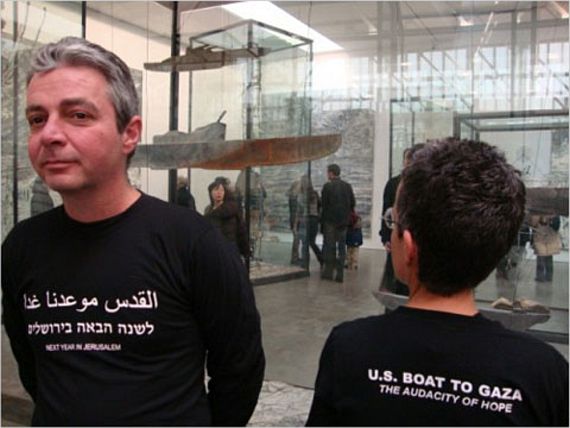
Four activists were forced to leave an art gallery in New York this month for wearing T-shirts promoting an effort to include an American boat in the next blockade-challenging Gaza flotilla.

The incident came on the final day of an exhibition at the Gagosian Gallery called “Next Year in Jerusalem,” featuring pieces by the German artist Anselm Kiefer on the subject of Nazi Germany and the Holocaust.

The T-shirts worn by the activists repeated the show’s title, which is borrowed from a Jewish prayer, in English, Hebrew and Arabic, on the front and said “U.S. Boat to Gaza” and “The Audacity of Hope” on the back. (As The Lede explained in a previous post, the American activists plan to call their boat the Audacity of Hope, echoing the title of a book by President Obama.)

As Claudia Roth Pierpont reported in an account of the incident on the New Yorker’s Web site last week, the gallery, on West 24th Street, called the police, and force was used to eject one bystander who asked the officers why the activists were being ordered to leave.

Facebooktwittermail

New York Times sick of Israel

I have no idea how accurate the reporting is here, but Israel Today Magazine has a colorful account of what it headlines as an Israeli diplomat getting “ambushed” by the New York Times editorial team, under the direction of “rabid columnist” Tom Friedman.

The New York Times, flagship of the liberal American media, has never been a friend of the Jewish state. But the newspaper’s aversion to Israel turned to open hostility this month when its top editors ambushed and tore into an unsuspecting senior official from the Israeli Consulate in New York City.

The Israeli official was invited by the Times editors, among them rabid columnist Thomas Friedman, to meet with them at their office. Being a veteran at dealing with the American media, the official assumed the invitation was for a friendly discussion and perhaps an interview regarding the peace process and other matters of importance to Israel.

The Israeli had no idea he was being invited for what he described as a lynch.

As the meeting started, the Times editors – most of them Jews, and one of them a former Israeli – began to attack the Israeli diplomat, and refused to give him even a moment to respond.

They blamed Israel for everything, the diplomat told Israel Today.

The Times editors insisted the breakdown of the peace process was Israel’s fault, that the lack of peace was Israel’s fault, and were adamant that Israel had given nothing to the Palestinians. They accused Israel of being an extremist and racist state, and blasted the diplomat for Israel’s “ill-treatment” of President Barack Obama.

In short, the Times staff informed the Israeli in no uncertain terms that they were sick of his country.

The diplomat told us he was shocked by the attack. He tried to respond, but the Times editors were not interested in hearing his arguments.

“I asked them,” said the diplomat, “We haven’t given the Palestinians anything? How can you say that? Prime Minister Benjamin Netanyahu broke with his party platform and implemented a 10-month Jewish building freeze, and what did we get in return? More Palestinian refusal to negotiate.”

According to the Israeli, the Times editors responded: “Yes, yes. Of course you are going to start telling us about how Israel’s security needs are not being met. You just don’t get it that we are sick of hearing about that.”

There is little doubt that this ambush was led by Friedman, whose hostility toward Israel in his recent columns has surprised even his liberal friends in the Jewish state.

In recent articles, Friedman has accused Israel of being a spoiled child, crazy and extremist. He insisted that the US stop being Israel’s “enabler,” and pointed out that the rest of the world is fully on the side of the Palestinians, so why not America?

Wrote Friedman in one of his columns: “Israel, when America – which has given you billions over the past 50 years and defended you in the international arena – asks you to stop building settlements for three months in order to jump start peace talks, there is only one correct answer, and that is ‘yes, whatever you say.’”

Facebooktwittermail

America’s leading liberal Zionists are losing faith in Israel

Earlier this month, Tom Friedman bemoaned the fact that Israel’s leadership has become “disconnected from reality”.

Then came the New Yorker‘s David Remnick warning Israelis about the way the American Jewish community is changing:

A new generation of Jews is growing up in the US. Their relationship with Israel is becoming less patient and more problematic. They see what has happened with the Rabbinical Letter [proscribing rental and sale of property to Arabs], for example. How long can you expect that they’ll love unconditionally the place called Israel? You’ve got a problem.

And now comes Israel’s most loyal American liberal defender, Jeffrey Goldberg.

Before Christmas, Goldberg was fretting that the possibility of a two-state solution is slipping out of reach:

I would like someone in the Netanyahu government to please explain the plan here. It would make things so much easier to understand if we just knew the plan. Is the plan to continue settling Judea and Samaria [the West Bank] so that there is no chance whatsoever of creating a Palestinian state? And if this is the plan, then what happens to those Palestinians who are being denied a state? Will they be absorbed into democratic Israel, thus bringing about an end to the idea that there should be a single small country on earth where Jews can be a majority? Or are they going to be denied democratic rights, in which case, well, Israel as we know it will cease to exist. Or is there some other plan? Or — maybe — there is no plan.

And now Goldberg is acknowledging his grimmest fear: that Israel can all too easily dispense with democracy.

As I wrote last week, there’s very little Israel’s right-wing government has done in the past year or so to suggest that it is willing to wean itself from its addiction to West Bank settlements, and the expansion of settlements bodes ill for the creation of a Palestinian state — and the absence of Palestinian statehood means that Israel will one day soon confront this crucial question concerning its democratic nature: Will it grant West Bank Arabs the right to vote, or will it deny them the vote? If it grants them the vote, this will be the end of Israel as a Jewish state; if it denies them the vote in perpetuity, it will cease to be a democratic state.

I will admit here that my assumption has usually been that Israelis, when they finally realize the choice before them (many have already, of course, but many more haven’t, it seems), will choose democracy, and somehow extract themselves from the management of the lives of West Bank Palestinians. But I’ve had a couple of conversations this week with people, in Jerusalem and out of Jerusalem, that suggest to me that democracy is something less than a religious value for wide swaths of Israeli Jewish society. I’m speaking here of four groups, each ascendant to varying degrees:The haredim, the ultra-Orthodox Jews, whose community continues to grow at a rapid clip; the working-class religious Sephardim — Jews from Arab countries, mainly — whose interests are represented in the Knesset by the obscurantist rabbis of the Shas Party; the settler movement, which still seems to get whatever it needs in order to grow; and the million or so recent immigrants from Russia, who support, in distressing numbers, the Putin-like Avigdor Lieberman, Israel’s foreign minister and leader of the “Israel is Our Home” party.

Let’s just say, as a hypothetical, that one day in the near future, Prime Minister Lieberman’s government (don’t laugh, it’s not funny) proposes a bill that echoes the recent call by some rabbis to discourage Jews from selling their homes to Arabs. Or let’s say that Lieberman’s government annexes swaths of the West Bank in order to take in Jewish settlements, but announces summarily that the Arabs in the annexed territory are in fact citizens of Jordan, and can vote there if they want to, but they won’t be voting in Israel. What happens then? Do the courts come to the rescue? I hope so. Do the Israeli people come to the rescue? I’m not entirely sure. There are many Israelis who value democracy, but they might not possess the strength to fight. Does American Jewry come to the rescue? Well, most of American Jewry would be so disgusted by Israel’s abandonment of democratic principles that I think the majority would simply write off Israel as a tragic, failed experiment.

Facebooktwittermail

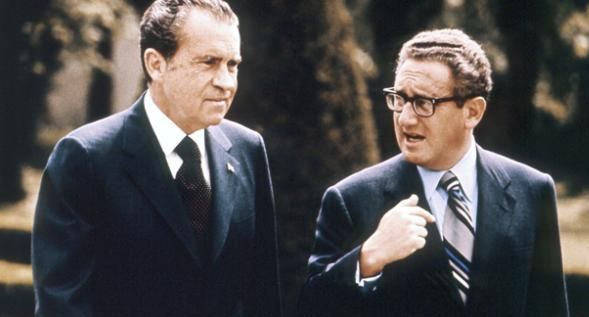
Kissinger’s entire career was a series of massacres and outrages

In 1973, moments after the Israeli prime minister, Golda Meir asked President Nixon to press the Soviet Union to permit Jews to emigrate and escape persecution there, Nixon’s national security adviser, Henry Kissinger, addressed the question.

“The emigration of Jews from the Soviet Union is not an objective of American foreign policy,” Kissinger said emphatically. “And if they put Jews into gas chambers in the Soviet Union, it is not an American concern. Maybe a humanitarian concern.”

From the audio tape, it is clear that Nixon was concerned about pressure he would face from the American Jewish community on this issue.

Since the tapes were made public earlier this month, prominent members of the Jewish community have been lining up to speak in Kissinger’s defense — an effort, they say, which is intended to put Kissinger’s callousness in context.

“The Nixon Tapes should not change history’s verdict on the important contributions and ultimate legacy of Henry Kissinger,” said the Anti-Defamation League’s Abraham Foxman.

Christopher Hitchens, having in recent years been distracted by 9/11, returns to the subject of Kissinger, and asks, “what if we did, indeed, accept the invitation to ‘remember the context of his entire life’?”

Here’s what we would find: the secret and illegal bombing of Indochina, explicitly timed and prolonged to suit the career prospects of Nixon and Kissinger. The pair’s open support for the Pakistani army’s 1971 genocide in Bangladesh, of the architect of which, Gen. Yahya Khan, Kissinger was able to say: “Yahya hasn’t had so much fun since the last Hindu massacre.” Kissinger’s long and warm personal relationship with the managers of other human abattoirs in Chile and Argentina, as well as his role in bringing them to power by the covert use of violence. The support and permission for the mass murder in East Timor, again personally guaranteed by Kissinger to his Indonesian clients. His public endorsement of the Chinese Communist Party’s sanguinary decision to clear Tiananmen Square in 1989. His advice to President Gerald Ford to refuse Alexander Solzhenitsyn an invitation to the White House (another favor, as with spitting on Soviet Jewry, to his friend Leonid Brezhnev). His decision to allow Saddam Hussein to slaughter the Kurds after promising them American support. His backing for a fascist coup in Cyprus in 1974 and then his defense of the brutal Turkish invasion of the island. His advice to the Israelis, at the beginning of the first intifada, to throw the press out of the West Bank and go for all-out repression. His view that ethnic cleansing in former Yugoslavia was something about which nothing could be done. Forget the criminal aspect here (or forget it if you can). All those policies were also political and diplomatic disasters.

We possess a remarkably complete record of all this, in and out of office, most of it based solidly on U.S. government documents. (The gloating over Bangladesh comes from July 19, 1971.) And it’s horribly interesting to note how often the cables and minutes show him displaying a definite relish for the business of murder and dictatorship, a heavy and nasty jokiness (foreign policy is not “a missionary activity”) that was by no means always directed, bad as that would have been, at gratifying his diseased and disordered boss. Every time American career diplomats in the field became sickened at the policy, which was not seldom, Kissinger was there to shower them with contempt or to have them silenced. The gas-chamber counselor is consistent with every other version of him that we have.

When in 2001 Hitchens took on the noble if perhaps quixotic endeavor of attempting to have Kissinger put on trial for war crimes and crimes against humanity, who could have anticipated that the polemicist would soon become so severely blown off course, or that almost a decade later the octogenarian would probably outlive his most furious and much younger critic.

The Trials of Henry Kissinger (2002)

Facebooktwittermail

Israel’s central role in ‘the new Cold War’

Even if Britain has yet to enact promised changes to the law in order to protect Israeli war criminals from facing the risk of arrest while visiting the UK, it would appear that some form of understanding is already in place so that Tamir Pardo, the new head of Mossad, will be able to visit in January.

An outline of some of the key issues on Pardo’s agenda when he meets Britain’s intelligence chiefs reveals the depth of Mossad’s operations across the Middle East. It also reveals that Israel sees itself having a pivotal role in what Pardo is branding “the new Cold War” between Russia and the West.

The Daily Telegraph reports:

[Pardo] is expected to brief officials on Mossad’s plans to provide Britain and Nato with increased intelligence over Iran’s nuclear weapons programme. Mossad has a network of undercover agents in the country.

He also intends to increase Mossad’s role in Yemen and to spearhead the hunt for al-Qaeda’s new chief of military operations, Saif al-Adel, who Mossad believe is based in Somalia.

At the same time he wants to expand Mossad’s watch over the SVR, Russia’s foreign intelligence service, which is an increasing presence in Syria and Turkey – and is using both countries as launch pads from which to enter Europe. In his first briefing to senior staff after he took up his new post, Mr Pardo said Mossad had a key role to play in helping the West win what he called “the new Cold War”.

With Mossad conducting operations in Iran, Yemen and Somalia, Israel sees itself as an indispensable partner with the United States in the enduring global conflict through which each nation now defines its identity and upon which each has become economically dependent. No two nations on the planet are more threatened by the possibility of peace.

Facebooktwittermail

State Dept spokesman P J Crowley is a liar

Richard Silverstein writes:

On February 25, 2010, State Department spokesperson Philip Crowley lied when he told a press conference that he wasn’t aware of any request from Dubai for assistance in tracking the Mossad killers of Mahmoud al-Mabouh. To those who say that Wikileaks hasn’t told us anything we didn’t already know–think again.

Wikileaks has just released a February 24, 2010 cable in which the embassy relays the specific credit card numbers used by 14 of the 27 known Mossad suspects to State with a request for assistance from authorities investigating the killing, and confirms that the UAE foreign minister made the exact same request directly to Secretary Clinton on February 23rd:

On the margins of a meeting with visiting Secretary [of Energy] Chu, on Feb 24 MFA Minister of State Gargash made a formal request to the Ambassador for assistance in providing cardholder details and related information or credit cards reportedly issued by a U.S. bank to several suspects in last month’s killing of Hamas leader Mahmoud Al-Mabhouh in Dubai. According to a letter Gargash gave the Ambassador (which transmitted details of the request from Dubai Security authorities to the UAE Central Bank), the credit cards were issued by MetaBank, in Iowa.

Comment: Ambassador requests expeditious handling of and reply to the UAEG request, which was also raised by UAE Foreign Minister Abdullah bin Zayed in a February 23 meeting with Secretary Clinton in Washington.

Given that the State of Israel’s role in the assassination of Mahmoud al Mabhouh and in the theft and fraudulent use of British and other passports, it comes as no surprise that as these facts become matters of public record, the new chief of Mossad is about to issue an apology to the British government and promise not to commit such crimes in the future. This is not to suggest that either the Israelis or the British are opposed to similar assassinations being conducted in the future — merely that Mossad is expected operate its death squads in such a way that Israel’s allies can be saved from embarrassment.

Facebooktwittermail

The corrupt system that turns American generals into war profiteers

When corruption has become systemic, it no longer gets called corruption.

When America’s decorated military elite believe that retirement means that it is now their turn to line their pockets by profiting from the United States’ profligate arms spending, we are witnessing what the Boston Globe refers to with the blandest of euphemisms: a routine fact of life.

When a country is in dire economic condition, it’s government running a massive deficit and yet it still expands its military spending, we are witnessing the effect of the “disastrous rise of misplaced power” possessed by the military-industrial complex — a danger about which Dwight D. Eisenhower cautioned America, yet his warning went unheeded.

An hour after the official ceremony marking the end of his 35-year career in the Air Force, General Gregory “Speedy’’ Martin returned to his quarters to swap his dress uniform for golf attire. He was ready for his first tee time as a retired four-star general.

But almost as soon as he closed the door that day in 2005 his phone rang. It was an executive at Northrop Grumman, asking if he was interested in working for the manufacturer of the B-2 stealth bomber as a paid consultant. A few weeks later, Martin received another call. This time it was the Pentagon, asking him to join a top-secret Air Force panel studying the future of stealth aircraft technology.

Martin was understandably in demand, having been the general in charge of all Air Force weapons programs, including the B-2, for the previous four years.

He said yes to both offers.

In almost any other realm it would seem a clear conflict of interest — pitting his duty to the US military against the interests of his employer — not to mention a revolving-door sprint from uniformed responsibilities to private paid advocacy.

But this is the Pentagon where, a Globe review has found, such apparent conflicts are a routine fact of life at the lucrative nexus between the defense procurement system, which spends hundreds of billions of dollars a year, and the industry that feasts on those riches. And almost nothing is ever done about it.

The Globe analyzed the career paths of 750 of the highest ranking generals and admirals who retired during the last two decades and found that, for most, moving into what many in Washington call the “rent-a-general’’ business is all but irresistible.

From 2004 through 2008, 80 percent of retiring three- and four-star officers went to work as consultants or defense executives, according to the Globe analysis. That compares with less than 50 percent who followed that path a decade earlier, from 1994 to 1998.

In some years, the move from general staff to industry is a virtual clean sweep. Thirty-four out of 39 three- and four-star generals and admirals who retired in 2007 are now working in defense roles — nearly 90 percent.

And in many cases there is nothing subtle about what the generals have to sell — Martin’s firm is called The Four Star Group, for example. The revolving-door culture of Capitol Hill — where former lawmakers and staffers commonly market their insider knowledge to lobbying firms — is now pervasive at the senior rungs of the military leadership. [Continue reading.]

Facebooktwittermail

Financial attacks on WikiLeaks — a low-cost ploy to please Washington

In an editorial, the New York Times says:

The whistle-blowing Web site WikiLeaks has not been convicted of a crime. The Justice Department has not even pressed charges over its disclosure of confidential State Department communications. Nonetheless, the financial industry is trying to shut it down.

Visa, MasterCard and PayPal announced in the past few weeks that they would not process any transaction intended for WikiLeaks. Earlier this month, Bank of America decided to join the group, arguing that WikiLeaks may be doing things that are “inconsistent with our internal policies for processing payments.”

The Federal Reserve, the banking regulator, allows this. Like other companies, banks can choose whom they do business with. Refusing to open an account for some undesirable entity is seen as reasonable risk management. The government even requires banks to keep an eye out for some shady businesses — like drug dealing and money laundering — and refuse to do business with those who engage in them.

But a bank’s ability to block payments to a legal entity raises a troubling prospect. A handful of big banks could potentially bar any organization they disliked from the payments system, essentially cutting them off from the world economy.

The fact of the matter is that banks are not like any other business. They run the payments system. That is one of the main reasons that governments protect them from failure with explicit and implicit guarantees. This makes them look not too unlike other public utilities. A telecommunications company, for example, may not refuse phone or broadband service to an organization it dislikes, arguing that it amounts to risky business.

Our concern is not specifically about payments to WikiLeaks. This isn’t the first time a bank shunned a business on similar risk-management grounds. Banks in Colorado, for instance, have refused to open bank accounts for legal dispensaries of medical marijuana.

Still, there are troubling questions. The decisions to bar the organization came after its founder, Julian Assange, said that next year it will release data revealing corruption in the financial industry. In 2009, Mr. Assange said that WikiLeaks had the hard drive of a Bank of America executive.

What would happen if a clutch of big banks decided that a particularly irksome blogger or other organization was “too risky”? What if they decided — one by one — to shut down financial access to a newspaper that was about to reveal irksome truths about their operations? This decision should not be left solely up to business-as-usual among the banks.

Although the financial companies have used the pretext that WikiLeaks is not complying with the terms each firm specify in the user agreements, we can strongly infer that in each instance these are cases of corporate lying — the kind of lying that lubricates the wheels of commerce. After all, when WikiLeaks in conjunction with several major newspapers started releasing US diplomatic cables, two things were clear:

  • Whatever impermissible action WikiLeaks was being accused of, The Guardian, New York Times and other newspapers engaged in the same actions and yet MasterCard, Visa, Paypal and Bank of America din’t seem to mind — flagrant double standards were in operation.
  • When WikiLeaks launched CableGate, there was no intrinsic difference from its release of intelligence reports about the war in Afghanistan or its earlier leaks. So why did the financial companies wait until now to enforce policies that they apparently had no interest in enforcing before?

What changed was the political climate.

For the Obama administration, WikiLeaks’ actions had crossed the threshold from irritating to intolerable and a few players in the financial industry — perhaps recognizing that they could win a little more favor from an administration that had already treated the sector so kindly — jumped at the opportunity to stand shoulder-to-shoulder with Washington.

What else should we expect from those whose fortunes are so intimately intertwined?

Facebooktwittermail

If journalism doesn’t embrace WikiLeaks, journalism is signing its own death sentence

Mathew Ingram writes:

While the U.S. government tries to determine whether what WikiLeaks and front-man Julian Assange have done qualifies as espionage, media theorists and critics alike continue to debate whether releasing those classified diplomatic cables qualifies as journalism. It’s more than just an academic question — if it is journalism in some sense, then Assange and WikiLeaks should be protected by the First Amendment and freedom of the press. The fact that no one can seem to agree on this question emphasizes just how deeply the media and journalism have been disrupted, to the point where we aren’t even sure what they are any more.

The debate flared up again on the Thursday just before Christmas, with a back-and-forth Twitter discussion involving a number of media critics and journalists, including MIT Technology Review editor and author Jason Pontin, New York University professor Jay Rosen, PhD student Aaron Bady, freelance writer and author Tim Carmody and several other occasional contributors. Pontin seems to have started the debate by saying — in a comment about a piece Bruce Sterling wrote on WikiLeaks and Assange — that the WikiLeaks founder was clearly a hacker, and therefore not a journalist.

Pontin’s point, which he elaborated on in subsequent tweets, seemed to be that because Assange’s primary intent is to destabilize a secretive state or government apparatus through technological means, then what he is doing isn’t journalism. Not everyone was buying this, however. Aaron Bady — who wrote a well-regarded post on Assange and WikiLeaks’ motives — asked why he couldn’t be a hacker and a journalist at the same time, and argued that perhaps society needs to have laws that protect the act of journalism, regardless of who practices it or what they call themselves.

Journalism is a nebulous enterprise. In its mainstream form it carries the pretensions of objectivity and balance. Nowhere is this more in evidence than in the vile liberal sensibilities of National Public Radio.

This afternoon, All Things Considered ran a segment about temporary workers “who are helping make our holidays brighter.” To hear it the way NPR tells it, the pool of 15 million unemployed Americans and the seasonal need for temporary workers is the happiest of conjunctions — packing boxes for Amazon has never been so much fun as it is for those now desperate for a full-time job. It all adds up to a healthy dose of Christmas cheer.

If this qualifies as journalism, who has the damn nerve to argue that WikiLeaks isn’t qualified to claim this lofty title?

But perhaps more important — at least for journalists who want journalism to survive — now is the time to be arguing for and defending the most expansive possible definition of journalism. Otherwise journalism will become a protected territory that successfully argues itself out of existence.

Facebooktwittermail

The truth that the CIA is desperate to conceal

The New York Times reports:

A seven-year effort by the Central Intelligence Agency to hide its relationship with a Swiss family who once acted as moles inside the world’s most successful atomic black market hit a turning point on Thursday when a Swiss magistrate recommended charging the men with trafficking in technology and information for making nuclear arms.

The prospect of a prosecution, and a public trial, threatens to expose some of the C.I.A.’s deepest secrets if defense lawyers try to protect their clients by revealing how they operated on the agency’s behalf. It could also tarnish what the Bush administration once hailed as a resounding victory in breaking up the nuclear arms network by laying bare how much of it remained intact.

“It’s like a puzzle,” Andreas Müller, the Swiss magistrate, said at a news conference in Bern on Thursday. “If you put the puzzle together you get the whole picture.”

The three men — Friedrich Tinner and his two sons, Urs and Marco — helped run the atomic smuggling ring of A. Q. Khan, an architect of Pakistan’s nuclear bomb program, officials in several countries have said. In return for millions of dollars, according to former Bush administration officials, the Tinners secretly worked for the C.I.A. as well, not only providing information about the Khan network’s manufacturing and sales efforts, which stretched from Iran to Libya to North Korea, but also helping the agency introduce flaws into the equipment sent to some of those countries.

The Bush administration went to extraordinary lengths to protect the men from prosecution, even persuading Swiss authorities to destroy equipment and information found on their computers and in their homes and businesses — actions that may now imperil efforts to prosecute them.

While it has been clear since 2008 that the Tinners acted as American spies, the announcement by the Swiss magistrate on Thursday, recommending their prosecution for nuclear smuggling, is a turning point in the investigation. A trial would bring to the fore a case that Pakistan has insisted is closed. Prosecuting the case could also expose in court a tale of C.I.A. break-ins in Switzerland, and of a still unexplained decision by the agency not to seize electronic copies of a number of nuclear bomb designs found on the computers of the Tinner family.

The fact that the CIA and the US government have gone to such lengths to try and prevent the details about the CIA’s involvement in global nuclear proliferation being exposed, means that we can only speculate about what kind of damning information remains hidden.

Several scenarios seem possible:

  • that the CIA’s efforts to track the AQ Khan network reached a point where it might have appeared that it was aiding and abetting the network’s operation;
  • that bungled CIA efforts to sabotage the Iranian nuclear program resulted in Iran acquiring know-how or technology that it might not have otherwise been able to obtain;
  • and conceivably, that the CIA’s involvement in Iran’s nuclear program was so deep that it was exerting an influence over the strategic direction of the program.
Facebooktwittermail

The leaks that aren’t really leaks

Glenn Greenwald praises the New York Times for an article which “exposed” planning for an imminent expansion of Obama’s war in Pakistan:

In my view, the NYT article represents exactly the kind of secret information journalists ought to be revealing; it’s a pure expression of why the First Amendment guarantees a free press. There are few things more damaging to basic democratic values than having the government conduct or escalate a secret war beyond public debate or even awareness. By exposing these classified plans, Mazzetti and Filkins did exactly what good journalists ought to do: inform the public about important actions taken or being considered by their government which the government is attempting to conceal.

Moreover, the Obama administration has a history of deceiving the public about secret wars. Recently revealed WikiLeaks cables demonstrated that it was the U.S. — not Yemen — which launched a December, 2009 air strike in that country which killed dozens of civilians; that was a covert war action about which the U.S. State Department actively misled the public, and was exposed only by WikiLeaks cables. Worse, it was The Nation’s Jeremy Scahill who first reported back in 2009 that the CIA was directing ground operations in Pakistan using both Special Forces and Blackwater operatives: only to be smeared by the Obama State Department which deceitfully dismissed his report as “entirely false,” only for recently released WikiLeaks cables to confirm that what Scahill reported was exactly true. These kinds of leaks are the only way for the public to learn about the secret wars the Obama administration is conducting and actively hiding from the public.

The question that emerges from all of this is obvious, but also critical for those who believe Wikileaks and Julian Assange should be prosecuted for the classified information they have published: should the NYT editors and reporters who just spilled America’s secrets to the world be criminally prosecuted as well? After all, WikiLeaks has only exposed past conduct, and never — like the NYT just did — published imminent covert military plans.

I wish I shared Greenwald’s enthusiasm for the NYT’s investigative journalism but I’m highly skeptical that the reporting in this instance should be regarded as an exposé.

What seems much more likely is that the newspaper is simply serving as the means through which classified information can be made public because doing so is thought (by the leakers) to serve policymaking goals — such as applying pressure on Pakistan.

This merely illustrates the fact that those who make the rules can — whenever they see fit — break the rules. No one is at risk of being caught having leaked classified information to the New York Times. The “leaking” was almost certainly authorized at the highest levels of the administration and the New York Times merely acted as a dutiful servant. The paper is very well-trained when it comes to distinguishing between classified information that it has permission to print and that which is verboten.

Facebooktwittermail