Category Archives: Analysis

Revelation on Brussels attackers fuels fears of new assaults

The New York Times reports: The announcement on Sunday that the plotters of last month’s Brussels terror attacks had originally intended to hit Paris again only heightened the concern among police and intelligence agencies that shadowy Islamic State networks could unleash new attacks at any time, not only in France and Belgium but in other European capitals.

As intelligence experts and officials took stock of what they have learned since the Nov. 13 assaults in and around Paris, which killed 130 people, several things have come into focus. The scale of the Islamic State’s operations in Europe are still not known, but they appear to be larger and more layered than investigators at first realized; if the Paris and Brussels attacks are any model, the plotters will rely on local criminal networks in addition to committed extremists.

Even as the United States, its allies and Russia have killed leaders of the Islamic State, and have rolled back some of the extremist organization’s gains on the battlefields of Iraq and Syria, the Islamic State appears to be posing a largely hidden and lethal threat across much of Europe. [Continue reading…]

Facebooktwittermail

FBI’s ‘shared responsibility committees’ to identify ‘radicalized’ Muslims raise alarms

The Intercept reports: The FBI’s plan to enlist community leaders in “Shared Responsibility Committees” all across the country with the goal of identifying “radicalized” individuals is raising alarm among civil rights activists.

The Shared Responsibility Committees, known as SRCs, “are expanding the informant program under the guise of an intervention program, which it is not,” said Abed Ayoub, legal director of the American-Arab Anti-Discrimination Committee (ADC).

The FBI’s ideas is to have social service workers, teachers, mental health professionals, religious figures, and others interdict young people they believe are on a path towards radicalization. The program was first revealed last November, and while details remain scant, it is widely believed to have been developed along the lines of similar “anti-radicalization” programs in the United Kingdom.

The FBI did not respond to multiple requests for comment.

Experts acknowledge the need to have options beyond sending young people to jail for making threatening statements. The committees purport to offer such an option, by allowing members to offer non-binding recommendations to law enforcement about whether certain individuals should be arrested or offered rehabilitation for their alleged radicalization.

But critics say that despite the FBI’s benign characterization of the SRCs, the proposal amounts to nothing more than an expansion of already existing FBI informant programs. The committees “would be doing the work of the FBI, gathering information. This initiative failed in the U.K., it’s not like this is a new idea,” said Ayoub.

The U.K. program called “Channel” has been widely blamed for alienating the communities it targeted while inflaming attitudes towards authorities. Arun Kundnani, an adjunct professor at New York University and expert on U.K. counterterrorism policy, said he worries that the U.S. program would “suffer from the same problems, such as drawing non-policing professionals into becoming the eyes and ears of counter-terrorism surveillance, and thereby undermining professional norms and relationships of trust among educators, health workers and others.” [Continue reading…]

Facebooktwittermail

Time to declassify 28 redacted pages of a report that holds 9/11 secrets

60 Minutes reports: In 10 days, President Obama will visit Saudi Arabia at a time of deep mistrust between the two allies, and lingering doubts about the Saudi commitment to fighting violent Islamic extremism.

It also comes at a time when the White House and intelligence officials are reviewing whether to declassify one of the country’s most sensitive documents — known as the “28 pages.” They have to do with 9/11 and the possible existence of a Saudi support network for the hijackers while they were in the U.S. [Continue reading…]

Facebooktwittermail

People still don’t get the link between high meat consumption and climate change

Annick de Witt writes: Over the last decade or so, the media have slowly but steadily fed the public information about the staggering impact of our meat-eating habits on the environment, and on climate change in particular. For instance, one recent study found that a global transition toward low-meat diets could reduce the costs of climate change mitigation by as much as 50 percent by 2050. From scientific reports and articles in magazines, to viral Facebook videos to documentaries like Cowspiracy and Meat the Truth, the news about the exorbitant contribution of a carnivorous to the greenhouse problem is clearly spreading.

However, despite all these messages, new research by my colleagues and myself shows that most people are still not aware of the full extent of meat’s climate impacts. We examined how citizens in America and the Netherlands assess various food and energy-related options for tackling climate change. We presented representative groups of more than 500 people in both countries with three food-related options (eat less meat; eat local and seasonal produce; and eat organic produce) and three energy-related options (drive less; save energy at home; and install solar panels). We asked them whether they were willing to make these changes in their own lives, and whether they already did these things. While a majority of the surveyed people recognized meat reduction as an effective option for addressing climate change, the outstanding effectiveness of this option, in comparison to the other options, was only clear to 6% of the US population, and only 12% of the Dutch population.

That is remarkably low! Considering that climate change is one of the greatest challenges of our time, wouldn’t we want people to know the power of a simple solution that is in their own hands? [Continue reading…]

Facebooktwittermail

These days, the worst multinational corporations have names you’ve never heard

Michael Hobbes describes how Joyce Chachengwa, a farmer in Zimbabwe, lost the land upon which she, her daughters and grandchildren depended, after a corporate takeover turning the land over to sugarcane for ethanol production. He writes: You know where I’m going with this, right? I’m about to tell you that the company behind all this is Monsanto, or Shell, or Coca-Cola. That your car is running on the ethanol this plant is producing. That the U.S. government is funding or facilitating or failing to prevent what is taking place here.

But none of that is true. The company responsible for all this is called Green Fuel. It is headquartered in Zimbabwe, it isn’t listed on any stock exchange, it doesn’t sell any products in the United States, and it has no Western investors.

And it is, increasingly, the rule rather than the exception. When you think of the worst abuses in poor countries — land grabs, sweatshops, cash-filled envelopes passed to politicians — you probably think they’re committed by companies based in rich ones: Nike in Indonesia, Shell in Nigeria, Dow in Bhopal, India.

These are the cases you’re most likely to hear about, but they are no longer representative of how these abuses actually take place — or who commits them. These days, the worst multinational corporations have names you’ve never heard. They come from places like China and South Africa and Russia. The countries where they are headquartered are unable to regulate them, and the countries where they operate are unwilling to.

For the last 10 years, I’ve worked at an NGO dedicated to preventing multinational corporations from violating human rights. Here’s why every actor in the West that could have prevented what happened in Chisumbanje — the media, the international agencies, my own NGO — is becoming increasingly powerless to do so. [Continue reading…]

Facebooktwittermail

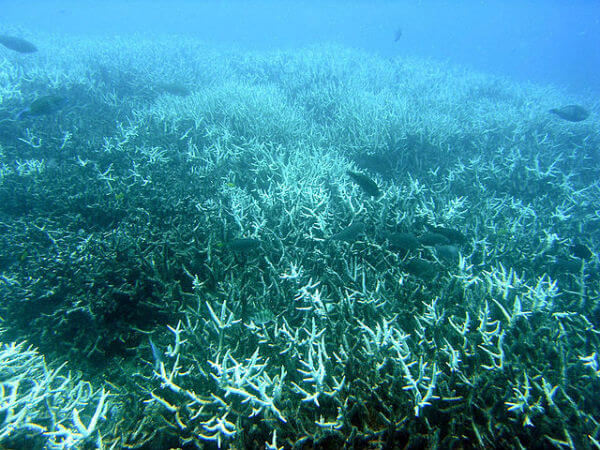
Climate-related death of coral around world alarms scientists

bleached-coral

The New York Times reports: Kim Cobb, a marine scientist at the Georgia Institute of Technology, expected the coral to be damaged when she plunged into the deep blue waters off Kiritimati Island, a remote atoll near the center of the Pacific Ocean. Still, she was stunned by what she saw as she descended some 30 feet to the rim of a coral outcropping.

“The entire reef is covered with a red-brown fuzz,” Dr. Cobb said when she returned to the surface after her recent dive. “It is otherworldly. It is algae that has grown over dead coral. It was devastating.”

The damage off Kiritimati is part of a mass bleaching of coral reefs around the world, only the third on record and possibly the worst ever. Scientists believe that heat stress from multiple weather events including the latest severe El Niño, compounded by climate change, has threatened more than a third of Earth’s coral reefs. Many may not recover.

Coral reefs are the crucial incubators of the ocean’s ecosystem, providing food and shelter to a quarter of all marine species, and they support fish stocks that feed more than one billion people. They are made up of millions of tiny animals, called polyps, that form symbiotic relationships with algae, which in turn capture sunlight and carbon dioxide to make sugars that feed the polyps.

An estimated 30 million small-scale fishermen and women depend on reefs for their livelihoods, more than one million in the Philippines alone. In Indonesia, fish supported by the reefs provide the primary source of protein.

“This is a huge, looming planetary crisis, and we are sticking our heads in the sand about it,” said Justin Marshall, the director of CoralWatch at Australia’s University of Queensland. [Continue reading…]

Facebooktwittermail

Donald Trump’s vision for America

president-trump

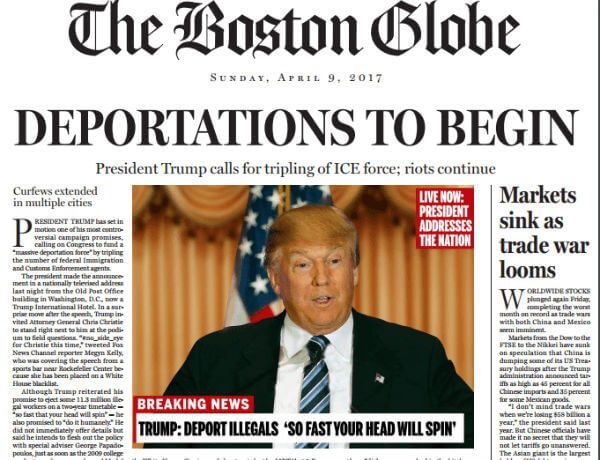
In an editorial, the Boston Globe says: Donald J Trump’s vision for the future of our nation is as deeply disturbing as it is profoundly un-American.

It is easy to find historical antecedents. The rise of demagogic strongmen is an all too common phenomenon on our small planet. And what marks each of those dark episodes is a failure to fathom where a leader’s vision leads, to carry rhetoric to its logical conclusion. The satirical front page of this section [shown above] attempts to do just that, to envision what America looks like with Trump in the White House.

It is an exercise in taking a man at his word. And his vision of America promises to be as appalling in real life as it is in black and white on the page. It is a vision that demands an active and engaged opposition. It requires an opposition as focused on denying Trump the White House as the candidate is flippant and reckless about securing it.

After Wisconsin, the odds have shrunk that Trump will arrive in Cleveland with the requisite 1,237 delegates needed to win the nomination outright. Yet if he’s denied that nomination for falling short of the required delegates, Trump has warned, “You’d have riots. I think you’d have riots.” Indeed, who knows what Trump’s fervent backers are capable of if emboldened by the defeat of their strongman at the hands of the hated party elite. [Continue reading…]

Facebooktwittermail

Obama’s counterterrorism strategy ‘an abject failure,’ says former official

decay9

The New York Times reports: The banging on the door jolted Sal Shafi awake. F.B.I. agents were looking for his son. “Where’s Adam?” they yelled. “Where’s Adam?”

Terrified, Mr. Shafi led the agents, guns drawn, up the stairs toward his son’s bedroom. He watched as they led his 22-year-old son away in handcuffs, backed by evidence of Adam Shafi’s terrorist ambitions.

He had come to the attention of officials not by a well-placed informant or a sting operation. His father, concerned and looking for help, had simply picked up the phone and led the government right to his son. For months, over the objections of his lawyer, Mr. Shafi had been talking to the F.B.I., believing he was doing the right thing.

“My God,” he thought, soon after the arrest in July. “I just destroyed Adam.”

Had things been different, Mr. Shafi, 62, a Silicon Valley executive, might have become a much-needed spokesman for the Obama administration’s counterradicalization campaign. Who better to talk to other parents about the seductive pull of terror organizations? Trust the government, he would tell them. They do not want to take away your children.

Despite nascent efforts to steer young people away from terrorism, the government’s strategy remains largely built on persuading people to call the F.B.I. when they first suspect a problem. [Continue reading…]

Facebooktwittermail

The new Europeans

The New York Times reports: Among the first Syrians to show up in Eisenärzt was Yasser, a stocky, 37-year-old seaman from the Syrian port city Latakia. When the bus dropped him off in front of his new home, Yasser told me, he had the sense that none of this strange new reality could be his. He said he had felt that way since a day last summer, when he was working on a ship bound for Tartus, Syria, and received word from a friend back home that uniformed men were looking for him. Until then, life in Latakia had still been manageable, despite the war. The city, a stronghold of Bashar al-Assad, had not seen the kind of fighting that has shattered other parts of the country. Yasser told me that he could still find work at sea to provide for himself and his wife, an architect in her mid 20s. They had lived a good life in Latakia; he had decorated their home with various souvenirs from his international travel — a sword from China, a tiger sculpture from Sierra Leone. In his free time, he rode his Suzuki motorcycle, and the roar of its 1,000-c.c. engine was a source of pleasure and pride. Yasser told me that he completed his mandatory military service years ago, but the men in uniform wanted to re-enlist him to fight for Assad. He could not fathom fighting for any side in the conflict. “I cannot hit a cat,” he told me. Rather than return to Syria, Yasser said he disembarked from his ship off Istanbul and joined the human tide making its way to the European Union. His wife remained in Latakia. (Yasser, like many other Syrians I met in Germany, asked that I withhold his last name to protect the safety of relatives back home.)

[In September, when] Yasser arrived at the Mallersdorfer Sisters’ former residence [which had been sold to the municipality for the purpose of housing asylum seekers], he was shown to his single room on an upper floor and greeted by the caretaker of the residence, Beni Beilhack, a multiple-pierced 36-year-old with thinning hair and a persistent smile. In the following days, Yasser, bored, began to follow Beilhack around, hoping to help with work around the residence. Eventually, Beilhack delegated some tasks to Yasser: repairing a broken doorknob, blowing leaves off the hiking trails near the residence. By October, Beilhack had outfitted Yasser with work clothes and made him his unofficial assistant. The two communicated with a peculiar mix of English, German and Arabic. Under Yasser’s tutelage, Beilhack’s command of Arabic profanities expanded rapidly, and Beilhack dispensed this knowledge liberally throughout his workday, to the delight of many of the young Syrian men. Beilhack, who worked as a truck driver before the Syrians came to town, told me he did not miss his old job, and he seemed to relish his interaction with the Syrians. He started inviting Yasser to family dinners. After school, Beilhack’s son, Luca, then 12, often came by the residence. The Syrians were generally “warmer” than the local residents, Luca told me, adding, “I’d be happy if they lived here forever.”

Beilhack’s 64-year-old mother, Evelyn, also works as a caretaker at the residence, where she lives on the ground floor with her husband. Evelyn held the position previously, when the sisters lived there. When Evelyn learned the Syrians would be moving in, she rejoiced. The nuns nitpicked about the smallest details, she told me, creating an oppressive work environment. She grew up in what she called a “very international” town, a place called Geretsried, south of Munich, which was settled by Germans expelled from Eastern Europe after World War II. Later, Southern European guest workers arrived. Growing up there left her open to seeing what the asylum seekers would be like. “You hear from a lot of different places about what an abominable people they are — not Syrians, but altogether, this whole mass of asylum seekers that are streaming in here,” she told me. People called them “terrible and slobs and poorly raised and primitive.” She wanted to find out for herself, she said. “I thought: I’ll take this on. I want to see this. I want to know this.”

Her experience with the Syrians did not confirm the prejudices. “They are respectful; they’re nice,” she said. Like her son, she seemed to enjoy the Syrians’ company. One evening, a saxophonist from Damascus serenaded her in the former chapel, stripped of religious relics, where the Mallersdorfer Sisters used to worship. The saxophonist stood next to the recently installed foosball table and puffed out a version of Lionel Richie’s “Hello.” One of the young Syrian men sitting next to Evelyn feigned being her companion in a cafe. “Garçon! Two glasses of wine!”

Through his conversations with the Beilhacks, Yasser began to understand something of life in Germany. Evelyn told him how much money was deducted from people’s paychecks for taxes and health insurance, and the cost of living generally seemed far higher than in prewar Syria. Back at home, his wife did some work in a private office, but he would not allow her to work for a firm. Women in Syria were not supposed to hold down such jobs, he said. In Germany, however, he would have to reconsider. He and his wife probably wouldn’t be able to afford a house and a car if she didn’t work too. “Life here is hard,” he said. If the war in Syria ended, he told me, he would go back in a minute. [Continue reading…]

Facebooktwittermail

How French secularism became fundamentalist

Robert Zaretsky writes: For nearly a century, laïcité [which originally assured “the liberty of conscience” for all French citizens] worked well enough. It ensured public space for both those who believed — not just Catholics and Protestants, but Jews as well — and those who did not. But with the 1980s and 1990s came a growing number of immigrants, most of whom were Muslim, from North Africa. And so a different kind of conflict between the French state and established religion began to take shape.

Emblematic of this new tension was a series of battles over a simple strip of clothing. In 1989, a few Muslim girls were expelled from school when they refused to take off their hijabs, or headscarves, which the principal believed was an assault on the secular character of public schools. Shortly after, the French administrative court, the Conseil d’État, ordered them to be reinstated. But two years after 9/11, when similar incidents were repeated at other schools, the court reversed its original finding. While all “ostentatious” signs of religious faith — be they Jewish yarmulkes or Sikh turbans — were declared verboten in public schools, everyone knew that the principal target of the law was the hijab.

In the subsequent sound and fury, the banner of laïcité was unfurled in ways that would surely have been unrecognizable to the 19th-century statesmen like Jules Ferry and Aristide Briand, who helped write the original law. The once-straightforward guarantees of “freedom of conscience” and “free exercise of religious faiths” — rooted in and restricted to the constitutions of the Third, Fourth, and Fifth Republics — were transformed under the forces of political passion and mounting existential anguish into the defining French values, and any form of retreat from a fundamentalist interpretation was a failure to defend the republic.

Today, public intellectuals like Alain Finkielkraut, Régis Debray, and Elisabeth Badinter, when discussing laïcité, invoke the very future of France. Badinter, a renowned feminist philosopher, as if in anticipation of the Charlie Hebdo editorial, declared in January that she was not afraid to be called an Islamophobe, arguing that accusations of racism are a weapon against secularism. In a recent essay on secularism, diversity, and national identity titled L’identité malheureuse (“Unhappy Identity”), Finkielkraut confounds myth with history when he declares his sympathy for those “who miss the good old days when native-born Frenchmen and women (Français de souche) mingled with their own kind and who are now shedding a tear over their sepia-colored France that has lost its homogeneity.”

The xenophobic and anti-immigration National Front, too, has weaponized laïcité, turning it into an ideological cudgel to be used against French Muslims. Last year, Marion Maréchal-Le Pen, the party’s rising star — and granddaughter of Jean-Marie Le Pen — asserted that the National Front is “laïque,” or secular. Yet she then offered an interpretation of the state of religion in France that had very little to do with laïcité as most of the world understands it, exposing the cognitive dissonance shared by the extreme right and left: “If French Muslims wish to practice their faith, they need to accept the fact that they are doing so on soil that is culturally Christian. This means that they cannot have the same rank as the Christian religion.”

Then, last week, the minister for families, children, and women’s rights, Laurence Rossignol, lambasted fashion designers for offering lines of Islamic wear-inspired clothing, including the so-called “burkini,” a full-body bathing suit sold by Marks and Spencer. These brands, Rossignol declared, had “irresponsibly” lent their prestige to clothing designed to oppress women. As for those Muslim women who freely choose to wear religious garb, Rossignol shrugged her shoulders: “There were also American negroes who favored slavery.”

In a single phrase, Rossignol not only let drop a racial slur, but also let slip the implications of how she — a member of government — sees the meaning of laïcité today: No normal French woman, Rossignol seems to believe, would choose to wear Islamic dress as a sign of her religious faith. Tellingly, Rossignol’s use of the word “négre” sparked more outrage in the media than her claim that burkini-wearing women have no place in a truly secular society. [Continue reading…]

Facebooktwittermail

Panama Papers: How the Seychelles saved Syria

James Denselow writes: Against the backdrop of recent territorial gains, the cessation of hostilities and a peace process in Geneva that is rumbling along, President Bashar al-Assad seems more secure than ever after five years of conflict in Syria.

When people ask how he managed to stay in power despite the country having its economy collapse in half, hundreds of thousands killed, one in two Syrians being forced from their homes and the conflict dragging in four of the five UN P5 members of the Security Council, you wouldn’t necessarily think about the Seychelles.

Yet as the Panama Papers, the biggest leak in global history, has shown, the idyllic archipelago of 115 islands in the Indian Ocean off East Africa has played its part in keeping Assad in the Presidential Palace in Damascus.

What this demonstrates is that what appears from a distance to be an insular, authoritarian regime far more proficient in the tools of medieval warfare than modern capitalism, has actually used the levers of globalisation well to protect its interests.

What the 11.5 million leaked documents reveal is that three Syrian companies close to the government – Maxima Middle East Trading, Morgan Additives Manufacturing and Pangates International – used the already infamous Panama-based law firm Mossack Fonseca to create shadow or shell companies in the Seychelles to avoid the increasing pressure of global sanctions.

Considering how near the regime was to collapse before the Russian intervention, this evasion of sanctions is fairly significant. The Panama Papers suggest it paid for fuel that kept Syria’s Air Force helicopters and airplanes in the air. [Continue reading…]

Facebooktwittermail

Where are the Syrians in Assad’s Syrian Arab Army?

Richard Spencer writes: The video shows the attack on Palmyra, the historic Syrian city reclaimed from Isil for the Assad regime, and as a column of troops heads across the desert behind him a soldier is giving a commentary.

“Despite many casualties, they are moving forward in the advance,” he says.

The oddity is that he is not speaking Arabic, but Persian. The man himself is Afghan, a member of a 10-20,000-strong Afghan army recruited in Iran to fight the war in Syria.

The reconquest of Palmyra was presented to the world as a victory for President Bashar al-Assad’s Syrian Arab Army.

As Islamic State jihadists fled, regime troops forced their way into the town, known for its celebrated Roman ruins. Everyone from Russian apparatchiks to British conservative politicians congratulated Mr Assad for reclaiming the town for civilisation.

The role of the Russian air force in preparing the way for the ground advance was noted: this was the anti-Isil alliance promised at the start of Russian military intervention in Syria but which in practice seemed slow to make gains.

In fact, it is now clear it was an eccentric multinational force that took Palmyra. Analysis of photographs, social media posts and Iranian, Russian and even Syrian media has shown that the path was led by the Russians, with much of the “grunt” work done by Afghan Shia and Iraqi militiamen under generals from the Iranian Revolutionary Guard. [Continue reading…]

Facebooktwittermail

Assad’s fateful choice

David W. Lesch writes: This spring marks the fifth year anniversary of the events that launched a civil war in Syria. Typically, there were some huge miscalculations early on that set the conflict in motion, such as the Syrian opposition’s expectation that the West would militarily intervene to facilitate the overthrow of the regime of Syrian President Bashar al-Assad. And then there was the West’s mistaken assumption that Assad would be the next domino to fall following the exits of dictators elsewhere in the Arab spring. Expecting this led to calls for Assad to step down, thus backing the West into a corner regarding a negotiated settlement once it became clear the Syrian president wasn’t going anywhere anytime soon. From the regime’s perspective, it made war the only choice.

But it is important to remember that the first — and biggest — mistake occurred at the onset, when Assad made the decision to crackdown harshly on the popular protests rather than offer real concessions. Indicative of this was Assad’s speech to the nation on March 30, 2011, his first to address the rising tensions. This was a seminal moment in modern Syrian history. The whole country, supporters and opponents, waited with bated breath to hear what he had to say. Syrians believed this would be the moment when Assad would finally live up to expectations.

From interviews I have conducted with current and former Syrian officials close to Assad and involved in the speech preparation, there were pronounced differences and confusion within the regime inner circle over how to react to the crisis. [Continue reading…]

Facebooktwittermail

How Saudi Arabia’s war in Yemen has made al Qaeda stronger – and richer

Reuters reports: Once driven to near irrelevance by the rise of Islamic State abroad and security crackdowns at home, al Qaeda in Yemen now openly rules a mini-state with a war chest swollen by an estimated $100 million in looted bank deposits and revenue from running the country’s third largest port.

If Islamic State’s capital is the Syrian city of Raqqa, then al Qaeda’s is Mukalla, a southeastern Yemeni port city of 500,000 people. Al Qaeda fighters there have abolished taxes for local residents, operate speedboats manned by RPG-wielding fighters who impose fees on ship traffic, and make propaganda videos in which they boast about paving local roads and stocking hospitals.

The economic empire was described by more than a dozen diplomats, Yemeni security officials, tribal leaders and residents of Mukalla. Its emergence is the most striking unintended consequence of the Saudi-led military intervention in Yemen. The campaign, backed by the United States, has helped Al Qaeda in the Arabian Peninsula (AQAP) to become stronger than at any time since it first emerged almost 20 years ago.

Yemeni government officials and local traders estimated the group, as well as seizing the bank deposits, has extorted $1.4 million from the national oil company and earns up to $2 million every day in taxes on goods and fuel coming into the port.

AQAP boasts 1,000 fighters in Mukalla alone, controls 600 km (373 miles) of coastline and is ingratiating itself with southern Yemenis, who have felt marginalised by the country’s northern elite for years.

By adopting many of the tactics Islamic State uses to control its territory in Syria and Iraq, AQAP has expanded its own fiefdom. The danger is that the group, which organised the Charlie Hebdo magazine attack in Paris last year and has repeatedly tried to down U.S. airliners, may slowly indoctrinate the local population with its hardline ideology.

“I prefer that al Qaeda stay here, not for Al Mukalla to be liberated,” said one 47-year-old resident. “The situation is stable, more than any ‘free’ part of Yemen. The alternative to al Qaeda is much worse.” [Continue reading…]

Facebooktwittermail

ISIS sent a child to kill children

The Washington Post reports: The suicide bomber who blew up a youth soccer match late last month left barely a dent in the hard, dry earth, and only a faint scorch on a concrete wall nearby.

But he gouged a chasm of grief in the heart of the small community that lost more than two dozen of its sons in a single moment, at 6:15 on the evening of March 25.

A total of 43 people died in the bombing at the game, according to figures provided by the local government. Of those, 29 were boys younger than 17 who had either been participating in the match or watching their friends play.

The bomber also was a teenager, no more than 15 or 16 years old, judging by the picture of him released by the Islamic State, which asserted responsibility for the bombing, and the accounts of those who saw him at the match. The militants’ statement said the target was a gathering of members of the Shiite paramilitary group known as Hashd al-Shaabi, and the local government said two members of a militia were among the adults who died.

Yet that hardly explains the horror of an attack that inevitably would kill children.

The bomber “was a child, and he came to kill children,” said Mohammed al-Juhaishi, one of the sheiks from the area, who lost five relatives in the blast. “It was a children’s soccer game. Of course he knew he was going to kill children.” [Continue reading…]

Facebooktwittermail

What I learned from tickling apes

chimp

Frans de Waal writes: Tickling a juvenile chimpanzee is a lot like tickling a child. The ape has the same sensitive spots: under the armpits, on the side, in the belly. He opens his mouth wide, lips relaxed, panting audibly in the same “huh-huh-huh” rhythm of inhalation and exhalation as human laughter. The similarity makes it hard not to giggle yourself.

The ape also shows the same ambivalence as a child. He pushes your tickling fingers away and tries to escape, but as soon as you stop he comes back for more, putting his belly right in front of you. At this point, you need only to point to a tickling spot, not even touching it, and he will throw another fit of laughter.

Laughter? Now wait a minute! A real scientist should avoid any and all anthropomorphism, which is why hard-nosed colleagues often ask us to change our terminology. Why not call the ape’s reaction something neutral, like, say, vocalized panting? That way we avoid confusion between the human and the animal.

The term anthropomorphism, which means “human form,” comes from the Greek philosopher Xenophanes, who protested in the fifth century B.C. against Homer’s poetry because it described the gods as though they looked human. Xenophanes mocked this assumption, reportedly saying that if horses had hands they would “draw their gods like horses.” Nowadays the term has a broader meaning. It is typically used to censure the attribution of humanlike traits and experiences to other species. Animals don’t have “sex,” but engage in breeding behavior. They don’t have “friends,” but favorite affiliation partners.

Given how partial our species is to intellectual distinctions, we apply such linguistic castrations even more vigorously in the cognitive domain. By explaining the smartness of animals either as a product of instinct or simple learning, we have kept human cognition on its pedestal under the guise of being scientific. [Continue reading…]

Facebooktwittermail

How to count trees

Zach St. George writes: Gregor Hintler had what seemed like a simple question: How many trees are there? As part of Plant for the Planet, a youth initiative that aimed to plant one billion trees in every country by 2020, he needed a way to figure out how many trees the planet could fit. But when he tried to find out, he realized nobody knew the answer. One estimate suggested 400 billion trees. “That sounds like a lot,” he recalls thinking. “Could be right.” But Hintler, who was then a graduate student in environmental management at Yale University, started looking at data from plots in Germany, Norway, and the United States, where foresters had counted the number of trees. He discovered that the old figures weren’t even close — 400 billion was, in fact, far too low.

Forests cover about one third of the planet’s terrestrial area. They prevent desertification and erosion, store carbon, and provide habitat for millions of species. The recent Paris climate agreement highlights their importance, recommending that signing countries take steps to slow deforestation and enlist their forests in carbon credit markets. Knowing how many trees there are now, and how many there used to be, will help researchers assess human impact on the planet and any options going forward. [Continue reading…]

Facebooktwittermail

Climate change is altering how the poles drift

Climate Central reports: The spin of the earth is a constant in our lives. It’s quite literally why night follows day.

And while that cycle isn’t going away, climate change is messing with the axis upon which our fair planet spins. Ice melting has caused a drift in polar motion, a somewhat esoteric term that tells scientists a lot about past and future climate and is crucial in GPS calculations and satellite communication.

Polar motion refers to the periodic wobble and drift of the poles. It’s been observed for more than 130 years, but the process has been going on for eons driven by mass shifts inside the earth as well as ones on the surface. For decades, the north pole had been slowly drifting toward Canada, but there was a shift in the drift about 15 years ago. Now it’s headed almost directly down the Greenwich Meridian (sorry Canada no pole for you, eh).

Like many other natural processes large and small, from sea levels to wildfires, climate change is also playing a role in this shift.

“Since about 2000, there has been a dramatic shift in this general direction,” Surendra Adhikari, a researcher at NASA’s Jet Propulsion Laboratory, said. “It is due to climate change without a doubt. It’s related to ice sheets, in particular the Greenland ice sheet.” [Continue reading…]

Facebooktwittermail