The New York Times reports: A terrorist hoping to buy an antiaircraft weapon in recent years needed to look no further than Facebook, which has been hosting sprawling online arms bazaars, offering weapons ranging from handguns and grenades to heavy machine guns and guided missiles.
The Facebook posts suggest evidence of large-scale efforts to sell military weapons coveted by terrorists and militants. The weapons include many distributed by the United States to security forces and their proxies in the Middle East. These online bazaars, which violate Facebook’s recent ban on the private sales of weapons, have been appearing in regions where the Islamic State has its strongest presence.
This week, after The New York Times provided Facebook with seven examples of suspicious groups, the company shut down six of them.
The findings were based on a study by the private consultancy Armament Research Services about arms trafficking on social media in Libya, along with reporting by The Times on similar trafficking in Syria, Iraq and Yemen. [Continue reading…]
Category Archives: Analysis
Everyone says the Libya intervention was a failure. They’re wrong
Shadi Hamid writes: Libya and the 2011 NATO intervention there have become synonymous with failure, disaster, and the Middle East being a “shit show” (to use President Obama’s colorful descriptor). It has perhaps never been more important to question this prevailing wisdom, because how we interpret Libya affects how we interpret Syria and, importantly, how we assess Obama’s foreign policy legacy.
Of course, Libya, as anyone can see, is a mess, and Americans are reasonably asking if the intervention was a mistake. But just because it’s reasonable doesn’t make it right.
Most criticisms of the intervention, even with the benefit of hindsight, fall short. It is certainly true that the intervention didn’t produce something resembling a stable democracy. This, however, was never the goal. The goal was to protect civilians and prevent a massacre.
Critics erroneously compare Libya today to any number of false ideals, but this is not the correct way to evaluate the success or failure of the intervention. To do that, we should compare Libya today to what Libya would have looked like if we hadn’t intervened. By that standard, the Libya intervention was successful: The country is better off today than it would have been had the international community allowed dictator Muammar Qaddafi to continue his rampage across the country.
Critics further assert that the intervention caused, created, or somehow led to civil war. In fact, the civil war had already started before the intervention began. As for today’s chaos, violence, and general instability, these are more plausibly tied not to the original intervention but to the international community’s failures after intervention. [Continue reading…]
Yemen: U.S. bombs used in deadliest market strike
Human Rights Watch: Saudi Arabia-led coalition airstrikes using United States-supplied bombs killed at least 97 civilians, including 25 children, in northwestern Yemen on March 15, 2016, Human Rights Watch said today. The two strikes, on a crowded market in the village of Mastaba that may have also killed about 10 Houthi fighters, caused indiscriminate or foreseeably disproportionate loss of civilian life, in violation of the laws of war. Such unlawful attacks when carried out deliberately or recklessly are war crimes.
Human Rights Watch conducted on-site investigations on March 28, and found remnants at the market of a GBU-31 satellite-guided bomb, which consists of a US-supplied MK-84 2,000-pound bomb mated with a JDAM satellite guidance kit, also US-supplied. A team of journalists from ITV, a British news channel, visited the site on March 26, and found remnants of an MK-84 bomb paired with a Paveway laser guidance kit. Human Rights Watch reviewed the journalists’ photographs and footage of these fragments.
“One of the deadliest strikes against civilians in Yemen’s year-long war involved US-supplied weapons, illustrating tragically why countries should stop selling arms to Saudi Arabia,” said Priyanka Motaparthy, emergencies researcher at Human Rights Watch. “The US and other coalition allies should send a clear message to Saudi Arabia that they want no part in unlawful killings of civilians.” [Continue reading…]
Rory Fanning: Talking to the young in a world that will never truly be ‘postwar’
The third time around, the Pentagon evidently wants to do it right — truly right — this time. What other explanation could there be for dispatching 12 generals to Iraq (one for every 416 American troops estimated to be on the ground in that country, according to Nancy Youssef of the Daily Beast). And keep in mind that those 12 don’t include the generals and admirals overseeing the air war, naval support, or other aspects of the campaign against the Islamic State from elsewhere in the Middle East or back in the U.S., nor do they include generals from allied forces like those of Australia and Great Britain also in Iraq. Youssef offers a “conservative” count of 21 “flag officers,” including allies, now in that country to oversee the war there. Among other things, they are undoubtedly responsible for ensuring the success of the major goal proclaimed by both Washington and Baghdad for 2016: an offensive to retake the country’s second largest city, Mosul. Only weeks ago, it got off to a rousing start when the Iraqi army recaptured a few obscure villages on the road to that city. Soon after, however, the offensive reportedly ground to a dispiriting halt when parts of the American-retrained and rearmed Iraqi Army (which had collapsed in June 2014 in the face of far smaller numbers of far more determined Islamic State militants) began to crumble again, amid mass desertions.
In the meantime, in both Iraq and Syria, U.S. operations seem to be on an inexorable mission-creep upward, with ever more new troops and special ops types heading for those countries in a generally under-the-radar manner, assumedly with the objective of someday justifying the number of generals awaiting them there. Somewhere in a top-heavy Pentagon, there surely must be an office of déjà vu all over again, mustn’t there? (And talking about déjà vu, last week the U.S. launched yet another air strike in Somalia, supposedly knocking off yet another leader of al-Shabab, the indigenous terror movement. If you could win a war by repeatedly knocking off the leaders of such movements, the U.S. would by now be the greatest victor in the history of warfare.)
Meanwhile in Afghanistan… but do I really have to tell you about the ground taken by the resurgent Taliban in the last year, the arrival of ISIS in that country, the halting (yet again) of withdrawal plans for U.S. forces almost 15 years into the second American war there, or other tales from the crypt of this country’s never-ending wars? I think not. Even if you haven’t read the latest news, you can guess, can’t you?
And this, of course, is exactly the repetitive world of war (and failure) into which the young, especially in America’s poorest high schools, are being recruited, even if they don’t know it, via JROTC. It’s a Pentagon-funded program that promises to pave the way for your future college education, give meaning to your life, and send you to exotic lands, while ensuring that the country’s all-volunteer military never lacks for new troops to dispatch to old (verging on ancient) conflicts. As Ann Jones has written, “It should be no secret that the United States has the biggest, most efficiently organized, most effective system for recruiting child soldiers in the world. With uncharacteristic modesty, however, the Pentagon doesn’t call it that. Its term is ‘youth development program.’” So let’s offer thanks for small favors when someone — in this case, ex-Army Ranger and TomDispatch regular Rory Fanning (author of Worth Fighting For: An Army Ranger’s Journey Out of the Military and Across America) — feels the urge to do something about that massive, militarized propaganda effort in our schools. In my book, Fanning is the equivalent of any 12 of our generals and we need more like him both in those schools and in our country. Tom Engelhardt
The wars in our schools
An ex-Army Ranger finds a new mission
By Rory FanningEarly each New Year’s Day I head for Lake Michigan with a handful of friends. We look for a quiet stretch of what, only six months earlier, was warm Chicago beach. Then we trudge through knee-deep snow in bathing suits and boots, fighting wind gusts and hangovers. Sooner or later, we arrive where the snowpack meets the shore and boot through a thick crust of lake ice, yelling and swearing as we dive into near-freezing water.
It took me a while to begin to understand why I do this every year, or for that matter why for the last decade since I left the military I’ve continued to inflict other types of pain on myself with such unnerving regularity. Most days, for instance, I lift weights at the gym to the point of crippling exhaustion. On summer nights, I sometimes swim out alone as far as I can through mats of hairy algae into the black water of Lake Michigan in search of what I can only describe as a feeling of falling.
With demolitions, Israel tightens squeeze on West Bank Palestinians
Reuters reports: In the past three months, the Israeli military has more than tripled its demolitions of Palestinian structures in the occupied West Bank, United Nations’ figures show, raising alarm among diplomats and human rights groups over what they regard as a sustained violation of international law.
Figures collated by the U.N.’s office for the coordination of humanitarian affairs (OCHA), which operates in Gaza, the West Bank and East Jerusalem, show that from an average of 50 demolitions a month in 2012-2015, the average has risen to 165 a month since January, with 235 demolitions in February alone.
The Israeli military, which has occupied the West Bank since the 1967 Middle East war, says it carries out the demolitions because the structures are illegal: they were either built without a permit, in a closed military area or firing zone, or violate other planning and zoning restrictions.
The U.N. and rights groups point out that permits are almost impossible for Palestinians to acquire, that firing zones are often declared but seldom used, and that many planning restrictions date from the British Mandate in the 1930s.
“It is a very marked and worrying increase,” said Catherine Cook, an OCHA official based in Jerusalem who closely monitors the demolitions, describing the situation as the worst since the U.N. body started collecting figures in 2009.
“The hardest hit are Bedouin and Palestinian farming communities who are at risk of forcible transfer, which is a clear violation of international law.” [Continue reading…]
Before Zionism: The shared life of Jews and Palestinians
Noam Rotem writes: Menachem Klein’s book, Lives in Common: Arabs and Jews in Jerusalem, Jaffa and Hebron, is a depressing one. Originally released in English, the book — which is being published in Hebrew — paints a picture of a shared life between Palestinians and Jews at the end of the 19th and the beginning of the 20th centuries, bringing us face to face with daily life, commerce, education, celebrations, and sadness. It shows that us this kind existence, despite everything we were taught by the Israeli education system, is possible. And then Klein goes on and destroys this delicate balance, burning everything left of it today.
As the Ottoman Empire, which ruled Palestine at the time, began losing its power toward the end of the 19th century, a new, local identity began developing out of the lived experiences of Jews and Arabs. This identity, which took precedence over religion, was shared by Muslims, Jews, and Christians.
Israel’s education minister wants to reduce Jewish history to pogroms By Gil Gertel | March 12, 2016
Following the collapse of the Ottoman Empire during the First World War, both the Zionist movement and the Palestinian national movement began trying to take control of that identity and define the people of the land as either Jewish Zionists or Palestinian Arabs. There were those who called for unity, such as Jerusalem Mayor Raghib al-Nashashibi, who wanted not to speak of Arabs and Jews, but of Palestinians. Klein debunks the myth according to which the residents of the country before the advent Zionism or the Arab national movement lacked all identity. Instead, he describes a lively and vivacious community with its own traditions and customs, bringing testimonies from Jews, Muslims and foreigners as proof. [Continue reading…]
The craving for public squares
Michael Kimmelman writes: Squares have defined urban living since the dawn of democracy, from which they are inseparable. The public square has always been synonymous with a society that acknowledges public life and a life in public, which is to say a society distinguishing the individual from the state. There were, strictly speaking, no public squares in ancient Egypt or India or Mesopotamia. There were courts outside temples and royal houses, and some wide processional streets.
By the sixth century BC, the agora in Athens was a civic center, and with the rise of democracy, became a center for democracy’s institutions, the heart of public life. In ancient Greek, the word “agora” is hard to translate. In Homer it could imply a “gathering” or “assembly”; by the time of Thucydides it had come to connote the public center of a city, the place around which the rest of the city was arranged, where business and politics were conducted in public — the place without which Greeks did not really regard a town or city as a town or city at all. Rather, such a place was, as the second-century writer Pausanias roughly put it, just a sorry assortment of houses and ancient shrines.
The agora announced the town as a polis. Agoras grew in significance during the Classical and Hellenistic years, physical expressions of civic order and life, with their temples and fishmongers and bankers at money-changing tables and merchants selling oil and wine and pottery. Stoas, or colonnades, surrounded the typical agora, and sometimes trees provided shade. People who didn’t like cities, and disliked democracy in its messiness, complained that agoras mixed religious and sacrilegious life, commerce, politics, and theater. But of course that was also their attraction and significance. The agora symbolized civil justice; it was organic, changeable, urbane. Even as government moved indoors and the agora evolved over time into the Roman forum, a grander, more formal place, the notion of the public square as the soul of urban life remained, for thousands of years, critical to the self-identity of the state.
I don’t think it’s coincidental that early in 2011 the Egyptian revolution centered around Tahrir Square, or that the Occupy Movement later that same year, partly inspired by the Arab Spring, expressed itself by taking over squares like Taksim in Istanbul, the Plaça de Catalunya in Barcelona, and Zuccotti Park in Lower Manhattan. And I don’t think it’s coincidental that the strangers who came together at places like Zuccotti and Taksim all formed pop-up towns on these sites, producing in miniature form (at least temporarily) what they imagined to be the outlines of a city, with distinct spaces designated for legal services, libraries, medical stations, media centers, kitchens serving free food, and general stores handing out free clothing. [Continue reading…]
An American interrogator’s memories of Abu Ghraib
In his newly released book, Consequence: A Memoir, Eric Fair writes: I take the time to ask the general about his life and learn what I can about Iraq. I do this with most prisoners, whether they have intelligence value or not. When I write the report, I’m supposed to call this the approach phase. I’m supposed to be building rapport. Some interrogators talk about how good they are at this, how they develop relationships with prisoners and come to some sort of understanding, opening lines of communication that will eventually produce good intelligence.
It’s all bullshit. This is Abu Ghraib prison. The Iraqis hate all of us.
As I talk to the general about the village where he grew up, his service in the Iran-Iraq War, and how much he loves his sons, I ignore the memories from the previous night, when I interrogated a young man in one of the uncomfortable interrogation booths. I made him stand with his arms in the air until he dropped them in exhaustion. He lied to me, said he didn’t know anything about the men he was captured with or the bomb that had been buried in the road. So I hurt him. Now I’m in a decent room serving decent tea and acting like a decent man. The comfortable interrogation booth is all I need to convince myself that the general and I are enjoying this conversation. I’ve fallen for my own stupid trick. When I pour the tea and turn up the heater, I complete the illusion.
As we drink our tea, the translator starts a conversation with the general about what it was like growing up as a Christian in Iraq and how her Muslim neighbors always took good care of her. I was an Arabic linguist in the Army, and while my language skills have faded,
I understand enough to allow the translator to steer the conversation for a bit. The general says he was never very religious, but as he gets older he attends Friday prayers more often. The translator seems to like him. I do, too. I pretend the general feels the same way about me.
I talk about growing up in Pennsylvania and attending a Presbyterian church as a boy and how hearing the call to prayer from the mosques of Baghdad reminds me that I should be praying to my god more often. “No, no,” the general says in English. “Not a different god. Same god. Same god.” He points at both the translator and me.
“We are same god.” [Continue reading…]
The Daily Beast interviewed Fair: Your upbringing as a devout Presbyterian plays a large role in the pages of Consequence, and you very openly explore the role that faith has had on your life, before, during and after Iraq. Why was that important to you?
It’s a foundational part of who I am and how I view my place in my world. And it has been my entire life, just how I was raised and how I’m raising my son now. It’s been a lifelong upbringing. I remember a youth pastor teaching me as child that faith was not this mystical experience, or not just it. Faith takes a lot of work and it takes a lot reading and care. Having that foundation helped me prepare for when things went totally wrong, which will happen one way or another to just about everybody.
Since Iraq, I will say that I’m far more cautious to suggest that my faith gives me any sort of right or privilege to tell anyone else what they’re doing is right or wrong. Approaching my faith with this type of humility is something I learned to do more of over time.
“I want him to be comfortable in the quiet.” This is my favorite line in a book full of beautiful writing. It’s about your son and his own developing faith, but what does Being Comfortable in the Quiet mean to you now, as a person, father and author?
Growing up in the Bethlehem community, the Presbyterian Church had this beautiful choir, a very well known choir, at least in our area. Bethlehem Steel had purchased this beautiful pipe organ for the church many years before … anyhow, every Sunday, they’d put on this incredible, incredible performance. Afterwards, though, there’d be nothing but silence. You were not to applaud or express outward admiration. And if you did, you were looked upon as someone who didn’t quite know what they were doing. The idea was that you modeled everything in your life after this approach—you don’t do things for show, or with expectations of affirmation. You simply just had to be comfortable in the quiet, and had to be willing to listen, and listen in a way that meant actually hearing what others were saying, rather than just waiting for your turn to speak.
The theological side of that quiet is when a person can experience God, or the Holy Spirit, or something spiritual, or what have you. Those moments of quiet are when we all chart our course of life, whatever it may be. And that’s what I want for my son.
“War stories aren’t for me.” We’ve talked before about hearing that from friends and readers alike. What’s your response to that sort of mindset, especially in regards to Consequence?
Well, certainly a reader can make their own decision, but I’m of the thought that war stories are, unfortunately, for everyone. That’s particularly the case in a country such as ours, a democracy, a republic. On some level there’s an obligation to be engaged with some war stories … that doesn’t mean that people have to read mine, but I think that if someone wants to self-identify as well informed, and well-read, and as a good citizen of the country, you need to interact and encounter this stuff. Literature is just one way to do that. [Continue reading…]
Distract, deceive, destroy: Putin at war in Syria

Atlantic Council: A new Atlantic Council report uses open-source data to debunk Russian claims that its military mostly struck Islamic State of Iraq and al-Sham (ISIS) targets, and links Russia to attacks on civilian facilities and the use of cluster bombs in Syria. So why haven’t Western governments that have more sophisticated intelligence capabilities employed similar technologies and techniques to counter Russian propaganda?
“Just as we saw an abuse of intelligence under the [George W.] Bush administration to make a case for specific action [in Iraq], I think you are seeing not as large an abuse but not proper use of intelligence right now because if they were to put this stuff out this would push their policy in a direction in which I don’t think they want to go,” said John E. Herbst, Director of the Atlantic Council’s Dinu Patriciu Eurasia Center.
Eliot Higgins, a Nonresident Senior Fellow at the Council’s Future Europe Initiative, said he didn’t think that the US government is using open-source data as much as one would assume. “In any bureaucratic establishment, it is going to take a long time for the wheels to turn and for this to be actually something that they do on a regular basis,” he said.
Herbst and Higgins are co-authors of the Atlantic Council report “Distract, Deceive, Destroy: Putin at War in Syria,” which was launched in Washington on April 5. [Continue reading…]
The politics of backlash
Roger Cohen writes: There is a global backlash against rising inequality, stagnant middle-class incomes, politicians for sale, social exclusion, offshoring of jobs, free trade, mass immigration, tax systems skewed for giant corporations and their bosses, and what Pope Francis has lambasted as the “unfettered pursuit of money.”
The backlash takes various forms. In the United States it has produced an angry election campaign. The success of both Donald Trump on the right and Bernie Sanders on the left owes a lot to the thirst for radical candidates who break the mold. Trump is unserious and incoherent; Sanders is neither of those things. But they both draw support from constituencies that feel stuck, reject politics as usual, and perceive a system rigged against them.
Hillary Clinton’s chief predicament, apart from the trust issue, is that she represents the past in a world where the post-cold-war optimism that accompanied her husband’s arrival in the White House almost a quarter-century ago has vanished. To embody continuity these days is political suicide.
In an interesting essay in the journal STIR, Jonna Ivin writes: “People want to be heard. They want to believe their voices matter. A January 2016 survey by the Rand Corporation reported that Republican primary voters are 86.5 percent more likely to favor Donald Trump if they ‘somewhat agree or ‘strongly agree’ with the statement, ‘People like me don’t have any say about what the government does.”’ [Continue reading…]
In order for our minds to go beyond syntax to semantics, we need feelings

Stephen T Asma writes: After you spend time with wild animals in the primal ecosystem where our big brains first grew, you have to chuckle a bit at the reigning view of the mind as a computer. Most cognitive scientists, from the logician Alan Turing to the psychologist James Lloyd McClelland, have been narrowly focused on linguistic thought, ignoring the whole embodied organism. They see the mind as a Boolean algebra binary system of 1 or 0, ‘on’ or ‘off’. This has been methodologically useful, and certainly productive for the artifical intelligence we use in our digital technology, but it merely mimics the biological mind. Computer ‘intelligence’ might be impressive, but it is an impersonation of biological intelligence. The ‘wet’ biological mind is embodied in the squishy, organic machinery of our emotional systems — where action-patterns are triggered when chemical cascades cross volumetric tipping points.
Neuroscience has begun to correct the computational model by showing how our rational, linguistic mind depends on the ancient limbic brain, where emotions hold sway and social skills dominate. In fact, the cognitive mind works only when emotions preferentially tilt our deliberations. The neuroscientist Antonio Damasio worked with patients who had damage in the communication system between the cognitive and emotional brain. The subjects could compute all the informational aspects of a decision in detail, but they couldn’t actually commit to anything. Without clear limbic values (that is, feelings), Damasio’s patients couldn’t decide their own social calendars, prioritise jobs at work, or even make decisions in their own best interest. Our rational mind is truly embodied, and without this emotional embodiment we have no preferences. In order for our minds to go beyond syntax to semantics, we need feelings. And our ancestral minds were rich in feelings before they were adept in computations.
Our neo-cortex mushroomed to its current size less than one million years ago. That’s a very recent development when we remember that the human clade or group broke off from the great apes in Africa 7 million years ago. That future-looking, tool-wielding, symbol-juggling cortex grew on top of the limbic system. Older still is the reptile brain — the storehouse of innate motivational instincts such as pain-avoidance, exploration, hunger, lust, aggression and so on. Walking around (very carefully) on the Serengeti is like visiting the nursery of our own mind. [Continue reading…]
How Stalin and his successors maintained an iron grip on power
By Mark Harrison, University of Warwick
The Soviet Union was one of the world’s more durable police states – and it is now one of the best documented. From Stalin’s bloody terror to the less violent but still rigidly authoritarian rule of Khrushchev and Brezhnev, the Soviet police state underwent many changes. From this history emerge seven underlying habits that communist rulers cultivated in order to safeguard their rule.
1. Your enemy is hiding
A dictator is hated and feared because of those he has caused to suffer. The more he is feared, the more his enemies will hide their hostility. To stay safe, the enemies will try to blend in with the supporters. This sets up what the political scientist Ronald Wintrobe called the dictator’s dilemma: the ruler is afraid of enemies, but cannot easily know who they are.
From Lenin to Andropov, Soviet rulers saw hidden enemies as the greatest threat to their authority. Stalin called them “wolves in sheep’s clothing”: he noted that their best cover was to join the ruling party. A powerful secret police with plenty of undercover agents was the logical way to manage such hidden threats.
Andrew Bacevich: Presidential wars
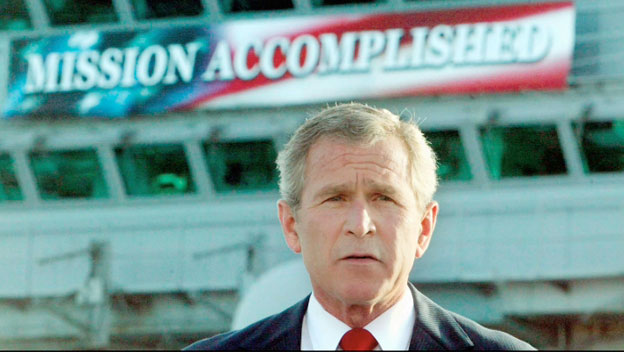
It was a large banner and its message was clear. It read: “Mission Accomplished,” and no, I don’t mean the classic “mission accomplished” banner on the USS Abraham Lincoln under which, on May 1, 2003, President George W. Bush proudly proclaimed (to the derision of critics ever since) that “major combat operations in Iraq have ended.” I’m actually referring to a September 1982 banner with those same two words (and an added “farewell” below them) displayed on a landing craft picking up the last Marines sent ashore in Beirut, Lebanon, to be, as President Ronald Reagan put it when they arrived the previous August, “what Marines have been for more than 200 years — peace-makers.” Of course, when Bush co-piloted an S-3B Viking sub reconnaissance Naval jet onto the deck of the Abraham Lincoln and made his now-classic statement, major combat had barely begun in Iraq (and it has yet to end) — nor was it peace that came to Beirut in September 1982: infamously, the following year 241 Marines would die there in a single day, thanks to a suicide bomber.
“Not for the last time,” writes Andrew Bacevich in his monumental new work, America’s War for the Greater Middle East: A Military History, “the claim proved to be illusory.” Indeed, one of the grim and eerie wonders of his book is the way in which just about every wrongheaded thing Washington did in that region in the 14-plus years since 9/11 had its surprising precursor in the two decades of American war there before the World Trade Center towers came down. U.S. military trainers and advisers, for example, failed (as they later would in Iraq and Afghanistan) to successfully build armies, starting with the Lebanese one; Bush’s “preventive war” had its predecessor in a Reagan directive called (ominously enough given what was to come) “combating terrorism”; Washington’s obsessive belief of recent years that problems in the region could be solved by what Andrew Cockburn has called the “kingpin strategy” — the urge to dismantle terror organizations by taking out their leadership via drones or special operations raids — had its precursor in “decapitation” operations against Muammar Gaddafi, Saddam Hussein, and Somali warlord Mohamed Farrah Aidid with similar resulting mayhem. The belief that “an additional increment of combat power might turn around a failing endeavor” — call it a “surge,” if you will — had its Iraq and Afghan pretrial run in Somalia in 1993. And above all, of course, there was Washington’s unquenchable post-1980 urge to intervene, military first, in a decisive way throughout the region, which, as Bacevich writes, only “produced conditions conducive to further violence and further disorder,” and if that isn’t the repetitive history of America’s failed post-2001 wars in a nutshell, what is?
As it happened, the effects of such actions from 1980 on were felt not just in the Greater Middle East and Africa, but in the United States, too. There, as Bacevich writes today, war became a blank-check activity for a White House no longer either checked (in any sense) or balanced by Congress. Think of it as another sad tale of a surge (or do I mean a decapitation?) that went wrong. Tom Engelhardt
Writing a blank check on war for the president
How the United States became a prisoner of war and Congress went MIA
By Andrew J. BacevichLet’s face it: in times of war, the Constitution tends to take a beating. With the safety or survival of the nation said to be at risk, the basic law of the land — otherwise considered sacrosanct — becomes nonbinding, subject to being waived at the whim of government authorities who are impatient, scared, panicky, or just plain pissed off.
The examples are legion. During the Civil War, Abraham Lincoln arbitrarily suspended the writ of habeas corpus and ignored court orders that took issue with his authority to do so. After U.S. entry into World War I, the administration of Woodrow Wilson mounted a comprehensive effort to crush dissent, shutting down anti-war publications in complete disregard of the First Amendment. Amid the hysteria triggered by Pearl Harbor, Franklin Roosevelt issued an executive order consigning to concentration camps more than 100,000 Japanese-Americans, many of them native-born citizens. Asked in 1944 to review this gross violation of due process, the Supreme Court endorsed the government’s action by a 6-3 vote.
More often than not, the passing of the emergency induces second thoughts and even remorse. The further into the past a particular war recedes, the more dubious the wartime arguments for violating the Constitution appear. Americans thereby take comfort in the “lessons learned” that will presumably prohibit any future recurrence of such folly.
What is a dirty bomb and how dangerous is it?
By Robert J Downes, King’s College London
The worrying news that individuals affiliated with the so-called Islamic State have undertaken hostile surveillance at a Belgian nuclear research facility has created growing speculation about the group’s nuclear ambitions.
Nuclear weapons and dirty bombs are frequently mentioned in the same breath. However, they are two distinct technologies. Understanding the differences between these weapons and the damage they can cause can ground speculation in reality – and help us work out the most likely route a terrorist organisation such as Islamic State may take in the future.
There are two types of actual nuclear weapon – fission and thermonuclear devices. Fission bombs are fuelled with fissile material such as uranium and plutonium. When detonated, the atoms in the weapon’s core split and release huge amounts of energy – producing a nuclear explosion. Thermonuclear weapons use a fission bomb to ignite special fuel, consisting of light hydrogen isotopes. These nuclei are forced together – undergoing nuclear fusion – releasing an even larger explosion.
There are no indications that a terrorist group has obtained any fissile material to date. If they could it would be possible for them to build a fission device, although this does pose a huge technical challenge. While highly engineered weapons need only a few kilograms of fissile material, a crude terrorist-built design would require far more. Thermonuclear weapons, on the other hand, are too complex for terrorist groups to develop.
An easier option for a terrorist group would be to build a dirty bomb or, technically, a radiological dispersal device. These do not rely on complex nuclear reactions. Instead, conventional explosives are used to disperse radioactive material, contaminating an area with elements such as radioactive isotopes of cobalt, caesium or americium.
Dilip Hiro: Flashpoint for the planet
Once upon a time, if a war was going to destroy your world, it had to take place in your world. The soldiers had to land, the planes had to fly overhead, the ships had to be off the coast. No longer. Nuclear war changed that equation forever and not just because nuclear weapons could be delivered from a great distance by missile. To use a term that has become commonplace in our world when discussing commerce, the prospect of nuclear conflict has globalized war and it’s a nightmare of the first order.
In the post-Cold War world, Exhibit A in that process would certainly be the unnerving potential for a nuclear war to break out between India and Pakistan. As TomDispatch regular Dilip Hiro, author most recently of The Age of Aspiration: Money, Power, and Conflict in Globalizing India, makes clear today, there is no place on the planet where a nuclear war is more imaginable. After all, those two South Asian countries have been to war with each other or on the verge of it again and again since they were split apart in 1947.
Of course, a major nuclear war between them would result in an unimaginable catastrophe in South Asia itself, with casualties estimated at up to 20 million dead from bomb blasts, fire, and the effects of radiation on the human body. And that, unfortunately, would only be the beginning. As Alan Robock and Owen Brian Toon wrote in Scientific American back in 2009, when the Indian and Pakistani arsenals were significantly smaller than they are today, any major nuclear conflagration in the region could hardly be confined to South Asia. The smoke and particulates thrown into the atmosphere from those weapons would undoubtedly bring on some version of a global “nuclear winter,” whose effects could last for at least 10 years, causing crop shortfalls and failures across the planet. The cooling and diminished sunlight (along with a loss of rainfall) would shorten growing seasons in planetary breadbaskets and produce “killing frosts in summer,” triggering declines in crop yields across the planet. Robock and Toon estimate that “around one billion people worldwide who now live on marginal food supplies would be directly threatened with starvation by a nuclear war between India and Pakistan.”
To say the least, it’s a daunting prospect at the very moment when the Obama White House has just ended the president’s final Nuclear Security Summit with fears rising that Pakistan’s new generation of small, front-line tactical nuclear weapons are “highly vulnerable to theft or misuse.” Hiro, an expert on the South Asian region, suggests just why a nuclear war is all too conceivable there and would be a catastrophe for us all. Tom Engelhardt
The most dangerous place on Earth
A nuclear Armageddon in the making in South Asia
By Dilip HiroUndoubtedly, for nearly two decades, the most dangerous place on Earth has been the Indian-Pakistani border in Kashmir. It’s possible that a small spark from artillery and rocket exchanges across that border might — given the known military doctrines of the two nuclear-armed neighbors — lead inexorably to an all-out nuclear conflagration. In that case the result would be catastrophic. Besides causing the deaths of millions of Indians and Pakistanis, such a war might bring on “nuclear winter” on a planetary scale, leading to levels of suffering and death that would be beyond our comprehension.
Alarmingly, the nuclear competition between India and Pakistan has now entered a spine-chilling phase. That danger stems from Islamabad’s decision to deploy low-yield tactical nuclear arms at its forward operating military bases along its entire frontier with India to deter possible aggression by tank-led invading forces. Most ominously, the decision to fire such a nuclear-armed missile with a range of 35 to 60 miles is to rest with local commanders. This is a perilous departure from the universal practice of investing such authority in the highest official of the nation. Such a situation has no parallel in the Washington-Moscow nuclear arms race of the Cold War era.
Taliban leader, trying to end infighting, appoints critics to senior posts
The New York Times reports: In a compromise bid to unite the ranks after months of infighting, the Taliban’s new leader has appointed the brother and son of Mullah Muhammad Omar, the movement’s deceased founder, to senior leadership posts, a spokesman for the insurgent group said on Tuesday.
The appointments are the latest move by the supreme Taliban leader, Mullah Akhtar Muhammad Mansour, to publicly consolidate his authority after a leadership struggle last summer.
Facing criticism or outright rebellion from field commanders who distrusted his ties to Pakistan and his handling of the succession, Mullah Mansour brutally quashed breakaway groups and sought to buy the support of other skeptical commanders, all while maintaining a publicity campaign that has portrayed the Taliban as united under his command, according to interviews with Taliban members. They spoke on condition of anonymity to avoid angering Mullah Mansour.
Now, the announcement that he had formally brought two of the most influential skeptics back into the fold — Mullah Abdul Manan, the brother of Mullah Omar; and Mullah Muhammad Yaqoub, the founder’s son — was expected to help bring other dissenters into line right as the Taliban’s annual offensive is expected to pick up momentum in Afghanistan. [Continue reading…]
Saudi Arabia passes Russia as world’s third biggest military spender
The Washington Post reports: Global military spending reached almost $1.7 trillion in 2015, marking a year-on-year increase for the first time since 2011, according to the Stockholm International Peace Research Institute, which tracks arms expenditure around the world.
The United States remained far and away the top spender, which despite a dip from 2014, accounted for more than a third of total global spending. It was followed by China and then, perhaps surprisingly, Saudi Arabia, which supplanted Russia in third place. [Continue reading…]
Unlike the secrets exposed by the Panama Papers, big U.S. tax dodging is done in full public view
Quartz reports: Unlike in emerging markets and in Europe, the main US tax avoidance problem isn’t about individuals. Data on financial assets such as stocks and bonds, instruments in which affluent people tend to park their wealth, show a relatively small share of US money is kept offshore.
No, in the US, tax avoidance has more to do with corporations. And much of that dodging has increasingly been done in the clear, bright light of public view.
In his terrific recent book on what he calls the “scourge of tax havens,” Gabriel Zucman, an economist at the University of California, Berkeley, estimates that the artificial shifting of profits to low-tax locales such as Ireland, Switzerland, and the Bahamas reduces US corporate tax liabilities by $130 billion per year.
But the US Treasury Department is taking steps to address this. On April 4, it imposed new limits on so-called tax inversions, a type of deal in which a US company merges with a smaller firm in a foreign country where taxes are lower, adopts the foreign address, and takes advantage of the discrepancy in tax rates.
Such deals have been one of the most popular type of M&A transaction in recent years. The $160 billion deal between US drug giant Pfizer and Ireland-based Allergan is perhaps the most eye-popping example of this. [Continue reading…]