Category Archives: Analysis

Israeli mainstream media recognizes the significance of the boycott

Larry Derfner writes: On Saturday night the boycott of Israel gained an impressive new level of mainstream recognition in this country. Channel 2 News, easily the most watched, most influential news show here, ran a heavily-promoted, 16-minute piece on the boycott in its 8 p.m. prime-time program. The piece was remarkable not only for its length and prominence, but even more so because it did not demonize the boycott movement, it didn’t blame the boycott on anti-Semitism or Israel-bashing. Instead, top-drawer reporter Dana Weiss treated the boycott as an established, rapidly growing presence that sprang up because of Israel’s settlement policy and whose only remedy is that policy’s reversal.

In her narration, Weiss ridicules the settlers and the government’s head-in-the-sand reaction to the rising tide. The segment from the West Bank’s Barkan Industrial Park opens against a background of twangy guitar music like from a Western. “To the world it’s a black mark, a symbol of the occupation,” she reads. “But here they insist it’s actually a point of light in the area, an island of coexistence that continues to flourish despite efforts to erase it from the map.” A factory owner who moved his business to Barkan from the other side of the Green Line makes a fool of himself by saying, “If the state would only assist us by boycotting the Europeans and other countries causing us trouble …” The Barkan segment ends with the manager of Shamir Salads saying that between the European and Palestinian boycott, he’s losing about $115,000 to $143,000 a month in sales. “In my view,” he says, “it will spread from [the West Bank] to other places in Israel that have no connection to the territories.”

Weiss likewise ridicules Deputy Foreign Minister Ze’ev Elkin, who runs the government’s “hasbara war,” as he puts it. Weiss: “Yes, in the Foreign Ministry they are for the time being sticking to the old conception: it’s all a question of hasbara. This week the campaign’s new weapon, developed with the contributions of world Jewry: (Pause) Another hasbara agency, this time with the original name ‘Face To Israel.’” She quotes the co-owner of Psagot Winery saying the boycott is “nothing to get excited about,” that people have been boycotting Jews for 2,000 years, and concluding, “If you ask me, in the last 2,000 years, our situation today is the best it’s ever been.” That final phrase, along with what Weiss describes as Elkin’s “conceptzia,” are the same infamous words that Israelis associate with the fatal complacency that preceded the surprise Yom Kippur War. [Continue reading…]

Facebooktwittermail

How the U.S. turned the world into a war zone

Gregory D Johnsen writes: Sunrise was still nearly an hour off when Nazih al-Ruqai climbed into his black Hyundai SUV outside a mosque in northern Tripoli and turned the key. The lanky 49-year-old had left the house barely 30 minutes earlier for a quick trip to the mosque on a Saturday. It was Oct. 5, 2013, and after more than two decades in exile, he had settled into a predictable existence of prayer and worship.

The homecoming hadn’t always been so smooth. Ruqai, who is better known in the jihadi world as Abu Anas al-Libi, was still feeling the effects of the hepatitis C he had contracted years earlier during a stint in an underground prison in Iran. Following overtures from Muammar al-Qaddafi’s government, his wife and children had returned to Libya in 2010. But Libi stayed away, wary of the man he had once plotted to kill. Only when the Libyan uprisings started in early 2011 did he follow his family back to Libya. But by then it was already too late. His oldest son, Abd al-Rahman, the only one of his five children who had been born in Libya, was dead, shot while fighting for the capital.

After that, things moved in fits and starts. Qaddafi was killed weeks later in October 2011, and Libi eventually settled in Nufalayn, a leafy middle-class neighborhood in northeast Tripoli, alongside several members of his extended family. Life after Qaddafi was chaotic and messy — nothing really worked as the new government struggled to reboot after 42 years of dictatorship, often finding itself at the mercy of the heavily armed militias and tribes that had contributed to Qaddafi’s downfall.

Libi knew he was a wanted man. He had been on the FBI’s most wanted list for more than a decade, following an indictment in 2000 for his alleged role in al-Qaeda’s attacks on U.S. embassies in Kenya and Tanzania two years earlier. Along with Libi the indictment named 20 other individuals, including Osama bin Laden and Ayman al-Zawahiri, as defendants.

“He suspected that at any moment he would be killed,” his son later told The New York Times. Still, on that Saturday morning in early October, much of the danger seemed to have passed. Libi had been living in the open for nearly a year, attending prayers and settling local disputes, where his history as a fighter and knowledge of the Qur’an made him a respected arbiter. Neighbors called him simply “the shaykh,” a sign of respect in the conservative circles in which Libi still moved.

He had also taken steps to address his past. Three weeks earlier, on Sept. 15, Libi had sat down with Libya’s attorney general to discuss his indictment, according to one report. (The Libyan Embassy in Washington did not respond to repeated requests to confirm Libi’s meeting.) But mostly he just wanted to move on with his life. He had applied for his old job at the Ministry of Oil and Gas and he couldn’t stop talking about how much he was looking forward to becoming a grandfather for the first time.

A trio of cars around 6 a.m. ended all of that.

Inside the family’s apartment, Libi’s wife heard the commotion. From a window she looked out over the beige wall that surrounded their building and into the street where several men had surrounded her husband, who was still in the driver’s seat of his black Hyundai.

“Get out,” the men shouted in Arabic. “Get out.” Then they smashed the window. Most of the men were masked, but she could see a few faces, she said later in Arabic interviews. They looked Libyan; they sounded Libyan. Some of them had guns; some didn’t, but they all moved quickly.

By the time the rest of the family made it to the street, all that was left was a single sandal and a few drops of blood.

Early that same morning, nearly 3,000 miles away in the seaside city of Baraawe on Somalia’s eastern coast, U.S. Navy SEALs crept through the darkness toward their target, which a local resident later described to me as a walled compound more than 100 yards inland. The Americans had been here before. Four years earlier, in September 2009, a contingent of Navy SEALs had ambushed a two-car convoy just outside of town. Flying low in helicopter gunships, the SEALs quickly disabled the cars and then touched down to collect the bodies.

This time the target — Abd al-Qadir Muhammad Abd al-Qadir, a young Kenyan of Somali descent better known as Ikrima — was stationary. The SEALs would have to go in and get him. Pre-raid intelligence suggested that the compound housed mostly fighters with few or no civilians present. Only 130 miles south of Mogadishu and what passed for the Somali government, Baraawe had been under the control of al-Shabaab, a fragmentary militant group, since 2009. Fighters came and went freely, as al-Shabaab implemented its own narrow version of Islamic law in the city.

Moving up the beach and into enemy territory, the SEALs needed the element of surprise. Through the trees and scrub brush ahead of them, most of the city was dark. Baraawe had only a few hours of electricity each day, usually from evening prayers until midnight. But al-Shabaab’s members lived separately and, along with some of the city’s wealthier residents, got around the shortages by running private generators. The plan that night took this into account, calling for the SEALs to jam internet signals, apparently in an attempt to cut off communication once the raid began. That would prove to be a mistake.

Inside the compound, some of the al-Shabaab fighters were up late and online. And, according to a report in the Toronto Star, when the internet suddenly went out in the middle of the night, they went to look for the source of the problem. At least one fighter stepped outside, and as he moved around in the darkness he spotted some of the SEALs.

The plan to knock the internet offline and isolate the fighters in the villa had backfired, effectively giving al-Shabaab an early warning that the SEALs were on their way. (In the days after the raid, al-Shabaab would arrest a handful of local men who were known to visit Western websites, accusing them of spying and aiding U.S. efforts.)

The firefight lasted several minutes, although residents reported hearing gunfire throughout the night as members of al-Shabaab discharged their weapons into the dark for hours after the Americans had withdrawn, empty-handed.

In the span of a few hours, the U.S. had launched a pair of raids — one successful and one not — 3,000 miles apart, in countries with which the nation was not at war. Hardly anyone noticed.

More than a dozen years after the Sept. 11 attacks, this is what America’s war looks like, silent strikes and shadowy raids. The Congressional Research Service, an analytical branch of the Library of Congress, recently said that it had located at least 30 similar occurrences, although the number of covert actions is likely many times higher with drones strikes and other secret operations. The remarkable has become regular.

The White House said that the operations in both Libya and Somalia drew their authority from the Authorization for the Use of Military Force, a 12-year-old piece of legislation that was drafted in the hours after the Sept. 11 attacks. At the heart of the AUMF is a single 60-word sentence, which has formed the legal foundation for nearly every counterterrorism operation the U.S. has conducted since Sept. 11, from Guantanamo Bay and drone strikes to secret renditions and SEAL raids. Everything rests on those 60 words. [Continue reading…]

Facebooktwittermail

The Sunni-Shiite divide in the Greater Levant

Giandomenico Picco writes: The entire region from Pakistan to Lebanon — what I refer to as the Greater Levant — has been affected by profound, seismic changes during the course of the last three decades. These began in the late 1970s, in the Pakistan-Afghanistan-Iran triangle.

Pakistan received the political support of Saudi Arabia, both in its tense standoff with nuclear India and in its increasingly intense relationship with the Soviet Union, which had invaded neighboring Afghanistan in December 1979. The Khomeini revolution (February 1979) in Shiite Iran convinced the Sunni “world” of an epochal change in the making. This little-noticed affair was at the very root of a more open confrontation along sectarian lines. In the mess of the first Afghan War of the 1980s, which I witnessed up close and personal, the underlying Sunni and Shiite conflict was barely noticed by the rest of the world, though it was better perceived in the war between Iran and Iraq in the same decade.

In the 1990s, however, events in Afghanistan revealed the true face of the underlying confrontation between Sunni and Shiite throughout the region. By the mid 1990s, the Taliban, with Pakistani support, began to make their run for total victory in Kabul. Soon the Sunni Afghan tribes (i.e., the Pasthun) and the Shiite Afghan tribes (i.e. the Tajiks and Hazaras), were engaged in open sectarian civil war. The Shiite tribes were supported by Russia and Iran, while the Taliban received support from Pakistan, somewhat from Saudi Arabia and, for a while, from the West, though in a very undecided way.

The tragic events of September 11, which had been masterminded by Sunni men who had trained in Afghanistan, resulted in a new understanding between Iran and the United States. The interests of both countries had coalesced. The 2001 Bonn Agreements between Washington and Tehran revealed that both nations had a common enemy in the Sunni extremists. At the same time, Hamid Karzai, a Pashtun Sunni, became president of Afghanistan and the opposing Tajiiks came back to Kabul and entered into a coalition of sorts with Karzai. While this did not end the sectarian conflict, which continued during and after the U.S. military intervention, post-2001 Afghanistan is an example of a country rife with sectarian conflict, yet one in which compromise of a sort can be sought and even found.

But then came Iraq. Iran welcomed the U.S. war against Saddam Hussein in 2003, seeing it as payback for 1534, an important, sad date in the Shiite narrative. In that year, Suleiman the First (the Ottoman Sultan) conquered Mesopotamia (modern day Iraq) and “the land of the two rivers” came under the control of the Sunni minority. Iran felt that the West had inadvertently given them a chance to reclaim Baghdad for the Shiites. Again, the ancient Sunni-Shiite conflict structured events but was little noticed by the West.

Despite vigorous efforts, there has been little progress on the Israeli-Palestinian question. Indeed, there has been no progress at all since Prime Minister Rabin was assassinated by one of his own fellow citizens in mid 1995. The longest running conflict in the modern Middle East now seems to have little effect on the day-to-day events of the region. Indeed I would submit that the conflict is no longer pivotal in the region.

There are several reasons for this shift in the prominence and perception of the issue: for one thing, the Cold War came to an end and power struggles in the region were no longer proxy conflicts between the superpowers. Globalization, moreover, has weakened national and nationalistic boundaries and created unprecedented economic interdependence. Technology has made the individual more powerful than he or she has ever been before and the very concept of the nation-state is changing. The simple, two-dimensional worldview of decades past has yielded to recognition of a multiplicity of variables in the Greater Levant. Still, the principal, underlying and organizational dynamic of the entire region is no longer the Palestinian-Israeli conflict but the Sunni-Shiite conflict and its cold and hot wars in every country from the Hindu Kush to the Litani River.

The lead actors in this ongoing drama remain Shiite Iran and Sunni Saudi Arabia. If a new architecture for the entire region is going to be found, then these two countries must take on the responsibility. Yet the chess game between Riyadh and Tehran continues: in Iraq, the Shiites have won a victory of sorts in the West’s defeat of Saddam. Yet Saddam’s Sunni backers in the region do not accept this as the last word. This remains the core line of demarcation for both sides. [Continue reading…]

Facebooktwittermail

America’s forgotten lobotomized soldiers

The Wall Street Journal reports: Roman Tritz’s memories of the past six decades are blurred by age and delusion. But one thing he remembers clearly is the fight he put up the day the orderlies came for him.

“They got the notion they were going to come to give me a lobotomy,” says Mr. Tritz, a World War II bomber pilot. “To hell with them.”

The orderlies at the veterans hospital pinned Mr. Tritz to the floor, he recalls. He fought so hard that eventually they gave up. But the orderlies came for him again on Wednesday, July 1, 1953, a few weeks before his 30th birthday.

This time, the doctors got their way.

The U.S. government lobotomized roughly 2,000 mentally ill veterans—and likely hundreds more—during and after World War II, according to a cache of forgotten memos, letters and government reports unearthed by The Wall Street Journal. Besieged by psychologically damaged troops returning from the battlefields of North Africa, Europe and the Pacific, the Veterans Administration performed the brain-altering operation on former servicemen it diagnosed as depressives, psychotics and schizophrenics, and occasionally on people identified as homosexuals.

The VA doctors considered themselves conservative in using lobotomy. Nevertheless, desperate for effective psychiatric treatments, they carried out the surgery at VA hospitals spanning the country, from Oregon to Massachusetts, Alabama to South Dakota.
Roman Tritz talks about the scars from his lobotomy.

The VA’s practice, described in depth here for the first time, sometimes brought veterans relief from their inner demons. Often, however, the surgery left them little more than overgrown children, unable to care for themselves. Many suffered seizures, amnesia and loss of motor skills. Some died from the operation itself.

Mr. Tritz, 90 years old, is one of the few still alive to describe the experience. “It isn’t so good up here,” he says, rubbing the two shallow divots on the sides of his forehead, bracketing wisps of white hair.

The VA’s use of lobotomy, in which doctors severed connections between parts of the brain then thought to control emotions, was known in medical circles in the late 1940s and early 1950s, and is occasionally cited in medical texts. But the VA’s practice, never widely publicized, long ago slipped from public view. Even the U.S. Department of Veterans Affairs says it possesses no records detailing the creation and breadth of its lobotomy program.

When told about the program recently, the VA issued a written response: “In the late 1940s and into the 1950s, VA and other physicians throughout the United States and the world debated the utility of lobotomies. The procedure became available to severely ill patients who had not improved with other treatments. Within a few years, the procedure disappeared within VA, and across the United States, as safer and more effective treatments were developed.”

Musty files warehoused in the National Archives show VA doctors resorting to brain surgery as they struggled with a vexing question that absorbs America to this day: How best to treat the psychological crises that afflict soldiers returning from combat.

Between April 1, 1947, and Sept. 30, 1950, VA doctors lobotomized 1,464 veterans at 50 hospitals authorized to perform the surgery, according to agency documents rediscovered by the Journal. Scores of records from 22 of those hospitals list another 466 lobotomies performed outside that time period, bringing the total documented operations to 1,930. Gaps in the records suggest that hundreds of additional operations likely took place at other VA facilities. The vast majority of the patients were men, although some female veterans underwent VA lobotomies, as well.

Lobotomies faded from use after the first major antipsychotic drug, Thorazine, hit the market in the mid-1950s, revolutionizing mental-health care.

The forgotten lobotomy files, military records and interviews with veterans’ relatives reveal the details of lives gone terribly wrong. There was Joe Brzoza, who was lobotomized four years after surviving artillery barrages on the beaches at Anzio, Italy, and spent his remaining days chain-smoking in VA psychiatric wards. Eugene Kainulainen, whose breakdown during the North African campaign the military attributed partly to a childhood tendency toward “temper tantrums and [being] fussy about food.” Melbert Peters, a bomber crewman given two lobotomies—one most likely performed with a pick-like instrument inserted through his eye sockets.

And Mr. Tritz, the son of a Wisconsin dairy farmer who flew a B-17 Flying Fortress on 34 combat missions over Germany and Nazi-occupied Europe.

“They just wanted to ruin my head, it seemed to me,” says Mr. Tritz. “Somebody wanted to.”

The VA documents subvert an article of faith of postwar American mythology: That returning soldiers put down their guns, shed their uniforms and stoically forged ahead into the optimistic 1950s. Mr. Tritz and the mentally ill veterans who shared his fate lived a struggle all but unknown except to the families who still bear lobotomy’s scars. [Continue reading…]

Facebooktwittermail

ISIS may be led by former Iraqi army officers

@wikibaghdady, a Twitter account that started on December 10, allegedly provides an insider’s account of the development of the Islamic State of Iraq and Syria (ISIS). A report in Al-Akbar based on the information provided in the tweets, begins by examining the identity of Abu Bakr al-Baghdadi, the ISIS “emir.”

The leaks maintain that he is Ibrahim Awwad Ibrahim Bou Badri bin Armoush, known as Abu Awwad or Abu Doaa. Abu Bakr is an alias.

According to the leaks, Baghdadi worked in Fallujah and served as an imam in a mosque in Diyala. Baghdadi is not from Baghdad, since he belongs to the Bou Badri clan, which is a part of the Bou Abbas clan from Samarra, which claims to be a descendant of Imam al-Hassan Bin Ali. This means Abu Bakr has roots in the Quraish tribe, which is a condition for becoming an emir in a jihadi group. However, the Alawi Heritage Validation Organization, which authenticates Hashemite heritage, published a statement in 2009 maintaining that the Bou Badri are neither descendants of Mohammed al-Jawad nor of Bin Idris, and thus do not belong to the Hassans as they claim.

The page indicates that the ISIS leadership council is 100 percent Iraqi, saying that Baghdadi would not accept any other nationality, since he does not trust anyone. The number of people in the council always changes, ranging between eight and 13 people. The leadership of the council is held by three former Iraqi army officers who served during the regime of Saddam Hussein.

They are commanded by a former Iraqi army colonel called Hajji Bakr, who joined ISIS when it was under the command of Abu Omar al-Baghdadi (killed in 2010). Hajji Bakr was appointed as a consultant to Abu Omar al-Baghdadi and Abu Hafs al-Muhajir, after providing them with military information about combat plans and communication methods with former Baath commanders.

The leaks mention that Abu Bakr al-Baghdadi was not a member of the former leadership council of the Islamic State of Iraq, headed by Abu Omar, although he was part of the organization and lived in Fallujah. However, after the killing of Abu Omar and his deputy, Hajji Bakr surprised everyone in the military council by supporting Abu Bakr al-Baghdadi as a new emir of the organization.

A new phase of the State began under two leaders, Abu Bakr al-Baghdadi in public and Hajji Bakr behind the scenes. The appearance of the colonel, “a beardless western imitator,” next to Abu Bakr, irritated members, so he grew a beard and changed his appearance and mannerisms. However, the members are not allowed to inquire about the leadership, “since inquiring is doubting, and doubting is a break in ranks, which calls for blood.” [Continue reading…]

Facebooktwittermail

Obama’s restrictions on NSA surveillance rely on narrow definition of ‘spying’

Barton Gellman reports: President Obama said Friday, in his first major speech on electronic surveillance, that “the United States is not spying on ordinary people who don’t threaten our national security.”

Obama placed restrictions on access to domestic phone records collected by the National Security Agency, but the changes he announced will allow it to continue — or expand — the collection of personal data from billions of people around the world, Americans and foreign citizens alike.

Obama squares that circle with an unusually narrow definition of “spying.” It does not include the ingestion of tens of trillions of records about the telephone calls, e-mails, locations and relationships of people for whom there is no suspicion of relevance to any threat.

In his speech, and an accompanying policy directive, Obama described principles for “restricting the use of this information” — but not for gathering less of it.

Alongside the invocation of privacy and restraint, Obama gave his plainest endorsement yet of “bulk collection,” a term he used more than once and authorized explicitly in Presidential Policy Directive 28. In a footnote, the directive defined the term to mean high-volume collection “without the use of discriminants.” [Continue reading…]

Facebooktwittermail

The truth about Israel’s secret nuclear arsenal

Julian Borger reports: Deep beneath desert sands, an embattled Middle Eastern state has built a covert nuclear bomb, using technology and materials provided by friendly powers or stolen by a clandestine network of agents. It is the stuff of pulp thrillers and the sort of narrative often used to characterise the worst fears about the Iranian nuclear programme. In reality, though, neither US nor British intelligence believe Tehran has decided to build a bomb, and Iran’s atomic projects are under constant international monitoring.

The exotic tale of the bomb hidden in the desert is a true story, though. It’s just one that applies to another country. In an extraordinary feat of subterfuge, Israel managed to assemble an entire underground nuclear arsenal – now estimated at 80 warheads, on a par with India and Pakistan – and even tested a bomb nearly half a century ago, with a minimum of international outcry or even much public awareness of what it was doing.

Despite the fact that the Israel’s nuclear programme has been an open secret since a disgruntled technician, Mordechai Vanunu, blew the whistle on it in 1986, the official Israeli position is still never to confirm or deny its existence.

When the former speaker of the Knesset, Avraham Burg, broke the taboo last month, declaring Israeli possession of both nuclear and chemical weapons and describing the official non-disclosure policy as “outdated and childish” a rightwing group formally called for a police investigation for treason.

Meanwhile, western governments have played along with the policy of “opacity” by avoiding all mention of the issue. In 2009, when a veteran Washington reporter, Helen Thomas, asked Barack Obama in the first month of his presidency if he knew of any country in the Middle East with nuclear weapons, he dodged the trapdoor by saying only that he did not wish to “speculate”. [Continue reading…]

Facebooktwittermail

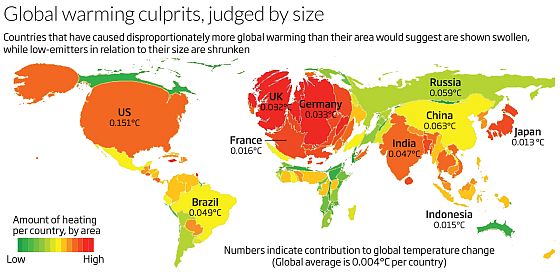
The United States’ disproportionate impact on global warming

global-warming-culprits

New Scientist reports: It’s a chart that no one wants to top, but global warming’s worst offenders, in absolute terms, are the US, China, Russia, Brazil, India, Germany and the UK. New calculations suggest that these nations are responsible for more than 60 per cent of the global warming between 1906 and 2005.

Damon Matthews of Concordia University in Montreal, Canada, and his colleagues calculated national contributions to warming by weighting each type of emission according to the atmospheric lifetime of the temperature change it causes. Using historical data, they included carbon dioxide from burning fossil fuels and changes in land use – such as deforestation. They also accounted for methane, nitrous oxide and sulphate aerosols. These together account for 0.7 °C of the world’s 0.74 °C warming between 1906 and 2005.

The US is the clear leader, responsible for 0.15 °C, or 22 per cent of the 0.7 °C warming. China accounts for 9 per cent, Russia for 8 per cent, Brazil and India 7 per cent each, and Germany and the UK for 5 per cent each. [Continue reading…]

Facebooktwittermail

If you want Obama to rein in the NSA, you’re about to be disappointed

James Oliphant writes: President Obama has a rare opportunity this week to reshape the nation’s counterterrorism strategy. He won’t take it.

The White House has been trying to lower expectations for the president’s planned Friday speech for days now. He’ll outline a series of reforms to the National Security Agency’s surveillance programs in an address at the Justice Department, but Obama will do nothing to diminish the government’s capacity to root out terror networks, aides say.

Ever since the flood of disclosures regarding the NSA from former contractor Edward Snowden, Obama and his team have tried to walk a careful public line: appearing to cherish Americans’ privacy while defending the agency’s actions, particularly the bulk collection of telephone records, the so-called “metadata.”

But it’s been evident all along that the White House has more or less been dragged into the reform debate. At a press conference back in August, for example, the president maintained, amid heavy criticism, that the programs are valuable and that a public skeptical about their reach simply needs reassurance that they won’t be abused.

That’s still Obama’s view. And in the days leading to Friday’s speech, Jay Carney and others in the White House have referred to the issue as one of transparency and disclosure, not of reining in government power. “The president has been clear throughout this review process that we will not harm our national security or our ability to face global threats,” Obama’s press secretary said last week. “And our intelligence-gathering activities are directly related to our ability to face those global threats and protect our national security.”

To lay the groundwork for that position, aides to the president told the Los Angeles Times this weekend that the NSA’s metadata collection scheme could have prevented the Sept. 11 attacks. What’s more, Obama has adopted that “9/11 justification” for the NSA program, the paper reported.

That’s a blinking-red signal that the administration is not about to be accused of making the country more vulnerable by tampering with such a preventive weapon. [Continue reading…]

Facebooktwittermail

NSA phone record collection does little to prevent terrorist attacks, group says

The Washington Post reports: An analysis of 225 terrorism cases inside the United States since the Sept. 11, 2001, attacks has concluded that the bulk collection of phone records by the National Security Agency “has had no discernible impact on preventing acts of terrorism.”

In the majority of cases, traditional law enforcement and investigative methods provided the tip or evidence to initiate the case, according to the study by the New America Foundation, a Washington-based nonprofit group.

The study, to be released Monday, corroborates the findings of a White House-appointed review group, which said last month that the NSA counterterrorism program “was not essential to preventing attacks” and that much of the evidence it did turn up “could readily have been obtained in a timely manner using conventional [court] orders.” [Continue reading…]

Facebooktwittermail

Looking for lessons in Iceland’s economic recovery

Der Spiegel reports: What should one expect from a country in which the sentence, “What an asshole!” is a compliment? Icelanders say “asshole,” or “rassgat,” when they tousle a child’s hair or greet friends, and they mean it to be friendly.

While trudging through a lava field within view of the Eyjafjallajökull volcano, the guide says: “Iceland is the asshole of the world.” That, too, is a positive statement. It’s also a geological metaphor. In Iceland, which lies on the Mid-Atlantic Ridge and thus on the dividing line of the North American and Eurasian tectonic plates, the earth has a tendency to relieve itself through various geysers, volcanoes and hot springs.

The island, an unlikely geological accident, has existed for some 18 million years, but has only been inhabited for 1,100 years. A pile of lava pushed out of the Atlantic that could eventually disappear again, it’s affectionately called “The Rock” by residents. Icelanders were traditionally fishermen and farmers until they decided to turn their country into a casino for global capital around the turn of the millennium.

But now they have returned to fishing, and gladly talk about their journey back to financial health. SPIEGEL spoke with an investor, a finance minister and a fisherman, in addition to an economist who says apologetically: “Icelanders are just daredevils.” And then there was a sex and knitting expert who says she believes Iceland has “found its way back to itself.”

What happened in Iceland from 2008 to 2011 is regarded as one of the worst financial crises in history. It seems likely that never before had a country managed to amass such great sums of money per capita, only to lose it again in a short period of time. But Iceland, with a population of just 320,000, has also staged what appears to be the fastest recovery on record. Since 2011, the gross domestic product has been on the rise once again, most recently at 2 percent. What’s more, salaries are rising, the national debt is sinking and the government has paid off part of the billions in loans it received in 2008 from the International Monetary Fund ahead of schedule. It’s a sign of confidence.

But how did they do it when others cannot? Can we learn something from Iceland? [Continue reading…]

Facebooktwittermail

The preacher who could topple Erdogan

Der Spiegel reports: Turgut Keles loved his premier. He maintained his support of Turkish Prime Minister Recep Tayyip Erdogan through early summer, when demonstrators in Istanbul were protesting the redevelopment of Gezi Park. When Erdogan held a rally for tens of thousands of supporters, Keles was in the first row.

But just half a year later, everything has changed. “Erdogan must go,” the former fan now says, adding that the prime minister has “betrayed” millions of Turks. Keles long voted in favor of Erdogan’s conservative Justice and Development Party (AKP). But his support of the party is exceeded by his admiration of Muslim preacher Fethullah Gülen, the leader of a powerful civic movement that is now at odds with Erdogan.

Keles attended a school founded by Gülen followers, and later studied at one of the movement’s universities. The organization helped him find a job, he says. Today, Keles works for a construction company in Istanbul and remains a devoted follower. “Anyone who insults Gülen, insults me,” he says.

For a long time, Gülen and Erdogan were allies. This fall, however, the prime minister announced that tutoring centers run by the Gülen movement would be shut down. Erdogan has accused the preacher’s supporters of creating a “state within a state,” and since then the two sides have been locked in a bitter power struggle. The conflict appears to confirm what many once dismissed as a conspiracy theory — that in many cases the Gülen movement controls the police and justice system.

Just before Christmas, police arrested more than 50 suspects, among them high-ranking AKP members, business owners and the sons of three ministers. They are accused of accepting bribes and involvement with illegal oil deals with Iran.

Gareth Jenkens, a Turkey expert from the Central Asia-Caucasus Institute, suspects that Gülen supporters are behind the investigations. “The movement wants to intimidate Erdogan. It is desperately trying to prevent the closure of its tutoring centers,” he says.

A former justice minister with the AKP even says that one employee of the country’s top court sought the preacher’s advice before ruling on a case.

Afraid of being watched, Keles looks into a cafe on an Istanbul side street. He’s not actually authorized to speak about the Gülen movement, which is also why he doesn’t want to use his real name. He wants to set one thing straight: It wasn’t the movement, but Erdogan, who started the current conflict, he says. “He’s behaving like a despot.”

Fethullah Gülen, who is believed to be 72, lives in exile in Pennsylvania. He fled Turkey in 1999 when the government, which was secular at the time, accused him of attempting to Islamize the country. His some 8 million supporters run schools, media companies, hospitals and an insurance company in 140 countries, including Germany. It is the “most powerful Islamist grouping” in Turkey, according to US State Department diplomatic cables made public by WikiLeaks in 2010. The network “controls major business, trade, and publishing activities, has deeply penetrated the political scene — including AKP at high levels.”

Gülen got his start as an imam in Ederne and Izmir, and soon persuaded pious businessmen to make donations. With this he financed schools, and his supporters founded student housing known as “lighthouses,” which are a fundamental part of the organization. Keles lived in one of these facilities, which often offer free accommodation in exchange for loyalty. Dropouts say the tone inside is militaristic; residents study Gülen’s writings and sermons under a provost’s supervision.

The community recruits new supporters in its schools and tutoring centers, training them as “soldiers of light.” Their task, whether they become businessmen, politicians or judges, is to spread Gülen’s conservative vision of Islam and to expand his influence.

But despite the fact that it’s a huge organization, the Gülen movement has no address and no headquarters. Fethullah Gülen alone determines its structure and path, while the cleric’s trusted “brothers” are in charge of its most important businesses. Among these is Zaman, Turkey’s highest-circulation newspaper, along with Bank Aysa, the country’s largest.

More than two years ago, Gülen urged his followers to infiltrate the Turkish state in a sermon that was captured on video. “You have to penetrate the arteries of the system without being noticed,” he said. You have to wait for the right moment, until you have seized the entire power of the state.” Gülen says the video has been manipulated. [Continue reading…]

Facebooktwittermail

The progress of inglorious revolutions

David A Bell writes: Two and a half years after it began, the revolution was widely considered a quagmire, even a disaster. Rebels had made disappointingly little headway against the forces of the hated tyrant. The capital and the country’s second major city remained under his control. Foreign powers had provided sympathy, but very little real aid. And despite promising to respect human rights, rebel forces were committing widespread abuses, including murder, torture and destruction of property. In short, the bright hopes of an earlier spring were fading fast.

This may sound like a description of Syria today, but it also describes quite well the situation of another country: the young United States in the winter of 1777–1778. George Washington had taken refuge in the miserable winter encampment of Valley Forge. Philadelphia (then the capital) and New York were both in British hands. France had not yet agreed to help the new republic militarily. And in areas under rebel control, loyalists were being persecuted—far more than most American school textbooks admit.

There is little reason to think that conditions in Syria will turn around the way they did in the United States between 1778 and 1781, when the American revolutionaries managed to eke out a military victory. But the comparison illuminates a different point. Historically, very few revolutions have been quick successes. They have been messy, bloody, long, drawn-out affairs. Victory has very rarely come without numerous setbacks, and, unfortunately, without abuses carried out by all sides. It has generally taken many years, even decades, for the real gains, if any, to become apparent. Yet today, international public opinion and international institutions usually fail to recognize this historical reality. There is an expectation that revolutions, where they occur, must lead within a very short period to the establishment of stable democracy and a full panoply of human rights, or they will be viewed as failures.

Consider, for instance, the disappointments that followed the Arab Spring and the resulting worldwide hand-wringing. Thomas Friedman, that great barometer of elite American conventional wisdom, wrote in May 2011 about the young Arabs who had begun to “rise up peacefully to gain the dignity, justice and self-rule that Bin Laden claimed could be obtained only by murderous violence.” Less than two years later, he was lamenting that “the term ‘Arab Spring’ has to be retired,” and comparing events in the region to the seventeenth century’s massively destructive Thirty Years’ War, in which areas of Central Europe lost up to a third of their populations. Many other commentators throughout the world now write off the Arab Spring as a disaster and failure, pure and simple. But arguably, not the least of the problems bedeviling the Arab revolutionaries of the last two and a half years has been the absurdly inflated expectations they have had to live up to. Put simply, they have been asked to achieve the sort of rapid and complete success that hardly any predecessors, including in the West, ever managed. [Continue reading…]

Facebooktwittermail

Social Darwinism isn’t dead

Matthew Hutson writes: London’s mayor, Boris Johnson, drew criticism late last year for saying that economic inequality can be attributed, in part, to IQ. “I am afraid that [the] violent economic centrifuge [of competition] is operating on human beings who are already very far from equal in raw ability,” he told an audience at the Centre for Policy Studies.

That’s a satisfying worldview for someone who is successful and considers himself unusually bright. But a quick look at the data shows the limitations of raw smarts and stick-to-itiveness as an explanation for inequality. The income distribution in the United States provides a good example. In 2012 the top 0.01 percent of households earned an average of $10.25 million, while the mean household income for the country overall was $51,000. Are top earners 200 times as smart as the rest of the field? Doubtful. Do they have the capacity to work 200 times more hours in the week? Even more doubtful. Many forces out of their control, including sheer luck, are at play.

But say you’re in that top 0.01 percent — or even the top 50 percent. Would you want to admit happenstance as a benefactor? Wouldn’t you rather believe that you earned your wealth, that you truly deserve it? Wouldn’t you like to think that any resources you inherited are rightfully yours, as the descendant of fundamentally exceptional people? Of course you would. New research indicates that in order to justify your lifestyle, you might even adjust your ideas about the power of genes. The lower classes are not merely unfortunate, according to the upper classes; they are genetically inferior.

In several experiments published in the Journal of Personality and Social Psychology, Michael Kraus of the University of Illinois at Urbana–Champaign and Dacher Keltner of the University of California at Berkeley explored what they call social class essentialism. Essentialism is the belief that surface differences between two groups of people or things can be explained by differences in fundamental identities. One sees categories as natural, discrete, and stable. Dogs have a certain dogness to them and cats a certain catness.

Researchers have found that people hold essentialist beliefs about generally biological categories such as gender, race, and sexuality, as well as about more cultural ones such as nationality, religion, and political orientation. Essentialism leads to stereotyping, prejudice, and a disinclination to mingle with outsiders. Kraus and Keltner wanted to know if we see social class as an essential category. [Continue reading…]

Facebooktwittermail

How the NSA almost killed the Internet

Wired reports: On June 6, 2013, Washington Post reporters called the communications depart­ments of Apple, Facebook, Google, Yahoo, and other Internet companies. The day before, a report in the British newspaper The Guardian had shocked Americans with evidence that the telecommunications giant Verizon had voluntarily handed a database of every call made on its network to the National Security Agency. The piece was by reporter Glenn Greenwald, and the information came from Edward Snowden, a 29-year-old IT consultant who had left the US with hundreds of thousands of documents detailing the NSA’s secret procedures.

Greenwald was the first but not the only journalist that Snowden reached out to. The Post’s Barton Gellman had also connected with him. Now, collaborating with documentary filmmaker and Snowden confidante Laura Poitras, he was going to extend the story to Silicon Valley. Gellman wanted to be the first to expose a top-secret NSA program called Prism. Snowden’s files indicated that some of the biggest companies on the web had granted the NSA and FBI direct access to their servers, giving the agencies the ability to grab a person’s audio, video, photos, emails, and documents. The government urged Gellman not to identify the firms involved, but Gellman thought it was important. “Naming those companies is what would make it real to Americans,” he says. Now a team of Post reporters was reaching out to those companies for comment.

It would be the start of a chain reaction that threatened the foundations of the industry. The subject would dominate headlines for months and become the prime topic of conversation in tech circles. For years, the tech companies’ key policy issue had been negotiating the delicate balance between maintaining customers’ privacy and providing them benefits based on their personal data. It was new and contro­versial territory, sometimes eclipsing the substance of current law, but over time the companies had achieved a rough equilibrium that allowed them to push forward. The instant those phone calls from reporters came in, that balance was destabilized, as the tech world found itself ensnared in a fight far bigger than the ones involving oversharing on Facebook or ads on Gmail. Over the coming months, they would find themselves at war with their own government, in a fight for the very future of the Internet. [Continue reading…]

Facebooktwittermail

How the U.S. and NATO helped sustain the Taliban

Quoting Shelley, Anatol Lieven writes:

I met a traveler from an antique land,
Who said, “Two vast and trunkless legs of stone
Stand in the desert…
Nothing beside remains. Round the decay
Of that colossal wreck, boundless and bare,
The lone and level sands stretch far away.”

A number of writers have preceded me in quoting Shelley’s Ozymandias to evoke the huge US and NATO bases planted since 2001 in Afghanistan. The comparison is irresistible, but not necessarily apt. Even if only the head and legs were left, bits of Ozymandias’s statue had still presumably survived for three thousand years or so, which is a pretty good record as these things go. Few US or NATO officials, by contrast, seem to be planning seriously much beyond the next three years.

In Kabul, the changes wrought by the West’s twelve-year Afghan adventure have a certain solidity, at least to the point where the banks and office buildings would make for reasonably imposing and long-lasting ruins. Even some more intelligent members of the Taliban seem to recognize that the Afghan capital, a city of some five million people, is no longer the rubble-filled and shrunken city that they ruled in 2001; that the modern educated classes have grown to the point where they cannot be subjected to the moral code of a madrassa in a Pashtun mountain village; and that if a future Afghan government including the Taliban wants the help of these people — those who do not depart following the West’s withdrawal — in ruling and developing Afghanistan, it will have to grant them some freedom.

In the southern Pashtun province of Helmand, however, the atmosphere is very different. The presence of the Taliban is much more palpable both from conversations and the watchfulness of the Western forces. The veil of progress brought by the West is also a great deal thinner. During a recent trip with NATO officials, I was kept within the fortified perimeters of the US and British forces and the Afghan government centers—an indication of the current level of concern about the Taliban.

Visiting US and NATO bases there, I found that the images that came to mind were not Ozymandian images of long-fallen imperial grandeur, but rather those of science fiction: of Ray Bradbury’s human and Martian species meeting under an enormous, indifferent sky amidst the vast and utterly strange landscape of Mars. In an even gloomier mood, I thought of the Strugatsky brothers’ dystopian novel Roadside Picnic, on which Tarkovsky’s film Stalker was based. The premise is that aliens dropped by briefly on earth for some reason of their own, leaving behind a weirdly transformed landscape littered with discarded alien objects. In fact, seen from the air at night, Helmand’s huge Western military installations — Camp Leatherneck, the US Marine base, and the adjacent Camp Bastion, the main British base — look like a giant spaceship, a great blob of blazing lights amid a dark sea of desert. At the height of the Western occupation, the camps used more electricity than the rest of the province put together. Every drop of fuel for the generators had to be shipped in through Pakistan, along with every drop of mineral water and every bite of food consumed by the troops.

And if you want to move from science fiction to Alice in Wonderland, ask yourself this: how has it been possible to bring all that stuff in by road through areas of Pakistan controlled largely by the Pakistani Taliban, allied to the Afghan Taliban — areas from which Pakistani Taliban have launched innumerable attacks on Pakistani forces? Why have there been so few attacks, and those few (to judge by circumstantial evidence) only when the Pakistani military wants to send a message to Washington? The answer appears to be that the Taliban tax these NATO convoys as they tax all other trade in the region: Obtaining tax revenues from mineral water, fruit juice, hamburgers, and other NATO necessities that do them no harm at all is, it turns out, far more advantageous than interrupting our supply routes. In other words, all these years NATO has actually been subsidizing the Taliban’s war effort. [Continue reading…]

Facebooktwittermail

Egypt’s campaign to crush the culture of protest

Marc Lynch writes: "Constructing democratic institutions and political infrastructure cannot be done overnight," intones Amr Moussa, head of the drafting committee for Egypt’s new constitution. Perhaps. But you know what can be done overnight? Releasing the vast array of political prisoners being held in horrific conditions as part of a concerted effort by Egypt’s resurgent security state to criminalize dissent and silence critical voices.

For all of the nationalist and anti-American posturing in its state-backed media, Egypt’s military-backed government keenly desires international approval for its new constitution. Nothing of the sort should be granted as long as non-violent political activists like Ahmed Maher and independent journalists like Mohamed Fahmy suffer in prison. Washington, the European Union, and every self-respecting electoral observation NGO should make the release of these political prisoners an absolute condition for bestowing any recognition or legitimacy upon next week’s constitutional referendum.

The trial of three leading activists, Mohamed Adel, Ahmed Douma, and Ahmed Maher, was postponed yesterday. So was the show trial of former President Mohamed Morsi. Neither hearing was likely to produce anything resembling justice from the transparently politicized courts anyway, any more than did the trials of Alaa Abdel Fattah and Mona Seif or Maheinour al-Massry and Hassan Mustafa — or legions of less famous activists. Canadian citizenship hasn’t helped the well-respected journalist (and Foreign Policy contributor) Mohamed Fahmy against absurd charges of terrorist conspiracy. And that’s not even counting the untold number of members of the criminalized Muslim Brotherhood being held on trumped up terrorism charges — with their assets frozen, their passports confiscated, their charities
closed
.

Egypt’s security services were able to tap into well-cultivated mistrust of the Muslim Brotherhood at home and abroad to justify its initial crackdown. But the intense animosity between the Brotherhood and many activists shouldn’t mask the reality that the campaign against the "terrorist" Muslim Brotherhood and the campaign against other political activists and independent voices are manifestations of the same political project. Both aim at crushing the culture of protest which overthrew former President Hosni Mubarak and restoring the "normality" of a carefully managed authoritarian regime. The arrests and public defamation campaigns aimed at restoring the fear and disengagement which has always been so vital to maintaining authoritarian regimes. The architects of the coup hoped to rebuild that barrier of fear which had been so famously shattered by the January 25 uprising.

Facebooktwittermail