Zahra Noorbakhsh writes: In November, a few days after the election, I got a call from a television producer, inviting me to be on her popular variety show.
Her pitch: “As a feminist, Muslim, Iranian-American comedian, you could be exactly what this country needs right now.” She explained that she wanted me to come up with a set with the potential to make millions of Trump supporters laugh and think: “Wow, she’s Muslim, but she’s funny! And she’s just like us!”
I replied, “Absolutely!” After all, as Joan Rivers advised, you should never turn down a gig.
But I was deeply conflicted about the opportunity and ultimately backed out. This ambivalence has followed me as I’ve fielded similar requests during a time when the Trump administration has attempted to defend its “Muslim ban” campaign promise in the courts, Islamophobic attacks have been reported throughout the country, and fears of a “Muslim registry” still swirl throughout my community.
The idea that jokes will stop the tide of fear, hate and misunderstanding about people who practice Islam is seductive. As a comedian, though, I’m not convinced. We have tried this before. [Continue reading…]
Category Archives: Analysis
A last-minute attempt to sabotage the French presidential election
The Washington Post reports: The French campaign watchdog on Saturday began investigating the “massive and coordinated piracy action” that presidential candidate Emmanuel Macron reported just minutes before the official end of campaigning in the most heated election for the presidency that France has seen in decades.
Late on Friday, the Macron campaign said in a statement that it had been the victim of a major hacking operation that saw thousands of emails and other internal communications dumped into the public domain.
At the end of a high-stakes race, the news quickly stoked fears of a targeted operation meant to destabilize the electoral process, especially after reports of Russian hacking in the U.S. presidential election.
Macron, an independent centrist, is facing off against the far-right populist and National Front leader Marine Le Pen, who for years has benefitted from considerable Russian financial support and from favorable coverage in state-run Russian media. Voters are set to decide Sunday which candidate becomes France’s next president.
“Intervening in the last hour of the official campaign, this operation is obviously a democratic destabilization, as has already been seen in the United States during the last presidential campaign,” the Macron campaign said.
It was not immediately clear who was being blamed for the hacking, which the campaign said had led to the leaking of documents via social media networks. [Continue reading…]
Reuters reports: Ben Nimmo, a UK-based security researcher with the Digital Forensic Research Lab of the Atlantic Council think tank, said initial analysis indicated that a group of U.S. far-right online activists were behind early efforts to spread the documents via social media. They were later picked up and promoted by core social media supporters of Le Pen in France, Nimmo said.
The leaks emerged on 4chan, a discussion forum popular with far right activists in the United States. An anonymous poster provided links to the documents on Pastebin, saying, “This was passed on to me today so now I am giving it to you, the people.”
The hashtag #MacronLeaks was then spread by Jack Posobiec, a pro-Trump activist whose Twitter profile identifies him as Washington D.C. bureau chief of the far-right activist site Rebel TV, according to Nimmo and other analysts tracking the election. Contacted by Reuters, Posobiec said he had simply reposted what he saw on 4chan.
“You have a hashtag drive that started with the alt-right in the United States that has been picked up by some of Le Pen’s most dedicated and aggressive followers online,” Nimmo told Reuters.
Vitali Kremez, director of research with New York-based cyber intelligence firm Flashpoint, told Reuters his review indicates that APT 28, a group tied to the GRU, the Russian military intelligence directorate, was behind the leak. He cited similarities with U.S. election hacks that have been previously attributed to that group.
APT28 last month registered decoy internet addresses to mimic the name of En Marche, which it likely used send tainted emails to hack into the campaign’s computers, Kremez said. Those domains include onedrive-en-marche.fr and mail-en-marche.fr.
“If indeed driven by Moscow, this leak appears to be a significant escalation over the previous Russian operations aimed at the U.S. presidential election, expanding the approach and scope of effort from simple espionage efforts towards more direct attempts to sway the outcome,” Kremez said. [Continue reading…]
The New York Times reports: In April, a report by the cybersecurity firm Trend Micro said there was evidence that the campaign was targeted in March by what appeared to be the same Russian operatives who were responsible for hacks of Democratic campaign officials before last year’s American presidential election. [Continue reading…]
Zeynep Tufekci writes: Hacking and releasing all internal documents and private communication of one campaign is a form of political sabotage, and it may be more potent than you expect. There won’t be time to prove or debunk anything but the confusion will spread. This isn’t whistleblowing meant to shed light on the operations of power. The goal is to frustrate, not persuade, and to create doubt, confusion and paralysis.
In the United States, many reporters had great difficulty resisting the lure of the uncurated dump from the Clinton campaign. I watched on Twitter as they spent a lot of time digging up emails about themselves and colleagues, and chuckling and snarking over it. There were just six weeks left before a consequential election in the United States, but they couldn’t take their eyes of all this candy, Most of the stuff was mundane. There were a few items of public interest — vastly outweighed by juicy, juicy gossip. A lot of this gossip made its way to major newspapers, even their front pages. Important issues got buried. We got very few stories before the election, for example, about the unprecedented conflicts-of-interest that would be posed by a presidency of a businessman with vast holdings all over the world, and a name that he licenses to commercial buildings.
It’s true that there is barely more than a day left until your election, but such fixation with the gossipy side of politics can cripple reporters’ attention after the election too. Editors will be tempted to assign many reporters to dig through the whole dump, and reporters may find themselves mentioned.
There are a lot of things you probably should be reporting on after the election, and the day will still be 24 hours. Editors and reporters should not just follow the candy that has been deliberately dumped in front of them. It’s hard to resist such temptation, but in an age when censorship operates by distracting us from what’s important, it is crucial to consider what’s essential and what is deliberate ploys at distraction. Consider carefully the opportunity cost of assigning large numbers of reporters to search through the dump. In this day of shrinking newspaper budgets, what else are you not covering? What does it mean to rifle through one side’s internal communication, while completely silent on the other, unhacked counterpart?
My advice for traditional media simple, but hard to follow: when reporting, have a laser sharp eye on news truly in the public interest: gross misconduct; major corruption; criminal actions. Before reporting on information from a hack, ask yourself this: would you go to great lengths to find a way to hack or leak this information if it wasn’t just conveniently dumped in front of you? If not, it’s probably not newsworthy enough to report on.
And while reporting, don’t forget the bigger story: this was an act of political sabotage, asymmetric releasing of all internal assets of only one campaign. The political sabotage itself is news, and it should be covered as news—and not just after the fact. [Continue reading…]
Macron vanquishes Le Pen — ‘the high priestess of fear’ — in presidential debate
Christopher Dickey writes: Barring an act of God or ISIS, or a massive vote for the mysterious Monsieur Blanc, 39-year-old centrist candidate Emmanuel Macron now looks certain to be the next president of France. He emerged from the one and only one-on-one debate against far-right nationalist-socialistic candidate Marine Le Pen on Wednesday night largely unscathed and indeed, according to instant polls, a clear winner.
If he is elected Sunday, the effect on European and global politics could be enormous: a definitive end to what had seemed a wave of nativism and populism sweeping across the West; a huge setback for Russian President Vladimir Putin’s designs to divide and weaken European (and American) democracies; and a much tougher, more united European Union position as London tries to negotiate Brexit.
Macron, a wunderkind banker and political neophyte who briefly served as economy minister in the current discredited government of President François Hollande, did not, as some of his supporters feared, fall on his face in the debate, even though Le Pen called him “the prostrate candidate” who grovels before international financial interests.
The heiress to the legacy of the National Front party founded by her irascible race-baiting father, Jean-Marie Le Pen, is anti-immigrant, anti-Islam, anti-euro, anti-European Union, anti-American, pro-Trump, and pro-Putin and would like to close France’s borders. A victory for her would turn the post-World War II order upside down—a proposition many frustrated and angry French, especially young ones, have flirted with on the left as well as the right. [Continue reading…]
How Trump makes dictators stronger
Anne Applebaum writes: When Reagan welcomed Ferdinand Marcos to the White House in 1982, for example, he was careful to speak of the history of U.S.-Philippine friendship, “forged in shared history and common ideals.” He also praised the Philippine constitution: “Independence, liberty, democracy, justice, equality . . . are engraved in our constitutions and embodied in our peoples’ aspirations.”
In his frequent and markedly enthusiastic comments about dictators, we hear no such aspirational language from President Trump. His admiration for men who torture and murder their opponents contains no historical or ethical nuance, no reference to theoretical ideals. Compare Reagan’s language in 1982 to Trump’s language a few weeks ago, when Abdel Fatah al-Sissi, Egypt’s brutal dictator, visited Washington. “I just want to let everybody know, in case there was any doubt, that we are very much behind President Sissi,” he told the cameras. “He’s done a fantastic job in a very difficult situation.”
Sissi has arrested tens of thousands of people, many of them tortured, many of them imprisoned for the “crime” of running independent charities or organizations.
His brutality is such that I’ve heard his prisons described as “factories for the creation of future Islamist fanatics.” His war on his people will increase instability in the region, not preserve it. Yet Trump’s language was not just positive but also personalized. Sissi, he declared, has been “very close to me from the first time I met him.”
For Sissi, this encounter was important: It helped to solidify his authority at home, justify his brutality and reinforce his power. [Continue reading…]
The obstacles to gender equality in the Arab world
The Economist reports: Ahmed, who lives in Cairo, allows his wife to work. “At first, I insisted she stay at home, but she was able to raise the kids and care for the house and still have time to go to work,” he says. Still, he doesn’t seem too impressed. “Of course, as a man, I’m the main provider for the family. I believe women just cannot do that.”
Ahmed’s outlook is widely shared throughout the region, where men dominate households, parliaments and offices. Chauvinist attitudes are reflected in laws that treat women as second-class citizens. A new survey by the UN and Promundo, an advocacy group, examines Arab men’s views on male-female relations. (One of the authors, Shereen El Feki, used to write for The Economist.) It finds that around 90% of men in Egypt believe that they should have the final say on household decisions, and that women should do most of the chores.
So far, so predictable. But the survey sheds new light on the struggles of Arab men in the four countries studied (Egypt, Lebanon, Morocco and Palestine) and how they hinder progress towards equality. At least two-thirds of these men report high levels of fear for the safety and well-being of their families. In Egypt and Palestine most men say they are stressed or depressed because of a lack of work or income. Women feel even worse, but for Arab men the result is a “crisis of masculinity”, the study finds.
Far from relaxing their patriarchal attitudes, Arab men are clinging to them. In every country except Lebanon, younger men’s views on gender roles do not differ substantially from those of older men. There may be several reasons for this, but the study suggests that the struggle of young Arab men to find work, afford marriage and achieve the status of financial provider may be producing a backlash against assertive women. In other words, male chauvinism may be fuelled by a sense of weakness, not strength. [Continue reading…]
The left must vote for Macron
Yanis Varoufakis writes: In 2002, Jacques Chirac, the French right’s leader, faced Jean-Marie Le Pen, the leader of the racist National Front, in the second round of France’s presidential election. The French left rallied behind the Gaullist, conservative Chirac to oppose the xenophobic heir of Vichy collaborationism. Fifteen years later, however, large sections of the French left are refusing to back Emmanuel Macron against Marine Le Pen, Jean-Marie Le Pen’s daughter.
Progressives have good reason to be angry with a liberal establishment that feels comfortable with Macron, a former banker with no previous experience in democratic politics prior to his brief appointment as Minister of Economy, Industry, and Digital Affairs by President François Hollande. They see him, correctly, as the minister who stripped full-time French workers of hard-won labor rights and who today is the establishment’s last resort against Le Pen.
Moreover, it is not hard to identify with the French left’s feeling that the liberal establishment is getting its comeuppance with Le Pen’s rise. In 2015, the same establishment that now supports Macron and rails against the “alternative facts,” loony economics, and authoritarianism of Le Pen, Donald Trump, the UK Independence Party (UKIP), and others, launched a ferociously effective campaign of falsehood and character assassination to undermine the democratically elected Greek government in which I served.
The French left cannot, and should not, forget that sorry episode. But the decision of many leftists to maintain an equal distance between Macron and Le Pen is inexcusable. There are two reasons for this. [Continue reading…]
Putin has a new secret weapon in Syria: Chechens
Neil Hauer writes: The Russian intervention in Syria has been, by most accounts, a success. And Russian President Vladimir Putin is going to do everything he can to keep it that way.
Beginning with an air campaign on behalf of Syrian President Bashar al-Assad in September 2015, Russian forces have not only stopped regime losses but also helped Damascus retake Aleppo city in December 2016. Now with the opposition stronghold under government control and Assad’s hold on power no longer in question, Moscow has said it plans to reduce its presence in the country. But while some Russian forces did initially depart in early January, Moscow is actually expanding its role in Syria. Russian officials announced major expansions to Russian military bases in the country while the number of private contractors fighting on the Kremlin’s behalf also swelled.
Most interestingly, however, Putin deployed an unprecedented Russian weapon to Syria: several units of Chechen and Ingush commandos hailing from Russia’s restive North Caucasus region.
Until recently, regular Russian forces in Syria were largely limited to being a support crew for aircraft conducting strikes across the country. Apart from a few notable exceptions — artillery and special forces deployments in Hama province and military advisors alongside Syrian troops in Latakia — Moscow’s ground game in Syria has been minimal. But the ongoing deployment of the Chechen and Ingush brigades marks a strategic shift for the Kremlin: Russia now has its own elite ground personnel, drawn from its Sunni Muslim population, placed across Syria. This growing presence allows the Kremlin to have a greater role in shaping events on the ground as it digs in for the long term. Such forces could prove vital in curtailing any action taken by the Assad regime that would undermine Moscow’s wider interests in the Middle East while offering a highly effective method for the Kremlin to project power at a reduced political cost.
The exact role and size of the Kremlin’s new brigades are still uncertain. Initial open-source reports on the ground placed the number of Chechens deployed in December at around 500, while some estimates suggested a total of 300-400. The number of Ingush is reportedly slightly smaller, at roughly 300. Despite their designation as “military police,” the units are reportedly drawn from elite Spetnaz formations within the Chechen armed forces and are being employed in a role far beyond the simple rear-area guard duty that’s typical of such units: manning checkpoints, distributing aid, guarding bases, and even coordinating the defense of pro-government strongholds with regime forces.
“I think this represents Moscow’s grudging recognition that it’s stuck in a quagmire,” says Mark Galeotti, a senior researcher at the Institute of International Relations in Prague. In their hybrid civil-military role, capable of a wide range of operations, these brigades have become a go-to deployment for the Kremlin as it seeks to assert itself in various theaters abroad. Chechen fighters have appeared alongside pro-separatist Russian “volunteers” in eastern Ukraine, and several battalions of Chechen servicemen also entered Georgia during its brief war with Russia in August 2008, occupying the town of Gori. At least some of the Chechen troops deployed in Syria have combat experience in eastern Ukraine, with the Russian newspaper Novaya Gazeta reporting that one of the Chechen commanders is Apti Bolotkhanov, who spent substantial time fighting alongside pro-Russian forces in the Donbass.
But beyond their skill on the battlefield, the brigades are valuable to Moscow for other reasons. Russian society and leadership have proved extremely sensitive to casualties in Syria; the Kremlin has gone to extreme lengths to hide its losses. Casualties are often only publicly confirmed after observers find the tombstones of deceased soldiers in their hometown cemeteries. Moscow’s official figures only account for 30 dead in Syria — with the true figure likely much higher. Using nonethnic Russian special personnel might protect the Kremlin from a public backlash sparked by rising battlefield casualties. Losses incurred by the new, North Caucasian contingent are unlikely to trigger such a response. Russian society carries a deep-seated resentment toward natives of the region, in particular Chechens, after two wars in the 1990s and multiple terrorist attacks since.
Gregory Shvedov, the editor of the Caucasian Knot website and an expert on the North Caucasus, says popular disdain toward the region is a major factor for the deployment of these personnel. “Cynically speaking [it would be much easier for Putin] if the Chechens or other [troops] from the Caucasus would be killed in Syria … than those from other regions of Russia,” Shvedov notes. [Continue reading…]
Why Obama just endorsed Emmanuel Macron for president of France
L'espoir est en marche. Merci @BarackObama. pic.twitter.com/0azZHLZLse
— Emmanuel Macron (@EmmanuelMacron) May 4, 2017
Zack Beauchamp writes: Former President Barack Obama has endorsed his first candidate for office since leaving office — and it’s not a fellow Democrat. In fact, it’s not even an American.
“I am supporting Emmanuel Macron to lead you forward,” Obama said in English in a video addressed to the French people just days before Macron faces far-right candidate Marine Le Pen Sunday in an election that will determine the country’s next president.
Obama closes the minute-long video in French. “En Marche! Vive la France!”
The endorsement is highly, highly unusual — I can’t think of a time when a former US president explicitly endorsed a candidate in a foreign election. But it makes a lot of sense. [Continue reading…]
What democracies can learn from Greece’s failed populist experiment
Stathis Kalyvas writes: The abysmal incompetence of populists leads to the mistaken belief that their rule will end quickly. Although SYRIZA’s deafening failure looked certain to spell its political death, Tsipras engineered a snap election in September 2015, which he won easily. It was just too early for the stunned electorate to admit its mistake and turn back to the discredited mainstream parties. Through its complacency towards populist parties, the opposition placed itself at a marked disadvantage. By assuming that the populists’ inability to deliver on their promises would doom them, it ultimately helped them remain in power.
The lesson here is that voters often resist a return to mainstream parties once they have abandoned them. They also don’t like to be reminded that they were wrong to jump on the populist bandwagon in the first place. Rather, it is up to the non-populist parties, the fetid mainstream, to convince the electorate that they themselves have changed and are ready to offer credible solutions. In Greece, SYRIZA managed to reclaim power in September 2015, even after its policies failed, partly because it faced a tired, unreformed opposition. Only when the underdog Kyriakos Mitsotakis, a younger reformist, won New Democracy’s leadership, did this old, tired party gain political traction.
Paradoxically, this suggests that there’s nothing like a populist experiment to re-legitimize the mainstream. With their promises in tatters and their incompetence on full display, populist parties are eventually exposed. At this point, they face the choice to either go mainstream or disappear. Populism may well be a necessary, perhaps effective treatment for the belief that there are easy solutions to hard problems—for belief that one can escape reality. [Continue reading…]
Case Farms hires vulnerable immigrants who endure harsh conditions that few Americans would tolerate
Michael Grabell reports: By late afternoon, the smell from the Case Farms chicken plant in Canton, Ohio, is like a pungent fog, drifting over a highway lined with dollar stores and auto-parts shops. When the stink is at its ripest, it means that the day’s hundred and eighty thousand chickens have been slaughtered, drained of blood, stripped of feathers, and carved into pieces—and it’s time for workers like Osiel López Pérez to clean up. On April 7, 2015, Osiel put on bulky rubber boots and a white hard hat, and trained a pressurized hose on the plant’s stainless-steel machines, blasting off the leftover grease, meat, and blood.
A Guatemalan immigrant, Osiel was just weeks past his seventeenth birthday, too young by law to work in a factory. A year earlier, after gang members shot his mother and tried to kidnap his sisters, he left his home, in the mountainous village of Tectitán, and sought asylum in the United States. He got the job at Case Farms with a driver’s license that said his name was Francisco Sepulveda, age twenty-eight. The photograph on the I.D. was of his older brother, who looked nothing like him, but nobody asked any questions.
Osiel sanitized the liver-giblet chiller, a tublike contraption that cools chicken innards by cycling them through a near-freezing bath, then looked for a ladder, so that he could turn off the water valve above the machine. As usual, he said, there weren’t enough ladders to go around, so he did as a supervisor had shown him: he climbed up the machine, onto the edge of the tank, and reached for the valve. His foot slipped; the machine automatically kicked on. Its paddles grabbed his left leg, pulling and twisting until it snapped at the knee and rotating it a hundred and eighty degrees, so that his toes rested on his pelvis. The machine “literally ripped off his left leg,” medical reports said, leaving it hanging by a frayed ligament and a five-inch flap of skin. Osiel was rushed to Mercy Medical Center, where surgeons amputated his lower leg.
Back at the plant, Osiel’s supervisors hurriedly demanded workers’ identification papers. Technically, Osiel worked for Case Farms’ closely affiliated sanitation contractor, and suddenly the bosses seemed to care about immigration status. Within days, Osiel and several others—all underage and undocumented—were fired.
Though Case Farms isn’t a household name, you’ve probably eaten its chicken. Each year, it produces nearly a billion pounds for customers such as Kentucky Fried Chicken, Popeyes, and Taco Bell. Boar’s Head sells its chicken as deli meat in supermarkets. Since 2011, the U.S. government has purchased nearly seventeen million dollars’ worth of Case Farms chicken, mostly for the federal school-lunch program.
Case Farms plants are among the most dangerous workplaces in America. In 2015 alone, federal workplace-safety inspectors fined the company nearly two million dollars, and in the past seven years it has been cited for two hundred and forty violations. That’s more than any other company in the poultry industry except Tyson Foods, which has more than thirty times as many employees. David Michaels, the former head of the Occupational Safety and Health Administration (OSHA), called Case Farms “an outrageously dangerous place to work.” [Continue reading…]
Why Trump’s budding bromance with Xi is doomed
The New York Times reports: President Xi Jinping of China and President Trump, despite vastly different personal styles, have several things in common.
They were both born to privilege. They both possess boundless self-confidence. Each seeks advice from a select inner circle, ignoring the big bureaucracies of his government.
Mr. Trump, not known for his effusive praise of world leaders, has talked up their relationship, saying in an interview on CBS’s “Face the Nation” last weekend that his relationship with China was “already acclaimed as being something very special, something very different than we’ve ever had.” He called Mr. Xi “a man that I’ve gotten to like and respect.”
But beneath the bonhomie, Chinese analysts say, fundamental differences of strategic interest are likely to undermine any personal ties Mr. Trump says he has forged with the Chinese leader. The romance, they say, may be more a short marriage of convenience.
Mr. Trump’s public effusiveness is barely reciprocated in China. The state-run media accords Mr. Trump polite coverage, much more so than it did President Barack Obama — a signal that the government, for the time being, would like the Chinese people to view the American president in a positive light.
Among foreign policy experts, however, there is skepticism that Mr. Trump’s flattery of Mr. Xi, and his reliance on the Chinese leader to bear down on North Korea over its nuclear program, will bring the results he wants. [Continue reading…]
Alex Jones will never stop being Alex Jones
Charlie Warzel reports: Jones has today found a place in a United States he helped create, led by a president he helped push into office. From the beginning, Donald Trump was a human distillation of Jones’ anti-establishment, anti-globalist, pro-libertarian, massively paranoid worldview; Jones, meanwhile, was an enthusiastic messenger for Trump’s campaign. There was Trump’s appearance on Jones’ show, in which he praised the host’s reputation as “amazing”; Infowars’ “Hillary for Prison” T-shirts, ubiquitous at campaign rallies; Jones’ championing of WikiLeaks’s emails dump and his characterization of Hillary Clinton as, among other things, “a complete wanton power-tripping self-worshipping devil worshipper”; and finally, in the earliest hours of November 9, a tearful Jones outlining Trump’s plan to “build a better world” while clinking champagne glasses with Trump adviser Roger Stone and listening to Frank Sinatra’s “My Way.”
After 15 years of obscurity, Jones has the audience and the influence he always wanted. And yet he is, somehow, off his game. He spent the first 100 days of the Trump administration — what should have been the honeymoon period — apologizing for his role in promoting the “Pizzagate” conspiracy theory, retracting his claims to stave off legal action, and, perhaps most unexpectedly, trying to convince a jury that some of his most salacious on-air diatribes were really just “performance art” all along.
Jones, an unwavering professional conspiracy theorist, is being interrogated about his true beliefs just as his golden age of conspiracy is ascendant. But conversations with 25 people in Jones’ orbit indicate that his troubles don’t stem from a split between the character and the human, but from the fact that Jones is eminently and unquestionably himself at all times. Jones has been this way since he was brawling among parked cars. It’s made him a fortune, but now that his moment is finally here, it could be his undoing. [Continue reading…]
Comey letter probably cost Clinton the election. So why won’t the media admit as much?
Nate Silver writes: Hillary Clinton would probably be president if FBI Director James Comey had not sent a letter to Congress on Oct. 28. The letter, which said the FBI had “learned of the existence of emails that appear to be pertinent to the investigation” into the private email server that Clinton used as secretary of state, upended the news cycle and soon halved Clinton’s lead in the polls, imperiling her position in the Electoral College.
The letter isn’t the only reason that Clinton lost. It does not excuse every decision the Clinton campaign made. Other factors may have played a larger role in her defeat, and it’s up to Democrats to examine those as they choose their strategy for 2018 and 2020.
But the effect of those factors — say, Clinton’s decision to give paid speeches to investment banks, or her messaging on pocket-book issues, or the role that her gender played in the campaign — is hard to measure. The impact of Comey’s letter is comparatively easy to quantify, by contrast. At a maximum, it might have shifted the race by 3 or 4 percentage points toward Donald Trump, swinging Michigan, Pennsylvania, Wisconsin and Florida to him, perhaps along with North Carolina and Arizona. At a minimum, its impact might have been only a percentage point or so. Still, because Clinton lost Michigan, Pennsylvania and Wisconsin by less than 1 point, the letter was probably enough to change the outcome of the Electoral College.
And yet, from almost the moment that Trump won the White House, many mainstream journalists have been in denial about the impact of Comey’s letter. The article that led The New York Times’s website the morning after the election did not mention Comey or “FBI” even once — a bizarre development considering the dramatic headlines that the Times had given to the letter while the campaign was underway. Books on the campaign have treated Comey’s letter as an incidental factor, meanwhile. And even though Clinton herself has repeatedly brought up the letter — including in comments she made at an event in New York on Tuesday — many pundits have preferred to change the conversation when the letter comes up, waving it away instead of debating the merits of the case.
The motivation for this seems fairly clear: If Comey’s letter altered the outcome of the election, the media may have some responsibility for the result. [Continue reading…]
Anand Gopal: The sheer brutality of the Assad regime has led people to join ISIS
Palestinians for Trump: ‘He might be the one’
Politico reports: The Qalandia checkpoint, the main border crossing separating this Palestinian city from East Jerusalem, is not a great place for anyone in a hurry.
On a recent hot afternoon, all passage was halted without explanation as hundreds of Palestinians with permits to work, study or seek medical treatment in Israel—or who actually live there—were packed into a maze of thick iron cages surrounded by barbed wire and monitored by guard towers waiting to be searched, interrogated and, for many, once again humiliated.
After a lengthy delay, small groups were permitted through the turnstiles into the screening areas—some only after being among the unlucky temporarily locked between the heavy revolving bars by an unseen Israeli soldier in an armored guard station with tiny blast-resistant windows.
Though as an accredited American journalist I could have used a speedier route for my return to Jerusalem, I opted to pass through the checkpoint to experience it for myself. Countless Palestinians use the border crossing each day—a procedure Israeli officials say is necessary, like the physical barrier that cuts off much of the West Bank, to prevent terrorism. (The next day, a Palestinian woman stabbed an Israeli soldier at the same checkpoint, one in a recent spate of lone-wolf attacks.)
The daily routine at Qalandia is also a metaphor for the fits and starts of the long struggle to settle the Israeli-Palestinian conflict—which, measured by Israel’s control of the West Bank and Gaza, will reach the milestone next month of half a century on the anniversary of the 1967 Six-Day War.
But there is new glimmer of hope here that things can get moving: Donald Trump.
Trump will welcome Palestinian leader Mahmoud Abbas to the White House on Wednesday ahead of his own planned official visit to the region later this month. In my conversations here with Palestinian officials, I found them surprisingly upbeat about an American president who came to office vowing to crack down on Muslim immigration and who has backed away from longtime U.S. support for a two-state solution.
“The hints are very positive,” General Jibril Rajoub, a member of the central committee of Fatah, the moderate wing of the Palestinian leadership, told me over lunch in late April in a trendy restaurant, Caspar and Gambini’s, on Ramallah’s Al Jihad Street.
A senior Palestinian official, in one of a series of interviews with Politico Magazine, put it this way: “He might be the one to bring the political settlement.”
It is a sense of optimism that virtually no one here anticipated—and one that feels genuine, if also calculated to get into the good graces of the new American leader. Trump’s personal chemistry with hawkish Israeli Prime Minister Benjamin Netanyahu and the pro-settler views of his new ambassador to Israel, David Friedman, were both seen as early omens that the new American president would have little, if any, interest in the Palestinian issue and might even encourage more Israeli settlement construction in the West Bank.
But Rajoub, an urbane diplomat who runs the Palestinian Football Federation and was a longtime adviser to the late Palestinian leader Yasser Arafat, said the quiet but seemingly earnest visits to Ramallah in recent months of CIA Director Mike Pompeo and Jason Greenblatt, the New York lawyer serving as a Trump envoy, were surprisingly positive. [Continue reading…]
Technology doesn’t make us better people
Nicholas Carr writes: Welcome to the global village. It’s a nasty place.
On Easter Sunday, a man in Cleveland filmed himself murdering a random 74-year-old and posted the video on Facebook. The social network took the grisly clip down within two or three hours, but not before users shared it on other websites — where people around the world can still view it.
Surely incidents like this aren’t what Mark Zuckerberg had in mind. In 2012, as his company was preparing to go public, the Facebook founder wrote an earnest letter to would-be shareholders explaining that his company was more than just a business. It was pursuing a “social mission” to make the world a better place by encouraging self-expression and conversation. “People sharing more,” the young entrepreneur wrote, “creates a more open culture and leads to a better understanding of the lives and perspectives of others.”
Earlier this year, Zuckerberg penned another public letter, expressing even grander ambitions. Facebook, he announced, is expanding its mission from “connecting friends and family” to building “a global community that works for everyone.” The ultimate goal is to turn the already vast social network into a sort of supranational state “spanning cultures, nations and regions.”
But the murder in Cleveland, and any similar incidents that inevitably follow, reveal the hollowness of Silicon Valley’s promise that digital networks would bring us together in a more harmonious world.
Whether he knows it or not, Zuckerberg is part of a long tradition in Western thought. Ever since the building of the telegraph system in the 19th century, people have believed that advances in communication technology would promote social harmony. The more we learned about each other, the more we would recognize that we’re all one. In an 1899 article celebrating the laying of transatlantic Western Union cables, a New York Times columnist expressed the popular assumption well: “Nothing so fosters and promotes a mutual understanding and a community of sentiment and interests as cheap, speedy, and convenient communication.”
The great networks of the 20th century — radio, telephone, TV — reinforced this sunny notion. Spanning borders and erasing distances, they shrank the planet. Guglielmo Marconi declared in 1912 that his invention of radio would “make war impossible, because it will make war ridiculous.” AT&T’s top engineer, J.J. Carty, predicted in a 1923 interview that the telephone system would “join all the peoples of the earth in one brotherhood.” In his 1962 book “The Gutenberg Galaxy,” the media theorist Marshall McLuhan gave us the memorable term “global village” to describe the world’s “new electronic interdependence.” Most people took the phrase optimistically, as a prophecy of inevitable social progress. What, after all, could be nicer than a village?
If our assumption that communication brings people together were true, we should today be seeing a planetary outbreak of peace, love, and understanding. Thanks to the Internet and cellular networks, humanity is more connected than ever. Of the world’s 7 billion people, 6 billion have access to a mobile phone — a billion and a half more, the United Nations reports, than have access to a working toilet. Nearly 2 billion are on Facebook, more than a billion upload and download YouTube videos, and billions more converse through messaging apps like WhatsApp and WeChat. With smartphone in hand, everyone becomes a media hub, transmitting and receiving ceaselessly.
Yet we live in a fractious time, defined not by concord but by conflict. Xenophobia is on the rise. Political and social fissures are widening. From the White House down, public discourse is characterized by vitriol and insult. We probably shouldn’t be surprised. [Continue reading…]
As U.S. and China find common ground on North Korea, is Russia the wild card?

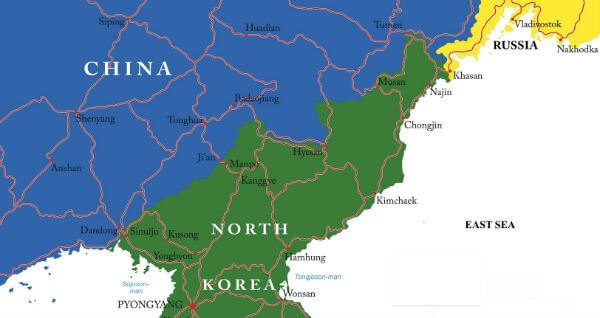
Reuters reports: When North Korean leader Kim Jong Un sent Lunar New Year greetings this year, the first card went to Russian President Vladimir Putin, ahead of leaders from China and other allies of the isolated country, according to its official news agency.
Some academics who study North Korea argue Kim could be looking for Russia to ease any pain if China, which accounts for about 90 percent of North Korea’s trade, steps up sanctions against the isolated country as part of moves to deter its nuclear and missile programmes.
U.S. President Donald Trump lavished praise on Chinese President Xi Jinping last week for Beijing’s assistance in trying to rein in Pyongyang. A day later, U.S. Secretary of State Rex Tillerson pressed the United Nations Security Council to impose more sanctions to further isolate Pyongyang.
There is no sign of any sustainable increase in trade between Russia and North Korea, but business and transport links between the two are getting busier.
A new ferry service starting next week will move up to 200 passengers and 1,000 tonnes of cargo six times a month between North Korea and the Russian port of Vladivostok. [Continue reading…]
Trump’s conviction in ‘deals’ betrays his lack of conviction in anything else
Jamelle Bouie writes: From Missouri to Nullification to the fierce battles over the Mexican War and the strife of the 1850s and last-ditch efforts to avoid conflict, slavery was the defining domestic concern of the antebellum United States, the dilemma that consumed the energy of the nation’s most able lawmakers and statesman, up until tensions exploded in open warfare. Donald Trump is apparently ignorant of all of this, but his alt-history musings aren’t necessarily unreasonable. Given what we know, what would Andrew Jackson have done in 1860 and 1861? Could it all have been “worked out,” to borrow the president’s words?
If you believe that slavery constituted an irrepressible moral and political conflict in the United States, then a war of some sort was likely inevitable. But that doesn’t mean it couldn’t have been postponed. There’s a case to make that a President Jackson in 1861 could have done just that, by bolstering the planter class and its search for new territories and new markets. This, in fact, was a live option in the timeline as it exists; unionist Democrats like Stephen Douglas, Lincoln’s chief opponent in the 1860 election, sought to preserve the United States through alliance with slaveholders and maintenance of a pro-slavery status quo. As chairman of the Senate committee on territories, Douglas helped craft the 1854 Kansas-Nebraska Act, which effectively undid a key provision of the Missouri Compromise (banning slavery in territories north of that state’s southern border) and organized two new territories—Kansas and Nebraska—that could choose to be slave or free. An almost unambiguous win for Southern slaveholders, Kansas-Nebraska would help push the sectional crisis to its breaking point. Likewise, as a presidential candidate, Douglas stood against Lincoln’s talk of a “house divided.” To talk about the end of slavery, he argued, was “revolutionary and destructive to the existence of this Government.” As Douglas declared in one debate, “I would not endanger the perpetuity of this Union. I would not blot out the great inalienable rights of the white men for all the negroes that ever existed.”
It is easy to imagine a President Jackson in 1860 who followed Douglas’ path. Who, in keeping with his sympathies and beliefs about Americans democracy, forestalled war by advancing the interests of slaveholders and Southern elites even further than Douglas proposed, opening new territories to the expansion of slavery, and organizing the nation’s foreign policy around new markets and opportunities for slave-produced commodities. Jackson may well have prevented the war, at the cost of 4 million black Americans, held in bondage.
That gets to the rub of it all. Trump isn’t wrong to think there was a deal that could have prevented the Civil War. There was. But the price of that deal was the maintenance of slavery; in fact, the strengthening of a monstrous system of violence and exploitation.
That this wasn’t obvious to President Trump—that, judging from his continued tweets on the issue, it still isn’t—is as revealing as it is troubling. It suggests a worldview in which everything can be resolved by deals, where there are no moral stakes or irreconcilable differences, where there aren’t battles that have to be fought for the sake of the nation and its soul. Slavery had to be eradicated, and war was the only option. Any deal that was achievable would have been an immoral maintenance of an abominable status quo.
Likewise, Trump seems to see presidential leadership as a game of dealmaking, where the best and most effective presidents are those that make the most “deals.” But this just isn’t true. Dealmaking and negotiation are part of the job of the presidency, but they have to happen with a purpose in mind; with an idea of the good within reach. [Continue reading…]