Category Archives: Editorials

Israel Firsters run NYT ad attacking critics

In a January op-ed for the Tablet, Spencer Ackerman rebuked MJ Rosenberg at Media Matters and others for their use of the phrase Israel Firster:

“Israel Firster” has a nasty anti-Semitic pedigree, one that many Jews will intuitively understand without knowing its specific history. It turns out white supremacist Willis Carto was reportedly the first to use it, and David Duke popularized it through his propaganda network. And yet Rosenberg and others actually claim they’re using it to stimulate “debate,” rather than effectively mirroring the tactics of some of the people they criticize.

Philip Weiss then pointed out that Ackerman was wrong about the origin of the phrase. It had first been used by the late Abram Leon Sachar, the leading American historian of Jews and president of Brandeis University.

Sachar, like many other diaspora Jews, took offense at a view promoted by Israeli Zionists that a Jew can only live a fully Jewish life inside Israel. He referred to those imposing this restrictive view of Jewishness as Israel Firsters.

Language evolves and the phrase now has a more obvious meaning — obvious that is to those of us who do not closely follow the internal struggles of Jewish identity. Israel Firsters are primarily American Jews whose first concern is Israel. They put Israel first. It’s not an antisemitic slur. It’s a literal, plain-as-daylight, description.

The campaign to drag the United States into a war against Iran on behalf of Israel is an Israel Firster campaign. It sure as hell is not being promoted by people who put the interests of the United States first.

The Emergency Committee for Israel ran a full-page ad in the New York Times yesterday promoting their Israel Firster agenda in a thinly veiled attack on the Obama administration and those Democrats who have yet to offer full-blooded support for an attack on Iran. The explicit targets of the ad were the Center for American Progress and Media Matters, but timed to appear just before Benjamin Netanyahu’s arrival in Washington for this year’s AIPAC conference, ECI clearly wanted to give the White House a rap on the shins before the boss comes into town.

But as ThinkProgress notes, ECI has already been roundly condemned inside the American Jewish community.

Last September, the American Jewish Committee’s director David Harris slammed ECI for turning Israel into a partisan wedge issue and exhibiting behavior “counterproductive to its stated aim of supporting Israel.” The head of the National Jewish Democratic Council said, “ECI’s behavior made it crystal clear that the organization is nothing more than a Republican front group bent on turning Israel into a partisan wedge issue.” And today, the Jewish Daily Forward says of the ECI ad: “[It’s] one of the most virulent anti-Jewish advertisements I’ve ever seen. And it came from other Jews.”

While the ECI is quick to casually throw around divisive language, it is much slower to condemn its own ties to ethnic and religious intolerance. In October, ECI board member Rachel Abrams raised eyebrows for calling Palestinian militants “savages,” “unmanned animals,” and “food for sharks,” in a blog post.

What’s strange about most Israel Firsters is that while they do very little to conceal their primary allegiance, they refuse to actually declare that they put Israel first. For instance, a couple of years ago when Sheldon Adelson said, “the uniform that I wore in the military unfortunately was not an Israeli uniform, it was an American uniform,” I don’t think he was making a fashion statement. He was talking about the country dearest to his heart — the one he most passionately wants to defend. So why do he and others recoil when their affinity is given a name? Maybe Israel Firster needs an extra nuance added — in-the-closet Israel Firster is perhaps more accurate.


Facebooktwittermail

Netanyahu wants Obama to promise war

This is what blackmail looks like.

Israel will start a war with Iran and inevitably drag America into this war — unless President Obama makes a promise. He must promise that the United States will start the war at the time of Israel’s choosing.

Here’s how Amos Yadlin, a former chief of Israeli military intelligence and now director of Israel’s Institute for National Security Studies, presents the bargain, based on the premise that Israel’s window of opportunity for attacking Iran will shortly close:

On Monday, Mr. Obama and Prime Minister Benjamin Netanyahu of Israel are to meet in Washington. Of all their encounters, this could be the most critical. Asking Israel’s leaders to abide by America’s timetable, and hence allowing Israel’s window of opportunity to be closed, is to make Washington a de facto proxy for Israel’s security — a tremendous leap of faith for Israelis faced with a looming Iranian bomb. It doesn’t help when American officials warn Israel against acting without clarifying what America intends to do once its own red lines are crossed.

Mr. Obama will therefore have to shift the Israeli defense establishment’s thinking from a focus on the “zone of immunity” [the point at which Iran’s nuclear program is invulnerable to an Israeli attack] to a “zone of trust.” What is needed is an ironclad American assurance that if Israel refrains from acting in its own window of opportunity — and all other options have failed to halt Tehran’s nuclear quest — Washington will act to prevent a nuclear Iran while it is still within its power to do so.

I hope Mr. Obama will make this clear. If he does not, Israeli leaders may well choose to act while they still can.

So here we approach another war and whether the war comes sooner or later hinges on whether the Israelis have the courage to trust Obama and whether Obama is indeed worthy of such an enormous leap of faith.

In this drama the Israelis cast themselves with the nobility to exercise restraint, the daring to take on a challenge from which others might shrink, and the vision to foresee dangers about which the rest of us are less alert.

Can Obama and can the United States ascend to such moral heights? Tune into to next week’s AIPAC conference to find out.

But wait a minute. The red line that the Israelis want Obama to pledge his commitment is a red line that most observers say Iran has already crossed: acquiring nuclear weapons capability. It already has a stockpile of enriched uranium sufficient to make several weapons by most estimates.

So while Netanyahu badgers Obama to promise war, the question shouldn’t be whether at the appointed time this war kicks off; instead it should be — given that Iran has crossed the red line that Israel set — why has Israel not already launched an attack?

The truth is that is that this war that Israel insists must be fought is a war that Israel would much prefer the United States to fight and pay for on Israel’s behalf.

If Israel’s interests and those of the U.S. were truly the same when it comes to Iran, then neither should need to cajole the other into action. The current tension is instead a reflection of the fact that the two countries interests are not the same.

Indeed, the objective which at this point is still only gradually being wheeled into position is a goal utterly beyond Israel’s much vaunted military capabilities: regime change in Tehran.

And even though that goal has not explicitly been adopted by the Obama administration, Obama’s language already hints at capitulation to Israeli and rightwing pressure. His choice of metaphor for describing pressure on Iran is one which any political leadership would treat as a mortal threat.

A noose is never tightened in preparation for negotiations or compromises.

Facebooktwittermail

Israel increases pressure on U.S. to start a war against Iran

The Wall Street Journal reports: Complaints from Israel about the U.S.’s public engagement with Iran have pushed the White House to consider more forcefully outlining potential military actions, and the “red lines” Iran must not cross, as soon as this weekend, according to people familiar with the discussions.

President Barack Obama could use a speech on Sunday before a powerful pro-Israel lobby to more clearly define U.S. policy on military action against Iran in advance of his meeting on Monday with Israeli Prime Minister Benjamin Netanyahu, these people said.

Israeli officials have been fuming over what they perceive as deliberate attempts by the Obama administration to undermine the deterrent effect of the Jewish state’s threat to use force against Tehran by publicly questioning the utility and timing of such strikes.

The Israeli leader has told U.S. officials that he wants Mr. Obama to outline specifically what Washington views as the “red lines” that Iran cannot cross, something the administration is considering as it drafts the president’s speech at the American Israel Public Affairs Committee and sets the agenda for his meeting with Mr. Netanyahu.

Some administration officials said that if Mr. Obama decides to more clearly define his red lines, he is likely to do it in private with Mr. Netanyahu, rather than state it in his AIPAC speech.

Mr. Netanyahu and other top Israeli officials also are pressing for Mr. Obama to publicly clarify his insistence that “all options are on the table” in addressing the Iranian nuclear threat.

Mr. Netanyahu recently conveyed his displeasure with the administration in separate meetings in Jerusalem with National Security Adviser Tom Donilon and a group of U.S. senators, said people involved in the meetings.

He complained that comments by senior U.S. officials have cast Israel as the problem, not Iran, and only encouraged Tehran to press ahead with its nuclear program by casting doubt over the West’s willingness to use force.

Israeli officials were particularly alarmed when Gen. Martin Dempsey, chairman of the Joint Chiefs of Staff, described Iran as a “rational actor” in a CNN interview after a recent visit to Israel.

That General Dempsey calls Iran a rational actor certainly runs counter to the “mad mullahs” narrative that many warmongers favor — a narrative upon which many of the arguments in favor of war utterly depend.

If Israeli officials are alarmed about Iran being described in this way by America’s top military official this would either be because they believe Demspsey’s wrong, or, because they think that although his characterization is accurate it is tactically counterproductive to openly express this fact. Either way, this unwillingness to publicly acknowledge that Iran behaves rationally, shines light on Israel’s motives for pushing for Obama to set “red lines” that Iran must not be allowed to cross.

If Iran is a rational actor then such red lines could serve as a deterrent in persuading the Islamic republic not to move closer to the development of nuclear weapons. But if, as the Israelis apparently insist, Iran is not a rational actor then the red lines being sought are designed to have more effect on the Obama administration than Iran. In other words, Israel is intent on forcing the United States into a corner so that it becomes politically impossible for this or any other U.S. president to refuse to attack Iran.

Will Obama bow to such pressure? To judge by his performance so far, this is a president who has yet to face any pressure that he is willing to resist. And this is the experience that Netanyahu is relying on: push Obama hard enough and he will almost always yield.

Facebooktwittermail

Bloomberg says spying on Muslims is OK because ‘we go after the terrorists’

In a press conference earlier this week, when New York’s Mayor Michael Bloomberg took challenging questions from reporters on the NYPD’s Muslim surveillance program, Bloomberg seemed to think that those posing the questions must be taking their own freedom for granted.

Remind yourself when you turn off the light tonight, you have your job because there are young men and women who have been giving their lives overseas for the last 200 plus years so that we would have freedom of the press. And we go after the terrorists. We are going to continue to do that and the same thing is true for the people that work on the streets of our cities.

So those reporters who whine about getting arrested while trying to cover Occupy Wall Street, or who suspect that the NYPD might be infringing on the constitutional rights of American Muslims, need to shut the fuck up. They should understand that they wouldn’t have the freedom to be asking these questions if it wasn’t for the NYPD. Got that?!

The New Jersey Star-Ledger reports:

The report was stamped top secret.

Inside was a confidential dossier compiled by the New York Police Department documenting “locations of concern” in Newark – all of the city’s 44 mosques, Muslim-owned restaurants and businesses and Islamic religious schools.

In 2007, the NYPD began an undercover spy operation within New Jersey’s largest city to find and document areas where Muslims lived, worked and prayed.

Today, city officials and many of those targeted voiced anger at the disclosures, which came in the wake of an Associated Press report showing that a secret NYPD surveillance program aimed at Muslims had extended throughout the Northeast.

“I have deep concerns and I am very disturbed that this might have been surveillance that was based on no more than religious affiliation,” Mayor Cory Booker said.

Booker said he had been unaware of the undercover work and the Newark Police Department – which had been contacted by the NYPD early on – had not been involved in any joint operations.

“What we are discovering appears to be an NYPD operation in our city that involved the blanket surveillance of Newark residents and workers based solely on the religion of those individuals,” he said. “If this is indeed what transpired, it is, I believe, a clear infringement on the core liberties of our citizenry.”

Separately, the American Civil Liberties Union of New Jersey immediately demanded a further investigation by the state Attorney General.

“These actions represent a violation of the public trust and raise red flags about religious discrimination and targeting by law enforcement,” ACLU-NJ executive director Deborah Jacobs said in a statement.

Since the Sept. 11, 2001, terror attacks, the New York Police Department has been methodically compiling data on the region’s Muslim populations, infiltrating mosques and student groups and building profiles of local ethnic groups.

But new reports on the extent of that surveillance operation revealed the NYPD had been operating well outside its jurisdiction, cataloging Muslim communities on Long Island and elsewhere and monitoring Muslim college students across the region.

New York Mayor Michael Bloomberg has strongly defended his department.

“The police department goes where there are allegations. And they look to see whether those allegations are true,” he told reporters earlier this week. “That’s what you’d expect them to do. That’s what you’d want them to do. Remind yourself when you turn out the light tonight.”

In Newark, the NYPD apparently catalogued every mosque and Muslim-owned business in the city – from fried-chicken joints to houses of worship located in private homes.

Facebooktwittermail

Images from besieged Baba Amr

First we were warned to be suspicious about accounts of a revolution in Syria because the “citizen journalists” telling the story were supposedly either Islamist extremists, or agents of Western interests, or both. Then, as Western journalists with increasing frequency managed to sneak into Syria and file first-hand accounts of the struggle, we were told that they too were serving an anti-Assad foreign agenda.

After I posted “The horror of Homs, a city at war,” a report which aired on Britain’s Channel 4 News, one reader suggested that much of its content must have been staged for the cameraman and then sarcastically asked: “So who was the cameraman, a ‘citizen journalist’?”

He’s a French photojournalist who described his reporting to Channel 4’s Jonathan Miller. Robert Mackey writes:

The photographer, who uses the assumed name Mani to shield his identity and make it possible for him to return to Syria to work again, was present when the current assault on districts of Homs under rebel control began on Feb. 3.

Looking at some of the comments now coming in, I surmise that War in Context has been added to a list of sites that Assad’s shills are being sent to in order to “set the record straight.” Thanks.

Facebooktwittermail

The small overnight strike that’s so easy it hasn’t happened

Among the supporters of a strike on Iran the only two things that can reliably be said are that none believe in Murphy’s Law or the law of unintended consequences.

The New York Times reports:

The possible outlines of an Israeli attack have become a source of debate in Washington, where some analysts question whether Israel even has the military capacity to carry it off. One fear is that the United States would be sucked into finishing the job — a task that even with America’s far larger arsenal of aircraft and munitions could still take many weeks, defense analysts said. Another fear is of Iranian retaliation.

“I don’t think you’ll find anyone who’ll say, ‘Here’s how it’s going to be done — handful of planes, over an evening, in and out,’ ” said Andrew R. Hoehn, a former Pentagon official who is now director of the Rand Corporation’s Project Air Force, which does extensive research for the United States Air Force.

Enter, Edward Luttwak, champion of the “small, overnight strike.” He argues this is the only option worth considering and were it not for alarmists in the Pentagon, this is the option Obama could employ. Obama and Bush have been hamstrung by planners who only offer an air war rather than an air strike.

[T]his war planning denied to the president and American strategy the option of interrupting Iran’s nuclear efforts by a stealthy overnight attack against the handful of buildings that contain the least replaceable components of Iran’s uranium hexafluoride and centrifuge enrichment cycle — and which would rely on electronic countermeasures to protect aircraft instead of the massive bombardment of Iran’s air defenses.

That option was flatly ruled out as science fiction, while the claim that Iran’s rulers might be too embarrassed to react at all — they keep telling their people that Iran’s enemies are terrified by its immense might — was dismissed as political fiction.

Yet this kind of attack was carried out in September 2007, when the Israeli air force invisibly and inaudibly attacked the nuclear reactor that Syria’s Assad regime had imported from North Korea, wholly destroying it with no known casualties. To be sure, an equivalent attack on Iran’s critical nuclear nodes would have to be several times larger. But it could still be inaudible and invisible, start and end in one night, and kill very few on the ground.

The resulting humiliation of the regime might be worthwhile in itself — the real fantasy is a blindly nationalist reaction from a thoroughly disenchanted population. In fact, given the probability that an attack could only delay Iran’s nuclear efforts by several years, the only one worth considering at all is the small, overnight strike.

What’s curious about Luttwak’s argument is that he hangs short of advocating that Israel should overcome America’s trepidation. When he says that the overnight strike he envisions would need to be several times larger than Israel’s 2007 strike on Syria, he declines to specify whether this puts such an operation inside or outside Israel’s capacity. The implication seems to be that what Israel might choose to do it will only be forced to do because the U.S. failed to take on the responsibility.

Perhaps the most revealing element in Luttwak’s argument is his throwaway remark towards the end: that an attack on Iran’s key nuclear installations might be worth conducting if for no other reason than to humiliate the regime by showing that such an attack could not be prevented. Luttwak might not be an Israeli, but he thinks like an Israeli. This has less to do with protecting Israel from an existential threat and much more to do with asserting dominance.

Facebooktwittermail

USA Today founder says Iran’s nuclear plans are no big deal

Al Neuharth, founder of USA Today and former head of Gannett, says there’s no justification for so much alarm around Iran’s nuclear ambitions. (For the umpteenth time it should be noted that no one outside Iran actually knows for sure what those ambitions are. For that matter, the Iranians themselves may still remain undecided about their goals.) Neuharth says:

It’s so simple: Countries that have nuclear weapons and know when or how to use them — or more likely not use them — will be the survivors and leaders.

Those who misuse them will die as other countries with nuclear weapons retaliate.

It appears USA Today took some heat from those who think it’s the duty of every mainstream U.S. publication to join in the hysteria being fomented by Israel’s leaders and so Neuharth’s op-ed is now “balanced” by some feedback from one of Washington’s chief fear-mongers, Dennis Ross:

Iran with nukes means a nuclear war in the Middle East becomes far more likely. With no one able to strike second, everyone will be on a hair trigger in a region with lots of triggers for conflict.

There is a host of assumptions loaded into those two sentences.

Firstly, the catalyst for nuclear proliferation across the region would be the acquisition of nuclear weapons by Iran. Why so? Why wouldn’t the most obvious such catalyst be the first country to have introduced nuclear weapons into the Middle East, namely, Israel? Conversely, wouldn’t the most effective way of preventing a regional nuclear arms race be for the sole nuclear power to disarm before anyone else acquired nuclear weapons?

Secondly, even if as Ross implicitly predicts, Iran risks promoting a Middle East nuclear arms race, is it really true that within a densely clustered group of nuclear armed states, each state has a greater incentive to initiate a preemptive strike because no one will have a realistic second strike capability?

It seems like the opposite argument carries as much if not more weight. That is to say, the closer the proximity between nuclear adversaries, the less the risk that they will attack each other. Why? Fallout.

The only country in the Middle East that suffers less risk that radiation released by its own weapons might drift back towards its own territory is Israel. Moreover, Israel is surrounded and interlaced by a unique human shield: five million Palestinians.

A nuclear strike on Israel would put at risk the lives of every member of a population whose interests every political leader across the region has long declared as dear to their hearts. (This is not to deny that these pro-Palestinian sentiments have often been utterly cynical, but that cynicism notwithstanding, it’s hard to imagine how an Iranian leader or anyone else could justify the harm to Palestinians that would be caused by a nuclear strike on Israel.)

Does the fact that there are 25,000 Jews living in Tehran offer Iran a similar form of protection from an Israeli nuclear attack? I don’t think so.

General Martin Dempsey, chairman of the U.S. military’s Joint Chiefs of Staff, has said he believes the Iranian government is a “rational actor.”

The same should be said of Israel.

However passionately its leaders might express their fear of an “existential threat” posed by Iran, the Islamic republic’s acquisition of a few nuclear weapons would not threaten Israel’s existence while it maintains an arsenal of as many as 200 nuclear weapons. What it would do would not merely threaten but irrevocably alter the regional balance of power.

A Middle East in which Israel was no longer the sole nuclear power, would be a region in which Israel could no longer enjoy the same level of political impunity. The Jewish state would lose its swagger. The pressure for it to make peace with its neighbors and to recognize the political rights of the Palestinians would be stronger than ever. Iran, cast in its current role as a putatively genocidal arch-enemy, is merely a device used to forestall this political day of reckoning.

Facebooktwittermail

New NYT Jerusalem bureau chief guilty of not being a Zionist

Since the departing New York Times Jerusalem bureau chief Ethan Bronner clearly is a Zionist, I guess some observers thought that being a Zionist must have become a job requirement.

The Washington Free Beacon thus reports with deep concern:

The New York Times’ incoming Jerusalem bureau chief, Jodi Rudoren, won’t say if she is a Zionist.

“I’m going to punt on that question,” Rudoren, who is Jewish, told the Washington Free Beacon in an interview yesterday. “I’m not really interested in labels about who I am and what I think.”

Rudoren, formerly the paper’s education editor, has come under fire in recent days for sending out a series of sympathetic tweets to some of Israel’s fiercest non-terrorist critics. Some pro-Israel observers are questioning Rudoren’s ability to remain neutral, as well as her qualifications, as she covers one of the Middle East’s most volatile and fraught conflicts.

Asked point-blank if she considers herself a Zionist, Rudoren demurred.

“I describe myself as a journalist. I don’t describe myself in political terms on any subject,” she said. “I see my role in the world as an observer of what’s going on, so I don’t take on labels that have, sort of, ideological or just activist positions.”

Rudoren added: “I don’t know that I’ve ever described myself as a Zionist in the past. I certainly think that right now in my job, and where Zionism is a subject of discussion, I don’t have any interest in being one or not being one. I’m not a Zionist or anti-Zionist.”

For most observers, Rudoren’s declaration that she is neither a Zionist nor an anti-Zionist would put her in the perfect position of neutrality. But if pro-Israel observers claim to be questioning her neutrality, what they really seem to be expressing is their own inability to trust anyone who is not a Zionist.

In the eyes of the Zionists, Rudoren’s most egregious mistake in her new position was to exchange tweets with Ali Abunimah, one of the most prominent Palestinian activists in the U.S.. She also tweeted with Mondoweiss. There were clear signs that the sky might be about to fall.

Former AIPAC spokesman, Josh Block, told the Beacon:

“These are not people you engage like this, especially your first day as Jerusalem Bureau Chief for the paper of record. You really don’t even want to be seen in public with them — it’s just a mistake.”

The Washington Free Beacon might be a publication you’ve never heard of — I hadn’t. So you might wonder: why is it that they have such a keen interest in Rudoren’s tweets? Turns out it’s a project of Center for American Freedom which itself seems to be an offshoot of the neoconservative Weekly Standard. William Kristol is on its three-person board and Michael Goldfarb is its chairman.

So the Beacon’s interest in Rudoren should be viewed less as journalism and more as a kind of Zionist police action. Rudoren just got given a ticket — since she’s a Jew but not a card-carrying Zionist, does she, the police officer wonders, have any business reporting in Israel?

Facebooktwittermail

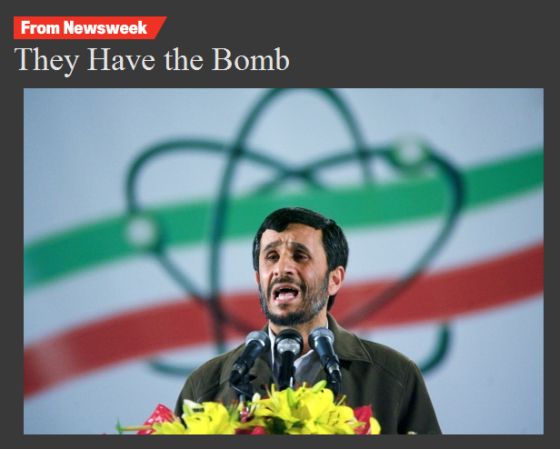
Iran already has the bomb — according to Newsweek — updated

That’s a misleading headline. And so is this:

This is the first image in a Newsweek/Daily Beast gallery on "Nations in the nuclear club".

The caption to the right of this photo of Iran’s President Mahmoud Ahmadinejad reads: “At left, the the [sic] reactor building of the Bushehr nuclear power plant in October 2010.” But in order to see the image of Bushehr, the reader needs to click to the next image and then click back to the previous. So, when readers click through to the gallery from the Newsweek feature article, “Obama’s Dangerous Game With Iran,” the first image they are presented with is Ahmadinejad under the headline, “They Have the Bomb.”

Update: Without any explanation for the earlier presence of the Ahmadinejad photo shown above, Newsweek now has Bushehr as the opening image in this gallery. Nevertheless, the headline, “They Have the Bomb,” and beneath that an image of an Iranian nuclear reactor, is still misleading.

Facebooktwittermail

Which way goes the Obama-Netanyahu ‘trust deficit’?

According to Newsweek’s Daniel Klaidman, Eli Lake, and Dan Ephron, Benjamin Netanyahu has a hard time trusting Barack Obama. They report that a key moment in the breakdown in trust came in late May last year.

From the get-go, Obama had a frosty relationship with Israeli Prime Minister Netanyahu. “There’s no question that tension grew between the two, because we felt like … they had a different estimation [of the timeline for Iran to get nuclear-weapons capability],” says the Pentagon source, “and we felt like some of their [kinetic] activities undermined what we were trying to do. Obama’s view was, why would you remove the opportunity for a diplomatic solution for something that was so incrementally significant [as killing a scientist]?”

That trust deficit was exacerbated in May of last year when Obama delivered a landmark speech outlining his wider Middle East policy. Netanyahu was preparing to fly to Washington at the time and was surprised when he heard the president state that the 1967 borders should be a basis for negotiating the final frontiers of a Palestinian state. Netanyahu believed he had an understanding with Obama that some Jewish settlements built in areas occupied by Israel in the 1967 war would remain inside Israel, a position detailed in a 2004 letter from President Bush to then-prime minister Ariel Sharon. When Netanyahu finally arrived at the Oval Office, he was furious. At a photo op with the two leaders, Netanyahu began to lecture the president on Israel’s security needs before the gathered journalists.

That incident was treated as a small blip in U.S.-Israel relations at the time. Obama soon clarified his position at the annual conference of the American Israel Public Affairs Committee, the most powerful pro-Israel lobby in Washington, stating that negotiated borders should be based on the 1967 lines “with mutually agreed swaps.” [My emphasis.] But resentment persisted. In June Israeli intelligence and military officers stopped discussing any details of their planning, analysis, and training cycles for a possible attack on Iran. Until then cooperation had been close: a regular video teleconference between U.S. and Israeli national-security advisers to discuss Iran was established during the first Netanyahu visit to Washington, in 2009. As one senior Israeli official puts it, “We … both wanted no surprises.”

But there’s a rather glaring problem with this account — a problem about which any journalist in Washington who had been half awake at the time would have been fully aware. Obama could hardly have later “clarified” his position by referring to “mutually agreed swaps.” Why? Because the very statement that had supposedly so enraged Netanyahu was this: “We believe the borders of Israel and Palestine should be based on the 1967 lines with mutually agreed swaps, so that secure and recognized borders are established for both states.” [My emphasis.] That’s what Obama said in his May 19 speech. But Netanyahu — and much of the Washington press corps that chooses to march in lockstep with Israel — chose to ignore Obama’s reference to mutually agreed territorial swaps.

Commenters, letter writers or someone must have brought this to the attention of Newsweek’s editors leading them to bury “correct” the “mistake.” In the online version of the article, this sentence:

Obama soon clarified his position at the annual conference of the American Israel Public Affairs Committee, the most powerful pro-Israel lobby in Washington, stating that negotiated borders should be based on the 1967 lines “with mutually agreed swaps.”

has been replaced with this:

Obama soon clarified his position at the annual conference of the American Israel Public Affairs Committee, the most powerful pro-Israel lobby in Washington, emphasizing that a negotiated border between Israel and a new Palestinian state would by definition be “different than the one that existed on June 4, 1967.”

This is what one might call a cover-your-ass correction. The article’s misrepresentation of the facts is no longer quite as glaring, yet the core accusation — that Obama had undermined Netanyahu’s confidence — remains. It remains, because the whole thrust of the article is about the degree to which Netanyahu has a hard time trusting Obama and that would be a hard argument to sustain if one of its key elements was bogus.

Netanyahu’s tantrum was not the result of a trust deficit. It was a piece of political theater from a man who knows how to push around American presidents. In 2001 he declared: “I know what America is. America is something that can easily be moved.”

Newsweek, instead of honestly portraying the duplicity of the Israeli prime minister, would rather have its readers believe that Netanyahu is burdened by the angst of wondering whether he can trust the White House.

Facebooktwittermail

The U.S.-Israeli don’t-ask-don’t-tell policy on murder

One man uses a bomb to kill another and he’s a terrorist. Another does the same and it’s a form of kinetic activity. I guess that makes the latter a kineticist. However, this kinetic activity is something that Americans are not allowed to engage in — because it’s illegal. It’s illegal because in the view of American law it’s not called kinetic activity; it’s called murder.

Newsweek reports: [W]hile the U.S. relationship with Israel is generally strong on security and intelligence matters, there is disagreement on both methods and strategy. Israel has no qualms about assassinating Iranians involved in nuclear research, for instance; U.S. law forbids it. (Drone strikes against jihadist leaders are considered acts of war.) “The Israelis handled everything that was kinetic, and we did the nonkinetic activities, sometimes along with the Israelis,” says a Pentagon source who was involved. A senior U.S. intelligence official says that both sides performed a kind of “Kabuki dance” on the assassinations and industrial “accidents” that have increased in Iran during the past year: “The Israelis don’t want to say and we don’t want to know.”

The United States, moreover, has conducted regular reviews of cooperation with Israel to make sure that American intelligence does not leak into operations that violate U.S. law. “We were always careful about what we said to the Israelis in meetings, and they knew why,” says the Pentagon source. “They knew that if we gave them certain kinds of information we’d run the risk of breaking the law. We often held things back from them—satellite imagery and other kinds of intelligence that could have helped them with their activities.”

From the get-go, Obama had a frosty relationship with Israeli Prime Minister Netanyahu. “There’s no question that tension grew between the two, because we felt like … they had a different estimation [of the timeline for Iran to get nuclear-weapons capability],” says the Pentagon source, “and we felt like some of their [kinetic] activities undermined what we were trying to do. Obama’s view was, why would you remove the opportunity for a diplomatic solution for something that was so incrementally significant [as killing a scientist]?”

Facebooktwittermail

Who cares about Israel?

There are two things that vex most American in equal degrees: the rise of anti-Semitism and the fate of Israel.

These two issues preoccupy ordinary people across this country in the same way — which is to say, very little.

Why would they? Jews are not a persecuted minority here — they seem to be doing fine. And Israel shares a common attribute with the rest of the world: it is not America.

Even during the best of times, the interests of Americans tend not to stray too far or long outside these borders. Most of the rest of the world is after all an ocean away.

And during these economically troubled times, that inward focus here has become even more entrenched, surpassing that in just about any other country.

In a recent Ipsos survey, 89 percent of Americans polled agreed that this country needs to focus less on the world, and more at home. Support for this sentiment was higher in the U.S. than in any of the other 23 countries surveyed.

Why then is it that the contestants for the GOP presidential primary nomination often seem like they are running for election to the Knesset?

There are competing theories.

Since 2008, Jewish support for Barack Obama has eroded and in swing states like Florida, a small shift in favor of the Republicans could be decisive. So the hunt is on for stray Jewish votes. But is that a hunt that should figure so prominently at a national level?

And then there’s a statistic Charles Krauthammer plucked — as far as I can tell — out of thin air: “98 percent of pro-Israeli Americans are gentile.”

Maybe he’s right — though a more interesting number is 41 percent. That’s the size of the minority of Americans of any faith who regard Israel as an ally of the United States.

Krauthammer’s point seems to be that Republican candidates have as much if not more interest in winning the Christian Zionist vote than in looking for support from the heavily Democratic Jewish community.

But there’s another factor here, a covert reason that American politicians of all political stripes see rewards in trumpeting their affection for the Jewish state — it is what might be called the 9/11 dividend.

Benjamin Netanyahu recognized the value of the 9/11 attacks when within hours of them taking place he said they were a “good thing” and they would “strengthen the bond between our two peoples, because we’ve experienced terror over so many decades, but the United States has now experienced a massive hemorrhaging of terror.”

In other words, Israel would in the minds of many Americans come to signify the antithesis of the Islamic threat. Support for Israel would become a coded way of expressing fear of Muslims and their religion.

Political correctness — which mostly serves as a finishing school for bigots — dictates that overt Islamophobia is reserved for those on the rabid right, like Pamela Geller, who have no shame in expressing bald hostility. But for those who harbor their fears more discreetly, the nemesis can be placed in the shadow of their declared affection.

To say how much one cares about Israel, says much more about how one views its neighbors. All this is about is cultivating solidarity and accumulating political capital through the promotion of fear.

Facebooktwittermail

When the dying wish they were already dead

Christopher Hitchens died last night.

The strange thing about death — especially the death of a public figure — is that it evokes in most onlookers the desire to revisit a life rather than view its conclusion.

Hitchens’ obituaries will perpetuate this death-denying ritual, but thankfully he offered his readers an opportunity to bravely look at a future from which most of us would rather turn away.

Having in recent years watched the wretched process of my mother’s death at a ripe 87 along with that of my brother-in-law with cancer at 48, I asked my doctor whether in his experience dying is usually so grim. His response: it depends what you believe. His claim (and arguably this may have been nothing more than his own belief) was that those with faith can die peacefully. Maybe.

What seems clear nevertheless, is that the “gift” of modern medicine has been too often to make slow-motion something that mercifully would be far more swift.

In his final piece for Vanity Fair, Hitchens relates his own experience to that of another famous atheist and explains why he no longer believes that whatever doesn’t kill you will make you stronger.

The late Professor Sidney Hook was a famous materialist and pragmatist, who wrote sophisticated treatises that synthesized the work of John Dewey and Karl Marx. He too was an unrelenting atheist. Toward the end of his long life he became seriously ill and began to reflect on the paradox that — based as he was in the medical mecca of Stanford, California — he was able to avail himself of a historically unprecedented level of care, while at the same time being exposed to a degree of suffering that previous generations might not have been able to afford. Reasoning on this after one especially horrible experience from which he had eventually recovered, he decided that he would after all rather have died:

I lay at the point of death. A congestive heart failure was treated for diagnostic purposes by an angiogram that triggered a stroke. Violent and painful hiccups, uninterrupted for several days and nights, prevented the ingestion of food. My left side and one of my vocal cords became paralyzed. Some form of pleurisy set in, and I felt I was drowning in a sea of slime. In one of my lucid intervals during those days of agony, I asked my physician to discontinue all life-supporting services or show me how to do it.

The physician denied this plea, rather loftily assuring Hook that “someday I would appreciate the unwisdom of my request.” But the stoic philosopher, from the vantage point of continued life, still insisted that he wished he had been permitted to expire. He gave three reasons. Another agonizing stroke could hit him, forcing him to suffer it all over again. His family was being put through a hellish experience. Medical resources were being pointlessly expended. In the course of his essay, he used a potent phrase to describe the position of others who suffer like this, referring to them as lying on “mattress graves.”

If being restored to life doesn’t count as something that doesn’t kill you, then what does? And yet there seems no meaningful sense in which it made Sidney Hook “stronger.” Indeed, if anything, it seems to have concentrated his attention on the way in which each debilitation builds on its predecessor and becomes one cumulative misery with only one possible outcome. After all, if it were otherwise, then each attack, each stroke, each vile hiccup, each slime assault, would collectively build one up and strengthen resistance. And this is plainly absurd. So we are left with something quite unusual in the annals of unsentimental approaches to extinction: not the wish to die with dignity but the desire to have died.

Facebooktwittermail

Who are they kidding? When Americans struggle to close the plausibility gap with Iran

After Iranian television broadcast film of a captured CIA RQ-170 stealth drone that landed in Iran a few days ago, the BBC’s security correspondent, Frank Gardner, wrote:

If, as was originally thought, the Sentinel had been shot down then there would have been little to put on display but a pile of twisted wreckage.

Instead, what was on show on Iranian TV was an immaculate gleaming white drone that looked straight off the production line.

Which tends to back up the claim by Iran that its forces brought down the drone through electronic warfare, in other words that it electronically hijacked the plane and steered it to the ground.

On Thursday, the Commander of Iran’s Islamic Revolutionary Guards Corps (IRGC) Aerospace Force Brig-Gen Amir Ali Hajizadeh said “through precise electronic monitoring it was known that this plane had the objective of penetrating the country’s skies for espionage purposes.

“After entering the country’s eastern space the plane was caught in an electronic ambush by the armed forces and it was brought down on the land with minimum damage.”

U.S. officials are now willing to concede what they must have known from day one: that the aircraft Iran captured is indeed an RQ-170.

But even after the release of close-up footage showing the drone in greater detail than it has ever been publicly viewed before, some U.S. officials remained skeptical.

ABC News’ Martha Raddatz reported:

Early Thursday, U.S. officials said, and ABC News reported, that the craft displayed did not appear to be the highly sensitive RQ-170 Sentinel and might be a model, in part because U.S. imagery indicated the Sentinel had not landed intact. Later, however, officials said it was possible that the Iranians had reconstructed the drone for display on television, but that the evidence was “inconclusive.”

An unnamed former senior Pentagon official “with extensive knowledge of unmanned aerial vehicles” also voiced skepticism to an AOL defense blogger:

Here’s what he said in an email after I sent a link to the Iranian footage. “Looks like a fake,” he wrote. “Does not look like the condition of an aircraft that lost control. Also wrong color, and they are not showing the landing gear or bottom of the aircraft… and the welds on the wing joints are hardly stealthy…” In order to avoid setting off radar, welds on stealthy aircraft must be very close to the surface of the structure and extremely smooth.

In both instances we get the same line of reasoning: those images of a captured RQ-170 can’t depict the real aircraft because we know the real one crashed and what we are being shown is intact.

That might sound plausible to a few people — especially those willing to believe anything a US government official says. But for the rest of us (and I’m inclined to think we’re in the majority), the reasoning is more likely to run like this: that thing doesn’t look like a model and it clearly didn’t crash, so any U.S. official who says that the lost RQ-170 crashed, either doesn’t know what he’s talking about, or he’s lying.

Most people will remain appropriately agnostic about the technical question of whether it would be feasible for an adversary to intercept and take control of such an aircraft.

As far as the issue of the weld joints on the wings go, it’s reasonable to make a couple of inferences.

Firstly, having recovered the aircraft, the first priority of the Iranians would have been to examine it thoroughly enough to make sure it wouldn’t self-destruct. The wings may well have been removed for that purpose and then later re-attached for public display.

Secondly, the Iranians clearly had an interest in giving U.S. officials and analysts plenty of time to make statements that could later be shown to be false. Given the difficulty that officials and experts have in uttering these simple words — I don’t know — it was predictable that the longer the Iranians kept quiet, the more often an American would say something stupid.

Loren Thompson at the Lexington Institute initially argued that the drone could be of no value to Iran because it was a “pile of wreckage.” He still insists, “whatever the insights that Iranians may glean from the RQ-170 Sentinel, the value of applying that knowledge in their ongoing war with America is likely to be modest.”

Others are less sanguine in their assessment.

Peter Singer of the Brookings Institution, author of “Wired for War: The Robotics Revolution and Conflict in the 21st Century,” said that while some of the mechanics of the aircraft are well known, some aspects — especially its sensors — would be important to countries like China.

“This is the jewel for them now,” Singer said. “It depends on what was on the plane on this mission, but one sensor it has carried in the past is an AESA radar. This is a very advanced radar that really is a difference maker for our next generation of planes, not just drones, but also manned ones like F-22s and F-35s.”

Maybe Iran won’t learn enough to clone drones for spying on America. But that’s irrelevant, firstly because the primary interest they have is in learning how to defend themselves from the U.S., and secondly, at a time when the U.S. is known to have been operating a fleet of RQ-170s over Iran for years and is suspected of involvement in a series of bombings, assassinations and acts of sabotage targeting Iran’s nuclear program, the evidence of an ongoing war is one being conducted by the United States (and Israel) against Iran — not the other way around.

What surprisingly few Americans still seem able to grasp is that countries like Iran, however malevolent their leadership might be, are much more preoccupied about defending themselves from the most heavily armed and aggressive nation on the planet, than they are in hatching plans to take over the world.

The more often Iran gets called the enemy of America, the more stupid we become.

Facebooktwittermail

Nothing’s free

On the internet, “free” means someone else paid.

We live in economically challenging times and if like me you live close to or the wrong side of the poverty line, then I’m happy I can provide this service without charge. But if you can afford to eat in restaurants, take vacations, or buy the latest electronic gadgets, then please consider supporting this site.

You see the ads in the right sidebar? The revenue they bring in wouldn’t even pay for my breakfast. But consider this: if I was earning a very modest wage for the time I’ve devoted to running this site, I’d now be a quarter of a million dollars better off. Am I crazy? Maybe, but dangerous times push people in unusual directions. My choice when I started doing this in 2002 was to step out of the defense intelligence industry and put my time to better use.

War in Context, from its inception, has been an effort to apply critical intelligence in an arena where political judgment has repeatedly been twisted by blind emotions. It presupposes that a world out of balance will inevitably be a world in conflict.

If you value my work and can afford to help keep this operation going, please click the button below to make a secure payment through Paypal. Thank you for your support, Paul Woodward.

Facebooktwittermail

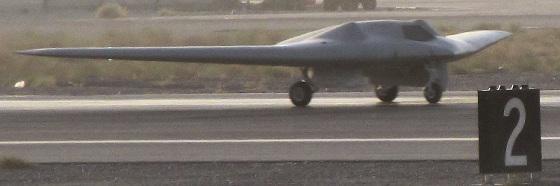
Iran captures ‘lost’ U.S. spy drone — the first remote hijacking?

Lockheed Martin RQ-170 Sentinel spy drone

The Los Angeles Times reports:

A drone that Iranian officials claimed to have shot down may be an unarmed U.S. reconnaissance aircraft that went missing over western Afghanistan late last week, according to U.S.-led forces in that country.

“The operators of the UAV [unmanned aerial vehicle] lost control of the aircraft and had been working to determine its status,” NATO’s International Security Assistance Force in Afghanistan said in a statement.

Iranian media reported Sunday that the country’s armed forces had shot down a U.S. drone that they said violated Iranian airspace along the eastern border. Iran borders Afghanistan and Pakistan in the east.

An Iranian military official quoted by the official Islamic Republic News Agency said the aircraft suffered minor damage and was in the possession of the armed forces. He identified the aircraft as an “RQ170” type drone and said Iranian forces were “fully ready to counter any aggression.”

When the existence of the RQ-170 first entered the public domain after it was photographed in Afghanistan, it quickly got dubbed the “Beast of Kandahar.”

As a highly classified stealth aircraft the question was: why would the US be flying a drone designed to evade radar when the Taliban have no radar? Speculation suggested that its areas of operation were more likely over Pakistan and perhaps spying on nuclear facilities in Iran.

In May this year the Washington Post reported that this aircraft had indeed been used to “fly dozens of secret missions deep into Pakistani airspace and monitor the compound where Osama bin Laden was killed.”

So how did the operators manage to lose such valuable piece of equipment last week? Someone fell asleep at the wheel? Very unlikely during such a critical intelligence operation. A technical malfunction? Maybe, but in such an event it would seem more likely that the aircraft would have crashed and been destroyed.

Another possibility is that “lost control” is another way of saying hijacked. In other words, U.S. remote pilots lost control as Iranians took control.

There maybe a connection with another drone story — this one about a drone that Israel lost.

Late last month, Richard Silverstein “revealed” that an Israeli drone brought down over Southern Lebanon by Hezbollah had been booby-trapped and later unwittingly taken to a weapons depot where it was remotely detonated. It was a story so implausible that it seemed like Israeli intelligence could only feed it to a scoop-hungry blogger since most journalists simply wouldn’t take it seriously.

If the story was indeed an Israeli fabrication then it was probably concocted in order to cover up a much more important story: that Hezbollah has managed to refine its tools of electronic warfare to a point that puts in jeopardy all of Israel’s drone missions over Lebanon.

If that was the case this would have serious consequences since it is widely assumed that in the event of an Israeli attack on Iran’s nuclear facilities, reprisal attacks on Israel from Lebanon would swiftly follow. In such a situation, Israel could not afford to have lost one of its most valuable intelligence gathering tools — the means on which it might depend to prevent missile strikes on Tel Aviv.

In other words, if Israel’s ability to defend itself from attacks from Lebanon has been significantly degraded, it might need to be a bit more cautious about threatening to attack Iran.

Israel is flying less sophisticated drones than the RQ-170, but even so, whatever skills Hezbollah has been acquiring in its counter-drone operations it has very likely been sharing with Iran’s Revolutionary Guard.

Might this provide part of the explanation about how the U.S. lost and Iran found a drone that supposedly went “missing”?

Facebooktwittermail

The rise of the Islamists

Mohamed Awad, director of the Alexandria and Mediterranean Research Center, describes to Patrick Martin from Toronto’s Globe and Mail, a scenario that many in Egypt’s liberal secular elite must now dread:

“My fear,” said Dr. Awad, whose office is surrounded by models of Alexandria’s prospective future waterfront, “is that the more extreme Islamists, the Salafists, may eventually come to power.”

That could happen, he explains, if the country’s economy collapses in the next few months. “In that event,” he says, “there will be another revolution, a revolution of the poor, and this one will be very violent.”

Is he describing the threat of Islamist rule or the threat of popular rule?

Early election results from Egypt make it clear that the new parliament will be dominated by Islamists — mostly from the Muslim Brotherhood but with the main Salafist party making a stronger than predicted showing, pushing the largest secular group into third place.

A recent poll showed that 41% of Egyptians hope Egypt will emulate Saudi Arabia, while 53% favor a democratic civil state. But what these polls obscure is the fact that whoever governs, one of their overriding concerns will be that they can govern successfully and thus ensure their continued power.

Who can offer Egypt’s newly empowered politicians the most useful tuition? The Saudis or Turkey’s AK Party? (That’s a rhetorical question.)

Atul Aneja reports: Early counting in Egypt’s parliamentary elections appears to confirm the region-wide trend of Islamists — moderate, hard-line and some who are yet to be fully tested — emerging as the most potent force in the aftermath of the Arab Spring.

Following the first phase of elections which ended on Tuesday, counting in Luxor, Cairo and elsewhere is showing that the Muslim Brotherhood’s Freedom and Justice Party (FJP) has solidly outpaced its rivals in many of the constituencies.

The ultra-conservative Al Nour party is also doing well in some districts. It is either leading over the other contenders or is in second place to the FJP.

Except in a few constituencies, non-religious parties are, so far, heavily trailing the Islamists, who are not contesting as a unified bloc. The FJP and Al Nour are not pre-poll allies, though the latter is open to participation in a coalition. The Al Nour comprises mainly Salafists, who seek to recreate a society based on pristine Islam.

The electoral picture, however hazy, that is emerging in Egypt, seems to amplify a political trend fast gathering momentum in West Asia and North Africa. Moderate Islamists have emerged as the most prominent political force in Tunisia and Morocco following recent elections. An Islamist assertion is also visible in Libya in the aftermath of the killing in October of Muammar Qadhafi. Some analysts say an Islamist political resurgence through the ballot can be traced to 2002, when the Justice and Development Party (AKP), the architect of the so-called “Turkish model” of new-age Islam, triumphed in Turkey.

Despite the AKP’s Islamist roots, Turkey remains secular and has deeply engaged with moderate Islamists in Tunisia and sections of the Muslim Brotherhood in Egypt.

Emile Nakhleh and Augustus R. Norton write: Misplaced fears about the implications of an Islamist sweep are often heard in Washington, where some media pundits have asked whether the Arab Spring is devolving into an Islamist Winter. But Tunisia’s election provides an instructive model on an alternative to that scenario. The election fostered a coalescence of Islamist and secular politicians. The victory of the Tunisian al-Nahda party, which won a 40-percent plurality, may be a harbinger for the coming of Arab political normalcy and the delegitimization of “Arab exceptionalism.’’ Al-Nahda’s leader, Rachid Ghannouchi, has begun reaching out to secular groups to form a coalition government, a move that would not have happened before the demise of authoritarian regimes in Tunisia, Egypt, and Libya.

The pragmatic behavior of Islamist parties in national legislatures should be the litmus test as to whether Western governments should engage them during transition to democracy. Their legislative performance, not ideological platforms or interpretations of the sacred text, should be the metric by which to judge their credibility as mainstream political actors.

Islamist parties that have been part of governments in Indonesia, Malaysia, Morocco, Turkey, and elsewhere have not threatened their countries’ national security and stability. On the contrary, they have been credible and legitimate defenders of good government and the rule of law, and strong proponents of tolerance and pluralism.

The lesson from the Tunisian elections should be equally clear to the remaining Arab authoritarian regimes. Dominating the political space, persecuting minorities, violating their peoples’ human and civil rights, and blaming foreign “agents and provocateurs” for anti-regime protests will no longer work. This regime narrative is no longer believable, whether in Syria, Bahrain, or Saudi Arabia.

What everyone in the West needs to remember is that when Egyptians or anyone else in the Middle East cast their votes for the Islamists, in most cases they are not making an ideological statement. They are doing what voters in all representative democracies do: picking out the candidates and parties with which they have the greatest affinity, which is to say, looking for representatives who appear to understand who they are meant to represent.

Facebooktwittermail

The threat of solidarity — when power becomes afraid of the people

Martin Luther King Jr leading civil rights march from Selma to Montgomery, 1965

The 99% shut down Wall Street, November 17, 2011

Students lock arms before police assault, University of California at Berkeley, November 9, 2011

After a police assault (shown in the video above) on non-violent student protesters — whose only arms were the ones they interlocked — Robert Birgeneau, the chancellor at Berkeley, issued a statement saying:

It is unfortunate that some protesters chose to obstruct the police by linking arms and forming a human chain to prevent the police from gaining access to the tents. This is not non-violent civil disobedience. By contrast, some of the protesters chose to be arrested peacefully; they were told to leave their tents, informed that they would be arrested if they did not, and indicated their intention to be arrested. They did not resist arrest or try physically to obstruct the police officers’ efforts to remove the tent. These protesters were acting in the tradition of peaceful civil disobedience, and we honor them.

What Birgeneau objects to is resistance in any form and interlocking arms in defiance of an advancing line of police is indeed an act of resistance.

But more than that, it is an act of solidarity and nothing threatens institutional power more than unity among ordinary people.

When burly police officers thrust night sticks into the chests of young students, this is not simply what is euphemistically called a “show of force,” but instead seems to be a display of “forward panic.”

In the kind of police violence that sociologist Randall Collins has dubbed forward panic, a cauldron of pent up tension suddenly erupts. Among Collins’ insights is that because people (including police and soldiers) universally have high-threshold inhibitions that restrain them from becoming violent, when those inhibitions suddenly fall away, the targets of violence will most often be those who are perceived as weak, unwilling or incapable of hitting back. Fear targets the easiest opponent.

This is the micro-social context in which the police lash out, but at the same time there is a broader context that fuels the fear of those who have been invested with the power of the state.

In the face of mass resistance, the primary line of defense for the police is not their weapons or shields — it is an idea already under challenge: that the state is more powerful than the people. And once the fault-lines in that idea have been exposed, the power equation is in jeopardy of suddenly being reversed.

Over the last twelves months, in the Middle East, in Europe, and now in the United States, the seeds have already been planted which could grow into the most dangerous idea that ever swept the world: that we have a greater interest in uniting than we do in being set apart; that what we might gain together will far exceed what we can achieve alone.

Human solidarity — this is what now threatens governments, corporations and every concentration of power.

* * *

Protesters in New York today were joined by one former police officer who sees that it his duty to stand with the people: Retired Police Captain Raymond Lewis from Philadelphia.

This afternoon, Captain Lewis was marched away in cuffs after being arrested by the NYPD.

Facebooktwittermail