Category Archives: Obama administration

Obama officials moving away from 2011 Afghan date

McClatchy reports:

The Obama administration has decided to begin publicly walking away from what it once touted as key deadlines in the war in Afghanistan in an effort to de-emphasize President Barack Obama’s pledge that he’d begin withdrawing U.S. forces in July 2011, administration and military officials have told McClatchy.

The new policy will be on display next week during a conference of NATO countries in Lisbon, Portugal, where the administration hopes to introduce a timeline that calls for the withdrawal of U.S. and NATO forces from Afghanistan by 2014, the year when Afghan President Hamid Karzai once said Afghan troops could provide their own security, three senior officials told McClatchy, along with others speaking anonymously as a matter of policy.

The Pentagon also has decided not to announce specific dates for handing security responsibility for several Afghan provinces to local officials and instead intends to work out a more vague definition of transition when it meets with its NATO allies.

What a year ago had been touted as an extensive December review of the strategy now also will be less expansive and will offer no major changes in strategy, the officials told McClatchy. So far, the U.S. Central Command, the military division that oversees Afghanistan operations, hasn’t submitted any kind of withdrawal order for forces for the July deadline, two of those officials told McClatchy.

Facebooktwittermail

First sign of the new U.S. political reality — Netanyahu’s swagger

At JTA, Ron Kampeas writes:

The sharpest signal of what last week’s elections meant for Jews came not from Washington but from New Orleans, Nova Scotia and Australia.

In New Orleans, Israeli Prime Minister Benjamin Netanyahu delivered a speech Monday calling for moving beyond sanctions to mounting a “credible military threat” against Iran as a means of avoiding war.

“Containment will not work,” Netanyahu said in his address to the General Assembly of the Jewish Federations of North America.

The prime minister’s remarks echoed the precise terminology used by Sen. Lindsey Graham (R-S.C.) in Nova Scotia two days earlier, when he told the Halifax International Security Forum that “containment is off the table.” The likely new majority leader in the U.S. House of Representatives, Rep. Eric Cantor (R-Va.), referred to a “credible military threat” in the days before the election.

It was a clear sign that Netanyahu feels empowered by the Republican sweep last week of the House of Representatives to trump the Obama administration’s emphasis on peacemaking with the Palestinians with his own priority: confronting Iran.

Facebooktwittermail

America’s ever-expanding knowledge deficit

At Salon, Justin Elliot reports:

An August Pew poll found that a growing number of Americans — 18 percent — falsely believe that President Obama is a Muslim. Why does that figure keep rising? It’s a difficult question, but it may partly be explained by the remarkable success of videos like this one, which has racked up over 2.5 million views in just three months on YouTube. It’s titled, “”BREAKING NEWS! – Is Barack Obama Really A Saudi / Muslim ‘Plant’ in the White House?”

The thrust of the video, put up by YouTube user ppsimmons, is this: The wife of an American-born Israeli author, Avi Lipkin, monitors the Egyptian media. She saw a broadcast in which the Egyptian foreign minister said that Obama personally told the him that Obama is a Muslim — and that the president is hiding that fact (and also that he is going to betray Israel).

All of this is narrated not by Lipkin, but by an unidentified man (possibly the YouTube user). Lipkin, who sometimes using the alias “Victor Mordecai,” is a former IDF spokesman and current right-wing speaker and writer on Islamic terrorism. He told Salon in an email that the YouTube video is an accurate portrayal of his beliefs.

“My wife, Rachel, has been listening to the Arabic language media from her office in Kol Israel Radio in Jerusalem, and this is just the tip of the iceberg,” he said. “It is ironic, because the whole Islamic world knows the American president is a Moslem. The only ones who don’t know it or want to know it are the Americans, themselves.”

There is no evidence presented that this Egyptian interview ever happened. And the YouTube video itself (which was apparently put up not by Lipkin, but by one of his fans) could well be the product of a lone conspiracy theorist. Which makes it all the more remarkable that it has racked up 2.5 million views.

The video does actually identify its narrator: PCG. That is, Pastor Carl Gallups from the Hickory Hammock Baptist Church in Milton, Florida. Online shoppers who want to accessorize their faith might enjoy visiting the church’s gift shop where they will find a fine line of “CHRISTIAN and GOD AND COUNTRY T-Shirts, Gifts Accessories and Home Items.”

Pastor Gallups was given national attention in late June when he was named as a runner-up in one of Keith Olbermann’s “worst person in the world” lists after the release another popular YouTube video: “EXCLUSIVE! OIL SPILL IN GULF – Hand of God? Connection to Israel?

To the extent that Gallups’ videos have gone “viral” (at least prior to receiving attention from MSNBC and Salon), the pathways of proliferation they have followed seem somewhat predictable. Spreading out from Pastor Gallups’ own congregation, along with listeners to his Freedom Friday show on northwest Florida’s 1330 AM Weby talk radio, these are messages spreading most likely among the already converted. Which is to say, people whose worldview is confirmed — not challenged — by claims such as that the Saudi Arabian monarchy is in control of the US government or that the BP Gulf oil spill was an expression of the wrath of God in reaction to the Obama administration applying pressure on the Netanyahu government.

Are these ideas that can only be accepted by people who have lost any grasp on reason? I think not.

The issue is the boundaries that circumscribe the pool of information that individuals draw upon as they form their understanding of the world. People like Gallups present a view of America and the world that has its own internal logic which holds up through the reinforcement of rigid definitions about what constitute legitimate and illegitimate sources of information.

Progressives, liberals, conservatives, evangelicals, and atheists, all employ the same form of prejudicial review in accessing the credibility of information, which is to attach weight to the source before assessing the value of the information. We attend to who is speaking before we hear what they are saying. Where we differ is in how broad and deep or narrow and shallow is the pool of imputed credibility we draw upon.

This is worth remembering at a time when it’s easy to believe that a wave of irrationality is sweeping across America.

Facebooktwittermail

Somewhere in hell, Joseph Stalin is smiling

Tony Keller writes:

In the 1930s, that great legal innovator Joseph Stalin introduced the show trial. The accused would stand up in court and willingly, even eagerly, confess to the most fantastical crimes. At the first great show trial, in 1936, Grigori Zinoviev, Lev Kamenev and other former senior Communist party members admitted to being members of a terrorist organization. They said they had plotted to kill Stalin and other Soviet leaders. In the following years, as Stalin’s purges picked up steam, show trials featured increasingly incredible stories, usually involving the accused admitting to being agents of Western imperialism.

What made men confess to things that were unlikely, sometimes impossible and usually unsupported by other evidence? Torture. Sleep deprivation, beatings, and threats against their wives and children. To stop the pain, you had to confess to whatever it was that the interrogators wanted to hear. And then you had to get up in court and willingly confess to it all over again.

The trial of Omar Khadr has been called a travesty of justice, a violation of the rule of law, a kangaroo court and lots of other things beside. But what it really was, was a show trial.

Facebooktwittermail

Obama’s problem simply defined: it was the banks

James K Galbraith writes:

Bruce Bartlett says it was a failure to focus. Paul Krugman says it was a failure of nerve. Nancy Pelosi says it was the economy’s failure. Barack Obama says it was his own failure — to explain that he was, in fact, focused on the economy.

As Krugman rightly stipulates, Monday-morning quarterbacks should say exactly what different play they would have called. Paul’s answer is that the stimulus package should have been bigger. No disagreement: I was one voice calling for a much larger program back when. Yet this answer is not sufficient.

The original sin of Obama’s presidency was to assign economic policy to a closed circle of bank-friendly economists and Bush carryovers. Larry Summers. Timothy Geithner. Ben Bernanke. These men had no personal commitment to the goal of an early recovery, no stake in the Democratic Party, no interest in the larger success of Barack Obama. Their primary goal, instead, was and remains to protect their own past decisions and their own professional futures.

Up to a point, one can defend the decisions taken in September-October 2008 under the stress of a rapidly collapsing financial system. The Bush administration was, by that time, nearly defunct. Panic was in the air, as was political blackmail — with the threat that the October through January months might be irreparably brutal. Stopgaps were needed, they were concocted, and they held the line.

But one cannot defend the actions of Team Obama on taking office. Law, policy and politics all pointed in one direction: turn the systemically dangerous banks over to Sheila Bair and the Federal Deposit Insurance Corporation. Insure the depositors, replace the management, fire the lobbyists, audit the books, prosecute the frauds, and restructure and downsize the institutions. The financial system would have been cleaned up. And the big bankers would have been beaten as a political force.

Facebooktwittermail

Beware the white Obama

Pepe Escobar writes:

The American right’s “road map” for these past two years has been to declare Obama an abysmal failure since January 20, 2008, and to do absolutely zilch to help the country out of its political/economic/cultural quagmire. Now – at least in theory – their bluff has been called by the American electorate.

Or has it? To talk about incoherence is a huge understatement. Americans have told exit polls they almost equally blame Wall Street (35%), Bush (30%) and Obama (23%) for the current economic disaster. Obama royally screwed up by bailing out Wall Street the way he did. But now the electorate has decided to reward a whole bunch of clowns and crooks who caused the debacle in the first place – among other things by endorsing George W Bush’s tax cuts and two trillionnaire, unwinnable wars. The tearful John Boehner – probably the next speaker of the House – is very tight with (what else is new?) financial lobbyists. Angry Americans voted – once again – for Wall Street.

The heart of the (sorry) matter is that Obama and the Democrats did not even strive to meet the great expectations awakened by the 2008 “Change we can believe in” collective rapture. They sowed the seeds of their own doom instead. No wonder they were deserted en masse by young people, ethnic minorities, pacifists and environmentalists while at the same time masses of enraged centrists, moderates and independents sought refuge in the right. Add to it the electorate’s gullibility in its manipulation by corporate media.
[…]
Flash forward to 2012; to the sound of Aretha Franklin singing Don Covay’s See Saw – “going up, down, all around/ like a see saw” – scores of US voters will have finally noticed they threw the bums out just to bring in another basket of equally lame bums.

United States corporate media is not emitting a peep about it but Obama should really start worrying about his white mirror – Marco Rubio, who has just won a senate seat for Florida. Rubio, 39, intelligent, good-looking, good orator, promises the world to people and has “American Dream” written all over his bio.

Born in Miami, raised in Vegas (where his Cuban exile parents worked hard in a hotel), good football player, hard-working college student, law degree, Catholic, blonde wife from a Colombian family, four kids – as a bonus to the establishment Rubio is not a wacko (although Palin loves him unconditionally). Mike Huckabee – former presidential candidate and now Fox News pundit – says he’s “our Obama, with more substance”. And crucially, his political godfather is none other than Jeb Bush. Establishment Republicans won’t allow Palin to grab a presidential nomination even over their dead bodies. Thus Rubio may be their savior for 2012.

An inept/indecisive Obama allowed Republicans to get away with murder – as in not being held accountable for the monster financial/economic mess and on top of it being allowed to exploit and profit from the all-American rage provoked by their “policies”. Now, after the “shellacking”, it’s about time for the president to show some balls and start playing offense. He could start by firing everyone at the White House. It won’t happen. Get ready; white Obama will eat him for breakfast in 2012.

Facebooktwittermail

Reading al Qaeda’s signals from Yemen — and Pakistan

David Ignatius writes:

Behind the latest terrorism plots is an al-Qaeda leadership that is getting battered in Pakistan but that is determined to strike back wherever it can – using a dispersed network and new tactics that are harder to detect.

The package bombs sent last week from Yemen are one face of al-Qaeda’s continuing campaign. The Yemeni operatives are nimble, adaptive and “frustratingly clever,” says a U.S. counterterrorism official. “They have one main goal, which is to mess with us.”

We’ve got all sorts of metaphors going here. Al Qaeda is up against the ropes — but it’s punching back. It used to wait in caves, ready to be smoked out — even while it was on the run. But just in case its persistent ability to outwit US intelligence services might make the latter look unintelligent, we are duly reminded that our cavebound-boxing-running nemesis is actually very smart.

Now, with a melodramatic Hollywood-style flourish, France’s interior minister, Brice Hortefeux, adds that one of the printer bombs was defused just 17 minutes before it was due to explode! Let’s not forget (or maybe we are meant to forget) that British investigators took 20 hours to figure out that one of these devices was actually a bomb.

What’s the common thread here? That when officials and commentators talk about al Qaeda, the structure of their own thinking is much more in evidence than any understanding of the strategic thinking that probably connects a set of seemingly disparate events. My hunch is that the string of “failed” operations emanating from Yemen have actually accomplished most of their objectives.

Consider, for instance, this detail in the printer bombs: the way they were addressed — with names linked to the Crusades at out-of-date locations for two synagogues in Chicago.

We are told the bombs were designed to blow up on board the cargo aircraft that carried them, so why use addresses that could prematurely flag the parcels? If on the other hand the bombs were meant to reach the synagogues, in a meticulously planned operation such as this, wouldn’t we expect valid addresses to have been used? The addresses provide a clue that these were bombs meant to be found rather than explode.

Let’s not forget how the attack was actually averted — not through an NSA intercept but thanks to a tip from a former Guantanamo inmate who had a change of heart just in time.

Perhaps the object of the exercise here was neither to blow up synagogues nor bring down aircraft but simply generate fear around both possibilities. Indeed, al Qaeda is currently demonstrating that bombs which don’t explode can in many ways be just as effective and in some ways more effective than those that wreak havoc.

The choice of synagogues in Chicago may simply have been a way of making sure that some of President Obama’s most influential supporters — such as Lester Crown — would be pressing the White House to do everything necessary to tackle the threat from Yemen.

But why would al Qaeda be wanting America’s attention to now focus on Yemen?

Ignatius quotes a US official who claims that bin Laden’s response to Obama’s expansion of drone warfare in Pakistan was to send out a directive which could be summarized: “Undertake operations however and wherever you can. We need to prove ourselves again.”

Even if such a directive went out — one that portrays this fight simply as a contest in the expression of power — I find it hard to believe that this actually reveals much about al Qaeda’s strategic thinking. After all, as grandiose as their ambitions might be, they surely have few illusions about the nature of the power differential they face as Hellfire missiles come raining down.

Bin Laden’s more pressing concern, I would suggest, is to find a way of getting the hell out of Waziristan and lining up a new base for operations — a move precipitated not just as a result of drone warfare but more importantly because of the likelihood that any process of reconciliation that brings about an end to the war in Afghanistan will result in al Qaeda losing its sanctuary in Pakistan.

The conventional wisdom is that al Qaeda in the Arabian Peninsula (AQAP) operates independently from Pakistan-based commanders, but the Australian counterterrorism expert, Leah Farrall, thinks otherwise. AQAP, she writes:

… is not an affiliate, not a franchise, and not a network. Rather it is an operating branch of AQ, which means that while it may have authority for attacks in its area of operations (the Arabian Peninsula), it comes under AQ’s strategic command and control for external attacks outside of this area of operation. And it has always done so, right back to 02.

To the extent that the message coming out of Washington for most of the last year has been that Yemen is now the epicenter of the al Qaeda threat, this may reflect less about the depth of US intelligence than it does about al Qaeda’s own messaging. In other words, al Qaeda very much wants to be equated with Yemen.

Why? This much should be obvious to everyone: wherever the US sees a terrorist threat emanating from, its primary response is military. Yemen is no exception. Ignatius confirms that in the wake of Obama’s expanding drone war in Pakistan:

[a] similar escalation is likely in Yemen, with soldiers from the U.S. Joint Special Operations Command working with Yemeni government forces. The JSOC sums up its lethal approach with the phrase ‘find, fix, finish,’ but a U.S. official says it has been hard to keep track of al-Qaeda targets in Yemen’s tribal villages and cities.

The Pentagon’s thinking no doubt, is that a sufficiently “robust” response will ensure that the burgeoning threat from al Qaeda in Yemen can be nipped in the bud. Al Qaeda’s strategic view however, may well be radically different.

Farrall points out that al Qaeda in Iraq began with only 16 operatives. Thanks to the blundering American military machine, the jihadists were able to tap into enough local hostility that they were eventually able to trigger a civil war.

Even though the US is not contemplating invading Yemen, operations it conducts in collaboration with a compliant Yemeni government will do more to weaken that already weak government and thereby make the country an even more hospitable environment for al Qaeda HQ to relocate its operations.

Yemenis, far from sharing Washington’s concerns, view them with a mix of skepticism and suspicion. As the New York Times reports:

For now, most Yemenis seem to dismiss reports of Al Qaeda killings as a “masrah,” or drama, staged by the government and its American backers. The suspicion runs so deep that any action by the Yemeni government seems to confirm it: counterterrorist raids are often described as punitive measures against domestic foes, and the failure to act decisively is derided as collusion.

“This latest episode with the packages is only making it worse,” said Mr. Faqih, the Sana University professor. “Many people think it was all about the elections in the U.S., or an excuse for American military intervention here.”

If there is a set of assumptions that al Qaeda’s strategists can reliably make about their American adversaries it is that the Americans find it next to impossible to respond to acts of terrorism without recourse to military violence; that they pay insufficient attention to the motives of those they choose to fight; that patience is their most easily exhausted asset; and that without fail a fear-bound America can always be guaranteed to overreact.

Meanwhile, what passes for strategic thinking in Washington still takes seriously this bizarre idea: that it is possible to simultaneously bomb a country and assist in its development.

And people still wonder how it’s possible for a tiny militant organization to challenge American might? Because America makes it far too easy.

Facebooktwittermail

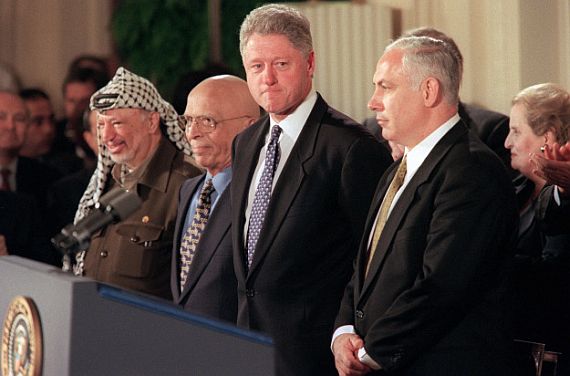
Bill Clinton’s prayer for peace

Bill Clinton referring to Benjamin Netanyahu in 1996: 'Who the fuck does he think he is? Who's the fucking superpower here?'

Less than two weeks ago, while observers gathered around the fetid corpse of the Middle East peace process, once again looking to see whether it might miraculously spring back to life, Laura Rozen reported:

[T]he New America Foundation’s Steve Clemons said he is convinced that the man who can help Obama bring peace to the Middle East is former President Bill Clinton. That is the spouse of Obama’s Secretary of State Hillary Clinton.

“Bill Clinton is the only guy I can think of who is trusted and liked by all sides,” Clemons told Politico. “He is the only guy I know who successfully wrestled and pushed Netanyahu to do what he wants to do. And Clinton has spectacular popularity in Israel and Obama doesn’t.”

The former president “has granular understanding of every deal and piece of the deal – behind the scenes stuff that has been distorted and reframed,” Clemons continued. “No one has a better grasp, … sees the opportunity and has the global stature to both cajole, seduce and embarrass” the parties towards an agreement.

And under that scenario, which Clemons concedes is a float though one influenced by some kibitzing on the peace process with Bill Clinton at an event last week, how would Obama control the force that is Bill Clinton?

“Why would you want to control him,” Clemons responded. The Israeli-Palestinian conflict “has become a global fault line in the eyes of the world, and a manifestation of America’s weakness today. It has far greater significance” strategically “than northern Ireland. My bet is this is one of several defining issues” for the U.S. and the Obama administration, Clemons continued.

And how would Hillary Clinton not lose her authority as Secretary of State if her husband played such a role?

“Hillary Clinton should embrace and support what he does, giving him the latitude to be a creative player,” Clemons responded. “He can outmaneuver” the obstacles to an agreement and “all their corks will rise.”

Lo and behold the force that is Bill Clinton has appeared like a comet soaring over the horizon, shining light when all seemed consumed by darkness. Or maybe not.

In his remembrance of Yitzhak Rabin who was assassinated 15 years ago, Clinton’s main message seems to be that Rabin could have delivered on the implementation of the two-state solution — but he got shot, and the rest is history.

In Clinton’s view, all the necessary pieces for a resolution to the conflict are now lined up — everyone just needs to get on with the work at hand.

Let us pray on this anniversary that [Rabin’s] service and sacrifice will be redeemed in the Holy Land and that all of us, wherever we live, whatever our capacity, will do our part to build a world where cooperation triumphs over conflict. Rabin’s spirit continues to light the path, but we must all decide to take it.

Those are not the words of an unstoppable force. “We must all decide” is really just a positive construction on the assertion that has been repeated so many times before: “We can’t want peace more than the parties themselves.”

If Clinton is laying groundwork here it is not for his own entry into the fray; it is instead the path along which Obama can gracefully bow out by saying, I did what I could but the time was not right.

Facebooktwittermail

Obama is through with Middle East peacemaking — at least for now

Larry Derfner writes:

Whatever the Obama administration may say, it is through with Middle East peacemaking, at least for this term. It has zero leverage over Israel’s right-wing government because the roaring Republicans love this government and especially its prime minister. The Republicans love the settlements, love Israeli rule over the West Bank, love the blockade of Gaza and, no less important, hate Palestinians and the rest of the Muslim world.

These are the political forces that have Obama in check. Well before the Tea Party surfaced, the GOP had lurched to the right on Israel/Palestine, lining up squarely with Likud and the Council of Jewish Communities in Judea, Samaria and the Gaza Strip, and now these people are in the catbird’s seat in Washington.

If you were a Palestinian, would you trust that the US could even soften the Netanyahu government in negotiations now, much less “deliver” it? No, you wouldn’t, and neither would I, so I don’t see why the Palestinians should be expected to go on playing with Israel when America is the dealer. If the game wasn’t rigged against them before, it obviously is after Tuesday.

And since Israel isn’t going to budge and America can’t force it to, that means the ball is in the Palestinians’ court.

What are they going to do, now that Pax Americana is not an option for them, not for at least two years and maybe a lot longer? Hopefully, they’re not going to return to violence. Hopefully, Palestinian Authority President Mahmoud Abbas and Prime Minister Salam Fayyad will not resign, nor be overthrown by Hamas in the West Bank like they were in the Gaza Strip.

The best-case scenario is that the PA will make good on its threat to seek UN recognition for statehood, knowing that even if the US vetoes such a resolution, it would be a show of strength. It would create a sense of urgency. Challenging the occupation in the UN might shake the moderate West into acting as a counterweight to Tea Party America in the conflict.

Hopefully, the PA will also keep pressing its claim on Arab east Jerusalem nonviolently, as Fayyad sought to do this week, with some success. And hopefully, the moderate West will show its support, as British Foreign Secretary William Hague did yesterday by meeting Palestinian activists on the city’s Arab side.

Ynet reports:

British Foreign Minister William Hague on Wednesday met with the Palestinian prime minister and Israeli foreign minister, but his visit with Palestinian activists made the most headlines.

Hague met with three senior Palestinian activists spearheading the popular struggle against Jewish settlements and the West Bank security fence, and expressed his support in their non-violent struggle.

“Hague told us that he supports the non-violent popular struggle, similarly to the official statement made by the European Union,” Mahmud Zuhari, one of the activists, told Ynet.

The meeting was held in the West Bank town of Bitunia, just south of Ramallah, in an area overlooking the security fence and Ofer Prison, where many activists are jailed.

Facebooktwittermail

‘We don’t want to be Iraq’

Steven Sotloff writes:

Though the foiled plot to mail packages filled with bombs to synagogues in Chicago has bumped congressional midterm elections as the top story in the United States, here in Yemen it has caused barely a ripple. While Washington focuses on combating the regional al-Qaeda affiliate believed to be behind the plot, Yemenis are much more concerned with a sectarian rebellion in the north, a secession movement in the south and the economic crisis that has crippled the country.

Most Yemenis are unaware that the packages that caused heightened concerns in the United States originated in their country, because the Saleh government has muted coverage of the story in the local press.

Washington’s policies of drone strikes coupled with high-profile military and diplomatic visits risk further alienating an already hostile Yemeni population and driving them into the arms of al-Qaeda in the Arabian Peninsula (AQAP), the local al-Qaeda affiliate the Obama administration is so focused on neutralizing.

“Americans come here and attack without knowing what is going on,” as one Yemeni put it. “We don’t want to be Iraq. This is an American war, not Yemen’s, and we don’t want to be a part of it.”

Facebooktwittermail

Broder and Israel’s Goldilocks war against Iran

What kind of institutional entity do the hacks in Washington constitute such that they can have a “dean”?

When David Broder is referred to as the dean of the Washington press corps, I guess it’s just a complimentary way of saying the old guy. But Broder’s nine years younger than Helen Thomas. How come she never rose to the same stature? Is baldness a requirement?

In spite of his institutional stature, Broder’s mental capacities have in recent years come into question and his op-ed in the Washington Post on Sunday provides yet another occasion to wonder what is going on inside this man’s brain as he pushes for war against Iran.

He writes:

War and peace influence the economy.

Look back at FDR and the Great Depression. What finally resolved that economic crisis? World War II.

Here is where Obama is likely to prevail. With strong Republican support in Congress for challenging Iran’s ambition to become a nuclear power, he can spend much of 2011 and 2012 orchestrating a showdown with the mullahs. This will help him politically because the opposition party will be urging him on. And as tensions rise and we accelerate preparations for war, the economy will improve.

I am not suggesting, of course, that the president incite a war to get reelected. But the nation will rally around Obama because Iran is the greatest threat to the world in the young century. If he can confront this threat and contain Iran’s nuclear ambitions, he will have made the world safer and may be regarded as one of the most successful presidents in history.

So another war is going to rescue the economy? But just a minute — if war’s such an excellent economic tonic, how come we aren’t already in great shape? A decade of war just hasn’t been quite enough?

It’s easy to mock Broder’s prescription and even to wonder whether he’s lost his grip on reality, but maybe he’s not quite as crazy as he sounds. Read more carefully, this is not actually a call for war — it is a call for the continuously escalating threat of war.

This is indeed the most likely “lesson” that some have drawn from the experience of Iraq: that the best kind of war is the one that has yet to be fought. A war that can be budgeted for, equipped for, and around which politicians can construct their postures of strength, resolution and righteousness. The context is one in which we have been encouraged to think that war is normal. War is in fact so normal that Washington pundits can now present it as a useful economic tool.

Washington’s lead comes from Israel, which has less interest in starting a war with Iran than in promoting the idea that war might be just over the horizon — a kind of Goldilocks war, not too far away and not too close, but just close enough. In this delicately modulated threat of mayhem, Iran itself remains politically and economically boxed in, while issues which merit more urgent attention — namely the intractable Israeli-Palestinian conflict — can be shunted to one side.

Two countries so heavily invested in manufacturing the means for engaging in war, actually have less interest in wars being fought than in a war-footing constantly being maintained. The problem is, a war posture can only be maintained for so long and momentum only be built up so much before a turning point is reached: war either then becomes inevitable or a real alternative has to be pursued.

Only through the hubris which metastasizes inside the brains of those trapped inside the Washington bubble, can anyone fail to see that the process of backing Iran into a corner risks the United States becoming trapped by the narrow logic of its own strategy. War is not normal. It is a failure of imagination.

Facebooktwittermail

The wisdom of insecurity

If Barack Obama came into office with a secret ambition, it was quite likely a desire to succeed where George Bush failed: to kill Osama bin Laden — preferably in the run-up to the 2012 election. Obama’s drone war in Pakistan now appears to make that prospect less unlikely.

According to Noman Benotman — the only expert who has an insider’s knowledge of al Qaeda — bin Laden’s personal courier, Mohammed Uthman, was one of the few people likely to know the al Qaeda leader’s whereabouts. Uthman was killed in a drone strike this month and its unclear whether the US even knew who they were targeting, reports Der Spiegel.

Uthman’s death reveals one of the fundamental flaws in the war on terrorism: killing so-called high-value targets makes it more difficult to track the operations of organizations whose structure is simultaneously adapting while under assault. The information that needs to be found is being lost while the ideology that needs to be transformed is being perpetuated.

The latest terror scare, is — the official line would have it — a reminder of the constant need to maintain vigilance. But it is also a reminder that in the course of the last decade, not a single politician has risen to face the real challenge: talking about terrorism in terms that acknowledge the capacity of adults to understand what constitutes a tolerable level of risk, while underlining the need for democratic governments to exercise only limited powers.

Instead the US government through a decade of war has fueled rather than diminished international terrorism and at the same time chosen to advise Americans when they should be moderately afraid, very afraid or terrified. What would be far more useful would be an ongoing audit of the government’s own efforts such that they can be seen to be doing more to generate awareness than hysteria or complacency and that the incentives for terrorism are diminishing rather than growing. On such a basis an under-performance alert could be issued in response to warnings such as this one, sent out on October 3: “The State Department alerts U.S. citizens to the potential for terrorist attacks in Europe.” They might as well just have said: “If something bad happens soon, don’t tell us you weren’t warned.”

If there’s one event in response to which President Obama should already have a carefully crafted plan, it is how he will handle a major terrorist attack — including one in Europe. So far, all the indications are that in such an event Obama’s response will simply reinforce the Bush paradigm: that a president must do everything in his power to make Americans safe and that new dangers can only be met by greater presidential powers. The only difference will be that he will act with technocratic ease and without Bush’s swagger. In that difference we should take no comfort.

Facebooktwittermail

How the US is being outmaneuvered by Iran and Saudi Arabia

Zvi Bar’el writes:

“Iran is not the enemy, Israel is the enemy,” the head of the Center for Strategic Studies in Saudi Arabia declared in an interview with Al Jazeera. This was his response to a question on whether the $60 billion arms deal between Riyadh and Washington was meant to deter Iran. The American efforts to portray the deal as aimed against Tehran doesn’t fit with the Saudi point of view, and it seems this isn’t the only subject over which these two countries fail to see eye to eye.

Iranian President Mahmoud Ahmadinejad spoke with King Abdullah of Saudi Arabia twice last week, and Iran reported that a senior Iranian official would visit Riyadh soon. It’s not clear if it will be Foreign Minister Manouchehr Mottaki or the head of the National Security Council, Saeed Jalili.

But the frequent contacts between Iran and Saudi Arabia are not over the big arms deal or Iran’s nuclear plans. The two countries have concluded that they need to reach an agreement on two other issues regarding their sphere of influence in the region: Iraq and Lebanon.

Regarding Lebanon, Iran is trying to persuade Saudi Arabia to help stop the work of the special international tribunal investigating the assassination of former Lebanese Prime Minister Rafik Hariri. This would prevent the collapse of the Lebanese regime. While Iran is worried about Hezbollah’s status, it also doesn’t want Lebanon to collapse or fall into another civil war, whose results cannot be ensured.

In this respect, Tehran doesn’t have to make too great an effort to get Riyadh’s support. This became clear last week to Jeffrey Feltman, the U.S. Assistant Secretary of State for Near Eastern Affairs and a former U.S. ambassador to Beirut, when he visited Riyadh. During his meeting with King Abdullah, the monarch tried to figure out America’s position if the international court’s work were stopped. Arab sources say Feltman was “furious but restrained,” and made it clear to the king that Washington was determined to support the tribunal.

With all due respect to the American insistence, if the client that is supposed to pay Washington $60 billion decides it’s vital to halt the tribunal’s work, it won’t make do with consulting the Americans. It will throw its full weight behind the efforts. Meanwhile, the indictment the tribunal is due to publish is not expected before February.

Facebooktwittermail

Leasehold settlements?

Haaretz reports:

Israel is conducting secret negotiations with the U.S. on establishing the future borders of a Palestinian state, the London-based Arabic language daily Asharq al-Awsat reported on Friday.

According to the report, Palestinian sources confirmed that the two sides discussed an option wherein Israel may lease lands in East Jerusalem from the Palestinians in exchange for the establishment of an independent Palestinian state.

Israel would lease the territories from the Palestinian state for a period of 40 to 99 years.

The Palestinian sources said that the talks are an American initiative that has been going on for some time in order to obtain an understanding with Israel regarding the terms surrounding a future Palestinian state.

The Palestinian Authority apparently has only recently been made aware of the talks and hasn’t been given the details of the proposal.

An Egyptian source told the newspaper that the negotiations are “more quiet than secret, and are meant to try to save the peace process.”

Neither the Prime Minister’s Office nor the U.S. government agreed to comment on the report.

Israel in secret negotiations with the US? I guess this confirms what has long appeared to be the case: that the Palestinians are regarded as being peripheral to the conflict. But I really don’t know what to make of this lease proposal. Britain held Hong Kong on a lease, but once the lease expired Hong Kong went back to China. Somehow I don’t see a Palestinian state ever having quite as much leverage as China. Neither, given its disregard for UN resolutions, do I see Israel feeling a heavy obligation to honor a legal contract limiting its occupation of East Jerusalem. The Israelis’ interests have always seemed to be focused on the so-called facts no the ground rather than legal issues of ownership.

Facebooktwittermail

Not getting to the promised land

“I just want to do God’s will. And He’s allowed me to go up to the mountain. And I’ve looked over. And I’ve seen the Promised Land. I may not get there with you. But I want you to know tonight, that we, as a people, will get to the promised land!” Dr Martin Luther King Jr, Memphis, Tennessee, April 3, 1968

“[T]oday, I state clearly and with conviction America’s commitment to seek the peace and security of a world without nuclear weapons. I’m not naive. This goal will not be reached quickly — perhaps not in my lifetime.” President Obama speaking in Prague, April 5, 2009

“I do know also that the future holds the possibility of progress, if not in our lifetimes then certainly in our children’s.” Hillary Clinton addressing the American Task Force for Peace in Washington DC, October 20, 2010

Is this the star by which President Obama plots his course: the promise of destinations that others must reach? Realism that just looks like cynicism, or cynicism dressed up as realism?

Just over a year ago, he sounded quite emphatic on the issue of the Middle East conflict — the issue on which Clinton now hints that progress may have to wait a generation.

Israelis must acknowledge that just as Israel’s right to exist cannot be denied, neither can Palestine’s. The United States does not accept the legitimacy of continued Israeli settlements. This construction violates previous agreements and undermines efforts to achieve peace. It is time for these settlements to stop.

I say sounded emphatic, but here’s the clue revealing Obama’s own lack of commitment: he leaves himself out. He is the observer rather than the agent. He doesn’t make demands.

What’s the use of an American president who can see the promised land but has no idea how to get there?

Less than two years after making Middle East peace central to his foreign policy agenda, Obama’s efforts have come to nothing.

The Washington Post reports:

In perhaps the shortest round of peace negotiations in the history of their conflict, talks between the Israelis and Palestinians have ground to a halt and show little sign of resuming.

Israeli Prime Minister Binyamin Netanyahu and Palestinian Authority President Mahmoud Abbas haven’t met since Secretary of State Hillary Rodham Clinton brought the two together on Sept. 15 in Jerusalem, two weeks after President Obama launched the resumption of negotiations on Palestinian statehood in Washington with much fanfare, including the presence of Egyptian President Hosni Mubarak and King Abdullah II of Jordan.

Now, the nearly six-week pause threatens to become permanent.

Pressure to restart the talks eased after the Arab League said it would wait a month – until Nov. 8 – before ending Abbas’s mandate for negotiations, thus pushing the issue beyond the U.S. midterm elections. But if Republicans score big gains, some Israelis argue, that could limit Obama’s ability to pressure Israel to make concessions. U.S. peace envoy George J. Mitchell is supposed to return to the region, but no date has been set.

In a speech Wednesday to Palestinian peace activists, Clinton acknowledged that “I cannot stand here tonight and tell you there is some magic formula that I have discovered that will break through the current impasse.”

While the administration has set a goal of achieving an agreement less than 11 months from now, Clinton at one point suggested a much longer time frame: “The future holds the possibility of progress, if not in our lifetimes, then certainly in our children’s.”

Facebooktwittermail