Category Archives: Obama administration

Obama gets kind of tough with Netanyahu

The Los Angeles Times says: “a dispute this week between the Obama administration and Israel has ballooned into the biggest U.S.-Israeli clash in 20 years.”

Tom Friedman says: “what the Israelis did played right into a question a lot of people are asking about the Obama team: how tough are these guys? The last thing the president needs, at a time when he is facing down Iran and China — not to mention Congress — is to look like America’s most dependent ally can push him around.”

But then Washington hit back — bam!

This is how Aluf Benn describes Obama’s get-tough approach:

Washington delivered its rebuke to Netanyahu through a number of channels. There was the extended censure by telephone from Secretary of State Hillary Clinton, a phone call from Biden, the summoning of Israel’s ambassador to Washington to the office of Deputy Secretary of State James Steinberg, the condemnation from the Quartet and, perhaps most important, a media briefing Clinton delivered during a CNN interview which escalated private rebukes into a full-blown public reprimand.

The reproofs were reminiscent of the “low chair diplomacy” the Turkish ambassador to Jerusalem was subjected to by the Israeli Foreign Ministry at the beginning of the year. The media was informed that the conversation between Clinton and Netanyahu lasted 43 minutes, “rather than 10 minutes as usual,” and that the prime minister barely uttered a word.

Obama himself reportedly worded the message to be delivered to Netanyahu during his weekly Thursday meeting with Clinton, lest the argument be made that it was merely the secretary of state scolding the Israeli leader, and not the U.S. president himself.

A State Department spokesman described the conversation using phrases which bring to mind a teacher castigating a student, not a working discussion with the leader of a friendly country and ally.

The substance was no less damning than the form – Clinton spoke of an “insult” to the United States and of “harming bilateral ties.” She could not understand, she said, how such a thing could have been done in light of America’s strong obligation to Israel’s security. U.S. media interpreted these remarks as suggesting that Washington’s military support for Israel is hardly unconditional.

Clinton dismissed Netanyahu’s explanation that the decision to approve the housing plan was made without his knowledge, reminding him that as prime minister he is responsible for his government’s actions.

The statements from the United States were publicized Friday evening – Shabbat – while Israel was officially unable to respond, therefore affording the White House a media exclusive. The instinctive reaction from Netanyahu and his associates was to accuse Washington of a diplomatic ambush, to simply rely on the support of his backers in the United States. Indeed, Abraham Foxman, national director of the Anti-Defamation League, was the first to charge the White House with “humiliating” the Israeli prime minister.

This week presents Netanyahu with a difficult decision. He may choose to visit Washington as planned to speak at the AIPAC conference, which would embarrass the preeminent pro-Israel lobby and put it on a collision course with the Obama administration. Senior U.S. officials will likely decline meetings with him, unless he agrees to at least some of Washington’s conditions. Canceling his flight, however, will be interpreted as acknowledgment of the crisis in U.S.-Israel ties.

High drama! But will it be of any lasting consequence? I really doubt it.

To put this in perspective we should not forget that the initiative the Obama administration is in a desperate effort to salvage — so-called proximity talks — is one that virtually no one had any confidence would accomplish anything in the first place. A successful resolution to the current dispute means getting this initiative back on a track that leads nowhere.

The Jerusalem District Planning and Building committee has canceled two meetings planned for this week. Big deal. It can reschedule them in a few weeks once America and the media are suitably distracted by current events. Indeed, the closer mid-term elections come, the greater this administration’s interests will be in restoring cordial relations with Israel.

Daniel Levy, a former adviser to then-Israeli prime minister Ehud Barak, says the administration is trying to “lay down a marker with [Netanyahu] that they will not allow him to make them look weak,” and no doubt that is true, but this is a marker on a movable line.

Nothing Netanyahu does or refrains from doing will reverse the perception of weakness that was Obama’s own doing when he caved on the issue of imposing a settlement freeze. To insist that this Israeli prime minister avoid doing anything to embarrass the US president merely underlines the extent to which this president is already highly susceptible to appearing weak.

As for whether the Israeli government has any interest in making meaningful gestures of reconciliation with the Palestinians, Ma’an reports on the latest indication: an order from Israeli authorities for the demolition of a mosque in Nablus, right in the heart of the West Bank.


Facebooktwittermail

Washington’s cult of narcissism and Iraq

Tom Engelhardt writes:

Hubris? We’re bigger than that!

We’ve now been at war with, or in, Iraq for almost 20 years, and intermittently at war in Afghanistan for 30 years. Think of it as nearly half a century of experience, all bad. And what is it that Washington seems to have concluded? In Afghanistan, where one disaster after another has occurred, that we Americans can finally do more of the same, somewhat differently calibrated, and so much better. In Iraq, where we had, it seemed, decided that enough was enough and we should simply depart, the calls from a familiar crew for us to stay are growing louder by the week.

The Iraqis, so the argument goes, need us. After all, who would leave them alone, trusting them not to do what they’ve done best in recent years: cut one another’s throats?

Modesty in Washington? Humility? The ability to draw new lessons from long-term experience? None of the above is evidently appropriate for “the indispensable nation,” as former Secretary of State Madeleine Albright once called the United States, and to whose leaders she attributed the ability to “see further into the future.” None of the above is part of the American arsenal, not when Washington’s weapon of choice, repeatedly consigned to the scrapheap of history and repeatedly rescued, remains a deep conviction that nothing is going to go anything but truly, deeply, madly badly without us, even if, as in Iraq, things have for years gone truly, deeply, madly badly with us.

An expanding crew of Washington-based opiners are now calling for the Obama administration to alter its plans, negotiated in the last months of the Bush administration, for the departure of all American troops from Iraq by the end of 2011. They seem to have taken Albright’s belief in American foresight — even prophesy — to heart and so are basing their arguments on their ability to divine the future.

Facebooktwittermail

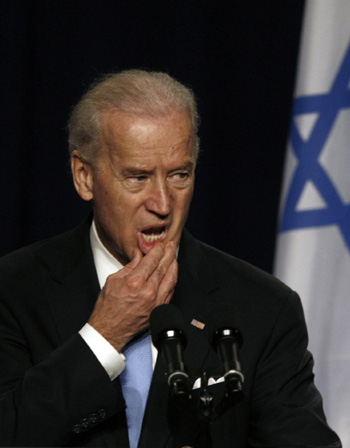
Why did Joe Biden insult America’s friends?

In an interview on CNN, Hillary Clinton was refreshingly blunt in saying that Israel insulted the US:

But now that’s been clearly stated, why did Joe Biden have to cap the first insult by adding another when he said: “the United States has no better friend in the community of nations than Israel”?

That’s not true — and most Americans know it. Canada, Britain, Germany and Japan are all viewed more favorably by Americans than is Israel.

Is it because Israel is the most ill-mannered among America’s friends that it has to be flattered with this “best friend” status? Is it because Israel remains perpetually on the verge of throwing a tantrum that its wet nurse feels compelled to constantly sing sweet words to this troublesome infant?

At least there are a few Israelis who can see through this farce.

Akiva Eldar writes:

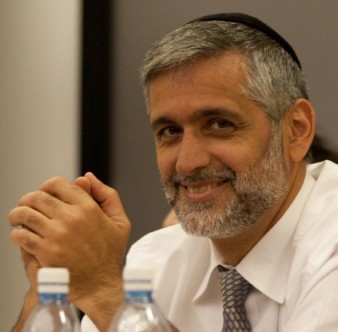
The apology offered by Prime Minister Benjamin Netanyahu and Interior Minister Eli Yishai recalls the joke about the servant who pinched the king’s bottom. En route to the gallows, the servant apologized: He thought it was the queen’s bottom.

The statement issued by Netanyahu’s bureau said that in light of the ongoing dispute between Israel and the United States over construction in East Jerusalem, the plans for new housing in the Ramat Shlomo neighborhood should not have been approved this particular week. It also said the premier had ordered Yishai to draft procedures that would prevent a recurrence. In other words, Yishai is welcome to submit more plans for Jewish construction in East Jerusalem next week, when U.S. Vice President Joe Biden will no longer be here.

Based on Biden’s reaction, it seems that he (and, presumably, his boss) has decided that it is better to leave with a few sour grapes than to quarrel with the vineyard guard. In his speech at Tel Aviv University, he said he appreciated Netanyahu’s pledge that there would be no recurrence. But what exactly does that mean? That next time he comes, the Planning and Building Committee will be asked to defer discussion of similar plans until the honored guest has left? With the media storm dying down, Netanyahu can breathe a sigh of relief.

In a sense, the uproar actually helped him: To wipe the spit off his face, Biden had to say it was only rain. Therefore, he lauded Netanyahu’s assertion that actual construction in Ramat Shlomo would begin only in another several years.

Thus Israel essentially received an American green light for approving even more building plans in East Jerusalem.

Biden might not know it, but the Palestinians certainly remember that this is exactly how East Jerusalem’s Har Homa neighborhood began: Then, too, Netanyahu persuaded the White House that construction would begin only in another several years.

When Biden arrived, the Arab League had just recommended that Palestinian Authority President Mahmoud Abbas accede to Washington’s proposal for indirect talks with Israel.

But instead of being able to leave with an announcement that the talks have officially begun, Biden is leaving with the news that the Arab League has suspended its recommendation.

Netanyahu can thus hope that the Ramat Shlomo imbroglio has deferred the moment of truth when he must reveal his interpretation of “two states for two peoples.” And just in case anyone failed to realize how impartial a mediator the U.S. is, Biden said in his Tel Aviv speech that the U.S. has “no better friend” than Israel.

For Netanyahu, the cherry on top was that the onus for advancing the negotiations has now been put on the Arab states – just two weeks before the Arab League summit in Tripoli, where the league’s 2002 peace initiative will again be up for discussion. For months, U.S. President Barack Obama has been trying to persuade Arab leaders not to disconnect this important initiative from life support. His argument is that nothing would make Iranian President Mahmoud Ahmadinejad happier than a final blow-up of the peace process and the outbreak of a third intifada. And his joy would be redoubled if the fire started in Jerusalem.

But while the U.S. may be papering over the rift for now, Western diplomats said the bill will come due once the talks with the PA begin (assuming they do). The U.S. has already said it will submit bridging proposals of its own during these talks, and its anger and frustration over the Ramat Shlomo incident are likely to make it far more sympathetic to the Palestinians’ positions, the diplomats said.

For instance, Netanyahu wants security issues to top the talks’ agenda, an Israeli source said. But the Palestinians want the first issue to be borders, including in Jerusalem.

And the European Union, which had planned to upgrade various agreements with Israel this week in honor of the resumed talks, has now postponed the upgrade until it becomes clear whether the talks will in fact take place.

Facebooktwittermail

Time for George Mitchell and the US to step aside

Among commentators unable to see beyond the bankrupt perspective that the United States has the indispensable role of mediating a Middle East peace agreement (if such an agreement is ever to be reached), much is being made about Joe Biden’s tough words “behind closed doors”. Laura Rozen quotes from a Yedioth Ahronoth report:

People who heard what Biden said were stunned. “This is starting to get dangerous for us,” Biden castigated his interlocutors. “What you’re doing here undermines the security of our troops who are fighting in Iraq, Afghanistan and Pakistan. That endangers us and it endangers regional peace.”

The vice president told his Israeli hosts that since many people in the Muslim world perceived a connection between Israel’s actions and US policy, any decision about construction that undermines Palestinian rights in East Jerusalem could have an impact on the personal safety of American troops fighting against Islamic terrorism.

Help us fight the war on terrorism, Biden admonishes his Israeli friends. But we are, they think but in this instance are too polite to say. That’s why we’re taking over East Jerusalem. We’re fortifying the front-line.

It seems to me that the crux of the issue is not the latest upset; it is that the so-called peace process has always rested on an unbalanced foundation. Which is to say, Israel will only accept the direct involvement of third parties that have a clear bias in their favor.

If President Obama wanted to do something truly radical, it might not have to take the form of applying pressure — pressure that would be fiercely and effectively resisted by the Israel lobby. On the contrary, it could be to acknowledge that American efforts have failed — not only his own but those of all his predecessors — and that there comes a point when failure has been so persistent and become so predictable, that it is time to step aside.

There is someone else waiting in the wings, eager to step in — a man who regards dialogue as the essence of politics and who can make a stronger claim to be even-handed than anyone in the United States or Europe: Brazil’s President Lula da Silva. He also happens to be the most popular political leader in the world.

Ahead of his visit to the Middle East next week, where his first stop will be in Israel, Lula was interviewed by Haaretz:

Lula was one of the first leaders to host President Mahmoud Ahmadinejad after Iran’s blood-stained election of June 2009. Brazil was also one of only five countries to abstain from an International Atomic Energy Agency vote last November on a condemnation of Iran.

He is set to visit the Islamic Republic in May, where his hosts will repay him in kind for the red carpet he laid out for them in Brasilia last November. When asked how he’ll be able to win over the Israelis, whose vantage point is related to the trauma of the Holocaust, Lula replies: “I spoke with the president of Iran and made it clear to him that he cannot go on saying that he wants Israel’s liquidation, just as it is untenable for him to deny the Holocaust, which is a legacy of all humanity. I added that the fact that he has differences with Israel does not allow him to deny or ignore history.”

In a way that will undoubtedly disturb those who will host him in Israel next week, Lula draws a direct association between the failure to advance Israeli-Palestinian peace and his planned visit to Tehran; between the need to ensure that Iran will not manufacture nuclear weapons and the need to resolve the Middle East conflict; and between the failed attempts at mediation led by international players, first and foremost the United States, and the need to bring in fresh new players – Brazilians, in all likelihood.

“I talked about Iran with many leaders, and particularly with those whose countries have a seat on the Security Council,” he explains. “The Americans, the French, the British, the Russians and the Chinese all want to advance the Middle East peace process. But I also feel that the parties to the conflict and the people involved in the process have long since grown tired of it. So, the time has come to bring into the arena players who will be able to put forward new ideas. Those players must have access to all levels of the conflict: in Israel, in Palestine, in Iran, in Syria, in Jordan and in many other countries that are associated with this conflict. This is the only way we will be able to advance Israeli-Palestinian peace, and at the same time be able to say clearly to Iran that we are against the manufacture of nuclear weapons.”

Lula does not overlook any of the elements in this comprehensive linkage when asked about the fact that Israeli patience regarding Iran seems to have worn thin. “The leaders I spoke to believe that we must act quickly, otherwise Israel will attack Iran. I do not want Israel to attack Iran, just as I do not want Iran to attack Israel. In an orderly world, people have to learn to talk to one another.” Here he seems to be alluding critically to the “proximity talks” about to get underway between Israel and the Palestinian Authority.

“The appropriate partners from each country have to be found, and more serious talks conducted,” he continues. “The importance of talks between third- and fourth-rank officials [does not hold] even 1 percent of the importance of tete-a-tete talks between leaders. Politics is mainly contact. People have to look at each other, sense each other. A leader has to look into the eyes of his interlocutor instead of communicating with him through lower-level individuals.”

The Brazilian president says he is disappointed that all that remains of the Oslo Accords is “Nobel Prizes and photographs of people hugging each other,” as well as the fact that the Annapolis conference of November 2007, in which Brazil participated, did not have any follow-up. “This gives me serious doubts: Who really wants peace in the Middle East? Who has an interest in achieving a solution and who would like the conflict to continue? The impression is that someone is constantly working here as though he has hidden enemies, people who simply do not want an agreement to be reached.”

Lula describes himself as a negotiator, not an ideologue, a person who manages to get along with both Hugo Chavez and George W. Bush, with Shimon Peres and Mahmoud Ahmadinejad. He says he has never read a book in his life, even though everyone admires his “supreme wisdom” and “creative mind.” As a chairman of the workers union during the years of military rule in Brazil, he encountered and resolved many difficult conflicts.

“I was born into the politics of dialogue, I became president of this country through dialogue and I have conducted my entire presidency by means of dialogue. I believe that through dialogue we will succeed in solving all the conflicts which today appear to be unsolvable,” he says.

He is well aware that he will be regarded as “naive” by his Israeli interlocutors. He is also familiar with the counter-rhetoric of Prime Minister Benjamin Netanyahu – who likens Ahmadinejad to Hitler, Iran to the Nazi regime and the world of 2010 to that of 1938. Lula’s assertive response is likely to surprise even those familiar with his arguments: “Anyone who compares Ahmadinejad and modern-day Iran to Hitler and the Nazis is having the same kind of radicalism of which Iran is being accused. Anyone who takes that line is not contributing in the least to the peace process which we want to create for the sake of the future. You cannot do politics with hate and resentment. Anyone who wants to do politics with hate and resentment should get out of politics. Nobody can rule a country through the liver. You have to rule a country with your head and your heart. Other than that, it’s best to stay somewhere else other than in politics

No doubt many veterans of the peace process would scoff at the notion that the Brazilian leader might succeed where those who have made this undertaking their professions have consistently failed. But if there is one place failure should succeed it is in the cultivation of humility.

As for the Israelis, there seems little prospect that they have the stomach for a genuinely even-handed approach and if they were to decline such an offer then that is undoubtedly their prerogative. They should be given these options: fair mediation or splendid isolation.

Claudio Lottenberg, the president of Sao Paulo’s Albert Einstein Hospital and a leader of Brazil’s Jewish community notes: “Lula is an important rising player in the international arena, and Israel should take account of this. It is important for Israel to have partners and allies besides the United States.”

But not only is Lula an important figure; Brazil itself clearly has much to teach a world which must become a multicultural success if it is to have any future at all.

Lula’s ambition to make a deep imprint in the Middle East goes beyond his country’s international status, to what he describes proudly as “a long Brazilian history of peace and a life of brotherhood in a region of diverse cultures. More than 120,000 Jews live here in full harmony with 10 million Arabs. It would seem that people can learn from us.” Brazil terms itself “the world’s largest Lebanese country” (some six million of Brazil’s Arabs are of Lebanese origin), “the second-largest African country in the world” (after Nigeria), and also the second-largest Italian and Japanese countries. It is a huge blend of peoples and cultures that do not know the meaning of friction.

You’d be hard-pressed to find someone in Rio de Janeiro who hasn’t heard of Saara Street, where Jews and Arabs sell clothing, toys and other items side by side. Whenever tension in the Middle East rises, local television crews show up to film the Brazilian version of coexistence. “All Brazilians are brothers,” they say – hence their ability, in their view, to bring brotherhood to all other nations.

Facebooktwittermail

Cornel West points out Obama’s hypocrisy on Israelis and Palestinians

Watch the clip above as Cornel West responds to this question:

The Obama administration talks about a new era of engagement. You spoke earlier about a “friendlier face of empire”. What does that mean? Is that just marketing? Or is there actually a change in US foreign policy these days?

Watch the whole 23-minute interview — if you live outside the U.S. in a location where Al Jazeera does not block access to its own videos.

Facebooktwittermail

The peace-process masquerade falls apart

It turns out that at least when it comes to the Israeli-Palestinian conflict the difference between the Bush administration and the Obama administration is this: team Bush had better choreography.

The Guardian now reports:

The US vice-president, Joe Biden, today attempted to salvage the Middle East peace talks after the Palestinians announced they were pulling out of a new round of indirect negotiations before they had begun.

The Palestinian move was in protest against Israel’s decision to build hundreds of new homes in a Jewish settlement in East Jerusalem.

The withdrawal from negotiations, announced in Cairo by Amr Moussa, the head of the Arab League, represents a major setback to months of diplomacy by the US administration prior to Biden’s visit to the region.

The US vice-president said an agreement would be “profoundly” in Israel’s interests and appealed to the Israeli government to make a serious attempt to reach peace with the Palestinians

Even so, Biden went on to say that in Israel the US has “no better friend”.

Does the vice president, does this administration, have no dignity?

Is it so craven that in the moment of its humiliation it feels driven to ingratiate itself even further?

What Goliaths are these that never fail in turning America’s leaders into gibbering fools?

Gideon Levy offers credit where credit is due:

Here’s someone new to blame for everything: Eli Yishai. After all, Benjamin Netanyahu wanted it so much, Ehud Barak pressed so hard, Shimon Peres wielded so much influence – and along came the interior minister and ruined everything.

There we were, on the brink of another historic upheaval (almost). Proximity talks with the Palestinians were in the air, peace was knocking on the door, the occupation was nearing its end – and then a Shas rogue, who knows nothing about timing and diplomacy, came and shuffled all the proximity and peace cards.

The scoundrel appeared in the midst of the smile- and hug-fest with the vice president of the United States and disrupted the celebration. Joe Biden’s white-toothed smiles froze abruptly, the great friendship was about to disintegrate, and even the dinner with the prime minister and his wife was almost canceled, along with the entire “peace process.” And all because of Yishai.

Well, the interior minister does deserve our modest thanks. The move was perfect. The timing, which everyone is complaining about, was brilliant. It was exactly the time to call a spade a spade. As always, we need Yishai (and occasionally Avigdor Lieberman) to expose our true face, without the mask and lies, and play the enfant terrible who shouts that the emperor has no clothes.

For the emperor indeed has no clothes. Thank you, Yishai, for exposing it. Thank you for ripping the disguise off the revelers in the great ongoing peace-process masquerade in which nobody means anything or believes in anything.

Facebooktwittermail

U.S. changing focus of Iran policy

The Los Angeles Times reports:

After keeping a careful distance for the last year, the Obama administration has concluded that the Iranian opposition movement has staying power and has embraced it as a central element in the U.S.-led campaign to pressure the country’s clerical government.

Administration officials and some allied governments believe that a combination of domestic unrest and international sanctions targeting Iran’s Revolutionary Guard offers the best hope for forcing Tehran to yield on its nuclear program, and could even lead to a change in the government.

The administration has made the shift at a time when it is facing sharp domestic criticism over President Obama’s failed initiative to launch negotiations with Iran and its perceived unwillingness to strongly back the opposition movement. Meanwhile, the protests sparked by June’s disputed presidential election in Iran grew despite a tough crackdown.

This new approach is not a sure thing: It is far from clear that squeezing the Revolutionary Guard, a sprawling military organization that has vast business interests and is close to President Mahmoud Ahmadinejad, would seriously damage it or strengthen the opposition, as the administration hopes. And despite high-profile encouragement by Secretary of State Hillary Rodham Clinton and other U.S. officials, many opposition activists fear that Washington’s embrace will bring more harm than good.

“Just leave us alone, please,” one activist in Tehran pleaded.

Facebooktwittermail

Biden late for dinner

The Associated Press reports that after the Israeli government humiliated the US Vice President Joe Biden, the minister responsible says he’s sorry:

Israeli Interior Minister Eli Yishai, whose office announced the latest construction plans in east Jerusalem, apologized Wednesday for disrupting Biden’s visit. But he said the problem was merely about timing, not substance.

“We had no intention, no desire, to offend or taunt an important man like the vice president during his visit,” Yishai told Israel Radio. “I am very sorry for the embarrassment … Next time we need to take timing into account.”

Ministry spokeswoman Efrat Orbach said the ministry routinely issues announcements of planning decisions immediately after they are taken. But this is not the first time that such announcements have dovetailed with visits by top U.S. officials. Plans for hundreds of settlement apartments were announced during the peace mission of former Secretary of State Condoleezza Rice.

The Israeli announcement drew an unusually harsh condemnation from Biden late Tuesday. And in an apparent snub Tuesday night, Biden pointedly arrived 90 minutes late to his scheduled dinner with Netanyahu

The Los Angeles Times reports:

Biden, who had come to try to smooth relations with a longtime ally and promote new peace talks, denounced Israel’s plans to build 1,600 housing units in traditionally Arab East Jerusalem as a threat to the search for peace.

“I condemn the decision by the government of Israel to advance planning for new housing units in East Jerusalem,” Biden said, calling it “precisely the kind of step that undermines the trust we need right now.”

“We must build an atmosphere to support negotiations, not complicate them,” Biden said.

The sharp turn of events abruptly changed the tenor of the trip in its second day, coming just hours after the vice president proclaimed his love for Israel and declared enduring U.S. support. Biden’s visit followed a year of tension brought on by Israel’s defiance of the Obama administration’s admonitions on precisely the same issue: housing settlements in disputed areas.

Obama administration cheerleaders like J Street might get a kick out of hearing Biden being harshly critical of the Israeli government, but what’s a denunciation like this really worth?

The administration either needs to threaten to apply real pressure on the Israeli government, or, if it wants to confine itself to diplomatic gestures then it should do so under the tutelage of Recep Tayyip Erdoğan.

In response to Israel’s latest contemptuous behavior, Biden could — he really could — have turned around and said adiós. He does after all belong to an administration that less than a year ago was advising Netanyahu to complete his “homework” on freezing settlements before it would be worth arranging a meeting.

Facebooktwittermail

The price tag for Israeli intransigence

The day before Vice President Joe Biden arrived in Israel — supposedly on a mission to help kick-start peace talks between Israelis and Palestinians — the Netanyahu government made its contempt for the Obama administration clear by approving new settlement construction.

They were quick to take offense — they being the Israelis!

“While we welcome Vice President Biden, a longtime friend and supporter of Israel,” Danny Danon, the deputy speaker of the Knesset, told the Washington Post, “we see it as nothing short of an insult that President Obama himself is not coming.”

Washington on the other hand had no interest in creating a fuss about settlement growth — its impotence on that particular issue has already been amply demonstrated. Pushing for a real settlement freeze is passé. The new game is proximity talks and shuttle diplomacy.

After 17 years of direct talks it’s now time to talk from a distance and have George Mitchell like an Energizer bunny going back and forth between Jerusalem and Ramallah. Irrespective of how much life there might be in his batteries, the Arab League has thankfully imposed a four-month deadline on this charade.

If the latest “initiative” seems like an exercise in atmospherics, an Israeli official was straightforward enough to confirm the fact when he told Ynet that resuming talks with the Palestinians “would create an atmosphere in the Arab world and the international community that would allow the world to focus on the real threat – Iran.”

George Mitchell is going to allow the Israelis to talk to the Palestinians so that the world can focus on Iran.

It’s not a novel idea. It came up three-and-a-half years ago in Washington when Philip Zelikow, Special Counselor to then-Secretary of State Condoleezza Rice, caused a stir by making a similar linkage between the threat from Iran and the Israeli-Palestinian conflict.

The controversy in Zelikow’s suggestion was that it hinted that the Bush administration might defy Tel Aviv and remove the peace process from its preservative, but Zelikow’s concern was the same as that of the Israelis now: how to mount pressure on Iran. This depended, he said, on strengthening an anti-Iran coalition.

What would bind that coalition and help keep them together is a sense that the Arab-Israeli issues are being addressed, that they see a common determination to sustain an active policy that tries to deal with the problems of Israel and the Palestinians. We don’t want this issue … [to] have the real corrosive effects that it has, or the symbolic corrosive effects that it causes in undermining some of the friends we need [as] friends to confront some of the serious dangers we must face together.

Note that Zelikow was not pushing for anything so grand as a resolution to the conflict, merely that an effort be made to create “a sense” that the issues were being addressed.

Initiatives, summits, and dark-suited earnestness with a liberal sprinkling of handshakes — we all know the routine. “What will they ask Israel to do? Meet with Abu Mazen? – so you’ll meet with Abu Mazen,” one Washington hand told Haaretz at the time.

That was 2006. Now in 2010 the Israelis don’t even need to inconvenience themselves by sitting in the same room as the Palestinians, even though Netanyahu would be happy to be granted the photo-op of face-to-face talks — talks that he can be confident will be fruitless.

The anti-Iran coalition might still be rather shaky but there is another coalition that has proved to be durable and near universal: the coalition of states who remain content to pay lip-service to the Palestinian issue; the political leaders who gladly shake hands with Mahmoud Abbas as though having Ramallah’s jaded political leaders received in global capitals was all the Palestinians could ever have aspired for.

But when it comes to dealing with the Israelis no one has a better understanding than the Israelis themselves. Jewish settlers in the West Bank insist that if they are uprooted, others will be forced to pay the “price tag.”

President Obama on the other hand insists that for Israel “the status quo is unsustainable” but neither he nor any of the other political leaders who profess some level of concern for the Palestinians have been willing to exact a price for Israeli intransigence. Until a price tag is applied effectively, Israel can remain confident in the durability of the status quo.

Facebooktwittermail

Fresh Middle East talks hit a wall

Al Jazeera reports:

Israel’s move to expand illegal settlements in the occupied West Bank has threatened to sabotage newly agreed indirect talks with the Palestinian Authority before they can even begin.

George Mitchell, the US envoy to the Middle East, announced on Monday that the two sides had agreed a day earlier to begin indirect negotiations that have been stalled since the December 2008 Gaza war.

He said he hoped the indirect talks would “lead to direct negotiations as soon as possible” and appealed to the two sides not do to anything that could jeopardise the talks.

But news that Israel’s defence ministry had approved the construction of 112 new apartments in the West Bank settlement of Beitar Illit drew a sharp response from the Palestinians.

Facebooktwittermail

The reconstruction blame game

At Mother Jones, Daniel Schulman writes:

After years of a US presence in Iraq and Afghanistan, rebuilding and stabilization projects remain disjointed and chaotic, resulting in wasted taxpayer dollars and, potentially, the deaths of soldiers and civilians. Meanwhile, the nearly six-year-old State Department office that was supposed to coordinate these efforts isn’t even fully operational. And for that, according to the official who heads the division, Sen. Tom Coburn (R-Okla.) is partly to blame.

As the Obama administration surges soldiers and civilians into Afghanistan, the State Department’s Office of the Coordinator for Reconstruction and Stabilization (known as S/CRS) is a key player in synchronizing the alphabet soup of agencies and divisions involved in the effort. But its effectiveness has come under fire—from Stuart Bowen, the Special Inspector General for Iraq Reconstruction and from members of the congressionally chartered Commission on Wartime Contracting. On Monday, the commission held a hearing on coordination failures and grilled officials from the Pentagon, the US Agency for International Development, and the State Department on their teamwork. Not masking his anger, Chris Shays, the panel’s co-chair and a former Republican congressman from Connecticut, laid out the stakes: “The lack of coordination costs billions and billions and billions of dollars—huge waste, which means that we don’t optimize the dollars that we spend. It also results in the loss of lives in our military, the loss of lives in our diplomatic corps, the loss lives of our civil servants, the loss of lives of our contractors…It’s a huge, huge issue.”

Facebooktwittermail

Incompetent McCarthyism and shared beliefs

Scott Horton takes on the neocon campaign against a group of lawyers, now working for the Obama Administration, who “voluntarily represented terrorists.”

…the incompetent McCarthyites haven’t done their homework. On a list of lawyers in recent government service who have served alleged terrorists, the first name might be Michael Chertoff’s. Chertoff served as counsel to Magdy El-Amir, a man identified as a leading Al Qaeda fundraiser in North America. Chertoff went on to head the criminal division at Justice and then to become secretary of Homeland Security. There is no hint that his ties to El-Amir in any way influenced Chertoff in his duties in the Bush Administration, nor would any reasonable person suspect that they would. The list would also include Michael Mukasey, Bush’s last attorney general, whose law firm had an active pro bono program writing appeals briefs in support of the Guantánamo inmates on constitutional issues, and Rudy Giuliani, whose firm was and is also engaged in representing Gitmo prisoners. It therefore came as no surprise when leading Republican lawyers quickly came out attacking the Cheney-Kristol-Goldfarb project as “shameful.”

But the question that Liz Cheney asks is an appropriate one. “Whose values do they share?” Perhaps it’s the values of John Adams. After the Boston Massacre, when revolutionary sentiment was flaring, Adams stood up to represent the British soldiers accused of slaughtering his fellow Bostonians in a criminal trial, and he helped them beat the rap. Most of his fellow citizens were dumbstruck by his decision, but at the end of a long life, looking back, Adams decided that this was “one of the best Pieces of Service I ever rendered my Country.” It’s the values of Kenneth Royall, the JAG colonel who defended a group of accused German saboteurs during World War II, bringing their appeal to the Supreme Court against the wishes of his commander-in-chief. Royall’s brilliant defense got him a promotion to brigadier general, and it later helped drive President Truman’s decision to name him the last American secretary of war. Vigorous defense of even the meanest person accused is an essential part of our democracy and our notions of justice—but it’s not a value that is shared by Liz Cheney.

Whose values does Liz Cheney share? Look at the nations around the world in which criminal defense counsel are harassed and persecuted. Look at Putin’s Russia and the case of Sergei Magnitsky, or Mugabe’s Zimbabwe and the case of Beatrice Mtetwa. Perhaps it is in countries like Russia and Zimbabwe that Liz Cheney and her Weekly Standard friends might find governments that share their values.

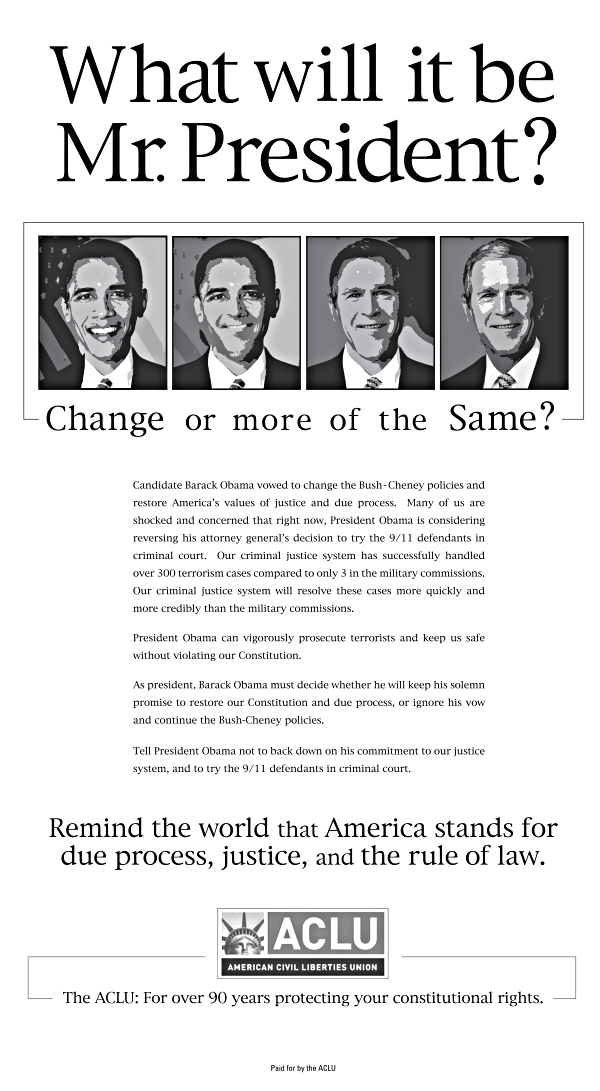
Meanwhile, the ACLU ran an ad in the New York Times on Sunday, calling on President Obama not to reverse his administration’s decision to prosecute the 9/11 suspects in civilian courts.

Facebooktwittermail

The Iranian riddle

Trita Parsi writes:

Iran is the 21st century equivalent of 1930s Russia — a riddle wrapped in a mystery inside an enigma. The Iranians haven’t stumbled upon this mystifying state coincidentally, and the enigma isn’t the result of outsiders’ failure to try to understand them. Rather, the Iranian government has a deliberate policy aimed at confusing the outside world about its goals and decision-making processes. “There is an intention out there to confuse,” a noted Iranian professor told me in Tehran a few years ago. The rulers in Tehran think that opacity and the perception of unpredictability buy them security.

Given that intent, it is hardly surprising that Washington has had such a difficult time formulating a successful Iran policy. Right now, the Obama Administration is embarking on the sanctions track, pursuing both a U.N. Security Council resolution, as well as measures by a coalition of the willing that would go beyond anything imposed by the U.N. The idea is that a tough sanction regime would hit the Iranian government — and especially the Islamic Revolutionary Guards — while sparing Iran’s population.

Yet despite what they say, few in Washington believe sanctions alone will alter Iran’s behavior. They have never worked as well as they might in Iran; rhetoric has only served to raise tensions further. The experience of the Bush Administration shows that the combination of sanctions and rhetoric about regime change — remember the “Axis of Evil?” — helped strengthen the hands of Iran’s hard-liners. It vindicated Tehran’s paranoia and reduced options available to the U.S. If the Iranian regime thinks that the real aim of U.S. policy is to topple it, it is hardly likely to make the conciliatory policy changes — for example, on its nuclear program — that the U.S. seeks.

So what should Washington do? A starting point should be to recognize that the U.S. is no longer dealing with an Iran that merely simulates indecisiveness. On the contrary, Iran seems genuinely irresolute and paralyzed by the Khamenei government’s loss of legitimacy and continued conflicts both within the élite and between the government and the people.

Facebooktwittermail

Israel’s game of bluff

Didi Remez has translated parts of a column by Nahum Barnea that appeared in Hebrew in Yediot‘s Friday political supplement. Barnea considers the assessments by Dr. Moshe Vered who published a study last year on possible scenarios that would result from an Israeli military strike on Iran’s nuclear facilities.

Barnea goes on to say:

The game is now approaching the critical stage, the “money time.” Netanyahu and Barak are waving the military card. “All the options are on the table,” they say, accompanying the sentence with a meaningful look. There are Israelis, in uniform and civilian clothes, who take them seriously. The Obama administration is troubled. It is no accident that US Chairman of the Joint Chiefs of Staff Admiral Michael Mullen was sent here, to make it clear that the US was vetoing a military strike. It is no accident that Barak was invited to Washington and Vice President Biden will be coming here on Monday. He is not only coming to visit Yad Vashem.

I find it difficult to believe that Netanyahu will undertake such a weighty and dangerous decision. It is more reasonable to assume that he and Barak are playing “hold me back.” On the day they will be called upon to explain why Iran attained nuclear weapons, they will say, each on his own, what do you want from me, I prepared a daring, deadly, amazing operation, but they—the US administration, the top IDF brass, the forum of three, the forum of seven, the forum of ten—tripped me up. They are to blame.

Netanyahu and Barak know: there is no military operation more successful, more perfect, than an operation that did not take place.

Netanyahu has upgraded Ahmadinejad to the dimensions of a Hitler. Against Hitler, one fights to the last bunker. This is what Churchill did, and Netanyahu wants so badly to be like Churchill. His credibility—a sensitive issue—is on the table. If he retreats, the voters will turn their back on him. Where will he go? In his distress, he may run forward.

The fascinating side of this story is that very few Israelis would appear to believe their prime minister. If they believed him, they would not run in a frenzy to buy apartments in the towers sprouting like mushrooms around the Kirya. In the event that Iran should be bombed, the residents of the towers would be the first to get it. If they believed [Netanyahu], the real estate prices in Tel Aviv would drop to a quarter of their current value, and long lines of people applying for passports would extend outside the foreign embassies.

Given that, as Barnea notes, Israelis can tell Netanyahu is bluffing, there seems little reason to doubt that the Israeli prime minister’s bluff is equally transparent to both Washington and Tehran.

Washington feels obliged to play along in order to make the Israeli threat seem credible. Tehran in turn needs to show that it will not bow to foreign pressure and thus the likely effect of Israel’s threats is to make the Iranian nuclear program advance more quickly than it would have minus the pressure.

How can this possibly serve Israel’s interests? In terms of thwarting Iran’s nuclear program it doesn’t, but this is not the Jewish state’s primary goal. What it wants more than anything else is to promote division across the region and thereby undermine the power of the opponents of Zionism.

Come the day that “the Iranian threat” turns out to have been overstated, a new threat will emerge. Israel cannot survive without its beloved enemies.

Facebooktwittermail

How the war on drugs gave birth to a permanent American undercaste

At TomDispatch, Michelle Alexander writes:

Ever since Barack Obama lifted his right hand and took his oath of office, pledging to serve the United States as its 44th president, ordinary people and their leaders around the globe have been celebrating our nation’s “triumph over race.” Obama’s election has been touted as the final nail in the coffin of Jim Crow, the bookend placed on the history of racial caste in America.

Obama’s mere presence in the Oval Office is offered as proof that “the land of the free” has finally made good on its promise of equality. There’s an implicit yet undeniable message embedded in his appearance on the world stage: this is what freedom looks like; this is what democracy can do for you. If you are poor, marginalized, or relegated to an inferior caste, there is hope for you. Trust us. Trust our rules, laws, customs, and wars. You, too, can get to the promised land.

Perhaps greater lies have been told in the past century, but they can be counted on one hand. Racial caste is alive and well in America.

Facebooktwittermail

Does Obama have a vision?

At Time, Mark Halperin writes:

Who would have thought that one of Barack Obama’s biggest missteps as president would be repeating some of the bad habits of George W. Bush? No single factor was more instrumental in Obama’s 2008 victory than his pledge to completely reverse the nation’s course once in the White House. Instead, over the past year, Obama has mimicked some of Bush’s most egregious blunders, leading to much of the political predicament in which the present decider finds himself today.

This is not to say that Obama has maintained Bush’s policies, although his administration’s continuity on issues ranging from Afghanistan to Wall Street has alienated the left. And he certainly hasn’t done himself any favors by failing to inspire the general public to rally around his agenda. But Obama’s stumbles atop the high-wire of running the federal government has created perhaps the greatest danger to his presidency, and they are oddly reminiscent of the misguided practices which tripped up his predecessor.

Reuters reports:

President Barack Obama will outline his administration’s vision for space agency NASA and an eventual trip to Mars during a conference in Florida in April, the White House said on Sunday.

Obama has had to defend his commitment to the space agency in the politically important U.S. state after submitting a budget to Congress that would cancel a program to return U.S. astronauts to the moon.

Obama wants to refocus NASA efforts on technologies to prepare for human missions to other destinations in the solar system.

In Mark Halperin’s analysis of the failings of the Obama administration the key word is “missteps”.

Journalists these days love judgement-free terms like this. Another favorite is “recalibrate”. These words evoke an image of political conduct that suggests Washington is a machine (usually poorly oiled) and the president is the master mechanic. He will do swimmingly well if he can just figure out exactly where to apply the lubricants. Up steps an old hand like Halperin, happy to advise which are the squeaky wheels that need fixing.

No doubt Obama is lacking in executive experience but unfortunately his problems seem to run much deeper than that. If he is unencumbered by Bush’s ideological rigidity, this appears to have less to do with being his being more intellectually nimble than with his being more shamelessly cynical.

The latest example of Obama’s cynicism is that he isn’t willing to ditch the scientifically unjustifiable objective of a human mission to Mars. One can only assume that this decision is driven by his fear that to abandon such a project would make him appear less adventurous, less visionary than his predecessor — even though when Bush announced that objective it was decried by scientists unwilling to indulge in the former president’s comic-book fantasies.

If Obama’s problem is less mechanical and more attitudinal, what’s he going to do? Tell us he realizes that in his first year he approached his job with too much cynicism but he’s recently had some good discussions with Axelrod and once again he’s rediscovered his inspirational core?

Of course cynicism isn’t a misstep and it can’t really be fixed — only exposed and condemned.

Facebooktwittermail

US preparing to send Special Ops forces into Somalia

The New York Times reports:

The Somali government is preparing a major offensive to take back this capital block by crumbling block, and it takes just a listen to the low growl of a small surveillance plane circling in the night sky overhead to know who is surreptitiously backing that effort.

“It’s the Americans,” said Gen. Mohamed Gelle Kahiye, the new chief of Somalia’s military, who said he recently shared plans about coming military operations with American advisers. “They’re helping us.”

That American assistance could be crucial to the effort by Somalia’s government to finally reassert its control over the capital and bring a semblance of order to a country that has been steeped in anarchy for two decades. For the Americans, it is part of a counterterrorism strategy to deny a haven to Al Qaeda, which has found sanctuary for years in Somalia’s chaos and has helped turn this country into a magnet for jihadists from around the world.

The United States is increasingly concerned about the link between Somalia and Yemen, a growing extremist hot spot, with fighters going back and forth across the Red Sea in what one Somali watcher described as an “Al Qaeda exchange program.”

But it seems there has been a genuine shift in Somali policy, too, and the Americans have absorbed a Somali truth that eluded them for nearly 20 years: If Somalia is going to be stabilized, it is going to take Somalis.

“This is not an American offensive,” said Johnnie Carson, the assistant secretary of state for Africa. “The U.S. military is not on the ground in Somalia. Full stop.”

Not an American offensive… An elusive truth has been absorbed…

But what’s the very next piece of information in this report?

An unnamed American official in Washington says: “What you’re likely to see is airstrikes and Special Ops moving in, hitting and getting out.”

Facebooktwittermail

Iraqi elections

The New York Times reported:

A concerted wave of attacks struck Baghdad and other cities across the country on Sunday as Iraqis voted to elect a new parliament and possibly a new prime minister. Explosions reverberated across the capital moments before the polls opened and continued through the morning haze for the first hours of voting.

At least 38 people were killed and dozens more wounded in Baghdad alone by the time polls officially closed there, the Interior Ministry reported.

Insurgents in Iraq had vowed to disrupt the election, and the attacks appeared timed to frighten voters away from polling sites. If that were the intent, it did not succeed entirely.

By late morning the attacks — dozens of mortars, rockets and bombs — had tapered off, and Iraqis lined up to vote, many of them expressing anger and determination.

“Everyone went,” Maliq Bedawi, 45, who works at Baghdad International Airport, said as he waved his purple-stained finger. He stood outside the rubble of an apartment building that was struck and destroyed by what the police said was a Katyusha rocket. “They were defiant about what happened. Even people who didn’t want to vote before, they went after this rocket.”

Iraqis, he went on, “are not afraid of bombs anymore.”

The Washington Post reported:

As Obama administration officials tried in recent weeks to anticipate what could go wrong in Sunday’s elections in Iraq, they realized with some relief that they are largely powerless to control what happens.

In twice-daily meetings leading up to the vote and in a final preelection videoconference Thursday with the U.S. ambassador and military commander on the ground, officials contemplated the possibilities. Violence, intimidation or fraud might limit turnout or mar the legitimacy of the vote. Post-election political jockeying could delay the formation of a government for months and leave a dangerous power vacuum. Iran could create mischief, or worse.

But beneath the last-minute activity in Washington, officials have recognized that the electoral contest and its aftermath are in the hands of the Iraqis. Nearly seven years after U.S.-led troops took over Iraq, the administration appears content with its changing role there.

Committed to halving the contingent of nearly 100,000 U.S. troops in Iraq by summer’s end as he escalates a red-hot war in Afghanistan, President Obama has set a high bar for intervening — or even acknowledging serious concern about the future.

Facebooktwittermail