Category Archives: Obama administration

Congress to Obama on Israel: Do what we say, not what we do

Following AIPAC’s lead, 327 members of Congress wrote a letter to President Obama last week whose core message resonates with the approach to politics favored by Pope Benedict: difficulties should be handled discreetly with the minimum of publicity. It’s a tried and tested practice that has throughout history been shown to be as rotten as it appears, yet it appeals to its proponents because those who follow this path have an immense tolerance for hypocrisy.

Thus, the letter to Obama read:

We recognize that, despite the extraordinary closeness between our country and Israel, there will be differences over issues both large and small. Our view is that such differences are best resolved quietly, in trust and confidence, as befits longstanding strategic allies.

As for differences between Congress and the administration, those are best handled through an open letter in which 327 publicity-conscious politicians can very visibly identify themselves as lackeys of the Israel lobby.

Had this letter to the president not been an open letter, I wonder how many signatures it would have got?

Facebooktwittermail

Effortless, carefree war

What was the most significant thing about President Obama’s surprise trip to Afghanistan on Sunday? He wore a leather bomber jacket.

Or, to be more precise, the most significant thing about Obama’s six-hour visit was nothing that he said, nor the fact that he went, but that in the utterly trivialized view of war that American civilians are fed, the fact that Obama’s attire would merit comment.

A recently leaked CIA document said that the foundation of support for the war from America’s European allies might be weakening. “Why Counting on Apathy Might Not Be Enough” a CIA “Red Cell” special memorandum warned.

While the apathy of Europeans might be in jeopardy, American apathy appears to be as reliable as ever.

Contrary to Obama’s claim that the war in Afghanistan is a war of necessity, it is really a war of indifference — a war that continues because the people paying for it don’t care strongly enough to object to its continuation. Most importantly, Americans have by and large acquiesced to the notion that perpetual war is a condition of this era rather than a product of political policy. War has become an inobtrusive background noise in the American way of life.

Postscript: The “effortless” in the headline is an allusion to that forgotten expression: the war effort.

The fact that America’s wars of this last decade have required no war effort is one of the most telling ways in which these have not been wars of necessity. In a war of necessity, a civilian war effort is not merely required; it is unavoidable.

Whereas the civilian role in a war effort is an adjunct to the military effort, in a war that requires no war effort, there is no civilian role. There is instead a necessity that civilians be cocooned by an infantilism engendered by consumerism, which is to say, that they be easily pacified and rendered politically apathetic by having their trivial desires easily fulfilled.

Facebooktwittermail

The world is sick of Israel

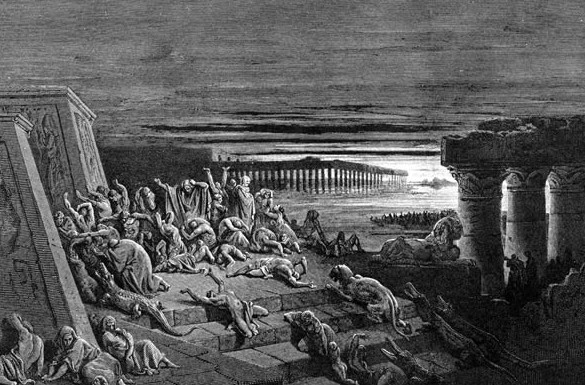
A commentary in Haaretz by Akiva Eldar opts for a Biblical theme with the headline: “The plague of darkness has struck modern Israelites.” But the observation in my headline comes directly from the text as Eldar bemoans the fact that Israeli prime minister Benjamin Netanyahu “simply refuses to see that the world is sick of us.”

A report from the BBC says US officials indicate the Obama administration would “seriously consider abstaining” if the issue of Israeli settlements was put to the vote in the UN Security Council.

This is one of the few threats Obama can make without needing Congressional support. And although this administration has not hesitated in making demands on the Israelis, it has thus far refrained from issuing threats. This could be a significant shift.

Eldar writes:

[T]he myopic Jewish state … has gone and collided head-on with the ally that offers existential support. Israel has become an environmental hazard and its own greatest threat. For 43 years, Israel has been ruled by people who have refused to see reality. They speak of “united Jerusalem,” knowing that no other country has recognized the annexation of the eastern part of the city. They sent 300,000 people to settle land they know does not belong to them. As early as September 1967, Theodor Meron, then the legal adviser to the Foreign Ministry, said there was a categorical prohibition against civilian settlement in occupied territories, under the Fourth Geneva Convention. Meron – who would become the president of the International Criminal Tribunal for the former Yugoslavia, and is now a member of the Appeals Chamber for both that court and a similar one for Rwanda – wrote to prime minister Levi Eshkol in a top-secret memorandum: “I fear there is great sensitivity in the world today about the whole question of Jewish settlement in the occupied territories, and any legal arguments that we try to find will not remove the heavy international pressure, from friendly states as well.”

It is true that for many years, we have managed to grope our way through the dark and keep the pressure at bay. We did so with the assistance of our neighbors, who were afflicted with the same shortsightedness.

On Sunday, however, the Arab League marked the eighth anniversary of its peace proposals, which offer Israel normalization in exchange for an end to the occupation and an agreed solution to the refugee problem, in accordance with UN Resolution 194. But Israel behaves as if it had never heard of this historic initiative. For the last year, it was too busy realizing its dubious right to establish an illegal settlement in Sheikh Jarrah in East Jerusalem. Prime Minister Benjamin Netanyahu, turning a blind eye to reality, has tried to persuade the world that what applies to Tel Aviv also applies to Sheikh Jarrah. He simply refuses to see that the world is sick of us. It’s easier for him to focus on his similarly nearsighted followers in AIPAC. Tonight they’ll all swear “Next year in rebuilt Jerusalem” – including the construction in Ramat Shlomo, of course.

Hillary Clinton is not Jewish, but it was she who had to remind the AIPAC Jews what demography will do to their favorite Jewish democracy in the Middle East. A few days earlier, she had come back from Moscow, where she took part in one of the Quartet’s most important meetings. Israeli politicians and media were too busy with the cold reception awaiting Netanyahu at the White House. They never gave any thought to the decision by the United States, the European Union, Russia and the United Nations to turn Palestinian Prime Minister Salam Fayyad’s state-building plan from a unilateral initiative into an international project.

The Quartet declared that it was backing the plan, proposed in August 2009, to establish a Palestinian state within 24 months. This was an expression of the Palestinians’ serious commitment that the state have a just and proper government and be a responsible neighbor. This means Israel has less than a year and a half to come to an agreement with the Palestinians on the permanent borders, Jerusalem and the refugees. If the Palestinians stick to Fayyad’s path, in August 2011, the international community, led by the United States, can be expected to recognize the West Bank and East Jerusalem as an independent country occupied by a foreign power. Will Netanyahu still be trying to explain that Jerusalem isn’t a settlement?

For 43 years, the Israeli public – schoolchildren, TV viewers, Knesset members and Supreme Court judges – have been living in the darkness of the occupation, which some call liberation. The school system and its textbooks, the army and its maps, the language and the “heritage” have all been mobilized to help keep Israelis blind to the truth. Luckily, the Gentiles clearly see the connection between the menace of Iranian control spreading across the Middle East and the curse of Israeli control over Islamic holy places.

Monday night, when we read the Passover Haggadah, we should note the plague that follows darkness. That may open our eyes.

Facebooktwittermail

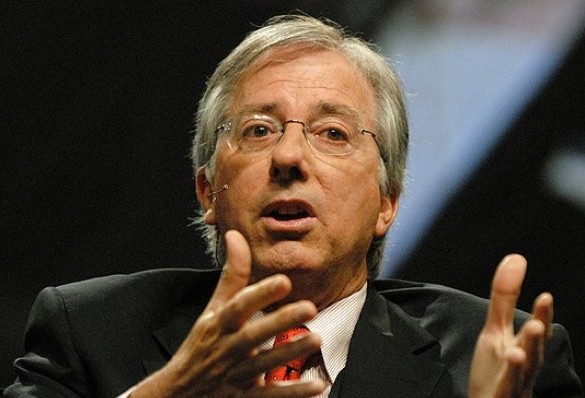
Dennis Ross ‘peddling the same snake oil’

If one man can be said to epitomize the failure of the peace process more than any other American official, it’s probably Dennis Ross. Why then, one might then ask, would he have such a central role in getting this “derailed” process “back on track”?

According to this report from Laura Rozen, Ross is provoking some blistering criticism from inside the administration, with one official quoted posing this exact question in the bluntest terms: “why, since [Ross’s] approach in the Oslo years was such an abysmal failure, is he back, peddling the same snake oil?”

Ross’s line is the Israel lobby’s line: American and Israeli interests are indistinguishable. The funny thing about that line is that if it was really true, then Washington would only need to take care of US interests – Israel’s would inevitably be served.

In truth, the only reason the drum of “indivisible interests” needs to be beat upon so loudly is because it’s so obvious that American and Israeli interests diverge.

Since Israeli Prime Minister Benjamin Netanyahu’s tense visit to the White House last week, an intense debate inside the Obama administration about how to proceed with Netanyahu to advance the Middle East peace process has grown more heated, even as Israeli officials are expected to announce they have reached some sort of agreement with Washington as soon as tonight.

Sources say within the inter-agency process, White House Middle East strategist Dennis Ross is staking out a position that Washington needs to be sensitive to Netanyahu’s domestic political constraints including over the issue of building in East Jerusalem in order to not raise new Arab demands, while other officials including some aligned with Middle East peace envoy George Mitchell are arguing Washington needs to hold firm in pressing Netanyahu for written commitments to avoid provocations that imperil Israeli-Palestinian peace talks and to preserve the Obama administration’s credibility.

POLITICO spoke with several officials who confirmed the debate and its intensity. Ross did not respond to a query, nor did a spokesman for George Mitchell.

“He [Ross] seems to be far more sensitive to Netanyahu’s coalition politics than to U.S. interests,” one U.S. official told POLITICO Saturday. “And he doesn’t seem to understand that this has become bigger than Jerusalem but is rather about the credibility of this Administration.”

What some saw as the suggestion of dual loyalties shows how heated the debate has become.

Last week, during U.S.-Israeli negotiations during Netanyahu’s visit and subsequent internal U.S. government meetings, the official said, Ross “was always saying about how far Bibi could go and not go. So by his logic, our objectives and interests were less important than pre-emptive capitulation to what he described as Bibi’s coalition’s red lines.”

When the U.S. and Israel are seen to publicly diverge on an issue such as East Jerusalem construction, the official characterized Ross’s argument as: “the Arabs increase their demands … therefore we must rush to close gaps … no matter what the cost to our broader credibility.”

A second official confirmed the broad outlines of the current debate within the administration. Obviously at every stage of the process, the Obama Middle East team faces tactical decisions about what to push for, who to push, how hard to push, he described.

As to which argument best reflects the wishes of the President, the first official said, “As for POTUS, what happens in practice is that POTUS, rightly, gives broad direction. He doesn’t, and shouldn’t, get bogged down in minutiae. But Dennis uses the minutiae to blur the big picture … And no one asks the question: why, since his approach in the Oslo years was such an abysmal failure, is he back, peddling the same snake oil?”

Facebooktwittermail

The loner in the White House

Howard LaFranchi, (in a rather superficial treatment), raises an interesting issue: Does it matter that Obama has no foreign friends?

When French President Nicolas Sarkozy and his wife, Carla Bruni, sit down for dinner with the Obamas in the White House family dining room March 30, it will be a rare occasion for Barack Obama: a private, personal, perhaps even chatty evening with another world leader.

Fourteen months into the Obama presidency, one striking feature of an American president who took office to a swooning world is the absence of any strong personal ties – or even a go-to working relationship – with any other world leader. Where Ronnie had Maggie, and Bill and even George W. had Tony, Mr. Obama has no one leader. Instead, the former law professor has what seems to be a preference for big-themed foreign speeches (think Cairo; Prague, Czech Republic; Moscow; Accra, Ghana) and policy gatherings (his UN nuclear summit, the Pittsburgh Group of 20 economic summit, a White House nuclear nonproliferation summit in May) bereft of the warm and fuzzy.

Even the Sarkozy dinner seems to be more an amendsmaker than a familiar, “Hey Sarko, why don’t you come on over for dinner and some one-on-one conversation?” When the Obamas were in Paris last year, Obama turned down a dinner invitation to the Elyseé Palace, ostensibly so he could take Michelle out for a private night on the town.

Obama’s cool, all-business demeanor with his global peers is all the more striking because it follows the polar-opposite style of George W. Bush.

It’s inevitable that Obama gets contrasted with Bush. After all, Obama got elected in large part by virtue of not being Bush. But the contrast in personalities tends to obscure a more important issue by casting this shift as something akin to a seasonal change — from warm to cool.

Stephen Hess is no doubt correct in pointing out that personal relations with foreign leaders may not ultimately dictate policy choices of an American president, but the significance of Obama’s aloofness may rest less on what we can predict about its specific political effects than in what it tells us about the president’s self-image and his relationships with others — not just other world leaders.

To the extent that an American president cultivates a rapport with his foreign counterparts, the significance in his doing so seems to be to be that at least to some degree he sees himself as part of a peer group. But to the extent that Obama does not believe he has peers, this will likely lead to a dangerous and corrosive form of isolation. The more isolated he becomes, the fewer checks and balances there are that can be applied to his own judgment.

And let’s not forget, this is an administration in which the president is surrounded by an exceptionally small inner circle of advisers who seem to prize their closeness above their capacity to advise.

Obama may be a great speech maker, but that doesn’t make him a great communicator.

Facebooktwittermail

Netanyahu — disgraced, isolated and weaker

The headline for Aluf Benn’s article in Haaretz says it all: “Netanyahu leaves U.S. disgraced, isolated and weaker.”

Benn’s full account appears below but some of the comments elsewhere in the Israeli press reveal how deeply a racist outlook on the world is embedded within the Israeli perspective. As the Daily Telegraph reported:

Sending a clear message of his displeasure, Mr Obama treated his guest to a series of slights. Photographs of the meeting were forbidden and an Israeli request to issue a joint-statement once it was over were turned down.

“There is no humiliation exercise that the Americans did not try on the prime minister and his entourage,” Israel’s Maariv newspaper reported. “Bibi received in the White House the treatment reserved for the president of Equatorial Guinea.”

Why, the editors of Maariv might care to explain, would the president of Equatorial Guinea not be afforded respect during a visit to the White House?

The Telegraph says that upon his arrival to meet with President Obama, Netanyahu was presented with a set of 13 demands, key among those that Israel halt all new settlement construction in East Jerusalem:

When the Israeli prime minister stalled, Mr Obama rose from his seat declaring: “I’m going to the residential wing to have dinner with Michelle and the girls.”

As he left, Mr Netanyahu was told to consider the error of his ways. “I’m still around,” Mr Obama is quoted by Israel’s Yediot Ahronot newspaper as having said. “Let me know if there is anything new.”

When the two men met briefly an hour later, a short meeting failed to break the impasse.

Aluf Benn writes:

The visit – touted as a fence-mending effort, a bid to strengthen the tenuous ties between Netanyahu and U.S. President Barack Obama – only highlighted the deep rift between the American and Israeli administrations.

The prime minister leaves America disgraced, isolated, and altogether weaker than when he came.

Instead of setting the diplomatic agenda, Netanyahu surrendered control over it. Instead of leaving the Palestinian issue aside and focusing on Iran, as he would like, Netanyahu now finds himself fighting for the legitimacy of Israeli control over East Jerusalem.

The most sensitive and insoluble core issues – those which when raised a decade ago led to the dissolution of the peace process and explosion of the second intifada – are now being served as a mere appetizer.

At the start of his visit, Netanyahu was tempted to bask in the warm welcome he received at the AIPAC conference, at which he gave his emotional address on Jerusalem.

Taking a page from Menachem Begin, he spoke not on behalf of the State of Israel, but in the name of the Jewish people itself and its millennia of history.

His speech was not radical rightist rhetoric. Reading between the lines, one could spot a certain willingness to relinquish West Bank settlements as long as Israel maintains a security buffer in the Jordan Valley.

But at the White House, the prime minister’s speech to thousands of pro-Israel activists and hundreds of cheering congressmen looked like an obvious attempt to raise political capital against the American president.

Knowing Netanyahu would be reenergized by his speech at the lobby, Obama and his staff set him a honey trap. Over the weekend they sought to quell the row that flared up during U.S. Vice President Joe Biden’s trip here two weeks ago, and U.S. Secretary of State Hillary Clinton described Netanyahu’s response to the ultimatums Washington presented to him as “useful.”

Special envoy George Mitchell made a televised visit to the prime minister’s bureau Sunday to invite Netanyahu to the White House. Washington, it seemed, was trying to make nice.

Far from it. Just when Netanyahu thought he had resolved the crisis by apologizing to Biden, Clinton called him up for a dressing down.

This time as well, Netanyahu almost believed the crisis had passed, that he had survived by offering partial, noncommittal answers to the Americans’ questions. Shortly before meeting with Obama, Netanyahu even warned the Palestinians that should they continue to demand a freeze on construction, he would postpone peace talks by a year.

His arrogant tone underscored the fact that Netanyahu believed that on the strength of his AIPAC speech, he could call the next few steps of the diplomatic dance.

But then calamity struck. At their White House meeting, Obama made clear to his guest that the letter Netanyahu had sent was insufficient and returned it for further corrections. Instead of a reception as a guest of honor, Netanyahu was treated as a problem child, an army private ordered to do laps around the base for slipping up at roll call.

The revolution in the Americans’ behavior is clear to all. On Sunday morning Obama was still anxiously looking ahead to the House of Representatives vote on health care – the last thing he wanted was a last-minute disagreement with congressmen over ties with Israel.

The moment the bill was passed, however, a victorious Obama was free to deal with his unruly guest.

The Americans made every effort to downplay the visit. As during his last visit in November, Netanyahu was invited to the White House at a late hour, without media coverage or a press conference. If that were not enough, the White House spokesman challenged Netanyahu’s observation at AIPAC that “Jerusalem is not a settlement.”

The Americans didn’t even wait for him to leave Washington to make their disagreement known. It was not the behavior Washington shows an ally, but the kind it shows an annoyance.

The approval of construction at the Shepherd Hotel in Sheikh Jarrah, announced before his meeting with Obama, again caught Netanyahu unawares. Apparently the special panel appointed after the Ramat Shlomo debacle to prevent such surprises failed its first test.

Netanyahu is having his most difficult week since returning to office, beginning with the unfortunate decision to relocate the planned emergency room at Ashkelon’s Barzilai Medical Center and lasting through his humiliating jaunt through Washington.

Returning to Israel today, Netanyahu will need to work hard to rehabilitate his image, knowing full well that Obama will not relent, but instead demand that he stop zigzagging and decide, once and for all, whether he stands with America or with the settlers.

The satisfaction that Washington gains from putting Netanyahu in his place may be short-lived. As Seth Freedman notes in The Guardian: “External pressure on Israel from the likes of the United States and European Union serves only to provoke a siege-mentality response from Israelis and plays into the hands of the paranoiacs on the Israeli right.”

Facebooktwittermail

What’s worse than an insult?

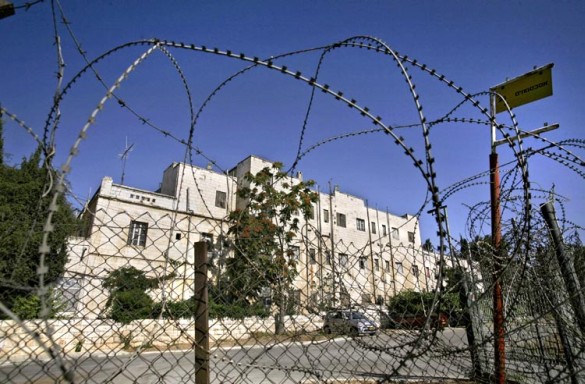
The Shepherd Hotel in the Sheikh Jarrah neighborhood of occupied East Jerusalem

[Updated below.] For Israel to announce new settlement construction in Israeli-occupied East Jerusalem right when Joe Biden was visiting, was, Hillary Clinton said, “insulting” to the United States.

Now Benjamin Netanyahu is visiting Washington and what happens right before he goes to the White House to meet President Obama? Another announcement from Jerusalem, but this time it’s even more inflammatory than the last one:

The Jerusalem municipality has given final approval to a group of settlers construct 20 apartments in a controversial hotel in east Jerusalem, Haaretz learned on Tuesday.

The announcement comes as Prime Minister Benjamin Netanyahu was in Washington smoothing over ties with the United States over the latest settlement-related tensions, and hours before the premier was to meet with President Barack Obama in Washington.

The Shepherd Hotel in the Sheikh Jarrah neighborhood was purchased by American Jewish tycoon Irving Moskowitz in 1985 for $1 million.

Moskowitz, an influential supporter of Ateret Cohanim and heightened Israeli settlement in East Jerusalem, plans to tear down the hotel and build housing units for Jewish Israelis in its place.

The local planning council initially approved the plan in July, a move which angered Britain and the United States and prompted them to call on Israel to cancel the plans. The council issued its final approval for the project last Thursday, which now enables the settlers to begin their construction at once.

An existing structure in the area will be town down to make room for the housing units, while the historic Shepherd Hotel will remain intact. A three-story parking structure and an access road will also be constructed on site.

Jake Tapper adds:

Moskowitz is a supporter of Ateret Cohanim (“Crown of the Priests”), a religious movement that seeks to populate East Jerusalem with Jewish settlers. As the Yeshiva puts it: “The Yeshiva is the spiritual epicenter of a community of almost 1000 residents in the heart of the Old City in the so-called ‘Moslem’ Quarter. This area was in fact, prior to the Arab riots, largely inhabited by Jews. It is on this historical basis that we refer to it now as the Renewed Jewish Quarter.”

No word yet on reaction from the White House.

Ynet reports:

Hatem Abdel Kader, holder of the Jerusalem portfolio in Fatah, told Ynet that the decision was tantamount to “Netanyahu slapping Obama in the face in his own house.”

Abdel Kader added that “Netanyahu feels that AIPAC is on his side, that he owns the US and that no action, no pressure by the Americans can prevent him from going ahead with the construction.”

The Fatah official added that the construction’s approval proved that the reports of Washington’s acquiescence in the face of Israel’s plans to build in east Jerusalem were true.

“The new plans for the Shepherd Hotel prove that the dispute between the Administration and Israel was not real and pertained to the way the plans were presented, rather than to the construction itself. What the Americans are actually saying to the Israelis is ‘keep building – but I don’t want to know about it,'” he said.

Update: After Netanyahu and Obama’s closed-door White House meeting, Politico says: “any impression that Netanyahu’s trip would mark a renewal of the troubled relationship between U.S. and Israeli leaders had faded by the time the men met.” The meeting was “shrouded in unusual secrecy” and marked a transition in the administration’s dealings with the Israeli prime minister that has shifted from the “red hot anger” of last week to “an icier suspicion” yesterday, reflected in the fact that no official statements followed the awkward encounter.

Still, the fact is, Obama didn’t turn Netanyahu away. The news that the Shepherd Hotel development had been approved prompted this: “This is exactly what we expect Prime Minister Netanyahu to get control of,” a senior U.S. official told POLTICO Tuesday evening. “The current drip-drip-drip of projects in East Jerusalem impedes progress.”

The transition from the Bush administration to the current administration has been in which the last secretary of state said the Israelis were being “unhelpful” whereas they are now described as “insulting” — either way, the status quo remains the same: Israel can do what it pleases whatever words of displeasure it might provoke.

Facebooktwittermail

Obama finds killing more convenient than trials or detention

Mind-reading is something that political commentators generally avoid. No one can claim to be any good at it. Yet even if we rarely find out what is actually going on inside a politician’s mind, there are moments when it seems impossible to avoid asking — even without the hope of getting an answer — what was he thinking?

One such moment came as soon as President Obama entered the White House when he signed an executive order to close Guantanamo. Symbolically, this appeared to mark the end of George Bush’s war on terrorism.

Obama had a wry expression on his face.

They have no idea.

Is that what he was he thinking, even at that moment when Obama euphoria was at its height?

Indeed, we really did have no idea that the president who had promised to end the mindset that led to war would within months of taking office have authorized even more extrajudicial killings than his predecessor and that a take-no-prisoners killing practice would be followed in order to avoid the legal complications of detention.

“Extrajudicial killing” is an Orwellian expression. In plain language it is murder.

Consider the case of Saleh Ali Saleh Nabhan who was killed in a helicopter attack in Somalia last year. Officials debated whether the militant suspected of being linked to al Qaeda should be captured but opted to kill him instead in part because they weren’t sure where he could be detained.

As the Los Angeles Times reports, the administration is still struggling to come up with its own version of Guantanamo, minus the name:

The White House is considering whether to detain international terrorism suspects at a U.S. military base in Afghanistan, senior U.S. officials said, an option that would lead to another prison with the same purpose as Guantanamo Bay, which it has promised to close.

The idea, which would require approval by President Obama, already has drawn resistance from within the government. Army Gen. Stanley A. McCrystal, the top commander of U.S. and NATO forces in Afghanistan, and other senior officials strongly oppose it, fearing that expansion of the U.S. detention facility at Bagram air base could make the job of stabilizing the country even tougher.

That the option of detaining suspects captured outside Afghanistan at Bagram is being contemplated reflects a recognition by the Obama administration that it has few other places to hold and interrogate foreign prisoners without giving them access to the U.S. court system, the officials said.

Without a location outside the United States for sending prisoners, the administration must resort to turning the suspects over to foreign governments, bringing them to the U.S. or even killing them.

In one case last year, U.S. special operations forces killed an Al Qaeda-linked suspect named Saleh Ali Saleh Nabhan in a helicopter attack in southern Somalia rather than trying to capture him, a U.S. official said. Officials had debated trying to take him alive but decided against doing so in part because of uncertainty over where to hold him, the official added.

Facebooktwittermail

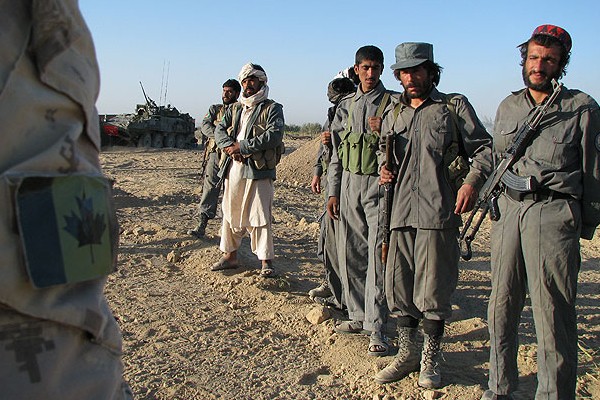
Policing Afghanistan

At TomDispatch, Pratap Chatterjee writes:

The Pentagon faces a tough choice: Should it award a new contract to Xe (formerly Blackwater), a company made infamous when its employees killed 17 Iraqis in Baghdad in 2007, or to DynCorp, a company made infamous in Bosnia in 1999 when some of its employees were caught trafficking young girls for sex?

This billion-dollar contract will be the linchpin of a training program for the Afghan National Police, who are theoretically to be drilled in counterinsurgency tactics that will help defeat the Taliban and bring security to impoverished, war-torn Afghanistan. The program is also considered a crucial component of the Obama administration’s plan for turning the war around. Ironically, Xe was poised to win the contract until a successful appeal by DynCorp last week threw the field wide open.

Some people in the U.S. government (and many outside it) believe that this task should not be assigned to private contractors in the first place. Meanwhile, many police experts are certain that it hardly matters which company gets the contract. Like so many before it, the latest training program is doomed from the outset, they believe, because its focus will be on defeating the Taliban rather than fostering community-oriented policing.

The Obama administration is in a fix: it believes that, if it can’t put at least 100,000 trained police officers on Afghan streets and into the scattered hamlets that make up the bulk of the country, it won’t be able to begin a drawdown of U.S. troop levels in Afghanistan by the middle of next year.

Meanwhile, the Washington Post reports that US forces are facing soaring IED attacks, the Taliban is making a dramatic comeback in the northern province of Kunduz.

The New York Times says that soon after what had been described as a successful offensive in Marja, the Taliban have begun waging a campaign of intimidation “that some local Afghan leaders worry has jeopardized the success of an American-led offensive there meant as an early test of a revised military approach in Afghanistan.”

Facebooktwittermail

Is Pakistan on a path back to military control?

From the New York Times:

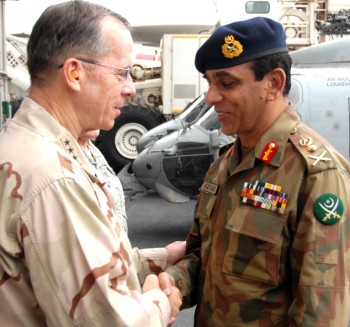
In a sign of the mounting power of the army over the civilian government in Pakistan, the head of the military, Gen. Ashfaq Parvez Kayani, will be the dominant Pakistani participant in important meetings in Washington this week.
At home, much has been made of how General Kayani has driven the agenda for the talks. They have been billed as cabinet-level meetings, with the foreign minister as the nominal head of the Pakistani delegation. But it has been the general who has been calling the civilian heads of major government departments, including finance and foreign affairs, to his army headquarters to discuss final details, an unusual move in a democratic system.

Foreign Minister Shah Mahmood Qureshi has been taking a public role in trying to set the tone, insisting that the United States needs to do more for Pakistan, as “we have already done too much.” And it was at his request that Secretary of State Hillary Rodham Clinton agreed this fall to reopen talks between the countries at the ministerial level.

The talks are expected to help define the relationship between the United States and Pakistan as the war against the Taliban reaches its endgame phase in Afghanistan. It is in that context that General Kayani’s role in organizing the agenda has raised alarm here in Pakistan, a country with a long history of military juntas.

The leading financial newspaper, The Business Recorder, suggested in an editorial that the civilian government of Prime Minister Yousaf Raza Gilani should act more forcefully and “shun creating an environment conducive to military intervention.”

The editorial added, “The government needs to consolidate civilian rule instead of handing over its responsibilities, like coordination between different departments, to the military.”

“General Kayani is in the driver’s seat,” said Rifaat Hussain, a professor of international relations at Islamabad University. “It is unprecedented that an army chief of staff preside over a meeting of federal secretaries.”

As Gen Kayani rises in power, it’s hard not to wonder whether the United States is falling back into its habitual pattern of preferring to deal with powerful military leaders rather than elected governments. For Washington, international relations always seem so much easier to manage on the basis of personal relations with generals who won’t be held accountable by a troublesome electorate.

Facebooktwittermail

Squeeze Israel by cutting US aid? Not likely

At the AIPAC conference in Washington on Monday, Hillary Clinton said of US-Israeli ties: “Our countries and peoples are bound together by our shared values of freedom, equality, democracy, the right to live free from fear, and our common aspirations for a future of peace, security, and prosperity.” But the most important tie is the one Clinton left off the list: weaponry. Weaponry paid for by US taxpayers and sold by the US defense industry, through a military aid program that ensures a steady flow of lucrative contracts to US manufacturers and guarantees that for decades to come the Israeli war machine will remain “made in the USA.”

The diplomatic crisis between the U.S. and Israel has sent a tremor through their alliance, but one key part of the bond seems virtually untouchable: the roughly $3 billion a year in U.S. military aid.

Israel’s harsher critics often call for aid cuts to twist Israel’s arm. Yet amid the uproar of recent days over plans to build 1,600 new homes for a Jewish neighborhood in a disputed part of Jerusalem, there has been no serious talk of using aid as a club.

One reason may be the potential backlash from Israel’s supporters in the U.S. Another is that the overwhelming part of the money cycles back into the American economy.

Israel is the biggest recipient of American aid after Afghanistan. But unlike most other countries, Israel’s aid is earmarked entirely for military spending. Under an agreement between the two allies, at least three-quarters of the aid must be spent with U.S. companies.

This means that the “close, unshakable bond,” as Secretary of State Hillary Rodham Clinton described it, is also a mutually beneficial one: Israel gets the latest American military technology, and American weapons makers – Lockheed Martin, Raytheon, Boeing and others – get a steady stream of income.

The U.S. stepped up funding to Israel after the Arab-Israeli wars of 1967 and 1973, at a time when the Soviet Union was arming the Arabs. Following the 1979 Israeli-Egyptian peace treaty, Washington guaranteed Israel would continue receiving annual military and civilian aid in a 3:2 ratio with aid given to Egypt. Since then, Israel’s share has ranged between $2.1 billion and $3.7 billion a year.

Over the last decade, as Israel’s economy has grown, the U.S. has converted the whole package to military funding, under an agreement to have it at $3.15 billion a year by fiscal 2013 and keep it at that level until 2018.

Facebooktwittermail

The status quo is unsustainable. Really?

A week ago, Gen David Petraeus referred to “a perception of U.S. favoritism for Israel” that fuels anti-American sentiment across the Middle East.

He knows — as does anyone else who is even marginally aware of the issues — that this is not simply a matter of perception.

The United States does not merely exhibit favoritism towards Israel. Its political leaders express a level of loyalty towards the Jewish state that should be regarded as unseemly by any patriotic American.

Last week, right on the heels of receiving what was widely regarded as a monumental insult, Joe Biden said: “Throughout my career, Israel has not only remained close to my heart but it has been the center of my work as a United States Senator and now as Vice President of the United States.”

On Friday, Hillary Clinton spoke of US relations with Israel as “deep and broad, strong and enduring,” and today at the AIPAC conference in Washington said that America’s future is “bound up with the future of Israel.”

This is the status quo that should be changed but shows every sign of being thoroughly sustainable. It is one in which American politicians shamelessly pander to Israel’s wealthy supporters and cast aside any semblance of dignity in their efforts to display their unfailing devotion to the Jewish state.

The obsequious nature of these flourishes of unvarnished affection is further reinforced by the fact that neither on a political level nor a popular level are such feelings reciprocated from the other side.

As Chris McGreal wrote yesterday:

In a country permeated by fear and insecurity, Israelis define the rest of the world not by loyalties but by varying degrees of distrust. You can hear it among residents of Jewish settlements deep in the occupied territories and in the cafes of liberal Tel Aviv: angst over the perception of a new wave of antisemitism gripping Europe, the incomprehension over foreign condemnation of Israel’s crimes in Gaza, the common agreement that the United Nations is a conspiracy against the Jewish state.

In all of this, the US emerges as the least distrusted country by far… . Israelis recognise that they have long counted on Washington to pay a good chunk of their military budget and provide diplomatic cover for the illegalities of occupation.

Israel depends on defense and political aid from Washington and Washington dances to the tune of the Israel lobby.

Those who now hold on to the notion that this administration is intent on shifting the political dynamic simply because it proclaims that the Israeli-Palestinian status quo is unsustainable are paying attention to the wrong status quo.

Facebooktwittermail

The American backbone deficit

Gideon Levy writes:

Israel has no real intention of quitting the territories or allowing the Palestinian people to exercise their rights. Israel does not truly intend to pursue peace, because life here seems to be good even without it. The continuation of the occupation doesn’t just endanger Israel’s future, it also poses the greatest risk to world peace, serving as a pretext for Israel’s most dangerous enemies.

No change will come to pass in the complacent, belligerent and condescending Israel of today. That’s why this difficult, thankless task has fallen on the shoulders of an ally, as only it has the power to get things started. No agreement will come out of another endless series of futile diplomatic trips or peace plans to which no one intends to adhere. We have tried this enough in the past, and all for naught. This is the time to come up with a rehabilitation program for Israel. The entire world, and ultimately Israel too, will applaud Barack Obama if he succeeds.

Expressing offense at “poor timing” and giving Israel’s prime minister the cold shoulder are not enough. This is the time for action, comprehensive and unwavering. America must now decide where it is heading and where it aims to lead Israel, the Middle East and the world. At issue is not just the future of 1,600 homes in Ramat Shlomo, but that of Israel itself. What is required is not merely extending the settlement construction freeze – whether or not it includes the occupied areas of Jerusalem – but applying pressure on Israel to begin withdrawing to its own borders. The means at Washington’s disposal – including assistance on security and economic issues, the campaign against Iran’s nuclear program and diplomatic support of Israel – can all be conditioned on an end to the occupation.

America must now decide whether it’s for us or against us. Will it make do with easing the sting of the insult to the vice president? Will it continue to give in to its powerful Jewish lobby? Will it keep passing itself off as a friend while acting as a foe? Or are we really playing by different rules now? Yes, it’s likely to hurt Israel, and even many Americans, but this is the opportunity. There will be no other.

I’m not holding my breath.

A few days ago, when Hillary Clinton read the riot act to Benjamin Netanyahu, the word was that she was reading from an Obama-approved script. The image was of an angry president being tough while maintaining his facade of cool.

Almost a week later there are signs that the latest manifestation of Obama toughness was yet another mirage. Obama’s characteristically bland assessment that there is no crisis in US-Israeli relations but merely “a disagreement in terms of how we can move this peace process forward,” will yet again confirm Benjamin Netanyahu’s understanding that he is dealing with a spineless president.

Can Clinton and Mitchell make up for the backbone deficit? If the latter ends up in Israel in a few days without Netanyahu having made any significant concessions and if the former shows up at the AIPAC conference next week and doesn’t manage to make a few of the participants piss in their pants, then we’ll know the answer is no.

Facebooktwittermail

A trial for Saddam and a bomb for bin Laden

The Associated Press reports:

Attorney General Eric Holder told Congress on Tuesday that Osama bin Laden will never face trial in the United States because he will not be captured alive.

In testy exchanges with House Republicans, the attorney general compared terrorists to mass murderer Charles Manson and predicted that events would ensure “we will be reading Miranda rights to the corpse of Osama bin Laden” not to the al-Qaida leader as a captive.

Holder sternly rejected criticism from GOP members of a House Appropriations subcommittee, who contend it is too dangerous to put terror suspects on trial in federal civilian courts as Holder has proposed.

Unless my memory fails me, there was no outrage expressed in Congress when Saddam Hussein was captured, rather than given a summary execution. Nor were there howls of protest when he was imprisoned without torture and treated humanely. Nor were there huge objections against him going through a criminal trial. This for a man widely understood to have been responsible for the deaths of tens of thousands of Iraqis.

And let’s not forget, throughout the time Saddam was being hunted down he was presented as a greater threat to the world than Osama bin Laden.

Do American lawmakers have such little faith in the law they make or in the judicial system that applies that law, that they regard the United States legal system as too feeble an entity to justly handle the fate of one man — even a man given mythical proportions of Osama bin Laden?

As John Brennan — Assistant to the President and Deputy National Security Advisor for Homeland Security and Counterterrorism — pointed out last month, “Terrorists are not 100-feet tall. Nor do they deserve the abject fear they seek to instill.”

Facebooktwittermail

Where’s Joe Biden?

Has the vice president gone missing? Or is he hiding in a secure undisclosed location?
Strong words delivered by Joe Biden during his visit to Israel were widely reported last week.

“This is starting to get dangerous for us,” Biden warned his Israeli hosts. “What you’re doing here undermines the security of our troops who are fighting in Iraq, Afghanistan and Pakistan. That endangers us and it endangers regional peace.”

Many in Washington were apparently so shocked that Biden could have said something like this, they were, for several days, dumb-struck and rendered immobile.

One of the first to regain his senses was Jeffrey Goldberg. It can’t be true, Goldberg thought, and then set about getting to the bottom or at the very least the periphery of the story.

Where would one turn if one wanted to find out what the vice president said? Maybe the Office of the Vice President? Not if you’re Goldberg. He asked some fellow at the White House.

Meanwhile, Eric Re-Cantor had a chat with Rahm Emanuel, and the White House Chief of Staff confirmed that he too had heard from some guy (could have been Biden himself — we don’t know) that Biden was misquoted.

I guess I’m a bit of a stickler because when it comes to establishing what Biden did or did not say, I’d prefer to hear it from the vice president himself — or at least in a written statement from his office. He has a reputation for being blunt. I dearly hope he hasn’t lost it.

Facebooktwittermail

Israel is empowering al Qaeda, Petraeus warns

As erupting violence in Jerusalem suggests a third intifada may soon take hold, the CENTCOM commander Gen David Petraeus, testifying before the US Senate Armed Services Committee today, gave a grave warning about the wider impact of a conflict that has been the epicenter of Middle East hostilities ever since the creation of Israel.

In issuing his warning, Petraeus — arguably the most influential even if not the highest ranking member of the US military — was reiterating a statement he made almost a year ago. The only difference between what he said in April 2009 and what he said today, was that he now acknowledges al Qaeda is being strengthened by the conflict.

He now says:

The enduring hostilities between Israel and some of its neighbors present distinct challenges to our ability to advance our interests in the AOR [CENTCOM’s area of responsibility]. Israeli-Palestinian tensions often flare into violence and large-scale armed confrontations. The conflict foments anti-American sentiment, due to a perception of U.S. favoritism for Israel. Arab anger over the Palestinian question limits the strength and depth of U.S. partnerships with governments and peoples in the AOR and weakens the legitimacy of moderate regimes in the Arab world. Meanwhile, al-Qaeda and other militant groups exploit that anger to mobilize support. The conflict also gives Iran influence in the Arab world through its clients, Lebanese Hizballah and Hamas.

If such a statement was being made outside the American political arena, it could be regarded as a rather bland expression of what has long been utterly obvious. Yet from the lips of a celebrated general, regarded by many as a potential future president, these words come as a bombshell.

Neoconservatives and the Israel lobby have worked hard and long to obscure the deeply corrosive regional impact of a conflict that successive Israeli leaders have either been unwilling or seemingly incapable of resolving. Others, who earlier said what Petraeus now says, have either been dismissed as poorly informed or worse, branded as anti-Israeli or by insinuation, anti-Semitic.

No such charge will stick to Petraeus. Indeed, if the Israel lobby was so foolhardy as to try and go after an American general who sometimes gets treated like a latterday Eisenhower, the lobby will be at dire risk of being visited by its own greatest fear: being branded as anti-American.

Facebooktwittermail

Netanyahu remains defiant

As Bill Clinton famously said about Benjamin Netanyahu in 1998, “Who the fuck does he think he is? Who’s the fucking superpower here?”

Twelve years later there is no sign that Bibi’s hubris has been tempered. In the midst of what Israel’s ambassador to the United States, Michael Oren, has told the country’s diplomats is the worst crisis in U.S.-Israeli relations in 35 years, what does Israel’s prime minister do? He declares that “building in Jerusalem – and in all other places – will continue in the same way as has been customary over the last 42 years.” In other words, Netanyahu reaffirms that Israel will continue on the same course that precipitated the crisis.

Meanwhile, Israel’s foreign minister today followed what appears to have now become standard diplomatic protocol in the aspiring pariah state by snubbing a visiting head of state, Brazil’s president Luiz Inacio Lula da Silva, because the latter declined to pay homage to Zionism.

I imagine that in fairly short order Israel’s leaders will no longer have the task of figuring out new ways of insulting their guests; they simply won’t have any guests to insult.

Even so, Netanyahu has persuaded his loyal American supporters that he has eaten enough humble pie. For that reason it seems hard to imagine that he will go very far in meeting a set of demands that Haaretz says were put on his plate when he got lectured by Hillary Clinton on Friday.

These were the demands:

1. Investigate the process that led to the announcement of the Ramat Shlomo construction plans in the middle of Biden’s visit. The Americans seek an official response from Israel on whether this was a bureaucratic mistake or a deliberate act carried out for political reasons. Already on Saturday night, Netanyahu announced the convening of a committee to look into the issue.

2. Reverse the decision by the Jerusalem District Planning and Building Committee to approve construction of 1,600 new housing units in Ramat Shlomo.

3. Make a substantial gesture toward the Palestinians enabling the renewal of peace talks. The Americans suggested that hundreds of Palestinian prisoners be released, that the Israel Defense Forces withdraw from additional areas of the West Bank and transfer them to Palestinian control, that the siege of the Gaza Strip be eased and further roadblocks in the West Bank be removed.

4. Issue an official declaration that the talks with the Palestinians, even indirect talks, will deal with all the conflict’s core issues – borders, refugees, Jerusalem, security arrangements, water and settlements.

The report continued:

Two advisers of the prime minister, Yitzhak Molcho and Ron Dermer, held marathon talks Sunday with senior White House officials in Washington and U.S. Mideast envoy George Mitchell and his staff to try to calm the situation. Mitchell will return to Israel Tuesday and expects to hear if Netanyahu intends to take the proposed steps.

At the beginning of Sunday’s cabinet meeting, Netanyahu tried to convey a message that there was no crisis in relations with the United States. But he sent precisely the opposite message to Oren in Washington.

In Oren’s Saturday conference call with the Israeli consuls general, he said that the current crisis was the most serious with the Americans since a confrontation between Henry Kissinger and Yitzhak Rabin in 1975 over an American demand for a partial withdrawal from the Sinai Peninsula.

At Sunday’s cabinet meeting, Netanyahu said the matter had been blown out of proportion by the media. He added: “There was an unfortunate incident here that was innocently committed and was hurtful, and certainly should not have occurred.”

He said steps would be taken to prevent such cases in the future. “It is extremely important to understand that the State of Israel and the United States have common interests,” he said, adding that those interests “also require us to take decisions to change the situation in the country.”

Four consuls discussed the conference call with Haaretz. Some noted that in previous conference calls with Oren, the ambassador took pains to make clear that relations with the United States were excellent. This time, however, Oren sounded extremely tense and pessimistic. Oren was quoted as saying that “the crisis was very serious and we are facing a very difficult period in relations [between the two countries].”

Oren told the consuls to lobby congressmen, Jewish community leaders and the media to convey Israel’s position. He said the message to be relayed was that Israel had no intention to cause offense to Vice President Biden and that the matter had stemmed from actions by junior bureaucrats in the Interior Ministry and was caused by a lack of coordination between government offices. “It should be stressed that [our] relations with the United States are very important to us,” Oren reportedly said.

Several of the consuls suggested waiting, but Oren hinted that his approach reflected Netanyahu’s wishes. “These instructions come from the highest level in Jerusalem,” he was quoted as saying, adding that the utmost must be done to calm matters.

If only Washington could be more understanding and recognize that Israel has a dysfunctional bureaucracy. The Jewish state should be seen as a Middle Eastern version of Pakistan, then all these misunderstandings could be resolved. That at least is the counsel offered by Israel’s pre-eminent American booster, the Anti-Defamation League’s, Abe Foxman.

Facebooktwittermail

Israel is putting American lives at risk

In Foreign Policy, Mark Perry describes an extraordinary Pentagon briefing on Israel’s impact on conflicts across the Middle East. Here is an excerpt and following some comments of my own, the author has provided me with additional background on his reporting.
[Important update: A senior military officer told Foreign Policy by email that one rather minor detail in Perry’s report was incorrect. A request from Gen Petraeus for the Palestinian occupied territories to be brought within CENTCOM’s region of operations was sent to the Chairman of the Joint Chiefs of Staff, Admiral Mullen, and not directly to the White House (who may or may not have subsequently been consulted). It is significant that the Pentagon made this correction, not because it was an important detail but on the contrary, because it was inconsequential to the overall narrative. In effect, the Pentagon clearly but discreetly said that there was virtually nothing in this report that could be denied.]

On January 16, two days after a killer earthquake hit Haiti, a team of senior military officers from the U.S. Central Command (responsible for overseeing American security interests in the Middle East), arrived at the Pentagon to brief JCS Chairman Michael Mullen on the Israeli-Palestinian conflict. The team had been dispatched by CENTCOM commander David Petraeus to underline his growing worries at the lack of progress in resolving the issue. The 33-slide 45-minute PowerPoint briefing stunned Mullen. The briefers reported that there was a growing perception among Arab leaders that the U.S. was incapable of standing up to Israel, that CENTCOM’s mostly Arab constituency was losing faith in American promises, that Israeli intransigence on the Israeli-Palestinian conflict was jeopardizing U.S. standing in the region, and that Mitchell himself was (as a senior Pentagon officer later bluntly described it) “too old, too slow…and too late.”

The January Mullen briefing was unprecedented. No previous CENTCOM commander had ever expressed himself on what is essentially a political issue; which is why the briefers were careful to tell Mullen that their conclusions followed from a December 2009 tour of the region where, on Petraeus’s instructions, they spoke to senior Arab leaders. “Everywhere they went, the message was pretty humbling,” a Pentagon officer familiar with the briefing says. “America was not only viewed as weak, but its military posture in the region was eroding.” But Petraeus wasn’t finished: two days after the Mullen briefing, Petraeus sent a paper to the White House requesting that the West Bank and Gaza (which, with Israel, is a part of the European Command – or EUCOM), be made a part of his area of operations. Petraeus’s reason was straightforward: with U.S. troops deployed in Iraq and Afghanistan, the U.S. military had to be perceived by Arab leaders as engaged in the region’s most troublesome conflict.

The Mullen briefing and Petraeus’s request hit the White House like a bombshell. While Petraeus’s request that CENTCOM be expanded to include the Palestinians was denied (“it was dead on arrival,” a Pentagon officer confirms), the Obama Administration decided it would redouble its efforts – pressing Israel once again on the settlements issue, sending Mitchell on a visit to a number of Arab capitals and dispatching Mullen for a carefully arranged meeting with Chief of the Israeli General Staff, Lt. General Gabi Ashkenazi. While the American press speculated that Mullen’s trip focused on Iran, the JCS Chairman actually carried a blunt, and tough, message on the Israeli-Palestinian conflict: that Israel had to see its conflict with the Palestinians “in a larger, regional, context” – as having a direct impact on America’s status in the region. Certainly, it was thought, Israel would get the message. [Read the rest of the report here.]

In December 2006, the Iraq Study Group Report was explicit in making this linkage: “The United States cannot achieve its goals in the Middle East unless it deals directly with the Arab-Israeli conflict and regional instability.”

What Mark Perry’s report indicates is that for the Obama administration a tipping point has been crossed in its perception of Israel’s effect on the conflicts that span the region.

Until now, the necessity for a resolution of the Arab-Israeli conflict has been framed in quasi-positive terms — such as that it would help defuse some of the hostility that the US now faces, or, that it would strengthen an alliance of nations attempting to curtail Iran’s nuclear program.

The shift, as expressed by Joe Biden last week and by the Petraeus briefing in January is that Israel is now being seen as a liability: the Jewish state is putting American lives at risk. “This is starting to get dangerous for us,” Biden reportedly told Netanyahu.

Such a shift marks a watershed in US-Israeli relations and so Perry’s report naturally raises questions. Indeed, the first line of defense from Israel and its supporters will be to claim that, on the contrary, recent events are nothing more than a bump in the road; that we can expect a quick resumption of business as usual between such close allies.

For this reason, I asked Mark — who I have had the privilege of working with in recent years — to provide some background to his report. This is what he said:

My piece on the briefing of Admiral Mullen by CENTCOM senior officers has occasioned a great deal of comment, as well as some skepticism: how accurate is the account? Was it told to me by direct participants in the briefing? Is there any basis for imagining that Petraeus has any kind of hidden agenda, whether that is a desire to expand CENTCOM – or even hostility towards Israel.

I won’t name my sources, even though it’s clear to people in the Pentagon – and certainly to General Petraeus – who they are. Was I told of the briefing by the briefers themselves? I will only say that there were four people in the briefing – the two briefers, Admiral Mullen, and Admiral Mullen’s primary adviser on the Israeli-Palestinian conflict. I know two of the people involved in the briefing. Whether or not they are my sources is something for the reader to determine. The account is not only accurate, it’s a precis of what actually happened. There is a lot more to it. The White House, State Department and Pentagon have not denied the account, and for good reason: it’s true.

Is there any basis for imagining that Petraeus has any kind of hidden agenda in ordering the briefing?

I have been reporting on the American military for thirty years. My work on the Joint Chiefs of Staff, Four Stars, is the authoritative account on the subject. I have deeply rooted contacts in the military that go back thirty years. I have never met a senior military officer whom I do not admire. There is no greater insult than to believe that General Petraeus or any other senior American military officer would use the lives of American soldiers as a lever to enhance their own political future. My sense is that General Petraeus neither likes nor dislikes Israel: but he loves his country and he wants to protect our soldiers. The current crisis in American relations with Israel is not a litmus test of General Petraeus’s loyalty to Israel, but of his, and our, concern for those Americans in uniform in the Middle East.

It is, perhaps, a sign of the depth of “the Biden crisis” that every controversy of this type seems to get translated into whether or not America and its leaders are committed to Israel’s security. This isn’t about Israel’s security, it’s about our security.

Facebooktwittermail