Category Archives: United Nations

Americans support UN recognition of Palestine

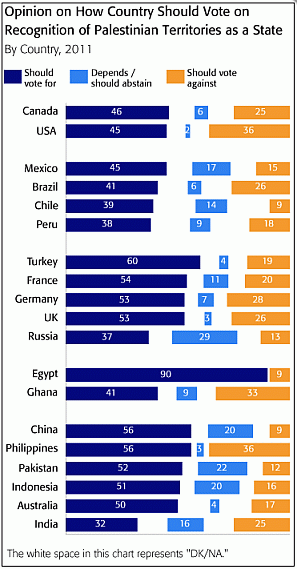
Here are some numbers President Obama should think about: Americans currently view him less favorably than they do UN recognition of Palestine! Obama’s approval rating is 43% while 45% support Palestine.

In a poll conducted for the BBC, Americans (among 20,446 citizens from 19 countries) were asked the following question:

As you may know, the Palestinian Authority is planning to request that the UN General Assembly recognize the Palestinian Territories as a state and as a member of the UN. Do you think [RESPONDENT’S COUNTRY] should vote for or against this request?

The response from Americans was 45% in favor, 36% opposed, 2% abstain, 17% undecided.

Globally, the public is five to two in favor of UN recognition of Palestine.

Even though less than a majority of Americans polled support the move, that number along with the large number who are undecided, needs to be put into perspective.

US media coverage of the Israeli-Palestinian conflict is heavily skewed in favor of the Israelis. Israel’s political leaders and Israel’s American supporters have characterized the Palestinian initiative as an attempt to delegitimize the Jewish state. The Palestinians do not have a charismatic leader whose face can serve as an iconic, positive and internationally recognized image of Palestinian nationalism. And yet in spite of the prevailing pressure to oppose the move, more Americans than those who think otherwise, support Palestine’s admission to the UN.

Most likely, this has much less to do with an interest or understanding of the conflict than it is an expression of an idea that most Americans readily accept: people should be allowed to govern themselves.

Facebooktwittermail

‘Israel will look like South Africa during the apartheid’ — Israeli ambassador Shalev

Gabriela Shalev, Israel’s ambassador to the UN from 2008-2010, was interviewed by Shalom Yerushalmi for Israel’s Hebrew daily, Maariv. Translation provided by Viktoria Lymar (Watching America).
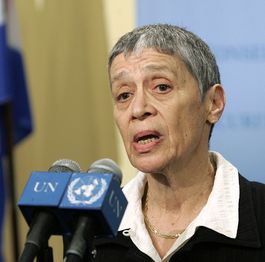
September is already here, and professor Gabriela Shalev, Israel’s previous ambassador to the U.N., is more pessimistic than ever: “We have no tools, we’re in trouble.”

Gaby Shalev, formerly Israel’s ambassador to the U.N., has a joke on the occasion of the beginning of the school year. Someone turns to his mom and complains in the corner: “I don’t want to go to school. All the teachers hate me, and I hate them. All the students hate me, and I hate them.” “You don’t have a choice,” responds the mother. “You’re the principal.”

Israel has no choice as well. Neither does the former ambassador. She had to return daily to a place where she felt condemned and despised. Today, exactly one year after finishing her term, she’s sitting in her beautiful house in Even Yehuda, still overcome by fear. September is in the doorway, and she sees that Israel will be engulfed in the wave of an unprecedented political tsunami, at the end [of which] Israel will be thrown outside of the fence, subject to heavy sanctions and boycotts.

After taking off the diplomat suit, Shalev speaks eloquently and daringly, trying to confront the failures of public relations, acknowledging weaknesses and mistakes and even how she was fundamentally unsuitable for the role she was asigned to.

“Operation Cast Lead [the Gaza War] broke out. The Netanyahu government came to power, the talks with the Palestinians were stopped, the Goldstone report loomed into prominence, and the Marmara affair struck waves in the world,” analyzes Shalev. “Add to this the rewarding diplomatic effort of the Palestinians and Arab countries, and you’ll fathom why Israel is at a political nadir in the U.N. that we have never before been driven to. The U.N. is a drainage collector of all the hostility toward Israel and the global delegitimization of Israel. There, they already don’t recognize our right to exist. These days are the gravest of all you can possibly recollect.”

But the United States is with us.

“Not precisely. We’re going from bad to worse, and losing the United States as well on the way. U.S. Ambassador Dan Shapiro may say that relations are steadfast, strong and good, but this is no longer the same type of relationship and support. A rapport between the leaders is not the most important thing, but even that is nonexistent. Obama is not opening his arms to us. He’s different. In my view, this is very impressive. Distant, noble. He is a cold and rational person. He thinks unusually. Esther Brimmer, Clinton’s assistant secretary of state, told me once, “Help us to help you.” In short, these are not the days of John Bolton, who was the American ambassador to the U.N., but everybody thought he was the Israeli delegate.

What has changed?

“You should comprehend the totality of the new interests of the United States. It wants to be the leader of the world, not to isolate itself from it. Ambassador Susan Rice remarked that the U.N. is not perfect, but it’s impossible [to do] without it. There is new black elite in America today: Barack Obama, his wife Michelle, Susan Rice, Esther Brimmer who is very close to the president and the others. Everyone went to Harvard. They became very associated with the blacks from Africa, from the islands. Susan Rice became attached to them, socially and politically. We remained outside. We are the separatists, we help neither our friends nor ourselves.”

What’s going to happen in September?

“It’s terrifying. I don’t call this ‘the black September’ only because my son was born in September, but the state of affairs is serious. The president of the [General] Assembly will be Abdelaziz al-Nasser, Qatar’s ambassador to the U.N. He used to be my friend, despite Qatar being extremely against us. The president of the Security Council (which changes according to monthly rotation) will be the Lebanese ambassador. From our standpoint, that is an intolerable condition. They are chairing meetings, bringing up proposals, setting the agenda, gaining control of the whole show.

Meanwhile, there are no talks between us and the Palestinians, there is an absolute standstill. Sept. 20 may yield a resolution for the recognition of the Palestinian state within 1967 borders. There’s no way it won’t be accepted.

At a conference of experts organized by the Knesset’s Foreign Affairs and Defense Committee last May, you noted that “As soon as the declaration on the disputable territories is received, the Yesha areas [West Bank] will not be considered as anything other than territories under occupation.”

“It is actually beyond that. Several of my fellow jurists comment that with the declaration, we won’t be regarded as an occupying power but instead, an invading force. This involves international sanctions, and they have fateful significance. Should the Palestinians be admitted as a member state in the U.N. through the Security Council, — we’re in complete trouble.”

Aren’t the Americans going to exercise their veto?

”The Americans are not our puppets. They are not in our pocket. You should remember that sanctions could be imposed on us even without agreement in the Security Council. The matter is based on the Resolution 377, adopted under the name ‘Uniting for Peace.’ Whatever will happen after the declaration, Israel will look like South Africa during the apartheid.”

Facebooktwittermail

Obama is about to squander an historic opportunity

Gideon Levy writes:

What is the American president going to say to his citizens? What will he say to the citizens of the world? How will he rationalize his country’s opposition to recognizing a Palestinian state? How will he explain his position, which runs counter to the position of the enlightened – and less enlightened – world?

And above all, what will Barack Obama say to himself before he goes to bed? That the Palestinians don’t deserve a state? That they have a chance to get it through negotiations with Israel? That they do not have equal rights in the new world that we thought he was going to establish? Will he admit to himself that, because of opportunistic election considerations – yes, Obama is now being exposed as quite an opportunist – he is also harming his country’s interests as well as the (real) interests of Israel, and is acting against his own conscience too?

It is difficult now to understand Obama’s America. The man who promised change is turning out to be the father of American conservatives. With regard to Israel, there is no difference between him and the last of the celebrants at the Tea Party. We did not expect a great deal from Hillary Clinton; she can continue to recite hollow speeches about negotiations-shmegotiations – but Obama?

Et tu, Brute? After all, in your Cairo speech you promised a new dawn for the Muslim world, you promised a new America to the Arab world. And what came of this? The same old American wolf – which blindly and automatically supports every whim of Israel’s to such an extent that it is not clear which is the world power and which is the protectorate – and not even dressed in sheep’s clothing. The riddle remains unsolved: How is it that the supposedly new America is continuing to sing the same old songs from its evil past? How is it that Obama is behaving as if he does not understand that the Palestinians will no longer agree to live another four decades without civil rights, certainly not in view of all that is taking place around them in the awakening Arab world?

The riddle remains unsolved because it is difficult to comprehend how a black president, who believes in justice and equality, can bow down with such unbearable lightness to a right-wing government in Israel, to narrow election considerations in America, and to Jewish and Christian lobbies. It is difficult to comprehend how his America does not understand that it is shooting itself with a lethal bullet in the heart by supporting the Israeli refusal to make peace. After all, deep in his heart this American president knows that the Palestinians’ demand is justified because they too are worthy, finally, of becoming independent – and that Israel supports occupation. Why does one have to wait for the book of memoirs that he will surely write one day in order to hear this? He knows that the Arab Spring, that erupted to a certain extent in the wake of his promising Cairo speech, will now turn its anger and hatred toward America, once more toward America, simply because of its insistent opposition to Palestinian freedom.

Obama is also supposed to know that concern for Israel’s future, and genuine friendship toward Israel, must include support for the establishment of a Palestinian state. That is the only way to neutralize the explosive fuse that is going to set off the entire region, against Israel and against the United States. He also knows that America’s stance against the entire world will once again arouse the hostility of the world against the U.S. leader. And all of that – for what? For a handful of votes in the next elections. That cannot be considered an excuse on the part of someone who was seen as so promising a leader with such a highly developed awareness of history. A person who sells his country’s interests and his own weltanschauung during his first term of office will display similar opportunism during the second term.

How pathetic is the vision of the two American emissaries who are once again shuttling back and forth now in the region and distributing threats. And to whom? To the Palestinians who are turning to a new diplomatic route, but not to the Israeli government for its destructive refusal. How pathetic it is to see Dennis Ross, the eternal American Mr. Negotiations of almost all its administrations, scuttling around with nothing to do between Ramallah and Jerusalem as he has been doing for decades. That is the old, bad America, as if there were no Obama.

The American president this week has the historic opportunity of improving the status of his country, of justifying retroactively the Nobel Prize for Peace that he was awarded, of demonstrating real commitment to imposing peace in the most dangerous region for the fate of the world, and of showing genuine concern for the well-being of Israel – but what do we get instead?

George Bush. George Bush for the poor.

Facebooktwittermail

The mainstreaming of Walt and Mearsheimer

Glenn Greenwald writes:

There were numerous reasons that Stephen Walt and John Mearsheimer were accused in prominent venues of all sorts of crimes — including anti-Semitism — when they published The Israel Lobby, but the most common cause was the book’s central theme: that there is a very powerful lobby in the U.S. which is principally devoted to Israel and causes U.S. political leaders to act to advance the interests of this foreign nation over their own.  In The New York Times today, Tom Friedman — long one of Israel’s most stalwart American supporters — wrote the following as the second paragraph of his column, warning that the U.S. was about to incur massive damage in order to block Palestinian statehood:

This has also left the U.S. government fed up with Israel’s leadership but a hostage to its ineptitude, because the powerful pro-Israel lobby in an election season can force the administration to defend Israel at the U.N., even when it knows Israel is pursuing policies not in its own interest or America’s.

Isn’t that exactly Walt and Mearseimer’s main theme, what caused them to be tarred and feathered with the most noxious accusations possible?  Indeed it is; here’s how the academic duo, in The Israel Lobby, described the crux of their argument as first set forth in an article on which the book was based:

After describing the remarkable level of material and diplomatic support that the United States provides to Israel, we argued that his support could not be fully explained on either strategic or moral grounds  Instead, it was due largely to the political power of the Israel lobby, a loose coalition of individuals and groups that seeks to influence American foreign policy in ways that will benefit Israel . . . We suggested that these policies were not in the U.S. national interest and were in fact harmful to Israel’s long-term interests as well.

Is that not exactly the point which The New York Times‘ most “pro-Israel” columnist himself just voiced today?

Facebooktwittermail

U.S. envoys’ paper emboldens Abbas to go before U.N.

The Los Angeles Times reports:

A paper special U.S. peace envoys David Hale and Dennis Ross presented to Palestinian Authority President Mahmoud Abbas on Thursday that was supposed to sway him away from going to the United Nations was what caused Abbas to take a final stand in favor of going, according to Nabil Shaath, a member of Abbas’ Fatah Central Committee.

Abbas told the Palestinian people on Friday that he is going to the Security Council to ask for membership in spite of strong U.S. objections and attempts to have him change his mind.

Shaath, speaking in Ramallah on Saturday, said the U.S. paper Hale and Ross had presented to Abbas when they met him at his headquarters and that was supposed to get him to decide against going to the U.N. has actually increased his resolve to go.

“It was the last straw” that got Abbas to take the decision in favor of going to the U.N. to ask for membership, Shaath said. “It seems that it [the paper] was designed to be rejected,” he said.

The American paper, Shaath said, was worse than a statement the U.S. had wanted the Middle East quartet — the U.S., the U.N., Russia and the European Union — to adopt two months ago and which the quartet members had then rejected.

The U.S. paper, he said, referred to the controversial settlements Israel had been building on Palestinian land occupied since 1967 as “demographic changes.” This, he said, would actually legalize the settlements, which the entire world, including the U.S., had so far considered as illegal.

Facebooktwittermail

Israel does not want a Palestinian state. Period.

Gideon Levy writes:

What will we tell the world next week, at the UN? What could we say? Whether in the General Assembly or the Security Council, we will be exposed in all our nakedness: Israel does not want a Palestinian state. Period. And it doesn’t have a single persuasive argument against the establishment and the international recognition of such a state.

So what will we say, that we’re opposed? Four prime ministers, Benjamin Netanyahu among them, have said that they’re in favor, that it must be accomplished through negotiations, so why haven’t we done it yet? Is our argument that we object to it’s being a unilateral measure? What’s more unilateral than the settlements that we insist on continuing to build? Or perhaps we will say that the route to a Palestinian state runs through Ramallah and Jerusalem, not New York, a la the U.S. secretary of state. The State of Israel itself was created, in part, in the United Nations.

Next week will be Israel’s moment of truth, or more precisely the moment in which its deception will be revealed. Be it the president, the prime minister or the ambassador to the UN, even the greatest of public speakers will be incapable of standing before the representatives of the nations of the world and explaining Israeli logic; none of the three will be able to convince them that there is any merit to Israel’s position.

Thirty-two years ago, Israel signed a peace agreement with Egypt in which it undertook “to recognize the legitimate rights of the Palestinian people” and to establish an autonomous authority in the West Bank and Gaza Strip within five years. Nothing happened.

Eighteen years ago the prime minister of Israel signed the Oslo Accords, in which Israel undertook to conduct talks in order to achieve a final-status agreement with the Palestinians, including the core issues, within five years. That, too, did not occur. Most of the provisions of the agreement have foundered since then – in the majority of cases because of Israel. What will Israel’s advocate at the UN say about this?

For years, Israel claimed that Yasser Arafat was the sole obstacle to peace with the Palestinians. Arafat died – and once again nothing happened. Israel claimed that if only the terror were to stop, a solution would appear. The terror stopped – and nothing. Israel’s excuses became increasingly empty and the naked truth was increasingly exposed. Israel does not want to reach a peace arrangement that would involve the establishment of a Palestinian state. This can no longer be covered up in the UN. And what did Netanyahu’s Israel expect the Palestinians to do in this case – another round of photo ops, like the ones with Ehud Barak, Ehud Olmert and Tzipi Livni that led nowhere?

The truth is that the Palestinians have just three options, not four: to surrender unconditionally and go on living under Israeli occupation for another 42 years at least; to launch a third intifada; or to mobilize the world on their behalf. They picked the third option, the lesser of all evils even from Israel’s perspective. What could Israel say about this – that it’s a unilateral step, as it and the United States have said? But it didn’t agree to stop construction in the settlements, the mother of all unilateral steps. What did the Palestinians have left? The international arena. And if that won’t save them, then another popular uprising in the territories.

The Palestinians in the West Bank, 3.5 million today, will not live without civil rights for another 42 years. We might as well get used to the fact that the world won’t stand for it. Can Netanyahu or Shimon Peres explain why the Palestinians do not deserve their own state? Do they have even the slightest of arguments? Nothing. And why not now? We have already seen, especially of late, that time only reduces the possible alternatives in the region. So even that weak excuse is dead.

Yesterday, a coalition of Israeli peace organizations published a list of 50 reasons for Israel to support a Palestinian state. Assuming that you only accept five of them, isn’t that enough? What exactly is the alternative, now that the heavens are closing in around us? Can anyone, can Peres or Netanyahu, seriously contend that the regional hostility toward us would not have lessened had the occupation already ended and a Palestinian state been established?

The truths are so basic, so banal, that it hurts even to repeat them. But, unfortunately, they’re the only ones we have. And so, a simple question to whoever will be representing us at the UN next week: Why not, for heaven’s sake? Why “no” once again? And to what will we say “yes”?

Facebooktwittermail

Virtual statehood or the Right of Return

Omar Barghouti writes:

“The Palestinian declaration of independence practically constitutes a victory for Israel’s declaration of independence, and this is why Israelis must celebrate in the streets and be the first to recognise Palestinian independence, calling on the world to follow suit.”

Sefi Rachlevsky, Yedioth Ahronoth, September 5, 2011 (Israeli writer who led a recent Israeli delegation that met Palestinian President Mahmoud Abbas to urge him to go forward with the statehood bid at the UN)

“Palestine 194” is the name of a campaign called for by Palestinian officials to drum up support for their “September Initiative”, or bid for statehood, in the hope that “Palestine” would become the 194th member of the UN. This same number, however, has historic connotations for the people of Palestine. It has been etched in our collective consciousness as the UN General Assembly resolution stipulating the right of the Palestinian refugees – most of whom were forcibly displaced and dispossessed during the 1948 Nakba by Zionist militias and later the state of Israel – to return to their homes and properties.

Without any sense of irony, Palestinian officials who have time and again colluded in eroding official international support for UNGA 194, as the Palestine Papers have amply shown, are now appropriating that very number and using it in a bid that runs the risk of surrendering the right of return associated with it for more than six decades. This is merely a symbol of the far more substantive moral, political and legal bind that this Initiative may potentially place the Palestinians and their supporters in.

The “September Initiative” is at best vague and confusing and at worst damaging to the interests of the Palestinian people. Regardless, it is entirely divorced from the will of the Palestinian people, and those advocating it have no democratic mandate from the people to employ it in any way that jeopardises our UN-sanctioned rights.

Facebooktwittermail

With success or failure for Palestinians at the UN, Israel still wins

Whatever the outcome of the bid for Palestinian statehood being presented at the UN, Joseph Massad argues that only Israel’s interests will be served.

If the UN votes for the PA statehood status, this would have several immediate implications:

(1) The PLO will cease to represent the Palestinian people at the UN, and the PA will replace it as their presumed state.

(2) The PLO, which represents all Palestinians (about 12 million people in historic Palestine and in the diaspora), and was recognised as their “sole” representative at the UN in 1974, will be truncated to the PA, which represents only West Bank Palestinians (about 2 million people). Incidentally this was the vision presented by the infamous “Geneva Accords” that went nowhere.

(3) It will politically weaken Palestinian refugees’ right to return to their homes and be compensated, as stipulated in UN resolutions. The PA does not represent the refugees, even though it claims to represent their “hopes” of establishing a Palestinian state at their expense. Indeed, some international legal experts fear it could even abrogate the Palestinians’ right of return altogether. It will also forfeit the rights of Palestinian citizens of Israel who face institutional and legal racism in the Israeli state, as it presents them with a fait accompli of the existence of a Palestinian state (its phantasmatic nature notwithstanding). This will only give credence to Israeli claims that the Jews have a state and the Palestinians now have one too and if Palestinian citizens of Israel were unhappy, or even if they were happy, with their third-class status in Israel, they should move or can be forced to move to the Palestinian state at any rate.

(4) Israel could ostensibly come around soon after a UN vote in favour of Palestinian statehood and inform the PA that the territories it now controls (a small fraction of the West Bank) is all the territory Israel will concede and that this will be the territorial basis of the PA state. The Israelis do not tire of reminding the PA that the Palestinians will not have sovereignty, an army, control of their borders, control of their water resources, control over the number of refugees it could allow back, or even jurisdiction over Jewish colonial settlers. Indeed, the Israelis have already obtained UN assurances about their right to “defend” themselves and to preserve their security with whatever means they think are necessary to achieve these goals. In short, the PA will have the exact same Bantustan state that Israel and the US have been promising to grant it for two decades!

(5) The US and Israel could also, through their many allies, inject a language of “compromise” in the projected UN recognition of the PA state, stipulating that such a state must exist peacefully side by side with the “Jewish State” of Israel. This would in turn exact a precious UN recognition of Israel’s “right” to be a Jewish state, which the UN and the international community, the US excepted, have refused to recognize thus far. This will directly link the UN recognition of a phantasmatic non-existent Palestinian state to UN recognition of an actually existing state of Israel that discriminates legally and institutionally against non-Jews as a “Jewish state”.

(6) The US and Israel will insist after a positive vote that, while the PA is right to make certain political demands as a member state, it would have to abrogate its recent reconciliation agreement with Hamas. Additionally, sanctions could befall the PA state itself for associating with Hamas, which the US and Israel consider a terrorist group. The US Congress has already threatened to punish the PA and will not hesitate to urge the Obama administration to add Palestine to its list of “State Sponsors of Terrorism” along with Cuba, Iran, Sudan and Syria.

All of these six outcomes will advance Israeli interests immeasurably, while the only inconvenience to Israel would be the ability of the PA to demand that international law and legal jurisdiction be applied to Israel so as to exact more concessions from that country. However, at every turn the US will block and will shield Israel from its effects. In short, Israeli interests will be maximised at the cost of some serious but not detrimental inconvenience.

Facebooktwittermail

A Palestinian autumn in New York — what to expect at the U.N.

The Associated Press reports:

The Palestinians will ask the Security Council next week to accept them as a full member of the United Nations, the Palestinian foreign minister said Thursday, a move that would defy Washington’s threat to veto the statehood bid.

The remarks by Riad Malki came just ahead of the arrival in the West Bank of a senior U.S. diplomatic team that was in the region in a last-ditch effort to persuade the Palestinians to drop the UN bid. Although Mr. Malki did not close the door on compromise, his comments signalled the chances of breakthrough were slim.

With a diplomatic showdown looming, Israeli Prime Minister Benjamin Netanyahu announced Thursday that he would travel to the UN next week to lead the opposition to the Palestinian initiative.

The emerging scenario would constitute a blow to U.S. diplomacy by forcing Washington to veto a proposal whose outcome – a Palestinian state – in principle is supported by most of the world, including the White House and many in Israel as well.

However, both the U.S. and Israel say a Palestinian state can be established only through negotiations.

It could also drag out the manoeuver at the United Nations for months.

The process would have to play out in the Security Council before the Palestinians turn to the General Assembly, where they are likely to find the needed majority for a lesser form of recognition as a “nonmember observer state.”

Mr. Malki said the Palestinian president, Mahmoud Abbas, will personally submit the Palestinian request for membership to UN Secretary-General Ban Ki-moon after addressing the General Assembly on the afternoon of Sept. 23. In the meantime, he said the Palestinians would listen to suggested alternatives.

Daniel Levy writes:

While neither the United States nor the Palestinians will emerge unscathed from a Security Council showdown, this course of action might actually be the easiest fix for preserving the status quo (undesirable as that is). The Palestinian leadership could rue the injustice of the world and indulge in its favored pastime of righteous indignation, but it would be spared the hard choices associated with going down the path of accumulating leverage and challenging Israel. The journey back to the golden cage of Palestinian Authority (PA) co-habitation with Israeli occupation is a shorter one from the Security Council than it is from the General Assembly.

Israel could much more easily brush off a Palestinian Security Council failure than a General Assembly success. One can imagine Israeli Prime Minister Netanyahu berating Palestinian President Abbas but asserting that he is still ready for negotiations without conditions at any time — a tri-fecta of domestic political win, great PR message, and an easier path for continuing to work with the PA as if nothing had happened (remembering that the continued functioning of the PA and security cooperation are above all an Israeli interest). Israeli messaging might even encourage Congress to maintain its PA and especially PA security funding.

Facebooktwittermail

U.N. experts say Israel’s blockade of Gaza illegal

Reuters reports:

Israel’s naval blockade of the Gaza Strip violates international law, a panel of human rights experts reporting to a U.N. body said on Tuesday, disputing a conclusion reached by a separate U.N. probe into Israel’s raid on a Gaza-bound aid ship.

The so-called Palmer Report on the Israeli raid of May 2010 that killed nine Turkish activists said earlier this month that Israel had used unreasonable force in last year’s raid, but its naval blockade of the Hamas-ruled strip was legal.

A panel of five independent U.N. rights experts reporting to the U.N. Human Rights Council rejected that conclusion, saying the blockade had subjected Gazans to collective punishment in “flagrant contravention of international human rights and humanitarian law.”

The four-year blockade deprived 1.6 million Palestinians living in the enclave of fundamental rights, they said.

Facebooktwittermail

Evidence that al Qaeda killed Lebanese Prime Minister Rafic Hariri in 2005

Part Two of an interview with Gareth Porter:

Part One:

See also, Hariri Bombing Indictment Based on Flawed Premise and Tribunal Concealed Evidence Al-Qaeda Cell Killed Hariri, by Gareth Porter.

For more background on the history of Lebanon, see the RealNews series parts One, Two, Three, Four, Five, Six, Seven, Eight, Nine, and Ten.

Facebooktwittermail

At the UN, the funeral of the two-state solution

Ilan Pappe writes:

We are all going to be invited to the funeral of the two-state solution if and when the UN General Assembly announces the acceptance of Palestine as a member state.

The support of the vast majority of the organization’s members would complete a cycle that began in 1967 and which granted the ill-advised two-state solution the backing of every powerful and less powerful actor on the international and regional stages.

Even inside Israel, the support engulfed eventually the right as well as the left and center of Zionist politics. And yet despite the previous and future support, everybody inside and outside Palestine seems to concede that the occupation will continue and that even in the best of all scenarios, there will be a greater and racist Israel next to a fragmented and useless bantustan.

The charade will end in September or October — when the Palestinian Authority plans to submit its request for UN membership as a full member — in one of two ways.

It could be either painful and violent, if Israel continues to enjoy international immunity and is allowed to finalize by sheer brutal force its mapping of post-Oslo Palestine. Or it could end in a revolutionary and much more peaceful way with the gradual replacement of the old fabrications with solid new truths about peace and reconciliation for Palestine. Or perhaps the first scenario is an unfortunate precondition for the second. Time will tell.

Facebooktwittermail

Ankara and Tel Aviv, collision course or path to progress?

Haaretz reports:

Turkey on Monday informed Israel’s top diplomat in Ankara that nearly all senior Israeli embassy personnel must leave the country by Wednesday.

Ella Ofek, the deputy to the Israeli ambassador to Turkey and the person currently in charge of the Israeli embassy in Ankara, was summoned to the Turkish Foreign Ministry on Monday. Ofek was informed that all Israeli diplomats ranked above the level of second secretary, including the IDF military attaché, must depart Turkey by Wednesday.

The only Israeli diplomats permitted to remain include embassy spokesman Nizar Amir and personnel who provide consular services.

Facebooktwittermail

Turkey to challenge Gaza blockade at International Court of Justice

The Guardian reports:

Turkey is to challenge Israel’s blockade on Gaza at the International Court of Justice, amid a worsening diplomatic crisis between the once close allies.

The announcement by Turkish foreign minister Ahmet Davutoglu appears to rebuff UN secretary general Ban Ki-moon’s attempt to defuse the row over Israel’s armed assault on a Gaza-bound aid flotilla in which nine people were killed.

Turkey dramatically downgraded its relations with Israel, cutting military ties with its former ally and expelling the country’s ambassador over his government’s refusal to apologise for the killings of eight Turkish citizens and a Turkish American last May.

Ban said today that the two countries should accept the recommendations of a UN report that examined the incident. The report found Israel had used “excessive and unreasonable” force to stop the flotilla approaching Gaza, but that it was justified in maintaining a naval blockade on the Palestinian enclave.

But Davutoglu later dismissed the report, stating it had not been endorsed by the UN and was therefore not binding.

“What is binding is the International Court of Justice,” he told Turkey’s state-run TRT television. “This is what we are saying: let the International Court of Justice decide.

“We are starting the necessary legal procedures this coming week.”

Facebooktwittermail

How Israel got away with murder on the Mavi Marmara

The long-delayed and long-awaited UN report [PDF] on the Mavi Marmara massacre has finally been released by the New York Times.

I guess the newspaper feels a responsibility that it should spin this as much in Israel’s favor as possible before the report get’s officially released.

“Report Finds Naval Blockade by Israel Legal but Faults Raid,” says the headline. The siege is OK. Executing unarmed activists is not OK.

“Israel considers the report to be a rare vindication for it in the United Nations,” we are told.

There are a few unpleasant pesky detail however. Go all the way down to paragraph seventeen of the Times article and we learn:

The report assailed Israel for the way in which the nine were killed and others injured. “Forensic evidence showing that most of the deceased were shot multiple times, including in the back, or at close range has not been adequately accounted for in the material presented by Israel,” it says. The report does, however, acknowledge that once on board the commandos had to defend themselves against violent attack. The report also criticizes Israel’s subsequent treatment of passengers, saying it “included physical mistreatment, harassment and intimidation, unjustified confiscation of belongings and the denial of timely consular assistance.”

Like so many elements of the Israeli-Palestinian conflict, the events on the Mavi Marmara produced two fiercely competing narratives, each full of self-justification and contempt for the other.

And couldn’t we move forward so much more easily if it wasn’t for those fiercely competing narratives.

But just a minute. The panel — even if it’s conclusion amounted to saying, can’t you all just learn to get along — did actually note that Israel provided no information whatsoever on the circumstances in which nine men were killed. And had those deaths not occurred, there would have been no inquiry.

Let’s repeat that. After nine men were killed on board the Mavi Marmara on May 31, 2010, and the United Nations conducted a commission of inquiry into this incident, Israel provided no information whatsoever on the circumstances in which each of these deaths occurred.

The Israeli Point of Contact sought to explain to the Panel that the chaotic circumstances of the situation, made it “difficult to identify specific incidents described by soldiers as related to a specific casualty from among the nine activists who died during the takeover.” This is greatly to be regretted.

Indeed — especially since the evidence — bullets shot between the eyes or in the back of the head — strongly suggests that several of these deaths involved cool calculation. In other words, these were execution-style killings.

These are the descriptions of deaths about which the UN panel regrets Israel could offer no further information:

In the Panel’s view the following facts are of particular concern and have not been adequately answered in the material provided by Israel. Although the Israeli Point of Contact provided a general response to these points, he was unable to provide the Panel with more detailed information, particularly with respect to the death of the passenger described below:

  • Seven of the nine persons killed received multiple gunshot wounds to critical regions of the body: Ali Bengi, Cengiz Akyüz, Çetin Topçuoğlu, Fahri Yaldız, Furkan Doğan, İbrahim Bilgen and Necdet Yıldırım.
  • Five of those killed had bullet wounds indicating they had been shot from behind: Cengiz Akyüz, Çetin Topçuoğlu, Necdet Yıldırım, Furkan Doğan and İbrahim Bilgen. This last group included three with bullet wounds to the back of the head: Cengiz Akyüz, Çetin Topçuoğlu and Furkan Doğan. İbrahim Bilgen was killed by a shot to the right temple.
  • Two people were killed by a single bullet wound: Cevdet Kılıçlar was killed by a single shot between the eyes; and Cengiz Songür was killed by a shot to the base of the throat.
  • At least one of those killed, Furkan Doğan, was shot at extremely close range. Mr. Doğan sustained wounds to the face, back of the skull, back and left leg. That suggests he may already have been lying wounded when the fatal shot was delivered, as suggested by witness accounts to that effect.
  • No evidence has been provided to establish that any of the deceased were armed with lethal weapons. Video footage shows one passenger holding only an open fire hose being killed by a single shot to the head or throat fired from a speedboat.
Facebooktwittermail

Turkish FM: No more delays for UN report on Israel

Today’s Zaman reports:

Ankara has refused to comply with Israel’s request seeking a delay of the UN report on the Mavi Marmara flotilla raid for another six months, reportedly designed to cut Israeli Prime Minister Benjamin Netanyahu some slack until he gets more political backing at home in Israel.

“It is not remotely possible for us to agree to a six-month delay,” said Turkish Foreign Minister Ahmet Davutoğlu from Sarajevo, where he was visiting as part of his tour of the Balkans during Eid al-Fitr. “For us the deadline [for the formal apology from Israeli officials] is the day the UN report gets released, or we resort to Plan B,” said the minister without further elaborating on what might constitute the premises of the alternative “B” route.

The UN-led Palmer Report, initially expected to be released in February 2011, has already seen multiple delays that Turkish officials blame on Israeli leaders who have taken one step forward and two steps back on the issue of an apology and compensation demanded by Turkey in the aftermath of the Mavi Marmara raid that brought about a diplomatic crisis between the two countries.

Although not conclusively determined, the UN report is expected to be released by UN Secretary-General Ban Ki-moon some time in early September and shed light on the investigation carried out concerning the deadly flotilla raid that is the reason of the year-long impasse between the old allies in the region.

Facebooktwittermail
