Category Archives: CIA

A more militarized CIA for a more militarized America

Glenn Greenwald writes:

The first four Directors of the CIA (from 1947-1953) were military officers, but since then, there has been a tradition (generally though imperfectly observed) of keeping the agency under civilian rather than military leadership. That’s why George Bush’s 2006 nomination of Gen. Michael Hayden to the CIA provoked so many objections from Democrats (and even some Republicans).

The Hayden nomination triggered this comment from the current Democratic Chairwoman of the Senate Intelligence Committee, Dianne Feinstein: “You can’t have the military control most of the major aspects of intelligence. The CIA is a civilian agency and is meant to be a civilian agency.” The then-top Democratic member of the House Intelligence Committee, Jane Harman, said “she hears concerns from civilian CIA professionals about whether the Defense Department is taking over intelligence operations” and “shares those concerns.” On Meet the Press, Nancy Pelosi cited tensions between the DoD and the CIA and said: “I don’t see how you have a four-star general heading up the CIA.” Then-Sen. Joe Biden worried that the CIA, with a General in charge, will “just be gobbled up by the Defense Department.” Even the current GOP Chair of the House Intelligence Committee, Pete Hoekstra, voiced the same concern about Hayden: “We should not have a military person leading a civilian agency at this time.”

Of course, like so many Democratic objections to Bush policies, that was then and this is now. Yesterday, President Obama announced — to very little controversy — that he was nominating Gen. David Petraeus to become the next CIA Director. The Petraeus nomination raises all the same concerns as the Hayden nomination did, but even more so: Hayden, after all, had spent his career in military intelligence and Washington bureaucratic circles and thus was a more natural fit for the agency; by contrast, Petraues is a pure military officer and, most of all, a war fighting commander with little background in intelligence. But in the world of the Obama administration, Petraeus’ militarized, warrior orientation is considered an asset for running the CIA, not a liability.

That’s because the CIA, under Obama, is more militarized than ever, as devoted to operationally fighting wars as anything else, including analyzing and gathering intelligence. This morning’s Washington Post article on the Petraeus nomination — headlined: “Petraeus would helm an increasingly militarized CIA” — is unusual in presenting such a starkly forthright picture of how militarized the U.S. has become under the 2009 Nobel Peace Prize winner:

Facebooktwittermail

Getting Libya’s rebels wrong

When Tunisians rose up calling for the end of Zine El Abidine Ben Ali’s rule, beyond the fact that the revolution caught the rest of the world by surprise, no one seemed in much doubt about what the Tunisian people wanted. And shortly after that when Egyptians rose up demanding that Hosni Mubarak must go, the sentiment of the people was not hard to decipher. But when it comes to Libya, many Western observers seem willing to accept the analysis provided by Saif al-Islam Gaddafi who in February warned that Libya is not Tunisia or Egypt and that those challenging his father’s rule would be inviting civil war.

On Wednesday, Libyan officials took Western journalists on a trek 70 miles south of Tripoli to witness the carnage wrought by NATO airstrikes. After 10 days of attacks, Siraj Najib Mohamed Suessi, an 18-month old baby, was described by a New York Times reporter as “the first specific and credible civilian death” from allied airstrikes.

Beyond the earshot of Gaddafi government officials, relatives of the child were clear about who they blamed for his death:

“No, no, no, this is not from NATO,” one relative said, speaking quietly and on condition of anonymity for fear of retaliation. The Western planes had struck an ammunition depot at a military base nearby, he said, and the explosion had sent a tank shell flying into the bedroom of the baby, a boy, in a civilian’s home. “What NATO is doing is good,” he said, referring to the Western military alliance that is enforcing a no-fly zone in Libya.

[A]s government minders directed journalists to the house and the grave, several residents approached foreign correspondents to tell them surreptitiously of their hatred of Colonel Qaddafi.

“He is not a man. He is Dracula,” one said. “For 42 years, it has been dark. Anyone who speaks, he kills. But everyone here wants Qaddafi to go.”

Denunciations of this type have been reported from all over Libya — even now some people in Tripoli are willing to cautiously speak out.

The objective of Libya’s rebel fighters is not hard to decipher — they aim to get rid of Gaddafi — unless, that is, you are skeptical about the intentions of the foreign powers.

Steve Coll says: “It is not clear what the rebels are fighting for, other than survival and the possible opportunity to take power in a country loaded with oil.”

David Bromwich sees the hand of the CIA at work and echoes of the Bay of Pigs.

While the Obama administration itself is raising the specter of al Qaeda:

President Obama’s top two national security officials signaled on Thursday that the United States was unlikely to arm the Libyan rebels, raising the possibility that the French alone among the Western allies would provide weapons and training for the poorly organized forces fighting Col. Muammar el-Qaddafi’s government.

Defense Secretary Robert M. Gates made his views known for the first time on Thursday in a marathon day of testimony to members of Congress. He said the United States should stick to offering communications, surveillance and other support, but suggested that the administration had no problem with other countries sending weapons to help the rebels, who in recent days have been retreating under attack from pro-Qaddafi forces.

Secretary of State Hillary Rodham Clinton, who pushed the president to intervene in Libya, was described by an administration official on Thursday as supremely cautious about arming the rebels “because of the unknowns” about who they were and whether they might have links to Al Qaeda.

Najla Abdurrahman, a Libyan-American writer and activist, expresses her frustration about the confused image of the Libyan pro-democracy movement that is frequently being presented in the media.

The recent remarks by Adm. James Stavridis, NATO’s supreme allied commander for Europe, alleging “flickers in the intelligence of potential al Qaeda, Hezbollah” among Libyan rebels are indicative of a disturbing trend in much of the discussion — and reporting — on Libya over the past several weeks. Ambiguous statements linking Libya and al Qaeda have repeatedly been made in the media without clarifying or providing appropriate context to such remarks. In many instances, these claims have been distorted or exaggerated; at times they have simply been false.

The admiral’s comments — and the subsequent headlines they’ve engendered — represent a new level of irresponsibility, constructing false connections, through use of highly obscure and equivocal language, between al Qaeda and Libyan pro-democracy forces backed by the Transitional National Council. The latter is itself led by a group of well-known and respected Libyan professionals and technocrats. Even more far-fetched is the admiral’s mention of a Hezbollah connection, or “flicker” as he put it.

Statements of this type are troubling because of their tendency to create alarmist ripple effects. Such perceptions, once created, are nearly impossible to reverse and may do serious damage to the pro-democracy cause in Libya. The fact that Stavridis qualified his comments by stating that the opposition’s leadership appeared to be “responsible men and women” will almost certainly be overshadowed by the mention of al Qaeda in the same breath. One must wonder, then, what precisely was the purpose of the admiral’s vague and perplexing remarks.

There is a pressing need for officials and commentators to clarify connections drawn between Libya and al Qaeda and to provide more accurate and responsible analysis. And it’s not just Stavridis’s reference to al Qaeda that is problematic; two similar claims making the media rounds also demand careful scrutiny. One involves an anti-Qaddafi organization called the Libyan Islamic Fighting Group (LIFG) that confronted and was crushed by the regime in the 1990s. The second involves disturbing reports of the recruitment of Libyan youth by al Qaeda in Iraq, some of whom left their homes to take part in suicide missions in that country. Neither is connected to the current uprising, but both are frequently mentioned when discussing it.

Facebooktwittermail

Holy moly — here comes another 9/11. Fears of blowback from Libya

Reuters reports that the CIA is now on the ground in Libya and the Obama administration is considering arming Gaddafi’s opponents.

This is some of the reaction from Firedoglake‘s David Dayen:

I can just go back to the American track record of arming insurgencies and it’s not very good. Robert Gates knows well from his experience in the CIA that when he armed or helped to arm the Afghan rebels to try to get the Soviets out, that didn’t end well for us.

I just don’t think we know enough about this opposition which is, I think, substantly [sic] different than the opposition that was in peaceful protest throughout the Arab world, to make that assessment that we are going to provide armaments and then possibly trainers to deal with the situation.

Let’s unpack this statement because there’s an awful lot embedded in it that reveals widely held assumptions among those who view Libya as a special case and believe what is going on there can be viewed as intrinsically different from the wider Arab democratic revolution.

Dayen refers to Gaddafi’s opponents as “insurgents” — a term generally applied to armed opponents of a legitimate government. But anyone who doubts that the Gaddafi government has lost its legitimacy needs to explain why so many of Libya’s ambassadors have defected — now even Moussa Koussa, Libya’s foreign minister, has fled to the UK.

I doubt that Dayen’s purpose is to legitimize Gaddafi, but this kind of language certainly delegitimizes those who are fighting to free Libya from Gaddafi’s control. Moreover, to refer to the US’s track record in supporting insurgencies is another way of casting aspersions at the Libyans by invoking memories of the counter-revolutionary anti-Sandinista Contras in Nicaragua or the Mujahadeen out of whose ranks al Qaeda later emerged.

Dayen then makes the ambiguous assertion that on the one hand we don’t know enough about the Libyan opposition, yet apparently we do know enough about them to know that they are intrinsically different from the revolutionaries in Egypt and Tunisia.

Are we supposed to distrust any uprising in which Facebook doesn’t play a prominent role?

Or is the fundamental reason for mistrusting the Libyan rebels because they fairly swiftly armed themselves after hundreds of unarmed demonstrators had been killed?

What would have placated the fears of those in the West who now view with suspicion Libya’s rag-tag army of rebel fighters? That several thousand more would have been killed before the peaceful protest movement transitioned into an armed uprising?

The fact is that peaceful protest movements can be crushed. The partial successes in Tunisia and Egypt says less about the indomitable force of people power, than it says about the extent to which the autocratic leaders in each of those countries were constrained in how far they could go in violently suppressing their own people while still retaining Western support. The West’s support for tyrants is utterly cynical but it does have limits and thus the awkward maneuvering we have repeatedly witnessed as Washington sustains its ties to old autocratic allies while simultaneously coaxing them to institute enough reforms that they might guarantee their survival.

In spite of his relatively brief political rehabilitation, Gaddafi knew from the moment the uprising burst forth, that he wasn’t going to get any protection from the West and thus he did not fear condemnation for his brutality. That’s why he has shown no restraint in his fight for survival. It would be ironic if he now found he was being offered a lifeline by those who oppose Western intervention in Libya.

Facebooktwittermail

CIA agents in Libya aid airstrikes and meet rebels

The New York Times reports:

The Central Intelligence Agency has inserted clandestine operatives into Libya to gather intelligence for military airstrikes and to contact and vet the beleaguered rebels battling Col. Muammar el-Qaddafi’s forces, according to American officials.

While President Obama has insisted that no American military ground troops participate in the Libyan campaign, small groups of C.I.A. operatives have been working in Libya for several weeks as part of a shadow force of Westerners that the Obama administration hopes can help bleed Colonel Qaddafi’s military, the officials said.

In addition to the C.I.A. presence, composed of an unknown number of Americans who had worked at the spy agency’s station in Tripoli and others who arrived more recently, current and former British officials said that dozens of British special forces and MI6 intelligence officers are working inside Libya. The British operatives have been directing airstrikes from British jets and gathering intelligence about the whereabouts of Libyan government tank columns, artillery pieces and missile installations, the officials said.

American officials hope that similar information gathered by American intelligence officers — including the location of Colonel Qaddafi’s munitions depots and the clusters of government troops inside towns — might help weaken Libya’s military enough to encourage defections within its ranks.

In addition, the American spies are meeting with rebels to try to fill in gaps in understanding who their leaders are and the allegiances of the groups opposed to Colonel Qaddafi, said United States government officials, speaking on the condition of anonymity because of the classified nature of the activities. American officials cautioned, though, that the Western operatives were not directing the actions of rebel forces.

A C.I.A. spokesman declined to comment.

The United States and its allies have been scrambling to gather detailed information on the location and abilities of Libyan infantry and armored forces that normally takes months of painstaking analysis.

“We didn’t have great data,” Gen. Carter F. Ham, who handed over control of the Libya mission to NATO on Wednesday, said in an e-mail last week. “Libya hasn’t been a country we focused on a lot over past few years.”

Several weeks ago, President Obama signed a secret finding authorizing the C.I.A. to provide arms and other support to Libyan rebels, American officials said Wednesday. But weapons have not yet been shipped into Libya, as Obama administration officials debate the effects of giving them to the rebel groups. The presidential finding was first reported by Reuters.

Facebooktwittermail

CIA killer gets “pardoned” in exchange for $2 million blood money

In order to make sure Hillary Clinton can enjoy cordial exchanges with her counterparts in Pakistan during her upcoming visit, CIA contractor Raymond Davis just got “pardoned” by the families of the men he killed in late January.

Dawn reports:

The US government did not pay any compensation to the families of two Pakistanis killed by Raymond Davis, US Secretary of State Hillary Clinton said on Wednesday.

She said the US did not pay to win Davis’s release, but she didn’t dispute that the men’s families were compensated.

The News reports:

The families of the murdered men, Fahim and Faizan, accepted the blood money of 2.34 million dollars (equal to Rs200 million) while, according to sources, four US visas were also part of the deal.
[…]
The counsel of the bereaved families, Manzoor Butt alleged that the families of Faizan and Fahim were forcibly brought from their homes to the court.

Lawyers for the families said they had been held on gun-point for four hours at the jail court where Davis was being tried on Wednesday, but had not been allowed to witness proceedings. They were also warned against uttering a word before the media, sources said.

Facebooktwittermail

CIA linked to Pakistan Taliban

Pakistan’s Express Tribune, which is affiliated with the New York Times, reports:

As American newspapers lifted a self-imposed gag on the CIA links of Raymond Davis, in place on the request of the US administration, The Express Tribune has now learnt that the alleged killer of two Pakistanis had close links with the Tehreek-e-Taliban Pakistan (TTP).

The New York Times reported on Monday that Davis “was part of a covert, CIA-led team of operatives conducting surveillance on militant groups deep inside the country, according to American government officials.”

This contradicts the US claim that Davis was a member of the ‘technical and administrative staff’ of its diplomatic mission in Pakistan.

Davis was arrested on January 27 after allegedly shooting dead two young motorcyclists at a crowded bus stop in Lahore. American officials say that the arrest came after a ‘botched robbery attempt’.

“The Lahore killings were a blessing in disguise for our security agencies who suspected that Davis was masterminding terrorist activities in Lahore and other parts of Punjab,” a senior official in the Punjab police claimed.

“His close ties with the TTP were revealed during the investigations,” he added. “Davis was instrumental in recruiting young people from Punjab for the Taliban to fuel the bloody insurgency.” Call records of the cellphones recovered from Davis have established his links with 33 Pakistanis, including 27 militants from the TTP and Lashkar-e-Jhangvi sectarian outfit, sources said.

Davis was also said to be working on a plan to give credence to the American notion that Pakistan’s nuclear weapons are not safe. For this purpose, he was setting up a group of the Taliban which would do his bidding.

Facebooktwittermail

Our diplomat in Pakistan

Glenn Greenwald writes:

On January 27, Raymond Davis, a former U.S. Special Forces soldier, shot and killed two Pakistani citizens in that nation’s second-largest city, Lahore, using a semi-automatic Glock pistol. Davis claims he acted in self-defense when they attacked his car to rob him — both of the dead were armed and had lengthy records of petty crimes — but each was shot five times, and one was killed after Davis was safely back in his car and the victim was fleeing. After shooting the two dead, Davis calmly photographed their bodies and then called other Americans stationed in Pakistan (likely CIA officers) for assistance; one of the Americans’ Land Rovers dispatched to help Davis struck and killed a Pakistani motorcyclist while speeding to the scene. The Pakistani wife of one of Davis’ victims then committed suicide by swallowing rat poison, saying on her deathbed that she had serious doubts that Davis would be held accountable.

For reasons easy to understand — four dead Pakistanis at the hands of Americans, two of whom (at least) were completely innocent — this episode has become a major scandal in that nation. From the start, the U.S. Government has demanded Davis’ release on the grounds of “diplomatic immunity.” But the very murky status of Davis and his work in Pakistan has clouded that claim. The State Department first said he worked for the consulate, not the embassy, which would make him subject to weaker immunity rights than diplomats enjoy (State now says that its original claim was a “mistake” and that Davis worked for the embassy). President Obama then publicly demanded the release of what he absurdly called “our diplomat in Pakistan”; when he was arrested, Davis “was carrying a 9mm gun and 75 bullets, bolt cutters, a GPS unit, an infrared light, telescope, a digital camera, an air ticket, two mobile phones and a blank cheque.” Late last week, a Pakistani court ordered a three-week investigation to determine if Davis merits diplomatic immunity, during which time he will remain in custody. And now it turns out, according The Guardian last night, that “our diplomat” was actually working for the CIA.

The Guardian reports:

Pakistani prosecutors accuse the spy of excessive force, saying he fired 10 shots and got out of his car to shoot one man twice in the back as he fled. The man’s body was found 30 feet from his motorbike.

“It went way beyond what we define as self-defence. It was not commensurate with the threat,” a senior police official involved in the case told the Guardian.

The Pakistani government is aware of Davis’s CIA status yet has kept quiet in the face of immense American pressure to free him under the Vienna convention. Last week President Barack Obama described Davis as “our diplomat” and dispatched his chief diplomatic troubleshooter, Senator John Kerry, to Islamabad. Kerry returned home empty-handed.

Many Pakistanis are outraged at the idea of an armed American rampaging through their second-largest city. Analysts have warned of Egyptian-style protests if Davis is released. The government, fearful of a backlash, says it needs until 14 March to decide whether Davis enjoys immunity.

A third man was crushed by an American vehicle as it rushed to Davis’s aid. Pakistani officials believe its occupants were CIA because they came from the house where Davis lived and were armed.

The US refused Pakistani demands to interrogate the two men and on Sunday a senior Pakistani intelligence official said they had left the country. “They have flown the coop, they are already in America,” he said.

ABC News reported that the men had the same diplomatic visas as Davis. It is not unusual for US intelligence officers, like their counterparts round the world, to carry diplomatic passports.

The US has accused Pakistan of illegally detaining him and riding roughshod over international treaties. Angry politicians have proposed slashing Islamabad’s $1.5bn (£900m) annual aid.

But Washington’s case is hobbled by its resounding silence on Davis’s role. He served in the US special forces for 10 years before leaving in 2003 to become a security contractor. A senior Pakistani official said he believed Davis had worked with Xe, the firm formerly known as Blackwater.

Pakistani suspicions about Davis’s role were stoked by the equipment police confiscated from his car: an unlicensed pistol, a long-range radio, a GPS device, an infrared torch and a camera with pictures of buildings around Lahore.

“This is not the work of a diplomat. He was doing espionage and surveillance activities,” said the Punjab law minister, Rana Sanaullah, adding he had “confirmation” that Davis was a CIA employee.

A number of US media outlets learned about Davis’s CIA role but have kept it under wraps at the request of the Obama administration. A Colorado television station, 9NEWS, made a connection after speaking to Davis’s wife. She referred its inquiries to a number in Washington which turned out to be the CIA. The station removed the CIA reference from its website at the request of the US government.

Facebooktwittermail

At CIA, deadly mistakes, then promotions

Associated Press report reveals the lack of accountability in the CIA where officers responsible for botched operations end up getting promotions.

In December 2003, security forces boarded a bus in Macedonia and snatched a German citizen named Khaled el-Masri. For the next five months, el-Masri was a ghost. Only a select group of CIA officers knew he had been whisked to a secret prison for interrogation in Afghanistan.

But he was the wrong guy.

A hard-charging CIA analyst had pushed the agency into one of the biggest diplomatic embarrassments of the U.S. war on terrorism. Yet despite recommendations by an internal review, the analyst was never punished. In fact, she has risen to one of the premier jobs in the CIA’s Counterterrorism Center, helping lead President Barack Obama’s efforts to disrupt al-Qaida.

In the years since the Sept. 11, 2001, terrorist attacks, officers who committed serious mistakes that left people wrongly imprisoned or even dead have received only minor admonishments or no punishment at all, an Associated Press investigation has revealed. The botched el-Masri case is but one example of a CIA accountability process that even some within the agency say is unpredictable and inconsistent.

Though Obama has sought to put the CIA’s interrogation program behind him, the result of a decade of haphazard accountability is that many officers who made significant missteps are now the senior managers fighting the president’s spy wars.

The AP investigation of the CIA’s actions revealed a disciplinary system that takes years to make decisions, hands down reprimands inconsistently and is viewed inside the agency as prone to favoritism and manipulation. When people are disciplined, the punishment seems to roll downhill, sparing senior managers even when they were directly involved in operations that go awry.

Two officers involved in the death of a prisoner in Afghanistan, for instance, received no discipline and have advanced into Middle East leadership positions. Other officers were punished after participating in a mock execution in Poland and playing a role in the death of a prisoner in Iraq. Those officers retired, then rejoined the intelligence community as contractors.

Facebooktwittermail

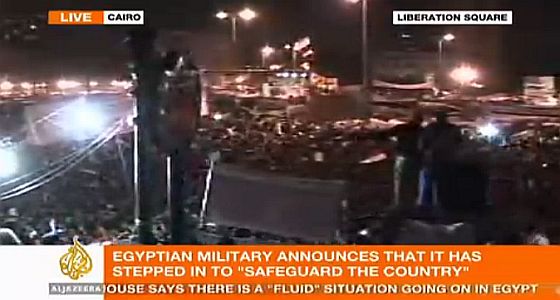
CIA watching Al Jazeera, learns Mubarak about to go

WATCH AL JAZEERA LIVE

“There’s a strong likelihood that Mubarak may step down in Eqypt tonight,” CIA Director Leon Panetta told a House Intelligence panel today.

The CIA later clarified that Panetta’s statement was not based on intelligence but on news reports.

And there you have it. This is how the US government and legislators stay abreast of world-changing events: by watching Al Jazeera.

How significant will Mubarak’s departure be, assuming that it shortly comes?

The Supreme Council of Egyptian Armed Forces has issued its communique #1. Does that mean Egypt will shortly be under military control?

Al Jazeera:

“Ambiguous” statement from military confirms its “commitment and responsibility to safeguard the people and to protect the interests of the nation, and its duty to protect the riches and assets of the people and of Egypt”. Mentioned the demands of the people are “lawful and legitimate”. Understood the military council met separately from Mubarak.

WATCH AL JAZEERA LIVE

Facebooktwittermail

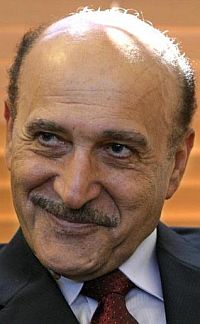
Omar Suleiman: Egypt’s torturer-in-chief threatens to unleash “dark bats of the night… to terrorize the people”

Lisa Hajjar writes:

Under the Bush administration, in the context of “the global war on terror”, US renditions became “extraordinary”, meaning the objective of kidnapping and extra-legal transfer was no longer to bring a suspect to trial – but rather for interrogation to seek actionable intelligence. The extraordinary rendition program landed some people in CIA black sites – and others were turned over for torture-by-proxy to other regimes. Egypt figured large as a torture destination of choice, as did [newly-appointed Vice President, Omar] Suleiman as Egypt’s torturer-in-chief. At least one person extraordinarily rendered by the CIA to Egypt — Egyptian-born Australian citizen Mamdouh Habib — was reportedly tortured by Suleiman himself.

In October 2001, Habib was seized from a bus by Pakistani security forces. While detained in Pakistan, at the behest of American agents, he was suspended from a hook and electrocuted repeatedly. He was then turned over to the CIA, and in the process of transporting him to Egypt he endured the usual treatment: his clothes were cut off, a suppository was stuffed in his anus, he was put into a diaper – and ‘wrapped up like a spring roll’.

In Egypt, as Habib recounts in his memoir, My Story: The Tale of a Terrorist Who Wasn’t, he was repeatedly subjected to electric shocks, immersed in water up to his nostrils and beaten. His fingers were broken and he was hung from metal hooks. At one point, his interrogator slapped him so hard that his blindfold was dislodged, revealing the identity of his tormentor: Suleiman.

Suleiman’s history should be kept in mind when considering statements he made yesterday. In a thinly veiled threat, he warned that if the protests do not end soon, there will be a coup and “dark bats of the night” will emerge “to terrorize the people.”

Egypt’s anti-government activists called on supporters Wednesday to expand their demonstrations in defiance of the vice president’s warning that protests calling for President Hosni Mubarak’s ouster would not be tolerated for much longer.

Vice President Omar Suleiman, who is managing the crisis, raised the prospect of a new crackdown on protesters Tuesday when he told Egyptian newspaper editors there could be a “coup” unless demonstrators agree to enter negotiations. The protesters insist they won’t talk before Mubarak steps down, which the president is refusing to do.

“He is threatening to impose martial law, which means everybody in the square will be smashed,” said Abdul-Rahman Samir, a spokesman for a coalition of the five main youth groups behind protests in Cairo’s Tahrir Square. “But what would he do with the rest of the 70 million Egyptians who will follow us afterward.”

Suleiman is creating “a disastrous scenario,” Samir said. “We are striking and we will protest and we will not negotiate until Mubarak steps down. Whoever wants to threaten us, then let them do so,” he added.

For the first time, protesters were calling forcefully Wednesday for labor strikes after Suleiman warned that calls by some protesters for a campaign of civil disobedience are “very dangerous for society and we can’t put up with this at all.”

The vice president’s warnings were the latest in a series of confused messages from the government to the protesters. Officials have made a series of pledges not to attack, harass or arrest the activists in recent days, followed by Suleiman’s thinly veiled threat of a new crackdown.

“We can’t bear this for a long time,” he said of the Tahrir protests. “There must be an end to this crisis as soon as possible.” He said the regime wants to resolve the crisis through dialogue, warning: “We don’t want to deal with Egyptian society with police tools.”

He also warned of chaos if the situation continued, speaking of “the dark bats of the night emerging to terrorize the people.” If dialogue is not successful, he said, the alternative is “that a coup happens, which would mean uncalculated and hasty steps, including lots of irrationalities.”

Facebooktwittermail

Secrecy is the original sin

From Truthout:

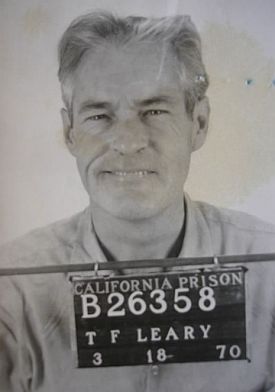
Largely because of his advocacy of psychedelic drugs, Tim Leary became a high-profile political prisoner whom Nixon called “the most dangerous man in America” (the same label Nixon used to describe Daniel Ellsberg). Leary was sentenced to ten years in prison for possession of .0025 grams of cannabis.

After escaping from prison in 1970, he became the object of an international manhunt. Finally captured in Afghanistan, he was kidnapped by the CIA – there was no extradition treaty between the two countries – and brought back to face four more years in prison, including long stretches in solitary confinement, before he was released in 1976. The following is an excerpt from a text he wrote in maximum-security Folsom Prison, California, in May 1973. — Michael Horowitz

Timothy Leary writing at the time of Watergate:

When you think about it, secrecy is the cause of the whole flap. Ellsberg and Russo published some secrets. Leaks in the White House. The plumbers steal Ellsberg’s psychiatric secrets. And bug the Democrat’s phone calls. The entire White House is involved in cover-up. The hearings center on cover-up of the cover-up.

Secrecy is the enemy of sanity and loving trust. If you keep secrets, you are an insane paranoiac. Concealment is the seed source of every human conflict. Secrecy is always caused by guilt or fear. [Gordon] Liddy’s parents were guilty about sex. And Nixon’s parents. It drives them crazy when he secretly suspects that she’s keeping secrets so he hires a private detective and vice versus.

Let’s break out of the huddle. Before [FBI Director] J. Edgar Hoover there were no secret police in this country. Before World War II there was no C.I.A. and America was amazingly unconcerned with secrecy. The hidden sickness has become lethally epidemic in the last forty years.

Now comes the electronic revolution. Reveal-ation. Bugging equipment effective at long distances is inexpensive and easily available. Good. Liberals want stiff laws against bugging. It’s the wrong move. Legalize everything. Legalize bugging. Let’s forget artificial secrets and concentrate on the mysteries.

I can tell you bugging is nothing to worry about. I’ve been tapped, surveilled, tailed for ten years. In Algeria everyone knew of at least three taps on all international calls — Algerian, French and C.I.A. The Algerians knew every move we made. That’s why they liked us. I was called in once by the Swiss Secret Service about some threats on my life. They offered me body guards. I looked at the chief agent and laughed. “Moi! Merci, non.” The agent laughed with me. “Professor, the Swiss police never sleep. We watch over you twenty-four hours a day.” Any real true intimate secrets are preserved in the tender codes of love. Privacy is woven with electric threads of contact that cannot be INTERCEPTED. Love has nothing to hide.

Secrecy is the original sin. Fig leaf in the Garden of Eden. The basic crime against love. The issue is fundamental. What a blessing that Watergate has been uncovered to teach us the primary lesson. The purpose of life is to receive, synthesize, and transmit energy. Communication fusion is the goal of life. Any star can tell you that. Communication is love. Secrecy, withholding the signal, hoarding, hiding, covering up the light is motivated by shame and fear, symptoms of the inability to love. Secrecy means that you think love is shameful and bad. Or that your nakedness is ugly. Or that you hide unloving, hostile feelings, Seed of paranoia and distrust.

Those who love have no need to hide their actions. As so often happens, the extreme wing is half right for the wrong reasons. They say primly: if you have done nothing wrong, you have no fear of being bugged. Exactly. But the logic goes both ways. Then F.B.I, files, and C.I.A. dossiers, and White House conversations should be open to all. Let every thing hang open. Let government be totally visible. The last, the very last people to hide their actions should be the police and government.

We operate on the assumption that everyone knows everything, anyway. There is nothing and no way to hide. This is the acid message. We’re all on cosmic T.V. every moment. We all play starring roles in the galactic broadcast: This Is Your Life. I remember the early days of neurological uncovering, desperately wondering where I could go to escape. Run home, hide under the bed, in the closet, in the bathroom? No way. The relentless camera “I” follows me everywhere. We can only keep secrets from ourselves.

And none of the legal experts get the point of Watergate. [Special prosecutor Archibald] Cox chasing leaks from his own staff.

We recall the classic political scandals involving secrets: Dreyfus, Alger Hiss, the Rosenbergs. The heroic figures around whom Watergate revolves, Tony [Russo] and Dan [Ellsberg]. Brave Russian dissenters uncovering the secret that everyone knows about Soviet repression.

I laugh at government bugging. Let the poor, deprived, bored creatures listen to our conversations, tape our laughter, study our transmissions. Maybe it will turn them on. Perhaps they’ll get the message our love-shine transmits: there is nothing to fear.

From Neuropolitics, 1977.

Facebooktwittermail

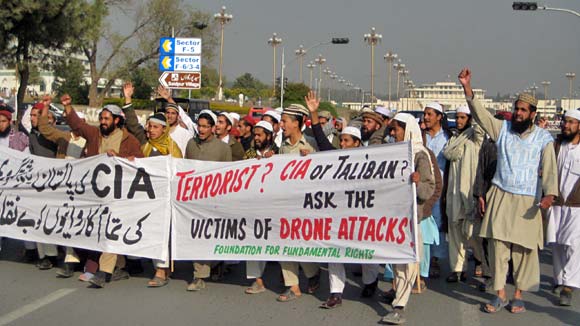
2010, the year of assassination by drones

The Asian News International news agency reports:

As many as 2,043 people, mostly civilians, were killed in US drone attacks in northwestern parts of Pakistan during the last five years, a research has revealed.

The yearly report of Conflict Monitoring Centre (CMC) has termed the CIA drone strikes as an ”assassination campaign turning out to be revenge campaign”, and showed that 2010 was the deadliest year ever of causalities resulted in drone-hits in Pakistan.

According to the report, 134 drone attacks were reported in Pakistan’s FATA region in 2010 alone, inflicting 929 causalities. December 17 was the deadliest day of 2010 when three drone attacks killed 54 people in Khyber Agency.

Regarding civilian causalities and attacks on women and children, the report said: “People in the tribal belt usually carry guns and ammunition as a tradition. US drone will identify anyone carrying a gun as a militant and subsequently he will be killed.”

“Many times, people involved in rescue activities also come under attack. The assumption that these people are supporters of militants is quite wrong,” The Nation quoted the CMC report, as stating.

The document cited the Brooking Institute”s research, which suggested that with every militant killed, nearly ten civilians also died.

It also mentioned a related research report of Campaign for Innocent Victims in Conflict (CIVIC), which underlined that at least 2,100 civilians were killed and various others injured during 2009, in the ongoing war on terror and drone attacks.

The CMC report, “2010, The Year of Assassination by Drones,” can be read here [PDF].

Facebooktwittermail

The truth that the CIA is desperate to conceal

The New York Times reports:

A seven-year effort by the Central Intelligence Agency to hide its relationship with a Swiss family who once acted as moles inside the world’s most successful atomic black market hit a turning point on Thursday when a Swiss magistrate recommended charging the men with trafficking in technology and information for making nuclear arms.

The prospect of a prosecution, and a public trial, threatens to expose some of the C.I.A.’s deepest secrets if defense lawyers try to protect their clients by revealing how they operated on the agency’s behalf. It could also tarnish what the Bush administration once hailed as a resounding victory in breaking up the nuclear arms network by laying bare how much of it remained intact.

“It’s like a puzzle,” Andreas Müller, the Swiss magistrate, said at a news conference in Bern on Thursday. “If you put the puzzle together you get the whole picture.”

The three men — Friedrich Tinner and his two sons, Urs and Marco — helped run the atomic smuggling ring of A. Q. Khan, an architect of Pakistan’s nuclear bomb program, officials in several countries have said. In return for millions of dollars, according to former Bush administration officials, the Tinners secretly worked for the C.I.A. as well, not only providing information about the Khan network’s manufacturing and sales efforts, which stretched from Iran to Libya to North Korea, but also helping the agency introduce flaws into the equipment sent to some of those countries.

The Bush administration went to extraordinary lengths to protect the men from prosecution, even persuading Swiss authorities to destroy equipment and information found on their computers and in their homes and businesses — actions that may now imperil efforts to prosecute them.

While it has been clear since 2008 that the Tinners acted as American spies, the announcement by the Swiss magistrate on Thursday, recommending their prosecution for nuclear smuggling, is a turning point in the investigation. A trial would bring to the fore a case that Pakistan has insisted is closed. Prosecuting the case could also expose in court a tale of C.I.A. break-ins in Switzerland, and of a still unexplained decision by the agency not to seize electronic copies of a number of nuclear bomb designs found on the computers of the Tinner family.

The fact that the CIA and the US government have gone to such lengths to try and prevent the details about the CIA’s involvement in global nuclear proliferation being exposed, means that we can only speculate about what kind of damning information remains hidden.

Several scenarios seem possible:

  • that the CIA’s efforts to track the AQ Khan network reached a point where it might have appeared that it was aiding and abetting the network’s operation;
  • that bungled CIA efforts to sabotage the Iranian nuclear program resulted in Iran acquiring know-how or technology that it might not have otherwise been able to obtain;
  • and conceivably, that the CIA’s involvement in Iran’s nuclear program was so deep that it was exerting an influence over the strategic direction of the program.
Facebooktwittermail

CIA launches a WTF task force to assess impact of U.S. cables’ exposure by WikiLeaks

The Washington Post reports:

The CIA has launched a task force to assess the impact of the exposure of thousands of U.S. diplomatic cables and military files by WikiLeaks.

Officially, the panel is called the WikiLeaks Task Force. But at CIA headquarters, it’s mainly known by its all-too-apt acronym: W.T.F.

The irreverence is perhaps understandable for an agency that has been relatively unscathed by WikiLeaks. Only a handful of CIA files have surfaced on the WikiLeaks Web site, and records from other agencies posted online reveal remarkably little about CIA employees or operations.

Even so, CIA officials said the agency is conducting an extensive inventory of the classified information, which is routinely distributed on a dozen or more networks that connect agency employees around the world.

And the task force is focused on the immediate impact of the most recently released files. One issue is whether the agency’s ability to recruit informants could be damaged by declining confidence in the U.S. government’s ability to keep secrets.

Facebooktwittermail

CIA gave waterboarders $5M legal shield

The Associated Press reports:

The CIA agreed to cover at least $5 million in legal fees for two contractors who were the architects of the agency’s interrogation program and personally conducted dozens of waterboarding sessions on terror detainees, former U.S. officials said.

The secret agreement means taxpayers are paying to defend the men in a federal investigation over an interrogation tactic the U.S. now says is torture. The deal is even more generous than the protections the agency typically provides its own officers, giving the two men access to more money to finance their defense.

It has long been known that psychologists Jim Mitchell and Bruce Jessen created the CIA’s interrogation program. But former U.S. intelligence officials said Mitchell and Jessen also repeatedly subjected terror suspects inside CIA-run secret prisons to waterboarding, a simulated drowning tactic.

The revelation of the contractors’ involvement is the first known confirmation of any individuals who conducted waterboarding at the so-called black sites, underscoring just how much the agency relied on outside help in its most sensitive interrogations.

Facebooktwittermail

How a secret gets revealed and then becomes secret again

On November 30, The Express Tribune, Pakistan’s first internationally affiliated newspaper (partnered with The International Herald Tribune – the global edition of The New York Times) reported:

A North Waziristan tribesman, whose brother and teenage son were killed in a drone strike last year, said on Monday that he would sue all those US officials supposedly in control of the predator’s operations in Pakistan.

Karim Khan, a local journalist from Mirali town of the lawless tribal district, had sent a $500 million claim for damages to the US Defence Secretary Robert Gates, CIA chief Leon Panetta and its station head in Islamabad Jonathan Banks.

On December 10, a report appearing in the Miami Herald repeated the same claims:

The lawsuit, which stands little chance of being won, is lodged against the CIA station chief in Islamabad, identified as Jonathan Banks; CIA Director Leon Panetta; and Defense Secretary Robert Gates. There’s speculation that the publicity has compromised the position of the CIA chief in Pakistan. The U.S. Embassy in Islamabad refused to confirm that Banks was the right person.

“What CIA station chief? I can’t talk about employees,” embassy spokesman Alberto Rodriguez said.

But yesterday, the New York Times started reporting like a newspaper that takes directions from the government censors.

Just as in Israel, where secrecy can be imposed through censorship even when the “secret” has been made known everywhere else in the world, the New York Times is now following government directions by refusing to reprint the CIA station chief’s name even though it has been widely reported outside and inside the United States.

The Central Intelligence Agency’s top clandestine officer in Pakistan’s capital, Islamabad, was removed from the country on Thursday amid an escalating war of recriminations between American and Pakistani spies, with some American officials convinced that the officer’s cover was deliberately blown by Pakistan’s military intelligence agency.

The American spy’s hurried departure is the latest evidence of mounting tensions between two uneasy allies, with the Obama administration’s strategy for ending the war in Afghanistan hinging on the cooperation of Pakistan in the hunt for militants in the mountains that border those two countries. The tensions could intensify in the coming months with the prospect of more American pressure on Pakistan.

As the cloak-and-dagger drama was playing out in Islamabad, 100 miles to the west the C.I.A. was expanding its covert war using armed drones against militants. Since Thursday, C.I.A. missile strikes have killed dozens of suspects in Khyber Agency, a part of the tribal areas in Pakistan that the spy agency had largely spared until now because of its proximity to the sprawling market city of Peshawar.

American officials said the C.I.A. station chief had received a number of death threats since being publicly identified in a legal complaint sent to the Pakistani police this week by the family of victims of earlier drone campaigns.

So, before his cover was blown and this cloak-and-dagger drama started playing out, are we to suppose that the CIA station chief was happily cruising round Islamabad in an open-top Cadillac proudly flying the Stars and Stripes on the hood?

Even if the station chief who must now not be named was less exposed before a name which might be his name appeared in print, let’s not pretend he operated in Pakistan with anything less than maximum security.

The Washington Post confirms: “Ordinarily, station chiefs in Islamabad rarely stray beyond the sprawling American diplomatic compound, living and working in a warren of apartments and offices set deep inside the embassy complex’s walls.”

Maybe the issue is not threats to the station chief’s life as much as threats to his liberty. Pakistan’s judicial system, unlike its government, has at times displayed what American officials might regard as an irksome level of independence.

A report in Pakistan’s Daily Mail, published on December 1 (part of which appears below without corrections — the English and editing are rough, but the story is strong), provides interesting background on the legal action being brought by Kareem Khan.
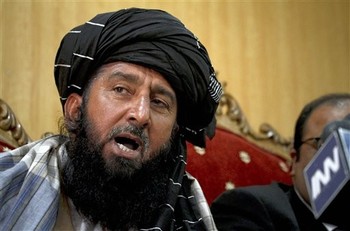
Kareem Khan challenged the precision of drone attacks and specifically questioned the precision of 31st December 2009 attack where in three innocent lives were taken by CIA in a secretive mode. He further challenged that if CIA can establish involvement of any of victims of 31st December attack in terrorism he will pay damages to United States instead.

While talking about the catastrophe he told The Daily Mail how his18 years old son Zaenullah, his young brother Asif Iqbal and a mason who was working on construction of village masque and had came from another village of Khyber Pakhtunkhawa were killed.

Kareem Khan told The Daily Mail that “his family is one of few educated families from the North Waziristan .He himself is M .Phil while his son was employee of Government school in town and his brother was graduate of National University of Modern languages from Islamabad .After compilation of his studies he went back to his town to add his positive contribution in educational uplifting of tribal area. They were innocent Pakistani citizen of Islamic Republic Of Pakistan whose fundamental rights have been guaranteed under the Constitution of Islamic Republic of Pakistan

In the response of one question about the families of victims he told Asif Iqbal left two years old son Muhammad Kafeel and a widow. Mohammad Kafeel has no one to look after as his mother is suffering great emotional and mental trauma. . “I lost my son and brother and now family’s full responsibility is now on me now we are living in uncle’s house waiting for justice or compensation”. He told The Daily Mail

Kareem Khan told the Daily Mail after this tragedy “I went here and there for Justice but all in vain because of undefined and so called system in tribal areas than one of my good friend suggested me to ask for Justice through legal way”. On November 29 2010 I through my lawyer Mirza Shahzad Akbar issued a legal notice to United States Secretary Defence Mr. Robert Gates, Director CIA Leon Panetta CIA Islamabad Station Chief Jonathan Banks for damages of $ 500 Million .he added

He also told that Drone attacks in tribal areas are carried out by CIA in langly, Virginia USA with co-ordination of local intelligence gathered by spies on ground in tribal area. CIA, s Islamabad station Chief, Jonathan Banks coordinates such intelligence through the network of on ground spies, who are paid a hefty amount for pointing out any militant. On these uncorroborated reports, CIA is executing people of tribal areas.

He stated that “CIA Director Leon Panetta has been reported in media saying that ‘Drone attacks are precise and limited in terms of collateral damage’.

“CIA officials are not part of United States armed forces, therefore under international law they are civilians directly participating in hostilities. Furthermore being non-diplomat and non-armed forces members CIA officials, who are operating drone attacks have no immunity and therefore are liable for murder and damages under laws of Pakistan and principles of natural justice throughout the world’ Kareem Khan explained

Kareem Khan also grumbled that media is not playing vibrant role and journalists even don’t bother to find ground realities. Every time we watched in media that numbers of militants are killed in the result of drone attacks. All the time they go for figures they don’t even bother to differentiate the innocent people and militants. Unfortunately they just rely on people who are present there and love to create hype for their own purpose.Kareem Khan gave the example of Hakeem Ullah Mehsood, Jalal Din ,Aimen Alzwari and Sheikh Usamma and told that according to so called reliable sources media published news regarding their, several times deaths . Which is very funny situation because in my limited knowledge a person died once in his or her life .

Shahzad Mirza Akbar ,the legal representative of Kareem khan who was present during the interview told The Daily Mail Drone attacks on house of his client is in clear violation of United Nations declaration of Human Rights ,International Covenant on Civil and Political Rights(ICCRP) and the citizens of Pakistan through the constitution of Islamic Republic of Pakistan .Those who have committed this atrocity are liable to be charged under the Penal Code of Pakistan and no law custom or authority gives CIA the permission to carry out killing in the sovereign territory of another country .So this is illegal act of United States and CIA and cannot be recognized as legal at any judicial or legal forum .The UN special report on extra –judicial ,summery and executions declared in 2004

“Empowering Government to identify and kill “known terrorists” places no verifiable obligation upon them to demonstrate in any way that those against whome lethal force is used are indeed terrorists, or to demonstrate that every other alternative had been exhausted”.

He told Court issued the notice on November 29, 2010 and count down has been started from today .He also talked about next step is to go in American court for justice.

So what’s the story here? Is it about the life of a CIA station chief being placed at risk? Or is it about the struggle among the victims of drone warfare who believe that tribal people should be afforded the same political, legal and human rights and protections as anyone else?

Strangely, the Washington Post and the Wall Street Journal, while acceding to a CIA request not to reprint the station chief’s name, nevertheless provide additional identifying information about him which I have not included here, nor has it appeared in the Pakistani press. That information was, no doubt, provided to them by the CIA!

Facebooktwittermail

How Israel and the US benefited from the murder of Rafik Hariri

Who has benefited most from the assassination of Rafik Hariri in Beirut in 2005? As the International Court of Justice arrives at its version of events, Dyab Abou Jahjah, writing in Open Democracy, finds confirmation in WikiLeaks for pointing us in a different direction.

Lebanon nowadays seems much bigger than it actually is. In a way this is no surprise for a country that always was a playground for regional and international agendas and a laboratory for testing any new formula in the area. However, this time, Lebanon is much more than that. Since 2006 it has become clear to all serious observers that this country is the focal point of a strategic divide, or more accurately the strategic divide in the Middle East. By virtue of the victory of Hezbollah against Israel in 2006, the Lebanese resistance has become a major factor in tipping the balance in favour of the Syrian/Iranian influence in the region as against that of the American/Israeli-led project. The latter project aims at further fragmenting political and social regional structures based upon sectarian and ethnic divisions, in order to create a new Middle East in which – to put it simply – Israel can play boss over everybody.

The Iranian and the Syrian regimes naturally oppose this scheme as it targets them in the first instance, but Iran at least also opposes this for ideological reasons. For the surge of the neo-conservative ‘creative chaos’ strategy in Iraq and beyond, the war against Lebanon in 2006 was supposed to be the final blow to any resistance, especially as this occurred at a time when Iraqi resistance was starting to be divided, weak and marginal, and the American grip over Iraq was growing stronger. Hezbollah’s defeat of the Israeli onslaught stopped the American surge in its tracks. The tide has started to turn since that moment: since then, both the Lebanese resistance and its Syrian and Iranian allies have been strengthened.

At this point, for the Americans and the Israelis a new priority was established: to destroy Hezbollah by any means necessary. This conclusion is confirmed by one of the documents lately published on wikileaks where the heads of the CIA and the Mossad are to be observed contemplating a possible augmentation of the pressure on Syria to make it take its distance from Iran, in order eventually to weaken Hezbollah. In that conversation between Meir Dagan and Frances Townsend, Dagan conveys to his American counterpart the “advantage of such an approach” – that, “the legal ground is already in place for action by the UNSC.” It is in this context that one must read the actions of the international tribunal investigating the death of Rafik Hariri and the indictment of Hezbollah that it will be releasing shortly.

Facebooktwittermail