The Guardian reports: Kerry announced the start of a new peace process in July – itself the product of intensive negotiations – flanked by Israeli and Palestinian negotiators, beneath the chandeliers of the State Department’s Benjamin Franklin Room in Washington. “I believe that history is not made by cynics,” he declared. “It is made by realists who are not afraid to dream.”
The goal Kerry set for the talks had defeated previous secretaries of state and presidents: a peace agreement, based on a resolution of every single major issue that has divided Israel and Palestine for decades. And he wanted it secured within just nine months.
The 68th secretary of state had by then already acquired a reputation for grandiose speeches; privately, some diplomats began asserting that his self-belief could border on hubris.
Now some of his critics say they are being proved right. “It does not seem to me the talks are going well,” said Elliott Abrams, a former White House advisor who worked on the Israel-Palestine conflict under George W Bush’s administration. “The secretary went into this initially with the goal of a final status agreement. It is very clear that that is impossible. He maybe has a rabbit in his hat. But I doubt it.”
Much of the scepticism is born from the fact Kerry’s ambitious talk of the all-encompassing “final status agreement” has, for some months now, been replaced with more modest noises about a getting the sides to endorse a set of basic principles for further talks.
Others say that persuading both sides to agree to a “framework deal” will be a remarkable achievement given the wide gaps between them thus far, and could lead to further progress. “A framework agreement is a logical part of trying to get to a final, comprehensive agreement,” said a senior US administration official close to the process.
But, clearly, the goalposts have shifted. Gone is the promise of a wide-ranging final agreement, achieved in one go; instead, the US has settled on a step-by-step approach. [Continue reading…]
Category Archives: US government
Israel needs to learn some manners
Avi Shlaim writes: On Jan. 14, the Israeli defense minister, Moshe Yaalon, told the daily Yediot Aharonot, “Secretary of State John Kerry — who arrived here determined, who operates from an incomprehensible obsession and a sense of messianism — can’t teach me anything about the conflict with the Palestinians.” Even by Israeli standards, Mr. Yaalon’s comments were rather rude. Mr. Kerry’s crime was to try to broker Israeli-Palestinian peace talks that began last July and to stipulate a nine-month deadline. This is the kind of talk that gives chutzpah a bad name.
The episode also reveals a great deal about the nature of the much-vaunted special relationship between the United States and Israel. It suggests that this relationship is a one-way street, with America doing all the diplomatic heavy lifting while Israel limits its role to obstruction and whining — repaying Uncle Sam’s generosity with ingratitude and scorn.
Israeli leaders have always underlined the vital importance of self-reliance when it comes to Israel’s security. But the simple truth is that Israel wouldn’t be able to survive for very long without American support. Since 1949, America’s economic aid to Israel amounts to a staggering $118 billion and America continues to subsidize the Jewish state to the tune of $3 billion annually. America is also Israel’s main arms supplier and the official guarantor of its “quantitative military edge” over all its Arab neighbors.
In the diplomatic arena, Israel relies on America to shield it from the consequences of its habitual violations of international law. The International Court of Justice pronounced the so-called “security barrier” that Israel is building on the West Bank to be illegal. All of Israel’s civilian settlements on the West Bank violate the Fourth Geneva Convention, but Israel continues to expand them. [Continue reading…]
Why I hate coming home to America
Host/producer for HuffPost Live, Ahmed Shihab-Eldin, writes: It’s not easy coming back home to America when your name is Ahmed.
I want to look forward to returning home from a trip abroad, but thanks to my name or as the TSA officer put it — my “profile” — I’ve come to dread it.
The last four times I’ve traveled abroad (to Turkey, Kuwait, Lebanon and Switzerland), Homeland Security has detained me upon arrival. It’s as frustrating as it is ironic, because although in Arabic my name, Ahmed, means, “blessed,” each time I land at JFK airport, I can’t help but feel somewhat cursed.
On Sunday night, after attending the World Economic Forum in Davos for the first time, I was detained for two hours upon arrival. In October, I was held for almost four, returning home after a 14-hour trip to Turkey where I moderated a UN conference on peace in the Middle East. For what it’s worth, I breezed through security in Istanbul.
In Davos — where I interviewed some of the world’s wealthiest, most powerful and highest-profile people — the running joke among our production team, and many of the other participants was how unusually friendly and hospitable the thousands of police officers, special forces, and security guards were. My team passed through security checkpoint after checkpoint at each of the various venues with respect and dignity.
Why then, you might be wondering, am I detained every time I set foot on U.S. soil? As it is always abstractly and bluntly explained to me: My “name” and “my profile” are simply a “match.”
Like all Americans (and every human being for that matter), I want to be safe. But I can’t help but question the efficacy of our national security policy, including the practice of detaining U.S. citizens because something (never specifically explained) about a name or person’s identity is said to match that of someone somewhere in the world who is deemed to pose a threat to America. [Continue reading…]
Investigations expose the Pentagon’s systemic problem with abusive commanders
The Washington Post reports: There are miserable bosses, and then there are toxic military commanders.
Air Force Maj. Gen. Stephen D. Schmidt was unquestionably among the latter in the view of some staff members under his thumb. A profane screamer, he ran through six executive officers and aide-de-camps in a year. He retired this month after an Air Force inquiry concluded that he was “cruel and oppressive” and mistreated subordinates.
More than a dozen people who worked with Brig. Gen. Scott F. “Rock” Donahue, a retired commander with the Army Corps of Engineers, reported him as a verbally abusive taskmaster. One was so desperate to escape from division headquarters in San Francisco that he asked for a transfer to Iraq. An Army investigation cited the general for “exhibiting paranoia” and making officers cry.
Troops who served under Army Brig. Gen. Eugene Mascolo of the Connecticut National Guard, described him as “dictatorial,” “unglued” and a master of “profanity-fused outbursts.” An Army investigation found widespread evidence of “verbal mistreatment.” He received a written reprimand but remains in the National Guard.
U.S. military commanders are not trained to be soft or touchy-feely. But over the past two years, the Pentagon has been forced to conduct a striking number of inspector-general investigations of generals and admirals accused of emotionally brutal behavior, according to military documents obtained under the Freedom of Information Act.
The affliction of abusive leadership has even infected some civilian leaders at the Pentagon, raising questions about the Defense Department’s ability to detect and root out flaws in its command culture.
Inspector-general files show, for example, that Army officers described the working atmosphere under Joyce E. Morrow, a powerful civilian official at Army headquarters, as “toxic,” corrosive” and “like you were in a prisoner of war camp.” Officers complained of menial servitude and said they were forced to fetch Morrow’s iced tea, which she would refuse to drink if it was not served in a cup with a lid and a straw, but no ice.
Most military commanders are upstanding and well-respected by their troops. Many are hailed as heroes, particularly after more than a dozen years of war. But in recent months, the armed forces have been shaken by an embarrassing number of generals and admirals who have gotten into trouble for gambling, drinking and sleeping around, among other ethical lapses.
Some current and former officers say those cases are symptomatic of a more damaging problem: a system that promotes and tolerates too many lousy leaders. [Continue reading…]
Almost everything in Dr. Strangelove was true
Eric Schlosser writes: This month marks the fiftieth anniversary of Stanley Kubrick’s black comedy about nuclear weapons, “Dr. Strangelove or: How I Learned to Stop Worrying and Love the Bomb.” Released on January 29, 1964, the film caused a good deal of controversy. Its plot suggested that a mentally deranged American general could order a nuclear attack on the Soviet Union, without consulting the President. One reviewer described the film as “dangerous … an evil thing about an evil thing.” Another compared it to Soviet propaganda. Although “Strangelove” was clearly a farce, with the comedian Peter Sellers playing three roles, it was criticized for being implausible. An expert at the Institute for Strategic Studies called the events in the film “impossible on a dozen counts.” A former Deputy Secretary of Defense dismissed the idea that someone could authorize the use of a nuclear weapon without the President’s approval: “Nothing, in fact, could be further from the truth.” (See a compendium of clips from the film.) When “Fail-Safe” — a Hollywood thriller with a similar plot, directed by Sidney Lumet — opened, later that year, it was criticized in much the same way. “The incidents in ‘Fail-Safe’ are deliberate lies!” General Curtis LeMay, the Air Force chief of staff, said. “Nothing like that could happen.” The first casualty of every war is the truth — and the Cold War was no exception to that dictum. Half a century after Kubrick’s mad general, Jack D. Ripper, launched a nuclear strike on the Soviets to defend the purity of “our precious bodily fluids” from Communist subversion, we now know that American officers did indeed have the ability to start a Third World War on their own. And despite the introduction of rigorous safeguards in the years since then, the risk of an accidental or unauthorized nuclear detonation hasn’t been completely eliminated.
The command and control of nuclear weapons has long been plagued by an “always/never” dilemma. The administrative and technological systems that are necessary to insure that nuclear weapons are always available for use in wartime may be quite different from those necessary to guarantee that such weapons can never be used, without proper authorization, in peacetime. During the nineteen-fifties and sixties, the “always” in American war planning was given far greater precedence than the “never.” Through two terms in office, beginning in 1953, President Dwight D. Eisenhower struggled with this dilemma. He wanted to retain Presidential control of nuclear weapons while defending America and its allies from attack. But, in a crisis, those two goals might prove contradictory, raising all sorts of difficult questions. What if Soviet bombers were en route to the United States but the President somehow couldn’t be reached? What if Soviet tanks were rolling into West Germany but a communications breakdown prevented NATO officers from contacting the White House? What if the President were killed during a surprise attack on Washington, D.C., along with the rest of the nation’s civilian leadership? Who would order a nuclear retaliation then?
With great reluctance, Eisenhower agreed to let American officers use their nuclear weapons, in an emergency, if there were no time or no means to contact the President. Air Force pilots were allowed to fire their nuclear anti-aircraft rockets to shoot down Soviet bombers heading toward the United States. And about half a dozen high-level American commanders were allowed to use far more powerful nuclear weapons, without contacting the White House first, when their forces were under attack and “the urgency of time and circumstances clearly does not permit a specific decision by the President, or other person empowered to act in his stead.” Eisenhower worried that providing that sort of authorization in advance could make it possible for someone to do “something foolish down the chain of command” and start an all-out nuclear war. [Continue reading…]
Leaked Pakistani official document records details of 330 drone strikes
The Bureau of Investigative Journalism reports: The Bureau is today publishing a leaked official document that records details of over 300 drone strikes, including their locations and an assessment of how many people died in each incident.
The document is the fullest official record of drone strikes in Pakistan to have yet been published. It provides rare insight into what the government understands about the campaign.
It also provides details about exactly when and where strikes took place, often including the names of homeowners. These details can be valuable to researchers attempting to verify eyewitness reports – and are often not reported elsewhere. But interestingly, the document stops recording civilian casualties after 2008, even omitting details of well-documented civilian deaths and those that have been acknowledged by the government.
Last July the Bureau published part of the document for the first time. This documented strikes, which hit the northwest tribal areas of Pakistan between 2006 and late 2009, and revealed that the Pakistani government was aware of hundreds of civilian casualties, even in strikes where it had officially denied civilians had died.
The reports are based on information filed to the FATA Secretariat each evening by local Political Agents – senior officials in the field. These agents gather the information from networks of informants in Pakistan’s Federally Administered Tribal Areas (FATA), the area bordering Afghanistan.
Now the Bureau has obtained an updated version of the document, which lists attacks up to late September 2013. [Continue reading…]
No evidence Russia helped Snowden to steal U.S. secrets: Feinstein
Reuters reports: The chairwoman of the Senate Intelligence Committee, Senator Dianne Feinstein, said on Tuesday she has seen no evidence that Russian spies helped former National Security Agency contractor Edward Snowden steal U.S. eavesdropping secrets.
The Democrat’s comments on the MSNBC TV channel contrast with statements by her Republican counterpart in the House of Representative Intelligence Committee, Mike Rogers.
Rogers suggested earlier this month that Russia had acquired influence over Snowden before he left his job as an NSA contractor and traveled to Hong Kong, where he leaked tens of thousands of classified documents describing U.S. and British eavesdropping operations.
“I have no information to that effect. I’ve never seen anything to that effect. I’ve asked some questions since and nothing has been forthcoming,” Feinstein said.
A senior U.S. official familiar with the matter said that he had seen no evidence Snowden had been recruited or influenced by Russia to acquire and leak U.S. eavesdropping secrets. Other U.S. security officials have privately offered similar assessments in recent weeks.
Rogers said on television 10 days ago that Snowden had likely been collaborating with Russia before he fled there last year. [Continue reading…]
America’s rise as a superpower
In Der Spiegel, Hans Hoyng writes: “Sarajevo, 21st-century version.” This is how political scientist Anne-Marie Slaughter, the director of policy planning under former Secretary of State Hillary Clinton, refers to what is currently brewing off the Chinese coast, where the territorial claims of several nations overlap.
The analogy to the period prior to the outbreak of World War I is striking. China, “the Germany of (that) time,” as American historian Robert Kagan puts it, is the emergent world power still seeking to define its role within the global community. At the same time, China is staking its claim to natural resources, intimidating its neighbors and developing massive naval power to secure its trade routes.
In taking these steps, China could easily become a rival to another world power, the United States of America, which would assume the role once played by Great Britain in this historical comparison. Just as the United Kingdom did at the time, the United States is now building alliances with its rival’s neighbors. And leaders in Beijing have responded to such attempts to encircle their country with a similar sense of outrage as that displayed by the German Reich.
The current crisis in the East China Sea illustrates once again that there are still lessons to be learned from World War I a century after it began and, upon closer inspection, that politicians on both sides are trying to avoid making the same mistakes. But the current crisis in East Asia diverges from the situation leading up to World War I in one important respect: There is currently no country able to assume the role once played by the United States, which, with its late entry into the war, decided its outcome and eventually outpaced both its winners and losers.
The US’s entry into the war in 1917 marked the beginning of its path to becoming a world power. In fact, according to historian Herfried Münkler, this was precisely the goal of some politicians in Washington. Treasury Secretary William Gibbs McAdoo, a son-in-law of President Woodrow Wilson, was already forging plans to replace the pound sterling with the dollar as the foremost international reserve currency.
But his father-in-law, a lawyer and political scientist, and America’s only president to enter politics after serving as the president of a university, had no such prosaic intentions. Wilson, the descendent of Scottish Presbyterians and a staunch idealist, and yet down-to-earth and in many respects, such as his racism, a son of the South, wanted to save the world and end war once and for all.
He failed, of course, with peace lasting only 20 years after World War I. Nevertheless, American politicians today justify military intervention with the same arguments Wilson used to convince the country to put an end to its isolation and intervene in Europe. [Continue reading…]
Contrary to Obama’s promises, the U.S. military still permits torture
Jeffrey Kaye writes: The United States Army Field Manual (AFM) on interrogation (pdf) has been sold to the American public and the world as a replacement for the brutal torture tactics used by the CIA and the Department of Defense during the Bush/Cheney administration.
On 22 January 2009, President Obama released an executive order stating that any individual held by any US government agency “shall not be subjected to any interrogation technique or approach, or any treatment related to interrogation, that is not authorized by and listed in Army Field Manual 2 22.3.”
But a close reading of Department of Defense documents and investigations by numerous human rights agencies have shown that the current Army Field Manual itself uses techniques that are abusive and can even amount to torture.
Disturbingly, the latest version of the AFM mimicked the Bush administration in separating out “war on terror” prisoners as not subject to the same protections and rights as regular prisoners of war. Military authorities then added an appendix to the AFM that included techniques that could only be used on such “detainees”, ie, prisoners without POW status.
Labeled Appendix M, and propounding an additional, special “technique” called “Separation”, human rights and legal group have recognized that Appendix M includes numerous abusive techniques, including use of solitary confinement, sleep deprivation and sensory deprivation. [Continue reading…]
White House viewed surveillance report as ‘liberal’
Politico: A member of President Barack Obama’s hand-picked surveillance review group said Friday the White House was swayed by U.S. intelligence officials sympathetic to the National Security Agency and ultimately viewed the group’s findings “as a liberal report.”
University of Chicago law professor Geoffrey Stone said that, after receiving the surveillance group’s report, Obama spent a month meeting “with many of the same people we had met with at great length, members of the intelligence community, members of the intelligence committees from Congress largely on one side of the picture.”
“And instead of our report being truly understood as a middle ground, based upon taking into account all of those perspectives on both sides of the spectrum, I think the White House got moved by thinking of our report as a liberal report,” Stone said.
Stone, speaking during a panel discussion at the National Press Club in Washington, said intelligence officials were “pushing [Obama] and the White House generally more to what we can call the right.”
Likelihood diminishes for vote on Iran sanctions bill
Greg Sargent: Add two more prominent Senators to the list of lawmakers who oppose a vote on an Iran sanctions bill right now: Patty Murray and Elizabeth Warren.
Murray’s opposition — which she declared in a letter to constituents that was sent my way by a source — is significant, because she is a member of the Senate Dem leadership, which is now clearly split on how to proceed. While Chuck Schumer favors the Iran sanctions bill, Murray, Harry Reid and (reportedly) Dick Durbin now oppose it. This could make it less likely that it ever gets a vote.
Snowden calls Russian-spy story ‘absurd’
Jane Mayer reports: Edward J. Snowden, the former National Security Agency contractor turned whistleblower, strongly denies allegations made by members of Congress that he was acting as a spy, perhaps for a foreign power, when he took hundreds of thousands of classified U.S. government documents. Speaking from Moscow, where he is a fugitive from American justice, Snowden told The New Yorker, “This ‘Russian spy’ push is absurd.”
On NBC’s “Meet The Press,” Mike Rogers, a Republican congressman from Michigan who is the chairman of the House Intelligence Committee, described Snowden as a “thief, who we believe had some help.” The show’s host, David Gregory, interjected, “You think the Russians helped Ed Snowden?” Rogers replied that he believed it was neither “coincidence” nor “a gee-whiz luck event that he ended up in Moscow under the handling of the F.S.B.”
Snowden, in a rare interview that he conducted by encrypted means from Moscow, denied the allegations outright, stressing that he “clearly and unambiguously acted alone, with no assistance from anyone, much less a government.” He added, “It won’t stick…. Because it’s clearly false, and the American people are smarter than politicians think they are.”
If he was a Russian spy, Snowden asked, “Why Hong Kong?” And why, then, was he “stuck in the airport forever” when he reached Moscow? (He spent forty days in the transit zone of Sheremetyevo International Airport.) “Spies get treated better than that.” [Continue reading…]
How the U.S. turned the world into a war zone
Gregory D Johnsen writes: Sunrise was still nearly an hour off when Nazih al-Ruqai climbed into his black Hyundai SUV outside a mosque in northern Tripoli and turned the key. The lanky 49-year-old had left the house barely 30 minutes earlier for a quick trip to the mosque on a Saturday. It was Oct. 5, 2013, and after more than two decades in exile, he had settled into a predictable existence of prayer and worship.
The homecoming hadn’t always been so smooth. Ruqai, who is better known in the jihadi world as Abu Anas al-Libi, was still feeling the effects of the hepatitis C he had contracted years earlier during a stint in an underground prison in Iran. Following overtures from Muammar al-Qaddafi’s government, his wife and children had returned to Libya in 2010. But Libi stayed away, wary of the man he had once plotted to kill. Only when the Libyan uprisings started in early 2011 did he follow his family back to Libya. But by then it was already too late. His oldest son, Abd al-Rahman, the only one of his five children who had been born in Libya, was dead, shot while fighting for the capital.
After that, things moved in fits and starts. Qaddafi was killed weeks later in October 2011, and Libi eventually settled in Nufalayn, a leafy middle-class neighborhood in northeast Tripoli, alongside several members of his extended family. Life after Qaddafi was chaotic and messy — nothing really worked as the new government struggled to reboot after 42 years of dictatorship, often finding itself at the mercy of the heavily armed militias and tribes that had contributed to Qaddafi’s downfall.
Libi knew he was a wanted man. He had been on the FBI’s most wanted list for more than a decade, following an indictment in 2000 for his alleged role in al-Qaeda’s attacks on U.S. embassies in Kenya and Tanzania two years earlier. Along with Libi the indictment named 20 other individuals, including Osama bin Laden and Ayman al-Zawahiri, as defendants.
“He suspected that at any moment he would be killed,” his son later told The New York Times. Still, on that Saturday morning in early October, much of the danger seemed to have passed. Libi had been living in the open for nearly a year, attending prayers and settling local disputes, where his history as a fighter and knowledge of the Qur’an made him a respected arbiter. Neighbors called him simply “the shaykh,” a sign of respect in the conservative circles in which Libi still moved.
He had also taken steps to address his past. Three weeks earlier, on Sept. 15, Libi had sat down with Libya’s attorney general to discuss his indictment, according to one report. (The Libyan Embassy in Washington did not respond to repeated requests to confirm Libi’s meeting.) But mostly he just wanted to move on with his life. He had applied for his old job at the Ministry of Oil and Gas and he couldn’t stop talking about how much he was looking forward to becoming a grandfather for the first time.
A trio of cars around 6 a.m. ended all of that.
Inside the family’s apartment, Libi’s wife heard the commotion. From a window she looked out over the beige wall that surrounded their building and into the street where several men had surrounded her husband, who was still in the driver’s seat of his black Hyundai.
“Get out,” the men shouted in Arabic. “Get out.” Then they smashed the window. Most of the men were masked, but she could see a few faces, she said later in Arabic interviews. They looked Libyan; they sounded Libyan. Some of them had guns; some didn’t, but they all moved quickly.
By the time the rest of the family made it to the street, all that was left was a single sandal and a few drops of blood.
Early that same morning, nearly 3,000 miles away in the seaside city of Baraawe on Somalia’s eastern coast, U.S. Navy SEALs crept through the darkness toward their target, which a local resident later described to me as a walled compound more than 100 yards inland. The Americans had been here before. Four years earlier, in September 2009, a contingent of Navy SEALs had ambushed a two-car convoy just outside of town. Flying low in helicopter gunships, the SEALs quickly disabled the cars and then touched down to collect the bodies.
This time the target — Abd al-Qadir Muhammad Abd al-Qadir, a young Kenyan of Somali descent better known as Ikrima — was stationary. The SEALs would have to go in and get him. Pre-raid intelligence suggested that the compound housed mostly fighters with few or no civilians present. Only 130 miles south of Mogadishu and what passed for the Somali government, Baraawe had been under the control of al-Shabaab, a fragmentary militant group, since 2009. Fighters came and went freely, as al-Shabaab implemented its own narrow version of Islamic law in the city.
Moving up the beach and into enemy territory, the SEALs needed the element of surprise. Through the trees and scrub brush ahead of them, most of the city was dark. Baraawe had only a few hours of electricity each day, usually from evening prayers until midnight. But al-Shabaab’s members lived separately and, along with some of the city’s wealthier residents, got around the shortages by running private generators. The plan that night took this into account, calling for the SEALs to jam internet signals, apparently in an attempt to cut off communication once the raid began. That would prove to be a mistake.
Inside the compound, some of the al-Shabaab fighters were up late and online. And, according to a report in the Toronto Star, when the internet suddenly went out in the middle of the night, they went to look for the source of the problem. At least one fighter stepped outside, and as he moved around in the darkness he spotted some of the SEALs.
The plan to knock the internet offline and isolate the fighters in the villa had backfired, effectively giving al-Shabaab an early warning that the SEALs were on their way. (In the days after the raid, al-Shabaab would arrest a handful of local men who were known to visit Western websites, accusing them of spying and aiding U.S. efforts.)
The firefight lasted several minutes, although residents reported hearing gunfire throughout the night as members of al-Shabaab discharged their weapons into the dark for hours after the Americans had withdrawn, empty-handed.
In the span of a few hours, the U.S. had launched a pair of raids — one successful and one not — 3,000 miles apart, in countries with which the nation was not at war. Hardly anyone noticed.
More than a dozen years after the Sept. 11 attacks, this is what America’s war looks like, silent strikes and shadowy raids. The Congressional Research Service, an analytical branch of the Library of Congress, recently said that it had located at least 30 similar occurrences, although the number of covert actions is likely many times higher with drones strikes and other secret operations. The remarkable has become regular.
The White House said that the operations in both Libya and Somalia drew their authority from the Authorization for the Use of Military Force, a 12-year-old piece of legislation that was drafted in the hours after the Sept. 11 attacks. At the heart of the AUMF is a single 60-word sentence, which has formed the legal foundation for nearly every counterterrorism operation the U.S. has conducted since Sept. 11, from Guantanamo Bay and drone strikes to secret renditions and SEAL raids. Everything rests on those 60 words. [Continue reading…]

America’s forgotten lobotomized soldiers
The Wall Street Journal reports: Roman Tritz’s memories of the past six decades are blurred by age and delusion. But one thing he remembers clearly is the fight he put up the day the orderlies came for him.
“They got the notion they were going to come to give me a lobotomy,” says Mr. Tritz, a World War II bomber pilot. “To hell with them.”
The orderlies at the veterans hospital pinned Mr. Tritz to the floor, he recalls. He fought so hard that eventually they gave up. But the orderlies came for him again on Wednesday, July 1, 1953, a few weeks before his 30th birthday.
This time, the doctors got their way.
The U.S. government lobotomized roughly 2,000 mentally ill veterans—and likely hundreds more—during and after World War II, according to a cache of forgotten memos, letters and government reports unearthed by The Wall Street Journal. Besieged by psychologically damaged troops returning from the battlefields of North Africa, Europe and the Pacific, the Veterans Administration performed the brain-altering operation on former servicemen it diagnosed as depressives, psychotics and schizophrenics, and occasionally on people identified as homosexuals.
The VA doctors considered themselves conservative in using lobotomy. Nevertheless, desperate for effective psychiatric treatments, they carried out the surgery at VA hospitals spanning the country, from Oregon to Massachusetts, Alabama to South Dakota.
Roman Tritz talks about the scars from his lobotomy.The VA’s practice, described in depth here for the first time, sometimes brought veterans relief from their inner demons. Often, however, the surgery left them little more than overgrown children, unable to care for themselves. Many suffered seizures, amnesia and loss of motor skills. Some died from the operation itself.
Mr. Tritz, 90 years old, is one of the few still alive to describe the experience. “It isn’t so good up here,” he says, rubbing the two shallow divots on the sides of his forehead, bracketing wisps of white hair.
The VA’s use of lobotomy, in which doctors severed connections between parts of the brain then thought to control emotions, was known in medical circles in the late 1940s and early 1950s, and is occasionally cited in medical texts. But the VA’s practice, never widely publicized, long ago slipped from public view. Even the U.S. Department of Veterans Affairs says it possesses no records detailing the creation and breadth of its lobotomy program.
When told about the program recently, the VA issued a written response: “In the late 1940s and into the 1950s, VA and other physicians throughout the United States and the world debated the utility of lobotomies. The procedure became available to severely ill patients who had not improved with other treatments. Within a few years, the procedure disappeared within VA, and across the United States, as safer and more effective treatments were developed.”
Musty files warehoused in the National Archives show VA doctors resorting to brain surgery as they struggled with a vexing question that absorbs America to this day: How best to treat the psychological crises that afflict soldiers returning from combat.
Between April 1, 1947, and Sept. 30, 1950, VA doctors lobotomized 1,464 veterans at 50 hospitals authorized to perform the surgery, according to agency documents rediscovered by the Journal. Scores of records from 22 of those hospitals list another 466 lobotomies performed outside that time period, bringing the total documented operations to 1,930. Gaps in the records suggest that hundreds of additional operations likely took place at other VA facilities. The vast majority of the patients were men, although some female veterans underwent VA lobotomies, as well.
Lobotomies faded from use after the first major antipsychotic drug, Thorazine, hit the market in the mid-1950s, revolutionizing mental-health care.
The forgotten lobotomy files, military records and interviews with veterans’ relatives reveal the details of lives gone terribly wrong. There was Joe Brzoza, who was lobotomized four years after surviving artillery barrages on the beaches at Anzio, Italy, and spent his remaining days chain-smoking in VA psychiatric wards. Eugene Kainulainen, whose breakdown during the North African campaign the military attributed partly to a childhood tendency toward “temper tantrums and [being] fussy about food.” Melbert Peters, a bomber crewman given two lobotomies—one most likely performed with a pick-like instrument inserted through his eye sockets.
And Mr. Tritz, the son of a Wisconsin dairy farmer who flew a B-17 Flying Fortress on 34 combat missions over Germany and Nazi-occupied Europe.
“They just wanted to ruin my head, it seemed to me,” says Mr. Tritz. “Somebody wanted to.”
The VA documents subvert an article of faith of postwar American mythology: That returning soldiers put down their guns, shed their uniforms and stoically forged ahead into the optimistic 1950s. Mr. Tritz and the mentally ill veterans who shared his fate lived a struggle all but unknown except to the families who still bear lobotomy’s scars. [Continue reading…]
What happened to AIPAC’s seventy senators?

In 2005, AIPAC’s Steven Rosen when prompted by Jeffrey Goldberg to assess the level of the lobby’s influence famously said: “In twenty-four hours, we could have the signatures of seventy senators on this napkin.”
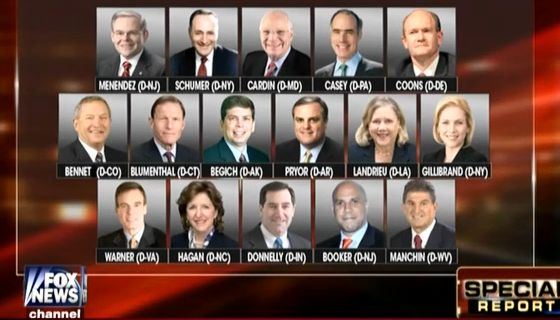
The “Nuclear Weapon Free Iran Act of 2013” sponsored by Democratic Senator Robert Menedez has the support of fifty-nine senators. That’s a dangerously large majority but just short of a veto-proof sixty-seven votes and well short of Rosen’s seventy.
Does that mean that AIPAC is refraining from pulling its weight or is it just not as powerful as Rosen declared?
I called my Democratic Senator Kay Hagan, one of the co-sponsors of the bill, to tell her that if she follows through and casts a vote in favor, she won’t have my vote in November. Interestingly, her staffer was at pains to underline the fact that this is still in process and hasn’t gone to a vote. I got a strong sense that Hagan, perhaps like many other senators both Democratic and Republican, would be content demonstrating her loyalty to AIPAC without actually casting a vote.
In the report below, Republican Senator Roy Blunt essentially says that every senator’s hands have been tied by Senate leader Harry Reid and far from striking a defiant tone, Blunt seems content to be rendered powerless.
If the bill got just one more supporter, would Reid bow to pressure and let it go to a vote? And can’t AIPAC with all its influence turn just one more senator in its favor?
I get the sense that for everyone involved — including AIPAC — this is all political theater. They want to act tough, but at the end of the day, they probably don’t want to be held responsible for sabotaging the most significant diplomatic opening in a decade.
National Journal reports: Senate Iran hawks have lots of votes to back their sanctions legislation. What they lack is a plan to get the bill to the floor.
Fifty-nine senators — including 16 Democrats — have signed onto sanctions legislation from Democratic Sen. Robert Menendez and Republican Sen. Mark Kirk. The measure would punish Iran with sanctions if it reneges on an interim nuclear agreement or if that agreement does not ultimately abolish any nuclear-weapons capabilities for Iran.
That count has climbed rapidly since the bipartisan pair introduced their legislation in late December. But now it’s unclear whether that support will be enough to clear the bill’s next major hurdle: Senate Majority Leader Harry Reid.
Reid is siding with the White House, which has put intense pressure on lawmakers not to act on sanctions, arguing it could result in both a nuclear-armed and hostile Iranian state. And without Reid’s backing, supporters of the Menendez-Kirk bill are unsure how to move the measure to the floor.
“I assume that if the Democrat senators put enough pressure on Senator Reid he might bring it to the floor,” said Missouri Republican Sen. Roy Blunt. “But, you know, we are at a moment in the Senate where nothing happens that Senator Reid doesn’t want to happen; and this is something at this moment that Senator Reid doesn’t want to happen.”
And for now, sanctions supporters are still mulling their strategy.
“We are talking amongst ourselves. There is a very active debate and discussion ongoing about how best to move forward,” said Democratic Sen. Richard Blumenthal of Connecticut, a cosponsor of the bill. “There are a number of alternative strategies, but we’re deliberating them.”
While Reid has, at least for now, foiled their policy plans, sanctions supporters are still scoring the desired political points on the issue. They can report their efforts to their constituents while blaming Reid for the inaction.
Jon Stewart, comparing these senators to egg-throwing Justin Bieber, is perfectly clear about which “constituents” they are trying to represent: AIPAC and Israel. (It’s a shame that Daily Show writers, having crafted a strong piece then felt compelled to add some “balance” by treating Rouhani’s tweet with scorn: “World powers surrendered to Iran’s national will.” If he can placate his hawkish critics just with a tweet, I’m sure Obama is envious.)
Video: Why Democrats may sabotage Obama’s Iran deal
An Iran hawk’s case against new Iran sanctions
Jeffrey Goldberg is arguably the most influential liberal Zionist in America, so it’s worth taking note when he speaks out against the efforts of the Israel lobby and its lackeys inside the U.S. Senate.
For years, Iran hawks have argued that only punishing sanctions, combined with the threat of military force, would bring Tehran to the nuclear negotiating table. Finally, Iran is at the table. And for reasons that are alternately inexplicable, presumptuous and bellicose, Iran hawks have decided that now is the moment to slap additional sanctions on the Iranian regime.
The bill before the U.S. Senate, which has 59 co-sponsors at last count, will not achieve the denuclearization of Iran. It will not lead to the defunding of Hezbollah by Iran or to the withdrawal of Iranian support for Syrian president Bashar al-Assad. What it could do is move the U.S. closer to war with Iran and, crucially, make Iran appear — even to many of the U.S.’s allies — to be the victim of American intransigence, even aggression. It would be quite an achievement to allow Iran, the world’s foremost state sponsor of terrorism, to play the role of injured party in this drama. But the Senate is poised to do just that.
Don’t trust Jonathan Pollard
M.E. Bowman writes: Jonathan Jay Pollard liked to imagine his life was greater than it was. He told fanciful tales to peers while at Stanford in the 1970s, including that he was a Mossad officer and that he had once been captured and tortured by Arabs.
After graduation, he lied to superiors and friends about his exploits and his qualifications. By the mid-1980s, he had used his position as a civilian naval intelligence analyst to become an enthusiastic and willing spy for profit by passing state secrets to Israel.
The Department of Justice was prepared to file a variety of charges against him, but in a plea agreement all except the most serious were dropped. Mr. Pollard pleaded guilty to espionage in 1987.
At the time of his arrest and trial, I was the liaison officer for the Department of Defense to the Department of Justice, and the coordinator of an investigation into the damage Mr. Pollard’s treachery had done to the American intelligence community.
Every few years, there is an orchestrated attempt to forge popular support for Mr. Pollard’s release. It is now happening again. In addition to calls for clemency coming from across the Israeli political spectrum, Lawrence J. Korb, the assistant secretary of defense at the Pentagon at the time of Mr. Polland’s arrest, has said that his punishment was disproportionate to his offense. R. James Woolsey, a former director of central intelligence echoed that sentiment at a security conference in November. Last month, when Secretary of State John Kerry traveled to Israel, there was a rash of hopeful reports in the Israeli press that he was considering releasing Mr. Pollard in exchange for Israeli concessions.
Mr. Pollard’s apologists portray him as a sort of dual patriot: loyal to the United States, but also motivated to help Israel. In fact, he was primarily a venal and selfish person who sought to get rich. [Continue reading…]