Category Archives: US government

CIA killer gets “pardoned” in exchange for $2 million blood money

In order to make sure Hillary Clinton can enjoy cordial exchanges with her counterparts in Pakistan during her upcoming visit, CIA contractor Raymond Davis just got “pardoned” by the families of the men he killed in late January.

Dawn reports:

The US government did not pay any compensation to the families of two Pakistanis killed by Raymond Davis, US Secretary of State Hillary Clinton said on Wednesday.

She said the US did not pay to win Davis’s release, but she didn’t dispute that the men’s families were compensated.

The News reports:

The families of the murdered men, Fahim and Faizan, accepted the blood money of 2.34 million dollars (equal to Rs200 million) while, according to sources, four US visas were also part of the deal.
[…]
The counsel of the bereaved families, Manzoor Butt alleged that the families of Faizan and Fahim were forcibly brought from their homes to the court.

Lawyers for the families said they had been held on gun-point for four hours at the jail court where Davis was being tried on Wednesday, but had not been allowed to witness proceedings. They were also warned against uttering a word before the media, sources said.

Facebooktwittermail

Saudis move troops into Bahrain to crush pro-democracy movement

CNN opts for the anodyne and official phrasing “Gulf Cooperation Council security forces,” but the troops who just marched into Bahrain are Saudis.

When US Defense Secretary Gates visited Bahrain on Friday, I assume King Hamad bin Issa al-Khalifah gave the US advance warning that his Kingdom would shortly be under something resembling Saudi martial law — just to make sure Washington would voice no more than minimal objections to the latest effort to crush Bahrain’s strengthening democracy movement.

The New York Times reports:

The White House issued a statement on Sunday that said the United States strongly condemned violence that had occurred in Bahrain and Yemen, and added, “We urge the government of Bahrain to pursue a peaceful and meaningful dialogue with the opposition rather than resorting to the use of force.”

And as the Khalifa family and their Saudi overlords ignore this request, what will the White House do? Withdraw the US Fifth Fleet? Not likely!

The Bahrain Youth Society for Human Rights describes the Saudi military presence as “an overt occupation of the kingdom of Bahrain and a conspiracy against the unarmed people of Bahrain.” Even while the White House urges the Bahrain government to engage the opposition in dialogue, no doubt Washington will dismiss the suggestion that Bahrain is now under occupation.

Given that Bahrainis already face brutality from security services — the majority of whom are foreign — I don’t know whether they will find the Saudi presence any more intimidating.

To have an idea of what protesters have been up against in recent days, just watch this video showing an unarmed man being hit by tear gas cannisters shot at point blank range:

GCC and now Arab League support for a no-fly zone over Libya (which they most likely expect will not be imposed), has I suspect, less to do with any concern about the fate of Libya’s revolutionaries than it does in fostering a permissive climate in which the Gulf states’ autocratic rulers can offer each other mutual support in their own efforts to counter the political demands coming from their own subjects. Support for a NFZ provides these monarchies with an opportunity to posture as defenders of Arab freedom at the same time that they suppress Arab freedom. Likewise, by opposing Gaddafi, the Gulf rulers want to cast their dictatorships as benign in contrast to Gaddafi’s brutal rule.

Facebooktwittermail

Obama’s regime of secrecy

Mark Benjamin reports:

It shouldn’t be much of a surprise that State Department spokesman P.J. Crowley has resigned his post in wake of his too-candid assessment of the incarceration conditions of suspected Wikileaker Private First Class Bradley Manning.

Last Thursday, Crowley told a panel at MIT that the Pentagon’s treatment of Manning at the Marine bring at Quantico, Va., was “ridiculous and counterproductive and stupid.”

The very next day, President Obama told reporters that he felt Manning’s confinement conditions were “appropriate.” His answer telegraphed a problem for Crowley. “I’ve actually asked the Pentagon whether or not the procedures that have been taken in terms of his confinement are appropriate and are meeting our basic standards,” Obama said, suggesting some of those procedures were to protect Manning’s safety. “They have assured me that they are.”

Manning is currently being held alone in his cell 23 hours a day, and was reportedly being stripped naked at night before being given a tear-proof smock for sleeping. Free speech advocates are shocked, and, as I wrote last week on TIME.com, concerned over Obama’s record as the most aggressive prosecutor of suspected government leakers in U.S. history.

Those advocates have wondered whether the penchant for secrecy in the Obama administration comes from the President, or those around him. Obama’s statement on Manning, followed by Crowley’s resignation, seem to suggest some of this comes from the President himself.

Facebooktwittermail

Bradley Manning being mistreated says State Department spokesman

The Guardian reports:

Hillary Clinton’s spokesman has launched a public attack on the Pentagon for the way it is treating military prisoner Bradley Manning, the US soldier suspected of handing the US embassy cables to WikiLeaks.

PJ Crowley, the assistant secretary of state for public affairs at the US state department, said Manning was being “mistreated” in the military brig at Quantico, Virginia. “What is being done to Bradley Manning is ridiculous and counterproductive and stupid on the part of the department of defence,” he said.

Crowley’s comments signal a crack within the Obama administration over the handling of the WikiLeaks saga in which hundreds of thousands of confidential documents were handed to the website.

As news of the remarks rippled through Washington, President Obama was forced to address the subject of Manning’s treatment for the first time.

Asked about the controversy at a White House press conference, Obama revealed he had asked the Pentagon “whether or not the procedures that have been taken in terms of his confinement are appropriate and are meeting our basic standards. They assure me that they are.”

Obama would not respond specifically to Crowley’s comments, which are the first critical remarks from within the administration about the handling of Manning. The prisoner is being held for 23 hours in solitary confinement in his cell and stripped naked every night.

Facebooktwittermail

The fight for Libya

Reuters reports Gaddafi may be looking for a way out:

Al Jazeera said Gaddafi had proposed to Libyan rebels to hold a meeting of parliament to pave the way for him to step down with certain guarantees.

It said Gaddafi made the proposal to the interim council, which speaks for mostly eastern areas controlled by his opponents. It quoted sources in the council as saying Gaddafi wanted guarantees of personal safety for him and his family and a pledge that they not be put on trial.

Al Jazeera said sources from the council told its correspondent in Benghazi that the offer was rejected because it would have amounted to an “honorable” exit for Gaddafi and would offend his victims.

The London-based daily Asharq al-Awsat and the daily al-Bayan, based in the United Arab Emirates, also cited unnamed sources as saying Gaddafi was looking for an agreement.

A source close to the council told Reuters he had heard that “one formula being proposed by the other side would see Gaddafi hand power to the head of parliament and leave the country with a certain guaranteed sum of money.”

“I was told that this issue of money is a serious obstacle from the national council’s point of view,” he said, adding that his information came from a single source close to the council.

Essam Gheriani, a media officer for the council, said: “No such offer has been put to the council as far as I am aware.”

Haaretz reports:

Long-time Libyan leader Muammar Gadhafi said Monday in an interview with TV network France 24 that his violent crackdown on opposition protesters is akin to Israel’s efforts to defend itself from extremism during its 2009 Gaza war against Hamas.

Libya has come under international scrutiny in recent weeks, in response to violent clashes between the Libyan military and anti-Gadhafi rebels, confrontations which caused what are estimated to be hundreds of deaths.

On Monday, UN Secretary General Ban Ki-moon dispatched a team to Tripoli to assess the humanitarian situation in the wake of the Libyan crisis, criticizing the Libya military’s “disproportionate use of force.”

Speaking with France 24 later Monday, however, Gadhafi defended his military’s right to oppress rebel activity, comparing his crackdown to Israel’s war against Hamas in the Gaza Strip in 2009, saying that “even the Israelis in Gaza, when they moved into the Gaza strip, they moved in with tanks to fight such extremists.”

Abigail Hauslohner reports from Ajdabiyah:

The provisional government in Benghazi says it needs time and reinforcements but insists that it is making progress nonetheless. To oversee the ramshackle force, the newly formed National Council appointed a Defense Minister, Omar Hariri, a former general who led an unsuccessful revolt against Gaddafi in 1975. Military officers in Benghazi says Hariri’s appointment will signal a shift to a more organized fighting force.

For the moment, the motley army has an overwhelming, undisciplined spirit in the place of military organization. The young men whoop and yell and set off celebratory gunfire with the slightest excuse. At a checkpoint in Brega on March 4, a blast of heavy machine-gun fire shattered the desert silence even as some men tried to restrain the exuberance of their younger compatriots. Wanis Kilani, an engineer turned volunteer fighter, shakes his head at the chaos. “So much ‘Blah blah blah,’ ” he says. “You know, we can’t prevent them from coming here because they all want to help — even the crazy, the young, even sick people want to help.” He explains, mostly to himself, that it’s a people’s army coming together. “We are not rebels,” he says. “We are mujahedin.”

The word is a loaded one for Westerners, a reminder of the holy warriors of Afghanistan who turned from fighting the Soviet Union to aiding Osama bin Laden. But it bears weight in liberated east Libya as well. Islamic scholars here have said that pious Muslim men in particular were persecuted under Gaddafi, and they may yet be a vocal and determined force in the fight to bring down the dictator. “He tried to stop people from going to dawn prayer because people who do this are very devout,” says Sheik Abdel Hamid Ma’toub, a religious leader in Benghazi. “He knows that the most dangerous people in Libya are those who go to dawn prayers.” That’s because, he says, the men who pray fear God, not Gaddafi.

Caught on open mic: Petraeus and Gates joke about attacking Libya

Facebooktwittermail

America is NOT broke

Michael Moore, speaking yesterday in Madison, Wisconsin:

Contrary to what those in power would like you to believe so that you’ll give up your pension, cut your wages, and settle for the life your great-grandparents had, America is not broke. Not by a long shot. The country is awash in wealth and cash. It’s just that it’s not in your hands. It has been transferred, in the greatest heist in history, from the workers and consumers to the banks and the portfolios of the uber-rich.

Right now, this afternoon, just 400 Americans have more wealth than half of all Americans combined.

Let me say that again — and please, someone in the mainstream media, just repeat this fact once. We’re not greedy. We’ll be happy to just hear it once: 400 obscenely wealthy individuals — 400 little Mubaraks — most of whom benefited in some way from the multi-trillion dollar taxpayer “bailout” of 2008, now have more cash, stock and property than the assets of 155 million Americans combined.

[Crowd chants: Shame! Shame! Shame!]

If you can’t bring yourself to call that a financial coup d’état, then you are simply not being honest about what you know in your heart to be true.

And I can see why. For us to admit that we have let a small group of men abscond with and hoard the bulk of the wealth that runs our economy, would mean that we’d have to accept the humiliating acknowledgment that we have indeed surrendered our precious Democracy to the moneyed elite. Wall Street, the banks and the Fortune 500 now run this Republic — and, until this past month here in Madison Wisconsin, the rest of us have felt completely helpless, unable to find a way to do anything about it.

Facebooktwittermail

Obama conspires with Mideast despots to slow the advance of democracy

“Everybody realized that Bahrain was just too important to fail,” said an Obama administration official. And what would cause failure? For the monarchy to be overthrown and replaced with a democracy.

From Washington’s perspective, the people in Bahrain, the other Gulf states and especially in Saudi Arabia cannot be trusted with the power to determine their own futures.

Saudi Arabia is preparing to launch a ruthless crackdown on dissent and when pro-democracy demonstrators get slaughtered, as they probably will, if President Obama has anything to say we can be sure he will go no further than issue one of his usual mealy-mouthed appeals for restraint. The House of Saud has already been given the green light to do whatever it must in the name of preserving “stability.”

The stability to which the Middle East’s rulers and their American friends now cling, is a stability whose foundation is built on graves and torture cells.

Robert Fisk writes:

Saudi Arabia was yesterday drafting up to 10,000 security personnel into its north-eastern Shia Muslim provinces, clogging the highways into Dammam and other cities with busloads of troops in fear of next week’s “day of rage” by what is now called the “Hunayn Revolution”.

Saudi Arabia’s worst nightmare – the arrival of the new Arab awakening of rebellion and insurrection in the kingdom – is now casting its long shadow over the House of Saud. Provoked by the Shia majority uprising in the neighbouring Sunni-dominated island of Bahrain, where protesters are calling for the overthrow of the ruling al-Khalifa family, King Abdullah of Saudi Arabia is widely reported to have told the Bahraini authorities that if they do not crush their Shia revolt, his own forces will.

The opposition is expecting at least 20,000 Saudis to gather in Riyadh and in the Shia Muslim provinces of the north-east of the country in six days, to demand an end to corruption and, if necessary, the overthrow of the House of Saud. Saudi security forces have deployed troops and armed police across the Qatif area – where most of Saudi Arabia’s Shia Muslims live – and yesterday would-be protesters circulated photographs of armoured vehicles and buses of the state-security police on a highway near the port city of Dammam.

Although desperate to avoid any outside news of the extent of the protests spreading, Saudi security officials have known for more than a month that the revolt of Shia Muslims in the tiny island of Bahrain was expected to spread to Saudi Arabia. Within the Saudi kingdom, thousands of emails and Facebook messages have encouraged Saudi Sunni Muslims to join the planned demonstrations across the “conservative” and highly corrupt kingdom. They suggest – and this idea is clearly co-ordinated – that during confrontations with armed police or the army next Friday, Saudi women should be placed among the front ranks of the protesters to dissuade the Saudi security forces from opening fire.

If the Saudi royal family decides to use maximum violence against demonstrators, US President Barack Obama will be confronted by one of the most sensitive Middle East decisions of his administration. In Egypt, he only supported the demonstrators after the police used unrestrained firepower against protesters. But in Saudi Arabia – supposedly a “key ally” of the US and one of the world’s principal oil producers – he will be loath to protect the innocent.

The Wall Street Journal reports:

After weeks of internal debate on how to respond to uprisings in the Arab world, the Obama administration is settling on a Middle East strategy: help keep longtime allies who are willing to reform in power, even if that means the full democratic demands of their newly emboldened citizens might have to wait.

Instead of pushing for immediate regime change—as it did to varying degrees in Egypt and now Libya—the U.S. is urging protesters from Bahrain to Morocco to work with existing rulers toward what some officials and diplomats are now calling “regime alteration.”

The approach has emerged amid furious lobbying of the administration by Arab governments, who were alarmed that President Barack Obama had abandoned Egyptian President Hosni Mubarak and worried that, if the U.S. did the same to the beleaguered king of Bahrain, a chain of revolts could sweep them from power, too, and further upend the region’s stability.

The strategy also comes in the face of domestic U.S. criticism that the administration sent mixed messages at first in Egypt, tentatively backing Mr. Mubarak before deciding to throw its full support behind the protesters demanding his ouster. Likewise in Bahrain, the U.S. decision to throw a lifeline to the ruling family came after sharp criticism of its handling of protests there. On Friday, the kingdom’s opposition mounted one of its largest rallies, underlining the challenge the administration faces selling a strategy of more gradual change to the population.

Administration officials say they have been consistent throughout, urging rulers to avoid violence and make democratic reforms that address the demands of their populations. Still, a senior administration official acknowledged the past month has been a learning process for policy makers. “What we have said throughout this is that there is a need for political, economic and social reform, but the particular approach will be country by country,” the official said.

A pivotal moment came in late February, in the tense hours after Mr. Obama publicly berated King Hamad bin Isa al-Khalifa for cracking down violently on antigovernment demonstrators in Bahrain’s capital. Envoys for the king and his Arab allies shuttled from the Pentagon to the State Department and the White House with a carefully coordinated message.

If the Obama administration did not reverse course and stand squarely behind the monarchy, they warned, Bahrain’s government could fall, costing America a critical ally and potentially moving the country toward Iran’s orbit. Adding to the sense of urgency was a scenario being watched by U.S. intelligence agencies: the possibility that Saudi Arabia might invade its tiny neighbor to silence the Shiite-led protesters, threatening decades-old partnerships and creating vast political and economic upheaval.

“We need the full support of the United States,” a top Bahraini diplomat beseeched the Americans, including Joint Chiefs of Staff Chairman Adm. Michael Mullen, Assistant Secretary of State Jeffery Feltman, Deputy National Security Adviser Denis McDonough, and other top policy makers.

Arab diplomats believe the push worked. Defense Secretary Robert Gates and Secretary of State Hillary Clinton emerged as leading voices inside the administration urging greater U.S. support for the Bahraini king coupled with a reform agenda that Washington insisted would be have to be credible to street protesters. Instead of backing cries for the king’s removal, Mr. Obama asked protesters to negotiate with the ruling family, which is promising major changes.

Israel was also making its voice heard. As Mr. Mubarak’s grip on power slipped away in Egypt, Israeli officials lobbied Washington to move cautiously and reassure Mideast allies that they were not being abandoned. Israeli leaders have made clear that they fear extremist forces could try to exploit new-found freedoms and undercut Israel’s security, diplomats said.

“Starting with Bahrain, the administration has moved a few notches toward emphasizing stability over majority rule,” said a U.S. official. “Everybody realized that Bahrain was just too important to fail.”

The BBC reports:

All protests and marches are to be banned in Saudi Arabia, the interior ministry has announced on state TV.

Its statement said security forces would use all measures to prevent any attempt to disrupt public order.

The announcement follows a series of protests by the kingdom’s Shia minority in the oil-producing eastern province.

Last month, King Abdullah unveiled a series of benefits in an apparent bid to protect the kingdom from the revolts spreading throughout many Arab states.

“Regulations in the kingdom forbid categorically all sorts of demonstrations, marches and sit-ins, as they contradict Islamic Sharia law and the values and traditions of Saudi society,” the Saudi interior ministry statement said.

It added that police were “authorised by law to take all measures needed against those who try to break the law”.

Facebooktwittermail

Bradley Manning’s forced nudity to occur daily

Glenn Greenwald writes:

To follow-up on yesterday’s observations about the prolonged forced nudity to which Bradley Manning has been subjected the last two days: brig officials now confirm to The New York Times that Manning will be forced to be nude every night from now on for the indefinite future — not only when he sleeps, but also when he stands outside his cell for morning inspection along with the other brig detainees. They claim that it is being done “as a ‘precautionary measure’ to prevent him from injuring himself.”

Has anyone before successfully committed suicide using a pair of briefs — especially when under constant video and in-person monitoring? There’s no underwear that can be issued that is useless for killing oneself? And if this is truly such a threat, why isn’t he on “suicide watch” (the NYT article confirms he’s not)? And why is this restriction confined to the night; can’t he also off himself using his briefs during the day?

Let’s review Manning’s detention over the last nine straight months: 23-hour/day solitary confinement; barred even from exercising in his cell; one hour total outside his cell per day where he’s allowed to walk around in circles in a room alone while shackled, and is returned to his cell the minute he stops walking; forced to respond to guards’ inquiries literally every 5 minutes, all day, everyday; and awakened at night each time he is curled up in the corner of his bed or otherwise outside the guards’ full view. Is there anyone who doubts that these measures — and especially this prolonged forced nudity — are punitive and designed to further erode his mental health, physical health and will?

Facebooktwittermail

Obama administration silent as Iraqi security forces kill, detain and abuse protesters

ProPublica reports:

As the Mideast protests and government crackdowns continue, one country to watch closely is Iraq, with whom the U.S. has a long-term partnership and where clashes between protesters and government forces recently turned violent. Even as Iraqi security forces detained and abused hundreds of intellectuals and journalists, the U.S. government—in keeping with a pattern of silence on Iraq’s abuses—has withheld criticism of its strategic ally. (Salon noticed this too.)

Asked generally about the violence against Iraqi demonstrators on Friday, White House Press Secretary Jay Carney said only “the approach we’ve taken with regard to Iraq is the same that we’ve taken with regard to the region,” which he said was to call on governments to respond to the protests peacefully. Neither the White House nor the State Department seem to have mentioned the matter since. Yesterday’s State Department briefing discussed Libya, Egypt, Iran, Oman, Saudi Arabia, South Korea, China, Pakistan, Argentina, South Africa and Haiti—Iraq was never discussed.

Facebooktwittermail

CIA linked to Pakistan Taliban

Pakistan’s Express Tribune, which is affiliated with the New York Times, reports:

As American newspapers lifted a self-imposed gag on the CIA links of Raymond Davis, in place on the request of the US administration, The Express Tribune has now learnt that the alleged killer of two Pakistanis had close links with the Tehreek-e-Taliban Pakistan (TTP).

The New York Times reported on Monday that Davis “was part of a covert, CIA-led team of operatives conducting surveillance on militant groups deep inside the country, according to American government officials.”

This contradicts the US claim that Davis was a member of the ‘technical and administrative staff’ of its diplomatic mission in Pakistan.

Davis was arrested on January 27 after allegedly shooting dead two young motorcyclists at a crowded bus stop in Lahore. American officials say that the arrest came after a ‘botched robbery attempt’.

“The Lahore killings were a blessing in disguise for our security agencies who suspected that Davis was masterminding terrorist activities in Lahore and other parts of Punjab,” a senior official in the Punjab police claimed.

“His close ties with the TTP were revealed during the investigations,” he added. “Davis was instrumental in recruiting young people from Punjab for the Taliban to fuel the bloody insurgency.” Call records of the cellphones recovered from Davis have established his links with 33 Pakistanis, including 27 militants from the TTP and Lashkar-e-Jhangvi sectarian outfit, sources said.

Davis was also said to be working on a plan to give credence to the American notion that Pakistan’s nuclear weapons are not safe. For this purpose, he was setting up a group of the Taliban which would do his bidding.

Facebooktwittermail

The military/media attacks on the Hastings article

Glenn Greenwald writes:

Last June, when Rolling Stone published Michael Hastings’ article which ended the career of Obama’s Afghanistan commander, Gen. Stanley McChrystal — an article which was just awarded the prestigious Polk Award — the attacks on Hastings were led not by military officials but by some of Hastings’ most celebrated journalistic colleagues. The New York Times‘ John Burns fretted that the article “has impacted, and will impact so adversely, on what had been pretty good military/media relations” and accused Hastings of violating “a kind of trust” which war reporters “build up” with war Generals; Politico observed that a “beat reporter” — unlike the freelancing Hastings — “would not risk burning bridges by publishing many of McChrystal’s remarks”; and an obviously angry Lara Logan of CBS News strongly insinuated (with no evidence) that Hastings had lied about whether the comments were on-the-record and then infamously sneered: “Michael Hastings has never served his country the way McChrystal has.” Here’s Jon Stewart last year mocking the revealing media disdain for Rolling Stone and Hastings in the wake of their McChrystal story.

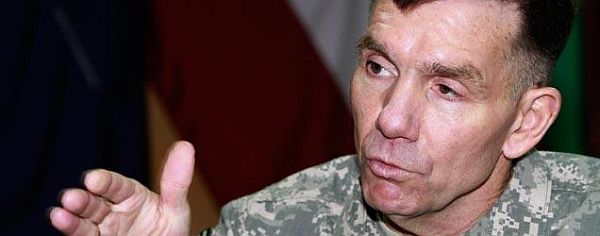
Hastings has now written another Rolling Stone article that reflects poorly on a U.S. General in Afghanistan. The new article details how Lt. Gen. William Caldwell “illegally ordered a team of soldiers specializing in ‘psychological operations’ to manipulate visiting American senators into providing more troops and funding for the war” and then railroaded the whistle-blowing officer who objected to the program. Now, the same type of smear campaign is being launched at Hastings as well as at his primary source, Lt. Col. Michael Holmes: from military officials and their dutiful media-servants. Ever since publication of this new article, military-subservient “reporters” have disseminated personal attacks on Hastings and his journalism as well as on Holmes and his claims, all while inexcusably granting anonymity to the military leaders launching those attacks and uncritically repeating them. As usual, anyone who makes powerful government or military leaders look bad — by reporting the truth — becomes the target of character assassination, and the weapon of choice are the loyal, vapid media stars who will uncritically repeat whatever powerful officials say all while shielding them from accountability through the use of anonymity.

Facebooktwittermail

Why isn’t Wall Street in jail?

Matt Taibbi writes:

Over drinks at a bar on a dreary, snowy night in Washington this past month, a former Senate investigator laughed as he polished off his beer.

“Everything’s fucked up, and nobody goes to jail,” he said. “That’s your whole story right there. Hell, you don’t even have to write the rest of it. Just write that.”

I put down my notebook. “Just that?”

“That’s right,” he said, signaling to the waitress for the check. “Everything’s fucked up, and nobody goes to jail. You can end the piece right there.”

Nobody goes to jail. This is the mantra of the financial-crisis era, one that saw virtually every major bank and financial company on Wall Street embroiled in obscene criminal scandals that impoverished millions and collectively destroyed hundreds of billions, in fact, trillions of dollars of the world’s wealth — and nobody went to jail. Nobody, that is, except Bernie Madoff, a flamboyant and pathological celebrity con artist, whose victims happened to be other rich and famous people.

The rest of them, all of them, got off. Not a single executive who ran the companies that cooked up and cashed in on the phony financial boom — an industrywide scam that involved the mass sale of mismarked, fraudulent mortgage-backed securities — has ever been convicted. Their names by now are familiar to even the most casual Middle American news consumer: companies like AIG, Goldman Sachs, Lehman Brothers, JP Morgan Chase, Bank of America and Morgan Stanley. Most of these firms were directly involved in elaborate fraud and theft. Lehman Brothers hid billions in loans from its investors. Bank of America lied about billions in bonuses. Goldman Sachs failed to tell clients how it put together the born-to-lose toxic mortgage deals it was selling. What’s more, many of these companies had corporate chieftains whose actions cost investors billions — from AIG derivatives chief Joe Cassano, who assured investors they would not lose even “one dollar” just months before his unit imploded, to the $263 million in compensation that former Lehman chief Dick “The Gorilla” Fuld conveniently failed to disclose. Yet not one of them has faced time behind bars.

Facebooktwittermail

The US Army psy-ops operation designed to deceive America

Michael Hastings reports:

The U.S. Army illegally ordered a team of soldiers specializing in “psychological operations” to manipulate visiting American senators into providing more troops and funding for the war, Rolling Stone has learned – and when an officer tried to stop the operation, he was railroaded by military investigators.

The orders came from the command of Lt. Gen. William Caldwell, a three-star general in charge of training Afghan troops – the linchpin of U.S. strategy in the war. Over a four-month period last year, a military cell devoted to what is known as “information operations” at Camp Eggers in Kabul was repeatedly pressured to target visiting senators and other VIPs who met with Caldwell. When the unit resisted the order, arguing that it violated U.S. laws prohibiting the use of propaganda against American citizens, it was subjected to a campaign of retaliation.

“My job in psy-ops is to play with people’s heads, to get the enemy to behave the way we want them to behave,” says Lt. Colonel Michael Holmes, the leader of the IO unit, who received an official reprimand after bucking orders. “I’m prohibited from doing that to our own people. When you ask me to try to use these skills on senators and congressman, you’re crossing a line.”

The list of targeted visitors was long, according to interviews with members of the IO team and internal documents obtained by Rolling Stone. Those singled out in the campaign included senators John McCain, Joe Lieberman, Jack Reed, Al Franken and Carl Levin; Rep. Steve Israel of the House Appropriations Committee; Adm. Mike Mullen of the Joint Chiefs of Staff; the Czech ambassador to Afghanistan; the German interior minister, and a host of influential think-tank analysts.

The incident offers an indication of just how desperate the U.S. command in Afghanistan is to spin American civilian leaders into supporting an increasingly unpopular war. According to the Defense Department’s own definition, psy-ops – the use of propaganda and psychological tactics to influence emotions and behaviors – are supposed to be used exclusively on “hostile foreign groups.” Federal law forbids the military from practicing psy-ops on Americans, and each defense authorization bill comes with a “propaganda rider” that also prohibits such manipulation. “Everyone in the psy-ops, intel, and IO community knows you’re not supposed to target Americans,” says a veteran member of another psy-ops team who has run operations in Iraq and Afghanistan. “It’s what you learn on day one.”

Facebooktwittermail

Our diplomat in Pakistan

Glenn Greenwald writes:

On January 27, Raymond Davis, a former U.S. Special Forces soldier, shot and killed two Pakistani citizens in that nation’s second-largest city, Lahore, using a semi-automatic Glock pistol. Davis claims he acted in self-defense when they attacked his car to rob him — both of the dead were armed and had lengthy records of petty crimes — but each was shot five times, and one was killed after Davis was safely back in his car and the victim was fleeing. After shooting the two dead, Davis calmly photographed their bodies and then called other Americans stationed in Pakistan (likely CIA officers) for assistance; one of the Americans’ Land Rovers dispatched to help Davis struck and killed a Pakistani motorcyclist while speeding to the scene. The Pakistani wife of one of Davis’ victims then committed suicide by swallowing rat poison, saying on her deathbed that she had serious doubts that Davis would be held accountable.

For reasons easy to understand — four dead Pakistanis at the hands of Americans, two of whom (at least) were completely innocent — this episode has become a major scandal in that nation. From the start, the U.S. Government has demanded Davis’ release on the grounds of “diplomatic immunity.” But the very murky status of Davis and his work in Pakistan has clouded that claim. The State Department first said he worked for the consulate, not the embassy, which would make him subject to weaker immunity rights than diplomats enjoy (State now says that its original claim was a “mistake” and that Davis worked for the embassy). President Obama then publicly demanded the release of what he absurdly called “our diplomat in Pakistan”; when he was arrested, Davis “was carrying a 9mm gun and 75 bullets, bolt cutters, a GPS unit, an infrared light, telescope, a digital camera, an air ticket, two mobile phones and a blank cheque.” Late last week, a Pakistani court ordered a three-week investigation to determine if Davis merits diplomatic immunity, during which time he will remain in custody. And now it turns out, according The Guardian last night, that “our diplomat” was actually working for the CIA.

The Guardian reports:

Pakistani prosecutors accuse the spy of excessive force, saying he fired 10 shots and got out of his car to shoot one man twice in the back as he fled. The man’s body was found 30 feet from his motorbike.

“It went way beyond what we define as self-defence. It was not commensurate with the threat,” a senior police official involved in the case told the Guardian.

The Pakistani government is aware of Davis’s CIA status yet has kept quiet in the face of immense American pressure to free him under the Vienna convention. Last week President Barack Obama described Davis as “our diplomat” and dispatched his chief diplomatic troubleshooter, Senator John Kerry, to Islamabad. Kerry returned home empty-handed.

Many Pakistanis are outraged at the idea of an armed American rampaging through their second-largest city. Analysts have warned of Egyptian-style protests if Davis is released. The government, fearful of a backlash, says it needs until 14 March to decide whether Davis enjoys immunity.

A third man was crushed by an American vehicle as it rushed to Davis’s aid. Pakistani officials believe its occupants were CIA because they came from the house where Davis lived and were armed.

The US refused Pakistani demands to interrogate the two men and on Sunday a senior Pakistani intelligence official said they had left the country. “They have flown the coop, they are already in America,” he said.

ABC News reported that the men had the same diplomatic visas as Davis. It is not unusual for US intelligence officers, like their counterparts round the world, to carry diplomatic passports.

The US has accused Pakistan of illegally detaining him and riding roughshod over international treaties. Angry politicians have proposed slashing Islamabad’s $1.5bn (£900m) annual aid.

But Washington’s case is hobbled by its resounding silence on Davis’s role. He served in the US special forces for 10 years before leaving in 2003 to become a security contractor. A senior Pakistani official said he believed Davis had worked with Xe, the firm formerly known as Blackwater.

Pakistani suspicions about Davis’s role were stoked by the equipment police confiscated from his car: an unlicensed pistol, a long-range radio, a GPS device, an infrared torch and a camera with pictures of buildings around Lahore.

“This is not the work of a diplomat. He was doing espionage and surveillance activities,” said the Punjab law minister, Rana Sanaullah, adding he had “confirmation” that Davis was a CIA employee.

A number of US media outlets learned about Davis’s CIA role but have kept it under wraps at the request of the Obama administration. A Colorado television station, 9NEWS, made a connection after speaking to Davis’s wife. She referred its inquiries to a number in Washington which turned out to be the CIA. The station removed the CIA reference from its website at the request of the US government.

Facebooktwittermail

Palestinians shout: ‘Obama, you despicable man, we want self-determination!’

Gideon Levy writes:

This weekend, a new member enrolled in Likud – and not just in the ruling party, but in its most hawkish wing. Located somewhere between Tzipi Hotovely and Danny Danon, U.S. President Barack Obama bypassed Dan Meridor and Michael Eitan on the right and weakened their position.

The first veto cast by the United States during Obama’s term, a veto he promised in vain not to use as his predecessors did, was a veto against the chance and promise of change, a veto against hope. This is a veto that is not friendly to Israel; it supports the settlers and the Israeli right, and them alone.

The excuses of the American ambassador to the UN won’t help, and neither will the words of thanks from the Prime Minister’s Office: This is a step that is nothing less than hostile to Israel. America, which Israel depends on more than ever, said yes to settlements. That is the one and only meaning of its decision, and in so doing, it supported the enterprise most damaging to Israel.

Moreover, it did so at a time when winds of change are blowing in the Middle East. A promise of change was heard from America, but instead, it continued with its automatic responses and its blind support of Israel’s settlement building. This is not an America that will be able to change its standing among the peoples of the region. And Israel, an international pariah, once again found itself supported only by America.

This should have disturbed every Israeli. Is that what we are? Alone and condemned? And all for the continuation of that worthless enterprise? Is it really worth the price? To hell with the UN and the whole world is against us?

We can’t wrap ourselves in this hollow iron dome forever. We must open our eyes and understand that if no country, aside from weakening America, supports this caprice of ours, then something fundamental is wrong here.

Israel, which is condemned by the entire world but continues merrily on its way, is a country that is losing its connection to reality. It is also a country that will ultimately find itself left entirely to its fate. That is why America’s decision harmed Israel’s interests: It continued to blind and stupefy Israel into thinking it can go on this way forever.

Jerry Haber writes:

In 1969, the United States voted with the rest of the Security Council to condemn Israel’s annexation of East Jerusalem and plans to build Jewish settlements in East Jerusalem. The Security Council “urgently calls once more upon Israel to rescind forthwith all measure taken by it which may tend to change the status of the City of Jerusalem.” And it explicitly mentioned expropriation of land.

Several days earlier, the US ambassador the United Nations had said in a speech to the UN:

The United States considers that the part of Jerusalem that came under the control of Israel in the 1967 war, like all other areas occupied by Israel, is occupied territory and hence subject to the provisions of international law governing the rights and obligations of an occupying Power. Among the provision of international law which bind Israel, as they would bind any occupier, are the provisions that the occupier has no right to make changes in law or in administration other than those which are temporarily necessitated by his security interests, and that an occupier may not confiscate or destroy private property. The pattern of behavior authorized under the Geneva Convention of 12 August 1949 and international law is clear: the occupier must maintain the occupied area as intact and unaltered as possible, without interfering with the customary life of the area, and any changes must be necessitated by the immediate needs of the occupation. I regret to say that the actions by Israel in the occupied portion of Jerusalem present a different picture, one which gives understandable concern that the eventual disposition of East Jerusalem may be prejudiced, and that the private rights and activities of the population are already being affected and altered. (Cited in Separate and Unequal: The Inside Story of Israeli Rule in East Jerusalem, by Amir S. Cheshin, Bil Hutman, and Avi Melamed (Cambridge: Harvard, 1999), pp. 46-7.

I should point out that this statement was made before a single Jewish settlement had been built outside of Jerusalem. The censure was in reaction to Israel construction of Jewish settlements over the Green Line in East Jerusalem – settlements that are now the “neighborhoods” of Ramot Eshkol and Ma’a lot dafna, East Talpiyot and Neveh Ya’akov.

AFP reports:

Around 3,000 Palestinians gathered in the West Bank city of Ramallah on Sunday to protest the US veto that nixed a Security Council resolution on Israeli settlements.

The crowd massed in Manara Square, a central traffic circle in the West Bank city, waving banners and shouting slogans against the American administration.

“Obama, you despicable man, we want self-determination!” shouted the demonstrators, many of them members of Palestinian president Mahmud Abbas’s Fatah party.

Ynet reports:

While the Palestinians continue to express their anger over the US veto against a UN vote condemning Israel’s settlement construction policy, new details have surfaced regarding the pre-veto discussions. Fatah elements claimed Saturday that US Secretary of State Hillary Clinton threatened to halt financial aid should the Palestinian Authority not withdraw its draft from the Security Council’s agenda. Nevertheless, Palestinian President Mahmoud Abbas stressed that the PA will not boycott the US.

A senior Fatah element told the Palestinian news agency Sama that Clinton threatened Abbas on Friday to cancel US aid. According to the source, US President Barack Obama told Abbas on Thursday night that no other American president has promoted the Palestinian issue more vigorously.

The Obama administration — which has yet to find a Bush policy it’s unwilling to promote — is continuing the practice of ideological exclusion (a Soviet-style policy of excluding political critics from entering the US). Omar Barghouti, author of Boycott, Divestment, Sanctions: The Global Struggle for Palestinian Rights, has been refused a visa for his upcoming speaking tour. He writes:

Ms. Clinton can sing the tunes of freedom all she wants when watching the news of Arab popular revolts from Morocco to Bahrain, but she is not fooling any average-intelligence person in the Arab world. US policy, especially after the veto cast yesterday against the most benign UN Security Council resolution, simply reiterating universal, long-held facts that Israel’s colonial settlements are illegal and thwart just peace, is being exposed to the new generation of restive, fearless, freedom-aspiring Arab youth as the main cause of their oppression, of buttressing and protecting the tyrants that have denied them all freedoms for decades. It has long been exposed, too, as the key partner of Israel in its occupation, colonialism and apartheid. Without US largess, Israel’s multi-tiered system of racist and colonial oppression cannot possibly survive.

Facebooktwittermail

Britain’s role in Bahrain’s torture regime

Colonel Ian Henderson, who from 1966 until 1998 was Bahrain’s security chief, is alleged to have instituted and overseen a brutal torture regime in the Gulf state, as a result of which he came to be known as the “Butcher of Bahrain.” Numerous human rights organizations have investigated and confirmed the allegations against him, yet an investigation by British police was suspended in 2008 due to a lack of co-operation from the Bahrain government.

“Ian Henderson has played a very dirty role,” said Saeed Shehabi, Bahrain Freedom Movement, in 2002. “Ever since he came to Bahrain in 1966, he embarked upon an era of terror and thousands of people were arrested — arbitrarily arrested — and tortured under his command. Until he retired, two or three years ago, he was the strong man behind the whole repressive regime in Bahrain.”

Blind Eye to the Butcher (2002)

In a report on Bahrain’s reliance on foreign nationals in its security services, Ian Black adds:

Bahrainis often complain that the riot police and special forces do not speak the local dialect, or in the case of Baluchis from Pakistan, do not speak Arabic at all and are reviled as mercenaries. Officers are typically Bahrainis, Syrians or Jordanians. Iraqi Ba’athists who served in Saddam Hussein’s security forces were recruited after the US-led invasion in 2003. Only the police employs Bahraini Shias.

The secret police – the Bahrain national security agency, known in Arabic as the Mukhabarat – has undergone a process of “Bahrainisation” in recent years after being dominated by the British until long after independence in 1971. Ian Henderson, who retired as its director in 1998, is still remembered as the “Butcher of Bahrain” because of his alleged use of torture. A Jordanian official is currently described as the organisation’s “master torturer”.

Channel 4 report on human rights abuses in Bahrain (1999)

Facebooktwittermail

Police in lethal crack down on peaceful mass protest in Bahrain

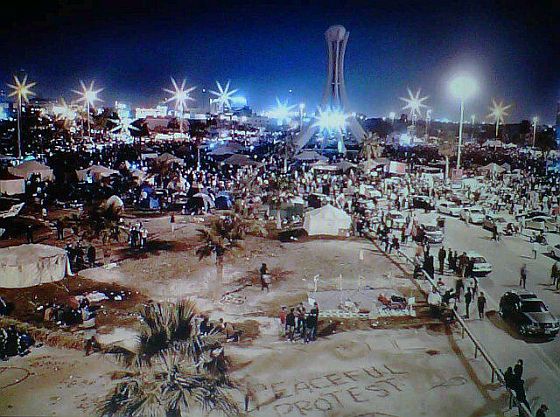
Peaceful protest at Pearl Roundabout several hours before police launched a deadly assault at 3am Thursday morning.

Al Jazeera is now reporting that at least two people have been killed and dozens injured as Bahrain police attacked sleeping demonstrators in the early hours of Thursday morning. The New York Times said:

Hundreds of riot police surrounded the nation’s symbolic center, Pearl Square, in the early morning Thursday, raining tear gas and percussion grenades on thousands of demonstrators who had poured into the square all day Wednesday to challenge the country’s absolute monarchy.

The protesters, including women and children, had been camping out and the atmosphere had been festive only hours before. But by about 3:30 a.m. Thursday, people were fleeing, screaming “We were sleeping. We were sleeping,” and ambulances, sirens blaring, were trying to make their way through the crowds.

Witnesses, some of them vomiting from the gas, said they had no warning the police were going to crack down on their peaceful protest before rows of police vehicles with blue flashing lights began to circle the area.

Shiite opposition leaders had spent the day Wednesday issuing assurances that they were not being influenced by Iran and were not interested in transforming the monarchy into a religious theocracy like the Islamic republic in Iran.

But that did not stop what appeared to be government attempts to deter the demonstrators who had laid claim to the square, the symbolic heart of the nation. Hours before the police action, the Internet was jammed to a crawl and cellphone service was intermittent. Those efforts, however, only seemed to energize the roaring crowds, which spilled out of the square, tied up roads for as far as the eye could see and united in a celebration of empowerment unparalleled for Bahrain’s Shiites, who make up about 70 percent of the country’s 600,000 citizens.

The following report from Al Jazeera was broadcast before the latest deaths. The position of the Bahrain royal family must now be even more precarious.

Graham Fuller writes:

Where’s the next place to blow in the Arab revolution? Candidates are many, but there’s one whose geopolitical impact vastly exceeds its diminutive size — the island of Bahrain.

This is a place run by an oppressive and corrupt little regime, long coddled by Washington because the U.S. Navy’s Fifth Fleet is headquartered there. The future of the base is far from secure if the regime falls.

A few hard facts about the island that should give pause for thought:

First, Bahrain is a Shiite island. You won’t see it described that way, but it is — 70 percent of the population, more than the percentage of Shiites in Iraq. And like Iraq under Saddam Hussein, these Arab Shiites have been systematically discriminated against, repressed, and denied meaningful roles by a Sunni tribal government determined to maintain its solid grip on the country. The emergence of real democracy, as in Iraq, will push the country over into the Shiite column — sending shivers down the spines of other Gulf rulers, and especially in Riyadh.

Appearances are deceiving. Go to Bahrain and on the surface you won’t feel the same heavy hand that dominates so many other Arab authoritarian states. The island is liberal in its social freedoms. Expats feel at home — you can get a drink, go to nightclubs, go to the beach, party.

But if you look behind the Western and elite-populated high-rises you’ll encounter the Shiite ghettoes — poor and neglected, with high unemployment, walls smeared with anti-regime graffiti.

Free market? Sure, except the regime imports politically neutered laborers from passive, apolitical states that need the money: Filipinos, Bangladeshis, Sri Lankans and other South Asians who won’t make waves or they’re on the next plane out.

The regime also imports its thugs. The ranks of the police are heavily staffed with expat police who often speak no Arabic, have no attachments to the country and who will beat, jail, torture and shoot Bahraini protesters with impunity.

Facebooktwittermail