The top U.S. military officer says the relationship between the American and Israeli militaries is especially relevant while Mideast nations are steeped in unrest.
Adm. Mike Mullen, the chairman of the Joint Chiefs of Staff, discussed the instability in Egypt with Israeli President Shimon Peres on Monday. He said the American-Israeli alliance is “something we both depend on.”
As the recipient of $3 billion in military aid annually, it’s clear how Israel is dependent on the United States, but much less clear how the dependence is mutual. Perhaps Mullen had personal dependence in mind, given that his principal adviser, Dr Lani Kass, grew up in Israel and was a major in the IDF.
Even at the lowest point of the Global War on Terror—in April 2004, say, when the number of casualties was spinning out of control and it looked like there was no end in sight—morale among our troops ran fairly high. Yet today, with casualties tapering and a slightly improved prognosis for stability, our troops, by every conceivable external measure, are falling apart. Veterans of the Iraq and Afghanistan wars make up a disproportionate number of the jobless; the Army’s divorce rate, which used to be lower than the civilian population’s, has surpassed it and is higher still among those who’ve deployed. A spokesman at Fort Drum, home to the 10th Mountain Division here in New York State, tells me by e-mail that one-quarter of its 20,000 soldiers have “received some type of behavioral health evaluation and/or treatment during the past year.” Defense Department spending on Ambien, a popular sleep aid, and Seroquel, an antipsychotic, has doubled since 2007, according to the Army Times, while spending on Topamax, an anti-convulsant medication often used for migraines, quadrupled; amphetamine prescriptions have doubled, too, according to the Army’s own data. Meanwhile, a study by the Rand Corporation has found that 20 percent of the soldiers who’ve deployed in this war report symptoms of post-traumatic stress and major depression.The number climbs to almost 30 percent if the soldiers have deployed more than twice.
“I feel like people with my symptoms are becoming the majority of the Army,” says a major from the New York area who recently started taking Effexor, an antidepressant, and a variety of sleep meds after a second tour in Iraq. “Feeling anxious when you don’t have a reason to, being a little depressed, having low-grade anhedonia, not sleeping well—this is the new normal for those of us who’ve been repeatedly deployed.”
The Army’s own research confirms that drug and alcohol abuse, disciplinary infractions, and criminal activity are increasing among active-duty service members. Most ominously, a growing number of soldiers can’t handle the strains of war at all. Until three years ago, the suicide rate of the Army, the branch with by far the most men and women in this war, was actually lower than the American population’s—a testament to the hardiness of our troops, given that young men with weapons are, at least as a statistical matter, disproportionately prone to suicide. But in 2008, the Army suicide rate surpassed that of the civilian population’s, and the Marines’ surpassed it shortly thereafter. So grim is the problem that this summer, the Army released a remarkably candid suicide report. “If we include accidental death, which frequently is the result of high-risk behavior (e.g., drinking and driving, drug overdose),” it concluded, “we find that less young men and women die in combat than die by their own actions. Simply stated, we are often more dangerous to ourselves than the enemy.”
In other words, nearly as many soldiers are dying at home today as are dying abroad.
In his last months alive, Senior Airman Anthony Mena rarely left home without a backpack filled with medications.
He returned from his second deployment to Iraq complaining of back pain, insomnia, anxiety and nightmares. Doctors diagnosed post-traumatic stress disorder and prescribed powerful cocktails of psychiatric drugs and narcotics.
Yet his pain only deepened, as did his depression. “I have almost given up hope,” he told a doctor in 2008, medical records show. “I should have died in Iraq.”
Airman Mena died instead in his Albuquerque apartment, on July 21, 2009, five months after leaving the Air Force on a medical discharge. A toxicologist found eight prescription medications in his blood, including three antidepressants, a sedative, a sleeping pill and two potent painkillers.
Yet his death was no suicide, the medical examiner concluded. What killed Airman Mena was not an overdose of any one drug, but the interaction of many. He was 23.
After a decade of treating thousands of wounded troops, the military’s medical system is awash in prescription drugs — and the results have sometimes been deadly.
Associated Press report reveals the lack of accountability in the CIA where officers responsible for botched operations end up getting promotions.
In December 2003, security forces boarded a bus in Macedonia and snatched a German citizen named Khaled el-Masri. For the next five months, el-Masri was a ghost. Only a select group of CIA officers knew he had been whisked to a secret prison for interrogation in Afghanistan.
But he was the wrong guy.
A hard-charging CIA analyst had pushed the agency into one of the biggest diplomatic embarrassments of the U.S. war on terrorism. Yet despite recommendations by an internal review, the analyst was never punished. In fact, she has risen to one of the premier jobs in the CIA’s Counterterrorism Center, helping lead President Barack Obama’s efforts to disrupt al-Qaida.
In the years since the Sept. 11, 2001, terrorist attacks, officers who committed serious mistakes that left people wrongly imprisoned or even dead have received only minor admonishments or no punishment at all, an Associated Press investigation has revealed. The botched el-Masri case is but one example of a CIA accountability process that even some within the agency say is unpredictable and inconsistent.
Though Obama has sought to put the CIA’s interrogation program behind him, the result of a decade of haphazard accountability is that many officers who made significant missteps are now the senior managers fighting the president’s spy wars.
The AP investigation of the CIA’s actions revealed a disciplinary system that takes years to make decisions, hands down reprimands inconsistently and is viewed inside the agency as prone to favoritism and manipulation. When people are disciplined, the punishment seems to roll downhill, sparing senior managers even when they were directly involved in operations that go awry.
Two officers involved in the death of a prisoner in Afghanistan, for instance, received no discipline and have advanced into Middle East leadership positions. Other officers were punished after participating in a mock execution in Poland and playing a role in the death of a prisoner in Iraq. Those officers retired, then rejoined the intelligence community as contractors.
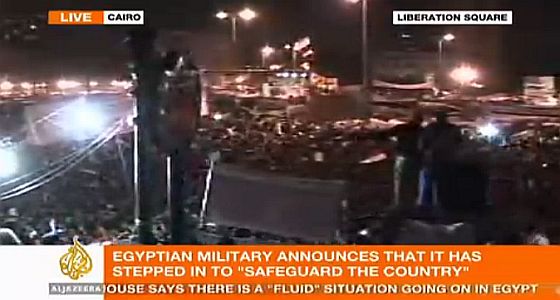
“Ambiguous” statement from military confirms its “commitment and responsibility to safeguard the people and to protect the interests of the nation, and its duty to protect the riches and assets of the people and of Egypt”. Mentioned the demands of the people are “lawful and legitimate”. Understood the military council met separately from Mubarak.
Under the Bush administration, in the context of “the global war on terror”, US renditions became “extraordinary”, meaning the objective of kidnapping and extra-legal transfer was no longer to bring a suspect to trial – but rather for interrogation to seek actionable intelligence. The extraordinary rendition program landed some people in CIA black sites – and others were turned over for torture-by-proxy to other regimes. Egypt figured large as a torture destination of choice, as did [newly-appointed Vice President, Omar] Suleiman as Egypt’s torturer-in-chief. At least one person extraordinarily rendered by the CIA to Egypt — Egyptian-born Australian citizen Mamdouh Habib — was reportedly tortured by Suleiman himself.
In October 2001, Habib was seized from a bus by Pakistani security forces. While detained in Pakistan, at the behest of American agents, he was suspended from a hook and electrocuted repeatedly. He was then turned over to the CIA, and in the process of transporting him to Egypt he endured the usual treatment: his clothes were cut off, a suppository was stuffed in his anus, he was put into a diaper – and ‘wrapped up like a spring roll’.
In Egypt, as Habib recounts in his memoir, My Story: The Tale of a Terrorist Who Wasn’t, he was repeatedly subjected to electric shocks, immersed in water up to his nostrils and beaten. His fingers were broken and he was hung from metal hooks. At one point, his interrogator slapped him so hard that his blindfold was dislodged, revealing the identity of his tormentor: Suleiman.
Suleiman’s history should be kept in mind when considering statements he made yesterday. In a thinly veiled threat, he warned that if the protests do not end soon, there will be a coup and “dark bats of the night” will emerge “to terrorize the people.”
Egypt’s anti-government activists called on supporters Wednesday to expand their demonstrations in defiance of the vice president’s warning that protests calling for President Hosni Mubarak’s ouster would not be tolerated for much longer.
Vice President Omar Suleiman, who is managing the crisis, raised the prospect of a new crackdown on protesters Tuesday when he told Egyptian newspaper editors there could be a “coup” unless demonstrators agree to enter negotiations. The protesters insist they won’t talk before Mubarak steps down, which the president is refusing to do.
“He is threatening to impose martial law, which means everybody in the square will be smashed,” said Abdul-Rahman Samir, a spokesman for a coalition of the five main youth groups behind protests in Cairo’s Tahrir Square. “But what would he do with the rest of the 70 million Egyptians who will follow us afterward.”
Suleiman is creating “a disastrous scenario,” Samir said. “We are striking and we will protest and we will not negotiate until Mubarak steps down. Whoever wants to threaten us, then let them do so,” he added.
For the first time, protesters were calling forcefully Wednesday for labor strikes after Suleiman warned that calls by some protesters for a campaign of civil disobedience are “very dangerous for society and we can’t put up with this at all.”
The vice president’s warnings were the latest in a series of confused messages from the government to the protesters. Officials have made a series of pledges not to attack, harass or arrest the activists in recent days, followed by Suleiman’s thinly veiled threat of a new crackdown.
“We can’t bear this for a long time,” he said of the Tahrir protests. “There must be an end to this crisis as soon as possible.” He said the regime wants to resolve the crisis through dialogue, warning: “We don’t want to deal with Egyptian society with police tools.”
He also warned of chaos if the situation continued, speaking of “the dark bats of the night emerging to terrorize the people.” If dialogue is not successful, he said, the alternative is “that a coup happens, which would mean uncalculated and hasty steps, including lots of irrationalities.”
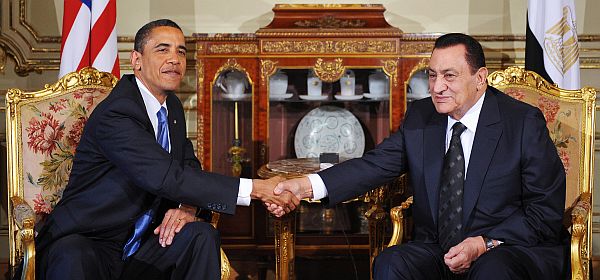
Egypt has been the second-largest recipient of U.S. foreign aid for decades, after Israel (not counting the funds expended on the wars and occupations of Iraq and Afghanistan). Mubarak’s regime has received roughly $2 billion per year since coming to power, overwhelmingly for the military.
Where has the money gone? Mostly to U.S. corporations. I asked William Hartung of the New America Foundation to explain:
“It’s a form of corporate welfare for companies like Lockheed Martin and General Dynamics, because it goes to Egypt, then it comes back for F-16 aircraft, for M-1 tanks, for aircraft engines, for all kinds of missiles, for guns, for tear-gas canisters [from] a company called Combined Systems International, which actually has its name on the side of the canisters that have been found on the streets there.”
Hartung just published a book, “Prophets of War: Lockheed Martin and the Making of the Military-Industrial Complex.” He went on: “Lockheed Martin has been the leader in deals worth $3.8 billion over that period of the last 10 years; General Dynamics, $2.5 billion for tanks; Boeing, $1.7 billion for missiles, for helicopters; Raytheon for all manner of missiles for the armed forces. So, basically, this is a key element in propping up the regime, but a lot of the money is basically recycled. Taxpayers could just as easily be giving it directly to Lockheed Martin or General Dynamics.”
Likewise, Egypt’s Internet and cell phone “kill switch” was enabled only through collaboration with corporations. U.K.-based Vodafone, a global cellular-phone giant (which owns 45 percent of Verizon Wireless in the U.S.) attempted to justify its actions in a press release: “It has been clear to us that there were no legal or practical options open to Vodafone … but to comply with the demands of the authorities.”
Narus, a U.S. subsidiary of Boeing Corp., sold Egypt equipment to allow “deep packet inspection,” according to Tim Karr of the media policy group Free Press. Karr said the Narus technology “allows the Egyptian telecommunications companies … to look at texting via cell phones, and to identify the sort of dissident voices that are out there. … It also gives them the technology to geographically locate them and track them down.”
Senior members of the U.S. Congress are debating whether to halt foreign aid to Egypt as a way to hasten President Hosni Mubarak’s exit from power amid continuing protests against his three-decade rule.
Senator Patrick Leahy, the chairman of the panel that controls foreign aid, said he’s prepared to stop all U.S. financial assistance to Egypt — which topped $1.5 billion last year — unless Mubarak steps aside immediately and allows a transitional government to take over.
“If he doesn’t leave, there will not be foreign aid; I mean, it’s as simple as that,” Leahy, a Vermont Democrat, told Bloomberg Television in an interview yesterday. U.S. money “will not go to the Mubarak administration,” Leahy said, adding, “that’s a pipeline that can easily be turned off.”
Today, the Senate passed a resolution calling on Mubarak to begin the transfer of power to an “inclusive, interim caretaker government.”
The Obama administration is discussing with Egyptian officials a proposal for President Hosni Mubarak to resign immediately, turning over power to a transitional government headed by Vice President Omar Suleiman with the support of the Egyptian military, administration officials and Arab diplomats said Thursday.
Even though Mr. Mubarak has balked, so far, at leaving now, officials from both governments are continuing talks about a plan in which, Mr. Suleiman, backed by Sami Enan, chief of the Egyptian armed forces, and Field Marshal Mohamed Tantawi, the Defense Minister, would immediately begin a process of constitutional reform.
The proposal also calls for the transitional government to invite members from a broad range of opposition groups, including the banned Muslim Brotherhood, to begin work to open up the country’s electoral system in an effort to bring about free and fair elections in September, the officials said.
Senior administration officials said that the proposal is one of several options under discussion with high-level Egyptian officials around Mr. Mubarak, though not him directly, in an effort to convince him to step down now.
The officials cautioned that the outcome depended on several factors, not least of all the mood of the protesters on the streets of Cairo and other Egyptian cities and the dynamics within the Egyptian government. Some officials said there was not yet any indication that either Mr. Suleiman or the military were willing to abandon Mr. Mubarak.
The New York Times, in its role as state storyteller, spins a fine yarn about how the White House artfully engineered Hosni Mubarak’s removal. A pivotal place in the narrative goes to “Frank G. Wisner, an adroit ex-diplomat whom President Obama had asked hours before to undertake a supremely delicate mission: nudging President Hosni Mubarak of Egypt out of power.”
Senior officials say that as Mr. Wisner traveled to Egypt, Obama officials in Washington were working on his message to Mr. Mubarak: to announce that he would not run for re-election (he did that), and to promise that his son would not run for election (he did not do that).
“No one wanted it to seem as if we were pushing him out,” one administration official said. “That would not serve American interests. It was important for President Mubarak to make the decision.”
Two hours after Mr. Wisner’s plane left Andrews Air Force Base, White House officials sent an e-mail to more than a dozen foreign policy experts in Washington, asking them to come in for a meeting on Monday morning. “Apologies for the short notice in light of a very fluid situation,” the e-mail said.
The Roosevelt Room meeting, led by Benjamin Rhodes, the deputy national security adviser for strategic communications, and two other National Security Council officials, Daniel Shapiro and Samantha Power, examined unrest in the region, and the potential for the protests to spread, according to several attendees.
Significantly, during the meeting, White House staff members “made clear that they did not rule out engagement with the Muslim Brotherhood as part of an orderly process,” according to one attendee, who like others interviewed for this article spoke on condition of anonymity because he did not want to talk publicly about the meeting. The Muslim group had been suppressed by Mr. Mubarak, and Bush administration officials believed it was involved in terrorist activities. It renounced violence years ago.
Several times, two other attendees said, White House staff members said that Mr. Obama believed that Egyptian politics needed to encompass “nonsecular” parties: diplomatic-speak for the Muslim Brotherhood.
“Orderly transition” is now the name of the game, but what remains unclear is whether Mubarak intends on sticking to the script.
After a half-hour conversation this evening, the only element of Mubarak’s thinking that Obama disclosed during his televised remarks was this: “He recognizes that the status quo is not sustainable and that a change must take place.”
That seems to leave open a wide range of possibilities — and one inconvenient fact: Mubarak is still Egypt’s president.
“The United States of America stands with the people of Tunisia, and supports the democratic aspirations of all people,” President Obama said on Tuesday, but he could not say the US stands with the people of Egypt, even though they are currently making their democratic aspirations crystal clear.
What the people of Egypt know, as do the citizens living under every US-backed autocratic ruler in the Middle East, is that if they are to win the prize of democratic freedom, they must surmount the obstacles that the US government throws in their way.
The Obama administration has made it perfectly evident that in spite of the pro-democracy platitudes it reluctantly espouses, it’s preeminent loyalties are with its undemocratic allies — thus Obama and Secretary of State Hillary Clinton’s reluctance to even utter the word “democracy.”
Instead of backing democracy in Egypt, the administration supports reform and it claims that Hosni Mubarak is capable of bringing about the necessary changes.
At the State Department yesterday, a Middle Eastern reporter challenged Clinton, saying:
[Y]ou seem to imply that the Egyptian Government is capable of reforming itself and meeting the expectation of the people. Yet the mood in the streets of Cairo today contrasts that, and people are demanding for radical change, removal of the government and President Mubarak not to nominate himself for another term. Are you unsure of what’s happening in Cairo?
Clinton responded:
I do think it’s possible for there to be reforms, and that is what we are urging and calling for. And it is something that I think everyone knows must be on the agenda of the government as they not just respond to the protest, but as they look beyond as to what needs to be done economically, socially, politically. And there are a lot of very well informed, active civil society leaders in Egypt who have put forward specific ideas for reform, and we are encouraging and urging the Egyptian Government to be responsive to that.
The message from Egypt is simple: the Egyptian people want democratic freedom and an end to dictatorship. They want an end to a brutal regime that still retains Washington’s support. The demonstrators are not calling on Mubarak to implement reforms; they are demanding that he go — and that is a demand that, so far, the Obama administration refuses to acknowledge.
When the status quo becomes untenable, people take to the streets in order to force political change. But Mubarak’s friends in Washington and Jerusalem are not ready to see him go — their preeminent interest is in stability.
Prime Minister Binyamin Netanyahu has met repeatedly since coming to power in March 2009 with Egyptian President Hosni Mubarak, and has said on a number of occasions that he has great respect for Mubarak as a statesman, and as a leader with vast experience and knowledge. Earlier this month he characterized the Egyptian-Israeli peace agreement as a “foundation for regional stability.”
There is not a prevalent sense among Egypt watchers in Jerusalem that the disturbances pose a threat to Mubarak’s regime. Rather, the concern is what comes after the 82-year-old Mubarak, and whether his successor – whether his son or someone else – will have the same authority and command the same degree of allegiance.
The sense in Jerusalem is that it would be a mistake to look at the events in Egypt and see an extension of what happened in Tunisia.
“This is not a Tunisian domino effect,” one official said.
Egypt, it was pointed out, is not as closed as Tunisia was under ousted president Zine al-Abidine Ben Ali – it has a different political culture, with more organized opposition and more outlets for letting off steam than existed in Tunisia.
Most importantly, the army is considered loyal to the government, whereas the commander of the Tunisian army determined that it would not face down the protestors there.
Labor MK Binyamin Ben-Eliezer, who is close to Mubarak and met on Tuesday with a senior Egyptian official, said Mubarak’s regime was strong and stable. He said there was no Egyptian who was serious enough competition for Mubarak to lead an effort against him.
“I don’t think it is possible [for there to be a revolution in Egypt],” Ben-Eliezer told Army Radio. “I see things calming down soon.
“Israel cannot do anything about what is happening there. All we can do is express our support for Mubarak and hope the riots pass quietly.”
Likewise, in an interview with Al Jazeera‘s Shihab Rattansi [see video below], State Department spokesman PJ Crowley said:
We want to see restraint on both sides. We want to see the Egyptian people have the opportunity to engage their government, to make clear what their aspirations of [sic], and we want to see that government respond in a meaningful way to meet those aspirations. That is our goal. That is the advice we are giving Egypt. We hope that Egypt will allow its people to protest peacefully but also open up the door for meaningful reforms.
Al Jazeera: Right, but we’re not talking in general terms here. Egypt is not letting its people protest peacefully. It’s deploying the full ranks of its US-backed $1.3 billion-backed security forces to beat up those protesters. Isn’t it time perhaps to be a little firmer with President Mubarak?
Crowley: We are giving Egypt advice publicly and privately. We have concerns about what is happening on the street. We are watching the situation carefully. We are in touch with the Egyptian government and we’re making clear that Egypt should allow its citizens to peacefully protest.
AJ: And if it doesn’t, is that funding — is that US support in jeopardy?
Crowley: We don’t see this as an either/or proposition. Egypt is an ally and friend of the United States. It’s an anchor of stability in the Middle East. It is helping us to pursue comprehensive peace in the Middle East.
But what every Egyptian knows today is that the United States government is not a friend of Egypt, it is a friend and ally of the Mubarak regime — a regime that does not represent the Egyptian people, nor should even be afforded the political shorthand of being referred to as “Egypt.”
Democracy is not the United State’s gift to the world and it will not be acquired under American tutelage. Real democrats don’t bankroll dictatorships.
We live — as politicians frequently repeat — under the rule of law and there is nothing the legal system frowns on more earnestly than perjury. Hence during trials the solemn ritual that witnesses must swear to tell the truth, the whole truth and nothing but the truth.
And then there is government, where the conduct of the people’s business apparently requires the economical expression of truth, the guarding of secrecy and a subtle contempt for honesty — as though only those who are ignorant about the way the world works would attach great value to truthfulness.
Tom Malinowski, the Washington director of Human Rights Watch, asked HRW staff to canvass sources in Tunisia to gauge the impact of the revelations from WikiLeaks and how they influenced the revolution.
The candid appraisal of Ben Ali by U.S. diplomats showed Tunisians that the rottenness of the regime was obvious not just to them but to the whole world — and that it was a source of shame for Tunisia on an international stage. The cables also contradicted the prevailing view among Tunisians that Washington would back Ben Ali to the bloody end, giving them added impetus to take to the streets. They further delegitimized the Tunisian leader and boosted the morale of his opponents at a pivotal moment in the drama that unfolded over the last few weeks.
This point might not be worth dwelling on, except that it suggests something interesting about how the United States, and the State Department in particular, approaches the challenge of promoting human rights and democracy in countries like Tunisia. Consider the following proposition: None of the decent, principled, conscientious, but behind the scenes efforts the State Department made in recent years to persuade the Tunisian government to relax its authoritarian grip — mostly through diplomatic démarches and meetings with top Tunisian officials — had any significant impact on the Ben Ali regime’s behavior or increased the likelihood of democratic change. Nor did the many quiet U.S. programs of outreach to Tunisian society, cultural exchanges and the like, even if Tunisians appreciated them and they will bear fruit as the country democratizes.
Instead, the one thing that did seem to have some impact was a public statement exposing what the United States really thought about the Ben Ali regime: a statement that was vivid, honest, raw, undiplomatic, extremely well-timed — and completely inadvertent.
Had anyone at the State Department proposed deliberately making a statement along the lines of what appears in the cables, they would have been booted out of Foggy Bottom as quickly as you can say “we value our multifaceted relationship with the GOT.” [Continue reading…]
How can you placate the frustrations of a disenfranchised population without giving them real political power?
The answers to this question describe the common ground that unites Western leaders with their authoritarian counterparts in the Middle East. The game is to come up with political formulae that will make a potentially rebellious population feel heard just enough so that the fire of revolution can be dampened.*
Egyptian Armed Forces Chief-of-Staff Sami Annan, along with a delegation from the Egyptian Army, happen to be visiting Washington this week. I doubt that their counterparts in the Pentagon will be advising them on the fastest way to prepare Egypt for democracy.
Issandr El Amrani comments on al-Sayed Badawi, the president of the Wafd party (the most established of Egypt’s legal opposition parties) who appeared on Al Jazeera, demanding the formation of a new national unity government, the dissolution of parliament, and new elections under a proportional representation system.
My gut reaction: this is either a significant break with the Wafd’s behavior for over 30 years, or he is making this announcement on behalf of the regime. Why the conspiracy theory? Because he doesn’t mention the question of the presidency, a chief demand of the protestors. Perhaps he should be given the benefit of the doubt.
Meanwhile, the National Association for Change has made its own demands, including asking Mubarak to step down and [his son] Gamal to be disqualified from the presidency, as well as the dissolution of the parliament. Other groups have other demands, including a new minimum wage and the firing of the interior minister.
These people should be coordinating — and remember they are not the ones who protested tonight.
The cautiousness of some of the Egyptian opposition leaders demonstrates exactly why an authoritarian regime provides space for an opposition to operate: so that at a moment such as this, opposition leaders will not place themselves at the vanguard of revolutionary change and that by holding back, they will undermine the popular will.
*Am I implying that any Western countries harbor the seeds of revolution? Far from it. The “success” of Western democracy has been to depoliticize populations through the anesthetizing power of consumerism. People don’t care too much if government by the people is a fiction, so long as they can get their hands on the latest iPhone. Once the anesthetic is applied sufficiently widely and sufficiently frequently, there ceases to be such a thing as the will of the people.
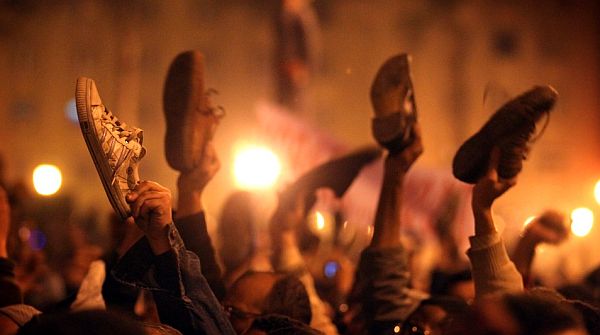
“I’ve never seen men so angry, yet so happy to be expressing their anger,” Courtney Graves, an American living in Giza told the BBC, describing what she witnessed in Tahrir square in Cairo today. “I walked next to girls in hijabs screaming for the downfall of Hosni Mubarak. I walked behind men begging God for freedom.” At least three people died in clashes between police and demonstrators.
In Hillary Clinton’s assessment, “the Egyptian Government is stable,” although Gamal Mubarak, Egyptian president Hosni Mubarak’s son who is widely tipped as his successor, has fled to London with his family, Arabic website Akhbar al-Arab said on Tuesday.
The Mubarak regime is clearly rattled and has blocked Twitter.
A popular uprising in Tunisia may have just pushed out President Zine El Abidine Ben Ali, but Egypt — the Arab world’s largest country with a vast security establishment — is something else again.
But activists, political analysts and average people in Egypt insist that something crucial shifted for Egypt today. Egyptian political scientist Mustapha Kamel Al Sayyid predicts that now the dam has broken, protests will continue. “the reservoir of discontent is huge,” he says. He adds it is much too soon to talk about a revolution in Egypt, where several factors would make a Tunisia-style toppling of Mubarak much more difficult.
Though both nations suffer from high unemployment and a have a large youth population, Egypt has a much smaller middle class than Tunisia. The regime’s power is not only concentrated in the security forces, as Tunisia’s was, but also in the Army. Tunisia’s military is credited with helping to bring about Ben Ali’s demise, while Egypt’s military is loyal to Mubarak, he says.
And while the corruption of Tunisia’s ruling family was a rallying point for protesters, corruption in Egypt extends further, meaning a widespread base of people who would have much to lose from the fall of the regime. Yet Egyptians have hope.
“All this is happening because we are not afraid,” said Shaimaa Morsy Awad, a young woman who held aloft an Egyptian flag during the protest. “Every day more people will join us. We are still weak, and there’s a lot of work we have to do. But there’s a revolution coming.”
The US State Department acknowledged Monday that the “Palestine Papers,” released by Al-Jazeera, complicated American efforts to forge an Israeli-Palestinian peace agreement. But it said it wouldn’t slow the Obama administration’s work toward that goal.
George Mitchell can be as busy as a hamster in a treadmill without actually getting anywhere. Still, the key rhetorical marker that the administration’s efforts have reached their termination point will be transparent when State Department spokesman PJ Crowley starts responding to questions about Israel with what has become Obama’s signature expression: “We’re monitoring the situation.”
One of the more astonishing revelations in The Palestine Papers — detailed records and minutes of the Middle East peace process leaked to Al Jazeera — is that the administration of US President Barack Obama effectively repudiated the Road Map, which has formed the basis of the “peace process” since 2003. In doing so it has backed away even from commitments made by the George W. Bush administration and blown an irreparable hole in the already threadbare “two-state solution.”
But even worse, the US position perhaps unwittingly opens the door to dangerous Israeli ambitions to transfer — or ethnically cleanse — non-Jewish Palestinian citizens of Israel in order to create an ethnically pure “Jewish state.”
Al Jazeera’s release of The Palestine Papers helps to make clear why there is no Palestinian state. It illuminates a key flaw in Palestinian and western understanding of Israeli thinking. It is this flaw which helps explain why a state has failed to emerge – despite the many, many opportunities in the last nineteen years in which it could have.
The root premise has been, since the outset of the ‘process’, that Israel was intent on having and maintaining a Jewish ‘majority’ within Israel, and that with time – and a growing Palestinian population – Israel would have to acquiesce to a Palestinian state simply to maintain its Jewish majority: that is, by losing Palestinians into their own state, Israel’s Jewish majority could be conserved – and by these means, and only by such means, finally could such a majority be conserved.
It is a very compelling narrative. It suggested that a Palestinian state was inevitable: Palestinians simply had to ‘prove’ their readiness to assume statehood to Israel – and a state would be given them.
Professor Mushtaq Khan from London’s School of Oriental and African Studies argued in a recent talk that it was precisely this type of analysis that lay behind Fatah’s approach to Oslo. It explains, he argues, why the Palestinian leadership at this time never made real attempts to create serious bargaining power vis-à-vis Israel: the leadership simply did not think it necessary. They saw their task to be ‘confidence building’ with the Israelis.
“The Obama way”:
4.29: At a moment when the success of the Tunisian revolution is sending a message across the region about the effectiveness of people’s power and arousing renewed hope for the restoration of lost dignity, the image of Palestinian negotiators ingratiating themselves before Israeli ministers, strikes a very discordant note.
When Ahmed Qurei, a former Palestinian prime minister, told Israel’s foreign minister Tzipi Livni that, “I would vote for you,” he might have been joking, but such a fawning expression of admiration for a minister who so strongly supported the slaughter of Palestinians in Gaza, exposes the Palestinian leadership in the worst possible light.
3.30: Mark Perry and Ali Abunimah describe how the Obama administration, contrary the image it presented as being willing to put pressure on the Netanyahu government, has in fact never swerved from the role of acting as “Israel’s lawyer”:
A series of six key documents dating from February of 2009 – a core element of the confidential memos, monographs and meeting notes leaked to Al Jazeera as part of The Palestine Papers – show that George Mitchell and his coordinating team, as well as Secretary of State Hillary Clinton, have consistently pressured Palestinian negotiators (and in particular chief negotiator Saeb Erekat) to accept Israeli demands on a host of core negotiating issues.
In addition, the documents show that the United States has been willing to ignore and even abandon key agreements and principles that, in years past, it insisted both parties follow. The evidence for this, in the documents, is compelling – even overwhelming. It explodes the idea that the Obama administration ever even attempted to pull the United States off a doomed course.
The evidence that America remains Israel’s lawyer emerges first in the account of a February 27, 2009 meeting between Mitchell and key members of his team, with Saeb Erekat (and a top assistant) at the U.S. Consulate in Jerusalem.
During several 2008 meetings with Palestinian negotiators, Livni proposed annexing Arab villages to the future Palestinian state, forcing tens of thousands of Israeli Arabs to choose between their citizenship and their land.
“The US position on borders perhaps unwittingly opens the door to dangerous Israeli ambitions to transfer — or ethnically cleanse — non-Jewish Palestinian citizens of Israel in order to create an ethnically pure ‘Jewish state.'”
Her clearest language came on June 21, 2008, when she told senior Palestinian negotiators Ahmed Qurei and Saeb Erekat that their land swaps should include Israeli Arab villages. Udi Dekel, a top adviser to the then-Israeli prime minister Ehud Olmert, rattled off a list of villages that would be annexed to Palestine.
Livni: We have this problem with Raja [Ghajar] in Lebanon. Terje Larsen put the blue line to cut the village in two. [This needs to be addressed.] We decided not to cut the village. It was a mistake. The problem now, those living on Lebanese soil are Israeli citizens.
Dekel: Barka, Barta il Sharqiya, Barta il [Garbiya], Betil, Beit Safafa…
Qurei: This will be difficult. All Arabs in Israel will be against us.
Becker: We will need to address it somehow. Divided. All Palestinian. All Israeli.
Two months earlier, in another meeting with Qurei and Erekat, Livni herself mentioned the same villages, describing them – their status in the state of Israel – as a problem in need of resolution.
Livni: Let us be fair. You referred to 1967 line. We have not talked about Jerusalem yet. There are some Palestinian villages that are located on both sides of the 1967 line about which we need to have an answer, such as Beit Safafa, Barta’a, Baqa al-Sharqiyeh and Baqa al-Gharbiyyeh.
Livni’s choice of words is striking. Beit Safafa, Barta’a and Baqa al-Gharbiyya all sit at least partly on the Israeli side of the Green Line; their inhabitants carry Israeli passports, pay taxes to the Israeli government, and overwhelmingly self-identify as Israelis.
But Livni describes them as Palestinians – and suggests that they do not belong in the state of Israel.
2.19: It has long been understood that a negotiated agreement between Israelis and Palestinians would involve so-called “land swaps” through which some of the occupied territory outside Israel’s 1967 borders on which Jewish settlements have been constructed would become part of Israel, in exchange for areas of land within the ’67 borders that would become part of the new Palestinian state.
The following exchange between Israeli and Palestinian negotiators during a meeting held on March 12, 2008, makes it clear that the Israelis do not even recognize the existence of the 1967 line. Keep in mind that these were negotiators representing the so-called moderate government of Ehud Olmert.
The following Israeli [I] and Palestinian [P] negotiators attended the meeting: Israeli: Udi Dekel [UD] and Dani Tirza [DT]; Palestinian: Dr. Samih Al-Abed [SA], Khaled Elgindy [KE], Nizar Farsakh [NF].
Udi Dekel [I]: Now, about today’s meeting, I don’t know what Abu Alaa and [Tzipi] Livni agreed but, as I understand it, we need to agree on a common language when it comes to territory and borders. From your side, I know there was discussion of percentages, or areas (in sq. km)… In the previous two meetings with Abu Alaa and Livni, we started to explain all the considerations of what we mean when we talk of territory and borders.
SA [P]: You are jumping directly into discussing areas. We need to discuss parameters or guidelines. You spoke of sq. km, but we already have a starting point, which is 1967. We just need to have all the maps. This is what we need for a breakthrough. We must have a common language, agree on common maps and data, and then we can have a discussion about the issues.
UD [I]: As you know, our guiding principles are UNSC Res. 242, the need for boundaries that can provide security for Israel, and we’re talking about the situation on the ground, as per Pres. Bush’s letter.
SA [P]: Do you mean the situation as it was then, or now?
UD [I]: Reality now… But we’re not going to argue. We can’t change reality on the ground. We don’t see the 1967 border as a reference, first because we don’t even know exactly where the line is.
SA [P]: We have all the maps that were signed by you.
UD [I]: But that wasn’t exactly the line on the ground.
SA [P]: If not the 1967 line, then what is your reference?
UD [I]: We said already, the situation on the ground.
SA [P]: The wall?
UD [I]: The security fence is not a border. Unfortunately, it is needed for security. Every week we intercept 3 to 4 suicide bombers. As we’ve said before, the fence is not a border and can be moved like we did with Lebanon.
NF [P]: What is your frame of reference?
UD [I]: We’re talking about blocs of settlements—not far in the West Bank, but close to the area we are talking about—are to be part of Israel. In Oslo we used the West Bank outline map.
DT [I]: It is the West Bank outline map, in which under our law Israeli military law is applied.
SA [P]: This is your law. In our law, the line is 1967.
DT [I]: Based on which maps? There is no…
SA [P]: This is the standard we’ve worked from, from Oslo to Taba… we are not going to discuss any other line. If we’re going to waste time this is something else.
UD [I]: This is your opinion, but not our opinion. It is very difficult to locate the exact line of the situation that existed on 4 June 1967.
1.54: This is one of those days when a lot of American journalists must know what it felt like being a native journalist in the Soviet Union — never allowed to swerve from the official line. At the Los Angeles Times, Edmund Sanders yawns: “The documents so far haven’t revealed anything that someone moderately familiar with the Mideast hasn’t already heard.”
12.19: Amjad Atallah suggests that the release of the Palestine Papers “may have the same emotive impact among Palestinians that the suicide of Mohamed Bouazizi had in Tunisia” — another event in which Al Jazeera‘s groundbreaking news coverage played a key role.
WikiLeaks’ data dump of U.S. diplomatic records; the demonstrations in Tunisia, Algeria, Egypt, Jordan, and Yemen; and Hezbollah’s success in Lebanon have created an atmosphere of empowerment among a normally dispirited Arab public. Change is no longer impossible — and the United States no longer needs to be the agent of change.
This means there may be more exhibitions of “people power” with unpredictable consequences. The Arab authoritarian systems (most with the support of the U.S. government) are ill-equipped to deal positively with this type of demand for change.
Different forces in the region will now begin to see how they can take advantage for good or bad from this new reality. Unfortunately, if the United States stays true to form, we’ll simply struggle to see whether we can maintain the status quo.
In other words, President Obama is likely to yet again act as an obstacle, not an instrument of change in the world.
11.59: Noam Sheizaf assesses the effect of the Palestine Papers on the Israeli side.
Prime Minister Netanyahu will probably not suffer any damage on the home front, at least in the short term. Netanyahu might even use the papers to claim that his government’s construction projects in occupied East Jerusalem pose no threat to the peace process, since the Palestinians have already agreed to give up most of the Jewish neighborhoods in this part of the city.
The Israeli government would also benefit from a renewal of the internal war on the Palestinian side. For years, Israel has tried (and for the most part, succeeded) to break Palestinian society into sub-groups with different political interests and agendas. When those groups fight each other, the Palestinian cause suffers.
Yet from a wider perspective, the release of the Palestinian offers during the 2008 talks serves as proof that Israel in fact had a partner for peace on the Palestinian side. Actually, the question from now on will be whether Israel itself is a partner for an agreement. Furthermore, after the steps Palestinian and Israeli negotiators took towards each other in previous rounds of talks, the current Israeli offers, such as a temporary state on half of the West Bank’s territory, will appear cynical and unrealistic.
For years, Israel has used the peace process as a way to hold back international pressure on the Palestinian issue. It will be harder to do so from now on. This will be Netanyahu’s greatest problem.
11.47: Rashid Khalidi on Democracy Now!: Leaked “Palestine Papers” underscore weakness of Palestinian Authority, rejectionism of Israel and U.S.
“The biggest Yerushalayim in Jewish history”
11.35: In the Financial Times [registration required], Nadia Hijab writes:
When, some 30 years on, the late Palestinian leader Yasser Arafat returned from the failed Camp David summit in 2000, he was excoriated by the US and Europe for rejecting Israel’s “generous offer”. By contrast, many Palestinians heaved a sigh of relief that Mr Arafat had refused to sign an agreement that would have ceded Jerusalem, and trisected the West Bank.
Now these new leaks reveal that it is the PLO/PA that has been making the generous offers, and Israel has been rejecting them. If the documents are to be believed, almost all of East Jerusalem has been on the table. Perhaps this time we should be grateful Israel hasn’t signed.
What next? The Palestinian leadership have two plausible options, but will likely take neither.
The first would to be attempt to retake the high ground. This would mean dissolving the PA, and refocusing its attention on the PLO’s primary task – the liberation of Palestine. This would also involve repairing relations with Hamas, and trying to bring all Palestinian political and civil forces into a rejuvenated organisation.
The second is to continue down the road of hoping that someone, somewhere will exert pressure on Israel to give up the occupied territories and recognise Palestinian rights.
10.56: The Guardian describes anger and disbelief among Palestinians in Gaza reacting to the release of the Palestine Papers:
Tailor Maher Mohammad, 50, said the revelations were incredible. “I couldn’t believe my eyes when I watched it, this is cheating to Palestinian people. Jerusalem is a holy land, nobody can make concessions regarding it because it’s not for Palestinians only but for all Muslims.”
Mahmoud Ismael, 58, a shopkeeper, questioned the motives of the person who leaked the documents. Palestinians, he added, expected little from their leaders whether Fatah or Hamas. “Both of them don’t care about Palestine, they care only about their benefits,” he said.
Salah Bardaweel, a senior Hamas leader, said the organisation was studying the document. “We are asking the president Mahmoud Abbas to go to the public and announce his position on what was leaked by Al Jazeera, and make it clear we don’t accept that and assure the Palestinian principles on the key issues.”
The main problem now, he added, was “not between Hamas and Fatah, it’s now between the Palestinian people and the Palestinian negotiator”.
10.03: Palestinian chief negotiator Saeb Erekat accused of treason:
9.23: Some Palestinians who don’t like the message have attacked the messenger. AJ’s Alan Fisher tweets: “The crowd has managed to get into the office in Ramaallah. #aljazeera’s staff is ok. Some walls have graffiti”. Fisher nows says the crowd has gone and the AJ building is under police protection.
[The British member of parliament] Gerald Kaufman once described Labour’s 1983 manifesto as the longest suicide note in history. If ever a set of documents merits this epithet, it is surely the one we publish today. Written by Palestinian officials, obtained by al-Jazeera and shared with the Guardian, the papers are the confidential record of 10 years of efforts to seek a peace agreement with Israel.
It is hard to tell who appears worst: the Palestinian leaders, who are weak, craven and eager to shower their counterparts with compliments; the Israelis, who are polite in word but contemptuous in deed; or the Americans, whose neutrality consists of bullying the weak and holding the hand of the strong. Together they conspire to build a puppet state in Palestine, at best authoritarian, at worst a surrogate for an occupying force. To obtain even this form of bondage, the Palestinians have to flog the family silver. Saeb Erekat, the PLO chief negotiator, is reduced at one point to pleading for a fig leaf: “What good am I if I’m the joke of my wife, if I’m so weak,” he told Barack Obama’s Middle East envoy George Mitchell.
9.12: AJ’s Clayton Swisher outlines the land swap agreement that Palestinian negotiators were offering — a swap that would be like exchanging real estate in Manhattan for vacant desert lots in Arizona:
9.05: Tariq Ali says that the extent of the capitulation documented in the papers would have shocked even Edward Said, who at its inception described the Oslo peace process as a ‘Palestinian Versailles’:
Even he would have been taken aback by the sheer scale of what the PLO leadership agreed to surrender: virtually everything except their own salaries. Their weaknesses, inadequacies and cravenness are now in the public domain.
Now we know that the capitulation was total, but still the Israeli overlords of the PLO refused to sign a deal and their friends in the press blamed the Palestinians for being too difficult. They wanted Palestine to be crushed before they would agree to underwrite a few moth-eaten protectorates that they would supervise indefinitely. They wanted Hamas destroyed. The PLO agreed. The recent assault on Gaza was carried out with the approval of Abbas and Hosni Mubarak in Egypt, not to mention Washington and its EU. The PLO sold out in a literal sense. They were bought with money and treated like servants. There is TV footage of Ehud Barak and Bill Clinton at Camp David playfully tugging at Arafat’s headgear to stop him leaving. All three are laughing. Many PLO supporters in Palestine must be weeping as they watch al-Jazeera and take in the scale of the betrayal and the utter cynicism of their leaders. Now we know why the Israel/US/EU nexus was so keen to disregard the outcome of the Palestinian elections and try to destroy Hamas militarily.
9.00: Haaretz‘s Akiva Eldar says Palestine Papers trump US State Department cables released by WikiLeaks:
The documents revealed by Al Jazeera are much more important than the documents recently released by WikiLeaks. The former document the talks that took place in 2008 between the head of the Palestinian negotiating team and then Foreign Minister Tzipi Livni, as well as with American officials, which is not just a chapter in history.
The compromises presented by the Palestinians vis-a-vis permanent borders in the West Bank and East Jerusalem are relevant to today. The Palestinian map that was shown to Ehud Olmert and representatives of the Bush administration was presented again two months ago to representatives of President Barack Obama, as well as Obama’s Mideast envoy George Mitchell and later Netanyahu’s representative Isaac Molcho. Molcho refused to accept the document.
The leaked documents completely discredit the claim that there is “no peace partner” made by the leader of the newly formed Atzmaut faction, Ehud Barak, and his boss, Benjamin Netanyahu.
8.53: Al Jazeera interviews Abdel Bari Atwan, Editor Al-Quds Al-Arabi
Amnesty International has written a letter to Defense Secretary Robert Gates objecting to the conditions of Bradley Manning’s detention, which was first reported here. The group denounces the oppressive conditions under which Manning is being held as “unnecessarily harsh and punitive,” and further states they “appear to breach the USA’s obligations under international standards and treaties, including Article 10 of the International Covenant on Civil and Political Rights.” The letter describes Manning’s treatment as particularly egregious “in view of the fact that he has no history of violence or disciplinary infractions and that he is a pre-trial detainee not yet convicted of any offence.” Moreover:
The harsh conditions imposed on PFC Manning also undermine the principle of the presumption of innocence, which should be taken into account in the treatment of any person under arrest or awaiting trial. We are concerned that the effects of isolation and prolonged cellular confinement . . . may, further, undermine his ability to assist in his defence and thus his right to a fair trial.
The letter follows a report from Manning’s lawyer, former Lt. Col. David Coombs, that the conditions of his detention temporarily worsened in the past week, prompting a formal complaint under the Uniform Code of Military Justice. [Continue reading…]
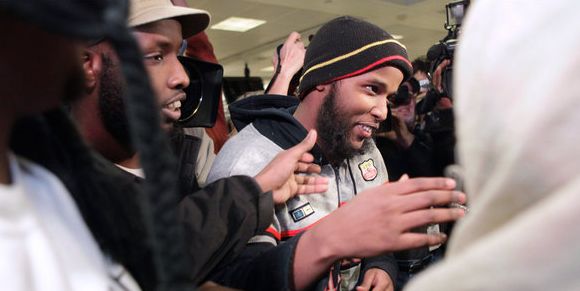
A Northern Virginia teen who had been barred from flying home from Kuwait landed in Washington on Friday morning, four weeks after being detained, allegedly beaten by Kuwait authorities and questioned by FBI agents about possible terrorist connections.
Gulet Mohamed, dressed in a worn hooded sweat shirt and sweat pants, was embraced by his family after he arrived at Dulles International Airport, the end of an ordeal that he said had “made me stronger.”
The United States “is built upon fighting for your rights,” Mohamed, 19, said in an interview.
Civil liberties groups charge that his case is the latest episode in which the U.S. government has temporarily exiled U.S. citizens or legal residents so they can be questioned about possible terrorist links without legal counsel.
The American Civil Liberties Union is suing the U.S. government on behalf of 17 citizens or legal residents who were not allowed to board flights to, from or within the United States, presumably because, like Mohamed, they were on the government’s no-fly list. Of those stranded overseas, all were eventually told they could return, often after they agreed to speak to the FBI. None was arrested upon their return.
The ACLU suit, filed in Portland, Ore., alleges that Americans placed on the no-fly list are denied due process because there is no effective way to challenge their inclusion. The government does not acknowledge that any particular individual is on the no-fly list or its other watch lists. Nor will it reveal the exact criteria it uses to place people on its list.
The drone technology that has revolutionized warfare in Iraq, Afghanistan and Pakistan is entering the national airspace: Unmanned aircraft are patrolling the border with Mexico, searching for missing persons over difficult terrain, flying into hurricanes to collect weather data, photographing traffic accident scenes and tracking the spread of forest fires.
But the operation outside Austin [described at the beginning of this report] presaged what could prove to be one of the most far-reaching and potentially controversial uses of drones: as a new and relatively cheap surveillance tool in domestic law enforcement.
For now, the use of drones for high-risk operations is exceedingly rare. The Federal Aviation Administration – which controls the national airspace – requires the few police departments with drones to seek emergency authorization if they want to deploy one in an actual operation. Because of concerns about safety, it only occasionally grants permission.
But by 2013, the FAA expects to have formulated new rules that would allow police across the country to routinely fly lightweight, unarmed drones up to 400 feet above the ground – high enough for them to be largely invisible eyes in the sky.
To say that the Obama administration’s campaign against WikiLeaks has been based on wildly exaggerated and even false claims is to understate the case. But now, there is evidence that Obama officials have been knowingly lying in public about these matters. The long-time Newsweek reporter Mark Hosenball — now at Reuters — reports that what Obama officials are saying in private about WikiLeaks directly contradicts their public claims:
Internal U.S. government reviews have determined that a mass leak of diplomatic cables caused only limited damage to U.S. interests abroad, despite the Obama administration’s public statements to the contrary.
A congressional official briefed on the reviews said the administration felt compelled to say publicly that the revelations had seriously damaged American interests in order to bolster legal efforts to shut down the WikiLeaks website and bring charges against the leakers. . . .
“We were told (the impact of WikiLeaks revelations) was embarrassing but not damaging,” said the official, who attended a briefing given in late 2010 by State Department officials. . .
But current and former intelligence officials note that while WikiLeaks has released a handful of inconsequential CIA analytical reports, the website has made public few if any real intelligence secrets, including reports from undercover agents or ultra-sensitive technical intelligence reports, such as spy satellite pictures or communications intercepts. . . .
National security officials familiar with the damage assessments being conducted by defense and intelligence agencies told Reuters the reviews so far have shown “pockets” of short-term damage, some of it potentially harmful. Long-term damage to U.S. intelligence and defense operations, however, is unlikely to be serious, they said. . . .
Shortly before WikiLeaks began its gradual release of State Department cables last year, department officials sent emails to contacts on Capitol Hill predicting dire consequences, said one of the two congressional aides briefed on the internal government reviews.
However, shortly after stories about the cables first began to appear in the media, State Department officials were already privately playing down the damage, the two congressional officials said.
In response to Hosenball’s story, Obama officials naturally tried to salvage the integrity of their statements, insisting that “there has been substantial damage” and that there were unspecified “specific cases where damage caused by WikiLeaks’ revelations have been assessed as serious to grave.” But the only specific cases anyone could identify were ones where the U.S. was caught by these documents lying to its own citizens or, at best, concealing vital truths — such as the far greater military role the U.S. is playing in Yemen and Pakistan than Obama officials have publicly acknowledged.
And this, of course, has been the point all along: the WikiLeaks disclosures are significant precisely because they expose government deceit, wrongdoing and brutality, but the damage to innocent people has been deliberately and wildly exaggerated — fabricated — by the very people whose misconduct has been revealed. There is harm from the WikiLeaks documents, but it’s to wrongdoers in power, which is why they are so desperate to malign and then destroy the group.
On Saturday, the New York Times revealed that the Stuxnet malware attack on Iran’s uranium enrichment program was a joint US-Israeli operation. The report illustrates the officially sanctioned relationship between the US government and the US press when it comes to the publication of classified information. Indeed, this relationship is so well understood that on matters of national security, the New York Times can be regarded as effectively serving as the US government’s ministry of information.
Although the report does not cite government sources — even anonymous officials — there seems little doubt that on an intelligence issue such as this (there could not be one of greater sensitivity) the newspaper’s editors would at least have shown the report to administration officials before publication. Which is to say, the New York Times would not publish a story of this nature without government approval. That is not to say that the accuracy of the report was being vouched for but that, at the least, the government could tolerate (and might well welcome) the disclosure of the classified information it contained.
This gets to the heart of the Obama administration’s fight against WikiLeaks: it’s not about the protection of secrecy; it’s about control of classified information. In other words, it’s about the exercising of the political power to pick and choose when the law should be upheld and when it can be disregarded.
WikiLeaks presents a challenge to centralized power; not governance by law.
In Washington, when a cabinet level official is facing calls for his resignation, he is likely to take cover behind that regal phrase, “I serve at the president’s pleasure.” Most of the Arab world’s autocratic leaders could use the same expression since most would find their positions untenable without American support.
Last Wednesday, when Hillary Clinton said “we are not taking sides,” as demonstrators clashed with Tunisian security forces, she could have dispensed with protocol and said with more honesty, “we are no longer taking sides.”
Up until that moment the United States had unequivocally taken sides with Tunisia’s dictatorial ruler, Zine el-Abidine Ben Ali, but thereafter he knew he was on his own. He rapidly lost his grip on power.
The Obama administration’s relationship with the Tunisian regime was mirrored on a smaller scale by that of the Washington Media Group, a consulting firm that severed its contract with the Tunisian government on January 6.
“We felt on principle that we could not work for a government that was shooting its own citizens and violating their civil rights with such abuse,” said WMG’s President Gregory L. Vistica. Was he claiming that his client’s record had suddenly taken a turn for the worse, or that his firm had only just discovered it had principles?
The point is that WMG, just like the US government, prefers to blur the distinction between statements of principle and actions of self-interest.
On Friday, when President Obama said, “I applaud the courage and dignity of the Tunisian people,” observers across the region might have appreciated the sentiment yet seen no reason to attach much gravity to his words. After, Ben Ali had already fled.
“No one thinks Obama is serious about democracy,” says Shadi Hamid from Brookings Doha Center. “In some ways they have given up hope. And that I think is one of the key post-Cairo Speech stories: that after a lot of optimism about Obama’s election, people realized that when it comes to the issue of democracy-promotion in the Arab world — and that is a very important one for many Arabs — Obama’s really not on board.”
What more damning an indictment could be made against an American president than to say that he does not support democracy?
Hamid is joined in conversation with fellow Middle East analyst Issandr El Amrani from The Arabist, for a fascinating discussion on the implications on the people’s uprising in Tunisia.
This website or its third-party tools use cookies, which are necessary to its functioning. By closing this banner, you agree to the use of cookies.





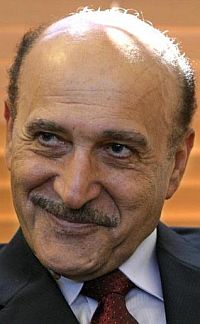 Under the Bush administration, in the context of “the global war on terror”, US renditions became “extraordinary”, meaning the objective of kidnapping and extra-legal transfer was no longer to bring a suspect to trial – but rather for interrogation to seek actionable intelligence. The extraordinary rendition program landed some people in CIA black sites – and others were turned over for torture-by-proxy to other regimes. Egypt figured large as a torture destination of choice, as did [newly-appointed Vice President, Omar] Suleiman as Egypt’s torturer-in-chief. At least one person extraordinarily rendered by the CIA to Egypt — Egyptian-born Australian citizen Mamdouh Habib — was reportedly tortured by Suleiman himself.