Category Archives: US government

The corrupt system that turns American generals into war profiteers

When corruption has become systemic, it no longer gets called corruption.

When America’s decorated military elite believe that retirement means that it is now their turn to line their pockets by profiting from the United States’ profligate arms spending, we are witnessing what the Boston Globe refers to with the blandest of euphemisms: a routine fact of life.

When a country is in dire economic condition, it’s government running a massive deficit and yet it still expands its military spending, we are witnessing the effect of the “disastrous rise of misplaced power” possessed by the military-industrial complex — a danger about which Dwight D. Eisenhower cautioned America, yet his warning went unheeded.

An hour after the official ceremony marking the end of his 35-year career in the Air Force, General Gregory “Speedy’’ Martin returned to his quarters to swap his dress uniform for golf attire. He was ready for his first tee time as a retired four-star general.

But almost as soon as he closed the door that day in 2005 his phone rang. It was an executive at Northrop Grumman, asking if he was interested in working for the manufacturer of the B-2 stealth bomber as a paid consultant. A few weeks later, Martin received another call. This time it was the Pentagon, asking him to join a top-secret Air Force panel studying the future of stealth aircraft technology.

Martin was understandably in demand, having been the general in charge of all Air Force weapons programs, including the B-2, for the previous four years.

He said yes to both offers.

In almost any other realm it would seem a clear conflict of interest — pitting his duty to the US military against the interests of his employer — not to mention a revolving-door sprint from uniformed responsibilities to private paid advocacy.

But this is the Pentagon where, a Globe review has found, such apparent conflicts are a routine fact of life at the lucrative nexus between the defense procurement system, which spends hundreds of billions of dollars a year, and the industry that feasts on those riches. And almost nothing is ever done about it.

The Globe analyzed the career paths of 750 of the highest ranking generals and admirals who retired during the last two decades and found that, for most, moving into what many in Washington call the “rent-a-general’’ business is all but irresistible.

From 2004 through 2008, 80 percent of retiring three- and four-star officers went to work as consultants or defense executives, according to the Globe analysis. That compares with less than 50 percent who followed that path a decade earlier, from 1994 to 1998.

In some years, the move from general staff to industry is a virtual clean sweep. Thirty-four out of 39 three- and four-star generals and admirals who retired in 2007 are now working in defense roles — nearly 90 percent.

And in many cases there is nothing subtle about what the generals have to sell — Martin’s firm is called The Four Star Group, for example. The revolving-door culture of Capitol Hill — where former lawmakers and staffers commonly market their insider knowledge to lobbying firms — is now pervasive at the senior rungs of the military leadership. [Continue reading.]

Facebooktwittermail

The truth that the CIA is desperate to conceal

The New York Times reports:

A seven-year effort by the Central Intelligence Agency to hide its relationship with a Swiss family who once acted as moles inside the world’s most successful atomic black market hit a turning point on Thursday when a Swiss magistrate recommended charging the men with trafficking in technology and information for making nuclear arms.

The prospect of a prosecution, and a public trial, threatens to expose some of the C.I.A.’s deepest secrets if defense lawyers try to protect their clients by revealing how they operated on the agency’s behalf. It could also tarnish what the Bush administration once hailed as a resounding victory in breaking up the nuclear arms network by laying bare how much of it remained intact.

“It’s like a puzzle,” Andreas Müller, the Swiss magistrate, said at a news conference in Bern on Thursday. “If you put the puzzle together you get the whole picture.”

The three men — Friedrich Tinner and his two sons, Urs and Marco — helped run the atomic smuggling ring of A. Q. Khan, an architect of Pakistan’s nuclear bomb program, officials in several countries have said. In return for millions of dollars, according to former Bush administration officials, the Tinners secretly worked for the C.I.A. as well, not only providing information about the Khan network’s manufacturing and sales efforts, which stretched from Iran to Libya to North Korea, but also helping the agency introduce flaws into the equipment sent to some of those countries.

The Bush administration went to extraordinary lengths to protect the men from prosecution, even persuading Swiss authorities to destroy equipment and information found on their computers and in their homes and businesses — actions that may now imperil efforts to prosecute them.

While it has been clear since 2008 that the Tinners acted as American spies, the announcement by the Swiss magistrate on Thursday, recommending their prosecution for nuclear smuggling, is a turning point in the investigation. A trial would bring to the fore a case that Pakistan has insisted is closed. Prosecuting the case could also expose in court a tale of C.I.A. break-ins in Switzerland, and of a still unexplained decision by the agency not to seize electronic copies of a number of nuclear bomb designs found on the computers of the Tinner family.

The fact that the CIA and the US government have gone to such lengths to try and prevent the details about the CIA’s involvement in global nuclear proliferation being exposed, means that we can only speculate about what kind of damning information remains hidden.

Several scenarios seem possible:

  • that the CIA’s efforts to track the AQ Khan network reached a point where it might have appeared that it was aiding and abetting the network’s operation;
  • that bungled CIA efforts to sabotage the Iranian nuclear program resulted in Iran acquiring know-how or technology that it might not have otherwise been able to obtain;
  • and conceivably, that the CIA’s involvement in Iran’s nuclear program was so deep that it was exerting an influence over the strategic direction of the program.
Facebooktwittermail

Bradley Manning speaks about the conditions of his detention

David House is one of the few people allowed to visit Bradley Manning while he is detained in the Quantico brig.

Manning is held in “maximum custody,” the military’s most severe detention policy. Manning is also confined under a longstanding Prevention of Injury (POI) order which limits his social contact, news consumption, ability to exercise, and that places restrictions on his ability to sleep.

Manning has been living under the solitary restrictions of POI for five months despite being cleared by a military psychologist earlier this year, and despite repeated calls from his attorney David Coombs to lift the severely restrictive and isolating order. POI orders are short-term restrictions that are typically implemented when a detainee changes confinement facilities and these orders are lifted after the detainee passes psychological evaluation.

Our conversations, which take place in the presence of marines and electronic monitoring equipment, typically revolve around topics in physics, computer science, and philosophy; he recently mentioned that he hopes to one day make use of the GI Bill towards earning a graduate degree in Physics and a bachelors in Political Science. He rarely if ever talks about his conditions in the brig, and it is not unusual for him to shy away from questions about his well-being by changing the subject entirely.

When I arrived at the brig on December 18th I found him to be much more open to lines of inquiry regarding his circumstances, and in a two and a half hour conversation I learned new details about his life in confinement. [Continue reading.]

Meanwhile, The Guardian reports:

The United Nations is investigating a complaint on behalf of Bradley Manning that he is being mistreated while held since May in US Marine Corps custody pending trial. The army private is charged with the unauthorised use and disclosure of classified information, material related to the WikiLeaks, and faces a court martial sometime in 2011.

The office of Manfred Nowak, special rapporteur on torture based in Geneva, received the complaint from a Manning supporter; his office confirmed that it was being looked into. Manning’s supporters say that he is in solitary confinement for 23 hours a day; this could be construed as a form of torture. This month visitors reported that his mental and physical health was deteriorating.

The Pentagon denies the former intelligence analyst is mistreated, saying he is treated the same as other prisoners at Quantico, Virginia, is able to exercise, and has access to newspapers and visitors.

Facebooktwittermail

The leaks that aren’t really leaks

Glenn Greenwald praises the New York Times for an article which “exposed” planning for an imminent expansion of Obama’s war in Pakistan:

In my view, the NYT article represents exactly the kind of secret information journalists ought to be revealing; it’s a pure expression of why the First Amendment guarantees a free press. There are few things more damaging to basic democratic values than having the government conduct or escalate a secret war beyond public debate or even awareness. By exposing these classified plans, Mazzetti and Filkins did exactly what good journalists ought to do: inform the public about important actions taken or being considered by their government which the government is attempting to conceal.

Moreover, the Obama administration has a history of deceiving the public about secret wars. Recently revealed WikiLeaks cables demonstrated that it was the U.S. — not Yemen — which launched a December, 2009 air strike in that country which killed dozens of civilians; that was a covert war action about which the U.S. State Department actively misled the public, and was exposed only by WikiLeaks cables. Worse, it was The Nation’s Jeremy Scahill who first reported back in 2009 that the CIA was directing ground operations in Pakistan using both Special Forces and Blackwater operatives: only to be smeared by the Obama State Department which deceitfully dismissed his report as “entirely false,” only for recently released WikiLeaks cables to confirm that what Scahill reported was exactly true. These kinds of leaks are the only way for the public to learn about the secret wars the Obama administration is conducting and actively hiding from the public.

The question that emerges from all of this is obvious, but also critical for those who believe Wikileaks and Julian Assange should be prosecuted for the classified information they have published: should the NYT editors and reporters who just spilled America’s secrets to the world be criminally prosecuted as well? After all, WikiLeaks has only exposed past conduct, and never — like the NYT just did — published imminent covert military plans.

I wish I shared Greenwald’s enthusiasm for the NYT’s investigative journalism but I’m highly skeptical that the reporting in this instance should be regarded as an exposé.

What seems much more likely is that the newspaper is simply serving as the means through which classified information can be made public because doing so is thought (by the leakers) to serve policymaking goals — such as applying pressure on Pakistan.

This merely illustrates the fact that those who make the rules can — whenever they see fit — break the rules. No one is at risk of being caught having leaked classified information to the New York Times. The “leaking” was almost certainly authorized at the highest levels of the administration and the New York Times merely acted as a dutiful servant. The paper is very well-trained when it comes to distinguishing between classified information that it has permission to print and that which is verboten.

Facebooktwittermail

Congress blocks closure of Guantanamo

The New York Times reports:

Congress voted Wednesday to impose strict new limits on transferring detainees out of the Guantánamo Bay prison, dealing a major blow to President Obama’s vows to shut down the center and give federal court trials to many of the prisoners.

The Guantánamo provisions were contained in a major defense authorization bill, which both chambers passed on the last day of Congress’s lame-duck session. It is considered highly unlikely that Mr. Obama will veto the bill because it also authorizes billions in spending for the wars in Afghanistan and Iraq.

Robert M. Chesney, a University of Texas law professor who specializes in national security matters, said the legislation would make it even harder to close the prison, at the American military base in Cuba. He said the next Congress, in which Republicans will have more power, was likely to keep or even intensify the restrictions.

“A Democratic Congress has done its level best to prevent prosecutions in civilian court,” Professor Chesney said.

“It strengthens the relative position of military commissions, and it separately strengthens the likelihood of continuing to rely on military detention” without trial, he said.

Facebooktwittermail

Time to be afraid of everyone and everything

The 1982 Chicago Tylenol murders resulted in seven deaths and spawned an industry: the production of tamper-resistant packaging. Four years earlier mercury-injected Jaffa oranges from Israel caused short-lived panic across Europe. But 32 years later tamper-resistant oranges have yet to make it to the produce shelves.

The same populations that needed at all costs to be protected from the risk of contaminated pharmaceutical products were apparently willing to live with the risk presented by unpackaged food. The difference between the two cases seemed to have had less to do with risk assessment than with the conjunction (or lack of one) between fear and commercial opportunity.

The Government of Fear in Washington is now raising two new alarms — each with security and commercial implications that have yet to become apparent, though right now this looks like good news for McDonalds and bad news for Sizzler.

CBS News has an exclusive report on the latest terrorist plot about which the Department of Homeland Security wants to generate some fear.

The plot uncovered earlier this year is said to involve the use of two poisons – ricin and cyanide – slipped into salad bars and buffets.

Of particular concern: The plotters are believed to be tied to the same terror group that attempted to blow up cargo planes over the east coast in October, al Qaeda in the Arabian Peninsula.

In online propaganda al Qaeda in the Arabian Peninsula has praised the cargo attack, part of what it called “Operation Hemorrhage.”

The propaganda says in part, “…attacking the enemy with smaller but more frequent operations” to “add a heavy economic burden to an already faltering economy.”

Meanwhile, here comes another alarm:

Attorney General Eric Holder says that the growing number of American citizens joining terrorist groups including Al Qaeda is “one of the things that keeps me up at night.”

“You didn’t worry about this even two years ago — about individuals, about Americans, to the extent that we now do,” Holder said in an interview with ABC News airing Tuesday. “And that is of … of great concern.”

Be afraid of what you eat. Be afraid of your fellow Americans.

Happy Holidays from the US Government!

Facebooktwittermail

CIA launches a WTF task force to assess impact of U.S. cables’ exposure by WikiLeaks

The Washington Post reports:

The CIA has launched a task force to assess the impact of the exposure of thousands of U.S. diplomatic cables and military files by WikiLeaks.

Officially, the panel is called the WikiLeaks Task Force. But at CIA headquarters, it’s mainly known by its all-too-apt acronym: W.T.F.

The irreverence is perhaps understandable for an agency that has been relatively unscathed by WikiLeaks. Only a handful of CIA files have surfaced on the WikiLeaks Web site, and records from other agencies posted online reveal remarkably little about CIA employees or operations.

Even so, CIA officials said the agency is conducting an extensive inventory of the classified information, which is routinely distributed on a dozen or more networks that connect agency employees around the world.

And the task force is focused on the immediate impact of the most recently released files. One issue is whether the agency’s ability to recruit informants could be damaged by declining confidence in the U.S. government’s ability to keep secrets.

Facebooktwittermail

FBI delivers subpoenas to four more anti-war, solidarity activists as U.S. Attorney Patrick Fitzgerald expands witch hunt

A press release from the Committee to Stop FBI Repression says:

The FBI came unannounced to knock on doors at two apartments in Chicago this morning. FBI agent Robert Parker, under orders from U.S. Attorney Patrick Fitzgerald’s office, delivered a subpoena to Maureen Murphy. Murphy, like several other individuals served subpoenas, is an organizer with the Palestine Solidarity Group-Chicago.

This continues the repression unleashed by Fitzgerald on the anti-war movement since September 24th, when fourteen subpoenas were delivered to anti-war, labor, and solidarity activists in coordinated raids involving more than 70 federal agents. Armed FBI agents raided homes, taking computers, phones, passports, documents, notebooks, and even children’s artwork. A total of 23 subpoenas have been served to activists around the country.

Maureen Murphy said, “Along with several others, I am being summoned to appear before the Grand Jury on Tuesday, January 25th, in the Dirksen Federal Building in Chicago. We are being targeted for the work we do to end U.S. funding of the Israeli occupation, ending the war in Afghanistan and ending the occupation of Iraq. What is at stake for all of us is our right to dissent and organize to change harmful US foreign policy.” Ms. Murphy is also the Managing Editor of the widely-read website, The Electronic Intifada.

In addition, three women in Minneapolis – Tracy Molm, Anh Pham, and Sara Martin – are threatened with reactivated subpoenas by Fitzgerald’s office and new Grand Jury dates. Tom Burke of the Committee to Stop FBI Repression explained, “It is likely the three individuals, like all the others so far, will continue to refuse to take part in Fitzgerald’s witch hunt. Fitzgerald can then call for putting them in jail as long as he wants.”

Facebooktwittermail

Outsourced war in Afghanistan wins only a thin slice of America’s attention

The New York Times reports:

The grueling war [in Afghanistan], where a day rarely goes by without an allied casualty, is like a faint heartbeat, accounting for just 4 percent of the nation’s news coverage in major outlets through early December, according to a study by the Project for Excellence in Journalism, an arm of the Pew Research Center.

That is down slightly from last year, when the war accounted for 5 percent.

“It’s never passed the threshold to be a big story week in, week out for Americans,” said Mark Jurkowitz, the associate director of the project.

One senior foreign correspondent for television, when told of the 4 percent coverage figure, said he was impressed — given the relatively small contingent of foreign journalists in Afghanistan.

“There are like seven of us there,” remarked the correspondent, who spoke only on the condition of anonymity because he did not want to call into question his network’s commitment to the war. Those who are there have done courageous work, exposing corruption and documenting military progress in rooting out insurgents.

The low levels of coverage reflect the limitations on news-gathering budgets and, some say, low levels of interest in the war among the public. About a quarter of Americans follow news about Afghanistan closely, according to recent surveys by the Pew Research Center for the People and the Press.

“Inside the United States, you’ve got audiences that are beginning to suffer from war fatigue,” said Tony Maddox, who oversees international coverage for CNN.

Mr. Maddox said CNN had “worked very hard” to make the war resonate with viewers, sometimes through human interest stories. “It’s always the eternal challenge in terms of international coverage: making the important interesting,” he said.

The only kind of war that has an audience is someone else’s war — which is what America’s wars have become for Americans. And for a CNN executive to say that his viewers are suffering from “war fatigue” is to employ a perverse euphemism. No one suffers fatigue while watching a war from their couch — they simply become bored.

No wonder the antiwar movement has struggled to enlist wide support when those who oppose the war are so vastly outnumbered by those who have next to no interest in the war.

Only in a nation that has “outsourced” war — which is to say, normalized war as a governmental activity that can be handled by a dedicated workforce — can a nation’s war become someone else’s war.

Facebooktwittermail

Pentagon health plan won’t cover brain-damage therapy for troops

T. Christian Miller at ProPublica and Daniel Zwerdling at NPR report:

During the past few decades, scientists have become increasingly persuaded that people who suffer brain injuries benefit from what is called cognitive rehabilitation therapy — a lengthy, painstaking process in which patients relearn basic life tasks such as counting, cooking or remembering directions to get home.

Many neurologists, several major insurance companies and even some medical facilities run by the Pentagon agree that the therapy can help people whose functioning has been diminished by blows to the head.

But despite pressure from Congress and the recommendations of military and civilian experts, the Pentagon’s health plan for troops and many veterans refuses to cover the treatment — a decision that could affect the tens of thousands of service members who have suffered brain damage while fighting in Iraq and Afghanistan.

Tricare, an insurance-style program covering nearly 4 million active-duty military and retirees, says the scientific evidence does not justify providing comprehensive cognitive rehabilitation. Tricare officials say an assessment of the available research [4] that they commissioned last year shows that the therapy is not well proven.

But an investigation by NPR and ProPublica found that internal and external reviewers of the Tricare-funded assessment criticized it as fundamentally misguided. Confidential documents obtained by NPR and ProPublica show that reviewers called the Tricare study “deeply flawed,” “unacceptable” and “dismaying.” One top scientist called the assessment a “misuse” of science designed to deny treatment for service members.

Facebooktwittermail

Peter King: ‘I’m willing to’ be called a bigot if that’s what it takes to target Muslim community

ThinkProgress reports:

The Islamophobia gripping the U.S. grows more entrenched by the day. Once confined to the far right, more and more pundits, power-brokers, and politicians are bringing it into mainstream. Apparently unsatisfied with dragging Muslims through the mud, Rep. Pete King (R-NY) is now committed to dragging them before Congress. Elected Chairman of the House Homeland Security Committee earlier this month, King penned an Newsday op-ed yesterday listing the investigation of “radicalization of the American Muslim community and homegrown terrorism” as a top priority. ” “I will do all I can to break down the wall of political correctness and drive the public debate on Islamic radicalization,” he said.

Civil rights, Constitutional, and sanity advocates have criticized King for repeatedly vilifying the entire Muslim community as obstacles to security. “We are disturbed that this representative who is in a leadership position does not have the understanding and knowledge of what the realities are on the ground,” the American-Arab Anti-Discrimination Committee’s legal director Abed Ayoub said, adding that Mr. King’s proposal “has bigoted intentions.” But rather than consider, address, or even refute the charge, King embraced it yesterday. Lambasting the Muslim community for its supposed refusal to help expose homegrown terrorism, King told Fox News’ Jaime Colby that if targeting all Muslims makes him a bigot, then “I’m willing to take that hit if I have to.”

Facebooktwittermail

Enforcing ignorance by design

Agence France Presse reports:

The Pentagon has banned journalists with the popular defense daily Stars and Stripes from consulting leaked diplomatic cables published by WikiLeaks, prompting charges of censorship.

“The editorial independence of Stars and Stripes and its readers’ right to news free of censorship are being threatened by an overly broad and misdirected response to the Wikileaks debacle,” the daily wrote.
“Amazingly, the government wants to bar this newspaper’s journalists — along with most federal workers — from reading information already plastered all over the public square.”

In the article, the daily’s ombudsman Mark Prendergast revealed that the Pentagon communications department had advised that “access to any classified information hosted on non-DoD systems from any government-owned system is expressly prohibited” even if it was now in the public arena.

Although Stars and Stripes is officially authorized by the Pentagon it is editorially independent and its journalists are guaranteed the right of freedom of expression contained in the US Constitution.

Mark Prendergast writes:

Putting reporters and editors under strictures intended for keepers of the nation’s secrets contradicts the fundamental purpose of journalism: to seek information, not avoid it.

More pointedly, this action imperils the editorial independence and First Amendment freedoms that Congress demanded of the Pentagon for Stars and Stripes two decades ago and then acted to ensure by authorizing an ombudsman to provide “aggressive and objective oversight.”

Journalists are supposed to report before they write. That means gathering as much information as they can – in breadth and depth – and consulting primary sources whenever feasible.

That might mean an editor clicking on Wikileaks to verify information in a wire story. Or an art director doing a screen grab to illustrate that story. Or a reporter reading a document in full for context in assessing a statement about it.

This newspaper needs to report more, not less.

Yet the government is demanding the opposite – less reporting. That’s enforcing ignorance by design, and that’s not just troubling by journalism standards. It imperils the “free flow of news and information” promised to Stars and Stripes readers.

Facebooktwittermail

CIA gave waterboarders $5M legal shield

The Associated Press reports:

The CIA agreed to cover at least $5 million in legal fees for two contractors who were the architects of the agency’s interrogation program and personally conducted dozens of waterboarding sessions on terror detainees, former U.S. officials said.

The secret agreement means taxpayers are paying to defend the men in a federal investigation over an interrogation tactic the U.S. now says is torture. The deal is even more generous than the protections the agency typically provides its own officers, giving the two men access to more money to finance their defense.

It has long been known that psychologists Jim Mitchell and Bruce Jessen created the CIA’s interrogation program. But former U.S. intelligence officials said Mitchell and Jessen also repeatedly subjected terror suspects inside CIA-run secret prisons to waterboarding, a simulated drowning tactic.

The revelation of the contractors’ involvement is the first known confirmation of any individuals who conducted waterboarding at the so-called black sites, underscoring just how much the agency relied on outside help in its most sensitive interrogations.

Facebooktwittermail

How a secret gets revealed and then becomes secret again

On November 30, The Express Tribune, Pakistan’s first internationally affiliated newspaper (partnered with The International Herald Tribune – the global edition of The New York Times) reported:

A North Waziristan tribesman, whose brother and teenage son were killed in a drone strike last year, said on Monday that he would sue all those US officials supposedly in control of the predator’s operations in Pakistan.

Karim Khan, a local journalist from Mirali town of the lawless tribal district, had sent a $500 million claim for damages to the US Defence Secretary Robert Gates, CIA chief Leon Panetta and its station head in Islamabad Jonathan Banks.

On December 10, a report appearing in the Miami Herald repeated the same claims:

The lawsuit, which stands little chance of being won, is lodged against the CIA station chief in Islamabad, identified as Jonathan Banks; CIA Director Leon Panetta; and Defense Secretary Robert Gates. There’s speculation that the publicity has compromised the position of the CIA chief in Pakistan. The U.S. Embassy in Islamabad refused to confirm that Banks was the right person.

“What CIA station chief? I can’t talk about employees,” embassy spokesman Alberto Rodriguez said.

But yesterday, the New York Times started reporting like a newspaper that takes directions from the government censors.

Just as in Israel, where secrecy can be imposed through censorship even when the “secret” has been made known everywhere else in the world, the New York Times is now following government directions by refusing to reprint the CIA station chief’s name even though it has been widely reported outside and inside the United States.

The Central Intelligence Agency’s top clandestine officer in Pakistan’s capital, Islamabad, was removed from the country on Thursday amid an escalating war of recriminations between American and Pakistani spies, with some American officials convinced that the officer’s cover was deliberately blown by Pakistan’s military intelligence agency.

The American spy’s hurried departure is the latest evidence of mounting tensions between two uneasy allies, with the Obama administration’s strategy for ending the war in Afghanistan hinging on the cooperation of Pakistan in the hunt for militants in the mountains that border those two countries. The tensions could intensify in the coming months with the prospect of more American pressure on Pakistan.

As the cloak-and-dagger drama was playing out in Islamabad, 100 miles to the west the C.I.A. was expanding its covert war using armed drones against militants. Since Thursday, C.I.A. missile strikes have killed dozens of suspects in Khyber Agency, a part of the tribal areas in Pakistan that the spy agency had largely spared until now because of its proximity to the sprawling market city of Peshawar.

American officials said the C.I.A. station chief had received a number of death threats since being publicly identified in a legal complaint sent to the Pakistani police this week by the family of victims of earlier drone campaigns.

So, before his cover was blown and this cloak-and-dagger drama started playing out, are we to suppose that the CIA station chief was happily cruising round Islamabad in an open-top Cadillac proudly flying the Stars and Stripes on the hood?

Even if the station chief who must now not be named was less exposed before a name which might be his name appeared in print, let’s not pretend he operated in Pakistan with anything less than maximum security.

The Washington Post confirms: “Ordinarily, station chiefs in Islamabad rarely stray beyond the sprawling American diplomatic compound, living and working in a warren of apartments and offices set deep inside the embassy complex’s walls.”

Maybe the issue is not threats to the station chief’s life as much as threats to his liberty. Pakistan’s judicial system, unlike its government, has at times displayed what American officials might regard as an irksome level of independence.

A report in Pakistan’s Daily Mail, published on December 1 (part of which appears below without corrections — the English and editing are rough, but the story is strong), provides interesting background on the legal action being brought by Kareem Khan.
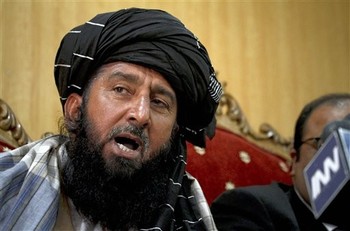
Kareem Khan challenged the precision of drone attacks and specifically questioned the precision of 31st December 2009 attack where in three innocent lives were taken by CIA in a secretive mode. He further challenged that if CIA can establish involvement of any of victims of 31st December attack in terrorism he will pay damages to United States instead.

While talking about the catastrophe he told The Daily Mail how his18 years old son Zaenullah, his young brother Asif Iqbal and a mason who was working on construction of village masque and had came from another village of Khyber Pakhtunkhawa were killed.

Kareem Khan told The Daily Mail that “his family is one of few educated families from the North Waziristan .He himself is M .Phil while his son was employee of Government school in town and his brother was graduate of National University of Modern languages from Islamabad .After compilation of his studies he went back to his town to add his positive contribution in educational uplifting of tribal area. They were innocent Pakistani citizen of Islamic Republic Of Pakistan whose fundamental rights have been guaranteed under the Constitution of Islamic Republic of Pakistan

In the response of one question about the families of victims he told Asif Iqbal left two years old son Muhammad Kafeel and a widow. Mohammad Kafeel has no one to look after as his mother is suffering great emotional and mental trauma. . “I lost my son and brother and now family’s full responsibility is now on me now we are living in uncle’s house waiting for justice or compensation”. He told The Daily Mail

Kareem Khan told the Daily Mail after this tragedy “I went here and there for Justice but all in vain because of undefined and so called system in tribal areas than one of my good friend suggested me to ask for Justice through legal way”. On November 29 2010 I through my lawyer Mirza Shahzad Akbar issued a legal notice to United States Secretary Defence Mr. Robert Gates, Director CIA Leon Panetta CIA Islamabad Station Chief Jonathan Banks for damages of $ 500 Million .he added

He also told that Drone attacks in tribal areas are carried out by CIA in langly, Virginia USA with co-ordination of local intelligence gathered by spies on ground in tribal area. CIA, s Islamabad station Chief, Jonathan Banks coordinates such intelligence through the network of on ground spies, who are paid a hefty amount for pointing out any militant. On these uncorroborated reports, CIA is executing people of tribal areas.

He stated that “CIA Director Leon Panetta has been reported in media saying that ‘Drone attacks are precise and limited in terms of collateral damage’.

“CIA officials are not part of United States armed forces, therefore under international law they are civilians directly participating in hostilities. Furthermore being non-diplomat and non-armed forces members CIA officials, who are operating drone attacks have no immunity and therefore are liable for murder and damages under laws of Pakistan and principles of natural justice throughout the world’ Kareem Khan explained

Kareem Khan also grumbled that media is not playing vibrant role and journalists even don’t bother to find ground realities. Every time we watched in media that numbers of militants are killed in the result of drone attacks. All the time they go for figures they don’t even bother to differentiate the innocent people and militants. Unfortunately they just rely on people who are present there and love to create hype for their own purpose.Kareem Khan gave the example of Hakeem Ullah Mehsood, Jalal Din ,Aimen Alzwari and Sheikh Usamma and told that according to so called reliable sources media published news regarding their, several times deaths . Which is very funny situation because in my limited knowledge a person died once in his or her life .

Shahzad Mirza Akbar ,the legal representative of Kareem khan who was present during the interview told The Daily Mail Drone attacks on house of his client is in clear violation of United Nations declaration of Human Rights ,International Covenant on Civil and Political Rights(ICCRP) and the citizens of Pakistan through the constitution of Islamic Republic of Pakistan .Those who have committed this atrocity are liable to be charged under the Penal Code of Pakistan and no law custom or authority gives CIA the permission to carry out killing in the sovereign territory of another country .So this is illegal act of United States and CIA and cannot be recognized as legal at any judicial or legal forum .The UN special report on extra –judicial ,summery and executions declared in 2004

“Empowering Government to identify and kill “known terrorists” places no verifiable obligation upon them to demonstrate in any way that those against whome lethal force is used are indeed terrorists, or to demonstrate that every other alternative had been exhausted”.

He told Court issued the notice on November 29, 2010 and count down has been started from today .He also talked about next step is to go in American court for justice.

So what’s the story here? Is it about the life of a CIA station chief being placed at risk? Or is it about the struggle among the victims of drone warfare who believe that tribal people should be afforded the same political, legal and human rights and protections as anyone else?

Strangely, the Washington Post and the Wall Street Journal, while acceding to a CIA request not to reprint the station chief’s name, nevertheless provide additional identifying information about him which I have not included here, nor has it appeared in the Pakistani press. That information was, no doubt, provided to them by the CIA!

Facebooktwittermail

If President Obama is sincere …

The Popular Struggle Coordination Committee comments on the Obama administration’s silence on the continued imprisonment of a Palestinian champion of non-violence.

Amid a flurry of European diplomatic attention over the imprisonment of Bil’in’s Abdallah Abu Rahmah, the United States has stayed strangely silent on the issue. Abu Rahmah, a non-violent leader from the West Bank village of Bil’in, has been in an Israeli military jail for over one year stemming from a charge of incitement and illegal protest levied against him after he was arrested in a night raid on his house on December 10th, 2009. After serving his sentence in full, the Israeli military prosecution demanded that he stay in jail while they file an appeal asking for a harsher sentence in order to ‘make an example’ of him.

On Friday, 10 December, AP reporter Matt Lee directly addressed Abdallah Abu Rahmah’s case during a US State Department briefing. US State department spokesman PJ Crowley responded that he was unable to provide a comment on the trial. When Matt Lee pushed, arguing that the EU and other foreign dignitaries had labeled Abu Rahmah a human rights defender, Crowley responded that he will “[find] out what we know.”
At his appeal hearing at the Ofer military court of appeals on 6 December 2010, a dozen European diplomats from France, Spain, the United Kingdom, Germany, Denmark, and Malta were on hand to observe the trial. Sir Vincent Fean gave a short statement to the press, noting his support of EU Foreign Policy Chief Catherine Ashton’s statement labeling Abu Rahmah as a human rights defender. He also pointed out that last month Abu Rahmah had already finished serving his sentence. Last month, British Foreign Minister, William Hague, met with leading Palestinian grassroots organizers in an unprecedented show of support in the face of ongoing Israeli repression.

The current US administration has made repeated statements on the need to support civil society activists, such as the one made by Secretary of State Clinton in July, 2010 the Krakow Community of Democracies meeting, in which she saluted “civil society activists around the world who have recently been harassed, censored, cut off from funding, arrested, prosecuted, even killed.” Clinton explained that when we defend civil society activists “we are defending an idea that has been and will remain essential to the success of every democracy.” She called for action to “protect civil society,” “to do more to defend the freedom of association,” and to “coordinate our diplomatic pressure” “to address situations where freedom of association comes under attack.”

Despite such statements, absent from the diplomatic core were representatives of the United States. In fact, the United States has not yet made any public statements on Abdallah’s imprisonment.

Yesterday, 15 December 2010, the issue of Abu Rahmah was followed up by the AP. Crowley answered that the case is ‘watched closely’ by US representatives in Israel. Far from releasing a statement on Abdallah Abu Rahmah, Crownly confirmed the silent position on Palestinian non-violence that the United States has maintained in recent months.

Facebooktwittermail

The legal assault on WikiLeaks and press freedom

As the Justice Department develops a legal strategy for attacking WikiLeaks it will be looking for political cover to defend itself from the charge that it is attacking the First Amendment rights of a free press and will do so by arguing that what WikiLeaks does is not journalism.

The administration’s lack of interest in defending the Constitution is transparent. The question is, where will the pillars of the American mainstream media establishment take their stand? In defense of a free press? Or will they equivocate because they attach greater value to the privilege of government access than they do to their obligation to serve the public?

Wired reports:

The Justice Department would have no problem distinguishing WikiLeaks from traditional media outlets, if it decides to charge WikiLeaks founder Julian Assange with violating the Espionage Act, a former federal prosecutor told lawmakers Thursday.

“By clearly showing how WikiLeaks is fundamentally different, the government should be able to demonstrate that any prosecution here is the exception and is not the sign of a more aggressive prosecution effort against the press,” said Kenneth Wainstein (pictured at right), former assistant attorney general on national security, during a House Judiciary Committee hearing about WikiLeaks and the Espionage Act on Thursday.

The hearing was the first to publicly address WikiLeaks. It consisted of testimony from legal scholars and attorneys as well as former Green Party presidential candidate and consumer advocate Ralph Nader. Testimony focused primarily on whether the 1917 Espionage Act should be revised to make it easier to prosecute recipients of classified information.

But Wainstein’s remarks, coming from a former prosecutor, hint at arguments the Justice Department is likely to make if it proceeds with prosecuting Assange under the existing Espionage Act.

Facebooktwittermail

The House Committee for Promoting Islamophobia in America

The New York Times reports:

The Republican who will head the House committee that oversees domestic security is planning to open a Congressional inquiry into what he calls “the radicalization” of the Muslim community when his party takes over the House next year.

Representative Peter T. King of New York, who will become the chairman of the House Homeland Security Committee, said he was responding to what he has described as frequent concerns raised by law enforcement officials that Muslim leaders have been uncooperative in terror investigations.

He cited the case of Najibullah Zazi, an Afghan man and a legal resident of the United States, who was arrested last year for plotting to bomb the New York subway system. Mr. King said that Ahmad Wais Afzali, an imam in Queens who had been a police informant, had warned Mr. Zazi before his arrest that he was the target of a terror investigation.

“When I meet with law enforcement, they are constantly telling me how little cooperation they get from Muslim leaders,” Mr. King said.

The move by Mr. King, who said he was planning to open a hearing on the matter beginning early next year, is the latest example of the new direction that the House will take under the incoming Republican majority.

Facebooktwittermail

Who gets to feed from the trough of classified information?

Robert Naiman points out that the only reason we know that President Obama’s Afghan “progress” report is at variance with the reports coming from the intelligence community, is thanks to classified information being made public — without being declassified.

[T]he reason that we know that the collective assessments of the 16 US intelligence agencies give a very different picture than the “progress” story that the administration is presenting to the public today is that news outlets such as the Los Angeles Times and the New York Times have reported on the National Intelligence Estimates (NIE) for Afghanistan and Pakistan, even though the NIEs are classified.

The Los Angeles Times reported yesterday [my emphasis throughout the following]:

Two new assessments by the US intelligence community present a gloomy picture of the Afghanistan war, contradicting a more upbeat view expressed by military officials as the White House prepares to release a progress report on the 9-year-old conflict.

The classified intelligence reports contend that large swaths of Afghanistan are still at risk of falling to the Taliban, according to officials who were briefed on the National Intelligence Estimates on Afghanistan and Pakistan, which represent the collective view of more than a dozen intelligence agencies.

The reports, the subject of a recent closed hearing by the Senate Intelligence Committee, also say Pakistan’s government remains unwilling to stop its covert support for members of the Afghan Taliban who mount attacks against US troops from the tribal areas of the neighboring nation. The officials declined to be named because they were discussing classified data.

[…]

Pakistan, which is due to receive $7.5 billion in US civilian aid over three years, denies secretly backing the Taliban. However, intelligence gathered by the US continues to suggest that elements of Pakistan’s security services arm, train and fund extremist militants, according to military and State Department documents disclosed this year by WikiLeaks.

[…]

Key members of Congress are watching the Obama strategy warily. “Our political and diplomatic efforts are not in line with our military efforts,” said Rep. Mike Rogers (R-Mich.), who is under consideration as the next chairman of the House Intelligence Committee.” It may be time to consider a smaller troop footprint.”

Speaker-designate John Boehner announced yesterday that Rogers will indeed be chair.

The New York Times reported:

As President Obama prepares to release a review of American strategy in Afghanistan that will claim progress in the nine-year-old war there, two new classified intelligence reports offer a more negative assessment and say there is a limited chance of success unless Pakistan hunts down insurgents operating from havens on its Afghan border.

[…]

The findings in the reports, called National Intelligence Estimates, represent the consensus view of the United States’ 16 intelligence agencies, as opposed to the military, and were provided last week to some members of the Senate and House Intelligence Committees. The findings were described by a number of American officials who read the reports’ executive summaries.

[…]

The White House review comes as some members of Mr. Obama’s party are losing patience with the war. “You’re not going to get to the point where the Taliban are gone and the border is perfectly controlled,” said Representative Adam Smith, a Washington Democrat who serves on the Armed Services Committee and the Permanent Select Committee on Intelligence, in an interview on Tuesday.

Mr. Smith said there would be increasing pressure from the political left on Mr. Obama to end the war, and he predicted that Democrats in Congress would resist continuing to spend $100 billion annually on Afghanistan.

Note that the Los Angeles Times and the New York Times cite unnamed officials, and then quote members of the Intelligence Committee. It’s a reasonable guess that Representative Rogers and Representative Smith are familiar with the contents of the NIEs, and that they are among the unnamed sources.

Today, the Washington Post reports on the White House/Pentagon review:

A White House review of President Obama’s year-old Afghan war strategy concluded that it is “showing progress” against al-Qaeda and in Afghanistan and Pakistan but that “the challenge remains to make our gains durable and sustainable,” according to a summary document released early Thursday.

[…]

The overview of the long-awaited report contained no specifics or data to back up its conclusions. The actual assessment document is classified and will not be made public, according to an administration official who said that interested members of Congress would be briefed on it in January.

This example shows why we need journalism on classified information, including WikiLeaks. If the assessment of the 16 intelligence agencies is different from the White House/Pentagon review, the public need to know that in order to have an informed opinion.

Clearly there is a public need for access to classified information, but what we see here is the subtext to the WikiLeaks story. It is not about secrecy per ce; it is about the government’s ability to act as the gatekeeper of classified information, so that officials retain a measure of control over when such information is released and to whom.

Classified information is food for journalists and it is provided on mutually understood but unstated terms: that journalists thus rewarded will use the material in such a way that they can expect to continue being offered future rewards. WikiLeak’s “crime” is that it operates outside this circle of privileged access to information and thus robs government officials of a significant measure of the power through which they can manipulate the media.

Facebooktwittermail
