Category Archives: US government

McChrystal gets the boot

I guess they just couldn’t figure out the seating chart for this morning’s meeting of the national security team in the Situation Room.

Have McChrystal sit between Gen “Clown” Jones and Richard “Wounded Animal” Holbrooke?

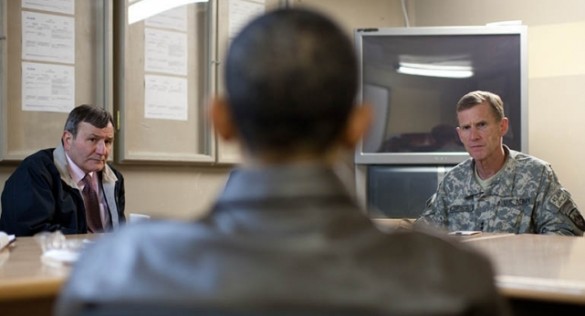
Instead, after meeting President Obama for 30 minutes, McChrystal returned to his home in Ft. McNair, Washington, D.C. He is being replaced by Gen David Petraeus.

The Wall Street Journal reports:

The decision to put Gen. Petraeus in command sends a signal that the president stands behind the counterinsurgency tactics pushed hard by Gen. McChrystal and championed by Gen. Petraeus.

Mr. Obama said his acceptance of Gen. McChrystal’s recommendation didn’t reflect a disagreement about strategy or personal insult. “We are in full agreement about our strategy,” he said Wednesday, expressing “great admiration” for the general.

“But war is bigger than any one man,” Mr. Obama said. He said the change was necessary to maintain a “unity of effort” in Afghanistan. “I welcome debate among my team, but I won’t tolerate division.”

As for sentiment among US troops on the ground, that might have been best summed up by a US Marine at Combat Outpost Hanson in Marjah:

A lance corporal from Denver explains that political news tends to trickle down slowly among Marines with limited access to the Internet, newspapers and other creature comforts readily available at rear bases. “Half of these guys don’t even know why we’re here in the first place,” he said with a laugh.

Facebooktwittermail

America’s war and its illusive heroes

The Russian mystic, Gurdjieff, is said to have advised that if a spiritual seeker wants to guard his faith, he should avoid getting too close to a saint. Perfection can rarely withstand close scrutiny.

The same can be said of war heroes.

The legend of General Stanley McChrystal has been years in the making, but even now, at a moment when he has in his own words “compromised the mission,” there are aspects of his character that for the very same reasons that they cause him trouble also burnish his image as an American hero — the kind captured in the US Army’s ridiculous (and short-lived) slogan “Army of One.”

In a passage of his Rolling Stone profile, Michael Hastings recounts a scene where McChrystal and his badboy comrades let it all hang out during a fraternity-style rebellion. They are up against the stiff cultural challenges presented by Paris nightlife with its “Gucci” restaurants — “Gucci” in McChrystal’s mind is apparently an all-purpose metaphor for what to his eye are Europe’s aristocratic affectations.

The night after his speech in Paris, McChrystal and his staff head to Kitty O’Shea’s, an Irish pub catering to tourists, around the corner from the hotel. His wife, Annie, has joined him for a rare visit: Since the Iraq War began in 2003, she has seen her husband less than 30 days a year. Though it is his and Annie’s 33rd wedding anniversary, McChrystal has invited his inner circle along for dinner and drinks at the “least Gucci” place his staff could find. His wife isn’t surprised. “He once took me to a Jack in the Box when I was dressed in formalwear,” she says with a laugh.

The general’s staff is a handpicked collection of killers, spies, geniuses, patriots, political operators and outright maniacs. There’s a former head of British Special Forces, two Navy Seals, an Afghan Special Forces commando, a lawyer, two fighter pilots and at least two dozen combat veterans and counterinsurgency experts. They jokingly refer to themselves as Team America, taking the name from the South Park-esque sendup of military cluelessness, and they pride themselves on their can-do attitude and their disdain for authority. After arriving in Kabul last summer, Team America set about changing the culture of the International Security Assistance Force, as the NATO-led mission is known. (U.S. soldiers had taken to deriding ISAF as short for “I Suck at Fighting” or “In Sandals and Flip-Flops.”) McChrystal banned alcohol on base, kicked out Burger King and other symbols of American excess, expanded the morning briefing to include thousands of officers and refashioned the command center into a Situational Awareness Room, a free-flowing information hub modeled after Mayor Mike Bloomberg’s offices in New York. He also set a manic pace for his staff, becoming legendary for sleeping four hours a night, running seven miles each morning, and eating one meal a day. (In the month I spend around the general, I witness him eating only once.) It’s a kind of superhuman narrative that has built up around him, a staple in almost every media profile, as if the ability to go without sleep and food translates into the possibility of a man single-handedly winning the war.

By midnight at Kitty O’Shea’s, much of Team America is completely shitfaced. Two officers do an Irish jig mixed with steps from a traditional Afghan wedding dance, while McChrystal’s top advisers lock arms and sing a slurred song of their own invention. “Afghanistan!” they bellow. “Afghanistan!” They call it their Afghanistan song.

McChrystal steps away from the circle, observing his team. “All these men,” he tells me. “I’d die for them. And they’d die for me.”

Bands of brothers always impress each other with their willingness to engage in seemingly heroic acts of self-sacrifice. They also often allow the power of solidarity to dissolve the strength of individual judgement.

McChrystal may well suffer the affliction of every cult leader: that the mutual psychological reinforcement provided by a closed social system inside which one individual becomes idealized, is that the guru becomes blind to his own failings. In turn these failings become amplified because they engender no social penalty among a circle of uncritical admirers.

President Obama now has a problem. Interestingly, the most useful lifeline he’s been presented comes from the Afghan government which sees McChrystal as an ally. President Karzai’s spokesman Waheed Omer says that at this critical juncture “we hope that there is not a change of leadership in the international forces here in Afghanistan.”

If Obama wants to creatively change the subject then he could turn it into an opportunity to implement not merely a structural or strategic adjustment to a war that’s going nowhere. He could initiate a paradigm shift.

Just suppose the war in Afghanistan was approached from a radically new perspective: as though Afghanistan and its people matter.

It’s Afghanistan, stupid — not the war.

Change the subject from the war to Afghanistan and McChrystal is no longer this gigantic figure.

The central issue should be: what will best serve the interests of Afghanistan?

Any American who asks that question should in the very asking, have the humility and intelligence to recognize that, by definition, this is not a question an American can answer. What we can reasonably hope is that if we are ultimately seen as having served this troubled nation’s greater interests, this will also serve our own interests. The key, though, is to abandon the missionary’s conceit: that we know better.

The lesson of a decade of war should be that when it comes to Afghanistan we have learned next to nothing.

As Winston Churchill said: “Americans can always be counted on to do the right thing… after they have exhausted all other possibilities.”

Facebooktwittermail

Maverick McChrystal out of line again

Gen Stanley McChrystal looks bemused at the sight of President Obama in a bomber jacket during a surprise visit to Afghanistan in March, 2010.

A Rolling Stone profile of Gen Stanley McChrystal due out on Friday “was a mistake reflecting poor judgment and it should have never happened,” the commander of US forces in Afghanistan now says.

It was a mistake to say what he and his staff said, or it was a mistake to make these remarks in the presence of a journalist?

The incident reveals the ambivalence Americans feel when it comes to the institutional power at the center of American democracy. Whatever keeps the wheels of Washington working smoothly, it isn’t candor.

Coming as I do from a country that has a real and ancient monarchy (for which I have little respect), during twenty-some years in the United States I’ve always viewed this country’s republican credentials with a certain measure of skepticism.

If at its conception America cast aside regal authority because of an unambiguous faith in the power of the people, why is it that so many Americans have such a gooey-eyed fascination with British royalty? Why the obsession with another form of royalty: celebrity? Why, in a supposedly egalitarian society, is such a high value attached to very visible displays of social status?

Americans seem to have had less interest in completely abandoning rule by a monarch than in modifying regal power and repackaging it in the quasi-regal institution of the presidency.

Having been crowned, a president always remains a president — even once out of office. He lives in a little palace, can never move around without being surrounded by a huge entourage of somewhat venal and sycophantic characters. And as in all forms of palace politics, those individuals who have wormed their way close to the center of power will do whatever they can to protect the status of the institution as they make frequent expressions of obeisance to the king-president.

But the concentration of power always involves the consolidation of power and so a president, just like any king, always needs to be on his guard, aware that one of his dukes or generals might pose a challenge.

Enter, Gen Stanley McChrystal.

McChrystal isn’t trying to stage a coup but he’s a repeat offender when it comes to upholding the most important principle in regal politics: never undermine the authority of the monarch or his highest officers.

National Security Adviser, Gen James Jones is a “clown.” Senior envoy Richard Holbrooke is a “wounded animal.” Joe Biden is “Bite me.” This is not language that can be uttered louder than a whisper in any palace.

As McChrystal heads to Washington for yet another dressing down, there’s one thing we can be sure of: President Obama won’t be wearing a bomber jacket when he lectures his top general. He’ll simply relying on the power of his throne — the Oval Office.

In his Rolling Stone profile of McChrystal, Michael Hastings writes:

The general prides himself on being sharper and ballsier than anyone else, but his brashness comes with a price: Although McChrystal has been in charge of the war for only a year, in that short time he has managed to piss off almost everyone with a stake in the conflict. Last fall, during the question-and-answer session following a speech he gave in London, McChrystal dismissed the counterterrorism strategy being advocated by Vice President Joe Biden as “shortsighted,” saying it would lead to a state of “Chaos-istan.” The remarks earned him a smackdown from the president himself, who summoned the general to a terse private meeting aboard Air Force One. The message to McChrystal seemed clear: Shut the fuck up, and keep a lower profile

Now, flipping through printout cards of his speech in Paris [in mid-April], McChrystal wonders aloud what Biden question he might get today, and how he should respond. “I never know what’s going to pop out until I’m up there, that’s the problem,” he says. Then, unable to help themselves, he and his staff imagine the general dismissing the vice president with a good one-liner.

“Are you asking about Vice President Biden?” McChrystal says with a laugh. “Who’s that?”

“Biden?” suggests a top adviser. “Did you say: Bite Me?”

When Barack Obama entered the Oval Office, he immediately set out to deliver on his most important campaign promise on foreign policy: to refocus the war in Afghanistan on what led us to invade in the first place. “I want the American people to understand,” he announced in March 2009. “We have a clear and focused goal: to disrupt, dismantle and defeat Al Qaeda in Pakistan and Afghanistan.” He ordered another 21,000 troops to Kabul, the largest increase since the war began in 2001. Taking the advice of both the Pentagon and the Joint Chiefs of Staff, he also fired Gen. David McKiernan – then the U.S. and NATO commander in Afghanistan – and replaced him with a man he didn’t know and had met only briefly: Gen. Stanley McChrystal. It was the first time a top general had been relieved from duty during wartime in more than 50 years, since Harry Truman fired Gen. Douglas MacArthur at the height of the Korean War.

Even though he had voted for Obama, McChrystal and his new commander in chief failed from the outset to connect. The general first encountered Obama a week after he took office, when the president met with a dozen senior military officials in a room at the Pentagon known as the Tank. According to sources familiar with the meeting, McChrystal thought Obama looked “uncomfortable and intimidated” by the roomful of military brass. Their first one-on-one meeting took place in the Oval Office four months later, after McChrystal got the Afghanistan job, and it didn’t go much better. “It was a 10-minute photo op,” says an adviser to McChrystal. “Obama clearly didn’t know anything about him, who he was. Here’s the guy who’s going to run his fucking war, but he didn’t seem very engaged. The Boss was pretty disappointed.”

Facebooktwittermail

FBI investigate peace activist

At a recent protest in San Francisco, Zionists hurled insults at peace activists and also issued threats such as this:

You’re all being identified, every last one of you…we will find out where you live. We’re going to make your lives difficult..we will disrupt your families…

It would appear that there are Zionists in Austin, Texas, who share the same sentiment and have decided to enlist the services of the FBI in order to pursue their political agenda.

What other plausible explanation can there be as to why the FBI came to question the mother of five shown in this video? She is a part-time registered nurse and part-time peace activist whose only form of “suspicious” behavior is that she has participated in protests calling for justice in Palestine.

(h/t Mondoweiss)

Facebooktwittermail

Is Obama’s word worth anything?

President Obama is either a liar or he has lost control of his own administration.

In a letter he sent to the president of Brazil in late April, Obama spelled out the terms on which the US would support a diplomatic initiative by Brazil and Turkey who hoped to revive a nuclear swap agreement that Iran had rejected last fall. Obama expressed his skepticism that Iran would make the necessary concessions. He was proved wrong, but then instead of welcoming Lula and Erdogan’s diplomatic accomplishment, Secretary Clinton dismissed it out of hand. If she did so with Obama’s consent, he has shown his word is worthless. If she did so on her own initiative, this president has lost his authority as chief executive.

This is what Obama wrote to Lula on April 20, 2010 (emphasis added):

His Excellency
Luiz Inácio Lula da Silva
President of the Federative Republic of Brazil
Brasilia
Dear Mr. President:

I want to thank you for our meeting with Turkish PrinIe Miuister Erdogan during the Nuclear Security Summit. We spent some time focused on Iran, the issue of the provision of nuclear fuel for the Tehran Research Reactor (TRR), and the intent of Brazil and Turkey to work toward finding an acceptable solution. I promised to respond in detail to your ideas. I have carefully considered our discussion, and I would like to offer a detailed explanation of my perspective and suggest a way ahead.

I agree with you that the TRR is an opportunity to pave the way for a broader dialogue in dealing with the more fundamental concerns of the intemational community regarding Iran’s overall nuclear program. From the beginning, I have viewed Iran’ s request as a clear and tangible opportunity to begin to build mutual trust and confidence, and thereby create time and space for a constructive diplomatic process. That is why the United States so strongly supported the proposal put forth by former International Atomic Energy Agency (IAEA) Director General EIBaradei.

The IAEA’s proposal was crafted to be fair and balanced, and for both sides to gain trust and confidence. For us, Iran’s agreement to transfer 1,200 kg of Iran’s low enriched uranium (LEU) out of the country would build confidence and reduce regional tensions by substantially reducing Iran’s LEU stockpile. I want to underscore that this element is of fundamental importance for the United States. For Iran, it would receive the nuclear fuel requested to ensure continued operation of the TRR to produce needed medical isotopes and, by using its own material, Iran would begin to demonstrate peaceful nuclear intent. Notwithstanding Iran’s continuing defiance of five United Nations Security Council resolutions mandating that it cease its enrichment of uranium, we were prepared to support and facilitate action on a proposal that would provide Iran nuclear fuel using uranium enriched by Iran — a demonstration of our willingness to be creative in pursuing a way to build mutual confidence.

During the course of the consultations, we also recognized Iran’s desire for assurances. As a result, my team focused on ensuring that the lAEA’s proposal contained several built-in measures, including a U.S. national declaration of support, to send a clear signal from my government of our willingness to become a direct signatory and potentially even play a more direct role in the fuel production process, a central role for Russia, and the IAEA’s assumption of full custody of the nuclear material throughout the fuel production process. In effect, the IAEA’s proposal offered Iran significant and substantial assurances and commitments from the IAEA, the United States, and Russia. Dr. EI Baradei stated publicly last year that the United States would be assuming the vast majority of the risk in the IAEA’s proposal.

As we discussed, Iran appears to be pursuing a strategy that is designed to create the impression of flexibility without agreeing to actions that can begin to build mutual trust and confidence. We have observed Iran convey hints of flexibility to you and others, but formally reiterate an unacceptable position through official channels to the IAEA. Iran has continued to reject the IAEA’s proposal and insist that Iran retain its low-enriched uranium on its territory until delivery of nuclear fuel. This is the position that Iran formally conveyed to the IABA in January 2010 and again in February.

We understand from you, Turkey and others that Iran continues to propose that Iran would retain its LEU on its territory until there is a simultaneous exchange of its LEU for nuclear fuel. As General Jones noted during our meeting, it will require one year for any amount of nuclear fuel to be produced. Thus, the confidence-building strength of the IAEA’s proposal would be completely eliminated for the United States and several risks would emerge. First, Iran would be able to continue to stockpile LEU throughout this time, which would enable them to acquire an LEU stockpile equivalent to the amount needed for two or three nuclear weapons in a year’ s time. Second, there would be no guarantee that Iran would ultimately agree to the final exchange. Third, IAEA “custody” of lran’s LEU inside of Iran would provide us no measurable improvement over the current situation, and the IAEA cannot prevent Iran from re-assuming control of its uranium at any time.

There is a potentially important compromise that has already been offered. Last November, the IAEA conveyed to Iran our offer to allow Iran to ship its 1,200 kg of LEU to a third country — specifically Turkey — at the outset of the process to be held “in escrow” as a guarantee during the fuel production process that Iran would get back its uranium if we failed to deliver the fuel. Iran has never pursued the “escrow” compromise and has provided no credible explanation for its rejection. I believe that this raises real questions about Iran’s nuclear intentions, if Iran is unwilling to accept an offer to demonstrate that its LEU is for peaceful, civilian purposes. I would urge Brazil to impress upon Iran the opportunity presented by this offer to “escrow” its uranium in Turkey while the nuclear fuel is being produced.

Throughout this process, instead of building confidence Iran has undermined confidence in the way it has approached this opportunity. That is why I question whether Iran is prepared to engage Brazil in good faith, and why I cautioned you during our meeting. To begin a constructive diplomatic process, Iran has to convey to the IAEA a constructive commitment to engagement through official channels — something it has failed to do. Meanwhile, we will pursue sanctions on the timeline that I have outlined. I have also made clear that I will leave the door open to engagement with Iran. As you know, Iran has thus far failed to accept my offer of comprehensive and unconditional dialogue.

I look forward to the next opportunity to see you and discuss these issues as we consider the challenge of Iran’s nuclear program to the security of the international community, including in the U.N. Security Council.

Sincerely,
Barack Obama

So what did Brazil and Turkey accomplish? An agreement by Iran to do exactly what Obama claimed he was seeking: that Iran would transfer 1200kg of LEU to be held in escrow by Turkey and in return for which, one year later, Iran would receive fuel rods for the TRR.

The US response? Secretary Clinton claimed there were “discrepancies” in the offer. These included that:

There is a recognition on the part of the international community that the agreement that was reached in Tehran a week ago between Iran and Brazil and Turkey only occurred because the Security Council was on the brink of publicly releasing the text of the resolution that we have been negotiating for many weeks. It was a transparent ploy to avoid Security Council action.

That is a truly Kafkaesque statement!

The US and its allies have been mounting diplomatic and economic pressure on Iran to force it to make concessions on the nuclear issue. As soon as Iran makes concessions, the US turns around and says the concessions are a “ploy” to avoid sanctions.

Facebooktwittermail

On national security, it’s the economy stupid!

In a speech delivered at West Point on Saturday, President Obama previewed his new security doctrine. This was a key passage:

Now even as we fight the wars in front of us, we also have to see the horizon beyond these wars — because unlike a terrorist whose goal is to destroy, our future will be defined by what we build. We have to see that horizon, and to get there we must pursue a strategy of national renewal and global leadership. We have to build the sources of America’s strength and influence, and shape a world that’s more peaceful and more prosperous.

Time and again, Americans have risen to meet and to shape moments of change. This is one of those moments — an era of economic transformation and individual empowerment; of ancient hatreds and new dangers; of emerging powers and new global challenges. And we’re going to need all of you to help meet these challenges. You’ve answered the call. You, and all who wear America’s uniform, remain the cornerstone of our national defense, the anchor of global security. And through a period when too many of our institutions have acted irresponsibly, the American military has set a standard of service and sacrifice that is as great as any in this nation’s history.

Now the rest of us — the rest of us must do our part. And to do so, we must first recognize that our strength and influence abroad begins with steps we take at home. We must educate our children to compete in an age where knowledge is capital, and the marketplace is global. We must develop clean energy that can power new industry and unbound us from foreign oil and preserve our planet. We have to pursue science and research that unlocks wonders as unforeseen to us today as the microchip and the surface of the moon were a century ago.

Simply put, American innovation must be the foundation of American power — because at no time in human history has a nation of diminished economic vitality maintained its military and political primacy.

The sub-text here seems to be a neo-Clintonism: when it comes to national security, it’s the economy stupid!

David Ignatius, who often acts as an unofficial spokesman for the administration, pursues the same theme:

One of the strongest voices arguing for fiscal responsibility as a national security issue has been Defense Secretary Bob Gates. He gave a landmark speech in Kansas on May 8, invoking President Dwight Eisenhower’s warnings about the dangers of an imbalanced military-industrial state.

“Eisenhower was wary of seeing his beloved republic turn into a muscle-bound, garrison state — militarily strong, but economically stagnant and strategically insolvent,” Gates said. He warned that America was in a “parlous fiscal condition” and that the “gusher” of military spending that followed Sept. 11, 2001, must be capped. “We can’t have a strong military if we have a weak economy,” Gates told reporters who covered the Kansas speech.

On Thursday the defense secretary reiterated his pitch that Congress must stop shoveling money at the military, telling Pentagon reporters: “The defense budget process should no longer be characterized by ‘business as usual’ within this building — or outside of it.”

Adm. Mike Mullen, chairman of the Joint Chiefs of Staff, has also argued for a rethinking of the strategic mind-set that encouraged two expeditionary wars in the past decade at immense cost. “U.S. foreign policy is still too dominated by the military,” he said in a March 3 speech. He cautioned that the military should use its power “in a precise and principled manner,” rather than always insisting on overwhelming force.

Let’s return to the class exercise of the military and civilian logisticians who were asked to prepare a national security strategy. They focused on America’s domestic challenges, which included “unsustainable budget,” “finite foreign energy” and “failing education,” and proposed this rubric: “Credibility abroad begins with credibility at home.” In a multipolar world, they said, the “U.S. cannot be the sole guarantor of international security.”

What’s interesting about this focus on domestic economic security is that it probably would be endorsed by Republicans and Democrats, Tea Party conservatives and antiwar liberals. In a country that doesn’t agree on much, it could be a unifying theme.

Facebooktwittermail

U.S. is still using private spy ring, despite doubts

The New York Times reports on a secret network of private spies who have produced hundreds of reports from deep inside Afghanistan and Pakistan, despite concerns among some in the military about the legality of the operation.

Since the Sept. 11, 2001, attacks, the Pentagon has used broad interpretations of its authorities to expand military intelligence operations, including sending Special Operations troops on clandestine missions far from declared war zones. These missions have raised concerns in Washington that the Pentagon is running de facto covert actions without proper White House authority and with little oversight from the elaborate system of Congressional committees and internal controls intended to prevent abuses in intelligence gathering.

The officials say the contractors’ reports are delivered via an encrypted e-mail service to a “fusion cell,” located at the military base at Kabul International Airport. There, they are fed into classified military computer networks, then used for future military operations or intelligence reports.

To skirt military restrictions on intelligence gathering, information the contractors gather in eastern Afghanistan and Pakistan’s tribal areas is specifically labeled “atmospheric collection”: information about the workings of militant groups in Afghanistan and Pakistan or about Afghan tribal structures. The boundaries separating “atmospherics” from what spies gather is murky. It is generally considered illegal for the military to run organized operations aimed at penetrating enemy organizations with covert agents.

But defense officials with knowledge of the program said that contractors themselves regarded the contract as permission to spy. Several weeks ago, one of the contractors reported on Taliban militants massing near American military bases east of Kandahar. Not long afterward, Apache gunships arrived at the scene to disperse and kill the militants.

The web of private businesses working under the Lockheed contract include Strategic Influence Alternatives, American International Security Corporation and International Media Ventures, a communications company based in St. Petersburg, Fla., with Czech ownership.

One of the companies employs a network of Americans, Afghans and Pakistanis run by Duane Clarridge, a C.I.A. veteran who became famous for his role in the Iran-Contra scandal.

Facebooktwittermail

Obama’s torture loophole

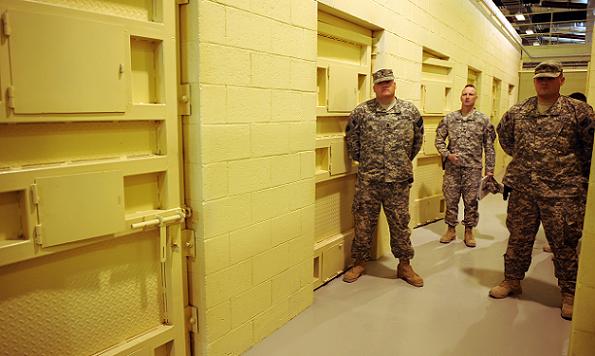
What’s the difference between a US-military-run detention facility and an intelligence gathering facility? For one thing, Red Cross officials are being prevented from seeing how prisoners are treated when held at Bagram’s intelligence gathering facility. Is that so that they can be tortured in secret?

Two days after taking office, Barack Obama signed an executive order banning torture. The era of secret detention facilities and CIA-administered waterboarding were over. Or so we thought.

Earlier this week, the BBC reported:

The US airbase at Bagram in Afghanistan contains a facility for detainees that is distinct from its main prison, the Red Cross has confirmed to the BBC.

Nine former prisoners have told the BBC that they were held in a separate building, and subjected to abuse.

The US military says the main prison, now called the Detention Facility in Parwan, is the only detention facility on the base.

However, it has said it will look into the abuse allegations made to the BBC.

The International Committee of the Red Cross (ICRC) said that since August 2009 US authorities have been notifying it of names of detained people in a separate structure at Bagram.

“The ICRC is being notified by the US authorities of detained people within 14 days of their arrest,” a Red Cross spokesman said.

“This has been routine practice since August 2009 and is a development welcomed by the ICRC.”

The spokesman was responding to a question from the BBC about the existence of the facility, referred to by many former prisoners as the Tor Jail, which translates as “black jail”.

Prisoners say they have been kept in isolation in cold cells and subjected to sleep deprivation, but it turns out the CIA’s hands are clean — this time it’s the Defense Intelligence Agency at work. And as for the fact that the Red Cross has been barred from entering this facility, that’s because it isn’t being called a detention facility.

Marc Ambinder reports:

Defense officials said that the White House is kept appraised of the methods used by interrogators at the site. The reason why the Red Cross hasn’t been invited to tour it, officials said, was because the U.S. does not believe it to be a detention facility, classifying it instead as an intelligence gathering facility.

A Defense official said that the agency’s inspector general had launched an internal investigation into reports in the Washington Post that several teenagers were beaten by the interrogators, but [Pentagon spokesman, Bryan] Whitman disputes this.

When the Obama Administration took over, it forbade the DIA from keeping prisoners in the facility longer than 30 days, although it is not clear how that dictum is enforced. It is also not clear how much Congress knows about the DIA’s interrogation procedures, which have largely escaped public scrutiny.

Facebooktwittermail

Is Obama moving to escalate the war in Pakistan?

The United States is at war in Pakistan. It will be up to historians to decide when this war began.

“Drone Strikes Pound West Pakistan” says the headline above a brief report in the New York Times. After the CIA fired 18 missiles resulting in at least 14 deaths on Tuesday, the operation was described merely as “a continuation of the air campaign to degrade the capabilities of Al Qaeda, the Pakistani Taliban and the Afghan Taliban fighters now working together in North Waziristan” (my emphasis).

“Continuation” is another name for escalation when developments that should prompt alarm have already been inoculated with the name “necessity.”

A course of action that if it initiated by George Bush might have been seen as an expression of his intemperate nature, when pursued by no-drama Obama is instead billed as a judicious expansion in the use of force.

But the danger of escalation — now as always — is that the seemingly carefully calibrated expansion of a war has unintended and far-reaching consequences. Only after it’s too late do we learn that the calibration rested on nothing more than wishful thinking.

The logic behind the apparent necessity of expanding the war into Pakistan has been evident ever since the war in Afghanistan began. For Bush, the dangers implicit in crossing the Durand Line seemed to provoke fear, but his successor seems intent on showing he lacks such trepidation. North Waziristan is where Obama gets to prove that he has the steel that Bush lacked — or so the script says.

In this context the Times Square attempted bombing has acquired particular significance. If the lack of a credible endgame in Afghanistan would make it even more difficult to justify expanding the war, then a scare in New York could be useful in prompting a renewed sense of urgency.

In Pakistan’s Dawn newspaper today, Rafia Zakaria writes:

Security experts in Washington have since begun to call Shahzad’s bombing attempt a “game changer” in the war against terror and have been signalling the possibility of an incursion of US forces into Pakistani territory. Several factors point to the fact that such an option is indeed being considered by the Obama administration and Pentagon officials. First, conservative lawmakers on Capitol Hill have long been sounding alarm bells asking for a wider presence in Pakistan to accomplish the goals of the war on terror. Recent hearings held on Capitol Hill have focused on groups such as Jaish-i-Muhammad and Lashkar-i-Taiba that do not operate in the areas currently being targeted by aerial drone attacks.

In a hearing held in March, several US congressmen noted that the Lashkar “had put the world on notice that they intend to escalate the carnage and take it worldwide”. Other analysts have repeatedly pointed to the necessity of expanding drone strikes into Quetta to target the Quetta shura which supposedly runs the Taliban operations. While Shahzad’s connections are not currently traced to groups other than the Taliban, the fact that he spent time in Pakistan bolsters the position of those who insist that a wider military presence in Pakistan is crucial to eliminating the threat to the American homeland.

Second, the problems faced by the highly publicised US/Nato initiatives in Marja and Kandahar in Afghanistan have created a political demand for a more decisive endgame in the region. In the footsteps of the Marja offensive in early April, The New York Times reported that many of the gains made in the area by the US Marines’ costly offensive had largely been reversed and many Taliban had moved back into the area. The Kandahar offensive due to start soon has also been the subject of lowered expectations, with experts saying that the easy absorption of Taliban fighters into the local population and the lack of visible centres of Taliban control make it difficult to win a decisive victory in the area.

The reason why the failure of both offensives — one yet to begin — is relevant to the Pakistan equation is simple: with the beginning of a US withdrawal already announced for 2011, there is immense political pressure on the Obama administration to produce some semblance of victory. The expansion of the Afghanistan war into Pakistani territory would not only be a culmination of the Obama campaign’s slogans of Pakistan being the real problem, it would also provide a visible endgame to the vexing and increasingly intractable issue of whether the war in Afghanistan has really eliminated global terrorism.

If Obama is now a victim of his own campaign logic — the repetition of half-baked slogans must surely be as harmful to those who utter them as it is to those who hear them — this logic is nevertheless looking less persuasive outside the administration.

Noah Shachtman notes that the skepticism once only voiced by counter-insurgency wonks like David Kilcullen and Andrew Exum has now percolated right into the mainstream media.

“If you go into Pakistan and talk to college kids, which is what we did, these drone attacks are feeding this narrative: this is what we [Americans] are aiming to do. We’re aiming to kill Muslims,” Leslie Stahl said today on MSNBC’s Morning Joe.

“Let’s say China was launching drone attacks on Idaho, we would be pretty angry too. We are launching attacking against a people were not at war with, officially,” Joe Scarborough responded. “I would rather us go after the terrorists — individual terrorists — drag ‘em out, interrogate ‘em, get information — instead of dropping bombs that kill four year-old little girls. That dismember grandmoms that happen to be in the family compound. That seems immoral.”

The decision to dramatically escalate the drone war was done behind closed doors, with no public debate about whether the strikes were the best way to smash the jihadist networks based in Pakistan’s tribal wildlands. Perhaps now, we’ll have that discussion.

Visit msnbc.com for breaking news, world news, and news about the economy

Facebooktwittermail

The terrorism recruiting myth

After almost a decade of a US-led global war on terrorism, America’s approach to the issue has barely advanced from being a deadly game of Whack-a-Mole.

On CBS, Scott Pelley asked Secretary of State, Hillary Clinton: “I wonder if there’s anything about U.S. foreign policy that needs to change in your estimation to put more pressure on these terrorist groups where they live, like in Pakistan?”

“Well, we are doing that. And we’re increasing it. We’re expecting more from it. This is a global threat. We have probably the best police work in the world. But we are also the biggest target. And therefore, we just have to be better than everybody else,” Clinton replied.

Earlier in the interview she said: “We’ve made it very clear [to the Pakistani government] that, if, heaven forbid, that an attack like this [in Times Square], if we can trace back to Pakistan, were to have been successful, there would be very severe consequences.”

The US will start bombing Pakistan? Special Forces will start conducting operations in North Waziristan? Clinton would not specify what form these severe consequences might take.

In response to the Times Square incident, Richard Clarke, former counter-terrorism coordinator for the Bush administration writes:

The reason such attacks are hard to stop is rooted in the identity of the attackers. They often seem to be successful or well-educated members of society, uninvolved in any form of radicalism. But then, the drip-drip of terrorist propaganda — either on the Internet or circulated through friends — has its effect. They quietly make contact with radical groups overseas, perhaps even traveling abroad for training and indoctrination. They throw away the life they have made in the West and agree to stage an attack. Faisal Shahzad, the alleged Times Square terrorist, fits that profile, as have others in the United States and Europe.

For U.S. intelligence and law enforcement authorities, these newly minted terrorists are the hardest to stop. They may not be part of any known cell; there is no reason for their phones or e-mail accounts to come under surveillance. When they buy rifles, handguns, tanks of propane gas or fertilizer, they are doing nothing out of the ordinary in American society.

If they succeed in inflicting harm on us with terrorist acts designed to rivet media and public attention, our political debate may once again be as wrongheaded as it will be predictable. Some elected officials will claim that their party would have done a much better job protecting the country. Critics of America’s Middle East policy — or our energy policy, or our foreign policy writ large — will also fault whatever administration is in power.

Likewise, in a 60 Minutes report that aired last night, the prism through which the issue is filtered is one in which individuals are turned into the tools of a deadly ideology. Vulnerable young men are in jeopardy of being recruited by merciless ideologues and terrorist planners.

But as Scott Atran points out, the idea that Shahzad and those like him have to be recruited, does not fit the evidence.

Shahzad was also apparently inspired by the online rhetoric of Anwar al-Awlaki, a former preacher at a Northern Virginia mosque who gained international notoriety for blessing the suicide mission of the failed Christmas airplane bomber, Umar Farouk Abdulmutallib, and for Facebook communications with Major Nadal Hasan, an American-born Muslim psychiatrist who killed thirteen fellow soldiers at Fort Hood in November 2009. Although many are ready to leap to the conclusion that Awlaki helped to “brainwash” and “indoctrinate” these jihadi wannabes, it is much more likely that they sought out the popular Internet preacher because they already self-radicalized to the point of wanting reassurance and further guidance. “The movement is from the bottom up,” notes forensic psychiatrist and former CIA case officer Marc Sageman, “just like you saw Major Hasan send twenty-one e-mails to al-Awlaki, who sends him back two, you have people seeking these guys and asking them for advice.”

The CBS report, stuck on the track that recruitment is a central issue, homes in on the role of the internet. The would-be terrorist is someone whose deadly intent is sure to be triggered by something he sees online.

Phillip Mudd, who until a few months ago was the senior intelligence advisor to the FBI and its director says:

They’re seeing images, for example, of children and women in places like Palestine and Iraq, they’re seeing sermons of people who explain in simple, compelling, and some cases magnetic terms why it’s important that they join the jihad. They’re seeing images, and messages that confirm a path that they’re already thinking of taking.

CBS helpfully provides such an image, but predictably neglects to add any commentary.

What are we seeing? An Israeli soldier terrorizing a Palestinian mother and her two girls.

And there we have it: exactly the kind of image the foments terrorism.

Viewed through the American counter-terrorism lens, the problem lies with the propagation of the image and the violent reaction such an image can provoke. Why? Because any serious consideration of the foreign policy issues that the image signals is still off-limits.

But here’s what everyone in the Middle East sees: An Israeli Jew brandishing an American-made weapon, serving America’s closest ally in the Middle East, is threatening a Muslim family. This is the narrative that no amount of spin or cleverly fought battles in a war of ideas, can undo.

Yet here is the foreign policy dilemma for Washington: How can the United States adopt a posture in the Middle East that acknowledges the role America has played in fueling terrorism, without appearing to capitulate to terrorist demands?

The answer is to trust in the universally recognized truth: actions speak louder than words.

What Obama does in Pakistan matters more than what he said in Cairo.

In April 2003, the Bush administration made a step in the right direction when it withdrew American troops from Saudi Arabia. The moved turned out to be of little consequence since it was triggered by utterly false expectations about the war in Iraq. Yet there was an implicit recognition: the presence of American soldiers in close proximity to Islam’s holiest sites sends an ugly message to the Muslim world.

Seven years later, as the Obama administration puts increased pressure on the Pakistani government to launch a major offensive in North Waziristan — an operation that would yet again result in the displacement of tens of thousands of civilians — and as the CIA continues to expand a drone war that has resulted in hundreds of civilian deaths, what kind of signal is this sending to those who might now contemplate following in the footsteps of Faisal Shahzad?

Facebooktwittermail

Lieberman’s TEA party and dual loyalty

Joe Lieberman’s Terrorist Expatriation Act is designed to strip the constitutional rights from any American who is accused of supporting terrorism, but the political sentiment he’s tapping into is simply, America first. Does Lieberman have no concern about where this might go?

How about this New Yorker who Max Blumenthal interviewed recently? Presumably she’s an American citizen, but it sounds like she puts Israel first:

As for where Lieberman is finding support, it isn’t coming from the White House but other Democrats have spoken favorably:

Several major Democratic officials spoke positively about the proposal, including Secretary of State Hillary Rodham Clinton. Noting that the State Department already had the authority to rescind the citizenship of people who declare allegiance to a foreign state, she said the administration would take “a hard look” at extending those powers to cover terrorism suspects.

“United States citizenship is a privilege,” she said. “It is not a right. People who are serving foreign powers — or in this case, foreign terrorists — are clearly in violation, in my personal opinion, of that oath which they swore when they became citizens.”

Speaker Nancy Pelosi said she supported the “spirit” of the measure, although she urged caution and said that the details of the proposal, like what would trigger a loss of citizenship, still needed to be fleshed out.

Interesting comment from Clinton… Makes me wonder: how does she feel about Rahm Emanuel serving in the Israeli Defense Force? I know that doesn’t count as an infraction of the law because Israel is not a country hostile to the US, but there’s no avoiding the fact that serving in the Israeli military is serving a foreign power.

As for the “spirit” of the measure, I guess Pelosi will have to explain what she means, but Megan McArdle is not alone in finding this spirit hard to discern:

Can someone explain to me–hopefully using graphs, and small words–why Joe Lieberman is willing to share the precious blessing of American citizenship with Charles Manson, Gary Ridgeway, and David Berkowitz, but wants citizenship stripped from a guy who strapped some firecrackers to a bag of non-explosive fertilizer?

Indeed. And if even Glenn Beck and Chuck Schumer both doubt the wisdom of Lieberman’s bill, that might be a hint that this truly is an act of idiocy.

Facebooktwittermail

An arrest warrant needs a name on it; a death warrant needs none.

In the narrative that sketches the legality of the war on terrorism, the tribal nature of the “battlefield” is the pretext used to justify killing people instead of attempting to arrest them. Counterterrorism experts scoff at the notion that FBI agents (or Pakistani law enforcement officials for that matter) could possibly waltz into a village in South Waziristan and handcuff a Taliban or al Qaeda suspect. The logistics of such an operation would indeed be daunting.

But here’s the thing: The United States is now killing people when it doesn’t even have a legal basis for even initiating their capture.

In the US — and most other legal jurisdictions — an arrest warrant needs to show probable cause connecting a crime that has been committed to the person named on the warrant.

In Pakistan, the CIA can target someone for assassination without knowing their name, without witnessing them commit a crime — simply on the Orwellian pretext that their “pattern of life” can be deemed a threat to the United States.

The Los Angeles Times reports:

The CIA received secret permission to attack a wider range of targets, including suspected militants whose names are not known, as part of a dramatic expansion of its campaign of drone strikes in Pakistan’s border region, according to current and former counter-terrorism officials.

The expanded authority, approved two years ago by the Bush administration and continued by President Obama, permits the agency to rely on what officials describe as “pattern of life” analysis, using evidence collected by surveillance cameras on the unmanned aircraft and from other sources about individuals and locations.

The information then is used to target suspected militants, even when their full identities are not known, the officials said. Previously, the CIA was restricted in most cases to killing only individuals whose names were on an approved list.

The new rules have transformed the program from a narrow effort aimed at killing top Al Qaeda and Taliban leaders into a large-scale campaign of airstrikes in which few militants are off-limits, as long as they are deemed to pose a threat to the U.S., the officials said.

At a time when Faisal Shahzad — a name that might not evoke much terror — is a name uppermost in many people’s minds, it’s worth remembering Mir Aimal Kasi.

In 1993 he too had conducted a pattern of life analysis, having noted the turn lane that directed traffic into the CIA’s Langley headquarters. In his targeted killing operation, he too had found the high-value targets of his choice — James Woollsey and Robert Gates — were too illusive and so he opted to shoot CIA employees whose names he didn’t know.

Soon before receiving a death sentence in 1998, Kasi told Salon:

“I am not against the USA or the American people. I am against the policies of the U.S. government toward Islamic countries or toward Muslims.”

“A lot of young people in Pakistan,” he said, “think mostly the same.”

Whoever follows in the footsteps of Faisal Shahzad may have less interest in constructing a Rube Goldberg type contraption than in causing mayhem the America way — as did Mir Aimal Kasi, John Allen Muhammad, and Nidal Malik Hasan.

“This is a blow back. This is a reaction. This is retaliation. And you could expect that,” Pakistani Foreign Minister Mahkdoom Qureshi told CBS News after the Times Square bombing attempt. “Let’s not be naive. They’re not going to sort of sit and welcome you eliminate them. They’re going to fight back.”

Facebooktwittermail

Drone strikes like “canon fire”

CNN reports:

Drone-launched missiles are now hitting lower-level al Qaeda and Taliban personnel, camps, training areas, bomb makers, buildings and other targets in the remote region.

“You’ve had an expanded target set for time now, and given the danger these groups pose and their relative inaccessibility, these kinds of strikes — precise and effective — have become almost like the cannon fire of this war. They’re no longer extraordinary or even unusual,” the official said.

The US counterterrorism official who likened Hellfire missile attacks to cannon fire, reached for a comparison which though perhaps ill-conceived is also revealing. If drone warfare is meant to epitomize precision, nothing represents blunt force more than a cannon.

As for the claim that big-name targets have now given way to an expanded range of lower level targets, US officials who still insist that there have been no more than a handful of civilians killed in drone attacks might be posed a basic challenge: How often can they even name the dead?

Facebooktwittermail

Drone attacks provoke calls for revenge

In a report on the CIA’s campaign of drone warfare in Pakistan, the Los Angeles Times recounts the stories of some of the civilian victims of the attacks.

Many of the boys that Zaman Khan grew up with in the South Waziristan town of Shakai eventually joined the Taliban. He knew they had become militants, but he never thought it odd to have them over for tea.

Whether it was because of Taliban visits or the proximity of a regular Taliban meeting place 30 yards away, Khan’s house became a target March 15, 2008.

The missile struck while everyone slept, killing Khan’s brother, Wazir Khan, 40; Wazir’s wife, Zara Bibi, 30; and their 4-year-old son, Irshad. The left half of Wazir’s body had been sheared off. Zara’s and Irshad’s bodies were charred from head to toe.

Wazir’s two other children, Noor Rehman, 10 at the time, and Ishaq Khan, 3, survived. Physically, they recovered but suffer from psychological problems, Zaman Khan said.

“Ishaq doesn’t talk at all,” Khan said. “He can’t recognize his family, and he drinks only if someone helps him.”

Three weeks after that strike, a house full of civilians in the same neighborhood was struck, instantly killing cousins Sher Maan, 20, and Azeem Ullah, 30, and Azeem’s wife, Gul Anama, 25.

“It was a huge blast that shook the ground,” said Amin Ullah, 20, a Shakai farmer.

“I believe that most of the victims of these drone attacks are innocent people,” Ullah said. “Pakistan should be carrying out these attacks. Pakistan knows the terrain, knows its people and knows the militants.”

Andrew Exum, a former Army officer in Afghanistan and Iraq, has declared the drone program counterproductive and called for an end to it. In an analysis published last year, Exum and David Kilcullen, a former counterinsurgency advisor to the head of U.S. Central Command, Army Gen. David H. Petraeus, dismissed drones as technology substituting for strategy.

“Every one of these dead noncombatants represents an alienated family, a new desire for revenge, and more recruits for a militant movement,” they wrote.

Drones have proved invaluable in Afghanistan, where they focus on surveillance, intelligence-gathering and watching over coalition troops, Exum said in an interview. But in Pakistan, the U.S. and the government in Islamabad need to make the case that the attacks are part of a joint strategy supporting Pakistani policy, he said.

“I’m not saying drones can’t be part of the solution, but right now I think they’re part of the problem,” Exum said.

Drone attacks have enraged men such as Momin Khan. On a September morning last year, Khan heard the thunderclap of a drone strike in Machis, his village in North Waziristan, and ran to see what had happened.

As he joined other villagers running down a dirt road, the 50-year-old unemployed teacher saw black smoke and flames curling out of a house about 60 yards away. The missile had killed two people there. As he ran closer, a second missile strike shook the ground.

Shrapnel from the blast cut into his shoulder and legs. He woke up in a hospital.

Four people were killed in the second strike, he said. Although Taliban militants have often used Machis as a haven, Khan said he was sure the house initially targeted had only civilians in it.

“These drones fly day and night, and we don’t know where to hide because we don’t know who they will target,” he said. “If I could, I would take revenge on America.”

Philip Alston, the United Nations special representative on extrajudicial, summary or arbitrary killings, said that without full disclosure of the CIA drone program, “the opportunities for abuse are immense.”

“The CIA is running a program that is killing a significant number of people, and there is absolutely no accountability in terms of the relevant international law,” he said.

Scott Horton, while considering some of the legal issues surrounding the program notes:

No weapons system remains indefinitely the province of a single power. Drone technology is particularly striking in this regard, because it is not really all that sophisticated. It seems clear that other powers have this technology–Israel and Iran have each been reported to be working with it, Russia and China could obviously do so easily if they desired, and the same is probably true for Britain, France, and Germany, not to mention Japan and Taiwan, where many of the cutting-edge breakthroughs in robotics actually occur. The way America uses this technology is therefore effectively setting the rules for others. Put another way, if it’s lawful for America to employ a drone to take out an enemy in the desert of Yemen, on the coast of Somalia, in a village in Sudan or Mauretania, then it would be just as lawful for Russia, or China–or, for that matter, for Israel or Iran. What kind of world is this choice then creating? Doesn’t it invariably lead us closer to the situation in which a targeted killing will be carried out in a major metropolis of Europe or East Asia, or even the United States? And doesn’t that move us in the direction of a dark and increasingly lawless world?

This is not idle speculation. The choices the United States has made are being studied very closely in capitals around the world. In Russia, for instance, national-security analysts have noted the American drone strikes with a measure of approbation, because they see such strikes as justifying lethal countermeasures of their own against perceived terrorist enemies. A number of enemies of the Russian government who were critical of policies or actions connected with the Second Chechen War have recently met violent death, often after Russian authorities linked them to Chechen terrorist groups. The Polonium poisoning of Aleksandr Litvinenko in London, for instance, or the assassination of Umar Israilov in Vienna, which Austrian prosecutors linked earlier this week to a Putin-protégé, the president of Chechnya, are two examples that suggest that Europe may have been cleared as a theater for targeted killings by a great power. The 2004 killing of former Chechen President Zelimkhan in Qatar is an example of another Russian targeted killing in the Gulf. The recent likely Israeli assassination of Mahmoud al-Mabhouh in Dubai is another instance. Targeted killings of this sort have always been with us, of course, but with the Bush-era “War on Terror” they are making a strong comeback and are gaining in claims of legitimacy and legality. The drone technology promises to take targeted killings to a whole new level.

My point here is a simple one. The United States cannot assume exclusivity in this technology, and how it uses the technology will guide others. The United States has to decide now whether it wants to legitimize a broader right of sovereign states to assassinate their enemies using drones. The consequence of such a step to the world as a whole will be severe. This also points to the danger of the United States using drones for targeted killings and keeping silent about the process, which invites the view that the practice involves an arbitrary and capricious use of power. If the United States elects to continue on its current path, it also owes the world a clear accounting for its use of drones as a vehicle for targeted killings.

Facebooktwittermail

How to: risk World War III, and blow billions doing it

At Wired, Noah Shachtman writes:

The Pentagon’s plan to fire ballistic missiles at terrorists isn’t just a nuclear Armageddon risk. It’s a ludicrously expensive way to accidentally start World War III: each weapon could cost anywhere from a few hundred million to $1 billion.

The Defense Department wants to spend about $240 million next year on the controversial “prompt global strike” project. Eventually, it could lead to weapons that could strike virtually anywhere in the planet within an hour or two. But that quarter-billion would be the tiniest of down payments.

“There are no accurate cost estimates for the program, largely because the technology is unproven,” writes Joe Cirincione at ForeignPolicy.com. His back-of-the-envelope calculation: $10 billion for 10 conventionally-armed Intercontinental Ballistic Missiles, meant to strike at terrorists on the move. “Each missile with its tiny payload could easily go over $1 billion each.”

Visit msnbc.com for breaking news, world news, and news about the economy

Facebooktwittermail

The perils of PowerPoint


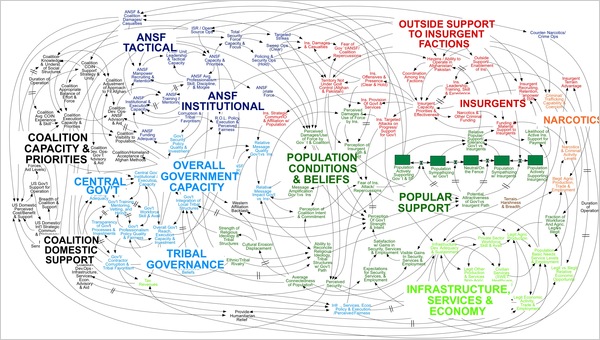
An article by Elisabeth Bumiller in the New York Times includes the diagram above. The illustration is indispensable for the lede — it does little to convey the principle failings of Powerpoint, least of all the cognitive style that Powerpoint engenders.

Gen. Stanley A. McChrystal, the leader of American and NATO forces in Afghanistan, was shown a PowerPoint slide in Kabul last summer that was meant to portray the complexity of American military strategy, but looked more like a bowl of spaghetti.

“When we understand that slide, we’ll have won the war,” General McChrystal dryly remarked, one of his advisers recalled, as the room erupted in laughter.

The slide has since bounced around the Internet as an example of a military tool that has spun out of control. Like an insurgency, PowerPoint has crept into the daily lives of military commanders and reached the level of near obsession. The amount of time expended on PowerPoint, the Microsoft presentation program of computer-generated charts, graphs and bullet points, has made it a running joke in the Pentagon and in Iraq and Afghanistan.

“PowerPoint makes us stupid,” Gen. James N. Mattis of the Marine Corps, the Joint Forces commander, said this month at a military conference in North Carolina. (He spoke without PowerPoint.) Brig. Gen. H. R. McMaster, who banned PowerPoint presentations when he led the successful effort to secure the northern Iraqi city of Tal Afar in 2005, followed up at the same conference by likening PowerPoint to an internal threat.

“It’s dangerous because it can create the illusion of understanding and the illusion of control,” General McMaster said in a telephone interview afterward. “Some problems in the world are not bullet-izable.”

In General McMaster’s view, PowerPoint’s worst offense is not a chart like the spaghetti graphic, which was first uncovered by NBC’s Richard Engel, but rigid lists of bullet points (in, say, a presentation on a conflict’s causes) that take no account of interconnected political, economic and ethnic forces. “If you divorce war from all of that, it becomes a targeting exercise,” General McMaster said.

Commanders say that behind all the PowerPoint jokes are serious concerns that the program stifles discussion, critical thinking and thoughtful decision-making. Not least, it ties up junior officers — referred to as PowerPoint Rangers — in the daily preparation of slides, be it for a Joint Staff meeting in Washington or for a platoon leader’s pre-mission combat briefing in a remote pocket of Afghanistan.

Last year when a military Web site, Company Command, asked an Army platoon leader in Iraq, Lt. Sam Nuxoll, how he spent most of his time, he responded, “Making PowerPoint slides.” When pressed, he said he was serious.

“I have to make a storyboard complete with digital pictures, diagrams and text summaries on just about anything that happens,” Lieutenant Nuxoll told the Web site. “Conduct a key leader engagement? Make a storyboard. Award a microgrant? Make a storyboard.”

Despite such tales, “death by PowerPoint,” the phrase used to described the numbing sensation that accompanies a 30-slide briefing, seems here to stay. The program, which first went on sale in 1987 and was acquired by Microsoft soon afterward, is deeply embedded in a military culture that has come to rely on PowerPoint’s hierarchical ordering of a confused world.

“There’s a lot of PowerPoint backlash, but I don’t see it going away anytime soon,” said Capt. Crispin Burke, an Army operations officer at Fort Drum, N.Y., who under the name Starbuck wrote an essay about PowerPoint on the Web site Small Wars Journal that cited Lieutenant Nuxoll’s comment.

In a daytime telephone conversation, he estimated that he spent an hour each day making PowerPoint slides. In an initial e-mail message responding to the request for an interview, he wrote, “I would be free tonight, but unfortunately, I work kind of late (sadly enough, making PPT slides).”

By Bumiller’s account, the military’s PowerPoint problem derives mostly from the ubiquity of its use, but as Edward Tufte, one of PowerPoint’s most ardent and cogent critics makes clear, the problem runs much deeper.

Imagine a widely used and expensive prescription drug that promised to make us beautiful but didn’t. Instead the drug had frequent, serious side effects: It induced stupidity, turned everyone into bores, wasted time, and degraded the quality and credibility of communication. These side effects would rightly lead to a worldwide product recall.

Yet slideware -computer programs for presentations -is everywhere: in corporate America, in government bureaucracies, even in our schools. Several hundred million copies of Microsoft PowerPoint are churning out trillions of slides each year. Slideware may help speakers outline their talks, but convenience for the speaker can be punishing to both content and audience. The standard PowerPoint presentation elevates format over content, betraying an attitude of commercialism that turns everything into a sales pitch.

Of course, data-driven meetings are nothing new. Years before today’s slideware, presentations at companies such as IBM and in the military used bullet lists shown by overhead projectors. But the format has become ubiquitous under PowerPoint, which was created in 1984 and later acquired by Microsoft. PowerPoint’s pushy style seeks to set up a speaker’s dominance over the audience. The speaker, after all, is making power points with bullets to followers. Could any metaphor be worse?

PowerPoint is packaged thought. The presenter has, supposedly, already done the required thinking and the audience is presented with the package on the understanding that the contents conform to the labeling. The PowerPoint spell is the illusion that a well-labelled package has valuable content when it may in fact turn out to be an empty box.

As Tufte concludes:

Presentations largely stand or fall on the quality, relevance, and integrity of the content. If your numbers are boring, then you’ve got the wrong numbers. If your words or images are not on point, making them dance in color won’t make them relevant. Audience boredom is usually a content failure, not a decoration failure.

At a minimum, a presentation format should do no harm. Yet the PowerPoint style routinely disrupts, dominates, and trivializes content. Thus PowerPoint presentations too often resemble a school play -very loud, very slow, and very simple.

The practical conclusions are clear. PowerPoint is a competent slide manager and projector. But rather than supplementing a presentation, it has become a substitute for it. Such misuse ignores the most important rule of speaking: Respect your audience.

Facebooktwittermail

Preparations for a military strike on Iran

Ten days ago, the New York Times published a story about a memo on Iran from Defense Secretary Robert Gates to National Security Adviser Gen James Jones.

David E Sanger and Thom Shanker reported on the contents of this memo, yet neither of them possesses a copy of the memo, nor have they read it, nor did they even report directly on its contents. In fact, it was not until after their story appeared that they received official confirmation of the memo’s existence.

In an interview on National Public Radio, when asked what the memo said, Sanger neglected to mention that he had never set eyes on the document. Were he to have made that clear, he could not have presumed to say anything about what the memo said — merely what he had been told about what it said. To position his source as the gatekeeper and shaper of the report would make it rather obvious that Sanger was a willing tool of a senior administration official, but no self-respecting journalist wants to be seen prostituting his services.

Sanger’s NPR interviewer, Warren Olney, also appeared willing to collude in this charade by skirting around the fact that the reporter had not set eyes on the memo, but nevertheless Olney pressed Sanger on the issue of his source’s agenda:

Olney: Can you say anything at all about the motivations of the people that revealed this memo to you?

Sanger: Um, no, the only thing I would say is that I would caution people against — I would do this in many kinds of story — the assumption that somebody just dropped off word of this memo in front of us.

A classified memo in an unmarked manila envelope could be dropped off, but how exactly would word of such a memo be “dropped off”?

Sanger wants to dispel an image of his being a passive recipient of information he is being fed, yet given that he has no means to independently interpret the contents of the memo and contrast that interpretation with the one being provided by his primary source, what he recounts is merely his source’s angle.

As I wrote when the article came out, the identity of Sanger’s source may be more significant than the existence of the memo. If it turns out that it was Dennis Ross, then the New York Times may yet again be serving a role in preparations for military action.

Flynt Leverett and Hillary Mann Leverett write:

We do not know who leaked the Gates memo. But the “senior officials” who did so were clearly seeking to use their selective description to catalyze more robust planning for potential military strikes against Iranian nuclear targets — the very option that Gates has consistently opposed.

This explains Gates’s public claim that his memo had been “mischaracterized” by the leaker. It also explains [Defense Undersecretary Michele] Fluornoy’s later statement that an attack against Iran is “off the table in the near term.” (Though, after White House intervention, Gates’s spokesman walked back Flournoy’s comment.)

The reality is that a cadre of senior National Security Council officials — including Deputy National Security Adviser Tom Donilon and Dennis Ross, senior director for the central region (including Iran) — is resisting the adoption of containment as the administration’s Iran strategy.

For some, containment is problematic because it would be interpreted in Israel and pro-Israeli circles here as giving up on preventing Iran from becoming a nuclear threshold state. Republicans could use this to label Obama as weak on national security.

Others in this camp may actually believe that Washington should be preparing for military action against Iran.

As Ross told us before he returned to government service in the Obama administration, President George W. Bush’s successor would probably need to order military strikes against Iranian nuclear targets.

Pursuing diplomatic initiatives early in Obama’s tenure, Ross said, would be necessary to justify potential military action to domestic and international constituencies.

That is precisely what the administration has done — first, by pursuing halfhearted diplomatic initiatives toward Tehran, then, when Iran did not embrace them, blaming Iran for the impasse.

Adopting containment as the administration’s posture toward Iran might undermine some White House officials’ efforts to prepare the political ground for an eventual presidential decision approving military strikes.

We have also heard former Bush administration officials close to Vice President Dick Cheney take note of the recent rise in U.S. public support for military action against Iran, as measured by some opinion polls.

Against that backdrop, these Republicans say, Obama — “a Chicago pol”— could ultimately see his way clear to ordering military strikes.

Facebooktwittermail

Israel’s indispensable enemies

The brutality with which the Iranian authorities have suppressed political dissent since last June’s disputed presidential election has been widely reported. The Washington Post now reveals that the political turmoil has had another effect: it has resulted in a new supply of intelligence as disaffected officials leak information about Iran’s nuclear program.

As a result, a National Intelligence Estimate being prepared for President Obama which was due out last fall is not expected to be completed until August.

The revisions to the NIE underscore the pressure on the U.S. intelligence community to produce an accurate assessment of Iran’s nuclear ambitions as President Obama pursues a policy aimed at preventing the country from acquiring an atomic bomb. The community’s 2007 assessment presented the startling conclusion that Iran had halted its work on developing a nuclear warhead, provoking enduring criticism that the report had underestimated the Iranian threat.

Officials briefed on the new version, which is technically being called a “memo to holders” of the first, say it will take a harder tone. One official who has seen a draft said that the study asserts that Iran is making steady progress toward nuclear weapons capability but that it stops short of concluding that the Islamic republic’s top leaders have decided to build and test a nuclear device.

There is little question that Iran sees strategic value in making its nuclear intentions hard to decipher, but let’s for the sake of argument assume that its goal is to put itself in the same position as Japan: not to assemble a nuclear arsenal but to have the means to do so at short notice. Could such a capability pose an existential threat to Israel (or anyone else)?

Israeli leaders have already made it clear that they draw no distinction between a nuclear armed Iran and an Iran that has nuclear weapons capability, yet this may say less about the nature of an Iranian threat than it does about the nature of Zionism. Deprive Israel of its existential threats, and the necessity for a Jewish state becomes less imperative. Take away the fear of annihilation and Jewish identity will lose one of its most unifying attributes.

Israel might fear its enemies, yet can it survive without them?

Facebooktwittermail