Category Archives: US government

U.S. military cyberwar: What’s off-limits?

CNET reports:

The United States should decide on rules for attacking other nations’ networks in advance of an actual cyberwar, which could include an international agreement not to disable banks and electrical grids, the former head of the CIA and National Security Agency said Thursday.

Michael Hayden, who was the principal deputy director of national intelligence and retired last year, said the rules of engagement for electronic battlefields are still too murky, even after the Defense Department created the U.S. Cyber Command last spring. The new organization is charged with allowing the U.S. armed forces to conduct “full-spectrum military cyberspace operations in order to enable actions in all domains,” which includes destroying electronic infrastructure as thoroughly as a B-2 bomber would level a power plant.

Even a formal cyberwar may have rules different from those applying to traditional warfare, Hayden suggested. One option would be for the larger G8 or G20 nations to declare that “cyberpenetration of any (financial) grid is so harmful to the international financial system that this is like chemical weapons: none of us should use them,” he said at the Black Hat computer security conference here.

Another option would be for those nations to declare that “outside of actual physical attacks in declared conflicts, denial of service attacks are never allowed and are absolutely forbidden and never excused,” and a consensus would “stigmatize their use,” said Hayden, who’s now a principal at the Chertoff Group. Nations “do not do it and they do not allow it to happen from their sovereign space.”

Facebooktwittermail

Good guests don’t overstay their welcome

“Be a good guest. Treat the Afghan people and their property with respect,” Gen David Petreaus advises his forces in a new counterinsurgency manifesto.

Maybe during his tenure in Tampa, Florida, Petreaus used to shop regularly at Target and thus has a more elastic definition of the word “guest”, but the way I understand the term, good guests always defer to the wishes of their hosts. Good guests don’t invite themselves into anyone’s home and they don’t overstay their welcome.

Petreaus says: “Live with the people: Position joint bases and combat posts as close to those we’re seeking to secure as is feasible.”

Now when Hezbollah does this in Southern Lebanon where it is the indigenous military force, it gets accused of using the local population as human shields. US and NATO forces in Afghanistan who “live with the people” — they’re just getting cozy with their hosts.

Facebooktwittermail

The Afghanistan war logs

The White House’s response to Wikileaks’ release of 92,000 classified military documents covering operations in Afghanistan from 2004 until 2009 has been to say the accounts are unreliable, irrelevant and cover a period preceding the announcement of President Obama’s new strategy. White House spokesman Tommy Vietor, drew reporters’ attention to a report in The Guardian which said:

A retired senior American officer said ground-level reports were considered to be a mixture of “rumours, bullshit and second-hand information” and were weeded out as they passed up the chain of command. “As someone who had to sift through thousands of these reports, I can say that the chances of finding any real information are pretty slim,” said the officer, who has years of experience in the region.

But if the White House truly shared this retired officer’s opinion, why push the line that everything here precedes the new strategy and say: “[s]ome of the disconcerting things reported are exactly why the President ordered a three month policy review and a change in strategy”?

The White House is clearly scrambling desperately to get its story straight.

In an interview with The Guardian, Wikileaks founder, Julian Assange, puts this major leak into perspective:

The nearest analog is The Pentagon Papers, which was released in the early ’70s. That exposed how the United States was prosecuting the war in Vietnam. That was some 10,000 pages, and some of those pages were accepted and put into the New York Times and other US newspapers. It wasn’t for several years that a book was published — 5,000 of those pages by Beacon Press.

This situation is different in that it’s not just more material and being pushed to a bigger audience and much sooner — if you like, everyone has the book, the whole lot at once — but rather that people can give back. So people who around the world are reading this are able to comment on it and put it in context and understand the full situation. That is not something that has previously occurred and that is something that can only be brought about as a result of the internet.

The Guardian describes how the Pentagon tracked down the source of the leaks.

On 21 May, a Californian computer hacker called Adrian Lamo was contacted by somebody with the online name Bradass87 who started to swap instant messages with him. He was immediately extraordinarily open: “hi… how are you?… im an army intelligence analyst, deployed to eastern bagdad … if you had unprecedented access to classified networks, 14 hours a day, 7 days a week for 8+ months, what would you do?”

For five days, Bradass87 opened his heart to Lamo. He described how his job gave him access to two secret networks: the Secret Internet Protocol Router Network, SIPRNET, which carries US diplomatic and military intelligence classified “secret”; and the Joint Worldwide Intelligence Communications System which uses a different security system to carry similar material classified up to “top secret”. He said this had allowed him to see “incredible things, awful things … that belong in the public domain and not on some server stored in a dark room in Washington DC … almost criminal political backdealings … the non-PR version of world events and crises.”

Bradass87 suggested that “someone I know intimately” had been downloading and compressing and encrypting all this data and uploading it to someone he identified as Julian Assange. At times, he claimed he himself had leaked the material, suggesting that he had taken in blank CDs, labelled as Lady Gaga’s music, slotted them into his high-security laptop and lip-synched to nonexistent music to cover his downloading: “i want people to see the truth,” he said.

He dwelled on the abundance of the disclosure: “its open diplomacy … its Climategate with a global scope and breathtaking depth … its beautiful and horrifying … It’s public data, it belongs in the public domain.” At one point, Bradass87 caught himself and said: “i can’t believe what im confessing to you.” It was too late. Unknown to him, two days into their exchange, on 23 May, Lamo had contacted the US military. On 25 May he met officers from the Pentagon’s criminal investigations department in a Starbucks and gave them a printout of Bradass87’s online chat.

On 26 May, at US Forward Operating Base Hammer, 25 miles outside Baghdad, a 22-year-old intelligence analyst named Bradley Manning was arrested, shipped across the border to Kuwait and locked up in a military prison.

Gathered from 92,201 records of individual events or intelligence reports, The Guardian presents a selection of 300 of the key ones.

Piecing together details from the reports, The Guardian describes the operations of an undisclosed “black” unit of special forces, Task Force 373, whose mission was to hunt down targets for death or detention without trial.

On the night of Monday 11 June 2007, the leaked logs reveal, the taskforce set out with Afghan special forces to capture or kill a Taliban commander named Qarl Ur-Rahman in a valley near Jalalabad. As they approached the target in the darkness, somebody shone a torch on them. A firefight developed, and the taskforce called in an AC-130 gunship, which strafed the area with cannon fire: “The original mission was aborted and TF 373 broke contact and returned to base. Follow-up Report: 7 x ANP KIA, 4 x WIA.” In plain language: they discovered that the people they had been shooting in the dark were Afghan police officers, seven of whom were now dead and four wounded.

The coalition put out a press release which referred to the firefight and the air support and then failed entirely to record that they had just killed or wounded 11 police officers. But, evidently fearing that the truth might leak, it added: “There was nothing during the firefight to indicate the opposing force was friendly. The individuals who fired on coalition forces were not in uniform.” The involvement of TF 373 was not mentioned, and the story didn’t get out.

However, the incident immediately rebounded into the fragile links which other elements of the coalition had been trying to build with local communities. An internal report shows that the next day Lieutenant Colonel Gordon Phillips, commander of the Provincial Reconstruction Team, took senior officers to meet the provincial governor, Gul Agha Sherzai, who accepted that this was “an unfortunate incident that occurred among friends”. They agreed to pay compensation to the bereaved families, and Phillips “reiterated our support to prevent these types of events from occurring again”.

Yet, later that week, on Sunday 17 June, as Sherzai hosted a “shura” council at which he attempted to reassure tribal leaders about the safety of coalition operations, TF 373 launched another mission, hundreds of miles south in Paktika province. The target was a notorious Libyan fighter, Abu Laith al-Libi. The unit was armed with a new weapon, known as Himars – High Mobility Artillery Rocket System – a pod of six missiles on the back of a small truck.

The plan was to launch five rockets at targets in the village of Nangar Khel where TF 373 believed Libi was hiding and then to send in ground troops. The result was that they failed to find Libi but killed six Taliban fighters and then, when they approached the rubble of a madrasa, they found “initial assessment of 7 x NC KIA” which translates as seven non-combatants killed in action. All of them were children. One of them was still alive in the rubble: “The Med TM immediately cleared debris from the mouth and performed CPR.” After 20 minutes, the child died.

The coalition made a press statement which owned up to the death of the children and claimed that troops “had surveillance on the compound all day and saw no indications there were children inside the building”. That claim is consistent with the leaked log. A press release also claimed that Taliban fighters, who undoubtedly were in the compound, had used the children as a shield.

The log refers to an unnamed “elder” who is said to have “stated that the children were held against their will” but, against that, there is no suggestion that there were any Taliban in the madrasa where the children died.

The rest of the press release was certainly misleading. It suggested that coalition forces had attacked the compound because of “nefarious activity” there, when the reality was that they had gone there to kill or capture Libi.

A New York Times report focuses on revelations in the documents about collaboration between Pakistan’s intelligence services and the Taliban “in secret strategy sessions to organize networks of militant groups that fight against American soldiers in Afghanistan, and even hatch plots to assassinate Afghan leaders.”

Facebooktwittermail

Top secret America?

Too secret for the Washington Post to reveal what it is?

It’s out there — but you won’t find out much about it at the Washington Post!

Memos being leaked from government agencies imploring lips to remain sealed; several days of media buzz in anticipation of a blockbuster investigative series…

One of Hollywood’s hottest publicists must surely have been contracted to push the Washington Post‘s sensational Top Secret America.

And what did we get when the bombshell exploded? Investigative reporting fit for the pages of Cosmopolitan. God help American journalism.

It’s big. It’s really, really big.

This is the big story about the uncontrolled growth of America’s post-9/11 national security industry — indeed an important story, but couldn’t two years of investigation have yielded more substance?

Consider this nugget from Wednesday’s feature on “The secrets next door“:

“In the Washington area, there are 4,000 corporate offices that handle classified information, 25 percent more than last year…”

Twenty-five percent growth in the first year of the Obama administration — that’s a big deal! It must tell us a lot about this administration’s national security philosophy. Or maybe not — maybe all the growth was all in the pipeline and the administration hasn’t figured out how to rein it in.

This is just one of the many statistics that Priest and Arkin toss out and then do nothing to explore. And in this instance it appears to be a purely anecdotal “statistic.” It comes from the supervisor of an industrial security specialist. Justin Walsh spends most of his time up a ladder and this is what Justin’s boss said.

But if the feature articles in the series are a bit lacking in substance, maybe the hard facts are stuffed into the databases the Post has compiled. That’s where we’ll get revelations on a company like Autonomy where the infamous neoconservative warmonger Richard Perle has served as a non-executive director since 2000.

The Post reveals the company has just one government client. Strange?

As far back as 2002, Autonomy was reporting it had “demonstrated its dominance of the Intelligence market by achieving the key infrastructure wins in the arenas of Homeland security and Intelligence systems for over 30 intelligence related and classified organizations in the U.S.” (That comes from the company’s 2002 fourth quarter financial report.) Subsequent company reports indicate that business with the intelligence community has continued to expand for the global leader in creating software for processing unstructured information — one of the core needs in most intelligence analysis. But Top Secret America has nothing to report on this.

OK. The private sector is a labyrinth. How about US government operations? This is where one might hope to learn more about the super secret electronic eavesdropping facility at Sugar Grove.

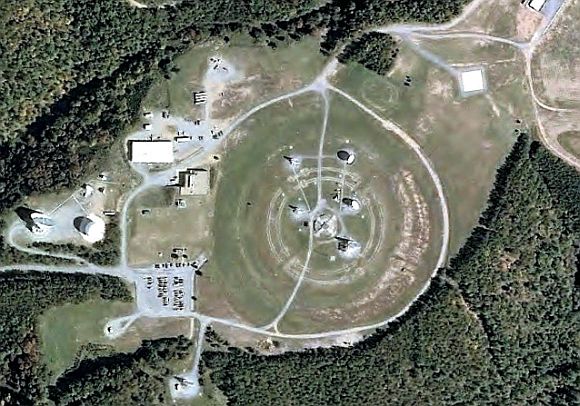
Sugar Grove, nestled in the mountains of West Virginia, is the location of an NSA facility which forms part of ECHELON, a global system of communications surveillance. More information can be found at the Navy Information Operations Command for the base — that is, if you have no qualms about agreeing to a Department of Defense consent agreement that says the US Government will thereafter have the right to seize your computer at any time! I’m not kidding.

And what do we learn about Sugar Grove in Top Secret America? Virtually nothing. It’s a red dot on the map (see the image at the top of this article).

But here’s the worst thing about Top Secret America: it is journalism that instead of providing in-depth exposure to a major political story will more likely have the effect of inoculating the issue.

While this country needs a wake-up call to the fact that its government is still locked in a Bush era fixation on national security, instead we are being cautioned that the crux of the issue primarily one of size. The national security industry in the US has grown out of control — oh yeah, I saw that report in the Washington Post. Big government. What’s new?

Sugar Grove, West Virginia - part of top secret America too secret for Top Secret America

Facebooktwittermail

The Post covers spy town

At the Atlantic, the independent investigative reporter, Tim Shorrock, slams the Washington Post‘s Top Secret America series:

Priest and Arkin offer an incredibly simplistic explanation for how the contracting bandwagon took off under President Bush, who they say manipulated “the federal budget process” to make it easier for agencies to hire contractors. Is that why Blackwater suddenly appeared on the scene in Afghanistan days after 9/11, signed up by counterterrorism official named Cofer Black who later joined the company? Is that how CACI International, a favorite of Donald Rumsfeld’s Pentagon, got the interrogation work at Abu Ghraib prison through an “IT” contract outsourced to the Interior Department? The Post also completely ignored the huge growth of contracting during the Clinton administration, which “reinvented” government by downsizing and outsourcing the federal workforce — including spies and surveillance teams in places like Bosnia. Many of the companies that are big wheels today got some of their first contracts during the late 1990s.

Worse, there is virtually nothing in the series about the deeper political questions raised by privatization, including the obvious issue of the revolving door. Unbelievably, Priest and Arkin don’t even mention that President Bush’s DNI, Mike McConnell, and President Obama’s counter-terrorism adviser, John Brennan, were both prominent contractors before taking their jobs. Why is that relevant? Well, McConnell came directly from Booz Allen Hamilton, one of the IC’s top contractors and an adviser to the NSA (and he’s back at Booz now). Brennan was an executive at The Analysis Corporation, which built a key terrorist database for the National Counterterrorism Center (which Brennan used to run).

There was not even a hint that Lt. Gen. James Clapper (ret.), who appeared before the Senate for his DNI confirmation hearing on the second day of the series, once had close ties to major contractors. Clapper once directed the National Geospatial-Intelligence Agency, which has extensive contracts with a satellite firm contracted by the government. Nor was there mention of the Intelligence and National Security Alliance, the largest association for NSA and CIA contractors, for which McConnell, Brennan, and Clapper have all served as chairman. That’s not part of the story? Could Clapper’s experience have influenced his strong defense of contractors during his testimony? Or would mentioning such ties hurt the Post’s access to the ODNI and the White House?

Despite Arkin’s much-vaunted reputation in collecting data, not even the charts are very good. The Post’s enormous database of contractors will be a useful tool for researchers and journalists, and certainly reveals the incredible scope of the industry (nothing new there though). But it does little to inform the public about what private corporations such as Lockheed Martin, SAIC, and Northrop Grumman actually do for the CIA and the dozens of intelligence units within the Pentagon. That’s partly because — as the authors admit in a note to readers — they removed certain “data points” at the suggestion of intelligence officials.

Therefore, you can look up a company like Booz Allen and see which agencies it holds contracts with and what kind of counter-terrorism, intelligence, or homeland security work it does; but you can’t learn what special tasks it carries out for specific agencies. Now some may applaud the Post for the omission, but I just see a failure to disclose.

Facebooktwittermail

Dynamic generals

(Updated below)

In the second article on its series on Top Secret America, the Washington Post looks at “National Security Inc” where the boundaries of government have dissolved in a defense-intelligence-corporate world.

To illustrate the way this world operates in the post-9/11 era, Dana Priest and William Arkin focus on one of the lead corporations: General Dynamics.

The evolution of General Dynamics was based on one simple strategy: Follow the money.

The company embraced the emerging intelligence-driven style of warfare. It developed small-target identification systems and equipment that could intercept an insurgent’s cellphone and laptop communications. It found ways to sort the billions of data points collected by intelligence agencies into piles of information that a single person could analyze.

It also began gobbling up smaller companies that could help it dominate the new intelligence landscape, just as its competitors were doing. Between 2001 and 2010, the company acquired 11 firms specializing in satellites, signals and geospatial intelligence, surveillance, reconnaissance, technology integration and imagery.

On Sept. 11, 2001, General Dynamics was working with nine intelligence organizations. Now it has contracts with all 16. Its employees fill the halls of the NSA and DHS. The corporation was paid hundreds of millions of dollars to set up and manage DHS’s new offices in 2003, including its National Operations Center, Office of Intelligence and Analysis and Office of Security. Its employees do everything from deciding which threats to investigate to answering phones.

General Dynamics’ bottom line reflects its successful transformation. It also reflects how much the U.S. government – the firm’s largest customer by far – has paid the company beyond what it costs to do the work, which is, after all, the goal of every profit-making corporation.

The company reported $31.9 billion in revenue in 2009, up from $10.4 billion in 2000. Its workforce has more than doubled in that time, from 43,300 to 91,700 employees, according to the company.

Revenue from General Dynamics’ intelligence- and information-related divisions, where the majority of its top-secret work is done, climbed to $10 billion in the second quarter of 2009, up from $2.4 billion in 2000, accounting for 34 percent of its overall revenue last year.

The company’s profitability is on display in its Falls Church headquarters. There’s a soaring, art-filled lobby, bistro meals served on china enameled with the General Dynamics logo and an auditorium with seven rows of white leather-upholstered seats, each with its own microphone and laptop docking station.

General Dynamics now has operations in every corner of the intelligence world. It helps counterintelligence operators and trains new analysts. It has a $600 million Air Force contract to intercept communications. It makes $1 billion a year keeping hackers out of U.S. computer networks and encrypting military communications. It even conducts information operations, the murky military art of trying to persuade foreigners to align their views with U.S. interests.

“The American intelligence community is an important market for our company,” said General Dynamics spokesman Kendell Pease. “Over time, we have tailored our organization to deliver affordable, best-of-breed products and services to meet those agencies’ unique requirements.”

In September 2009, General Dynamics won a $10 million contract from the U.S. Special Operations Command’s psychological operations unit to create Web sites to influence foreigners’ views of U.S. policy. To do that, the company hired writers, editors and designers to produce a set of daily news sites tailored to five regions of the world. They appear as regular news Web sites, with names such as “SETimes.com: The News and Views of Southeast Europe.” The first indication that they are run on behalf of the military comes at the bottom of the home page with the word “Disclaimer.” Only by clicking on that do you learn that “the Southeast European Times (SET) is a Web site sponsored by the United States European Command.”

What all of these contracts add up to: This year, General Dynamics’ overall revenue was $7.8 billion in the first quarter, Jay L. Johnson, the company’s chief executive and president, said at an earnings conference call in April. “We’ve hit the deck running in the first quarter,” he said, “and we’re on our way to another successful year.”

But here’s what’s remarkable about this description of General Dynamics: no mention of the way in which this company exemplifies in its governance the revolving door through which retired military officers and government officials cash in on their years of “public service.”

Nothing lubricates the wheels of defense commerce better than to have General Dynamics’ boardroom filled with retired generals and admirals:

  • Jay L. Johnson, Chairman and Chief Executive Officer — Retired Admiral, U.S. Navy. Chief of Naval Operations from 1996 to 2000.
  • George A. Joulwan, Director and Chairman, Compensation Committee — Retired General, U.S. Army. Supreme Allied Commander, Europe, from 1993 to 1997. Commander-in-Chief, Southern Command from 1990 to 1993.
  • Paul G. Kaminski, Director and Chairman, Finance and Benefit Plans Committee — Under Secretary of U.S. Department of Defense for Acquisition and Technology from 1994 to 1997.
  • John M. Keane, Director — Retired General, U.S. Army. Vice Chief of Staff of the Army from 1999 to 2003.
  • Lester L. Lyles, Director — Retired General, U.S. Air Force. Commander of the Air Force Materiel Command from 2000 to 2003. Vice Chief of Staff of the Air Force from 1999 to 2000.
  • Robert Walmsley, Director — Retired Vice Admiral, Royal Navy. Chief of Defence Procurement for the United Kingdom Ministry of Defence from 1996 to 2003.
  • The Washington Post article ends with the suggestion that government officials can be enticed with baubles as modest as a free pen, but the key nodes in the corrupt government-corporate nexus are clearly at the highest levels where tax dollars get siphoned into private bank accounts by retired generals and former government officials who smugly regard the practice as the way Washington works.

    Indeed it is — and it is the way capitalism corrupts democracy.

    Update: A reader has drawn my attention to the significance of the Crown family (which has been a strong financial supporter of Barack Obama since the 2003), Henry Crown being a Chicago financier and one of the richest, but least known, men in the US who acquired General Dynamics in 1959. Crown’s grandson, James S Crown, is currently Lead Director and Chairman of GD and also a director of J.P. Morgan Chase & Co. and Sara Lee Corporation.

    Through the Crown family, GD has strong ties to the Israeli defense industry.

    An article that appeared in Electronic Intifada in 2005 noted:

    A 2003 press release of the General Dynamics Ordnance and Tactical Systems business unit in St. Petersburg, Florida also noted that it had formed “a strategic alliance with Aeronautics Defense Systems, Ltd.,” an Israeli firm based in Yavne. Aeronautics Defense Systems Ltd. is the firm that developed the Unmanned Multi-Application System (UMASa) aerial surveillance tool which the Israeli military uses to “provide a real-time ‘bird’s eye view’ of the surveillance area to combatant commanders and airborne command posts.” According to Israeli Deputy Prime Minister Ehud Olmert, the agreement between General Dynamics and Aeronautics Defense Systems to bring together “both companies’ state-of-the art technologies in defense and homeland security” was “additional proof of the technological and commercial benefits that alliances between industries from the U.S. and Israel can produce.”

    From its investments in Pentagon war contractors like General Dynamics and U.S. real estate, the Crown family has accumulated a family fortune of $3.6 billion, according to a recent Forbes magazine estimate. A portion of the Crown family’s surplus wealth was apparently recently shifted to Brandeis University in Massachusetts in order to establish the “Crown Center for Middle East Studies.”

    According to the February 27, 2005 issue of the Jerusalem Post, “the center’s major funder, the Crown family of Chicago, is well-known for its support of sectarian Jewish causes, including the Ida Crown Jewish Academy, an orthodox day school in Chicago.” In addition to being a member of the General Dynamics corporate board, for instance, Lester Crown is a member of the board of The Jerusalem Foundation Inc. and a a member of Tel Aviv University’s Board of Governors. Lester Crown has also been actively involved with the American Jewish Committee and is a member of the advisory board of Medis Technologies, a joint venture business partner of Israel Aircraft Industries Ltd.

    In January 2008, during the presidential election, Lester Crown (father of James Crown) wrote a “Dear friends” letter to a large number of Jewish voters, titled “Barack Obama on Israel as a Jewish State.”

    “While my involvement in politics is motivated by a variety of issues, there is one issue that is fundamental: My deep commitment to Israel and to a strong U.S.-Israel relationship that strengthens both Israel’s security and its efforts to seek peace,” Crown wrote. “I am writing to share with you my confidence that Senator Barack Obama’s stellar record on Israel gives me great comfort that, as President, he will be the friend to Israel that we all want to see in the White House – stalwart in his defense of Israel’s security, and committed to helping Israel achieve peace with its neighbors.”

    Crown’s confidence in the reliability of his investment in Obama appears to have been well-founded.

    Professor John Mearsheimer from the University of Chicago, includes Crown among what he calls “new Afrikaners, who will support Israel even if it is an apartheid state. These are individuals who will back Israel no matter what it does, because they have blind loyalty to the Jewish state.”

    Facebooktwittermail

    America’s national security protection racket

    Every year, the images of a national security state careening out of control, as depicted in Terry Gilliam’s 1985 movie Brazil, become eerily more realistic. In his Ministry of Information, the underlings sneak their entertainment when the overseer steps out of sight, but at the National Counterterrorism Center (a “dumping ground for bad analysts“), entertainment (otherwise known as cable news) is on constant big-screen display.

    The Washington Post‘s investigation into “Top Secret America” reveals two sadly predictable tendencies:

    1. That the default position inside the US government remains: any problem can be solved if enough money is thrown at it, and
    2. the primary responsibility of an investigative reporter dealing with a story like this is supposedly to focus on whether taxpayers’ money is being well-spent and making us safer.

    The first feature article in the series says:

    At least 20 percent of the government organizations that exist to fend off terrorist threats were established or refashioned in the wake of 9/11. Many that existed before the attacks grew to historic proportions as the Bush administration and Congress gave agencies more money than they were capable of responsibly spending.

    The Pentagon’s Defense Intelligence Agency, for example, has gone from 7,500 employees in 2002 to 16,500 today. The budget of the National Security Agency, which conducts electronic eavesdropping, doubled. Thirty-five FBI Joint Terrorism Task Forces became 106. It was phenomenal growth that began almost as soon as the Sept. 11 attacks ended.

    Nine days after the attacks, Congress committed $40 billion beyond what was in the federal budget to fortify domestic defenses and to launch a global offensive against al-Qaeda. It followed that up with an additional $36.5 billion in 2002 and $44 billion in 2003. That was only a beginning.

    With the quick infusion of money, military and intelligence agencies multiplied. Twenty-four organizations were created by the end of 2001, including the Office of Homeland Security and the Foreign Terrorist Asset Tracking Task Force. In 2002, 37 more were created to track weapons of mass destruction, collect threat tips and coordinate the new focus on counterterrorism. That was followed the next year by 36 new organizations; and 26 after that; and 31 more; and 32 more; and 20 or more each in 2007, 2008 and 2009.

    In all, at least 263 organizations have been created or reorganized as a response to 9/11. Each has required more people, and those people have required more administrative and logistic support: phone operators, secretaries, librarians, architects, carpenters, construction workers, air-conditioning mechanics and, because of where they work, even janitors with top-secret clearances.

    The report continues:

    Not far from the Dulles Toll Road, the CIA has expanded into two buildings that will increase the agency’s office space by one-third. To the south, Springfield is becoming home to the new $1.8 billion National Geospatial-Intelligence Agency headquarters, which will be the fourth-largest federal building in the area and home to 8,500 employees. Economic stimulus money is paying hundreds of millions of dollars for this kind of federal construction across the region.

    It’s not only the number of buildings that suggests the size and cost of this expansion, it’s also what is inside: banks of television monitors. “Escort-required” badges. X-ray machines and lockers to store cellphones and pagers. Keypad door locks that open special rooms encased in metal or permanent dry wall, impenetrable to eavesdropping tools and protected by alarms and a security force capable of responding within 15 minutes. Every one of these buildings has at least one of these rooms, known as a SCIF, for sensitive compartmented information facility. Some are as small as a closet; others are four times the size of a football field.

    SCIF size has become a measure of status in Top Secret America, or at least in the Washington region of it. “In D.C., everyone talks SCIF, SCIF, SCIF,” said Bruce Paquin, who moved to Florida from the Washington region several years ago to start a SCIF construction business. “They’ve got the penis envy thing going. You can’t be a big boy unless you’re a three-letter agency and you have a big SCIF.”

    SCIFs are not the only must-have items people pay attention to. Command centers, internal television networks, video walls, armored SUVs and personal security guards have also become the bling of national security.

    “You can’t find a four-star general without a security detail,” said one three-star general now posted in Washington after years abroad. “Fear has caused everyone to have stuff. Then comes, ‘If he has one, then I have to have one.’ It’s become a status symbol.”

    Among the most important people inside the SCIFs are the low-paid employees carrying their lunches to work to save money. They are the analysts, the 20- and 30-year-olds making $41,000 to $65,000 a year, whose job is at the core of everything Top Secret America tries to do.

    At its best, analysis melds cultural understanding with snippets of conversations, coded dialogue, anonymous tips, even scraps of trash, turning them into clues that lead to individuals and groups trying to harm the United States.

    Their work is greatly enhanced by computers that sort through and categorize data. But in the end, analysis requires human judgment, and half the analysts are relatively inexperienced, having been hired in the past several years, said a senior ODNI official. Contract analysts are often straight out of college and trained at corporate headquarters.

    Nine years after the 9/11 attacks, the United States has a bloated national security structure of questionable effectiveness, at fantastic cost, and with very little accountability. Yet the analysis implies that if the system was more efficient and could indeed deliver as promised by making America safer, then this would indeed be a good thing.

    But do we need to be safer or simply less afraid?

    The explosion in the growth of the national security economy occurred right at the moment that the technology industry was desperate for support. The internet bubble had burst, an IPO no longer offered a path to quick fortunes for companies that had yet to develop an effective business model, so if the stock market was no longer willing to throw mountains of cash at speculative technological innovation, in the post 9/11 economy, the US government quickly became the investor of choice — at least for companies that could make a halfway plausible claim that their niche expertise might in some way enhance US national security.

    If greed was the engine of economic growth of the 90s, fear has demonstrated its economic value for most of the last decade. But what neither greed nor fear do is to improve the quality of life. That only happens when we look at the ways our lives are impoverished and address those needs.

    The need to feel safer is a need that has in large part been manufactured by those eager to capitalize on the economic value of fear.

    Just suppose that after 9/11 George Bush’s response had been this: clean up the mess in New York and Washington, improve security on airlines so no one could hijack a plane with a pocket knife, and then be done with it. Would we not now be living in a much better world?

    Perhaps we should be less afraid of those who might attack us than those who are in the business of protecting us. Top secret America looks like the biggest protection racket ever created.

    Facebooktwittermail

    Qualitative Military Edge — another name for Israeli brutality backed by the US

    On October 15, 2008, just three weeks before the US presidential election, George Bush signed into law the Naval Vessel Transfer Act which had been sponsored by one of Israel’s most loyal supporters in the US Congress, Rep. Howard Berman.

    The new law, which from its title might have been assumed to relate primarily to the sale of ships from the US Navy to foreign governments, actually had a much more important purpose: to place every American president under a legal obligation to ensure that Israel maintains its military dominance over the Middle East.

    What had previously been a matter of foreign policy, suddenly became law — law written to meet the interests of a foreign government.

    Israel’s regional hegemony is legally enshrined in the concept of Israel’s “Qualitative Military Edge” (QME). The US Government must now guarantee that “the sale or export of the defense articles or defense services will not adversely affect Israel’s qualitative military edge over military threats to Israel.”

    The law states:

    [T]he term ‘qualitative military edge’ means the ability to counter and defeat any credible conventional military threat from any individual state or possible coalition of states or from non-state actors, while sustaining minimal damages and casualties, through the use of superior military means, possessed in sufficient quantity, including weapons, command, control, communication, intelligence, surveillance, and reconnaissance capabilities that in their technical characteristics are superior in capability to those of such other individual or possible coalition of states or non-state actors. [Emphasis mine.]

    Andrew J Shapiro is the Assistant Secretary of State for Political-Military Affairs. One of his primary responsibilities is to ensure that Israel maintains its qualitative military edge. Does he serve the US government or the Israeli government? It’s far from clear.

    This is how he presented the United States’ obligation to serve Israel’s interests in a speech he delivered at the Brookings Institute in Washington on Friday:

    For decades, the cornerstone of our security commitment to Israel has been an assurance that the United States would help Israel uphold its qualitative military edge — a commitment that was written into law in 2008. Israel’s QME is its ability to counter and defeat credible military threats from any individual state, coalition of states, or non-state actor, while sustaining minimal damages or casualties. The Obama Administration has demonstrated its commitment to Israel’s QME by not only sustaining and building upon practices established by prior administrations, but also undertaking new initiatives to make our security relationship more intimate than ever before.

    Each and every security assistance request from the Israeli Government is evaluated in light of our policy to uphold Israel’s Qualitative Military Edge. At the same time, QME considerations extend to our decisions on defense cooperation with all other governments in the region. This means that as a matter of policy, we will not proceed with any release of military equipment or services that may pose a risk to allies or contribute to regional insecurity in the Middle East.

    The primary tool that the United States uses to ensure Israel’s qualitative military edge is security assistance. For some three decades, Israel has been the leading beneficiary of U.S. security assistance through the Foreign Military Financing program, or FMF. Currently, Israel receives almost $3 billion per year in U.S. funding for training and equipment under FMF. The total FMF account is $5 billion annually and is distributed among some 70 countries. So it is a testament to our special security relationship that each year Israel accounts for just over 50 percent of U.S. security assistance funding distributed through FMF.

    The Obama Administration is proud to carry on the legacy of robust U.S. security assistance for Israel. Indeed, we are carrying this legacy to new heights at a time when Israel needs our support to address the multifaceted threats it faces.

    For Fiscal Year 2010, the Administration requested $2.775 billion in security assistance funding specifically for Israel, the largest such request in U.S. history. Congress fully funded our request for FY 2010, and we have requested even more — $3.0 billion — for FY 2011. These requests fulfill the Administration’s commitment to implementing the 2007 memorandum of understanding with Israel to provide $30 billion in security assistance over 10 years.

    This commitment directly supports Israel’s security, as it allows Israel to purchase the sophisticated defense equipment it needs to protect itself, deter aggressors, and maintain its qualitative military edge. Today, I can assure you that — even in challenging budgetary times — this Administration will continue to honor this 10-year, $30 billion commitment in future fiscal years. [Emphasis mine.]

    Code Pink’s Medea Benjamin challenged Shapiro during Q&A:

    [I]t pains me to hear you sound more like an agent of the Israeli government than a U.S. representative because as you travel around the world you see that this “special relationship” really endangers us, makes us more hated around the world. So I wonder if you would be willing to step in other shoes and go to Gaza, see the results of the Israeli invasion there, see the destruction, talk to people in Gaza, talk to the elected government, which is Hamas. You don’t have to like them to talk to them. I also wonder if you’ve spent any time with people in the West Bank and East Jerusalem to see what it feels like for Palestinians, the daily humiliations they suffer.

    And I also wonder, given the financial crisis here at home and the great needs of impoverished nations around the world, couldn’t you think of a better use of $3 billion than giving it to a wealthy country like Israel that is abusing the human rights of Palestinians on a daily basis?

    Benjamin drew a round of applause — Shapiro declined to respond directly to her challenge.

    As Shapiro noted, the concept of Israel’s QME has been in use for decades, but it was only when the Bush administration let Israel draft American law, that QME turned into a license to use force with impunity.

    In January 2008, William Wunderle, a U.S. Army lieutenant colonel, and Andre Briere, a U.S. Air Force lieutenant colonel, wrote in a paper for The Washington Institute for Near East Policy:

    The US commitment to maintain Israel’s qualitative military edge (QME) is a long-standing tradition that every president since Lyndon Johnson has maintained and reiterated. The basic principle behind this commitment is simple: Israel is a bastion of liberal representative government in the Middle East, and, as such, its continued survival is a vital national interest of the United States. To ensure this longtime ally’s continued existence in a sea of nations that reflexively call for its destruction, Israel must be able to defend itself militarily and deter potential aggression. In this effort, Israel will always be militarily outnumbered with regard to the artillery, tanks, and combat aircraft that can be deployed by a coalition of Arab states. Israel’s continued survival can be ensured only if it is able to maintain qualitative military superiority, relying on superior weaponry, tactics, training, leadership, and other factors of military effectiveness to deter or defeat its numerically superior adversaries in the Middle East.

    In other words, the US policy advocated that Israel should be able to counter a quantitative disadvantage with a qualitative advantage. It said nothing about supporting Israel’s use of that advantage at minimal cost. The expression after all was qualitative military edge — not supremacy.

    These analysts noted however that:

    Israel defines QME as “the ability to sustain credible military advantage that provides deterrence and, if need be, the ability to rapidly achieve superiority on the battlefield against any foreseeable combination of forces with minimal damage and casualties.”

    The Israeli phrasing went straight into US law which says that Israel must maintain the ability to use military force “while sustaining minimal damages and casualties.”

    Let’s put that in context. The law was signed just two years after Israel had visibly lost its qualitative military edge in Lebanon in 2006 when it faced Hezbollah, and less than three months before it used the assault on Gaza to once again demonstrate its ability to wreak massive destruction while sustaining minimal damages and casualties.

    The war on Gaza, which President-elect Obama watched in silence, showed not merely the brutality that Israel is willing to use under America’s political protection, but the extent to which Israel’s military agenda is empowered through its ability to control the United States Government.

    The war on Gaza was QME in action.

    Facebooktwittermail

    Does the CIA know how to invest wisely?

    “You don’t give something for nothing,” a CIA official told the Washington Post while trying to justify the $5 million payment made to Shahram Amiri, an Iranian nuclear scientist whose American dream turned out to be so short-lived it raised questions about whether his original defection was genuine. He arrived back in Tehran on Thursday, receiving a hero’s welcome.

    Whether the agency received an adequate return on its investment in Amiri is difficult to assess. The size of the payment might offer some measure of the value of the information he shared. But it could also reflect a level of eagerness within the U.S. intelligence community for meaningful information on Iran.

    Eagerness for success is what led seven Americans to their deaths at the end of last year as they were lured into a trap by a Jordanian doctor named Humam Khalil Abu-Malal al-Balawi when he blew himself up in the CIA base in Khost.

    The case of Amiri might not have done as much damage to the Agency, but the assumption that everyone has their price — what amounts to an article of faith in a land where wealth has been deified — is a naive American perspective that repeatedly results in a distorted view of the world.

    As for whether Amiri really was, as ABC News reported, one of the CIA’s “most valued former spies,” I have a hard time believing that a prize nuclear scientist would not already have a PhD. (The desire to acquire a doctorate was supposedly one of his reasons for coming to the US.) More likely, Amiri was a “prize catch” simply because he was willing to accept the prize.

    Facebooktwittermail

    An Iranian nuclear espionage mystery

    ABC News reports:

    The CIA has lost one of its most valued former spies.
    Iranian nuclear scientist Shahram Amiri, who defected to the US, is now on his way back home to Tehran after a very messy and public re-defection. ABC News obtained exclusive photos of Amiri leaving Washington’s Dulles International Airport late Tuesday night on a commercial flight to Doha, Qatar, en route to Iran.

    Amiri was escorted directly to the jetway entrance by a security officer. He was flanked by what appeared to be a U.S. official and a representative from the Pakistani Embassy in Washington. He boarded the Qatar Airways flight ahead of the other passengers, and spoke only to his companions. After more than a year in the US, Amiri claimed he had never really defected. In a series of videos released on the internet, he insisted that he had been kidnapped, drugged and tortured by the CIA. The US flatly denies that it ever held Amiri against his will.

    The Washington Post columnist and unofficial spokesman for the CIA, David Ignatius, attributes Amiri’s departure to a change of heart.

    The CIA has struggled for decades with how to handle defectors better so that they are happy in a strange new land. The agency periodically tries to improve its tradecraft in working with these skittish guests. But defectors are trouble. They are like small boats in a heavy sea, not sure which way is home.

    But Ignatius concedes that it is hard to understand why the Iranian scientist would have defected while leaving his wife and child behind. That detail, along with the deaths of Ardeshire Hassanpour and Masoud Alimohammadi, might seem to reinforce the claim that Amiri was in fact abducted and that all three cases be seen in the context of a US-backed, Israeli-led covert war targeting Iran’s nuclear programme.

    What seems more likely however, is that the Iranians took the CIA for a ride — that Amiri’s “defection” took place so the Iran could glean more about the extent of American knowledge about its nuclear program and that the information he gathered was worth more valuable than the information he gave away.

    Facebooktwittermail

    Petraeus: mission will be accomplished

    Predicting what will happen in Afghanistan is about as wise as declaring “mission accomplished.” As he arrived to take over command of US forces in what has become America’s longest war, Gen David Petraeus might not have actually predicted the outcome of the war but he certainly narrowed what can be deemed an acceptable conclusion:

    In a ceremony on the tree-shaded lawn in front of NATO headquarters in Kabul, Petraeus assumed command from Gen. Stanley A. McChrystal, who was fired last month after a magazine quoted him and his staff making critical remarks about Obama administration officials.

    A general with a sterling reputation for military creativity and political acumen, Petraeus, 57, struck a determined tone in his remarks to fellow officers, foreign diplomats and Afghan officials, insisting “we are in this to win.”

    “We’re engaged in a contest of wills. Our enemies are doing all that they can to undermine the confidence of the Afghan people,” he said.

    Before he mentioned the Taliban, Petraeus described those enemies as “al-Qaeda and its network of extremist allies,” harking back to the justification for invasion nine years ago. He said his mission is to demonstrate to Afghanistan and the world that the extremists “will not be allowed to once again establish sanctuaries in Afghanistan from which they can launch attacks on the Afghan people and on freedom-loving nations around the world.”

    “We must demonstrate to the people and to the Taliban that Afghan and [U.S. and coalition] forces are here to safeguard the Afghan people, and that we are in this to win,” he said. “That is our clear objective.”

    This commitment to safeguard the civilian population has inevitably been called into question each time an operation results in civilian casualties, yet Petraeus is now under great pressure to make it easier for his troops to fight.

    A few days before Gen McChrystal got fired, CJ Chivers, a former US marine who now reports for the New York Times, wrote:

    It is an axiom of military service that troops gripe; venting is part of barracks and battlefield life. Troops complain about food, equipment, lack of sleep, delays in their transportation and the weather where they work.

    Complaints about how they are allowed to fight are another matter and can be read as a sign of deeper disaffection and strains within the military over policy choices. One Army colonel, in a conversation this month, said the discomfort and anger about the rules had reached a high pitch.

    “The troops hate it,” he said. “Right now we’re losing the tactical-level fight in the chase for a strategic victory. How long can that be sustained?”

    The Los Angeles Times reports today:

    At his Senate confirmation hearings last week, Petraeus said he foresaw no major shift in strategy in the Afghanistan war. But he has made it clear that even if the rules of engagement do not change, the nuances of how they are implemented will get a close new look.

    Assuming command Sunday, Petraeus told his troops that while civilian safety remains a critical consideration, “as you and our Afghan partners on the ground get into tough situations, we must employ all assets to ensure your safety.”

    It was a remark apparently intended to reassure troops that the safeguarding of Afghans was not to come at the expense of military lives.

    The problem with this idea that a balance can be struck between reducing the risks faced by Afghan civilians without putting American soldiers at unnecessary risk is that it implicitly overstates the military’s commitment to a humanitarian mission. The Pentagon is assuming a posture as though it treats all lives as being of equal value, yet the truth — transparent to everyone — is that America regards its soldiers’ lives as being of vastly greater value than the those of the citizens in any of the nations the US has decided to “save.”

    Embedded in this is what I call the evangelical conceit: I know better than you do, what’s good for you; you will become better than you are, if you become more like me. It is the antithesis of respect, but describes the mindset with which so many Americans venture into the world on their military and religions missions.

    Facebooktwittermail

    Petraeus schemed with neocon columnist to push pro-Israel pap

    Philip Weiss reveals:

    Last March General David Petraeus, then head of Central Command, sought to undercut his own testimony before the Senate Armed Services Committee that was critical of Israel by intriguing with a rightwing writer to put out a different story, in emails obtained by Mondoweiss.

    The emails show Petraeus encouraging Max Boot of Commentary to write a story — and offering the neoconservative writer choice details about his views on the Holocaust:

    Does it help if folks know that I hosted Elie Wiesel and his wife at our quarters last Sun night?! And that I will be the speaker at the 65th anniversary of the liberation of the concentration camps in mid-Apr at the Capitol Dome…

    Petraeus passed the emails along himself through his own carelessness last March. He pasted a Boot column from Commentary‘s blog into in an “FYI” email he sent to an activist who is highly critical of the U.S.’s special relationship with Israel. Some of the general’s emails to Boot were attached to the bottom of the story. The activist, James Morris, shared the emails with me.

    Facebooktwittermail

    Mainstreaming realism

    It was widely assumed that George Bush’s departure from Washington would coincide with a revival of strength for the reality-based community — the people the neocons swept aside for the sake of empire. But though the neocon dream was quick to perish, the reality-based community is still struggling to assert itself — at least inside the nation’s capital.

    It turns out that Tampa, Florida, where CENTCOM is headquartered (and where General David Petraeus was in charge before being sent to Kabul), is more amenable to the expression of realism.

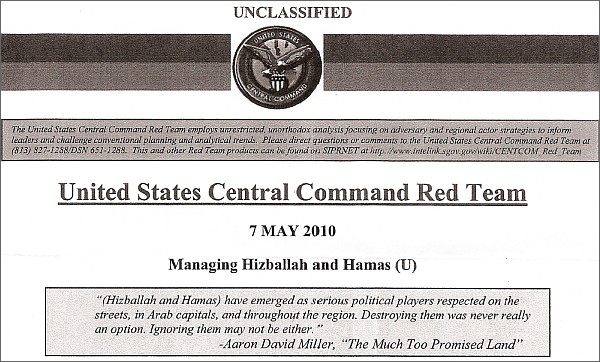
    Since its publication in Foreign Policy yesterday, a report by Mark Perry has been causing a stir. In “Red Team — CENTCOM thinks outside the box on Hamas and Hezbollah,” Perry writes:

    While it is anathema to broach the subject of engaging militant groups like Hizballah and Hamas in official Washington circles (to say nothing of Israel), that is exactly what a team of senior intelligence officers at U.S. Central Command — CENTCOM — has been doing. In a “Red Team” report issued on May 7 and entitled “Managing Hizballah and Hamas,” senior CENTCOM intelligence officers question the current U.S. policy of isolating and marginalizing the two movements. Instead, the Red Team recommends a mix of strategies that would integrate the two organizations into their respective political mainstreams. While a Red Team exercise is deliberately designed to provide senior commanders with briefings and assumptions that challenge accepted strategies, the report is at once provocative, controversial — and at odds with current U.S. policy.

    Among its other findings, the five-page report calls for the integration of Hizballah into the Lebanese Armed Forces, and Hamas into the Palestinian security forces led by Fatah, the party of Palestinian Authority President Mahmoud Abbas. The Red Team’s conclusion, expressed in the final sentence of the executive summary, is perhaps its most controversial finding: “The U.S. role of assistance to an integrated Lebanese defense force that includes Hizballah; and the continued training of Palestinian security forces in a Palestinian entity that includes Hamas in its government, would be more effective than providing assistance to entities — the government of Lebanon and Fatah — that represent only a part of the Lebanese and Palestinian populace respectively” (emphasis in the original). The report goes on to note that while Hizballah and Hamas “embrace staunch anti-Israel rejectionist policies,” the two groups are “pragmatic and opportunistic.”

    To call the Red Team report a “deliberately provocative piece” — as Spencer Ackerman describes it — is to misinterpret the intelligence team’s brief in providing what they do call “unorthodox analysis.”

    A Red Team’s approach merely attempts to look at an issue from a broader perspective than the one that military culture engenders. The goal, nevertheless, is objectivity. This isn’t simply an exercise in creative thinking.

    Consider, for instance, this uncontroversial observation in the report (written before the recent international outcry demanding a swift end to the siege of Gaza):

    The hardships in Gaza may be radicalizing more people, especially the young, and increasing the number of potential recruits for HAMAS. This is the opposite effect Israel thought the blockade would have in Gaza, hoping instead that people would see HAMAS as the cause of their suffering and turn against it.

    Yet even today while it is clear to rest of the world that Israel’s divide-and-rule strategy in Gaza has failed, Israel’s deputy foreign minister Danny Ayalon wrote on Twitter: “Our position is to differentiate between Hamas, the occupiers of Gaza, and the civilian population.”

    Gaza under occupation — by Hamas!

    Ayalon might imagine he’s cleverly modifying the concept of “occupation” but the twist will persuade no one in Gaza, which — an ease to the restrictions on the flow of goods notwithstanding — remains the world’s largest prison.

    Indeed, the seeming intransigence of Hamas has been in response to this very fact: that the reward for the moderation that the Palestinian Authority has already exhibited and in whose footsteps Hamas is being implored to follow is not self determination but an occupation with no end in sight. In this respect, Hamas, far from representing the extreme position it is claimed to hold, exhibits a sober realism, which is to say, it sees little evidence that concessions by Palestinians are matched with concessions by Israel.

    CENTCOM’s Red Team may have concerned themselves only with the issue of “mainstreaming” Hamas and Hezbollah yet the possibility of that happening may depend less on the internal workings of each Islamist organization and more on the extent to which realism can be mainstreamed inside Washington.

    The Obama administration’s support for the Supreme Court’s recent ruling in favor of a ridiculously broad interpretation of the meaning of “material support” (as applied to so-called Foreign Terrorist Organizations and thus both Hamas and Hezbollah) is not a promising sign.

    Facebooktwittermail

    The price of perpetual war

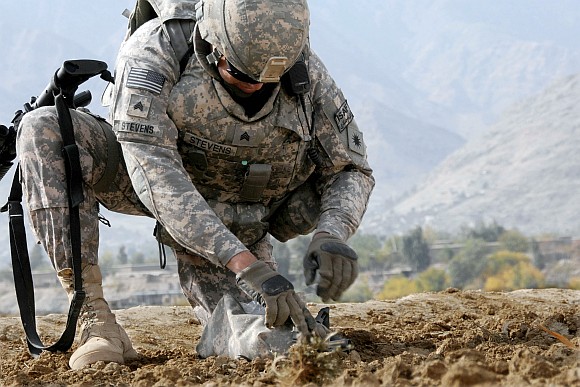
    Sgt. Jason Stevens, a horticulturist with the California Army National Guard's 40th Infantry Division Agribusiness Development Team, gathers a soil sample from a field alongside the main road in Marawara, Afghanistan, Nov. 23, 2009. The ADT stopped in Marawara to meet with local farmers about their crop output and farming in the area, as well as to gather soil samples to learn how crop production might be increased in the area.

    If wars could be won through slick advertising, no one would be better qualified to become the US commander in Afghanistan than General David Petraeus.

    This is how he recently encapsulated his wisdom on counterinsurgency:

    We have learned above all that, in campaigns such as those in Iraq or Afghanistan, the human terrain is the decisive terrain. We have to understand the people, their culture, their social structures and how systems to support them are supposed to work — and how they do work. And our most important tasks have to be to secure and to serve the people, as well as to respect them and to facilitate the provision of basic services, the establishment of local governance and the revival of local economies.

    That’s a fine wish list — and to be fair, Petraeus makes no claims about the success of the US military in accomplishing these aims. Indeed, he concedes that success in the war is likely to go to whichever side is swifter to learn and adapt.

    It might not quite rise to the level of being a law of physics, but the capacity for massive organizations to swiftly learn and adapt is about as great as the ability of oil tankers to make sudden U-turns. It doesn’t matter who’s in charge or how gifted he might be in charming the US Congress.

    But Petraeus’ problems run deeper than the structural limitations of the military. As Andrew Bacevich makes clear, the US military is now suffering the corrupting effect of endless war. Far from seeing Gen Stanley McChrystal’s recently revealed contempt for civilian command as exceptional, Bacevich sees strong indications that the problem is systemic.

    In the seemingly endless wars of the post-Sept. 11 era, a military that has demonstrated remarkable durability now shows signs of coming undone at the top. The officer corps is losing its bearings.

    Americans might do well to contemplate a famous warning issued by another frustrated commander from a much earlier age.

    “We had been told, on leaving our native soil,” wrote the centurion Marcus Flavius to a cousin back in Rome, “that we were going to defend the sacred rights conferred on us by so many of our citizens [and to aid] populations in need of our assistance and our civilization.” For such a cause, he and his comrades had willingly offered to “shed our quota of blood, to sacrifice our youth and our hopes.” Yet the news from the homeland was disconcerting: The capital was seemingly rife with factions, treachery and petty politics. “Make haste,” Marcus Flavius continued, “and tell me that our fellow citizens understand us, support us and protect us as we ourselves are protecting the glory of the empire.”

    “If it should be otherwise, if we should have to leave our bleached bones on these desert sands in vain, then beware of the anger of the legions!”

    Stanley McChrystal is no Marcus Flavius, lacking the Roman’s eloquence, among other things. Yet in ending his military career on such an ignominious note, he has, however clumsily, issued a warning that deserves our attention.

    The responsibility facing the American people is clear. They need to reclaim ownership of their army. They need to give their soldiers respite, by insisting that Washington abandon its de facto policy of perpetual war. Or, alternatively, the United States should become a nation truly “at” war, with all that implies in terms of civic obligation, fiscal policies and domestic priorities. Should the people choose neither course — and thereby subject their troops to continuing abuse — the damage to the army and to American democracy will be severe.

    Whether for an individual or an nation, change often hinges on reaching a point where the status quo is intolerable.

    Over the last decade, perpetual war, far from becoming less tolerable has on the contrary become easier to ignore. It is the backdrop to normalcy — just like climate change — in a culture that barely has any sense of gravity.

    Facebooktwittermail

    Grave injustice: Maher Arar and unaccountable America

    At Middle East Report Online, Lisa Hajjar writes:

    On June 14, the Supreme Court buried the prospect of justice for Maher Arar, a Canadian citizen of Syrian origin who was “extraordinarily rendered” by the United States (via Jordan) to Syria in 2002. Arar was suing the US officials who authorized his secret transfer, without charge, to a country infamous for torture. With the justices’ 22-word statement, the case of Arar v. Ashcroft exited the American legal system and entered the annals of American legal history under the category “grave injustice.” Alphabetically, Arar precedes Dred Scott v. Sanford, which upheld slavery, and Korematsu v. United States, which upheld the internment of Japanese Americans. In this case, however, the grave is literal: Arar spent ten months of his year in Syrian custody confined in what he describes as “an underground grave.”

    Facebooktwittermail

    Idiocy holds sway on the Supreme Court and inside the Obama administration

    It seems hard to fathom but the evidence is now overwhelming: if someone repeats the word “terrorist” often enough their brain will become functionally useless.

    Consider the Supreme Court’s decision on Monday in support of the Obama administration’s sweeping definition of “material support” as applied to so-called Foreign Terrorist Organizations (FTO) — a designation applied by the State Department.

    If an NGO such as the Humanitarian Law Project (HLP) wants to train a group such as the Kurdistan Workers’ Party (PKK) on how to use humanitarian and international law to peacefully resolve disputes, then the HLP risks criminal prosecution. Why? Such training could help legitimize the PKK and also free up resources that it can dedicate to its terrorist activities.

    Solicitor General Elena Kagan (who is nominated to become a Supreme Court Justice) argued the case for the Obama administration.

    Kay Guinane described the decision:

    The Court ruled that even though pure speech is entitled to a high level of constitutional scrutiny, it would forgo such scrutiny and defer to Congress and the executive branch, which asserted unsupported, theoretical findings that support aimed at countering violence can somehow indirectly support violence. The Court’s reasoning was that the matter involves national security.

    With its overly deferential approach, the Court failed to fulfill its responsibilities in the checks-and-balances system that keeps our democracy healthy. If it had looked behind the broad generalizations cited by the government, it would have seen there are no facts either in the Congressional Record or elsewhere that support the Congressional or State Department “findings.” And even if there are some circumstances where conflict mediation and human rights training can be co-opted to support violence, it is not inevitable that it will happen in all cases.

    For an obvious example of the fault in the findings, one need look no further than the Good Friday Accords that brought a lasting peace to Northern Ireland for the first time in more than eight centuries. For years, non-governmental organizations (NGOs) had worked to bring violent factions of Catholics and Protestants to the bargaining table. Their work behind the scenes was instrumental in persuading those groups — “terrorists” in the eyes of most of their captive civilian populations, as well as the governments seeking to disarm them — to put down their weapons and negotiate a peaceful resolution to 850 years of violence.

    If the “material support” law had been in place, as authorized by the Supreme Court today, those organizations would have been criminals. And the people of Northern Ireland would likely still be victims of sectarian violence that only a very few supported.

    “Orwellian” doesn’t begin to describe a law that makes it a crime to promote peaceful conflict resolution.

    If the administration actually intends to uphold the law in the way they argue it should be applied, then the Israeli-Palestinian conflict can be expected to continue forever.

    There is a rather broad consensus among foreign policy analysts in the US and Europe, that Hamas, a designated FTO, has far too much grassroots political support among ordinary Palestinians for the organization to be destroyed. Neither Israel’s war on Gaza nor it’s internationally supported siege of Gaza, succeeded in bringing the Islamist organization and democratically-elected government to its knees.

    If the Obama administration wants to revive the Middle East peace process, sooner or later Hamas will have to be involved. It’s hard if not impossible to anticipate that those involved in the initial efforts to open dialogue with Hamas can avoid falling foul of the broad definition of “material support” that the Supreme Court has just upheld.

    The Obama administration told the Supreme Court that the United States is engaged in an effort to “delegitimize and weaken” groups such as Hamas, yet it would behoove Washington and democratic governments everywhere to remember where political legitimacy springs from: not idiotic Supreme Court rulings, but the will of the people — and that includes the Palestinians.

    Facebooktwittermail

    Risk-free killing and the fear of death

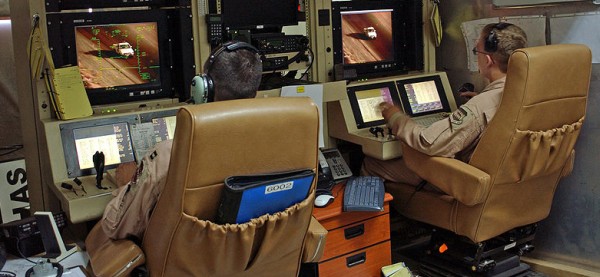
    There was an age when those afraid of dying knew they should, if they could, stay away from war. They could instead, if so inclined, read about war and fantasize about battlefield heroics from the comfort of an armchair. Nowadays, America’s newest class of warriors enjoy the same comfort with as little risk.

    Tom Engelhardt writes:

    The drone is our latest wonder weapon and a bragging point in a set of wars where there has been little enough to brag about.

    CIA director Leon Panetta has, for instance, called the Agency’s drones flying over Pakistan “the only game in town” when it comes to destroying al-Qaeda; a typically anonymous U.S. official in a Washington Post report claims of drone missile attacks, “We’re talking about precision unsurpassed in the history of warfare”; or as Gordon Johnson of the Pentagon’s Joint Forces Command told author Peter Singer, speaking of the glories of drones: “They don’t get hungry. They are not afraid. They don’t forget their orders. They don’t care if the guy next to them has been shot. Will they do a better job than humans? Yes.”

    Seven thousand of them, the vast majority surveillance varieties, are reportedly already being operated by the military, and that’s before swarms of “mini-drones” come on line. Our American world is being redefined accordingly.

    In February, Greg Jaffe of the Washington Post caught something of this process when he spent time with Colonel Eric Mathewson, perhaps the most experienced Air Force officer in drone operations and on the verge of retirement. Mathewson, reported Jaffe, was trying to come up with an appropriately new definition of battlefield “valor” — a necessity for most combat award citations — to fit our latest corps of pilots at their video consoles. “Valor to me is not risking your life,” the colonel told the reporter. “Valor is doing what is right. Valor is about your motivations and the ends that you seek. It is doing what is right for the right reasons. That to me is valor.”

    There is a simple calculus upon which American warfare depends: the fewer Americans get killed, the longer the war can continue.

    Maimed Americans don’t count. As for dead or maimed non-Americans, they are a variable part of the calculus, problematic or not depending on the circumstances.

    The Pentagon’s love of the drone is Washington’s dread of the dead — let’s not pretend that valor has any place in this equation.

    When through the press of a button a soldier in an air-conditioned office rains down death and destruction thousands of miles away, whatever military virtues he might possess, there’s no reason to assume they include bravery. Indeed, the risk-free killing of remote warfare is really the most cowardly form of combat, far removed as it is from battlefields that demand courage because the killers risk being killed.

    In Shakespeare’s Henry V, as the Battle of Agincourt is about to commence, the king addresses his men — “We few, we happy few, we band of brothers” — heavily outnumbered by the French and facing the risk of imminent slaughter.

    Henry — a king who fights with his men and doesn’t simply issue commands — declares:

    … he which hath no stomach to this fight,
    Let him depart; his passport shall be made,
    And crowns for convoy put into his purse;
    We would not die in that man’s company
    That fears his fellowship to die with us.

    To the extent that there is a noble dimension to warfare it is this: that those willing to kill are also willing to die. Those taking the lives of others do so knowing that just as easily they could lose their own.

    The technological advance of war has broken this equation and broken it so thoroughly that not only does the new class of drone-armed killers face no risk of being killed; they may not even lose any sleep.

    Facebooktwittermail

    Was McChrystal ready to get pushed out?

    The problem with owning a military strategy the way Gen Stanley McChrystal owned the counterinsurgency strategy at the center of the war in Afghanistan, is that it’s hard to admit it’s not working. It might be easier just to get fired.

    Are we really supposed to believe that McChrystal knew so little about journalism or the magazine that he couldn’t have anticipated what kind of material would end up in his Rolling Stone profile? And more to the point, is it conceivable that another story from just two years ago somehow escaped his attention: the Esquire profile of Admiral William Fallon that led to his swift resignation?

    On some level, most indiscretions can be seen as a loss of faith.

    Meanwhile, in a short follow up to profile that toppled McChrystal, Michael Hastings writes at Rolling Stone:

    President Obama, in announcing the replacement of Gen. Stanley McChrystal moments ago, sought to reassure the American people about the war in Afghanistan. “This is a change in personnel,” he declared, “but not a change in policy.”

    That’s precisely the problem.

    Changing generals isn’t likely to resolve the real trouble in Afghanistan: the fundamental flaws in the U.S. strategy of counterinsurgency.

    So why did the president pick David Petraeus, the most political — and media-savvy — general of his generation, to replace McChrystal? Petraeus makes sense. He’s considered the hero of Iraq, and he has the public’s trust. He won’t be caught dead calling the offensive in Marja a “bleeding ulcer,” as McChrystal did. His appointment neutralizes him as a potential (though highly unlikely) political rival for 2012. He literally wrote the book on counterinsurgency, drafting the Army field manual on the U.S. strategy that is being pursued in Afghanistan. Above all, he is a master at crafting a narrative that Americans are eager to hear. He has almost single-handedly convinced many Washington insiders that his “surge” in Iraq resulted in some kind of major victory in Mesopotamia — a notion that is right up there with thinking that Pizza Hut has good pizza.

    Here is the narrative we’re about to be sold: Things will be tough in Afghanistan. It’s going to get worse before it gets better. But eventually, with good old American perseverance, violence will drop (fingers crossed). When that happens, U.S. soldiers will stop dying in large numbers — and Americans will stop paying attention in large numbers.

    Thomas Barnett, whose Esquire profile led to Admiral Fallon’s undoing, suggests that Petraeus will now have a bigger say in the conduct of the war than does his own commander in chief:

    If Petraeus says the strategy needs more time, then Obama’s running for re-election as a wartime president. Period. There’s just no way that Obama can overrule Petraeus on this one without wounding himself politically. McChrystal had been signaling that Obama’s summer 2011 deadline to begin withdrawing combat troops was too optimistic. Expect Petraeus to press that case — however subtly — from day one.

    Facebooktwittermail