Category Archives: US government

Can Obama take charge?

Paul Krugman describes the current crisis in Washington and its parallels with the collapse of Poland at the end of the eighteenth century:

…given the state of American politics, the way the Senate works is no longer consistent with a functioning government. Senators themselves should recognize this fact and push through changes in those rules, including eliminating or at least limiting the filibuster. This is something they could and should do, by majority vote, on the first day of the next Senate session.

Don’t hold your breath. As it is, Democrats don’t even seem able to score political points by highlighting their opponents’ obstructionism.

It should be a simple message (and it should have been the central message in Massachusetts): a vote for a Republican, no matter what you think of him as a person, is a vote for paralysis. But by now, we know how the Obama administration deals with those who would destroy it: it goes straight for the capillaries. Sure enough, Robert Gibbs, the White House press secretary, accused Mr. Shelby of “silliness.” Yep, that will really resonate with voters.

After the dissolution of Poland, a Polish officer serving under Napoleon penned a song that eventually — after the country’s post-World War I resurrection — became the country’s national anthem. It begins, “Poland is not yet lost.”

Well, America is not yet lost. But the Senate is working on it.

The problem with locating the root of the problem in what has become a dysfunctional Senate, is that it turns the administration into a victim. Krugman might bemoan the White House’s ineffectual defense mechanisms but he’s essentially sidelining the heart of the problem: a weak president.

Facebooktwittermail

‘When Guantanamo walked in the door, Rahm walked out’

In her New Yorker piece on Attorney General Eric Holder and the Khalid Sheikh Mohammed trial, Jane Mayer describes White House Chief of Staff, Rahm Emanuel’s role in blocking the investigation of torture by the CIA:

Emanuel viewed many of the legal problems that [Greg] Craig [Obama’s first White House counsel] and Holder were immersed in as distractions. “When Guantánamo walked in the door, Rahm walked out,” the informed source said. Holder and Emanuel had been collegial since their Clinton Administration days. Holder’s wife, Sharon Malone, an obstetrician, had delivered one of Emanuel’s children. But Emanuel adamantly opposed a number of Holder’s decisions, including one that widened the scope of a special counsel who had begun investigating the C.I.A.’s interrogation program. Bush had appointed the special counsel, John Durham, to assess whether the C.I.A. had obstructed justice when it destroyed videotapes documenting waterboarding sessions. Holder authorized Durham to determine whether the agency’s abuse of detainees had itself violated laws. Emanuel worried that such investigations would alienate the intelligence community. But Holder, who had studied law at Columbia with Telford Taylor, the chief American prosecutor in the Nuremberg trials, was profoundly upset after seeing classified documents explicitly describing C.I.A. prisoner abuse. The United Nations Convention Against Torture requires the U.S. to investigate credible torture allegations. Holder felt that, as the top law-enforcement officer in the U.S., he had to do something.

Emanuel couldn’t complain directly to Holder without violating strictures against political interference in prosecutorial decisions. But he conveyed his unhappiness to Holder indirectly, two sources said. Emanuel demanded, “Didn’t he get the memo that we’re not re-litigating the past?”

Facebooktwittermail

Iran ratchets up atom work despite sanctions threat

Reuters reports:

Iran’s president gave instructions on Sunday for the production of higher-grade nuclear reactor fuel, prompting the United States and Germany to threaten carefully targeted new sanctions against Tehran.

President Mahmoud Ahmadinejad’s announcement raised the stakes in Iran’s dispute with the West, but he said talks were still possible on a nuclear swap offer by world powers designed to allay fears the Islamic Republic is making an atomic bomb.

U.S. Defense Secretary Robert Gates said the response by Iran, a major oil exporter which says its nuclear program is to make electricity and not bombs, was very disappointing.

Deutsche Welle added:

US Senator Joe Lieberman, who heads the Senate Committe on Homeland Security, told the German Press Agency dpa that the world faces a choice between imposing tough sanctions against Iran or launching a military strike.

Lieberman was the last speaker of the day on Saturday and obviously frustrated at the Iranian Foreign Minister’s late-night speech on Friday didn’t mince his words.

“We have a choice here: to go to tough economic sanctions to make diplomacy work or we will face the prospect of military action against Iran,” Lieberman said.

That is because a nuclear-armed Iran would create chaos in the Middle East, send oil prices soaring and shatter any hope of an end to the Israeli-Palestinian conflict, he said.

“They should just accept the existing (IAEA) proposal,” Lieberman told dpa.

Facebooktwittermail

U.S. deaths in Pakistan fuel suspicion

Time magazine reports:

By killing three U.S. soldiers in a bomb attack in a remote corner of northwest Pakistan on Wednesday, Feb. 3, the Taliban scored a political jackpot. With anti-American sentiment cresting in Pakistani public opinion, the presence of the three American trainers in a convoy passing through Koto village when it was struck by a roadside bomb has set off a flurry of questions and even wild conspiracy theories about the U.S. presence in the country. The news left Islamabad in a difficult position, deepened suspicion of the U.S. and further strained an already troubled relationship.

The trainers’ presence had been Pakistan’s worst-kept secret. They’re here at the invitation of the paramilitary Frontier Corps, the front-line force in the battle against the Pakistan Taliban, to help improve its poor counterinsurgency capability. In 2008, Washington dispatched 100 military personnel to train Pakistani officers, who would in turn pass on their skills to rank-and-file soldiers; but local sensitivities precluded the Americans from being given direct access to the troops. As U.S. special envoy Richard Holbrooke told reporters in Washington, “There is nothing secret about their presence there.”

Noah Shachtman adds:

The U.S. military has 200 troops on the ground in Pakistan. That’s about the double the previously-disclosed number of forces there. It’s a whole lot more than the “no American troops in Pakistan” promised by special envoy Richard Holbrooke. And let’s not even get into the number of U.S. intelligence operatives and security contractors on Pakistani soil.

The troop levels are one of a number of details that have emerged about the once-secret U.S. war in Pakistan since three American troops were killed yesterday by an improvised bomb. The New York Times reports that the soldiers were disguised in Pakistani clothing, and their vehicle was outfitted with radio-frequency jammers, meant to stop remotely-detonated bombs. “Still, the Taliban bomber was able to penetrate their cordon. In all 131 people were wounded, most of them girls who were students at a high school adjacent to the site of the suicide attack,” the paper reports.

Facebooktwittermail

The Siddiqui conviction: A verdict ‘based on fear, not on fact’

It should go without saying but yet again needs to be repeated: in an effective justice system, justice not only must be done but it must be seen to be done. In this respect the trial of Dr Aafia Siddiqui, which ended in New York on Wednesday was a miserable failure.

Although most Americans haven’t even heard the name of this MIT-trained neuroscientist, Dr Siddiqui’s case has captured the attention of much of her native Pakistan. Her conviction on two counts of attempted murder quickly led Pakistan’s President Asif Ali Zardari to direct his government to offer her legal assistance.

AP reported:

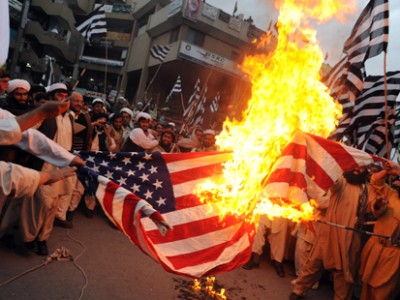
Pakistanis shouted anti-American slogans and burned the Stars and Stripes on Thursday in protest of a New York jury’s conviction of a Pakistani woman accused of trying to kill Americans while detained in Afghanistan.

The protests drew thousands in at least four cities, demonstrating the widespread distrust, and even hatred, of the U.S. in this country whose cooperation Washington needs to stabilize neighboring Afghanistan.

The New York Times said:

Defense lawyers argued that an absence of bullets, casings or residue from the M4 [– the rifle allegedly snatched and fired by the accused –] suggested it had not been shot. They used a video to show that two holes in a wall supposedly caused by the M4 had been there before July 18 [the date of the alleged crime].

They also pointed out inconsistencies in the testimony from the nine government witnesses, who at times gave conflicting accounts of how many people were in the room, where they were sitting or standing and how many shots were fired.

Ms. Siddiqui’s lawyers said they had not decided whether to appeal. They suggested that prosecutors had played to New Yorkers’ anxieties about terror attacks.

“This is not a just and right verdict,” Elaine Sharp, one of Ms. Siddiqui’s lawyers, said outside the courtroom. “In my opinion this was based on fear but not fact.”

If the views of jurors were shaped by irrational fears, it seems as though Judge Richard M. Berman suffered the same frailty. Far from recognizing that the conduct of the trial had wider implications for the relations between the US and Pakistan, so-called security considerations meant that journalists with the least interest in covering the case had the best access while those with the greatest interest weren’t allowed into the court room.

As Petra Bartosiewicz reported for Time magazine early in the proceedings:

[Dr Siddiqui’s] case has been major news in much of the Muslim world — and a crush of journalists from Pakistan have been struggling to gain access to a trial hemmed in by security-conscious New York City officials. How the foreign press is able to follow the court proceedings — and thus perceive the fairness of the trial — will have an impact on upcoming high-profile terrorism trials like that of Khalid Sheikh Mohammed and four other suspected 9/11 plotters, likely to be held in the same courthouse as the Siddiqui case.

“If we were able to file a transcript of the proceedings they’d probably print it,” Iftikhar Ali, a reporter with the Associated Press of Pakistan, said of the Siddiqui trial. “That’s how much interest there is in this case.” But Ali, like many other reporters from overseas, has been hampered in gaining access to the live proceedings. Journalists from Pakistan on assigment in New York have been largely excluded from the courtroom. Because of tight restrictions observed by the presiding Judge Richard Berman, not a single Pakistani reporter had been granted a press credential when opening statements began on Tuesday. They were instead sent to an overflow courtroom to watch the proceedings via video link.

In the overflow room this week I met journalists from Pakistan with United Nations and U.S. State Department issued press credentials. They work for some of the biggest outlets in their countries, including BBC Urdu, the Associated Press in Pakistan, Jang, Dawn, Geo and Haj TV. None were issued credentials for the trial, though some had applied weeks ago. We watched the proceedings on a flat screen television. The view didn’t include any of the exhibits being offered into evidence, among them multiple diagrams of the scene of the shooting and incriminating documents allegedly written by Siddiqui. At one point a key government eyewitness stepped off the witness stand and out of range of both the camera and microphone to use a visual aid to demonstrate where he was during the shooting. He was permitted to give much of his testimony off camera.

Ali, who has been at the court every day of the trial — including jury selection — was granted access to the main courtroom for about five minutes on the first day, but was escorted out when court security guards realized he was not on the list of approved media. At the time the only other occupants of the four-row press box, which covers half the available seating in the courtroom with room for about 20 individuals, were one each from the The New York Times, The New York Post and the New York Daily News. The court has officially recognized only media who carry New York Police Department issued press passes, traditionally reserved for reporters who regularly cover crime scenes and certain public events in the city. Out of the approximately 30 such individuals from U.S. news outlets who were eligible to attend the trial, most were not present for opening statements.

“We’ve been coming to all the pretrial hearings and we were never told there was going to be a different system for the trial. We were told the press will be allowed,” Ayesha Tanzeem, a journalist with Voice of America Urdu said. After TIME made inquiries on Thursday, individuals in the overflow room, including the Pakistani journalists, were for the first time ushered into the main courtroom during the afternoon session. But with the exception of a BBC Urdu reporter and a Samaa TV reporter who received official passes, none have been granted a press credential that would guarantee them a seat on future days.

The decision to accept solely the NYPD pass for the Siddiqui trial came from the judge’s chambers, says Elly Harrold of the District Executive’s office, the administrative arm at the federal courthouse. “Of course there are exceptions,” Harrold said, “but I’m not at liberty to discuss that.”

Although Siddiqui is not charged with any terrorism-related crime, security concerns are paramount though the procedures seem to be unevenly enforced. During the lunch break on the first day of the Siddiqui trial a group of Muslim men praying in the waiting areas outside the courtroom were afterwards asked to leave the floor. That prevented them from securing a place in line for the afternoon session. Several Muslim women in hijabs were also given similar instructions, but others in the same area, dressed in business attire, including this reporter, were permitted to stay. On the second day of the trial metal detectors were posted outside the courtroom and individuals were asked for photo identification and their names and addresses were logged by court security officers. At the close of proceedings on Thursday defense attorney Charles Swift protested the practice. “The suggestion is that the gallery may be a threat,” said Swift, calling the measure “highly prejudicial.”

If Charles Swift sounds like a familiar name it’s because he has the rare distinction of having stood up and successfully defended his country while its Constitution faced attack from the Bush administration. In Hamdan vs Rumsfeld, Swift won a major victory for the rule of law.

The case of Dr Siddiqui exposes a moral fallacy that has haunted America throughout the war on terrorism. It is this: that injustice is something that can only be done to the innocent.

We have abandoned what used to be the universally recognized foundation of a just legal system: that it treats the guilty and the innocent with fairness and impartiality.

(For fascinating background on the Siddiqui case, read Declan Walsh’s November 2009 report in The Guardian.)

Facebooktwittermail

Off with his head!

Matthew Yglesias writes:

If the President wants to do something like implement a domestic policy proposal he campaigned on—charge polluters for global warming emissions, for example—he faces a lot of hurdles. He needs majority support on a House committee or three. He also needs majority support on a Senate committee or three. Then he needs to get a majority in the full House of Representatives. And then he needs to de facto needs a 60 percent supermajority in the Senate. And then it’s all subject to judicial review.

But if Scooter Libby obstructs justice, the president has an un-reviewable, un-checkable power to offer him a pardon or clemency. If Bill Clinton wants to bomb Serbia, then Serbia gets bombed. If George W Bush wants to hold people in secret prisons and torture them, then tortured they shall be. And if Barack Obama wants to issue a kill order on someone or other, then the order goes out. And if Congress actually wants to remove a president from office, it faces extremely high barriers to doing so.

Whether or not you approve of this sort of executive power in the security domain, it’s a bit of a weird mismatch. You would think that it’s in the field of inflicting violence that we would want the most institutional restraint. Instead, the president faces almost no de facto constraints on his deployment of surveillance, military, and intelligence authority but extremely tight constraint on his ability to implement the main elements of the his domestic policy agenda.

This kind of presidential power looks “weird” if viewed from a constitutional vantage point but maybe not as weird as an expression of American culture.

Having moved to this country twenty years ago from the country that America successfully wrestled its independence from, it’s often struck me that Americans did not fully reject the concept of monarchical rule; they simply wanted a kind of modified monarchy.

First off, the monarch would need to be a native — a vehement “no” to foreign rule.

Next, the monarch would need to be one of the people, be elected and not restricted to a line of inheritance. It wasn’t that Americans did want a king; they simply wanted everyone to be able to nurture the fantasy that some day they too might become the king.

But dynasties are OK. In fact, the occasional dynasty helps burnish the executive’s regal image.

And what’s more befitting of the powers of an American king than that he should be able to occasionally proclaim: “Off with his head!”

Who knows, maybe in a few years the old regal custom of hosting public executions will be re-instituted. No doubt they’d get excellent ratings on cable news.

Facebooktwittermail

Murder with impunity

Glenn Greenwald writes:

… even if you’re someone who does want the President to have the power to order American citizens killed without a trial by decreeing that they are Terrorists (and it’s worth remembering that if you advocate that power, it’s going to be vested in all Presidents, not just the ones who are as Nice, Good, Kind-Hearted and Trustworthy as Barack Obama), shouldn’t there at least be some judicial approval required? Do we really want the President to be able to make this decision unilaterally and without outside checks? Remember when many Democrats were horrified (or at least when they purported to be) at the idea that Bush was merely eavesdropping on American citizens without judicial approval? Shouldn’t we be at least as concerned about the President’s being able to assassinate Americans without judicial oversight? That seems much more Draconian to me.

It would be perverse in the extreme, but wouldn’t it be preferable to at least require the President to demonstrate to a court that probable cause exists to warrant the assassination of an American citizen before the President should be allowed to order it? That would basically mean that courts would issue “assassination warrants” or “murder warrants” — a repugnant idea given that they’re tantamount to imposing the death sentence without a trial — but isn’t that minimal safeguard preferable to allowing the President unchecked authority to do it on his own, the very power he has now claimed for himself? And if the Fifth Amendment’s explicit guarantee — that one shall not be deprived of life without due process — does not prohibit the U.S. Government from assassinating you without any process, what exactly does it prohibit?

Greenwald makes a series of excellent points but I would add one major point that really should come in front of the whole discussion: the idea that a legal distinction should be made between American citizens and non-Americans is a thoroughly un-American idea.

The Declaration of Independence does not say:

We hold these truths to be self-evident, that all Americans are created equal, that they are endowed by their Creator with certain unalienable Rights, that among these are Life, Liberty and the pursuit of Happiness.

It didn’t say “Americans”, it said “all men” — a declaration of what were taken to be universal human values.

To be concerned about whether the president has claimed to right to murder Americans is really missing the point. What in practice this and the former president are doing is not exercising any kind of specially fabricated legal right; they are committing murder exclusively where they believe they can get away with it.

Assassinations taking place in the tribal areas of Pakistan, in Yemen and Somalia, are all occurring in environments whose lawlessness means that US government officials can be reliably confident that they can act with relative legal impunity.

Facebooktwittermail

The CIA: a continuing threat to U.S. persons or interests?

The Director of National Intelligence Dennis Blair reassured the House Intelligence Committee yesterday that he understands that killing Americans is a “very sensitive issue” and that the agency must always “get specific permission” to do so.

I wonder how much comfort that provides to the family of Jim and Veronica “Roni” Bowers and their two children, six-year-old son Cory and infant daughter Charity, who under the CIA’s watch were shot down by the Peruvian Air Force while flying over Peru in 2001. Veronica Bowers and her daughter Charity were killed. The video below shows what happened:

ABC News reports:

…for almost nine years, the CIA misled Congress, the White House and the dead woman’s parents about how and why the agency defied the rules established to make sure innocent people were not killed.

“I want to know the truth,” Garnett Luttig, father of Roni Bowers, told ABC News. “I want to know why. I wonder why my baby’s gone. Don’t they understand that?”

Said Gloria Luttig, Roni’s mother, “I want somebody to have to stand up and say I was responsible. I want him to know what a mother’s heart is like.”

On Wednesday, the CIA said its nine-year long investigation had determined that 16 CIA employees should be disciplined, including the woman then in charge of counter-narcotics.

Many of them are no longer with the CIA, and one of those involved said his discipline was no more than a letter of reprimand placed in his file, which he was told would be removed in one year.

So what are we to understand from DNI Blair? That while the CIA engages in extrajudicial killings, it does so with great caution but if mistakes are made, those responsible certainly face the risk of receiving a letter of reprimand?

Either we live in a land governed by law or we don’t. A determination by an intelligence operative is by no stretch of the imagination a substitute for due process.

Facebooktwittermail

US missile test mimicking Iran strike fails

From Reuters:

A U.S. attempt to shoot down a ballistic missile mimicking an attack from Iran failed after a malfunction in a radar built by Raytheon Co (RTN.N), the Defense Department said.

The abortive test over the Pacific Ocean coincided with a Pentagon report that Iran had expanded its ballistic missile capabilities and posed a “significant” threat to U.S. and allied forces in the Middle East region.

The Missile Defense Agency said that in Sunday’s test both the target missile, fired from Kwajalein in the Marshall Islands, and the interceptor, from Vandenberg Air Force Base in California, had performed normally.

“However, the Sea-Based X-band radar did not perform as expected,” the agency said on its web site. Officials will investigate the cause of the failure to intercept, it said.

Facebooktwittermail

Covering up homicide

In his State of the Union speech, President Obama said: “… in the last year, hundreds of al Qaeda’s fighters and affiliates, including many senior leaders, have been captured or killed — far more than in 2008.”

He could have said “we have killed…” just to make it clear that he includes himself as an actor, not an observer, in the killing process. And he could also have said “and we killed a bunch of innocent bystanders as well.” But maybe when it comes to al Qaeda, there is in Obama’s mind no such person as an innocent bystander. Maybe the children, wives and grandparents are “affiliates”.

In Pakistan the concept of an innocent bystander has not been abandoned and what Obama touts as great success is perceived as an ongoing unrelenting massacre.

Here are some of the latest damning numbers – numbers that no doubt many an American journalist will hesitate to report because they haven’t been confirmed by the holiest of sources, the Pentagon:

Afghanistan-based US predators carried out a record number of 12 deadly missile strikes in the tribal areas of Pakistan in January 2010, of which 10 went wrong and failed to hit their targets, killing 123 innocent Pakistanis. The remaining two successful drone strikes killed three al-Qaeda leaders, wanted by the Americans.

The rapid increase in the US drone attacks in the Pakistani tribal areas bordering Afghanistan can be gauged from the fact that only two such strikes were carried out in January 2009, which killed 36 people. The highest number of drone attacks carried out in a single month in 2009 was six, which were conducted in December last year. But the dawn of the New Year has already seen a dozen such attacks.

Note that all of these Predator attacks came after the CIA team widely reported as having been responsible for Predator targeting had been killed in the Khost bombing.

Now if it became known that the US government was responsible for sending gunmen into restaurants where mafia-style they left their targets riddled with bullets in front of horrified onlookers, even if there were no innocent bystanders killed, there would be public outrage. The government would be accused of having stooped to using the methods of gangsters.

Instead, we fire missiles, destroy the restaurant and kill everyone in it and even if it turns out the target had already left, somehow it’s OK. It was an innocent mistake. It happened in a distant country. We’ll never hear the names of the dead.

Facebooktwittermail

The immutable connection between greed and talent

From Politico:

In the midst of two wars and the fight against Al Qaeda, the CIA is offering operatives a chance to peddle their expertise to private companies on the side — a policy that gives financial firms and hedge funds access to the nation’s top-level intelligence talent, POLITICO has learned.

In one case, these active-duty officers moonlighted at a hedge-fund consulting firm that wanted to tap their expertise in “deception detection,” the highly specialized art of telling when executives may be lying based on clues in a conversation.

The never-before-revealed policy comes to light as the CIA and other intelligence agencies are once again under fire for failing to “connect the dots,” this time in the Christmas Day bombing plot on Northwest Flight 253.

But sources familiar with the CIA’s moonlighting policy defend it as a vital tool to prevent brain-drain at Langley, which has seen an exodus of highly trained, badly needed intelligence officers to the private sector, where they can easily double or even triple their government salaries. The policy gives agents a chance to earn more while still staying on the government payroll.

OK, I know it’s supposed to be a fundamental law in free-market economics that the only way of finding and holding on to talent is through high “compensation” but whatever else we might have learned from the Wall Street debacle, isn’t it that the bright minds there turned out not to have wisdom commensurate with their pay checks.

Isn’t this the only sure thing that can be said: that those who seek the highest paying jobs are the people who want to make the most money and their talent, such as it is, consists most reliably in this: their ability to enrich themselves.

For the last eight years we’ve been told that the CIA is staffed by heroic patriots who’ve dedicated their careers to protecting America. Mistakes, they’ve made a few, but they did it their way.

Are we now supposed to add the caveat – so long as they can make as money as possible in the process.

Facebooktwittermail

America’s contract killers

Twelve years ago, after Benjamin Netanyahu personally directed Mossad assassins to try and murder Khalid Meshaal in Amman, Jordan, President Clinton expressed his frustration with the Israeli leader, saying: “I cannot deal with this man. He is impossible.”

In accordance of the diplomatic norms of the era, it was seen as preposterous that Israel would send its agents onto the streets of a neighboring friendly capital to murder one of its enemies and for them to do so while posing as Canadians. Moreover, Israeli agents had been caught in the act and were in custody. The Jordanians had been embarrassed and an antidote to the deadly poison injected into Meshaal would have to be promptly administered if Israel wanted its operatives released. Only under US pressure did Netanyahu yield.

If the murder of Mahmoud al Mabhouh in a hotel in Dubai eleven days ago happens to have been performed by another team of Netanyahu’s hit men, what might President Obama’s response have been?

“Are there any useful lessons for the United States here Mr Prime Minister?”

It turns out that contract killing — something that President George W Bush opened the door to but didn’t pursue with vigor — has been embraced with surprising passion by his successor.

Is it for that proverbial reason that dead men don’t talk or equally that dead al Qaeda operatives don’t present the many legal conundrums as do those caught alive? Is it that detention below rather than above ground has simply become a matter of political expedience?

There are now officers in the CIA who supposedly have the legal authority to sign a death warrant on the basis that an individual is “deemed to be a continuing threat to U.S. persons or interests.”

There is a level of accountability. We’re not told who signs these death warrants but we can rest assured that those who sit on Obama’s death panels must sign their names in ink. These are not a death sentences delivered by email or text message.

As the LA Times reports:

Former officials involved in the program said it was handled with sober awareness of the stakes. All memos are circulated on paper, so those granting approval would “have to write their names in ink,” said one former official. “It was a jarring thing, to sign off on people getting killed.”

Jarring perhaps, yet the greatest human frailty is that moral judgment so easily yields to the legitimizing power that flows from normality. And nothing shapes normality more effectively than bureaucracy.

Set up a bureaucratic process and — as the Nazis proved — anything becomes possible. Through faithfulness to a government-endorsed procedure almost anyone will sooner or later become willing to suspend the timid dictates of their own conscience.

The LA Times describes in clinical terms the process that runs from signature to incineration:

The CIA sequence for a Predator strike ends with a missile but begins with a memo. Usually no more than two or three pages long, it bears the name of a suspected terrorist, the latest intelligence on his activities, and a case for why he should be added to a list of people the agency is trying to kill.

The list typically contains about two dozen names, a number that expands each time a new memo is signed by CIA executives on the seventh floor at agency headquarters, and contracts as targets thousands of miles away, in places including Pakistan and Yemen, seem to spontaneously explode.

No U.S. citizen has ever been on the CIA’s target list, which mainly names Al Qaeda leaders, including Osama bin Laden, according to current and former U.S. officials. But that is expected to change as CIA analysts compile a case against a Muslim cleric who was born in New Mexico but now resides in Yemen.

When America’s contract killers target their first US citizen, will his fellow citizens pay much attention? Probably not. He has an Arabic name and dark skin — he’s suitably other. If Anwar al Awlaki is eliminated, the CIA’s hit list will briefly get shorter.

Facebooktwittermail

The sanctity of military spending

The sanctity of military spending

In sum, as we cite our debtor status to freeze funding for things such as “air traffic control, farm subsidies, education, nutrition and national parks” — all programs included in Obama’s spending freeze — our military and other “security-related” spending habits become more bloated every year, completely shielded from any constraints or reality. This, despite the fact that it is virtually impossible for the U.S. to make meaningful progress in debt reduction without serious reductions in our military programs.

Public opinion is not a legitimate excuse for this utterly irrational conduct, as large percentages of Americans are receptive to reducing — or at least freezing — defense spending. A June, 2009 Pew Research poll asked Americans what they would do about defense spending, and 55% said they would either decrease it (18%) or keep it the same (37%); only 40% wanted it to increase. Even more notably, a 2007 Gallup poll found that “the public’s view that the federal government is spending too much on the military has increased substantially this year, to its highest level in more than 15 years.” In that poll, 58% of Democrats and 47% of Independents said that military spending “is too high” — and the percentages who believe that increased steadily over the last decade for every group.

The clear fact is that, no matter how severe are our budgetary constraints, military spending and all so-called “security-related programs” are off-limits for any freezes, let alone decreases. Moreover, the modest spending freeze to be announced by Obama tomorrow is just the start; the Washington consensus has solidified and is clearly gearing up for major cuts in Social Security, Medicare and Medicaid, with the dirty work to be done by an independent “deficit commission.” It’s time for “everyone” to sacrifice and suffer some more — as long as “everyone” excludes our vast military industry, the permanent power factions inside the Pentagon and intelligence community, our Surveillance and National Security State, and the imperial policies of perpetual war which feed them while further draining the lifeblood out of the country. [continued…]

Obama liquidates himself

A spending freeze? That’s the brilliant response of the Obama team to their first serious political setback?

It’s appalling on every level.

It’s bad economics, depressing demand when the economy is still suffering from mass unemployment. Jonathan Zasloff writes that Obama seems to have decided to fire Tim Geithner and replace him with “the rotting corpse of Andrew Mellon” (Mellon was Herbert Hoover’s Treasury Secretary, who according to Hoover told him to “liquidate the workers, liquidate the farmers, purge the rottenness”.)

It’s bad long-run fiscal policy, shifting attention away from the essential need to reform health care and focusing on small change instead.

And it’s a betrayal of everything Obama’s supporters thought they were working for. Just like that, Obama has embraced and validated the Republican world-view — and more specifically, he has embraced the policy ideas of the man he defeated in 2008. A correspondent writes, “I feel like an idiot for supporting this guy.” [continued…]

Obama would ‘rather be really good one-term president’

President Obama, buffeted by criticism of his massive health care reform bill and election setbacks, said today he remained determined to tackle health care and other big problems despite the political dangers to his presidency.

“I’d rather be a really good one-term president than a mediocre two-term president,” he told ABC’s “World News” anchor Diane Sawyer in an exclusive interview today. [continued…]

Editor’s Comment — As though he’s in a men’s store trying out a new suit for size, Obama’s trying on the One-Termer — wants to see if he likes the cut.

If as a bold political choice this president was to make a commitment not to run for re-election, that could be a decisive way of breaking free from the stranglehold of powerful interest groups. But with this statement, as in so many others, there’s nothing bold about what Obama is doing.

Bob Herbert, who is clearly clutching hold of the last straws of hope, sees tomorrow’s State of the Union speech as an slim opportunity for the renewal of faith: “Americans want to know what he stands for, where his line in the sand is, what he’ll really fight for, and where he wants to lead this nation. They want to know who their president really is.”

This really is the most damning statement: that after one year Americans have less of a sense of who occupies the White House than they did before he took office – back when he was perceived as an unknown.

The One-Termer — Obama doesn’t need to decide whether it’s a good fit or he can afford it — they’re giving them away for free. Try it on and it’s yours for keeps.

Facebooktwittermail

U.S. mulls legality of killing American al Qaeda “turncoat”

U.S. mulls legality of killing American al Qaeda “turncoat”

White House lawyers are mulling the legality of proposed attempts to kill an American citizen, Anwar al Awlaki, who is believed to be part of the leadership of the al Qaeda group in Yemen behind a series of terror strikes, according to two people briefed by U.S. intelligence officials.

One of the people briefed said opportunities to “take out” Awlaki “may have been missed” because of the legal questions surrounding a lethal attack which would specifically target an American citizen. [continued…]

Editor’s Comment — I’m not a lawyer, but isn’t this the way it works? If someone has an Arabic name, then citizenship is secondary. So long as they are “taken out” overseas, preferably in a state or area with a reputation for lawlessness, then legal process fits comfortably into the tip of a Hellfire missile. Extra latitude is of course provided when the “target” is not white.

But maybe the Justice Department could provide a little extra clarity — some new designations in citizenship status just so everyone understands which American citizens can be executed on the basis of a presidential order and which can’t. As for non-Americans, well, America has always reserved the right to kill them as and when it sees fit.

The drone surge

One moment there was the hum of a motor in the sky above. The next, on a recent morning in Afghanistan’s Helmand province, a missile blasted a home, killing 13 people. Days later, the same increasingly familiar mechanical whine preceded a two-missile salvo that slammed into a compound in Degan village in the tribal North Waziristan district of Pakistan, killing three.

What were once unacknowledged, relatively infrequent targeted killings of suspected militants or terrorists in the Bush years have become commonplace under the Obama administration. And since a devastating December 30th suicide attack by a Jordanian double agent on a CIA forward operating base in Afghanistan, unmanned aerial drones have been hunting humans in the Af-Pak war zone at a record pace. In Pakistan, an “unprecedented number” of strikes — which have killed armed guerrillas and civilians alike — have led to more fear, anger, and outrage in the tribal areas, as the CIA, with help from the U.S. Air Force, wages the most public “secret” war of modern times.

In neighboring Afghanistan, unmanned aircraft, for years in short supply and tasked primarily with surveillance missions, have increasingly been used to assassinate suspected militants as part of an aerial surge that has significantly outpaced the highly publicized “surge” of ground forces now underway. And yet, unprecedented as it may be in size and scope, the present ramping up of the drone war is only the opening salvo in a planned 40-year Pentagon surge to create fleets of ultra-advanced, heavily-armed, increasingly autonomous, all-seeing, hypersonic unmanned aerial systems (UAS). [continued…]

Facebooktwittermail

The return of the neocons

The return of the neocons

Technically, there is nothing “neo” about conservatives like Robert Kagan, the historian and another Washington Post columnist, or John Podhoretz, the editor of Commentary; each is a son of one of neoconservatism’s founding fathers. Indeed, no strain in American politics is so dynastic. It is akin to the right-wing Likud Party in Israel, whose religion and politics, world view, and succession rituals the neocons often share. The definitions, and analogy, are inexact, but both groups have recent ties to Europe and are haunted by the Holocaust, which has left them feeling wounded, suspicious, and sometimes bellicose, determined never again to be naive or to trust the world’s good intentions. Both spent decades in the po-litical wilderness before miraculously acquiring power; both begat “princes” who defied the normal generational tensions and allied themselves with their kingly fathers. When Bill Kristol rose to praise Irving that morning, he was really picking up his scepter.

Had you Googled “neoconservative” and “death” that day, four days after the 89-year-old Kristol expired, you’d have found lots on their long-rumored—and for some, much-anticipated and -savored—demise. On both the left and right, neoconservatism was deemed a spent force. Its ideas, Foreign Policy magazine had pronounced, “lie buried in the sands of Iraq.”

But obituaries can be premature. At the moment, in fact, the neocons seem resurrected. One of their own, Frederick Kagan of AEI (Robert’s younger brother), helped turn around the war in Iraq by devising and pushing for the surge there. More recent-ly, President Obama—whose foreign–policy pronouncements (nuanced, multi-lateral, interdependent) and style (low-key, self-critical, conciliatory, collegial) were a repudiation of neoconservative assertiveness—has swung their way, or so they believe. First, he’s sending an additional 30,000 troops to Afghanistan, nearly as many as leading neocons had sought. Then came his Nobel Prize acceptance speech, which, with its acknowledgment of the need for force, its nod to dissidents in Iran and elsewhere, and its talk about good and evil, was surprisingly congenial.

As if on cue, a Nigerian man with explosives in his crotch nearly brought down an American airliner over Detroit on Christmas Day, leaving the neocons feeling further vindicated and energized. Obama, who’d ratcheted up his rhetoric after an initial response that Bill Kristol and other neocons considered too tepid, had been “mugged by reality,” Kristol declared. It was an obvious homage to his father, who’d long ago defined “neocon” as a liberal to whom just that had happened. “Whether they praise or denounce Obama, the neocons are winning,” says Jacob Heilbrunn, a senior editor at The National Interest and author of They Knew They Were Right: The Rise of the Neocons (2008). “They’ve got him embracing the surge in Afghanistan and on the run for being ‘soft on terrorists.’ Either way, he ends up catering to them.” With Obama further weakened by an electoral repudiation in Massachusetts, that process might only intensify. [continued…]

Obama quietly continues to defend Bush’s terror policies

Although the FBI has acknowledged it improperly obtained thousands of Americans’ phone records for years, the Obama administration continues to assert that the bureau can obtain them without any formal legal process or court oversight.

The FBI revealed this stance in a newly released report, troubling critics who’d hoped the bureau had been chastened enough by its own abuses to drop such a position.

In further support of the legal authority, however, the Justice Department’s Office of Legal Counsel backed the FBI in a written opinion issued this month.

The opinion by the OLC — the section that wrote the memos that justified enhanced interrogation techniques during the last administration — appears to be yet another sign that the Obama administration can be just as assertive as Bush’s in claiming sweeping and controversial anti-terrorism powers. [continued…]

CIA deaths prompt surge in U.S. drone strikes

… officials deny that vengeance is driving the increased attacks, though one called the drone strikes “the purest form of self-defense.”

Officials point to other factors. For one, Pakistan recently dropped restrictions on the drone program it had requested last fall to accompany a ground offensive against militants in South Waziristan. And tips on the whereabouts of extremists ebb and flow unpredictably.

A C.I.A. spokesman, Paul Gimigliano, declined to comment on the drone strikes. But he said, “The agency’s counterterrorism operations — lawful, aggressive, precise and effective — continue without pause.”

The strikes, carried out from a secret base in Pakistan and controlled by satellite link from C.I.A. headquarters in Virginia, have been expanded by President Obama and praised by both parties in Congress as a potent weapon against terrorism that puts no American lives at risk. That calculation must be revised in light of the Khost bombing, which revealed the critical presence of C.I.A. officers in dangerous territory to direct the strikes. [continued…]

Editor’s Comment — The question that the New York Times‘ Washington-based reporters (true to form) fail to address is this: If the Khost bombing killed CIA officers who were critical in choosing the targets for drone attacks, how have subsequent targets been chosen? Are we supposed to believe that right in the aftermath of this huge blow to the CIA’s drone operation, a flood of valuable intelligence swept in?

How convenient… and improbable.

Facebooktwittermail

The official response begins

The official response begins

When a cover-up is exposed, nothing is more telling than the first reactions from those who are involved. Do they maintain their stories and face potentially aggravated consequences? Or do they simply remain silent? In making this choice, they often telegraph the depth of their anxiety and concern.

Last night on MSNBC’s Countdown with Keith Olbermann, I focused on the first responses to “The Guantánamo ‘Suicides.’” Colonel Michael Bumgarner, the former commander at Camp America, had sent an email to the Associated Press, the text of which AP confirmed to me, in which he said he would have to get clearance from the Defense Department to speak, but then stated:

This blatant misrepresentation of the truth infuriates me. I don’t know who Sgt. Hickman is, but he is only trying to be a spotlight ranger. He knows nothing about what transpired in Camp 1, or our medical facility. I do, I was there.

This statement merits closer inspection. The first sentence is a classic nondenial denial. It appears on the surface to deny part of the account, but in fact denies nothing. Bumgarner needs to state specifically what allegations he considers inaccurate. His failure to do so is telling. [continued…]

Facebooktwittermail

Intelligence chief says FBI was too hasty in handling of attempted bombing

Intelligence chief says FBI was too hasty in handling of attempted bombing

The man accused of trying to blow up a U.S. airliner on Christmas Day should have been interrogated by special terrorism investigators instead of FBI agents, the nation’s intelligence chief said Wednesday, adding that senior national security officials were not consulted before FBI and Justice Department authorities questioned him and pursued criminal charges.

Director of National Intelligence Dennis C. Blair faulted the decision not to use the “High Value Interrogation Group” (HIG) to question alleged al-Qaeda operative Umar Farouk Abdulmutallab.

“That unit was created exactly for this purpose — to make a decision on whether a certain person who’s detained should be treated as a case for federal prosecution or for some of the other means,” Blair told the Senate homeland security committee.

The intelligence chief said the interrogation group was created by the White House last year to handle overseas cases but will be expanded now to domestic ones. “We did not invoke the HIG in this case; we should have,” he added.

Blair amended his remarks later in written statements, acknowledging that the interrogation group is not “fully operational.” However, he maintained, “There should be a decision process right at the outset as to the balance between intelligence-gathering and evidence for prosecution.” [continued…]

Facebooktwittermail

Obama’s lost senate seat is a victory for Netanyahu

Obama’s lost senate seat is a victory for Netanyahu

The Republican upset in the race for the U.S. Senate seat held for nearly half a century by liberal Edward M. Kennedy reflects a huge victory for opponents of U.S. President Barack Obama – and also for Prime Minister Benjamin Netanyahu.

Scott Brown defeated once-favored Martha Coakley for the Massachusetts seat even after U.S. President Barack Obama rushed to Boston on Sunday to try to save her candidacy.

Over the past nine months, Netanyahu has managed to curb pressure from Obama, who enjoys a Democratic majority in both houses of Congress. Now, however, Obama will be more dependent on the support of his Republican rivals, the supporters and friends of Netanyahu. [continued…]

Facebooktwittermail