Category Archives: US government

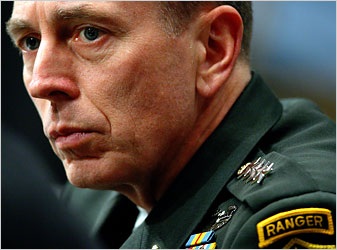
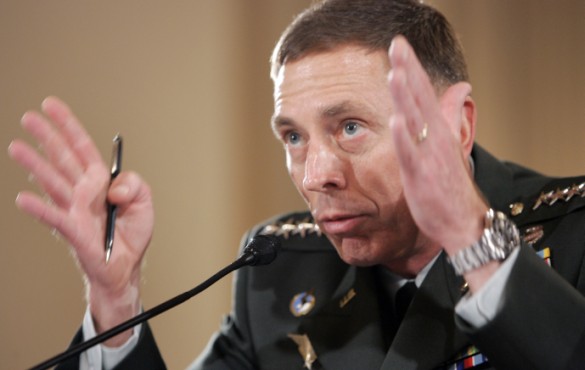
Israel is empowering al Qaeda, Petraeus warns

As erupting violence in Jerusalem suggests a third intifada may soon take hold, the CENTCOM commander Gen David Petraeus, testifying before the US Senate Armed Services Committee today, gave a grave warning about the wider impact of a conflict that has been the epicenter of Middle East hostilities ever since the creation of Israel.

In issuing his warning, Petraeus — arguably the most influential even if not the highest ranking member of the US military — was reiterating a statement he made almost a year ago. The only difference between what he said in April 2009 and what he said today, was that he now acknowledges al Qaeda is being strengthened by the conflict.

He now says:

The enduring hostilities between Israel and some of its neighbors present distinct challenges to our ability to advance our interests in the AOR [CENTCOM’s area of responsibility]. Israeli-Palestinian tensions often flare into violence and large-scale armed confrontations. The conflict foments anti-American sentiment, due to a perception of U.S. favoritism for Israel. Arab anger over the Palestinian question limits the strength and depth of U.S. partnerships with governments and peoples in the AOR and weakens the legitimacy of moderate regimes in the Arab world. Meanwhile, al-Qaeda and other militant groups exploit that anger to mobilize support. The conflict also gives Iran influence in the Arab world through its clients, Lebanese Hizballah and Hamas.

If such a statement was being made outside the American political arena, it could be regarded as a rather bland expression of what has long been utterly obvious. Yet from the lips of a celebrated general, regarded by many as a potential future president, these words come as a bombshell.

Neoconservatives and the Israel lobby have worked hard and long to obscure the deeply corrosive regional impact of a conflict that successive Israeli leaders have either been unwilling or seemingly incapable of resolving. Others, who earlier said what Petraeus now says, have either been dismissed as poorly informed or worse, branded as anti-Israeli or by insinuation, anti-Semitic.

No such charge will stick to Petraeus. Indeed, if the Israel lobby was so foolhardy as to try and go after an American general who sometimes gets treated like a latterday Eisenhower, the lobby will be at dire risk of being visited by its own greatest fear: being branded as anti-American.

Facebooktwittermail

Israel is putting American lives at risk

In Foreign Policy, Mark Perry describes an extraordinary Pentagon briefing on Israel’s impact on conflicts across the Middle East. Here is an excerpt and following some comments of my own, the author has provided me with additional background on his reporting.
[Important update: A senior military officer told Foreign Policy by email that one rather minor detail in Perry’s report was incorrect. A request from Gen Petraeus for the Palestinian occupied territories to be brought within CENTCOM’s region of operations was sent to the Chairman of the Joint Chiefs of Staff, Admiral Mullen, and not directly to the White House (who may or may not have subsequently been consulted). It is significant that the Pentagon made this correction, not because it was an important detail but on the contrary, because it was inconsequential to the overall narrative. In effect, the Pentagon clearly but discreetly said that there was virtually nothing in this report that could be denied.]

On January 16, two days after a killer earthquake hit Haiti, a team of senior military officers from the U.S. Central Command (responsible for overseeing American security interests in the Middle East), arrived at the Pentagon to brief JCS Chairman Michael Mullen on the Israeli-Palestinian conflict. The team had been dispatched by CENTCOM commander David Petraeus to underline his growing worries at the lack of progress in resolving the issue. The 33-slide 45-minute PowerPoint briefing stunned Mullen. The briefers reported that there was a growing perception among Arab leaders that the U.S. was incapable of standing up to Israel, that CENTCOM’s mostly Arab constituency was losing faith in American promises, that Israeli intransigence on the Israeli-Palestinian conflict was jeopardizing U.S. standing in the region, and that Mitchell himself was (as a senior Pentagon officer later bluntly described it) “too old, too slow…and too late.”

The January Mullen briefing was unprecedented. No previous CENTCOM commander had ever expressed himself on what is essentially a political issue; which is why the briefers were careful to tell Mullen that their conclusions followed from a December 2009 tour of the region where, on Petraeus’s instructions, they spoke to senior Arab leaders. “Everywhere they went, the message was pretty humbling,” a Pentagon officer familiar with the briefing says. “America was not only viewed as weak, but its military posture in the region was eroding.” But Petraeus wasn’t finished: two days after the Mullen briefing, Petraeus sent a paper to the White House requesting that the West Bank and Gaza (which, with Israel, is a part of the European Command – or EUCOM), be made a part of his area of operations. Petraeus’s reason was straightforward: with U.S. troops deployed in Iraq and Afghanistan, the U.S. military had to be perceived by Arab leaders as engaged in the region’s most troublesome conflict.

The Mullen briefing and Petraeus’s request hit the White House like a bombshell. While Petraeus’s request that CENTCOM be expanded to include the Palestinians was denied (“it was dead on arrival,” a Pentagon officer confirms), the Obama Administration decided it would redouble its efforts – pressing Israel once again on the settlements issue, sending Mitchell on a visit to a number of Arab capitals and dispatching Mullen for a carefully arranged meeting with Chief of the Israeli General Staff, Lt. General Gabi Ashkenazi. While the American press speculated that Mullen’s trip focused on Iran, the JCS Chairman actually carried a blunt, and tough, message on the Israeli-Palestinian conflict: that Israel had to see its conflict with the Palestinians “in a larger, regional, context” – as having a direct impact on America’s status in the region. Certainly, it was thought, Israel would get the message. [Read the rest of the report here.]

In December 2006, the Iraq Study Group Report was explicit in making this linkage: “The United States cannot achieve its goals in the Middle East unless it deals directly with the Arab-Israeli conflict and regional instability.”

What Mark Perry’s report indicates is that for the Obama administration a tipping point has been crossed in its perception of Israel’s effect on the conflicts that span the region.

Until now, the necessity for a resolution of the Arab-Israeli conflict has been framed in quasi-positive terms — such as that it would help defuse some of the hostility that the US now faces, or, that it would strengthen an alliance of nations attempting to curtail Iran’s nuclear program.

The shift, as expressed by Joe Biden last week and by the Petraeus briefing in January is that Israel is now being seen as a liability: the Jewish state is putting American lives at risk. “This is starting to get dangerous for us,” Biden reportedly told Netanyahu.

Such a shift marks a watershed in US-Israeli relations and so Perry’s report naturally raises questions. Indeed, the first line of defense from Israel and its supporters will be to claim that, on the contrary, recent events are nothing more than a bump in the road; that we can expect a quick resumption of business as usual between such close allies.

For this reason, I asked Mark — who I have had the privilege of working with in recent years — to provide some background to his report. This is what he said:

My piece on the briefing of Admiral Mullen by CENTCOM senior officers has occasioned a great deal of comment, as well as some skepticism: how accurate is the account? Was it told to me by direct participants in the briefing? Is there any basis for imagining that Petraeus has any kind of hidden agenda, whether that is a desire to expand CENTCOM – or even hostility towards Israel.

I won’t name my sources, even though it’s clear to people in the Pentagon – and certainly to General Petraeus – who they are. Was I told of the briefing by the briefers themselves? I will only say that there were four people in the briefing – the two briefers, Admiral Mullen, and Admiral Mullen’s primary adviser on the Israeli-Palestinian conflict. I know two of the people involved in the briefing. Whether or not they are my sources is something for the reader to determine. The account is not only accurate, it’s a precis of what actually happened. There is a lot more to it. The White House, State Department and Pentagon have not denied the account, and for good reason: it’s true.

Is there any basis for imagining that Petraeus has any kind of hidden agenda in ordering the briefing?

I have been reporting on the American military for thirty years. My work on the Joint Chiefs of Staff, Four Stars, is the authoritative account on the subject. I have deeply rooted contacts in the military that go back thirty years. I have never met a senior military officer whom I do not admire. There is no greater insult than to believe that General Petraeus or any other senior American military officer would use the lives of American soldiers as a lever to enhance their own political future. My sense is that General Petraeus neither likes nor dislikes Israel: but he loves his country and he wants to protect our soldiers. The current crisis in American relations with Israel is not a litmus test of General Petraeus’s loyalty to Israel, but of his, and our, concern for those Americans in uniform in the Middle East.

It is, perhaps, a sign of the depth of “the Biden crisis” that every controversy of this type seems to get translated into whether or not America and its leaders are committed to Israel’s security. This isn’t about Israel’s security, it’s about our security.

Facebooktwittermail

CIA drone attacks produce America’s own unlawful combatants

Gary Solis, an adjunct professor at Georgetown University Law Center, writes:

In our current armed conflicts, there are two U.S. drone offensives. One is conducted by our armed forces, the other by the CIA. Every day, CIA agents and CIA contractors arm and pilot armed unmanned drones over combat zones in Afghanistan and Pakistan, including Pakistani tribal areas, to search out and kill Taliban and al-Qaeda fighters. In terms of international armed conflict, those CIA agents are, unlike their military counterparts but like the fighters they target, unlawful combatants. No less than their insurgent targets, they are fighters without uniforms or insignia, directly participating in hostilities, employing armed force contrary to the laws and customs of war. Even if they are sitting in Langley, the CIA pilots are civilians violating the requirement of distinction, a core concept of armed conflict, as they directly participate in hostilities.

Facebooktwittermail

Dubai tells spies to clear out

Newsweek reports:

Police in the Persian Gulf emirate of Dubai have advised all foreign spies to get out of town—and preferably out of the region—within a week. Although it is widely known in international spy circles, news of the expulsion threat has received little circulation beyond media in the Arab world. However, Gulf News, a newspaper based in Dubai, said the demand that foreign spies leave the area was confirmed to it by Lt. Gen. Dahi Khalfan Tamim, Dubai’s police chief and leader of the investigation into the Mahmoud al-Mabhouh murder.

“Those spies that are currently present in the Gulf must leave the region within one week. If not, then we will cross that bridge when we come to it,” Tamim reportedly said. When asked whether the spies he was talking about were holders of European passports, Tamim said “Europeans and others,” but offered no further details.

Gulf News says:

The ultimatum indicates that Dubai Police are aware of the identities of spies operating in the UAE and the Gulf region and appears to be a warning of exposure if they do not comply.

If Dubai is really serious about kicking out its resident spies, the consequences will be far reaching.

As Zvi Bar’el noted earlier this month:

Dubai has several masks. It helps Iran, but behind its back it provides the United States with an opportunity to gather intelligence about that country. The U.S. Consulate in Dubai also operates as a station for gathering information and enlisting agents. A few years ago the U.S. State Department wanted to close the consulate, but the CIA succeeded in convincing it to leave it open and even to boost the number of employees so that it could handle the hundreds and perhaps thousands of Iranians who come to request visas.

It’s not only the U.S. intelligence services that love Dubai: The tremendous scope of commerce and the large number of companies and foreign agencies there are an excellent cover and an appropriate disguise for any city of spies.

Dubai has now replaced 20th-century Istanbul, Nicosia, Casablanca and Berlin as a hotbed of spying activity. Russians exchange information with Pakistanis, Afghans and Chechens trade tactics, members of Hezbollah convert illegal money and diamonds in bank transactions “for widows and orphans,” and all while enjoying car races and performances by international artists.

Facebooktwittermail

The reconstruction blame game

At Mother Jones, Daniel Schulman writes:

After years of a US presence in Iraq and Afghanistan, rebuilding and stabilization projects remain disjointed and chaotic, resulting in wasted taxpayer dollars and, potentially, the deaths of soldiers and civilians. Meanwhile, the nearly six-year-old State Department office that was supposed to coordinate these efforts isn’t even fully operational. And for that, according to the official who heads the division, Sen. Tom Coburn (R-Okla.) is partly to blame.

As the Obama administration surges soldiers and civilians into Afghanistan, the State Department’s Office of the Coordinator for Reconstruction and Stabilization (known as S/CRS) is a key player in synchronizing the alphabet soup of agencies and divisions involved in the effort. But its effectiveness has come under fire—from Stuart Bowen, the Special Inspector General for Iraq Reconstruction and from members of the congressionally chartered Commission on Wartime Contracting. On Monday, the commission held a hearing on coordination failures and grilled officials from the Pentagon, the US Agency for International Development, and the State Department on their teamwork. Not masking his anger, Chris Shays, the panel’s co-chair and a former Republican congressman from Connecticut, laid out the stakes: “The lack of coordination costs billions and billions and billions of dollars—huge waste, which means that we don’t optimize the dollars that we spend. It also results in the loss of lives in our military, the loss of lives in our diplomatic corps, the loss lives of our civil servants, the loss of lives of our contractors…It’s a huge, huge issue.”

Facebooktwittermail

Incompetent McCarthyism and shared beliefs

Scott Horton takes on the neocon campaign against a group of lawyers, now working for the Obama Administration, who “voluntarily represented terrorists.”

…the incompetent McCarthyites haven’t done their homework. On a list of lawyers in recent government service who have served alleged terrorists, the first name might be Michael Chertoff’s. Chertoff served as counsel to Magdy El-Amir, a man identified as a leading Al Qaeda fundraiser in North America. Chertoff went on to head the criminal division at Justice and then to become secretary of Homeland Security. There is no hint that his ties to El-Amir in any way influenced Chertoff in his duties in the Bush Administration, nor would any reasonable person suspect that they would. The list would also include Michael Mukasey, Bush’s last attorney general, whose law firm had an active pro bono program writing appeals briefs in support of the Guantánamo inmates on constitutional issues, and Rudy Giuliani, whose firm was and is also engaged in representing Gitmo prisoners. It therefore came as no surprise when leading Republican lawyers quickly came out attacking the Cheney-Kristol-Goldfarb project as “shameful.”

But the question that Liz Cheney asks is an appropriate one. “Whose values do they share?” Perhaps it’s the values of John Adams. After the Boston Massacre, when revolutionary sentiment was flaring, Adams stood up to represent the British soldiers accused of slaughtering his fellow Bostonians in a criminal trial, and he helped them beat the rap. Most of his fellow citizens were dumbstruck by his decision, but at the end of a long life, looking back, Adams decided that this was “one of the best Pieces of Service I ever rendered my Country.” It’s the values of Kenneth Royall, the JAG colonel who defended a group of accused German saboteurs during World War II, bringing their appeal to the Supreme Court against the wishes of his commander-in-chief. Royall’s brilliant defense got him a promotion to brigadier general, and it later helped drive President Truman’s decision to name him the last American secretary of war. Vigorous defense of even the meanest person accused is an essential part of our democracy and our notions of justice—but it’s not a value that is shared by Liz Cheney.

Whose values does Liz Cheney share? Look at the nations around the world in which criminal defense counsel are harassed and persecuted. Look at Putin’s Russia and the case of Sergei Magnitsky, or Mugabe’s Zimbabwe and the case of Beatrice Mtetwa. Perhaps it is in countries like Russia and Zimbabwe that Liz Cheney and her Weekly Standard friends might find governments that share their values.

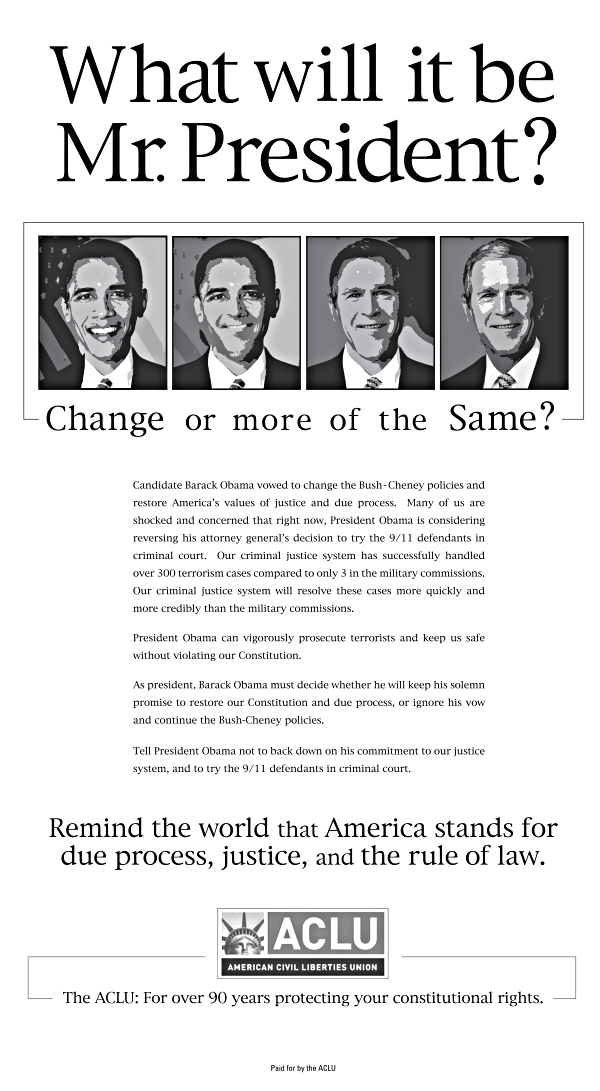
Meanwhile, the ACLU ran an ad in the New York Times on Sunday, calling on President Obama not to reverse his administration’s decision to prosecute the 9/11 suspects in civilian courts.

Facebooktwittermail

Obama advisers set to recommend military tribunals for alleged 9/11 plotters

The Washington Post reports:

President Obama’s advisers are nearing a recommendation that Khalid Sheik Mohammed, the self-proclaimed mastermind of the Sept. 11, 2001, attacks, be prosecuted in a military tribunal, administration officials said, a step that would reverse Attorney General Eric H. Holder Jr.’s plan to try him in civilian court in New York City.

The president’s advisers feel increasingly hemmed in by bipartisan opposition to a federal trial in New York and demands, mainly from Republicans, that Mohammed and his accused co-conspirators remain under military jurisdiction, officials said. While Obama has favored trying some terrorism suspects in civilian courts as a symbol of U.S. commitment to the rule of law, critics have said military tribunals are the appropriate venue for those accused of attacking the United States.

Scott Horton comments:

In sharp violation of rules of prosecutorial conduct and ethics, political figures in the White House are engaged in the micromanagement of decisions concerning the prosecution of individual criminal defendants. Rahm Emanuel is a political figure, without any serious legal expertise or abilities. He openly presented the question as a matter of political opportunity—thereby infecting the criminal justice system with political horse-trading. This is more than just unseemly. It presents a direct affront to the integrity of the criminal justice system. After eight years in which Karl Rove manipulated essential prosecutorial decisions at Justice, now his successor is engaged in the same type of misconduct. But unlike Rove, Emanuel does it openly.

Facebooktwittermail

Genocide vote harms US-Turkey ties

Stephen Kinzer writes:

For the US house of representatives foreign affairs committee to decide that the killing of Armenians by Ottoman Turks in 1915 constituted genocide, as it did Thursday by a one-vote margin, would be acceptable and even praiseworthy if it were part of a serious historical effort to review all the great atrocities of modern history. But the singling out of Turks for censure, among all the killers of the 20th century, is something quite different. This vote was a triumph of emotion, a victory for ethnic lobbying, and another example of the age-old American impulse to play moral arbiter for the world.

Turkey recalled its ambassador in Washington immediately after the vote, which was broadcast live on Turkish television. The resolution now goes to the full House of Representatives. Given the pull of moneyed politics, and President Obama’s unwillingness or inability to bring Congress to heel on this issue, as Presidents Bush and Clinton did, it could pass. That would provoke much anger in Turkey, and might weaken the US-Turkish relationship at the precise moment when the US needs to strengthen it.

In the past few years, Turkey has taken on a new and assertive role in the Middle East and beyond. Turkey can go places, talk to factions, and make deals that the US cannot. Yet it remains fundamentally aligned with western values and strategic goals. No other country is better equipped to help the US navigate through the region’s treacherous deserts, steppes and mountains.

Before the resolution was passed, Philip Giraldi wrote:

Every year the resolution lives or dies based on a key but never openly verbalized question: what does Israel want? This year, Israel is somewhat chagrined by Turkish refusal to see last year’s Gaza carnage as a measured response, but remarks by Israeli Defense Minister Ehud Barak would seem to indicate that Tel Aviv still values the relationship, unleashing AIPAC to make sure that each and every congressman votes the right way. Having received its instructions, the US Congress will likely genuflect and do as it is told, allowing the resolution to languish in committee just as it did last year.

Giraldi turns out to have been wrong about the outcome of the vote, but his assumption that Israel would make its preference known to members of Congress — especially under the leadership of Israel-loyalist Howard L. Berman — is surely well-founded. Might that suggest that Israel, convinced that the administration’s efforts to place sanctions on Iran are destined to go nowhere, is now intent on short-circuiting the process? Souring US-Turkish relations would be useful in serving that agenda.

Hmmm… On second thoughts, maybe in this instance these were not the dynamics at play. After all, if word had come down from AIPAC on which way the Congress members should vote, I can’t imagine it would have split so evenly – 23 to 22.

MJ Rosenberg, however, sees a clear Israeli hand at play here:

The Israelis are trying to teach the Turks a lesson. If the Armenian resolution passes both houses and goes into effect, it will not be out of some newfound compassion for the victims of the Armenian genocide and their descendants, but to send a message to Turkey: if you mess with Israel, its lobby will make Turkey pay a price in Washington.

And, just maybe, the United States will pay it too.

Facebooktwittermail

The new McCarthyism

In The American Prospect, Adam Serwer writes:

The “Gitmo Nine” aren’t terrorists. They weren’t captured fighting for the Taliban. They’ve made no attempts to kill Americans. They haven’t declared war on the United States, nor have they joined any group that has. The “Gitmo Nine” are lawyers working in the Department of Justice who fought the Bush administration’s treatment of suspected terrorists as unconstitutional. Now, conservatives are portraying them as agents of the enemy.

In the aftermath of September 11, the Bush administration tried to set up a military-commissions system to try suspected terrorists. The commissions offered few due process rights, denied the accused access to the evidence against them, and allowed the admission of hearsay — and even evidence gained through coercion or abuse. The Bush administration also sought to prevent detainees from challenging their detention in court. Conservatives argued that the nature of the war on terrorism justified the assertion of greater executive power. In case after case, the U.S. Supreme Court sided with the administration’s critics.

“These lawyers were advocating on behalf of our Constitution and our laws. The detention policies of the Bush administration were unconstitutional and illegal, and no higher a legal authority than the Supreme Court of the United States agreed,” says Ken Gude, a human-rights expert with the Center for American Progress, of the recent assault on the Justice Department. “The disgusting logic of these attacks is that the Supreme Court is in league with al-Qaeda.”

The New York Times reports:

A former Justice Department official who led the Bush administration’s courtroom defense against lawsuits filed by Guantanamo detainees is denouncing attacks on Obama administration appointees who previously helped such prisoners challenge their indefinite detention without trial.

Peter D. Keisler, who was assistant attorney general for the civil division in the Bush administration, said in an interview that it was “wrong” to attack lawyers who volunteered to help such lawsuits before joining the Justice Department.

“There is a longstanding and very honorable tradition of lawyers representing unpopular or controversial clients,” Mr. Keisler said. “The fact that someone has acted within that tradition, as many lawyers, civilian and military, have done with respect to people who are accused of terrorism – that should never be a basis for suggesting that they are unfit in any way to serve in the Department of Justice.”

Facebooktwittermail

Obama wants to expand America’s military reach

As President Obama prepares to present his first Nuclear Posture Review, the news is that he’s about to announce plans to eliminate thousands of nuclear weapons from the United States arsenal. So good so far — but it gets worse from here on in.

If a smaller arsenal might look like a step towards the elimination of nuclear weapons, the fact that this president wants to retain a first strike option is not a step in the right direction. Worst of all are the designs for a non-nuclear future in the shape of what is called “Prompt Global Strike” — the ultimate form of remote warfare through which the US could strike any target on the planet in less than an hour.

This is how the New York Times describes the new class of non-nuclear weapons:

The idea, officials say, would be to give the president a non-nuclear option for, say, a large strike on the leadership of Al Qaeda in the mountains of Pakistan, or a pre-emptive attack on an impending missile launch from North Korea. But under Mr. Obama’s strategy, the missiles would be based at new sites around the United States that might even be open to inspection, so that Russia and China would know that a missile launched from those sites was not nuclear — to avoid having them place their own nuclear forces on high alert.

Better than firing nuclear weapons, isn’t it? Of course. But the one virtue of strategic nuclear weapons is that their use has seemed unthinkable to a point where we’ve gone 65 years without their use — apart from in testing.

To call Prompt Global Strike a “non-nuclear option” is to imply that it is some kind of relatively benign alternative to nuclear force. On the contrary, what we’re looking at here are two classes of weapons of mass destruction: one whose primary function is that they be held in reserve as a diabolical threat; the other system is very much designed for use. Indeed, one can imagine that at some point in his or her term of office, every American president will make a point of showcasing American power with a prompt global strike.

Noah Shachtman describes how this would work:

A tip sets the plan in motion — a whispered warning of a North Korean nuclear launch, or of a shipment of biotoxins bound for a Hezbollah stronghold in Lebanon. Word races through the American intelligence network until it reaches U.S. Strategic Command headquarters, the Pentagon and, eventually, the White House. In the Pacific, a nuclear-powered Ohio class submarine surfaces, ready for the president’s command to launch.

When the order comes, the sub shoots a 65-ton Trident II ballistic missile into the sky. Within 2 minutes, the missile is traveling at more than 20,000 ft. per second. Up and over the oceans and out of the atmosphere it soars for thousands of miles. At the top of its parabola, hanging in space, the Trident’s four warheads separate and begin their screaming descent down toward the planet. Traveling as fast as 13,000 mph, the warheads are filled with scored tungsten rods with twice the strength of steel. Just above the target, the warheads detonate, showering the area with thousands of rods-each one up to 12 times as destructive as a .50-caliber bullet. Anything within 3000 sq. ft. of this whirling, metallic storm is obliterated.

If Pentagon strategists get their way, there will be no place on the planet to hide from such an assault.

What Prompt Global Strike is really about is turning inter-continental ballistic missiles (minus nuclear warheads) into usable weapons.

Facebooktwittermail

Twenty-seven years of solitary confinement

In the United States it isn’t just suspected terrorists who are subject to cruel and unusual punishment. The case of Tommy Silverstein highlights the extremes that can be found inside the largest prison system in the world:

Tommy Silverstein has been held in solitary confinement for the past 27 years, longer than anyone else in the federal prison system, his lawyers say.

He is locked up at the high-security prison in Florence, Colorado, known as Supermax. The lights are always on. Guards who slip him food through a slot in his cell door usually ignore him. A few times a week, he is permitted to exercise in the recreation room — alone. Visits with his family and his lawyers are conducted through Plexiglas.

Silverstein’s isolation is the result of an unusual no-human-contact order issued by a judge in 1983, after he murdered a guard at the federal prison in Marion, Illinois. Marion was known at the time as the most rigorous confinement in the federal prison system.

Silverstein has referred to his solitary existence as “a slow, constant peeling of the skin.”

His attorneys, who are affiliated with the University of Denver, filed a lawsuit against the U.S. Bureau of Prisons in 2007, alleging that such prison conditions violate the cruel and unusual punishment clause of the Eighth Amendment. The lawsuit, filed in the federal district court of Colorado, is awaiting trial.

Facebooktwittermail

The rise of militainment

At Foreign Policy, P W Singer writes:

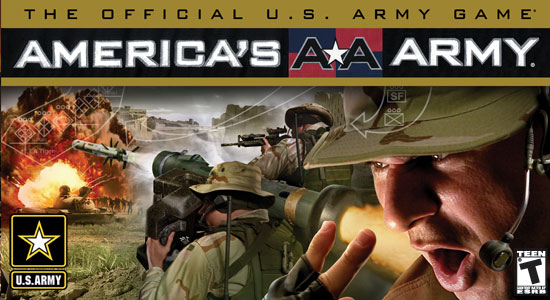
The country of Ghanzia is embroiled in a civil war. As a soldier in America’s Army, your job is to do everything from protect U.S. military convoys against AK-47-wielding attackers to sneak up on a mountain observatory where arms dealers are hiding out. It is a tough and dangerous tour of duty that requires dedication, focus, and a bit of luck. Fortunately, if you get hit by a bullet and bleed to death, you can reboot your computer and sign on under a new name.

America’s Army is a video game — a “tactical multiplayer first-person shooter” in gaming lingo — that was originally developed by the U.S. military to aid in its recruiting and training, but is now available for anyone to play. Among the most downloaded Internet games of all time, it is perhaps the best known of a vast array of video game-based military training programs and combat simulations whose scope and importance are rapidly changing not just the video-game marketplace, but also the way the U.S. military finds and trains its future warriors and even how the American public interfaces with the wars carried out in its name. For all the attention to the strategic debates of the post-9/11 era, a different sort of transformation has taken place over the last decade — largely escaping public scrutiny, at modest cost relative to the enormous sums spent elsewhere in the Pentagon budget, and with little planning but enormous consequences.

Facebooktwittermail

The Dubai-Payoneer connection

As I noted below, the New York-based company Payoneer is linked to Israel in a number of ways, not least through it’s Israeli CEO, Yuval Tal, a former member of an elite combat unit of the Israel Defense Forces and former Vice President of Business Development for the Tel Aviv-based technology company, Radware. Tal describes how Payoneer operates in this video.

As Clayton Swisher notes:

Mr Tal did not exactly conceal his prior affiliations when he appeared on Fox News during the 2006 Lebanon war. He opined then that “this is a war that Israel cannot afford to lose”.

If Tal or his Payoneer firm are in any way involved in the conspiracy to help a foreign intelligence service (like, say providing Mossad operatives with credit cards), he may soon find himself in his own battle with little prospects of winning – in a US courtroom.

The Federal Bureau of Investigation (FBI) is the lead agency with statutory authority and responsibilities for investigating foreign espionage activities on US soil. It’s a job they take seriously and with a proven record of not shying away from the numerous instances when America’s special ally played foul.

As an initial inquiry, I imagine case agents will subpoena all financial records associated with the fraudulently issued credit cards. This would include the original credit card applications, which requires such things as a delivery address (to mail the card to), social security numbers, dates of birth, and employment information.

If the applications were made on paper, then the documents may contain all manner of evidence, from handwriting samples to fingerprints. There will be a similar trail to pore over if the applications were made over the phone or electronically via computer.

I also smell money laundering, as the money was supposedly dumped into prepaid accounts to conceal its purpose and origination. So US investigators may even want to tap in on the US treasury department’s crack financial investigator, Financial Crimes Enforcement Network (FINCEN).

Beneath an article about Payoneer appearing at TechCrunch, a commenter suggests: “payoneer is definitely in the legal gray area when it comes to the patriot’s act, anti-money laundering, and a host of other laws around ‘know your customer'”
Tal answers:

Payoneer is meticulously compliant with all federal, state and MasterCard regulations, including AML, BSA, Patriot act, KYC etc. There is nothing grey about it. As a certified MasterCard Member Service Provider we undergo rigorous ongoing diligence related, among others, to our regulatory compliance level.

If Payoneer comes under investigation, the FBI and US government regulatory agencies will not simply take Tal at his word. They will want to know exactly how Payoneer cards could be used by individuals with false identification.

Facebooktwittermail

Fixing what’s wrong in Washington… in Afghanistan

Tom Engelhardt, noting that the US government is broke and that there is a bipartisan consensus that Washington is paralyzed, asks:

Why does the military of a country convinced it’s becoming ungovernable think itself so capable of making another ungovernable country governable? What’s the military’s skill set here? What lore, what body of political knowledge, are they drawing on? Who do they think they represent, the Philadelphia of 1776 or the Washington of 2010, and if the latter, why should Americans be considered the globe’s leading experts in good government anymore? And while we’re at it, fill me in on one other thing: Just what has convinced American officials in Afghanistan and the nation’s capital that they have the special ability to teach, prod, wheedle, bribe, or force Afghans to embark on good governance in their country if we can’t do it in Washington or Sacramento?

Meanwhile, The Times reports:

Nato forces in southern Afghanistan bombed a civilian convoy, killing 27 people including women and children and injuring many more, Afghan officials said.

The airstrike in a remote part of Oruzgan province yesterday capped a bloody week for Afghan civilians that has seen some 60 innocent people killed by Nato weapons.

Afghanistan’s cabinet called the attack “unjustifiable” and condemned the raid “in the strongest terms possible”.

The New York Times reports on the latest fracture in the NATO coalition:

A day after his government collapsed, Prime Minister Jan Peter Balkenende said Sunday that he expected Dutch troops to come home from Afghanistan before the end of the year.

A last-ditch effort by Mr. Balkenende to keep Dutch soldiers in the dangerous southern Afghan province of Oruzgan instead saw the Labor Party quit the government in the Netherlands early Saturday, immediately raising fears that the Western military coalition fighting the war was increasingly at risk.

Even as the allied offensive in the Taliban stronghold of Marja continued, it appeared almost certain that most of the 2,000 Dutch troops would be gone from Afghanistan by the end of the year. The question plaguing military planners was whether a Dutch departure would embolden the war’s critics in other allied countries, where debate over deployment is continuing, and hasten the withdrawal of their troops as well.

The Times says:

… Afghans involved in western-backed attempts to start talks with the Taliban to end the war were furious, warning that the arrest [of Mullah Abdul Ghani Baradar] might have ruined chances of negotiations.

“It’s a spectacular own goal [for the US],” said one official. “They want to wreck talks,” said a close aide to Afghanistan’s president, Hamid Karzai.

“Mullah Baradar was independently in contact with the Afghan government to find a way for reconciliation and the Pakistanis knew that from their secret agents.”

Finally, the Associated Press reports:

Pakistan will not turn over the Afghan Taliban’s No. 2 leader and two other high-value militants captured this month to the United States, but may deport them to Afghanistan, a senior minister said Friday.

Interior Minister Rahman Malik said Pakistani authorities were still questioning Mullah Abdul Ghani Baradar, the most senior Taliban figure arrested since the start of the Afghan war in 2001, and two other senior militants arrested with U.S. assistance in separate operations this month.

If it is determined that the militants have not committed any crimes in Pakistan, they will not remain in the country, he said.

“First we will see whether they have violated any law,” Malik told reporters in Islamabad. “If they have done it, then the law will take its own course against them.

“But at the most if they have not done anything, then they will go back to the country of origin, not to USA,” Malik said.

Facebooktwittermail

Are we living in the post-moral age?

Rafi Eitan, an Israeli elder statesman and former intelligence officer is perhaps best known for having led the Mossad operation that captured Adolf Eichmann, architect of the Holocaust, and brought him back to face trial and execution in Israel in 1962.

In an interview with Haaretz this week, Eitan summed up the Zeitgeist in which we live — the Israelification of the Western world which unfolded after 9/11:

when there is a war on terror you conduct it without principles. You simply fight it.

President Bush, with his Manichaean view of the world, wanted to paint his war on terror in quasi-moral terms. President Obama has distilled it to its unprincipled essence.

The arc that has led from twisted morality to a rarefied amorality reached its completion point this week when the Obama administration made its determination that the authors of the former administration’s torture policies had done no more than make an error of judgment.

Newsweek reports:

The chief author of the Bush administration’s “torture memo” told Justice Department investigators that the president’s war-making authority was so broad that he had the constitutional power to order a village to be “massacred,” according to a report by released Friday night by the Office of Professional Responsibility.

The views of former Justice lawyer John Yoo were deemed to be so extreme and out of step with legal precedents that they prompted the Justice Department’s internal watchdog office to conclude last year that he committed “intentional professional misconduct” when he advised the CIA it could proceed with waterboarding and other aggressive interrogation techniques against Al Qaeda suspects.

The report by OPR concludes that Yoo, now a Berkeley law professor, and his boss at the time, Jay Bybee, now a federal judge, should be referred to their state bar associations for possible disciplinary proceedings. But, as first reported by NEWSWEEK, another senior department lawyer, David Margolis, reviewed the report and last month overruled its findings on the grounds that there was no clear and “unambiguous” standard by which OPR was judging the lawyers. Instead, Margolis, who was the final decision-maker in the inquiry, found that they were guilty of only “poor judgment.”

The report, more than four years in the making, is filled with new details into how a small group of lawyers at the Justice Department, the CIA, and the White House crafted the legal arguments that gave the green light to some of the most controversial tactics in the Bush administration’s war on terror. They also describe how Bush administration officials were so worried about the prospect that CIA officers might be criminally prosecuted for torture that one senior official—Attorney General John Ashcroft—even suggested that President Bush issue “advance pardons” for those engaging in waterboarding, a proposal that he was quickly told was not possible.

At the core of the legal arguments were the views of Yoo, strongly backed by David Addington, Vice President Dick Cheney’s legal counsel, that the president’s wartime powers were essentially unlimited and included the authority to override laws passed by Congress, such as a statute banning the use of torture. Pressed on his views in an interview with OPR investigators, Yoo was asked:

“What about ordering a village of resistants to be massacred? … Is that a power that the president could legally—”

“Yeah,” Yoo replied, according to a partial transcript included in the report. “Although, let me say this: So, certainly, that would fall within the commander-in-chief’s power over tactical decisions.”

“To order a village of civilians to be [exterminated]?” the OPR investigator asked again.

“Sure,” said Yoo.

Yoo is depicted as the driving force behind an Aug. 1, 2002, Justice Department memo that narrowly defined torture and then added sections concluding that, in the end, it essentially didn’t matter what the fine print of the congressionally passed law said: The president’s authority superseded the law and CIA officers who might later be accused of torture could also argue that were acting in “self defense” in order to save American lives.

Where does Obama stand?

“I’m a strong believer that it’s important to look forward and not backwards, and to remind ourselves that we do have very real security threats out there.”

Terrorism — even if this administration thinks the term is passé — remains the only reality. Obama’s cynical mastery rests in his ability to sustain the terror zeitgeist without using the word.

Principles? They’re a distraction — a preoccupation and an indulgence for those of us little folks who do not daily wrestle with the moral ambiguity of governance.

Facebooktwittermail

Has Israel been helping supply weapons to Hamas?

The idea that Israel could be involved in supplying weapons to Hamas might sound like a preposterous conspiracy theory, but let’s look at some connections — the theory might not be as wild as it sounds.

In undisputed reports, Mahmoud al-Mabhouh has been described as the top Hamas commander responsible for coordinating the flow of arms into Gaza. He is said to have established a smuggling route through Sudan — a route upon which a convoy of weapons was intercepted and destroyed in an Israeli drone attack just over a year ago.

From accounts of Mabhouh’s killing we know that he bought his ticket to Dubai just two days before traveling there and within just a few hours of his departure from Syria, an assassination team was en route to the same destination. Nineteen hours before the assassination, fifteen operatives left on flights for Dubai, departing from France, Germany, Switzerland and Italy. The Times reported that Mabhouh was “tracked from the moment he boarded Emirates flight EK 912 at Damascus at 10.05 on January 19.”

I said “an assassination team” but from hereon I’ll refer to them as the Mossad operatives. Until one of them is arrested and the Israeli government starts negotiating for his or her release, we won’t know with absolute certainty that this was a Mossad operation, but I’ll go with the Dubai police chief and say that we can be 99% sure.

The British and Irish governments would not haul in the Israeli ambassadors in London and Dublin to demand an explanation for the theft of their citizens’ passports simply on the basis of a rumor. Indeed, if Israel had been set up by one of its enemies, as some Israeli leaders have suggested, then Israel too would be launching an investigation into the breach of its own passport records. As well as being concerned about a serious security breach, Israeli would have every reason to want to pacify the concerns of those citizens who now fear that they are being placed at risk by their own government — Israelis such as Anshel Pfeffer, who writes:

Enough cases in the past have come to light in which the identities of Jews, most of whom were born outside of Israel, were used by Israeli secret agents. It is hard not to feel that there has been and still is a blatant disregard for the safety and privacy of those whose identities were used… [H]ow can Israel claim to be a democracy fighting terror and dictatorships, and continue to promote aliyah from Western countries, when this is the way it supposedly treats its citizens?

Far from allaying such anxieties, Israeli officials have thus far seemed much more interested in gloating over an operational success. “Mossad knows how to get the job done,” said one minister, while the Israeli embassy in London, though claiming ignorance about the assassination, saw fit to brag on Twitter about the “hit on #Dubai target”.

So let’s return to the sequence of events. There is compelling evidence that the Mossad operatives who killed Mabhouh had plenty of lead time. Indeed, there’s reason to suppose that rather than this being a strike provided by an opportunity, it was a carefully laid trap that the Hamas commander walked straight into.

We know that he left Damascus confident enough for his security detail to face an acceptable delay. This was no blind date. Yet the information released by Dubai suggests that the only people he met once he got there were his killers. Did he miss his contact or did his contact turn out to have deceived him?

It is now reported that Israel provided British intelligence with advance notice of an “overseas operation” that would involve the use of fake British passports. A Mossad officer said Britain’s Foreign Office was also informed hours before Mabhouh’s murder.

If word was out among intelligence agencies, it would come as no surprise if Dubai was also conducting its own surveillance operation. A review of the CCTV images they released, along with the speed with which they identified the members of the Mossad team, does indeed suggest that to some degree they were able to track events as they unfolded and not merely piece together the evidence after the fact.

In some of the videos, the camera appears to be tracking its subject — a mere coincidence that the individuals walked in the same direction the camera was moving? Perhaps.

In the montage of clips put together by Gulf News‘ GNTV, there is another intriguing element. At 13 minutes 40 seconds we see one of the suspects exiting his hotel. The caption reads: “16.14 [local time, January 19] Kevin leaves the hotel and heads towards Al-Bustan Rotana.”

As “Kevin” is stepping into a taxi, a large man — he looks like an American — in jeans, pale blue t-shirt and dark blue jacket, strolls up as the next in line for a taxi. In the video his face has been digitally obscured. Why? Did he have Kevin under surveillance or might he be one of the thus far unnamed suspects?

In all of the video sequences there is only one other individual whose identity is obscured. This comes at 20 minutes 37 seconds in the montage. Kevin is speaking on a cell phone, strolling back and forth in front of the elevator doors in the lobby adjacent to Mabhouh’s room. A large individual exits the right side elevator and engages with Kevin, then exits the lobby walking in the direction of the crime scene. Throughout the sequence the individual’s image has been digitally obscured. In general appearance he looks like an over-weight middle-aged American.

We know that five credit cards issued by American banks were used in the operation. There is an American element to this story that so far remains veiled.

So, keeping in mind all of the above, how do I come to my audacious claim that Israel has been helping supply Hamas with weapons? This doesn’t have to be quite as conspiratorial a theory as it sounds.

The bombing of the Sudan convoy suggests that Mabhouh’s supply network was infiltrated some time ago and though Israel’s much-repeated goal is to stop the flow of weapons into Gaza, the weapons themselves are perhaps less of a concern than is finding the means to weaken or disable Hamas.

What better way of infiltrating the Islamist movement than through its weapons supply chain?

If the Iranian arms dealers in Dubai have been conspicuous by their absence from this story, perhaps it’s because the trap Mabhouh fell into involved Israelis posing as Iranians.

After all, the involvement of governments in illicit arms dealing for political purposes is not unheard of — one of Israel’s closest friends, Elliot Abrams, knows the routine.

Further comment: As presented by Israeli leaders the issue of Gaza is without deviation always treated as a security threat. Gaza, under Hamas’ control presents a threat to southern Israel as in recent years cities such as Sderot have come under persistent rocket attack.

How then is it conceivable that Israel would allow a single weapon to find its way into the Palestinian enclave even if there might be an intelligence payoff from being able to infiltrate and monitor a weapons supply chain?

Wrong question. If Israel really wanted to effectively control the flow of weapons into Gaza it would never have imposed a blockade that resulted in the construction of thousands of smuggling tunnels under the Rafah border.

The surest way of rigorously controlling what gets into Gaza is through a stringently monitored open border. If goods could be brought in overland, there would be little economic incentive for constructing tunnels.

Rather than preventing the flow of weapons, Israel’s greater interest has been in punishing the Palestinian population in the naive hope that people living in great deprivation would turn against their political leaders.

Israel, confident in its ability to use overwhelming force to crush its opponents, has less interest in disarming the Palestinians than it does in breaking their will to fight.

Facebooktwittermail

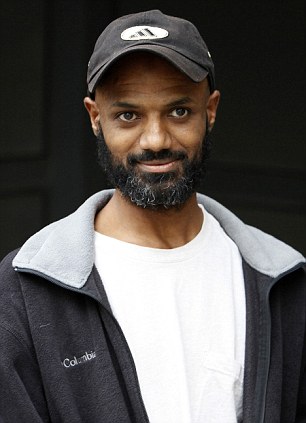
White House ‘deeply disappointed’ after British court upholds the law. Judge says MI5 operates ‘culture of suppression’

The story of Binyam Mohamed is probably one of the most under-reported stories of the war on terrorism — it has still only partially been told. If, as the former Guantanamo prisoner alleges, he had his genitals sliced with a scalpel after being captured by the US, then the defenders of so-called “harsh interrogation techniques” should finally be rendered mute and duly shamed.

The Daily Mail said:

By any measure, the treatment meted out to Binyam Mohamed was medieval in its barbarity.

Shackled in total blackness in the CIA’s ‘dark prison’ in Kabul, he was forced to listen to ear-splitting music 24 hours a day for a month.

In Morocco he was hung from walls and ceilings and repeatedly beaten, his penis and chest were sliced with a scalpel and hot, stinging liquid poured into the open wounds.

‘They cut all over my private parts,’ he wrote in his diary. ‘One of them said it would be better just to cut it off, as I would only breed terrorists.’

The Obama administration, which has consistently acted like putty in the hands of the intelligence services, regards the exposure of criminal actions by those services as a national security threat. In truth it is the US-sanctioned use of torture that poses a much more serious threat to this nation.

As The Guardian noted, the ruling by three of Britain’s most senior judges, “shattered the age-old ­convention that the courts cannot ­question claims by the government relating to national security, whatever is done in its name, in an unprecedented ruling that is likely to cause deep anxiety among the security and intelligence agencies.”

This is how democracy is supposed to work. Both in Britain and the US, all too often the phrase “national security” really means protection of the power-holders. A judiciary that is truly independent cannot allow any government to protect its own interests at the expense of the nation it serves.

Afua Hirsch describes in greater legal detail how the British government disregarded 400 years of legal precedence in its effort to suppress revelations about the use of torture.

The Guardian reported:

MI5 faced an unprecedented and damaging crisis tonight after one of the country’s most senior judges found that the Security Service had failed to respect human rights, deliberately misled parliament, and had a “culture of suppression” that undermined government assurances about its conduct.

The condemnation, by Lord Neuberger, the master of the rolls, was drafted shortly before the foreign secretary, David Miliband, lost his long legal battle to suppress a seven-paragraph court document showing that MI5 officers were involved in the ill-treatment of a British resident, Binyam Mohamed.

Amid mounting calls for an independent inquiry into the affair, three of the country’s most senior judges – Lord Judge, the lord chief justice, Sir Anthony May, president of the Queen’s Bench Division, and Lord Neuberger – disclosed evidence of MI5’s complicity in Mohamed’s torture and unlawful interrogation by the US.

So severe were Neuberger’s criticisms of MI5 that the government’s leading lawyer in the case, Jonathan Sumption QC, privately wrote to the court asking him to reconsider his draft judgment before it was handed down.

The judges agreed but Sumption’s letter, which refers to Neuberger’s original comments, was made public after lawyers for Mohamed and media organisations, including the Guardian, intervened.

They argued that Neuberger had privately agreed with Sumption to remove his fierce criticisms without giving then the chance to contest the move.

At The Atlantic, Marc Ambinder said:

The White House hinted today that it may have to alter long-standing intelligence sharing arrangements with the United Kingdom after the release of information provided to the Brits about the confinement and interrogation of one of its citizens, Binyam Mohamed.

“The United States government made its strongly held views known throughout this process. We appreciate that the UK Government stood by the principle of protecting foreign government intelligence in its court filings,” said Ben LaBolt, a White House spokesperson. “We’re deeply disappointed with the court’s judgment today, because we shared this information in confidence and with certain expectations.”

LaBolt’s statement hinted that the US might reevaluate the type of information it shares with British counterterrorism and intelligence agencies.

“As we warned, the court’s judgment will complicate the confidentiality of our intelligence-sharing relationship with the UK, and it will have to factor into our decision-making going forward. This just means that we need to redouble our efforts to work through this challenge, because the UK remains a key partner in our collective efforts to suppress terrorism and other threats to our national security.”

With respect to LaBolt, I think this is a bluff. The US shares more raw data and polished intel product with Britain on a daily basis than any other country in the world, and that’s not going to change. Perhaps the US will be more careful in certain documents that might find their way into the UK court system — but it’s hard to imagine that intelligence cooperation between the two countries will really be damaged by today’s revelation.

Facebooktwittermail

How the CIA became dumb and dangerous

Melvin A Goodman and Philip Giraldi — former CIA officers with decades of experience — both agree that the agency’s focus on paramilitary operations has undermined its core intelligence mission.

Giraldi writes:

It has been observed that no countries on the earth but the United States and Israel claim extraterritoriality, i.e. the right to seize or attack anyone anywhere and at any time based on evidence that is secret. The foul-up at Base Chapman [in which seven CIA officers were killed in a suicide attack] is reflective of the transformation of CIA into a Washington-sanctioned retribution machine, something not unlike the terrorist groups that it claims to oppose rather than an intelligence agency. It is telling that after the slaughter at Base Chapman senior Agency officers immediately announced that they would get revenge and the pace of drone attacks has dramatically increased, killing few or no actual terrorists but many civilians and further destabilizing an already tottering Pakistan. The broader problems that the Agency is experiencing are revealed in CIA’s eight years of largely unrewarding effort against “international terrorism,” a symptom of a systemic failure to understand much less identify and penetrate groups that are, ironically, constantly looking for volunteers to fill their ranks. CIA’s traditional strength in recruiting agents and collecting intelligence has all but disappeared, subsumed into a paramilitary mission to launch hellfire missile firing drones, which is also almost certainly a reflection of the White House’s perception of what needs to be done. If that is so, the tactic is ultimately self defeating in that it produces more enemies that it is able to eliminate, making failure in Afghanistan an absolute certainty.

Likewise, Goodman says:

In a democracy, where laws are derived from broad principles of right and wrong and where those principles are protected by agreed procedures, it is not in the interest of the state to flout those procedures at home, or to permit extra-legal activities abroad, which have complicated the task of maintaining credible relations with our allies in the battle against terrorism.

The CIA’s most important mission remains the preparation of independent analysis of international issues for senior decision makers; therefore, it is essential to protect the integrity of objective and balanced intelligence. The CIA gives far too much attention to support for the Pentagon and to current intelligence. In the past, CIA analysis served to contradict or at least temper the worst-case analysis of the Pentagon, but this is no longer the case.

President Harry Truman created the CIA to produce strategic intelligence that was not beholden to policy and political interests; President Obama must restore this mission.

Facebooktwittermail