Manoubia Bouazizi has grown used to the idea that her son Mohamed no longer belongs to her but to the Arab world. In the streets near where she lives on the outskirts of Tunis, she is stopped by people who recognise her, who have heard she is the mother of the market trader who set himself on fire in protest against an authoritarian regime, who kick-started the Jasmine revolution, and so the Arab spring.
His likeness is everywhere. Around the corner from her home, a pizza restaurant proprietor has mounted a full-colour reproduction of Mohamed’s face in his window to advertise a special discounted “Revolutionary Menu”.
Manoubia freely admits she, also, has made money from the global interest surrounding her son’s death. Sometimes she will be paid by the media organisations who want to interview her, and she has a ready-made contract drawn up for them to sign. The family were given 20,000 Tunisian dinars (about £9,000) by former president Zine al-Abidine Ben Ali as compensation for their loss and there are rumours – which Manoubia denies – that she has sold Mohamed’s vegetable cart to a rich businessman in the Emirates.
Still, her new-found prosperity is much in evidence. The Bouazizi family used to live in a modest, concrete house in the central Tunisian town of Sidi Bouzid. Now Manoubia, her husband and her six surviving children have decamped to a large apartment in La Marsa, a pretty seaside suburb of Tunis. Inside, there are caged canaries hanging from the tiled walls and a computer in one of the bedrooms.
When asked to describe what kind of person her son was, Manoubia has difficulty replying. “I can’t think of one single memory,” she says. “He was a man of good faith.” When pressed, her daughter Laila remembers that her brother’s favourite meal was “steak and chips” and that he supported Esperance Sportive, a Tunisian football team. Other than this, the family is disinclined to dwell on personal detail.
For Manoubia, as for those around her, it seems that the man has been subsumed by the myth. “It is strange to think that my little Mohamed should grow up to become this person,” Manoubia says, sitting in the front room of her rented house, her black robes gathered around her and set starkly against a bright orange blanket covering the sofa. She turns away as she speaks, not making eye contact, and it feels sometimes as though she is reciting answers she has learned by rote, having formulated the sentences hundreds of times before. “I am proud and happy that he should have been the first spark of the revolution.”
It is a phrase I will hear again and again, in varying forms across Tunisia. Some will call Mohamed Bouazizi “the drop that tipped over the vase”; others will insist that his death “lit the touchpaper” for the Arab spring revolts. But listen closely and there is also a growing murmur of dissent among those who believe that Mohamed was not a political hero but a media creation, manufactured by a myth-making machine that swung into action in the immediate aftermath of his death.
ROBERT SIEGEL (NPR host): And I’d like to ask you to begin with what has been a major difference between Fatah and your group, Hamas. Ismail Haniyeh, the prime minister of the Hamas government in Gaza, spoke the other day of the Palestinians’, and I quote, “great hope of bringing to an end the Zionist project in Palestine.”
About a week earlier, Hamas leader Khaled Mashaal said in Cairo that the goal of your movement is a Palestinian state in the West Bank and Gaza with Jerusalem as its capital. Which is it that Hamas seeks, a two-state solution alongside Israel or an end to the state of Israel altogether?
GHAZI HAMAD (Deputy Foreign Minister, Hamas): I think there is all kind of contradictions because maybe people understand that the occupation is a reflection of the Zionist movement, and I think the declaration of Hamas is very clear. We accept the state and ’67 borders. This state should be independent. It was chosen as the capital for Palestine and the right of return for the refugees.
But I think that Israel will not accept this because Israel reject all the demands of the Palestinian people because they believe that they have to have a Jewish state and Jerusalem is the capital of Israel and no right of return. So I think we’ll still have a big struggle and big disputes.
SIEGEL: But just to clarify, if Israel were to accept a two-state solution in which Palestine would be in Gaza and the West Bank and have its capital in Jerusalem, is that an acceptable aim that Hamas is striving for, or is that in and of itself insufficient because there would still be a state of Israel?
Mr. HAMAD: Look, we said frankly we accept this state and ’67 borders, but the question now should be directed to Israel. We need clear answer from Israel because Netanyahu said that we will not go back to the ’67 borders. We will not (unintelligible) settlements. So we still the victims of the occupation. (NPR)
The United States slapped sanctions on Syrian President Bashar Assad and six senior Syrian officials for human rights abuses over their brutal crackdown on anti-government protests, for the first time personally penalizing the Syrian leader for actions of his security forces.
The White House announced the sanctions Wednesday, a day before President Barack Obama delivers a major speech on the uprisings throughout the Arab world. The speech is expected to include prominent mentions of Syria.
The Obama administration had pinned hopes on Assad, seen until recent months as a pragmatist and potential reformer who could buck Iranian influence and help broker an eventual Arab peace deal with Israel. (AP)
Tanks shelled a Syrian border town for the fourth day Wednesday in a military campaign to crush demonstrations against President Bashar al-Assad, under mounting Western pressure to stop his violent repression of protesters.
Troops went into Tel Kelakh Saturday, a day after a demonstration there demanded “the overthrow of the regime,” the slogan of revolutions that toppled Arab leaders in Egypt and Tunisia and challenged others across the Middle East.
Assad had been partly rehabilitated in the West over the last three years but the United States and European Union condemned his use of force to quell unrest and warned they plan further steps after imposing sanctions on top Syrian officials. (Reuters)
“While much attention has been focused on rebel efforts in eastern Libya and in the city of Misurata, rebels have held control of most of the Nafusah Mountain region since the unrest began in February,” my colleagues Sergio Peçanha and Joe Burgess explain in the introduction to a fascinating, richly informative graphic on the fighting there.
Last month, after the rebels in these remote mountains made an unexpected show of strength, seizing a border post along the Tunisian frontier, my colleague Scott Sayare reported that “the region’s isolated hamlets were among the first to join the uprising,” fueled by simmering resentment from a Berber community which was neglected by Col. Muammar el-Qaddafi’s Arab nationalist regime.
Despite the fact that even rebel fighters in the region estimate their ranks at just a few hundred ill-equipped and untrained young men, they have someone held off attempts by government forces to reimpose Tripoli’s rule. (New York Times)
NATO kept up its bombing campaign against Libyan leader Moammar Gadhafi over the weekend, hitting missile launchers and other targets around Tripoli. The rebels say they welcome military support, but they would like something more: formal diplomatic recognition for their transitional government.
Some special guests flew in recently for the rebels’ weekly pep rally in Benghazi — delegates from areas of western Libya that are still under Gadhafi’s control. The delegates came to take their seats in the 30-seat National Transitional Council — a kind of proto-parliament.
Eastern Libyans like Mansour Makhlouf are glad to see them.
“Gadhafi’s people are spreading rumors that we are divided. But we’re not divided — we are all brothers,” Makhlouf says. (NPR)
The International Criminal Court’s chief prosecutor has asked a three-judge panel to issue arrest warrants for Libyan leader Muammar Gaddafi, his second-eldest son, Saif al-Islam, and his intelligence chief, Abdullah Senussi.
Luis Moreno-Ocampo described the evidence against the three men as “very strong” in a press conference on Monday and said he believed Libyans eventually would turn them over to the court.
The filing against Gaddafi comes just three months into the uprising against his 41-year rule, which evolved from peaceful protests in major cities to an armed rebellion based out of the east. Gaddafi’s regime has brutally attempted to suppress the opposition movement by shelling rebellious cities, and imprisoning and torturing those who speak out. (Al Jazeera)
For hours and hours, I didn’t know what to make of it: Tribute FM is the first ever English language radio station in Libya. And it sounds just like Magic. Diana Ross . . . the Jackson Five . . . the Temptations . . . some German rap . . . Easy Like Sunday Morning . . . just as you’re nodding along, thinking “this is nice, I wonder if they have a phone-in,” you remember: this is probably the most radical statement of a successful revolution coming out of any radio, anywhere in the world. It is a huge moment for a country in which not just English but most European languages have been invisible for decades.
Before Muhammad, Aman and two others launched Tribute in Benghazi last week, “English wasn’t frowned on, it was completely illegal,” Muhammad tells me by phone. “It was taken out of schools, it got to the point where nothing in English was available in the city. You couldn’t advertise in English, you couldn’t read a newspaper in English.”
It is a measure of how isolating this was for young Libyans that setting up a radio station would be such a priority as the fighting continues, the stream of refugees is unabated and Gaddafi has not, as yet, surrendered. (The Guardian)
For many years now, we’ve heard American commentators bemoan the violence of the Palestinian national movement. If only Palestinians had learned the lessons of Gandhi and Martin Luther King, we hear, they’d have had their state long ago. Surely no Israeli government would have violently suppressed a non-violent Palestinian movement of national liberation seeking only the universally recognised right of self-determination.
Palestinian commentators and organisers, including Fadi Elsalameen and Moustafa Barghouthi, have spent the last couple of years pointing out that these complaints resolutely ignore the actual and growing Palestinian non-violent resistance movement. For that matter, they elide the fact that the first intifada, which broke out in 1987, was initially as close to non-violent as could be reasonably expected. For the most part, it consisted of general strikes and protest marches. In addition, there was a fair amount of kids throwing rocks, as well as the continuing threat of low-level terrorism, mainly from organisations based abroad; the Israelis conflated the autochthonous protest movement with the terrorism and responded brutally, and the intifada quickly lost its non-violent character. That’s not that different from what has happened over the past couple of months in Libya; it shows that it’s very hard to keep a non-violent movement non-violent when the government you’re demonstrating against subjects you to gunfire for a sustained period of time.
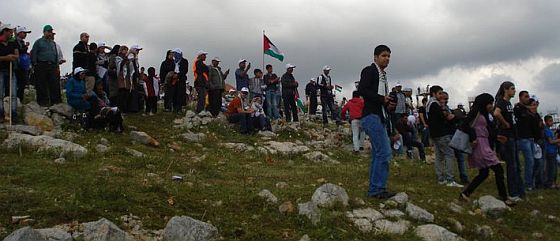
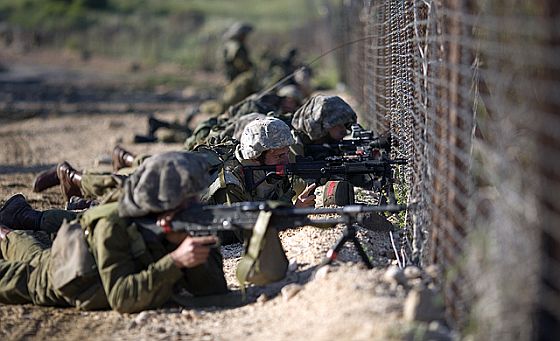
In any case, if you’re among those who have made the argument that Israelis would give Palestinians a state if only the Palestinians would learn to employ Ghandhian tactics of non-violent protest, it appears your moment of truth has arrived. As my colleague writes, what happened on Nakba Day was Israel’s “nightmare scenario: masses of Palestinians marching, unarmed, towards the borders of the Jewish state, demanding the redress of their decades-old national grievance.” Peter Beinart writes that this represents “Israel’s Palestinian Arab Spring”: the tactics of mass non-violent protest that brought down the governments of Tunisia and Egypt, and are threatening to bring down those of Libya, Yemen and Syria, are now being used in the Palestinian cause.
So now we have an opportunity to see how Americans will react. We’ve asked the Palestinians to lay down their arms. We’ve told them their lack of a state is their own fault; if only they would embrace non-violence, a reasonable and unprejudiced world would see the merit of their claims. Over the weekend, tens of thousands of them did just that, and it seems likely to continue. If crowds of tens of thousands of non-violent Palestinian protestors continue to march, and if Israel continues to shoot at them, what will we do? Will we make good on our rhetoric, and press Israel to give them their state? Or will it turn out that our paeans to non-violence were just cynical tactics in an amoral international power contest staged by militaristic Israeli and American right-wing groups whose elective affinities lead them to shape a common narrative of the alien Arab/Muslim threat? Will we even bother to acknowledge that the Palestinians are protesting non-violently? Or will we soldier on with the same empty decades-old rhetoric, now drained of any truth or meaning, because it protects established relationships of power? What will it take to make Americans recognise that the real Martin Luther King-style non-violent Palestinian protestors have arrived, and that Israeli soldiers are shooting them with real bullets?
Why did thousands of Palestinians yesterday converge upon Israel’s borders? Partly because Syria’s war-criminal leader, Bashar al-Assad, and his ally, Hezbollah, wanted them to. But there’s more to it than that. Palestinians also marched from Jordan and Egypt, whose governments did their best to stop the protests. In fact, they marched from every corner of the Palestinian world, in a tech-savvy, coordinated campaign. What hit Israel yesterday was the Palestinian version of the Arab spring.
Something fundamental has changed. I grew up believing that we—Americans and Jews—were the shapers of history in the Middle East. We created reality; others watched, baffled, paralyzed, afraid. In 1989, Americans gloated as the Soviet Union, our former rival for Middle Eastern supremacy, retreated ignominiously from the region. When Saddam Hussein tried to challenge us from within, we thrashed him in the Gulf War. Throughout the 1990s, we sent our economists, law professors and investment bankers to try to teach the Arabs globalization, which back then meant copying us. In a thousand ways, sometimes gently, sometimes brutally, we sent the message: We make the rules; you play by them.
For Jews, this sense of being history’s masters was even more intoxicating. For millennia, we had been acted upon. Mere decades earlier, American Jews had watched, trembling and inarticulate, as European Jews were destroyed. But it was that very impotence that made possible the triumph of Zionism, a movement aimed at snatching history’s reins from gentiles, and perhaps even God. Beginning in the early 20th century, Zionists created facts on the ground. Sometimes the great powers applauded; sometimes they condemned, but acre by acre, Jews seized control of their fate. As David Ben-Gurion liked to say, “Our future does not depend on what gentiles say but on what Jews do.” The Arabs reacted with fury, occasional violence, and in Palestine, a national movement of their own. But they could rarely compete, either politically or militarily. We went from strength to strength; they never missed an opportunity to miss an opportunity.
That world is gone. America and Israel are no longer driving history in the Middle East; for the first time in a long time, Arabs are. In Tahrir Square, Egypt’s young made a revolution. President Obama bowed to reality and helped show Hosni Mubarak the door; Benjamin Netanyahu stood athwart history, impotently yelling stop. Now Egypt’s leaders are doing its people’s will, bringing Hamas and Fatah together in preparation for elections. Hamas and Fatah are complying because they fear their own Tahrir Square. They sense that in Palestine too, a populist uprising stirs; that’s part of what yesterday’s marches were about. For American and Israeli leaders accustomed to Palestinian autocrats and Palestinian terrorists, this is something new. Netanyahu and his American backers are demanding that Obama rewind the clock, but he can’t. The Palestinians no longer listen to functionaries like George Mitchell. They have lost faith in American promises, and they no longer fear American threats. Instead, they are putting aside their internal divisions and creating facts on the ground.
At least 353 people were injured, one of them critically, when Egyptian security forces attacked a pro-Palestine demonstration outside the Israeli embassy in Cairo on Sunday night, according to witnesses and the Health Ministry.
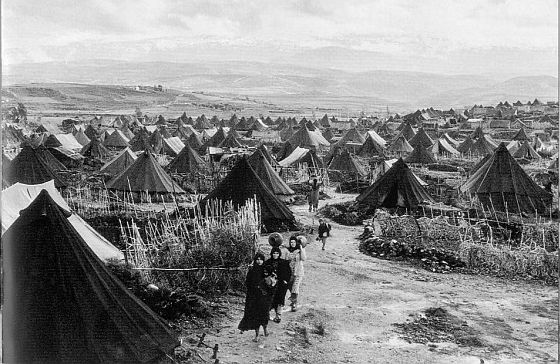
Activists told Al Jazeera that army and internal security troops used tear gas, rubber-coated bullets and live ammunition to disperse thousands of protesters who had gathered to mark the 63rd anniversary of the “Nakba” or “catastrophe” – the day in 1948 that Israel declared its independence and thousands of Palestinians fled or were expelled form their homes.
At least two protesters were shot by live ammunition, while others were hospitalised after inhaling tear gas or being hit by rubber-coated steel bullets, some of which penetrated the skin, witnesses said.
From his hiding place in Tripoli, Colonel Muammar Gaddafi is desperately trying to pave a way for an exit from public life.
Sources say the veteran autocrat’s grand plan is to retire to a godfather-like role in the nation he has ruled for more than 40 years and then allow institutions to grow that will eventually replace his hold on power.
This, he hopes, will convince Nato to stop its two-month campaign of almost nightly air strikes, which have decimated Libya’s military and defences and reinforced a rebellion that is steadily eroding the country’s power base.
Interviews with four regime members have confirmed that Gaddafi knows his time is up. “But he isn’t going to run away to Venezuela,” one official said. “He wants to move to the background and lead a dignified life. He himself has said he wants to be like the Japanese emperor, or Castro.”
“He knows and we know that Libya doesn’t have a future through imposing his cult of personality on the people and the world,” said a second official. “There is no question that the country needs reforms, many reforms.”
The world faces a watershed moment in human rights with tyrants and despots coming under increasing pressure from the internet, social networking sites and the activities of WikiLeaks, Amnesty International says in its annual roundup.
The rights group singles out WikiLeaks and the newspapers that pored over its previously confidential government files, among them the Guardian, as a catalyst in a series of uprisings against repressive regimes, notably the overthrow of Tunisia’s long-serving president, Zine al-Abidine Ben Ali.
“The year 2010 may well be remembered as a watershed year when activists and journalists used new technology to speak truth to power and, in so doing, pushed for greater respect for human rights,” Amnesty’s secretary general, Salil Shetty, says in an introduction to the document. “It is also the year when repressive governments faced the real possibility that their days were numbered.”
But, Shetty adds, the situation in the Middle East and North Africa, and elsewhere, remains unpredictable: “There is a serious fightback from the forces of repression. The international community must seize the opportunity for change and ensure that 2011 is not a false dawn for human rights.”
The New York Times reports from Abu Dhabi, in the United Arab Emirates:
Late one night last November, a plane carrying dozens of Colombian men touched down in this glittering seaside capital. Whisked through customs by an Emirati intelligence officer, the group boarded an unmarked bus and drove roughly 20 miles to a windswept military complex in the desert sand.
The Colombians had entered the United Arab Emirates posing as construction workers. In fact, they were soldiers for a secret American-led mercenary army being built by Erik Prince, the billionaire founder of Blackwater Worldwide, with $529 million from the oil-soaked sheikdom.
Mr. Prince, who resettled here last year after his security business faced mounting legal problems in the United States, was hired by the crown prince of Abu Dhabi to put together an 800-member battalion of foreign troops for the U.A.E., according to former employees on the project, American officials and corporate documents obtained by The New York Times.
The force is intended to conduct special operations missions inside and outside the country, defend oil pipelines and skyscrapers from terrorist attacks and put down internal revolts, the documents show. Such troops could be deployed if the Emirates faced unrest in their crowded labor camps or were challenged by pro-democracy protests like those sweeping the Arab world this year.
The U.A.E.’s rulers, viewing their own military as inadequate, also hope that the troops could blunt the regional aggression of Iran, the country’s biggest foe, the former employees said. The training camp, located on a sprawling Emirati base called Zayed Military City, is hidden behind concrete walls laced with barbed wire. Photographs show rows of identical yellow temporary buildings, used for barracks and mess halls, and a motor pool, which houses Humvees and fuel trucks. The Colombians, along with South African and other foreign troops, are trained by retired American soldiers and veterans of the German and British special operations units and the French Foreign Legion, according to the former employees and American officials.
In outsourcing critical parts of their defense to mercenaries — the soldiers of choice for medieval kings, Italian Renaissance dukes and African dictators — the Emiratis have begun a new era in the boom in wartime contracting that began after the Sept. 11, 2001, attacks. And by relying on a force largely created by Americans, they have introduced a volatile element in an already combustible region where the United States is widely viewed with suspicion.
A public spat between Iran’s Supreme Leader Ayatollah Ali Khamenei and the country’s president Mahmoud Ahmadinejad made the international headlines last week. Politics is rarely ever a harmonious business in any country, so why the brouhaha over this particular stand-off?
To be sure, the disagreement itself was an unusual occurrence. Khamenei’s very public reinstatement of Intelligence Minister Heydar Moslehi – citing Maslehat or the “greater good of the nation”, no less – shortly after Ahmadinejad removed him, could only be viewed as a tough dressing down. And then Ahmadinejad unexpectedly raised the stakes further by boycotting cabinet meetings for eleven days.
The whole point of a Supreme Leader – or Velayat-e-Faghih – as conceived by the Islamic Revolution’s founders, is that he is the ultimate arbiter over both state and religious affairs.
Ahmadinejad’s defiant snit was a direct challenge to the authority of the Supreme Leader. It served to catapult the affair into the political stratosphere, and he was eventually forced to back down.
But there’s more to this. Tehran sits at the epicentre of a geopolitical struggle between two battling regional worldviews. One “bloc” is comfortable with the existing US and Israeli hegemony in the Middle East and consists of many of the autocratic leaders now being swept away in the Arab Spring. The other is the Iran-led “Resistance Bloc” that seeks to end this foreign hegemony and embrace regional and national self-determination.
What is it about free Arabs that Barack Obama, Hillary Clinton and other leading Western officials still do not fully understand or embrace?
I am troubled that every few months, we hear a drum roll of anticipation building up to a moment when we are told to expect a defining speech, or a new statement, or another initiative, or just a really heartfelt television interview in which the United States will clearly define its policy toward, well, toward many things – in fact, toward an entire, ever-changing constellation of moving targets in the Middle East that seem to deeply confound the United States government at the historic moment when Arabs en mass are agitating for their own liberty and rights. It is troubling to see those who claim to ring the bell of freedom for all humankind prove hesitant to apply a freedom-promoting foreign policy across the entire Arab world.
This is not purely an American issue, to be fair, as Europeans, Turks and other freedom-loving democrats have also supported the Arab revolts for freedom and citizenship rights with selectivity and serial hesitancy. So what should we make of the fact that we now hear that President Barack Obama will give a major speech next week outlining his country’s approach to the Middle East and the wider Islamic world in the wake of the killing of Osama Bin Laden?
We will listen to a fine speech once again, one ear cocked toward his speech, the other toward what Arab men and women are doing throughout the Middle East as they fight, suffer and die in the thousands now to achieve the liberty and democracy that Obama and others keep telling us comprise the shared values that unite us all.
Yet Washington’s attitude to the Arab Spring reflects a wider problem across much of the Western world that I personally experience daily in my assorted discussions with journalists, officials, diplomats and researchers. It is the same old and ugly problem of double standards in many Western governments’ treatment of Arab issues.
In this case, the problem is simply that the epic Arab struggle for liberty, rights and dignity is perceived by many abroad as a television drama that is captivating, even thrilling – but one that remains peculiarly detached from the world of Western powers and, more importantly, remains beyond that realm of people, political movements and social forces that the West can embrace with the same clarity and force with which, for example, it embraced the Soviet dissidents in the 1970s and 1980s. The Arab citizen’s right to liberty is neither clear nor consistent in Western eyes. When it touches on the realms of Israel or oil, especially, Arab liberty becomes the victim and ward of greater Western interests.
Friday’s announcement of George Mitchell’s planned resignation as the U.S. mediator in the Arab-Israeli conflict appears to be yet another sign of the disarray and failure in President Obama’s handling of the Middle East. Recently, two articles provided a troubling inside look at the ineptitude that makes Mitchell’s departure unsurprising. A New Yorker piece on the Arab Spring by Ryan Lizza describes Obama’s navigation between realists and idealists, and tags him (per the article’s title) as “The Consequentialist.” Perhaps “The Cluelessist” is more like it.
Lizza’s article this month and “Obama Seeks Reset in the Arab World” by Mark Landler in the New York Times this week relay the narrative of the president’s spinmeisters: the Middle East poses devilishly complicated challenges, and Obama is struggling with them as well as can be expected. Lizza lets an Obama adviser get away with making the concept of “leading from behind” sound like a tool of noble statesmanship rather than a cowardly cop-out. Yet, as Obama prepares to give a foreign policy speech as early as next week, the reporting in these two articles — and now Mitchell’s resignation — add up to an unflattering portrait of a White House wandering the Middle East without a map.
One of the signs is the White House’s effort to erase Obama’s misjudgments from the record. In Egypt, the truth is that the White House failed to see the writing on the wall and foolishly stood by the brutal and corrupt Mubarak regime to the end. As Lizza writes, “Obama decided not to call for Mubarak to step down… Obama’s instinct was to have it both ways.” While Obama supposedly sympathized with the protesters, he clearly didn’t want to alienate other pro-American dictators or risk destabilization in a major Arab country that had made peace with Israel.
“Damascus has seen all that has ever occurred on earth, and still she lives,” wrote Mark Twain after visiting Syria’s capital in the 1860s. “She has looked upon the dry bones of a thousand empires, and will see the tombs of a thousand more before she dies.”
The turmoil in Syria, where hundreds of unarmed protesters have been mown down by the forces of President Bashar al-Assad, who comes from the country’s Alawi minority, is much more menacing than the generally peaceful revolutions in Tunisia and Egypt, from which the Syrian protesters drew their initial inspiration. The regime of Zine el-Abidine Ben Ali in Tunisia capitulated in the face of spontaneous demonstrations sparked by the self-immolation of a twenty-six-year-old man who had been reduced to scratching out a living as a humble street vendor. Ben Ali, along with his hated wife and family, chose to go into exile before a single shot had been fired.
In Egypt, if press reports are to be believed, the generals unseated President Hosni Mubarak after tank commanders refused his orders to fire on civilians. The Egyptian revolution, which has seen some resistance from the military and police, has now taken a constitutional turn, with the country approving a series of amendments that could lead to the emergence of a parliamentary democracy. Much will depend on the willingness of the military to allow an open political process to take place.
The Syrian government’s response to the Arab world’s turbulent spring, by contrast, has been both violent and vacillating. Its initial response was to characterize the protests across the country as the result of a global conspiracy fomented by a clutch of unlikely allies, including the US, Israel, and Arab enemies in Lebanon, Saudi Arabia, and Qatar, working with former regime officials and homegrown Salafists, or fundamentalists. Then President Assad tried to defuse the opposition by receiving protest delegations and announcing the lifting of long-standing emergency laws, apparently acknowledging the existence of legitimate grievances. But this proved no more than a gesture. In effect the government’s response has been contradictory to the point of incoherence: as the Brussels-based International Crisis Group points out in a report released on May 3:
The regime has lifted the emergency law but has since allowed the security services to conduct business as usual, thereby illustrating just how meaningless the concept of legality was in the first place. It authorises demonstrations even as it claims they no longer are justified and then labels them as treasonous. It speaks of reforming the media and, in the same breath, dismisses those who stray from the official line. It insists on ignoring the most outrageous symbols of corruption. Finally, and although it has engaged in numerous bilateral talks with local representatives, it resists convening a national dialogue, which might represent the last, slim chance for a peaceful way forward.
Over seven hundred people have been killed so far, more than a hundred of them in the southwestern city of Deraa, near the Jordanian border, where the Omari mosque—a center of resistance—has been closed to worshipers after being shelled by tanks and taken over by snipers. Some ten thousand people are now said to have been detained by elite security forces backed by the army. According to Amnesty International, detainees have been beaten with sticks and cables, and sometimes deprived of food. Unlike in Libya there are no NATO forces to protect Syria’s cities or parts of the country from the murderous attacks inflicted by a regime that is now losing the last threads of international legitimacy. Assad has a more effective army than Qaddafi and powerful friends in Iran, Lebanon, and Iraq.
In contrast to Libya, military action in defense of Syria’s beleaguered population would barely attract a shred of international support. While the Arab League voted unanimously for the no-fly zone to protect the people of Benghazi, in the case of Syria it has not even mentioned the country by name, merely declaring that pro-democracy protesters “deserve support, not bullets.”
The Bahraini government has destroyed a number of mosques in continuation of its aggressive crackdown on pro-democracy protesters, a special Al Jazeera investigation has revealed.
At least 28 mosques and Shia religious institutions have been destroyed in the Gulf state since the crackdown on Shia-led protests began in Mid-March, the opposition group, Al Wefaq, told Al Jazeera’s Charles Stratford.
The Justice Ministry, however, said it was tearing down the mosques because they were not licensed. (Al Jazeera)
Adopting what might be called the Qaddafi defense, the head of Bahrain’s military claimed that the country’s brutal crackdown on dissent was entirely justified because the kingdom’s security forces had been confronted by young protesters under the influence of mind-altering drugs.
According to Bahrain’s state news agency, Sheik Khalifa bin Ahmed Al Khalifa said on Wednesday that “young people were given pills which affected their minds and made them do unusual things.” He also claimed “that Bahrain had been the victim [of] a conspiracy involving foreign agents and financing.” (New York Times)
Christopher Stokes writes: In Bahrain, to be wounded by security forces has become a reason for arrest and providing healthcare has become grounds for a jail sentence. During the current civil unrest, Bahraini health facilities have consistently been used as a tool in the military crackdown against protesters.
The muted response from key allies outside of the region such as the United States – which has significant ties to Bahrain, including a vast naval base in the country – can only be interpreted as acceptance of the ongoing military assault, which is backed by the Gulf Co-operation Council.
While the government and its supporters in Bahrain continue to refer to the protesters as rioters, criminals, extremists, insurgents or terrorists, the label that remains conspicuously absent for those who are wounded is “patient”. (The Guardian)
The Obama administration’s special Mideast envoy, former Sen. George Mitchell, is resigning after more than two largely fruitless years of trying to press Israel and the Palestinians into peace talks, U.S. officials said Friday.
The White House is expected to announce that the veteran mediator and broker of the Northern Ireland peace accord is stepping down for personal reasons, the officials told The Associated Press. The officials spoke on condition of anonymity ahead of an afternoon announcement that will follow a White House meeting between Mitchell and President Barack Obama.
There are no imminent plans to announce a replacement for Mitchell, the officials said, although his staff is expected to remain in place at least temporarily.
Mitchell’s resignation comes at a critical time for the Middle East, which is embroiled in turmoil, and the Israeli-Palestinian peace process, which has been moribund since last September and is now further complicated by an agreement between Palestinian factions to share power.
Obama will deliver a speech next Thursday at the State Department about his administration’s views of developments in the region, ahead of a visit to Washington by Israeli Prime Minister Benjamin Netanyahu. Jordan’s King Abdullah II also will travel to Washington next week. (AP)
On Thursday, The Palestinian Central Bureau of Statistics (PCBS) issued a report stating that more than 7000 Palestinians were killed by Israeli soldiers and settlers in the occupied Palestinian territories over the past ten years.
The PCBS said that 7342 Palestinians were killed in the period between September 29, 2000 and December 31, 2010.
The report stated that by the end of 2009, the number of Palestinians killed by Israeli fire arrived to 7235, including 2183 killed by Israeli fire in the West Bank. (IMEC)
Israeli security forces have clashed with Palestinians in several East Jerusalem neighbourhoods ahead of “Nakba Day” or “day of catastrophe” on Sunday.
The anniversary marks Israel’s 1948 declaration of statehood after which more than 700,000 Palestinians fled or were expelled in the war that ensued.
A correspondent for the AFP news agency saw four people hurt as police opened fire with rubber bullets at stone-throwing youths in Silwan. (Al Jazeera)
A 17 year-old was critically injured from live fire in East Jerusalem, and an American protester suffered serious head injury after being hit by a tear-gas projectile shot directly at him from close range.
Israeli military and police forces responded heavy handedly to demonstrations commemorating 63 years to the Palestinian Nakba (catastrophe) of 1948 today all over the West Bank and East Jerusalem. Morad Ayyash, a 17 year old from the Ras el-Amud neighborhood was shot in the stomach with live ammunition. He has reached the Muqassed hospital with no pulse and the doctors are now fighting for his life.
Tension also rose in the East Jerusalem neighborhood of Silwan, where 19 protesters have been injured and 11 were arrested. During the evening hours, large police forces raided houses in Silwan and carried out additional arrests. (Mondoweiss)
Khaled Diab writes: With the world’s attention focused on the tumultuous changes gripping Tunisia, Egypt, Yemen, Bahrain, Libya and Syria, one may be excused for thinking that all is quiet on the Palestinian-Israeli front.
So why haven’t Palestinian youth risen up like their counterparts elsewhere in the region to demand their rights?
Well, it is not for want of trying. Inspired by events in Tunisia and Egypt, and following the date-based example of counterparts elsewhere in the Arab world, a new youth movement dubbed by some as the March 15 movement has emerged in Palestine.
The date refers to the day when organisers employing social media, text messaging and word of mouth managed to draw thousands of protesters on to the streets of Ramallah and other parts of the West Bank, as well as Gaza City.
However, in contrast to other popular uprisings in the region, their demands were not wholesale regime change, despite the undoubted failings of both Fatah in the West Bank and Hamas in Gaza, and the absence of a democratic mandate for both parties.
“Our top priority is to end the divisions within Palestinian society. This is the only way to deal with the occupation,” explained Z, one of the founders of the movement in Ramallah, who wished to conceal his identity for professional reasons.
Some of the others involved in March 15 are also reluctant to reveal their identities, partly as an expression of the decentralised and “leaderless” approach preferred by Middle Eastern protesters tired of authoritarianism, and partly to avoid popping up on the radars of security services run by the PA, Hamas or Israel.
Despite its relative success on 15 March, the movement has not managed to replicate the most successful ingredient of the protests in Tunisia, Egypt, Yemen and Bahrain: constant pressure from the streets. This is partly due to the two-tiered nature of the oppression facing Palestinians, and the restrictions on their movement imposed by the occupation. “Unfortunately, we have two levels of repression in Palestine: Israeli and domestic,” says Z, who is in his early 20s.
In addition, there is the psychological barrier of widespread despair and disillusionment afflicting wide swaths of the population, which the Arab spring is just beginning to chip away at. Most Palestinians I have met since I moved to Jerusalem a few weeks ago speak enthusiastically and excitedly about the Egyptian revolution.
“The problem among Palestinians is that revolutions are nothing new, yet nothing changes or things get worse,” Z observes. “Neither uprisings nor negotiations have worked, Palestinians believe – we’re still under occupation.” (The Guardian)
Khaled Meshaal, the head of the political bureau of the Islamic resistance movement Hamas, said that for the time being Egyptians are not required to march to the Gaza Strip in support of the Palestinian cause.
Egyptian activists had called on Egyptians to march to the Gaza Strip through the Rafah border crossing on 15 May. The event, which has been dubbed “March to Palestine Day”, is intended to mark the 63rd anniversary of the declaration of the State of Israel.
In statements published on the official website of the Muslim Brotherhood in Alexandria, Meshaal said that, “advocating the cause by taking a political stance, sending relief aid, boycotting and sending prayers is a must at the moment. We do not ask you to march.” (Al-Masry Al-Youm)
Libyan state television has aired what it says is a statement by Muammar Gaddafi, in which the Libyan leader denies reports that he has been wounded.
In the audio message, broadcast on Friday evening, Gaddafi said he is alive and well despite air strikes from the NATO military alliance on his Bab al-Aziziyah compound in the capital, Tripoli, on Thursday.
Gaddafi said he is in a place where NATO bombs can not reach him. (Al Jazeera)
Concern is growing over a British-based photographer who has been missing for 39 days after being captured in Libya by forces loyal to Muammar Gaddafi.
Anton Hammerl, an award-winning photographer, was captured on 4 April and his family have had no concrete news about him since then.
The regime has, however, allowed access to three other journalists who were captured with him. (The Guardian)
Thousands of protesters in Syria defied a ferocious crackdown and returned to the streets Friday, even in towns that the military had besieged only days before, in a relentless contest of wills that a leading dissident described as an emerging stalemate.
For successive weeks, Fridays have served as a weekly climax in the challenge to President Bashar al-Assad’s rule. Calls for demonstrations this Friday came after a withering wave of repression that has killed hundreds and detained thousands in towns and cities stretching from the Mediterranean coast to Damascus’s outskirts and the poverty-ridden south.
While some of the country’s most restive locales remained relatively quiet — namely Baniyas on the coast and Dara’a in the south — protesters took to the streets in at least five neighborhoods in Homs, Syria’s third largest-city and a center of the two-month uprising. Activists said protests ranged in numbers from hundreds to thousands, and at least two people were killed when security forces opened fire.
“We don’t like you!” crowds chanted in Homs, referring to the president. “You and your party, leave us!” (New York Times)
Syrian forces carried out raids in towns on the outskirts of Damascus and a besieged city on the coast on Thursday, as the number of detainees surged in a government campaign so sweeping that human rights groups said many neighborhoods were subjected to repeated raids and some people detained multiple times by competing security agencies.
The ferocious crackdown on the uprising, which began in March, has recently escalated, as the government braces for the possibility of another round of protests on Friday, a day that has emerged as the weekly climax in a broad challenge to the 11-year rule of President Bashar al-Assad.
Residents have reported that hundreds of detainees are being held in soccer stadiums, schools and government buildings in various towns and cities across the country, some of them arrested in door-to-door raids by black-clad forces carrying lists of activists. (New York Times)
The neighbors watched helplessly from behind locked gates as an exchange of gunfire rang out at the police station. Then about 80 prisoners burst through the station’s doors — some clad only in underwear, many brandishing guns, machetes, even a fire extinguisher — as the police fled.
“The police are afraid,” said Mohamed Ismail, 30, a witness. “I am afraid to leave my neighborhood.”
Three months after the ouster of Hosni Mubarak, a crime wave in Egypt has emerged as a threat to its promised transition to democracy. Businessmen, politicians and human rights activists say they fear that the mounting disorder — from sectarian strife to soccer riots — is hampering a desperately needed economic recovery or, worse, inviting a new authoritarian crackdown.
At least five attempted jailbreaks have been reported in Cairo in the past two weeks, at least three of them successful. Other attempts take place “every day,” a senior Interior Ministry official said, speaking on the condition of anonymity because he was not authorized to talk publicly.
Newspapers brim with other episodes: the Muslim-Christian riot that raged last weekend with the police on the scene, leaving 12 dead and two churches in flames; a kidnapping for ransom of a grandniece of President Anwar el-Sadat; soccer fans who crashed a field and mauled an opposing team as the police disappeared; a mob attack in an upscale suburb, Maadi, that hospitalized a traffic police officer; and the abduction of another officer by Bedouin tribes in the Sinai.
“Things are actually going from bad to worse,” said Mohamed ElBaradei, the former international atomic energy official, now a presidential candidate. “Where have the police and military gone?” (New York Times)
Reports that the Gulf Cooperation Council (GCC) is considering some form of membership for two non-Gulf states – Jordan and Morocco – confirm that the conservative Sunni monarchies of the Middle East are closing ranks against Iran, Shiite-led Iraq and the democratic wave sweeping the region.
GCC secretary general Abdullatif al-Zayani made the announcement Tuesday after a summit of the six-member group affirmed support for Saudi and United Arab Emirates military intervention against predominantly Shiite pro-democracy protesters in Bahrain.
Zayani did not make clear whether Morocco and Jordan would be offered a second-tier membership in the GCC, which groups Saudi Arabia, Kuwait, Oman, the UAE, Qatar and Bahrain.
Foreign ministers from Jordan and Morocco will meet with GCC foreign ministers to “complete required procedures”, Zayani told reporters.
Founded in 1981 in the aftermath of Iran’s 1979 revolution and in the midst of the 1980-88 Iran-Iraq war, the GCC encourages economic and especially military cooperation among its members, which all border the Persian Gulf. In territorial terms, it would make more sense to offer membership to Iraq or Yemen than to Jordan or faraway Morocco.
However, the wave of popular unrest that has swept the region since January – and toppled once durable pro-Western authoritarian non- monarchies in Tunisia and Egypt – has spread anxiety among conservative Sunni monarchies already unsettled by the Shiite replacement of a Sunni regime in Iraq and by Iran’s slow but steady nuclear advancement. (IPS)
The Syrian military intensified a methodical, ferocious march across the country’s most restive locales on Wednesday, shelling the country’s third-largest city from tanks, forcing hundreds to flee and detaining hundreds more in what has emerged as one of the most brutal waves of repression since the Arab Spring began.
Homs, in central Syria near the Lebanese border, has become the latest target of the crackdown, which has already besieged and silenced, for now, the cities of Dara’a, in the fertile but drought-stricken southern steppe, and Baniyas, on the Mediterranean coast. Dozens of tanks occupied Homs, as black-clad security forces, soldiers and militiamen in plain clothes filtered through the industrial city of 1.5 million people. At least 19 people were killed there Wednesday, human rights groups said.
The crackdown in some neighborhoods alternated with the relative calm in the center of a city that is home to a Sunni Muslim majority and a Christian minority.
“We see the smoke rising in the sky after we hear the shells explode,” said Abu Haydar, a resident reached by telephone. “The sky was pretty quickly covered in smoke.”
In public statements and interviews, the government has acknowledged the crackdown, describing the military’s targets as militant Islamists and saboteurs. It said nearly 100 soldiers and members of the security forces had been killed, and American officials say that some protesters have indeed taken up arms.
In Washington, two Obama administration officials said that the United States still did not see a clear or organized opposition or another leader in Syria who could serve to unite the foes of the government of President Bashar al-Assad. (New York Times)
Joshua Landis writes: I am a pessimist about Syria’s future because the regime will dig in its heels and fight to the end. The Syrian opposition has successfully established a culture of resistance that is widespread in Syria and will not be eliminated. Even if demonstrations can be shut down for the time being, the opposition will not be defeated. Syria’s youth, long apolitical and appathetic, is now politicized, mobilized, and passionate. All the same, the opposition remains divided and leaderless, which presents great dangers for a post-Assad Syria.
It is hard to see any soft landing for the regime or the people. It is also hard to see how the regime will be brought down short of economic collapse and its inability to pay wages, which would lead to wider social defections and a possible splitting of the military, as happened in Lebanon and Libya. If the military splits, both sides would have ample firepower to do real damage. Large sections of Syria could fall out of state control. Regions not divided by sect could remain fairly quite and stable for a time if there is a unified political leadership to step into the vacuum. Otherwise competing parties will develop militias as happened in Iraq and Lebanon.
No foreign power will feel compelled to step in to protect the people or stop the fighting because no one will be responsible for “losing Syria.” Syria is a political orphan today.
The army has split in Syria once before. This happened in Feb 1954 at the end of Adib Shishakli’s rule. The army divided along geographic lines. The divisions in the North went with the opposition centered on the People’s Party based in Homs and Aleppo. The South stood by Shishakli. Fortunately, General Shishakli decided to leave the country and flew off to Saudi Arabia, helped by the US. He had a change of mind in mid air but the US prevented his return. Washington convinced Lebanon to refuse his jet landing rights. After a brief spell in Arabia, Shishakli migrated to Brazil, where a relative of a Druze man, for whose death Shishakli was responsible, assassinated him.
Syria’s great weakness is it lack of unity. This is why the Assad household has been able to rule for so long. Hafiz al-Assad was able to bring stability to Syria after 20 years of coups and political chaos by reverting to the use of traditional loyalties. He ended Syria’s period as a banana republic by placing his brother in charge of protecting the presidency and using tribal and sectarian loyalties to coup-proof the regime. Alawite faithful were carefully recruited to all the sensitive security positions in the Mukhabarat and military. The Sunni elite was grateful for the stability and was further brought in through the crafty use of graft and patronage. Rami Makhlouf is corrupt, but he is also the fixer for the Sunni merchant class. The way he brought the Sham Holding Company in to the circle of regime loyalists was a classic use of privilege and muscle to glue the elite families of Syria to the regime. They have made millions my accepting an offer that they could not refuse.
The Syrian opposition has always been divided between Arab nationalists, Islamist currents, liberals, and all those who disprove of the regime but are too conservative to take part in active opposition. Then there are the sectarian communities and the Kurds, class divisions, and the urban-rural split, not to mention the traditional rivalry between Damascus and Aleppo. The reason that the Assads have been so successful for so long is largely due to the inability of Syrians to unite around a common platform and national identity. The oppositions lack of unity does not augur well for a post Assad future, especially as the death toll mounts and the desire for revenge grows. (Syria Comment)
Yemeni forces have opened fire on demonstrators in three major cities, killing at least 18 and wounding hundreds in one of the fiercest bouts of violence witnessed in nearly three months of popular unrest aimed at toppling President Ali Abdullah Saleh.
The clashes between a defected faction of Yemen’s army and the republican guard, have raised fears that Yemen may be reaching a critical juncture as public fury continues to mount at the president’s refusal to step down.
Violence broke out in the capital when a throng of 2,000 protesters tore away from the main sit-in area at Sana’a University and surged en masse towards the cabinet building in downtown Sana’a with shouts of “God is great” and “Allah rid us of this tyrant”. (The Guardian)
Hamas is not a terror organization, Turkish Prime Minister Recep Tayyip Erdogan said in an interview with U.S. television late Wednesday, saying he felt the recently penned Palestinian reconciliation agreement was an essential step toward Mideast peace.
Erdogan’s comments came one day after Hamas Gaza strongman Mahmoud Zahar said that while his organization would accept a Palestinian state within 1967 borders, it would never recognize Israel, as a result of the damage such a move would do to Palestinian refugees in the “diaspora.”
Senior Israeli officials, led by Prime Minister Benjamin Netanyahu, have voiced opposition to Fatah’s new unity deal with Hamas, saying that a Palestinian government that included a terrorist group calling for Israel’s destruction could not be a partner for peace.
Speaking to Charlie Rose on Wednesday, however, the Turkish PM chimed in on the recently achieved unity agreement between rival Palestinian factions Fatah and Hamas, indicating that he did not feel Hamas was an obstacle in achieving Mideast peace. (Haaretz)
Palestinian President Mahmoud Abbas has told Egyptian officials that incumbent Prime Minister Salam Fayyad is his only candidate to head the burgeoning Palestinian unity cabinet, the London-based Arabic daily Al-Hayat reported on Thursday.
The report came after international donors were reportedly applying significant pressure on Abbas to retain Fayyad as prime minister, after earlier reports claimed the Palestinian prime minister would have to step down as a result of Fatah’s newly signed unity pact with former rivals Hamas. (Haaretz)
Muammar Gaddafi’s compound in Tripoli has been hit by Nato rockets again, a few hours after the veteran autocrat appeared in public for the first time in almost two weeks.
Gaddafi was shown on state television in a traditional brown robe addressing tribal leaders, whom he empowered to speak on behalf of a nation he has ruled with absolute power for almost 42 years.
The labyrinthine complex in the heart of the capital was struck at around 3am with five bombs and rockets that appeared to target military installations and bunkers.
A giant crater could be seen in the lawn in the middle of the complex, with one of the rockets having hit what appeared to be a bunker . Officials said six people were killed in the attack, including two Libyan reporters who had been interviewing supporters camped out at the scene.
“These locations were known to be command and control facilities engaged in co-ordinating attacks against civilian populations in Libya,” said a Nato official speaking from Brussels.
Libyan spokesman Moussa Ibrahim said the underground facility was not a bunker, but a sewage network. But following the strike, chanting Gaddafi supporters guarded a stairwell leading to the ruined site, having been told to let no reporters near it. Heat rose from a second smaller crater, where shattered reinforced concrete exposed a cavernous hole beneath. (The Guardian)
The Obama administration is stepping up its engagement with forces fighting Libyan leader Muammar Gaddafi, inviting opposition leaders to meet with U.S. officials at the White House Friday, while stopping short of recognizing their council as Libya’s legitimate government.
The White House said Mahmoud Jibril, a representative of the Libyan Transitional National Council, would meet with senior administration officials, including National Security Adviser Tom Donilon, as well as members of Congress. But there were no plans for President Barack Obama to meet with Jibril and his delegation.
France and Italy are among the nations that recognize the Council as Libya’s legitimate government. But White House press secretary Jay Carney said today that while the U.S. would continue consulting and assisting the opposition, giving the Council political legitimacy would be “premature.”
Defence Secretary Robert Gates, speaking with Marines, said the U.S. is keeping a “wary eye” on the opposition, and lacks clarity about exactly who the opposition is and what actions they may take long-term.
Still, the U.S. has been boosting its support for the opposition over the past month, including Obama’s authorization of $25 million in non-lethal assistance to the revolutionaries. The first shipment of that aid — 10,000 meals ready to eat from Pentagon stocks — arrived in the liberated city of Benghazi this week. The U.S. has also supplied some $53 million in humanitarian aid.
In addition, the administration has begun working with Congress to free up a portion of the more than $30 billion in frozen Gaddafi regime assets in U.S. banks so it can be spent to help the Libyan people. Senator John Kerry, a Democrat, who met with Jibril this week, said yesterday he was drafting legislation at the request of the White House that would allow that to happen.
The revolutionaries have said they need up to $3 billion in the coming months for military salaries, food, medicine and other supplies in order to keep fighting Gaddafi’s forces. They also say no country has sent the arms that they desperately need. (Libya TV)
Less than two weeks after U.S. special operations commandos killed Osama bin Laden, a resolution viewed as an expansion of the legal basis for the global war on terror is moving through Congress.
The House Armed Services Committee added language to the fiscal 2012 Defense Authorization bill on Wednesday that would define the current war on al Qaeda to include the Taliban and affiliated armed groups, affirming the U.S. District Court for the District of Columbia’s interpretation of the 2001 war resolution.
The committee began marking up the bill on Wednesday. It sets out the guidance for the U.S. defense budget.
The provision, known as the Authorization for the Use of Military Force, is key legislation used by lawyers for both President George W. Bush and President Obama as a legal basis for detaining terrorists without trial who are captured around the world. The legislation also was used to authorize U.S. drone strikes and special operations forces raids in countries where the United States is not formally at war.
Civil liberties groups have expressed worries that the new legislation, sponsored by Rep. Howard P. “Buck” McKeon, California Republican and committee chairman, significantly expands the scope of the global war on terror. (Washington Times)
When the Taliban ruled Afghanistan, they eschewed most modern technology, including television and music players.
But in the latest sign of the hardline movement’s rapprochement with at least some areas of the modern world, the Taliban have embraced microblogging.
Their Twitter feed, @alemarahweb, pumps out several messages each day, keeping 224 followers up to date with often highly exaggerated reports of strikes against the “infidel forces” and the “Karzai puppet regime”.
Most messages by the increasingly media-savvy movement are in Pashtu, with links to news stories on the elaborate and multilingual website of the Islamic Emirate of Afghanistan, as the Taliban’s shadow government likes to style itself. (The Guardian)
The New York Times gave readers a double-whammy of Syrian statements on Tuesday. Its correspondent in Beirut, Anthony Shadid, landed interviews with presidential adviser Bouthaina Shaaban and with Rami Makhlouf, the powerful maternal cousin of President Bashar Assad, who represents the financial front of the regime.
Shadid was allowed into Syria for only a few hours to conduct the interviews. You have to wonder whether this provoked much debate in the newspaper’s offices. The condition transformed the correspondent into a stenographer, and the New York Times into a platform, for the dual messages emanating from Damascus. This irked quite a few people. However, it’s also fair to say that Shadid has kept the Syria story on the front pages of his daily, at a moment when the attention in the United States has been drifting elsewhere.
What did Shaaban and Makhlouf say? The essence of Shaaban’s remarks was that the Syrian regime had gained the upper hand against the uprising. “I think now we’ve passed the most dangerous moment. I hope so, I think so,” she said. Shaaban repeated the government line that Syria faced an armed rebellion, and disclosed that she had been tasked with initiating a dialogue with dissidents. “We see [the Syrian events] as an opportunity to try to move forward on many levels, especially the political level,” she added.
Makhlouf’s comments sounded more ominous. “If there is no stability [in Syria], there’s no way there will be stability in Israel,” he warned. “No way, and nobody can guarantee what will happen after, God forbid, anything happens to this regime.” He observed that the regime had opted to fight, insisting that all its members were united: “We will sit here. We call it a fight until the end.” He also issued a transparent threat: “They should know when we suffer, we will not suffer alone.”
Some have suggested that the two messages reveal a split in the Syrian regime. That’s not convincing. The messages were not that different, and to put Shaaban on the same level as Makhlouf is absurd. Shaaban is viewed as a spokesman for the president, but she plays no central role in the Assad-Makhlouf constellation. She doubtless needed a green light to go ahead with the interview, one that required some measure of approval by Makhlouf and Assad’s younger brother Maher, both of whom have taken an eradication approach to the protests. Makhlouf, in turn, needed no authorization whatsoever.
What Shaaban said was likely intended to be interpreted in the United States as a marginally soft statement by Bashar Assad. In contrast, Makhlouf offered the harsher alternative if the president’s approach was rejected by the international community. It was a classic good cop, bad cop routine, and those familiar with Syrian manners will be little surprised by the ploy. That’s why it seems far-fetched to assume that we are witnessing a fundamental rift in Syria’s ruling family.
NATO carried out its most forceful attacks in weeks in Libya on Tuesday, part of an apparently coordinated push with rebel forces to bring an end to Moammar Gaddafi’s 41-year-long rule.
NATO warplanes pummeled command-and-control targets in four cities, including Tripoli and Gaddafi’s home town of Sirte. U.S. officials said NATO had increased the tempo of its airstrikes throughout the country, and members of the alliance spoke of improved targeting of dug-in loyalist forces, made possible in part by the presence of U.S. Predator drone aircraft.
The new assault appeared to reflect increased cooperation between NATO and the rebel army, allowing the rebels to make modest gains on the ground this week, particularly in and around the western city of Misurata. Although it was too early to tell whether the advances would mark a meaningful turning point in a conflict that has left the country divided since February, the progress “shows where the momentum lies,” said a European diplomat privy to NATO’s internal discussions.
“It is noteworthy that Gaddafi’s forces have not been able to mount a sustained attack for quite some time,” said the official, who spoke on the condition of anonymity to discuss ongoing military operations. He said the rebels’ recent success in Misurata was largely due to the fact that government troops had been forced to abandon entrenched positions, making them vulnerable to ground attack. (Washington Post)
leader Muammar Gaddafi has until the end of May to agree his exile before an arrest warrant from the International Criminal Court is issued, Italian Foreign Minister Franco Frattini said on Wednesday.
‘There are countries that in recent weeks have indicated… a willingness to welcome him,’ Mr Frattini said in an interview with RAI public radio.
‘It’s clear that if there is an international arrest warrant it would be more difficult to find an arrangement for the colonel and his family,’ he said.
‘This will happen by the end of May,’ he added.
Mr Frattini also said he believed there were ‘many defections’ from the regime underway, adding: ‘This shows we have probably arrived at a turning point.’ (AFP)
Three weeks ago, a traveler spotted a man’s body in the farmland on this city’s outskirts, shot twice in the head with his hands and feet bound. He had disappeared earlier that day, after visiting a market.
Ten days later, near the same spot, a shepherd stumbled upon the body of a second man, killed with a single bullet to the forehead. Masked, armed men had taken him from his home the night before, without giving a reason, his wife said.
The dead men, Nasser al-Sirmany and Hussein Ghaith, had both worked as interrogators for Col. Muammar el-Qaddafi’s internal security services, known for their brutality against domestic dissidents. The killings, still unsolved, appeared to be rooted in revenge, the families said, and have raised the specter of a death squad stalking former Qaddafi officials in Benghazi, the opposition stronghold.
The killings have unsettled an already paranoid city, where rebel authorities have spent weeks trying to round up people suspected of being Qaddafi loyalists — members of a fifth column who they say are trying to overthrow the rebels. If the violence continues, it will pose a stern challenge to a movement trying to present a vision of a new country committed to the rule of law, while potentially undermining hopes for a peaceful transition if Colonel Qaddafi surrenders power.
The rebels say their security forces are not responsible for the killings. Prosecutors here say they are investigating at least four attacks, including another murder in March, and they are exploring the possible involvement of Islamists who were imprisoned by the Qaddafi government and are now settling old scores. “It’s our responsibility to protect people,” said Jamal Benour, the justice coordinator for the opposition in Benghazi. “It’s important the killers are punished. The law is most important.”
But some here dismiss talk of Islamists, saying they believe the killings are being carried out by an armed group allied with the rebels, or possibly Qaddafi loyalists pretending to be. (New York Times)
Rebels in the contested western city of Misurata stormed the city’s airport on Wednesday afternoon, swarming over the grounds from the south and east and reclaiming it from the military of Col. Muammar el-Qaddafi.
Seizing the airport in Misurata, Libya’s third-largest city, which has been under siege for nearly two months, marked one of the most significant rebel victories in the Libyan conflict.
The airport and its approaches were the last remaining pieces of significant terrain in the city to be controlled by the Qaddafi soldiers. (New York Times)
Nick Clegg has backed a decision by the home secretary, Theresa May, not to open Britain’s borders to migrants fleeing the turmoil in Libya and North Africa.
Instead the Liberal Democrat leader said Italy should be offered practical assistance in helping those refugees and migrants who manage to complete the dangerous journey from Libya across the Mediterranean.
On Thursday May is to confirm Britain’s rejection of calls to take part in a European-wide “burden-sharing” scheme when she meets EU interior ministers in Brussels to discuss the north African situation. (The Guardian)
Simon Tsidall writes: Given the mad rush to war in Libya, when Britain and others suddenly decided Benghazi risked becoming the new Srebrenica, it is unsurprising that little or no thought was given to the seemingly unrelated question of sub-Saharan migration into the EU. But the law of unintended consequences is inexorable. What began as a quixotic fight in a faraway country has mutated into a life-or-death struggle on the tourist beaches of Europe. Apparently, nobody saw it coming.
The people dying in this war within a war are not Libyans, not the Gaddafi-ites, not the rebels. They are not the endlessly affronted residents of Lampedusa and other Italian and Maltese islands. Nor are they British or other Nato airmen. They are the people who always die first in such situations: the poor, the uneducated, the dark-skinned.
They are people from Eritrea and Somalia, from Chad and Niger, and from other sub-Saharan loser nations. And they are now being washed up daily on Europe’s shores, some just alive, others not so lucky – washed up in their hundreds and thousands, unknowing and blameless, the helpless collateral victims of the high-handed US-British-French decision to rid the world of Colonel Muammar Gaddafi and damn the consequences. (The Guardian)
Secret filming conducted by Al Jazeera has revealed shocking evidence of the brutal crackdown against pro-democracy protesters in the Gulf state of Bahrain.
An undercover investigation conducted by Al Jazeera’s correspondent, Charles Stratford, has unearthed evidence that Bahraini police carried out periodic raids on girls’ schools since the unrest began.
The government of Bahrain deployed security forces onto the streets on March 14 in an attempt to quell more than four weeks of protests.
A three-month “state of emergency” that was declared by King Hamad bin Isa Al Khalifa on March 15, is due to be lifted on June 1.
At the height of the protests, up to 200,000 people rallied against the government. The crackdown was an attempt to end the protests that demanded the end of the despotic rule of the Khalifah royal family.
In an interview “Heba”, a 16-year-old schoolgirl, alleges she, along with three of her school friends, were taken away by the police from their school and subjected to severe beatings while in custody for three consecutive days. (Al Jazeera)
Witnesses say Yemeni security forces and snipers have opened fire on thousands of anti-government protesters marching towars the cabinet building in Sanaa, the capital.
A doctor who treated some of the wounded said that at least one protester had been killed and dozens more wounded.
The doctor, who wished to remain anonymous, said that wounded protesters were still arriving at a field hospital where he was treating patients.
The protesters were calling for the resignation of Ali Abdullah Saleh, the country’s logtime president, when they came under fire on Wednesday. (Al Jazeera)
This website or its third-party tools use cookies, which are necessary to its functioning. By closing this banner, you agree to the use of cookies.