



Nathan Brown writes:
What Egyptians have termed their “revolution” is now beginning to look like one. Seen from afar, it appears that the military rulers have struggled successfully to hold most state institutions intact and slow the pace of change, but the Egyptian political order is still being fundamentally rewritten. The core constitutional demands of a diverse opposition-for freer and more democratic politics-are not being silenced or diverted.
Yet if Egyptians will find their political system freer, it may not be in a fully liberal sense. There is already far greater pluralism and greater freedom of both expression and organization. Such trends are likely to entrench themselves more deeply. But from a purely institutional perspective, something else seems to be happening as well: a variety of strong actors are escaping from presidential control and finding their own voices. Egypt was always a state of strong institutions–when seen from the bottom up. From the top down, all those institutions have been dominated by a strong presidency. Labor unions, professional associations, parts of the judiciary, the parliament, large parts of the press, the military, the security apparatus, the ruling party, and even legal opposition parties have all been silenced, brought to heel, or remolded to serve presidential will. With the presidency vacant and Egypt now ruled by a military committee that governs by Facebook posts and short communiqués, all those institutions are now struggling to act on their own. And leaders within those bodies too associated with the old ways are coming under intense pressure and many may be tossed out. In many of Egypt’s institutions, mini-revolutions seem to be brewing against leaders who had been co-opted into cravenly serving the president.
The emerging outcome of Egypt’s revolution thus might be as much syndicalist as liberal. “Syndicalism” is a dimly remembered term at best, referring to a way of organizing society in strong and autonomous (generally class-based) constituencies; it was a leftist ideology that served as an alternative to communism and sometimes merged with anarchism. But Egypt’s syndicalism-as it is emerging-is neither fully leftist nor entirely class based. It is anything but anarchic. And its driving force is not a nineteenth century European ideology but a twenty-first century sense that those who have exercised political and economic power have done so only in their own personal interests; this is seen as a time to make them responsive instead to the needs of various groups in society.
Eman Al Nafjan writes:
In Riyadh the mood is tense; everyone is on edge wondering what will happen on Friday – the date the Saudi people have chosen for their revolution. The days building up to Friday so far have not been as reassuring as one would like.
On 4 March, there were protests in the eastern region and a smaller protest here in Riyadh. The protests in the eastern region were mainly to call for the release of Sheikh Tawfiq al-Amer, who had been detained after giving a sermon calling for a constitutional monarchy.
The protest in Riyadh was started by a young Sunni man, Mohammed al-Wadani, who had uploaded a YouTube video a few days before, explaining why the monarchy has to fall. After the protests, 26 people were detained in the eastern region and al-Wadani was taken in soon after he held up his sign near a major mosque in Riyadh.
It’s not just the people who are on edge; apparently the government is also taking this upcoming Friday seriously. Surprisingly, Sheikh Amer was released on Sunday, while usually political detentions take much longer.
All this week, government agencies have been issuing statements banning protests. First it was the interior ministry that promised to take all measures necessary to prevent protests. Then the highest religious establishment, the Council of Senior Clerics, deemed protests and petitions as un-Islamic. The Shura Council, our government-appointed pretend-parliament, also threw its weight behind the interior ministry’s ban and the religious decree of prohibition. But you can’t blame the clerics or the Shura for making these statements – the status quo is what’s keeping them in power and comfortable.
Aziz Meshiea, a Libyan reader of War in Context writes on his blog:
Qaddafi’s support inside the country is so wafer-thin and dependent on his ability to show continued strength in suppressing any resistance, is a pretty well understood fact inside the country.
As a Libyan myself, I see anti-interventionist essays and it truly irritates me. So here is a short list of what would be welcomed by Libyan’s trying to defeat Qaddafi.
1. A no-fly zone would NOT give Qaddafi more support but LESS. The mere idea that Western force will aid rebels will increase the rate at which his “followers” will defect to what they see as the winning side. The same can be said for targeted bombings, a tactic already called for by leaders of the rebel army.
2. As the NYT (http://www.nytimes.com/2011/03/05/opinion/05Gonzales.html) recently suggested communications for the rebels can be boosted by flying signal re-routers an boosters allowing the rebels to coordinate attacks and defense against the better equipped Government forces.
3. Similar to #2, jamming Government military communications would also be feasible and can be done from many miles away effectively blinding the fixed-wing forces and potentially handicapping the attack coordination of the government forces
4. Jam and disable all state media broadcasts especially but not limited to Libyan State TV. This would seriously hamper Qaddafi’s effort to demoralize the people in Tripoli who, like their brothers and sisters outside, would vastly prefer a nation without Qaddafi within it. This has the added advantage of silencing the Idiot Dictator.
None of the above suggestions would likely cost a single foreign life, would not involve foreign intervention on the ground and would greatly improve relations between the New Arab world and the West.
How anyone can argue [for] a hands-off approach in Libya, where the side of despotism is vastly better equipped and vastly more ruthless than any other Arab regime, is beyond me.
Reuters reports Gaddafi may be looking for a way out:
Al Jazeera said Gaddafi had proposed to Libyan rebels to hold a meeting of parliament to pave the way for him to step down with certain guarantees.
It said Gaddafi made the proposal to the interim council, which speaks for mostly eastern areas controlled by his opponents. It quoted sources in the council as saying Gaddafi wanted guarantees of personal safety for him and his family and a pledge that they not be put on trial.
Al Jazeera said sources from the council told its correspondent in Benghazi that the offer was rejected because it would have amounted to an “honorable” exit for Gaddafi and would offend his victims.
The London-based daily Asharq al-Awsat and the daily al-Bayan, based in the United Arab Emirates, also cited unnamed sources as saying Gaddafi was looking for an agreement.
A source close to the council told Reuters he had heard that “one formula being proposed by the other side would see Gaddafi hand power to the head of parliament and leave the country with a certain guaranteed sum of money.”
“I was told that this issue of money is a serious obstacle from the national council’s point of view,” he said, adding that his information came from a single source close to the council.
Essam Gheriani, a media officer for the council, said: “No such offer has been put to the council as far as I am aware.”
Haaretz reports:
Long-time Libyan leader Muammar Gadhafi said Monday in an interview with TV network France 24 that his violent crackdown on opposition protesters is akin to Israel’s efforts to defend itself from extremism during its 2009 Gaza war against Hamas.
Libya has come under international scrutiny in recent weeks, in response to violent clashes between the Libyan military and anti-Gadhafi rebels, confrontations which caused what are estimated to be hundreds of deaths.
On Monday, UN Secretary General Ban Ki-moon dispatched a team to Tripoli to assess the humanitarian situation in the wake of the Libyan crisis, criticizing the Libya military’s “disproportionate use of force.”
Speaking with France 24 later Monday, however, Gadhafi defended his military’s right to oppress rebel activity, comparing his crackdown to Israel’s war against Hamas in the Gaza Strip in 2009, saying that “even the Israelis in Gaza, when they moved into the Gaza strip, they moved in with tanks to fight such extremists.”
Abigail Hauslohner reports from Ajdabiyah:
The provisional government in Benghazi says it needs time and reinforcements but insists that it is making progress nonetheless. To oversee the ramshackle force, the newly formed National Council appointed a Defense Minister, Omar Hariri, a former general who led an unsuccessful revolt against Gaddafi in 1975. Military officers in Benghazi says Hariri’s appointment will signal a shift to a more organized fighting force.
For the moment, the motley army has an overwhelming, undisciplined spirit in the place of military organization. The young men whoop and yell and set off celebratory gunfire with the slightest excuse. At a checkpoint in Brega on March 4, a blast of heavy machine-gun fire shattered the desert silence even as some men tried to restrain the exuberance of their younger compatriots. Wanis Kilani, an engineer turned volunteer fighter, shakes his head at the chaos. “So much ‘Blah blah blah,’ ” he says. “You know, we can’t prevent them from coming here because they all want to help — even the crazy, the young, even sick people want to help.” He explains, mostly to himself, that it’s a people’s army coming together. “We are not rebels,” he says. “We are mujahedin.”
The word is a loaded one for Westerners, a reminder of the holy warriors of Afghanistan who turned from fighting the Soviet Union to aiding Osama bin Laden. But it bears weight in liberated east Libya as well. Islamic scholars here have said that pious Muslim men in particular were persecuted under Gaddafi, and they may yet be a vocal and determined force in the fight to bring down the dictator. “He tried to stop people from going to dawn prayer because people who do this are very devout,” says Sheik Abdel Hamid Ma’toub, a religious leader in Benghazi. “He knows that the most dangerous people in Libya are those who go to dawn prayers.” That’s because, he says, the men who pray fear God, not Gaddafi.
Caught on open mic: Petraeus and Gates joke about attacking Libya
Storming Egypt State Security
The video speaks for itself. We stormed into the notorious political police main HQ in Cairo after the authorities didn’t dismantle the apparatus. We did it ourselves.
The end of the video shows an former Islamist detainee who discovered an electric torture tool explaining how he was tortured on it.
Glory to the martyrs of the Egyptian Revolution. (Mohamed Abdelfattah)
Hamas makes first contact with new Egyptian leaders
Gaza’s Hamas rulers on Monday contacted Egypt’s new leadership for the first time since a popular revolt toppled Hosni Mubarak from power last month, a statement from the Islamist group said.
Hamas leader in Gaza Ismail Haniyeh telephoned Egypt’s new Prime Minister Essam Sharaf to congratulate him on his post and urged him to help lift an Israeli blockade of the coastal territory, a statement from Haniyeh’s office said.
Gaza shares a border with Israel and Egypt. Both countries have limited the movement of people and goods into and from Gaza since Hamas seized the territory in 2007, a policy which has crippled the enclave’s economic growth. (Reuters)
West Bank wind of change
The PLO leadership called for a Day of Rage across the occupied territories on 25 February, following the US veto of a United Nations Security Council resolution one week earlier condemning Israel’s continued settlement building. It sought thereby to deflect growing discontent at the Palestinian Authority (PA) and direct indignation at the US for protecting Israel. Though Hamas also condemned the veto, Gaza remained calm.
In Hebron, a thousand turned out to protest against the Jewish settlements in the heart of the city, clashing with Israeli soldiers (IDF); as the protests spread, the PA sent in their riot police to help the IDF. In Ramallah, the PA failed to mobilise support for their Day of Rage. A day earlier, Palestinian youth had already taken to its streets, in a separate protest, to demand national unity between the PA and Hamas. Scuffles broke out between supporters of PA president Mahmoud Abbas and Palestinians demanding an end to the Oslo accords.
After the regimes in Egypt and Tunisia fell, the PA had moved quickly to counter the spreading wave of people power. Al-Jazeera’s release of the leaked “Palestine papers” in January, exposing a relationship between the Palestinian leadership and Israel based on concessions to, and collusion with, the occupation, had already undermined PA legitimacy. The PA watched nervously as Egypt’s president Hosni Mubarak was forced from office, and adopted a policy of containment. The chief PLO negotiator Saeb Erekat resigned, Abbas declared there would be presidential and legislative elections by September, and prime minister Salam Fayyad dissolved his cabinet.
According to PA spokesman Ghassan Khatib, Erekat’s departure was in response to the Palestine papers, not the events in Egypt. Khatib explained that there was a vast difference between the Palestinian situation and the rest of the region: “The cabinet reshuffle was overdue but the events in Egypt sped it up. Here it’s not the same as elsewhere; there is a democratic process that has been disrupted by occupation and the internal division” between competing authorities in the West Bank and Gaza.
Though the call for elections suggests the PA’s concern to move with the winds of change, Khatib said it had other intentions: “President Abbas didn’t imagine elections in the West Bank without Gaza. For elections to happen in Gaza, it would require national unity, and I think the chances of that are very low.” The call for elections – a show of intent, not a decree – was “an attempt by the PLO to put pressure on Hamas to go ahead and allow elections in Gaza”. (Joseph Dana and Jesse Rosenfeld)
In Tunisia, political ambiguity breeds violence
Tunisia vibrated with palpable euphoria in the days after mass protests forced Zine El Abidine Ben Ali to decamp to Saudia Arabia.
A few short weeks on, utopic expectations of a sweeping break with the old regime are colliding with concerns that the country is edging towards political and economic crisis.
“There’s a big discussion underway between those that are concerned that genuine revolution be realised, and those that are really concerned that the power vacuum will lead to chaos,” says Michael Willis, a lecturer at Oxford University’s School of Oriental Studies.
Tunisians are split into two general camps: what might be called the ‘idealists,’ who refuse to rest until every last relic of the old regime has been stripped away, and the ‘realists” who fear that, however imperfect and in need of reform the existing institutions may be, instability and lack of governance could open the way for either the military or the barely-ousted regime to take power.
The idealist group includes a tactical alliance of Islamists, trade unionist and far-left groups, while the reformers include centre-left opposition parties, conservatives, former allies of Ben Ali and independents who have stepped into the political sphere for the first time.
Until the deadlock between the two sides is bridged, the country is floating in a state of limbo.
Lurking in the shadows, both groups are quick to say, are Ben Ali loyalists poised to profit from any ambiguity to re-establish their political might. Each side accuses the other of being infiltrated by former members of the recently disbanded RCD (Constitutional Democratic Rally) party. (Al Jazeera)
As a debate continues in Washington and other Western capitals on the necessity, advisability or feasibility of some kind of foreign intervention in Libya, Britain has demonstrated why Libyans of any persuasion have good reason to question the intentions of outsiders.
After a British “diplomatic team” made up of six SAS special forces soldiers and two MI6 intelligence officers was captured four days ago, Libyan revolutionary commanders reasonably asked how they were supposed to know that their captives represented the British government and were not in fact a group of Israeli spies.
According to Guardian sources, the British intelligence and special forces unit were caught near the al-Khadra Farm Company, 18 miles (30km) south-west of Benghazi. A senior member of Benghazi’s revolutionary council said: “They were carrying espionage equipment, reconnaissance equipment, multiple passports and weapons. This is no way to conduct yourself during an uprising.
“Gaddafi is bringing in thousands of mercenaries to kill us, most are using foreign passports and how do we know who these people are?
“They say they’re British nationals and some of the passports they have are British. But the Israelis used British passports to kill that man in Dubai last year.”
The Guardian reported:
The six SAS troops and two MI6 officers were seized by Libyan rebels in the eastern part of the country after arriving by helicopter four days ago. They left on HMS Cumberland, the frigate that had docked in Benghazi to evacuate British and other EU nationals as Libya lurched deeper into conflict. The diplomatic team’s departure marked a perfunctory end to a bizarre and botched venture.
“I can confirm that a small British diplomatic team has been in Benghazi,” said William Hague, the foreign secretary. “The team went to Libya to initiate contacts with the opposition. They experienced difficulties, which have now been satisfactorily resolved. They have now left Libya.”
Audio of a telephone conversation between the UK’s ambassador to Libya, Richard Northern, and a senior rebel leader was later leaked.
Northern suggested in the call that the SAS team had been detained due to a misunderstanding.
The rebel leader responded: “They made a big mistake, coming with a helicopter in an open area.”
Northern said: “I didn’t know how they were coming.”
Despite the failure of the mission, Hague indicated that Britain would continue to try to make contact with the opposition.
“We intend, in consultation with the opposition, to send a further team to strengthen our dialogue in due course,” he said. “This diplomatic effort is part of the UK’s wider work on Libya, including our ongoing humanitarian support. We continue to press for Gaddafi to step down and we will work with the international community to support the legitimate ambitions of the Libyan people.”
The Financial Times reports:
The oppositions’ volunteer forces have shown a willingness to go into battle, but lack the capacity to launch a big offensive. The fighting over the oil towns of Brega and Ras Lanuf has been over in hours and it has not been clear if regime forces tactically withdrew or were defeated. Col. Gaddafi’s forces have air superiority and are better equipped, but appear to be concentrated on regaining control of the western cities of Zawiya and Misurata, and there has been no major battle for cities in the east. The opposition has ruled out any negotiations and know that if they did give up their fight they would probably be the victims of a backlash from the regime.
What started as a popular uprising increasingly bears the hallmarks of a civil war and a country split between the opposition-controlled east and the regime’s strongholds of Tripoli, Sirte and Sabha in the south. Army, air force and navy units have defected and increasing numbers of civilians are donning looted military uniforms and taking up weapons to fight Col Gaddafi’s forces.
The opposition says that if the international community imposes a no-fly zone and launches air strikes against regime forces’ strongholds, they can win although they have repeatedly warned against the deployment of foreign ground troops, saying that would create another Iraq or Afghanistan. But Col Gaddafi has proved that he is willing to use all means to retain power and will not give up without a huge fight.
Reuters political risk correspondent, Peter Apps, reports:
Foreign powers hope threatening Libyan leader Muammar Gaddafi with a war crimes trial at The Hague will help drive him from office, but some worry such talk might instead leave him thinking he has no way out.
The United Nations Security Council voted unanimously to refer Libya to the International Criminal Court following its crackdown on protesters. ICC chief prosecutor Luis Moreno-Ocampo said on Monday attacks on civilians could be a crime against humanity and warranted a full investigation.
But — just as with previous ICC probes into Congolese warlords, Sudan’s president and Uganda’s Lord’s Resistance Army — there is the lingering worry that prosecutions will make compromise and finding a solution harder.
Part of the problem, experts say, is that there is simply no real way to know what impact the threat will have on Libya’s always somewhat erratic leader.
“It’s a difficult balancing act,” said Alia Brahimi, a research fellow on North Africa at the London School of Economics. “There is a risk that taking an absolute moral and legalistic approach and talking about war crimes charges simply reinforces Gaddafi’s idea that he has nowhere else to go and no option to step down. But on the flip side, it sends a strong message to those around him.”
Mustafa Barghouthi writes:
The rush and tumult of events makes it hard, sometimes, to draw the most important general conclusions from their significance. This said, the revolutionary tidal wave, which began in Tunisia and Algeria, reached its crest in Egypt and is currently sweeping other countries such as Libya and Bahrain, offers a unique opportunity to watch how people can reshape history as they reconstruct their fates and futures. It also offers a rare scientific window to observe the birth of the new from the old and to study a moment of qualitative transformation that culminated from a long process of quantitative accumulation and that manifests the dialectical laws of social dynamics with utmost clarity.
What happened in Tunisia and then in Egypt, and what will certainly follow in other places, cannot be produced or fabricated by a political party, movement or force, domestic or otherwise. The uprisings are the product of a long cumulative evolution, lasting years, decades or perhaps even centuries in some areas, that eventually erupted into millions-strong grassroots protest movements of a magnitude unprecedented in the modern history of the Arab world, and perhaps in its entire history. Perhaps the only moment of similar size, scope and breadth is the first popular Palestinian Intifada, in its first year (1987-88). Sadly, the Oslo Accords undermined the magnificent initial results of this uprising and destroyed a historic opportunity to end the Israeli occupation. We should add that this Palestinian revolutionary moment was never sufficiently documented, first due to the differences in size and strategic importance compared to the Egyptian case, and second due to the lack of media coverage and unprecedented sophistication in communications technology that was available to Egypt today.
The events in Egypt today — as was the case in Tunisia and in all great revolutions, such as the French and Russian revolutions — epitomise what sociologists call a “revolutionary moment”. Such a moment occurs when the governed refuse to be ruled as they had been and when the rulers can no longer govern in the same manner. It is a momentous event. It is one that political parties, movements and forces, and intellectuals and spontaneous popular action can prepare for. But it is far bigger than anyone could have expected, planned for or attempted to produce. Great revolutions cannot be made. They erupt, like volcanoes, atop of the mounting force of huge and long-suppressed social and political contradictions.
It is precisely because these contradictions have been pent- up for so long, prevented from expressing themselves and unable to vent their anger, that the moment of explosion is too powerful to cap or control. Therefore, political parties and forces should be careful not overrate their own size, role and or abilities with respect to this condition. They might be akin to a midwife who is there to help with a safe delivery, but they did not produce the embryo or induce the birth, and they are not the mother (the people), or even the surrogate mother.
Rather than blaming themselves for their actions in the past, political forces should focus on their role at present, which is to ensure the safety of the birth and the health of the infant, and to safeguard it against any attempts on the part of the old order to abort, kill or stunt it. The revolution, or the eruption, may produce a newborn, but it cannot guarantee its survival and wellbeing. This is one of the tasks of an organised and aware intellectual vanguard.
The phenomenon that is unfolding before our eyes today is not restricted to Egypt; it has its roots in the state of the Arab world as a whole. That Tunisia was the first country to react is due to the fact that it was the weakest link in the chain of an interconnected order, whose profound internal contradictions, some of which are old and others of which are relatively new, have long needed to be resolved.
GlobalPost reports:
With single young men at the heart of Arab world revolt, China might seem a country ripe for uprising. But while it’s got millions of single young men, they don’t appear interested in amassing a movement for change.
China now has at least 20 million young men with no chance of ever finding a female partner, according to population experts. In short, there are too many men. Demographers predict the gender gap will grow to 35 million by 2020. The reason: China’s one-child policy and a culturally ingrained preference for male children, along with a rise in accessible ultrasound technology and sex-selective abortion, led to a staggering surplus of young men born in the 1980s and 90s.
The overall trend is beginning to change for new families, but there remains a bubble of young men that can’t be reversed or repaired. So why aren’t they rising up and causing trouble for the authoritarian regime of China? In short, they’re too busy.
Andrea den Boer, co-author of the 2005 book “Bare Branches,” an in-depth investigation of surplus males and related potential security issues in Asia, said China’s situation is different than that of Egypt, which suffers from what is know as a “youth bulge.”
China has the millions of single young men, but what it’s missing is massive unemployment and economic decline. With the world’s fastest-growing large economy, opportunity is abundant. Development has reached every corner of the country and work opportunities have begun taking tens of thousands of young Chinese men to Africa and other parts of the world.
“The bare branches in China could potentially mimic the effect of a youth bulge given the large numbers of males, but they would have to have a motivation for unrest,” said den Boer, referencing her book title, taken from a Chinese term for unmarriageable young men. “Given the relative stability of China and the continued economic growth and low unemployment in the state at present, China isn’t at risk for large scale unrest.”
The Washington Post reports:
Chinese officials have repeatedly stated that their country’s authoritarian but economically vibrant system has nothing to fear from the spectacle of dictatorships crumbling in distant Arab lands. Yet officials have mobilized massive resources to chase what at times seem to be little more than phantoms of unrest.
Anonymous calls on the Internet for Chinese to rally each Sunday in protest, in Beijing and other major cities, have brought out throngs of uniformed and undercover police, but few actual protesters. Foreign journalists have been harassed and, in a few cases, beaten. Human rights groups estimate that scores of dissidents and lawyers have been detained or confined to their homes.
China’s so-called “jasmine rallies” are inspired by Tunisia’s January uprising, the first in what has since become a region-wide convulsion. There is no sign that most Chinese want to follow Tunisia’s example, but the heavy-handed response of authorities has played into the hands of the mysterious organizers of China’s so-far nonexistent revolt.
Egypt and Tunisia’s unfinished revolutions
It’s been just seven weeks since President Zine el Abidine Ben Ali fled Tunisia, and just over three weeks since Hosni Mubarak was unceremoniously dumped from the presidency by the Egyptian military — but both countries have already unseated their interim prime ministers. Egypt’s Ahmed Shafiq on Wednesday followed last week’s decision by Tunisia’s Mohammed Ghannouchi to step down, heeding the will of those who had taken to the streets to oust the autocrats who had appointed them. The two countries have chosen different models for their transition to democracy: Tunisia has a civilian government supported by the military; in Egypt, a Supreme Council of the Armed Forces has taken charge and has suspended the constitution. But in both countries, the interim rulers face a crisis of legitimacy, with controversy surrounding some of the personalities now in charge and their transition plans contested by many of the same forces that took to the streets to demand political change. And at the same time, they must deal with the mountain of problems left behind by the dictators, from corruption and cronyism to collapsing state authority and anemic economic performance. (Issandr El Amrani)
Can the richest of all the Arab royal families stem the tide of reform?
The increasing disconnect between Saudi subjects and their rulers, growing stresses in Saudi society, and troubles inside the ruling family all point to turbulence ahead.
Whereas 70% of Saudis are under the age of 30, and their median age is 19, the Saudi cabinet ministers average 65. Some senior princes have held their jobs as ministers or provincial governors for decades; one has governed the Northern Borders Province since 1956. Whereas 40% of Saudi youths have no jobs and nearly half of those in work take home less than 3,000 riyals ($830) a month, every prince (of whom there are probably 7,000-8,000) gets a monthly stipend ranging from a few thousand dollars up to $250,000, according to an estimate in a WikiLeaks cable.
In forums where Saudis are able to express discontent, anger is rising. Out of 1,600 asked in a recent web poll to rate the credibility of statements by Saudi officials, 90% ticked “untrustworthy”. (The Economist)
Egypt security building stormed
Egyptian protesters have stormed the headquarters of Egypt’s state security force in Alexandria, with several people suffering injuries in scuffles with riot police.
Around 1,000 people encircled the State Security Agency building late on Friday, demanding that the officers inside come out or they would storm the building.
Protesters then entered into the building and scuffled with riot police before military forces intervened and took control of the building.
Demonstrators said officers inside had been shredding and burning documents that may have proven past abuses. (Al Jazeera)
Continued disappearance of Iran opposition figures raises concerns of torture
Iranian officials should immediately end the illegal, incommunicado detention of four leading opposition figures: Mehdi Karroubi; Mir Hossein Mousavi; Fatemeh Karroubi; and Zahra Rahnavard, the International Campaign for Human Rights in Iran said today.
The Campaign warns that the incommunicado nature of their eighteen day long detention in an undisclosed location increases the likelihood that the four are facing psychological and physical torture for the purposes of extracting false confessions.
“Arbitrary and incommunicado detention in unknown locations is often associated with torture and ill treatment, and even extrajudicial execution in Iran,” said Hadi Ghaemi, the Campaign’s spokesperson.
“Time and again opposition figures in Iran are detained without contact with their families or lawyers, only to undergo abuse and appear on TV weeks later confessing to baseless charges,” he said. (International Campaign for Human Rights in Iran)
Youths ‘attack Algerian protesters’
Anti-government protesters have been attacked in the Algerian capital and an attempt made to lynch a prominent opposition politician, local media have said.
The reports said that protests organised by the National Co-ordination for Democracy and Change (CNDC) in Algiers were violently suppressed on Saturday morning.
According to the the Algerian daily newspaper El Watan, a group of youths tried to lynch Said Sadi, the president of the Rally for Culture and Democracy (RCD).
Dozens of youths wearing banners supporting Abdelaziz Bouteflicka, the Algerian president, forced Sadi to flee in his car after they threatened to kill him in the al-Madania neighbourhood of Algiers, the publication said. (Al Jazeera)
Qatari blogger detained
Amnesty International says a blogger and human rights activist has been detained incommunicado in Qatar and is at risk of torture or other ill-treatment.
The UK-based human rights group said Sultan al-Khalaifi was arrested on March 2 by around eight individuals in plain clothes, believed to be members of the security forces.
According to information received by Amnesty International, al-Khalaifi had told his wife earlier that day that state security had contacted him, asking him to report to them, but that he did not know why.
The reasons for his detentions and his whereabouts are unknown, Amnesty said in a statement on Friday, adding that it is believed he is being held in the custody of state security. (Al Jazeera)
Bahrain protesters encircle state compound
Tens of thousands of Bahraini opposition protesters encircled a sprawling government compound on Sunday, forcing the cancellation of a meeting of senior lawmakers and further escalating pressure on the ruling Al-Khalifa family to accept sweeping reforms.
Protesters began assembling before 9 a.m., taking up positions at each of the complex’s four gates and repeating opposition calls for the fall of the government. Behind the compound’s gates, hundreds of riot police stood guard, while police helicopters circled overhead.
The protest forced government ministers to abandon their weekly council meeting, where Prime Minister Sheikh Khalifa bin Salman al-Khalifa coordinates policy with the heads of Bahrain’s top ministries. Opposition groups cite the resignation of the Prime Minister, who has been in his post for 41 years, as one of their top demands.
Opposition leaders said the demonstration expanded their strategy of escalating pressure on the ruling family by marching on politically sensitive locations across the capital.
“We are attacking peacefully all the institutions of state. This is really a regime change without overthrowing the monarchy,” said Ebrahim Sharif, a Sunni Muslim and former banker who heads the National Democratic Action Society, one of the groups tasked with unifying the opposition’s message. (Wall Street Journal)
“Everybody realized that Bahrain was just too important to fail,” said an Obama administration official. And what would cause failure? For the monarchy to be overthrown and replaced with a democracy.
From Washington’s perspective, the people in Bahrain, the other Gulf states and especially in Saudi Arabia cannot be trusted with the power to determine their own futures.
Saudi Arabia is preparing to launch a ruthless crackdown on dissent and when pro-democracy demonstrators get slaughtered, as they probably will, if President Obama has anything to say we can be sure he will go no further than issue one of his usual mealy-mouthed appeals for restraint. The House of Saud has already been given the green light to do whatever it must in the name of preserving “stability.”
The stability to which the Middle East’s rulers and their American friends now cling, is a stability whose foundation is built on graves and torture cells.
Robert Fisk writes:
Saudi Arabia was yesterday drafting up to 10,000 security personnel into its north-eastern Shia Muslim provinces, clogging the highways into Dammam and other cities with busloads of troops in fear of next week’s “day of rage” by what is now called the “Hunayn Revolution”.
Saudi Arabia’s worst nightmare – the arrival of the new Arab awakening of rebellion and insurrection in the kingdom – is now casting its long shadow over the House of Saud. Provoked by the Shia majority uprising in the neighbouring Sunni-dominated island of Bahrain, where protesters are calling for the overthrow of the ruling al-Khalifa family, King Abdullah of Saudi Arabia is widely reported to have told the Bahraini authorities that if they do not crush their Shia revolt, his own forces will.
The opposition is expecting at least 20,000 Saudis to gather in Riyadh and in the Shia Muslim provinces of the north-east of the country in six days, to demand an end to corruption and, if necessary, the overthrow of the House of Saud. Saudi security forces have deployed troops and armed police across the Qatif area – where most of Saudi Arabia’s Shia Muslims live – and yesterday would-be protesters circulated photographs of armoured vehicles and buses of the state-security police on a highway near the port city of Dammam.
Although desperate to avoid any outside news of the extent of the protests spreading, Saudi security officials have known for more than a month that the revolt of Shia Muslims in the tiny island of Bahrain was expected to spread to Saudi Arabia. Within the Saudi kingdom, thousands of emails and Facebook messages have encouraged Saudi Sunni Muslims to join the planned demonstrations across the “conservative” and highly corrupt kingdom. They suggest – and this idea is clearly co-ordinated – that during confrontations with armed police or the army next Friday, Saudi women should be placed among the front ranks of the protesters to dissuade the Saudi security forces from opening fire.
If the Saudi royal family decides to use maximum violence against demonstrators, US President Barack Obama will be confronted by one of the most sensitive Middle East decisions of his administration. In Egypt, he only supported the demonstrators after the police used unrestrained firepower against protesters. But in Saudi Arabia – supposedly a “key ally” of the US and one of the world’s principal oil producers – he will be loath to protect the innocent.
The Wall Street Journal reports:
After weeks of internal debate on how to respond to uprisings in the Arab world, the Obama administration is settling on a Middle East strategy: help keep longtime allies who are willing to reform in power, even if that means the full democratic demands of their newly emboldened citizens might have to wait.
Instead of pushing for immediate regime change—as it did to varying degrees in Egypt and now Libya—the U.S. is urging protesters from Bahrain to Morocco to work with existing rulers toward what some officials and diplomats are now calling “regime alteration.”
The approach has emerged amid furious lobbying of the administration by Arab governments, who were alarmed that President Barack Obama had abandoned Egyptian President Hosni Mubarak and worried that, if the U.S. did the same to the beleaguered king of Bahrain, a chain of revolts could sweep them from power, too, and further upend the region’s stability.
The strategy also comes in the face of domestic U.S. criticism that the administration sent mixed messages at first in Egypt, tentatively backing Mr. Mubarak before deciding to throw its full support behind the protesters demanding his ouster. Likewise in Bahrain, the U.S. decision to throw a lifeline to the ruling family came after sharp criticism of its handling of protests there. On Friday, the kingdom’s opposition mounted one of its largest rallies, underlining the challenge the administration faces selling a strategy of more gradual change to the population.
Administration officials say they have been consistent throughout, urging rulers to avoid violence and make democratic reforms that address the demands of their populations. Still, a senior administration official acknowledged the past month has been a learning process for policy makers. “What we have said throughout this is that there is a need for political, economic and social reform, but the particular approach will be country by country,” the official said.
A pivotal moment came in late February, in the tense hours after Mr. Obama publicly berated King Hamad bin Isa al-Khalifa for cracking down violently on antigovernment demonstrators in Bahrain’s capital. Envoys for the king and his Arab allies shuttled from the Pentagon to the State Department and the White House with a carefully coordinated message.
If the Obama administration did not reverse course and stand squarely behind the monarchy, they warned, Bahrain’s government could fall, costing America a critical ally and potentially moving the country toward Iran’s orbit. Adding to the sense of urgency was a scenario being watched by U.S. intelligence agencies: the possibility that Saudi Arabia might invade its tiny neighbor to silence the Shiite-led protesters, threatening decades-old partnerships and creating vast political and economic upheaval.
“We need the full support of the United States,” a top Bahraini diplomat beseeched the Americans, including Joint Chiefs of Staff Chairman Adm. Michael Mullen, Assistant Secretary of State Jeffery Feltman, Deputy National Security Adviser Denis McDonough, and other top policy makers.
Arab diplomats believe the push worked. Defense Secretary Robert Gates and Secretary of State Hillary Clinton emerged as leading voices inside the administration urging greater U.S. support for the Bahraini king coupled with a reform agenda that Washington insisted would be have to be credible to street protesters. Instead of backing cries for the king’s removal, Mr. Obama asked protesters to negotiate with the ruling family, which is promising major changes.
Israel was also making its voice heard. As Mr. Mubarak’s grip on power slipped away in Egypt, Israeli officials lobbied Washington to move cautiously and reassure Mideast allies that they were not being abandoned. Israeli leaders have made clear that they fear extremist forces could try to exploit new-found freedoms and undercut Israel’s security, diplomats said.
“Starting with Bahrain, the administration has moved a few notches toward emphasizing stability over majority rule,” said a U.S. official. “Everybody realized that Bahrain was just too important to fail.”
All protests and marches are to be banned in Saudi Arabia, the interior ministry has announced on state TV.
Its statement said security forces would use all measures to prevent any attempt to disrupt public order.
The announcement follows a series of protests by the kingdom’s Shia minority in the oil-producing eastern province.
Last month, King Abdullah unveiled a series of benefits in an apparent bid to protect the kingdom from the revolts spreading throughout many Arab states.
“Regulations in the kingdom forbid categorically all sorts of demonstrations, marches and sit-ins, as they contradict Islamic Sharia law and the values and traditions of Saudi society,” the Saudi interior ministry statement said.
It added that police were “authorised by law to take all measures needed against those who try to break the law”.
The #Libyan people are no longer protesting, we’re simply trying to survive. This is war, not revolution. #Gaddafi changed the game. @Libyan4life
At least 15 people have been killed and 200 more wounded in the Libyan city of Zawiya, an eyewitness told CNN.
Wounded people started arriving at the hospital Friday morning. Most of the injuries resulted from gunshots, and many of the injuries were to the head and chest.
The eyewitness said the hospital is running out of medical supplies.
“There is a river of blood here in the hospital. The situation is very bad,” he said.
The Washington Post reports:
Forces loyal to Libyan leader Moammar Gaddafi unleashed their fiercest counterattack yet against the opposition on Friday, assaulting rebel-held positions by ground and air and firing on demonstrators in the government stronghold of Tripoli.
The lethal force of the government offensive – including what rebels described as a “bloodbath” in the strategic western port city of Zawiyah – raised the stakes for Washington and its western allies. They have threatened military intervention should the Gaddafi government cross red lines including the systematic endangerment of defenseless civilians or if the battle for Libya evolved into a long-term, bloody stalemate.
Yet if anything, the events Friday underscored Gaddafi’s ability to press defiantly ahead with a brutal campaign to reclaim land already lost to the rebels and squelch dissent within bastions of government control. The government appeared to be attempting to secure a buffer zone around Tripoli and target areas vital to the country’s oil industry, taking aim at cities and ports that have given the rebels a foothold close to the capital.
The White House expressed renewed alarm, saying that President Obama is “appalled by the use of force against unarmed, peaceful civilians.” Obama is being briefed on Libya three times a day, and “we’re not taking any options off the table,” said Jay Carney, the White House press secretary.
With thousands of refugees stuck on the Tunisian border with Libya, the U.S. Air Force flew in humanitarian supplies for them Friday aboard two C-130 cargo planes and planned to return Saturday to pick up Egyptian refugees and fly them home.
The fiercest attack on Friday fell on the opposition-held city of Zawiyah, home to one of Libya’s largest oil refineries and situated just 27 miles west of Tripoli. Official Libyan media claimed the government had retaken the city, though the rebels there denied it. As of late Friday, however, the city remained under siege.
“We are still in the square,” said Mohamed Magid, an opposition spokesman. “Zawiyah has not fallen.”
Gaddafi loyalists armed with tanks and heavy machine guns and reportedly led by his son, Khamis Gaddafi, launched an offensive around midday, rebels said. Forces loyal to Gaddafi entered the city from several directions, using tanks, SUVs and trucks armed with heavy machine guns, witnesses said. They also laid siege to the city with mortar fire.
Though details were impossible to verify, witnesses in Zawiyah said at least 15 people were killed and 200 wounded, with a senior rebel leader reported to be among the dead. Some reports put the death toll as high as 50.
The Cable reports:
Libyan Ambassador to the United States Ali Aujali, who joined the opposition in the early days of the crisis, issued an urgent plea for the United States to take more aggressive actions against the Libyan government in an interview with Foreign Policy today.
Aujali strongly supported the implementation of a no-fly zone over Libya, calling it “a historic responsibility for the United States.” He also criticized the arguments about the risks of no-fly zone, which have been made by U.S. Defense Secretary Robert Gates and other military officials. “When we say, for example, that the no-fly zone will take a long time, that it is complicated — please don’t give this regime any time to crush the Libyan people,” he said.
The ambassador, who began his diplomatic career four decades ago, raised the flag of the Libyan opposition over the ambassador’s residence in Washington after resigning last week. He told Foreign Policy that he decided to resign following Saif al-Qaddafi’s speech on Feb. 21, in which Qaddafi’s favored son warned protesters of “rivers of blood” if they did not cease their demonstrations.
Aujali warned that further delay in organizing an international response raised the risk that Qaddafi would be able to reconstitute his strength. “Time means losing lives, time means that Qaddafi will regain control,” he said. “He has weapons, he has rockets with about 450 kilometers’ distance, and we have to protect the people. These mercenaries now are everywhere.”
The Guardian reports:
Britain is to send a team of experts capable of giving military advice into eastern Libya to make contact with opposition leaders as the struggle for control of the country escalates.
The move is a clear intervention on the ground to bolster the anti-Gaddafi uprising, learn more about its leadership, and see what logistical support it needs. Whitehall sources said the diplomatic taskforce would not be providing arms to the rebels, as there is an international arms embargo.
It came as Libya’s deputy foreign minister, Khaled Kaim, said that Tripoli had accepted a peace initiative put forward by Venezuela’s president Hugo Chávez, which was heavily criticised by the White House. Kaim said it stated that a committee would be formed by African, Asian and Latin American countries “to help the international dialogue and to help the restoration of peace and stability”.
Interpol issued a global alert against Muammar Gaddafi and 15 other Libyans, including his daughter and seven sons, in an effort to enforce sanctions.
The Guardian reports:
Security forces have used teargas and live ammunition to disperse hundreds of anti-government protesters who marched in Tripoli after prayers.
Several hundred demonstrators gathered in Tajura, an area east of the capital, chanting: “Gaddafi is the enemy of God.”
Protesters tore down posters of the Libyan leader and spraypainted walls with graffiti reading: “Down with Gaddafi” and “Tajura will dig your grave.”
Scores of police cars descended on the area, forcing journalists from the scene, and at least one person was detained.
Soon after the march began, officers fired teargas at the crowd. The protesters scattered, but quickly regrouped before security forces fired live ammunition, scattering the protesters again. It was not immediately clear if the shots had been fired in the air or at the marchers.
Libya unrest: the civil war begins — an interactive map in The Guardian (click image below):
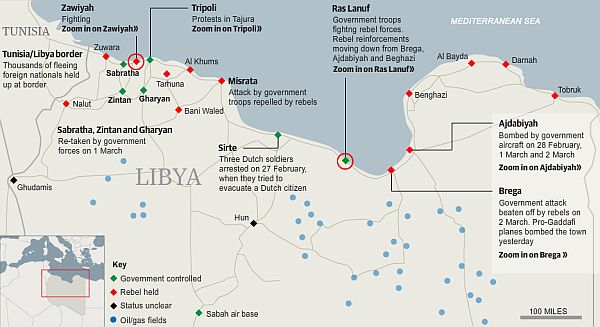
Clare Morgana Gillis writes:
On Wednesday, Libyan leader Qaddafi’s warplanes bombarded opposition-held Ajdabia, a coastal town 175 km south of Benghazi, the eastern city that has become the unofficial headquarters of anti-Qaddafi forces. That same day, Qaddafi also sent mercenaries to attack the oil-rich town of Brega, 80 km to the southwest, where fighting left 17 dead and, according to some reports, eight more dragged off by mercenaries to an unknown fate. Though fighting between the regime and the opposition has raged openly in Tripoli for the past week, these attacks brought Qaddafi’s first overt hostilities against the rebel-controlled east of the country since yellow-hatted mercenaries massacred civilian protesters in Benghazi on February 17th.
Since ousting Qaddafi’s forces and seizing control over much of eastern Libya on February 21, civilians and defectors from Qaddafi’s army have been gathering in military camps in Benghazi, receiving training from former officers, arming themselves with weapons taken from now-abandoned depots, and preparing for the inevitable counterattack, which began two days ago. That morning, the nascent rebel force mobilized., Many in Ajdabia and elsewhere had received phone calls from friends and family in Brega, which they said was under attack. Newly trained and ready to fight, thousands of these volunteers sped down to help. Ultimately, this irregular force managed to hold the town. Victorious, many returned to the military camp in Ajdabia that evening.
A 26-year-old pharmacist and volunteer in the uprising who gave his name only as Mohammed, sped down the highway toward Ajdabia on Wednesday night. Also in his car was Abdallah Kamal, an Egyptian who participated in the uprising in Cairo’s Tahrir Square, as well as myself and another foreign journalist along for the ride. The road’s checkpoints were marked with burning tires and manned by young men sporting Kalashnikovs and kaffiyehs wrapped around their heads.

Alain Gresh writes:
The fantasy that the Arabs are passive and unsuited to democracy has evaporated in weeks. Arabs have overthrown hated authoritarian regimes in Tunisia and Egypt. In Libya, they have fought a sclerotic regime in power for 42 years that has refused to listen to their demands, facing extraordinary violence, hundreds of deaths, untold injuries, mass exodus and generalised chaos. In Algeria, Morocco, Bahrain, Yemen, Jordan, Iraqi Kurdistan, the West Bank and Oman, Arabs have taken to the streets in vast numbers. This defiance has spread even to non-Arab Iran.
And where promises of reform have been made but were then found wanting, people have simply returned to the streets. In Egypt, protesters have demanded faster and further-reaching reform. In Tunisia, renewed demonstrations on 25-27 February led to five deaths but won a change of prime minister (Mohamed Ghannouchi stepped down in favour of Beji Caid-Essebsi). In Iraq, renewed protests led to a promise to sack unsatisfactory ministers. In Algeria, the 19-year emergency law was repealed amid continuing protests. The demands are growing throughout the region, and will not be silenced.
The revolutions in Tunisia and Egypt, the uprising in Libya, and all the other popular movements that have shaken the region are not just about how people want to live and develop, but about regional politics. For the first time since the 1970s, geopolitics cannot be analysed without taking into account, at least in part, the aspirations of people who have retaken control of their destinies.