Category Archives: Israel-Palestinian conflict

‘We went into Gaza and God went into Gaza with us’

‘We went into Gaza and God went into Gaza with us’

“After the Second Lebanon War, we learned some very valuable lessons. We learned that we had been living in an imaginary world and that the most dangerous type of war is the one that you call peace. We learned that we are not in fact in a ‘peace process’ at all. We are at war.

“Today the question is still asked, ‘But how do we WIN?’ And that is another question coming directly from a Western mindset. There is no such thing as winning in this new kind of war. The war is ongoing, with periods of more violence and periods of less violence, during which the enemy regroups and plans his next attack. When we feel the enemy is getting strong, we must be prepared to make preemptive strikes, hard and fast at key targets, with viciousness, as the enemy would do to us. Only then can we acquire, not peace, but sustained periods of relative calm.” — Ariel Siegelman

From Lebanon to Gaza: a new kind of war

The Gaza experience was very different from the Lebanon War and even those of us who were there are trying to fully understand why. Lebanon was a wake-up call for Israelis and was the result of many years of foolish thinking. Since the so-called “Middle East Peace Process” began in the early 1990s with the Oslo Accords, many Palestinian children were raised on ideals of jihad (holy war) and hatred of Israel and the West, while Israeli children were generally taught that “peace is on the horizon”. A euphoric and asinine attitude persisted on the Israeli street throughout the 1990s, leading to the problems that we experienced in Lebanon. The Israeli political echelons and the upper ranks of the army had not established any real plans for entering Lebanon because they wanted to believe that, just like Jordan and Egypt, we had another border about which we could begin to relax. The Israeli public wanted to believe that we really were getting closer to peace. Not only was the army unprepared on a tactical level, but, since the threat was largely marginalized, the equipment that was available to reservists during the Second Lebanon War was far from adequate. Furthermore, the reservists themselves were generally psychologically and physically unprepared for war. They had lived for at least six years—since Israel pulled out of southern Lebanon in 2000—in a bubble of “peace”. In 2004, the army had claimed that we would never go back to Lebanon.

A New Kind of War

After the Second Lebanon War, we learned some very valuable lessons. We learned that we had been living in an imaginary world and that the most dangerous type of war is the one that you call peace. We learned that we are not in fact in a “peace process” at all. We are at war. On their own accord, many reservists began formidable fitness programs. The army invested in state-of-the-art equipment for us. We began planning for possible wars and attacks that might occur at any or all of our borders. And the whole army became much more serious about training again. The debacle of Lebanon set the stage for the success of Gaza. If there is one thing that Israelis are good at, it is taking lessons from their losses and being creative on the battlefield.

The Israel Defense Force (IDF) developed a different mentality toward Gaza. Lebanon, before the war, was very quiet and even boring, giving the perception that it was not a threat. Gaza, on the other hand, was always considered a hot zone. Certainly since Lebanon, we were told that “it [was] not a matter of IF, it [was] a matter of WHEN.” As Special Forces operators we were often crossing into the Strip and we knew the enemy. Now, after the Gaza war, the world has developed a perception that Hamas is not nearly on the level of Hezbollah. That in itself shows how successful we were—and lucky. Hamas is NOT a ragtag group of thugs. They are a vicious, well-trained, well-supplied, motivated, and creative fighting force. They are an unconventional army, no less capable than Hezbollah. The difference between Lebanon and Gaza is simply how Israel adapted to the enemy. Lebanon reminded each individual soldier that he has to be a warrior. It reminded the army that good intelligence and well thought out plans with realistic goals are key elements to the solution. It reminded the home front that we are still in a “war process” and it reminded the government that ego has no place in war and that politicians who are incompetent at military actions should step aside and allow those who know to take charge.

A new kind of enemy has become formidable over the last ten years. Western armies can look to Lebanon and Gaza to gain lessons for operating against this enemy. Even now, the Western concept of warfare is quite conventional, prompting us to think that if we can capture territory, and certainly if we can neutralize the enemy’s leadership, we will win. And we are confused when, no matter how well we do on the battlefield, the enemy continues and even increases its attacks. What we have not yet come to grips with is that the enemy is not playing by our rules. The new war is unconventional and is motivated by ideology. The enemy cannot hope to match Western technology, so he operates in a way to make the technology relatively meaningless. He simply refuses to meet the conventional army on the battlefield. The Western army invades enemy lands with almost no resistance, even captures the enemy’s leadership, developing the erroneous conception that victory has been achieved. Only then do the conventional soldiers begin being blown up by an enemy that cannot be identified or differentiated from the civilian population. The conventional soldier has no idea of how to operate in this environment because he is looking for a uniformed foe. A nine year-old child with a bomb does not fit the Western model of “combatant” and takes soldiers by surprise. The conquest of territory by a Western army only brings new targets closer to the terrorist so that he does not need to travel as far to blow up Western targets. It does not serve to bring the enemy to his knees. Likewise, Middle Eastern societies are tribal in nature and are fiercely proud of their ideology. They will not play chess with a conventional army, accepting defeat simply because their king is captured or their territory is occupied.

Lebanon: What NOT to do

Lebanon is a perfect example of the wrong way to confront the problems that the West faces in this new kind of war. The challenges that US forces face in Iraq are comparable. Let’s forget about the lack of Israeli leadership in 2006 and simply analyze the strategy. Israeli soldiers understood that the goals upon entering Lebanon were to destroy Hezbollah and end rocket attacks from the northern border. These goals were difficult to achieve and set Israel up for failure. Hezbollah, like any terrorist movement, is an ideology, and unless you are willing to kill everyone, an ideology cannot be toppled through military conquest. There only had to be one vigilant team left alive who held to its creed for Israel to fail in achieving its goals. Likewise, the moment that one rocket hit Israel from Lebanon after it withdrew to its own borders, Hezbollah would be victorious. Israel fell into the age-old trap that has caused much larger and seemingly stronger armies to be defeated by their unconventional foes: a poor evaluation of the enemy. It made no difference how much destruction Lebanon incurred or how many men Hezbollah lost. Perception is the deciding factor in this new kind of war. Hezbollah came out of the war appearing strong and, therefore, gained the respect of the world. Once the Israeli army entered from the south, the only real strategy for achieving its elusive goals was to reach the Litani River with ground forces, sweeping through Lebanese villages and towns. The Western military model had the Israelis convinced that by moving from one line on the map to another, all of the territory in between would be “conquered”. In the unconventional model, every moment that the army was moving forward, they provided ample targets to Hezbollah, who were attacking while retreating. They did not have to hold territory and they did not need to kill or injure huge numbers of Israeli soldiers. They only had to instill fear in the conventional force, a sense of hopelessness in the Israeli home front, and frustration in the military ranks. There are no front lines or rear lines in the new kind of war; the enemy will hit you from behind just as quickly (if not more quickly) as he will hit you from the front, and if you understand how the enemy operates, you can combat his ability to achieve his objectives.

Gaza: The Learning Curve

The lessons of Lebanon were immediately put into practice in preparing for the next conflict. The Special Forces (SF) were always very adept at urban warfare tactics, and during missions in the West Bank we operated ferociously, pulling missions almost every night. This combat experience produced a very high level of operational knowledge which trickled down through army doctrine for how to deal with our enemies. The regular army, and certainly the reserves, were lacking in their fighting skills in general until after Lebanon. In 2006, army leadership put new policies into action. The army supplied new gear to almost all combat units. Reservists had never seen such good equipment and their duty stopped being a vacation and became intensified training. The construction of an urban warfare training facility was completed in the desert, at about the same time that the Second Lebanon War was being fought. This facility is, perhaps, the most advanced urban warfare training facility in the world. It is built like the other facilities that we use, just much bigger. It resembles a real Arab city with Middle Eastern architecture, complete with mosques, schools, hospitals, large multi-story buildings, streets, squares, alleys, and vehicles. This offered the first opportunity for large scale training that allowed us to practice the concert of war, with SF, regular infantry, tanks, and artillery all operating together as a symphony. There is a strict training rotation that has all combat units drilling open-field combat techniques and urban warfare every few months. For almost three years, there were no illusions; we knew that we were training for Gaza. Unlike Lebanon, we knew that when we entered Gaza, the military goals and the execution of the missions in order to reach those goals would be methodical and well-prepared.

The IDF entered Gaza with realistic goals—significantly reduce Hamas’ ability to inflict damage on Israel and Israeli targets. We were told specifically that our goal was NOT to topple Hamas and was NOT to destroy all of its capabilities. Those goals would have been too difficult to achieve and would have set us up for defeat and a blow to the morale of the army and the nation. Likewise, the tactics would be unconventional. We were not to think in terms of conquest and holding territory. Concepts of front and rear lines had no place in this war. We were to frustrate and attack at the morale of the enemy, fighting much like he would fight us. The only rule was, don’t fight by the rules. The IDF went in, simply to wreak havoc on Hamas without getting into any situations that could afford our enemies the opportunity to achieve anything that would resemble a victory. We were to keep them at arm’s length, not attempt to engage them in combat, and use anything within our means to destroy them. And when Israel decided the desired perception had been reached (because perception is everything in these kinds of conflicts), we pulled out. Unlike Hezbollah, Hamas came out of this conflict without the world taking them very seriously. Even though Hamas was still shooting missiles into Israel, in a desperate attempt to save face, its capabilities had been seriously reduced and Israel had achieved its goals.

A New Kind of Success

It is not good training, technology, or strategy that makes bullets miss their targets or causes your eye to notice a trip-wire. For those experiences, I have to thank the Big Guy upstairs. He and I became very close during those cold nights. With all of our training and preparation, we were still afraid to go into Gaza. We knew the enemy and we had lost men even in the last year to their ambushes. When we were entering the Strip, we were fully prepared for high casualties. In Gaza they were waiting for us; they were looking for a fight. There were snipers, teams that were waiting to ambush us with anti-tank rockets, Improvised Explosive Devices (IEDs), booby traps, and mortars falling around us.

The successes that we saw in Gaza resulted from a combination of an appropriate response to the new kind of enemy, a healthy Israeli attitude that fiercely guarded its men and its right to stop intolerable attacks against its people, and protection from the Almighty, which some people call “luck”. I saw an attitude that I have been waiting to see for a long time from a nation that has too often apologized for every move that it makes. Today the question is still asked, “But how do we WIN?” And that is another question coming directly from a Western mindset. There is no such thing as winning in this new kind of war. The war is ongoing, with periods of more violence and periods of less violence, during which the enemy regroups and plans his next attack. When we feel the enemy is getting strong, we must be prepared to make preemptive strikes, hard and fast at key targets, with viciousness, as the enemy would do to us. Only then can we acquire, not peace, but sustained periods of relative calm.

Ariel Siegelman is Vice President of Security Training for The Draco Group, a service provider in advanced security and training. He served in the Israel Defense Force, Special Forces, as a counter terror operative, counter terror sniper and counter terror instructor, and remains active in these capacities in the Reserves. He can be reached at ariel@thedracogroup.com

This article originally appeared on The Colloquium, a US Army Combined Arms Center blog, March, 2009.


Facebooktwittermail

War crimes and denial

War crimes and denial

Is there no limit to the wiles of those dastardly anti-Semites?

Now they have decided to slander the Jews with another blood libel. Not the old accusation of slaughtering Christian children to use their blood for baking Passover matzoth, as in the past, but of the mass slaughter of women and children in Gaza.

And who did they put at the head of the commission which was charged with this task? Neither a British Holocaust-denier nor a German neo-Nazi, nor even an Iranian fanatic, but of all people a Jewish judge who bears the very Jewish name of Goldstone (originally Goldstein, of course). And not just a Jew with a Jewish name, but a Zionist, whose daughter, Nicole, is an enthusiastic Zionist who once “made Aliyah” and speaks fluent Hebrew. And not just a Jewish Zionist, but a South African who opposed apartheid and was appointed to the country’s Constitutional Court when that system was abolished.

All this in order to defame the most moral army in the world, fresh from waging the most just war in history! [continued…]

Facebooktwittermail

Settling for failure in the Middle East

Settling for failure in the Middle East

Like so many of his predecessors, President Obama is quickly discovering that persuading Israel to change course is nearly impossible.

Obama came to office determined to achieve a two-state solution between Israelis and Palestinians. His opening move was to insist that Israel stop building settlements in the West Bank and East Jerusalem — a tough line aimed at bolstering Palestinian President Mahmoud Abbas and persuading key Arab states to make conciliatory gestures toward Israel. These steps would pave the way for the creation of a viable Palestinian state and the normalization of Israel’s relations with its Arab neighbors, and also help rebuild America’s image in the Arab and Muslim world.

Unfortunately, Israeli Prime Minister Binyamin Netanyahu has no interest in a two-state solution, much less ending settlement expansion. He and his government want a “greater Israel,” which means maintaining effective control of the West Bank and Gaza. His response to Obama’s initiative has ranged from foot-dragging to outright defiance, with little pushback from Washington. [continued…]

Facebooktwittermail

Can Israel continue to evade international law?

Israel must now heal itself

For months, the Israeli human rights community has been beseeching its government to launch a credible, independent Israeli inquiry as the alternative to being hauled in front of the international community. Nine Israeli human rights NGOs responded to the Goldstone report by repeating this call and suggesting the Israeli government take the Goldstone findings seriously.
Such an inquiry would not be unheard of – prominent precedents exist such as the Kahan Commission Report on Sabra and Shatila in 1982, the Winograd Commission Report on the events of military engagement in Lebanon 2006 and the Or Commission Report with regard to the treatment of Israeli-Arabs. There was even the SELA Disengagement Authority Report in 2006 to investigate the functioning of the administration established to absorb Gaza settlers following the withdrawal.

Will a UN mission manage to nudge Israel in ways that the reports by human rights NGOs, including Israeli ones, failed to do? The instinctive answer would be no. Israel, if anything, has entered into more of a hunker-down mode with its highly dismissive response and has a track record of deep suspicion towards the UN. Repetitions of the mantra that the IDF is the most moral army in the world are again being heard from Jerusalem. Yet closer examination of these first 48 hours since the report’s publication suggest the picture is more nuanced. One of Israel’s most prominent, uncritical and rightist commentators, Ben Dror Yemini in the daily Maariv suggested that the lesson perhaps was that Israel should have ended the war after the first 48 hours of the strike. Haaretz’s Aluf Benn argued that Israel would not be able to act in such a way again after this report, a comment quite widely echoed.

While official Israel is now focusing on out-manoeuvring the implementation of Goldstone’s recommendations, it is also coming closer to a recognition that there may be consequences and repercussions for what happened during the Gaza operation. Israel’s image was already tarnished but the attention that a report of such magnitude attracts and the unimpeachable credibility and standing of its lead author, Goldstone, may cause many who dismissed previous reports to take a second look. This is likely to be a cause for particular division and concern within Jewish communities. Those groups who unquestioningly attack the report’s veracity find themselves further alienated from significant swaths of Jewish opinion, especially among the younger generation. But it is in the arena of practical judicial consequences and of implications for future behaviour that the Goldstone report could have most impact. [continued…]

Editor’s Comment — If the Goldstone report [PDF] is to have some diplomatic teeth, that will depend on the Obama administration’s willingness not to block the UN Security Council’s consideration and implementation of the report’s recommendations — namely, that absent an effective Israeli investigation, the case should be handed over to the International Criminal Court.

Once again, the earliest signs indicate that the United States will retain what has become its standard position: to function as Israel’s lawyer.

American “legal council”, in the form of the US ambassador to the UN, Susan Rice, has already suggested that the report is flawed. “We have very serious concerns about many of the recommendations in the report,” Rice said on Thursday.

In spite of the seriousness of the report’s conclusions — that the Israeli government has committed war crimes and possibly crimes against humanity — the fact that the Obama administration appears ready to provide Israel with diplomatic and legal cover should come as no surprise.

What was president-elect Obama’s reaction to the onslaught in Gaza while it was happening? Silence.

Where did candidate Obama plant his moral and emotive flag in the wider conflict? Alongside the worried parents of Sderot.

What have Middle East peace envoy George Mitchell’s findings been during his trips to see the war’s aftermath? None. He has never been to Gaza.

What have Secretary of State Clinton’s efforts to help in the reconstruction of Gaza accomplished? Nothing.

With that kind of track record, is the Obama administration now about to take a stand as a stalwart defender of international law?

I don’t think so.

Israel’s Gaza blockade crippling reconstruction

A leaked UN report has warned that Israel’s continued economic blockade of Gaza and lengthy delays in delivering humanitarian aid are “devastating livelihoods” and causing gradual “de-development”.

For more than two years, Gaza has been under severe Israeli restrictions, preventing all exports and confining imports to a limited supply of humanitarian goods.

Now, eight months after the end of the Gaza war, much reconstruction work is still to be done because materials are either delayed or banned from entering the strip.

The UN report, obtained by the Guardian, reveals the delays facing the delivery of even the most basic aid. On average, it takes 85 days to get shelter kits into Gaza, 68 days to deliver health and paediatric hygiene kits, and 39 days for household items such as bedding and kitchen utensils. [continued…]

Facebooktwittermail

US fails to broker deal with Israel over settlements

US fails to broker deal with Israel over settlements

The US envoy to the Middle East, George Mitchell, appeared today to have failed to win an agreement from Israel on a halt to settlement construction in the Palestinian territories.

A deal would have laid the foundations for a meeting planned for next week at the UN in New York between President Barack Obama, the Israeli prime minister, Binyamin Netanyahu, and the Palestinian president, Mahmoud Abbas. That now seems less likely to go ahead.

The New York meeting would have restarted peace talks between the two sides for the first time in nearly a year, and would have been the first such Middle East negotiations under the Obama administration. [continued…]

Israel: TUC boycott on goods produced in illegal settlements is ‘slap in face’

Aargeted boycott of Israeli goods originating from illegal settlements agreed by the TUC [the Trades Union Congress which leads Britain’s labor movement] today to step up the pressure “for an end to the occupation of Palestinian territories” was described by Israel as a “slap in the face” for those seeking peace in the Middle East.

Hugh Lanning, chairman of the Palestine Solidarity Campaign, described the TUC move as a “landmark” decision which followed a wave of motions passed at individual union conferences this year because of “outrage” at Israel’s “brutal war” on Gaza.

But the Israeli embassy rounded on the “reckless” commitment to a boycott passed at the TUC congress following protracted behind-the-scenes disputes. [continued…]

Facebooktwittermail

How to put pressure on Netanyahu

How to put pressure on Netanyahu

Faced with the Israeli prime minister’s delaying tactics, President Obama, who has displayed both determination and extreme caution on this issue, is well aware that he may not be able to reduce the financial aid or lay so much as a finger on the military assistance provided by the United States to Israel every year. A decision of this kind, were it to be made, would immediately be perceived as a serious attack on Israel’s security and would inevitably result in an American Israel Public Affairs Committee intervention in Congress. While the pro-Israel lobbyists may feel uncomfortable about the Jewish settlements and can hardly contest the principle of a Palestinian state, at the same time they seem prepared to stand up to the White House in order to secure continued U.S. material and financial aid to Israel.

The Obama administration, nevertheless, has a number of effective levers that it can use to make the Israeli government give way. First, it can refrain from the systematic use of its Security Council veto in favor of Israel, and thus intensify the Jewish state’s diplomatic isolation. It can then gradually reduce the level of military cooperation in crucial areas where Israel is very dependent on the United States, such as intelligence, space, communications, detection and nuclear power.

It can also insist publicly that Israel join the Non-Proliferation Treaty review conference next year, as suggested by the State Department in May. This could force Israel to acknowledge openly its nuclear arsenal and to formalize a deterrence doctrine that could be applied against its potential adversaries — steps that so far the Israelis have refused to take.

Lastly, it can reduce its loan guarantees to Israel along the lines of the measures taken by James Baker in 1991-1992 to make Yitzhak Shamir agree to the Oslo peace process.

There is of course another simple, effective and relatively painless way to put pressure on the Israeli government without going to such extremes: The Obama administration merely needs to make the Israeli government understand that the strategic interests of the two countries no longer necessarily converge. It should then leave the Israelis out of the negotiations with Iran, informing them neither of the status of discussions nor of their content.

In so doing, U.S. negotiators would convey directly to the Israeli authorities the message that not all the issues of concern to Israel necessarily dominate Washington’s agenda and should not jeopardize the outcome of negotiations as a whole. This is guaranteed to make Jerusalem edgy. [continued…]

Editor’s Comment — The question is: does Obama have the will to apply any of these types of pressure?

Facebooktwittermail

Israel’s war against human rights

UN: Evidence Israeli ‘war crimes’ and ‘crimes against humanity’ a ‘result of deliberate planning and policy decisions’

A United Nations fact-finding mission investigating the three-week war in Gaza issued a lengthy, scathing report [PDF] on Tuesday that concluded that both the Israeli military and Palestinian armed groups “committed actions amounting to war crimes,” and possibly crimes against humanity.

The four-member mission, led by Justice Richard Goldstone, a widely respected South African judge, also concluded that neither Israel nor the Palestinian groups had carried out any “credible investigations” into the alleged violations. If that did not change within six months, the United Nations Security Council should refer the situation to the International Criminal Court in the Hague for possible prosecution, the panel concluded.

“The prolonged situation of impunity has created a justice crisis in the Occupied Palestinian Territory that warrants action,” the members said in their 574-page report on the war, during which some 1,200 Palestinians were killed, including at least several hundred civilians, and 13 Israelis died, 10 soldiers and 3 civilians. [continued…]

Editor’s Comment — Perhaps the report’s most disturbing finding says less about the past than it portends for Gaza and Israel’s future:

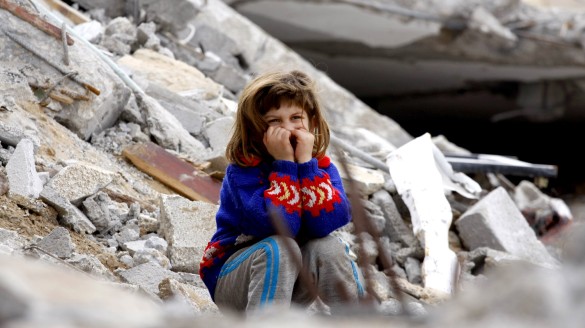
Some 30 per cent of children screened at UNRWA schools had mental health problems, while some 10 per cent of children had lost relatives or friends or lost their homes and possessions. WHO estimated that some 30,000 children would need continued psychological support and warned of the potential for many to grow up with aggressive attitudes and hatred.

Judge Goldstone and the pollution of argument

The despicable attacks on human rights organisations investigating Israel’s Gaza offensive in January confirm Churchill’s observation: “A lie gets halfway around the world before the truth has a chance to get its pants on.” The mission led by the South African judge Richard Goldstone to investigate international human rights and international humanitarian law violations during Israel’s offensive, established by the UN Human Rights Council (UNHRC), is the latest victim. His findings are about to be made public. The knives have been out for the mission for months. Now they are being plunged into him and his colleagues. Until the report is out Goldstone can’t defend it. So the smears and misrepresentation are left free to pollute public discourse.

The New York-based Human Rights Watch (HRW) has assiduously responded to a deluge of scurrilous attacks on its credibility and staff, yet totally unfounded allegations – for example, about accepting Saudi government funding and failing to give a critical report to the Israel Defence Forces before releasing it to the public – are constantly being recycled. HRW messed up by failing to see that the nerdy and, to most people, disturbing hobby of its weapons expert Marc Garlasco (he collects German and American second world war memorabilia) could be used to discredit his role as author of highly critical reports of Israel’s military conduct in Gaza. But when this story broke last week, the equation implied in some allegations – “Nazi” object-collector plus “Israel-basher” equals “antisemite” – was baseless and defamatory. That he also worked on reports critical of Hamas and Hezbollah was ignored. As another excuse to attack HRW, and deflect attention from its reports’ findings, the Garlasco affair was a gift.

The human rights world is not beyond reproach. UNHRC has hardly been impartial on Israel. Goldstone accepted his role only after the council president agreed to the alteration of the mission’s mandate to cover all parties to the conflict, not just Israel. But mistrust alone does not explain the extraordinary scale of the attacks on human rights organisations, including all Israeli ones, for their reports on Israel. [continued…]

Facebooktwittermail

The point of no return

The point of no return

Let’s just ask ourselves what would have happened in Israel itself without what is known as the “settlement enterprise.” Where would another half a million women, children, and men live within the 1967 borders? How many new towns, neighborhoods, and communities would have to be built? What kind of infrastructure would have to be built? How many additional roads would we need to pave, instead of the ones paved in the West Bank, some of them for Israelis only? And what would have happened to the population density in central Israel and in western Jerusalem?

The evacuation of 8,000 Jewish settlers from the Gaza Strip and their absorption in Israel cost taxpayers NIS 10 billion. Those interested in turning back time and evacuating Israelis from the areas beyond the 1967 borders would have to invest NIS 600 billion [$160 billion] for that end. An unreal figure.

Without the Palestinians grasping the process, and without most of Israeli citizens giving it some thought, the areas beyond the 1967 borders have become the main absorption area for new Israeli citizens: New immigrants from the former Soviet Union, young Jerusalemites, haredim facing economic distress, etc. The “territories” served as Israel’s territorial backbone, and played this role with great success.

Israel’s Leftist camp believes that it has the upper hand, referring as ultimate proof to Likud Prime Minister Benjamin Netanyau’s declaration in favor of a Palestinian state, albeit with some conditions. Yet the Left is wrong: While it was engaged in the futile “diplomatic process,” the active Rightist camp, with the backing and assistance of all of Israel’s governments with the exception of one, engaged in developing Jewish settlements in the territories.

Half a million Jews beyond the Green Line constitute the point of no return. The talk about a “construction freeze” or “construction suspicion” at certain settlements are a joke and an insurance policy for the leaders – in Israel, in Palestine, and in the world – who know deep in their hearts that the decision had been made.

What we have here is two peoples that cannot be divided: A mixture of Jews and Palestinians that cannot be separated. It’s too late. [continued…]

Editor’s Comment — When Benjamin Netanyahu uttered the phrase, “Palestinian state”, it should have been taken as a signal that the two-state solution was well and truly dead.

Shimon Peres now says Salam Fayyad is a “Palestinian Ben-Gurion”. A Ben-Gurion or a Pétain?

The state Fayyad envisions may indeed provide the means for the effective pacification of the majority of Palestinians. And as a Haaretz commenter put it, the Palestinians may end up being able “to elect their own dog catchers, … issue Palestinian stamps and sing their own anthem and even have an Olympic ping-pong team.” What they will not gain is sovereignty.

As a Jewish 36-year-old mother of five told The National recently when asked whether her Palestinian neighbors had any right to their shared water supply:

“We should take care of the foreigners here, and give them running water and help them survive and live the proper way,” she says firmly, like a schoolmarm. “But we should do this only after they understand we are the rulers of this country. Until they deserve it, they can’t have the best conditions.”

Cap in hand, the Palestinians must ask their masters if they can be given a state — a little patchwork one without any real power.

Maybe they’d be better off simply asking for a vote.

EU sources: Terms set for renewal of Israel-PA talks

Negotiations between Israel and the Palestinians will resume next month on the basis of an understanding that the establishment of a Palestinian state will be officially announced in two years.

Palestinian and European Union sources told Haaretz that talks will initially focus on determining the permanent border between Israel and the West Bank.

Due to the Palestinians’ reservations over establishing a state with temporary borders, as was proposed during the second stage of the road map, this step will probably be defined as “early recognition” of Palestine. [continued…]

Borders first?

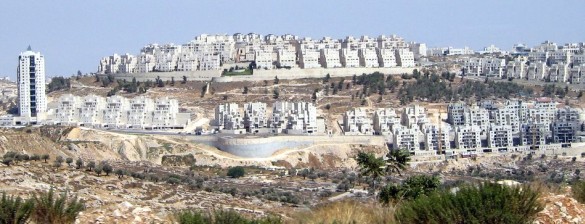
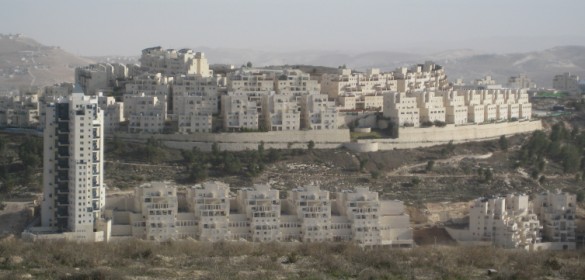
The most immediate issue raised by ‘borders first’ is whether it will deal with the Greater Jerusalem border. The issue here is not the Old City, the central focus of so much emotion and identity. It is the large central area of the West Bank, an area far beyond the old municipal boundaries of the city which extends deep into the central West Bank. Israel has developed huge settlements and a massive infrastructure which now almost surrounds East Jerusalem and which all but prevents any meaningful connection between the north and the south, and between the West Bank and East Jerusalem.

Will the negotiated border between the West Bank and Israel deal with the Jerusalem area? If the negotiated borders ratify the Israeli settlements and infrastructure as currently configured and proposed (including the controversial E-1 area), then the supposed Palestinian state would be essentially non-viable. It’s hard to imagine a government led by Netanyahu agreeing to remove existing settlements around the Greater Jerusalem area. But no Palestinian leader is likely to be able to sell a deal which ignores or ratifies the Greater Jerusalem settlement areas to his people, even if pressured to accept. If the negotiated borders ignore or defer the Jerusalem area – an idea I’ve heard in circulation – then the outcome would be meaningless and counter-productive. [continued…]

Dividing war spoils: Israel’s robbery of Palestinian property

While the news headlines were occupied with the freeze or suspension of Jewish settlements in the Occupied Palestinian Territories or with the competition for positions in the sixth Fateh conference in Bethlehem, Israel is putting into effect the most devastating operation since the ethnic cleansing of Palestine in al Nakba of 1948. This new operation aims to eliminate irrevocably Palestinian rights and historical roots in Palestine.

Ironically, Arab and Palestinian leaderships remain oblivious to these cataclysmic developments. In particular, the Palestinian leadership, whose main duty is to defend Palestinian rights, is bogged down with the assignment of internal political posts and fighting what it sees as its primary enemy, Hamas.

The Zionist leadership in Israel felt bold enough to transform the ideological slogan of ‘Jewish Israel’ into a reality on the ground. The Knesset, the Israel Parliament, passed a law on August 3rd, 2009, after its second and third readings, which allowed the sale of “Absentees” Palestinian refugees’ land to Jewish individuals and Jewish institutions exclusively anywhere in the world. Thus, the legal right of the original Palestinian owner to his land would be severed through creating a barrier between the owner and his property. The passing of the new law represents an audacious initiative by the current Israeli government that no previous Israeli government dared contemplate or venture into. [continued…]

Wobbly stools

There no question anymore that the only recipe for healing the Israeli-Palestinian wound is the termination of the occupation and the establishment of peace between the State of Israel and the new State of Palestine beside it. This demands meaningful and intense negotiations, within a fixed time span. That is impossible if at the same time settlements continue to expand. As the Palestinian lawyer Michael Tarasi aptly put it: ‘We are negotiating about the division of a pizza and in the meantime Israel is eating the pizza.’

That’s why Obama has presented the Israeli government with an unequivocal demand: an immediate stop to all building in the settlements, including East Jerusalem. A clear and logical demand. But while pressuring Netanyahu, he himself is exposed to heavy pressure at home over the health insurance system and the Afghan war…

The Americans recognise, of course, that our government is trying to deceive them. If they allow the building of just another 500 houses in the settlement blocks, and the completion of just another 2500 houses whose construction has already begun, and just a few more in East Jerusalem, in practice the building will go on unchecked.

The settlers know perfectly well that their whole enterprise has been based on deceit and trickery, house after house and neighbourhood after neighbourhood, and they are happy to allow Netanyahu to continue with this method. For the time being, they do not cry out, they are not worried, the more so as no large Israeli public movement has yet arisen in support of Obama’s peace efforts. [continued…]

Facebooktwittermail

Dismantling the matrix of control

Dismantling the matrix of control

Many Palestinian, Israeli and international proponents of a just peace took heart in Obama’s early gestures. Beginning with the appointment of former Sen. George Mitchell as special envoy and continuing through the president’s June 4 speech in Cairo, these proponents allowed themselves, after years of disappointment and struggle, a cautious hopefulness. Some of the speech’s formulations, like the nods to the “pain of dislocation” felt by Palestinians and the “daily humiliations” of occupation, had been heard before. But one sentence had not been: Obama said that a two-state solution “is in Israel’s interest, Palestine’s interest, America’s interest and the world’s interest.” Obama seemed to “get it,” that is, he seemed to understand that the US is isolated politically by its unquestioning backing of Israel, which is seen as obstructing a solution to the conflict. And, for the first time, a US president actually said that resolving the Israeli-Palestinian conflict is in the vital national interest, not just a nice thing to do. These words significantly raise the bar. Framing the conflict in this way makes it easier for the administration to win Congressional support for tougher demands upon Israel while undermining the ability of the American Israel Public Affairs Committee (AIPAC) to mount an effective resistance, given American Jewish sensibilities about suspicions of dual loyalty.

Since the Cairo speech, however, fundamental doubts about US efforts have resurfaced. The only demand made by Obama upon Israel has been for a settlement “freeze,” a welcome symbolic gesture, to be sure, yet irrelevant to any peace process. Israel has enough settlement-cities in strategic “blocs” that it could in fact freeze all construction without compromising its control over the West Bank and “greater” Jerusalem, the Arab areas to the north, south and east of the city where Israel has planted its flag. Focusing on this one issue — which, months later, is still being haggled over — has provided Israel with a smokescreen behind which it can actively and freely pursue more significant and urgent construction that, when completed, will truly render the occupation irreversible. It is rushing to complete the separation barrier, which is already being presented as the new border, replacing the “Green Line,” the pre-June 1967 boundary to which Israel is supposed to withdraw, by the terms of UN Security Council resolutions, but on which even the most ardent two-staters have long since given up. Israel is demolishing homes, expelling Palestinian residents and permitting Jewish settlement throughout East Jerusalem, measurably advancing the “judaization” of the city. It is confiscating vast tracts of land in the West Bank and “greater” Jerusalem and pouring bypass road asphalt at a feverish pace so as to permanently redraw the map. It is laying track on Palestinian land for a light-rail line connecting the West Bank settlement-city of Pisgat Ze’ev to Israel. It is drying up the main agricultural areas of the West Bank, forcing thousands of people off their lands, while instituting visa restrictions that either keep visiting Palestinians and internationals out of the country altogether, or limit their movement to the truncated Palestinian enclaves of the West Bank.

“Quiet,” behind-the-scenes diplomacy is surely taking place, but the few details that have emerged are far from reassuring. The State Department has mocked as “fiction” a ten-point document given to the Arab press by Fatah figure Hasan Khreisheh that promises an “international presence” in parts of the West Bank and US backing for a Palestinian state by 2011. The component of this alleged plan that seems more likely is that the US wants a partial freeze on settlement activity from Israel in exchange for a pledge from Washington to push for more stringent sanctions upon Iran for its nuclear research. On August 25, the Guardian quoted “an official close to the negotiations” saying: “The message is: Iran is an existential threat to Israel; settlements are not.” By all indications, if the Obama administration does present a regional peace plan, which it is expected by many to do around the time of the UN General Assembly meeting on September 20, it will be nothing more than a “rough draft.” It is no exaggeration to say a two-state solution will rise or fall on the outlines of this draft — and may perhaps fall forever if no concrete plan is presented at all, which is also possible. Although the two-state solution has been eulogized many times in the past, Obama represents a best-case scenario. If he presents, in the end, a disappointing peace plan that offers no genuine breakthrough, then the shift to a one-state solution on the part of the Palestinian people and their international supporters will be inescapable. [continued…]

Facebooktwittermail

Israeli settlement expansion may bring one-state solution closer

Israeli settlement expansion may bring one-state solution closer

As Israel announced plans to expand settlements in the West Bank in anticipation of a settlement “freeze”, the former US president, Jimmy Carter, who recently returned from a trip to the Holy Land, suggested that the implementation of a two-state solution is becoming increasingly unlikely.

“A more likely alternative to the present debacle is one state, which is obviously the goal of Israeli leaders who insist on colonising the West Bank and East Jerusalem. A majority of the Palestinian leaders with whom we met are seriously considering acceptance of one state, between the Jordan River and the Mediterranean Sea. By renouncing the dream of an independent Palestine, they would become fellow citizens with their Jewish neighbours and then demand equal rights within a democracy. In this nonviolent civil rights struggle, their examples would be Mahatma Gandhi, Martin Luther King Jr and Nelson Mandela.”

Mr Carter belongs to a group of veteran world leaders, known as the Elders, who recently visited Israel and the West Bank. Another member of the group, former Irish president and UN Human Rights Commissioner Mary Robinson told The Jerusalem Post last month that if Israel does not freeze settlement construction, a two-state solution may no longer be possible. [continued…]

Facebooktwittermail

The path to peace is hard to find on Obama’s ‘roadmapolis’

The path to peace is hard to find on Obama’s ‘roadmapolis’

President Bush’s “road map” first emerged as the US began preparing to invade Iraq. Key Arab regimes had long made clear to Washington that the price of even tacit support for the war was American willingness to address a conflict that generated immense hostility towards the US on the Arab street. The “road map” read like a crack of the whip, outlining a timetable that promised a provisional Palestinian state by the end of 2003 and a resolution of all final status issues by the beginning of 2005. But the Bush administration gave the Israelis and Palestinians no reason to take it seriously; its purely symbolic purpose was plain to see.

The Bush administration made a second high-profile stab at the peace process in the form of the Annapolis Conference held in November 2007, which drew in not only the Israelis and Palestinians, but also a range of Arab states – in what it portrayed as a symbolic affirmation of the administration’s policy of building an alliance of Arab moderates with the US and Israel against the region’s radicals, namely Hamas, Hizbollah, Syria and Iran. Again, there was little reason for the Israelis or Palestinians to take the process seriously. Annapolis simply invited them to talk among themselves about what a peace agreement could look like. The conversation went nowhere, of course, but the fact that it was happening at all was the point for the Bush administration, whose new priority had become rallying Arab support against Iran and its allies.

So what does any of this have to with the US president Barack Obama’s own efforts to jump start the peace process? After all, Mr Obama made it a priority from the get-go of his presidency and can hardly be accused of going through the motions in order to mollify the Arabs to win their support on other issues. Or can he? [continued…]

Facebooktwittermail

Israel to build new houses in settlements

Israel to build new houses in settlements

Prime Minister Benjamin Netanyahu will approve hundreds of new housing units in West Bank settlements before slowing settlement construction, two of his aides said Friday, in an apparent snub of Washington’s public demand for a total settlement freeze.

The aides also said Netanyahu would be willing to consider a temporary freeze in settlement construction, but their definition of a freeze would include building the new units and finishing some 2,500 others currently under construction.

The settlement suspension also would not include east Jerusalem, which the Palestinians hope to make their future capital.

The U.S. has a set a high public bar for a freeze, saying repeatedly that all settlement activity on lands the Palestinians claim for a future state must stop, without exception. However, Israel appeared to gain some wiggle room in recent weeks as the sides discussed the details of a would-be settlement freeze. [continued…]

Editor’s Comment — When did Netanyahu make his definitive assessment of Obama?

Was it when the presidential candidate was putting on his most obsequious performance in front of AIPAC, spouting drivel about an indivisible Jerusalem?

Or was it when as president-elect he became a mute witness to the Gaza massacre?

Whenever it happened, it is clear that Netanyahu took a clear measure of the strength of his adversary and concluded that whatever the power of his office, this particular president was pliable as willow.

The White House now says:

We regret the reports of Israel’s plans to approve additional settlement construction. Continued settlement activity is inconsistent with Israel’s commitment under the Roadmap.

As the President has said before, the United States does not accept the legitimacy of continued settlement expansion and we urge that it stop.

When this president urges this prime minister to stop, I’m reminded of Bush urging Sharon to pull his troops out of Jenin “without delay” in 2002 – a meek demand that was predictably ignored – and of Olmert telling Bush how Rice should vote at the UN – a presumptuous call that was not rebuffed.

Crude as this way of expressing it might be, again and again we witness a suposedly powerful American president acting like he’s the Israeli prime minister’s bitch.

Have I given up on Obama? Not yet, but I see little evidence that he has the capacity to be bold. The skeptic at this blog is teetering on the brink of becoming a cynic.

Netanyahu accepts part settlement freeze: report

The Central Bureau of Statistics said there were 672 new housing starts in Jewish settlements in the West Bank in the first half of 2009, down from 1,015 in the same period last year.

The data which does not include annexed east Jerusalem.

But while the 33 percent dip appears significant, it returns construction levels to about the same pace as 2007 when 713 new housing projects were begun. [continued…]

Abbas: Netanyahu’s new West Bank build ‘unacceptable’

Prime Minister Benjamin Netanyahu’s planned approval of the construction of hundreds of new housing units in West Bank settlements is “unacceptable,” Palestinian President Mahmoud Abbas said Friday in Paris.

“What the Israeli government said [about the planned construction] is not useful,” Abbas said after a meeting with French President Nicolas Sarkozy. “It is unacceptable for us. We want a freeze on all settlement construction.”

Abbas also told journalists that a possible summit meeting with Netanyahu and U.S. President Barack Obama in New York, on the margins of a UN General Assembly meeting, depended on “steps that are taken beforehand regarding a settlement construction freeze.” Continue reading

Facebooktwittermail

Liberation, not a fictitious Palestinian “state”

Liberation, not a fictitious Palestinian “state”

Late last month, Salam Fayyad, the appointed Palestinian Authority (PA) prime minister in Ramallah, made a surprise announcement: he declared his intention to establish a Palestinian state in the West Bank and Gaza Strip before the end of 2011 regardless of the outcome of negotiations with Israel.

Fayyad told the London Times that he would work to build “facts on the ground, consistent with having our state emerge as a fact that cannot be denied.” His plan was further elaborated in a lengthy document grandly titled “Program of the Thirteenth Government of the Palestinian National Authority.”

The plan contains all sorts of ambitious ideas: an international airport in the Jordan Valley, new rail links to neighboring states, generous tax incentives to attract foreign investment, and of course strengthening the “security forces.” It also speaks boldly of liberating the Palestinian economy from its dependence on Israel, and reducing dependence on foreign aid.

This may sound attractive to some, but Fayyad has neither the political clout nor the financial means to propose such far-reaching plans without a green light from Washington or Tel Aviv. [continued…]

Jewish settlers plan massive construction

The accelerating pace of Jewish settlement expansion in East Jerusalem this year may spur violence between Israelis and Palestinians in the city and cripple new efforts by the Obama administration to kick-start peace talks, an Israeli anti-settlement group warned yesterday.

The “massive” construction being planned by Jewish settlers within Palestinian neighbourhoods in East Jerusalem is likely to prompt clashes, said Yudith Oppenheimer, the executive director of Ir Amim, a Jerusalem-based advocacy group.

“There is a combination of factors, including settlers invading Palestinian neighbourhoods, already annoying with their presence and control of houses and land and their mass construction plans when, next door, Palestinian neighbours cannot even build a balcony because they do not get a permit. This creates the conditions for violence,” she said. [continued…]

Facebooktwittermail

Fifteen minutes of hate in Silwan

Fifteen minutes of hate in Silwan

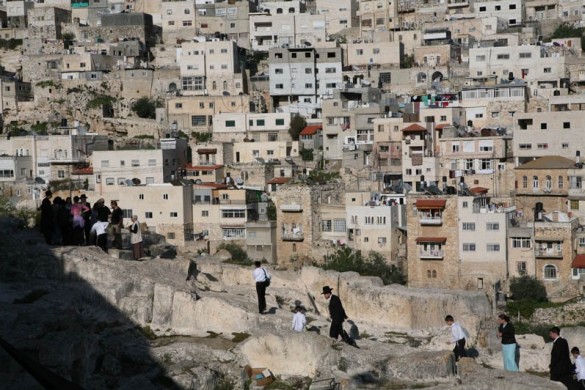
It’s searing hot, but there’s some pleasantness about the stone-flagged path rising from the centre of Silwan, Jerusalem. Maybe it’s the breeze, or the stone houses oozing coolness into the air, or maybe it’s the wide-open mountain landscape. There are three of us – Ilan, the director, Michael, the cameraman and me, the interviewee. We’re making a film on the blatant institutional discrimination against the residents of this Palestinian east-Jerusalem neighbourhood; authorities favour the Jewish settlers who are not hiding their desire to Judaise the neighbourhood, to void it of its Palestinian character.

Even before we position the camera, a group of orthodox Jewish girls, aged about eight to 10, come walking up the path in their ankle-long skirts, pretty, chattering, carefree. One of them slows down beside us, and pleasantly asks us if we want to film her. What would you like to tell us, we ask. I want to say that Jerusalem belongs to us Jews, she says as she walks on, only it’s a pity there are Arabs here. The messiah will only come when there isn’t a single Arab left here. She walks on, and her girlfriends giggle and rejoin her.

Two minutes later a young, well-built young man comes up, carrying a weapon and a radio, without any uniform or tag upon his clothes. Even before he opens his mouth I’m already guessing he’s a security guard, an employee of the private security contractor operated by settlers but sponsored by the housing ministry at an annual budget of NIS 40m (£4.6m). This security company has long since become a private militia policing the entire neighbourhood and intimidating the Palestinian residents without any legal basis whatsoever. A committee set up by a housing minister determined that this arrangement was to cease, and the security of both Palestinian and Jewish residents must be handed over to the Israeli national police. The government endorsed the committee’s conclusions in 2006, but recanted six months later, under settler pressure. The private security contractor went on operating. [continued…]

From Shiloah to Silwan

Jerusalem began as a small village in a place known as the City of David where the Palestinian village of Silwan sits today. Buried under the village lands, 5000 years of history bind the stories of ancient nations and rulers with the present life of the local residents. Dozens of excavated archaeological strata tell the complex multi-cultural saga of Jerusalem.

We, a group of archaeologists and residents of Silwan, invite you to hear the story of ancient Jerusalem and of life in the village today. Our tour sheds light on the role of archaeology in the Israeli-Palestinian conflict and in the discourse of the future of Jerusalem. We will offer a different perspective: archaeology without an ownership, one that bridges between periods, cultures and nations; archaeology which involves the local residents and examines the past as a shared asset regardless of religion or nationality.

We believe that archaeology in Silwan/”City of David” has the power to change the dynamics of the conflict and promote tolerance and respect for other cultures, past and present, for a better future for both the local residents and the whole region. [continued…]

Facebooktwittermail

Against the Israel boycott

Against the Israel boycott

One of the main battlefields in our fight for peace is Israeli public opinion. Most Israelis believe nowadays that peace is desirable but impossible (because of the Arabs, of course.) We must convince them not that peace would be good for Israel, but that it is realistically achievable.

When the archbishop [Tutu] asked what we, the Israeli peace activists, are hoping for, I told him: We hope for Barack Obama to publish a comprehensive and detailed peace plan and to use the full persuasive power of the United States to convince the parties to accept it. We hope that the entire world will rally behind this endeavor. And we hope that this will help to set the Israeli peace movement back on its feet and convince our public that it is both possible and worthwhile to follow the path of peace with Palestine.

No one who entertains this hope can support the call for boycotting Israel. Those who call for a boycott act out of despair. And that is the root of the matter. [continued…]

Netanyahu ‘doesn’t care what Britain thinks of Israel’

The editor of The Jewish Chronicle has accused Israel’s Prime Minister, Binyamin Netanyahu, of not caring about British public opinion after he refused to give any interviews during his visit to London last week.

In a comment piece in the newspaper, Stephen Pollard – though essentially supportive of Mr Netanyahu – concludes of his office: “The truth of it is that for all they moan about coverage of the Middle East, they don’t actually care. They don’t care if Brits end up thinking they are warmongers. They don’t care if they are losing the PR war. And they don’t care if those of us who do care are left fuming at their wilful refusal to do anything to help us counter Israel’s appalling image.” [continued…]

Editor’s Comment — Uri Avnery’s hope might be a testament to the tenacious spirit of this old peace activist, but is there any evidence that Israel’s political leadership or the majority of its population would be receptive to an Obama peace initiative? Fifty-one percent of Jewish Israelis view Obama as anti-Israel (pro-Palestinian) and a mere four percent see him as supportive of the Jewish state.

When The Jewish Chronicle‘s Stephen Pollard bemoans Benjamin Netanyahu’s indifference to international opinion, Pollard might be voicing a frustration commonplace within the Jewish diaspora, but the object of his frustration is what many (perhaps most) Israelis regard as one of the nation’s core strengths: it’s righteous isolation. Israel’s isolation — so the thinking goes — is not the product of its behavior but proof for the necessity of its existence.

Why should the Israeli prime minister be concerned about Israel’s appalling global image? He’s milking it for all it’s worth!

Facebooktwittermail

Israel ‘ups settlement activity in east Jerusalem’

Israel ‘ups settlement activity in east Jerusalem’

Israeli settlement activity in annexed east Jerusalem accelerated in the first half of 2009 despite US calls for a freeze, an anti-settlement activist group said on Sunday in a report.

“Recent months have seen the acceleration of the process of Israeli settlement in Palestinian communities in east Jerusalem,” the Israeli Ir Amim group said.

“These settlements… implant (a) Jewish population… precisely in the areas of the most intense dispute in the Palestinian-Israeli conflict,” it said. [continued…]

Facebooktwittermail

U.S.: We will be flexible on conditions for Mideast talks

U.S.: We will be flexible on conditions for Mideast talks

State Department spokesman said on Friday that the Obama administration will be flexible on pre-conditions for all parties involved in Middle East peace negotiations.

“We put forward our ideas, publicly and privately, about what it will take for negotiations to be restarted, but ultimately it’ll be up to the parties themselves, with our help, to determine whether that threshold has been met,” spokesman P.J. Crowley said, adding that the U.S. position on an Israeli settlement freeze remains unchanged.

“Ultimately,” he added, “this is not a process by which the United States will impose conditions on Israel, on the Palestinian Authority, on other countries.

“We’re asking them to meet their commitments under the Roadmap, but most importantly, we’re asking them what they’re prepared to do and to demonstrate the steps that that they are prepared to take that allow us to have confidence that these negotiations can be restarted,” he said. Continue reading

Facebooktwittermail

Barack Obama on brink of deal for Middle East peace talks – updated

Barack Obama on brink of deal for Middle East peace talks

Barack Obama is close to brokering an Israeli-Palestinian deal that will allow him to announce a resumption of the long-stalled Middle East peace talks before the end of next month, according to US, Israeli, Palestinian and European officials.

Key to bringing Israel on board is a promise by the US to adopt a much tougher line with Iran over its alleged nuclear weapons programme. The US, along with Britain and France, is planning to push the United Nations security council to expand sanctions to include Iran’s oil and gas industry, a move that could cripple its economy.

In return, the Israeli government will be expected to agree to a partial freeze on the construction of settlements in the Middle East. In the words of one official close to the negotiations: “The message is: Iran is an existential threat to Israel; settlements are not.” [continued…]

Editor’s Comment — A US-brokered Israeli-Palestinian deal – in other words, how Obama got shafted by Netanyahu and the Palestinians and Iran’s reformist movement got thrown under the bus, all for what? A little Clinton-era nostalgia in the form of a Rose Garden handshake between Netanyahu and Abbas while Rahm Emanuel gets to re-live the good old nineties?

Updated: Perhaps a hasty judgment on my part.

Laura Rozen writes: “In meetings with news editors in London Monday, Netanyahu seemed to describe Israeli and U.S. positions moving closer together on a settlements deal, policy towards Iran, and other issues, according to sources familiar with the discussion.”

I thus infer that The Guardian, having been honored to be able to sit at Bibi’s feet, thought that they should thereafter try and perform like his parrot.

Why Israel will thwart Obama on settlements

The idea that the Obama administration can advance the Middle East peace process by having Israel freeze its construction of Jewish settlements in the West Bank stretches credulity.

Does any serious observer of the region believe that Israel’s appetite for land – owned and occupied for generations by Palestinians – is going to abate?

The Israeli land grab has continued for four decades, in defiance of international law and most US presidents. US Middle East envoy George Mitchell has been trying to secure a halt, but his efforts follow a well-worn path that typically ends in charade. [continued…]

Palestinians seek state by 2011

Palestinian Prime Minister Salam Fayyad released a government plan Tuesday calling for the establishment of a de facto Palestinian state by the end of 2011 regardless of the outcome of negotiations with Israel.

The plan faces significant practical hurdles and raised worries that Mr. Fayyad was advocating the sort of unilateral actions toward statehood long opposed by the U.S. and Israel. Implementing it would mean overcoming likely Israeli opposition to key elements and Mr. Fayyad’s own weak domestic political standing, and would also require hefty financial-aid commitments from foreign donors, such as the U.S., European Union, and Arab states.

But the plan also reflected an unprecedented Palestinian emphasis on the nuts and bolts of self-rule. It lays out the broad outlines of a state on Palestinian lands occupied by Israel in 1967 with East Jerusalem as its capital, and details each government ministry and its functions. [continued…]

Facebooktwittermail