Category Archives: Issues

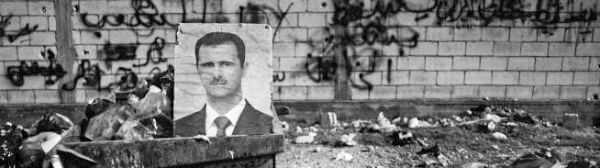
The Assad files

assad-2

Ben Taub reports: The investigator in Syria had made the drive perhaps a hundred times, always in the same battered truck, never with any cargo. It was forty miles to the border, through eleven rebel checkpoints, where the soldiers had come to think of him as a local, a lawyer whose wartime misfortunes included a commute on their section of the road. Sometimes he brought them snacks or water, and he made sure to thank them for protecting civilians like himself. Now, on a summer afternoon, he loaded the truck with more than a hundred thousand captured Syrian government documents, which had been buried in pits and hidden in caves and abandoned homes.

He set out at sunset. To the fighters manning the checkpoints, it was as if he were invisible. Three reconnaissance vehicles had driven ahead, and one confirmed by radio what the investigator hoped to hear: no new checkpoints. Typically, the border was sealed, but soldiers from the neighboring country waved him through. He drove until he reached a Western embassy, where he dropped off the cargo for secure transfer to Chris Engels, an American lawyer. Engels expected the papers to include evidence linking high-level Syrian officials to mass atrocities. After a decade spent training international criminal-justice practitioners in the Balkans, Afghanistan, and Cambodia, Engels now leads the regime-crimes unit of the Commission for International Justice and Accountability, an independent investigative body founded in 2012, in response to the Syrian war.

In the past four years, people working for the organization have smuggled more than six hundred thousand government documents out of Syria, many of them from top-secret intelligence facilities. The documents are brought to the group’s headquarters, in a nondescript office building in Western Europe, sometimes under diplomatic cover. There, each page is scanned, assigned a bar code and a number, and stored underground. A dehumidifier hums inside the evidence room; just outside, a small box dispenses rat poison.

Upstairs, in a room secured by a metal door, detailed maps of Syrian villages cover the walls, and the roles of various suspects in the Syrian government are listed on a whiteboard. Witness statements and translated documents fill dozens of binders, which are locked in a fireproof safe at night. Engels, who is forty-one, bald and athletic, with a precise, discreet manner, oversees the operation; analysts and translators report directly to him.

The commission’s work recently culminated in a four-hundred-page legal brief that links the systematic torture and murder of tens of thousands of Syrians to a written policy approved by President Bashar al-Assad, coördinated among his security-intelligence agencies, and implemented by regime operatives, who reported the successes of their campaign to their superiors in Damascus. The brief narrates daily events in Syria through the eyes of Assad and his associates and their victims, and offers a record of state-sponsored torture that is almost unimaginable in its scope and its cruelty. Such acts had been reported by survivors in Syria before, but they had never been traced back to signed orders. [Continue reading…]


Facebooktwittermail

Barack Obama: Israel’s most loyal protector

Lara Friedman writes: With the Obama administration in its final year, several officials have said that the president has grown so frustrated with trying to revive Middle East peace talks that he may lay down his own outline for an Israeli-Palestinian two-state peace agreement, in the form of a resolution in the United Nations Security Council.

If that happens, count on two reactions: Israel’s prime minister, Benjamin Netanyahu, will oppose it, and a chorus of American politicians and commentators will suggest that it would be unprecedented — even unthinkable — for an American president to support a Security Council resolution that Israel opposed, rather than veto it.

Last spring, when similar reports circulated, Senator John McCain of Arizona said that such an action would “contradict American policy for the last at least 10 presidents of the United States.” The Republican chairman and ranking Democrat of the House Foreign Affairs Committee joined in a letter protesting that “for decades the U.S. has used its U.N. Security Council veto to protect Israel from undue pressure at the world body.” A bipartisan group of senators agreed, seeking assurances that the policy would not change.

Remarkably, the assumption beneath those protests — that President Obama would be committing an unprecedented betrayal of the American-Israeli relationship if he did not block every Security Council resolution that challenged the actions or positions of Israel’s government — has gone unchallenged.

Yet it flies in the face of truth. Over seven years, Mr. Obama has not permitted passage of any Security Council resolution specifically critical of Israel. But a careful examination of the record shows that, since 1967, every other American president allowed, or even had America vote for, Security Council resolutions taking Israel to task for actions and policies toward the Palestinians and other Arab neighbors. [Continue reading…]

Facebooktwittermail

Kerry encourages Obama to visit Hiroshima

The New York Times reports: Secretary of State John Kerry attended a memorial ceremony in Hiroshima on Monday for victims of the American atomic bombing 71 years ago, becoming the highest-ranking United States administration official to visit the site of one of the most destructive acts of World War II.

The visit is likely to intensify speculation about whether President Obama will go to Hiroshima during a planned trip to Japan next month. Mr. Obama would be the first sitting American president to visit the city, a decision that would resonate deeply in Japan but would be controversial at home.

“Everyone should visit Hiroshima, and everyone means everyone,” Mr. Kerry said at a news conference on Monday in response to a question about whether Mr. Obama would go. He said that the president had been invited by Japanese officials and that he would like to visit someday, but Mr. Kerry added: “Whether or not he can come as president, I don’t know.”

Mr. Kerry spoke after he and other leading diplomats from the Group of 7 industrialized countries toured Hiroshima’s atomic bomb museum, laid flowers at a cenotaph in its Peace Memorial Park and examined the former exhibition hall that stood directly under the atomic blast and has been preserved as a skeletal monument. He called the experience “stunning” and “gut-wrenching.”

Mr. Kerry and the other officials were in the city for talks ahead of the annual Group of 7 summit meeting next month, to be hosted by Japan.

The question of how to acknowledge the nuclear attack on Hiroshima, and another on the city of Nagasaki three days later, has long troubled American diplomats. The bombings ultimately killed more than 200,000 people, most of them civilians, in a country that after the war was transformed from an enemy of the United States into one of its closest allies.

But a majority of Americans have long believed that the bombings were necessary to force Japan’s surrender and to spare American lives. [Continue reading…]

An article by Ward Wilson, published in Foreign Policy in 2013, argues, however, that Japan’s decision to surrender probably had much less to do with the effect of nuclear weapons, than with Stalin’s decision to invade.

Facebooktwittermail

FBI’s ‘shared responsibility committees’ to identify ‘radicalized’ Muslims raise alarms

The Intercept reports: The FBI’s plan to enlist community leaders in “Shared Responsibility Committees” all across the country with the goal of identifying “radicalized” individuals is raising alarm among civil rights activists.

The Shared Responsibility Committees, known as SRCs, “are expanding the informant program under the guise of an intervention program, which it is not,” said Abed Ayoub, legal director of the American-Arab Anti-Discrimination Committee (ADC).

The FBI’s ideas is to have social service workers, teachers, mental health professionals, religious figures, and others interdict young people they believe are on a path towards radicalization. The program was first revealed last November, and while details remain scant, it is widely believed to have been developed along the lines of similar “anti-radicalization” programs in the United Kingdom.

The FBI did not respond to multiple requests for comment.

Experts acknowledge the need to have options beyond sending young people to jail for making threatening statements. The committees purport to offer such an option, by allowing members to offer non-binding recommendations to law enforcement about whether certain individuals should be arrested or offered rehabilitation for their alleged radicalization.

But critics say that despite the FBI’s benign characterization of the SRCs, the proposal amounts to nothing more than an expansion of already existing FBI informant programs. The committees “would be doing the work of the FBI, gathering information. This initiative failed in the U.K., it’s not like this is a new idea,” said Ayoub.

The U.K. program called “Channel” has been widely blamed for alienating the communities it targeted while inflaming attitudes towards authorities. Arun Kundnani, an adjunct professor at New York University and expert on U.K. counterterrorism policy, said he worries that the U.S. program would “suffer from the same problems, such as drawing non-policing professionals into becoming the eyes and ears of counter-terrorism surveillance, and thereby undermining professional norms and relationships of trust among educators, health workers and others.” [Continue reading…]

Facebooktwittermail

Time to declassify 28 redacted pages of a report that holds 9/11 secrets

60 Minutes reports: In 10 days, President Obama will visit Saudi Arabia at a time of deep mistrust between the two allies, and lingering doubts about the Saudi commitment to fighting violent Islamic extremism.

It also comes at a time when the White House and intelligence officials are reviewing whether to declassify one of the country’s most sensitive documents — known as the “28 pages.” They have to do with 9/11 and the possible existence of a Saudi support network for the hijackers while they were in the U.S. [Continue reading…]

Facebooktwittermail

Afghan soldiers desert as Taliban threaten key Helmand capital

CNN reports: Sometimes you know a war’s going badly when your enemy is right in front of you.

About 3 miles outside the southern city of Lashkar Gah, Afghan soldiers can see a white flag. It’s not one of surrender — quite the opposite.

The flag belongs to the Taliban, and shows exactly how close the militant group is to the capital of Helmand province.

Despite Afghan government assurances that the army can hold and retake ground, the strategic province that hundreds of NATO troops — who have been in the country for the last 15 years — died fighting for is closer than ever to falling to the Taliban.

Those inside Lashkar Gah are understandably nervous.

A Helmand police official, who did not want to be named for his own safety, told CNN on Sunday that the army had not made any recent advances, and at least five full districts in the province were already under full Taliban control. [Continue reading…]

Facebooktwittermail

People still don’t get the link between high meat consumption and climate change

Annick de Witt writes: Over the last decade or so, the media have slowly but steadily fed the public information about the staggering impact of our meat-eating habits on the environment, and on climate change in particular. For instance, one recent study found that a global transition toward low-meat diets could reduce the costs of climate change mitigation by as much as 50 percent by 2050. From scientific reports and articles in magazines, to viral Facebook videos to documentaries like Cowspiracy and Meat the Truth, the news about the exorbitant contribution of a carnivorous to the greenhouse problem is clearly spreading.

However, despite all these messages, new research by my colleagues and myself shows that most people are still not aware of the full extent of meat’s climate impacts. We examined how citizens in America and the Netherlands assess various food and energy-related options for tackling climate change. We presented representative groups of more than 500 people in both countries with three food-related options (eat less meat; eat local and seasonal produce; and eat organic produce) and three energy-related options (drive less; save energy at home; and install solar panels). We asked them whether they were willing to make these changes in their own lives, and whether they already did these things. While a majority of the surveyed people recognized meat reduction as an effective option for addressing climate change, the outstanding effectiveness of this option, in comparison to the other options, was only clear to 6% of the US population, and only 12% of the Dutch population.

That is remarkably low! Considering that climate change is one of the greatest challenges of our time, wouldn’t we want people to know the power of a simple solution that is in their own hands? [Continue reading…]

Facebooktwittermail

These days, the worst multinational corporations have names you’ve never heard

Michael Hobbes describes how Joyce Chachengwa, a farmer in Zimbabwe, lost the land upon which she, her daughters and grandchildren depended, after a corporate takeover turning the land over to sugarcane for ethanol production. He writes: You know where I’m going with this, right? I’m about to tell you that the company behind all this is Monsanto, or Shell, or Coca-Cola. That your car is running on the ethanol this plant is producing. That the U.S. government is funding or facilitating or failing to prevent what is taking place here.

But none of that is true. The company responsible for all this is called Green Fuel. It is headquartered in Zimbabwe, it isn’t listed on any stock exchange, it doesn’t sell any products in the United States, and it has no Western investors.

And it is, increasingly, the rule rather than the exception. When you think of the worst abuses in poor countries — land grabs, sweatshops, cash-filled envelopes passed to politicians — you probably think they’re committed by companies based in rich ones: Nike in Indonesia, Shell in Nigeria, Dow in Bhopal, India.

These are the cases you’re most likely to hear about, but they are no longer representative of how these abuses actually take place — or who commits them. These days, the worst multinational corporations have names you’ve never heard. They come from places like China and South Africa and Russia. The countries where they are headquartered are unable to regulate them, and the countries where they operate are unwilling to.

For the last 10 years, I’ve worked at an NGO dedicated to preventing multinational corporations from violating human rights. Here’s why every actor in the West that could have prevented what happened in Chisumbanje — the media, the international agencies, my own NGO — is becoming increasingly powerless to do so. [Continue reading…]

Facebooktwittermail

Climate-related death of coral around world alarms scientists

bleached-coral

The New York Times reports: Kim Cobb, a marine scientist at the Georgia Institute of Technology, expected the coral to be damaged when she plunged into the deep blue waters off Kiritimati Island, a remote atoll near the center of the Pacific Ocean. Still, she was stunned by what she saw as she descended some 30 feet to the rim of a coral outcropping.

“The entire reef is covered with a red-brown fuzz,” Dr. Cobb said when she returned to the surface after her recent dive. “It is otherworldly. It is algae that has grown over dead coral. It was devastating.”

The damage off Kiritimati is part of a mass bleaching of coral reefs around the world, only the third on record and possibly the worst ever. Scientists believe that heat stress from multiple weather events including the latest severe El Niño, compounded by climate change, has threatened more than a third of Earth’s coral reefs. Many may not recover.

Coral reefs are the crucial incubators of the ocean’s ecosystem, providing food and shelter to a quarter of all marine species, and they support fish stocks that feed more than one billion people. They are made up of millions of tiny animals, called polyps, that form symbiotic relationships with algae, which in turn capture sunlight and carbon dioxide to make sugars that feed the polyps.

An estimated 30 million small-scale fishermen and women depend on reefs for their livelihoods, more than one million in the Philippines alone. In Indonesia, fish supported by the reefs provide the primary source of protein.

“This is a huge, looming planetary crisis, and we are sticking our heads in the sand about it,” said Justin Marshall, the director of CoralWatch at Australia’s University of Queensland. [Continue reading…]

Facebooktwittermail

Sanders: ‘You can’t just be concerned about Israel’s needs. You have to be concerned about the needs of all of the people of the region.’

Think Progress reports: Vermont Senator and Democratic presidential candidate Bernie Sanders spoke out on Sunday against Israel’s military response during the 2014 war with Gaza, calling the country’s actions “disproportionate.”

Sanders, who is the first Jewish candidate in U.S. history to win a major presidential primary, discussed the seven-week armed conflict between Israeli and Gazan forces during a taped interview with Jake Tapper on CNN’s “State of the Union.”

“Was Israel’s response disproportionate? I think it was,” Sanders said. The 2014 conflict, which was sparked after Hamas forces in Gaza launched rockets into southern Israel, resulted in the deaths of more than 2,130 Palestinians — 70 percent of whom were civilians, according to the United Nations. Israel, which lost 65 soldiers and 3 civilians in the fighting, claims only 50 percent of Palestinians killed were civilians. [Continue reading…]

Facebooktwittermail

Donald Trump’s vision for America

president-trump

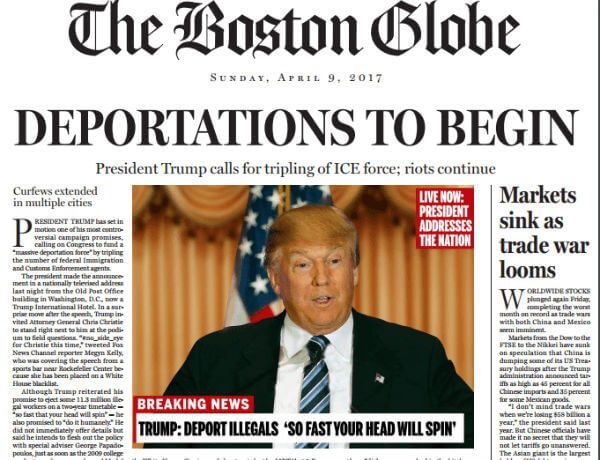
In an editorial, the Boston Globe says: Donald J Trump’s vision for the future of our nation is as deeply disturbing as it is profoundly un-American.

It is easy to find historical antecedents. The rise of demagogic strongmen is an all too common phenomenon on our small planet. And what marks each of those dark episodes is a failure to fathom where a leader’s vision leads, to carry rhetoric to its logical conclusion. The satirical front page of this section [shown above] attempts to do just that, to envision what America looks like with Trump in the White House.

It is an exercise in taking a man at his word. And his vision of America promises to be as appalling in real life as it is in black and white on the page. It is a vision that demands an active and engaged opposition. It requires an opposition as focused on denying Trump the White House as the candidate is flippant and reckless about securing it.

After Wisconsin, the odds have shrunk that Trump will arrive in Cleveland with the requisite 1,237 delegates needed to win the nomination outright. Yet if he’s denied that nomination for falling short of the required delegates, Trump has warned, “You’d have riots. I think you’d have riots.” Indeed, who knows what Trump’s fervent backers are capable of if emboldened by the defeat of their strongman at the hands of the hated party elite. [Continue reading…]

Facebooktwittermail

Sheldon Adelson and top GOP donors retreat to the sidelines

Politico reports: Dispirited over a Republican Party primary that has devolved into an ugly, damaging fight, some of the GOP’s biggest financiers are reevaluating whether to invest in the 2016 presidential contest at all.

Among those on the sidelines: Sheldon Adelson, the billionaire casino mogul who hosted the Republican Jewish Coalition’s spring meeting at his Venetian hotel this weekend. His apparent ambivalence about 2016 was shared by many RJC members here. With grave doubts about the viability of the few remaining Republican contenders, many of these Republican donors have decided to sit out the rest of the primary entirely. And while some are reluctantly getting behind a remaining candidate, others are shifting their attention to congressional contests.

On Friday morning, during a meeting of the group’s board, Arthur Finkelstein, an iconic Republican strategist who has advised numerous politicians over the past four decades, presented polling data that showed Donald Trump sitting at historically low approval numbers among American Jews, according to three attendees who described the off-the-record meeting. Ted Cruz, despite an aggressive recent push to court Jews, fared little better.

Following the nearly 30-minute presentation, the group turned to a discussion about what’s next in the race. While some in the room spoke in favor of Cruz, others expressed reservations about his prospects in the general election. Trump, meanwhile, had little support: Not one person volunteered to raise money for him if he were the nominee. [Continue reading…]

Facebooktwittermail

Obama’s counterterrorism strategy ‘an abject failure,’ says former official

decay9

The New York Times reports: The banging on the door jolted Sal Shafi awake. F.B.I. agents were looking for his son. “Where’s Adam?” they yelled. “Where’s Adam?”

Terrified, Mr. Shafi led the agents, guns drawn, up the stairs toward his son’s bedroom. He watched as they led his 22-year-old son away in handcuffs, backed by evidence of Adam Shafi’s terrorist ambitions.

He had come to the attention of officials not by a well-placed informant or a sting operation. His father, concerned and looking for help, had simply picked up the phone and led the government right to his son. For months, over the objections of his lawyer, Mr. Shafi had been talking to the F.B.I., believing he was doing the right thing.

“My God,” he thought, soon after the arrest in July. “I just destroyed Adam.”

Had things been different, Mr. Shafi, 62, a Silicon Valley executive, might have become a much-needed spokesman for the Obama administration’s counterradicalization campaign. Who better to talk to other parents about the seductive pull of terror organizations? Trust the government, he would tell them. They do not want to take away your children.

Despite nascent efforts to steer young people away from terrorism, the government’s strategy remains largely built on persuading people to call the F.B.I. when they first suspect a problem. [Continue reading…]

Facebooktwittermail

The new Europeans

The New York Times reports: Among the first Syrians to show up in Eisenärzt was Yasser, a stocky, 37-year-old seaman from the Syrian port city Latakia. When the bus dropped him off in front of his new home, Yasser told me, he had the sense that none of this strange new reality could be his. He said he had felt that way since a day last summer, when he was working on a ship bound for Tartus, Syria, and received word from a friend back home that uniformed men were looking for him. Until then, life in Latakia had still been manageable, despite the war. The city, a stronghold of Bashar al-Assad, had not seen the kind of fighting that has shattered other parts of the country. Yasser told me that he could still find work at sea to provide for himself and his wife, an architect in her mid 20s. They had lived a good life in Latakia; he had decorated their home with various souvenirs from his international travel — a sword from China, a tiger sculpture from Sierra Leone. In his free time, he rode his Suzuki motorcycle, and the roar of its 1,000-c.c. engine was a source of pleasure and pride. Yasser told me that he completed his mandatory military service years ago, but the men in uniform wanted to re-enlist him to fight for Assad. He could not fathom fighting for any side in the conflict. “I cannot hit a cat,” he told me. Rather than return to Syria, Yasser said he disembarked from his ship off Istanbul and joined the human tide making its way to the European Union. His wife remained in Latakia. (Yasser, like many other Syrians I met in Germany, asked that I withhold his last name to protect the safety of relatives back home.)

[In September, when] Yasser arrived at the Mallersdorfer Sisters’ former residence [which had been sold to the municipality for the purpose of housing asylum seekers], he was shown to his single room on an upper floor and greeted by the caretaker of the residence, Beni Beilhack, a multiple-pierced 36-year-old with thinning hair and a persistent smile. In the following days, Yasser, bored, began to follow Beilhack around, hoping to help with work around the residence. Eventually, Beilhack delegated some tasks to Yasser: repairing a broken doorknob, blowing leaves off the hiking trails near the residence. By October, Beilhack had outfitted Yasser with work clothes and made him his unofficial assistant. The two communicated with a peculiar mix of English, German and Arabic. Under Yasser’s tutelage, Beilhack’s command of Arabic profanities expanded rapidly, and Beilhack dispensed this knowledge liberally throughout his workday, to the delight of many of the young Syrian men. Beilhack, who worked as a truck driver before the Syrians came to town, told me he did not miss his old job, and he seemed to relish his interaction with the Syrians. He started inviting Yasser to family dinners. After school, Beilhack’s son, Luca, then 12, often came by the residence. The Syrians were generally “warmer” than the local residents, Luca told me, adding, “I’d be happy if they lived here forever.”

Beilhack’s 64-year-old mother, Evelyn, also works as a caretaker at the residence, where she lives on the ground floor with her husband. Evelyn held the position previously, when the sisters lived there. When Evelyn learned the Syrians would be moving in, she rejoiced. The nuns nitpicked about the smallest details, she told me, creating an oppressive work environment. She grew up in what she called a “very international” town, a place called Geretsried, south of Munich, which was settled by Germans expelled from Eastern Europe after World War II. Later, Southern European guest workers arrived. Growing up there left her open to seeing what the asylum seekers would be like. “You hear from a lot of different places about what an abominable people they are — not Syrians, but altogether, this whole mass of asylum seekers that are streaming in here,” she told me. People called them “terrible and slobs and poorly raised and primitive.” She wanted to find out for herself, she said. “I thought: I’ll take this on. I want to see this. I want to know this.”

Her experience with the Syrians did not confirm the prejudices. “They are respectful; they’re nice,” she said. Like her son, she seemed to enjoy the Syrians’ company. One evening, a saxophonist from Damascus serenaded her in the former chapel, stripped of religious relics, where the Mallersdorfer Sisters used to worship. The saxophonist stood next to the recently installed foosball table and puffed out a version of Lionel Richie’s “Hello.” One of the young Syrian men sitting next to Evelyn feigned being her companion in a cafe. “Garçon! Two glasses of wine!”

Through his conversations with the Beilhacks, Yasser began to understand something of life in Germany. Evelyn told him how much money was deducted from people’s paychecks for taxes and health insurance, and the cost of living generally seemed far higher than in prewar Syria. Back at home, his wife did some work in a private office, but he would not allow her to work for a firm. Women in Syria were not supposed to hold down such jobs, he said. In Germany, however, he would have to reconsider. He and his wife probably wouldn’t be able to afford a house and a car if she didn’t work too. “Life here is hard,” he said. If the war in Syria ended, he told me, he would go back in a minute. [Continue reading…]

Facebooktwittermail

How French secularism became fundamentalist

Robert Zaretsky writes: For nearly a century, laïcité [which originally assured “the liberty of conscience” for all French citizens] worked well enough. It ensured public space for both those who believed — not just Catholics and Protestants, but Jews as well — and those who did not. But with the 1980s and 1990s came a growing number of immigrants, most of whom were Muslim, from North Africa. And so a different kind of conflict between the French state and established religion began to take shape.

Emblematic of this new tension was a series of battles over a simple strip of clothing. In 1989, a few Muslim girls were expelled from school when they refused to take off their hijabs, or headscarves, which the principal believed was an assault on the secular character of public schools. Shortly after, the French administrative court, the Conseil d’État, ordered them to be reinstated. But two years after 9/11, when similar incidents were repeated at other schools, the court reversed its original finding. While all “ostentatious” signs of religious faith — be they Jewish yarmulkes or Sikh turbans — were declared verboten in public schools, everyone knew that the principal target of the law was the hijab.

In the subsequent sound and fury, the banner of laïcité was unfurled in ways that would surely have been unrecognizable to the 19th-century statesmen like Jules Ferry and Aristide Briand, who helped write the original law. The once-straightforward guarantees of “freedom of conscience” and “free exercise of religious faiths” — rooted in and restricted to the constitutions of the Third, Fourth, and Fifth Republics — were transformed under the forces of political passion and mounting existential anguish into the defining French values, and any form of retreat from a fundamentalist interpretation was a failure to defend the republic.

Today, public intellectuals like Alain Finkielkraut, Régis Debray, and Elisabeth Badinter, when discussing laïcité, invoke the very future of France. Badinter, a renowned feminist philosopher, as if in anticipation of the Charlie Hebdo editorial, declared in January that she was not afraid to be called an Islamophobe, arguing that accusations of racism are a weapon against secularism. In a recent essay on secularism, diversity, and national identity titled L’identité malheureuse (“Unhappy Identity”), Finkielkraut confounds myth with history when he declares his sympathy for those “who miss the good old days when native-born Frenchmen and women (Français de souche) mingled with their own kind and who are now shedding a tear over their sepia-colored France that has lost its homogeneity.”

The xenophobic and anti-immigration National Front, too, has weaponized laïcité, turning it into an ideological cudgel to be used against French Muslims. Last year, Marion Maréchal-Le Pen, the party’s rising star — and granddaughter of Jean-Marie Le Pen — asserted that the National Front is “laïque,” or secular. Yet she then offered an interpretation of the state of religion in France that had very little to do with laïcité as most of the world understands it, exposing the cognitive dissonance shared by the extreme right and left: “If French Muslims wish to practice their faith, they need to accept the fact that they are doing so on soil that is culturally Christian. This means that they cannot have the same rank as the Christian religion.”

Then, last week, the minister for families, children, and women’s rights, Laurence Rossignol, lambasted fashion designers for offering lines of Islamic wear-inspired clothing, including the so-called “burkini,” a full-body bathing suit sold by Marks and Spencer. These brands, Rossignol declared, had “irresponsibly” lent their prestige to clothing designed to oppress women. As for those Muslim women who freely choose to wear religious garb, Rossignol shrugged her shoulders: “There were also American negroes who favored slavery.”

In a single phrase, Rossignol not only let drop a racial slur, but also let slip the implications of how she — a member of government — sees the meaning of laïcité today: No normal French woman, Rossignol seems to believe, would choose to wear Islamic dress as a sign of her religious faith. Tellingly, Rossignol’s use of the word “négre” sparked more outrage in the media than her claim that burkini-wearing women have no place in a truly secular society. [Continue reading…]

Facebooktwittermail

Panama Papers: How the Seychelles saved Syria

James Denselow writes: Against the backdrop of recent territorial gains, the cessation of hostilities and a peace process in Geneva that is rumbling along, President Bashar al-Assad seems more secure than ever after five years of conflict in Syria.

When people ask how he managed to stay in power despite the country having its economy collapse in half, hundreds of thousands killed, one in two Syrians being forced from their homes and the conflict dragging in four of the five UN P5 members of the Security Council, you wouldn’t necessarily think about the Seychelles.

Yet as the Panama Papers, the biggest leak in global history, has shown, the idyllic archipelago of 115 islands in the Indian Ocean off East Africa has played its part in keeping Assad in the Presidential Palace in Damascus.

What this demonstrates is that what appears from a distance to be an insular, authoritarian regime far more proficient in the tools of medieval warfare than modern capitalism, has actually used the levers of globalisation well to protect its interests.

What the 11.5 million leaked documents reveal is that three Syrian companies close to the government – Maxima Middle East Trading, Morgan Additives Manufacturing and Pangates International – used the already infamous Panama-based law firm Mossack Fonseca to create shadow or shell companies in the Seychelles to avoid the increasing pressure of global sanctions.

Considering how near the regime was to collapse before the Russian intervention, this evasion of sanctions is fairly significant. The Panama Papers suggest it paid for fuel that kept Syria’s Air Force helicopters and airplanes in the air. [Continue reading…]

Facebooktwittermail

Climate change is altering how the poles drift

Climate Central reports: The spin of the earth is a constant in our lives. It’s quite literally why night follows day.

And while that cycle isn’t going away, climate change is messing with the axis upon which our fair planet spins. Ice melting has caused a drift in polar motion, a somewhat esoteric term that tells scientists a lot about past and future climate and is crucial in GPS calculations and satellite communication.

Polar motion refers to the periodic wobble and drift of the poles. It’s been observed for more than 130 years, but the process has been going on for eons driven by mass shifts inside the earth as well as ones on the surface. For decades, the north pole had been slowly drifting toward Canada, but there was a shift in the drift about 15 years ago. Now it’s headed almost directly down the Greenwich Meridian (sorry Canada no pole for you, eh).

Like many other natural processes large and small, from sea levels to wildfires, climate change is also playing a role in this shift.

“Since about 2000, there has been a dramatic shift in this general direction,” Surendra Adhikari, a researcher at NASA’s Jet Propulsion Laboratory, said. “It is due to climate change without a doubt. It’s related to ice sheets, in particular the Greenland ice sheet.” [Continue reading…]

Facebooktwittermail

It’s amazing what America could do with the money the rich hide overseas

Max Ehrenfreund writes: The documents known as the “Panama Papers” have created a global scandal around the ways the world’s rich conceal their wealth from the authorities. The prime minister of Iceland offered his resignation after the papers reportedly revealed that he and his wife had a fortune on paper hidden away in the British Virgin Islands. British Prime Minister David Cameron is taking criticism as well, and he acknowledged that he profited from a secret family trust.

The Washington Post has not reviewed the Panama Papers or verified their authenticity, but what seems certain is that wealthy people all over the world — and in the United States — pay much less in taxes by moving their income and assets to foreign countries.

In the United States, the Treasury would collect about $124 billion a year in additional taxes — $36 billion from individual taxpayers and $88 billion from multinational corporations — if it weren’t for such schemes, according to estimates by Gabriel Zucman, an economist at the University of California at Berkeley.

That’s a lot of money — and we’re all paying for it, Zucman said.

When the wealthy pay less in taxes, the rest of the population bears the burden. Either the government spends less money, providing fewer public services, or ordinary citizens pay more to make up the cost. [Continue reading…]

Facebooktwittermail