Elizabeth Rubin writes: I recently received a phone call from Alabama. It was Samey Honaryar, an Afghan who had worked as an interpreter with the United States military and had fled Taliban persecution hoping to find asylum here. Samey is not accused of committing any crime. Yet for nearly a year, he’s been locked up in Etowah County Detention Center, among the worst and most remote of immigration detention centers, with little access to lawyers or medical attention.
“I cannot take it anymore,” said Samey, who was planning a hunger strike. “I served this country. I risked my life for this country, and this is how I’m repaid.”
I have reported from Afghanistan frequently since 2001, and I know that interpreters are an essential conduit into a culture easily misread by foreigners. Nearly every translator I’ve worked with has saved my life. But once they choose to work for the military, their job becomes a political act, making them marked men and women for the Taliban.
At a time when Europeans and Canadians are sheltering over a million asylum seekers, many from conflicts created by United States policies, Samey’s treatment demands attention. Documents and witnesses show that Samey risked his life for American soldiers. But he has been cast into immigration purgatory nonetheless, his troubles caused by a toxic mix of bureaucracy, fear, prejudice and, most poignantly, his naïve faith in American honor. [Continue reading…]
Category Archives: Issues
American inquisition: Training teachers to extract confessions from their students

Douglas Starr writes: About a year and a half ago, Jessica Schneider was handed a flyer by one of her colleagues in the child-advocacy community. It advertised a training session, offered under the auspices of the Illinois Principals Association (I.P.A.), in how to interrogate students. Specifically, teachers and school administrators would be taught an abbreviated version of the Reid Technique, which is used across the country by police officers, private-security personnel, insurance-fraud investigators, and other people for whom getting at the truth is part of the job. Schneider, who is a staff attorney at the Chicago Lawyers’ Committee for Civil Rights Under Law, was alarmed. She knew that some psychologists and jurists have characterized the technique as coercive and liable to produce false confessions — especially when used with juveniles, who are highly suggestible. When she expressed her concerns to Brian Schwartz, the I.P.A.’s general counsel, he said that the association had been offering Reid training for many years and found it both popular and benign. To prove it, he invited Schneider to attend a session in January of 2015.
The training was led by Joseph Buckley, the president of John E. Reid and Associates, which is based in Chicago. Like the adult version of the Reid Technique, the school version involves three basic parts: an investigative component, in which you gather evidence; a behavioral analysis, in which you interview a suspect to determine whether he or she is lying; and a nine-step interrogation, a nonviolent but psychologically rigorous process that is designed, according to Reid’s workbook, “to obtain an admission of guilt.” Most of the I.P.A. session, Schneider told me, focussed on behavioral analysis. Buckley described to trainees how patterns of body language — including slumping, failing to look directly at the interviewer, offering “evasive” responses, and showing generally “guarded” behaviors — could supposedly reveal whether a suspect was lying. (Some of the cues were downright mythological — like, for instance, the idea that individuals look left when recalling the truth and right when trying to fabricate.) Several times during the session, Buckley showed videos of interrogations involving serious crimes, such as murder, theft, and rape. None of the videos portrayed young people being questioned for typical school misbehavior, nor did any of the Reid teaching materials refer to “students” or “kids.” They were always “suspects” or “subjects.”
Laura Nirider, a professor of law at Northwestern University and the project director of the Center on Wrongful Convictions of Youth, attended the same session as Schneider. She told me that about sixty people were there. “Everybody was on the edge of their seat: ‘So this is how we can learn to get the drop on little Billy for writing graffiti on the underside of the lunchroom table,’” she said. One vice-principal told Nirider that the first thing he does when he interrogates students is take away their cell phones, “so they can’t call their mothers.” [Continue reading…]
Libya’s deep state is back and wants you to know it
Borzou Daragahi reports: A pudgy, graying middle-aged man in a brown sweater vest sat quietly sipping tea in the hotel lobby. If you noticed him at all, you might have thought he was a businessman, or an engineer, maybe a mid-ranking civil servant. He frowned occasionally as he contemplated the messages on his smartphone.
He allowed a smile as two men approached. They greeted each other as old friends, exchanging embraces, asking after relatives. One of the men complained a little about the state of business in the region, and warned he might have to head off at some point: “My daughter has a ballet recital.”
The entourage moved to a darkly lit corner of the hotel, their voices dropping, sometimes to a whisper. They looked up with paranoid glares each time a waiter or hotel guest walked by. The three men knew they could never be too careful.
The newcomers were retired colleagues; the first, a balding man in his sixties, works for a charity that helps African migrants in Libya; the second, in his late forties, is a real estate developer, dividing his time between the Libyan capital, Tripoli, and Europe.
But this was no workaday meeting of middle-aged businessmen. The three men are operatives from one of the most feared institutions in the Middle East: Libya’s mukhabarat, or intelligence agency. Formed shortly after the Second World War, the mukhabarat has worked behind the scenes to monitor and manipulate Libya for decades. And they have now joined the war against ISIS, as well as al-Qaeda and loyalists to the former regime of Muammar al-Qaddafi. They have made many, many enemies over the years.
“Extremists are extremists,” said the man in the sweater vest, a senior ranking official of the agency’s counter-terrorism division. “It doesn’t matter if they’re government militias, ISIS, or Qaddafi loyalists. In my focus, I target them all. Political extremists are all the same. And I want stability.” [Continue reading…]
HSBC and Citibank aided firm at center of international bribery scandal
Huffington Post reports: No business can operate without bankers — not even the bribery business.
British financial giant HSBC and American bailout kingpin Citibank processed transactions, managed money and vouched for Unaoil, a once-obscure firm that is now at the center of a massive international corruption scandal. Police raided Unaoil’s Monaco offices and interviewed its executives on Thursday, a day after The Huffington Post and Fairfax Media first exposed the company’s practices. Law enforcement agencies in at least four nations are involved in a wide-ranging probe of the company and its partners.
Halliburton, KBR and other corporate conglomerates relied on Unaoil to deliver them lucrative contracts with corrupt regimes in oil-rich nations. But without the help of banks like HSBC and Citibank, none of Unaoil’s operations would have been possible. [Continue reading…]
After WikiLeaks revelation, Greece asks IMF to clarify bailout plan
The New York Times reports: Greece called on the International Monetary Fund on Saturday to explain whether it was seeking to usher Athens toward bankruptcy ahead of a pivotal referendum in June on Britain’s membership in Europe. Greece’s comments came after I.M.F. officials raised questions in a private discussion published by WikiLeaks about what it would take to get Greece’s creditors to agree to debt relief.
The transcript, which captures what WikiLeaks said was a teleconference conversation in March between Poul Thomsen, the head of the I.M.F.’s European operations, and the I.M.F.’s Greek bailout monitor, underscored a widening rift between the I.M.F. and Greece’s European creditors that could jeopardize Greece’s new 86 billion euro bailout. It also exposed the fraught behind-the-scenes political machinations that have led to a deadlock on how to deal with a country still regarded as Europe’s weakest link.
The I.M.F. declined to comment on the WikiLeaks transcript, but said in a statement that Greece needed to be put “on a path of sustainable growth” supported by reforms and further debt relief. The document touched off a fresh political frenzy inside Prime Minister Alexis Tsipras’s government, which accused the I.M.F. of trying to “politically destabilize Europe.” [Continue reading…]
Is Donald Trump actually a fascist?
The Toronto Star reports: Google Donald Trump, and it won’t be long before the “f” word comes up.
The word is “fascist.” And it’s back in a way that hasn’t been seen for years, as opponents grope for a term that matches the repulsion that a majority of Americans feel for The Donald.
Former Mexican president Vicente Fox has all but called Trump a fascist — and used another “f-word” for his proposed border wall.
Historian Fedja Buric compared him with founding fascist Benito Mussolini. And New Republic editor Jamil Smith said it straight out: “yes, Donald Trump is a fascist.”
Trump even went too far for tub-thumping far right radio host Glenn Beck, who lumped him with “Adolph Hitler in 1929,” on ABC-TV.
But those who have made an academic study of fascism say although Trump and his Coalition of the Chilling may share some of the characteristics of past fascists, the jaw-jutting reality star doesn’t quite squeeze into the classic 20th-century mould. [Continue reading…]
No, America isn’t 100 percent safe from terrorism. And that’s a good thing
Juliette Kayyem writes: Admit it. After the terrorist attacks in Brussels this past week, after the brief reflection for those lost or wounded and the sense of “oh, no, not again” passed, other thoughts quickly followed. My own selfish but natural worry, as a mother of three: Should we cancel that trip to Europe this summer?
In the nearly 15 years since 9/11, the questions I’ve fielded from family and friends have varied but never ceased: Should I buy a gun? (Only with training and safety measures at home, and certainly not to combat Islamic terrorists.) Is Times Square safe on New Year’s Eve? (Like every crowd scene, you have to stay alert, but security is high at events like that.) Or my personal favorite, because it combines parental insecurities with disaster management: Is Tulane a good school so many years after Hurricane Katrina? (Yes; it had a few rough months, but your kid should still apply.)
All these queries about a world in mayhem boil down to: Is my family safe? The answer is both simple and liberating: No, not entirely. America was built vulnerable, and thank goodness for that. [Continue reading…]
Ex-CIA director Michael Hayden on torture and drones
A CIA grunt’s tale of the fog of secret war
The New York Times reports: In Douglas Laux’s final days as a C.I.A. officer, the futility of his mission prompted him to quote George Orwell to his boss.
Mr. Laux had spent months in 2012 working with various Middle Eastern nations that were trying to ship arms to Syria to help disparate rebel groups there. But it had become clear to him that the C.I.A had little ability to control the squabbling and backstabbing among the Saudis, Qataris and other Arabs.
He told a senior C.I.A. officer he felt like Winston Smith, the character in “1984” known for his fatalism, because he was carrying out his work without comprehending the politics and competing agendas thwarting progress in aiding the rebellion. “I understand the how,” Mr. Laux said, paraphrasing one of Smith’s famous lines. “I do not understand the why.”
It is a sentiment that might sum up much of Mr. Laux’s career at the C.I.A., an organization he served for eight years as an undercover case officer and soldier in the agency’s shadowy conflicts overseas. His career at the agency began with a tour at a remote firebase in southern Afghanistan and ended with a spot on the agency’s Syria Task Force — a life in war zones that is emblematic of the lives of a large cadre of American spies who joined the C.I.A. after the Sept. 11 terrorist attacks. He left the agency three years ago, but is speaking publicly about his experiences there for the first time in conjunction with the release of a memoir. [Continue reading…]
A terror attack, then far right moves in
Turkey is no ‘safe haven’ for refugees – it shoots them at the border
Patrick Kingsley writes: It was beyond sad to read in the Times this week that Turkish border guards have allegedly shot dead Syrians trying to reach safety in Turkey. Sixteen refugees, including three children, have been killed trying to escape the battlegrounds of northern Syria in the past four months, according to the Syrian Observatory for Human Rights, a frequently cited watchdog.
It is shocking to think of people fleeing the combined atrocities of Islamic State and Bashar al-Assad being gunned down just as they make their bid for safety. But what is perhaps most shocking of all is that we observers are still shocked by this.
The shooting of Syrians on the border is not a new phenomenon. Refugees and rights groups have reported shootings of migrants on the Turkish-Syrian border since at least 2013. These abuses are well-documented, and the reports widely circulated. So why, in the months following a shady European deal that forces Turkey to shoulder the biggest burden of the refugee crisis, are we still so appalled when Turkey continues to use deadly violence to stop that burden getting any bigger? [Continue reading…]
Amid clashes, Greece presses on with plan to deport refugees
The New York Times reports: Violent clashes erupted in Greek refugee camps among panicked migrants as Greece and the European Union pressed ahead on Friday with their intention to expel them from Europe and deport thousands back to Turkey, despite strong objections from rights groups and United Nations relief officials who say the plan is illegal and inhumane.
Hundreds of migrants broke out of an overcrowded detention center on the Greek island of Chios and began walking to the port to protest a European Union deal that went into effect in March, authorizing Greece to return them to Turkey if their applications for asylum in Europe were not accepted. The deportations officially begin on Monday.
Video clips in the Greek media showed migrants streaming away from the camp unhindered by the police, hours after a brawl broke out at the camp’s registration center. Several refugees were taken to a hospital after the riot police used stun grenades, and a help center run by Doctors Without Borders was destroyed, forcing the aid group to abandon its work. More than 1,500 migrants were being held at the center, designed for 1,200. Three people were also reported stabbed during a migrant riot on the island of Samos, where another detention facility operates. [Continue reading…]
Global investigation launched on bribery and corruption in the oil industry
Fairfax Media and the Huffington Post report: he FBI, US Department of Justice and anti-corruption police in Britain and Australia have launched a joint investigation into revelations of a massive global bribery racket in the oil industry.
The news comes as Fairfax Media and The Huffington Post can reveal that US giant Halliburton and its former subsidiary Kellogg, Brown & Root are embroiled in the Unaoil bribes-for-contracts scandal through their operations in former Soviet states.
The biggest leak of confidential files in the history of the oil industry also unveils rampant corruption inside Italian oil giant Eni in many of the countries in which the firm has been contracted by national governments to manage their oilfields.
Texas firm National Oilwell Varco, Singapore conglomerate Keppel, Norway’s Aker Kvaerner and giant Turkish joint venture GATE are also implicated. Information from hundreds of thousands of emails to Unaoil’s chief executive, Cyrus Ahsani, show individual executives and managers from Halliburton and Kellogg Brown & Root (KBR), which split in 2007, knew or suspected that Unaoil was acting corruptly to win contracts in Kazakhstan.
Managers from Eni, Spanish Firm Tecnicas Reunidas, French firm Technip, drilling giant MI-SWACO and Rolls-Royce not only actively supported bribery but were offered, or pocketed, their own kickbacks. And US defence giant Honeywell and Australian firm Leighton Offshore agreed to hide bribes inside fraudulent contracts in Iraq. [Continue reading…]
How to hack an election
Bloomberg Businessweek reports on the confessions of Andrés Sepúlveda, a political hacker who rigged elections throughout Latin America for almost a decade: His teams worked on presidential elections in Nicaragua, Panama, Honduras, El Salvador, Colombia, Mexico, Costa Rica, Guatemala, and Venezuela. Campaigns mentioned in this story were contacted through former and current spokespeople; none but Mexico’s PRI and the campaign of Guatemala’s National Advancement Party would comment.
As a child, he witnessed the violence of Colombia’s Marxist guerrillas. As an adult, he allied with a right wing emerging across Latin America. He believed his hacking was no more diabolical than the tactics of those he opposed, such as Hugo Chávez and Daniel Ortega.
Many of Sepúlveda’s efforts were unsuccessful, but he has enough wins that he might be able to claim as much influence over the political direction of modern Latin America as anyone in the 21st century. “My job was to do actions of dirty war and psychological operations, black propaganda, rumors — the whole dark side of politics that nobody knows exists but everyone can see,” he says in Spanish, while sitting at a small plastic table in an outdoor courtyard deep within the heavily fortified offices of Colombia’s attorney general’s office. He’s serving 10 years in prison for charges including use of malicious software, conspiracy to commit crime, violation of personal data, and espionage, related to hacking during Colombia’s 2014 presidential election. He has agreed to tell his full story for the first time, hoping to convince the public that he’s rehabilitated — and gather support for a reduced sentence.
Usually, he says, he was on the payroll of Juan José Rendón, a Miami-based political consultant who’s been called the Karl Rove of Latin America. Rendón denies using Sepúlveda for anything illegal, and categorically disputes the account Sepúlveda gave Bloomberg Businessweek of their relationship, but admits knowing him and using him to do website design. “If I talked to him maybe once or twice, it was in a group session about that, about the Web,” he says. “I don’t do illegal stuff at all. There is negative campaigning. They don’t like it — OK. But if it’s legal, I’m gonna do it. I’m not a saint, but I’m not a criminal.” While Sepúlveda’s policy was to destroy all data at the completion of a job, he left some documents with members of his hacking teams and other trusted third parties as a secret “insurance policy.”
Sepúlveda provided Bloomberg Businessweek with what he says are e-mails showing conversations between him, Rendón, and Rendón’s consulting firm concerning hacking and the progress of campaign-related cyber attacks. Rendón says the e-mails are fake. An analysis by an independent computer security firm said a sample of the e-mails they examined appeared authentic. Some of Sepúlveda’s descriptions of his actions match published accounts of events during various election campaigns, but other details couldn’t be independently verified. One person working on the campaign in Mexico, who asked not to be identified out of fear for his safety, substantially confirmed Sepúlveda’s accounts of his and Rendón’s roles in that election.
Sepúlveda says he was offered several political jobs in Spain, which he says he turned down because he was too busy. On the question of whether the U.S. presidential campaign is being tampered with, he is unequivocal. “I’m 100 percent sure it is,” he says. [Continue reading…]

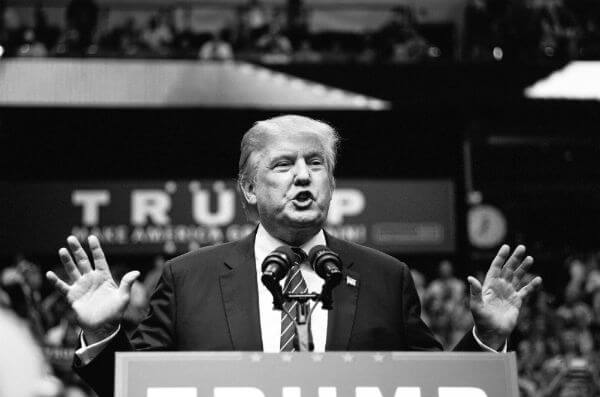
The overlooked star of the Trump show is the crowd

Gwynn Guilford writes: Over the span of three days in March, in far-flung corners of Ohio, more than 20,000 people—retired schoolteachers, hair stylists, chinos-clad Young Republicans, Nicaraguan immigrants, Vietnam vets, primly coiffed soccer moms—braved downpours, traffic, muscle spasms, hunger, and protesters for a chance to behold, in the very tanned flesh, Donald J. Trump, billionaire, business genius, TV star, and, very possibly, the next president of the United States. One of those people was me.
I went, first and foremost, to answer a deceptively simple question: How has Trump defied pretty much every rule not just of electoral politics, but of contemporary civil discourse to lead the race for the Republican party’s nomination for president? Set aside for one moment the economic conditions that we know have made Trump’s rise possible. What about those of the human psyche? What does Trump’s improbable rise reveal about how Americans understand themselves, what they imagine for their country, what they crave in their leaders?
To find answers to these questions, I decided to become part of Trump’s audience, not just its observer. For three days in mid-March, I buried my reporter credentials in my bag and lost myself in the throngs of Trump supporters at rallies in Cleveland, Cincinnati, and Youngstown. What I experienced astonished me. I’m far from being a Trump supporter; in fact I object to most of his views. But as I shuffled out of a Youngstown aircraft hangar, I became aware of the unsettling but very real possibility that, in the thrill of the moment, I’d been chanting along with the Trump crowd. (I don’t think I did, but I can’t be sure). Indeed, it felt like I had just taken part in an epic psychological experiment.
Spending three straight days in the audience taught me one crucial thing. The overlooked star of the Trump show is the crowd—the single-voiced creature that roars “Mexico!” when asked about wall construction, and emits a foghorn of boos when reminded of reporters cooped in a pen at the rear of the room. From within the Trump rally masses, I felt the strange sea-change that fuses 20,000 individuals into one being, I felt its power swell, and sometimes it felt good. [Continue reading…]
Adventures in the Trump Twittersphere
Zeynep Tufekci writes: Every morning since August, I have steeled myself to enter an alternate universe. I scroll through social media feeds where people are convinced that Congress funds the Islamic State, that our president hates this country and wants it to fail and that Donald J. Trump is the only glimmer of hope in this bleak landscape.
It’s my look at a list of Twitter users whom I’ve identified as Trump supporters. Some accounts have only a few followers while some have tens of thousands. (No one comes close to Mr. Trump himself, at more than seven million.) They include people of many professions and backgrounds. I found them by reading at responses to news media or political accounts, and then went on to seek out other accounts they followed. It’s a large, sprawling network.
As an academic, I study social media and social movements, from the uprising in Egypt to Black Lives Matter. As I watched this election season unfold, I wanted to gain a better understanding of the power of the Trump social media echo chamber. What I’ve been reading has surprised even my jaded eyes. It’s a world of wild falsehoods and some truth that you see only rarely in mainstream news outlets, or hear spoken among party elites.
It’s popular to argue today that Mr. Trump’s success is, in part, a creation of the traditional news media — cable networks that couldn’t get enough of his celebrity and the ratings it brought, and newspapers that didn’t scrutinize him with enough care. There is some truth in that, but the contention misses a larger reality.
Mr. Trump’s rise is actually a symptom of the mass media’s growing weakness, especially in controlling the limits of what it is acceptable to say. [Continue reading…]
As long as there is no real democracy in the Middle East, ISIS will continue to mutate
David Hearst writes: The betting is that neither the pro-Assad coalition nor the Saudi-backed one will prevail in Syria. The likeliest outcome of a ceasefire is a Syria permanently fragmented into sectarian statelets in the way Iraq was after the US invasion.
This could be regarded as the least worst option for foreign powers meddling in Syria. Jordan, the Emirates and Egypt will have stopped this dangerous thing called regime change. Saudi will have stopped Iran and Hezbollah. Russia will have its naval base and retain a foothold in the Middle East. Assad will survive in a shrunken sectarian state. The Kurds will have their enclave in the north. America will walk away once more from the region.
There is just one loser in all this – Syria itself. Five million Syrians will become permanent exiles. Justice, self-determination, liberation from autocracy will be kicked into the long grass.
The history of the region has lessons for foreign powers. It proves that fragmentation only leads to further chaos. The region needs reconciliation, common projects and stability as never before. That will not come from creating sectarian enclaves backed by foreign powers.
The Islamic State is a distraction from the real struggle of the region, which is liberation from dictatorship and the birth of real democratic movements. IS is not a justification for the strong men. It is a product of their resistance to change. History did not start in 2011 and it won’t stop now. The revolutions of 2011 were empowered by decades of misrule. There is a reason why millions of Arab rose – peacefully at first – against their rulers and that reason still exists today.
As long as there is no real democratic solution in the Middle East, the Islamic State group will continue to mutate like a pathogen that has become antibiotic-resistant in the body politic of the Middle East. Each time it changes shape, it will become more virulent. [Continue reading…]
Zuma court ruling: South Africans witness a massive day for democracy
By Hugh Corder, University of Cape Town
The accountability of public governance in South Africa has come a long way since 1994. When the transitional constitution was hammered out in negotiations in 1993, the primary consideration was to establish an unshakeable commitment to government under law in terms of a binding constitution.
Founded on the “rule of law”, this means that no one is above the law and that everyone is formally equal before the ordinary courts. No-one, not even the president, may take the law into their own hands. One of the founding values of the constitution is the:
… supremacy of the constitution and the rule of law.
The brand of democracy enshrined in the final constitution of 1996 emphasises participation by the people in a multi-party system of democratic government, to achieve “accountability, responsiveness and openness”.
Recognising the democratic deficit that South Africa faced because of the ravages of apartheid, additional mechanisms were introduced to strengthen participative democracy and popular accountability. One of them was the establishment of the office of the Public Protector.
The Constitutional Court’s judgment in Economic Freedom Fighters and Democratic Alliance v The Speaker of the National Assembly, the President and Others represents the exercise of judicial authority and expertise at the highest level by international standards.