Category Archives: Issues

Jean-Marie Le Pen endorses Trump days after ex-KKK leader urges support

The Guardian reports: Donald Trump received a vote of confidence on Saturday from Jean-Marie Le Pen, the former leader of France’s Front National who in the past has said the Nazi occupation was not “particularly inhumane” and suggested Ebola could solve Europe’s “immigration problem”.

“If I were American, I would vote Donald Trump,” Le Pen tweeted on Saturday about the Republican frontrunner for president. “But may God protect him!”

Trump’s ascendance in American politics began with his promises to build a “big, beautiful wall” along the US-Mexican border, derogatory comments about Mexicans, and a promise to deport 11 million undocumented people.

Le Pen founded Front National, a far-right party that campaigns mostly on anti-immigration policies. [Continue reading…]

Facebooktwittermail

Donald Trump declines to disavow David Duke

The New York Times reports: Donald J. Trump declined on Sunday to disavow the support of David Duke, the white nationalist and ex-Ku Klux Klansman, who has called Mr. Trump “by far the best candidate.”

Mr. Duke, a former member of Congress who once ran for president, is famous for his white supremacist views and is generally considered a pariah in politics. In an interview with CNN, Mr. Trump pleaded ignorance about him.

“Well, just so you understand, I don’t know anything about David Duke,” Mr. Trump said. “I don’t know anything about what you’re even talking about with white supremacy or white supremacists.” [Continue reading…]

Facebooktwittermail

Clear evidence that hospitals and medical workers are deliberate bombing targets in Syria

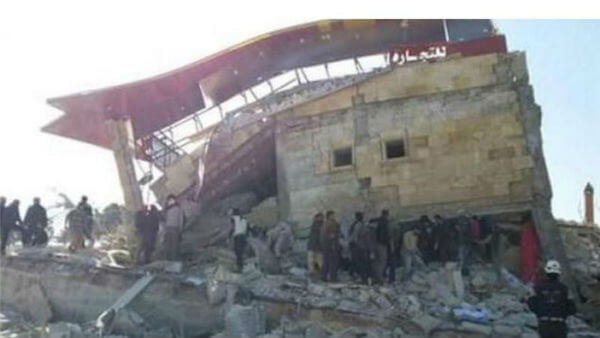
msf-hospital

The New York Times reports: The hospital in the northern Syrian town of Maarat al-Noaman was not just grazed, or damaged, by the airstrikes last week. It was destroyed, taking a direct hit that pancaked its three stories into one, entombing and killing 25 people, including nine staff members.

It was struck at around 9:02 a.m., just as day-shift workers and patients were arriving; then again at around 9:05. As rescuers swarmed around, another explosion struck at 9:45, and another at 9:48. That same morning, two airstrikes hit the National Hospital on the other side of town, which was treating nurses injured in the attack on the first facility.

This detailed account, provided by the director of the hospital, which was supported by Doctors Without Borders, is one example of why many Syrian medical workers in insurgent-held areas and human rights groups believe medical facilities are not just being hit by stray bombs or indiscriminate attacks, but have long been deliberately targeted by the Syrian government and its Russian allies. It is a measure of the deep mistrust that gravely challenges prospects for a truce set to begin Saturday.

“I had the feeling they were trying to kill me,” said the director, Dr. Mazen al-Saoud, 55, in a telephone interview from Maarat al-Noaman, his hometown. “Wherever I went, there was bombing.”

According to Doctors Without Borders, there were 94 attacks last year alone on 67 hospitals and clinics the group supports in insurgent-held areas from northern to southern Syria, destroying 12 facilities and killing 23 staff members. In 2016, there have already been 17 attacks on health facilities, including six assisted by the group. [Continue reading…]

Facebooktwittermail

Beyond Yarmouk, Palestinians in Syria need aid

Al Jazeera reports: The United Nations has called for immediate and sustained humanitarian access in the Deraa and Damascus areas of war-torn Syria, where more than 20,000 Palestinian refugees live.

In an interview with Al Jazeera, Chris Gunness, spokesperson for the UN agency for Palestinian refugees (UNRWA), said an estimated 17,500 Palestinians remained “inaccessible” in the Deraa province, along with another 5,000 civilians in Khan Eshieh.

“UNRWA is extremely concerned about the safety and liberty of every Palestine refugee and each of its staff,” Gunness said.

Last week, UNRWA was able to deliver aid to neighbouring areas of Yarmouk, the besieged Damascus-area camp home to both Palestinians and Syrians, for the first time in nine months.

Yet the agency has been unable to gain access to Yarmouk’s interior since late March 2015, days before the Islamic State of Iraq and the Levant (ISIL) invaded and took control of most of the camp.

Elsewhere, UNRWA has been unable to reach camps in the Deraa area, as well as the Khan Eshieh camp in southern Damascus, for more than two years.

Al Jazeera spoke to Gunness about recent developments in Palestinian refugee camps across Syria. [Continue reading…]

Facebooktwittermail

Saudi Arabia is reeling from falling oil prices — and it could get much worse

The Washington Post reports: Stung by falling oil prices, Saudi Arabia has cut spending and subsidies as part of harsh austerity measures that threaten the lavish welfare programs underpinning its stability.

The oil-exporting giant’s economy has gone from producing windfalls to deficits, and Saudi rulers increasingly struggle to provide the cushy government jobs, expensive state handouts and tax-free living that have long bought them domestic obedience.

The pivot to austerity — which also has been imposed by neighboring Gulf Arab oil monarchies — risks triggering unrest in a Saudi society that is conservative and particularly resistant to change, analysts and diplomats warn.

The cutbacks are seen as necessary by King Salman’s son, defense minister and head of economic planning, Mohammed bin Salman. The 30-year-old prince has raised eyebrows for overseeing leadership shake-ups at home and two wars abroad. Advisers say he also intends to wean the country off its overwhelming dependence on oil sales and reform a bloated and opaque public sector. [Continue reading…]

Facebooktwittermail

How arms sales to Saudi Arabia are promoting instability

William D. Hartung writes: According to a report released this week by the Stockholm International Peace Research Institute (SIPRI), arms deliveries to Saudi Arabia have increased by an astonishing 279% between 2011 and 2015, compared with the prior five-year period. More then three quarters of the weaponry came from the U.S. and the United Kingdom.

There was a time when sales to the Saudis were more about money and politics than fighting actual conflicts. Multi-billion dollar sales from the Nixon administration onward were seen as a way to bolster U.S. weapons contractors and “recycle petrodollars” — earn back some of the funds that flowed out of the U.S. to purchase Saudi oil. It didn’t hurt that Saudi officials frequently skimmed off funds for their own use as part of these mega-deals.

Until recently, the military relevance of sending weapons to Saudi Arabia had less to do with the Saudis using U.S.-supplied arms than it did with cementing ties with Washington. The implicit understanding was that the purchase of large quantities of U.S. armaments was a form of payback for Washington’s commitment to come to the rescue of the Saudi regime in a crisis. [Continue reading…]

Facebooktwittermail

States must stop selling weapons to Saudi Arabia for use in Yemen conflict

Amnesty: Campaigners are today calling on governments due to attend the latest round of discussions on the implementation of the Arms Trade Treaty (ATT) in Geneva on 29 February to set their hypocrisy aside and stop selling billions of dollars worth of deadly weapons to Saudi Arabia being used to attack Yemeni civilians.

In a new report released today, the Control Arms Coalition names France, Germany, Italy, Montenegro, the Netherlands, Spain, Sweden, Switzerland, Turkey, the UK, and the US as having reported licenses and sales to Saudi Arabia worth more than $25bn in 2015 including drones, bombs, torpedoes, rockets and missiles. These are the types of arms currently being used by Saudi Arabia and its allies for gross violations of human rights and possible war crimes during aerial and ground attacks in Yemen. [Continue reading…]

Facebooktwittermail

Greenland’s melting ice sheet is now losing 8,000 tons of water every second

John R. Platt writes: Greenland’s melting ice sheets are contributing more water to the oceans than previously realized, and that’s going to lead to even greater amounts of sea-level rise around the world, according to new research.

The paper, published in the journal Nature Climate Change, reveals something scientists wouldn’t have expected just five years ago. “It’s a very rapid change,” said one of the study’s authors, William Colgan of York University in Toronto. “The ice sheet is now losing about 8,000 tons every second, year-round, day in and day out.”

Colgan said the “lion’s share” of that loss—about 5,000 tons per second—comes in the form of meltwater. The ice sheet, like a sponge, used to be able to absorb most of what melted each year because the uppermost layers are composed of tightly packed but permeable snow, as opposed to the impermeable layers of ice much farther below. That porous surface, called “firn,” normally would allow meltwater to sink downward, where it would refreeze and stay within the glacier.

That started changing about a decade ago. [Continue reading…]

Facebooktwittermail

Umberto Eco’s definitions of modern fascism seem ever more prescient

decay6bw

Christopher Dickey writes: Here in Europe, people know a thing or two about fascism.

It is not, as it was when Bernie Sanders was young, a term tossed around by left-wing activists to describe anyone opposed to progressive ideas, whether presidents or parents.

No, here in Europe, by various names — as Fascism, Nazism, Stalinism — it was the living, vibrant, vicious force that led directly to the most horrific global war in history. More recently, it took root and lingered as an active ideology in Latin America, providing a crude foundation for the repressive revolutions and dirty wars that raged from the ’60s through the ’80s.

Indeed, the fundamentals of fascism are with us today, in the killing fields of ISIS-land, in the madness of North Korea, and also, sadly, in battered democracies from newly militaristic Japan to xenophobic, isolationist parties in Europe. And, yes, in somewhat more subtle forms fascism can be found on the campaign trail in the U.S. of A.

When I saw last week that the great Italian intellectual Umberto Eco had died, I was reminded of a long essay he wrote for the New York Review of Books more than two decades ago. And, re-reading it now, it strikes me as an important guide to our thinking about this powerful, almost primal political force, its seductive strength and its inherent, enormous dangers. [Continue reading…]

Facebooktwittermail

Donald Trump’s grandfather was an illegal migrant and ‘Trojan horse’

By Stefan Manz, Aston University

During New Year celebrations in Cologne, there were more than 500 reported attacks against women, including robbery and sexual assault. Most of the suspects are of North African origin, and some are thought to have entered the country illegally or as asylum seekers.

The news was welcome campaign fodder for US presidential hopeful Donald Trump. Referring to German chancellor Angela Merkel’s open door policy on refugees from Syria, he commented in his usual rhetoric: “I don’t know what the hell she is thinking”.

Trump went on to say that he did not want to have “people coming in from migration from Syria (sic)” as these were aggressive young men who “look like they should be on the wrestling team”. More dangerously still, Trump believed such people could act as terrorist “Trojan horses”.

Continue reading

Facebooktwittermail

If the FBI concerns us, Apple should concern us even more

decay9

Ned O’Gorman writes: whatever privacy is, it has to be in Apple’s eye primarily an engineering problem. Apple’s privacy is an engineer’s construct, even conceit. Many everyday senses of privacy follow this very limited idea of “data on my device.” Though I’ve entered vital data online numerous times, I would be more likely to feel a violation of privacy at an “unauthorized” family member thumbing through the pictures on my phone than a stranger using my date of birth and social security number to secure fraudulent credit. There’s something about Apple’s sense of “personal data” that gels very well with our sense that the gadgets we carry with us are “personal devices” rather than nodes in a massive economic and technological system.

But what about privacy’s co-dependents, especially the “public”? Apple’s narrow and problematic sense of privacy, if Apple sticks to it and if it were made the rule among tech companies, could have major public consequences, reshaping our experience of public life. First of all, Apple is explicitly pitting a forensic good, a good having to do with public justice, against the protection of privacy, and it is doing so in an absolutist fashion that undermines the delicate balance between certain rights and justice so vital to public life (just as the NSA did, but in reverse fashion).

In the case of Syed Rizwan Farook’s iPhone, we are talking about a specific and targeted forensic investigation — exactly what critics of the NSA call for. It is quite plausible that the data on Farook’s phone may be critical in helping to forensically reconstruct the networks (if any) of which Farook was a part. The knowledge that would come out of such an investigation may not end up preventing another similar attack. Nevertheless, it represents an immediate public good both with respect to our sense of justice and to making sense of indiscriminate acts of political violence that are, in their very performance, meant to cripple or otherwise alarm the citizenry. My point here is simply that legally sanctioned and legitimate forensic police work represents a public good, and Apple is now pitting that good against the good of privacy — and privacy as Apple defines it. [Continue reading…]

Facebooktwittermail

France’s state of emergency

rivera4 (1)

Didier Fassin writes: The state of emergency that François Hollande declared on 14 November, the day after 130 people were killed and more than 300 wounded by the attackers in Paris, is still in force. It’s worth noting how exceptional this situation is. Neither José María Aznar after the 2004 Madrid bombings that killed 191 people and injured 1800 nor Tony Blair after the 2005 London bombings in which 52 people were killed and 700 injured invoked any such measures. In France, it was only the second time under the Fifth Republic that a state of emergency had been applied to the entire country (the first was in April 1961, after the Algiers putsch, the generals’ failed coup against Charles de Gaulle). ‘France is at war,’ Hollande announced on 16 November, having convened a special congress at the Palace of Versailles to argue that the state of emergency should in due course be written into the constitution and, in the meantime, extended for three months; two days after his speech, 551 of 558 National Assembly representatives voted in favour of the extension. A poll indicated that 91 per cent of the public supported it, the approval rate showing little variation across party lines: 93 per cent among Socialists and 98 per cent among Republicans. Since then, support has remained very high. Why are these measures, which other heads of state, confronted with similar events, did not deem necessary, so popular at large?

The state of emergency, in general terms, gives the executive branch of government extraordinary powers over the mobilisation of the army, control of the borders, limitation of movement and setting of curfews. But in practice it has four main concrete consequences. The police can conduct searches in private and public spaces at any time without judicial warrant. The minister of the interior can put anyone considered a threat to public security under house arrest. State authorities can ban demonstrations and gatherings on the same grounds. Law enforcement officers can stop and search anyone without specific justification. Anticipating appeals to the European Court of Human Rights against the measures, the French government pre-emptively informed the Council of Europe on 27 November of ‘its decision to contravene the European Convention on Human Rights’.

You would think that these restrictions on public liberties and fundamental rights would be unpopular, and might even lead to public protest. In fact, the reverse has happened. In poll after poll, a large majority continues to support the emergency measures. There are two reasons: first, they are widely thought to be effective in countering terrorism; second, most of the population never gets to see the negative consequences. [Continue reading…]

Facebooktwittermail

Crackdowns on free speech rise across a Europe wary of terror

The New York Times reports: A puppet show at an open square in Madrid during Carnival festivities this month featured a policeman who tried to entrap a witch. The puppet officer held up a little sign to falsely accuse her, using a play on words that combined Al Qaeda and ETA, the Basque separatist group.

Angry parents complained, and the real police stepped in. They arrested two puppeteers, who could now face as much as seven years in prison on charges of glorifying terrorism and promoting hatred.

Paradoxically, the puppeteers say in their defense, the police proved their point: that Spain’s antiterrorism laws are being misapplied, used for witch hunts.

Far from an isolated episode, the arrests on Feb. 5 are part of a lengthening string of prosecutions, including two against a rap musician and a poet, that have fueled a debate over whether freedom of protest and speech are under threat in Spain and elsewhere in Europe because of fears of terrorism. [Continue reading…]

Facebooktwittermail

How the changing media is changing terrorism

Jason Burke writes: Mohamed Merah, a 23-year-old petty criminal, spent much of the last 36 hours of his life crouched over a laptop in his small apartment in the south‑western French city of Toulouse. It was March 2012. Outside, armed police and journalists gathered. Merah reheated frozen food in a microwave and checked his weapons. He spoke with negotiators and described how he had travelled to Pakistan a few months earlier to receive some desultory training from a faction linked to al-Qaida. He also explained, incoherently, why he had killed seven people over the previous two weeks in a series of shootings. But most of the time, Merah worked on his computer.

Just a few hours before he was killed by armed police after a sustained firefight, Merah finished editing a 24-minute video clip. It was a compilation of images from the GoPro camera that he had attached to his body armour before each of his killings. GoPro primarily caters to practitioners of extreme sports who wish to obtain point-of-view footage of their adrenalin-charged exploits. Merah had filmed his preparations, the murders themselves and his motorbike getaways. His first three victims were off-duty soldiers, two Muslims and a Catholic. The others, a rabbi and three children, had died when he had attacked a Jewish school. The images showed how Merah had chased and caught one of those children: eight-year-old Miriam Monsonego, who had hesitated for a second when others ran, reluctant to abandon her school bag. Merah grabbed her by the hair, changed his weapon when the first jammed, and then finally shot the girl in the head.

Roughly 24 hours after police located Merah and surrounded his building, he managed to slip through a gap in the security cordon. He did not take the opportunity to escape. Instead, he walked to a postbox, deposited a package containing a USB stick with the video on it, and then returned to his home to await his own death.

The package he dropped into the postbox was addressed to al-Jazeera, the Qatar-based TV network. Merah was confident that al-Jazeera would broadcast the material because, in his words, it constantly showed “massacres and bombs and suchlike”. In fact, al-Jazeera did not show any of the clip because, the network said in a statement, Merah’s images did not “add any information” not already in the public domain and breached its ethical code.

The network’s decision did little to diminish the stream of horrendous violence that has been disseminated by Islamic militant groups and individuals in recent years. Since Merah’s death, the use and broadcast of graphic and violent images has reached an unprecedented level. Much of this is due to the emergence of the Islamic State (Isis), which launched its campaign to carve out an enclave in eastern Syria and western Iraq at around the time Merah was planning his killings. But much is also a result of the capabilities of the new technology that Isis has been able to exploit. [Continue reading…]

Facebooktwittermail

EU parliament votes for embargo on arms sales to Saudi Arabia

The Guardian reports: MEPs have voted for a European Union-wide arms embargo against Saudi Arabia to protest against the Gulf state’s heavy bombing campaign in Yemen.

The European parliament voted by a large majority for an EU-wide ban on arms sales to the kingdom, citing the “disastrous humanitarian situation” as a result of “Saudi-led military intervention in Yemen”.

The vote does not compel EU member states to act but it does increase pressure on Riyadh, in the wake of criticism from the UN and growing international alarm over civilian casualties in Yemen.

The resolution also turns up the heat on the British government, which has supplied export licences for up to £3bn worth of arms to Saudi Arabia in the last year. The UK has been accused of direct involvement in the bombing campaign through the deployment of UK military personnel to the kingdom. [Continue reading…]

Facebooktwittermail

The largely unheard story of democracy developing in Syria

Syria1

Middle East Monitor reports: Until now the Syrian story has been a fabrication of assumptions and sensationalism spun by the media. Burning Country is an attempt to counter this, a chance for real Syrians to tell their own stories. As co-author Robin Yassin-Kassab puts it: “We felt that people had been coming at it from narratives of big stories that zoomed out so far they couldn’t hear the people on the ground that had made the revolution and were suffering the counter-revolution. We wanted to amplify those voices.”

Yassin-Kassab and fellow co-author Leila Al-Shami have weaved together the testimonies of revolutionaries, activists, refugees, fighters, democracy activists, pro-regime Alawites and Islamists with their own analysis to create an account of Syria that takes us back further than Ottoman rule and up to October 2015. Published by Pluto Press this year, the book describes how Al-Assad was once respected for adopting an anti-Zionist, anti-Western and pro-Arab rhetoric and today garners western sympathy for his so-called opposition to US-led imperialism, a position the authors describe as “populist opportunism”.

“I think his rhetoric was very anti-imperialist and that was in line with popular sentiment in the Arab street and I think for that reason he was popular for his foreign policy stance both inside Syria and more broadly around the Arab world,” says Al-Shami. “But that didn’t match up in practice and when you see the actions of the Baathist regime whether they’re under Bashar or his predecessor, his father, they certainly didn’t match that rhetoric. You had the massacres of Palestinians in Tel Zaatar camp in Lebanon, you had the intervention against the Black September movement in Jordan and then under Bashar you had collusion with imperialism because you had people that were basically deported, tortured by proxy, to the Assad regime under the US rendition programme as part of its ‘War on Terror’.”

Though the nationalist rhetoric did work among some sections of the population, Yassin-Kassab explains, most people living in Syria were unhappy under the regime. But prior to 2011 economic stability was more important than foreign policy and Hafez Al-Assad had achieved this stability by building roads and installing electricity in long neglected areas of the countryside and subsidising fuel and food. When Bashar succeeded his father, he retracted many of these benefits. “I think these things were important and when these things were pulled out everybody said, ‘look this nationalist rhetoric which we’ve gone along with is rubbish isn’t it?’ When they got hungry, which is what happened when Bashar Al-Assad came and did these neo-liberal reforms which were really crony-capitalist reforms and removed a lot of the safety nets that had allowed people to keep quiet. I think that’s more important, I don’t think they stayed in power because of the nationalist rhetoric.” [Continue reading…]

Facebooktwittermail