The New York Times reports: The Department of Homeland Security, at the urging of Congress, is building tools to more aggressively examine the social media accounts of all visa applicants and those seeking asylum or refugee status in the United States for possible ties to terrorist organizations.
Posts on Twitter, Facebook and other social media can reveal a wealth of information that can be used to identify potential terrorists, but experts say the department faces an array of technical, logistical and language barriers in trying to analyze the millions of records generated every day.
After the December mass shooting in San Bernardino, Calif., “we saw that our efforts are not as robust as they need to be,” Francis X. Taylor, under secretary for intelligence and analysis, the top counterterrorism official at the Department of Homeland Security, said at a congressional hearing.
Travel industry officials and immigration rights advocates say the new policy carries the peril of making someone who posts legitimate criticism of American foreign policy or who has friends or followers who express sympathy toward terrorists subject to unwarranted scrutiny.
Their concerns underline the mounting challenge for law enforcement agencies that are trying to keep pace with the speed and scope of technology as terrorists turn to social media as an essential tool.
“We haven’t seen the policy, but it is a concern considering the already lengthy and opaque process that refugees have to go through,” said Melanie Nezer of HIAS, a group that helps resettle refugees in the United States. “It could keep out people who are not a threat.” Several trade organizations in the travel industry said they had similar concerns.
The attackers in San Bernardino, Tashfeen Malik and her husband, Syed Rizwan Farook, had exchanged private online messages discussing their commitment to jihad and martyrdom, law enforcement officials said. But they did not post any public messages about their plans on Facebook or other social media platforms, officials said. [Continue reading…]
Category Archives: Issues
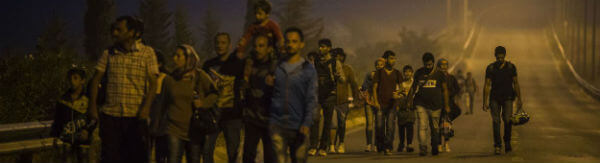
Refugee arrivals in Greece exceed 100,000 in less than two months
The Guardian reports: More than 100,000 refugees and migrants have arrived in Europe so far this year, at triple the rate of arrivals over the first half of 2015.
At least 102,500 have arrived on the Greek islands of Samos, Kos and Lesbos, according to the International Organisation for Migration (IOM). Another 7,500 have reached Italy, and in the first six weeks of the year 411 people are known to have died attempting to make the journey.
In 2015 the threshold of 100,000 arrivals was not reached until the end of June. As spring approaches and the weather improves, the rate of arrivals this year is expected to climb further.
The IOM said 20% of the arrivals were from Afghanistan and nearly half were Syrians. On Monday the US and Russia agreed to organise a partial truce involving the Assad regime and most of the Syrian armed opposition, but not Islamic State or the Nusra Front. There are widespread doubts about how effective the ceasefire will be and how long it will last. [Continue reading…]
Report details ‘inhuman’ treatment in Israeli jail
Al Jazeera reports: Blows to the head and sleeping in insect-infested beds are among numerous examples of “degrading” and “inhuman” treatment of Palestinian detainees by Israeli interrogators, according to a new report from Israeli human rights groups.
The 54-page report from HaMoked and B’Tselem, released on Wednesday, alleges that the treatment of detainees is at times “tantamount to torture”. It documents physical abuse by Israeli interrogators both in the field and at the Shikma detention facility in the southern Israeli city of Ashkelon.
“[One Palestinian] was beaten until he passed out. Another detainee related that police officers photographed themselves next to him as he lay handcuffed on the ground after being beaten for about half an hour,” the report stated, noting that abusive conditions had been “used systematically against Palestinians interrogated at Shikma”.
The findings are based on the testimonies of 116 Palestinians interviewed between August 2013 and March 2014, along with dozens of affidavits and medical records. [Continue reading…]
Netanyahu demands Israeli apartheid posters be removed from London Underground
The Guardian reports: The Israeli prime minister, Binyamin Netanyahu, has asked the UK government to remove hundreds of flyposters on London Underground trains put up by pro-Palestinian activists which claim that his country’s policies amount to apartheid.
The posters, designed to look like genuine adverts, were pasted on tube trains by London Palestine Action as part of this year’s Israeli Apartheid Week. Political leaders in Jerusalem and Jewish organisations in the UK condemned the posters.
Netanyahu asked Israel’s foreign ministry director, Dore Gold, to raise the matter with British government officials while on a trip to London. “I asked him to demand from the British government that the posters be removed,” he told parliamentary colleagues, according to reports in the Israeli media. [Continue reading…]
In political leanings, Catholics mirror average Americans
Since Catholics make up the largest religious denomination in the U.S. (69.5 million members, which is 22% of the population), it makes sense that their political leanings would be close to the average among Americans of all and no religious affiliations.
Still, since in the media there is a tendency to associate religious with right-wing, it’s worth noting that Catholics lean Democratic rather than Republican — 44% vs. 37% — by exactly the same proportions as do all U.S. adults.
Pew Research breaks down the numbers for all religious groups:
Seas are now rising faster than they have in 2,800 years, scientists say
The Washington Post reports: A group of scientists says it has now reconstructed the history of the planet’s sea levels arcing back over some 3,000 years — leading it to conclude that the rate of increase experienced in the 20th century was “extremely likely” to have been faster than during nearly the entire period.
“We can say with 95 percent probability that the 20th-century rise was faster than any of the previous 27 centuries,” said Bob Kopp, a climate scientist at Rutgers University who led the research with nine colleagues from several U.S. and global universities. Kopp said it’s not that seas rose faster before that – they probably didn’t – but merely that the ability to say as much with the same level of confidence declines.
The study was published Monday in the Proceedings of the National Academy of Sciences.
Seas rose about 14 centimeters (5.5 inches) from 1900 to 2000, the new study suggests, for a rate of 1.4 millimeters per year. The current rate, according to NASA, is 3.4 millimeters per year, suggesting that sea level rise is still accelerating.
Unsurprisingly, the study blames the anomalous 20th-century rise on global warming — and not just that. It also calculates that, had humans not been warming the planet, there’s very little chance that seas would have risen so much during the century, finding that instead of a 14 centimeter rise, we would have seen somewhere between a 3 centimeter fall and a 7 centimeter rise. [Continue reading…]
How Denmark turned ugly

Hugh Eakin writes: In country after country across Europe, the Syrian refugee crisis has put intense pressure on the political establishment. In Poland, voters have brought to power a right-wing party whose leader, Jarosław Kaczyński, warns that migrants are bringing “dangerous diseases” and “various types of parasites” to Europe. In France’s regional elections in December, some Socialist candidates withdrew at the last minute to support the conservatives and prevent the far-right National Front from winning. Even Germany, which took in more than a million asylum-seekers in 2015, has been forced to pull back in the face of a growing revolt from Chancellor Angela Merkel’s own party and the recent New Year’s attacks on women in Cologne, allegedly by groups of men of North African origin.
And then there is Denmark. A small, wealthy Scandinavian democracy of 5.6 million people, it is according to most measures one of the most open and egalitarian countries in the world. It has the highest income equality and one of the lowest poverty rates of any Western nation. Known for its nearly carbon-neutral cities, its free health care and university education for all, its bus drivers who are paid like accountants, its robust defense of gay rights and social freedoms, and its vigorous culture of social and political debate, the country has long been envied as a social-democratic success, a place where the state has an improbably durable record of doing good. Danish leaders also have a history of protecting religious minorities: the country was unique in Nazi-occupied Europe in prosecuting anti-Semitism and rescuing almost its entire Jewish population.
When it comes to refugees, however, Denmark has long led the continent in its shift to the right—and in its growing domestic consensus that large-scale Muslim immigration is incompatible with European social democracy. To the visitor, the country’s resistance to immigrants from Africa and the Middle East can seem implacable. In last June’s Danish national election—months before the Syrian refugee crisis hit Europe—the debate centered around whether the incumbent, center-left Social Democrats or their challengers, the center-right Liberal Party, were tougher on asylum-seekers. The main victor was the Danish People’s Party, a populist, openly anti-immigration party, which drew 21 percent of the vote, its best performance ever. Its founder, Pia Kjærsgaard, for years known for suggesting that Muslims “are at a lower stage of civilization,” is now speaker of the Danish parliament. With the backing of the Danish People’s Party, the center-right Liberals formed a minority government that has taken one of the hardest lines on refugees of any European nation. [Continue reading…]
A requiem for the European dream
Olivier Guez writes: Even though radical Islam, mass migrations, Russian revanchism and military interventions are challenges that no European state can meet alone, political sentiments across the Continent are all in the wrong direction. Frightened Europeans retreat into their sovereign little states, propelled by the popular right and xenophobia. In Hungary and Poland, those forces have taken power. By 2017, they may well do so in France, and Britons may have quit Europe altogether. That would leave no nation in a position to take the reins from France or Germany in leading Europe’s imperfect union.
So what comes next? Can we reasonably believe Europe will snap out of it? Will there be a Franco-German turnaround in shamed memory of the slaughter at Verdun 100 years ago? I don’t think so.
It is a matter of leadership. In the 1990s, François Mitterrand and Helmut Kohl, like Adenauer and De Gaulle before them, could work together, in part because they had experienced the ultimate alternative — the horrors of war. But those giants have long left the stage. There exists today neither any guiding program nor true solidarity, and historical memories have grown very short. Ms. Merkel and Mr. Hollande are more than ever focused on their own national conundrums: for France, how to control terrorism; for Germany, how to treat refugees.
What Europe’s heads of state have not done, and simply must begin to do, is prepare their citizens for the one great requirement for progress toward more unity — an enormous leap of faith and optimism, even while in the grip of fear. Instead, they betray their peoples’ fondest dreams by pecking at one another. And even my generation, who were 15 to 20 years old when the Berlin Wall fell, fails to stand up to them and demand that they save the dream we were promised — a Europe finally at permanent peace and working in unison after all the divisions and horrors of the 20th century. [Continue reading…]
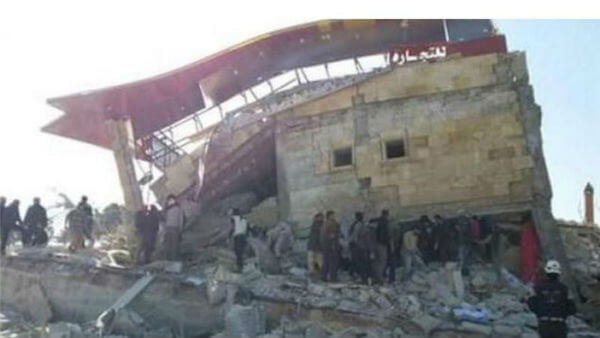
UN finds ‘deliberate’ destruction of hospitals in Syria

The New York Times reports: First, the government soldiers made sure no food could get into rebel-held towns. Then, government planes bombed what health centers remained in those towns, making sure that those who got sick from hunger had no medical care to save them.
That is the harrowing picture painted by the latest report of the United Nations Commission of Inquiry on the war in Syria. The report, released Monday, chronicles a series of attacks on health care centers by government forces and the Islamic State, and it says the “deliberate destruction of health care infrastructure” was responsible for driving up deaths and permanent disabilities.
To follow the commission’s work in Syria — it has written 11 reports since August 2011 — is to witness how blatantly the laws of war have been broken, with no prospects of accountability.
The commission flatly asserts in the latest report that “war crimes are rampant” by government forces and their armed rivals, and for the first time it sharply points to the very countries that are bargaining over a peace deal for fueling the violence. [Continue reading…]
Russia wants closer look from above the U.S.
The New York Times reports: Russia asked on Monday to fly surveillance planes equipped with high-powered digital cameras over the United States, fueling a long-simmering debate among Pentagon and intelligence officials over Russia’s intentions to use such flights to spy on American power plants, communications networks and other critical infrastructure.
Russia has for years conducted unarmed observation flights over the United States — as the United States does over Russia — as part of the Open Skies Treaty that was signed in 1992 by both nations and 32 other countries at the end of the Cold War, and entered into force a decade later. Although the treaty and the flights, unfamiliar to most Americans, amount to officially sanctioned spying, their goal has been to foster transparency about military activity and to reduce the risk of war and miscalculation, especially in Europe.
Now some senior American intelligence and military officials say the new digital technology combined with shifting Russian flight plans would violate the spirit of the treaty. Some Republicans also expressed alarm. [Continue reading…]
Alfred McCoy: Washington’s twenty-first-century opium wars
In October 2001, the U.S. launched its invasion of Afghanistan largely through proxy Afghan fighters with the help of Special Operations forces, American air power, and CIA dollars. The results were swift and stunning. The Taliban was whipped, a new government headed by Hamid Karzai soon installed in Kabul, and the country declared “liberated.”
More than 14 years later, how’d it go? What’s “liberated” Afghanistan like and, if you were making a list, what would be the accomplishments of Washington all these years later? Hmm… at this very moment, according to the latest reports, the Taliban control more territory than at any moment since December 2001. Meanwhile, the Afghan security forces that the U.S. built up and funded to the tune of more than $65 billion are experiencing “unsustainable” casualties, their ranks evidently filled with “ghost” soldiers and policemen — up to 40% in some places — whose salaries, often paid by the U.S., are being pocketed by their commanders and other officials. In 2015, according to the U.N., Afghan civilian casualties were, for the seventh year in a row, at record levels. Add to all this the fact that American soldiers, their “combat mission” officially concluded in 2014, are now being sent by the hundreds back into the fray (along with the U.S. Air Force) to support hard-pressed Afghan troops in a situation which seems to be fast “deteriorating.”
Oh, and economically speaking, how did the “reconstruction” of the country work out, given that Washington pumped more money (in real dollars) into Afghanistan in these years than it did into the rebuilding of Western Europe after World War II? Leaving aside the pit of official corruption into which many of those dollars disappeared, the country is today hemorrhaging desperate young people who can’t find jobs or make a living and now constitute what may be the second largest contingent of refugees heading for Europe.
As for that list of Washington’s accomplishments, it might be accurate to say that only one thing was “liberated” in Afghanistan over the last 14-plus years and that was, as TomDispatch regular Alfred McCoy points out today, the opium poppy. It might also be said that, with the opium trade now fully embedded in both the operations of the Afghan government and of the Taliban, Washington’s single and singular accomplishment in all its years there has been to oversee the country’s transformation into the planet’s number one narco-state. McCoy, who began his career in the Vietnam War era by writing The Politics of Heroin, a now-classic book on the CIA and the heroin trade (that the Agency tried to suppress) and who has written on the subject of drugs and Afghanistan before for this site, now offers a truly monumental look at opium and the U.S. from the moment this country’s first Afghan War began in 1979 to late last night. Tom Engelhardt
How a pink flower defeated the world’s sole superpower
America’s opium war in Afghanistan
By Alfred W. McCoyAfter fighting the longest war in its history, the United States stands at the brink of defeat in Afghanistan. How can this be possible? How could the world’s sole superpower have battled continuously for 15 years, deploying 100,000 of its finest troops, sacrificing the lives of 2,200 of those soldiers, spending more than a trillion dollars on its military operations, lavishing a record hundred billion more on “nation-building” and “reconstruction,” helping raise, fund, equip, and train an army of 350,000 Afghan allies, and still not be able to pacify one of the world’s most impoverished nations? So dismal is the prospect for stability in Afghanistan in 2016 that the Obama White House has recently cancelled a planned further withdrawal of its forces and will leave an estimated 10,000 troops in the country indefinitely.
Were you to cut through the Gordian knot of complexity that is the Afghan War, you would find that in the American failure there lies the greatest policy paradox of the century: Washington’s massive military juggernaut has been stopped dead in its steel tracks by a pink flower, the opium poppy.
Sheldon Adelson is hedging his bets in this presidential race
Politico reports: Few of the Adelsons’ associates wanted to be quoted talking about the famously temperamental self-made billionaire, who is known for valuing loyalty and holding grudges. But, with Tuesday’s GOP presidential caucuses in his backyard looming, several expressed concern that Adelson’s hesitance could have long-lasting consequences. Time is running short, they say, for major donors to fund an assault to try to slow the momentum of GOP front-runner Donald Trump.
While Adelson, whose political involvement is largely animated by his support for Israel’s defense, is thought to distrust Trump on the issue, an Adelson adviser suggested his boss had no plans to spend big on behalf of — or against — any candidate in the tumultuous GOP primary.
“I don’t see any involvement until there is a nominee,” the adviser told POLITICO.
If Adelson sticks with that plan — a big “if” given his reputation for writing massive checks with little warning — it could remove a major source of anti-Trump cash and also could hamper Republicans’ general election chances up and down the ballot.
The prospect is a serious source of concern for other Republican megadonors and operatives, who have offered a range of explanations for Adelson’s sudden tightening of his purse strings.
“Nobody knows exactly why he’s still on the sidelines or when he might come off,” said one operative with ties to Adelson, “but the party needs him to get in the game before it’s too late.” [Continue reading…]
In the past, Adelson’s concern has been to back the candidate who he thinks would best serve his interests. His greater interest right now might not be to support the stop-Trump campaign but instead to avoid making Trump his enemy. Both Trump and Adelson operate in a world where loyalty gets rewarded and enemies get punished.
The curious case of San Francisco’s Tech bro v. Homelessness
Holly Wood writes: I am writing today to voice my concern and outrage over the increasing tech bro problem, conspicuously concentrated in the city of San Francisco. The curious case of Tech bro v. Homelessness has been presented before me for comment.
Many of you have petitioned the Council for Human Decency your concerns regarding the callousness of one startup entrepreneur, Justin Keller. As penance for sins I must no doubt have committed in a past life, I found this case dumped on my desk alongside the even more absurd case of Marc Andreessen v. Indian Emancipation and the morally bankrupt case of Yelp v. Talia Jane. Yes indeed, this week has been a low watermark for Human Decency in San Francisco. But I digress.
In publishing his open letter to Mayor Ed Lee and Police Chief Greg Suhr on Feb. 15, Keller is guilty of betraying an incredible sense of bourgeois entitlement, reckless irony, and sloppy philosophy. “I shouldn’t have to see the pain, struggle, and despair of homeless people to and from my way to work every day,” he writes. But I urge, nevertheless, that we stay the blade.
You are not wrong to imagine Keller’s morality long rusted, encrusted in the residue of so long having volunteered himself a willing cog in a fetishized industry. But here at the Council, we husband our resources strategically. It bears recognition that Keller is merely a foot soldier on the tech front of the class war, a prole with aspirations so banal, history has already forgotten him. As a startup founder, statistics and conventional wisdom would suggest Keller will burn out — if not this year, then the next. Your anger is my anger is our anger, but from our vantage, Keller is but Silicon Valley cannon fodder.
Still, the irony of the incident warrants reflection. Perhaps the greatest tragedy of Tech bro v. Homelessness is that Keller sincerely believes himself entitled to comfort and security from the city—not because he believes these protections should be guaranteed to everyone as rights, but because of all the money he hopes to earn as a tech startup founder. “The wealthy working people have earned their right to live in the city,” he declares, despite the fact that he is unlikely to have yet earned anything at all. [Continue reading…]
Britain lobbied UN to whitewash Bahrain police abuses
The Observer reports: neutering United Nations criticism of Bahrain for its human rights record, including the alleged use of torture by its security forces.
Documents shared with the Observer reveal that the UN’s criticism of the Gulf state was substantially watered down after lobbying by the UK and Saudi Arabia, a major purchaser of British-made weapons and military hardware.
The result was a victory for Bahrain and for Saudi Arabia, which sent its troops to quell dissent in the tiny kingdom during the Arab spring.
But the UK’s role has prompted concern among human rights groups. According to the international human rights organisation, Reprieve, two political prisoners in Bahrain are facing imminent execution and several more are on trial, largely due to confessions obtained through torture. [Continue reading…]
The NSA’s SKYNET program may be killing thousands of innocent people
Ars Technica reports: In 2014, the former director of both the CIA and NSA proclaimed that “we kill people based on metadata.” Now, a new examination of previously published Snowden documents suggests that many of those people may have been innocent.
Last year, The Intercept published documents detailing the NSA’s SKYNET programme. According to the documents, SKYNET engages in mass surveillance of Pakistan’s mobile phone network, and then uses a machine learning algorithm on the cellular network metadata of 55 million people to try and rate each person’s likelihood of being a terrorist.
Patrick Ball — a data scientist and the director of research at the Human Rights Data Analysis Group — who has previously given expert testimony before war crimes tribunals, described the NSA’s methods as “ridiculously optimistic” and “completely bullshit.” A flaw in how the NSA trains SKYNET’s machine learning algorithm to analyse cellular metadata, Ball told Ars, makes the results scientifically unsound. [Continue reading…]
My friend, the former Muslim extremist
Nicholas Kristof writes: Whenever a Muslim carries out a terror attack in the West, the question arises: Why do they hate us?
Provocative answers come from my friend Rafiullah Kakar, who has lived a more astonishing life than almost anyone I know. Rafi is a young Pakistani who used to hate the United States and support the Taliban. His brother joined the Taliban for a time, but now I worry that the Taliban might try to kill Rafi — ah, but I’m getting ahead of myself.
One of 13 children, Rafi is a Pashtun who grew up in a mud home close to the Afghan border, in an area notorious for tribal feuds and violent clashes. His parents are illiterate farmers, and it looked as if Rafi’s education would end in the fifth grade, when he was sent to a madrasa. His mom wanted him to become a hafiz, someone who has memorized the entire Quran.
“One reason people send kids to madrasa is that a hafiz can get to paradise and take 10 other people along,” Rafi notes, explaining a local belief about getting to heaven. “My mother wanted me to be a hafiz, so I could be her ticket to paradise.” [Continue reading…]
Trump’s remarks on pigs’ blood elicit challenge from sister of Chapel Hill victim
The New York Times reports: Suzanne Barakat, the sister of a Muslim student killed alongside his wife and sister-in-law last year in an attack in North Carolina, challenged Donald J. Trump to meet with her after a speech in which he spoke approvingly of killing Islamic terrorists with bullets dipped in the blood of pigs.
Ms. Barakat, 28, said the comments and other anti-Muslim rhetoric from Mr. Trump, including a proposal to ban Muslims from entering the country, have contributed to an atmosphere of intolerance that she fears could have deadly consequences.
“It allows for the Average Joe to see Muslims the way Craig Hicks saw my brother and his wife of six weeks and her sister,” she said, referring to the man who killed her relatives last February. “As ‘The Other,’ as subhuman, because of their faith.” [Continue reading…]
Ex-NSA chief opposes government effort to require ‘back doors’ in all devices
USA Today reports: Retired four-star general Michael Hayden, who as director of the NSA installed and still defends the controversial surveillance program to collect telephone metadata on millions of Americans, says he opposes proposals to force Apple and other tech companies to install “back doors” in digital devices to help law enforcement.
In an emerging court battle over access to information on the iPhone owned by one of the San Bernardino attackers, Hayden says “the burden of proof is on Apple” to show that limited cooperation with investigators would open the door to broader privacy invasions. Apple is being asked not to decrypt information on the smartphone but rather to override the operating system so investigators could try an endless series of passwords to unlock it.
“In this specific case, I’m trending toward the government, but I’ve got to tell you in general I oppose the government’s effort, personified by FBI Director Jim Comey,” Hayden told Capital Download in an interview about his memoir, Playing to the Edge: American Intelligence in the Age of Terror. “Jim would like a back door available to American law enforcement in all devices globally. And, frankly, I think on balance that actually harms American safety and security, even though it might make Jim’s job a bit easier in some specific circumstances.”[Continue reading…]