Category Archives: Issues

How Saudi Arabia’s grip on oil prices could bring Russia to its knees

By James Henderson, University of Oxford

When Saudi Arabia led an OPEC decision to end a restraint put on oil production in November 2014, it marked the beginning of a new era in oil economics. It has given us a tumbling oil price, prompted huge losses and job cuts at oil firms like BP and might yet give us economic and political drama in the heart of Moscow. To understand why, it’s worth drilling down to the start of the whole process, and the costs of getting oil out of the ground in the first place.

Historically, the OPEC cartel of oil-producing nations has been able to manage oil prices because of the lack of flexibility in global supply. The whole business of setting up wells, operating pipelines and building rigs entails large and long-term investments which makes producers slow to respond to price movements. And a small cut in OPEC supply can have a significant impact on the global oil price.

The advent of the US shale oil boom changed this dynamic. The industry has lower fixed costs but higher variable costs and is more like an industrial process than a major one-off investment. That makes it more responsive to price movements and more flexible in adjusting short-term output.

Overall though, shale is a relatively high cost source of oil, especially compared to Middle East production. As a result, when US shale threatened OPEC’s market share, the cartel allowed a position of global oversupply to develop. It was a simple trick: make oil prices fall to make shale unprofitable.


Continue reading

Facebooktwittermail

Iran still ranks as one of the most repressive states in the world

In an editorial, The Guardian says: The government was probably looking for a public relations bonus in the west when it recently released a number of journalists, but the statistics tell another story: in 2015 Iran executed at least 830 people, including juveniles, many for non-violent crimes. The security services continue to harass and detain activists, writers and journalists. The methods used by the regime to crush the pro-democracy Green movement in 2009 are still very much in use today.

Nor has Iran become in any way more “moderate” in its behaviour in the Middle East. In Syria, Iran’s militias and Republican Guards are direct participants in the war crimes that the Assad regime inflicts on its own population. Iran’s close ally Hezbollah played a key role in the siege of Madaya, where children died of hunger as a result, and it is part of similar operations elsewhere.

It is to be hoped that a sustained implementation of the nuclear agreement will improve international security. But to draw from that the notion that Iran must now be spared any reproach would be foolish. Iran’s hardliners sought economic relief through the nuclear deal because they desperately want to keep their hold on power, not because they want to pursue a more democratic path at home or more rational policies abroad. Diplomacy is important, but it must not come at the expense of clearsightedness, nor should it be accompanied by the kind of simplistic analysis that puts the sole onus on Saudi Arabia rather than on Iran as far as human rights are concerned. The records of both countries are equally dismal. [Continue reading…]

Facebooktwittermail

Syrian refugee children subjected to forced labor and early marriage in Lebanon

Nick Grono writes: I met six-year-old Mustafa in the safe zone of one of the many tented settlements for Syrian refugees in Lebanon’s Bekaa valley. These areas offer schooling, including art and music classes, for Syrian children. They provide a respite from the brutal realities of life as a refugee, which can involve back-breaking labour for children as young as six, and marriage for girls at the age of 13.

Mustafa told us that, after leaving class at midday, he would spend the afternoon carting bricks to earn a pittance for his family. One of his classmates, a seven-year-old girl, said she picks potatoes every afternoon – tough, physical work that involves constant bending while carrying a heavy load.

Officially, Lebanon is home to almost 1.2 million refugees, but unofficial estimates put it at more than 1.5 million. Given that its prewar population was just over 4 million, this is an overwhelming burden, one with which any government would struggle to cope.

Syrian refugees in Lebanon are highly vulnerable to exploitation. Most have little or no money, yet they have to pay landlords for the patches of land on which they erect their tents, and to supplement the meagre aid handouts they may be fortunate enough to receive. But the Lebanese government – keen to stop Syrians settling permanently in Lebanon – is preventing refugees from working or even residing legally in the country. It is refusing to issue work permits except in exceptional circumstances. And it is now very difficult for Syrians to obtain residency permits – a key obstacle being a $200 (£140) annual fee per adult refugee – meaning most are breaking the law simply by staying in the country (pdf).

This creates conditions ripe for abusive employers to exploit vulnerable refugees. Because they don’t have the necessary papers, refugees live in fear of coming into contact with the authorities, particularly at the many checkpoints throughout the country. As children are less likely to be stopped at checkpoints, they are forced to work in the fields or in nearby towns. Unscrupulous employers prefer them because they are more compliant, and more unwilling to complain about physical abuse. For this laborious and often hazardous work, they are paid a few dollars at most, a portion of which is often retained by the Syrian settlement leader. [Continue reading…]

Facebooktwittermail

Saudi Arabia: Palestinian poet sentenced to eight years in prison and 800 lashes for apostasy

The Guardian reports: A Saudi court has overturned the death sentence on a Palestinian poet accused of renouncing Islam, instead imposing an eight year prison term and 800 lashes.

The decision by a panel of judges came after Ashraf Fayadh’s lawyer argued that his conviction of apostasy was seriously flawed as he was denied a fair trial. In a briefing on the verdict, Fayadh’s lawyer said the new judgement revoked the death sentence but upheld that the poet was guilty of apostasy.

A memo written by the lawyer, posted by Abdulrahman al-Lahem on Twitter, describes the details of Fayadh’s new punishment. He is sentenced to eight years in prison and 800 lashes, with 50 lashes carried out on 16 occasions, and must also publicly renounce his poetry on Saudi state media.

Al-Lahem welcomed the overturning of the death sentence but reaffirmed Fayadh’s innocence and announced they would launch an appeal and ask for bail.

Adam Coogle, Middle East researcher at Human Rights Watch, said: “Instead of beheading Ashraf Fayadh, a Saudi court has ordered a lengthy imprisonment and flogging. No one should face arrest for peacefully expressing opinions, much less corporal punishment and prison. Saudi justice officials must urgently intervene to vacate this unjust sentence.” [Continue reading…]

Facebooktwittermail

How the Telegram messaging app is changing Iranian media

Saeid Jafari reports: “A grandson of the late founder of the Islamic Republic of Iran has been disqualified from running for the Assembly of Experts”; “The Joint Comprehensive Plan of Action has reached a deadlock”; “The bodybuilding champion of Iran and the world has been killed in a street fight”; and “Following in the footsteps of Djibouti and Sudan, Tunisia has also severed its ties with Iran.”

These are some of the stories that have been widely circulated among Iranians in recent weeks — but they weren’t reported by any of the licensed Iranian media outlets. Thanks to the power of social media, where ordinary Iranians can produce and broadcast their own news, many of these stories find their way into people’s homes. The same, unfortunately, also goes for mere rumors.

First it was Facebook, and then the smartphone messaging apps Viber and Line. Now, however, the hottest communication tool among Iranians is Telegram. It has more advanced features than its predecessors, and enjoys a high level of influence in Iranian society. Information and Communications Technology Minister Mahmoud Vaezi said there are roughly 13 million to 14 million Telegram users in Iran. More recent surveys, however, put this figure at over 20 million. The simplicity and ease associated with using Telegram has prompted users to see themselves as a rival of licensed media outlets. In fact, many governmental organizations are now using Telegram to create a bridge to communicate with their audiences. [Continue reading…]

Facebooktwittermail

Mali’s irrepressible musical spirit resounds after jihadi-imposed silence

The Guardian reports: n the courtyard of a colonial villa in Bamako, four young men crouch around a tiny camping stove. The Malian tradition of simmering tea for hours is as old as the ancient trade routes crossing the Sahara desert. There is even a saying behind the practice, says Aliou Touré, a singer in the Mali band Songhoy Blues.

“Here in Mali we say that the first cup is bitter like life, the second is sweet like love and the third is soft like the breath of a dying man,” he says.

Songhoy Blues are one of the latest musical acts to emerge from the west African country that has produced artists such as Salif Keita and Toumani Diabaté – both multiple Grammy winners – Tinariwen, Ali Farka Touré, Bassekou Kouyaté, and Rokia Traoré.

The band is one of a dozen acts at this week’s Bamako acoustic festival, the first major music festival in the capital since 2012, when Islamist extremists seized northern Mali and imposed their hardline interpretation of sharia law that, among other things, banned music. [Continue reading…]

Facebooktwittermail

The staggering economic cost of air pollution

The Washington Post reports: Air pollution caused by energy production in the U.S. caused at least $131 billion in damages in the year 2011 alone, a new analysis concludes — but while the number sounds grim, it’s also a sign of improvement. In 2002, the damages totaled as high as $175 billion, and the decline in the past decade highlights the success of more stringent emissions regulations on the energy sector while also pointing out the need to continue cracking down.

“The bulk of the cost of emissions is the result of health impacts — so morbidity and particularly mortality,” said the paper’s lead author, Paulina Jaramillo, an assistant professor of engineering and public policy at Carnegie Mellon University. Using models, researchers can place a monetary value on the health effects caused by air pollution and come up with a “social cost” of the offending emissions — in other words, the monetary damages associated with emitting an additional ton (or other unit) of a given type of pollutant. This social cost can then be used to calculate the total monetary damages produced by a certain amount of emissions in a given time period.

The new analysis, just published in the journal Energy Policy, did just that. Using an up-to-date model and a set of data acquired from the Environmental Protection Agency on emissions from the energy sector, the researchers set about estimating the monetary damages caused by air pollution from energy production between 2002 and 2011. [Continue reading…]

Facebooktwittermail

How China’s downturn threatens one of the world’s greatest success stories

poverty

The Washington Post reports: Over the last 25 years, a period of remarkable economic growth spanning from China to South America spurred one of the world’s greatest — and oft-overlooked — modern achievements: a dramatic reduction in the number of extreme poor. More than one billion were pulled out of the most destitute conditions, and the pace of improvement inspired such optimism that two years ago the United Nations vowed to eliminate extreme poverty entirely by 2030.

But now, China’s downturn — and the related prospect of weaker growth across the world — is threatening to stall that progress, signaling a new era of dimmer prospects for the poorest of the poor. That is just one of the emerging challenges from a slowdown that has crippled some nations’ currencies and wiped hundreds of billions from stock markets globally.

Economists caution that the rise or fall of poverty in the coming years depends on a number of hard-to-predict factors, including technology, disease, corruption, war, and climate change. But they also say with growing confidence that the job of fighting poverty is getting harder, particularly in Africa, a continent that is home to half the world’s extreme poor and depends disproportionately on Chinese demand for raw materials. [Continue reading…]

Facebooktwittermail

Trump is starting to spend money like a real candidate

Vanity Fair reports: as he funnels more of his own money into the campaign [$10.8 million in the last quarter], combined with his first attempts at running T.V. ads, it appears that Trump has begun shifting into a more focused, serious phase of his campaign.

If he wins the Republican nomination, however, Trump can expect an even steeper uphill climb to rival the finances of either Hillary Clinton or Bernie Sanders. According to Sunday’s F.E.C. disclosures, Clinton raised $33.1 million in the fourth quarter and spent $33 during that time period, though only $5.7 million came from small donors. Sanders raised $33 million in the last quarter as well — nearly all from small donors — and put up an impressive $20 million in January alone. [Continue reading…]

Facebooktwittermail

Fear and paranoia lead Finns to form vigilante groups that ‘protect women’ from asylum seekers

The Washington Post reports: On a frigid night in this industrial city, three local men pulled up to a curb in a beat-up van sporting the stars and bars of the American Confederacy (because, they said, they just liked the look of it). Soon, they joined a dozen other beefy vigilantes gathering on a sidewalk for their first patrol to keep “our women” safe.

These are the Soldiers of Odin, a new far-right citizens group sprouting chapters across Finland. Its members are multiplying as this northern nation becomes a case study in the fear and suspicion gripping Europe after multiple sexual assaults allegedly committed by asylum seekers and others on New Year’s Eve.

Those incidents, in cities across central and northern Europe, included hundreds of complaints of sexual harassment in Cologne, Germany, as well as 15 alleged sex-related crimes in the Finnish capital, Helsinki. They have quickly altered the debate over a record wave of asylum seekers arriving in Europe from the Middle East, Africa and Asia. Fresh barriers to new migrants are going up from Sweden to Greece. [Continue reading…]

Facebooktwittermail

Britain is distracted while Europe faces an existential crisis

By Clara Sandelind, University of Huddersfield

Europe is undergoing an existential crisis. Whatever the eurozone hasn’t already managed to break is well on the way to being destroyed by the refugee crisis.

The Schengen agreement of open borders has more or less vanished, at least for now. The Dublin regulation, aimed at supporting asylum seekers, is hardly being upheld. The burden-sharing schemes that were agreed last year to distribute refugees more evenly over Europe are failing to come to fruition.

Donald Tusk, president of the European Council, warned earlier this year that the EU has two months to get the refugee crisis under control, or the whole EU project will be in question.

Continue reading

Facebooktwittermail

Ban Ki-moon to Israel: Don’t shoot the messenger

Secretary general of the United Nations, Ban Ki-moon, writes: In Israel and the occupied Palestinian territories, 2016 has begun much as 2015 ended — with unacceptable levels of violence and a polarized public discourse. That polarization showed itself in the halls of the United Nations last week when I pointed out a simple truth: History proves that people will always resist occupation.

Some sought to shoot the messenger — twisting my words into a misguided justification for violence. The stabbings, vehicle rammings and other attacks by Palestinians targeting Israeli civilians are reprehensible. So, too, are the incitement of violence and the glorification of killers.

Nothing excuses terrorism. I condemn it categorically.

It is inconceivable, though, that security measures alone will stop the violence. As I warned the Security Council last week, Palestinian frustration and grievances are growing under the weight of nearly a half-century of occupation. Ignoring this won’t make it disappear. No one can deny that the everyday reality of occupation provokes anger and despair, which are major drivers of violence and extremism and undermine any hope of a negotiated two-state solution. [Continue reading…]

Facebooktwittermail

Battered by war, Iraq now faces calamity from dropping oil prices

The New York Times reports: Iraqis seeking to withdraw money from banks are told there is not enough cash. Hospitals in Baghdad are falling back to the deprivation of the 1990s sanctions era, resterilizing, over and over, needles and other medical products meant for one-time use.

In the autonomous Kurdish region in the north, the economic crisis is even worse: government workers — and the pesh merga fighters who are battling the Islamic State — have not been paid in months. Already, there have been strikes and protests that have turned violent.

These scenes present a portrait of a country in the midst of an expensive war against the Islamic State that is now facing economic calamity brought on by the collapse in the price of oil, which accounts for more than 90 percent of the Iraqi government’s revenue.

Analysts and officials, though, say much tougher economic times are ahead, even as they insist the war will be largely unaffected because of help from foreign powers determined to defeat the Islamic State. The United States, for instance, recently extended new loans to Iraq to buy weapons, and other countries are stepping up with donations of arms and ammunition. [Continue reading…]

Facebooktwittermail

In Sisi’s Egypt there is close to zero tolerance for dissent

The New York Times reports: A popular Egyptian cartoonist was arrested Sunday on charges of running a website without a license, the Interior Ministry said, in the latest escalation of a campaign to silence the government’s online critics.

The cartoonist, Islam Gawish, 26, who has 1.6 million Facebook followers, was arrested during a police raid on the offices of a news website based in Cairo. Although his satirical cartoons have been published online, Mr. Gawish was not seen as an especially vehement critic of President Abdel Fattah el-Sisi.

It was the most prominent arrest since the Jan. 25 anniversary of the 2011 uprising that ultimately toppled President Hosni Mubarak, which had been preceded by a wave of arrests and closures that focused on democracy activists and well-known cultural spaces in downtown Cairo.

Although Mr. Sisi’s government has silenced many critical voices in Egypt’s major news media, either by arresting journalists or forcing them into exile, it has struggled to contain free speech on the Internet, which is one of the few forums for open dissent at a time when public protest has been all but outlawed.

Facebook and other social media sites, which played a role in organizing the 2011 uprising, are popular with millions of Egyptians, but a few high-profile prosecutions have sent a warning to users about the limits of tolerance for political discussion.

In October a military court handed down a three-year jail sentence to Amr Nohan, a 22-year-old law graduate who had posted to his Facebook page an image that depicted Mr. Sisi with Mickey Mouse-style cartoon ears.

In recent weeks, the authorities arrested five people who are accused of administering hundreds of Facebook pages that were sympathetic to the banned Muslim Brotherhood and that had sought to encourage public protest on Jan. 25.

The circumstances of Mr. Gawish’s arrest, which follows the recent closing of the Townhouse Gallery arts space in central Cairo and a raid on the offices of a book publisher, seemed to signal that the government is seeking new ways to silence even moderate forms of dissent. [Continue reading…]

Facebooktwittermail

Warnings about risks posed by encryption have been wildly overblown by intelligence agencies, says report

encryption

The New York Times reports: For more than two years the F.B.I. and intelligence agencies have warned that encrypted communications are creating a “going dark” crisis that will keep them from tracking terrorists and kidnappers.

Now, a study in which current and former intelligence officials participated concludes that the warning is wildly overblown, and that a raft of new technologies — like television sets with microphones and web-connected cars — are creating ample opportunities for the government to track suspects, many of them worrying.

“ ‘Going dark’ does not aptly describe the long-term landscape for government surveillance,” concludes the study, to be published Monday by the Berkman Center for Internet and Society at Harvard.

The study argues that the phrase ignores the flood of new technologies “being packed with sensors and wireless connectivity” that are expected to become the subject of court orders and subpoenas, and are already the target of the National Security Agency as it places “implants” into networks around the world to monitor communications abroad. [Continue reading…]

Facebooktwittermail

A private company has captured 2.2 billion photos of license plates in cities across the U.S.

Conor Friedersdorf writes: Throughout the United States — outside private houses, apartment complexes, shopping centers, and businesses with large employee parking lots — a private corporation, Vigilant Solutions, is taking photos of cars and trucks with its vast network of unobtrusive cameras. It retains location data on each of those pictures, and sells it.

It’s happening right now in nearly every major American city.

The company has taken roughly 2.2 billion license-plate photos to date. Each month, it captures and permanently stores about 80 million additional geotagged images. They may well have photographed your license plate. As a result, your whereabouts at given moments in the past are permanently stored. Vigilant Solutions profits by selling access to this data (and tries to safeguard it against hackers). Your diminished privacy is their product. And the police are their customers.

The company counts 3,000 law-enforcement agencies among its clients. Thirty thousand police officers have access to its database. Do your local cops participate?

If you’re not sure, that’s typical.

To install a GPS tracking device on your car, your local police department must present a judge with a rationale that meets a Fourth Amendment test and obtain a warrant. But if it wants to query a database to see years of data on where your car was photographed at specific times, it doesn’t need a warrant — just a willingness to send some of your tax dollars to Vigilant Solutions, which insists that license plate readers are “unlike GPS devices, RFID, or other technologies that may be used to track.” Its website states that “LPR is not ubiquitous, and only captures point in time information. And the point in time information is on a vehicle, not an individual.” [Continue reading…]

Facebooktwittermail

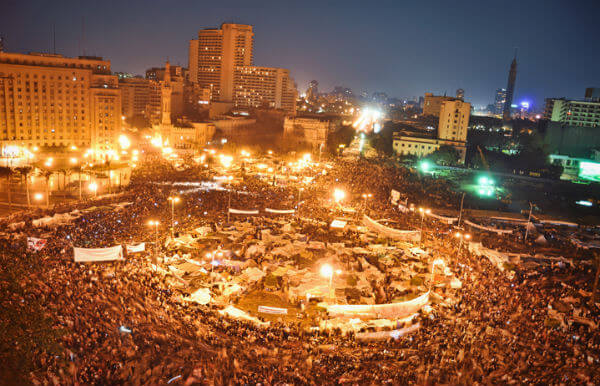
The failure of Egypt’s democratic transition was not inevitable

Tahrir_Square

Michael Wahid Hanna writes: The fifth anniversary of the 2011 Egyptian uprising has produced an oddly structuralist set of reflections in which the failure of its democratic transition has taken on an almost foreordained quality. Influential political science interpretations of the Egyptian uprising’s failure have focused analytical attention on structural factors, such as the role of a politicized and overreaching military, the uneven balance of power between the Muslim Brotherhood and its non-Islamist competitors, the former regime’s political structure and the weakness of transitional institutions.

Structure matters, of course. But so does agency. Overly structural interpretations miss the decisive impact of highly contingent events, deflects responsibility from the political actors whose choices drove the transition off course and can lead to unwarranted skepticism about the possibility of meaningful political change.

Egypt’s transition to a legitimate, civilian-led political order after the popular mobilization of January 2011 always faced long odds, but the failure of the transition was never inevitable. Structural explanations of the July 2013 military coup gloss over the fear and uncertainty that shaped political decision-making over the previous two years. The political openings of 2011 were real and potentially transformative and could have provided a platform for slow but sustainable change. Structural analysis should not become an excuse for political malpractice or an analytical surrender to the necessity of autocracy. Different decisions by key political actors such as the military, the Muslim Brotherhood and the National Salvation Front could have shaped a very different political environment. [Continue reading…]

Facebooktwittermail

Masked men in Stockholm threaten to ‘punish’ refugee children

The Guardian reports: A gang of masked men have been detained in Stockholm after distributing leaflets threatening to punish “north African street children roaming” the Swedish capital.

Police said one man had been charged with assaulting a police officer and the others had been charged with wearing a mask in public, which is illegal in Sweden, and for causing a public disturbance.

A police spokesman told local media the men detained were believed to have gathered “with the purpose of attacking refugee children”.

According to the Swedish newspaper Aftonbladet, up to 100 masked men marched into central Stockholm on Friday to hand out leaflets carrying the message “It’s enough now” and threatening to give the “north African street children who are roaming around” the “punishment they deserve”.

This week an employee at a refugee centre for unaccompanied youths in Mölndal, near Gothenburg, was fatally stabbed, allegedly by a young man living at the centre.

The killing of Alexandra Mezher, 22, has led to questions about overcrowded conditions in some refugee centres, with too few adults and employees to take care of children, many of whom are traumatised by war. [Continue reading…]

Facebooktwittermail