Category Archives: Issues

To avoid a 2016 crash, the major powers need to pull in the same direction

By Anton Muscatelli, University of Glasgow

It looks already as if 2016 will be a pivotal year for the world economy. RBS has advised investors to “sell everything except for high-quality bonds” as turmoil has returned to stock markets. The Dow Jones and S&P indices have fallen by more than 6% since the start of the year, which is the worst ever yearly start. There is a similar story in other major markets, with the FTSE leading companies losing some £72bn of value in the same period.

These declines have come on the back of a major shock to the Chinese stock market. China’s stock exchange is very different from that of other major economies, as Chinese companies don’t rely on it to fund themselves to the same extent, using debt instead. All the same, the repeated suspensions of trading as the Chinese circuit-breakers came into operation (as they do when share prices fall too sharply) spooked investors around the world.

On top of that we are seeing commodity prices continuing to retreat. Oil prices have dropped towards $30 per barrel and don’t look likely to increase soon, with Iranian and Saudi oil production continuing to sustain supply. We are seeing many emerging economies dependent on petroleum revenues suffering (Brazil, Russia), and there is speculation that many oil producers (and perhaps even Saudi Arabia) are having to abandon their currencies’ link with the US dollar.

Continue reading

Facebooktwittermail

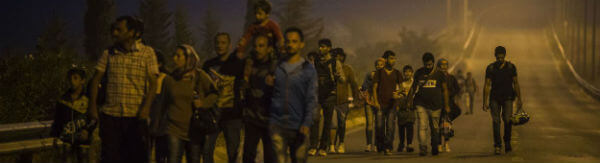
U.S. accepted 2,500 Syrian refugees over four years while Canada took in more in just two months

refugees1

The New York Times reports: Among the Obamas’ guests at the State of the Union address on Tuesday was Refaai Hamo, a middle-aged widower with sunken eyes, a side-swept mop of silver hair and a harrowing account of losing his wife and his daughter in an air raid over his home in Syria.

His presence in the gallery was meant to send a signal to the world that the United States — or at least this administration, in its last year in the White House — believes that people like Mr. Hamo deserve a chance to restart their lives in this country.

“The world respects us not just for our arsenal,” President Obama said in his address. “It respects us for our diversity and our openness.”

The gesture raised an obvious question: Has the United States lived up to its idea of itself as a haven for those fleeing war and persecution?

The numbers offer a partial answer, and they reflect the acute dilemmas that confront countries worldwide amid a historic global crisis.

The United Nations says that an estimated 20 million people around the world, half of them children, have fled their home countries because of conflict or persecution. The war in Syria is now the single largest source of new refugees, casting about 4.4 million Syrians out of their country since the conflict began nearly five years ago.

But unlike in 1951 — when the international refugee convention was forged in the aftermath of World War II, requiring countries to offer protection to those scattered by war and persecution — the political calculus for world leaders has sharply shifted. The costs of taking in refugees have grown and the payoffs, many feel, have diminished.

First, the numbers.

The United States has taken in around 2,500 Syrian refugees since 2012, shortly after the war began.

Canada took in more than that in the last two months of 2015 alone.

Brazil has offered what it calls “humanitarian visas” to three times as many Syrian refugees as the United States has accepted — 7,380 at last count by the United Nations refugee agency.

Switzerland has issued 4,700 special-category visas for Syrians who have family in the country. And Australia, which has come under international criticism for turning away boats of potential refugees from South and Southeast Asia, has said it will take 12,000 from Syria and Iraq.

Germany is in a category of its own, with Syrians making up the largest single group (428,500) of the 1.1 million people who were registered as refugees and asylum seekers there in 2015. [Continue reading…]

Facebooktwittermail

How Trump appeals to Americans who see themselves as victims

Kaddie Abdul wore her hijab at a Trump rally in Reno, Nevada, and writes: I attended Sunday’s rally with the intention to educate myself and, hopefully, to educate others. I didn’t go to shout at Trump’s supporters, no matter how passionately I feel about some of their claims. And it was interesting to hear Trump and his supporters’ viewpoints for more than just the few seconds offered by most soundbites.

His supporters are people, not caricatures. They feel marginalized economically, politically, and socially; they see a world different from the one they think should exist. Many non-Trump supporters are also concerned about the current economic and political state of our planet and its implications for a stabile future for our children.

What differentiates me from many of the Trump supporters I met this weekend is that their concerns for our future have led to an overwhelming need to see all of our problems as someone else’s fault.

To Trump and his supporters, Asian countries have “dumped” their goods in America and almost bankrupted our country by causing our trade deficit; Mexico won’t keep “illegals” (who are the “source” for Americans’ drugs) on their side of the border; and, of course, Muslims have “always” been fighting us, and come from countries populated by ingrates who are unwilling to pay for the wars that we started on “their” behalf.

But solving our trade deficit isn’t as simple as ending the supply of cheap Asian goods that Americans so happily consume. Mexico is not going to pay us to build us a wall. The rest of the world will not stand by and let the US seize Iraq’s oilfields (and thus control a significant supply of the world’s oil).

Trump’s supporters, though, love him for his outrageous suggestions; it provides them with a sense of empowerment and control. And his lack of specificity allows each person to hear what they want to hear. [Continue reading…]

Facebooktwittermail

Fearmongering around Muslim immigrants echoes anti-Asian hysteria of past

Murtaza Hussain writes: On May 6, 1882, U.S. President Chester Arthur signed into law the Chinese Exclusion Act, the first in a series of discriminatory legal measures aimed at curbing immigration from Asia. Speaking at the time of its passage, California Sen. John F. Miller, a leading proponent of the law, declared that the Chinese were “an inferior sort of men” and that “Chinese civilization in its pure essence appears as a rival to American civilization. It is a product of a people alien in every characteristic to our people, and it has never yet produced and can never evolve any form of government other than an imperial despotism. Free government is incompatible with it, and both cannot exist together.”

There are echoes of Miller’s demagoguery, and of contemporaneous warnings about the supposed “Yellow Peril” posed by East Asians, in the warnings politicians and prominent media figures issue today about allegedly unassimilable immigrants and refugees from Muslim countries.

“The type of rhetoric we’re seeing today about Muslims is both very similar and also slightly different from that which was used to describe Asian immigrants in the past,” said University of Minnesota professor Erika Lee. A specialist in immigration studies, Lee is also author of the 2015 book The Making of Asian America, which chronicles in part the anti-Asian sentiment that new arrivals often had to contend with. “Like Muslims, Asian immigrants were characterized as a slowly creeping civilizational threat to the security and integrity of the United States, but today, with Muslims, there is also the additional allegation that they have a violent intent to overthrow the existing order.” [Continue reading…]

Facebooktwittermail

Istanbul suicide bomber went from dental school to ISIS

BuzzFeed reports: The man who blew himself up in Istanbul on Tuesday, killing 10 people, was a former dental student and member of ISIS who may have initially planned to carry out the attack on New Year’s Eve, sources told BuzzFeed News.

Nabil Fadli went from student at Aleppo University to anti-government rebel before casting his lot with ISIS radicals, people who knew him said.

“We fought for our revolution, but they wanted to build their Islamic state,” said one former rebel who fought alongside Fadli against the brutal government of Syrian President Bashar al-Assad, requesting anonymity because he feared retaliation from ISIS for speaking to the press. “We thought he was a good guy, but he’s a son of a bitch.”

Turkish authorities are still working to piece together a profile of Fadli, who entered the country as a refugee before attacking the heart of Istanbul, ratcheting up Turkey’s conflict with ISIS. But interviews with those who knew him in Syria provide new details about his path to terror — one that has become all too common over the course of the war.

They were still trying to come to grips with Fadli’s attack, which they saw as not only an act of terror, but also a bid to demonize 2 million of his countrymen who have been forced to take refuge in Turkey. “I was shocked when I heard what he did in Istanbul,” said Mohammed Bakir Hussein, who recalled studying with Fadli at Aleppo University, describing him as a well-liked student, quiet and conscientious. “It’s a very terrible thing.”

“He did it to make problems for the refugees,” the former rebel said. “He killed 10 people, but he put the 2 million Syrians in Turkey at risk.” [Continue reading…]

Facebooktwittermail

Turkish prosecutors to investigate academics over Erdoğan petition

erdogan

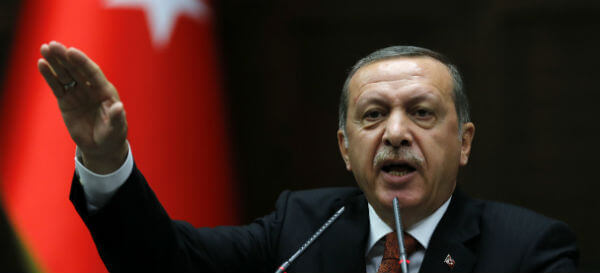
The Guardian reports: Turkey has launched an investigation into academics who signed a petition criticising the military’s crackdown on Kurdish rebels in the south-east that angered President Recep Tayyip Erdoğan.

More than 1,200 academics from 90 Turkish universities calling themselves “Academicians for Peace”, as well as foreign scholars, signed the petition last week calling for an end to the months-long violence.

Entitled “We won’t be a party to this crime”, the petition urged Ankara to “abandon its deliberate massacre and deportation of Kurdish and other peoples in the region”.

It was signed by dozens of foreign luminaries and intellectuals, among them the US academic Noam Chomsky and the Slovenian philosopher Slavoj Žižek. [Continue reading…]

Facebooktwittermail

Five years on, Tunisia’s Jasmine Revolution continues from the ground up

By Adnan Saif, University of Birmingham

Tunisians are marking five years since the culmination of their “Jasmine Revolution”. Since its longtime authoritarian leader Zine El Abidine Ben Ali was forced out of office in January 2011, Tunisia has been embarking on a long transition to constitutional democracy – a transation that, although very bumpy at times, has nevertheless led to two successful multi-party elections and a new constitution.

The award of the 2015 Nobel Peace Prize to the Tunisia National Dialogue Quartet, representing Tunisian civil society, was but one of many recognitions by the international community for the progress the country has made on its path to a stable and democratic new order.

During my many visits to Tunisia over the last four years, I witnessed the transition process through its highs and lows. My most recent visit was in August 2015, just after the terrorist attack in the coastal city of Sousse that left 38 people dead, mostly British tourists.

In spite of the tragic loss of life and the damage done to the national economy, Tunisians have developed a remarkable resilience and are able to pick themselves up and move on. That capacity is inspired in no small part by the country’s leaders, especially the two “sheikhs”, as some have now began to call them: president Beji Caid Essebsi and Rashid Al-Ghannoushi, respective leaders of the two largest political parties, Nidaa Tounes and Ennahdah.

Continue reading

Facebooktwittermail

Palestinian citizens in Israel: A fast-shrinking civic space

Nadim Nashif and Raya Naamneh write: Israel still portrays itself as a Jewish and democratic state. Yet in practice, as its Palestinian citizens can attest, it functions as a Jewish ethnocracy, leaving small margins of freedom for its Palestinian citizens that have been steadily shrinking in the past few years. Now the Israeli state has come under the complete control of the far right wing, which sees no need even for such limited margins of freedom. This is evident in the wave of discriminatory legislation and the use of the Emergency Regulations against established non-governmental organizations (NGOs) and movements such as the northern branch of the Islamic Movement in Israel.

The many laws that Israeli Knesset (parliament) and government have passed to constrain Palestinian citizens’ political participation and activism include, in 2011 alone, the “Anti-Boycott” law, which prohibits the public promotion of boycotts; the “Nakba” law, which prevents Palestinian commemoration of their catastrophe due to Israel’s creation in 1948; and the “Foreign Government Funding” law, which places onerous reporting requirements on NGOs. These laws have severely damaged the ability of Palestinian parties, NGOs, and activists to freely express their opinions and protest Israel’s crimes, both within and outside the Green Line.

More recently, a bill proposed by former foreign minister and current Member of Knesset (MK) Avigdor Lieberman would prohibit the Israeli Supreme Court from interfering in the Knesset’s Central Elections Committee decision to disqualify MKs based on their political stances. If approved, this bill would directly target Palestinian MKs, such as Haneen Zoubi and her party, “Balad – the National Democratic Alliance,” who have previously been faced with attempts to disqualify them.

In addition to targeting political participation at the government level, Israel has limited or prohibited the work of several NGOs at the municipal level. It is important to note that the NGOs impacted include both Palestinian and Israeli organizations fighting to expose Israel’s human rights violations and the apartheid regime it maintains in all of historic Palestine. [Continue reading…]

Facebooktwittermail

Wikipedia at 15: In decline but condition isn’t terminal – so what may the future hold?

By Aleksi Aaltonen, University of Warwick

As Wikipedia reaches its 15th birthday, our perception of the free online encyclopedia feels quite different to when it launched. The controversy and excitement that surrounded the service in the early days has passed. This isn’t surprising. An encyclopedia is, after all, supposed to be merely a neutral collection of generally relevant knowledge.

Behind this sense of a coming of age are two opposing narratives – an incredible achievement, but also some signs of decline. First the positives: more than five million articles have been produced by more than 27m registered users in the English version alone.

The product that founder Jimmy Wales and his team have created is a story of explosive growth without the traditional foundations of organisations, such as managerial authority, contracts or revenue (donations aside). Wikipedia is said to be the seventh most visited website in the world.

Continue reading

Facebooktwittermail

Happy birthday Wikipedia!

As Wikipedia turns 15 years old, it turns out that there is no richer source of information about Wikipedia than Wikipedia itself.

The circularity of being able to read about Wikipedia on Wikipedia, signals the intricate depth of this wonderful enterprise.

So, here’s a sampling of pages that provide doorways into the labyrinth (follow the links to read the complete articles):

Wikipedia’s description of itself: Wikipedia is a free-access, free-content Internet encyclopedia, supported and hosted by the non-profit Wikimedia Foundation. Those who can access the site can edit most of its articles. Wikipedia is ranked among the ten most popular websites, and constitutes the Internet’s largest and most popular general reference work.

History of Wikipedia

Wikipedia notability: On Wikipedia, notability is a test used by editors to decide whether a given topic warrants its own article.

List of Wikipedias: This is a list of the different language editions of Wikipedia; as of January 2016 there are 291 Wikipedias of which 280 are active.

Wikipedia’s Top 5000 pages: This lists pages accessed during the last week (updated once a week).

Wikipedia’s contents overview: This is a portal that allows readers to explore content through a directory system.

Conflict-of-interest editing on Wikipedia

Gender bias on Wikipedia

What Wikipedia is not

Wikimedia Endowment: “This Endowment will serve as a perpetual source of support for Wikipedia and the Wikimedia Foundation. It will empower people around the world to create and contribute free knowledge, and share that knowledge with every single human being.

“With your support, we are only getting started. Help us ensure that Wikipedia lives forever!”

Facebooktwittermail

The Middle East is now suffering from neoconservative sins of commission and realist sins of omission

obama-assad

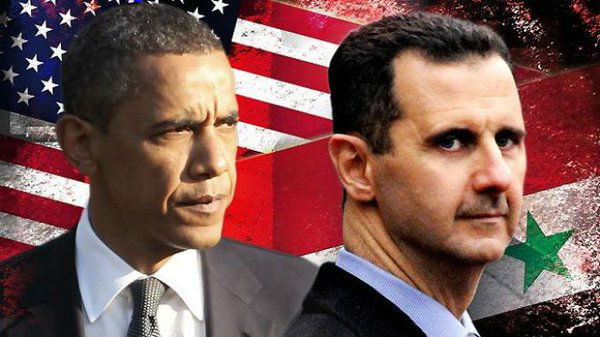
Muhammad Idrees Ahmad writes:  By now it is clear that US policy in Iraq and Syria is a disaster. In neither country has the situation been improved by the US military presence. In Iraq it empowers the same sectarian militias that forced alienated Sunnis into the arms of ISIS. In Syria it ignores, even accommodates, the regime whose brutality spawned the jihadi menace in the first place. In both its actions address symptoms rather than causes and alienate people without providing any commensurate security gains.

But would the situation improve if the United States were to withdraw? Ask the Yazidis of Iraq, whose tragedy would have been much larger had it not been for the timely US intervention; ask the Kurds of Syria, who would have been routed in Kobani had it not been for the sustained airstrikes that helped them repel an ISIS offensive. The Sunnis of Iraq might well ask who would protect them from the revanchist fury of the newly empowered sectarian militias, absent a US presence.

The issue then is not so much the fact of US military involvement as the nature of this involvement.

The United States bears responsibility for much of the current turmoil in the Levant. Had it not been for George W. Bush’s war and the fracturing of the Iraqi society, the region wouldn’t have turned into an incubator for jihadism. Had it not been for Barack Obama’s betrayal of the Syrian revolution — by making lofty promises and offering meager support; by following brave words with conspicuous inaction; and by demanding that Syrians submit their political aspirations to US security concerns — a quarter-million people would not have lost their lives, millions would not have been displaced, and thousands would not have drowned. The region suffers today from neoconservative sins of commission and realist sins of omission.

The United States could exit the Middle East and, in Sarah Palin’s immortal words, “let Allah sort it out.” But it would have condemned the region to perpetual war. Isolationism in the face of serious geopolitical challenges is not only an abdication of responsibility, but also a recipe for disaster. [Continue reading…]

Facebooktwittermail

In Syrian town cut off from the world, glimpses of deprivation

The New York Times reports: Nisrine kept teaching school for months as the siege tightened around the Syrian town of Madaya, but had to give up a few weeks ago when her students got too weak to walk to class. A local medic has been surviving on the rehydration salts he gives patients, while a business school graduate picks grass to make soup for his 70-year-old father, consulting shepherds about which ones their long-since-slaughtered flocks liked best.

A dozen women waited anxiously in their doorways one recent evening as an antigovernment activist named Firas trudged slowly up their street handing out small batches of smuggled bulgur wheat.

Firas, though, was in shock. He had taken a meal to the house of Suleiman Fares, 63 and bone-thin, in hopes of saving his life, only to find him already dead. Frustrated, Firas declared that far to the north, rebels allied with those in Madaya ought to resume shelling two pro-government towns — towns full of civilians who are also suffering, tit for tat, a siege from the other side.

“Better to die fighting,” he said that night in one of a series of recent telephone interviews, “than to starve.”

The people of Madaya and neighboring Zabadani have tried, since the siege by pro-government forces began in July, to keep society functioning and adjust to their surreal new set of dynamics. There is the black market across blockade lines, for instance, and the quiet or unexpected ways this type of warfare can kill: heart attacks, stillbirths, a step on a land mine while foraging for food.

And there is the relentless physical and psychological contraction of their communities, only an hour’s drive from Damascus, Syria, and two from Beirut yet suddenly sealed off from the outside world. [Continue reading…]

Facebooktwittermail

Obama ridiculed for saying conflicts in the Middle East ‘date back millennia’

The Washington Post reports: In his seventh and final State of the Union address, President Obama played up the state of the economy, played down the threat of the Islamic State, and introduced a new effort to beat cancer. He also found time for several not-so-subtle swipes at the Republican front-runner Donald Trump.

But for those versed in international relations, there was one line in particular that jumped out from his hour-long speech.

“The Middle East is going through a transformation that will play out for a generation, rooted in conflicts that date back millennia,” Obama said.

Thousands of years? Many of the conflicts in the Middle East don’t even date back a decade.

The Twitterati spotted the gaffe, and pounced. Obama was accused of peddling convenient falsehoods while others said he was espousing concepts unworthy of an undergraduate university student. Many said that Obama was not only excusing the conflicts, but in effect was making them seem normal and intractable. [Continue reading…]

Facebooktwittermail

How to create a better politics

I didn’t watch President Obama’s State of the Union speech on Tuesday, but news reports alerted me to this passage:

A better politics doesn’t mean we have to agree on everything. This is a big country, with different regions and attitudes and interests. That’s one of our strengths, too. Our Founders distributed power between states and branches of government, and expected us to argue, just as they did, over the size and shape of government, over commerce and foreign relations, over the meaning of liberty and the imperatives of security.

But democracy does require basic bonds of trust between its citizens. It doesn’t work if we think the people who disagree with us are all motivated by malice, or that our political opponents are unpatriotic. Democracy grinds to a halt without a willingness to compromise; or when even basic facts are contested, and we listen only to those who agree with us. Our public life withers when only the most extreme voices get attention. Most of all, democracy breaks down when the average person feels their voice doesn’t matter; that the system is rigged in favor of the rich or the powerful or some narrow interest.

It’s easy to view politics as a marketplace in which trading is taking place as competing constituencies haggle over power. From that perspective, the only question is which group best represents your interests and if no such group exists, politics then becomes a dull spectator sport. Such a marketplace is inevitably dominated by the loudest voices.

Even if that characterization is reasonably accurate, it is likely to have a constricting effect.

Politics seen as jostling power groups, makes those groups into somewhat static entities and it saps a spirit of inquiry.

If the activity of asking and answering questions — an activity that needs to be driven by curiosity — seems pointless, it gets replaced by a much less constructive exercise: the solidification of opinion through affiliation.

In other words, politics is reduced to the question of who you want to stand with and who you stand against.

In the Republican response to Obama’s speech, South Carolina Governor Nikki Haley said:

Some people think that you have to be the loudest voice in the room to make a difference. That is just not true. Often, the best thing we can do is turn down the volume. When the sound is quieter, you can actually hear what someone else is saying. And that can make a world of difference.

It would be easy to dismiss these appeals from Obama and Haley to reduce the level of rancor in politics as simply calls for a cosmetic change — as though politics can be reformed by making it more pleasant. But I don’t think these calls for a tone change should be trivialized.

The dynamic at issue is driven by the cycle of attention-seeking and attention-giving.

Donald Trump’s success has had less to do with either his financial independence or his alignment with a large segment of the population, than it has with his skill in co-opting the services of the mass media.

He took reality TV to the next level (cliche intended) by turning a presidential campaign into a form of mass entertainment. Trump supporters commonly say that a significant part of his appeal is that they find him entertaining. The tedium of politics has been turned into a raucous circus with Trump as ringmaster.

He couldn’t have done this without the help of a media which salivates at each and every opportunity to boost ratings and make more money.

Ultimately, this is an issue of American values. If creating wealth is the axis around which American life turns, then the media will inevitably function like every other branch of commerce.

The health of any society, however, requires a balance between self-interest and collective interests.

If government, the legal system, the media, education, medicine, and the arts, are controlled by commerce then we all end up as the slaves of profit.

Facebooktwittermail

Germany’s right-wing AfD party surges to new high amid concern over refugees

AfD

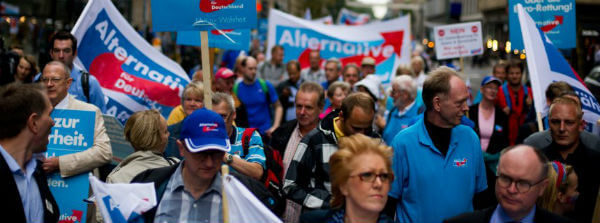
The Independent reports: Germany’s eurosceptic right-wing party has hit a new all-time high in the opinion polls as concern about migration rises in the country.

Alternative for Germany (AfD) would take 11.5 per cent of the vote is a federal general election were held today, according to a poll for Bild magazine.

The party is in third place after Angela Merkel’s CDU/CSU, who are on 35 per cent. The centre-left social democrats are on 21.5 per cent.

The Green Party and the Left Party are on 10 per cent each, while the centre-right liberal FDP would re-enter parliament on 6 per cent after it was wiped out in the most recent Federal elections. [Continue reading…]

Facebooktwittermail

Anti-immigrant ‘Soldiers of Odin’ raise concern in Finland

Reuters reports: Wearing black jackets adorned with a symbol of a Viking and the Finnish flag, the “Soldiers of Odin” have surfaced as self-proclaimed patriots patrolling the streets to protect native Finns from immigrants, worrying the government and police.

On the northern fringes of Europe, Finland has little history of welcoming large numbers of refugees, unlike neighbouring Sweden. But as with other European countries, it is now struggling with a huge increase in asylum seekers and the authorities are wary of any anti-immigrant vigilantism.

A group of young men founded Soldiers of Odin, named after a Norse god, late last year in the northern town of Kemi. This lies near the border community of Tornio, which has become an entry point for migrants arriving from Sweden.

Since then the group has expanded to other towns, with members stating they want to serve as eyes and ears for the police who they say are struggling to fulfil their duties.

Members blame “Islamist intruders” for what they believe is an increase in crime and they have carried placards at demonstrations with slogans such as “Migrants not welcome”.

While most Finns disapprove of the group, its growth signals disquiet in a country strained by the cost of receiving the asylum seekers while mired in a three-year-old recession that has forced state spending and welfare cuts.

Finnish police have also reported harassment of women by “men with a foreign background” at New Year celebrations in Helsinki, as well as at some public events last autumn. [Continue reading…]

Facebooktwittermail

Q&A: Why did terror hit Jakarta’s streets – and what happens next?

By Noor Huda Ismail, Monash University

Explosions and gunfire on Thursday left seven people dead in Jakarta. The blasts and gunfight between Indonesian police and the suspected attackers took place near the busy Sarinah shopping mall in central Jakarta. Indonesian President Joko Widodo spoke of “acts of terror”.

Five suspected attackers are reportedly among those killed. What affiliation if any they had to a terrorist group is currently unknown.

Since 2000, Islamic hardliners in Indonesia have carried out several high-profile bombing attacks. Notably, the Bali bombings in 2002 killed 202 people, including 88 Australians.

The Conversation spoke to Noor Huda Ismail, a counter-terrorism analyst from Monash University, on the landscape of Indonesia’s terror groups and the threat the country faces.

Continue reading

Facebooktwittermail

Al Jazeera to shut down American news channel

The Wall Street Journal reports: When Al Jazeera America was launched to great fanfare in 2013, its then-leader boasted he didn’t have to worry too much about profits.

After all, the cable news channel was backed by the oil-and-gas-rich government of Qatar, and oil was trading around $100 a barrel.

On Wednesday, with oil trading near $30, Al Jazeera made an about-face, announcing it was shutting its American cable channel by April 30 for economic reasons.

“The economic landscape of the media environment has driven its strategic decision to wind down its operations and conclude its service,” wrote Al Anstey, an Al Jazeera executive who took over as chief executive of the American channel in May after its founding CEO was ousted in the wake of discrimination suits.

Charles Herring, president of Herring Broadcasting Co., which runs the conservative One America News Network, said his company is interested in buying the channel because of its valuable affiliation agreements. One America is currently available is about a quarter as many homes as Al Jazeera America and would like to put its channel in this wider footprint, he said. A spokesman for Al Jazeera declined to comment. Trade publication Multichannel News earlier reported Herring’s interest.

Partly as a result of its weak negotiating position, Al Jazeera America was forced to stop streaming Al Jazeera English online in the U.S., which had helped it build influence thanks to its close-up coverage of the Arab Spring. It was a condition of its deals with distributors, who are never fans of paying for channels that also put their content online free.

As part of its announcement on Wednesday, Al Jazeera said it will now “expand its existing international digital services to broaden its multiplatform presence in the United States.” [Continue reading…]

Hopefully this means the return of full online access to Al Jazeera English programming. Stay tuned…

Facebooktwittermail