Douglas Birch and R. Jeffrey Smith write: Israel has a substantial arsenal of nuclear weapons.
Former CIA Director Robert Gates said so during his 2006 Senate confirmation hearings for secretary of defense, when he noted—while serving as a university president—that Iran is surrounded by “powers with nuclear weapons,” including “the Israelis to the west.” Former President Jimmy Carter said so in 2008 and again this year, in interviews and speeches in which he pegged the number of Israel’s nuclear warheads at 150 to around 300.
But due to a quirk of federal secrecy rules, such remarks generally cannot be made even now by those who work for the U.S. government and hold active security clearances. In fact, U.S. officials, even those on Capitol Hill, are routinely admonished not to mention the existence of an Israeli nuclear arsenal and occasionally punished when they do so.
The policy of never publicly confirming what a scholar once called one of the world’s “worst-kept secrets” dates from a political deal between the United States and Israel in the late 1960s. Its consequence has been to help Israel maintain a distinctive military posture in the Middle East while avoiding the scrutiny—and occasional disapprobation—applied to the world’s eight acknowledged nuclear powers.
But the U.S. policy of shielding the Israeli program has recently provoked new controversy, partly because of allegations that it played a role in the censure of a well-known national-laboratory arms researcher in July, after he published an article in which he acknowledged that Israel has nuclear arms. Some scholars and experts are also complaining that the government’s lack of candor is complicating its high-profile campaign to block the development of nuclear arms in Iran, as well as U.S.-led planning for a potential treaty prohibiting nuclear arms anywhere in the region. [Continue reading…]
Category Archives: Issues
To beat ISIS, the Arab world must promote inclusive politics
Rula Jebreal writes: Last week’s counter-terrorism conference in Jeddah can be summed up in two words: lost opportunity. Why? None of the participants were representative of an independent, democratic or critical voice in the Middle East. Rather, the Muslim scholars who participated were voices of their inept governments, who condemn every dissident voice as a terrorist.
In the backdrop of the conference, President Barack Obama made his case for war against ISIS in Iraq to the American public last week as well. Obama also sent a direct message Muslims around the world that ISIS is not really Islamic and America is not at war with Islam. This message was meant to hit the heart of the Arab Muslim world, but it fell on deaf ears.
Nonetheless, Secretary of State John Kerry is lobbying Arab allies to play a central role to insure the success of the initiative, since ISIS poses a much greater threat to them than it does to the United States. While this is a more responsible strategy on the part of the United States, the truth is that Arab and Muslim states continue to pursue myopic and delusional policies that produce more extremism, rather than countering it. [Continue reading…]
This is how you can expose ISIS using Twitter and Google Earth
The Independent: Eliot Higgins is the British analyst who, from his home in Leicester more than 3,000 miles away, helped expose Syrian president Bashar al-Assad’s use of Sarin gas.
The 35-year-old began blogging about the Syrian conflict as a hobby in 2012 under the pseudonym Brown Moses, after leaving a job in admin.
He had never been to Syria and did not speak Arabic. Now, Higgins runs the crowdfunded website Bellingcat, which recently claimed to have uncovered the location of an Islamic State (Isis) training camp using Google Earth; located where James Foley was killed; and spotted the Buk missile launcher which could have downed MH17 inside Russia – all within a month of reaching its funding goal on Kickstarter.
As well as investigations, with Bellingcat, Higgins aims to help educate journalists, activists and researchers about how to geolocate, verify and investigate images and videos that appear on social media. [Continue reading…]
Bautista, Crisp-Sauray, and McKibben: A future to march for
[Next Sunday’s event in New York City is already being pre-billed as “the largest climate change demonstration in history.” (It doesn’t actually have that much competition.) My hope is that anyone who can get here will help make it impressively so, if for no other reason — and there are plenty — than because it feels good once in a while to know that you’re not alone. You’ll find all the information you need about the timing and logistics of the march by clicking here. So, if you can, turn out and join the 1,100 groups that have already endorsed the march and the 20 marching bands slated to be on hand. See you there! Tom Engelhardt]
It was June 12, 1982. My daughter was still in her stroller, my son as yet unborn, when my wife and I, six friends, and another child in a stroller joined an estimated million people in New York City at the largest antinuclear protest in history. All of the adults in our party had grown up in a world unsettled in a unique way: Armageddon had, for the first time, potentially become a secular event. End times were no longer God’s choice for us, but ours for ourselves. It seemed no mistake that, three decades into the Cold War, the nuclear readiness of the two superpowers was referred to as “mutual assured destruction,” about as graphic a phrase as you could find for the end of civilization; and, of course, it had its own acronym which, to us at least, seemed less like an abbreviation than sardonic commentary: MAD.
In 1979, a near-catastrophe at the Three Mile Island nuclear plant in Pennsylvania helped launch a new iteration of the antinuclear movement. Initially, it was focused on “peaceful” nuclear power, and then, amid a renewed superpower arms race, on the potential destruction of the planet in a MAD conflagration; in the atmosphere of that moment, that is, we found ourselves living with a renewed sense that the world might not be ours or anyone else’s for long.
The first nuclear weapon had been detonated at the White Sands Proving Ground in New Mexico on July 16, 1945, just four days before I turned one, which meant world-ending fears and dreams would be woven into my life. So, with a child of my own, it felt right to be in that giant crowd of protestors, marching near a contingent of hibakusha, or survivors, from the Hiroshima and Nagasaki atomic blasts that had, thanks to America’s “victory weapon,” ushered in the nuclear age.
In 1991, only nine years later, the Soviet Union, that other superpower, would disappear. If you had told me then, with the Berlin Wall down and not an enemy in sight, that almost a quarter of a century later — with two of our 1982 marchers dead — most of the rest of us would be planning to meet and march again, lest our children’s children have no world worth living in, I would have been surprised indeed. And I would have been no less surprised to learn that the U.S. and Russia still preserve, update, and upgrade monstrous nuclear arsenals that contain enough weapons to destroy a number of Earth-sized planets, or that those weapons continue to proliferate globally, or that, as we now know (given the “nuclear winter” phenomenon), even a “modest” regional nuclear exchange between India and Pakistan could result in an event of unimaginable horror for humanity. Told all this, I would undoubtedly have wondered where the then-much-talked-about post-Cold War “peace dividend” had gone.
Had you also told me that, on September 21, 2014, I would be planning to be out with my wife, my old friends, my son, my daughter, my son-in-law, and my grandson marching in New York City, but this time against a second human-produced potential apocalypse, and that it was already happening in something like slow motion, I would have been stunned.
And yet so it is, and there I will be at the People’s Climate March, and I wouldn’t be anywhere else that day. At some future moment, wouldn’t it be sad to say that humanity’s greatest achievement was to exploit to the fullest two energy sources — the atom and fossil fuels — capable of destroying the basis for our lives on this planet, and potentially much other life as well? What a strange possible epitaph for humanity: what we burned burned us.
At 70, this world won’t be mine for that much longer, so it’s not a matter of my life or my planet, but I only have to look at my grandson to know what’s at stake, to know that this is not the world he or his peers deserve. To make global warming his inheritance could represent the greatest crime in history, which means that those who run the giant energy companies (and the oil states that go with them) and who know better will be the ultimate criminals.
No single march, of course, will alter the tide — or perhaps I mean the greenhouse gases — of history, but you have to begin somewhere (and then not stop). And to do so, you have to believe that the human ability to destroy isn’t the best we have to offer and to remind yourself of our ability to protest, to hope, to dream, to act, and to say no to the criminals of history and yes to the children to come. Tom Engelhardt
Why we march
Stepping forth for a planet in peril
By Eddie Bautista, La Tonya Crisp-Sauray, and Bill McKibbenOn Sunday, September 21st, a huge crowd will march through the middle of Manhattan. It will almost certainly be the largest rally about climate change in human history, and one of the largest political protests in many years in New York. More than 1,000 groups are coordinating the march — environmental justice groups, faith groups, labor groups — which means there’s no one policy ask. Instead, it’s designed to serve as a loud and pointed reminder to our leaders, gathering that week at the United Nations to discuss global warming, that the next great movement of the planet’s citizens centers on our survival and their pathetic inaction.
Fear of ISIS and warnings about ‘wide open’ U.S. borders fuels Islamophobia
Fox News reports: Midland County Sheriff Gary Painter said that law enforcement agencies along the “wide open” border have received alerts to be on the lookout for terrorists from the Islamic State of Iraq and Syria crossing into the United States.
Painter, who said he has worked along the border for “about eight years,” stated that alerts have been issued to border law enforcement to be on the lookout for suspicious terrorist activity, specifically involving ISIS cells being smuggled into the United States.
“I received an intelligence report that said that there was ISIS cells that were active in the Juarez area, which is the northern part of the Chihuahua state, and that they were moving around over there, that there was some activity…” Painter told Fox News. The report asked “for the sheriffs along the border to be on the alert, for all law enforcement to be on the alert, and to be on the lookout for these people maybe trying to come across.”
Painter sidestepped any direct knowledge that ISIS, specifically, is along the border, but he reiterated that the border “is wide open.” [Continue reading…]
The case for open borders
Dylan Matthews writes: “What would you think about a law that said that blacks couldn’t get a job without the government’s permission, or women couldn’t get a job without the government’s permission, or gays or Christians or anyone else?” George Mason economist Bryan Caplan asks. It’s a pretty easy question. Obviously, such a law is discriminatory on its face, serves no rational purpose, and is unacceptable in a liberal democracy. But Caplan continues: “So why, exactly, is it that people who are born on the wrong side of the border have to get government permission just to get a job?”
This is Caplan’s elevator pitch for open borders, an idea that for years was treated as deeply unserious, as an extreme straw man that nativists could beat up in the course of resisting more modest efforts to help immigrants. It had its defenders — philosopher Joseph Carens primary among them — but they were relatively lonely voices.
But in recent years, a small but devoted group of advocates have succeeded in turning open borders from a dirty word to a real movement with strong arguments backing it up. The team at OpenBorders.info — Vipul Naik, John Lee, Nathan Smith, Paul Crider — has led the charge, as Shaun Raviv wrote in an excellent profile of the group in the Atlantic. The University of Colorado’s Michael Huemer honed Carens’ moral case, while the Center for Global Development’s Michael Clemens has been hugely influential in arguing that we’re leaving trillions in potential economic growth on the table by enforcing border restrictions.
But few have been as prolific and forceful in their advocacy for the idea as Caplan. “The upside of open borders,” he once wrote, “would be the rapid elimination of absolute poverty on earth.” He is relentless at rebutting objections. It would take jobs away from native-born workers? It’d hurt growth in poor countries as more and more people leave? It’d leave us vulnerable to crime? No, no, and no. [Continue reading…]
Veterans of elite Israeli intel unit refuse reserve duty, citing mistreatment of Palestinians
The New York Times reports: Denouncing Israel’s treatment of Palestinians under occupation, a group of veterans from an elite, secretive military intelligence unit have declared they will no longer “take part in the state’s actions against Palestinians” in required reserve duty because of what they called “our moral duty to act.”
In a letter sent Thursday night to their commanders as well as Israel’s prime minister and army chief, 43 veterans of the clandestine Unit 8200 complained that Israel made “no distinction between Palestinians who are and are not involved in violence” and that information collected “harms innocent people.” Intelligence “is used for political persecution,” they wrote, which “does not allow for people to lead normal lives, and fuels more violence, further distancing us from the end of the conflict.”
The letter, revealed Friday in Israel’s Yediot Aharonot newspaper as well as The Guardian in Britain, echoes similar periodic protests by reservists over the years, including a group of 27 pilots who refused to participate in what Israel calls targeted assassinations, and 13 members of the vaunted commando unit known as Sayeret Matkal, both in 2003. But it is the first public collective refusal by intelligence officers rather that combat troops. Unit 8200 has a special role in Israeli society as a coveted pipeline to its high-technology industry.
“After our service we started seeing a more complex picture of a nondemocratic, oppressive regime that controls the lives of millions of people,” said one of the group’s organizers, a 32-year-old sergeant major who was on active duty from 2001 to 2005. He spoke on the condition of anonymity because the military prohibits Unit 8200 members from being publicly identified. [Continue reading…]
Syrian Kurds ally with rebel groups to fight ISIS
Vice reports: Kurdish and rebel armed groups fighting extremist militants the Islamic State (IS) in Syria have agreed to join forces against their common enemy, the latest in a complex and shifting series of battlefield allegiances.
Units affiliated with the Kurdish People’s Protection Units (YPG), Islamic Front (IF) and US-backed Free Syrian Army (FSA) will form a new coalition named Burkan al-Forat (Euphrates Volcano) after the river which flows through the region in which the agreement was formalized.
The alliance was announced via a video posted on Wednesday in which a man read a statement in front of an armed group including a number of women fighters backed by YPG pennants alongside the three-starred flag of Syrian opposition groups and others. The UK-based Syrian Observatory for Human Rights also reported the news.
The man asked those who had joined IS to desert the group, called for assistance from the international community and finished by saying that the coalition wished to free all areas of Syria under IS control, including Qaraqozaq, Jarabulus, Sirin, Manbaj and Raqqa.
Syrian rebel groups have not always had a smooth relationship with Kurdish militias. The YPG, which is the main force in majority Kurdish parts of the country, has maintained an uneasy truce with President Bashar al-Assad’s forces in the region, leading some rebels to accuse them of colluding with the government, a charge the Kurds deny.
However, it has been instrumental in the fight against IS and has been one of the few forces to mount an effective defense against the jihadis, inflicting heavy losses against them clashes across northern Syria and stymying their efforts to extend control into Kurdish regions. Problematically for the US, the YPG is affiliated with the Kurdistan Worker’s Party (PKK), an organization which is on both America and the EU’s terrorist blacklist. [Continue reading…]
Is ‘progress’ good for humanity?
Jeremy Caradonna writes: The stock narrative of the Industrial Revolution is one of moral and economic progress. Indeed, economic progress is cast as moral progress.
The story tends to go something like this: Inventors, economists, and statesmen in Western Europe dreamed up a new industrialized world. Fueled by the optimism and scientific know-how of the Enlightenment, a series of heroic men — James Watt, Adam Smith, William Huskisson, and so on — fought back against the stultifying effects of regulated economies, irrational laws and customs, and a traditional guild structure that quashed innovation. By the mid-19th century, they had managed to implement a laissez-faire (“free”) economy that ran on new machines and was centered around modern factories and an urban working class. It was a long and difficult process, but this revolution eventually brought Europeans to a new plateau of civilization. In the end, Europeans lived in a new world based on wage labor, easy mobility, and the consumption of sparkling products.
Europe had rescued itself from the pre-industrial misery that had hampered humankind since the dawn of time. Cheap and abundant fossil fuel powered the trains and other steam engines that drove humankind into this brave new future. Later, around the time that Europeans decided that colonial slavery wasn’t such a good idea, they exported this revolution to other parts of the world, so that everyone could participate in freedom and industrialized modernity. They did this, in part, by “opening up markets” in primitive agrarian societies. The net result has been increased human happiness, wealth, and productivity — the attainment of our true potential as a species.
Sadly, this saccharine story still sweetens our societal self-image. Indeed, it is deeply ingrained in the collective identity of the industrialized world. The narrative has gotten more complex but remains à la base a triumphalist story. Consider, for instance, the closing lines of Joel Mokyr’s 2009 The Enlightened Economy: An Economic History of Britain, 1700–1850: “Material life in Britain and in the industrialized world that followed it is far better today than could have been imagined by the most wild-eyed optimistic 18th-century philosophe — and whereas this outcome may have been an unforeseen consequence, most economists, at least, would regard it as an undivided blessing.”
The idea that the Industrial Revolution has made us not only more technologically advanced and materially furnished but also better for it is a powerful narrative and one that’s hard to shake. It makes it difficult to dissent from the idea that new technologies, economic growth, and a consumer society are absolutely necessary. To criticize industrial modernity is somehow to criticize the moral advancement of humankind, since a central theme in this narrative is the idea that industrialization revolutionized our humanity, too. Those who criticize industrial society are often met with defensive snarkiness: “So you’d like us to go back to living in caves, would ya?” or “you can’t stop progress!”
Narratives are inevitably moralistic; they are never created spontaneously from “the facts” but are rather stories imposed upon a range of phenomena that always include implicit ideas about what’s right and what’s wrong. The proponents of the Industrial Revolution inherited from the philosophers of the Enlightenment the narrative of human (read: European) progress over time but placed technological advancement and economic liberalization at the center of their conception of progress. This narrative remains today an ingrained operating principle that propels us in a seemingly unstoppable way toward more growth and more technology, because the assumption is that these things are ultimately beneficial for humanity.
Advocates of sustainability are not opposed to industrialization per se, and don’t seek a return to the Stone Age. But what they do oppose is the dubious narrative of progress caricatured above. Along with Jean-Jacques Rousseau, they acknowledge the objective advancement of technology, but they don’t necessarily think that it has made us more virtuous, and they don’t assume that the key values of the Industrial Revolution are beyond reproach: social inequality for the sake of private wealth; economic growth at the expense of everything, including the integrity of the environment; and the assumption that mechanized newness is always a positive thing. Above all, sustainability-minded thinkers question whether the Industrial Revolution has jeopardized humankind’s ability to live happily and sustainably upon the Earth. Have the fossil-fueled good times put future generations at risk of returning to the same misery that industrialists were in such a rush to leave behind? [Continue reading…]
Steve Fraser: The return of the titans
Think of this as the year that democracy of, by, and for the billionaires shall not perish from the Earth — not when we’re on a new electoral playing field in a political world in which distinctions are no longer made between unlimited money and unlimited speech. In other words, these days, if you have billions of dollars, you can shout from the skies and the rest of us have to listen. If, as Steve Fraser points out today, we’ve been witnessing the return of “family capitalism on steroids,” nowhere has it been bigger than in American politics, aided and abetted by that ultimate family institution, the Supremes (and I’m not, of course, talking about the classic Motown group).
We’re still almost two months from the midterm elections in which the Republicans already have the House of Representatives essentially wrapped up and ads for Senate races are zipping onto TV screens in “battleground states” at a dizzying pace. To fund those ads and other campaign initiatives, dollars by the millions are pouring into the coffers of “dark money” outfits in a way guaranteed to leave the record for spending on midterm elections in a ditch at the side of the road. We now have our first estimates of what election 2014 is going to look like as a billionaire’s playground; and count on it, you’re going to hear the words “record,” “billionaire,” and “ads” a lot more until November.
“Outside groups” have already spent $120 million on TV ads alone, more than half that sum coming from those dark-money groups that don’t have to let anyone know who their contributors are. At the top of that shadowy list are six outfits linked to David and Charles Koch, the billionaire brothers from Wichita. Together, those groups have already sent a mind-spinning 44,000 ads into the politico-sphere in those battleground states, and the Kochs’ Americans for Prosperity (AFP) leads the pack with 27,000 of them. In the end, AFP alone is expected to put $125 million into this year’s midterm elections, a figure that should take your breath away and yet that’s only a start.
Sheldon Adelson, of casino fame, may, for example, put $100 million of his $31.6 billion fortune into this campaign season, shuttling much of it through dark-money outfits, including AFP. On the liberal side of the spectrum, environmentalist and billionaire Tom Steyer has pledged to sink $50 million into campaigns to promote candidates ready to act on global warming (though there is little question that, in the billionaire sweepstakes, the right-wing ones are going to outspend the liberal ones, and Republicans outspend Democrats).
In all of this, you can see the urge of America’s new crop of billionaires to “play god” at our expense and with our lives — to decide for us, ad by ad, dark-money outfit by dark-money outfit, how we should organize ourselves politically. Historian Steve Fraser, TomDispatch regular, author of Wall Street: America’s Dream Palace, and co-founder (with me) of the American Empire Project, has rubbed elbows with many a billionaire — on the page, if not in life. From this country’s earliest tycoons to the latest batch of family capitalists, he finds one overwhelming, unifying trait: a deep-seated belief, in a country that worships self- or family-made money, that the more billions you have, the more you should be listened to. In his upcoming book, The Age of Acquiescence: The Life and Death of American Resistance to Organized Wealth and Power, he explores how, in our second (even more) gilded age, others with little money also came to believe that, rather than resist it. Tom Engelhardt
Playing God
The rebirth of family capitalism or how the Koch Brothers, Sheldon Adelson, Sam Walton, Bill Gates, and other billionaires are undermining America
By Steve FraserGeorge Baer was a railroad and coal mining magnate at the turn of the twentieth century. Amid a violent and protracted strike that shut down much of the country’s anthracite coal industry, Baer defied President Teddy Roosevelt’s appeal to arbitrate the issues at stake, saying, “The rights and interests of the laboring man will be protected and cared for… not by the labor agitators, but by the Christian men of property to whom God has given control of the property rights of the country.” To the Anthracite Coal Commission investigating the uproar, Baer insisted, “These men don’t suffer. Why hell, half of them don’t even speak English.”
We might call that adopting the imperial position. Titans of industry and finance back then often assumed that they had the right to supersede the law and tutor the rest of America on how best to order its affairs. They liked to play God. It’s a habit that’s returned with a vengeance in our own time.
The criminal shape of terror to come
Christopher Dickey writes: He is the very model of a modern ISIS terrorist: not very smart, not very religious, certainly sadistic, hugely egotistical, a minor criminal most of his life who’s looking to kill whoever he can whenever he can to make a name for himself. The territories now held by the so-called Islamic State (aka ISIS or ISIL) were his training ground but not his battleground: He was a jailor alternately torturing Western hostages and singing to them. But his sights were set on bigger Western targets. And he became such a loose Kalashnikov that, in the view of some European counterterrorism experts, even ISIS wanted to be rid of him.
Such a man, according to his victims and his prosecutors, is 29-year-old Mehdi Nemmouche. On May 24, the young Frenchman allegedly walked into a Jewish museum in Brussels and killed four people.
At the time, before ISIS had conquered Mosul, the second-largest city in Iraq, the attack evoked outrage but not hysteria. Today, amid the furor created by the realization that ISIS is redrawing the map of the Middle East, and after the horror evoked by the beheadings of American journalists James Foley and Steven Sotloff, such an attack would have much more dramatic repercussions.
Over the weekend the French press published reports, unconfirmed, that when Nemmouche acted as one of the jailors for French hostages held in Syria in 2013, and possibly for the Americans James Foley and Steven Sotloff, as well, he bragged about ambitious plans to attack the July 14 Bastille Day parade in Paris.
There are many reasons to worry that ISIS will, at some point, try to carry out a major terrorist attack in Europe or the United States. (It will claim it was forced to do so by the American bombing campaigns, just as it says it was forced to behead American journalists James Foley and Steven Sotloff.) But the immediate risk is from disorganized, undisciplined, and nonetheless very deadly characters who want to see their names go down in their own half-assed version of history.
Maybe like Nemmouche they’ve spent some “jihad tourism” time in Syria or Iraq—many hundreds of Europeans and a substantial number of Americans are believed to have done so. Or perhaps they’ve only been “inspired” by ISIS from afar. All can claim the black banner of “the Caliphate,” and in the emotionally fraught environment of today, a little terrorism goes a long way.
When President Barack Obama addresses the nation on Wednesday, not the least of his goals will be to rein in the rampant rhetoric surrounding ISIS. But it won’t be easy. Obama would rather talk about “managing” ISIL than “destroying” or “defeating” it—words he has used but with obvious reluctance. In classic Obama fashion, he wants to keep his options open, only to discover he’s lost control of the narrative altogether.
Veteran terrorism expert Brian Jenkins notes the alarmism in Washington has reached such proportions, there’s a kind of “shock and awe in reverse.” Thus, as Jenkins writes, Defense Secretary Chuck Hagel proclaims ISIS is an “imminent threat to every interest we have.” A congressional staffer argues that it is “highly probable ISIS will…obtain nuclear, chemical, biological or other weapons of mass death…to use in attacks against New York [or] Washington.” Texas Governor Rick Perry claims there is a “very real possibility” that ISIS forces may have crossed the U.S.-Mexican border. Senator James Inhofe asserted, “We are in the most dangerous position we’ve ever been in as a nation,” and retired Marine four-star Gen. John Allen goes so far as to say, “World War III is at hand.” [Continue reading…]
Domestic violence kills far more people than wars
Reuters reports: Domestic violence, mainly against women and children, kills far more people than wars and is an often overlooked scourge that costs the world economy more than $8 trillion a year, experts said on Tuesday.
The study, which its authors said was a first attempt to estimate global costs of violence, urged the United Nations to pay more attention to abuse at home that gets less attention than armed conflicts from Syria to Ukraine.
“For every civil war battlefield death, roughly nine people … are killed in inter-personal disputes,” Anke Hoeffler of Oxford University and James Fearon of Stanford University wrote in the report.
From domestic disputes to wars, they estimated that all violence worldwide cost $9.5 trillion a year, mainly in lost economic output and equivalent to 11.2 percent of world gross domestic product.
In recent years, about 20-25 nations suffered civil wars, devastating many local economies and costing about $170 billion a year. Homicides, mainly of men unrelated to domestic disputes, cost $650 billion.
But those figures were dwarfed by the $8 trillion annual cost of domestic violence, mostly against women and children.
The study said about 290 million children suffer violent discipline at home, according to estimates based on data from the United Nations Children’s Fund, UNICEF. Based on estimated costs, ranging from injuries to child welfare services, the study estimated that non-fatal child abuse sapped 1.9 percent of GDP in high income nations and up to 19 percent of GDP in sub-Saharan Africa where severe discipline was common.
Bjorn Lomborg, head of the Copenhagen Consensus Center which commissioned the report, said household violence was often overlooked, just as car crashes attracted less attention than plane crashes even many more died in road accidents. [Continue reading…]
International response to Syria failing on ‘every front’ says Oxfam
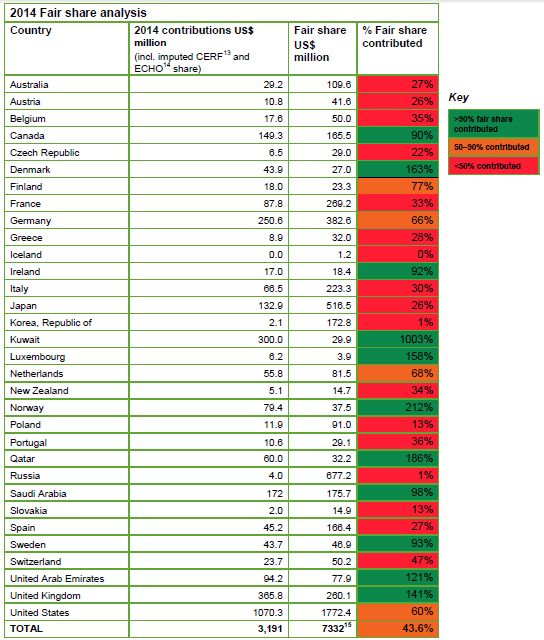
Oxfam: The international response to Syria is failing on three fronts – insufficient aid, meager resettlement offers and continued arms transfers – Oxfam warns in a report published today.
Oxfam is calling on the UN to impose an arms embargo on all warring parties in Syria and is urging governments to provide their fair share of aid, and offer a haven to greater numbers of refugees fleeing violence.
The report, A Fairer Deal for Syrians, details how the $7.7 billion humanitarian appeals are less than half funded, while a continued supply of arms is fuelling widespread violations and undermining peace efforts. Rich countries are offering a safe haven to a paltry number of refugees from Syria while neighboring countries are struggling to support more than 3 million people who have fled the conflict.
Russia, a major arms exporter to Syria, has committed only one percent of its fair share of aid. France and the USA have provided just 33 percent and 60 percent of their fair share respectively and are continuing to supply arms, undermining efforts to stop the conflict. Many Gulf countries are giving more than their fair share but need to do more to stop arms flowing. Other generous donors include the UK and Denmark. [Continue reading…]

For Gaza’s children, ‘safety’ is just a word
Samer Badawi writes: As the smoke clears over Gaza and its residents begin to assess the damage of Israel’s 50-day war, no group has been more traumatized than this enclave’s children. They represent roughly half of Gaza’s population and, according to a report released on August 27, died at a rate of twelve a day, every day, during the conflict. Their parents, too, have perished in unprecedented numbers, leaving more than 1,500 of Gaza’s children orphaned.
Alaa Balata is one of them.
I met Alaa during one of the war’s temporary ceasefires. Israeli drones buzzed overhead, and the 17-year-old was surrounded by relatives who had been keeping a close eye on him since his parents perished. It had been fewer than two weeks since the incident, and Alaa spoke in the steady understatement of a person in shock, damming the sadness — at least for now.
When I asked him what happened, Alaa gestured toward the heap of rubble that was his uncle’s home. We were sitting on plastic chairs in a dirt alley flanked by cinder-block walls — a familiar scene in any Palestinian refugee camp. But here, in the heart of Jabalia, the path was strewn with shrapnel—the same dense metal that tore through every member of Alaa’s immediate family on the afternoon of July 29.
“It was the second day of Eid,” Alaa told me. A day earlier, on the first day of the Muslim feast marking the end of Ramadan, Alaa’s father decided to move the family to his brother’s house, which was was deep inside the camp and farther from the Israeli tanks shelling everywhere along Gaza’s border.
“He thought we would be safer here,” Alaa said. [Continue reading…]
Noam Chomsky: The fate of the Gaza ceasefire
Is there nowhere on the face of the Earth where opinion polls aren’t taken? In the wake of the 50-day Israeli assault on Gaza, parts of that tiny strip of land now look, according to photographs, like a moonscape of destruction. At least 10,000 homes were obliterated and thousands more damaged; at least 175 major factories were pummeled into the dust. Its only power plant was destroyed, damaging electricity, water, and sewage systems. Large apartment houses, as well as the ministry of education, schools, and other sites, were hit and sometimes reduced to so much rubble. It was all part of a massive Israeli assault on Hamas, several of whose senior leaders were assassinated, but also on the Palestinian population, involving what looked like collective punishment for its support of that organization or simply living in proximity to it. And indeed, with almost no hope of rebuilding much of their world any time soon, you might think that Palestinians would hold the Hamas leadership at least somewhat responsible for the destruction that has rained down, as assumedly the Israelis wanted them to. But a recent poll by the Palestinian Center for Policy and Survey Research (PSR), begun in the last day before the ceasefire took hold, and carried out, in part, amid the rubble that is now Gaza, suggests otherwise.
It finds that Palestinian opinion couldn’t be clearer. Support hasn’t been this high for Hamas since 2006, when it won a fair and square democratic election. If a presidential vote were held today, the pollsters of PSR discovered, Hamas leader Ismail Haniyeh would beat Fatah’s Mahmoud Abbas hands down. Here are just a few of the findings: “79% [of Palestinians] believe that Hamas has won the Gaza War; 3% believe Israel came out the winner; and 17% believe the two sides were losers… If new presidential elections are held today and only two [candidates] were nominated, Haniyeh, for the first time since we have started asking about his popularity about eight years ago, would receive a majority of 61% and Abbas would receive 32%. [The] vote for Haniyeh stands at 53% in the Gaza Strip and 66% in the West Bank. Abbas receives 43% in the Gaza Strip and 25% in the West Bank… A majority of 53% believe that armed confrontation is the most effective means to establish a Palestinian state next to the state of Israel. Only 22% believe negotiation is the best means to establish a Palestinian state and 20% believe that popular non-violent resistance is the most effective route to statehood.”
As historically has often been the case, massive bombings and other assaults do not destroy the support of populations for movements or governments, but tend to solidify it. In other words, Israeli policy is reducing civilized life for Palestinians in a major way and yet increasing the urge both to fight on and the desire for revenge. It’s an ugly pattern and, as TomDispatch regular Noam Chomsky (whose latest book, Masters of Mankind, is due out this week) indicates today, it’s been going on in this same fashion for a remarkably long time, as Israel continues to gobble up Palestinian lands on the West Bank, while working to hem Palestinians in yet further in the Gaza Strip. Tom Engelhardt
Ceasefires in which violations never cease
What’s next for Israel, Hamas, and Gaza?
By Noam ChomskyOn August 26th, Israel and the Palestinian Authority (PA) both accepted a ceasefire agreement after a 50-day Israeli assault on Gaza that left 2,100 Palestinians dead and vast landscapes of destruction behind. The agreement calls for an end to military action by both Israel and Hamas, as well as an easing of the Israeli siege that has strangled Gaza for many years.
This is, however, just the most recent of a series of ceasefire agreements reached after each of Israel’s periodic escalations of its unremitting assault on Gaza. Throughout this period, the terms of these agreements remain essentially the same. The regular pattern is for Israel, then, to disregard whatever agreement is in place, while Hamas observes it — as Israel has officially recognized — until a sharp increase in Israeli violence elicits a Hamas response, followed by even fiercer brutality. These escalations, which amount to shooting fish in a pond, are called “mowing the lawn” in Israeli parlance. The most recent was more accurately described as “removing the topsoil” by a senior U.S. military officer, appalled by the practices of the self-described “most moral army in the world.”
Kissinger still at work covering up his war crimes
In an interview broadcast on NPR on Saturday, “realist” supremo, Henry Kissinger, made this extraordinary statement:
I think we would find, if you study the conduct of [the military], that the Obama administration has hit more targets on a broader scale than the Nixon administration ever did. And, of course, B-52s have a different bombing pattern.
On the other hand, drones are far more deadly because they are much more accurate. And I think the principle is essentially the same. You attack locations where you believe people operate who are killing you. You do it in the most limited way possible. And I bet if one did an honest account, there were fewer civilian casualties in Cambodia than there have been from American drone attacks. [My emphasis.]
Obviously, Kissinger’s purpose in making this claim is not to portray President Obama as a war criminal. After all, Obama often acts like one of Kissinger’s most devoted students.

Kissinger wants to be seen as having done during the Vietnam war what any American in his position would have done. And since from the American public there has been little opposition to Obama’s use of drones, Kissinger hopes to liken himself to Obama and thereby shed his image as a war criminal.
There’s no doubt that Obama’s use of drones has been cynical, counter-productive, and indeed a criminal exercise in extra-judicial killing. But for Kissinger to claim that more civilians have been killed by drones than he killed by carpet bombing Cambodia is outrageous, absurd, and patently false.
The Bureau for Investigative Journalism has been the leader in documenting the effects of America’s drone wars. Its estimate of the number of casualties in Pakistan, Yemen, and Somalia since 2002 is at least 571 and at most 1225 civilian deaths.
In the four-year secret bombing campaign of Cambodia which Kissinger instigated, “the U.S. dropped 540,000 tons of bombs, killing anywhere from 150,000 to 500,000 civilians.”
The Trials of Henry Kissinger (2002) describes how this happened:
Kissinger is now 91 and no doubt increasingly preoccupied with how he will be remembered after his death. Americans born after the Vietnam era might view him as a figure from the past (if they view him in any way at all), but no one should underestimate his enduring influence. Ironically, his realist worldview has tacitly been accepted even by people who identify themselves as anti-interventionists and opponents of war and for whom Kissinger might be one of the despised characters in American history.
In post 9/11 America, even those who are willing to argue that U.S. foreign policy should be informed by humanitarian principles also feel compelled to bow towards U.S. national interests. For instance, in as much as there was any debate about military intervention in Syria after the chemical attacks a year ago, the element in the argument that carried more weight than any other was America’s national interest. The wide consensus that America had no appetite to become entangled in another war and that getting dragged into the war in Syria would not serve our interests, overshadowed any consideration about what might serve the interests of the Syrian people. Their appeals for international support in their struggle to overthrow Assad have fallen on deaf ears among those who believe that there is no cause greater than the pursuit of our national interests.
Likewise, when it comes to a global issue such as climate change, America’s role in having precipitated the crisis and the fact that world’s poor living in flood-prone countries such as Bangladesh will suffer the worst consequences, appear to be of less influence in shaping American public opinion than are perceptions of how much the U.S. will be affected. In other words, to the extent that Americans believe this country can adapt and even prosper, the expectation that we can live while millions of others die, makes climate change look like a manageable problem.
Kissinger doesn’t have to worry about his legacy because with very few exceptions, Americans are all Kissingers now.
For Israel, the beginning of wisdom is to admit its mistakes
Avi Shlaim writes: Israel has a habit of justifying its actions in the occupied Palestinian territories, however illegal and indecent, in the name of security. But denying any security to the other side only perpetuates the conflict.
Five days after reaching a ceasefire with Hamas to end the latest round of fighting in Gaza, the Israeli cabinet decided to appropriate 988 acres of land on the West Bank, near the place where three Israeli teenagers were recently abducted and murdered, to make way for another illegal Jewish city. This is the biggest land grab in three decades. As the justice minister, Tzipi Livni, pointed out: “It was a decision that weakens Israel and damages its security.” What it proves, if further proof is needed, is that Israel’s leaders are determined to prevent a two-state solution to the conflict.
Operation Protective Edge, which came to an end after 50 days of fighting, was the third and deadliest war in six years between Israel and Hamas, the Islamic resistance movement that rules Gaza. Israel lost 66 soldiers and six civilians. On the Palestinian side, the war left 2,104 dead, mostly civilians, and 12,656 injured; 17,000 houses were destroyed or damaged; 520,000 people, out of a population of 1.8 million, were displaced. The damage to buildings and to the civilian infrastructure, estimated at $6bn, will take many years to repair.
What did Israel gain by unleashing the deadly firepower of the IDF against the caged population of this tiny coastal enclave? Virtually nothing. [Continue reading…]
The Hannibal Directive: How Israel killed its own troops and massacred Palestinians to prevent soldiers’ capture
Max Blumenthal writes: In the southern city of Rafah in the Gaza Strip, Aug. 1, 2014 is known as Black Friday. This was the day the Israeli military bombarded the city with almost every mode of destruction available to it, from F-16 missiles to Apache rockets to naval shelling to drone strikes and mortars.
Bulldozers ripped down homes at random while tanks barreled through neighborhoods, shelling anything in sight. In a matter of hours, at least 500 artillery shells and hundreds of missiles were dumped on the city, almost entirely in civilian areas. By the end, at least 190 people had been killed, so many that unequipped local hospitals were forced to store their corpses and body parts in ice cream coolers.
The target of the operation was not necessarily Rafah’s civilian population, though attacking it was part of the Israeli military’s underlying logic. Instead, the army apparently aimed to kill one of its own. Indeed, Israeli forces had invoked the Hannibal Directive, opening up an indiscriminate assault on the entire circumference of the area where one of its soldiers, Lt. Hadar Goldin, was allegedly taken captive by an ambush team from the Hamas military wing known as the Qassam Brigades.
It was one of possibly three instances during Israel’s 51-day war with Hamas that it initiated the Hannibal Directive. [Continue reading…]

Such a man, according to his victims and his prosecutors, is 29-year-old Mehdi Nemmouche. On May 24, the young Frenchman allegedly walked into a Jewish museum in Brussels and killed four people.