Category Archives: Issues

As NATO allies unite against ISIS, it’s time for the U.S. to talk to the PKK

The Washington Post reports: The Obama administration accelerated efforts Friday to build an international coalition to combat the Islamic State, winning pledges of support from nine allies but leaving questions about the extent of possible expanded military force.

The United States has waged a series of airstrikes seeking to slow the advance of the Islamic State in northern Iraq and bolster the defenses of Western-allied fighters in the Iraq’s nearby Kurdish region.

But Washington is now eager to broaden the military and diplomatic pressures on the group, which has drawn international condemnation for sending non-Muslim minorities fleeing in fear and waging bloodshed such as mass killings and the beheadings of two American journalists.

The 10-nation alliance, forged at a NATO summit in Wales, could raise worries about deepening Western military engagement in the region nearly three years after the withdrawal of U.S. combat forces from Iraq.

Secretary of State John F. Kerry and Defense Secretary Chuck Hagel used the NATO forum to hold meetings with foreign and defense ministers from nine countries: Britain, France, Germany, Canada, Australia, Turkey, Italy, Poland and Denmark.

The leaders described themselves as the core of an emerging coalition to counter the Islamic State, although they downplayed the prospect of imminent joint military action. They also left unsaid whether they were planning to attack Islamic State’s strongholds in Syria or limit their mission to Iraq. [Continue reading…]

The New York Times adds this tough-talk from Kerry: “There is no containment policy for ISIL,” Secretary of State John Kerry said at the beginning of the meeting, using an alternate acronym for ISIS. “They’re an ambitious, avowed, genocidal, territorial-grabbing, caliphate-desiring quasi state with an irregular army, and leaving them in some capacity intact anywhere would leave a cancer in place that will ultimately come back to haunt us.”

So even though the text of the statement issued by the State Department makes no mention of attacking ISIS in Syria, that’s part of the plan — right?

It’s widely recognized that the most effective force fighting against ISIS is the YPG (People’s Protection Units), the branch of the PKK (Kurdistan Workers’ Party) based in Rojava, Syrian Kurdistan.

When the U.S. claimed success in rescuing thousands of Yazidis trapped on Mount Sinjar, it was YPG fighters on the ground who played the crucial role in creating a safe corridor.

In building its international coalition to fight ISIS, the U.S. will naturally want the support of as many allies as possible, yet what could be the most productive alliance of all — with the PKK — will remain hamstrung unless Washington grows up and ditches its childish anti-terrorism fundamentalism and quickly de-lists the PKK as a so-called terrorist organization.

Not only is this particular designation unwarranted — as Henri Barkey points out, the U.S. should be willing to talk to the PKK when the PKK’s chief adversary, Turkey, is already doing so — but the whole idea of designating organizations and individuals as terrorists is itself an insult to the rule of law. Such labeling functions as a political tool used without much more subtlety than the Catholic church’s practice of branding heretics at the time of the inquisition. Democracy, however, only allows for the designation of illegal actions — not illegal opinions or affiliations.

The necessity of fighting ISIS has arisen not because it promotes a diabolical ideology; it derives from the fact that the members of ISIS are engaging in genocide, ethnic cleansing, war crimes, and crimes against humanity.


Facebooktwittermail

Is the PKK becoming a new Middle East power?

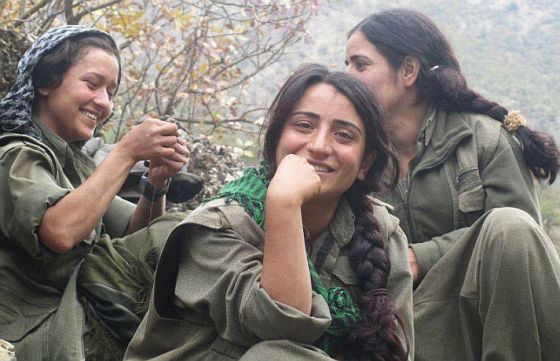
30% of PKK fighters are women.

30% of the PKK’s fighters are women.

The Turkish columnist, Kadri Gursel, writes: [T]he PYD [the Democratic Union Party, the PKK’s Syrian branch] has been able to hold on to these three regions [Ras al-Ain, Kobani and Afrin, in northern Syria] and resist the jihadists for more than two years. Hence, long before IS’ capture of Mosul, the PKK already deserved to be recognized as the Middle East’s only fighting force to defy and resist IS for the struggle it has waged in Rojava [Syrian Kurdistan].

The Kurdish forces in Syria have surprised the world not only with their resolve against the jihadists but also with their female fighters. Against a barbarian mindset that enslaves and sells women as concubines, the PYD has displayed a secular mindset embracing gender equality, which has enormously contributed to its international image.

In Iraq, on the other hand, the PKK has put aside disagreements with the Kurdistan Democratic Party (KDP) to form a national military alliance against the jihadist threat to Iraqi Kurdistan.

That the Western public is already discussing the prospect of the PKK’s removal from the lists of terrorist organizations is a clear indication of how much the PKK’s struggle against the jihadists has contributed to its international standing.

Lauren Bohn reports: Standing in a parched field far from any roads in Turkey’s southeastern mountains, a teary-eyed Sokrun Gunduz clutched photographs of her two absent sons.

Mazlum, 15, is in a Turkish prison under suspicion of collaborating with the Kurdistan Workers Party (PKK), a group branded a terrorist organization by Turkey, the European Union and the United States.

Agit, 22, is in northern Iraq battling the jihadist Islamic State in Iraq and Syria (ISIS) with the same group. The young man is one of thousands of PKK soldiers who have joined the war against ISIS in Kurdish areas of Syria and Iraq, and who have become vital to the international community’s battle against the powerful Islamist insurgency.

“The Kurdish fight has spread,” the 43-year-old grocer said at a recent rally marking the anniversary of the PKK’s armed struggle against Turkey. The group has battled the Turkish state for cultural and political rights and Kurdish self-rule for 30 years in a conflict that has claimed more than 30,000 lives.

“We must protect our Kurdish brothers and sisters,” she said amid a crowd of thousands of PKK fighters and supporters celebrating the 30th anniversary of the group’s struggle. “In doing so, we will finally get our own Kurdish state.”

Many of Turkey’s Kurds – a disenfranchised minority that makes up a fifth of the country’s population – feel revitalized by the PKK’s role in Syria and Iraq, and hope their successes on the battlefield will produce political victories such as greater autonomy, more rights and perhaps even an independent state.

“In a way, we have to thank the Islamic State. They’ve united us, reviving the great Kurdish cause,” said Seyid Narin, a municipal mayor in Diyarbakir, long the center of the Kurdish resistance and separatist movement in southeast Turkey. Ten months ago he lost a son who was fighting in Syria — a second one is now in northern Iraq with the PKK.

“Our struggle is reborn,” he said.

This struggle poses a potential threat to Turkey’s ruling Justice and Development Party (AK Party) which has spearheaded efforts to restart peace talks with the terror group and now tolerates its military role in Turkey.

“Both the (ruling party) and PKK know that ISIS must be stopped … if anything, this fight will bring the AK party and Kurds closer together,” said Bedirhan Akyol, a Kurdish Justice and Development official in Diyarbakir. “The PKK is becoming stronger through this fight, but that won’t have a bad effect on peace talks.”

But Akyol’s positive spin belies a deep unease in Turkey about the PKK’s role fighting ISIS in Syria and its place in society at large. That the long reviled organization has been cast as the hero in the war against homicidal Islamist fighters has prompted alarm and anger in some circles.

The ruling party and the PKK are essentially creating laws that would result in the break- up of Turkey, said Oktay Vural, a leading Turkish opposition politician.

“The terrorists failed to divide Turkey for 30 years, but the country is now being brought to the brink of partition in the name of [Recep Tayyip] Erdogan’s political future,” he wrote in an editorial, referring to the country’s powerful prime minister and president elect.

Even some who do not consider talks with the PKK treasonous, like Vural does, worry that Turkey already has enough on its plate with the regional threat posed by ISIS and a teeming Syrian refugee population, before dealing with the legitimization of a group long branded as terrorists. [Continue reading…]

Facebooktwittermail

How some Israeli leaders are promoting war crimes

Bethan Staton writes: Just over a week ago, a young Long Islander called Yochanan Gordon published a blog in the Times of Israel. It argued – poorly – that the only way to deal with the “enemy” facing the Israeli people was to “obliterate them completely.” The headline – “When genocide is permissible” – left little doubt over precisely what this meant.

The outcry that followed the publication – and the Times’ swift removal and apology – showed the sentiment was far from representative of wider society. Because the paper operates an open blog policy the piece hadn’t been seen by any editors before being uploaded. Gordon was a total unknown who in his pompous bio listed a family connection to journalism as his only professional qualification. For many reasons, Yochanan’s argument looked a lot like an aberration.

Except it wasn’t. In the heightened tension following the abduction and murder of three settler teenagers in the West Bank and the Gaza war that followed, Gordon’s blog was merely the crudest note in a chorus of calls for war crimes, of the grimmest hue, against the Palestinian people.

After the bodies of missing teens Gilad, Naftali and Eyal were found, the secretary general of the world’s largest youth Zionist movement, Rabbi Noam Perel, called for a murderous revenge that would “not stop at 300 Philistine foreskins.” At the end of July, Chief Rabbi of the Kiryat Arba settlement Dov Lior used religious texts to justify the potential “destruction of Gaza,” writing that in wartime a “nation under attack” could punish its adversaries in any way, including “taking crushing deterring steps to exterminate the enemy.”

Such words demand a response. “When it comes to language that incites to hatred and violence, it’s a human rights obligation on the state to take action,” explains Michael Kearney, a law lecturer at Sussex University who researches propaganda and incitement in international law. “Direct and public incitement to genocide is, in itself, what we’d call a crime in customary international law. Basically it’s binding on all states to live up to that obligation to prevent genocide and to deal with people who do explicitly incite to genocide.”
advertisement

Precisely how that obligation might manifest itself is up to the state in question: often symbolic steps to demonstrate that such incitement is not acceptable, Kearney says, might be appropriate.

There has been much outcry among Israeli, Jewish and American communities over statements like these: After widespread condemnation, indeed, Rabbi Perel retracted his statements and apologized. But few measures have been taken against the writers and commentators in question here. Worse, incitement from Israeli politicians hasn’t resulted in serious consequences. At the beginning of July, Knesset member Ayelet Shaked posted an extract from an article by Uri Elitzur on her Facebook page. It defined the “enemy” as the “entire Palestinian people,” and wrote that the “mothers of terrorists” should be destroyed, “as should the physical homes in which they raised the snakes.” Aside from the condemnation of commentators, Shaked received no official censure: a day after, three Israeli men kidnapped 16-year-old Mohamed Abu Khdeir and burned him to death. [Continue reading…]

Facebooktwittermail

Michael Klare: Oil rush in America

Whatever you may imagine, “peak oil” has not been discredited as a concept, a statement no less true for “peak fossil fuels.”  Think of them instead as postponed.  We are, after all, on a finite planet that, by definition, holds a finite amount of oil, natural gas, and coal.  Sooner or later, as such deposits get used up (no matter the new techniques that might be invented to extract more of the ever tougher stuff from the earth), we will reach a “peak” of production from which it will be all downhill.

That’s a simple fact to which, as it happens, there’s a catch.  Here, according to the New York Times, is the key finding from the latest leaked 127-page draft report of the U.N.’s Intergovernmental Panel on Climate Change (IPCC), which manages to use the word “risk” 351 times, “vulnerable” or “vulnerability” 61 times, and “irreversible” 48 times: “The report found that companies and governments had identified reserves of these [fossil] fuels at least four times larger than could safely be burned if global warming is to be kept to a tolerable level.”

In other words, while “peak oil” may be a perfectly on-target concept, “peak existence” turns out to precede it by decades and from that far more consequential “peak” we are, unlike “peak oil,” already on the downhill slide.  The scientists who produced the IPCC’s draft report expect the average global temperature to increase by 3.6 degrees Fahrenheit by mid-century and at least 6.7 degrees by its end, which will leave humanity on a staggeringly less habitable planet.

The damage, including the melting of the Greenland ice shield, which alone could raise global sea levels by an average of 23 feet, will be irreversible (at least on a historical — that is, human — timescale).  Faced with this relatively straightforward reality, as TomDispatch regular Michael Klare, the author of The Race for What’s Left, reports today, oil companies are using remarkable ingenuity and spending billions of dollars to reach ever deeper, ever more difficult to extract, and ever more environmentally treacherous deposits of fossil fuels.  No less strikingly, the Obama administration has been working energetically to pave the way for them to do so — to, that is, make real headway in removing those deposits four times larger than will be even faintly comfortable for our future.  Not only is it doing so in a thoroughly drill-baby-drill spirit of cooperation with the globe’s largest and most avaricious energy outfits, but it’s bragging about it, too. 

In my childhood, I remember ads that fascinated me.  I’m not sure what they were selling or promoting, but they showed scenes of multiple error, including, if I remember rightly, five-legged cows floating through clouds.  They were always tagged with some question like: What’s wrong with this picture?  Today, as in those ads, Klare offers us a picture filled with the energy exploitation and global-warming equivalent of those five-legged cows in the clouds and asks the same question. Tom Engelhardt

Oil is back!
A global warming president presides over a drill-baby-drill America
By Michael T. Klare

Considering all the talk about global warming, peak oil, carbon divestment, and renewable energy, you’d think that oil consumption in the United States would be on a downward path.  By now, we should certainly be witnessing real progress toward a post-petroleum economy.  As it happens, the opposite is occurring.  U.S. oil consumption is on an upward trajectory, climbing by 400,000 barrels per day in 2013 alone — and, if current trends persist, it should rise again both this year and next.

In other words, oil is back.  Big time.  Signs of its resurgence abound.  Despite what you may think, Americans, on average, are driving more miles every day, not fewer, filling ever more fuel tanks with ever more gasoline, and evidently feeling ever less bad about it.  The stigma of buying new gas-guzzling SUVs, for instance, seems to have vanished; according to CNN Money, nearly one out of three vehicles sold today is an SUV.  As a result of all this, America’s demand for oil grew more than China’s in 2013, the first time that’s happened since 1999.

Continue reading

Facebooktwittermail

Is translating jihadist texts on the internet a crime?

Mark Joseph Stern writes: In the spring of 2005, Tarek Mehanna began translating radical Arabic books and videos into English for the website At Tibyan. The materials had an undeniable flavor of terrorism, encouraging readers to join al-Qaida and kill American soldiers in Iraq. But even the government acknowledges that Mehanna never translated anything at the direct behest of al-Qaida operatives—which is why it’s rather surprising that the government successfully prosecuted him for providing “material support” to a terrorist organization and sentenced him to 210 months in prison.

Everybody agrees that Mehanna supported al-Qaida’s cause; At Tibyan is a fairly popular terrorist forum, and Mehanna translated its content with the clear intention of swaying opinion toward the jihadist cause. But translating, publishing, and praising ideological texts, no matter how morally vile, is generally considered to be a basic free speech activity. Everyone knows that the First Amendment protects translations of Mein Kampf. Why did Mehanna’s translation of jihadist hosannas land him behind bars?

That’s the question Mehanna is asking the Supreme Court, which will decide whether to take his case later in September. If the justices do agree to review Mehanna’s conviction, it’ll be wading into a constitutional controversy at once timeless and novel. The court has long recognized that cheerleading for terrorism may eventually cross the line from free speech to a criminal act. But the Internet’s ability to spread ideas and connect like-minded people may now force the justices to reconsider that boundary. And if the court lets Mehanna’s conviction stand, it may wind up drawing the line dangerously close to the kind of Internet activity some of us engage in without a second thought.

The Supreme Court has been grappling with the question of dangerous speech for as long as America has been attempting to suppress dissent in the name of national security — that is, pretty much forever. For our first century or so, nobody thought that criminalizing anti-American speech raised a real First Amendment concern. But in a 1919 case called Abrams v. United States, Justice Oliver Wendell Holmes, joined by Justice Louis Brandeis, cracked the orthodoxy wide open, issuing a stunning dissent from the conviction of a revolutionary anarchist who advocated a violent overthrow of the U.S. government. Holmes described a constitutional command to tolerate anti-government speech, explaining that censorship of “opinions that we loathe and believe to be fraught with death” is unacceptable unless those opinions “imminently threaten” the country’s safety.

Today, Holmes’ view is more or less the law. But that hasn’t kept Congress from passing censorship laws on the theory that a certain group’s speech qualifies as a clear and present danger to the country. [Continue reading…]

Facebooktwittermail

Can the Kurdish pesh merga forces rebuild their reputation?

When ISIS fighters advanced on Kurdistan in August, the pesh merga fled the front line and only reclaimed lost ground thanks to U.S. airstrikes. The failure of the Kurdish forces has prompted Kurdish president, Massoud Barzani, to reorganize the army. The New York Times reports:

Last Tuesday, Mr. Barzani signed an amendment to create a more national army. Rather than having a force largely divided between their allegiance to two major parties, the Kurdistan Democratic Party and the Patriotic Union of Kurdistan, officials will integrate the units under the banner of the Ministry of the Pesh Merga.

Officials said consistent training would become the focus. Young men and women, whether they join the military or not, will be given some measure of military training, he said.

“During this long period of time, we failed to create a nationalized pesh merga,” said Mustafa Sayid Qadir, the minister of pesh merga. “We are planning to create and establish a united, nationalized and systematic army.”

Still, many remain skeptical that the political will exists to upend a decades-old power structure. Some officials believe that to encourage the pesh merga restructuring, there should be conditions set on any aid given to the Kurdish government.

“As we know in this part of the world, it is not just about laws on paper, but about political commitment,” said one Kurdish official, speaking on the condition of anonymity because of the sensitivity of the issue. “It can be done, but it could go either way.”

As it stands, experts believe that each of the two parties fields more than 60,000 soldiers, while the ministry can claim just 50,000 in its own ranks.

“The vast bulk of the pesh merga are under the control of the individual political parties,” said Michael Knights, a researcher at the Washington Institute, who has specialized in the Kurdish forces.

Exact numbers of pesh merga fighters are a closely held secret in Kurdistan, but experts like Mr. Knights figure the total has swelled to about 175,000 since the ISIS assault began. Young and old have rushed to the battlefront, dusting off old weapons to assist in the defense of the Kurdish enclave.

But the young fighters have no battle experience. Many of the older pesh merga moved on, starting businesses and embracing the changing face of Kurdistan. And for those who remained, the pesh merga was practically a pension — steady pay for little work. [Continue reading…]

Facebooktwittermail

Gruesome evidence of ethnic cleansing in northern Iraq as ISIS moves to wipe out minorities

Fresh evidence uncovered by Amnesty International indicates that members of the armed group calling itself the Islamic State (IS) have launched a systematic campaign of ethnic cleansing in northern Iraq, carrying out war crimes, including mass summary killings and abductions, against ethnic and religious minorities.

A new briefing, Ethnic cleansing on historic scale: the Islamic State’s systematic targeting of minorities in northern Iraq, published today presents a series of hair-raising accounts from survivors of massacres who describe how dozens of men and boys in the Sinjar region of northern Iraq were rounded up by Islamic State fighters, bundled into pick-up trucks and taken to village outskirts to be massacred in groups or shot individually. Hundreds, possibly thousands, of women and children, along with scores of men, from the Yezidi minority have also been abducted since the Islamic State took control of the area.

“The massacres and abductions being carried out by the Islamic State provide harrowing new evidence that a wave of ethnic cleansing against minorities is sweeping across northern Iraq,” said Donatella Rovera, Amnesty International’s Senior Crisis Response Adviser currently in northern in Iraq.

“The Islamic State is carrying out despicable crimes and has transformed rural areas of Sinjar into blood-soaked killing fields in its brutal campaign to obliterate all trace of non- Arabs and non-Sunni Muslims.”

Amnesty International has gathered evidence that several mass killings took place in Sinjar in August. Two of the deadliest incidents took place when IS fighters raided the villages of Qiniyeh on 3 August and Kocho on 15 August. The number of those killed in these villages alone runs into the hundreds. Groups of men and boys including children as young as 12 from both villages were seized by IS militants, taken away and shot.

“There was no order, they [the IS fighters] just filled up vehicles indiscriminately,” one survivor of the massacre in Kocho told Amnesty International.

Said, who also narrowly escaped death with his brother, Khaled, was shot five times; three times in his left knee and once in the hip and shoulder. They lost seven brothers in the massacre. Another survivor, Salem, who managed to hide and survive near the massacre site for 12 days described to Amnesty International the horror of hearing others who had been injured cry out in pain.

“Some could not move and could not save themselves; they lay there in agony waiting to die. They died a horrible death. I managed to drag myself away and was saved by a Muslim neighbour; he risked his life to save me; he is more than a brother to me. For 12 days he brought me food and water every night. I could not walk and had no hope of getting away and it was becoming increasingly dangerous for him to continue to keep me there,” he said.

He was later able to escape by donkey and rode to the mountains and then on into the areas controlled by the Kurdistan Regional Government (KRG).

The mass killings and abductions have succeeded in terrorizing the entire population in northern Iraq leading thousands to flee in fear for their lives.

The fate of most of the hundreds of Yezidis abducted and held captive by the Islamic State remains unknown. Many of those held by IS have been threatened with rape or sexual assault or pressured to convert to Islam. In some cases entire families have been abducted. [Continue reading…]

Facebooktwittermail

‘ISIS tore our families apart. Now we’re fighting back’. Meet the Kurdish women’s resistance army

Sofia Barbarani reports: A shot rings out across an oval of dusty land, next to a man-made lake.

There, crouched in front of a light support weapon, is a young Iraqi woman, her hair in a long plait tied with a silver butterfly clip, hanging over her shoulder. Two Syrian Kurdish soldiers instruct her on how to aim and shoot, while a row of women dressed in camouflage sit beind her on a mound of sand, looking on. And awaiting their turn.

Welcome to this remote corner of Syria’s Kurdish region, between the city of Derik and the Tigris River, where a group of 11 Yazidi women are being trained to form a resistance army.

They are among more than 1,000 men and women who have joined the Sinjar Resistance Units here and are being prepared to fight by the People’s Protection Units (YPG) and Women’s Protection Units (YPJ); the female armed-wing of Syria’s Kurdish Supreme Committee.

In early August approximately 200,000 of Iraq’s estimated 600,000 Yazidis – a minority religious community – fled their hometowns in Sinjar province when the Islamic State gave them an ultimatum: convert to Islam or die.

While most found refuge in the Kurdistan Region, more than 15,000 fled to the Sinjar mountain range, where they were escorted by the protection units through a man-made ‘safety corridor’ into Syria. They have been sheltering here ever since.

Video footage from the area has shown refugees, including many children, living in unbearably hot conditions, with little food and water and reliant on aid.

But there is another side to the Yazidi experience. For, in driving these people from their homes, the extremist organisation IS – known for its barbaric treatment of women and girls – has unknowingly created an army of women, prepared to fight.

“For myself and for my people I will go to Sinjar to either die or live there freely,” 26-year-old Hend Hasen Ahmed tells me.

“We are being trained to use snipers, Kalashnikovs, rocket propelled grenades and hand grenades,” she explains. [Continue reading…]

Facebooktwittermail

U.S. Special Operations Forces may already be fighting in Iraq

From Zumar in northern Iraq, the Daily Beast reports: At around 10 a.m. [yesterday], the Peshmerga halted our movement. Fearing that the situation was changing rapidly, we asked the Kurdish security element accompanying us what was happening. “We don’t know,” they said, “we just got information that you cannot move forward.” Repeated calls were met with the same firm statement that we could not move forward.

Stuck out in the open with no clear sense of what was occurring in the battle that required us to be stopped, we made contact with high-level Peshmerga ministries, both in Erbil and on the ground in Zumar. “Yes, we want to let you in, but we can’t,” said one high-level Kurdish government official. “We have visitors, you’ll see them,” he stated. As we tried to decipher his cryptic response our answer came: multiple armored Toyotas swept down the mountain, passing within feet of us. The Toyotas were packed with what appeared to be bearded Western Special Operations Forces. I watched the trucks pass and saw for myself the crews inside them. They didn’t wear any identifying insignia but they were visibly Western and appeared to match all the visual characteristics of American special operations soldiers.

Contacts in the Kurdish intelligence service and Peshmerga leadership confirmed what we saw. “Yes,” one commander replied to our questions. “German and American forces are on the ground here. “They are helping to support us in the attack.”

“There are no U.S. troops on the ground in or around Zumar.” The Pentagon told The Daily Beast on Monday night. Captain Rick Haupt, a spokesman for U.S. Central Command, which has control over military operations in the Middle East, denied that U.S. troops were involved in the fighting but confirmed U.S. aircraft “performed one strike destroying several vehicles in the vicinity of Zumar” on Monday.

Kurdish officials told The Daily Beast a different story. Ranking members of the Kurdish military and intelligence service said that one team of U.S. Special Operations was on the ground in Zumar along with several German counterparts, working in conjunction with Peshmerga units. According to the Kurdish sources, U.S. and German special operations teams had taken up positions in Zumar that allowed them to coordinate with U.S. aircraft.

If American troops were active in the fighting in Zumar, as they appeared to be on Monday, and as Kurdish officials stated, it would mark a significant break with U.S. official policy. [Continue reading…]

Facebooktwittermail

Decaying Guantánamo defies closing plans

The New York Times reports: The prison facilities amid this harsh landscape of sun, scrub and dust have expanded, even as the detainee population has shrunk. In 2003, about 680 prisoners filled Camp Delta, a sprawling complex with three units of open-air cellblocks and another area of communal bunks.

Today, the remaining 149 detainees live in newer buildings, and Camp Delta sits empty. To the north, the original complex, Camp X-Ray — with kennel-like cages that were used for about four months in 2002 while Delta was built — is a ghost prison, overrun by vegetation and banana rats, tropical rodents the size of opossums.

Hidden in the hills about a half-mile back from the seacoast sits Camp 7, an intelligence operations center where a group of high-level terrorism suspects, like Khalid Shaikh Mohammed, the self-proclaimed mastermind of the Sept. 11 attacks, are imprisoned.

Last year, the Southern Command, or Southcom, requested about $200 million to rebuild that structure; to upgrade housing for the 2,000 troops participating in the prison task force; and to replace or repair other buildings, arguing that the compound was not designed for long-term use and patching up various buildings was no longer adequate.

The Pentagon rejected the request, but Congress may approve about $23 million for two wish-list items: replacing the kitchen building and moving the medical clinic closer to Camps 5 and 6, concrete-walled structures where most of the detainees now live surrounded by layers of high fences covered with concertina wire.

Moreover, military officials here say they are updating a 10-year budgeting “road map” to eventually build many of the other items. They would gradually tap general military construction funds, not seek line-item approval from lawmakers in spending bills.

“We are forced to at least forecast so that we’re prepared if this detention facility is open two years from now, 12 years from now, 22 years from now, so that we’re prepared to be able to continue to do the mission,” said Rear Adm. Kyle Cozad, who took over the prison task force in July. [Continue reading…]

Facebooktwittermail

U.S. urges Israel to reverse planned West Bank land appropriation

Reuters reports: The United States sees Israel’s announcement on Sunday of a land appropriation for possible settlement construction in the occupied West Bank as “counterproductive” to peace efforts and urges the Israeli government to reverse the decision, a State Department official said.

Israel laid claim to nearly a thousand acres (400 hectares) in the Etzion settlement bloc near Bethlehem, a move which an anti-settlement group termed the biggest appropriation in 30 years and a Palestinian official said would cause only more friction after the Gaza war.

“We have long made clear our opposition to continued settlement activity,” the U.S. official said. “ This announcement, like every other settlement announcement Israel makes, planning step they approve and construction tender they issue is counterproductive to Israel’s stated goal of a negotiated two-state solution with the Palestinians.” [Continue reading…]

Facebooktwittermail

Abbas may push for deadline to end occupation

The New York Times reports: President Mahmoud Abbas of the Palestinian Authority may use the global stage of the annual General Assembly here in a few weeks to publicly demand a deadline for ending Israel’s occupation, according to his ambassador, while expecting that the Israelis — and almost certainly their American allies — will oppose that demand.

“He wants the international community to agree on a date,” the ambassador, Riyad H. Mansour, said. Mr. Mansour called the demand part of what he described as a new strategy by Mr. Abbas to unilaterally advance the goal of Palestinian independence and a two-state solution to the Israeli-Palestinian conflict after a litany of frustrations, notably the collapse of American-brokered talks with Israel this year.

Mr. Abbas also is apparently hoping that the Palestinian Authority’s role in helping to halt the 50-day war in Gaza between Israeli forces and Hamas militants, achieved last Tuesday with an Egyptian brokered cease-fire agreement, has infused his position with new vitality and leverage.

If Mr. Abbas is denied an occupation end date, Mr. Mansour said, he will use the Palestine observer state status at the United Nations, an upgrade won nearly two years ago over Israeli and American objections, to make the occupied territories even more like the independent state he has sought.

The most coercive measure available to him is to make Palestine a member of the International Criminal Court, opening the way for possible prosecutions of Israeli actions as an occupying power. [Continue reading…]

Facebooktwittermail

Israel plans to expropriate 988 acres of West Bank

AFP reports: Israel announced Sunday it will expropriate 400 hectares (988 acres) of Palestinian land in the occupied West Bank, angering the Palestinians and alarming Israeli peace campaigners.

The move to seize the land, in the Bethlehem area in the south of the territory, is the biggest of its kind in three decades, Peace Now said.

“On the instructions of the political echelon… 4,000 dunams at Gevaot (settlement) is declared as state land,” said the army department charged with administering civil affairs in occupied territory, laying down a 45-day period for any appeal.

It said the move stemmed from political decisions taken after the June killing of three Israeli teenagers snatched from a roadside in the same area, known to Israelis as the Gush Etzion settlement bloc. [Continue reading…]

Facebooktwittermail

Female fighters of the PKK may be the ISIS’s worst nightmare

Zekia Karhan

Stars and Stripes reports: It’s an Islamic State fighter’s worst fear: to be killed by a woman.

In northern Iraq, where Kurdish forces are rapidly regaining territory held by the Islamic State, that’s becoming real risk for the extremists.

There are plenty of female Kurdish soldiers on the front lines. They’re smaller than their male comrades, but they talk just as tough as they prowl the battlefield clutching automatic rifles and vowing vengeance for those victimized by the Islamic State.

“We are equal with the men,” said Zekia Karhan, 26, a female guerrilla from Turkey who is with the Kurdistan Workers’ Party, known as the PKK. “Every responsibility for a man is the same for a woman. We are treated equally, and that is why we are fighting.”

The female PKK troops accessorize their olive drab uniforms with colorful scarfs, but they’re as thirsty for battle as anyone.

“I fired on this position from the mountain,” said Felice Budak, 24, another PKK fighter from Turkey, as she stood next to a window pierced by several bullet holes in Makhmur, a town that the PKK helped recapture from the Islamic State this month.

Budak said she wasn’t scared during the battle.

Islamic State fighters “are very scared of death because they are only here to kill people,” she said. “I don’t mind doing it over and over again. I’ve already fought in Turkey, Iran and Syria.”

The leftist PKK has been fighting the Turkish government for decades and is classed as a terrorist organization by the U.S. But its fighters have been going into battle alongside Kurdish peshmerga in recent weeks and are credited by some locals with turning the tide of battle in Iraq. [Continue reading…]

Facebooktwittermail

Disappearances in Syria: The ghosts of the war

Peaceful activist Mohamed Bachir Arab has been missing since November 2, 2011.

Amnesty: The last time Rania (not her real name) spoke to her friend Mohamed Bachir Arab, was on 1 November 2011. As a hard working doctor and committed political activist, Mohamed had been living in hiding for six months, trying to evade the ever present tentacles of the Syrian intelligence forces, who routinely detain peaceful activists like him.

The following day her worst fears were realized. A strap line on the evening news announced he had been arrested. None of his relatives knew where he had been taken.

Mohamed was a marked man. He had been a student leader at his university in the city of Aleppo, in north-west Syria. Over the years, he had organized a number of protests against government policies, which had landed him in trouble with the authorities. Between 2004 and 2005 he was detained for several months before being released.

But this time, his relatives and colleagues feared it was different. Since the crisis in Syria began in March 2011, the number of individuals who have been detained in secret by the state – or forcibly disappeared – has spiralled out of control.

“The Syrian authorities’ strategy to deal with dissent is brutal: speak against them once and they’ll arrest you; do it again and they will simply make you disappear,” said Philip Luther, Director for the Middle East and North Africa at Amnesty International.

Many of those lucky enough to be released, after months sometimes years in detention, bear the scars of the brutal treatment they have been subjected to.

Most of them have spoken about passing through a number of the detention centres that make up the dark maze of abuse controlled by the Syrian security forces and intelligence agencies. [Continue reading…]

Facebooktwittermail

Iraqi Kurds say their fight is against more than just ISIS

The Washington Post reports: Kurdish fighters are struggling to hold on to recent gains against Islamic State militants in Iraq in the face of constant shelling and sniper fire. But Kurds say the jihadists have another weapon: local Arab sympathizers.

The Kurds suspect ethnic Arabs have backed the militants in battles that have raged in Iraq’s north over the past month, including a stunning advance by the jihadists. The fighting has displaced thousands of families in a region long known as a flashpoint for Arab-Kurdish violence. Now many Sunni Arab residents are barred from coming home.

“The Arabs here stabbed us in the back, and now they are threatening us” from the villages nearby, a Kurdish intelligence officer, Ahmed Hawleri, said from the front-line district of Gwer.

About 30 miles from the city of Irbil, Gwer offers a glimpse into how the fighting has intensified the ethnic divide in some communities. The town was a diverse community of roughly 10,000 before Islamic State gunmen seized it on Aug. 7. Arabs and Kurds had lived side by side despite tensions that lurked beneath the surface.

Now the desolate landscape of shuttered shops and toppled power lines is a military and ethnic fault line. [Continue reading…]

Facebooktwittermail