Category Archives: Issues

Gazans want a ceasefire with an end to the siege

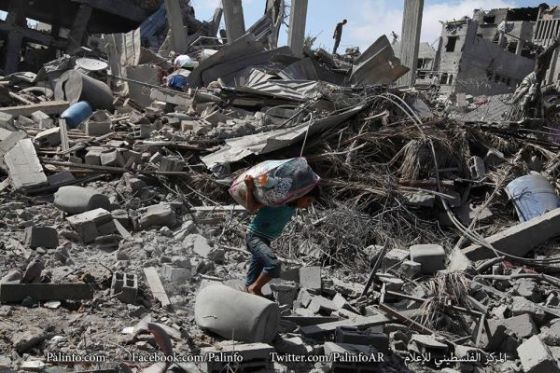
Sharif Abdel Kouddous reports: The destruction is total. No building has been left untouched by Israel’s bombardment in the Masryeen neighborhood in this northeast Gaza town. Mounds of rubble line the streets where buildings once stood. Dead horses and donkeys lie in the road, stiff with rigor mortis. Even colors have been erased. The entire area is covered in grey cement dust, a monochromatic wasteland. The smell of death lingers in the air as the bodies yet to be retrieved from the debris decompose in the summer heat. The sounds of shelling and airstrikes have stopped but the buzzing of the drones remains.

A 12-hour humanitarian truce agreed to by Israel and Hamas took hold on Saturday morning, allowing residents displaced from the areas hardest hit by Israel’s assault to return to their neighborhoods for the first time in days. Gaza health officials said more than 100 bodies were recovered during the lull, bringing the Palestinian death toll above 1,000, the vast majority of them civilians, including more than 200 children. Forty-three Israeli soldiers and three civilians in Israel have also been killed. On Sunday, as the conflict entered its 20th day, Israel announced that it would extend the quiet for 24 hours, but a more lasting cease-fire remains elusive. (And by Sunday’s end in Gaza, the fighting resumed.)

“We don’t just want a humanitarian truce, we want a total cease-fire that will end the siege. Truce after truce is not what we’re looking for,” Ihab al-Hussein, Hamas’s deputy information minister, told me in an interview on Saturday in Gaza City. “This is not a real truce because that would mean Israel pulling out its tanks from Gaza,” he said. “We didn’t start this war, we don’t want it. If you ask Palestinian people they say they want a cease-fire but with an agreement to end the siege.”

In the hours leading up the temporary cease-fire, the Israeli air force dropped 100 bombs, each containing a ton of explosives on Beit Hanoun, a town in northeastern Gaza close to the borders with Israel, according to Haaretz. Many of Beit Hanoun’s 30,000 residents had fled the area.

The devastation is so complete that some residents who returned during the temporary cease-fire on Saturday could not locate where their homes once stood. A man walked alone in the middle of the road surveying the wreckage. “This is a town of ghosts, not people,” he said aloud to himself.

Hamza al-Masry, a 27-year-old from al-Masryeen, sat crouched atop a pile of broken cement and twisted rebar that used to be his family home, a four-story apartment building that once housed 50 people. He came back to try and salvage something. There was nothing left.

“I couldn’t get anything out. I can’t even find clothes,” he said. “I only have the ones I am wearing.” He says he left his home with his family on Monday and sought refuge in a nearby United Nations school. The shelter was shelled on Thursday as 1,500 displaced Palestinians had gathered in the schoolyard awaiting buses to transfer them to another area.

Al-Masry said at least four shells hit the school sending hundreds fleeing into the streets in panic. Sixteen people were killed and 200 wounded in the attack. Displaced again, al-Masry is now staying at another U.N. school in Jabalia, further south. “We don’t want a cease-fire anymore,” he said. “After the destruction we have seen, all we want is resistance.” [Continue reading…]


Facebooktwittermail

‘Only stones remain’: Gaza lies in ruins

Mohammed Omer reports: Umm Ahmed Abu Sahwish holds stones in her hands. They are now all that’s left of her demolished home. “My home is gone and only stones remain,” the 65-year-old says.

Hundreds of homes here have been destroyed, and unexploded Israeli missiles litter the ground at the entrance to the town, at Gaza’s northern tip near the border with Israel. The local hospital, emergency rescue equipment, and infrastructure have also incurred heavy damage from Israeli shelling.

Another woman, from a family of 20 people, cries as she tries to dig through the rubble of her house. “Lifetimes of personal and household belongings are gone, with one Israeli missile. Where can we go? We have no food, water, bedding or extra clothes,” she says.

Driving the length of this tiny stretch of land – 1.8 million Palestinians live on Gaza’s 360sq km – scenes of devastation are everywhere. The trip from the north to the south of Gaza was only possible during a 12-hour humanitarian ceasefire, agreed to by Israel and Hamas on July 26.

On Sunday, Israel resumed its military operation in Gaza, as the prime minister’s office declared: “If residents are inadvertently hit, it is Hamas which is responsible given that it has – again – violated the humanitarian truce that Israel acceded to.” [Continue reading…]

Facebooktwittermail

Rabid Jewish nationalism now governs Israel

Lisa Goldman writes: The vast majority of Israeli Jews support the military operation, called Protective Edge, but leftist Jews and the Arab minority organized anti-war protests, primarily in liberal Tel Aviv and then in Haifa, a mixed Arab-Jewish city.

There’s nothing new in seeing a minority of Israelis protest a popular war. It is not unprecedented for that minority to be met by counter-protestors who wrap themselves in the flag and call out insults like “traitor.” But this time something new and worrying happened: Peaceful, unarmed demonstrators in Israel’s two most liberal cities were physically attacked by ultra-nationalists wielding stones and bottles. In Haifa, nationalist thugs assaulted the Arab deputy mayor, slamming the middle-aged man down on the pavement. In Tel Aviv, they chased anti-war protestors into a cafe and smashed a chair over the head of one of them, even as municipal sirens wailed to announce an incoming rocket from Gaza. The police were ineffective in stopping the violence. Later, it emerged that the ultra-nationalist attackers had organized via a Facebook group managed by a well-known rap artist – a tattooed, muscular fellow who goes by the name The Shadow.

Something has broken down in Israeli society. Friends who always said they would never leave because they were too deeply rooted in the place, its language and their families are deeply worried and even despairing over the radical rightward shift of the mainstream political discourse. Several have said they were looking for opportunities abroad because they couldn’t see themselves raising their children in a country where dissent was slowly but surely being suppressed even as the national discourse hardened rightward.

Israel has always been a flawed democracy with many festering internal divisions. Its policies toward the Arab minority reflect the unresolved tension of a conflicted identity: Should Israel aspire to be a liberal democracy or a democracy for Jews? But in the five years since Benjamin Netanyahu was elected prime minister and formed a governing coalition composed of far-right, racist and anti-democratic parties, something very fundamental has changed in Israeli society. It feels as though the majority is willing to suspend essential elements of democracy in favor of Jewish nationalism. There doesn’t seem to be a place for dissent anymore.

Facebooktwittermail

Father recounts witnessing his family killed by Israeli missile strike

Ayman Mohyeldin reports: Hassan Al Hallaq did what any sensible parent would do: When the latest bout of violence erupted here, he moved his family — heavily pregnant wife, Samar, and two young sons — away from their apartment on the outskirts of town and into the middle of Gaza City.

Away from the border, away from the tunnels, the rockets and the front line, Al Hallaq thought his wife and sons Kenan, 6, and four-year-old Saji would be safe.

The IT manager at a Palestinian bank had lived with his family through two previous wars and knew his neighborhood in East Gaza would be targeted by the Israelis because it is close to the border.

Facebooktwittermail

Israel is not my birthright

Shira Lipkin: I’m writing this in my new baby niece’s room. I am here in Florida visiting my family because of this niece, this tiny pudgy innocent baby. We are Jewish, and it’s time for my niece to receive her Hebrew name in a sweet little ceremony at our longtime synagogue.

Last night I sat at the synagogue next to my 19-year-old daughter. I felt a swell of joy as the services began; I’d been away too long. I’d loved services as a child and teenager.

And then we hit the first mention of Israel as the Promised Land, and I burst into tears.

On the way to services, I’d caught up on Twitter a bit. I’d read about the Israeli missiles still falling on Palestine. I’d read about the outright murder of Palestinian children.

And I sat there and listened to the rabbi call Israel our Promised Land, and it broke something in me.

I am an American Jew of a certain age (40), and what that means is that I was raised to believe that Israel was ours by divine right.

It sounds ridiculous when you say it aloud. Especially because, like many of my generation of Jews, I’m not particularly religious. Many Jews my age slid into paganism, a sort of ambivalent agnosticism, or outright atheism; we are cultural Jews rather than religious Jews. And yet when I first spoke about the conflict between Israel and Palestine some years ago, I found that falling out of my mouth – that God promised us Israel. It’s ours because God said so.

My daughter, trying to comfort me after the services, said, “Maybe it is the Promised Land, just not right now.”

My daughter is an atheist. And the narrative got her, too.

The history we are taught in our Sunday school is that we were there first, and that therefore the Palestinians are occupying our land. How long ago were we there, though? And who, exactly, is we? I find myself using that we – “We need to stop bombing Palestine,” “we need to give land back,” but I am not Israeli. I have never been to Israel. This is how deep it runs, this idea of possession. [Continue reading…]

Facebooktwittermail

Israel is destroying itself by clinging to victimhood

David Grossman writes: Look at us: The strongest nation in the region, a regional superpower that enjoys the support of the United States on an almost inconceivable scale, along with the sympathy and commitment of Germany, England and France – and still, deep inside, it sees itself as a helpless victim. And still it behaves like a victim – of its anxieties, its real and imagined fears, its tragic history, of the mistakes of its neighbors and enemies.

Facebooktwittermail

Bibi = Bashar

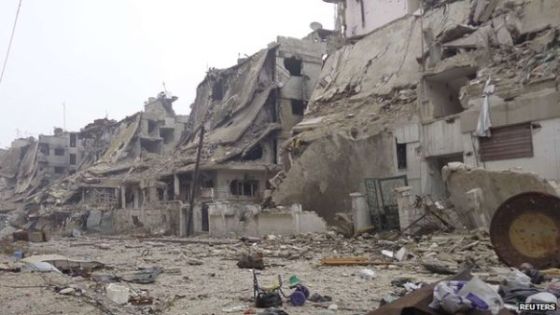
When Bashar al-Assad proceeded to destroy Homs and other Syrian cities, President Obama and other Western leaders declared, “Assad must go.”

Homs

Homs, Syria

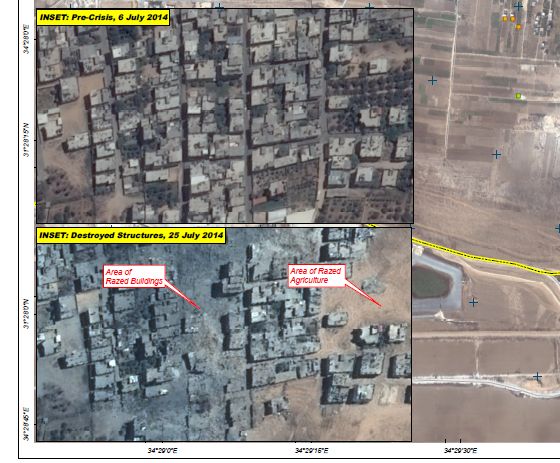
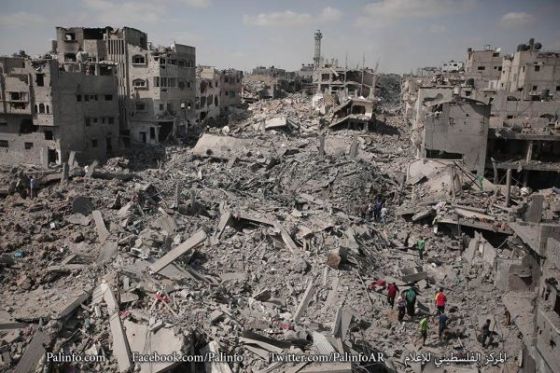
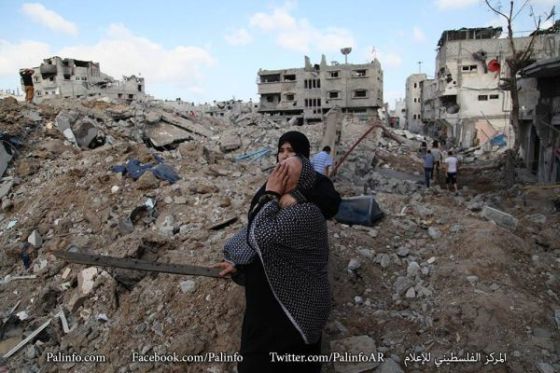
When Benjamin Netanyahu ordered the IDF to destroy Shujaiyah while killing hundreds of Palestinians across the Gaza Strip, President Obama and other Western leaders declared, “Israel has the right to defend itself.”

Shujaiyah, Gaza

Shujaiyah, Gaza

Shujaiyah, Gaza

Shujaiyah, Gaza

Shujaiyah, Gaza

Shujaiyah, Gaza

In its response to the suffering of the people in Gaza and in Syria, the West has once again shown its impotence and moral bankruptcy.

Facebooktwittermail

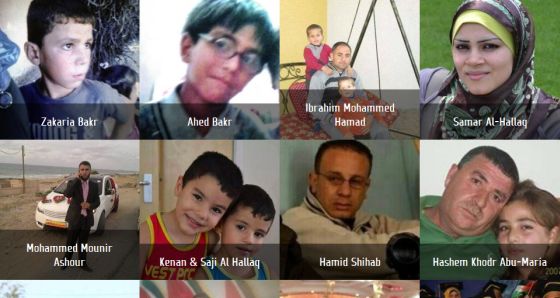
Beyond Numbers: Remembering the victims of Israeli operation ‘Protective Edge’ on Gaza

The Beyond Numbers platform aims to remember all innocent victims of the Israeli Operation “Protective Edge” on Gaza, launched on July 8, 2014. Each picture portrays a victim and his/her story, rather than a number to add to the death count.

The platform is regularly updated by Palestinians living in the conflict zone through the website’s proprietary crowdsourcing interface. The hope is to inspire the world to take action and call for the end of the violence.

beyondthenumber

Facebooktwittermail

Russian paper issues front page apology to Netherlands for MH17

Foreign Policy: In the aftermath of the downing of Malaysia Airlines Flight 17, many Russian media outlets have put forth a variety of ridiculous conspiracy theories to explain the plane’s demise. In the face of overwhelming evidence that Moscow-backed separatists shot down the plane, the Russian media stubbornly insists that the thugs armed, funded, and led by the Kremlin could not possibly have done such a thing. On Friday, a corner of the Russian media offered them all a powerful rebuke.

In a striking front-page design that serves as a testament to the power of that dying medium, the liberal Novaya Gazeta offered an apology to the people of the Netherlands, which lost 193 citizens in the crash. “Forgive us, Netherlands,” reads the headline.

Novaya Gazeta is one of the few — if not the last — liberal newspapers operating in Russia. It has a small circulation and its readership is mostly limited to Moscow. Anna Politkovskaya, the legendary war reporter who chronicled the horror of Russian military operations in Chechnya only to be murdered for running afoul of the regime, wrote for the paper. Mikhail Gorbachev is a shareholder.

But it’s hard not to think that this front page will land the paper on the Kremlin’s blacklist.

Facebooktwittermail

The secret government rulebook for labeling you a terrorist

The Intercept reports: The Obama administration has quietly approved a substantial expansion of the terrorist watchlist system, authorizing a secret process that requires neither “concrete facts” nor “irrefutable evidence” to designate an American or foreigner as a terrorist, according to a key government document obtained by The Intercept.

The “March 2013 Watchlisting Guidance,” a 166-page document issued last year by the National Counterterrorism Center, spells out the government’s secret rules for putting individuals on its main terrorist database, as well as the no fly list and the selectee list, which triggers enhanced screening at airports and border crossings. The new guidelines allow individuals to be designated as representatives of terror organizations without any evidence they are actually connected to such organizations, and it gives a single White House official the unilateral authority to place entire “categories” of people the government is tracking onto the no fly and selectee lists. It broadens the authority of government officials to “nominate” people to the watchlists based on what is vaguely described as “fragmentary information.” It also allows for dead people to be watchlisted.

Over the years, the Obama and Bush Administrations have fiercely resisted disclosing the criteria for placing names on the databases — though the guidelines are officially labeled as unclassified. In May, Attorney General Eric Holder even invoked the state secrets privilege to prevent watchlisting guidelines from being disclosed in litigation launched by an American who was on the no fly list. In an affidavit, Holder called them a “clear roadmap” to the government’s terrorist-tracking apparatus, adding: “The Watchlisting Guidance, although unclassified, contains national security information that, if disclosed … could cause significant harm to national security.” [Continue reading…]

Facebooktwittermail

10,000 bodies: Inside Syrian President Bashar al-Assad’s crackdown

The Wall Street Journal reports: At Hospital 601, not far from the presidential palace in Damascus, Syrian guards ran out of space to store the dead and had to use an adjoining warehouse where military vehicles were repaired.

A forensic photographer working for Syria’s military police walked the rows and took pictures of the emaciated and disfigured corpses, most believed to be anti-Assad activists. Numbers written on the bodies and on white cards, the photographer said, told regime bureaucrats the identities of the deceased, when they died and which branch of the Syrian security services had held them.

U.S. investigators who have reviewed many of the photos say they believe at least 10,000 corpses were cataloged this way between 2011 and mid-2013. Investigators believe they weren’t victims of regular warfare but of torture, and that the bodies were brought to the hospital from the Assad regime’s sprawling network of prisons. They were told some appeared to have died on site.

Last year, the Syrian military-police photographer defected to the West. Investigators later gave him the code name Caesar to disguise his identity. He turned over to U.S. law-enforcement agencies earlier this year a vast trove of postmortem photographs from Hospital 601 that he and other military photographers took over the two-year period, which he helped smuggle out of the country on digital thumb drives.

Over the ensuing months, U.S. investigators pored over the photos, which depicted the deaths and the elaborate counting system, and started to debrief Caesar and other activists involved in his defection. U.S. and European investigators have since concluded not only that the images were genuine, but that they offered the best evidence to date of an industrial-scale campaign by the government of Bashar al-Assad against its political opponents. U.S. Ambassador-at-large Stephen Rapp, head of the State Department’s Office of Global Criminal Justice, has compared the pattern to some of the most notorious acts of mass murder of the past century.

This account, based on interviews with war-crimes investigators in the U.S. and Europe, more than a dozen defectors, and opposition leaders working with Caesar, provides fresh details about Syria’s crackdown on its political opponents and the central role of Hospital 601 in processing bodies and documenting the deaths for the government.

Investigators haven’t finished analyzing the entire cache of photographs and are still trying to gather evidence to fully understand the regime’s role in the deaths. Prosecutors must be careful about jumping to conclusions before all the evidence is in, cautioned a senior U.S. official, who noted that investigators are far from finished debriefing Caesar.

The Federal Bureau of Investigation unit that investigates genocide and war crimes, and other agencies, hope to soon get a more detailed account of what happened at Hospital 601 from Caesar, officials said. Some U.S. officials want to use Caesar’s photographs, which show bodies that appear to have been strangled, beaten or disfigured, to build a case for a potential war-crimes prosecution of the Assad regime. It is unclear when, if ever, such a case might be brought. [Continue reading…]

Facebooktwittermail

After CIA gets secret whistleblower email, Congress worries about more spying

McClatchy reports: The CIA obtained a confidential email to Congress about alleged whistleblower retaliation related to the Senate’s classified report on the agency’s harsh interrogation program, triggering fears that the CIA has been intercepting the communications of officials who handle whistleblower cases.

The CIA got hold of the legally protected email and other unspecified communications between whistleblower officials and lawmakers this spring, people familiar with the matter told McClatchy. It’s unclear how the agency obtained the material.

At the time, the CIA was embroiled in a furious behind-the-scenes battle with the Senate Intelligence Committee over the panel’s investigation of the agency’s interrogation program, including accusations that the CIA illegally monitored computers used in the five-year probe. The CIA has denied the charges.

The email controversy points to holes in the intelligence community’s whistleblower protection systems and raises fresh questions about the extent to which intelligence agencies can elude congressional oversight. [Continue reading…]

Facebooktwittermail

Mustafa Barghouti: ‘The Intifada has started’

At Mondoweiss, Martin Gajsek reports: Fireworks burst at the separation wall, lighting the heads of Israeli soldiers who are poised ready with loaded guns. Overhead, flare guns also brighten the scene at Qalandia checkpoint, quickly followed by shots from Israeli snipers that race into the burgeoning crowd. In the middle of the haze and chaos Palestinian politician Dr. Mustafa Barghouti is clear in his definition of the events unfolding around him, “The Intifada has started. This is the Intifada! Peaceful and nonviolent but as you have seen, they encountered us with gunshots,” Barghouti told Mondoweiss. Amidst his words, molotov cocktails hit the military watchtowers, while young men scrambled by in a desperate attempt to get the wounded out of the line of fire.

At around 9 p.m. last night, the streets of Ramallah started to flood with Palestinian protesters, all of them heading in the same direction — Qalandia Checkpoint. One of the biggest protests the West Bank has seen since the end of the second Intifada took place, with a march of several thousand Palestinians towards the checkpoint between Ramallah and Jerusalem. The march was to demonstrate solidarity with the people in Gaza who have been under heavy bombardment for the past two weeks. That bombardment has been part of Israel’s latest military incursion, Operation Protective Edge, and has resulted in the death of over 800 people. Conservative figures state that at least 70% of the casualties are civilian, among them nearly 200 children. [Continue reading…]

Facebooktwittermail

A morality lesson on Israel and Hamas from an American four-star general

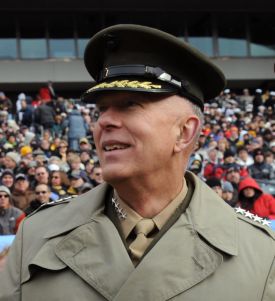
In spite of this nation’s numerous military misadventures and its corrupt military establishment, many Americans still have an uncritical admiration for this country’s generals — men whose stainless uniforms and steely faces seem to be an outward representation of their trustworthiness and moral stature.

Gen. James T. Conway USMC (Ret)

Gen. James T. Conway USMC (Ret)

Who better to speak in defense of Israel, than a good Christian soldier like retired General James T Conway, former commander of the United States Marine Corps?

Propaganda, which is nothing more than a form of political advertising, works by engaging its target audience emotionally while circumventing any kind of analytical process. It trades in ideas whose truth should seem so obvious that we will accept them without thought. And the easiest way of making an idea seem true is through endless repetition.

The Israeli government and those inside and outside Israel who operate in its service, have settled on two messages — on human shields and tunnels — through which they want to demonize Hamas and cover up war crimes committed by the Israeli Defense Forces.

In “The Moral Chasm Between Israel and Hamas,” an op-ed for the Wall Street Journal, this is how Conway regurgitates Israel’s message about human shields:

Israel’s military exists to protect its civilian population and seeks to avoid harming noncombatants, while its adversary cynically uses Palestinian civilians as human shields while deliberately targeting Israeli civilians.

Conway describes the Hamas tunnels, of which Israel is reported to have discovered about 30, as having been “designed for launching murder and kidnapping raids.”

Let’s first consider the claim that Hamas uses human shields, since this has become Israel’s favorite explanation for why the IDF has killed hundreds of Palestinian civilians.

The human shield, as a concept, is a mainstay of American movie and TV drama. We all know how it works.

The bad guys hold women and children at gunpoint and the good guys hold fire because they don’t want to kill the innocents.

It’s an expression of the moral depravity and cowardice of evil men who know how to exploit the good intentions of righteous men. (It’s also a narrative in which the heroes and villains are all men and the powerless women can do no more than hope they fall into the right arms.)

So how does this work in Gaza. The evil Hamas fighters hide behind the women and children and then the Israelis kill the women and children.

Wait a minute! That’s not how it’s supposed to work. What’s the point of holding a human shield if your adversary has little interest in protecting the life of that supposed “shield”?

This gets to the nub of the issue: the only kind of human shield worth holding is one whose life is valued by your adversary.

The Israelis understand this. That’s why, as has been well documented, they have been seen using Palestinians as human shields.

The closest Hamas can come to making forcible use of human shields is by taking prisoners. Which brings us to the tunnels.

The tunnel is the perfect abode of the bogeyman. It has iconic power in the representation of an invisible evil force — a force which emerges out of darkness and might spring up from anywhere. No wonder Israel’s propagandists believe they can use the “terrorist-tunnel threat” to their advantage.

There’s no question that militants in Gaza have constructed tunnels under the fortified perimeter which surrounds the open-air prison of the Gaza Strip. We can also surmise that these have not been constructed to provide “escape” routes to Israel.

What we can deduce is that far more time and effort has been invested in the construction of these tunnels than in their use. Moreover, if or when any of these tunnels gets put into service there is a high probability that the IDF will quickly thereafter discover the tunnel’s location and just as quickly destroy it.

The implication, therefore, is that these tunnels have been constructed as part of a defensive infrastructure to only be used at a time of necessity. That inference is further reinforced by the fact that extended periods of calm during which ceasefires have been in effect, have not been interrupted by the Palestinians going on the offensive and trying to capture Israeli soldiers in the vicinity of the fence.

* * *

I don’t actually know whether General Conway is a Christian soldier. He could believe in the non-dual philosophy of Advaita Vedanta. He could be a Sufi, or he might be an initiate of the Kabbalah.

What I do know is that when Conway left the Pentagon, like so many of his other colleagues, he passed through the revolving door that leads straight into the defense industry. There he became a director of Textron, a corporation one of whose subsidiaries, AAI, manufactures drones used by Israel.

I have little doubt that when sales reps for AAI tout the effectiveness of their products, they proudly point out how they have been “battlefield tested” by the IDF.

In other words, to be absolutely blunt, when General Conway takes to the pages of the Wall Street Journal to offer lessons on the morality of Israel’s current war on Gaza, I have little doubt that this is a war from which Conway is personally profiting — and therein, I would suggest, lies the real morality tale.

Facebooktwittermail

The right of armed resistance

Giles Fraser, who is a priest in the Church of England, founder of the Inclusive Church, and has lectured on moral leadership to the British Army, writes: For decades now the United Nations has been unable to agree a definition of terrorism. Even our own supreme court recently concluded that there is no internationally agreed definition. The stumbling block has been that western governments want states and state agents to be exempt from any definition. And a number of Islamic counties want some national liberation movements exempt.

Or, to put it in terms of today’s news: the Israelis won’t have any definition that would make them terrorists for bombing old people’s homes in Gaza, and West Bank Palestinians won’t have any definition that will make them terrorists for fighting back against occupation with petrol bombs. Writing in his annual report this week, David Anderson QC, the government’s independent reviewer of terrorism legislation, sounds exasperated: “The intractability of some of these questions has induced a degree of defeatism among those seeking to define terrorism.”

I am eating aubergines and flatbread with Dr Samah Jabr in a cool Palestinian cafe in Stoke Newington. A psychiatrist and psychotherapist who works out of East Jerusalem, Dr Jabr is quietly spoken, modest, and perhaps just a little bit shocked by my lapses into overly colourful language. She is an educated, middle-class Palestinian (in no way a rabble-rouser) but she insists that the word terrorist has become a powerful – though often un-thought-through – political pejorative employed to discredit legitimate resistance to the violence of occupation.

What some would call terrorism, she would call a moral duty. She gives me her paper on the subject. “Why is the word ‘terrorist’ so readily applied to individuals or groups who use homemade bombs, but not to states using nuclear and other internationally proscribed weapons to ensure submission to the oppressor?” she asks. She insists that violent resistance must be used in defence and as a last resort. And that it is important to distinguish between civilian and military targets. “The American media call our search for freedom ‘terrorism’,” she complains, “despite the fact that the right to self-determination by armed struggle is permissible under the UN charter’s article 51, concerning self-defence.” [Continue reading…]

Facebooktwittermail