Jon Lee Anderson writes: “Step by step, we have led Crimeans to realize their dream of returning home to Russia,” Vladimir Konstantinov, the speaker of the breakaway Crimean legislature, told his colleagues recently, as they hastily voted in a new, Russia-friendly constitution. The dream was not universally shared, of course. During the March referendum to rubber-stamp the peninsula’s annexation by Russia, the region’s long-oppressed Tatar minority had launched a boycott. On the eve of the vote, a Tatar man was abducted and tortured to death, presumably by pro-Russian thugs. It was a warning—perhaps an intentional one — of the violence and provocation now occurring in eastern Ukraine, where pro-Russian paramilitaries are increasingly active, with the apparent connivance of the Kremlin. Last week, the Tatars’ historic leader, Mustafa Dzhemilev, who spent years in Soviet prisons for agitating on behalf of his people, went to Ukraine in an attempt to meet with Joe Biden; on the way home, he received papers informing him that he was barred from reëntering Crimea until 2019. The Kremlin and the regional government have denied the ban, and he was eventually let through. But it was a clear sign that the Russian-backed authorities have little sympathy for the Tatars. The acting Prime Minister, Sergei Aksyonov, a former gangster, noted on Twitter that any Tatars who were unhappy with the new order in Crimea should “leave if they don’t like it.”
For the second time in seventy years, the Crimean Tatars are forced to confront a complete upending of their lives. The Tatars, Muslim descendants of Genghis Khan’s Golden Horde, saw virtually their entire community — some two hundred thousand people — uprooted in May, 1944, after Stalin’s forces took Crimea from the occupying Nazis. Stalin justified the occupation by pointing out that some Tatars had fought alongside the Nazis in the war — even though others had fought in the Red Army. Nearly half of the Tatars are thought to have died in the harsh conditions of their deportation and the early years of their exile.
In the late nineteen-eighties, as the Soviet Union opened up a bit, Tatars were allowed to return, and a trickle began coming back from Central Asia. Those who could afford it returned to their villages, but few provisions were made for their reintegration into Ukrainian society, and there was no compensation for the properties they had lost. Many ended up squatting on public lands, where they remain. Known as the “original inhabitants” of the peninsula, Crimea’s Tatars now constitute twelve per cent of the region’s population. They are the poorest and least educated section of society, and the least represented in local government. For all the rhetoric emanating from the Kremlin—and from Kiev—they are effectively the Ukraine’s Lakota Sioux. [Continue reading…]
Category Archives: Issues
Report lists 13 times nuclear weapons were almost launched
The Guardian reports: A report recounting a litany of near-misses in which nuclear weapons came close to being launched by mistake concludes that the risk of potentially catastrophic accidents is higher than previously thought and appears to be rising.
Too Close for Comfort: Cases of Near Nuclear Use and Options for Policy, published by Chatham House, says that “individual decision-making, often in disobedience of protocol and political guidance, has on several occasions saved the day”, preventing the launch of nuclear warheads.
The report lists 13 instances since 1962 when nuclear weapons were nearly used. In several cases the large-scale launch of nuclear weapons was nearly triggered by technical malfunctions or breakdowns in communication causing false alarms, in both the US and Russia. Disaster was averted only by cool-headed individuals gambling that the alert was caused by a glitch and not an actual attack. [Continue reading…]
Stop using Microsoft’s IE browser until bug is fixed, U.S. and U.K. warn
If you don’t already use Firefox, it’s probably time to install it.
CNET reports: It’s not often that the US or UK governments weigh in on the browser wars, but a new Internet Explorer vulnerability — one that affects all major versions of the browser from the past decade — has forced them to raise an alarm: Stop using IE.
The zero-day exploit, the term given to a previously unknown, unpatched flaw, allows attackers to install malware on your computer without your permission. That malware could be used to steal personal data, track online behavior, or gain control of the computer. Security firm FireEye, which discovered the bug, said that the flaw is being used with a known Flash-based exploit technique to attack financial and defense organizations in the US via Internet Explorer 9, 10, and 11. Those versions of the browser run on Microsoft’s Windows Vista, Windows 7, and Windows 8, although the exploit is present in Internet Explorer 6 and above.
While the Computer Emergency Readiness Team in England and the US regularly issue browser advisories, this is one of the few times that the CERT team has recommended that people avoid using a specific browser. [Continue reading…]
The U.S. supreme court needs to keep up with our cellphones – and the NSA
Yochai Benkler writes: Tuesday’s US supreme court arguments involved a seemingly basic legal question about the future of the Fourth Amendment: do police officers need a warrant to search the cellphone of a person they arrest? But the two privacy cases pit against each other two very different conceptions of what it means to be a supreme court in the first place – and what it means to do constitutional law in the 21st century.
“With computers, it’s a new world,” several justices reportedly said in the chamber. Are they ready to be the kinds of justices who make sense of it?
Cellphones expose so much of our most personal data that the decision should be a 9-0 no-brainer. The basic problem that makes it a harder call is that lawyers and judges are by training and habit incrementalists, while information and communications technology moves too fast for incrementalism to keep up. [Continue reading…]
How many have we killed with drones?
David Cole writes: On Monday, The New York Times reported that “the Senate has quietly stripped a provision from an intelligence bill that would have required President Obama to make public each year the number of people killed or injured in targeted killing operations in Pakistan and other countries where the United States uses lethal force.” National security officials in the Obama administration objected strongly to having to notify the public of the results and scope of their dirty work, and the Senate acceded. So much for what President Obama has called “the most transparent administration in history.”
The Senate’s decision is particularly troubling in view of how reticent the administration itself continues to be about the drone program. To date, Obama has publicly admitted to the deaths of only four people in targeted killing operations. That came in May 2013, when, in conjunction with a speech at the National Defense University, and, in his words, “to facilitate transparency and debate on the issue,” President Obama acknowledged for the first time that the United States had killed four Americans in drone strikes. But according to credible accounts, Obama has overseen the killing of several thousand people in drone strikes since taking office. Why only admit to the four Americans’ deaths? Is the issue of targeted killings only appropriate for debate when we kill our own citizens? Don’t all human beings have a right to life?
In the NDU speech, President Obama also announced new limits on the use of drones “beyond the Afghan theater.” He proclaimed that drone strikes would be authorized away from the battlefield only when necessary to respond to “continuing and imminent threats” posed by people who cannot be captured or otherwise countermanded. Most important, he said, “before any strike is taken, there must be near-certainty that no civilians will be killed or injured—the highest standard we can set.” Yet in December, a US drone strike in Yemen reportedly struck a wedding party. The New York Times reported that while some of the victims may have been linked to al-Qaeda, the strike killed “at least a half dozen innocent people, according to a number of tribal leaders and witnesses.” [Continue reading…]
Mystery surrounds move of Afghan ‘torturer in chief’ to U.S. amid allegations of spy agency abuse
The Washington Post reports: In Afghanistan, his presence was enough to cause prisoners to tremble. Hundreds in his organization’s custody were beaten, shocked with electrical currents or subjected to other abuses documented in human rights reports. Some allegedly disappeared.
And then Haji Gulalai disappeared as well.
He had run Afghan intelligence operations in Kandahar after the U.S.-led invasion in 2001 and later served as head of the spy service’s detention and interrogation branch. After 2009, his whereabouts were unknown.
Because of his reputation for brutality, Gulalai was someone both sides of the war wanted gone. The Taliban tried at least twice to kill him. Despite Gulalai’s ties to the CIA and Afghan President Hamid Karzai, United Nations officials and U.S. coalition partners sought to rein him in or have him removed.
Today, Gulalai lives in a pink two-story house in Southern California, on a street of stucco homes on the outskirts of Los Angeles. [Continue reading…]
Israel advanced some 14,000 West Bank apartments during talks
JTA reports: Israel promoted plans and tenders for nearly 14,000 housing units in the West Bank during the nine months of peace talks, the activist group Peace Now said.
An average of 50 apartments was built daily in the West Bank throughout the U.S.-backed negotiations launched last summer, the nongovernmental organization said in a report issued Tuesday.
Of the tenders issued for building new apartments, 2,248 were in the West Bank and 2,620 in eastern Jerusalem, according to Peace Now. In addition, tenders for another 1,235 were reissued for units that were not sold in previous tenders. [Continue reading…]
Anand Gopal: How to lose a war that wasn’t there
You might think that 12-and-a-half years after it began, Washington would have learned something useful about its war on terror, but no such luck. If you remember, back in the distant days just after 9/11 when that war was launched (or, in a sense, “lost”), the Bush administration was readying itself to take out not just Osama bin Laden and his relatively small al-Qaeda outfit but “terror” itself, that amorphous monster of the twenty-first century. They were planning to do so in somewhere between 60 and 83 countries and, as they liked to say, “drain the swamp” globally.
In reality, they launched an overblown war not so much “on” terror, but “of” terror, one that, in place after place, from Afghanistan to Somalia, Pakistan to parts of Africa, destabilized regions and laid the basis for a spreading jihadist movement. In so many cases, as at Abu Ghraib and Guantanamo, they fulfilled Osama bin Laden’s wildest fantasies, creating the sort of recruiting posters from hell for future jihadists that al-Qaeda was itself incapable of.
So many years later, they seem to be repeating the process in Yemen. They are now escalating a “successful” drone and special operations war against a group in that impoverished land that calls itself al-Qaeda in the Arabian Peninsula (AQAP). The drones turn out to be pretty good at knocking off various figures in that movement, but they are in another sense like a godsend for it. In what are called “targeted killings,” but might better be termed (as Paul Woodward has) “speculative murders,” they repeatedly wipe out civilians, including women, children, and in one recent case, part of a wedding party. They are Washington’s calling card of death and as such they only ensure that more Yemenis will join or support AQAP.
The process of creating ever more enemies you must then kill started in Afghanistan in 2001, even if that remains news to most Americans. Now, TomDispatch regular Anand Gopal in his new book No Good Men Among the Living: America, the Taliban, and the War Through Afghan Eyes offers a stunning history of how the U.S. fought its “war on terror” for almost a year in that country against — quite literally — ghosts. In the process, it resuscitated a Taliban movement that had ceased to exist and then found itself in a conflict it couldn’t win. It’s a story that’s never been told before, even if Washington’s second Afghan War makes no sense without it.
For many Americans, as Henry Ford so famously put it, history is bunk. In this case, however, history turns out to be everything that matters, and the rest has proved to be bloody, painful, and costly bunk. If you don’t believe me, read Gopal’s hidden history of the Afghan War at this website today and then get your hands on his book. Tom Engelhardt
How the U.S. created the Afghan war — and then lost it
The unreported story of how the Haqqani network became America’s greatest enemy
By Anand GopalIt was a typical Kabul morning. Malik Ashgar Square was already bumper-to-bumper with Corolla taxis, green police jeeps, honking minivans, and angry motorcyclists. There were boys selling phone cards and men waving wads of cash for exchange, all weaving their way around the vehicles amid exhaust fumes. At the gate of the Lycée Esteqial, one of the country’s most prestigious schools, students were kicking around a soccer ball. At the Ministry of Education, a weathered old Soviet-style building opposite the school, a line of employees spilled out onto the street. I was crossing the square, heading for the ministry, when I saw the suicide attacker.
He had Scandinavian features. Dressed in blue jeans and a white t-shirt, and carrying a large backpack, he began firing indiscriminately at the ministry. From my vantage point, about 50 meters away, I couldn’t quite see his expression, but he did not seem hurried or panicked. I took cover behind a parked taxi. It wasn’t long before the traffic police had fled and the square had emptied of vehicles.
Twenty-eight people, mostly civilians, died in attacks at the Ministry of Education, the Ministry of Justice, and elsewhere across the city that day in 2009. Afterward, U.S. authorities implicated the Haqqani Network, a shadowy outfit operating from Pakistan that had pioneered the use of multiple suicide bombers in headline-grabbing urban assaults. Unlike other Taliban groups, the Haqqanis’ approach to mayhem was worldly and sophisticated: they recruited Arabs, Pakistanis, even Europeans, and they were influenced by the latest in radical Islamist thought. Their leader, the septuagenarian warlord Jalaluddin Haqqani, was something like Osama bin Laden and Al Capone rolled into one, as fiercely ideological as he was ruthlessly pragmatic.
And so many years later, his followers are still fighting. Even with the U.S. withdrawing the bulk of its troops this year, up to 10,000 Special Operations forces, CIA paramilitaries, and their proxies will likely stay behind to battle the Haqqanis, the Taliban, and similar outfits in a war that seemingly has no end. With such entrenched enemies, the conflict today has an air of inevitability — but it could all have gone so differently.
Kerry clarifies when, where, and how the words ‘Israel’ and ‘apartheid’ can be used in the same sentence
In a statement issued by the State Department, Secretary of State John Kerry said: “I do not believe, nor have I ever stated, publicly or privately, that Israel is an apartheid state or that it intends to become one.” [Emphasis mine.]
In a closed-door meeting on Friday, Kerry had said:
“A two-state solution will be clearly underscored as the only real alternative. Because a unitary state winds up either being an apartheid state with second class citizens—or it ends up being a state that destroys the capacity of Israel to be a Jewish state.”
Kerry has now offered clarification to that statement by saying:
“I have been around long enough to also know the power of words to create a misimpression, even when unintentional, and if I could rewind the tape, I would have chosen a different word to describe my firm belief that the only way in the long term to have a Jewish state and two nations and two peoples living side by side in peace and security is through a two state solution. In the long term, a unitary, binational state cannot be the democratic Jewish state that Israel deserves or the prosperous state with full rights that the Palestinian people deserve. That’s what I said, and it’s also what Prime Minister Netanyahu has said. While Justice Minister Livni, former Prime Ministers Barak and Ohlmert have all invoked the specter of apartheid to underscore the dangers of a unitary state for the future, it is a word best left out of the debate here at home.”
In other words, in order to avoid startling and disappointing the likes of Abe Foxman, ‘apartheid’ is a word best reserved for conversations with Israelis.
Hamas and the tyranny of labels
Paul Pillar writes: The Israeli prime minister says Hamas is “dedicated to the destruction of Israel.” Actually, Hamas leaders have repeatedly made clear a much different posture, one that involves indefinite peaceful coexistence with Israel even if they officially term it only a hudna or truce. It would be more accurate to say that Israel is dedicated to the destruction of Hamas, an objective that Israel has demonstrated with not just its words but its deeds, including prolonged collective punishment of the population of the Gaza Strip in an effort to strangle the group. Such efforts have included large-scale violence that—although carried out overtly by military forces and thus not termed terrorism—has been every bit as lethal to innocent civilians. In such circumstances, why should Hamas be expected to be the first to go beyond the vocabulary of hudna and mouth some alternative words about the status of its adversary?
The Israeli and U.S. reactions do not seem to take account of the fact that the terms of the announced Hamas-PLO reconciliation are undetermined and still under negotiation. The agreement can involve Hamas moving much more toward the posture of Abbas and the PLO than the other way around. Palestinian Authority representatives already have indicated that there will not be a change in its fundamental stance of recognizing Israel and seeking to resolve the conflict with it peacefully through negotiations. Hamas representatives have pointed out that support for a governing coalition with an established set of policies does not require each party that is part of that government to express identical policies on its own behalf. In fact, that is true of coalition governments everywhere. The coalition government in Britain does things that you won’t find in the Liberal Democrats’ platform. [Continue reading…]
U.S. senators remove requirement for disclosure over drone strike victims
The Guardian reports: At the behest of the director of national intelligence, US senators have removed a provision from a major intelligence bill that would require the president to publicly disclose information about drone strikes and their victims.
The bill authorizing intelligence operations in fiscal 2014 passed out of the Senate intelligence committee in November, and it originally required the president to issue an annual public report clarifying the total number of “combatants” and “noncombatant civilians” killed or injured by drone strikes in the previous year. It did not require the White House to disclose the total number of strikes worldwide.
But the Guardian has confirmed that Senate leaders have removed the language as they prepare to bring the bill to the floor for a vote, after the director of national intelligence, James Clapper, assured them in a recent letter that the Obama administration was looking for its own ways to disclose more about its highly controversial drone strikes. [Continue reading…]
Kerry warns Israel could become ‘an apartheid state’
John Kerry echoes former Israeli prime ministers Ehud Olmert and Ehud Barak. The Daily Beast reports: If there’s no two-state solution to the Israeli-Palestinian conflict soon, Israel risks becoming “an apartheid state,” Secretary of State John Kerry told a room of influential world leaders in a closed-door meeting Friday.
Senior American officials have rarely, if ever, used the term “apartheid” in reference to Israel, and President Obama has previously rejected the idea that the word should apply to Jewish State. Kerry’s use of the loaded term is already rankling Jewish leaders in America—and it could attract unwanted attention in Israel, as well.
It wasn’t the only controversial comment on the Middle East that Kerry made during his remarks to the Trilateral Commission, a recording of which was obtained by The Daily Beast. Kerry also repeated his warning that a failure of Middle East peace talks could lead to a resumption of Palestinian violence against Israeli citizens. He suggested that a change in either the Israeli or Palestinian leadership could make achieving a peace deal more feasible. He lashed out against Israeli settlement-building. And Kerry said that both Israeli and Palestinian leaders share the blame for the current impasse in the talks.
Kerry also said that at some point, he might unveil his own peace deal and tell both sides to “take it or leave it.”
“A two-state solution will be clearly underscored as the only real alternative. Because a unitary state winds up either being an apartheid state with second class citizens—or it ends up being a state that destroys the capacity of Israel to be a Jewish state,” Kerry told the group of senior officials and experts from the U.S., Western Europe, Russia, and Japan. “Once you put that frame in your mind, that reality, which is the bottom line, you understand how imperative it is to get to the two state solution, which both leaders, even yesterday, said they remain deeply committed to.” [Continue reading…]
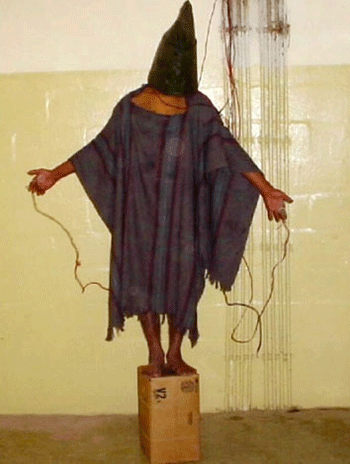
Karen Greenberg: Abu Ghraib never left us
In mid-April, Abu Ghraib was closed down. It was a grim end for the Iraqi prison where the Bush administration gave autocrat Saddam Hussein a run for his money. The Iraqi government feared it might be overrun by an al-Qaeda offshoot that calls itself the Islamic State of Iraq and the Levant. By then, the city of Fallujah for which American troops had fought two bitter, pitched battles back in 2004 had been in the hands of those black-flag-flying insurgents for months. Needless to say, the American project in Iraq, begun so gloriously — remember Iraqi exiles assuring Vice President Cheney that the invaders would be greeted with “sweets and flowers” — was truly in ruins. By then, hundreds of thousands had died in the aftermath of the 2003 invasion, the insurgencies that followed, and the grimmest of sectarian civil wars. And the temperature was rising anew in that divided land, where only the Kurdish north was relatively peaceful. Iraq was once again threatening to fracture, with suicide bombers and car bombs daily occurrences, especially in Shiite areas of the country, and the body count rising rapidly.
The legacy of America’s Iraq is essentially an oil-producing wreck of a state with another autocrat in power, a Shiite government allied to Iran in Baghdad, and a Sunni population in revolt. That, in short, is the upshot of Washington’s multi-trillion-dollar war. It might be worth a painting by George W. Bush. Or maybe the former president should reserve his next round of oils not for the world leaders he met (and Googled), but for those iconic photos from the prison that might have closed in Iraq, but will never close in the American mind. From the torture troves of Abu Ghraib, there are so many scenes that the former president could focus on in his days of tranquil retirement.
Those photos from hell were, at the time, so run-of-the-mill for the new American Iraq (“as common as cornflakes”) that they were used as screen-savers by U.S. military guards at that prison. The images then returned to the United States as computer “wallpaper” before making it onto “60 Minutes II” and into our collective brains. They revealed to this country for the first time that, post-9/11, Washington had taken a cue from the Marquis de Sade and any other set of sadists you cared to invoke. Of course, the photos and the systematic torture and abuse that went with them at Abu Ghraib were quickly blamed on the usual “few bad apples” and “some hillbilly kids out of control.”
As it happened, those photos that first entered public consciousness 10 years ago this week exposed a genuine American nightmare that led right to the top in Washington and has never ended. Included in the debacle were Justice Department lawyers who, at the bidding of the highest officials in the land, redefined torture in remarkable ways. They made it clear, for instance, that the only person who could affirm whether torture had actually taken place was the torturer himself. (If he didn’t think he had tortured, he hadn’t, or so the reasoning then went.)
No one has followed this endlessly grim tale more assiduously than TomDispatch regular Karen Greenberg, the chronicler of the creation of the prison at Guantanamo Bay and the editor of The Torture Papers: The Road to Abu Ghraib. Today, she explores the shameful tale of why, a decade later, the Abu Ghraib affair remains without an end. Tom Engelhardt
The road from Abu Ghraib
A torture story without a hero or an ending
By Karen J. GreenbergIt’s mind-boggling. Torture is still up for grabs in America. No one questions anymore whether the CIA waterboarded one individual 83 times or another 186 times. The basic facts are no longer in dispute either by those who champion torture or those who, like myself, despise the very idea of it. No one questions whether some individuals died being tortured in American custody. (They did.) No one questions that it was a national policy devised by those at the very highest levels of government. (It was.) But many, it seems, still believe that the torture policy, politely renamed in its heyday “the enhanced interrogation program,” was a good thing for the country.
Now, the nation awaits the newest chapter in the torture debate without having any idea whether it will close the book on American torture or open a path of pain and shame into the distant future. No one yet knows whether we will be allowed to awake from the nightmarish and unacceptable world of illegality and obfuscation into which torture and the network of offshore prisons, or “black sites,” plunged us all.
Low-level federal judges balking at law enforcement requests for electronic evidence
The Washington Post reports: Judges at the lowest levels of the federal judiciary are balking at sweeping requests by law enforcement officials for cellphone and other sensitive personal data, declaring the demands overly broad and at odds with basic constitutional rights.
This rising assertiveness by magistrate judges — the worker bees of the federal court system — has produced rulings that elate civil libertarians and frustrate investigators, forcing them to meet or challenge tighter rules for collecting electronic evidence.
Among the most aggressive opinions have come from D.C. Magistrate Judge John M. Facciola, a bow-tied court veteran who in recent months has blocked wide-ranging access to the Facebook page of Navy Yard shooter Aaron Alexis and the iPhone of the Georgetown University student accused of making ricin in his dorm room. In another case, he deemed a law enforcement request for the entire contents of an e-mail account “repugnant” to the U.S. Constitution. [Continue reading…]
How the world failed on climate change
Brad Plumer writes: It was the early 1990s. Climate scientists had long known that humans were warming up the planet. But politicians were just beginning to grasp that it would take a huge coordinated effort to get nations to burn fewer fossil fuels and avoid sharp temperature increases in the decades ahead.
Those policymakers needed a common goal — a way to say, Here’s how bad things will get and This is what we need to do to stop it. And that posed a dilemma. No one could really agree on how much global warming was unacceptable. How high did the seas need to rise before we had a serious problem? How much heat was too much?
Around this time, an advisory council of scientists in Germany proposed a stunningly simple way to think about climate change. Look, they reasoned, human civilization hasn’t been around all that long. And for the last 13,000 years, Earth’s climate has fluctuated within a narrow band. So, to be on the safe side, we should prevent global average temperatures from rising more than 2° Celsius (or 3.6° Fahrenheit) above what they were just before the dawn of industrialization.
Critics grumbled that the 2°C limit seemed arbitrary or overly simplistic. But scientists were already compiling evidence that the risks of global warming became especially daunting somewhere above the 2°C threshold: rapid sea-level rise, the risk of crop failure, the collapse of coral reefs. And policymakers loved the idea of a simple, easily digestible target. So it stuck.
By 2009, nearly every government in the world had endorsed the 2°C limit — global warming beyond that level was deemed “dangerous.” And so, every year, the world’s leaders meet at UN climate conferences to discuss policies and emissions cuts that they hope will keep us below 2°C. Climate experts churn out endless papers on how we can adapt to 2°C of warming (or less).
Two decades later, there’s just one major problem with this picture. The idea that the world can stay below 2°C looks increasingly delusional. [Continue reading…]
Rap News: Israel vs. Palestine
Decades of failed peace talks have led nowhere; but do not lose hope just yet. Join Robert Foster as he attempts to host the first ever Middle East Peace Raps, using rhyme and reason to bring together Israeli Prime Minister Benjamin “Bibi” Netanyahu, and a representative of Hamas. We investigate the key arguments, counter-arguments and ad-hominems from both sides. But the picture would not be complete without a thorough discussion of “America’s last taboo”, as Edward Said once referred to it: the USA’s role as Israel’s best (and only) buddy in the world (Ok, together with Australia).
Averting planetary disaster will mean forcing Big Oil to give up at least $10 trillion in wealth
Chris Hayes writes: In 2012, the writer and activist Bill McKibben published a heart-stopping essay in Rolling Stone titled “Global Warming’s Terrifying New Math.” I’ve read hundreds of thousands of words about climate change over the last decade, but that essay haunts me the most.
The piece walks through a fairly straightforward bit of arithmetic that goes as follows. The scientific consensus is that human civilization cannot survive in any recognizable form a temperature increase this century more than 2 degrees Celsius (3.6 degrees Fahrenheit). Given that we’ve already warmed the earth about 0.8 degrees Celsius, that means we have 1.2 degrees left — and some of that warming is already in motion. Given the relationship between carbon emissions and global average temperatures, that means we can release about 565 gigatons of carbon into the atmosphere by mid-century. Total. That’s all we get to emit if we hope to keep inhabiting the planet in a manner that resembles current conditions.
Now here’s the terrifying part. The Carbon Tracker Initiative, a consortium of financial analysts and environmentalists, set out to tally the amount of carbon contained in the proven fossil fuel reserves of the world’s energy companies and major fossil fuel–producing countries. That is, the total amount of carbon we know is in the ground that we can, with present technology, extract, burn and put into the atmosphere. The number that the Carbon Tracker Initiative came up with is… 2,795 gigatons. Which means the total amount of known, proven extractable fossil fuel in the ground at this very moment is almost five times the amount we can safely burn.
Proceeding from this fact, McKibben leads us inexorably to the staggering conclusion that the work of the climate movement is to find a way to force the powers that be, from the government of Saudi Arabia to the board and shareholders of ExxonMobil, to leave 80 percent of the carbon they have claims on in the ground. That stuff you own, that property you’re counting on and pricing into your stocks? You can’t have it.
Given the fluctuations of fuel prices, it’s a bit tricky to put an exact price tag on how much money all that unexcavated carbon would be worth, but one financial analyst puts the price at somewhere in the ballpark of $20 trillion. So in order to preserve a roughly habitable planet, we somehow need to convince or coerce the world’s most profitable corporations and the nations that partner with them to walk away from $20 trillion of wealth. Since all of these numbers are fairly complex estimates, let’s just say, for the sake of argument, that we’ve overestimated the total amount of carbon and attendant cost by a factor of 2. Let’s say that it’s just $10 trillion.
The last time in American history that some powerful set of interests relinquished its claim on $10 trillion of wealth was in 1865 — and then only after four years and more than 600,000 lives lost in the bloodiest, most horrific war we’ve ever fought.
It is almost always foolish to compare a modern political issue to slavery, because there’s nothing in American history that is slavery’s proper analogue. So before anyone misunderstands my point, let me be clear and state the obvious: there is absolutely no conceivable moral comparison between the enslavement of Africans and African-Americans and the burning of carbon to power our devices. Humans are humans; molecules are molecules. The comparison I’m making is a comparison between the political economy of slavery and the political economy of fossil fuel.
More acutely, when you consider the math that McKibben, the Carbon Tracker Initiative and the Intergovernmental Panel on Climate Change (IPCC) all lay out, you must confront the fact that the climate justice movement is demanding that an existing set of political and economic interests be forced to say goodbye to trillions of dollars of wealth. It is impossible to point to any precedent other than abolition. [Continue reading…]
The bear and the dragon: Russia pivots to China in the face of western sanctions
The Globe and Mail reports: On March 20, the U.S. authorized sanctions against billionaire Gennady Timchenko amid the escalating crisis between Russia and Ukraine. Three weeks later, the Russian tycoon, who amassed a fortune trading oil and selling natural gas, appeared on Russian television. He was not in Russia at the time. He was in China. The West, he said, was “pushing us away.” China was not. In fact, Chinese companies were talking with Mr. Timchenko about buying more of Russia’s abundant energy.
“There is a market with a lot of potential developing in the Asia-Pacific region,” said the billionaire, who boasts close ties to Vladimir Putin and has been called one of Russia’s most powerful men.
This week, the country’s Prime Minister was even more explicit: “We are interested in diversifying today more so than ever before. Therefore we are implementing solutions for the export of gas and oil to Asian and Pacific countries, first and foremost China,” Dmitry Medvedev said on Russian television.
As the global fissures radiating from Russia’s moves against Ukraine call into question the future of its ties with Western powers, Russia is increasingly casting its gaze east, to a distant border long neglected. In May, Mr. Putin is expected to come to Beijing to sign a major contract that will see Russia pipe vast quantities of natural gas to China. It will mark the sixth meeting between Mr. Putin and Chinese President Xi Jinping since the beginning of 2013, as Russia pushes for a “pivot east” that has taken on sudden new urgency in the wake of the country’s moves in Ukraine, which have earned it global criticism, and an increasing likelihood of punitive sanctions.
The change stands to have wide-reaching ramifications, redrawing geopolitical alignments and altering global energy flows, a matter of concern to Canada, among others.
For Russia’s economy, Ukraine stands to create “a major crisis,” said Vassily Kasin, a China expert with the Centre for Analysis of Strategies and Technologies, a Moscow-based defence studies organization. “And China will become the major economic partner.” The two countries “will in fact move very close to an alliance, I think,” he said. “This is a major change.” [Continue reading…]