Category Archives: Issues

What was done to the Jews for generations, the Jews are now doing to themselves

o13-iconGideon Levy writes: This kind of talk could only take place in darkness; in beer cellars, at violent fringe demonstrations or at the headquarters of outlawed organizations. Only the extreme, fascist, neo-Nazi, anti-Semitic and xenophobic right would dare to breathe a word of it. Only skinheads and their masters would dare to speak of national purity and of defining their country based on ethnicity, religion, race, nationality or heredity.

No one would dare to say France for the French, America is all-American, Germany is a German state or Italy is a Catholic one. Anyone who did so wouldn’t be considered credible. These countries are democracies of all their citizens; their character is determined by the components of the entire population. Living in each are minorities, their numbers growing in this era of globalization and migration. No one speaks of a nation-state, of a state of one religion, of one racial group.

But this kind of talk is fashionable in Israel. It’s legitimate and even Zionist: a Jewish state. Only in Israel are individual rights and the character of the state determined by origin, like having a Jewish great-grandmother. The hell with members of minority groups – most of whom were born here.

This kind of talk has also become a basic condition for the negotiations with the Palestinians. It’s just a cheap excuse, of course – one more obstacle on the road to reaching a peace agreement, heaven forfend. But the disease’s malignant symptoms are deeply encoded in Israel’s DNA.

Israel is returning to the ghetto, building its own neo-ghetto with its own two hands. Welcome to the Israel Ghetto; it built the walls and fences that surround it long ago, and the mental and cultural walls are on the way. What was done to the Jews for generations, the Jews are now doing to themselves: judging people by their ancestors and withdrawing into a ghetto-state whose nature will be determined by its degree of purity. [Continue reading…]

Facebooktwittermail

How America’s billionaires are taking over science

f13-iconWilliam J Broad writes: American science, long a source of national power and pride, is increasingly becoming a private enterprise.

In Washington, budget cuts have left the nation’s research complex reeling. Labs are closing. Scientists are being laid off. Projects are being put on the shelf, especially in the risky, freewheeling realm of basic research. Yet from Silicon Valley to Wall Street, science philanthropy is hot, as many of the richest Americans seek to reinvent themselves as patrons of social progress through science research.

The result is a new calculus of influence and priorities that the scientific community views with a mix of gratitude and trepidation.

“For better or worse,” said Steven A. Edwards, a policy analyst at the American Association for the Advancement of Science, “the practice of science in the 21st century is becoming shaped less by national priorities or by peer-review groups and more by the particular preferences of individuals with huge amounts of money.”

They have mounted a private war on disease, with new protocols that break down walls between academia and industry to turn basic discoveries into effective treatments. They have rekindled traditions of scientific exploration by financing hunts for dinosaur bones and giant sea creatures. They are even beginning to challenge Washington in the costly game of big science, with innovative ships, undersea craft and giant telescopes — as well as the first private mission to deep space.

The new philanthropists represent the breadth of American business, people like Michael R. Bloomberg, the former New York mayor (and founder of the media company that bears his name), James Simons (hedge funds) and David H. Koch (oil and chemicals), among hundreds of wealthy donors. Especially prominent, though, are some of the boldest-face names of the tech world, among them Bill Gates (Microsoft), Eric E. Schmidt (Google) and Lawrence J. Ellison (Oracle).

This is philanthropy in the age of the new economy — financed with its outsize riches, practiced according to its individualistic, entrepreneurial creed. The donors are impatient with the deliberate, and often politicized, pace of public science, they say, and willing to take risks that government cannot or simply will not consider.

Yet that personal setting of priorities is precisely what troubles some in the science establishment. Many of the patrons, they say, are ignoring basic research — the kind that investigates the riddles of nature and has produced centuries of breakthroughs, even whole industries — for a jumble of popular, feel-good fields like environmental studies and space exploration.

As the power of philanthropic science has grown, so has the pitch, and the edge, of the debate. Nature, a family of leading science journals, has published a number of wary editorials, one warning that while “we applaud and fully support the injection of more private money into science,” the financing could also “skew research” toward fields more trendy than central.

“Physics isn’t sexy,” William H. Press, a White House science adviser, said in an interview. “But everybody looks at the sky.”

Fundamentally at stake, the critics say, is the social contract that cultivates science for the common good. They worry that the philanthropic billions tend to enrich elite universities at the expense of poor ones, while undermining political support for federally sponsored research and its efforts to foster a greater diversity of opportunity — geographic, economic, racial — among the nation’s scientific investigators.

Historically, disease research has been particularly prone to unequal attention along racial and economic lines. A look at major initiatives suggests that the philanthropists’ war on disease risks widening that gap, as a number of the campaigns, driven by personal adversity, target illnesses that predominantly afflict white people — like cystic fibrosis, melanoma and ovarian cancer. [Continue reading…]

Facebooktwittermail

Compare the NSA’s Facebook malware denial to its own secret documents

f13-iconRyan Gallagher writes: On Wednesday, Glenn Greenwald and I revealed new details about the National Security Agency’s efforts to radically expand its ability to hack into computers and networks across the world. The story has received a lot of attention, and one detail in particular has sparked controversy: specifically, that the NSA secretly pretended to be a fake Facebook server in order to covertly infect targets with malware “implants” used for surveillance.

This revelation apparently infuriated Facebook founder Mark Zuckerberg so much that he got on the phone to President Barack Obama to complain about it. “I’ve been so confused and frustrated by the repeated reports of the behavior of the US government,” Zuckerberg wrote in a blog post Thursday. “When our engineers work tirelessly to improve security, we imagine we’re protecting you against criminals, not our own government.”

That wasn’t all. Wired ran a piece saying that the NSA’s widespread use of its malware tools “acts as implicit permission to others, both nation-state and criminal.” Slate noted that the NSA’s hacking platform appears to be “becoming a bit more like the un-targeted dragnets everyone has been so upset about.” Meanwhile, Ars Technica wrote that the surveillance technology we exposed “poses a risk to the entire Internet.”

In response, the NSA has attempted to quell the backlash by putting out a public statement dismissing what it called “inaccurate” media reports. The agency denied that it was “impersonating U.S. social media or other websites” and said that it had not “infected millions of computers around the world with malware.” The statement follows a trend that has repeatedly been seen in the aftermath of major disclosures from documents turned over by NSA whistleblower Edward Snowden, in which the NSA or one of its implicated allies issues a carefully worded non-denial denial that on the face of it seems to refute an allegation but on closer inspection does not refute it at all. [Continue reading…]

Facebooktwittermail

Obama’s duty is to defend the Constitution, not the CIA

Steve Coll writes: In the vestibule of Room 211 of the Hart Senate Office Building, just to the north of the Capitol, a cop guards an inner door that requires a numerical code to open it. The room, where the staff of the Senate Select Committee on Intelligence sits, is called a “skiff,” for “sensitive compartmented information facility.” Last week, Senator Dianne Feinstein, the committee’s chair, described secret documents that are now apparently stored in the office. She did so publicly, during a remarkable jeremiad on the Senate floor, which was part “Homeland” treatment, part grand-jury instruction. She recounted several years of maneuvering between the committee staff and the C.I.A., before announcing “grave concerns” that agency officers had broken the law and violated the Constitution during a struggle over the documents.

Feinstein called them the Panetta Review, in reference to the former C.I.A. director Leon Panetta, who left the agency in 2011. The documents were prepared by C.I.A. officers, and although their contents are secret, their subject matter is clear and vitally important: the true history of the brutal interrogation of about a hundred Al Qaeda leaders and suspects at offshore C.I.A. “black sites” between roughly 2002 and 2006, on orders of the Bush Administration. The interrogations included the use of “enhanced interrogation techniques,” such as waterboarding, which constituted torture in the judgment of the Red Cross and many other authorities. Feinstein suggested that the Panetta Review may illuminate still disputed issues; namely, whether the program produced significant intelligence, whether the C.I.A. lied to Congress about it, and how cruel and degrading the black sites really were.

Barack Obama ended the program on his second day in office, in 2009, denouncing it as torture. Yet he also signalled that he would not hold the C.I.A. or its career officers accountable for the past. Moreover, he decided to advance the C.I.A.’s role in counterterrorism, which complicated the options for examining the interrogation program. The C.I.A.’s Counterterrorism Center ran the sites. It also managed the agency’s drone program and the hunt for Osama bin Laden. Obama called its officers into action, ordering drone strikes in Pakistan and encouraging the agency to finally find bin Laden, which it did, in 2011. For the President to have investigated some of the same personnel for past complicity in torture would have been awkward. [Continue reading…]

Facebooktwittermail

Should Ukraine have given up its nuclear arsenal?

e13-iconThe Guardian reports: Ukraine’s prime minister Arseniy Yatsenyuk has accused Russia of demonstrating unacceptable “military aggression” which has “no reason and no grounds”.

Moscow has deployed 10,000 troops along its border with Ukraine, deepening the crisis in Crimea ahead of a last desperate effort by the US secretary of state, John Kerry, to broker a deal with his Russian counterpart, Sergei Lavrov, in London on Friday.

Yatsenyuk told the UN security council on Thursday he is convinced Russians do not want war. He urged Russia’s leaders to heed the people’s wishes and return to dialogue with Ukraine. “If we start real talks with Russia, I believe we can be real partners,” Yatsenyuk said.

He said Ukraine gave up the world’s third-largest nuclear arsenal in 1994 in exchange for guarantees of its independence and territorial integrity. After Russia’s recent actions, Yatsenyuk said, “it would be difficult to convince anyone on the globe not to have nuclear weapons”. [Continue reading…]

In an op-ed for the New York Times yesterday, John Mearsheimer wrote: The West has few options for inflicting pain on Russia, while Moscow has many cards to play against Ukraine and the West. It could invade eastern Ukraine or annex Crimea, because Ukraine regrettably relinquished the nuclear arsenal it inherited when the Soviet Union broke up and thus has no counter to Russia’s conventional superiority.

No doubt, if Israel’s leaders are ever pushed into a position where they need to defend retaining their own nuclear arsenal, they will surely be tempted to cite Professor Mearsheimer’s position — that giving up such weapons can turn out to be regrettable.

Let’s suppose, however, that Ukraine was still bristling with nuclear weapons — at its peak its arsenal was larger than those of Britain, France, and China combined — are we to imagine that its interim government would now be making veiled threats to incinerate Moscow? Are we to suppose that Russian forces would have stayed out of Crimea? After all, how many wars have Israel’s nuclear weapons prevented?

It seems just as likely that in the current situation, Putin would be arguing that Russia had no choice but take over the whole of Ukraine — not under the pretext of protecting ethnic Russians but in the name of defending global security, his argument being that in an unstable Ukraine, “loose nukes” pose a threat to everyone.

What seems regrettable is not that Ukraine gave up its nuclear weapons but that the security guarantees it was given for doing so appear to have been worthless.

Facebooktwittermail

Russia blocks access to major independent news sites

Electronic Frontier Foundation reports: Russia’s government has escalated its use of its Internet censorship law to target news sites, bloggers, and politicians under the slimmest excuse of preventing unauthorized protests and enforcing house arrest regulations. Today, the country’s ISPs have received orders to block a list of major news sites and system administrators have been instructed to take the servers providing the content offline.

The banned sites include the online newspaper Grani, Garry Kasparov’s opposition information site kasparov.ru, the livejournal of popular anti-corruption crusader Alexei Navalny, and even the web pages of Ekho Moskvy, a radio station which is majority owned by the state-run Gazprom, and whose independent editor was ousted last month and replaced with a more government-friendly director.

The list of newly prohibited sites was published earlier today by Russia’s Prosecutor General, which announced that the news sites had been “entered into the single register of banned information” after “calls for participation in unauthorized rallies.” Navalny’s livejournal was apparently added to the register in response to the conditions of his current house arrest, which include a personal prohibition on accessing the Internet. [Continue reading…]

Facebooktwittermail

How the Russia Today propaganda apparatus operates

a13-iconBuzzFeed reports: Staci Bivens knew something was seriously wrong when her bosses at Russia Today asked her to put together a story alleging that Germany — Europe’s economic powerhouse — was a failed state.

“It was me and two managers and they had already discussed what they wanted,” Bivens, an American who worked in RT’s Moscow headquarters from 2009 through 2011, said of a meeting she’d had to discuss the segment before a planned reporting trip to Germany. “They called me in and it was really surreal. One of the managers said, ‘The story is that the West is failing, Germany is a failed state.’”

Bivens, who had spent time in Germany, told the managers the story wasn’t true — the term “failed state” is reserved for countries that fail to provide basic government services, like Somalia or Congo, not for economically advanced, industrialized nations like Germany. They insisted. Bivens refused. RT flew a crew to Germany ahead of Bivens, who was flown in later to do a few standups and interviews about racism in Germany. It was the beginning of the end of her RT career.

“At that point I’d been there for a little bit and I’d had enough of the insanity,” Bivens said. She stayed until the end of her contract in 2011 and didn’t make an effort to renew it.

Judging by interviews with seven former and current employees, Bivens’ story is typical. [Continue reading…]

Facebooktwittermail

Yarmouk and a contagion of doubt

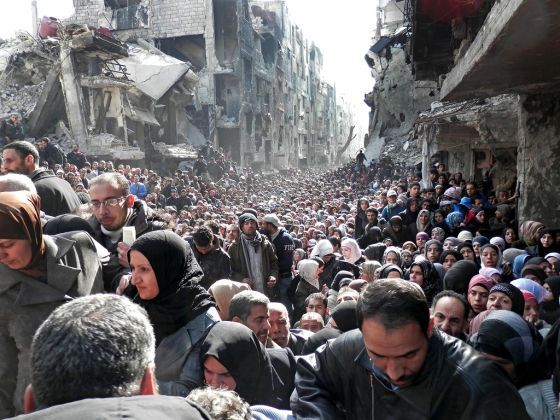
U.N. Denies That Syria Image Was Faked” and “U.N. Denies Altering Image of Palestinian Refugees in Damascus” — both headlines appeared in the New York Times on Tuesday and referred to doubts that have been expressed about the authenticity of what has become an iconic representation of suffering in Syria.

Yarmouk

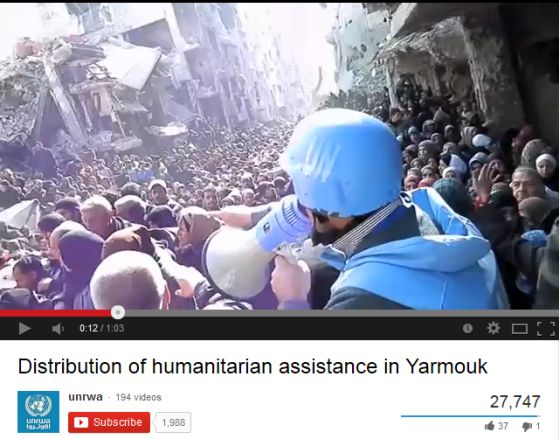
As the following screenshot taken from a video that the United Nations Relief and Works Agency (UNRWA) posted on YouTube and filmed at the same time as the photo above makes clear, the photograph’s authenticity is beyond doubt.

unrwa-yarmouk

Paradoxically, the fact that UN officials were put in a position where they needed to refute accusations that the photograph had been faked, and the New York Times’ own headlines, will quite likely have had the opposite of the intended effect. Where doubts may have previously been few, they are now just as likely to continue growing.

We live in an age of doubt and the internet is its engine — the very notion that something can be “beyond doubt” has itself become an object of doubt.

As someone who from a very early age was taught to question — I was lucky enough to have parents and teachers who recognized that questioning is a vital instrument of intelligence — the proliferation of doubt might to my eye look like a positive development. It might seem like a sign that people are less susceptible to manipulation by the political and corporate forces which shape popular thought. But I see little evidence that this is indeed the case.

On the contrary, the doubt that spreads so easily has less to do with critical intelligence and much more to do with suspicion and fear. The “fake” meme is much more contagious than any sober analysis.

Doubt and cynicism are held onto because they offer psychic armor for shielding ourselves from the dark forces controlling the world. The price, however, for those who employ this form of protection, is that it tends to render them immobile.

Yet clearly, the image of Yarmouk’s starving residents that got retweeted more than eight million times was not being passed around primarily by those who had doubts about what the photograph depicted.

As Chris Gunness, the spokesman for UNRWA said: “I saw that image and said, ‘This has the wow factor.’”

It is an image that resonates and does so for multiple reasons. Strange as it may sound, this is not only a news image but also a work of art.

In accordance with the principle of the “golden ratio” (or divine proportion), it is a perfectly balanced composition. It is a photograph that could just as easily be a painting.

More than simply capturing a moment of one day for one particular group of people, it seems to represent something timeless about the vulnerability of all people throughout history in times of war.

Within the skeletal remains of a city shattered by human brutality, we see that reinforced concrete is easier to destroy than the will to live.

Hope and desperation come together.

Facebooktwittermail

U.N. refugee chief warns world powers not to forget Syria conflict

n13-iconn13-iconReuters reports: The head of the United Nation’s refugee agency said on Tuesday it must be ready in case Ukraine’s crisis causes refugees to flee Crimea, but his biggest worry is that “a total disaster” could occur if the international community diverts its attention away from Syria’s conflict.

Antonio Guterres, the head of the U.N.’s High Commission for Refugees (UNHCR), said in an interview that little progress was being made in efforts by the United States and Russia, now at loggerheads over Ukraine, to bring Syria’s warring sides together after the collapse of talks in Geneva last month.

“In the moment in which we need the most relevant countries in the world to be able to come together to narrow their differences and to try to find a way to move into peace for Syria, this tension around Ukraine will obviously not help,” Guterres told Reuters while visiting Washington to discuss Syria’s refugee crisis.

“I hope that those that have the most important responsibility in world affairs will be able to understand that forgetting Syria will be a total disaster,” he said. [Continue reading…]

Facebooktwittermail

Editor of independent Russian news site replaced with pro-Kremlin figure

n13-iconThe Guardian reports: In what appears to be part of a growing state crackdown on liberal media, the editor of a major independent Russian news website has been replaced by a Kremlin-friendly editor after running an interview with a controversial Ukrainian nationalist.

Lenta.ru announced on its site on Wednesday that Galina Timchenko, who had worked there since its founding in 1999, would immediately be replaced by Alexei Goreslavsky, the former editor of the pro-Kremlin internet publication Vzglyad. Goreslavsky is currently deputy general director for external communications at the Afisha-Rambler-SUP media holding that owns Lenta.ru.

The news came only hours after the state communications watchdog issued a warning to Lenta.ru over a recent interview with Dmytro Yarosh, leader of the Ukrainian ultranationalist paramilitary group Right Sector, which played a key role in the protests that ousted President Viktor Yanukovych. The Investigative Committee of Russia, the country’s main federal investigator, has charged Yarosh, who recently announced he would run for president in Ukraine’s May elections, with inciting terrorism over a post on a Right Sector social network page that called on Russia’s most-wanted terrorist, Doku Umarov, to “activate his struggle.”

But a letter posted on Lenta.ru and signed by 69 employees and correspondents said Goreslavsky’s appointment amounted to “direct pressure on the Lenta.ru editorial staff” and a violation of censorship laws. Lenta.ru’s editorial policy, which embraced controversial topics and was often critical of the Kremlin, won the site a wide readership, including 13.6 million unique visitors last month, according to Rambler.ru rankings.

“This is absolutely a political situation,” said Lenta.ru’s night editor, Pavel Borisov. “Galina Timchenko was the best editor-in-chief I ever had. I don’t plan to work with Goreslavsky.” The change in editor came with no warning, he added. [Continue reading…]

Facebooktwittermail

Nick Turse: American proxy wars in Africa

Our major post-9/11 wars are goners and the imagery of American war-making is heading downhill. The Iraq War was long ago left in the trash heap of history, while in Afghanistan the talk is now about “the zero option” — that is, about an irritated Obama administration making a lock, stock, and drone departure from that country as 2014 ends. Meanwhile, back in America, headlines indicate that the U.S. military stands trembling at the brink of evisceration, with the U.S. Army soon to return to pre-World War II levels of troop strength and all the services about to go on a diet in an era of belt-tightening.  The only new arms being promoted are the ones Republicans are “up in” when it comes to the potential destruction of U.S. military might.

As it happens, the impression this leaves bears only the most minimal relationship to the actual U.S. global military posture of this moment.  The Middle Eastern and Persian Gulf buildup around Iran remains massive, even as talks on that country’s nuclear program are underway.  Despite the “zero option” media focus on Afghanistan, Obama administration officials seem determined that a residual force of trainers, mentors, and special operations types will remain in that country to anchor a rump war after combat troops leave this year.  They clearly expect the successor to the recalcitrant President Hamid Karzai to sign the necessary bilateral security pact — even if at the last moment.  As for the axe being taken to the Pentagon budget, it turns out, at worst, to be a penknife.

In the meantime, hardly noticed amid all the hoopla about future cuts to Army strength (which do indicate a genuine no-invasions-no-occupations-on-the-Eurasian-landmass change of strategy initiated in the late Bush years), there has been next to no attention paid to a striking piece of budgetary news: despite speculations about cuts to its fleet of aircraft carriers, the U.S. Navy is expected to keep its full contingent of 11 aircraft carrier strike groups — essentially 11 giant floating bases off the world’s coasts.  This fits well with the Obama administration’s much ballyhooed “pivot” to Asia.  As Michael Klare recently explained, that pivot is, at heart, a naval strategy (consonant with those 11 carriers) of ensuring ongoing control over the crucial energy sea lanes in the Persian Gulf, the Indian Ocean, and the East and South China Seas through which China is going to have to import staggering amounts of liquid energy in the coming decades.

Finally, on a planet still impressively heavily garrisoned by Washington, hardly noticed by anyone and rarely written about, the U.S. military has for years been quietly moving into Africa in a distinctly below-the-radar fashion.  This represents a major new commitment of American power in a world of supposed cutbacks, but you would never know it.  If you’re a news jockey, every now and then you can catch a report, like David Cloud’s recently in the Los Angeles Times, which offers a brief snapshot of that process with, for instance, a head’s-up that 50 U.S. Special Operations troops have just been put on the ground at a “remote outpost” in Tunisia.  However, only at TomDispatch, thanks to the reporting of Nick Turse, can you find an ongoing account of the U.S. military move into Africa, its planning, its implementation, and the destabilization and blowback that seem to accompany it.  The Pentagon’s newest tactic for Africa, as he documents today: refight the colonial wars in partnership with the French.  Just tell me: What could possibly go wrong? Tom Engelhardt

Washington’s back-to-the-future military policies in Africa
America’s new model for expeditionary warfare
By Nick Turse

Lion Forward Teams? Echo Casemate? Juniper Micron?

You could be forgiven if this jumble of words looks like nonsense to you.  It isn’t.  It’s the language of the U.S. military’s simmering African interventions; the patois that goes with a set of missions carried out in countries most Americans couldn’t locate on a map; the argot of conflicts now primarily fought by proxies and a former colonial power on a continent that the U.S. military views as a hotbed of instability and that hawkish pundits increasingly see as a growth area for future armed interventions.     

Since 9/11, the U.S. military has been making inroads in Africa, building alliances, facilities, and a sophisticated logistics network.  Despite repeated assurances by U.S. Africa Command (AFRICOM) that military activities on the continent were minuscule, a 2013 investigation by TomDispatch exposed surprisingly large and expanding U.S. operations — including recent military involvement with no fewer than 49 of 54 nations on the continent.  Washington’s goal continues to be building these nations into stable partners with robust, capable militaries, as well as creating regional bulwarks favorable to its strategic interests in Africa.  Yet over the last years, the results have often confounded the planning — with American operations serving as a catalyst for blowback (to use a term of CIA tradecraft). 

Continue reading

Facebooktwittermail

Blackwater in Ukraine? No, it was Alpha

Yesterday I laid out a timeline suggesting how the Blackwater-in-Ukraine story may have evolved. I did not, however, attempt to identify the armed men in the video that has kept this rumor alive in social media.

Thanks to a reader who said that the Ukrainian press identified the armed men as “Спецназ (Alpha) СБУ,” I have been able to piece together the story.

The elite Alpha special operations unit is attached to the Security Service of Ukraine.

The reason for their appearance outside the regional administrative building in Donetsk was given in the following local press report, Преступности.Нет (English version):

In Donetsk day 3 March during the seizure of the regional state administration of protesters attacked the ex-Governor of area Andrey shishatskiy.

It is reported by channel «Donbass» on his Youtube page.

So, the footage shows a group of people, among them people with the Russian flag in his hands, and beat former Governor of Donetsk region Shishatskiy.

According to the TV company, beat it from the attackers, interferes with the police and the special forces of the security service of Ukraine covers of his departure.

As is known, today the building of the Donetsk regional Council were captured by a group of Pro-Russian activists, who declared about the illegitimacy of Kyiv and declared himself the new authorities in Donetsk region.

This is the video showing former Governor Shishatskiy being attacked. Although the Alpha unit is not shown, they can be seen in another news report on the same incident.

alpha-donetsk

Before any of the dozens of copies of the video labelled “USA military mercenary BlackWater in Ukraine (Donetsk)” appeared on YouTube, the same video had been posted with this title: “Alpha” – Donetsk. 03/03/2014. The video’s description says: “After the Russian provocations, Special Forces of Alpha security appeared in Donetsk.”

No mention of Blackwater.

Facebooktwittermail

How the NSA plans to infect ‘millions’ of computers with malware

f13-iconRyan Gallagher and Glenn Greenwald report: Top-secret documents reveal that the National Security Agency is dramatically expanding its ability to covertly hack into computers on a mass scale by using automated systems that reduce the level of human oversight in the process.

The classified files – provided previously by NSA whistleblower Edward Snowden – contain new details about groundbreaking surveillance technology the agency has developed to infect potentially millions of computers worldwide with malware “implants.” The clandestine initiative enables the NSA to break into targeted computers and to siphon out data from foreign Internet and phone networks.

The covert infrastructure that supports the hacking efforts operates from the agency’s headquarters in Fort Meade, Maryland, and from eavesdropping bases in the United Kingdom and Japan. GCHQ, the British intelligence agency, appears to have played an integral role in helping to develop the implants tactic.

In some cases the NSA has masqueraded as a fake Facebook server, using the social media site as a launching pad to infect a target’s computer and exfiltrate files from a hard drive. In others, it has sent out spam emails laced with the malware, which can be tailored to covertly record audio from a computer’s microphone and take snapshots with its webcam. The hacking systems have also enabled the NSA to launch cyberattacks by corrupting and disrupting file downloads or denying access to websites.

The implants being deployed were once reserved for a few hundred hard-to-reach targets, whose communications could not be monitored through traditional wiretaps. But the documents analyzed by The Intercept show how the NSA has aggressively accelerated its hacking initiatives in the past decade by computerizing some processes previously handled by humans. The automated system – codenamed TURBINE – is designed to “allow the current implant network to scale to large size (millions of implants) by creating a system that does automated control implants by groups instead of individually.” [Continue reading…]

Facebooktwittermail

How a shift in the FISA court secretly facilitated mass surveillance

n13-iconThe New York Times reports: Ten months after the Sept. 11 attacks, the nation’s surveillance court delivered a ruling that intelligence officials consider a milestone in the secret history of American spying and privacy law. Called the “Raw Take” order — classified docket No. 02-431 — it weakened restrictions on sharing private information about Americans, according to documents and interviews.

The administration of President George W. Bush, intent on not overlooking clues about Al Qaeda, had sought the July 22, 2002, order. It is one of several still-classified rulings by the Foreign Intelligence Surveillance Court described in documents provided by Edward J. Snowden, the former National Security Agency contractor.

Previously, with narrow exceptions, an intelligence agency was permitted to disseminate information gathered from court-approved wiretaps only after deleting irrelevant private details and masking the names of innocent Americans who came into contact with a terrorism suspect. The Raw Take order significantly changed that system, documents show, allowing counterterrorism analysts at the N.S.A., the F.B.I. and the C.I.A. to share unfiltered personal information.

The leaked documents that refer to the rulings, including one called the “Large Content FISA” order and several more recent expansions of powers on sharing information, add new details to the emerging public understanding of a secret body of law that the court has developed since 2001. The files help explain how the court evolved from its original task — approving wiretap requests — to engaging in complex analysis of the law to justify activities like the bulk collection of data about Americans’ emails and phone calls.

“These latest disclosures are important,” said Steven Aftergood, the director of the Project on Government Secrecy at the Federation of American Scientists. “They indicate how the contours of the law secretly changed, and they represent the transformation of the Foreign Intelligence Surveillance Court into an interpreter of law and not simply an adjudicator of surveillance applications.” [Continue reading…]

Facebooktwittermail

Conflict of interest: CIA lawyer at center of computer snooping clash

n13-iconThe Associated Press reports: The senior CIA lawyer accused by the head of the Senate Intelligence Committee of trying to intimidate the panel over its investigation into secret prisons and brutal interrogations of terrorism suspects was himself involved in the controversial programs. The attorney, the CIA’s top lawyer, is cited by name for his role more than 1,600 times in the Senate’s unpublished, 6,300-page investigative report, according to the panel’s chairwoman, Sen. Dianne Feinstein.

Until the California Democrat’s extraordinary Senate speech Tuesday, the CIA’s senior deputy general counsel, Robert Eatinger, was little known outside a small cadre of highly specialized national security lawyers. He has maintained a low profile in a legal career that has spanned two decades at the CIA and in the Navy. But Feinstein’s remarkable accusations instantly made Eatinger famous — or infamous — over a simmering constitutional dispute that threatens to engulf two branches of the government.

Eatinger had filed a formal criminal complaint earlier this year on behalf of the CIA asking the Justice Department to investigate whether the Senate Intelligence Committee had improperly obtained classified CIA documents for an as-yet unreleased Senate report on the agency’s use of waterboarding and other abusive tactics against al-Qaida prisoners during the George W. Bush administration.

Eatinger’s move boomeranged Tuesday. [Continue reading…]

Facebooktwittermail

Why John Kerry’s peace mission should worry liberal Zionists

o13-iconPeter Beinart writes: As John Kerry’s bid to broker Israeli-Palestinian peace approaches its moment of truth, you can sense the desperation among liberal Zionists. “Kerry’s mission is the last train to a negotiated two-state solution,” declared Thomas Friedman in January.

“This is a watershed moment after which Israel will face a completely different situation – one which will be governed by new realities much less favorable than those Israel faces today,” argued the philanthropist S. Daniel Abraham that same month. Kerry himself has said that, “If we do not succeed now, we may not get another chance.”

I get it. You have to be blind not to see that liberal Zionists—those of us who believe in the legitimacy of a state dedicated to Jewish self-protection and the illegitimacy of Israel’s unjust, undemocratic control of the West Bank—are losing ground to one-staters at both ends. Kerry’s failure, which might spell the end of the American-led peace process itself, could turn that retreat into a rout.

But there’s a problem with being desperate for a deal: You lose your leverage over its content. Kerry and the rest of the Obama foreign policy team know that if they present a framework that Benjamin Netanyahu dislikes, he and the right-leaning American Jewish establishment will make their lives miserable. If, on the other hand, they present a framework that tilts against the Palestinians, the resulting Palestinian outrage will be far easier to withstand. That’s partly because Palestinians wield little influence in Washington. And it’s partly because we liberal Zionists—desperate to see Kerry succeed—have given every indication that we’ll support whatever he serves up, the particulars be damned.

The consequences of this political imbalance have been quietly playing themselves out for months now. Numerous press reports have suggested that Kerry is contemplating a framework that offers the Palestinians substantially less than what Bill Clinton offered them in December 2000 and what Ehud Olmert offered in 2008.

The Clinton parameters, for instance, called for Israeli troops to leave the Jordan Valley—the twenty-five percent of the West Bank that abuts its border with Jordan— within three years of a peace deal. Olmert was willing to withdraw them even faster

Mahmoud Abbas is also reportedly calling for a transition of three to five years. Netanyahu, by contrast, depending on whose reporting you believe, insists that Israeli troops must remain for ten or even forty years. 

And Kerry? Palestinian sources say he’s endorsed the ten-year timetable. According to the Washington Post, he’s suggested somewhere between five and fifteen

Kerry’s proposal, in other words, violates both the Clinton parameters and the understanding reached by Olmert and Abbas. Yet with rare exceptions, liberal Zionists aren’t protesting at all.

That’s just the beginning. When it comes to Jerusalem, the Clinton Parameters declared that, “the general principle is that Arab areas are Palestinian and Jewish ones are Israeli.” 

According to Bernard Avishai, Olmert and Abbas agreed to the same concept: “Jewish neighborhoods [of Jerusalem] should remain under Israeli sovereignty, while Arab neighborhoods would revert to Palestinian sovereignty.” 

And Kerry? In January, Israeli television reported that he had offered to locate the Palestinian capital in only one, relatively remote, neighborhood of East Jerusalem. (Either Isawiya, Beit Hanina, Shuafat or Abu Dis, which is not even in Jerusalem at all). Late last month, the Palestinians leaked that Kerry had again offered them a capital in Beit Hanina alone

Notice a pattern? Once again, assuming the reports are true, Kerry is pulling back from the principles established by both Clinton and Olmert. And once again, liberal Zionists are cheering him on.

Facebooktwittermail