Category Archives: Issues

Russian media and ‘journalistic independence’

e13-iconA couple of days ago, Glenn Greenwald wrote:

American media elites awash in an orgy of feel-good condemnation in particular love to mock Russian media, especially the government-funded English-language outlet RT, as being a source of shameless pro-Putin propaganda, where free expression is strictly barred (in contrast to the Free American Media). That that network has a strong pro-Russian bias is unquestionably true. But one of its leading hosts, Abby Martin, remarkably demonstrated last night what “journalistic independence” means by ending her Breaking the Set program with a clear and unapologetic denunciation of the Russian action in Ukraine:

I imagine most readers here will have already seen Martin’s widely publicized statement. Clearly she was flattered by gaining Greenwald’s attention, whose remarks she featured at the beginning of her next show.

Even so, anyone who thinks that Martin’s statement should be taken as a sign that RT values journalistic independence, is ignoring the reality of the Russian media and the organization she works for and chooses to continue working for despite her opposition to the invasion of Crimea.

RIA Novosti reports: On Wednesday, Izvestia daily newspaper reported that a ruling United Russia party deputy is readying legislation that would, among other things, make it a crime to “allow publication of false anti-Russian information.”

Starting Wednesday, staff at RIA Novosti’s Moscow-based English-language desk was asked to decide whether they wanted to work at [the newly created] Rossiya Segodnya or accept compensation packages. The bulk of the writers and editors for the English-language service have opted for the latter option.

The new agency is to be headed by Dmitry Kiselyov, a notoriously outspoken conservative TV presenter, and will share its editor-in-chief, Margarita Simonyan, with the Kremlin-funded TV news channel RT.

RT, which was formerly known as Russia Today, has been at the center of controversy recently with two reporters at the channel “going rogue” to openly criticize Russia’s interventions in the southern Ukrainian province of Crimea in the past few days. Criticism of the Kremlin typically gets little to no attention on RT, while content devoted to negative aspects of life in Western countries makes up a substantial part of its broadcasts.

Kiselyov’s ascendancy appears to point to efforts by the Russian authorities to appeal more to ultra-conservative values, a trend best signaled by last year’s passage of a law banning the promotion of homosexual “propaganda” to minors.

In Kiselyov’s most notorious on-screen harangue, dating back to 2012, he suggested it would be advisable to “burn or bury the hearts of gays” who die in car crashes.


Facebooktwittermail

CIA and senators in bitter dispute over Capitol Hill spying claims

n13-iconThe Guardian reports: Relations between the CIA and the US senators charged with its political oversight were at a nadir on Wednesday after the head of the agency issued a rare public rebuke to lawmakers who accused it of spying on their staff.

John Brennan, the director of the CIA, said the claims by members of the Senate intelligence committee were “spurious” and “wholly unsupported by the facts”, and went as far as suggesting the committee itself may have been guilty of wrongdoing.

The battle stems from a hotly contested report into the use of torture by the CIA in the interrogations it carried out after 9/11, whose conclusions are so explosive that it has yet to be declassified, despite exhortations from the White House that a summary should be published.

Earlier on Wednesday reports surfaced that the CIA inspector general had opened an inquiry, said to have been referred to the justice department, into claims that CIA employees had acted improperly. Suggestions that the CIA had monitored the computer networks of committee staffers had shocked the senators that sit on the panel. Some observers believe that such actions might be criminal. [Continue reading…]

Facebooktwittermail

From Greece to Ukraine: welcome to the new age of resistance

f13-iconCostas Douzinas writes: Failure, defeat, persecution and the attendant paranoia are marks of the Left. The left has learned to be under attack, to fail, to lose and wallow in the defeat. An enduring masochism lurks in the best Leftist books: many are stories of failure and variable rationalisation. It is true that the Left has lost a lot: a united analysis and movement, the working class as political subject, the inexorable forward movement of history, planned economy as an alternative to capitalism.

It is also true that the falling masonry of the Berlin wall hit western socialists more than the old Stalinists. Using Freud’s terms, the necessary and liberating mourning for the love object of revolution has turned into permanent melancholy. In mourning, the libido finally withdraws from the lost object and is displaced on to another. In melancholy, it “withdraws into the ego”. This withdrawal serves to “establish an identification of the ego with the abandoned object”.

Walter Benjamin has called this “Left melancholy”: the attitude of the militant who is attached more to a particular political analysis or ideal – and to the failure of that ideal – than to seizing possibilities for radical change in the present. For his part, Benjamin calls upon the left to grasp the “time of the now”, while for the melancholic, history is an “empty time” of repetition. Part of the Left is narcissistically fixed to its lost object with no obvious desire to abandon it. Left melancholy leads inexorably to the fetishism of small differences: politically, it appears in the interminable conflicts, splits and vituperation among erstwhile comrades. Attacks on the closest, the threatening double, are more vicious than those on the enemy. Theoretically, according to Benjamin, Left melancholy betrays the world for the sake of knowledge. In our contemporary setting, we have a return to a particular type of grand theory, which combines an obsession with the explanation of life, the universe and everything with the anxiety of influence. The shadows and ghosts of the previous generation of greats weigh down on the latest missionaries of the encyclopaedia.

The most important reason why radical theory has been unable to fully comprehend recent resistances is perhaps the “anxiety of the grand narrative”. A previous generation of radical intellectuals – such as Jean-Paul Sartre, Bertrand Russell, Edward Thompson and Louis Althusser – had close links with the movements of their time. Contemporary radical philosophers are found more often in lecture rooms than street corners.

The wider “academisation” of radical theory and its close proximity with “interdisciplinary” and cultural studies departments has changed its character. These academic fields have been developed as a result of university funding priorities. They happily welcome the appeal of radical philosophers contributing to their celebrity value. But this weakening of the link between practice and theory has an adverse effect on theory construction. The desire for a “radical theory of everything” caused by the “anxiety of influence” created by the previous generation of philosophical greats does not help overcome the limitations of disembodied abstraction.

It is no surprise that many European Leftists are happy to celebrate the late Hugo Chavez, Evo Morales or Rafael Correa and to carry out radical politics by proxy, while ready to dismiss what happens in our part of the world as irrelevant or misguided. It may feel better to lose gloriously than to win, even with a few compromises.

Repeated defeats do not help the millions whose lives have been devastated by neoliberal capitalism and post-democratic governance. What the Left needs is not a new model party or an all-encompassing brilliant theory. It needs to learn from the popular resistances that broke out without leaders, parties or common ideology and to build on the energy, imagination and novel institutions created. The Left needs a few successes after a long interval of failures.

Greece is perhaps the best chance for the European Left. The persistent and militant resistances sank two austerity governments and currently Syriza, the radical left coalition, is likely to be the first elected radical government in Europe. The historical chance has been created not by party or theory but by ordinary people who are well ahead of both and adopted this small protest party as the vehicle that would complement in parliament the fights in the streets. The political and intellectual responsibility of radical intellectuals everywhere is to stand in solidarity with the Greek Left. [Continue reading…]

Facebooktwittermail

Russia Today anchor resigns live on air

Russia Today America anchor Liz Wahl resigned live on air on Wednesday, saying: “I cannot be part of a network funded by the Russian government which whitewashes the actions of Putin.” RT dismissed her action by calling it a “self-promotional stunt.”

James Kirchick reports: Wahl, for her part, says that while the Kremlin influence over RT isn’t always overt, that journalists there understand what they have to do to succeed and fall into line accordingly. “I think management is able to manipulate the very young and naïve employees,” she says. “They will find ways to punish you covertly and reward those that do go along with their narrative.”

“It’s interesting that our motto is ‘Question More,’” she says of the RT slogan. (It once adorned posters showing President Obama morphing into former Iranian President Mahmoud Ahmadinejad with the words, “Who poses the greater nuclear threat?”)

“In order to succeed there you don’t question… In a way you kind of suppress any concerns that you have and play the game.”

Wahl recalls a story she attempted to report about last year’s French intervention in Mali, aimed at repelling an al-Qaeda takeover of the country. She interviewed a Malian man who “talked about what it was like to live under sharia law, people getting limbs amputated…And I thought it was probably one of the best interviews that I’ve ever done. I was touched by what he said as a first hand source, but he also talked about how the French were well-received there and how they were waving French flags and how they should have come sooner, how grateful a large part of the population was, having seen people being literally tortured and having their limbs cut off.”

That story, however, didn’t fit the RT narrative, which portrays every Western military intervention as an act of imperialism while depicting Russian ones as mere humanitarian attempts at “protecting” local populations, as the network constantly describes Moscow’s role in Crimea. Needless to say, Wahl’s interview with the thankful Malian never aired. “I was told after that it was a ‘weak’ interview,” Wahl said.

Though RT America has many American staffers, Wahl says that Russian expatriates call the shots. “They’re definitely at the top, the Russians, they’re kind of able to pull the strings… I just think it’s absurd that we’re just a few blocks away from the White House and this is all able to go along,” she says.

Having worked on the inside, Wahl perfectly understands RT’s marketing strategy, which is to appeal to a young, Western demographic cynical about mainstream media outlets and traditional political authority. “I think some of them are kind of like this hipster generation, they just kind of think it’s cool to question authority,” she says.

But what the network’s many young viewers don’t understand, or refuse to understand, is that the channel’s message emanates from the most authoritarian of sources: the Kremlin.

Facebooktwittermail

Ukraine crisis: The impact on nuclear proliferation

o13-iconSteven Pifer writes: Russia’s military occupation of Ukrainian territory on the Crimean peninsula constitutes a blatant violation of the commitments that Moscow undertook in the 1994 Budapest Memorandum on Security Assurances for Ukraine. The United States and United Kingdom, the other two signatories, now have an obligation to support Ukraine and penalize Russia.

When the Soviet Union collapsed in 1991, Ukraine found itself holding the world’s third largest nuclear arsenal, including some 1,900 strategic nuclear warheads that had been designed to attack the United States. Working in a trilateral dialogue with Ukrainian and Russian negotiators, American diplomats helped to broker a deal —the January 1994 Trilateral Statement — under which Ukraine agreed to transfer all of the strategic nuclear warheads to Russia for elimination and to dismantle all of the strategic delivery systems on its territory.

Kiev did this on the condition that it receive security guarantees or assurances. The Budapest Memorandum, signed on December 5, 1994, by the leaders of Ukraine, Russia, the United States and the United Kingdom (the latter three being the depositary states of the Non-Proliferation Treaty, that is, the states that receive the accession documents of other countries that join the treaty) laid out a set of assurances for Ukraine. These included commitments to respect Ukraine’s independence, sovereignty and existing borders; to refrain from the threat or use of force against Ukraine’s territorial integrity and independence; and to refrain from economic coercion against Ukraine. [Continue reading…]

Facebooktwittermail

As China looks on, Putin poses risky dilemma for the West

a13-iconDavid Rohde writes: One senior Obama administration official called Vladimir Putin’s actions in the Ukraine “outrageous.” A second described them as an “outlaw act.” A third said his brazen use of military force harked back to a past century.

“What we see here are distinctly 19th and 20th century decisions made by President Putin,” said the official who spoke on condition of anonymity to a group of reporters. “But what he needs to understand is that in terms of his economy, he lives in the 21st century world, an interdependent world.”

James Jeffrey, a retired career U.S. diplomat, said that view of Putin’s mindset cripples the United States’ response to the Russian leader. The issue is not that Putin fails to grasp the promise of western-style democratic capitalism. It is that he and other American rivals flatly reject it.

“All of us that have been in the last four administrations have drunk the Kool-Aid,” Jeffrey said, referring to the belief that they could talk Putin into seeing the western system as beneficial. “‘If they would just understand that it can be a win-win, if we can only convince them’ – Putin doesn’t see it,” Jeffrey said. “The Chinese don’t see it. And I think the Iranians don’t see it.”

Jeffrey and other experts called for short-term caution in the Ukraine. Threatening military action or publicly baiting Putin would likely prompt him to seize more of Ukraine by force. [Continue reading…]

Facebooktwittermail

A Siberian giant virus and the butterfly effect

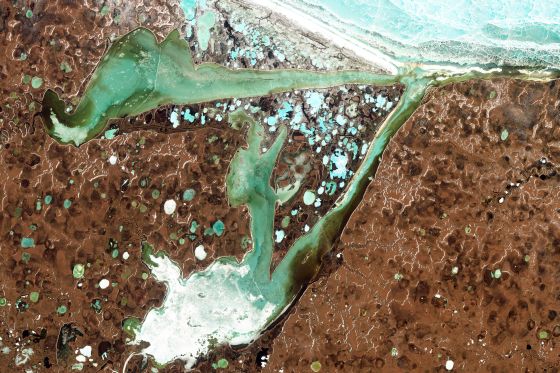
Omulyakhskaya and Khromskaya Bays lie along the northern Siberian coast, where permafrost blankets the land around the bays. Photo: NASA Earth Observatory

Omulyakhskaya and Khromskaya Bays lie along the northern Siberian coast, where permafrost blankets the land around the bays. Photo: NASA Earth Observatory

Embedded in the mud, glistening green and gold and black, was a butterfly, very beautiful and very dead.

“Not a little thing like that! Not a butterfly!” cried Eckels.

It fell to the floor, an exquisite thing, a small thing that could upset balances and knock down a line of small dominoes and then big dominoes and then gigantic dominoes, all down the years across Time. Eckels’ mind whirled. It couldn’t change things. Killing one butterfly couldn’t be that important! Could it? — Ray Bradbury, A Sound of Thunder, 1952

As one of the massive and probably irreversible consequences of climate change, the melting of the Northern Hemisphere’s permafrost is not an example of the butterfly effect. Yet the discovery of a giant virus which has come back to life after 30,000 years of frozen dormancy, suggests many possibilities including some akin to those envisaged by Ray Bradbury is his famous science fiction story.

Whereas his narrative required that the reader suspend disbelief by entertaining the idea of time travel, the thawing tundra may produce a very real kind of time travel if any viruses or other microbes were to emerge as new invasive species.

Rather than being transported geographically as a result of human activity, these will spring suddenly from a distant past into an environment that may lack necessary evolutionary adaptations to accommodate their presence.

We are assured that Pithovirus sibericum poses no threat to humans — it just attacks amoebas. But our concern shouldn’t be limited to fears about the reemergence of something like an ancient strain of smallpox.

The rebirth of a pathogen that could strike phytoplankton — producers of half the world’s oxygen — would have a devastating impact on the planet.

BBC News reports: The ancient pathogen was discovered buried 30m (100ft) down in the frozen ground.

Called Pithovirus sibericum, it belongs to a class of giant viruses that were discovered 10 years ago.

These are all so large that, unlike other viruses, they can be seen under a microscope. And this one, measuring 1.5 micrometres in length, is the biggest that has ever been found.

The last time it infected anything was more than 30,000 years ago, but in the laboratory it has sprung to life once again.

Tests show that it attacks amoebas, which are single-celled organisms, but does not infect humans or other animals.

Co-author Dr Chantal Abergel, also from the CNRS, said: “It comes into the cell, multiplies and finally kills the cell. It is able to kill the amoeba – but it won’t infect a human cell.”

However, the researchers believe that other more deadly pathogens could be locked in Siberia’s permafrost.

“We are addressing this issue by sequencing the DNA that is present in those layers,” said Dr Abergel.

“This would be the best way to work out what is dangerous in there.”

The researchers say this region is under threat. Since the 1970s, the permafrost has retreated and reduced in thickness, and climate change projections suggest it will decrease further.

It has also become more accessible, and is being eyed for its natural resources.

Prof Claverie warns that exposing the deep layers could expose new viral threats.

He said: “It is a recipe for disaster. If you start having industrial explorations, people will start to move around the deep permafrost layers. Through mining and drilling, those old layers will be penetrated and this is where the danger is coming from.”

He told BBC News that ancient strains of the smallpox virus, which was declared eradicated 30 years ago, could pose a risk. [Continue reading…]

Facebooktwittermail

Has Putin lost his mind?

When a professor of journalism refers to Julia Ioffe, a senior editor at The New Republic, putting on “a clinic with her writing and reporting on Russia and Ukraine,” I’m assuming that’s meant as a compliment — a way of signalling to his students and Twitter followers: this is what insightful journalism looks like:


This is how Ioffe’s clinic opens:

In Sunday’s New York Times, Peter Baker reported that German Chancellor Angela Merkel had tried talking some sense into Vladimir Putin. The Russian leader has an affinity for the Germans and Merkel especially: He served in the KGB in East Germany, where Merkel grew up. And yet, nothing:

Chancellor Angela Merkel of Germany told Mr. Obama by telephone on Sunday that after speaking with Mr. Putin she was not sure he was in touch with reality, people briefed on the call said. “In another world,” she said.

If you weren’t sure of the veracity of that little reportorial nugget, all doubt should’ve vanished after Putin’s press conference today.

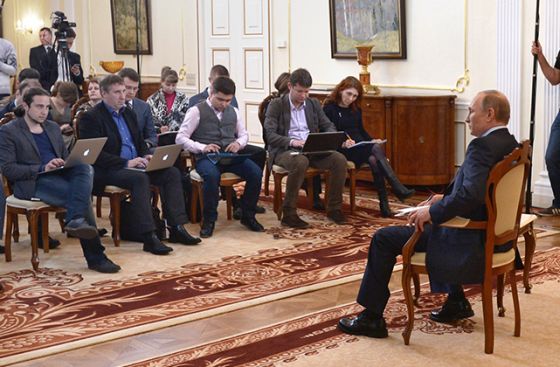
Slouching in a fancy chair in front of a dozen reporters, Putin squirmed and rambled. And rambled and rambled. He was a rainbow of emotion: Serious! angry! bemused! flustered! confused! So confused.

The Russian president, slouching in a fancy chair — that’s a very evocative image.

But Ioffe doesn’t just leave it to her word and her readers’ powers of imagination to conjure up a picture of the scene; she kindly provides a link. It’s what I’d call a cover-your-ass link, or a don’t-click-on-this link. Which is to say, writers sometimes make misleading statements or exaggerate, but then point to their source as though this will absolve them of any responsibility for misinforming their readers.

putin-chair

Do armrests make a chair fancy? That’s the only difference between Putin’s chair and the ones being used by the reporters — most of whom have laptops which are easier to use when elbows aren’t hitting armrests. As for Putin’s slouch, granted, he probably does not have every single lower vertebrae thrust hard against the chair’s back, but by that measure, who doesn’t slouch?

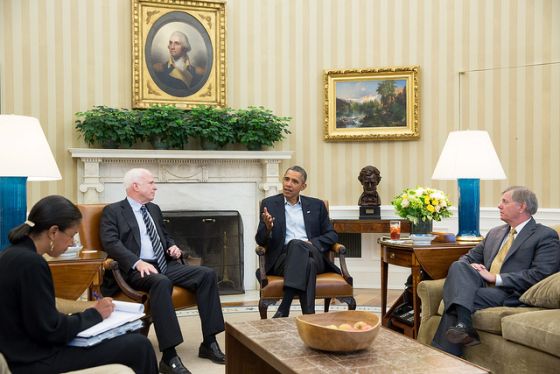
How about this president in his fancy chair? He didn’t even manage to put on a neck tie before he met his White House guests:

obama-chair

I’m all in favor of journalists adding narrative color to their reporting, but when it turns out that Putin wasn’t sitting in a fancy chair and he wasn’t slouching, why am I supposed to swallow Ioffe’s emphatic claim: “Putin has lost it”?

Aside from the circumstantial evidence for questioning Putin’s sanity — his posture and his self-aggrandizing chair — the substance of Ioffe’s diagnosis is rendered in her delivery of the Russian president’s rambling statement:

Victor Yanukovich is still the acting president of Ukraine, but he can’t talk to Ukraine because Ukraine has no president. Ukraine needs elections, but you can’t have elections because there is already a president. And no elections will be valid given that there is terrorism in the streets of Ukraine. And how are you going to let just anyone run for president? What if some nationalist punk just pops out like a jack-in-the-box? An anti-Semite? Look at how peaceful the Crimea is, probably thanks to those guys with guns holding it down. Who are they, by the way? Speaking of instability, did you know that the mayor of Dniepropetrovsk is a thief? He cheated “our oligarch, [Chelsea owner Roman] Abramovich” of millions. Just pocketed them! Yanukovich has no political future, I’ve told him that. He didn’t fulfill his obligations as leader of the country. I’ve told him that. Mr. Putin, what mistakes did Yanukovich make as president? You know, I can’t answer that. Not because I don’t know the answer, but because it just wouldn’t be right of me to say. Did you know they burned someone alive in Kiev? Just like that? Is that what you call a manifestation of democracy? Mr. Putin, what about the snipers in Kiev who were firing on civilians? Who gave them orders to shoot? Those were provocateurs. Didn’t you read the reports? They were open source reports. So I don’t know what happened there. It’s unclear. But did you see the bullets piercing the shields of the Berkut [special police]. That was obvious. As for who gave the order to shoot, I don’t know. Yanukovich didn’t give that order. He told me. I only know what Yanukovich told me. And I told him, don’t do it. You’ll bring chaos to your city. And he did it, and they toppled him. Look at that bacchanalia. The American political technologists they did their work well. And this isn’t the first time they’ve done this in Ukraine, no. Sometimes, I get the feeling that these people…these people in America. They are sitting there, in their laboratory, and doing experiments, like on rats. You’re not listening to me. I’ve already said, that yesterday, I met with three colleagues. Colleagues, you’re not listening. It’s not that Yanukovich said he’s not going to sign the agreement with Europe. What he said was that, based on the content of the agreement, having examined it, he did not like it. We have problems. We have a lot of problems in Russia. But they’re not as bad as in Ukraine. The Secretary of State. Well. The Secretary of State is not the ultimate authority, is he?

And so on, for about an hour. And much of that, by the way, is direct quotes.

Now compare this with an actual translated transcript of what Putin said: Continue reading

Facebooktwittermail

Chomsky: In times of government surveillance, whose ‘security’ is at stake?

f13-iconNoam Chomsky: A leading principle of international relations theory is that the state’s highest priority is to ensure security. As Cold War strategist George F. Kennan formulated the standard view, government is created “to assure order and justice internally and to provide for the common defense.”

The proposition seems plausible, almost self-evident, until we look more closely and ask: Security for whom? For the general population? For state power itself? For dominant domestic constituencies?

Depending on what we mean, the credibility of the proposition ranges from negligible to very high.

Security for state power is at the high extreme, as illustrated by the efforts that states exert to protect themselves from the scrutiny of their own populations.

In an interview on German TV, Edward J. Snowden said that his “breaking point” was “seeing Director of National Intelligence, James Clapper, directly lie under oath to Congress” by denying the existence of a domestic spying program conducted by the National Security Agency.

Snowden elaborated that “The public had a right to know about these programs. The public had a right to know that which the government is doing in its name, and that which the government is doing against the public.”

The same could be justly said by Daniel Ellsberg, Chelsea Manning and other courageous figures who acted on the same democratic principle.

The government stance is quite different: The public doesn’t have the right to know because security thus is undermined—severely so, as officials assert. [Continue reading…]

Facebooktwittermail

Obama: The U.S. may soon be unable to defend Israel from international isolation

n13-iconJeffrey Goldberg writes: When Israeli Prime Minister Benjamin Netanyahu visits the White House tomorrow, President Barack Obama will tell him that his country could face a bleak future — one of international isolation and demographic disaster — if he refuses to endorse a U.S.-drafted framework agreement for peace with the Palestinians. Obama will warn Netanyahu that time is running out for Israel as a Jewish-majority democracy. And the president will make the case that Netanyahu, alone among Israelis, has the strength and political credibility to lead his people away from the precipice.

In an hourlong interview Thursday in the Oval Office, Obama, borrowing from the Jewish sage Rabbi Hillel, told me that his message to Netanyahu will be this: “If not now, when? And if not you, Mr. Prime Minister, then who?” He then took a sharper tone, saying that if Netanyahu “does not believe that a peace deal with the Palestinians is the right thing to do for Israel, then he needs to articulate an alternative approach.” He added, “It’s hard to come up with one that’s plausible.”

Unlike Netanyahu, Obama will not address the annual convention of the American Israel Public Affairs Committee, a pro-Israel lobbying group, this week — the administration is upset with Aipac for, in its view, trying to subvert American-led nuclear negotiations with Iran. In our interview, the president, while broadly supportive of Israel and a close U.S.-Israel relationship, made statements that would be met at an Aipac convention with cold silence.

Obama was blunter about Israel’s future than I’ve ever heard him. His language was striking, but of a piece with observations made in recent months by his secretary of state, John Kerry, who until this interview, had taken the lead in pressuring both Netanyahu and the Palestinian leader, Mahmoud Abbas, to agree to a framework deal. Obama made it clear that he views Abbas as the most politically moderate leader the Palestinians may ever have. It seemed obvious to me that the president believes that the next move is Netanyahu’s. [Continue reading…]

Facebooktwittermail

Rouhani tells Iran generals to cut hostile rhetoric

n13-iconReuters reports: President Hassan Rouhani urged Iran’s military leaders on Saturday to let diplomacy prevail in dealing with potential foreign threats, in a clear reference to efforts to end the nuclear dispute and decades of hostile relations with the West.

“It is very important to formulate one’s sentences and speeches in a way that is not construed as threat, intention to strike a blow,” Rouhani said in a meeting with Iran’s top military echelon.

“We must be very careful in our calculations. Launching missiles and staging military exercises to scare off the other side is not good deterrence, although a necessity in its proper place,” the official IRNA news agency quoted him as saying.

“A misfire could burst into flames and wreak havoc to everything.” [Continue reading…]

Facebooktwittermail

Ukraine crisis: Why it matters to the world economy

a13-iconCNN reports: While the world watches the escalating crisis in Ukraine, investors and world leaders are considering how the instability could roil the global economy.

The political turmoil is rooted in the country’s strategic economic position. It is an important conduit between Russia and major European markets, as well as a significant exporter of grain.

But in the post-Soviet era, it’s a weakened economy. Now, the government is in need of an economic rescue — and torn between whether Russia or the Western economies (including the European Union) is the savior it needs.

Here are five reasons the world’s largest economies are watching what happens in Ukraine. [Continue reading…]

Facebooktwittermail

Ukrainian activists work to counter Russian narrative on social networks

a13-iconRobert Mackey reports: Faced with what they call misleading reports on Russian state television that ethnic-nationalist violence is sweeping Ukraine, Internet-savvy Ukrainian activists drew attention on Sunday to video and images posted online that showed street protests in support of the new government in Kiev, and acts of violence instigated by men waving the Russian flag.

Video uploaded to the Euromaidan protest movement’s YouTube channel showed demonstrators in the eastern city of Dnipropetrovsk singing Ukraine’s national anthem on Sunday, one day after the Russian flag was raised there by ethnic Russians.

The activists also shared photographs on Twitter of young men volunteering to defend Ukraine against the threatened Russian invasion in the same city, and a rally in support of the interim government in Zaporizhzhya and Odessa, where pro-Russia demonstrators had also gathered the day before. [Continue reading…]

Facebooktwittermail

Big data has outpaced our legal system’€™s ability to control it

f13-iconNeil Richards writes: These days, everyone seems to be talking about “big data.” Engineers, researchers, lawyers, executives and self-trackers all tout the surprising insights they can get from applying math to large data sets. The rhetoric of big data is often overblown, exaggerated and contradictory, but there’s an element of truth to the claim that data science is helping us to know more about our world, our society and ourselves.

Data scientists use big data to deliver personalized ads to Internet users, to make better spell checkers and search engines, to predict weather patterns, perform medical research, learn about customers, set prices and plan traffic flow patterns. Big data can also fight crime, whether through the use of automated license-plate readers or, at least theoretically, through the collection of vast amounts of “metadata” about our communications and associations by the National Security Agency.

Big data allows us to know more, to predict and to influence others. This is its power, but it’s also its danger. The entities that can harness the power of math applied to large sets of personal information can do things that used to be impossible. Many of these new uses are good, but some of them aren’t. For example, if our “personalized prices” can be based on our race or sex, or if our college admissions are based on things like ZIP code or car ownership, we might want to think more deeply about the kinds of big decisions our big data can be used for. We’re creating a society based on data, and we need to make sure that we create a society that we want to live in. [Continue reading…]

Facebooktwittermail

What’s behind the ‘Jewish state’ idea?

o13-iconRami G. Khouri writes: In my discussions on Palestinian-Israeli negotiations with various informed audiences around the United States during the past month, the question that comes up most often is about how the Palestinians can, should or will respond to the Israeli government demand that they must recognize Israel as a “Jewish state.” The prevalent Arab and Palestinian demand is to rule out any such recognition, on several valid grounds, such as: The Jewish state concept is not defined, it does not take account of the Palestinian Arab and other non-Jewish Israelis, it does not address the implications of such recognition for the U.N.-acknowledged rights of Palestinian refugees, and it does not have any basis in international law or diplomatic norms related to how states recognize each other.

These points do not seem to impress the Israelis, who have made this more central to their demands for any permanent peace agreement. Israel also seems to have convinced the United States to come down on its side, as the American president, secretary of state and other senior officials have routinely referred to Israel as “the Jewish state of Israel” or some other such formulation.

It is not clear if Palestinians will cave in and accept the Israeli-American demand as they usually do, for three main reasons. First, the demand comes in the context of final-status negotiations that aim to resolve all outstanding disputes, so there is likely to be some room for give-and-take in any final agreement. Second, the “Jewish state” concept remains undefined, and its clear definition, coupled with agreement on the rights of the Palestinians and non-Jewish Israelis, could pave the way for some mutual acknowledgments that satisfy both sides. Third, a central negotiating demand such as this that springs up suddenly after over six decades of warfare seems to be a proxy concept that reflects deeper issues that must be resolved. [Continue reading…]

Facebooktwittermail

Crisis over Crimea steals thunder from AIPAC conference

n13-iconHaaretz reports: The recent losses of face over the Syria and Iran issues had already cast a pall on the mammoth annual conference of the pro-Israel lobby AIPAC, which opens Sunday in Washington. But the crisis in the capital over Russia’s move into Crimea, which threatens to reignite the Cold War, has infused the America Israel Public Affairs Committee confab with a strong sense of anticlimax.

If a week ago the question before the 14,000 delegates was whether AIPAC could regain the full fearsomeness of its reputation in Washington, the question now appears to be: Will anybody be paying attention? [Continue reading…]

Facebooktwittermail

Pierre Omidyar’s role at First Look Media

Following a report on Pierre Omidyar’s involvement in Ukrainian politics, Glenn Greenwald felt obliged to explain why he knew nothing about this.

That’s because, prior to creating The Intercept with Laura Poitras and Jermey Scahill, I did not research Omidyar’s political views or donations. That’s because his political views and donations are of no special interest to me – any more than I cared about the political views of the family that owns and funds Salon (about which I know literally nothing, despite having worked there for almost 6 years), or any more than I cared about the political views of those who control the Guardian Trust.

There’s a very simple reason for that: they have no effect whatsoever on my journalism or the journalism of The Intercept. That’s because we are guaranteed full editorial freedom and journalistic independence. The Omidyar Network’s political views or activities – or those of anyone else – have no effect whatsoever on what we report, how we report it, or what we say.

I’m having a hard time squaring Greenwald’s description of the editorial independence of The Intercept with the following statements made by his colleague there, Jeremy Scahill, as reported by the Daily Beast:

The whole venture will have a lower wall between owner and journalist than traditional media. Omidyar, he says, wanted to do the project because he was interested in Fourth Amendment issues, and they are hiring teams of lawyers, not just to keep the staff from getting sued, but to actively push courts on the First Amendment, to “force confrontation with the state on these issues.”

“[Omidyar] strikes me as always sort of political, but I think that the NSA story and the expanding wars put politics for him into a much more prominent place in his existence. This is not a side project that he is doing. Pierre writes more on our internal messaging than anyone else. And he is not micromanaging. This guy has a vision. And his vision is to confront what he sees as an assault on the privacy of Americans.”

Facebooktwittermail