Category Archives: Issues

‘There’s no hope left’: the Syrian refugee camp that is becoming a township

f13-iconRobin Yassin-Kassab writes: This must be how the Palestinian camps began their slow transformation into towering townships. The Syrian families here are still living in canvas or plastic tents, but the little shops selling falafel and cola on the Atmeh camp’s “main street” are now breeze-block and corrugated-iron constructions. And now nobody dares talk about going home.

Atmeh camp, just inside Syria, hugs the Turkish border fence. It is December, and the population has risen in the six months since I was here in June, from 22,000 to almost 30,000. This new settlement is one of many – there are more than 6 million people displaced inside Syria, and more than 2 million in neighbouring states. The camp’s population dwindles and swells according to the vicissitudes of battle. When the regime reconquered (and obliterated) the Khaldiyeh quarter of Homs last July, an additional 50 to 60 families a day arrived.

Six months ago, when I last visited, I was able to travel deep into liberated Syria – as far as Kafranbel in the south of Idlib province – with nothing to fear from the Free Army fighters manning checkpoints. This time I don’t dare go as far as Atmeh village, sitting on the nearby hilltop, because it is occupied by al-Qaida franchise the Islamic State of Iraq and Syria (Isis). Last June the camp’s residents referred derisively to the mainly foreign jihadists as “the spicy crew”. Now they are a real threat – abducting and often murdering revolutionary activists, Free Army fighters and journalists. This development contributes greatly to the gloom of the camp’s residents.

In the camp, the steaming vats of the Maram Foundation’s charity kitchen are cooking the same meal they were six months ago: lentil soup. Children wait with buckets in the red mud outside for lunch to be distributed. Also on the main street is a new clinic and one-room dentist (funded by the Syrian-American Medical Society). Dr Haytham grins as he complains about the conditions. The roof leaks, and the recent snowstorm has flooded his crowded space, destroying electrical equipment. As he serves us tea, a boy called Mahmoud, aged about five, walks in to observe us, his face marked by post-treatment leishmaniasis scars (a resurgent disease caused by the sand flies which prosper in uncollected rubbish). Mahmoud seems a pleasant child at first, but after a smiling photograph with one of our group his mood flips; he violently pinches the hand of the man he’d been cuddling up to and then takes to whipping his older sister with a cable. “Nobody can control him,” somebody remarks. “He doesn’t have a father.”

Fatherless, husbandless, homeless … When I ask a man where he’d come from he changed the name of his town from Kafranboodeh to Kafr Mahdoomeh, “the Demolished Village”. I ask him why. “Because they haven’t left one house standing, nor any animals in the fields. What will we ever return to? The whole town’s gone.” [Continue reading…]


Facebooktwittermail

British ex-Guantanamo inmate denies Syria-related terror charges

n13-iconReuters reports: A British man once held at Guantanamo Bay turned human rights campaigner told a court in London on Saturday he would plead not guilty to providing training and funding terrorism in Syria, police said.

Moazzam Begg, 45, who was released without charge from the U.S. military prison in Cuba in 2005, was detained at his home in Birmingham in central England last week and charged with terrorism offences dated between October 2012 and April 2013.

He appeared at Westminster Magistrates Court on Saturday and was remanded in custody to appear at London’s Old Bailey criminal court on March 14.

It is the first time he has ever faced any charges.

Begg was held by the U.S. government at Bagram detention center in Afghanistan, then Guantanamo Bay in Cuba, for nearly three years after being arrested in Pakistan in February 2002 suspected of being a member of al-Qaeda.

After his release, he founded Cage, a human rights organization that campaigns for the rights of people detained during counter-terrorism operations.

Cage accused British authorities of “retraumatising” Begg by refusing to grant him bail, saying this was part of a campaign to criminalize legitimate activism. [Continue reading…]

Facebooktwittermail

Climate change and world history

f13-iconChristopher Rose, Outreach Director, Center for Middle Eastern Studies, University of Texas, Austin, interviews Sam White, Department of History, the Ohio State University:

Rose: Your first book, which is called The Climate of Rebellion in the Early Modern Ottoman Empire, explores the far reaching effects of the severe cold and drought in the Middle East during the so-called Little Ice Age, and your current research looks at how New World settlement was affected during the same period. I want to start off by asking a really broad question: what is the importance of understanding climate and climate change in the broader field of world history?

White: That’s an excellent question. The importance is really twofold. One point is the importance of climate for history as history. Climate was something that past historians generally were not focused on, they were looking for political history, for social history, for economic history, really looking for everything but the environment. Environmental history as a field has really taken off over the past generation, that is to say, looking at ways that humans have changed the environment in the past, and the ways that environmental factors have affected the course of human history.

Climate, though, was not a large part of that discussion. There were some exceptions — I could name some important scholars of the past couple generations who have looked at it — but in the mainstream, even of environmental history, climate was not much considered. Now, though, with rising concern over global warming, climate is really starting to enter the picture. This is for two reasons. One is that historians, like all other people, have become aware of climate simply as a force in human affairs. Second is that, along with the rising concern over global warming, there has been a great deal more research into reconstructing past climates, so that we can know about climate much more than every before.

Now, with that greater understanding, we can see ways that climate fits into greater history in much more details and a much more convincing way than ever before. We can see how large scale climate changes have affected large scale developments, particularly in more extreme climates, particularly at the edges of settlement or agriculture, either in Arctic lands or deserts, and also in more particular short term ways as major climatic extremes have influenced the course of human events, as I discussed in my book about the Ottoman Empire. So, with that in mind, we can see climate really as an actor in history for really the first time.

The other part of this equation, too, is what does looking at the climate of the past — what does looking at the past experience of climate change help us understand about our current predicament, about how the world will face global warming now. Here, I have to say, we’re not going to give exact policy predictions. We can’t raise the bar too high, as it were. But, I do think there are wider lessons — wider parables, perhaps, that we can gather from looking at the experience of climate change in the past. With that in mind, we can look to see if there are bigger patterns in how people handle climate change and whether we can relate that to the present day. [Continue reading…]

Facebooktwittermail

The murders before the Boston Marathon

f13-iconSusan Zalkind writes: It’s nearly midnight in a nondescript condo complex a few blocks from Universal Studios in Orlando, and Tatiana Gruzdeva has been crying all day. Though neither of us knows it yet, as she sits on the corner of her bed and sobs in tiny convulsions, the fact that she’s talking to me will lead to her being arrested by federal agents, placed in solitary confinement, and deported back to Russia.

Next to us on the bed are nine teddy bears. Eight of them came with her from Tiraspol, Moldova. The ninth was a gift from her boyfriend, Ibragim Todashev. Today would have been Ibragim’s 28th birthday, but he is not here to see it, because in the early hours of May 22, 2013, a Boston FBI agent shot and killed him in this very apartment, under circumstances so strange that a Florida state prosecutor has opened an independent investigation. According to the FBI, just before Ibragim was shot—seven times, in two bursts, including once in the top of the head—he was about to write a confession implicating himself and alleged Boston Marathon bomber Tamerlan Tsarnaev in a brutal triple homicide that took place in Waltham, Massachusetts, in September 2011.

I’m sitting awkwardly at one end of the twin bed. She’s crying quietly, cross-legged at the other end, wearing shorts and a white shirt with sequins. Most of her outfits have sequins or rhinestones. She’s 19. I’m 26. We both have long blond hair. We’ve both been close to men who were in trouble with the law, and lost them violently. We’ve been talking for about an hour, mostly about men, and parties, and moving forward after a tragedy. Ibragim was a good man, she says. He could never have committed a murder.

“I’m here alone,” she cries. “I hope it never can be worse than this.”

I try to comfort her, but it’s complicated. We both want to know why Ibragim Todashev was killed. She wants to clear his name. For me, and for the families of the Waltham murder victims, Ibragim’s shooting may have snuffed out the last chance at finding out what really happened that night. In the back of my mind is this question: Did her dead boyfriend kill my friend Erik? [Continue reading…]

Facebooktwittermail

Eavesdropping by algorithm is still eavesdropping

Bruce Schneier writes: Increasingly, we are watched not by people but by algorithms. Amazon and Netflix track the books we buy and the movies we stream, and suggest other books and movies based on our habits. Google and Facebook watch what we do and what we say, and show us advertisements based on our behavior. Google even modifies our web search results based on our previous behavior. Smartphone navigation apps watch us as we drive, and update suggested route information based on traffic congestion. And the National Security Agency, of course, monitors our phone calls, emails and locations, then uses that information to try to identify terrorists.

Documents provided by Edwards Snowden and revealed by the Guardian today show that the UK spy agency GHCQ, with help from the NSA, has been collecting millions of webcam images from innocent Yahoo users. And that speaks to a key distinction in the age of algorithmic surveillance: is it really okay for a computer to monitor you online, and for that data collection and analysis only to count as a potential privacy invasion when a person sees it? I say it’s not, and the latest Snowden leaks only make more clear how important this distinction is.

The robots-vs-spies divide is especially important as we decide what to do about NSA and GCHQ surveillance. The spy community and the Justice Department have reported back early on President Obama’s request for changing how the NSA “collects” your data, but the potential reforms – FBI monitoring, holding on to your phone records and more – still largely depend on what the meaning of “collects” is. [Continue reading…]

Those who claim a special privilege to define words in their own way, defying the dictates of everyday usage, are also claiming a right to employ their own definitions of truthfulness and lying. This might have some legal utility, but the price for going this route is that language, thus constrained, becomes worthless.

As Schneier notes, Google has also fallen back on the dumb-machine defense when claiming that it does not read our email.

Back when Gmail was introduced, this was Google’s defense, too, about its context-sensitive advertising. Googles computers examine each individual email and insert an advertisement nearby, related to the contents of your email. But no person at Google reads any Gmail messages; only a computer does. In the words of one Google executive: “Worrying about a computer reading your email is like worrying about your dog seeing you naked”.

The absence of human eyes does not add a layer of privacy. On the contrary it constitutes a glaring lack of oversight by promoting a fiction: that what people don’t see, must be harmless.

Google is not a dumb companion, eager to please and dependably obedient; its only loyalty is to its own commercial interests and it currently sees those interests best served by pursuing an ambition to dominate the field of machine learning.

The data analysis being performed by computers enables surveillance more sweeping than could ever be carried out by people.

Although most Americans seem more afraid of government than commerce, the powers being exercised by the NSA are dwarfed by those that have been acquired by companies like Google, Amazon, and Facebook. Indeed the intelligence community has been doing little more than opportunistically taking a piggyback ride on the shoulders of Silicon Valley.

Facebooktwittermail

GCHQ intercepted webcam images of millions of Yahoo users worldwide

n13-iconThe Guardian reports: Britain’s surveillance agency GCHQ, with aid from the US National Security Agency, intercepted and stored the webcam images of millions of internet users not suspected of wrongdoing, secret documents reveal.

GCHQ files dating between 2008 and 2010 explicitly state that a surveillance program codenamed Optic Nerve collected still images of Yahoo webcam chats in bulk and saved them to agency databases, regardless of whether individual users were an intelligence target or not.

In one six-month period in 2008 alone, the agency collected webcam imagery – including substantial quantities of sexually explicit communications – from more than 1.8 million Yahoo user accounts globally.

Yahoo reacted furiously to the webcam interception when approached by the Guardian. The company denied any prior knowledge of the program, accusing the agencies of “a whole new level of violation of our users’ privacy”. [Continue reading…]

Facebooktwittermail

Karen Greenberg: Obama’s commandments

Think of us as having two presidents.  One, a fellow named Barack Obama, cuts a distinctly Clark Kent-ish figure.  In presiding over domestic policy, he is regularly thwarted in his desires by the Republicans in Congress and couldn’t until recently get his most basic choices for government positions or the judiciary through the Senate.  For the most minimal look of effectiveness, he has to rely on relatively small gestures by executive order.  In the recent history of the American presidency, he is a remarkably powerless figure presiding over what everyone who is a media anyone claims is a riven, paralyzed, even broken government structure, one in which the Republicans are intent on ensuring that a Democratic president can do nothing until they take the White House (which is almost guaranteed to be never).  What this president wants, almost by definition, he can’t have.  He is, as Guardian columnist Gary Younge wrote recently, a man who’s lost the plot line to his own story and has been relegated to the position of onlooker-in-chief.

But keep in mind that that’s only one of our two presidents.  The other, a fellow named Barack Obama, flies (by drone) like Superman, rules more or less by fiat, sends U.S. missiles to strike and kill just about anyone, including American citizens, anywhere in the distant backlands of the planet, and dispatches the country’s secret warriors (whether from the CIA or the special operations forces) wherever he pleases.  He can, with rare exceptions, intervene violently wherever he chooses.  He can (by proxy) listen in on whomever he’s curious about (including, it seems, 320 German business and political leaders).  He rules over what former Congressional insider Mike Lofgren calls the “deep state” in Washington, a national security apparatus that is neither riven, nor broken, nor paralyzed, with only the rarest intercessions from Congress.  In this world, Obama’s powers have only grown, along with the “kill list” he reviews every week.

Admittedly, in his actions abroad from Afghanistan to Libya, his moves on the global stage haven’t exactly proven to be brilliant coups de théâtre.  Many have, in fact, been remarkably boneheaded.  But no one ever claimed that Superman’s superpowers included super-brain-power.

Think of this White House, then, as the schizophrenic presidency, one half remarkably impotent, the other ever more potent.  The conundrum is that they both inhabit the same man.  And if they add up to anything, as Karen Greenberg, director of the Center on National Security at Fordham Law and TomDispatch regular, makes clear today, it’s long-term bad news for the country and the planet. Tom Engelhardt

The Five Commandments of Barack Obama
How “thou shalt not” became “thou shalt”
By Karen J. Greenberg

In January 2009, Barack Obama entered the Oval Office projecting idealism and proud to be the constitutional law professor devoted to turning democratic principles into action.  In his first weeks in office, in a series of executive orders and public statements, the new president broadcast for all to hear the five commandments by which life in his new world of national security would be lived. 

Thou shalt not torture.

Thou shalt not keep Guantanamo open.

Thou shalt not keep secrets unnecessarily.

Thou shalt not wage war without limits.

Thou shalt not live above the law.

Five years later, the question is: How have he and his administration lived up to these self-proclaimed commandments?

Continue reading

Facebooktwittermail

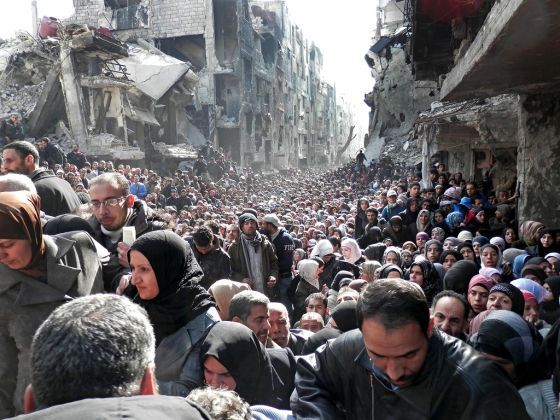
Palestinians besieged in Yarmouk

Yarmouk

The Guardian reports: It is a vision of unimaginable desolation: a crowd of men, women and children stretching as far as the eye can see into the war-devastated landscape of Yarmouk refugee camp in Damascus.

A photograph released on Wednesday by the UN agency for Palestinian refugees, UNRWA, shows the scene when thousands of desperate Palestinians trapped inside the camp on the edge of the Syrian capital emerged to besiege aid workers attempting to distribute food parcels.

More than 18,000 people are existing under blockade inside Yarmouk, enduring acute shortages of food, medicines and other essentials. Much of the camp has been destroyed by shelling, and attempts to deliver aid to those inside have been hampered by continued fighting in Syria’s three-year-old civil war.

United Nations workers have delivered about 7,000 food parcels over recent weeks, following negotiations between the Syrian government, rebel forces and Palestinian factions within the camp. The most recent delivery, of 450 parcels, was on Wednesday. The UN acknowledges that the level of aid is a “drop in the ocean”. [Continue reading…]

Facebooktwittermail

Forget the NSA, the LAPD spies on millions of innocent folks

f13-iconLA Weekly reports: Edward Snowden ripped the blinds off the surveillance state last summer with his leak of top-secret National Security Agency documents, forcing a national conversation about spying in the post-9/11 era. However, there’s still no concrete proof that America’s elite intelligence units are analyzing most Americans’ computer and telephone activity — even though they can.

Los Angeles and Southern California police, by contrast, are expanding their use of surveillance technology such as intelligent video analytics, digital biometric identification and military-pedigree software for analyzing and predicting crime. Information on the identity and movements of millions of Southern California residents is being collected and tracked.

In fact, Los Angeles is emerging as a major laboratory for testing and scaling up new police surveillance technologies. The use of military-grade surveillance tools is migrating from places like Fallujah to neighborhoods including Watts and even low-crime areas of the San Fernando Valley, where surveillance cameras are proliferating like California poppies in spring.

The use of militarized surveillance technology appears to be spreading beyond its initial applications during the mid-2000s in high-crime areas to now target narrow, specific crimes such as auto theft. Now, LAPD and the Los Angeles County Sheriff are monitoring the whereabouts of residents whether they have committed a crime or not. The biggest surveillance net is license plate reading technology that records your car’s plate number as you pass police cruisers equipped with a rooftop camera, or as you drive past street locations where such cameras are mounted. [Continue reading…]

Facebooktwittermail

Is solitary confinement an impossible idea?

f13-iconBenjamin Wallace-Wells writes: On July 8 of last year, a 50-year-old man named Todd Ashker, an inmate at California’s Pelican Bay State Prison, began a hunger strike. He had compiled a list of demands, but the essential one was that the policy that dictated the terms of his imprisonment be abolished. Ashker was housed in Pelican Bay’s Security Housing Unit, the most restrictive prison unit in California and a place of extreme isolation. Convicts stay in their cells 23 hours a day and leave only to exercise in a concrete room, alone; their meals are fed into their cell through a slot. Other than an awareness that they are staring at the same blank wall as seven other men kept in their “pod,” they are completely alone. Ashker has been there since 1990; in his view, he has been subject to nearly a quarter-­century of continuous torture. “I have not had a normal face-to-face conversation with another human being in 23 years,” he told me recently, speaking from the other side of a thick plate of glass.

The sheer length of time inmates spend here has made Pelican Bay a novel experiment in social control. The California prison system allows any confirmed gang member to be kept in the SHU indefinitely, with a review of his status only every six years. (Prisoners who kill a guard or another inmate, by contrast, are given a five-year term in the SHU.) This policy has filled Pelican Bay with men considered the most influential and dangerous gang leaders in California. Ashker, allegedly a senior member of the Aryan Brotherhood, had for years shared a pod with Sitawa Jamaa, allegedly the minister of education of the Black Guerrilla Family, and Arturo Castellanos, allegedly an important leader of the Mexican Mafia. In the next pod over was Antonio Guillen, allegedly one of three “generals” of Nuestra Familia. According to the state, these men have spent much of their lives running rival, racially aligned criminal organizations dedicated, often, to killing one another. But over a period of years, through an elaborate and extremely patient series of conversations yelled across the pod and through the concrete walls of the exercise room, the four men had formed a political alliance. They had a shared interest in protesting the conditions of their confinement and, eventually, a shared strategy. They became collaborators.

The men planned for the hunger strike meticulously. They had staged two more modest strikes in 2011, and afterward some had staged private fasts in their cells to try to learn how long they might be able to go without food. The four men had spent the spring putting on weight. Ashker had calculated how much water he needed to drink to keep his electrolytes ­balanced, his heart pumping: 240 ounces a day. In June, the men sent letters to an activist group detailing their grievances, explaining when the strike would begin, and asking other prisoners to join them. In letters to families and friends, they spread the word. Corrections officers throughout the state heard the news; on July 2, a few senior officials visited from Sacramento to meet with the prisoners and measure their intent. They left ­convinced the men were serious. Then, a few days later, the prisoners stopped eating.

The severity of his isolation meant that as the strike began, Ashker had little idea of what effect it was having or how many other prisoners had decided to join him. It turned out to be the largest coordinated hunger strike in American history. [Continue reading…]

Facebooktwittermail

Maidan, Ukraine … Tahrir, Egypt … the square symbolises failure, not hope

o13-iconSimon Jenkins writes: The experience was eerie. I was watching a documentary, The Square, on Netflix about the 2011 Tahrir Square occupation when the lead character, Ahmed, let out a cry of delight, “The revolution has been won.” At that very moment my radio blurted out a voice live from a different square, Kiev’s Maidan. “The revolution has been won,” it repeated.

Squares are famously potent political theatres. This year is a second showing for Ukraine’s revolution, and a third for Egypt’s. Western TV viewers have cheered them all on. We thrill to see young people hurling rocks at power. Fire, smoke, bloodstained flags, broken heads, water, gas and sinister paramilitaries are Les Misérables for slow learners. We can sit with a front seat in the auditorium of history. It beats polling booths any day.

Tahrir and Maidan squares thus join Istanbul’s Taksim, Tehran’s Azadi, Beijing’s Tiananmen, Prague’s Wenceslaus, Athens’s Syntagma, London’s Trafalgar and a dozen other urban spaces the world over as icons of modern revolutionary politics. Their furniture is the barricade, their tipple the Molotov cocktail, their tonic the tear gas canister. They gather people in their thousands to sacred forums and invite the world to witness the latest trial of strength with a supposedly oppressive regime. Sometimes they even win.

If I were a dictator I would build shopping malls over these places right away, as Turkey’s Recep Erdoğan tried to do last year in Taksim’s Gezi Park. At the very least, I would learn the message of Tiananmen: that a crowd once formed in a square is fiendishly hard to remove, and creates worse publicity worldwide than a dozen provincial massacres.

Vladimir Putin reportedly damned Ukraine’s Viktor Yanukovych for failing immediately to remove crowds from Maidan, at whatever cost in brutality. It is hard to imagine Putin allowing an occupation of Red Square. [Continue reading…]

Facebooktwittermail

Watch: Zeynep Tufekci on social media-fueled protest style from Arab Spring to Gezi protests in Turkey

a13-iconWhat can we learn from the protest wave of the last years? How does social media impact the capacity for collective action? Does social media contribute to blunting movement impacts by facilitating horizontal, non-institutional and “leaderless” movements? How do these movements compare with their predecessors like the civil-rights or anti-colonial movements? In this talk Zeynep Tufekci — assistant professor at the University of North Carolina, a faculty associate at Berkman Center for Internet & Society, and a fellow at the Center for Information Technology Policy at Princeton University — discusses these questions by drawing from research on a variety of social movements including the “Arab Spring”, European indignados movements, Occupy and Turkey’s Gezi protests. (October 15, 2013, Berkman Center for Internet & Society, Harvard University.)

Facebooktwittermail

White House considers four options for modifying NSA mass phone surveillance

The Wall Street Journal reports that administration lawyers have presented the White House with four options for reforming the NSA’s mass phone-surveillance program the first of which would require phone companies to store such data and deliver specific search requests.

A second option presented to the White House would have a government agency other than the NSA hold the data, according to a U.S. official. Candidates for this option could include the Federal Bureau of Investigation, which some current and former intelligence officials have recommended.

Another possibility floated in policy circles was turning the program over to the custody of the Foreign Intelligence Surveillance Court, which oversees the phone-data and other NSA surveillance programs, but judges have balked at an expanded role for the court.

A third option would be for an entity outside the phone companies or the government to hold the data, officials said. This approach has been criticized by privacy groups who say such a third party would just become an extension of the NSA and would provide no additional privacy benefit.

A final alternative would be to scrap the phone-data program and instead bolster investigative efforts under current authorities to obtain the information about possible terrorist connections some other way, an official said. Mr. Obama acknowledged this approach in his January speech, but said “more work needs to be done to determine exactly how this system might work.”

Facebooktwittermail

FBI had human source in contact with bin Laden as far back as 1993

n13-iconThe Washington Times reports: In a revelation missing from the official investigations of the Sept. 11, 2001, terrorist attacks, the FBI placed a human source in direct contact with Osama bin Laden in 1993 and ascertained that the al Qaeda leader was looking to finance terrorist attacks in the United States, according to court testimony in a little-noticed employment dispute case.

The information the FBI gleaned back then was so specific that it helped thwart a terrorist plot against a Masonic lodge in Los Angeles, the court records reviewed by The Washington Times show.

“It was the only source I know in the bureau where we had a source right in al Qaeda, directly involved,” Edward J. Curran, a former top official in the FBI’s Los Angeles office, told the court in support of a discrimination lawsuit filed against the bureau by his former agent Bassem Youssef.

Mr. Curran gave the testimony in 2010 to an essentially empty courtroom, and thus it escaped notice from the media or terrorism specialists. The Times was recently alerted to the existence of the testimony while working on a broader report about al Qaeda’s origins.

Members of the Sept. 11 commission, congressional intelligence committees and terrorism analysts told The Times they are floored that the information is just now emerging publicly and that it raises questions about what else Americans might not have been told about the origins of al Qaeda and its early interest in attacking the United States.

“I think it raises a lot of questions about why that information didn’t become public and why the 9/11 Commission or the congressional intelligence committees weren’t told about it,” said former Rep. Peter Hoekstra, Michigan Republican, who chaired the House Permanent Select Committee on Intelligence from 2004 through 2007 when lawmakers dealt with the fallout from the 9/11 Commission’s official report.

“This is just one more of these examples that will go into the conspiracy theorists’ notebooks, who say the authorities are not telling us everything,” Mr. Hoekstra told The Times in an interview last week. “That’s bad for the intelligence community. It’s bad for law enforcement and it’s bad for government.”

Former Rep. Lee Hamilton, an Indiana Democrat who co-chaired the 9/11 Commission with former New Jersey Gov. Thomas Kean, said that as far as he can remember, the FBI never told the commission that it had been working a source so close to bin Laden that many years before 9/11.

“I do not recall the FBI advising us of a direct contact with Osama bin Laden,” Mr. Hamilton told The Times in a recent interview. [Continue reading…]

Facebooktwittermail

U.N.: Syrians soon to become world’s biggest refugee population, surpassing Afghans

n13-iconThe Associated Press reports: Syrians could soon overtake Afghans as the world’s biggest refugee population, with their numbers expected to pass 4 million by year’s end, a top U.N. official said Tuesday.

High Commissioner for Refugees Antonio Guterres spoke as the international community sharply urged Syria to comply with a new Security Council resolution demanding that President Bashar Assad and the opposition provide immediate access for humanitarian aid.

Opposition activists say more than 140,000 people have died in the conflict, which enters its fourth year next month. The U.N. says 9.3 million Syrians are in need of humanitarian assistance.

The number of Afghan refugees was 2.6 million at the end of 2012, UNHCR says. Syrians, with nearly 2.5 million registered as refugees, should overtake that long before the end of the year. About one-half of the refugees are children.

Facebooktwittermail

Why Israelis are content to live in a bubble of denial

o13-iconJonathan Cook writes: The 24-hour visit by German chancellor Angela Merkel to Israel this week came as relations between the two countries hit rock bottom. According to a report in Der Spiegel magazine last week, Ms Merkel and Israeli prime minister Benjamin Netan­yahu have been drawn into shouting matches when discussing by phone the faltering peace process.

Despite their smiles to the cameras during the visit, tension behind the scenes has been heightened by a diplomatic bust-up earlier this month when Martin Schulz, the president of the European parliament and himself German, gave a speech to the Israeli parliament.

In unprecedented scenes, a group of Israeli legislators heckled Mr Schulz, calling him a “liar”, and then staged a walkout, led by the economics minister Naftali Bennett. Rather than apologising, Mr Netanyahu intervened to lambast Mr Schulz for being misinformed.

Mr Schulz, who, like Ms Merkel, is considered a close friend of Israel, used his speech vehemently to oppose growing calls in Europe for a boycott of Israel. So how did he trigger such opprobrium?

Mr Schulz’s main offence was posing a question: was it true, as he had heard in meetings in the West Bank, that Israelis have access to four times more water than Palestinians? He further upset legislators by gently suggesting that Israel’s blockade of Gaza was preventing economic growth there.

Neither statement should have been in the least controversial. Figures from independent bodies such as the World Bank show Israel, which dominates the local water supplies, allocates per capita about 4.4 times more water to its population than to Palestinians.

Equally, it would be hard to imagine that years of denying goods and materials to Gaza, and blocking exports, have not ravaged its economy. The unemployment rate, for example, has increased 6 per cent, to 38.5 per cent, following Israel’s recent decision to prevent the transfer of construction materials to Gaza’s private sector.

But Israelis rarely hear such facts from their politicians or the media. And few are willing to listen when a rare voice like Mr Schulz’s intervenes. Israelis have grown content to live in a large bubble of denial. [Continue reading…]

Facebooktwittermail

If native advertising is so harmless, why does it rely on misleading readers?

o13-iconBob Garfield writes: The devil walks into a bar and sits at a table with eight newspaper and magazine publishers plus one strange little fellow in shabby, dated robes. The devil says, “How’d you all like to get some advertising revenue at higher rates than what you’ve been fetching for the past five or six years?”

The publishers crowd in to hear to his offer. All they need do in exchange is make the advertising look similar to the surrounding editorial matter. “Can we label it as advertising?” one publisher asks.
“You can label it ‘sponsored content,'” the devil replies.
“And it will be worthy?” chimes in another publisher.
“Oh yes,” says the devil. “My clients don’t benefit if people don’t read the stuff.”
“But won’t this confuse our readers,” ventures another publisher, “and even deceive them into reading brand propaganda when they’re expecting arms-length journalism?”

The devil has an answer for that, too. “I repeat: the rates are higher than for the regular display ads that nobody ever looks at. What say we put this to a vote?”

One by one the publishers raise their hands. The Economist. Forbes. The Atlantic. The Huffington Post. The Washington Post. Time Inc. The New York Times. And, most recently, Yahoo. Nine people sit at the table, and eight hands eventually are raised. Only one, the strange fellow with the odd garments and a thick German accent, fails to accept the devil’s offer.

“And you, sir,” says the prince of darkness. “I didn’t catch your name.”
“Faust,” answers the holdout.
“And may I ask why you did not accept my bargain, Mr Faust?”
The odd fellow nods. “Sure,” he says to the devil. “To tell you the truth, I don’t see much of an upside.” [Continue reading…]

Facebooktwittermail