Category Archives: Issues

AIPAC’s lackeys in Congress ready to obstruct Iran talks

Foreign Policy reports: The Obama administration is facing an unexpected hurdle in its new nuclear talks with Iran – a sizeable bloc of Democratic lawmakers who have made clear that they would break with the White House and fight any effort to lift the current sanctions on Tehran.

The future of those sanctions is a key issue in this week’s negotiations in Geneva between senior officials from Iran and the U.S., the most serious talks between the two longtime adversaries in decades. Iranian Foreign Minister Mohamad Javad Zarif kicked off Monday’s session with a PowerPoint presentation, delivered in English, which offered to put new limits on his country’s nuclear program in exchange for easing the Western sanctions that have devastated the Iranian economy and decimated the value of its currency.

The White House has already signaled a potential openness to that kind of deal, but a wide array of powerful Democrats — including the top members of both the Senate and House foreign affairs committees — strongly oppose lifting any of the existing sanctions on Iran unless Tehran offers concessions that go far beyond anything Zarif has talked about in Geneva. The American Israel Public Affairs Committee, one of the most powerful lobbies in Washington, has also promised to do everything in its power to keep the punitive measures in place.

“If the president were to ask for a lifting of existing sanctions it would be extremely difficult in the House and Senate to support that,” Rep. Steve Israel (D-NY), chairman of the Democratic Congressional Campaign Committee, told The Cable. “I’m willing to listen but I think that asking Congress to weaken and diminish current sanctions is not hospitable on Capitol Hill.”

“I’d say no,” said Sen. Bob Casey (D-PA) when asked if he’d accept a presidential plea to lift sanctions. “They’ve got a long way to go to demonstrate the kind of credibility that would lead us to believe we can move in a conciliatory direction. And sanctions are what has strengthened the administration’s hand.”

Opposition from Democratic lawmakers represents more than just a political headache for the administration. Congress has the power to impose, modify or remove sanctions regardless of what the White House wants, and it has shown a willingness to overrule the administration in the past. [Continue reading…]


Facebooktwittermail

Court rejects appeal bid by Risen in leak case

The New York Times reports: A federal appeals court on Tuesday declined to hear an appeal by James Risen, an author and a reporter for The New York Times, who was ordered in July to testify in the trial of a former Central Intelligence Agency official accused of leaking information to him.

The decision, by the full United States Court of Appeals for the Fourth Circuit, is expected to set up an appeal by Mr. Risen to the Supreme Court in what has become a major case over the scope and limitations of First Amendment press freedoms.

“We are disappointed by the Fourth Circuit’s ruling,” said Joel Kurtzberg, a lawyer for Mr. Risen. “My client remains as resolved as ever to continue fighting.”

In July, a three-judge panel of the appeals court ruled in a 2-to-1 decision to order Mr. Risen to testify in the trial of the C.I.A. officer, Jeffrey Sterling. It is rare for a full appeals court to grant petitions to rehear cases that have already been decided by a panel. Still, the vote count was notably lopsided: 13 voted to reject the petition, while only Judge Roger L. Gregory, who had cast the dissenting vote in July, wanted to grant it. [Continue reading…]

Facebooktwittermail

Qaeda suspect’s shipboard fast brings halt to U.S. interrogation

Reuters reports: An elite U.S. interrogation team abandoned its questioning of an al-Qaeda militant who was snatched in Libya after he stopped eating and drinking regularly on board a U.S. Navy ship where he was being held, a U.S. official familiar with the matter said.

As his health deteriorated, U.S. authorities decided to fly the suspect known as Abu Anas al-Liby to New York last weekend, where he was taken to a hospital for treatment.

Al-Liby, whose real name is Nazih al-Ragye, was expected to be arraigned in Federal Court in Manhattan on Tuesday on long-standing charges related to the bombings of U.S. embassies in Africa in 1998.

Upon arrival in the United States, al-Liby became subject to the rules of the civilian American court system. That means he can no longer be interrogated without being advised of his constitutional right to avoid incriminating himself, the official said. [Continue reading…]

Facebooktwittermail

Greenwald exits Guardian for new Omidyar media venture

Reuters reports: Glenn Greenwald, who has made headlines around the world with his reporting on U.S. electronic surveillance programs, is leaving the Guardian newspaper to join a new media venture funded by eBay founder Pierre Omidyar, according to people familiar with the matter.

Greenwald, who is based in Brazil and was among the first to report information provided by one-time U.S. National Security Agency (NSA) contractor Edward Snowden, wrote in a blog post on Tuesday that he was presented with a “once-in-a-career dream journalistic opportunity” that he could not pass up.

He did not reveal any specifics of the new media venture but said details would be announced soon. Greenwald did not immediately respond to a request for comment.

Two sources familiar with the new venture said the financial backer was Omidyar. It was not immediately clear if he was the only backer or if there were other partners.

Omidyar could not immediately be reached for comment.

Omidyar, who is chairman of the board at eBay Inc but is not involved in day-to-day operations at the company, has numerous philanthropic, business and political interests, mainly through an investment entity called the Omidyar Network.

Forbes pegged the 46-year-old Omidyar’s net worth at $8.5 billion.

Among his ventures is Honolulu Civil Beat, a news website covering public affairs in Hawaii. Civil Beat aimed to create a new online journalism model with paid subscriptions and respectful comment threads, though it is unclear how successful it has been.

Omidyar, a French-born Iranian-American, also founded the Democracy Fund to support “social entrepreneurs working to ensure that our political system is responsive to the public,” according to its website.

Omidyar’s active Twitter account suggests he is very concerned about the government spying programs exposed by Greenwald and Snowden.

Facebooktwittermail

What U.S.-Iranian rapprochement could bring

Roger Cohen writes: If in Turkey it has taken 90 years for a democracy to evolve that is not anti-Islamic, then the 30 months since the Arab Spring are a mere speck in time. Moreover, as Mustafa Akyol points out in his book “Islam Without Extremes,” Turkey, unlike most other Muslim countries, was never colonized, with the result that political Islam did not take on a virulent anti-Western character. It was not a violent reaction against being the West’s lackey, as in Iran.

Now Iran, under its new president, Hassan Rouhani, is trying again to build moderation into its theocracy and repair relations with the West. Such attempts have failed in the past. But the Middle Eastern future will look very different if the U.S. Embassy in Tehran — symbol of the violent entry into the American consciousness of the Islamic radical — reopens and the Islamic Republic becomes a freer polity.

Nothing inherent to Islam makes it anti-Western. History has. The Islamic revolution was an assertion of ideological independence from the West. As power in the world shifts away from the West, this idea has run its course. Iranians are drawn to America.

The United States can have cordial relations with Iran just as it does with China, while disagreeing with it on most things. A breakthrough would demonstrate that the vicious circles of the Middle East can be broken.

I believe the U.S. Embassy in Tehran will reopen within five years because the current impasse has become senseless. With Iran inside the tent rather than outside, anything would be possible, even an Israeli-Palestinian peace.

Facebooktwittermail

Saudis fret about U.S.-Iran ‘thaw’

Ian Black writes: Big changes make governments nervous, so it is striking to observe the jitters emanating from Saudi Arabia at the incipient thaw in relations between the US and Iran. Riyadh had long been rumbling with discontent over Washington’s responses to the Arab spring but their differences burst into the open with last month’s US-Russian deal to destroy Syria’s chemical weapons — putting Bashar al-Assad out of range of punitive air strikes. Now the prospect of agreement on the Islamic Republic’s nuclear programme is said to be giving the Saudi royals bad dreams.

Saudi Arabia and Iran have been strategic rivals since before the 1979 revolution – the shah was known as the “policeman of the Gulf” – as well as the respective leaders of the Sunni and Shia branches of Islam. Iran’s position was inadvertently strengthened by the US-led invasion of Iraq and the installation of a Shia government in Baghdad. Tehran backs Assad and Hizbullah in Lebanon while Riyadh openly advocates regime change in Damascus. Syria’s conflict is indeed, in some ways, a proxy war.

The Saudis also fear Iran’s nuclear ambitions – King Abdullah famously urged the US to “cut off the head of the snake” – and have repeatedly signalled that they will acquire nuclear weapons if Iran does. They blame Tehran – though without much evidence – for encouraging Shia opposition to the Sunni monarchy in neighbouring Bahrain. Shias in the kingdom’s eastern provinces face state repression and Saudi clerics have used inflammatory sectarian language over Syria, especially Assad’s Alawite community.

Saudi diplomacy is unusually opaque, so the signs of anxiety are subtle but unmistakable. Saud al-Faisal, the foreign minister, cancelled his speech to the UN general assembly out of pique at the Syria CW agreement. In private conversations senior Saudis are scathing about President Obama’s preference for inspections and disarmament over military action. Obama’s high-profile phone call with Hassan Rouhani, Iran’s new president, is another big factor in this diplo-sulk. Like the Israelis, the Saudis do not believe, or do not want to believe, that Rouhani is a genuine moderate or can overcome hardline elements at home. Their fear is that in a much-touted “grand bargain” between Washington and Tehran, the Gulf states will be the losers. [Continue reading…]

Facebooktwittermail

Iraq study estimates war-related deaths at 461,000

BBC News reports: About half a million people died in Iraq as a result of war-related causes between the US-led invasion in 2003 and mid-2011, an academic study suggests.

University researchers from the US, Canada and Iraq based their estimate on randomised surveys of 2,000 households.

The toll includes not only violent deaths from the invasion and subsequent insurgency, but avoidable fatalities linked to infrastructure collapse.

It exceeds the 112,000 violent civilian deaths reported by Iraq Body Count.

The British-based organisation bases its tally on media reports, hospital and mortuary records, and information from official and non-governmental sources.

There has been a surge in sectarian violence in Iraq in the past year, with almost 5,000 civilians killed in attacks between January and September, according the UN. It says more than 3,000 people died in 2012.

Facebooktwittermail

Israel’s brain drain crisis

Max Fisher writes: For decades, educated and talented Jews from around the world and particularly Europe have migrated to Israel, contributing to an Israeli economic boom that began in the late 1980s and has continued since. In recent years, though, some Israelis have been going the other direction, migrating back to Europe or to the United States. That development has sparked particular concern in Israel about losing some of its highly educated, entrepreneurial citizens – the sort who helped drive the economic miracle.

That anxiety was crystallized for Israel with this year’s list of Nobel Prize laureates. The chemistry prize went to three Americans, two of whom were born in Israel but had immigrated to the United States. It’s felt like a reversal of the natural order for Israel, which prides itself on attracting other countries’ talent. The Nobel was a symbol of that: Of Israel’s 11 Nobel laureates, six had been born in other countries before immigrating.

These two chemists, of course, don’t definitively prove anything about Israel’s trajectory. But this was a live debate in Israel long before the Nobel announcement, which the Associated Press says has “touched a raw nerve about an exodus of scientists, academics and business leaders over the years, and fueled an anguished debate about whether the country can do more to retain its best talent.”

A recent study by the Taub Center for Social Policy Studies in Israel found that, since just 2008, a little over one in five faculty members at Israeli universities have left the country to work at American universities. Another study found that one in four Israeli scientists had left the country. [Continue reading…]

Facebooktwittermail

Iran presents ‘timetable’ to end nuclear talks deadlock

The Guardian reports: The Iranian delegation to international talks in Geneva has presented proposals which it claims will end the longstanding deadlock over its nuclear programme.

Iran’s foreign minister, Mohammad Javad Zarif, gave an hour-long PowerPoint presentation of the proposals, entitled “Closing an unnecessary crisis: Opening new horizons”, to senior diplomats from the US, UK, France, Germany, Russia, and China at the Palace of Nations in Geneva on Tuesday.

The presentation was not made public, but it is believed to lay out a timetable for a confidence-building deal that would place limits on Iran’s nuclear programme in return for relief from sanctions and international recognition of the country’s right to enrich uranium.

The presentation marked the opening gambit in the first round of negotiations between the new Iranian government of President Hassan Rouhani and the six-nation negotiating group chaired by the EU foreign policy chief, Lady Ashton. All sides have described the talks as the most constructive for years.

Unlike previous negotiations, the two days of talks are being carried out in English, as Zarif and his deputy, Abbas Araqchi, are fluent, so they moved at at least twice the speed, without the need for interpreters.

Speaking to reporters after the presentation, Araqchi said: “We believe our proposal has the capacity to make a breakthrough.”

He said the Iranian plan set out a timeline of six months to get to a deal and that Iran hoped the next step, a new round of talks on the details of a deal, would take place within a month. [Continue reading…]

Facebooktwittermail

Netanyahu’s absurd demand that Israel be recognized ‘as a Jewish state’

M.J. Rosenberg writes: Prime Minister Binyamin Netanyahu gave a major speech the other day at Bar Ilan University. Most of it was saber rattling at Iran. But enough of it was about the Palestinians to steel my belief that negotiating with Netanyahu is a waste of time and that Kerry’s initiative is a charade.

The centerpiece of his discussion of the Israeli-Palestinian conflict was this: his demand that Palestinians recognize Israel “as a Jewish state.”

This is the nation state of the Jewish people….Recognize the Jewish state. As long as you refuse to do so, there will never be peace. Recognize our right to live here in our own sovereign state, our nation state – only then will peace be possible. I emphasize this here – this is an essential condition.

It’s a new demand, one that only became Israeli policy when Netanyahu came to office. Every prime minister prior to Netanyahu only demanded that the Palestinians recognize Israel. But then, on September 9, 1993, PLO Chairman Yasir Arafat sent this statement to Prime Minister Yitzhak Rabin (in exchange for Rabin’s recognition of the PLO as the legitimate representative of the Palestinian people). This agreement stands to this day and is recognized as binding by both sides.

The PLO recognizes the right of Israel to exist in peace and security. The PLO accepts United Nations resolutions 242 and 338. The PLO commits itself to the peaceful resolution of the conflict between the two sides and declares that all outstanding issues related to final status will be resolved through negotiations.

This commitment — encompassing Palestinian acceptance of Israel’s three long-standing conditions – led to Rabin’s agreement to begin negotiations with the Palestinians.

Netanyahu, who was then leader of the Likud opposition, vehemently opposed Rabin’s acceptance of Arafat’s concessions and began a campaign of incitement against Rabin himself. He understood then, as he does now, that Palestinian recognition of Israel meant that the largest obstacle to a land-for-peace agreement was gone. [Continue reading…]

Facebooktwittermail

Naming the dead: the victims of U.S. drone attacks in Pakistan

The Bureau of Investigative Journalism: Over the past nine years, the tribal region of Pakistan’s north west has been hit by hundreds of drone attacks as the CIA has sought to stamp out al Qaeda fighters and the militant groups that have given them shelter.

Missiles launched from these high-tech, unmanned aircraft have hit homes, cars, schools, shops and gatherings. At least 2,500 people have been killed, according to data already collected by the Bureau as part of our wider Covert Drone War research.

Senior US officials have described drones as highly precise weapons that target and kill enemies of the US. John Brennan, who oversaw the development of the drone campaign and is now director of the CIA, has called drone technology an ‘essential tool’ for its ‘surgical precision – the ability, with laser-like focus, to eliminate the cancerous tumour called an al Qaeda terrorist while limiting damage to the tissue around it.’

Those killed by drones include high-ranking militant leaders – figures such as Abu Yahya al Libi, al Qaeda’s feared second-in-command, or Baitullah Mehsud, commander of the Pakistan Taliban (TTP).

But according to credible media reports analysed by the Bureau, the dead also include at least 400 civilians. Some were unlucky enough to be nearby when militants were attacked. Others were killed alongside their husbands or fathers, who were believed to be militants. Still others were mistaken for terrorists by drone operators sitting thousands of miles away.

In most cases, there is little information available about who the drones are really killing. Most of the dead – an estimated four-fifths of those killed – are believed to be militants. But their deaths are typically reported as a number – their names, origins and livelihoods remain a mystery.

For so many people to die in obscurity, unnamed and unacknowledged, is a tragedy. But it is a further tragedy that the public, and even policy makers, are unable to properly test whether drones are ‘highly precise weapons’ when so little is known about who is actually dying.

Through Naming the Dead, the Bureau aims to increase the transparency around this conflict and inform the public debate. Initially this project will record all names published in open-source material – in credible reports by journalists, in legal documents presented in court, in academic studies and in field investigations carried out by human rights groups. [Continue reading…]

Facebooktwittermail

NSA collects millions of e-mail address books globally

The Washington Post reports: The National Security Agency is harvesting hundreds of millions of contact lists from personal e-mail and instant messaging accounts around the world, many of them belonging to Americans, according to senior intelligence officials and top-secret documents provided by former NSA contractor Edward Snowden.

The collection program, which has not been disclosed before, intercepts e-mail address books and “buddy lists” from instant messaging services as they move across global data links. Online services often transmit those contacts when a user logs on, composes a message, or synchronizes a computer or mobile device with information stored on remote servers.

Rather than targeting individual users, the NSA is gathering contact lists in large numbers that amount to a sizable fraction of the world’s e-mail and instant messaging accounts. Analysis of that data enables the agency to search for hidden connections and to map relationships within a much smaller universe of foreign intelligence targets.

During a single day last year, the NSA’s Special Source Operations branch collected 444,743 e-mail address books from Yahoo, 105,068 from Hotmail, 82,857 from Facebook, 33,697 from Gmail and 22,881 from unspecified other providers, according to an internal NSA PowerPoint presentation. Those figures, described as a typical daily intake in the document, correspond to a rate of more than 250 million a year. [Continue reading…]

Facebooktwittermail

Bush administration feared chemical weapons inspections would conflict with rationale for invading Iraq

The New York Times reports: More than a decade before the international agency that monitors chemical weapons won the Nobel Peace Prize, John R. Bolton marched into the office of its boss to inform him that he would be fired.

“He told me I had 24 hours to resign,” said José Bustani, who was director general of the agency, the Organization for the Prohibition of Chemical Weapons in The Hague. “And if I didn’t I would have to face the consequences.”

Mr. Bolton, then an under secretary of state and later the American ambassador to the United Nations, told Mr. Bustani that the Bush administration was unhappy with his management style.

But Mr. Bustani, 68, who had been re-elected unanimously just 11 months earlier, refused, and weeks later, on April 22, 2002, he was ousted in a special session of the 145-nation chemical weapons watchdog.

The story behind his ouster has been the subject of interpretation and speculation for years, and Mr. Bustani, a Brazilian diplomat, has kept a low profile since then. But with the agency thrust into the spotlight with news of the Nobel Prize last week, Mr. Bustani agreed to discuss what he said was the real reason: the Bush administration’s fear that chemical weapons inspections in Iraq would conflict with Washington’s rationale for invading it. Several officials involved in the events, some speaking publicly about them for the first time, confirmed his account. [Continue reading…]

Facebooktwittermail

Who wants to help improve the image of an oppressive government?

pr-execs

The deceit at the core of public relations is contained in the name.

Public Relations, or PR — it has a Stalinist blandness, as though it might perform the most benign, necessary, and mundane of functions. One might imagine that someone in public relations dealt with issues like making sure the trains run on time.

But if its name was more befitting of the function, then PR should be called mind twisting. It’s all about obscuring reality and shaping perceptions so that those perceptions meet the interests of the PR client, irrespective of the interests of the public.

The autocratic and brutal rulers of Bahrain have called out for the services of the best mind twisters in the business and bids have been made by companies that clearly have few concerns about tarnishing their own images. Why would they? After all, most PR outfits have less public visibility than intelligence agencies.

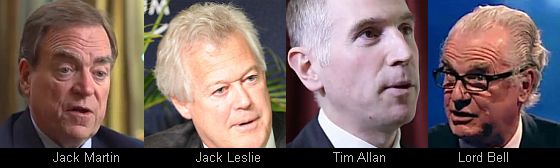
Bahrain Watch is calling attention to six major American and British PR firms that are hoping to win a new contract with the Bahrain government, those being, Bell Pottinger, Hill & Knowlton, Weber Shandwick, Portland Communications, Citigate Dewe Rogerson, and Consulum.

These aren’t household names and neither are the people who run them — but they should be, because these are people who not only advise Middle Eastern autocrats but just as often they counsel the leaders of Western governments.

Lord Bell, chairman of Bell Pottinger, was an adviser to Margaret Thatcher during three general election campaigns. Jack Martin, chairman and CEO of Hill Knowlton, was a senior advisor to the Democratic National Committee and the U.S. Senate Democratic Committee. Jack Leslie, chairman of Weber Shandwick, was a senior aide to U.S. Senator Edward M. Kennedy. Tim Allan, founder of Portland Communications, was a key media adviser to Tony Blair and served as deputy press secretary in Number 10, Downing Street.

With advisers like these, it’s small wonder we have such little confidence in our own democratic leaders. If those who have perfected the art of lubricating the wheels of government in Washington and London, can just as easily offer their services to a government that “has received widespread condemnation from international human rights bodies for human rights abuses, including arbitrary detentions, torture, mass political sackings and severe restrictions on freedoms of expression and association,” what does this say about the condition of contemporary Western governance?

Everyone knows our political system is rotten, but far too little attention is given to the individuals who, outside the media spotlight, have played such an instrumental role in turning democracy itself into the practice of public relations.

Facebooktwittermail

How did a form of torture become policy in America’s prison system?

Andrew Gumbel writes: In 1831, Alexis de Tocqueville visited the Eastern State Penitentiary in Philadelphia to observe first-hand the effects of a peculiar — and, at the time, entirely novel — form of incarceration. The Quakers, who had opened the prison two years earlier, believed that long-term solitary confinement was an ideal form of religious penitence (whence the term penitentiary) and would hasten prisoners’ rehabilitation and reintegration into society. They saw it not as extreme punishment but as a progressive idea, far preferable to the giant holding pens typical of the age, where mutilations and violence among prisoners were common, and spiritual betterment all but unthinkable.

Tocqueville was favorably impressed. “Can there be a combination more powerful for reformation,” he wrote, “than that of a prison which hands over the prisoner to all the trials of solitude, leads him through reflection to remorse, through religion to hope, and makes him industrious by the burden of idleness?”

Ten years later, Dickens paid his own visit to Eastern State, and came away with a rather different opinion. Solitary confinement, he found, inflicted unimaginable torment on the minds of those subjected to it. Far from leading prisoners to enlightenment, it ruined their concentration and haunted them with hideous visions. They fell into deep despair, losing track of time and of themselves. “I hold this slow and daily tampering with the mysteries of the brain, to be immeasurably worse than any torture of the body,” he wrote in his American Notes for General Circulation:

[B]ecause its ghastly signs and tokens are not so palpable to the eye and sense of touch as scars upon the flesh; because its wounds are not upon the surface, and it extorts few cries that human ears can hear […] It wears the mind into a morbid state, which renders it unfit for the rough contact and busy action of the world.

Dickens was not alone. Harry Hawser, who wrote poems about his experience at Eastern State around the same time, hauntingly described the effects of being plunged into a “living tomb.” By the end of the 19th century, the Supreme Court noted that solitary confinement had caused many prisoners to fall “into a semi-fatuous condition,” and others still to kill themselves or to become violently insane. By World War I, the practice was largely abandoned.

Still, the idea never entirely went away, and in our bewildering world of chronically overcrowded, gang-infested prisons, it has returned with a vengeance. The new generation of high-security supermax prisons, whose spreading popularity over the past 40 years has coincided with an explosion in prisoner numbers, is premised on the notion that dangerous inmates — the “worst of the worst,” in official parlance — need to be kept separate from the general prison population, and from each other. [Continue reading…]

Facebooktwittermail

Why Julian Assange is a crucial historical figure

Benjamin Wallace-Wells writes: Assange’s entire public life has been an experiment on the theme of trust, one devoted to the conviction that the public trust in government has been badly misplaced. But for a time, in 2010, Assange felt a part of something larger—if not affiliated with any institution other than his own, then at least part of a broader political movement against American power. The Fifth Estate, a thoughtful drama out this week with the English actor Benedict Cumberbatch as Assange, focuses on the extraordinary eight-month period when WikiLeaks published the military’s war logs from Afghanistan and Iraq, the State Department’s internal cables, and the “Collateral Murder” video—everything that made Assange famous. There was a casual brutality to the way that powerful states and com­panies seemed to behave in these documents: A Shell executive bragged about having packed the Nigerian government with sympathizers, American military officers substantially underreported the numbers of Iraqi civilians their soldiers were killing. In London, Wiki­Leaks became an Establishment liberal cause, and the Australian found himself joined by human-rights crusaders who had been knighted by the queen, journalists and filmmakers, concerned citizens and TED Talk celebrities.

These allegiances were always bound to collapse—Assange is simply too weird, in his person and his politics, to have become part of any mainstream coalition—but they have collapsed so completely that there is little left of Assange’s public image right now beyond the crude cartoon. Vain and self-mythologizing, he has been accused of sexual assault by two of his supporters; a prophet of the mounting powers of the surveillance state, he now reportedly lives in a fifteen-by-thirteen-foot room in London’s Ecuadoran Embassy, sleeping in a women’s bathroom, monitored by intelligence agencies at all times; still trusting of the volunteers around him, he gave one such man access to secret American diplomatic cables about Belarus, only to find that information passed along to the Belarusian dictator. It is as if Assange has been consumed by his own weaknesses and obsessions. Calling around, I’d heard that the last prominent London intellectual who still supported him was the writer Tariq Ali, but when I finally reached him, via Skype, on an island in the Adriatic, it turned out that Ali, too, had grown exasperated with Assange. “He hasn’t formulated his worldview,” Ali said. “Certainly he is hostile to the American empire. But that’s not enough.” Assange has come to be seen, as a journalist at The Guardian put it, as nothing more than “a useful idiot.”

All of this is Assange’s own doing. And yet it is strange how completely these dramas have obscured the power of his insights and how fully we now seem to be living in Julian Assange’s world. His real topic never was war or human rights. It was always surveillance and the way that technology unbalanced the relationship between the individual and the state. Information now moves through electronic circuits, which means it can all be collected, stored, analyzed. The insight that Assange husbanded (and Snowden’s evidence confirmed) is that the sheer seduction of this trove—the possibility of secretly knowing everything about other people—would lead governments and companies to abandon their own laws and ethics. This is the paranoid worldview of a hacker, assembled from a lifetime of chasing information. But Assange proved that it was accurate, and the consequence of his discovery has been a strange political moment, when to see the world through the lens of conspiracies has not only made you paranoid. It’s also made you aware. [Continue reading…]

Facebooktwittermail

GCHQ accused of monitoring privileged emails between lawyers and clients

The Guardian reports: GCHQ is probably intercepting legally privileged communications between lawyers and their clients, according to a detailed claim filed on behalf of eight Libyans involved in politically sensitive compensation battles with the UK.

The accusation has been lodged with Britain’s most secret court, the investigatory powers tribunal (IPT), which examines complaints about the intelligence services and government use of covert surveillance. Most of its hearings are in private.

The allegation has emerged in the wake of the Guardian’s revelations about extensive monitoring by GCHQ of the internet and telephone calls, chiefly through its Tempora programme.

The system taps directly into fibre optic cables carrying the bulk of online exchanges transiting the UK and enables intelligence officials to screen vast quantities of data.

The eight Libyans, members of two families now living in the country’s capital, Tripoli, say they were victims of rendition. They claim they were kidnapped by MI6 and US intelligence agencies, forcibly returned to Colonel Muammar Gaddafi’s regime and tortured. At that time, in 2004, when Gaddafi relinquished his nuclear weapons programme, intelligence relations between Tripoli, London and Washington were close.

A landmark legal action between Abdel Belhaj, 47, and the UK government is due to be heard at the high court shortly to resolve the kidnap and torture allegations.

But lawyers working with the human rights group Reprieve fear their ability to fight the case will be undermined because their legal correspondence may be surreptitiously monitored. [Continue reading…]

Facebooktwittermail