Category Archives: Issues

Pity the elf slaves of online shipping

Mac McClelland writes: Since June, I’ve been ruining my friends’ online-shopping lives. Back then, I reported on a vast warehouse in Ohio where goods bought from online retailers are sorted, boxed, and shipped to consumers. Unsurprisingly, this job does not pay well. A little more surprisingly, this job seems designed to crush employees’ spirits. During my visit, two people got fired within 10 minutes, one for talking to someone while he was working—"Where are you from?" was the offending comment—and one for going to the bathroom too much. So occasionally, and now more that it’s the holidays, my friends and family will call to complain that "Bleh, I want to order something from Amazon/Walmart/Staples/whatever, but I feel guilty about helping oppress workers."

Why would online retailers be so mean? Well, in the case of many, they have helpfully outsourced interaction with workers. When Walmart started selling its merchandise on the internet, it turned to third-party logistics contractors, or 3PLs, experts who could handle the, uh, logistics, like warehousing and transportation, of online sales. Take Exel, for example, the largest 3PL in the country, and a subsidiary of Deutsche Post DHL, one of the largest companies in the world. Exel alone has 86 million square feet of warehouse all over North America and processes literally millions of goods every single day. Other retailers directly perpetrate the oppression. Amazon.com made headlines earlier this year when 20 current and former employees of its Breinigville, Pennsylvania, warehouse told the local Morning Call that workers were fainting in stifling heat and getting yelled at for not meeting ridiculously high productivity goals and generally being "treated like a piece of crap." Employees who were sent home with heat exhaustion were disciplined; a local ER doc eventually called OSHA and reported "an unsafe environment."

Either way, many of the people actually loading and unloading trucks, packing boxes, and pasting labels work not for retailers, or for 3PLs, but for yet another company: temporary staffing agencies. When an online retailer (especially one that doesn’t actually make anything) wants to wring out the most profit possible, it helps to have a labor pool that is on demand, so it can order the exact number of humans it needs to fill that day’s number of orders if the humans are working at top capacity. That way, workers can’t unionize or be legally entitled to decent benefits. That way, the online retailer can give them outlandish productivity goals, like hundreds of orders and thousands of items per day apiece—and when workers burn out, just replace them with the next temp, who can join the rest of the ranks living in fear that they won’t make their numbers and might be incessantly berated for it, or simply fired. Even if you meet the outlandish goals, don’t necessarily expect to be rewarded by say, a real job. As with so many in the industry, the warehouse in Ohio are mostly "temps"—even though some of them have been working in the same place for more than a year.


Facebooktwittermail

Hamas responds to the Arab Spring

The Washington Post reports: Buoyed by the success of Islamist movements in countries swept by the Arab Spring, Hamas, the militant Islamist group that rules the Gaza Strip, is showing signs of pragmatism as its sense of isolation fades.

The organization is jockeying to reposition itself amid shifting terrain in the Arab world. It is reported to be scaling down its presence in Syria, where its long-time patron, President Bashar al-Assad, is facing a popular uprising. At the same time, it is seeking to strengthen ties with Arab countries where moderate Islamists have made political gains.

Hamas officials are holding talks in Cairo this week with the rival Palestinian faction, Fatah, on implementing a reconciliation accord reached earlier this year, as some leaders of the organization suggest that it is ready for political pluralism at home and limiting violence against Israel.

Ismail Haniyeh, the Hamas prime minister in Gaza, is planning his first official trip outside the territory since the militant group seized power there in 2007. According to an aide, Haniyeh plans to visit Turkey, Bahrain, Qatar and Tunisia.

The Islamist surge, say Hamas officials and analysts, has boosted the group’s confidence, giving it more room to maneuver.

“This is an Islamic area, and once people are given a fair chance to vote for their real representatives, they vote for the Islamists,” said Mahmoud Zahar, a senior Hamas leader in Gaza, referring to the ascendance of Islamist parties in recent elections in Egypt, Tunisia and Morocco. “We feel strengthened by popular support.”

For Hamas, a sense of validation has replaced a siege mentality after years of international boycott and blockade by Israel and by Egypt under former president Hosni Mubarak.

“The rise of the Islamists could be seen as game-changer for Hamas,” said Fawaz Gerges, director of the Middle East Center at the London School of Economics. “Hamas no longer sees itself as a besieged island in a sea of hostility. This goes to the very psychology of the movement. . . . They feel that they have strategic depth now.”

On the domestic front, this has translated into a declared intention of following the model of the Islamist parties abroad, which have shown readiness to share power with secular and liberal parties in governing coalitions, and, in the case of Tunisia, have already struck such a deal.

The Islamists’ message of pluralism is now being echoed by officials of Hamas, which has mostly stifled dissent in the Gaza Strip since it took over the territory.

The example of the Islamist parties has had an impact on Hamas leaders and “opened their eyes to make coalitions with other Palestinian factions,” said Ghazi Hamad, deputy foreign minister of the government in Gaza. “This will create a new political Islam in which a coalition is the main goal, not to monopolize the regime. No one accepts one political color. The time of one-party rule has passed.”

Meanwhile, the Associated Press reports: The Hamas militant group has agreed to join the Palestine Liberation Organization — a key step toward unifying the long-divided Palestinian leadership.

Hamas’ leader Khaled Mashaal on Thursday joined a committee that will prepare for elections to the PLO leadership.

Those elections are likely years away but Mashaal’s move means he will work with Palestinian President Mahmoud Abbas, head of the rival Fatah party.

The PLO is the umbrella group of the Palestinian independence movement.

Thursday’s development is an important step toward reconciliation between Hamas and Fatah — which have been split since Hamas seized control of the Gaza Strip in 2007.

Separate elections in the West Bank and Gaza for a unified parliament are tentatively set for next year.

Facebooktwittermail

Syrian rebels take the fight to Bashar al-Assad’s heartland

The Daily Telegraph reports: Military trucks stood parked at the end of the dark empty street. The electricity was cut, the phone signals out and apartment windows boarded up with whatever wood or metal people could find. It was to stop the bullets, activists explained.

Shouting and chanting of “down down Bashar al Assad” could be heard in the distance, interspersed with the crackle of gunfire.

This is not Homs, Idlib, or any of those Syrian towns that for months have been in the throes of rebellious unrest and violent crackdown. This is Douma, a large satellite town on the edge of Damascus, the heartland of support for President Assad’s regime.

Damascus Old City continues in relative normality with the bustle of daily life. Occasional power cuts and a shortage of gas are the principal signs that all is not well.

But less than seven miles away, Douma is in lockdown. Every Friday – when protests traditionally take place after prayers in the mosques, the suburb is under a military siege.

“Do you see the army?” said Ali, an activist who risked arrest and much more to show The Daily Telegraph the situation in his home town. “This is Douma, not Kandahar or Baghdad,” he added still incredulous at the scenes before him.

At the bottom of the street, locals had put up flaming barricades to halt the advance of military vehicles. Regime soldiers were positioned on the tops of the building.

Men huddled in the doorway of the Obeid mosque. Mustering courage, they leapt out in groups, hurling themselves across the central avenue that was in the snipers’ “kill zone”, and into the relative safety of the alleyway opposite. Those who had made it encouraged the others, adrenalin high, shouting “Freedom” and “down down down with the regime” at the top of their voices.

The New York Times reports: Syrian rights activists and opposition groups said on Wednesday that forces loyal to President Bashar al-Assad had killed at least 160 defecting soldiers, civilians and antigovernment activists over the last three days in northwestern Syria. If confirmed, the killings would constitute one of the worst spasms of violence in the nine-month-old uprising.

The killings, which the activists and opposition groups said had taken place near the city of Idlib in the Turkish border region, were reported a day before observers from the Arab League are to visit Syria for the first time to monitor pledges by Mr. Assad’s government to withdraw its troops from besieged areas.

Facebooktwittermail

Obama and the rule of law

Jeff Connaughton writes: Long silent and now contradictory, President Obama needs to deliver a clarifying speech about our financial markets and the rule of law. Speaking in Kansas on December 6, he said, “Too often, we’ve seen Wall Street firms violating major anti-fraud laws because the penalties are too weak and there’s no price for being a repeat offender.” Just five days later on 60 Minutes, he said, “Some of the least ethical behavior on Wall Street wasn’t illegal.” Which is it? Have there been no prosecutions because Wall Street acted legally (albeit unethically)? Or did Wall Street repeatedly violate major anti-fraud laws (and should thus find itself in the dock)?

The President is confusing “legal” with “difficult to prosecute successfully.” The Justice Department’s repeated decisions not to risk losing at trial against Wall Street executives don’t make these person’s actions legal. (If a district attorney can’t prove the actual thief stole your wallet, that doesn’t make stealing legal. It simply means that, regrettably, a malefactor goes unpunished.) As Securities and Exchange Commission Enforcement Director Robert Khuzami said in Senate testimony in 2009, Wall Street perpetrators “are smart people who understand that they are crossing the line” and “are plotting their defense at the same time they’re committing their crime.”

Moreover, the President is misleading us when he says that Wall Street firms violate anti-fraud law because the penalties are too weak. Repeat financial fraudsters don’t pay relatively paltry — and therefore painless — penalties because of statutory caps on such penalties. Rather, regulatory officials, appointed by Obama, negotiated these comparatively trifling fines. This week, the F.D.I.C. settled a suit against Washington Mutual officials for just $64 million, an amount that will be covered mostly by insurance policies WaMu took out on behalf of executives, who themselves will pay just $400,000. And recently a federal judge rejected the S.E.C.’s latest settlement with Citigroup, an action even the Wall Street Journal called “a rebuke of the cozy relationship between regulators and the regulated that too often leaves justice as an orphan.”

The Obama Justice Department hasn’t tried a single Wall Street executive in a criminal court. Against a handful, it decided to let the S.E.C. bring civil charges of fraud, which are easier to prove. So if defendants’ wrists are merely being slapped by the S.E.C. instead of cuffed by the Justice Department, Obama has only his appointees to blame.

For three important reasons, the President needs to explain why the Justice Department has filed away its investigations of big banks and Wall Street firms without indicting anyone. First, American confidence in the system is deeply shaken. Second, it strains credulity for millions of Americans — and has impelled thousands of them to occupy public places in protest — that no banking or insurance executive deserves criminal prosecution for the actions that brought on the financial crisis. Third, by failing to prosecute a single high-profile Wall Street actor today, the Administration is failing to deter financial fraud tomorrow.

Facebooktwittermail

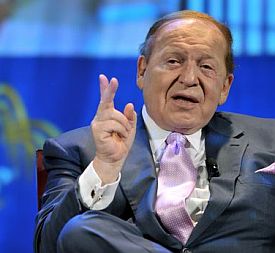
Hardline Zionist casino boss Sheldon Adelson: the deep pockets behind Newt Gingrich

Think Progress reports: The funding behind Newt Gingrich’s American Solutions for Winning the Future, an independent political committee, offers an intriguing clue into the financial deep pockets backing Gingrich’s candidacy. This week, McClatchy revealed that American Solutions footed the $8 million bill for private jet charters while Gingrich weighed whether to enter the 2008 and 2012 presidential races. Casino billionaire Sheldon Adelson was the biggest funder of American Solutions, contributing $7.65 million and rumored to have committed $20 million to a pro-Gingrich super PAC, a report denied by an Adelson spokesperson. Whether the report is true or not, the facts increasingly show that the billionaire casino magnate is a central figure in Newt Gingrich’s political career.

Sands Corporation CEO Sheldon Adelson is based in Las Vegas but has business and political interests in Macau, China and Israel. In Israel, Adelson’s importance stems from his close friendship with Israeli Prime Minister Benjamin Netanyahu and his ownership of Israel HaYom, a free daily newspaper which supports Netanyahu’s Likud party. Back in the U.S., Adelson sits on the board of the Republican Jewish Coalition and is outspoken about his views on the Israeli-Palestinian conflict.

During the George W. Bush presidency, Adelson opposed efforts to jump start peace talks between the Israelis and Palestinians and even took sides against the influential American Israel Public Affairs Committee (AIPAC) when the organization supported peace talks. “I don’t continue to support organizations that help friends committing suicide just because they say they want to jump,” Adelson told the Jewish Telegraph Agency.

Facebooktwittermail

The undeniable Palestinian right to resist occupation

Noam Sheizaf writes: Following the killing of Mustafa Tamimi in his village Nabi Saleh, Spokesperson for the IDF presented pictures of a slingshot Tamimi had on him when he was brought to the hospital. This was to be the indicting evidence that the protester was taking part in hostile action against the army – i.e. throwing stones – and therefore responsible for his own death.

Only in the context of the occupation can throwing stones at a bullet-proof army jeep be seen as an offense deserving the death penalty, carried out on the spot (clearly, the soldiers weren’t acting in self-defense). Furthermore, as recent attacks by settlers on soldiers – including a brick thrown from close range on the IDF regional commander – demonstrated, the army’s treatment of Jews is very different (to be clear, I don’t call for shooting Jewish stone-throwers either). But there is a larger issue here, concerning the whole notion of “legitimate” resistance to the occupation.

Facts and context are important: Israel took over the West Bank and Gaza more than 44 years ago. Since then, the Palestinians have been under military occupation, which denies their basic human and civil rights. The Palestinians can’t vote. They are tried in military court, where the conviction rate is astonishing. They don’t enjoy due process. Their property rights are limited, and their lands – including private lands – are regularly seized by Israel. All this is well-known and well-documented.

As far as Israel is concerned, this situation can go on forever. Israel is not attempting to leave the West Bank – it actually strengthens its hold on the territory – and it doesn’t plan to give the Palestinians equal rights within the state of Israel.

The Palestinians therefore have a moral right to resist the occupation. It’s as simple as that.

Facebooktwittermail

The top 1 percent whining selfish bastards

Bloomberg reports: Jamie Dimon, the highest-paid chief executive officer among the heads of the six biggest U.S. banks, turned a question at an investors’ conference in New York this month into an occasion to defend wealth.

“Acting like everyone who’s been successful is bad and because you’re rich you’re bad, I don’t understand it,” the JPMorgan Chase & Co. (JPM) CEO told an audience member who asked about hostility toward bankers. “Sometimes there’s a bad apple, yet we denigrate the whole.”

Dimon, 55, whose 2010 compensation was $23 million, joined billionaires including hedge-fund manager John Paulson and Home Depot Inc. (HD) co-founder Bernard Marcus in using speeches, open letters and television appearances to defend themselves and the richest 1 percent of the population targeted by Occupy Wall Street demonstrators.

If successful businesspeople don’t go public to share their stories and talk about their troubles, “they deserve what they’re going to get,” said Marcus, 82, a founding member of Job Creators Alliance, a Dallas-based nonprofit that develops talking points and op-ed pieces aimed at “shaping the national agenda,” according to the group’s website. He said he isn’t worried that speaking out might make him a target of protesters.

“Who gives a crap about some imbecile?” Marcus said. “Are you kidding me?”
‘Feels Lonely’

The organization assisted John A. Allison IV, a director of BB&T Corp. (BBT), the ninth-largest U.S. bank, and Staples Inc. co- founder Thomas Stemberg with media appearances this month.

“It still feels lonely, but the chorus is definitely increased,” Allison, 63, a former CEO of the Winston-Salem, North Carolina-based bank and now a professor at Wake Forest University’s business school, said in an interview.

At a lunch in New York, Stemberg and Allison shared their disdain for Section 953(b) of the Dodd-Frank Act, which requires public companies to disclose the ratio between the compensation of their CEOs and employee medians, according to Allison. The rule, still being fine-tuned by the Securities and Exchange Commission, is “incredibly wasteful” because it takes up time and resources, he said. Stemberg called the rule “insane” in an e-mail to Bloomberg News.

“Instead of an attack on the 1 percent, let’s call it an attack on the very productive,” Allison said. “This attack is destructive.”

Facebooktwittermail

Occupy Albany’s demand

Statement:

We have joined together to Occupy as an affirmation of the future of democracy where each person has an equal voice in shaping our common future. While we come from diverse backgrounds and worldviews, we stand united in the recognition that our current system of governance is failing us- the voice of the People is drowned out by the corrupting influence that concentrated economic power exerts on the government. The interests of those who purchase influence are rewarded at the expense of the People, from whom the government’s just power is derived. We believe that this failure in our system is at the core of many interconnected issues we face as a society, and its resolution is key to a just future. We therefore demand true democracy, unshackled from the corrosive influence of concentrated economic power, and call all who share in this common goal to stand with us and take action toward this end.

Facebooktwittermail

What can prevent state failure for Egypt?

An editorial in Al-Masry Al-Youm says: Downtown Cairo is once again a battlefield, and this time, the military is not just a silent facilitator, but an active participant — beating, dragging, shooting, and assaulting civilians. The latest round of brutality has led us to not only question the military’s handling of the transition period, but also the nature of the modern Egyptian state, which is associated with a strong military.

We are at a juncture whereby the revolution has begun to challenge the centrality of the military to the modern state, a legacy dating back to Mohammed Ali’s rule.

When the ruling military junta presented its own version of recent events at a press conference on Monday, the generals, yet again, raised the terrifying prospect of “state failure,” saying that the Supreme Council of the Armed Forces (SCAF) and the army are the sole protectors of the state and everything they do is justified in the name of preventing its dissolution at the hands of those who want to undermine it.

This self-assigned supremacy is rapidly losing even the pretense of legitimacy.

The army’s violence and cruelty has been thoroughly documented by eyewitnesses, in photos and videos. We will not soon forget the image of two soldiers dragging a woman, half naked, by her clothes while a third stands ready to stomp on her chest. When skeptics condemn descriptions of soldiers resorting to violence, they cite how the army was provoked, or how paid infiltrators are allegedly plotting chaos and instability for Egypt. But what can provoke an organized professional army to engage in disorganized, unprofessional street fighting against civilian protesters?

The SCAF claims that “thuggery” and “chaos” have marred the purity of the 25 January revolution. After watching the events of the past five days, we have to agree. The state’s prestige has been irreparably undermined by soldiers urinating on protesters from atop a government building, sexually assaulting women, throwing furniture and flatware from government offices, making lewd sexual gestures, and turning sites of heritage and democracy — such as the Egyptian Museum and the parliament building — into temporary torture centers.

Facebooktwittermail

How Egypt’s prime minister tries to cover up state brutality

Parallel Dimensions from arabist on Vimeo.

Meanwhile, AFP reports: A US official voiced outrage Tuesday after an adviser to Egypt’s military said that some protesters facing down troops in Cairo should be “thrown into Hitler’s incinerators.”

Retired general Abdelmoneim Kato’s “anti-Semitic comments are outrageous, offensive and clearly unacceptable,” Hannah Rosenthal, the US special envoy against anti-Semitism, wrote on Twitter.

Kato, who advises the military, faced criticism from human rights groups and dissidents after saying that some protesters in Cairo’s Tahrir Square were “street kids who deserve to be thrown into Hitler’s incinerators.”

Presidential hopeful and former UN nuclear watchdog chief Mohamed ElBaradei said such statements showed “a deranged and criminal state of mind.”

The Arabic Network for Human Rights Information said Kato’s comments “incite hatred and justify violence against citizens.”

Facebooktwittermail

Arms suppliers urged to halt transfers to the Egyptian army

Global arms suppliers must halt the transfer of small arms, ammunition and other repressive equipment to the Egyptian military and security forces, Amnesty International said today after the army again violently dispersed protests in Cairo.

The organization condemned the excessive use of force against protesters and called for a cessation of all transfers of small arms, light weapons and related munitions and equipment to Egypt, as well as a halt to all internal security equipment that could be used to violently suppress human rights, such as tear gas, rubber and plastic bullets and armoured vehicles.

“It can no longer be considered acceptable to supply the Egyptian army with the types of weaponry, munitions and other equipment that are being used to help carry out the brutal acts we have seen used against protesters,” said Hassiba Hadj Sahraoui, Deputy Director for the Middle East and North Africa at Amnesty International.

“It is clear that either the military police has been given orders to disperse demonstrators at any cost, or the Supreme Council of the Armed Forces does not control the army and security forces. Either scenario is equally worrying.”

Facebooktwittermail

Israel: Publishing in a country that has outlawed free speech

In its relentless slide towards outright fascism, Israel has imposed an effective prohibition on political debate around the issue of boycott, divestment and sanctions (BDS). At +972, Dimi Reider describes the effect of the new law by answering the question, What is +972‘s stance on BDS?

The simple answer is that we don’t have one. The website is a collective of authors, each of whom have their own opinions about BDS. Some oppose it, some support it; some, like yours truly, support the D but are not particularly fond of the BS. But unfortunately, our ability to freely discuss this key aspect of the fight against the occupation has been severely and deliberately crippled by recent legislation. We may still carry opinions on BDS; but outright calls for boycott, divestment and sanctions hold far too great a risk for our site – a risk we are not in the financial position to take. Since we are legally responsible for all content appearing on the website, this obligates us to erase outright calls, and only outright calls for BDS from the comment thread as well.

Here is how it works: In May 2011, the Knesset passed the notorious “Boycott Law”. The Boycott Law does not make it a criminal offence or even misdemeanour to call for boycott. Neither any of us, nor any of readers will go to jail for making such a call. But the law does allow anyone who feels they have been materially impaired by that hypothetical call to sue us for damages – without actually proving any damages were suffered. In other words, if a reader was to publish a comment explicitly calling for BDS, tomorrow the website could be slammed with a massive lawsuit by some other reader or a right-wing “lawfare” organisaton. Even if we won the case in the long run, the legal fees would have sunk us very quickly – our budget is minimal, not to say minute, and we have no assets we can liquify and throw into the fight.

Facebooktwittermail

Egyptian women march against military rule

Sarah Carr reports: It was an image that shocked Egypt and within hours went viral: the woman in the exposed blue bra being beaten and kicked by a gang of soldiers during an attack on Tahrir Square protesters.

In a press conference on Sunday, General Adel Emara, a member of the ruling Supreme Council of the Armed Forces (SCAF), downplayed the incident, telling reporters that “they should consider all the circumstances” before judging.

On Tuesday, women responded. Some 4000 took to the streets in a march organized by the Mohamed ElBaradei Campaign and the April 6 Youth Movement.

Later on Tuesday evening, the SCAF issued an apology to the “women of Egypt,” in its statement Number 91.

“The SCAF reaffirms its upmost respect and admiration for the women of Egypt and their right to protest and of positive participation in political life on the path of democratic change Egypt is currently witnessing,” the statement reads. “All legal measures have been taken to hold officials accountable for transgressions,” it continues.

In Tahrir Square, women gathered, surrounded by men whose linked hands formed a cordon to protect them. One of the men, Mohamed Fathy, said he supported the idea of a women-only march because “they are here defending their rights and have to have their say.”

After circling the square once the march proceeded through downtown Cairo — the scene in 2007 of horrific mass assaults during the Eid vacation when packs of youths sexually assaulted women.

Their chants, “Girls of Egypt are a red line” — a variation on the now-abandoned “The Egyptian army is a red line” — echoed around the street. From balconies, office workers clapped and cheered. The women chanted for them to join them saying, “Come down from your houses, Tantawi undressed your girls.” Field Marshal Hussein Tantawi is the head of the SCAF.

There was pervasive anger against the army, with frequent chants for the SCAF to leave power and condemnation of violence by military “riff-raff”.

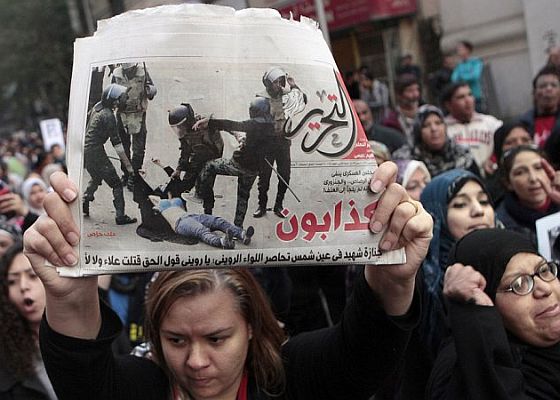
“Tantawi is the supreme commander of harassment and violation of honor,” one placard read. Other posters declared that the military consists of “liars” — a reference to the Sunday edition of independent newspaper Al-Tahrir, the front page of which made the accusation next to a picture of the woman in the blue bra.

Naglaa Talat marched carrying her two-year-old daughter.

“I had to come after I saw the picture of the naked girl in the newspapers — the images were enough to make any respectable person come. I have daughters and I came for them,” Talat told Egypt Independent.

Like many of the protesters, Talat insisted that Tantawi must leave power and the SCAF hand over power to civilian rule.

Facebooktwittermail

The secret program empowering Obama to kill anyone, anywhere, without any explanation

The Washington Post reports: Since September, at least 60 people have died in 14 reported CIA drone strikes in Pakistan’s tribal regions. The Obama administration has named only one of the dead, hailing the elimination of Janbaz Zadran, a top official in the Haqqani insurgent network, as a counterterrorism victory.

The identities of the rest remain classified, as does the existence of the drone program itself. Because the names of the dead and the threat they were believed to pose are secret, it is impossible for anyone without access to U.S. intelligence to assess whether the deaths were justified.

The administration has said that its covert, targeted killings with remote-controlled aircraft in Pakistan, Yemen, Somalia and potentially beyond are proper under both domestic and international law. It has said that the targets are chosen under strict criteria, with rigorous internal oversight.

It has parried reports of collateral damage and the alleged killing of innocents by saying that drones, with their surveillance capabilities and precision missiles, result in far fewer mistakes than less sophisticated weapons.

Yet in carrying out hundreds of strikes over three years — resulting in an estimated 1,350 to 2,250 deaths in Pakistan — it has provided virtually no details to support those assertions.

In outlining its legal reasoning, the administration has cited broad congressional authorizations and presidential approvals, the international laws of war and the right to self-defense. But it has not offered the American public, uneasy allies or international authorities any specifics that would make it possible to judge how it is applying those laws. [Continue reading…]

Facebooktwittermail

This bastardised libertarianism makes ‘freedom’ an instrument of oppression

George Monbiot writes: Freedom: who could object? Yet this word is now used to justify a thousand forms of exploitation. Throughout the rightwing press and blogosphere, among thinktanks and governments, the word excuses every assault on the lives of the poor, every form of inequality and intrusion to which the 1% subject us. How did libertarianism, once a noble impulse, become synonymous with injustice?

In the name of freedom – freedom from regulation – the banks were permitted to wreck the economy. In the name of freedom, taxes for the super-rich are cut. In the name of freedom, companies lobby to drop the minimum wage and raise working hours. In the same cause, US insurers lobby Congress to thwart effective public healthcare; the government rips up our planning laws; big business trashes the biosphere. This is the freedom of the powerful to exploit the weak, the rich to exploit the poor.

Rightwing libertarianism recognises few legitimate constraints on the power to act, regardless of the impact on the lives of others. In the UK it is forcefully promoted by groups like the TaxPayers’ Alliance, the Adam Smith Institute, the Institute of Economic Affairs, and Policy Exchange. Their concept of freedom looks to me like nothing but a justification for greed.

So why have we been been so slow to challenge this concept of liberty? I believe that one of the reasons is as follows. The great political conflict of our age – between neocons and the millionaires and corporations they support on one side, and social justice campaigners and environmentalists on the other – has been mischaracterised as a clash between negative and positive freedoms. These freedoms were most clearly defined by Isaiah Berlin in his essay of 1958, Two Concepts of Liberty. It is a work of beauty: reading it is like listening to a gloriously crafted piece of music. I will try not to mangle it too badly.

Put briefly and crudely, negative freedom is the freedom to be or to act without interference from other people. Positive freedom is freedom from inhibition: it’s the power gained by transcending social or psychological constraints. Berlin explained how positive freedom had been abused by tyrannies, particularly by the Soviet Union. It portrayed its brutal governance as the empowerment of the people, who could achieve a higher freedom by subordinating themselves to a collective single will.

Facebooktwittermail

Mass march by Cairo women in protest over soldiers’ abuse

The New York Times reports: Thousands of women massed in Tahrir Square here on Tuesday afternoon and marched to a journalists’ syndicate and back in a demonstration that grew by the minute into an extraordinary expression of anger at the treatment of women by the military police as they protested against continued military rule.

Many held posters of the most sensational image of violence over the last weekend: a group of soldiers pulling the abaya off a prone woman to reveal her blue bra as one raises a boot to kick her. The picture, circulated around the world, has become a rallying point for activists opposed to military rule, though cameras also captured soldiers pulling the clothes off other women.

The march, guarded by a cordon of male protesters, was a surprising turn. In Egypt, as in other countries swept by the revolts of the Arab Spring, women played important roles, raising hopes that broader social and political rights would emerge along with more accountable governments. But with the main popular focus on preparing for elections and protesting the military’s continued hold on power, women here had grown less politically visible.

The women’s protest came on the fifth day of violent clashes between Egyptian soldiers and protesters. The severity of the military’s defense of its hold on power, even as the newly elected Parliament begins to take shape, has restored a degree of unity that had been missing among the civilian political factions, liberal and Islamist, since the ouster of President Hosni Mubarak in February.

Facebooktwittermail