Avraham Burg, former Speaker of the Knessett, argues that it is time for what remains of an Israeli left to abandon the idea of a two-state solution.
Until now, we the seekers of peace, wandered through the world, spreading the hope that there would soon be solutions, while they were busy creating disheartening facts on the ground. With time, our rhetoric was victorious (Netanyahu said “two states” ), but it died. Their acts won the day and are already killing all of us.
So enough of the illusions. There are no longer two states between the Jordan River and the sea. Let the right-wing MKs, the Katzes and the Elkins, travel around the world and show the beauty of their faces without the deceptive layer of makeup we provided.
Meanwhile we must consider how we can enter into the new Israeli discourse. It has intriguing potential. The next diplomatic formula that will replace the “two states for two peoples” will be a civilian formula. All the people between the Jordan and the sea have the same right to equality, justice and freedom. In other words, there is a very reasonable chance that there will be only one state between the Jordan and the sea – neither ours nor theirs but a mutual one. It is likely to be a country with nationalist, racist and religious discrimination and one that is patently not democratic, like the one that exists today. But it could be something entirely different. An entity with a common basis for at least three players: an ideological right that is prepared to examine its feasibility; a left, part of which is starting to free itself of the illusions of “Jewish and democratic”; and a not inconsiderable part of the Palestinian intelligentsia.
The conceptual framework will be agreed upon – a democratic state that belongs to all of its citizens. The practicable substance could be fertile ground for arguments and creativity. This is an opportunity worth taking, despite our grand experience of missing every opportunity and accusing everyone else except ourselves.
I’m not a fan of Rick Steves’ PBS travelogues, but superficial as it might be, seeing a tourist eye’s view of Iran isn’t such a bad way of normalizing perceptions of this endlessly demonized country.
Bloomberg Businessweek reports: Like a broker tracking the dips and spikes of a volatile but lucrative stock, Mohammad Shakir Afridi has kept a close eye on U.S. troop levels in Afghanistan since the first Americans landed in the country 10 years ago. As president of the Khyber Transport Assn., one of the largest associations of truck owners in Pakistan, Afridi’s biggest contract involves moving military equipment for American and coalition forces through Pakistan to military bases in Afghanistan. The slightest policy shift in Washington can carry major consequences for Afridi and his business.
Sitting on a rooftop in a leafy residential block in Peshawar, the largest city in northwest Pakistan, Afridi slaps the morning paper on the floor beside his mat. “Twenty-four of our boys in one go,” he spits out. A front page photograph shows a field full of coffins draped in Pakistani flags. The soldiers were killed on Nov. 26 when U.S. helicopters and jet fighters from Afghanistan fired on military outposts on the Pakistani side of the border. The relationship between Pakistan and the U.S., which has been rocky for years, hit a new low. While the U.S. military promised to investigate and the NATO chief regretted the “tragic, unintended” incident, the Pakistani Prime Minister said there would be “no more business as usual” with the U.S. Pakistan demanded the U.S. vacate an airbase it was using in the South and choked off all U.S. and coalition military supplies traveling through the country.
Afridi learned of the American attack before the Pakistan military or government had issued any statement; one of his truck drivers called to tell him the border was closed. Afridi was later given orders from the military to halt trucks near the border, and to direct all others to the southern port city of Karachi. He quickly obliged. “It’s serious this time,” Afridi says. “They’ll make the Americans sweat.”
U.S. and Allied forces in Afghanistan get the bulk of their supplies in two ways. The first is the Northern Distribution Network, a web through Central and Eastern Europe and Central Asia that crosses through at least 16 countries, using a combination of roads, railway, air, and water to move supplies in from the north. The chain can be complex and circuitous. One path through the network, for example, might involve military cargo that arrives by sea in Istanbul. From there it travels the width of Turkey on truck and crosses the northern border into Poti, Georgia. In Georgia the equipment goes by rail to Baku in Azerbaijan, where it’s loaded onto a ship bound for the Kazakh Port of Aktau, across the Caspian Sea. Then it’s put on trucks for the 1,000-mile ride through Kazakhstan, then a train through Kyrgyzstan and, finally, into Afghanistan.
The second passage to Afghanistan, known as Pakistani Lines of Communication, begins at the port of Karachi and continues on one of two land routes, north toward the logistical hub at Bagram Airfield or west toward Kandahar. It has always been the primary option for American forces: It’s the shortest and cheapest, requires only one border crossing, and minimal time on the road inside Afghanistan. Nearly 60,000 trucks drive more than 1,200 miles through the length of Pakistan every year carrying supplies and fuel. According to varying figures provided by U.S. and NATO forces, 40 percent to 60 percent of all military supplies used by coalition forces in Afghanistan come through Pakistan. [Continue reading…]
Reuters reports: Pakistan’s powerful army is fed up with unpopular President Asif Ali Zardari and wants him out of office, but through legal means and without a repeat of the coups that are a hallmark of the country’s 64 years of independence, military sources said.
Tensions are rising between Pakistan’s civilian leaders and its generals over a memo that accused the army of plotting a coup after the U.S. raid that killed Osama bin Laden in May.
“Who isn’t fed up with Zardari? It’s not just the opposition and the man on the street but people within the government too,” said one military source who asked not to be named.
“But there has to be a proper way. No action is being planned by the army. Even if we tried, it would be very unpopular and not just with the government and the opposition but most Pakistanis too.”
The Pakistani military spokesman declined comment.
General Ashfaq Kayani has pledged to keep the military out of Pakistani politics since taking over as army chief in 2007.
Any coup — Pakistan has had three since independence in 1947 — could further tarnish the military’s public image which has already taken a battering after the bin Laden operation, widely seen in Pakistan as a violation of sovereignty.
But the army remains the arbiter of power and analysts say it has plenty of ways to pressure Zardari to step down, especially if a link is established between him and the memo, which sought the Pentagon’s help in averting a feared coup.
On the right in the U.S., nothing garners political support as easily as preaching the evils of Big Government. But if someone wants to observe big government in one of its most tyrannical expressions, there’s probably no place better to go than the West Bank where Palestinians live under Israeli military rule.
Haaretz reports on the red tape that controls everyday life:
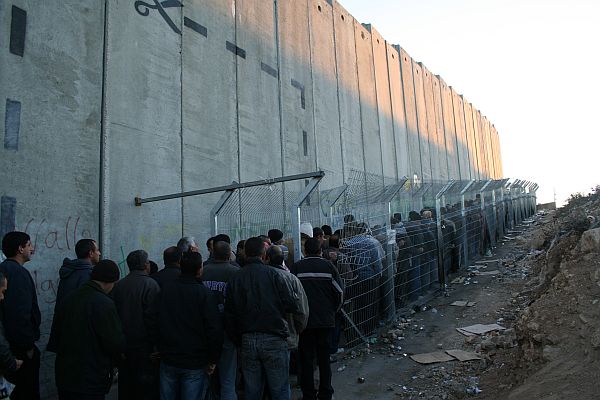
Israel’s Civil Administration issues 101 different types of permits to govern the movement of Palestinians, whether within the West Bank, between the West Bank and Israel or beyond the borders of the state, according to an agency document of which Haaretz obtained a copy.
The most common permits are those allowing Palestinians to work in Israel, or in Jewish settlements in the West Bank. Over the decades, however, the permit regimen has grown into a vast, triple-digit bureaucracy.
There are separate permits for worshipers who attend Friday prayers on the Temple Mount in Jerusalem and for clerics working at the site; for unspecified clergy and for church employees. Medical permits differentiate between physicians and ambulance drivers, and between “medical emergency staff” and “medical staff in the seam zone,” meaning the border between Israel and the West Bank. There is a permit for escorting a patient in an ambulance and one for simply escorting a patient.
There are separate permits for traveling to a wedding in the West Bank or traveling to a wedding in Israel, and also for going to Israel for a funeral, a work meeting, or a court hearing.
The separation fence gave rise to an entirely new category of permits, for farmers cut off from their fields. Thus, for instance, there is a permit for a “farmer in the seam zone,” not to be confused with the permit for a “permanent farmer in the seam zone.”
Human rights organizations have challenged the permit regime on various grounds.
According to a report by the UN Office for the Coordination of Humanitarian Affairs, international agencies operating in the West Bank waste an estimated 20 percent of their working days on permits from the Civil Administration – applying for them, renewing them and sorting out problems.
The checkpoint-monitoring organization Machsom Watch claims that the Shin Bet security service uses the permit regime to recruit informers. Palestinians whose permit requests are rejected “for security reasons” are often invited to meetings with Shin Bet agents, who then offer “assistance” in obtaining the desired permits in exchange for information.
Guy Inbar, spokesman for the Coordinator of Government Activities in the Territories, said in response that the Civil Administration is aware of the issues raised in the article and intends to evaluate them in the coming year as part of its streamlining program.
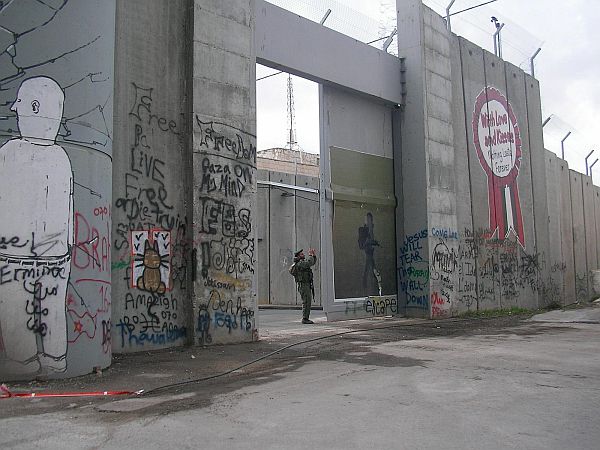
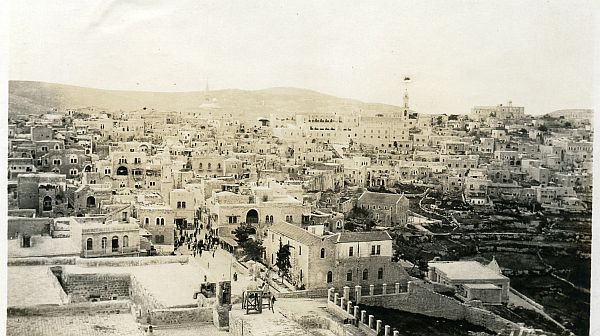
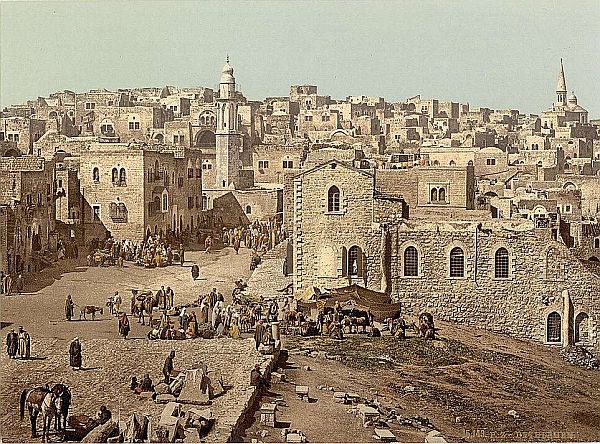
The Guardian reports: If Joseph and Mary were making their way to Bethlehem today, the Christmas story would be a little different, says Father Ibrahim Shomali, a parish priest in the town. The couple would struggle to get into the city, let alone find a hotel room.
“If Jesus were to come this year, Bethlehem would be closed,” says the priest of Bethlehem’s Beit Jala parish. “He would either have to be born at a checkpoint or at the separation wall. Mary and Joseph would have needed Israeli permission – or to have been tourists.
“This really is the big problem for Palestinians in Bethlehem: what will happen when they close us off completely?”
Bethlehem is the heart of Christian Palestine and it swells with pride every Christmas. Manger Square is transformed into a grotto of lights and stalls crowned by a towering Christmas tree. Strings of illuminated angels, stars and bells festoon the streets. But just a few minutes’ drive to the north, the festive atmosphere stops abruptly.
A strip of Israeli settlements built on 18 sq km of what was once northern Bethlehem threatens to cut the city off from its historic twin, Jerusalem. To the Israeli authorities, these have been neighbourhoods of Jerusalem since 1967. One of the settlements, Har Homa, is built on land where angels are said to have announced the birth of Christ to local shepherds. A narrow corridor of land between Har Homa and another settlement, Gilo, still connects Bethlehem to Jerusalem but the construction of Givat Hamatos, a new settlement announced in October, will fill this in a matter of years.
The European Union and United Nations routinely denounce Israel’s unilateral settlement expansion but in October, EU high commissioner Baroness Catherine Ashton warned the construction of Givat Hamatos was “of particular concern as [it] would cut the geographic contiguity between Jerusalem and Bethlehem”.
European concern is not slowing Israel’s progress. Last week, 500 new units were approved for Har Homa and a further 348 in Betar Illit, on Bethlehem’s western boundary. Earlier this month, an additional 267 units were sanctioned for settlements running up to the edge of the city’s southern suburbs, where the Ministry of Defence also gave settlers permission to start a farm on Palestinian land. This is in addition to the 6,782 new apartments already slated for Har Homa, Gilo and Givat Hamatos.
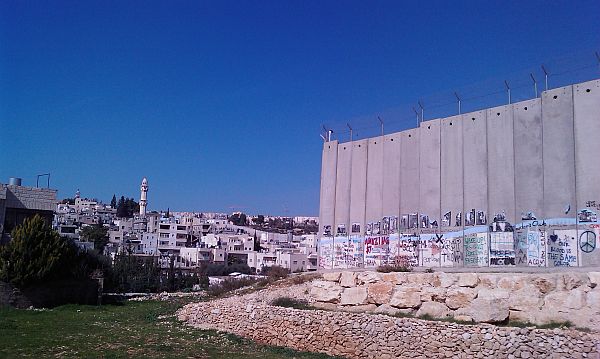
In the short term, the closure won’t make a big difference to everyday life in Bethlehem: the separation wall already prevents Palestinians from entering Jerusalem from the town without an Israeli permit.
But this ring of settlements will permanently change the geography of the biblical landscape: if a peace agreement razes the separation wall, the two cities will remain divided.
Israeli activist Hargit Ofram, director of Peace Now, reads a clear political intention in Israel’s plans: “These efforts are being made to prevent a possible two-state solution because in order for that to work, you would need a viable Palestinian state with its capital in East Jerusalem.
“If that capital is going to be surrounded by settlements, Israel would have to remove them. The more Israel is building, the higher the price of a Palestinian state is becoming.”
A year ago, Mayor Victor Batarseh described the impact of the occupation on the Bethlehem and Palestinian Christians who wish to visit the town to celebrate Christmas.
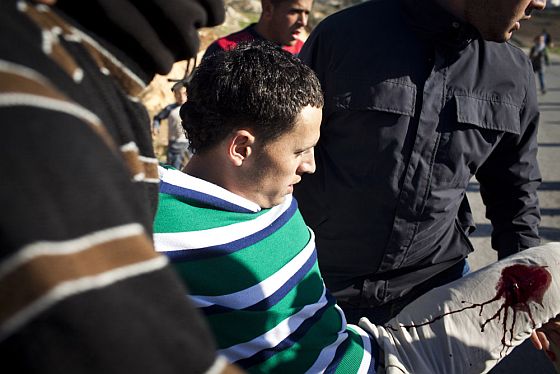
The Popular Struggle Coordination Committee reports: Earlier today, an Israeli military sniper opened fire at demonstrators in the village of Nabi Saleh, injuring one in the thigh. The wounded protester was evacuated by a Red Crescent ambulance to the Salfit hospital. The incident takes place only two weeks after the fatal shooting of Mustafa Tamimi at the very same spot. Additionally, a Palestinian journalist was injured in his leg by a tear-gas projectile shot directly at him, and two Israeli protesters were arrested.
The protester was hit by 0.22″ caliber munitions, which military regulations forbid using in the dispersal of demonstrations. Late in 2001, Judge Advocate General, Menachem Finkelstein, reclassified 0.22” munitions as live ammunition, and specifically forbade its use as a crowd control means. The reclassification was decided upon following numerous deaths of Palestinian demonstrators, mostly children.
Despite this fact, the Israeli military resumed using the 0.22” munitions to disperse demonstrations in the West Bank in the wake of Operation Cast Lead. Since then at least two Palestinian demonstrators have been killed by 0.22” fire:
Az a-Din al-Jamal, age 14, was killed on 13 February 2009, in Hebron,
Aqel Sror, age 35, was killed on 5 June 2009, in Ni’lin.
Following the death of Aqel Srour, JAG Brig. Gen. Avichai Mandelblit reasserted [PDF] that 0.22” munitions “are not classified by the IDF as means for dispersing demonstrations or public disturbances. The rules for use of these means in Judea and Samaria are stringent, and comparable to the rules for opening fire with ‘live’ ammunition.”
Contrary to the army’s official position, permissive use of 0.22” munitions against demonstrators continues in non life-threatening situations. [Continue reading for more background.]
Protester evacuated after being shot with live ammo in Nabi Saleh today. Picture credit: Oren Ziv/ActiveStills
Carne Ross writes: It has been clear for some time that the conduct of the banking and financial industry is one very important cause of the 2008 credit crunch. Moreover, for-profit banks by and large fail to deliver services to the poor, deepening poor people’s marginalization from the mainstream economy. The banks relentless pursuit of profit, an intrinsic feature of the industry (as of the broader economy), continues to expose all of us to the risk of another banking crisis which would repeat the enormous harm done last time, above all to the world’s poorest. Sadly, it’s unrealistic to expect Washington to do much to curb the industry, given the banks’ enormous lobbying sway and privileged access to senior officials, regardless which party is in power.
It’s no surprise then that the banks have been an important focus of discussion in the Occupy Wall Street movement. And a new approach to banking may become one of the important ways that Occupy moves forward and starts producing material change.
One evening in Zuccotti Park, I somewhat rashly, and without much forethought, stood up and announced that I wanted to set up a working group to explore alternative systems of banking. I did not have a clear plan but felt that we had to get to the heart of the problem. If we could change banking and make it embody the values of Occupy—equality, transparency, democracy—we might not only change the financial industry for the better, but also change the very nature of the economy—and thus society itself.
Other members of the group share this ambition. Those who have joined the group represent an extraordinary and eclectic mix. There are army vets and unemployed students, but also a large number of financial experts: former derivative traders, SEC regulators, bankers, financial analysts and bloggers and even a professor of financial law. We have no shortage of expertise, and no shortage of determination either.
Over the last several weeks, we have been examining what legislative changes are needed to reform the banking sector: some day soon there may be Occupy-originated proposals and draft legislation, for instance to amend the so-called “Volcker Rule”. One group has split off to explore and design the creation of an ideal bank that would put into practice the values of Occupy. What would this look like? [Continue reading…]
The anonymous Arab journalist who blogs at The Arab Digest examines those reasons that support the idea that the Assad regime is behind these bombings, versus those reasons suggesting Free Syrian Army or Islamist involvement. In his view, the regime itself is more suspect.
One could say the regime is behind it for the following reasons:
1. Friday is a day off which means more civilians will die than security services.
2. Arab League observers just arrived in town, and such operations serve the regime’s reasoning of current events, and justifies to some extent its heavy handedness.
3. Precedence. The regime has allegedly used a suicide bomber in Lebanon’s Hariri assassination.
4. The FSA has denied its involvement, and accused the regime. The Syrian National Council has previously asked the FSA, and reportedly agreed with its leader Riyadh Al-Assaad, to restrict its role to protecting civilian demonstrators.
But on the other hand, there is the following supporting the anti regime FSA/Islamists involvement:
1. The Free Syrian Army was not happy with the Arab League Observers arriving in Syria. They were counting on the Arab League increasing the international and regional isolation of Syria.
2. The Islamists have a history of attacking the Security apparatuses. These events are reminiscent of the 1980s showdown with the regime.
3. There is growing anger in the conservative cities and regions, against Damascus and Aleppo for not joining the revolution. This might be a warning.
4. The FSA is not an organised force. The Islamists have a different cell-based structure and might go about such operations without consulting anyone. In Iraq, they had no political calculations whatsoever except to ruin any political process, and promote Sectarian violence.
Both are strongly supported. Still, I see the regime blamed for the bombings due to the timing, and for it being the main perpetrator in repression and violence (the stronger side in violence, and the violent one in repressing peaceful demonstrations). Also, the fact that the regime quickly accused Al-Qaeda and had a team of media people quickly reporting and analysing this, will draw more suspicions regarding its possible involvement.
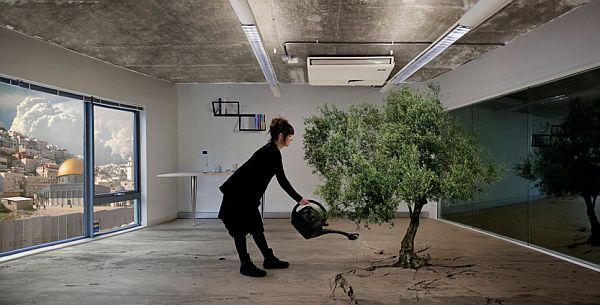
io9.com reports: Palestinian artist Larissa Sansour uses science fictional imagery to discuss her people’s stateless condition, so her work was always bound to cause some controversy. She’s done a host of short films playing with science fiction movie themes, and commenting on Middle Eastern politics.
But after Sansour’s “sci-fi photo series” Nation Estate became one of the finalists for the Lacoste Elysée Prize 2011 — a prestigious award that carries a payment of over $30,000 — the contest’s sponsor, Lacoste, insisted that her work be disqualified. (Yes, the company that makes those funny alligator shirts.) Sansour’s name was removed from the prize’s website, and the photos were removed from an upcoming issue of the magazine ArtReview.
The Nation Estate Project imagines the entire Palestinian people living in one giant high-rise building, sort of like a J.G. Ballard novel, with each floor representing a different city. It’s an offshoot of one of her science fictional short films. Sansour told the Daily Star:
I think the most shocking thing about this development, is that I didn’t apply for this prize… They nominated [me] only to revoke my nomination later on grounds that my work is ‘too pro-Palestinian.’
The Swiss gallery hosting the prize later issued a statement [PDF] explaining its decision to suspend the contest and disassociate itself from Lacoste’s choice:
The Musée de l’Elysée has based its decision on the private partner’s wish to exclude Larissa Sansour, one of the prize nominees. We reaffirm our support to Larissa Sansour for the artistic quality of her work and her dedication. The Musée de l’Elysée has already proposed to her to present at the museum the series of photographs “Nation Estate”, which she submitted in the framework of the contest.
For 25 years, the Musée de l’Elysée has defended with strength artists, their work, freedom of the arts and of speech. With the decision it has taken today, the Musée de l’Elysée repeats its commitment to its fundamental values.
A recent study by the U.S. Air Force School of Aerospace Medicine assessed the level of stress involved in remote warfare being conducted by Air Force drone operators. The New York Times reports:
4 percent or less of operators were at high risk of developing post-traumatic stress disorder, the severe anxiety disorder that can include flashbacks, nightmares, anger, hypervigilance or avoidance of people, places or situations. In those cases, the authors suggested, the operators had seen close-up video of what the military calls collateral damage, casualties of women, children or other civilians. “Collateral damage is unnerving or unsettling to these guys,” Colonel McDonald said.
The percentage of troops returning from Iraq and Afghanistan at risk of developing post-traumatic stress disorder was 12 to 17 percent, the authors said.
In contrast to nearly half of drone operators’ reporting “high operational stress,” 36 percent of a control group of 600 Air Force members in logistics or support jobs reported stress. The Air Force did not compare the stress levels of the drone operators with military pilots who fly planes in the air.
The biggest sources of stress for drone operators remained long hours and frequent shift changes because of staff shortages.
[A]t least some of these drone pilots have enough of a conscience to be seriously disturbed by the horrific results of these strikes. If only the general citizenry — who are typically kept blissfully unaware of the human devastation their government is causing — were as affected.
But to suggest that a measure of conscience is the way these pilots react to the unintended effects of their actions, doesn’t really say much about what is going on here.
In a recent edition of “The Stream” on Al Jazeera, former CentCom spokesman Josh Rushing, made these observations. (Watch the following video from 20min 22 sec till 21min 22sec.)
As unprecedented as it might seem for a killer to so closely study his target, this really isn’t new. Indeed, there is a commonly used term we associate with this kind of planning: premeditation.
Murder of the worst kind involves cold calculation and emotional detachment. The idea that a drone operator might end up with PTSD simply as a result of seeing innocent people get killed, ignores the effect of his spending hours or days anticipating an intentional killing.
The military precursor of the drone operator is the sniper and the non-military correlate of both is the hitman.
Randall Collins notes that inside the military, the sniper stands apart.
Snipers tend to be disliked even by their fellow soldiers, or at least regarded with uneasiness. A British sniper officer in World War I noted that infantrymen did not like to mingle with the snipers “for there was something about them that set them apart from ordinary men and made the soldiers uncomfortable”… World War II soldiers sometimes jeered at them. U.S. snipers in Vietnam were met with the comment: “Here comes Murder Incorporated.”
Josh Rushing notes that the Pentagon’s shift in favor of remote warfare is a reflection of a political reality: that if Americans are not taxed to support this country’s wars, and if wars can be fought without American soldiers getting killed, then Washington faces few political constraints in starting new wars about which the public will show little interest.
The Air Force is now recruiting more drone pilots than fighter and bomber pilots combined, but the continued success in recruitment requires that the job of these armchair pilots be glamorized and tied into a traditional warfighting culture. Hence the creation of commercials like this:
But note the irony: the stated target in this portrayal of 21st century warfare is the “enemy sniper” and the role of the drone pilot is to protect ordinary American soldiers.
In the battlefields that the Pentagon prefers however, there are no American soldiers, death comes by decree and those getting killed — however they might be labelled — are utterly defenseless.
Toby C. Jones writes: The U.S. is finally drawing down its military presence from Iraq, but why stop there? Why not reduce or outright remove our military presence from the entire Persian Gulf? The U.S. has been waging war in the Gulf for more than two and a half decades, since it took up arms against in Iran in the closing stages of the Iran-Iraq war. The human and environmental costs have been catastrophic. The presumptive gains of what has amounted to one long war have proven elusive at best. More often that not, the justifications for war have been either ill-conceived or manufactured. The Persian Gulf today is hardly stable or secure. But permanent war, and our militarization of the Gulf, isn’t so much a reflection of regional instability as it is the cause.
Today, it’s still not clear what the United States’ strategic priorities are in the Gulf. Are we there to secure access to oil? Protect friendly regimes from unfriendly ones? American policymaking is muddled, a combination of concern about energy security, Iranian aggression, and terrorism. This uncertainty is perilous. And the reality is that none of these challenges really require a significant military presence. Indeed, if recent history is any guide, a large military footprint in the Gulf will generate more rather than less risk.
Historically, oil and “energy security” have been at the heart of American strategy in the Gulf. It is home to the richest oil and natural gas deposits on the planet. It was President Jimmy Carter who most clearly made protecting the flow of oil to global markets a national priority. Carter declared oil a “vital interest” and that any assault on it would “be repelled by any means necessary, including military force.” Protecting oil meant protecting its producers. Indeed, much of the war-fighting of the last two decades has been rationalized as necessary to defend Kuwait and Saudi Arabia, and their oil, from neighborhood threats. The economic logic that has underpinned all this is based mostly on an assumption that oil is a scarce resource, that there is a tight gap between supply and demand, that ensuring supply is essential to stabilize prices and to protect the global economy from potentially devastating disruptions.
None of that is really true. For most of the 20th century, oil companies and oil producing states regularly collaborated to regulate supply in order to limit competition and control prices. There never has been a global oil market. Instead, oil’s production and delivery has been managed by a small network of corporate and national energy elites, whose primary concern has been serving their own interests and maintaining their bottom line.
This website or its third-party tools use cookies, which are necessary to its functioning. By closing this banner, you agree to the use of cookies.