Category Archives: Issues

Inequality in America is even worse than you thought

Justin Elliot reports: There has been no shortage of headlines this week about the growing income and wealth inequality in the United States. A new study from the Congressional Budget Office, for example, found that income of the top 1 percent of households increased by 275 percent in the 30-year period ending in 2007. American households at the bottom and in the middle, meanwhile, saw income growth of just 18 to 40 percent over the same period

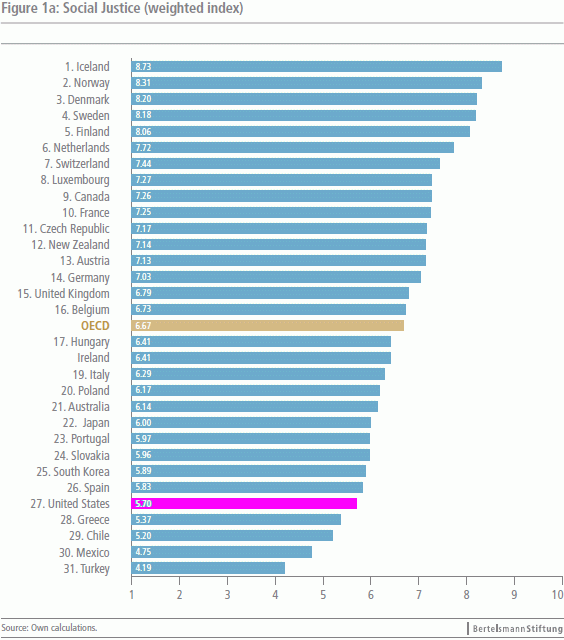
But less attention has been paid to the fact that not only are the numbers bad in America, they’re particularly bad when compared to other developed nations.

A new report (.pdf) by the Bertelsmann Foundation drives this point home. The German think tank used a set of policy analyses to create a Social Justice Index of 31 developed nations in the Organisation for Economic Co-operation and Development (OECD). The United States came in a dismal 27th in the rankings.

Facebooktwittermail

Bank of America’s death rattle

Bill Black writes: Bob Ivry, Hugh Son and Christine Harper have written an article that needs to be read by everyone interested in the financial crisis. The article (available here) is entitled: BofA Said to Split Regulators Over Moving Merrill Derivatives to Bank Unit. The thrust of their story is that Bank of America’s holding company, BAC, has directed the transfer of a large number of troubled financial derivatives from its Merrill Lynch subsidiary to the federally insured bank Bank of America (BofA). The story reports that the Federal Reserve supported the transfer and the Federal Deposit Insurance Corporation (FDIC) opposed it. Yves Smith of Naked Capitalism has written an appropriately blistering attack on this outrageous action, which puts the public at substantially increased risk of loss.

I write to add some context, point out additional areas of inappropriate actions, and add a regulatory perspective gained from dealing with analogous efforts by holding companies to foist dangerous affiliate transactions on insured depositories. I’ll begin by adding some historical context to explain how B of A got into this maze of affiliate conflicts. [Continue reading…]

Facebooktwittermail

U.S. drone kills 28 in south Somalia

Another attack by a US assassination drone has claimed the lives of at least 28 civilians, while injuring dozens of others in southern Somalia, Press TV reports.

The incident took place in the town of Gilib, 350 kilometers south of Mogadishu, a Press TV correspondent reported on Sunday.

The Washington Post reported on Thursday: The Air Force has been secretly flying Reaper drones on counterterrorism missions from a remote civilian airport in southern Ethi­o­pia as part of a rapidly expanding U.S.-led proxy war against an al-Qaeda affiliate in East Africa, U.S. military officials said.

The Air Force has invested millions of dollars to upgrade an airfield in Arba Minch, Ethi­o­pia, where it has built a small annex to house a fleet of drones that can be equipped with Hellfire missiles and satellite-guided bombs. The Reapers began flying missions earlier this year over neighboring Somalia, where the United States and its allies in the region have been targeting al-Shabab, a militant Islamist group connected to al-Qaeda.

On Friday, the Pentagon said the drones are unarmed and have been used only for surveillance and collecting intelligence, though it would not rule out the possibility that they would be used to launch lethal strikes in the future.

Mindful of the 1993 “Black Hawk Down” debacle in which two U.S. military helicopters were shot down in the Somali capital of Mogadishu and 18 Americans killed, the Obama administration has sought to avoid deploying troops to the country.

As a result, the United States has relied on lethal drone attacks, a burgeoning CIA presence in Mogadishu and small-scale missions carried out by U.S. Special Forces. In addition, the United States has increased its funding for and training of African peacekeeping forces in Somalia that fight al-Shabab.

The Washington Post reported last month that the Obama administration is building a constellation of secret drone bases in the Arabian Peninsula and the Horn of Africa, including one site in Ethi­o­pia. The location of the Ethio­pian base and the fact that it became operational this year, however, have not been previously disclosed. Some bases in the region also have been used to carry out operations against the al-Qaeda affiliate in Yemen.

Facebooktwittermail

Prominent Egyptian blogger in military detention

Al-Masry Al-Youm reports: Alaa Abd El Fattah, a prominent blogger and activist, will be held for 15 days of military interrogation, his lawyer said on Sunday. Meanwhile, Bahaa Saber, another activist and blogger, has been released but is still under investigation.

Abd El Fattah was called into the military prosecution office for questioning regarding his involvement in the clashes between mostly Coptic protesters and the military on 9 October in which 28 people were killed. Abd El Fattah is accused of assaulting military personnel, stealing machine guns that belong to the armed forces, and inciting violence against the military, his lawyer, Ahmed Saif al-Islam said.

Saber was released from detention because the military prosecutors believe he will not attempt to flee. Saber faces charges of inciting violence against the military and assaulting military personnel, but is not accused of stealing weapons, his lawyer, Ramy Ghanem, said. He may still face a military trial.

According to Saif al-Islam, a prominent human rights lawyer who is also Abd El Fattah’s father, his client refused to answer the military’s questions. Saif al-Islam believes Abd El Fattah is being punished for not cooperating.

Abd El Fattah would not cooperate because he believes the military is implicated in the crime of which he is accused, his lawyer said, adding that he believes the military hopes to send a message to other protesters that they should not opt to be uncooperative.

Facebooktwittermail

The murder brigades of Misrata

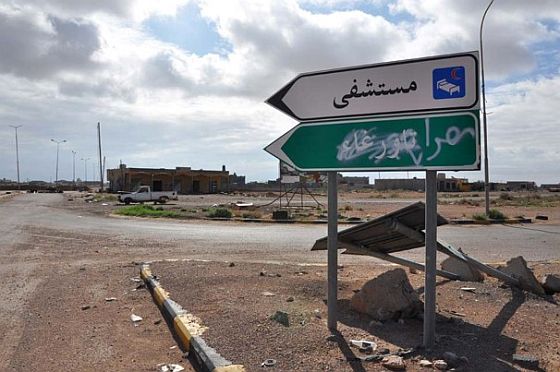
In this Friday, Oct. 28, 2011 photo, a road sign pointing to the town of Tawergha, a former bastion of support for Moammar Gadhafi, has been painted over with “Misrata,” in Arabic, as part of score-settling following Libya’s eight-month civil war. Tawergha’s roughly 25,000 residents have fled, fearing retribution from the neighboring city of Misrata.

Daniel Williams writes: If anyone is surprised by the apparent killing of Moammar Gadhafi while in the custody of militia members from the town of Misrata, they shouldn’t be.

More than 100 militia brigades from Misrata have been operating outside of any official military and civilian command since Tripoli fell in August. Members of these militias have engaged in torture, pursued suspected enemies far and wide, detained them and shot them in detention, Human Rights Watch has found. Members of these brigades have stated that the entire displaced population of one town, Tawergha, which they believe largely supported Gadhafi avidly, cannot return home.

As the war in Libya comes to an end, the pressing need for accountability and reconciliation is clear. The actions of the Misrata brigades are a gauge of how difficult that will be, and Misrata is not alone in its call for vengeance. In the far west, anti-Gadhafi militias from the Nafusa Mountains have looted and burned homes and schools of tribes that supported the deposed dictator. Anti-Gadhafi militias from Zuwara have looted property as they demanded compensation for damage they suffered during the war.

The apparent execution of 53 pro-Gadhafi supporters in a hotel in Sirte apparently under control of Misrata fighters is a bad omen. It is up to the National Transitional Council to rein in all the militias and quickly establish a functioning justice system. The NTC should take control of the many makeshift detention facilities, expedite the return of displaced Libyans, and ensure the investigation, trial and punishment of wrongdoers acting in the name of vengeance. That includes Gadhafi’s killers if the evidence showed crimes were committed. The NTC, and its foreign backers, have comprehensively failed to start setting up a justice system — even in Benghazi, where they have been in charge since the spring.

Clearly the NTC is up against the passions of a nasty war. Misrata withstood a two-month siege at the hands of Gadhafi’s forces with near-daily indiscriminate attacks that killed about 1,000 of its citizens. The town’s main boulevard, Tripoli Street, is in ruins. Facades of public buildings and private homes collapsed from tank fire and are charred inside and out. The pockmarks of bullet holes disfigure construction everywhere.

The fierce fight for Misrata has left a penetrating bitter aftertaste. Misratans say they detest anyone who backed Gadhafi. They are not welcome in Misrata, even if the city and its environs was their home for generations.

The Misrata militia is focusing its greatest wrath on Tawergha, a town of about 30,000 people just south of the city. Both Misratans and Tawerghas say residents there were enthusiastic Gadhafi supporters. Hundreds of erstwhile civilians in that town took up arms to fight for him. Misratans say Tawergha volunteers committed rapes and pillaged with gusto, though Misrata officials decline to produce evidence of the alleged rapes, saying family shame inhibits witnesses and victims from coming forward.

In any event, Misratan militia members are venting their anger on all Tawerghas, who are largely descendants of African slaves. Most fled their town as Misratan fighters advanced there between Aug. 10 and Aug. 12.

Witnesses and victims we interviewed provided credible accounts of Misratan militias shooting and wounding unarmed Tawerghas and torturing detainees, in a few cases to death. In Hun, about 250 miles south of Misrata, militias from Benghazi have taken it upon themselves to protect about 4,000 refugees. They say Misratans are hunting down Tawerghas.

One hospitalized Tawergha told Human Rights Watch how he was shot in the side and leg and abandoned to die near Hun: “They left us at the edge of the road, put a blanket over us and then started swearing, ‘You are dogs, hope you die.’”

Misrata militias, with the momentary compliance of local officials, insist that no Tawerghas should return to the area. Ibrahim Yusuf bin Ghashir, a representative of the NTC, said: “We think it would be better to relocate them somewhere else.” The allegations of rape, he added, “cannot be forgiven and it would be better to resettle them far away.”

This unforgiving campaign is not limited to Tawerghas. Many Misratans say that any tribe or group that supported Gadhafi — thousands of people — should not return to the city. The graffiti on tumble-down town walls express Misratans’ view: “(Expletive) No returnees.”

Human Rights Watch has interviewed refugees from Misrata who tried to return and were forbidden to enter the city without a permit from the local council. A Misrata militia member told the media that all pro-Gadhafi travelers are barred from the city.

As painful as the losses have been for Misrata and the rest of Libya, everyone who fought Gadhafi should remember what they were fighting for: an end to torture, to arbitrary detention, to pitting one tribe against another; for respect and equality among neighbors. Otherwise, the agony that preceded victory will breed vengeance, rancor and a divided new Libya — one that in disturbing ways may resemble the old.

Daniel Williams is a Senior Researcher at Human Rights Watch

The Associated Press reports: For the past two months, Tawergha has been a ghost town, with access roads blocked by earthen mounds and other obstacles. Road signs pointing to Tawergha have been painted over. Misrata brigades have scribbled slogans on the walls of abandoned homes.

“The Tawergha are the rats of Gadhafi,” read graffiti on one facade, using Gadhafi’s derogatory name for his opponents. The fallen regime had tried to ensure Tawergha’s loyalty with promises of jobs and investment, and while some of the homes there were ramshackle, the town also boasted a modern school, medical clinic and rows of new apartment buildings.

A tour of Tawergha on Friday showed widespread vandalism. The school, clinic, small shops and modern apartments had been ransacked, with some rooms burned and contents of closets strewn on the ground.

Human Rights Watch said its team saw militias and individuals from Misrata set 12 homes on fire during a three-day period in early October. On Oct. 25, the team saw trucks drive out of Tawergha with furniture and carpets that had apparently been looted, and that Misrata fighters who claimed to be guarding the town did not intervene.

Two Misrata fighters driving through Tawergha on Friday said the town’s residents are no longer welcome. “They will have to find a different place and build houses there,” said 22-year-old Naji Akhlaf, standing outside a small grocery that had been largely emptied out, with cartons of juice strewn across the entrance.

“This is the best solution so we can relax and get on with our lives,” he said.

Tawerghans also lived in other parts of Libya, including in Misrata where a rundown apartment complex that once housed hundreds of them is to be razed. City officials say the complex is also home to non-Tawerghans and is being torn down because it’s unsanitary and unsafe. Tawerghans have fled those apartments and their neighbors said they won’t allow them back.

Human Rights Watch, citing interviews with dozens of Tawerghans, said they gave credible accounts of arbitrary arrests and beatings of detainees by Misrata militias, including descriptions of two deaths in custody.

About 10,000 Tawerghans have reached two camps on the outskirts of the eastern city of Benghazi, until recently the seat of the National Transitional Council, and U.N. officials say that number is growing. Thousands more have sought refuge near Tripoli, Tarhouna and in remote areas of the south.

An NTC-funded aid group, LibAid, is providing food and other supplies to some of the displaced, said Mohammed el-Sweii, an official in the group. El-Sweii said guards have been stationed at the camps to prevent acts of revenge.

Facebooktwittermail

The American way of bombing?

At Open Democracy, Derek Gregory writes: The problems with remote-controlled warfare are legion. The human operator ‘is terribly remote from the consequences of his actions; he is likely to be sitting in an air-conditioned trailer, hundreds of miles from the area of battle.’ He evaluates ‘target signatures’ captured by various sensor systems that ‘no more represent human beings than the tokens in a board-type war game.’

The rise of this new ‘American way of bombing’, as it’s been called, has two particularly serious consequences. First, ‘through its isolation of the military actor from his target, automated warfare diminishes the inhibitions that could formerly be expected on the individual level in the exercise of warfare’. In short, killing is made casual. Secondly, once the risk of combat is transferred to the target, it becomes much easier for the state to go to war. Domestic audiences are disengaged from the violence waged in their name: ‘Remote-controlled warfare reduces the need for the public to confront the consequences of military action abroad.’

All familiar stuff, you might think, except that these warnings were not prompted by the appearance of Predators and Reapers in the skies over Afghanistan, Pakistan, Somalia or Yemen. They appeared in Harper’s Magazine in June 1972, the condensed results of a study of the US air war in Indochina by a group of scholar-activists at Cornell University. As they suggest, crucial elements of today’s ‘drone wars’ were assembled during the US bombing of Vietnam, Laos and Cambodia. There were three of them: drones, real-time visual reconnaissance, and the electronic battlefield.

The US fought multiple air wars in Indochina. The air strikes against North Vietnam involved what is now called deliberate targeting, in which targets are identified and assigned to aircrews before take off. To the US military the first series of attacks from 1965 to 1968 (code-named ‘Rolling Thunder’) was an interdiction campaign to close lines of communication and choke off the supply of men and materials from the North to the insurgency in the South. To President Johnson and his civilian advisers, however, its purpose was to open up a different line of communication: bombing was a way of ‘sending a message’ to Hanoi, designed to coerce the North through a ‘diplomatic orchestration of signals and incentives, of carrots and sticks, of the velvet glove of diplomacy backed by the mailed fist of air power.’ From either perspective the campaign had to be carefully controlled and calibrated, but the air intelligence was of variable quality. Starting in October 1964 the US Air Force sought to improve the situation by using reconnaissance drones, which were launched from C-130A transport aircraft on programmed flight paths over target areas in North Vietnam (and Laos) and then recovered off Da Nang.
Facebooktwittermail

In rubble-strewn Sitra, faces of the young foretell a grim future for Bahrain

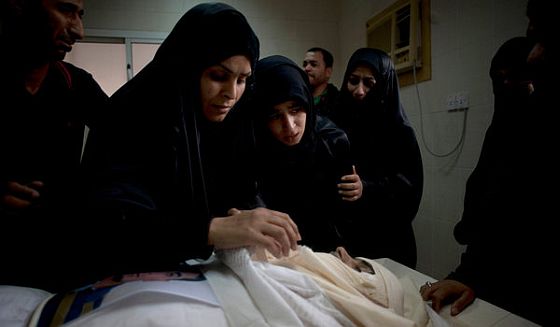
Family members in Sitra in March mourned a 30-year-old man killed by security forces. Government officials are suggesting the crisis in Bahrain has ended. No one in Sitra seems to agree.

Reporting from Sitra in Bahrain, Anthony Shadid writes: Sometimes a name suggests a condition. There was Beirut a generation ago, Baghdad more recently. In Bahrain, a Persian Gulf state so polarized that truth itself is a matter of interpretation, it is Sitra. Here, the faces of young men foretell a future for the country that looks like the rubble-strewn and violent streets of this town.

On a recent night, after clashes that erupt almost daily, one of them entered the house of a relative, squinting as though he had stumbled from a dungeon into the sun. Tear gas. His friend smirked as he showed the smooth scars left by rubber bullets fired at his leg and chest. Another shrugged as he removed his shirt to reveal a back scarred by pellets.

“Sitra,” said the friend, Sanad, “is the crisis.”

When the protests erupted in Bahrain in February, activists cast them as part of the Arab revolts, the wave of tumult that has upended an old order from Tunisia to Syria this year. That was before Saudi Arabia intervened militarily, before a crackdown ensued on the Shiite Muslim majority that was so sweeping they compared it to apartheid, before the most hard-line elements in the Sunni Muslim ruling family became ascendant.

Government officials today suggest that the crisis has ended, even as they acknowledge the damage it wrought in relations between Sunnis and Shiites in a country that had managed relative openness and even cosmopolitanism despite its entrenched inequality. “An open wound,” said Sheik Abdel-Aziz bin Mubarak al-Khalifa, a senior government counselor. But, he added, “We are in a much better place than we were three months ago.”

No one in Sitra seems to agree. This Shiite town of 80,000, a once-bucolic village of fishing and farming turned into a tableau of urban distress, is so restive that even opposition leaders shake their heads at its defiance. Nearly a third of the protesters killed — 10 so far — have come from Sitra, a half-hour drive from the capital, Manama, seething in a caldron of politicization, hardship and repression.

Though the clashes are nothing new — the 1990s witnessed similar bouts — their persistence and breadth signal the intractability of Bahrain’s conflict and mirror the unrest between the police and youths in other neglected Shiite towns.

“Sitra is a miniature version of Bahrain,” said Muhammad, another youth here, who like others interviewed did not want to be identified by his full name.

Added Sanad, his friend: “We are still here, we are demanding, and we exist.”

In scenes redolent of Hama in Syria, or parts of Tahrir Square at the height of Egypt’s uprising, youths build barricades at night to keep out the hated police, then remove some of them in the morning. There are telephone poles and cinder blocks and living room chairs and large trash bins, overturned and disgorging their soggy contents. The police have taken to foot patrols, given the difficulty of navigating the streets. Youths stand on corners, passing their own intelligence by cellphone, Twitter and Skype.

Even the fortresslike walls around the local police station are awash in graffiti, despite their ritual whitewashing. The slogans that remain bear the youths’ messages, revealed by the headlights of the occasional car driving on dark and empty streets. “Down with Hamad,” one reads, in a message to King Hamad bin Isa al-Khalifa. “We will only kneel before God,” declares another. Nearby, a slogan in red says, “The movement continues.”

Facebooktwittermail

Rebels claim Gaddafi was tied to plot against Iraq

The New York Times reports: When Tripoli, the Libyan capital, fell, rebel fighters found secret intelligence documents linking Col. Muammar el-Qaddafi to a plot by former members of Saddam Hussein’s military and Baath Party to overthrow the Iraqi government, according to an Iraqi official who spoke on the condition of anonymity.

The details of the plot were revealed to Iraq’s prime minister, Nuri Kamal al-Maliki, this month in a surprise visit to Baghdad by Libya’s interim leader, Mahmoud Jibril, said the official, who demanded anonymity because the matter was supposed to be confidential. This week, Iraqi security forces responded, arresting more than 200 suspects in connection with the plot.

The looted ruins of Colonel Qaddafi’s intelligence headquarters in Tripoli have revealed many secrets. The trove has uncovered ties between the Libyan strongman and the C.I.A. and shed light on negotiations between Chinese arms dealers and Libyan officials during the course of the uprising, an embarrassment to officials in Beijing.

But here in Iraq, the records of Colonel Qaddafi’s plot had special resonance. The Iraqi news media celebrated Colonel Qaddafi’s death last week. But the news that the colonel may have been backing a Baathist-led coup added another layer of intrigue just as Iraq was digesting the weekend news that President Obama had announced that the last American soldier would leave by the end of the year. Some suggested that it was a fiction spread only to allow for the arrests of Sunnis, a reflection of the fragile sectarian tensions.

“The people that were arrested do not deserve this, because many of them were old,” said Hamid al-Mutlaq, a member of Parliament’s security committee from the Iraqiya bloc, which is largely Sunni. “The timing for this is bad because the U.S. forces are about to leave, and we should focus on national reconciliation.”

On state television, Hussein Kamal, Iraq’s deputy interior minister, said the plot included agitators spread throughout the country’s south and just north of Baghdad, and had been planning “terrorist operations and sabotage” after the withdrawal of the United States military.

Facebooktwittermail

Wall Street isn’t winning — it’s cheating

Matt Taibbi writes: I was at an event on the Upper East Side last Friday night when I got to talking with a salesman in the media business. The subject turned to Zucotti Park and Occupy Wall Street, and he was chuckling about something he’d heard on the news.

“I hear [Occupy Wall Street] has a CFO,” he said. “I think that’s funny.”

“Okay, I’ll bite,” I said. “Why is that funny?”

“Well, I heard they’re trying to decide what bank to put their money in,” he said, munching on hors d’oeuvres. “It’s just kind of ironic.”

Oh, Christ, I thought. He’s saying the protesters are hypocrites because they’re using banks. I sighed.

“Listen,” I said, “where else are you going to put three hundred thousand dollars? A shopping bag?”

“Well,” he said, “it’s just, their protests are all about… You know…”

“Dude,” I said. “These people aren’t protesting money. They’re not protesting banking. They’re protesting corruption on Wall Street.”

“Whatever,” he said, shrugging.

These nutty criticisms of the protests are spreading like cancer. Earlier that same day, I’d taped a TV segment on CNN with Will Cain from the National Review, and we got into an argument on the air. Cain and I agreed about a lot of the problems on Wall Street, but when it came to the protesters, we disagreed on one big thing.

Cain said he believed that the protesters are driven by envy of the rich.

“I find the one thing [the protesters] have in common revolves around the human emotions of envy and entitlement,” he said. “What you have is more than what I have, and I’m not happy with my situation.”

Cain seems like a nice enough guy, but I nearly blew my stack when I heard this. When you take into consideration all the theft and fraud and market manipulation and other evil shit Wall Street bankers have been guilty of in the last ten-fifteen years, you have to have balls like church bells to trot out a propaganda line that says the protesters are just jealous of their hard-earned money.

Think about it: there have always been rich and poor people in America, so if this is about jealousy, why the protests now? The idea that masses of people suddenly discovered a deep-seated animus/envy toward the rich – after keeping it strategically hidden for decades – is crazy.

Where was all that class hatred in the Reagan years, when openly dumping on the poor became fashionable? Where was it in the last two decades, when unions disappeared and CEO pay relative to median incomes started to triple and quadruple?

The answer is, it was never there. If anything, just the opposite has been true. Americans for the most part love the rich, even the obnoxious rich. And in recent years, the harder things got, the more we’ve obsessed over the wealth dream. As unemployment skyrocketed, people tuned in in droves to gawk at Evrémonde-heiresses like Paris Hilton, or watch bullies like Donald Trump fire people on TV.

Moreover, the worse the economy got, the more being a millionaire or a billionaire somehow became a qualification for high office, as people flocked to voting booths to support politicians with names like Bloomberg and Rockefeller and Corzine, names that to voters symbolized success and expertise at a time when few people seemed to have answers. At last count, there were 245 millionaires in congress, including 66 in the Senate.

And we hate the rich? Come on. Success is the national religion, and almost everyone is a believer. Americans love winners. But that’s just the problem. These guys on Wall Street are not winning – they’re cheating. And as much as we love the self-made success story, we hate the cheater that much more.

Facebooktwittermail

After violence in Occupy Oakland, remembering FDR’s engagement with another occupation

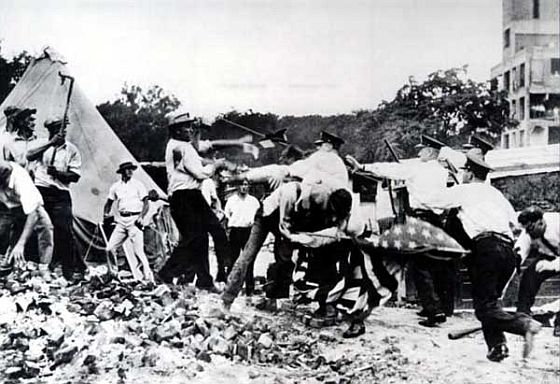
Bonus Army marchers confront the police, Washington DC, July 28, 1932.

David Woolner writes: The violence that broke out in Oakland earlier this week and the wounding of Scott Olsen, a Marine veteran, recalls a similar “occupy movement” involving veterans that took place in Washington at the onset of the Great Depression.

In 1932, thousands of unemployed World War I veterans, desperate from lack of work, converged on Washington, mostly by riding the rails, in support of a bill that would have allowed them to receive immediate cash payment of the war service “bonus” they were due in 1945. The veterans called themselves the “Bonus Army” or “Bonus Expeditionary Force.” By the end of May of that year, more than 20,000 had occupied a series of abandoned buildings near the Washington Mall and a sprawling shantytown they built on the Anacostia Flats not far from the Capitol. On June 15, 1932, the House of Representatives passed a bill in favor of the veteran payments, but as both President Hoover and a majority in the Senate opposed it, the “Bonus bill” went down to defeat two days later.

In the wake of this defeat, roughly 15,000 members of the Bonus Army decided that they would continue their occupation as a protest against the government’s decision. By late July, President Hoover decided it was time to clear the city of the protesters, using four troops of cavalry under the command of General Douglas MacArthur. Late in the afternoon of July 28, General MacArthur’s troops — with sabers drawn — cleared the buildings near the Mall. They then fired tear gas among the men, women, and children encamped in Anacostia (many veterans were accompanied by their families); stormed the area on horseback, driving them out; and intentionally burned the shantytown to the ground in the process. More than 1,000 people were injured in the incident and two veterans and one child died.

In attacking the shantytown, MacArthur had exceeded his orders, which were simply to clear the buildings and surround the camp so as to contain it. But this meant little to the public, who were outraged at the treatment the veterans had received at the hands of the government and furious at Hoover for ordering the operation. Hoover, nevertheless, remained publically unrepentant and refused to apologize to the veterans — moves that contributed greatly to his massive loss to Franklin Roosevelt a few months later.

Facebooktwittermail

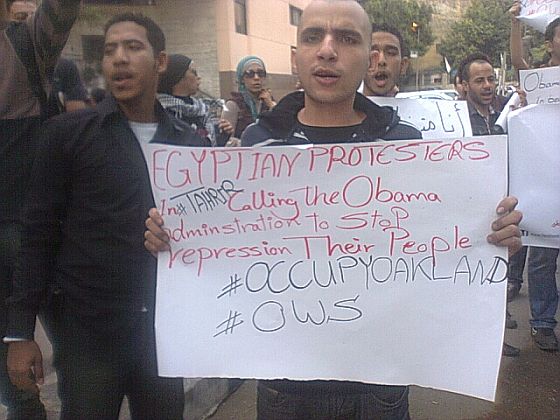
Egyptian protesters’ message to Obama: Stop repression of your own people

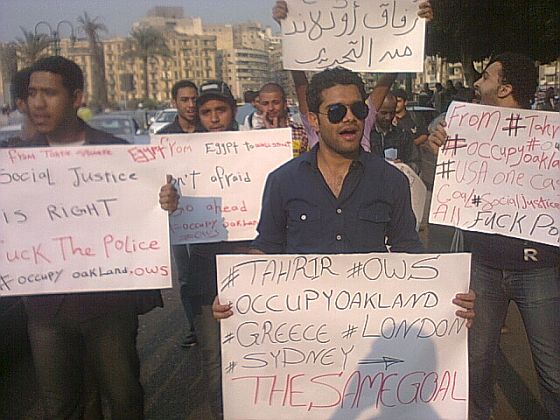
Xeni Jardin writes: As they vowed earlier this week to do, Egyptian pro-democracy protesters marched from Tahrir square to the U.S. Embassy today to march in support of Occupy Oakland—and against the type of police brutality witnessed in Oakland on Tuesday night, and commonly experienced in Egypt.

In this post, photos from Egyptian blogger Mohammed Maree, who is there at the march live-tweeting these snapshots. He is a journalist with Egytimes.org, a human rights activist, and a veterinarian; all photos are his.


Meanwhile, the New York Times reports on questions being raised about the violent tactics used by police in Oakland where the weapons being used are the same as those used lethally by Israeli soldiers against non-violent Palestinian protesters in the West Bank and by Egyptian security services against non-violent Egyptian protesters in Tahrir Square.


Two days after an Iraq war veteran suffered a serious head wound at a protest in Oakland, Calif., questions are being asked about the way police officers tried to disperse Occupy Oakland protesters with tear gas and other “less-lethal” munitions.

The condition of the wounded veteran, Scott Olsen, was upgraded to fair from critical at Highland Hospital in Oakland on Thursday The San Francisco Chronicle reported. On Friday morning, Mr. Olsen’s roommate, Keith Shannon, who served with him in the Marines, told CNN that doctors expect him to make a full recovery, although he is still unable to speak and still has some trouble writing.

Oakland’s mayor, Jean Quan, visited Mr. Olsen in the hospital to apologize for his injuries and promised an investigation, a hospital spokesman told The Chronicle. The mayor also tried to address protesters near City Hall late Thursday night but was “greeted with cries of ‘Go home!’ and ‘Citizen’s Arrest,’” The Bay Citizen, a local news site, reported.

Another spokesman told reporters that Mr. Olsen “responded with a very large smile” to a visit from his parents on Thursday.

As The Lede reported on Wednesday, Mr. Olsen is a 24-year-old former Marine and a member of two veterans peace groups. He works at a San Francisco software firm.

Video uploaded to YouTube on Thursday appeared to show that Mr. Olsen was standing peacefully in front on police lines just before he was struck in the head. This edit of clips from various sources by a video blogger named Raleigh Latham shows Mr. Olsen standing still as projectiles were fired into the crowd of protesters on Tuesday night:

Facebooktwittermail

Egyptian anger grows after latest case of death by torture

The Guardian reports: Egyptian officials have tortured a 24-year-old prisoner to death, provoking accusations that the increasingly unpopular junta is failing to dismantle Hosni Mubarak’s brutal security apparatus.

Essam Ali Atta, a civilian serving a two-year jail term in Cairo’s high-security Tora prison following his conviction in a military tribunal earlier this year for an apparently “common crime”, was reportedly attacked by prison guards after trying to smuggle a mobile phone sim card into his cell.

According to statements from other prisoners who witnessed the assault, Atta had large water hoses repeatedly forced into his mouth and anus on more than one occasion, causing severe internal bleeding. An officer then transferred Atta to a central Cairo hospital, but he died within an hour.

The death occurred less than 24 hours after two police officers in Alexandria were each sentenced to seven years in jail for their part in the murder of Khaled Said, a young businessman beaten to death by security forces in broad daylight last year. That incident led to the creation of the Facebook group “We are all Khaled Said” and helped mobilise a wave of protests which eventually toppled Mubarak in February.

On Friday, a new Facebook page entitled We are all Essam Atta appeared online, and quickly attracted thousands of supporters. Activists and human rights campaigners flocked to social media sites to express their fury at Egypt’s ruling generals, whom many now view as indistinguishable from the Mubarak regime they replaced.

Facebooktwittermail